INTRODUCTION
Disinhibition is a prominent symptom in frontotemporal lobe degeneration (FTLD), together with personality change, lack of insight, stereotypy, and later apathy, as well as progressive aphasia (Gustafson, Brun, & Passant, Reference Gustafson, Brun and Passant1992). There is increasing evidence for clinical and pathological overlap between several degenerative dementing disorders affecting the frontal and temporal lobes, the frontotemporal dementias (FTD, Woollacott & Rohrer, Reference Woollacott and Rohrer2016). Disinhibition is a more or less prominent feature in these syndromes: behavioral (or frontal) variant frontotemporal dementia (bvFTD); the primary progressive aphasias including the semantic variant (here denoted semantic dementia, SD) and the non-fluent variant; progressive supranuclear palsy (PSP), FTD with motor neuron disease, and corticobasal degeneration syndrome. Behavioral disinhibition can be manifested in various ways, such as social inappropriate comments and behavior, utilization behavior, as well as in difficulty inhibiting an ongoing activity as shown in the applause sign (Dubois et al., Reference Dubois, Slachevsky, Pillon, Beato, Villalponda and Litvan2005). Inhibition is considered one of three central aspects of executive functions (Miyake et al., Reference Miyake, Friedman, Emerson, Witzki, Howerter and Wager2000); however, there are several theoretical models of executive functions (Chan, Shum, Toulopoulou, & Chen, Reference Chan, Shum, Toulopoulou and Chen2008), the supervisory system being of special relevance for this study (Shallice & Burgess, Reference Shallice and Burgess1998).
Early diagnosis of FTD is a challenge, and the time from symptom onset to correct diagnosis varied between 1 and 15 years (median = 4 years) in a neuropathological verified sample (Landqvist Waldo, Gustafson, Passant, & Englund, Reference Landqvist Waldo, Gustafson, Passant and Englund2015). The clinical assessment requires a multi-professional team and neuropsychological assessment is an important part of the diagnostic procedure (Neary et al., Reference Neary, Snowden, Gustafson, Passant, Stuss, Black and Benson1998; Rascovsky et al., Reference Rascovsky, Hodges, Knopman, Mendez, Kramer, Neuhaus and Miller2011) as well as characterization of disease progress. In a series of 137 cases, Rascovsky and coworkers (2011) identified that 86% of neuropathologically verified bvFTD cases met the criteria for possible bvFTD with three of the six clinically discriminating features present: disinhibition, apathy/inertia, loss of sympathy/empathy, perseverative/compulsive behaviors, hyperorality, and dysexecutive neuropsychological profile.
The neuropsychological profile of bvFTD is defined as “executive/generation deficits with relative sparing of memory and visuospatial functions” (Rascovsky et al., Reference Rascovsky, Hodges, Knopman, Mendez, Kramer, Neuhaus and Miller2011, p. 2460) and was present in approximately 60% of the cases. The criteria for probable bvFTD, which requires imaging evidence of atrophy or hypoperfusion/hypometabolism in frontotemporal regions, was met by 76%. Vijverberg and colleagues (Reference Vijverberg, Dols, Krudop, Peters, Kerssens, van Berckel and Pijnenburg2016) found that the sensitivity of the neuropsychological profile in identifying bvFTD was 40%, whereas the specificity was 79% in a clinical cohort presenting with a frontal lobe syndrome.
Cognitive impairment is a prominent feature also in PSP (Hoglinger et al., Reference Hoglinger, Respondek, Stamelou, Kurz, Josephs and Lang2017). A neuropsychological assessment is also normally required to differentiate between the progressive aphasias (Gorno-Tempini et al., Reference Gorno-Tempini, Hillis, Weintraub, Kertesz, Mendez, Cappa and Grossman2011; Neary et al., Reference Neary, Snowden, Gustafson, Passant, Stuss, Black and Benson1998). Hence, the neuropsychological assessment arsenal needs to be enlarged as well as adapted to Swedish patients to improve early and differential diagnosis.
The Hayling Sentence Completion Test (Hayling test) assesses the executive functions of response initiation and response suppression (Burgess & Shallice, Reference Burgess and Shallice1996). In the first section of the test, the subject is asked to quickly complete sentences correctly with one word to measure response initiation. In the second section, the task is to complete sentences with an unconnected word, measuring response inhibition. The tasks tap different processes according to the model of the supervisory system (Shallice & Burgess, Reference Shallice and Burgess1998). Response initiation is related to the contention scheduling system, whereas the inhibition of a prepotent response requires that a temporary schema or new strategy come into operation.
The Hayling test has been translated to several other languages: three versions in French (Belleville, Rouleau, & Van der Linden, Reference Belleville, Rouleau and Van der Linden2006; Borella, Ludwig, Fagot, & De Ribaupierre, Reference Borella, Ludwig, Fagot and De Ribaupierre2011; Collette et al., Reference Collette, Van der Linden, Delfiore, Degueldre, Luxen and Salmon2001), Portuguese (Siqueira, Goncalves, Hubner, & Fonseca, Reference Siqueira, Goncalves, Hubner and Fonseca2016), Spanish (Perez-Perez et al., Reference Perez-Perez, Matias-Guiu, Caceres-Guillen, Rognoni, Valles-Salgado, Fernandez-Matarrubia and Matias-Guiu2016), and German (Jantscher, Willinger, Schmöger, Müller, & Auff, Reference Jantscher, Willinger, Schmöger, Müller and Auff2011), as well as recently another Swedish version (Stenback, Hallgren, Lyxell, & Larsby, Reference Stenback, Hallgren, Lyxell and Larsby2015). However, presentations of psychometric data are scarce with the Spanish version being a shining exception with internal consistency and inter-rater reliability reported (Perez-Perez et al., Reference Perez-Perez, Matias-Guiu, Caceres-Guillen, Rognoni, Valles-Salgado, Fernandez-Matarrubia and Matias-Guiu2016).
The Swedish version published by Stenback and colleagues (Reference Stenback, Hallgren, Lyxell and Larsby2015) do not present psychometric data, nor how the performances relate to demographic variables. The Hayling test has earlier been shown to detect impairment in several neurodegenerative disorders: Alzheimer’s disease (AD), bvFTD, PSP, Parkinson’s disease, and Lewy body dementia (Ghosh, Carpenter, & Rowe, Reference Ghosh, Carpenter and Rowe2013; Hornberger et al., Reference Hornberger, Savage, Hsieh, Mioshi, Piguet and Hodges2010; Johns et al., Reference Johns, Phillips, Belleville, Goupil, Babins, Kelner and Chertkow2009; O’Callaghan, Naismith, Hodges, Lewis, & Hornberger, Reference O’Callaghan, Naismith, Hodges, Lewis and Hornberger2013). In addition, the Hayling test could discriminate bvFTD patients from patients with AD (Hornberger et al., Reference Hornberger, Savage, Hsieh, Mioshi, Piguet and Hodges2010; Lough et al., Reference Lough, Kipps, Treise, Watson, Blair and Hodges2006; O’Callaghan et al., Reference O’Callaghan, Naismith, Hodges, Lewis and Hornberger2013), Parkinson’s disease (O’Callaghan et al., Reference O’Callaghan, Naismith, Hodges, Lewis and Hornberger2013), as well as between bvFTD progressors and non-progressors (Hornberger, Piguet, Kipps, & Hodges, Reference Hornberger, Piguet, Kipps and Hodges2008), most frequently by examining the response inhibition ability.
Furthermore, the Hayling test has detected impairment in several conditions other than neurodegenerative conditions, such as schizophrenia, bipolar disorder, and autism spectrum disorder (Chan, Chen, Cheung, & Cheung, Reference Chan, Chen, Cheung and Cheung2004; Cotrena et al., Reference Cotrena, Damiani Branco, Ponsoni, Milman Shansis, Kochhann and Paz Fonseca2017; Spitzer, White, Mandy, & Burgess, Reference Spitzer, White, Mandy and Burgess2017). Several studies have thus examined the use of the Hayling test in patients with bvFTD, whereas studies of the other FTD syndromes, including direct comparison of the different syndromes, are rare.
There are a few studies regarding the neural correlates of the Hayling test. Hornberger, Geng, and Hodges (Reference Hornberger, Geng and Hodges2011) found that the error score, considered a measure of response inhibition, covaried with atrophy in the orbitofrontal/subgenual, medial prefrontal and anterior temporal lobe areas. Furthermore, it covaried with the integrity of several white matter tracts, especially the uncinate fasciculus, the forceps major as well as genu of the corpus callosum in bvFTD and AD patients. Another study found that the error score was related to a distributed pattern of fronto-striatal atrophy in bvFTD whereas in Parkinson’s disease it was related to medial and right lateral orbitofrontal, insular and inferior frontal cortex (O’Callaghan et al., Reference O’Callaghan, Naismith, Hodges, Lewis and Hornberger2013). We have recently shown that in a mixed group of PSP and bvFTD-patients, the Hayling test error score correlated with cortical thickness in the parahippocampal gyrus, the posterior insula as well as in the orbitofrontal cortex (except the ventromedial prefrontal region) of the right hemisphere (Santillo et al., Reference Santillo, Lundblad, Nilsson, Landqvist Waldo, van Westen, Latt and Nilsson2016). Furthermore, the error score correlated with the integrity of the right uncinate fasciculus, right anterior cingulum, and forceps minor.
To sum up, disinhibition as measured by the Hayling test, has been related to atrophy in orbito and medial prefrontal areas in bvFTD, AD and PSP with some variation in the exact distribution between these different groups. Furthermore, the integrity of uncinate fasciculus and forceps minor has also been related to disinhibition in these three clinical groups. Both the cortical areas and the white matter tracts seem to be more affected in the right hemisphere.
The aim of this study was to assess the psychometric properties of a Swedish version of the Hayling test (HT-S) and its clinical utility in a group of patients with different FTD syndromes. Our hypothesis was that all syndromes would perform worse than the healthy controls (HC). Furthermore, we explored potential differences in the performances of patients with bvFTD, PSP, and SD.
MATERIALS AND METHODS
Participants
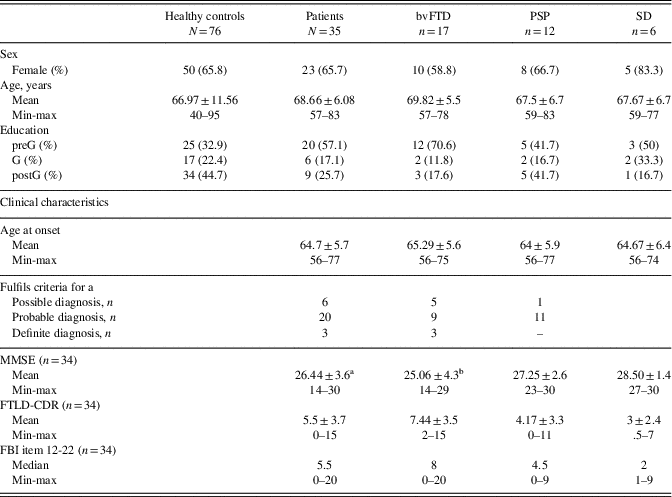
HC were recruited by advertisements in meeting places for senior citizens, in the waiting room at the memory clinic at Lund University Hospital, Sweden, and by personal communication. Inclusion criteria were fluency in the Swedish language and age>40 years. A diagnosis of a psychiatric or neurological disease/condition was exclusion criteria. Seventy-six HC were recruited, see Table 1 for descriptive data of the demographic variables.
Demographic and clinical characteristics

Note:
a Two missing.
b One missing.
bvFTD = behavioral variant frontotemporal dementia; PSP = progressive supranuclear palsy; SD = semantic dementia; G = high school; MMSE = Mini Mental State Examination; FTLD-CDR = frontotemporal lobar degeneration specific Clinical Dementia Rating scale; FBI = Frontal Behavioural Inventory.
Patients participated in the Lund Prospective Frontotemporal Dementia Study (LUPROFS), a longitudinal study at the Memory clinic, Skåne University Hospital in Sweden. Patients with any of the of FTD clinical syndromes or with a high likelihood of a prodromal phase of one of these syndromes (before all criteria were met) were included (Santillo et al., Reference Santillo, Martensson, Lindberg, Nilsson, Manzouri, Landqvist Waldo and Nilsson2013).
The assessments consisted of clinical and neurological examinations executed by a specialized physician within the research group (M.L.W., C.N., or A.S.), caregiver history, magnetic resonance tomography, and cerebrospinal fluid analysis. A comprehensive neuropsychological test-battery assessing the cognitive domains of attention and executive functions, memory and learning, visuospatial ability, and verbal functions was administered to those patients that were assumed to have the capacity to take part in the assessment procedure. Diagnosis was made at a diagnostic conference based on all available data but without knowledge of the results on the HT-S using Frontotemporal Lobe Degeneration Consensus criteria for bvFTD (Rascovsky et al., Reference Rascovsky, Hodges, Knopman, Mendez, Kramer, Neuhaus and Miller2011); NINDS criteria for PSP (Litvan et al., Reference Litvan, Agid, Calne, Campbell, Dubois, Duvoisin and Zee1996); and the Manchester Lund criteria for SD (Neary et al., Reference Neary, Snowden, Gustafson, Passant, Stuss, Black and Benson1998).
Patients with the non-fluent variant primary progressive aphasia were not included in this study due to their impaired speech production. Patients were included if they had completed the HT-S and had a possible, probable or definite diagnosis of bvFTD (n = 17), PSP (n = 12), and SD (n = 6), giving a total of 35 patients. For demographic variables and clinical characteristics, see Table 1. The gender distribution and mean age were comparable between the HC and the patients though the variance in age was broader among the HC. As shown, a larger proportion of HC than patients had a post-graduate level of education and the proportion of patients with a lower level than high school was larger than that of the HC.
All participants gave written consent to participate after written and oral information. The study is approved by the Regional Ethical Review Board in Lund, Sweden (Number 617/2008), and the data included were obtained in compliance with the Helsinki Declaration.
Instruments
The Hayling test mainly intends to measure verbal response inhibition (Burgess & Shallice, Reference Burgess and Shallice1997). In the first section of the test, the subject is asked to quickly complete a sentence correctly with one word, measuring response initiation in seconds (Time section 1). For example: “The rich child attended a private...” where a correct response could be: “school”. In its second section, sentences are to be completed with an unconnected word, measuring efficiency (seconds, Time section 2), and response inhibition (errors, Total Error Score). For example: “London is a very lively...” where banana is an example of a correct response and city is a wrong response. Depending on the overall semantic relatedness of the response to its stimulus sentence, errors are classified as type A Error, a word that completes the sentence in a meaningful way, or as type B Error, a word that could be contradictory, slightly connected to the sentence or a vulgarity.
Each section consists of 15 sentences. The raw scores can be converted into scaled scores according to published normative data ranging from 1 (Impaired) to 10 (Very superior). An Overall scaled score can be derived based on the summary of the three scaled scores. According to the manual, the split half reliability for Time section 1 is 0.35; Time section 2: 0.83; Total Error Score: 0.41 (Burgess & Shallice, Reference Burgess and Shallice1997).
This study examined the psychometric properties of the HT-S and its diagnostic validity/utility. The sentences were translated to Swedish by a neuropsychologist and a speech therapist and slightly changed to fit the Swedish language.
The Color Word Interference Test (CWIT) is intended to measure inhibition of a dominant and automatic verbal response and is part of the Delis-Kaplan Executive Function System (Delis, Kaplan, & Kramer, Reference Delis, Kaplan and Kramer2001). The test is based on the classic procedure developed by Stroop (Reference Stroop1935) and consists of four conditions. The results of the HC on Condition 3 Inhibition (Seconds To Complete and Total Inhibition Errors) were used to examine the construct validity of the HT-S, second section. The raw scores can be converted in to scaled scores ranging from 1–19, M: 10 ± 3.
The Mini Mental State Examination (MMSE) measured global cognition (Folstein, Folstein, & McHugh, Reference Folstein, Folstein and McHugh1975). A higher score (range, 0–30) indicates a better cognitive function and a score below 24 is an indication of a major neurocognitive disorder. The Clinical Dementia Rating scale (CDR) (Hughes, Berg, Danziger, Coben, & Martin, Reference Hughes, Berg, Danziger, Coben and Martin1982) was developed to improve the staging of dementia by rating the function in six cognitive and behavioral categories: Memory, Orientation, Judgement and Problem solving, Community affairs, Home and Hobbies, as well as Personal care. The FTLD-specific CDR (FTLD-CDR) assesses the additional categories of Language and Behavior plus Comportment and Personality which capture key characteristics in FTLD patients. The sum of boxes was used to assess general disease severity since it is found more accurate to capture impairment in FTD syndromes than CDR sum of boxes (Knopman et al., Reference Knopman, Kramer, Boeve, Caselli, Graff-Radford, Mendez and Mercaldo2008). A higher score indicates worse functioning.
The Frontal Behavioural Inventory (FBI) is a rating scale for every day behavior, based on a care-giver interview, and the inventory in its entirety consists of 24 items (Kertesz, Davidson, & Fox, Reference Kertesz, Davidson and Fox1997). Each item is assessed on a scale from 0 to 3 (Not present, Mild/occasional, Moderate, and Severe/most of the time). Here, we present data from item 12-22 (FBI12-22) since they detect disinhibited behavior such as perseverations, excessive jocularity, poor judgement, inappropriateness, impulsivity, and hyperorality (Santillo et al., Reference Santillo, Lundblad, Nilsson, Landqvist Waldo, van Westen, Latt and Nilsson2016).
Statistical Analyses
The Statistical Packages for Social Sciences (SPSS) Version 23 was used. The psychometric properties (reliability scores and construct validity) were assessed using data from the HC. The relations to demographic variables (gender, age, and education) were assessed with t test (equal variances not assumed when relevant), Pearsons r or Spearman r s depending on type of data. The split half reliability was examined using the Spearman Brown coefficient for unequal length, even vs. uneven items. The inter-item reliability for Time section 1 and 2 was calculated using Cronbach’s alpha, and the interrater reliability for the error scores in the second section was examined with intra-class correlation (ρ I ), the two-way mixed model with absolute agreement.
Two persons (one licensed and experienced neuropsychologist and one psychology student, E.B.N.) independently scored the first 45 protocols. The intra-class correlation was examined both on item level and by using mean total error scores. The level of clinical significance was determined according to guidelines in Cicchetti (Reference Cicchetti1994). Validity was examined only for the measures showing sufficient reliability. The construct validity was assessed through convergent validity by analysing the associations between (A) the raw scores (seconds) from Section 2 HT-S and Seconds To Complete from Inhibition CWIT, as well as (B) Error score from Section 2 HT-S and Total Inhibition Errors from Inhibition CWIT. The associations were assessed using the Pearsons r.
The diagnostic validity was examined by comparing the results of the HC and the patients with the independent t test equal variances not assumed. Furthermore, a comparison between all the groups, HC, bvFTD, PSP, and SD, was performed with the non-parametric Kruskal-Wallis test due to small groups and pairwise testing followed using the Mann-Whitney U test.
Effect sizes are reported using Cohen’s d (d) and eta square (ŋ2), respectively.
RESULTS
Relation of HT-S to Demographic Variables
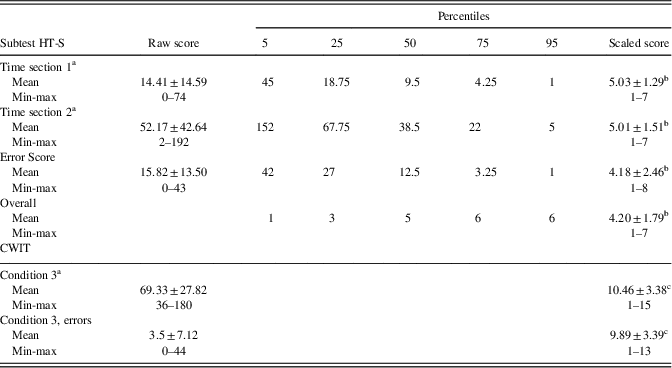
The results of the HC on the HT-S is presented in Table 2 together with the results on CWIT. The raw scores were transformed into scaled scores in accordance with the norms in the manuals to elucidate the performances of these Swedish controls in comparison with the performances of the original normative groups. As shown, the mean scaled scores are within the average for both HT-S and CWIT but the highest scaled score is not reached for all measures.
Results of the healthy controls (N = 76) on the Hayling test, Swedish version (HT-S), and condition 3 inhibition from the CWIT

a Seconds.
b According to the norms (Burgess & Shallice, Reference Burgess and Shallice1997) ranging from 1 = impaired to 10 = very superior. There are ceiling effects with 7 as the highest possible scaled score on Time section 1 and 8 on Time section 2 and Error Score.
c According to the norms (Delis, Kaplan, & Kramer, Reference Delis, Kaplan and Kramer2001) ranging from 1 to 19 with M = 10 ± 3.
CWIT = Color Word Inhibition Test.
There were no significant differences between males and females on any of the subtests of HT-S; however, there was a tendency that males responded faster on Time section 2 (p = .058). Age showed significant correlations with Time section 1 (r = 0.23; p = .042), Time section 2 (r = 0.45; p <.001) and Error scores (r = 0.46; p <.001) with better performances in younger participants. Level of education showed a significant correlation only with Time section 1 (r s = −0.37; p = .001) with a higher level of education corresponding with better performances.
Reliability
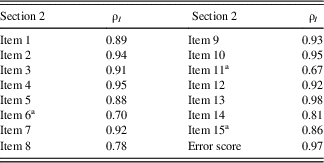
The split half reliability coefficients were as follows: Time section 1: 0.52; Time section 2: 0.85, and Error scores: 0.87. The internal consistency calculated using Cronbach’s alpha for Time section 1 using all 15 items was 0.37. After removing five items the Cronbach’s alpha increased but was still low; 0.6. The Cronbach’s alpha for Time section 2 was 0.81 and for Error scores 0.81 using all 15 items. The inter-rater reliability of error scoring for the 45 first test protocols varied between ρ I = 0.67 (good) and ρ I = 0.98 (excellent) for the individual items and was ρ I = 0.97 (95% CI [0.95–0.98], excellent) for the Error Score (Table 3). Only two items had values ρ I <0.75.
Intra-class coefficients (ρ I ) of the Hayling test, Swedish version, Error Scores of the first 45 protocols

Note. Analysis based on the judgement of two persons on the first 45 protocols in the healthy controls.
a n = 44.
Validity
There was a significant positive correlation (r = 0.24; p = .035) between the HT-S Time Section 2 and Seconds To Complete from Inhibition CWIT. The correlation between the HT-S Section 2 Error Score and Total Inhibition Errors from Inhibition CWIT was moderate and highly significant (r = 0.43; p <.001).
Comparisons between HC and patient groups
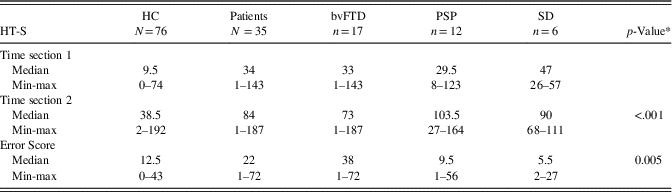
The performances on HT-S of the HC and the patients are presented in Table 4. The comparisons were restricted to Time section 2 and Error score due to the insufficient reliability of Time section 1. The HC had significantly better results than the total patient group on both measures: Time section 2 (52.17 ± 42.64 vs. 88.03 ± 42.33; t = −4.13; p < .001; d = 0.87); Error Score (15.82 ± 13.5 vs.25.2 ± 22.09; t = −2.32; p = .02; d = 0.54).
Results (raw scores) on the Hayling test, Swedish (HT-S) version, including HC and the diagnostic subgroups

Note:
* Result from Kruskal-Wallis test comparing HC, bvFTD, PSP, and SD.
bvFTD = behavioral variant frontotemporal dementia; PSP = progressive supranuclear palsy; SD = semantic dementia; HC = healthy controls.
The four groups (HC, bvFTD, PSP, and SD) differed significantly on both measures (see Table 4). Pairwise testing with the Mann-Whitney U test showed that HC had significantly better performances than bvFTD on Time Section 2 (p = .004, ŋ2 = .09); Error score (p = .001, ŋ2 = .12), and were faster than PSP (p = .004; ŋ2 = .09) and SD (p = .005; ŋ2 = .1) on Time Section 2 whereas there were no significant differences regarding Error scores between HC and PSP or SD. Patients with bvFTD made significantly more errors than both PSP (p = .038; ŋ2 = .16) and SD (p = .013; ŋ2 = .26). The pairwise testing did not reveal any significant differences for Time section 2 between bvFTD and PSP or SD. There were no significant differences between PSP and SD.
DISCUSSION
The aim of this study was to examine the psychometric properties of a Swedish version of the Hayling test as well as its clinical utility in three clinical syndromes within the FTD spectrum. Younger age was consistently and significantly associated with higher performances on all three measures of HT-S. Higher education was associated with a better performance only on Time section 1 (response initiation), whereas there were no association between sex and performance on any of the three measures. Low educational achievement in combination with low performance on intelligence test was, however, found to be associated with both greater variability and worse performance in the original version of the Hayling test, and the authors recommend cautious use of the Hayling test in such cases (Burgess & Shallice, Reference Burgess and Shallice1997).
Our results are in line with data published by Bielak, Mansueti, Strauss, and Dixon (Reference Bielak, Mansueti, Strauss and Dixon2006) based on a sample of 457 healthy individuals. Two French versions of the Hayling test showed a similar pattern only for age on Time section 2 (efficiency) (Andres & Van der Linden, Reference Andres and Van der Linden2000; Belleville et al., Reference Belleville, Rouleau and Van der Linden2006), whereas no difference between young adults (18–35 years) and old adults (60–88 years) were detected on any of the measures on yet another French version (Borella et al., Reference Borella, Ludwig, Fagot and De Ribaupierre2011). Hence, the relation between age and performance on the Hayling test varies between different versions but it could be recommended to take age into consideration when interpreting the results of HT-S. Education seems to be important only in relation to efficiency.
The split half reliability was good for the second section measuring efficiency and response inhibition (Error scores), whereas it was inadequate for response initiation. These values are comparable to the reported split half reliability coefficients in the original test for the Time section 1 and 2 (Burgess & Shallice, Reference Burgess and Shallice1997) but clearly improved in regard to the Error scores (.41 vs. .87). The internal consistency followed a similar pattern with inadequate reliability for Time section 1, but good reliability for Time section 2 and Error scores considering sample size and number of items (Ponterotto & Ruckdeschel, Reference Ponterotto and Ruckdeschel2007). The Error score is dependent on careful judgement whether the answer is correct, meaning that the word added does not at all complete the sentence in a meaningful way, or whether it is a type A or type B error. The guidelines for interpretation of the answers published in the manual were applied after translation into Swedish. The inter-rater reliability for the Swedish version was excellent for response inhibition (Error score), with good to excellent reliability also on item level.
The construct validity of the second section was supported by significant correlations with performances on CWIT Condition 3 regarding efficiency and response inhibition. However, the correlations were weak regarding efficiency and moderate for inhibition indicating that HT-S and CWIT measures partly different aspects of efficiency/tempo and the ability to inhibit a prepotent verbal response. Belleville and co-workers (2006) found that AD patients were more impaired on the Hayling test than on a Stroop task (using the same paradigm as CWIT), which might be interpreted as either the Hayling test being more sensitive or measuring slightly different cognitive processes than the Stroop task. The latter explanation is supported by findings showing a right-sided neural network in the prefrontal cortex related to performances on the Hayling test and a left-sided one related to the Stroop Color-Word test (Cipolotti et al., Reference Cipolotti, Spano, Healy, Tudor-Sfetea, Chan, White and Bozzali2016). A right-sided engagement in relation to the performance of the Hayling test is further corroborated by earlier findings from our group showing a correlation between HT-S Error score and cortical thickness in subregions of the right hemisphere (Santillo et al., Reference Santillo, Lundblad, Nilsson, Landqvist Waldo, van Westen, Latt and Nilsson2016).
A cutoff based on the 5% worse performances of the Swedish HC allows longer response times and a higher number of errors than in the original test (Burgess & Shallice, Reference Burgess and Shallice1997), indicating that using the results of these healthy controls might be less sensitive than the original test. Hence, these results would rather be used as guidelines in interpreting the performances of HT-S than as normative scores.
As hypothesized, the patients had significantly lower performances than the healthy controls on efficiency and response inhibition with moderate to large effects sizes. This supports the diagnostic validity and, hence, the clinical utility of HT-S in patients with FTD disorders. However, it is important to consider the overlap of performances between the healthy controls and the patients. Furthermore, the results of individual neuropsychological tests is not primarily used for diagnostic classifications but for descriptions of strengths and weaknesses, useful in monitoring disease progress and for planning purposes (Lezak, Howieson, Bigler, & Tranel, Reference Lezak, Howieson, Bigler and Tranel2012).
The bvFTD group performed worse than HC on both efficiency and response inhibition, in line with findings from earlier studies (Hornberger et al., Reference Hornberger, Savage, Hsieh, Mioshi, Piguet and Hodges2010; Lough et al., Reference Lough, Kipps, Treise, Watson, Blair and Hodges2006; O’Callaghan et al., Reference O’Callaghan, Naismith, Hodges, Lewis and Hornberger2013), whereas the PSP and SD groups differed from the HC only on the performances related to efficency. Accordingly, a low performance on response inhibition might be considered a support for a diagnosis of bvFTD since they differed also from PSP and SD on this measure. For the PSP, these results differ slightly from data presented by Ghosh and co-workers (2013) where PSP showed significantly lower performances on type A errors (but not on type B errors) than the matched controls; however, no measurements of time were included in that study. A significant impairment in response inhibition (Error score) in PSP and SD was, contrary to our hypothesis, not supported in this study. However, individual patients in these groups did show low performances and the lack of significant differences may be due to small samples. The long response time in PSP (Time section 2) might be explained by bradyphrenia or reduced verbal fluency (Hoglinger et al., Reference Hoglinger, Respondek, Stamelou, Kurz, Josephs and Lang2017) or be interpreted as a consequence of diminished capacity to inhibit a prepotent response for the benefit of an alternate answer.
The differences revealed between the FTD syndromes are unlikely explained by demographic factors since the age is essentially comparable over the groups. The diversity in performances between the different syndromes could be related to variances in the spreading of cortical atrophy. Patients with bvFTD are mainly affected in frontomedian and frontolateral structures, which corresponds well with impaired inhibitory functions (Schroeter et al., Reference Schroeter, Laird, Chwiesko, Deuschl, Schneider, Bzdok and Neumann2014). Furthermore, this is in line with the finding that patients with bvFTD performed worse than those with PSP with atrophy mainly in the subthalamic nucleus and the substantia nigra in common (Williams & Lees, Reference Williams and Lees2009) and than those with SD, with the anterior temporal lobe and anterior fusiform gyrus being most affected (Landin-Romero, Tan, Hodges, & Kumfor, Reference Landin-Romero, Tan, Hodges and Kumfor2016).
The validity of the results on HT-S is also corroborated by the ratings on FTLD-CDR and FBI12-22 showing a similar pattern with bvFTD having the highest impact in comparison with PSP and SD. However, the patients are not matched for disease severity and the results on MMSE and FTLD-CDR indicate that the bvFTD patients are more impaired generally. Due to small sample sizes, especially for PSP and SD, the comparisons of the different clinical syndromes should be interpreted with caution and need to be replicated in future studies. The measures of reliability are as good as, or better than, the original version of the test. Nevertheless, the translation procedure was not optimal and it cannot be precluded that sentences with a high predictability to be concluded with the same word might increase also the diagnostic validity. Furthermore, a normative study would increase the test’s utility in various patient groups.
In conclusion, this study supports the use of HT-S in a clinical diagnostic neuropsychological test battery when assessing patients with a suspected FTD syndrome. This applies to both its psychometric properties and its contribution to differential diagnosis, with the need to acknowledge the different profiles in each syndrome. However, our results need to be corroborated in other and bigger samples.
ACKNOWLEDGMENTS
The authors thank the study participants and their relatives involved in the study for their invaluable contributions. Furthermore, we are thankful to associate professor Christina Elfgren and speech therapist Helena Andersson for the translation and accommodation of the Hayling test into a Swedish version and neuropsychologist Anna-Karin Thulin for her scoring of the HT-S that rendered the analysis of inter-rater reliability possible. The authors have no conflicts to disclose. This research was financially supported by the University Hospital in Lund, Sweden, as well as by grants from the Alzheimer Foundation, Sweden, the Elly Berggren Foundation, the Greta and Johan Kocks Foundations, the Thure Carlsson Foundation, and the Trolle-Wachtmeister Foundation.