The practice of manumission (the master's concession of freedom to a slave) and its pervasive consequences have been documented in virtually every slave system, ancient and modern. Not only did high manumission rates give classical slavery in Rome a defining open character (Temin 2004, p. 523; Watson 1980; Andreau and Descat 2006, p. 245),3 but also the lower manumission rates of the Americas had a remarkable effect on the composition of society long before the end of slavery. For instance, by 1811 freed slaves outnumbered the white urban population in Suriname, and, by 1830 three-quarters of the blacks living in Baltimore were free. Manumissions continue to this day: in 2007 police discovered that sex slaves in the Amsterdam red-light district were allowed to buy back their freedom for 30,000 euro.Footnote 4
Yet, while it is relatively well understood why manumissions were often regulated,5 individual masters’ decisions to manumit their slaves are still unexplained. As Orlando Patterson (2009, p. 23) recently observed, “there is as yet no half-good theory of manumission rates.” Likewise, Keith Hopkins’ (1978, p. 115) famous question—“Why did the Romans free so many slaves?”—is still unanswered. Rosemary Brana-Shute (2009, pp. 178–79) has characterized the problem as follows: “As manumissions were not distributed randomly among the slave population, the researcher has to ask why particular slaves were ‘chosen’ to be freed.” The identification of such a criterion of choice has eluded scholarly efforts.Footnote 6
Explanations based on philanthropy, religion, or abolitionist ideals clash with the fact that the practice of manumission coexisted both with harsh treatment and the purchase of new slaves, and predated abolition by millennia.Footnote 7 Explanations based on sexual or progeny relationships are not supported by the data: although overall in the New World women were more likely to be manumitted than men, and children were often manumitted, only a small fraction of the instances of manumission can be explained by sexual or progeny relationships with the manumitter.Footnote 8 Similarly, the higher manumission rates in urban areas and for domestic slaves9 have suggested explanations stressing the slaves’ contact with their owners, their control of earnings and the opportunity to acquire enough cash to buy freedom.Footnote 10 However, from a legal point of view, all slaves’ possessions—including the money used to pay the manumission price—were property of the master.Footnote 11 Hence, manumission was always a gift and it remains to be explained why the master would make such a large gift more frequently in towns or to domestic slaves.
Theories based on the master's self-interest also face specific challenges and fail to provide a criterion for the selective use of manumission. Proposed explanations include: preventing revolts, which does not explain why the slaves most likely to be manumitted were those with little propensity to revolt; ostentation of wealth, which fails to account for the fact that indiscriminate manumissions would work as well; and increasing one's ranks of business and political supporters, which does not explain variation in the assets given to manumitted slaves. Similarly, the gift-exchange theory implies a correlation between slave productivity (the slave's gift to the master) and freedom (the master's gift to the slave). However, there is no evidence that the slaves most likely to be freed were those employed in the most productive enterprises. Quite the opposite, slaves in lucrative tobacco plantations were less likely to be freed than domestic servants. Finally, an oft-mentioned self-interest explanation refers to the master's objective to obtain a price for freedom and hence replace old slaves with younger ones in a budget-neutral way. Clearly, this theory fails to account for the fact that the money that the slave used to pay for freedom was, as a matter of law, the master's money. This fact remains true even when the slave was allowed to independently manage some assets (peculium in Rome or coartación in Cuba and Louisiana), since the master could withdraw those assets at will under ancient and modern law alike.Footnote 12
The above-mentioned theories each address only one side of the problem: either the supply side—the master's philanthropy or self-interest—or the demand side—the slave's earning ability—of manumissions. In contrast, an incentive theory accounts for both sides by starting from the idea that the master attempts to maximize the slave's effort while the slave tries to reduce it. From this perspective, manumissions are examined in the broader context of rewards (carrots) and punishments (sticks) as alternative ways to provide incentives. The importance of incentives has long been recognized in the context of slavery: Aristotle stressed the importance of the prospect of freedom and Varro explicitly approved of the use of additional food and clothing as a reward for performing slaves (Aristotle, Economics 1.1344b; Varro, De agri cultura 1.17.5).Footnote 13 Modern scholarship largely supports the incentive approach14 and manumission records provide clear evidence that freedom was deliberately used as a reward in the vast majority of cases.Footnote 15 Yet, incentives could be cheaply generated by the threat of violence (Fenoaltea 1981, pp. 306–07; Joshel 2011, p. 217).Footnote 16 Thus, an incentive model of slavery must necessarily answer three crucial questions:
Question 1 (carrots versus sticks): Under what conditions do slave masters employ carrots rather than (or in combination with) sticks?
Question 2 (the magnitude of carrots): What determines the magnitude of carrots on a continunuum ranging from marginal improvements in living conditions to large monetary rewards and freedom?
Question 3 (labor versus slavery): If a slave is to be incentivized with large carrots, why not rely on wage workers?
The influential incentive approach proposed by Stefano Fenoaltea almost 30 years ago is based on an informal model in which punishments are assumed to be effective incentive devices when the slave exerts physical effort, but are inappropriate when the slave is involved in care-intensive activities. The prospect of pain induces anxiety and hence carelessness; therefore, rewards can provide better motivation for slaves to do work. This approach produces an answer to Question 1: the use of carrots is connected with care-intensive activities, while reliance on sticks dominates in simple activities requiring simply physical effort. (A similar logic is applied to the choice between wage workers and slaves, Question 3). By design, this approach cannot account for the use of carrots when motivation is not an issue. Moreover, this approach does not explain why different slaves were rewarded differently, nor does it account for the choice between manumission and lesser rewards, such as food, clothing, or more comfortable housing (Question 2), which is the main focus of this article. This article will take a different route than Fenoaltea's approach: the master's decision to free a slave will be explained by the need to provide incentives in occupations characterized by a high degree of asymmetric information rather than motivation. From this perspective, the master-slave relationship will be examined in a formal model in order to generate novel answers to all three of the questions above. The model's implications concern the central role of asymmetric information in shaping slavery and will be tested against the qualitative and quantitative evidence about Roman and Atlantic slavery.
ASYMMETRIC INFORMATION IN THE MASTER-SLAVE RELATIONSHIP
Slavery is usually viewed as a relationship based on the master's coercive power. However, although coercion probably offers the most obvious paradigm for the analysis of a master-slave relationship,17 this approach depicts the slave's effort as an automatic reaction to the master's whip and draws a veil over two important aspects of the problem. First, the slave, although subject to the master's material (and legal) power, can in principle withhold labor if he is willing to bear the costs of doing so. Second, the master's reaction—to punish or deny a reward to the slave—crucially depends on whether the master has information about the slave's behavior.Footnote 18 To account for these two aspects, the master-slave relationship is modeled as a relationship where the principal (master) cannot directly observe the agent's (slave's) effort. Typically, the slave's effort must be inferred from an observable signal, such as how many hours the slave works, the yield of crops, or the volume of sales, which is only imperfectly correlated with effort. Therefore, the master can only condition the application of punishments or rewards on the (observable) signal of effort rather than on the (unobservable) effort.Footnote 19
Note that rewards and punishments produce incentive only to the extent that masters are able to commit to carry them out in the future. As Alan Watson (1987, p. 65) notes, reputation was a common commitment device: “It was in the interest of masters and slaves alike that the master acquire the reputation for allowing his slaves to buy their freedom.” Punishing or rewarding a slave had thus the effect of signaling the master's commitment: in 1772 a Surinamese master requested the permission to manumit his slave explicitly “to the encouragement of his other slaves.” (Hof van Politie, Requesten, 408 (1772), 207, ARA, cited in Brana-Shute 2009, p. 187). A second type of solution was provided by the repeated nature of the interaction between the master and his slave, which continued long after manumission. Freedom was usually preceded by daily rewards carrots, such as improvements in the slave's living conditions, and followed by a continued (not only commercial or professional) relationship between the master and a freed slave.Footnote 20 Masters could also commit by other means, for instance, by publicly announcing that they would free a slave; although such announcements only had social value and typically gave no legally enforceable right to freedom, acting upon them was a way to affirm one's wealth.Footnote 21 Finally, it is important to notice that the commitment problem was potentially as serious with sticks as it was with carrots, given that both were costly to apply. Hence, difficulties in committing to reward slaves could have marginally reduced, but not annihilated, the incentive effect of carrots relative to sticks.
The master-slave interaction is embedded in the formal model presented in the next section. Depending on the slave's tasks, the signal that the master receives can be more or less informative. For simple tasks the signal is relatively informative and the master can easily perceive that the slave has exerted effort. For complex tasks, the master often makes errors when assessing whether a good outcome implies the slave has or has not exerted effort.Footnote 22 In a nutshell, the central result of the model is that the master's choice between carrots and sticks—concerning Question 1—is determined by the information characteristics of the slave's task and by several other factors, which include the need to motivate the slave, the protection of the master's investment, and the costs of monitoring and supervision. In contrast, the magnitude of the carrot (Question 2) depends on information alone.Footnote 23 The latter result shows that information was the main determinant of the frequency of manumissions, the endowments of freedmen at manumission, and the openness of a slave system, because these features are a consequence of the magnitude of carrots and not merely of their use.
Intuitively, if the slave task is simple, masters prefer sticks to carrots. Indeed, if a threat to punish is followed by compliance, the punishment does not actually need to be applied. At the limit when signals are perfectly informative, all slaves work hard, and none are punished. Thus, using threats turns out to be a rather inexpensive mechanism for the master.Footnote 24 In contrast, when the task assigned to the slave is complex sticks produce two problems. First, noisy signals cause some innocent slaves to be erroneously punished, which dilutes incentives:25 In order to keep the incentive effect of sticks constant, as information worsens the master must threaten greater punishments. Second, punishments are applied more often as a result of errors, because some innocents are also punished by mistake. Since sticks may be costly to the master, inter alia, because they temporarily or permanently (by torture or execution) impair the investment that the master has made in the slave, when the signal is particularly uninformative and hence large sticks are frequently applied, the master may find it convenient to switch to carrots.
By linking the master's choice to the quality of signals about slave effort, the model predicts that sticks will be used in simple tasks (with informative signals), while carrots will be used in complex tasks (with uninformative signals), thereby addressing Question 1. Furthermore, since uninformative signals dilute incentives, the less informative the signal (that is, the more complex the task), the greater the carrot will be,26 which provides a solution to Question 2. This basic framework is further enriched to include the value of the master's investment in the slave and in the activity that the slave carries out, the cost of supervising the slave or measuring his performance, and the effects of motivation and fear of punishment on slaves’ productivity. Ceteris paribus, large master investments, expensive slave supervision, and large motivation effects make carrots more attractive than sticks, but have no bearing on the magnitude of carrots—and hence manumission—which is determined solely by information considerations. On a continuum from simple to complex activities, the model predicts that we should observe sticks at the simple end of the spectrum (informative signals), small carrots in an intermediate region and greater carrots—including the concession of freedom—at the complex end (uninformative signals).
Concerning Question 3, slavery plus carrots is different from the employment of wage workers in a least two respects: the availability of harsher punishments and the protection of agent-specific investments made by the master. On the one hand, tasks are often multidimensional; for instance, a slave keeping the accounts of his master is effectively expected to do two things: to keep the accounts in good order and to abstain from stealing. Because each of these tasks involves a different amount of asymmetric information, they will not both be incentivized by a single measure; instead, keeping the accounts in good order requires the use of carrots, while stealing will be better deterred by large sticks. The availability of larger sticks makes slavery preferable to free labor when stealing is a serious concern. On the other hand, a master investing in specific training for his slave is assured that he will be able to reap the fruits of such investments, while with free labor, he would be exposed to the risk that the employee may quit. The last point completes the asymmetric information theory of slavery by qualifying the choice of carrots versus sticks as distinct from the choice of labor versus slavery. These results are demonstrated in a formal way in the following section, which may be skipped by readers not interested in the technicalities of the model.
MODEL
The model considers a stylized interaction between a representative master and one of his slaves, both risk-neutral. The slave decides whether to exert effort or not. The cost (disutility) of effort is normalized to 1. Since effort is costly, the slave prefers not to exert effort. In order to induce the slave to exert effort, the master can choose between a carrot c and a stick s. The interaction between the master and the slave will be examined at three points in time: at time 1, the master decides between carrots and sticks and chooses their magnitude; at time 2, the slave reacts to the incentives provided by the master and decides whether to exert effort or not; and at time 3, the master receives a signal about the slave's effort and applies the carrot or the stick as announced at time 1. The analysis proceeds backward from time 3 to time 1.
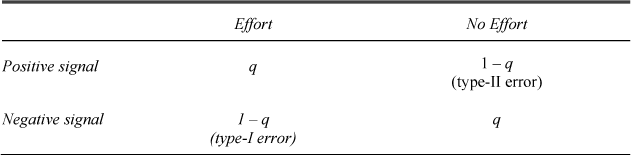
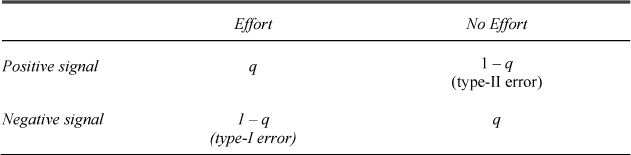
PROBABILITY OF OBSERVING A CERTAIN SIGNAL GIVEN THE CHOICE OF EFFORT BY THE SLAVE
Notes:
See the text.
The Master Infers Effort from Imperfect Signals
The master is not able to observe effort directly, thus, he infers whether the slave has exerted effort from a binary signal. The signal is imperfectly correlated with effort, so that four situations can materialize, as illustrated in Table 1. The quality (informativeness) of the signal is measured by ½ < q < 1, which is the probability that the signal is truthful, that is, the probability that the signal correctly indicates whether the slave has exerted effort.Footnote 27 If the slave exerts effort, in q cases the signal correctly indicates effort while in a residual portion (1 – q) of the cases, the signal gives the wrong indication, resulting in the punishment of or refusal to reward an “innocent” slave (type-I error). Similarly, if the slave does not exert effort, in q cases the signal correctly indicates no effort, while it wrongly indicates effort in the remaining (1 – q) instances, implying a reward for or failure to punish a “guilty” slave (type-II error). When a slave performs a simple task, which can be easily monitored, q is high (think of a field worker). Instead, with a lower q, the signal is much less reliable and errors occur with a higher probability. This could be the case when the slave performs a highly complex and risky commercial operation on which the master has very little direct control (think of a business agent or a supervisor).
The Slave Decides Whether to Exert Effort
The slave chooses the course of action with the largest payoff given the probability of being unjustly rewarded or punished. We start with carrots. Under carrots, a slave who exerts effort incurs a cost of effort equal to 1 and is rewarded with probability q; thus, his payoff is qc − 1. If the slave does not exert effort, there is a probability 1 – q of being mistakenly rewarded without incurring any cost; his payoff in this case is (1 – q)c. The slave chooses the action that yields the higher payoff; that is, the slave exerts effort if qc − 1 ≥ (1 – q)c, which can be rewritten as c ≥ 1/(2q − 1).
Similarly, in the case of sticks, if the slave does not exert effort, then he will be punished with probability q; thus, his negative payoff is qs. However, if the slave exerts effort, he will be erroneously punished with probability 1 – q. Hence, the slave's negative payoff when he exerts effort is 1 + (1 – q)s. The slave chooses the action yielding the smaller negative payoff; that is, the slave exerts effort if 1 + (1 – q)s ≤ qs, which can be rewritten as: s ≥1/(2q − 1).
The carrot (or stick) that induces effort depends only on information. Since errors dilute incentives, the master will have to apply a bigger carrot or stick if the quality q of the signal is lower. Notice at this point that the carrot that induces effort is exactly the same as the stick that induces effort: 1/(2q − 1). Hence absent other considerations, information issues do not produce any difference between carrots and sticks.
The Master Chooses Between Carrots and Sticks
The master's choice between carrots and sticks depends on the net benefits he receives from the slave's activity and on the costs he incurs per unit of carrot or stick applied. Because costs and benefits are symmetric in our simple model, we ignore variation in benefits and normalize them to v. Without loss of generality, we normalize the cost of a unit of carrot to 1 and the cost of a unit of stick to k.
The variable k captures the effects of costs that are only incurred if a carrot or a stick is actually applied. Thus, the cost of monitoring is ignored because it is incurred ex ante for all slaves, but the cost of the reward is only incurred when a slave is actually rewarded or punished. Sticks are costly both to the slave and to the master. Punishing a slave will generally hinder his productivity; harsher punishments (up to the capital punishment) may destroy the value of the investment—including the purchase price and the cost of training—which the master has made in the slave. For instance, cutting out a slave's tongue (Bradley 1994, p. 3) may be very damaging for the master if the slave runs a commercial activity but less so if he works in the fields. The slave typically values his personal integrity and life more than the master does. However, there might be cases in which a relatively small punishment for the slave (think of temporary confinement inside the house) has a large cost for the master (interruption of a profitable business). To be sure, the cost of a reward to the master might be different from the value of the same reward to the slave. For instance, the concession of freedom has a cost to the master—including the market value of the slave, the idiosyncratic value of his services, the value of future services of the slave as a freedman and so forth—which is most likely very different from the value that the slave himself attaches to his freedom. Thus, k (the relative cost of reward and punishment) may be greater or less than 1.
The master chooses between carrots and sticks depending on their payoffs. With sticks, his profit (Πs) is equal to the value of effort minus the expected costs of punishing: Πs = v – psks. The probability of punishment, ps, depends on whether the slave exerts effort and whether the master makes errors. For the master, it is advantageous to set the stick just high enough so that the slave exerts effort. Recall that the minimum stick necessary to induce the slave to exert effort is such that s = 1/(2q − 1). Under these conditions, the slave exerts effort for sure, but with probability ps = 1 – q he is punished by mistake. We can now substitute these values for s and ps in Πs and write the master's payoff as a function of q. Thus Πs = v – (1 – q)k/(2q − 1).
With carrots (where the cost of rewards is 1), the master's payoff is Πc = v – pcc. The minimum carrot necessary to induce the slave to exert effort is such that c = 1/(2q − 1). Under these conditions, the slave exerts effort for sure, but with probability 1 – q he is denied a reward by mistake; thus, the master rewards the slave with probability pc = q. We can now substitute these values for c and pc into the master's payoff Πc = v – q/(2q–1).
Notice that Πs – Πc = q/(2q − 1) – (1 – q)k/(2q − 1). So Πs – Πc > 0 if k < q/(1 – q). Because q > ½, if k ≤ 1, sticks are always preferred to carrots. However, if the cost of imposing punishments is larger than that of rewards then carrots may be preferred to sticks. Now fix k > 1. For any k > 1, there is some signals quality q* such that for any q > q*, the master prefers sticks because they have to be produced infrequently. If the signal is of lower quality than q*, the master prefers carrots. As we consider higher cost of sticks (k), q* increases and the range of occupations for which the master chooses rewards widens.
The model identifies a fundamental relationship between the use of carrots (including manumission) and the informational characteristics of the task assigned to the slave. There are additional results. To begin consider the magnitude of optimal incentives c = s = 1/(2q − 1). As we move from tasks with little asymmetric information (high signal quality q) to tasks in which asymmetric information is more severe (lower signal quality q), the magnitude of both carrots and sticks increases. As we have explained, this is because asymmetric information dilutes incentives and hence needs to be complemented by larger punishments or rewards.
THE DETERMINANTS OF THE MASTER'S CHOICES
Carrots versus Sticks
Several factors affect the point q* at which the switch from sticks to carrots occurs. Although we only considered variation in the cost of effort, our results are symmetric if the relative benefits of effort are higher when it is induced by rewards than punishment. Suppose the slave is more likely to do a good job if encouraged by the prospect of a reward than if frightened by the possibility of a punishment (for instance, when a task requires particular care but little physical effort); hence, q* will be pushed to the right and the area where carrots dominate will be large. The opposite will occur if the task requires physical effort but little care. In this case, the switch to carrots will occur only at relatively low levels of q. This also implies that slaves with more complex tasks might be subjected to large punishments. Note that, by allowing for different values of vc and vs, this model includes Fenoaltea's analysis of motivation but does not depend on it, since the results remain valid even if the relative benefits of effort do not vary.
Monitoring costs also have an effect on the choice between carrots and sticks. If the slave performs his task in a team of slaves—for instance, gang labor in the fields—it might be cheaper to supervise and punish him for not working hard enough than trying to assess his individual contribution in the profits in order to reward him accordingly. This pushes q* to the left and enlarges the region in which sticks are preferable. The opposite may be true if the slave manages a business and hence it is costly and largely unproductive to invest resources in measuring his work hours, while it may be more effective to verify his business accounts periodically and reward him for good performance.
Finally, the relative costs of applying carrots and sticks play a role in determining the switching point. Slaves endowed with high human capital and idiosyncratic talents are highly valued on the slave market. Hence, slaves involved in knowledge-intensive activities such as trading and manufacture are more costly to punish than easily replaceable quarry workers (k is large), because the master has more to lose by punishing a higher-value slave. Under these conditions, the switching point is plausibly located toward the right, which leaves much room for carrots. Conversely, easily replaceable slaves of low market value are cheaper to punish for the master (k is small) and hence the switching point will plausibly be located further to the left, creating a larger scope for sticks.
Implication 1 (carrots versus sticks): Carrots are more likely to be used than sticks if the slave performs a care-intensive activity, the cost of monitoring violations is high relative to the cost of monitoring compliance, the cost of punishing is high relative to the cost of rewarding, or the slave task is complex (large asymmetry of information).
The Magnitude of Carrots
The magnitude of the carrot or the stick necessary to induce effort increases as the complexity of the task increases. This result is completely independent of all other factors considered above, which only determine the point at which the master switches from sticks to carrots—not the magnitude of the carrots or sticks themselves. Conditional on the use of carrots, the choice between small and large carrots only depends on the quality of information. This brings us to the main claim of this article: information is the sole determinant of the choice between manumission and lesser rewards. Moreover that choice cannot be explained by the other factors considered above, including monitoring and motivation.
Implication 2 (the magnitude of carrots): Large carrots (including manumission) are more likely to be used than small carrots if the slave task is complex (large asymmetry of information).
Labor versus Slavery
Slavery has two advantages over the employment of wage workers from the master's point of view: the availability of large punishments and the absence of an exit option for the slave. Generally, under a free labor arrangement, dismissal is the harshest punishment possible and the employee has the option to quit. These two factors distinguish the choice of labor versus slavery from the choice of carrots versus sticks. Holding the costs of labor (wage) and of slavery (depreciation and maintenance) constant for the sake of simplicity, the master will prefer slaves (even if incentivized with carrots) over free labor when the availability of large punishments and the absence of an exit option play a major role in a particular employment environment. The analysis above shows that large sticks are employed when the signal is of low quality and the cost of applying carrots is high compared to sticks (k is small). In addition, large sticks are preferred to carrots when the signal is very good. In these cases, slavery will be chosen over free labor due to the availability of large sticks. The second factor (absence of an exit option) relates to the agent-specific investments that the master may make. Investments in training (or, generally, in human capital) are lost if the employee leaves. Labor exposes the master to the loss of such investments, while slavery does not, irrespective of whether carrots or sticks are employed.
Implication 3 (labor versus slavery): Slavery is more likely to be used than free labor if large sticks are necessary or if the master makes agent-specific investments.
ASYMMETRIC INFORMATION IN THE ROMAN WORLD
Ancient Rome provides an ideal setting for testing the model because there, unlike in other slave systems, manumission was frequent and freed slaves became citizens.Footnote 28 According to a recent estimate, in a millennium, the Romans enslaved more than 100 million people, with an average “serving time” of about 20 years. The living conditions of those slaves were tremendously variable, from extremely undesirable to something agreeable enough that one might voluntarily chose it.Footnote 29 In turn, material conditions crucially depended upon whether the master chose sticks or carrots as an incentive device. The model predicts that this choice was determined by the degree of asymmetric information characterizing the slave's task.
Sticks were readily available since the slave was regarded as a thing (res) rather than an individual. A master's power extended over the life and death of his slaves (Buckland 1908, pp. 10–72; Watson 1987; Joshel 2011, pp. 215–16; Patterson 1982).Footnote 30 Carrots ranged from favorable living conditions—such as independent living quarters, better clothing, food and family life—to the concession of or the possibility of buying one's freedom and the allotment of an allowance in addition to freedom.Footnote 31 Once freed, some former slaves were able to accumulate wealth and power and several freedmen, such as the fabulist Phaedrus, even made it into history books. Thus, although the condition of being either free or a slave provided for the fundamental legal divide among individuals, this divide was not based on race and was in fact a “porous” boundary that allowed for transitions from freedom to slavery and vice versa.Footnote 32 The evidence shows that, according to the model's implications, both the master's choice between carrots and sticks and the magnitude of rewards and punishments were a function of the tasks assigned to the slave and, in particular, of the asymmetry of information that characterized these tasks. In turn, this explains both the emergence and decline of classical slavery and its unique “open” character, providing an answer to Hopkins’ question.Footnote 33
The Emergence and Decline of Classical Slavery in Rome
The Roman slave system made use of carrots as an incentive devise at times when many slave tasks were characterized by a high degree of asymmetric information and mainly relied on sticks in other periods. The period before the third century BC was characterized by patriarchal slavery, which concerned a small number of war prisoners employed in agriculture and treated not very differently from other members of the family. This situation changed in the third century, and even more so in the second century BC when Rome rapidly came to dominate the Mediterranean Sea. By the end of the second century AD, the city of Rome hosted about one million inhabitants and the empire produced a national income that was higher than any European state achieved until the Industrial Revolution.Footnote 34 Due to this expansion, war prisoners began to flock into the Roman world in rising numbers. Slaves captured during these wars were often well-educated, possibly even more so than their Roman masters. These slaves provided labor input for virtually all economic activities, and many of them could offer intellectual services in addition to manual labor. The expansion also fostered peace and the Roman infrastructure (harbors and roads) stimulated commerce and entrepreneurial activities, fueling the transition from patriarchal to classical slavery.Footnote 35
There are several elements of the dynamics of the expansion that are relevant for our analysis. On the supply side, slaves entering the Roman economy (through conquest or breeding) from the third century BC onward were more numerous and of superior skills in comparison to their predecessors. On the demand side, the war effort made many male adults leave their agricultural occupations to join the Roman army, making some land available for purchase by the Roman elite. The concentration of extensive estates (villae and latifundia) in the hands of the elite made it possible for the elite to structure production more intensively, for which growing markets provided an outlet. The economic activities generated by commerce also included manufacturing, shipping, and some financial services such as lending. Such activities required a degree of delegation and specialization, which was not necessarily the case in the previous, small-scale agricultural production system (Bradley 1994, p. 26; 2011b, p. 246; Morel 2007, p. 507; Bradley). The combination of the increased supply of and demand for many, often educated, slaves caused a change of attitude toward slave labor, which is nicely illustrated by two legal changes that took place near the same time and were probably fostered by the economy's need for a new legal framework.
On the one hand, in the Laws of the Twelve Tables (mid-fifth century) both harm to a slave and harm to a freeborn were qualified as iniuria (although the punishment was double in the case of harm to a freeborn). Later, the Lex Aquilia (third century) downgraded harm to a slave to a property damage, likening it to harming cattle, a mere means of production. On the other hand, under the ius civile, the slave could not create obligations for his master. Although not an issue when slaves’ tasks were purely manual (domestic or agricultural), as occupations evolved to encompass managerial and entrepreneurial activities, this rule ensured that slaves could not commit to honor contracts, which in turn severely limited the range of tasks that masters could effectively delegate to slaves. Beginning in the third century BC, a series of remedies were developed by the praetor (actiones adiecticiae qualitatis) in order to address these problems. The new rules expanded the liability of the master to include obligations assumed by the slave. This evolution was clearly in the interest of masters, who were thereby enabled to run businesses through their slaves.Footnote 36 Both changes point to the same trend: slaves were increasingly seen as qualified means of production in complex entrepreneurial and commercial activities. As the model predicts, this evolution in the tasks to which the slaves were assigned brought along a new system of incentives, which was increasingly based on carrots and will be more closely examined in the next section.
At the other end of the period considered, starting from the third century AD, the Roman economy entered into a lasting crisis. The Antonine plague of AD 165–180 and the plague of AD 250 claimed the life of emperors and peasants alike and a series of incursions brought destruction, demographic contraction, and a rise in military costs. The economy slowed down and commerce declined. The demand for skilled slaves decreased, as is evidenced by falling slave prices (given that supply plausibly did not increase). In this context and through a long and complex process, slaves—in particular, slave managers and slave entrepreneurs—lost a great part of their role in the Roman economy. Consequently, new forms of exploitation emerged, which tied free peasants to the land, relied much less on carrots and precluded the possibility of exit.Footnote 37
Explaining the Openness of the Roman Slave System
The period from the third century BC to the third century AD offers the richest material for the study of incentives in the master-slave relationship. Slaves were traded in slave markets and, although prices cannot be accurately estimated, there is little doubt that they were sensitive to the characteristics of the slave as advertised by the seller, especially to idiosyncratic skills (Strabo, Geographica 14.5.2; Morel 2007, p. 504; Bradley 2011b, pp. 246, 249; Scheidel 2011, p. 297; Jongman 2007). The various tasks performed by slaves can be distinguished on the basis of their information characteristics. Jean Andreau (2001, p. 125) offers a distinction among slave workers, slave managers, and slave entrepreneurs. Slave workers operated under the master's (or a delegate's) instructions; such slaves usually took no initiative. These slave workers were unskilled, assigned to complete simple tasks, kept at a subsistence level, subjected to sticks, closely monitored by other slaves, and treated no better than livestock (Thébert 1989, pp. 154–55; Jongman 2007, pp. 609–10; George 2011, pp. 386–91; Edmondson 2011, pp. 347–49). In contrast, the vilicus, the slave in charge of the management of the villa, is an example of a slave manager: he had more autonomy and better living conditions—among which were separate living quarters and a partner—and even enjoyed some remuneration (Hopkins 1978, p. 126; Morley 2011, p. 269).Footnote 38 Other slaves who managed shops or workshops often received a salary, but all gains from their activity accrued directly to the master. Finally, slave entrepreneurs received a peculium that they could autonomously manage; they bought and equipped a workshop and operated without the master being involved in their dealings (Andreau 2001, pp. 126, 128, 139; Bürge 2010; Gardner 2011, pp. 419–23).Footnote 39 These categories can be arranged along a line of increasing asymmetric information from the slave worker to the slave entrepreneur. Correspondingly, sticks dominated the incentive structure of slave workers while carrots were often used for slave managers and even more so for slave entrepreneurs. Moreover, the peculium was often a means for the slave to enrich himself, suggesting that more asymmetric information also led to greater rewards.
Valuable information about the use and magnitude of carrots mainly comes from freed slaves. Examples of freedmen who accumulated vast patrimonies and climbed the social ladder are not infrequent; by some accounts, they could be as rich as senators.Footnote 40 According to the model's implications, most of the rich freedmen of whom we have notice had been involved in managerial or entrepreneurial activities as slaves. Due to the use of carrots, some freeborn were ready to sell themselves into slavery ad actum gerendum, that is, to obtain a managerial position, with the attached prospects of enrichment and, eventually, freedom.Footnote 41
Nevertheless, slaves subjected to carrots were not spared sticks. Apuleius describes the punishment administered to a vilicus for disloyalty to his master—covered in honey, the slave is eaten by insects—while Martial tells the story of a slave cook beaten after he made a poor meal.Footnote 42 Both the vilicus (a slave manager) and the cook (a domestic slave) were among those slaves who would normally be eligible for carrots. This coexistence of carrots and sticks is consistent with the model. If a slave carried out two different tasks, sticks were used for the task characterized by high-quality signals, such as when a slave was caught stealing or trying to escape. By contrast, carrots were used for tasks characterized by low-quality signals, such as the good management of the villa. Also because slaves could be subjected to harsh punishments, slaves rather than free labor dominated the managerial levels of employment (Harris 2007, p. 527).
In addition, masters were ready to invest in their slaves and in the businesses they ran. Cicero's pro Roscio comoedo provides an instructive example: Roscius had trained a slave of Fannius to be an actor. The slave earned huge profits, which they shared until the slave was killed. Cicero argued that not only the owner Fannius but also Roscius should be compensated, because he had lost the investment in training he had made in the slave as a consequence of the killing.Footnote 43 As the model shows, such investments in idiosyncratic skills made masters prefer slaves to free labor.
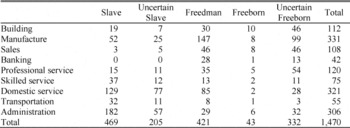
The paucity of data on the ancient world prevents us from reliably testing the implications of the model in a quantitative way. However, some cautious conclusions can be derived from the data set of epitaphs and dedications from the Corpus Inscriptionum Latinarum collected and integrated by Sandra Joshel (1992, pp. 16, 19), which provides the best (to date) quantitative assessment of this issue. The data set concerns 1,470 individuals—1,262 men and 208 women—who worked for private individuals or in the marketplace and contains information on their status and occupations at death (see Appendix Table 1).
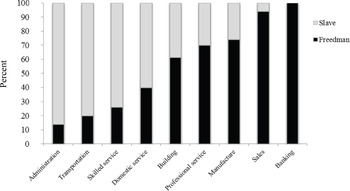
PERCENTAGE OF SLAVES AND FREEDMEN PER OCCUPATION IN ROME

The model predicts that the occupations exhibiting higher asymmetric information gave slaves higher chances of being freed and hence should occur more frequently among freedmen than among slaves. Although the data provides no hard measure of asymmetric information, Figure 1, showing the percentage of slaves and freedman per occupation,44 is compatible with this prediction: except for administration, occupations on the left of Figure 1 were those characterized by low levels of asymmetric information (and low probability of manumission), while those on the right exhibited higher levels of asymmetric information (and high probability of manumission). Administration is a notable exception, as it plausibly involves a high degree of asymmetric information but is mainly dominated by slaves. This fact can be explained by the need to discourage fraud by means of large punishments, which were more readily available for slaves than for freedmen.
Yet, caution is in order: this data set provides a picture of occupations at the moment of death and hence it is impossible to exclude a competing hypothesis: freedmen might have moved to higher-asymmetric-information jobs after manumission. A counterargument is that most freedmen might have retained the same occupation after manumission in order to take advantage of the skills they acquired as slaves. In addition, not everyone (especially slaves) had an epitaph, and only 10 percent of the epitaphs included occupational titles; thus, it can be questioned whether the group with occupational titles is a representative sample of the populations of slaves and freedmen (Joshel 1992, pp. 7, 53).
ASYMMETRIC INFORMATION IN THE ATLANTIC WORLD
Explaining Manumissions in the Atlantic World
Atlantic slavery had a markedly racial connotation and lacked the open character that was typical of Roman slavery. Yet, manumissions still occurred, although less frequently. The available evidence strongly indicates that overall in the Atlantic world manumissions, which were generally meant to encourage “good behavior,” were more frequent in towns and for domestic slaves than in plantations, although the vast majority of slaves were involved in plantation work (Blackburn 2009, pp. 3–4; Klooster 2009, p. 164; Caverns 2009, p. 105). This general picture confirms Implication 2 and is supported by further quantitative evidence showing that slave tasks characterized by a higher degree of asymmetric information resulted in a higher likelihood of manumission for the slaves involved.
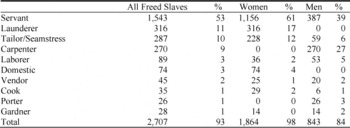
Data on Suriname, collected by Rosemary Brana-Shute (1989, pp. 41–42, 48) from the letters of petition (requesten) that owners were required to submit in order to manumit a slave, contain a sample of 943 petitions for the manumission of 1,346 slaves, which account for almost a third of all manumissions in Suriname between 1760 and 1826. Only 256 slaves (19 percent) are identified as coming from plantations. Data on 2,897 manumissions collected by Okke ten Hove (1999) for a later period (1832–1863) reveals that the five most common occupations of manumitted slaves were servant, launderer, tailor/seamstress, carpenter, and laborer (see Appendix Table 2). The latter accounts for only 3 percent of the manumissions although this was the overwhelmingly most common occupation among slaves. Servant is the most common occupation among freed slaves (both women and men) and accounts for 53 percent (61 percent for women and 39 percent for men) of the manumissions in the sample. The second most common occupations are laundress for women and carpenter for men (17 and 27 percent, respectively) while tailor/seamstress comes in third for both genders (12 and 6 percent, respectively). The list includes teaching assistants, hospital workers, and various types of crafts (from brewers and bakers to smiths and shoemakers) confirming that the slaves selected for manumission where principally those assigned to complete tasks characterized by larger asymmetries of information.
The data on Barbados (1650–1700) collected by Jerome Handler and John Pohlmann (1984, pp. 391, 405) from wills and deeds (133 manumissions) is the “largest single body of data available on slave manumissions for any seventeenth-century English colony.” Barbados was a “plantation-slave society;” in the mid-1670s it had more slaves that any other English colony (at least 32,800 versus 23,700 in all other English colonies in the Caribbean and in the mainland). The authors note that “An overwhelming […] majority of Barbados’ slaves worked at agricultural or other income-producing tasks. It is therefore striking that (except for small children) most, if not all, of the will and deed manumittees were domestics.” A majority of the manumitters were planters (66.2 percent), but a significant portion of them (12.5 percent) were doctors, merchants, or tradesmen, which, in a predominantly agricultural economy, suggests that manumissions occurred relatively more frequently in professions and trade, where asymmetric information is most likely to be high.Footnote 45
According to Stephen Whitman (1995, p. 336; 1997, pp. 6–8), Baltimore accounted for the majority of Maryland's manumissions in 1790–1860, while manumission rates remained very low in the countryside. Two-fifths of craftspeople with taxable income in Baltimore were slaveowners, suggesting that involvement in the crafts supported higher manumission rates. Similar patterns have been found in Buenos Aires by Lyman Johnson (1979, pp. 260–76), in Louisiana by Shawn Cole (2005, p. 1017), in the Atlantic islands by William Phillips (2011, p. 345), and elsewhere in the Americas (Brana-Shute, 1989, p. 41). Stuart Schwartz's (1974, pp. 606–08) data on 1,160 slaves manumitted in Bahia in 1684–1745, as recorded in 1,015 cartas de aforia registered in notarial offices in the City of Salvador, indicate that, while slaveowners were not necessarily residents in the city, 82 percent of the manumitted slaves were urban slaves. Yet, occupations involving a large asymmetry of information are not an exclusive city prerogative. Joao Fragoso and Ana Rios (2011, p. 372) show that slaves in Brazilian gold and diamond mines also enjoyed higher manumission rates than plantation laborers, and monetary rewards accompanied the finding of particularly precious stones. This was due to the fact that these miners were clearly not as easy to monitor as field workers.
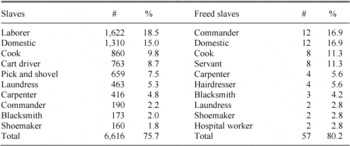
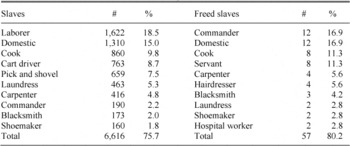
MOST FREQUENT OCCUPATIONS FOR SLAVES AND FREED SLAVES IN LOUISIANA, 1725–1820
Source:
Author's own elaboration on data from Hall 2000.
All these data sets have the major limitation of only containing information about manumitted slaves. Thus, manumission rates cannot be estimated and compared across occupations. This information is included in two data sets from Louisiana for the period ranging from the arrival of the Europeans in 1725 to 1820. The data sets have been compiled by Gwendolyn Hall (2000) on the basis of every document available not only in Louisiana but also in other American states and abroad (such as in France and Spain): the Louisiana Slave Database (for slaves) and the Louisiana Free Database (for manumitted slaves). These data have already been examined by Cole (2005, p. 1018), with the purpose of investigating manumission prices. However, the information on slave occupations has not yet been exploited. We restrict the analysis to the subsets of the data containing occupational information, that is, to two subsets of 8,745 observations (8.7 percent) from the Louisiana Slave Database and 71 observations (1.7 percent) from the Louisiana Free Database. Table 2 lists the 10 most frequent occupations for slaves and freed slaves, covering 75.7 percent and 80.2 percent of the respective samples.
LIKELIHOOD OF MANUMISSION PER OCCUPATION IN LOUISIANA, 1725–1820

Source:
Author's own elaboration on data from Hall 2000.
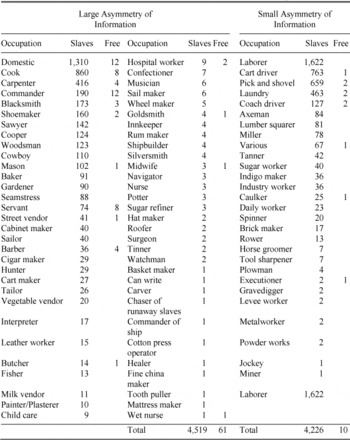
While Louisiana's most common slave occupation was also agriculture, laborers (holding small asymmetry of information jobs) are not mentioned in the Louisiana Free Dataset as they were almost never manumitted. In contrast, commanders (holding large asymmetry of information jobs), which are relatively less common among slaves, feature prominently among freed slaves. To have a more precise estimate of the probability of manumission, we divide slave occupations into two subsets: those characterized by a small asymmetry of information (simple tasks involving manual labor and limited use of tools, such as laborer or laundress) and those with large asymmetry of information (more complex tasks involving some discretion, such as carpenter or commander). (See Appendix Table 3). For each group, we estimate the probability of manumission as the ratio between the number of freed slaves over the number of slaves.
As indicated in Table 3, on average, holding a large asymmetry of information rather than small asymmetry of information occupation yields a sixfold increase in the probability of manumission (1.3 compared to 0.2 percent). The one-tail B. L. Welch (1947) test for unpaired hetheroschedastic samples is used to confirm the statistical significance of the results at the 1 percent level. These results are robust to possible errors made while assigning occupations to either group. For instance, by switching “domestic”—the occupation with the largest frequency in its group—from the large asymmetry of information group to the small asymmetry of information group, the results remain qualitatively the same.Footnote 46 Looking at three specific occupations with decreasing degrees of asymmetric information, for commanders’ manumission was six times more likely than for carpenters and 21 times more likely than for pick and shovel laborers.
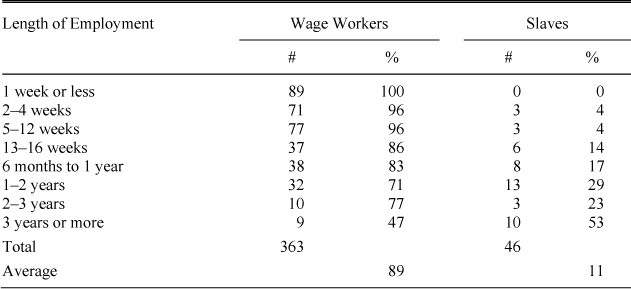
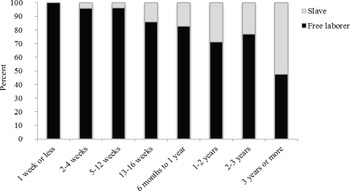
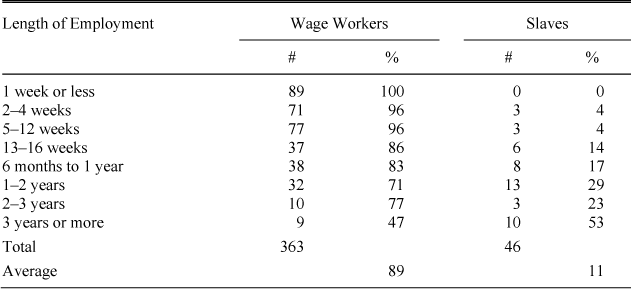
PROPORTION OF SLAVES AND FREE LABORERS PER LENGTH OF EMPLOYMENT AT MARYLAND CHEMICAL WORKS, 1827–1832

Although all of these databases have sample-selection problems and quantitative estimates should be cautiously interpreted, the qualitative evidence they provide is consistent across geographical areas, type of data and collection methods. The data available overwhelmingly confirm the predictions of the model concerning the effect of asymmetric information on the individual slaves’ likelihood of manumission (Implication 2).
“Carrots versus Sticks” and “Labor versus Slavery” in the Atlantic World
While the main objective of this article is to investigate implication 2, two additional data sets provide some support for implications 1 and 3. Alaine Hutson's (2002, p. 66) data set on Saudi Arabia (1926–1938) contains data from questionnaires completed by slaves running away from Saudi Arabia as they were received by British authorities in Jeddah. The data shows that ill treatment was a more frequent reason given by runaway slaves involved in agriculture (93 percent) compared to domestic service (54 percent) and commerce (25 percent). Percentages align nicely with the model's predictions (Implication 1): ill treatment is correlated with the use of sticks rather than carrots, which in turn are more frequent in occupations involving complex, difficult to monitor tasks typical of domestic service and, especially, commerce. Likewise, Whitman's (1997, pp. 41) data set on the duration of employment of slaves from the Maryland Chemical Works pay book from September 15, 1827, to April 28, 1832 provides some evidence about the model's predictions concerning the choice between slavery and labor. As Figure 2 shows (see also Appendix Table 4), the proportion of slaves increases when going from short-term to long-term employment. Whitman (1997, pp. 43) puts it very clearly in terms of Implication 3: “the only good workers [the entrepreneur] could be assured of keeping were those he owned.”
CONCLUSION
This article shows how asymmetric information shaped one of the most persistent institutions in history, slavery, by determining the likelihood of manumission. The analysis points to a single determinant: the asymmetry of information between the slave and the master, which in turn determines whether manumission will be used by the master as an incentive for good performance. The theoretical model puts manumissions in the broader context of carrots versus sticks as incentives for slave performance and derives three sets of implications concerning the choice of carrots versus sticks, the use of manumission (a particularly large carrot), and the choice of labor versus slavery. The empirical validation focuses on manumissions. Further research could focus on the gathering of additional individual-level data on slave occupations and on punishments and rewards. Furthermore, although this article focuses on slavery, phenomena such as wage slavery, despotism, and colonialism, which involve the exploitation of an individual or a group by another individual or group, could be investigated using a similar framework.
Likewise, the implications produced by the model could be used to investigate differences in the manumission rates in different slave systems. As Patterson (2009, p. 22) notes: “Explaining why certain kinds of individuals in a given slave society were more likely to be manumitted is not the same thing as explaining why some slave societies have higher rates than others, even if the variables tend to overlap.” The theory presented here predicts that, ceteris paribus, a society in which slaves are assigned to occupations characterized by a high degree of asymmetric information will have higher manumission rates than a society in which most slave occupations exhibit a lower degree of asymmetric information.
This point raises a crucial question for future research: what are the macroeconomic or political determinants of slave occupations at the aggregate level? In the analysis of ancient Rome, I showed that the demand for trusted agents to whom to delegate complex tasks was met by a large supply of educated slaves over the classical period. The interaction of demand and supply stimulated both the assignment of complex tasks to slaves and the development of supporting legal rules. The analysis could be profitably expanded to other slave systems and carried out in a comparative perspective in order to identify other relevant drivers of the assignment of slaves to the completion of complex tasks.
Moreover, at the aggregate level the determinants of the individual master's decision need to be supplemented by consideration of the conflict between private and social incentives to manumit. Historically, manumissions have been mandated (emancipation) or restricted (by taxation or regulation), indicating a tension between the master's decision whether to hold or manumit a slave and the perceived social effects of both slavery and the decentralized injection of new citizens (freed slaves).Footnote 47 By focusing on the master's private incentives to manumit, the analysis presented here makes only a first step towards a political economy theory of slavery, while leaving the analysis of social incentives for further research.
This article's focus on asymmetric information may be best understood in the context of the literature's frequent emphasis on slaves’ skills as determinants of rewards and manumissions (Higman 2011, p. 498; Brana-Shute 1989, pp. 47–49; Whitman 1997, p. 11; Genovese 1974, pp. 390–92; Franklin 1950, p. 195) as skilled slaves are more likely to be assigned to complex tasks. Although, in some cases, skill might be a proxy for asymmetric information, skill concerns the slaves’ ability to perform a certain task, which is not necessarily related with the asymmetry of information characterizing these tasks. On the one hand, the rewards given to Brazilian diamond mine workers cannot be explained by skill (in fact, little skill was required) but rather by asymmetric information. On the other hand, skill makes a slave more expensive and hence more costly to free, and may actually limit or retard manumissions, while asymmetric information always fosters manumissions. It is asymmetric information, not skill, that explains manumissions.
The author would like to thank Editor Jean-Laurent Rosenthal, two anonymous referees, Barbara Abatino, Marco Casari, Gerrit De Geest, Stanley Engerman, Stefano Fenoaltea, Carmine Guerriero, Okke ten Hove, Willem Jongman, Dennis Kehoe, Egbert Koops, Roberto Pardolesi, Anna Plisecka, Walter Scheidel, Rens Tacoma, Peter Temin, Jeroen van de Ven, and the participants in the 2008 meeting of the Comparative Law and Economics Forum in Madrid, the 2009 European Association Law and Economics Annual Meeting in Rome, the 2010 VIDI workshop on Law, Economics, and History at the University of Amsterdam, the 2011 American Economic Association Annual Meeting in Denver, the 2011 American Law and Economics Association Annual Meeting at Columbia Law School, and the seminars at the University of Bologna and at Collegio Carlo Alberto in Turin for helpful comments. Lauren Abbott, Anghel Negriu, and Sander Verrips provided excellent editorial assistance. The financial support by the Netherlands Organisation for Scientific Research (NWO) grant 016.075.332 is gratefully acknowledged.
Data Appendix
OCCUPATION AND STATUS IN EPITAPHS AT ROME

TEN MOST COMMON OCCUPATIONS OF FREED SLAVES IN SURINAME, 1832–1863

OCCUPATIONS OF SLAVES AND FREED SLAVES IN LOUISIANA, 1725–1820

LENGTH OF EMPLOYMENT AT MARYLAND CHEMICAL WORKS, 1827–1832