Introduction
Is there life on Mars? There have been several attempts to answer this question. The core of the issue arises from the first debated Viking experiments held on Mars in 1976, that officially did not detect organic compounds on Martian surface and failed in obtain coherent results, probably due to the physico-chemical interaction between the potential organics in the complex nature of the soil-containing perchlorates (Navarro-Gonzalez et al. Reference Navarro-Gonzalez, Vargas, de la Rosa, Raga and McKay2010). Also the combustion temperature was too low to get the kerogenic organics out, more likely a detection issue (McKay et al. Reference McKay2013). Perchlorates are used in the terrestrial metabolic pathways of a large number of microorganism (Logan Reference Logan1998; Coates et al. Reference Coates, Michaelidou, O'Connor, Bruce, Achenbach and Urbansky2000; Coates & Achenbach Reference Coates and Achenbach2004). Also, the reports of methane in the Martian atmosphere suggested to reconsidering the question of organics on Mars (Ten Kate Reference Ten Kate2010). A biological interpretation of the Viking experiment was suggested by applying mathematical and fractal analysis to the record of monitored data, which have proved an occurrence of a circadian sequence related to a bacterial metabolism that should prove the existence of an extant microbial life on Mars (Bianciardi et al. Reference Bianciardi, Miller, Straat and Levin2012). At the same time, fossil evidence of microorganisms was, also, suggested about the Martian meteorite ALH84001 (McKay et al. Reference McKay, Gibson, Thomas-Keprta, Vali, Romanek, Clemett, Chillier, Maechling and Zare1996). Some years after other authors stated that the carbonate globules in ALH84001 were nanobacteria-like structures associated with Fe-oxide precipitation and questioned if they were originated on Mars or they could represent some Antarctic biota contamination (Folk & Taylor Reference Folk and Taylor2002). So, the theory that there is life on Mars became to be talked about again from 2005 onwards, when many researchers put forward the proposal that the strange spherules at Meridiani Planum (nicknamed ‘blueberries’) could be concretions induced by chemolithoautotrophic bacteria in acid environments enriched by iron minerals (Parro et al. Reference Parro2005; Jepsen et al. Reference Jepsen, Priscu, Grimm and Bullock2007). The concretions could have resulted by other kind of living microorganisms, a long time ago, in the acid groundwater, flowing through porous rocks and along cracks and fissures on Martian soil (McKay Reference McKay2004; Catling Reference Catling2004; Chan et al. Reference Chan, Bietler, Parry, Ormö and Komatsu2005, Reference Chan, Johnson, Beard, Bowman and Parry2006; Aubrey et al. Reference Aubrey, Cleaves, Chalmers, Skelley, Mathies, Grunthaner, Ehrenfreund and Bada2006; Jolliff & McLennan Reference Jolliff and McLennan2006; Barge & Petruska Reference Barge and Petruska2007; Potter & Chan Reference Potter and Chan2007; Souza-Egipsy et al. Reference Souza-Egipsy, González-Toril, Zettler, Amaral-Zettler, Aqilera and Amils2008; Loope et al. Reference Loope, Kettler and Weber2010, Reference Loope, Kettler and Weber2011; Weber et al. Reference Weber, Spanbauer, Wacey, Kilburn, Loope and Kettler2012). This biological interpretation was posed again by the controversial discovery in CL1 carbonaceous meteorites of some microfossils very close to terrestrial cyanobacteria (Hoover Reference Hoover2011) or could be results of some contamination from the terrestrial environment where they were found. Unfortunately, based on the available data, there is no biological confirmation until now, while scientists are seeking it by looking at pristine proxies for putative life. All these hypotheses were strengthened by some studies about terrestrial extremophiles as desert cyanobacteria of the genus Chroccocidiopsis living in extremely hot and cold deserts that shed a new light on the possible history of Martian microbial life (Grilli-Caiola & Billi Reference Grilli-Caiola and Billi2011). In this way, the discovery of a new photopigment, found within terrestrial stromatolites and named Chlorophyll f, that can absorb light of even lower photon energy until 720 nμ (Chen et al. Reference Chen, Schliep, Willows, Cai, Neilan and Scheer2010), suggests that cyanobacteria could also live in extreme environments and at the lowest luminous intensity as on Mars. Besides, orbital data suggested a vast array of aqueous alteration soils on Mars (Murchie et al. Reference Murchie2009; Carter et al. Reference Carter, Poulet, Bibring, Mangold and Murchie2013), including those formed by subsurface groundwater (Ehlmann et al. Reference Ehlmann, Mustard, Murchie, Bibring, Meunier, Fraeman and Langevin2011). According to this, the potential for extant life on Mars was recently, put forward by some interesting data acquired by the Mars Reconnaissance Orbiter (MRO) actually orbiting around the Red Planet. These images clearly showed the recurring of slope linear forms interpreted as a possible result of a contemporary water activity on Mars (Ojha et al. Reference Ojha, Wilhelm, Murchie, McEwen, Wray, Hanley, Massé and Chojnacki2015). In this way, our morphological study at microscopic scale, based on amplification of MI rovers images, pointed out that ‘blueberries’ and the flat-lying laminated sulphate-rich sediments, outcropping at Meridiani Planum, showed occurrence of complex microstructures made by microspherule aggregates forming sheets, filaments and polispherules, all having microstructural parallels to terrestrial stromatolites (Rizzo & Cantasano Reference Rizzo and Cantasano2009, Reference Rizzo and Cantasano2011; Rizzo et al. Reference Rizzo, Farias, Cantasano, Billi, Contreras, Pontenani and Bianciardi2015).
As regards meso and macrostructures, microbialites, including stromatolites, show a large structural and morphological variety, thriving in different environments. On Earth, microbial mats may appear in a large environmental range such as lacustrine, littoral and hypersaline biotopes, as well as in frost waters or in arid environments (Gerdes Reference Gerdes, Schieber, Bose, Eriksson, Banerjee, Sarkar, Altermann and Catuneau2007). As a direct consequence, a lot of peculiar bio-signatures and microbially induced sedimentary structures (MISS) was pointed out and described (Eriksson et al. Reference Eriksson, Simpson, Eriksson, Stein and Sarker2000; Noffke Reference Noffke and Middleton2003). Also, on Mars some lithofacies in the Gillespie Lake Member, have been recently described, suggesting strong similarities, in their macroscopic morphology, to terrestrial MISS (Noffke Reference Noffke2015). By this way, recent works show the striking similarities, based on multi-fractal analysis between terrestrial microbialites and Martian sediments, supporting the occurrence of unicellular life on the ancient Mars (Bianciardi et al. Reference Bianciardi, Rizzo and Cantasano2014; Rizzo et al. Reference Rizzo, Farias, Cantasano, Billi, Contreras, Pontenani and Bianciardi2015).
Despite all these putative biomarkers and the possibility of an extant microbial life on Mars, advanced by various authors, there are few studies about structural and morphological parallels, at micro, meso and mega scales between terrestrial microbialites and Martian outcroppings.
This work aims to cover such void, using morphological approaches upon a set of selected pictures shot by NASA rovers and comparing structure, morphology and shape, at different levels, between Martian sediments and terrestrial microbialites.
Materials and methods
Classical microbialite structures, including stromatolites and MISS, as cited in literature (Hoffmann Reference Hoffmann1969; Walter Reference Walter and Walter1976; Krumbein Reference Krumbein1983; Riding Reference Riding1999; Knoll et al. Reference Knoll, Worndle and Kah2013; Noffke & Awramik Reference Noffke and Awramik2013), were acquired from WEB sites and compared, searching for possible parallels with the wide photo record of NASA rovers (‘Opportunity’, ‘Spirit’ and ‘Curiosity’).
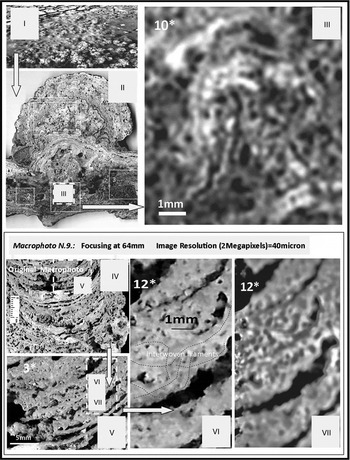
As regards microstructures, a systematic analysis of stromatolites has been performed on a wide set of enlarged sampling pictures, as described in a previous work (Bianciardi et al. Reference Bianciardi, Rizzo and Cantasano2014). In this study, macrophotos of stromatolites from Milano Civic Museum and from the Department of Earth Science of Calabria University, shot by Nikon Colpix L830, have been investigated, using shots at different megapixels (from 2 to 16 MP) and at various focusing (from 3 to 16 cm). These images have been analysed in order to obtain a multi-set of pictures so to collate each other and to compare with Microscopic Imagery (MI) recorded by Athena, a camera mounted on Martian rovers ‘Opportunity’ and ‘Spirit’, having a fixed focusing of about 6 cm and a resolution power of 30 µm. In this way, it was possible to compare Martian and terrestrial pictures having similar features, as focusing distance and resolution. Finally, images have been transferred into the Microsoft Publish 2010 software and opportunely enlarged (three times for Rovers images and up to six times for terrestrial samples) in order to obtain comparable working conditions and equal metric scales to investigate the dimensional field between 0.1 and 1.0 mm by length. All the images have been analysed in colour/black and white shades to compare them with those of the Martian rovers, increasing slightly, if necessary, the contrast of about 10–20% for an optimal view. In order to understand significance and similarity of structures, selected from amplified stromatolites web pictures, as well from Martian sediments, we made several attempts in image processing. In particular, we have analysed pictures varying focus, contrast and brightness using the software ‘Fotonic Snapseed.2 editor’ (Figs. 1 and 2).
A peculiar chaotic microtexture, named ‘intergrown filaments of microspherules’ (frame III, from ‘Lagoa Salgada’ recent stromatolite. This picture shows details from an enlarged published figure (outcrop on frame I, sample about 15 cm large on frame II; from Srivastava Reference Srivastava, Campos, Queiroz, Winge and Berber-Bonn1999). Comparison of picture on frame III with processed macro photo elaborations at the same dimensional scale (frames VI and VII) of a sample from the same outcrop (frames IV and V) shows similar pattern. The analogy becomes more evident (compare frames III and IV) by applying to frame VI a defocusing process of 60% and a contrast increase of 20%.

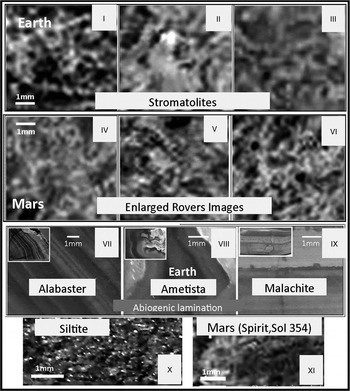
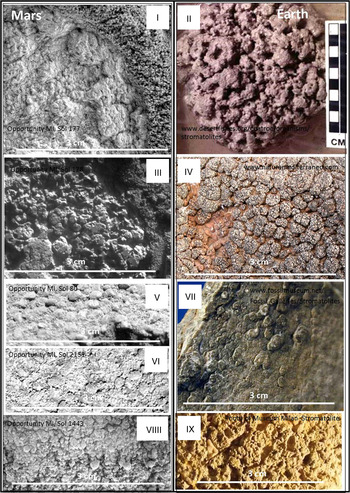
Selected stromatolite microtextures (frames I–III) in comparison with some Martian ones imaged by the rovers ‘Opportunity’ and ‘Spirit’ (frames IV–VI, from Rizzo et al. Reference Rizzo, Farias, Cantasano, Billi, Contreras, Pontenani and Bianciardi2015). The images were taken from both the web site macrophotos and from museum samples. All pictures, compared at the same dimensional scale, show a pattern similar to that shown in Fig. 1. Note the difference with abiogenic lamination in colloidal or microcrystalline terrestrial samples of pseudostromatolites (frames VII–IX). Difference was also found when comparing stromatolite microtextures (frames I–III and XI) with a terrestrial granular sample (siltstone, frame X).

In this way, we have analysed images captured by rovers Opportunity (MI), Spirit (PANCAM Panoramic Camera) and Curiosity (MAHLI Mars Hand Lens Imagery, MASTCAM Master Camera). This comparison was performed at the same micro, meso and macro scale of observation, regarding the structural and morphological peculiarity of terrestrial microbialites.
Then, all the work should be considered as the result of a long and logical comparison, starting from microscopic arrays until macroscopic ones and giving us a general idea of possible structural and morphological relationships between terrestrial microbialites and Martian sediments.
Results
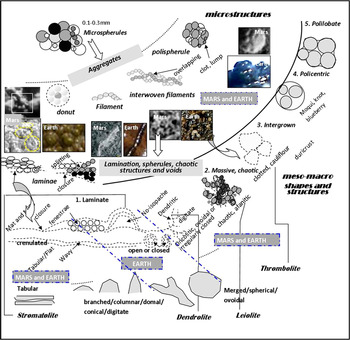
Occurrence in terrestrial microbialites of peculiar fabrics, structures and morphologies at different scales is well known (Vologdin Reference Vologdin1962; Walter Reference Walter1972; Komar Reference Komar1976). In order to produce a convincing parallel between the potential Martian microbialites and the terrestrial ones, we have to consider their fabrics, structures and morphologies. This kind of approach could help astrobiology in the large debate that involves their morphological similarity to other abiogenic geological deposits. Peculiar microstructures, as are clotted, peloidal, bushy, filamentous, etc., observed at dimensional scale of ~0.1 mm, are important and can be used to discriminate between ancient abiogenic deposit and those made by microbial mats, as suggested by several authors (Pope et al. Reference Pope, Grotzinger and Schreiber2000; Perry et al. Reference Perry2007; Riding Reference Riding2008; Knoll et al. Reference Knoll, Worndle and Kah2013); whereas at a lower scale, on micro and ultra-micro levels, the large debate on meteorites investigation, such as ALH84001 has led to the general conclusion that micron scale features, as in morphology and morphometry of single microstructures, cannot be used as definitive biomarkers. Nowadays, although microbialites are characterized by a wide variety of structures, at micro, meso, macro and mega scale, their common classification and differentiation are essentially based on their mesostructures (i.e. Stromatolites, Dendrolites, Thrombolites and Leiolites) with gradual transition between them (Riding Reference Riding2008, Reference Riding and Reitner2011). In particular, we have already highlighted (Rizzo & Cantasano Reference Rizzo and Cantasano2009, Reference Rizzo and Cantasano2011; Bianciardi et al. Reference Bianciardi, Rizzo and Cantasano2014) that the widespread occurrence of elementary microspherule structures appears at a micro scale level, from 0.1 mm to some millimetres, both in laminated sediments of Mars and on terrestrial – fossil and living – microbialites. In fact, the first common geometry of a microbial colony, where microbes are bound up with extra polymeric substance (EPS), is a clot or a sub-spherical body. These elementary structures, if close and/or merge into each other, may form donuts, giving planar assembly and laminae, somewhere concentric, or may form poli-spherules giving clots, lumps and ‘blueberries’, or may form filaments with clusters and interwoven filaments set in chaotic and thrombolytic bodies (Fig. 3, top). Recently, our attention has turned to these latter filamentous structures, referred to as ‘interwoven microspherules filament’ and observed in enlarged photographic images, that somewhere spread characterizing a peculiar microfabric.
Simplified view of peculiar microbialite structures distribution and their possible parallels found on Martian sediments. On the top, are shown basic microstructures made by microspherule aggregates, such are donuts, filaments, interwoven filaments of microspherules and polispherules. At the micro array level, morphological and structural parallels seem to be strong. Passing from micro and macrostructures, parallels decrease. Microbialite structures, made by domical, columnar and branched structures, shown in the central area of the picture, are absent or rare on Mars. On the contrary, polycentric/polylobate, intergrown, massive/chaotic and laminated structures frequently occur, giving dendrolitic, stromatolitic and thrombolytic mesostructures of tabular type (flat lamination, wavy lamination and/or crenulated lamination).

This typical texture, found using unusual procedures, shows similar shape if compared at the same dimensional field, both for Martian sediments and terrestrial stromatolites (Figs. 1 and 2). The same structure shows significant difference if compared with pseudo-stromatolites and other abiogenic detrital samples (Bianciardi et al. Reference Bianciardi, Rizzo, Farias and Cantasano2015). In this work such ‘filamentous structure’ and the consequent texture, was in deeply investigated by using comparisons of enlarged macro photos of stromatolites, suitably elaborated, as earlier described (Fig. 1). This comparative approach could explain what they really are, that is a defocused well-known ribboned structure (Walter Reference Walter and Walter1976), normally made by clots of mixed material surrounded by cyanobacteria in elongated structures (Knoll et al. Reference Knoll, Worndle and Kah2013). It was found that the associated textures, observed on enlarged photos, selected from several samplings of both terrestrial stromatolites and Martian sediments, should be considered mathematically the same, as proved by a multi-fractal approach (Bianciardi et al. Reference Bianciardi, Rizzo and Cantasano2014, Reference Bianciardi, Rizzo, Farias and Cantasano2015).
Starting from the previously described elementary microstructures and following a scheme, mainly based on geometrical array, it was observed that more complex geometries and shapes could be formed at meso and macro scale, as a repetitive or combined way, to develop planar (tabular/flat lamination), linear (columnar, conical, domical, branched, dendritic and other no-isopachous settings) and open or closed spherical assembly, as suggested in Fig. 3. We observed that on Mars occur typical and well-known features, both at structural and morphological levels.
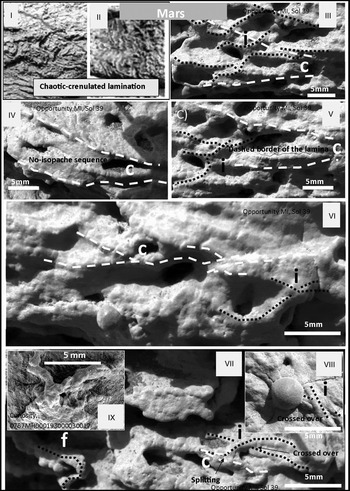
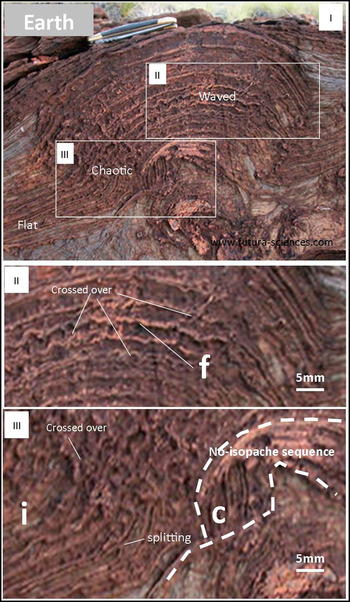
An example of mesostructures is provided in Fig. 4, whereas a planar crenulated laminae sequence becomes gradually chaotic (frames I and II). At the same time, Figs. 4 and 6 show lamina sequences with lamina closure (symbol ‘c’) and giving no-isopachous settings. In such conditions, they could form single lamina disharmonic folding (‘f’) or transit shapes from lamina to filaments, giving crossings and overlaps (‘i’). Similar features, at the same dimensional scale and bearing the same conceptual relevance, could be observed on a sample of terrestrial stromatolite (image taken from the web site), as shown in Fig. 5.
Examples of Martian chaotic lamination, taken by rover ‘Opportunity’, at microscopic scale (frames III–VIII) and at outcrop scale (frames I and II), all having peculiar features that may represent counterparts of terrestrial microbialites (see Fig. 5). Frames I–II show convolute/chaotic lamination. Frames III–VIII show lamina closures and consequent no-isopache crossed-over filaments (‘i’). The last ones represent transient structure, of which there are clear examples on frames VII and VIII, due to their presumable biogenic origin (counterparts on Fig. 5). Note how lamina borders are segmented in dashed clots, due to their internal structure. A stronger case of crossing clotted filaments is shown in frame IX.

Domical stromatolite (Tumbiana Formation, France; available at http://www.futura-sciences.com/magazines/terre/infos/actu/d/geologie-plus-ancienne-trace-vie-date-27-milliards-annees-14396) showing chaotic, waved and flat lamination (frame I) with peculiar lamina settings, similar to those reported for Mars in Fig. 4. The enlarged frames II and III contain examples of no-isopache sequence, lamina splitting, as structures of type ‘c’, ‘I’ and ‘f’, as described in Fig. 4. Noteworthy are the transient structures of the lamina change from flat to chaotic. Note the transforming of lamina to crossed over filament settings.

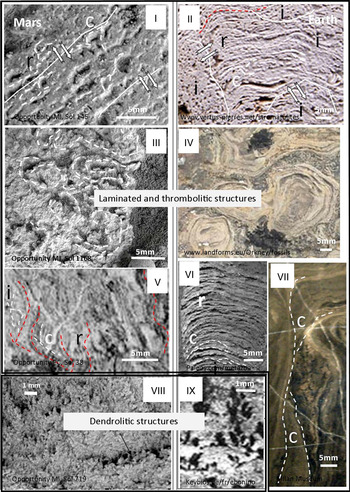
Pictures show possible microbialite mesostructural features on Mars and on Earth. They are: vertical or lateral structural changing (arrows) from waved ‘r’ to chaotic ‘i’ (frames I and II); closed or open irregular curved lamination (frames III and IV); closure of no-isopache sequence ‘c’, as well as crossing filaments ‘i’ and waved lamination ‘r’ (frames V–VII); occurrence on Mars of laminated and dendrolitic type structures (frame VIII) show the same pattern of terrestrial microbialites counterpart (frame IX).

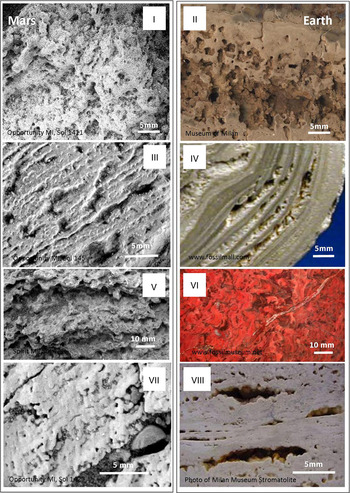
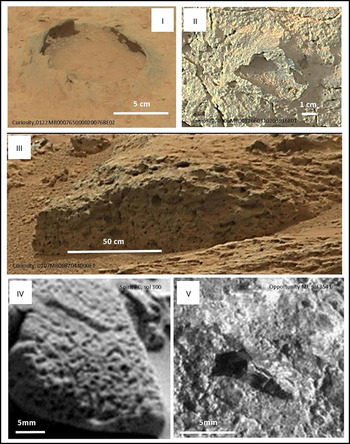
Other examples of such mesostructural features, both for terrestrial stromatolites and for Martian sediments, are presented in Figs. 6 and 11. Figure 6 reports examples of gradually transient structures, from laminated to thrombolytic ones (see arrows in frames I and II) and examples showing together laminated and dendrolitic mesostructures (frame VIII). This figure also shows occurrence of possible parallels in irregular – closed or open – laminated structures (frames III and IV) and in dendrolitic structural parallels (frames VIII and IX). In the same figure, it is possible to observe how typical stromatolite wavy lamination (frames VI and VII) could modify the isopachous sequences, giving irregular settings, also observed on Mars (frame V). Besides, it is well known that the amount and the distribution of voids are very important in microbialite formations (Grotzinger & Knoll Reference Grotzinger and Knoll1999; Lamond & Tapanila Reference Lamond and Tapanila2003; Bosak et al. Reference Bosak, Bush, Flynn, Liang, Ono, Petrof and Sim2010). They are, not only, indirect structures induced by gas production during bacterial metabolism, but also, they could have a functional role, as demonstrated in the case of films formation (Baqué et al. Reference Baqué, Scalzi, Rappow, Rettberg and Billi2013). Then, their occurrence and shape are important because they should reflect the (bio) mineralic fabric, as could be for a laminated or a thrombolitic mesostructure. This occurrence on Martian sediments represents a further parallelism and should reflect a common biological fabric (Fig. 7). In other cases, their shapes are not related to the fabric, but could deform them due to the strong gas accumulation, showing a tendency to assume not conform round shapes (Fig. 8). As a result, the Martian sediments, as imaged by rovers, show everywhere a lot of voids, whose shape and dimension have counterparts in terrestrial stromatolites. Moreover, voids at micro and meso scales, shown in Fig. 8, are clearly referable to ‘pustules’ and ‘burst gas domes’ type structures, due to large volumes and widespread gas production. Voids also occur inside interesting welded and inter-grown structures of ‘cauliflower type’ (Sprachta et al. Reference Sprachta, Camoin, Golubic and LeCampion2001), of which strong counterparts with terrestrial microbialites were also found (Fig. 9). This structure seems composed by the inter-digitate growing of biomineralized bodies from ancestral aggregation points, such as microclots and/or lumps.
Parallels between different types of void shapes reflecting microbialite samples structure. Void comparison for Earth and Mars showing: a thrombolytic structure, where voids are infra clot spaces (frames I and II); a stromatolitic structure, where voids follow laminations (frames III and IV); a stromatolitic and chaotic lamination, where voids are both waved and chaotic (frames V and VI); a stromatolitic and clotted lamination, where voids follow both wave lamination than clots shape (frames VII and VIII).

Examples of voids on Mars, denoting a strong and widespread gas production. Possible MISS type structures are shown on: frames I and II, as example of ‘gas burst dome’ (note the irregular protruding shape of void on frame II, due to the bursting); frame V, as possible ‘pustule’ (note the top rupture of the layer swelling surface). Pictures, on frames III and IV, show widespread gas production on Martian sediments, recorded respectively by rovers ‘Curiosity’ and ‘Spirit’. All such voids are quite different from those of the previous Fig. 7 because they are strongly deforming the sediment structure due to the abundant gas production and/or accumulation, both on large scale (frames I and III) than on micro scale (frames IV and V).

Pictures show possible parallels of Martian sediments with thrombolytic and other interpenetrate structures of terrestrial microbialites. On frames II and IV, are reported thrombolytic structures, made by inter-grown clots, whose possible Martian counterparts are shown in frames I and III. In particular, the inter-grown structures, shown in frame IV, are known as ‘cauliflower type’. Note that all the terrestrial thrombolytic structures, shown in frames II, IV, VII and IX, could be considered as interpenetrate or inter-grown structures, as well as the Martian ones, set on frames I, III, V, VI and VIII. Noteworthy, frames V and VI belong to a Martian encrusting coating, which was already regarded as terrestrial ‘desert varnish’, generated by microbial activity.

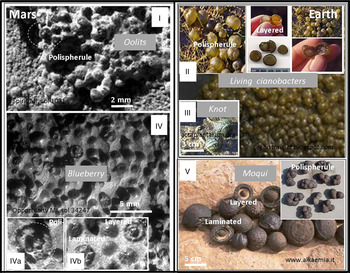
Occurrence of mesostructural parallels between Martian ‘blueberries’ and terrestrial ‘moqui’, including the possible role of microbial activity in their genesis, was already pointed out by several authors (Catling Reference Catling2004; Chan et al. Reference Chan, Bietler, Parry, Ormö and Komatsu2005). More complex settings of Martian ‘blueberries’, including polispherules and spiralate/wrapped structures, as well as internal growing, were also described in previous works (Rizzo & Cantasano Reference Rizzo and Cantasano2009, Reference Rizzo and Cantasano2011). In Fig. 10, it is highlighted how such peculiar spherical structures, named as ‘knot’ and having polispherule or layered settings, both occur in stromatolites and also in living colonies of cyanobacteria.
Examples of mesostructural parallels with occurrence of spherical bodies having similar shape and structure. On Mars, ‘blueberries’ could assume polycentric polispherules or concentric structures (frame IV, sub-frames IVa and IVb); on frame I, a spherule heap, like oolits, with a polispherule structure. On Earth, structural and shape parallels with ‘moqui’ (frame V) were already proposed, where microbial activity had a relevant role in their formation (Chan et al. Reference Chan, Bietler, Parry, Ormö and Komatsu2004, Reference Chan, Bietler, Parry, Ormö and Komatsu2005, Reference Chan, Johnson, Beard, Bowman and Parry2006). Note how such parallels occur also for living colony of cyanobacteria (frame II), as polispherule and concentric structures and for stromatolites (the knot structure in the frame III).

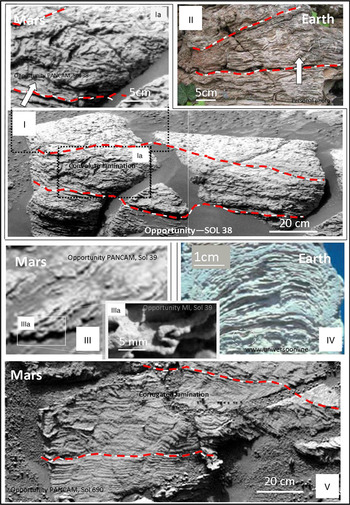
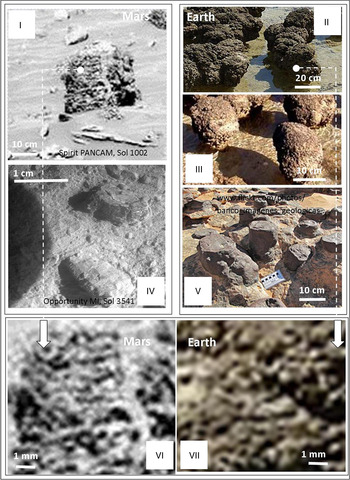
As regards macrostructures, preserved domical settings are unlikely to occur, due to the long history of Martian surface and to the widespread occurrence of meteorite impacts, affecting their integrity and unequivocal identification. However, especially in the first stretch of the rover Opportunity path, it was observed a gradual transition from flat laminated sequences to convoluted ones; a feature that also occurs in terrestrial stromatolites (Fig. 11). Other macrostructural parallels regard the possible presence of columnar stromatolites that, appropriately enlarged at the same scale of observation, show similar micro textures of the type highlighted in Fig. 2 (Fig. 12).
Parallels in waved/convolute lamination. Waved lamination on Mars shows chaotic ripples and gradually transient structures, like those of terrestrial stromatolites. In frame I and in sub-frame Ia, a planar laminated sequence gradually transient (arrow) to a very convolute/chaotic one. Frame II shows a similar transient stromatolitic structure. Frames III, IV and V show parallels between lamina ripples. The sub-frame IIIa of the Martian laminated sequence shows a single strong disharmonic lamina convolution, which might be incongruent with an abiogenic sedimentary environment.

Possible macrostructural parallels between columnar stromatolites (frames II, III and V) and similar Martian structures (frames I and IV) which may or may not represent structural remains. It is interesting to note that such similarity occurs, not only, for their shapes but also, for their microtextures, as shown in the magnified images of frames VI and VII.

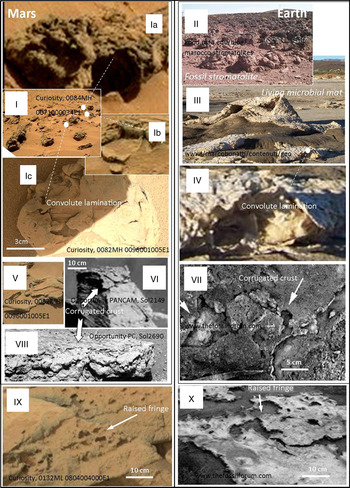
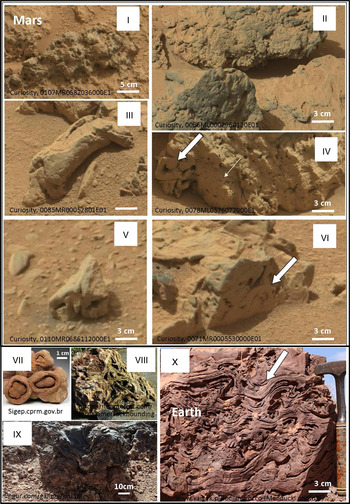
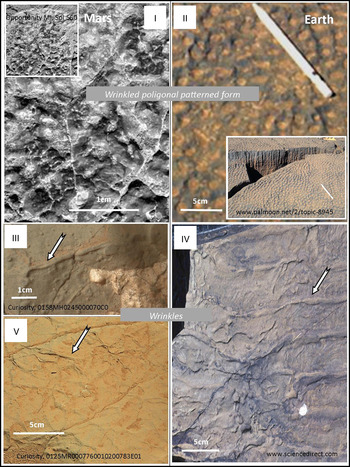
As well, at meso and macro scales, are frequently detectable fragments of layers very folded or convoluted, that resemble some microbial mat structures (Figs. 13 and 14). Somewhere, these fragments show smothered rounded borders typical of microbialite features. Examples of mixed structures, containing highly convoluted layers and ‘cauliflower type’ structures or filled in piles with extended and contiguous hollows (Fig. 14, frame I), are observable in the ‘Sheepbeed’ formation at Gale crater near Martian locations for which it has been proposed a possible parallel with microbialite outcroppings (Noffke Reference Noffke2015). Amongst these structures, are noteworthy the ones of ‘very convolute and roll up types’, as well as those of very strange conical shape shown on Fig. 14, frame V. These last resemble terrestrial stromatolites known as ‘Conophyton’ but cannot be ascribed to them, because they are lacking of a typical lamination. Finally, it was noted a strong likeness between some MISS observed on terrestrial mat and certain layer surface deformations on Mars, such as ‘wrinkles’ (Fig. 15) as well as other microbialite crust convolutions (Figs. 13 and 14).
Structural parallels between sheet-like layers of microbial mat and similar Martian outcroppings. Frame I (at Gale Crater), shows laminated/convolute (sub-frames Ia and Ic) and wrinkled (sub-frame Ib) structures, whose terrestrial biogenic counterparts are biogenic remains of stromatolite cover (frame II; see also frame IX of Fig. 14) and dried convolute microbial mat (frames III and IV). Fragments of similar convolute layers are shown in frame V. Frames VI–X show parallels in crust deformation. On Earth, such strong deformation and cover hardness are, generally, respectively due to high plasticity and to EPS adhesiveness of microbial mat. Note the protruding more adhesive/cohesive crust (arrows of b/n picture in frame VI) and the raised mat fringes (frames VII and X) whose counterparts are on Mars (frame IX).

Examples of convolute macrostructures in terrestrial microbialites and in Martian outcroppings at Gale Crater. Outcrop in frame I shows a lot of voids, somewhere stuffed, surrounded by a more consistent material. Detailed pictures of similar near located structures are given on frames III and V. The same outcrop shows occurrence (frames IV and V) of very convolute/chaotic and consistent layers (thick arrow) or lamina (thin arrow) and clots arrays (frame II). All structures denote a high pristine adhesiveness, whose counterparts on Earth are microbialites (frames VIII–X). Note the shape similarity, except lamination, between structures shown in frame V and the ‘Conophyton’ type stromatolite in frame VII.

Possible parallels between terrestrial microbialite wrinkle structures (MISS) and some Martian outcroppings. Frames I and II show surface polygonal deformations both on Earth (a tabulate stromatolite) than on Mars (by rover ‘Opportunity’, at Meridiani Planum). Frames III, IV and V show elongated wrinkled deformation (arrows) both on Mars (by rover ‘Curiosity’, at Gale Crater) and on Earth.

Discussion
Thousands of images acquired by the NASA rovers show a largely bare landscape covered by dunes with heavily destroyed outcroppings. However, even though rovers are moving on different sedimentary formations, many images, especially at Meridiani Planum, depict an ancient marine environment of shallow and calm waters, today in a dried setting. Really, in the Martian landscape of Meridiani Planum and Gusev Crater, the rovers have highlighted the presence of thinly laminated silt deposits containing sulphates, sometimes covered by alluvial outcroppings (Fernandez-Remolar et al. Reference Fernandez-Remolar, Morris, Gruener, Amils and Knoll2005; Squyres & Knoll Reference Squyres and Knoll2005; Grotzinger et al. Reference Grotzinger2011). Besides, rover ‘Curiosity’ shot some typical series of an intertidal environment in Gale Crater (Grotzinger et al. Reference Grotzinger2014). Such environments, on Earth, were generally interested by the first forms of life, as are microbialites and their peculiar multi-scale structures. Stromatolites, as a target for the search of life on Mars, was first suggested by McKay et al. (Reference McKay, Gibson, Thomas-Keprta, Vali, Romanek, Clemett, Chillier, Maechling and Zare1996) and then elaborated in more detail (McKay et al. Reference McKay2013).
In fact, we have found in Martian outcroppings, imaged by rovers, many structures, at micro, meso and macro scales, that seem to be similar to terrestrial stromatolites. This similarity involves not only morphological aspects, such are those shown in Figs. 1, 10 and 14 (possible cases of ‘Pareidolia’), but also peculiar internal structures (Figs. 2, 4–6, 10 and 12). Such arrays include, amongst others, transformations from lamina to crossing filaments (Figs. 4–6), incompatible with a physico-chemical sedimentation, assuming a conceptual meaning.
Also in this case, unlikeness was highlighted comparing these textures with some abiogenic granular rocks, such as siltstone, and pseudostromatolites, as are cave concretions (Fig. 2, frames VII–X). Micro texture parallels were, also, supported by multi-fractal approaches applied to the dimensional range of 0.1–1.0 mm (Bianciardi et al. Reference Bianciardi, Rizzo and Cantasano2014, Reference Bianciardi, Rizzo, Farias and Cantasano2015).
So, the widespread and simple structures observed at micro scale, by digital enhancement of macro photos are, really, microspherule arrays organized in more complex globular aggregates and/or in ribboned structures. Such microspherules, commonly of about 0.2–0.5 mm, were observed in all the analysed samples from Mars and Earth (Figs. 1 and 2). These compound bodies were also observed in fossil and living stages (Fig. 3) (Rizzo et al. Reference Rizzo, Farias, Cantasano, Billi, Contreras, Pontenani and Bianciardi2015), resembling ‘peloids’ or ‘ooids’ (Folk Reference Folk1980). These typical textures are, respectively, made by chaotic aggregate of micrite (a mixed of inorganic fine components) and by organic material (made by bacteria and EPS) or, most exclusively, by bio-mineralizing bacteria forming laminated/concentric patterns. It was, also, clearly documented that such spherules on terrestrial microbialites could be linked, during their growth, by enveloping cyanobacteria (Brehm et al. Reference Brehm, Palinska and Krumbein2004) or by an infilling endolithic microbial activity after their formation (McIntyre et al. Reference McIntyre, Prufert-Bebout and Ried2000; Baumgartner et al. Reference Baumgartner, Spear, Bucley, Pace, Reid, Dupraz and Vissker2009).
In regards to microfabric and laminae arrangements, both on Mars than on Earth, some researchers believe that they could be used to discriminate lithified microbial mats from sparry authigenic carbonate crusts formed by abiogenic processes (Perry et al. Reference Perry2007). As an example, the typical texture of isopachous sequences, dominated by chemogenic precipitation and observed in some thinly laminated terrestrial microbialites, must be considered of abiotic origin (Pope et al. Reference Pope, Grotzinger and Schreiber2000) while, in the opposite direction, terrestrial deposits of peloidal stromatolites, controlled by sedimentation stages and occurring in microbial mats, are clear evidence of a biological process (Paerl et al. Reference Paerl, Steppe and Reid2001; Dupraz et al. Reference Dupraz, Vissker, Baumgartner and Reid2004; Riding & Tomás Reference Riding and Tomás2006; Spadafora et al. Reference Spadafora, Perri, McKenzie and Vasconcelos2010). Nowadays, it is generally assumed that, at a lower scale, structural comparison between Mars and Earth cannot be useful as bio-discriminant. Instead, focusing on large features, microbialites/stromatolites could be detected in the field by using morphological approaches, as are space and shape of the lamina and other known meso and macrostructures. Then, a comparison could become effective starting at the scale of millimetre-thick layers or at the level of sub-millimetre microspherule arrays, as proposed in this paper. Accordingly to this kind of approach, it is possible to follow the layers arrangement over centimetre and their setting, in the context of the outcrop, usually in metres.
In fact, starting from basic microstructures, as in microspherules, and following a mainly geometric point of view, it was observed that a large variety of microbialites in their meso and macrostructures, shows the same order of spatial distribution in spherical, linear and other derivate arrays, as are planar or polycentric settings. Indeed, in many samples it is noticeable the presence of aggregates in spheroidal assets as clots, lumps and polycentric structures, growing in a ‘cauliflower type’ aggregation and/or in crossing and interwoven filaments forming the well-known chaotic mesostructures by thrombolytic type. As well, on-line developments, organized in clusters, form dendrolitic mesostructures, while planar growths of mixed structures give lamina. Besides, occurrence of linked microspherules in donut settings on Mars sediments, as described in a previous work (Rizzo & Cantasano Reference Rizzo and Cantasano2009), is highlighted by crenellated/toothed lamina edges.
Due to these developing basic microstructures, one can observe at meso and macro level peculiar temporary structures, both on Mars and Earth, which could also help in their genesis assessment. As an example, the transient structures due to laminae crossing and/or splittings, shown in frames III–VIII of Fig. 4, have strong counterparts in the stromatolite frames II and III of Fig. 5. They are a geometrical non-sense considering that layers cannot be crossed or split, but they could be explained considering that lamina could turn into filaments, as one observe in stromatolite sequence. On Earth, it is noteworthy that transient structures, from laminate to convolute, as shown in Fig. 11, are commonly due to a gradual change in hydrodynamic flows where they show ordered sequences, known as ‘Bouma Unit’, due to ‘turbiditic current’ flowing in very deep sea environment. Really, this condition is incongruent with seafloor sediment structures of a calm hydrodynamic environment, as are those of laminated sediments at Meridian Planum (Clark et al. Reference Clark2005; Fernandez-Remolar et al. Reference Fernandez-Remolar, Morris, Gruener, Amils and Knoll2005; Squyres & Knoll Reference Squyres and Knoll2005). Similarly, other possible causes, due to slump structures and erosion followed by transport and deposition, seem to be incongruent to the lack of a stratigraphical discontinuity. Furthermore, examples of gradual transient lamination one can observe also at the mm-scale of a single lamina, where hydrodynamic condition cannot be involved in the explanation of a disharmonic folding (Fig. 11, frame IIIa) having, instead, clear counterparts on terrestrial stromatolites (Fig. 5). Noteworthy are the different ways that a single-layer folding can usually form in terrestrial geological systems (e.g. ptygmatic folding, slumping and gravity inversion) cannot be taken into account, for the different geological environment and for the variable dimensional scales. Really, ptygmatic folding are due to the different layer plasticity near their melting, while slumping generally involves the rupture and the deformation of a layer sequence.
At meso and macro scale, possible parallels with Martian sediments have been identified for most of structural patterns except for columnar, branched and domical forms, that are very rare or absolutely absent on Mars (Fig. 3). By this way, it has been proposed that, passing from micro and meso, where parallels are strong, to macrostructures, where there seems to be a lack, the main morphological and structural patterns differ to each other, probably, in relationship with different environmental conditions.
A further confirmation of such structural relationship could be inferred from the spherical bodies, spreading on Martian sediments (known as ‘blueberries’) and from fossil/living terrestrial microbialites (Fig. 10), both showing polispherules or concentric mesostructures, somewhere protruding in polilobate bodies. On Earth, this large amount of spherical bodies, both in stromatolites and, more generally, in microbialites, is a rule reaching until 100% of microfabric components in salty and evaporitic environments (Schneider et al. Reference Schneider, Arp, Reimer, Reitner and Daniel2013; Noffke Reference Noffke2015). In these conditions, the large amount of microspherules, forming the fabric, should be considered directly related to calm and brackish waters, while in fossil stromatolites seems to be more abundant in the Proterozoic Age when the declining of atmospheric CO2 and the increasing level of O2-led cyanobacteria to develop a ‘carbon concentrated mechanism’ (CCM; Riding Reference Riding, Nemeth, Manville and Kano2006). Really, in some terrestrial and Martian areas it is possible to observe coalescing triplets of these spherical forms and also ‘Pop Corn’ structures as multiple cement generations (McLennan et al. Reference McLennan2005) connected to nucleation sites and developed in early diagenetic stages (Chan et al. Reference Chan, Bietler, Parry, Ormö and Komatsu2005). Comparable hematite concretions occur in a large variety of terrestrial geological settings as pedogenic (Stiles et al. Reference Stiles, Mora and Driese2001), oolitic (Van Houten & Bhattacharya Reference Van Houten and Bhattacharya1982) or seafloor nodules (Bums & Burns Reference Bums and Burns1975). Above all, in both environments, the terrestrial and Martian processes of mineralization include similar spheroidal concretions, as well as some joined or triplet forms with the same pattern (Potter et al. Reference Potter, Chan, Petersen, Dyar and Sklute2011).
Briefly, as regard the found mesostructural parallels, Figs. 4–15 show some peculiar features, related to conceptual milestones that, normally, on Earth, are used for in situ detection of stromatolites; these are:
-
• transitions from a splitting lamina to two filaments;
-
• typical wrinkled laminations;
-
• gradual transition from planar settings into irregular waved sequences;
-
• thickness variations of laminae and of their sequences;
-
• production of gas, forming voids, adapting (Fig. 7) and/or altering (Fig. 8) the biofabric;
-
• production of EPS conferring high plasticity and adhesiveness to sediments (Figs. 11, 13 and 14);
-
• bio-mineralization processes forming organosedimentary bodies, characterized by special structures and textures (Figs. 11–15).
In particular, as regards voids, those shown in Fig. 7 seem to follow the built structure, as occurs for terrestrial stromatolites, while the bubbles shown in Fig. 8 highlight a marked and widespread gas production that, on Earth, is noticeable in microbial environment. In the same way, the layer deformations and the wrinkled polygonal patterns of honeycomb type, shown in Fig. 15, as well as the convoluted lamination shown in Figs 11, 13 and 14, have strong counterparts in terrestrial microbialites. Really, such deformations are so convolute and chaotic, as those shown in frames IV and VI of Fig. 14 and in frames Ia–c of Fig. 13, and are more in accordance with a typical deformation of microbial mats, as shown in frames IX and X of Fig. 14, than with clayey layers affected by some kinds of mechanical disturbance.
Conclusions
Images and data acquired by NASA rovers ‘Opportunity’ in Meridiani Planum, ‘Spririt’ in Gusev Crater and ‘Curiosity’ in Gale Crater, highlight the common presence of sedimentary rocks, formed in shallow water or in infra-tidal areas. The great amount and the high quality of the analysed pictures, available at both microscopic and macroscopic levels, allowed us to conduct structural investigation of Martian outcroppings and comparison between these structures and terrestrial sediments from similar environments.
These parallels are not only visual features, but also at a functional level underlying the structural complexity emerging from the study. Our work shows a wide range of parallels and close relationships existing between the Martian structures and the terrestrial features described here. Such analogies suggest a potential common biological origin, rather than a simple case of ‘Pareidolia’.
Acknowledgements
We acknowledge the Regional Museum of Natural Science at Turin (Italy), the Civic Museum of Natural History at Milan (Italy) and Professor Edoardo Perri at the University of Calabria (UNICAL) for providing stromatolite samples. Finally, we are grateful to the National Areonautics and Space Administration (NASA) for Martian images, which have provided the basis of our study.