INTRODUCTION
Two species of sole, the common sole Solea solea (Linnaeus, 1758) and the Senegalese sole Solea senegalensis Kaup, 1858, present some morphological similarities. However, the distinction is relatively easy. These species have a wide geographical distribution from the eastern Atlantic and Mediterranean Sea, in the north-eastern and south-eastern Atlantic, respectively, inhabiting sandy and muddy bottoms at depths near to 100 and 200 m (Quéro et al., Reference Quéro, Desoutter, Lagardère, Whithead, Bauchot, Hureau, Nielsen and Tortonese1986a), occurring in sympatry from North Africa and the western Mediterranean up to the Bay of Biscay.
The Portuguese coast is a very important area for several flatfish species (e.g. Nielsen, Reference Nielsen, Whithead, Bauchot, Hureau, Nielsen and Tortonese1986a, Reference Nielsen, Whithead, Bauchot, Hureau, Nielsen and Tortoneseb, Reference Nielsen, Whithead, Bauchot, Hureau, Nielsen and Tortonesec, Reference Nielsen, Whithead, Bauchot, Hureau, Nielsen and Tortonesed; Quéro et al., Reference Quéro, Desoutter, Lagardère, Whithead, Bauchot, Hureau, Nielsen and Tortonese1986a, Reference Quéro, Desoutter, Lagardère, Whithead, Bauchot, Hureau, Nielsen and Tortoneseb; Cabral, Reference Cabral2000a), and, some of these species have a high commercial interest. Flatfish fisheries represent 4% of all the fish biomass landed on the Portuguese coast (source: Direcção Geral das Pescas (DGPA)). However, the importance of flatfish fisheries is considerably higher due to the high commercial value of flatfish species, accounting for nearly 11% of the economic value of the fish landings (source: DGPA). According to official data, soles landings increased from 464.01 tonnes, in 1998, to 510.39 tonnes, in 2005 (source: DGPA).
Studies on the feeding ecology of S. solea have been carried out on coastal areas of north-western Europe (e.g. Rijnsdorp & Vingerhoed, Reference Rijnsdorp and Vingerhoed2001; Vinagre et al., Reference Vinagre, França, Costa and Cabral2005) and the western Mediterranean (e.g. Molinero et al., Reference Molinero, Garcia and Flos1991; Darnaude et al., Reference Darnaude, Harmelin-Vivien and Salen-Picard2001). Unlike S. solea, the diet of S. senegalensis is known only from the western Mediterranean (Molinero et al., Reference Molinero, Garcia and Flos1991; Garcia-Franquesa et al., Reference Garcia-Franquesa, Molinero, Valero and Flos1996) and Portugal (Cabral, Reference Cabral2000b; Sá et al., Reference Sá, Bexiga, Vieira, Veiga and Erzini2003). Most of these studies were focused mainly on juveniles.
Age and growth of S. solea has been studied by several authors, in Western Europe (e.g. Cabral, Reference Cabral2003; Henderson & Seaby, Reference Henderson and Seaby2005) and in the Mediterranean (e.g. Vianet et al., Reference Vianet, Quignard and Tomasini1989; Garcia et al., Reference Garcia, Molinero and Flos1991; Türkmen, Reference Türkmen2003). Few studies were conducted for S. senegalensis, and all are related to the Portuguese coast (Dinis, Reference Dinis1986; Andrade, Reference Andrade1992; Cabral, Reference Cabral2003).
Studies on reproduction have been conducted on S. solea in Western Europe (e.g. Baynes et al., Reference Baynes, Howell, Beard and Hallam1994; Bromley, Reference Bromley2003) and the Mediterranean (e.g. Vallisneri et al., Reference Vallisneri, Tinti, Tommasini and Piccinetti2002; Türkmen, Reference Türkmen2003). Reproduction of S. senegalensis has been studied in Western Europe (e.g. Dinis, Reference Dinis1986; Andrade, Reference Andrade1990) and in the Mediterranean (Ramos, Reference Ramos1982).
Studies conducted along the Portuguese coast, revealed that the diet of S. solea was similar to the diet of S. senegalensis, the soles fed on a low variability of invertebrates, such as Polychaeta and Amphipoda (Cabral, Reference Cabral2000b; Sá et al., Reference Sá, Bexiga, Vieira, Veiga and Erzini2003; Vinagre et al., Reference Vinagre, França, Costa and Cabral2005). Longevity of S. solea was 15 years with a maximum total length of 500 mm (Dinis, Reference Dinis1986), and Andrade (Reference Andrade1990) determined for S. senegalensis a maximum total length of 516 mm and a longevity of 11 years. Solea senegalensis presented a long reproduction period ranging from autumn to spring (Andrade, Reference Andrade1990), or from spring to summer (Dinis, Reference Dinis1986).
Studies on the ecology of these two species in sympatric areas (i.e. from the Bay of Biscay to North Africa and western Mediterranean) are scarce. The importance of these studies is crucial for management purposes. The aim of the present work was to study the diet ecology, age and growth, and reproduction of S. solea and S. senegalensis on the Portuguese coast.
MATERIALS AND METHODS
Sampling surveys and samples processing
Bimonthly samples were collected between January 2003 and June 2005 from commercial fishing vessels operating with gill-nets and bottom trawls along the Portuguese coast. The whole Portuguese coast was sampled throughout the year (a minimum of 40 individuals were obtained by sampling time and area).
All fish were measured (total length to nearest 1 mm) and weighed (total and eviscerated wet weight with 0.01 g precision). Gut and gonads were removed and frozen (–20°C) for further analysis. Sagittae otoliths were removed, cleaned and kept dry for later age determination.
Feeding ecology
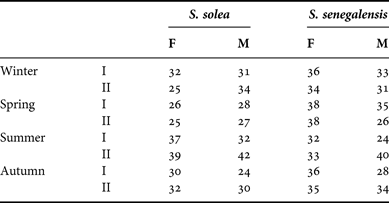
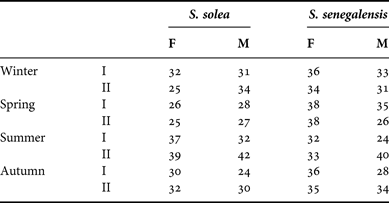
The stomach contents of 494 S. solea (total length between 187 mm and 465 mm) and 533 S. senegalensis (total length between 191 mm and 494 mm) were analysed (Table 1). Each prey item was identified to the lowest taxonomic level possible, counted and weighed (wet weight with 0.001 g precision).
Number of Solea solea and Solea senegalensis stomachs analysed per sex, size and season (F, females; M, males; I, size-class I; II, size-class II).
The relative importance of each prey item in the diet was evaluated by the numerical (NI), occurrence (OI) and gravimetric (GI) indices (Hyslop, Reference Hyslop1980). Feeding activity was evaluated by the vacuity index (VI) defined as the percentage of empty stomachs (Hyslop, Reference Hyslop1980).
Correspondence analyses (CA) were run to evaluate diet variation with season, sex and fish length according to each of the three index values. Prey items were grouped to a broader taxonomic level, four seasons (winter, spring, summer and autumn) and two size-classes (size-class 1 < 300 mm and size-class 2 ≥ 300 mm total length) were considered. These analyses were performed using CANOCO (CANOnical Community Ordination) version 4.5 (ter Braack & Šmilauer, 2002).
Diet differences between season, sex and fish size were tested using the χ2-test (Zar, Reference Zar1984) with a 0.05 significance level.
Diet overlap was measured using the Schoener index (IS), defined as
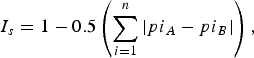
where p iA and p iB and were the numerical frequencies of item i in the diet of species A and B, respectively (Linton et al., Reference Linton, Davies and Wrona1981). Values of diet overlap vary from 0, when no food is shared, to 1, when there is the same proportional use of all food resources. Although there are no critical levels with which overlap values can be compared, Wallace (Reference Wallace1981) and Wallace & Ramsey (Reference Wallace and Ramsey1983) suggested that values higher than 0.6 should be considered as biologically significant.
The degree of feeding specialization of each season, sex and size-class of fish was determined using the Shannon–Wiener diversity index H′(Shannon & Weaver, Reference Shannon and Weaver1949):
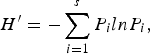
where P i is the numerical proportion of the ith prey category in the diet and s is the total number of different prey categories consumed by predator. This index corresponds to the dietary breadth (Marshall & Elliott, Reference Marshall and Elliott1997).
Growth
Age was evaluated using otoliths readings. For each specimen, two counts of otolith annuli were made under a dissecting microscope. Whenever the two readings of the same otolith resulted in different age estimates the data were not considered for further analysis.
Estimates of theoretical growth in length were obtained by fitting length-at-age data to the von Bertalanffy growth equation:

where Lt is the total length, L ∞ is the asymptotic length, k is the growth coefficient and t 0 is the theoretical age at zero length. The growth parameters of this model were estimated iteratively using the least squares method in STATISTICA (Statsoft) software. This analysis was performed separately for males and females.
Reproduction
Gonads were observed macroscopically and a maturation stage was assigned to each individual, according to the scale: I, immature; II, development; III, spawning; and IV, post-spawning (Cabral, Reference Cabral1998). For each season (winter, spring, summer and autumn), the percentage of fish in stages II, III and IV was determined.
In order to evaluate gonadal development throughout the year in order to determine the spawning season, the gonadosomatic index (GSI) was calculated, per sex, for each season. The GSI was expressed as the percentage of the weight of gonads in relation to eviscerated weight of fish. The sex-ratio was expressed as the proportion between the number of females and the number of males. Age and length at first maturity were determined.
RESULTS
Feeding ecology
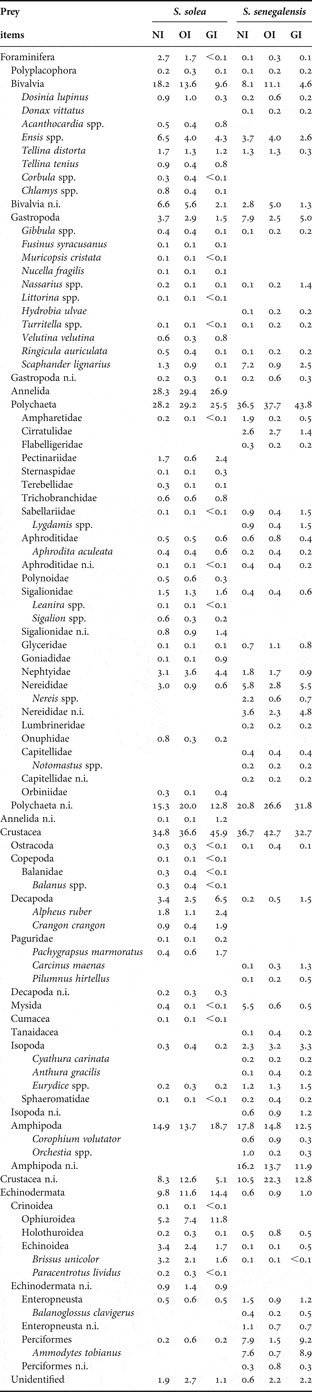
Crustacea, Polychaeta and Bivalvia were the most important items in the diet of S. solea and S. senegalensis (Table 2). Among Crustacea, Amphipoda presented the highest contribution to the diet of both species, followed by Decapoda and Mysida, for common sole and Senegalese sole, respectively. The most important Polychaeta prey were Nephtyidae and Nereididae to S. solea and Nereididae and Cirratullidae to S. senegalensis. Ensis spp. and Tellina distorta were the most important bivalves in the diet of both species. The VI was higher for Senegalese sole (45.4%) compared to the value obtained for common sole (33.3%). The lowest values of vacuity occurred in summer, for females and for small size individuals (Table 3).
Numerical (NI), occurrence (OI) and gravimetric (GI) indices values of prey found in guts of Solea solea and Solea senegalensis, on the Portuguese coast. n.i., not identified.

Vacuity index for each season (w, winter; sp, spring; s, summer; a, autumn), sex (F, females; M, males) and size-class (I, size-class I; II, size-class II), for Solea solea and Solea senegalensis.

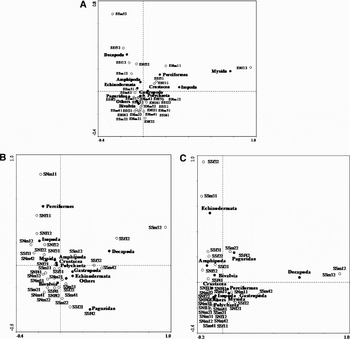
The correspondence analysis (CA) performed using data on the three indices for the main prey groups, by season, sex and size-class, explained ~40% of the variance in the first two axes (37.3%, 45.9% and 43.7% for NI, OI and GI, respectively) (Figure 1).
Ordination diagrams of the correspondence analyses performed using numerical (A), occurrence (B) and gravimetric (C) indices values of prey found in guts of Solea solea and Solea senegalensis (SS, S. solea; SN, S. senegalensis; f, females; m, males; w, winter; sp, spring; s, summer; a, autumn; 1, size-class I; 2, size-class II).

In the ordination diagram obtained for the numerical index (Figure 1A) it can be seen that: S. solea was associated with Bivalvia. Largest females, in summer and in winter were associated with Decapoda. Diet of largest individuals, in autumn, was composed of Paguridae. In the summer, small individuals' diet was mainly associated with Echinodermata. The small males' diet, in winter and spring, was composed of Gastropoda. Solea senegalensis was chiefly associated with Bivalvia and Polychaeta. For common sole and Senegalese sole, the numbers of each prey item differed between seasons (χ2 = 337.3, df = 18, P < 0.05 and χ2 = 1349.2, df = 18, P < 0.05, respectively).
When the OI was considered in the ordination analysis (Figure 1B), the diet of S. solea was mainly composed of Bivalvia. Small females' diet, in winter was composed of Mysida. Largest individuals, in winter and summer, were associated with Decapoda, and in summer and autumn, were associated with Gastropoda. Females' diet in spring and summer were associated with Paguridae. Small individuals were associated, in winter and summer, with Polychaeta. Solea senegalensis was strongly associated with Bivalvia and Mysida. Largest individuals were associated with Isopoda. In the autumn, the diet of small females was composed of Polychaeta. The diet of common sole and Senegalese sole was different between sexes (χ2 = 40.3, df = 11, P < 0.05 and χ2 = 449.2, df = 11, P < 0.05, respectively).
If the gravimetrical data were considered in the ordination diagram (Figure 1C) it can be seen that small individuals of S. solea were chiefly associated with Polychaeta. The diet of females, in spring and summer, was composed of Amphipoda. Decapoda and Paguridae were associated with the largest individuals. Solea senegalensis diet was largely associated with Polychaeta. Solea solea and S. senegalensis presented a different diet between the two size-classes (χ2 = 144.0, df = 11, P < 0.05 and χ2 = 614.0, df = 11, P < 0.05, respectively).
Both species showed highest dietary diversity in winter (H′ = 2.90 to common sole, H′ = 2.20 to Senegalese sole). Females of common sole showed a higher dietary breadth than males (H′ = 3.13 and H′ = 2.98, respectively), and the dietary diversity increased with size (H′ = 3.13 to class II and H′ = 2.98 to class I). Senegalese sole showed an opposite tendency relative to common sole dietary breadth, males Shannon–Wiener index was greater than females Shannon–Wiener index (H′ = 2.63 and H′ = 2.18), and the dietary breadth decreased with size (H′ = 2.63 and H′ = 2.18).
Judged by the Schoener index values >0.6, a high diet overlap occurred only in the winter period (0.79) and between females (0.66).
Age and growth
Among the 267 individuals collected for age determination for S. solea, the otoliths from 154 females and 113 males were used. The total length of fish analysed varied from 224 mm to 462 mm from females and from 187 mm to 415 mm from males. The ages of the samples ranged from 1 to 9 years. A total of 181 individuals were analysed for age determination for S. senegalensis, the otoliths from 84 females and 97 males were used. The length of the female specimens analysed varied from 215 mm to 472 mm and that of males from 199 mm to 412 mm. The age of S. senegalensis specimens analysed ranged from 2 to 8 years.
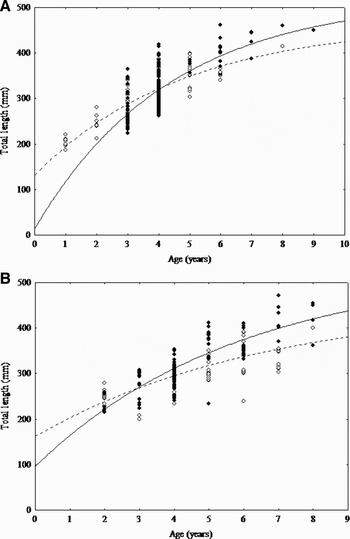
The von Bertalanffy growth equation coefficients for common sole differed between sexes (Figure 2A). The asymptotic length (L ∞) obtained for females was higher compared to males (521.5 mm and 466.9 mm, respectively), while the growth coefficient (k) estimate of females (k = 0.23) was higher than that determined for males (k = 0.21). The t 0 estimates were –0.11 and 1.57 for females and males, respectively.
von Bertalanffy growth curves fitted to length-at-age data of Solea solea (A) and Solea senegalensis (B) (females, black circles and solid lines; males, empty circles and dashed lines).

Coefficients of the von Bertalanffy growth equation for Senegalese sole showed a difference between sexes (Figure 2B). The estimated asymptotic lengths were higher for females (L ∞ = 532.3) than for males (L ∞ = 457.2), while growth coefficient was higher for females compared to males (k = 0.17 and k = 0.15, respectively), and the t 0 estimates were –1.17 for females and –2.91 for males.
Reproduction
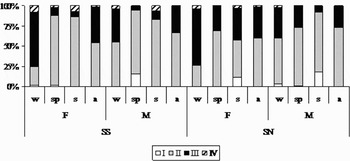
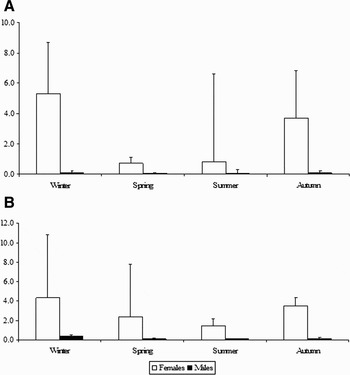
The percentage of individuals of S. solea in each maturation developmental stage per season is in agreement with the variation pattern obtained for the GSI (Figures 3 & 4). The highest values of the GSI were obtained in winter, which was the period when the highest percentage of individuals in stage III (spawning) was recorded.
Percentage of individuals of Solea solea (SS) and Solea senegalensis (SN) in each maturation stage (I, immature; II, development; III, spawning; IV, post-spawning), according to season (w, winter; sp, spring; s, summer; a, autumn) and sex (F, females; M, males).

Gonadosomatic index mean values, determined for each season and sex for Solea solea (A) and Solea senegalensis (B) (standard deviation is represented above bars).

Comparing the GSI values of males and females, it can be noticed that the values obtained for females (mean value from 0.70 to 5.31) were extremely high when compared with those determined for males (mean value from 0.05 to 0.10).
The proportion of individuals of S. senegalensis according to maturity stages was found in agreement with GSI seasonal changes (Figures 3 & 4). The highest values of the GSI were obtained in winter, which was the period when the highest percentage of individuals in stage III (spawning) was recorded.
Comparing the GSI values of males and females, it can be noticed that the values obtained for females (mean value from 1.49 to 4.30) were extremely high when compared with those determined for males (mean value from 0.08 to 0.42).
DISCUSSION
The present study shows that the trophic profile of common sole is characterized by Crustacea, Polychaeta and Mollusca. Our results were similar to the results obtained in several studies made in Western Europe (e.g. Cabral, Reference Cabral2000b; Sá et al., Reference Sá, Bexiga, Vieira, Veiga and Erzini2003; Vinagre et al., Reference Vinagre, França, Costa and Cabral2005) and in the Mediterranean (Molinero & Flos, Reference Molinero and Flos1992). Other authors (e.g. Darnaude et al., Reference Darnaude, Harmelin-Vivien and Salen-Picard2001; Vallisneri et al., Reference Vallisneri, Tinti, Tommasini and Piccinetti2002) reported that this species consumes mainly Polychaeta, Crustacea and Mollusca. The variety of habitats—shallow costal areas, continental shelf, estuarine ecosystems—and the range of fish lengths analysed in these studies probably account for these slight dietary dissimilarities.
The diet of S. senegalensis was similar to S. solea as outlined by several authors (e.g. Garcia-Franquesa et al., Reference Garcia-Franquesa, Molinero, Valero and Flos1996; Cabral, Reference Cabral2000a; Sá et al., Reference Sá, Bexiga, Vieira, Veiga and Erzini2003).
The feeding activity of common sole and Senegalese sole varied throughout the year, being highest in summer but lowest in winter. This feeding behaviour is consistent with the findings reported in several studies (e.g. Ramos, Reference Ramos1981; Molinero & Flos, Reference Molinero and Flos1992; Cabral, Reference Cabral2000a), but disagrees with Garcia-Franquesa et al. (Reference Garcia-Franquesa, Molinero, Valero and Flos1996), Vallisneri et al. (Reference Vallisneri, Tinti, Tommasini and Piccinetti2002) and Sá et al. (Reference Sá, Bexiga, Vieira, Veiga and Erzini2003) who pointed out, for both species, that vacuity was higher in spring–summer. Females of both species presented lower vacuity values than males, which is in agreement with previous studies (Molinero & Flos, Reference Molinero and Flos1991; Garcia-Franquesa et al., Reference Garcia-Franquesa, Molinero, Valero and Flos1996). Smallest individuals of these two sole species were more active for feeding than the largest ones (Molinero & Flos, Reference Molinero and Flos1991; Garcia-Franquesa et al., Reference Garcia-Franquesa, Molinero, Valero and Flos1996). Several factors may explain these differences. Firstly, in spring, environmental conditions are favourable for an increase of prey availability. Secondly, since the process of reproduction was completed, females must recover their energetic resources, as it has been reported for other flatfish (Pitt, Reference Pitt1973; Lozán, Reference Lozán1992).
Common sole and Senegalese sole presented variations in diet according to season, sex and length, that may be due to many factors, such as changes in space and time of benthic prey, shifts due to life-history patterns of prey and feeding activity of predator (Wootton, Reference Wootton and Wootton1998). The results relative to diet variation according to fish length were similar to those obtained by other authors for other flatfish species, showing an increase in the importance of larger prey with increasing size of fish (e.g. Belghyti et al., Reference Belghyti, Aguesse and Gabrion1993; Cabral, Reference Cabral2000a). This is consistent with the optimum foraging theory (Gerking, Reference Gerking1994), which states that larger predators tend to consume larger prey in order to maximize the energetic gain relative to capture effort.
Common sole presented a larger dietary breadth compared to Senegalese sole. The diet diversity of both sole species was higher when the vacuity reached a maximum value, which could constitute a compensatory response to a possible decrease of prey availability during those seasons. A study conducted in southern Portugal (Sá et al., Reference Sá, Bexiga, Vieira, Veiga and Erzini2003) showed than both species presented low dietary variation.
Diet overlap values were high only in the winter period between the two species and for females. Cabral (Reference Cabral2000a) showed that interspecific diet overlap was low for juveniles of the two sole species. Some authors (Moore & Moore, Reference Moore and Moore1976; Poxton et al., Reference Poxton, Eleftheriou and McIntyre1983; Burke, Reference Burke1995) report the avoidance of interspecific competition by the adoption of different strategies of resource, which may also be the case for adult soles.
The estimate of von Bertalanffy parameters for S. solea obtained in the present study was similar to those reported by Dinis (Reference Dinis1986) for the Tagus estuary. The asymptotic length values reported for Northern Europe and the Mediterranean (e.g. Deniel, Reference Deniel1981; Türkmen, Reference Türkmen2003) were lower than the ones estimated in the present work. Growth coefficient (k) estimates were lower for the Portuguese coast compared to those determined for Northern Europe and the Mediterranean; the highest values were obtained for males by Vianet et al. (Reference Vianet, Quignard and Tomasini1989).
Growth studies for S. senegalensis are scarce and all developed on the Portuguese coast. The estimates of von Bertalanffy parameters obtained in this study were similar to those proposed by Andrade (Reference Andrade1990), for the southern coast of Portugal. Andrade (Reference Andrade1990) points out that the highest values of total length were relative to females and estimated that the largest individual analysed (516 mm) should have 11 years. The estimates of L ∞ reported by Dinis (Reference Dinis1986), for the Tagus estuary, were lower than our results and also the values determined by Andrade (Reference Andrade1990).
Many factors could influence growth. According to Pauly (Reference Pauly1994a) latitudinal variation in growth is caused mainly by variations in maintenance metabolism due to latitudinal differences in temperature. The differential growth according to sex, registered for both species, may be due to the distinct maintenance metabolism of the two sexes by different oxygen consumption (Pauly, Reference Pauly1994b), by the different share between reproduction and somatic growth of surplus energy, as Rijnsdorp & Ibelings (Reference Rijnsdorp and Ibelings1989) and Rijnsdorp (Reference Rijnsdorp1993a) found in plaice, and different food intake, as Lozán (Reference Lozán1992) found in other flatfish.
The results concerning the seasonal variation of gonadal indices suggest that the spawning period of both species is winter. Previous studies reported that the common sole reproduction period occurred mainly in winter, but it can occur in spring (e.g. Koutsikopoulos et al., Reference Koutsikopoulos, Desaunay, Dorel and Marchand1989; Zaki, Reference Zaki1989). Some authors reported reproduction only in winter (Vallisneri et al., Reference Vallisneri, Tinti, Tommasini and Piccinetti2002) or in spring (Türkmen, Reference Türkmen2003). Previous studies (Ramos, Reference Ramos1982; Türkmen, Reference Türkmen2003) reported lower values of length at first maturation than the values obtained in the present work. Studies taking place on the Portuguese coast have shown that the reproduction period of Senegalese sole ranges from autumn to spring (Andrade, Reference Andrade1990), or for spring to summer (Dinis, Reference Dinis1986). Some authors, for the north coast of France (Lagardère et al., Reference Lagardère, Decampes and Quero1979) and the Mediterranean (Ramos, Reference Ramos1982), suggested that reproduction occurs in the spring–summer period. Length at first maturation obtained in the present study was similar to values obtained by Andrade (Reference Andrade1990), for the south coast of Portugal.
Natural variation in size and age at maturity within a population of a species can occur in stable populations but is generally small. Several studies (e.g. Walsh, Reference Walsh1994; Bowering et al., Reference Bowering, Morgan and Brodie1997; Rijnsdorp & Vethaak, Reference Rijnsdorp and Vethaak1997) showed that a large variability in maturation could be related to the decline of populations. Variations in size and age at maturity may be genetic, or associated with changes in environmental conditions on the nursery grounds or later during the juvenile/adult stage (e.g. Stearns & Crandall, Reference Stearns, Crandall, Potts and Wootton1984; Rijnsdorp, Reference Rijnsdorp, Stokes, McGlade and Law1993b).
In conclusion, several aspects of S. solea and S. senegalensis biology remain to be studied, namely the evaluation of prey availability and predation pressure, length–frequency distribution analysis, the characterization of the reproductive period and gonadal modifications, as well as regarding larvae and juvenile stages.
ACKNOWLEDGEMENTS
This study was partially financed by the Fundação para a Ciência e a Tecnologia (FCT), through the grant awarded to C.M. Teixeira (Grant SFRH/BD/19319/2004).
This study was also co-funded by the European Union through the FEDER—Fisheries Programme (MARE).