Disasters, either man-made or natural, are occurring more frequently around the world.Reference Wise1 No country is considered immune from them or any other catastrophic events.Reference Veenema2 Disasters can take place anywhere in the world, at any time, and cause extensive damage to resources and goods, especially homes, health care facilities, vehicles, transport, and communication networks.Reference Jose and Dufrene3 Approximately, there has been a 60% increase in disasters worldwide in the last 10 years. These disastrous events have left 2 million people dead, 4.2 million casualties, and 3.3 million people homeless.Reference Achora and Kamanyire4 Although disasters have had a harsh impact on peoples’ belongings and their surroundings, the ensuing morbidity and mortality rates require health care professionals to respond as effectively and as efficiently as possible.Reference Sloan5
Disaster and mass casualties differ from ordinary emergency situations, necessitating extraordinary efforts to equip nurses with knowledge and skills that will prepare them to respond effectively.Reference Hubloue and Debacker6 Furthermore, for health care professionals, disaster management is a challenging situation in different settingsReference Conlon and Wiechula7 in which professionals, especially nurses, play an important role in all of the phases, such as planning, mitigation, and responding to medical consequences of a disaster or other community crisis, whether natural or man-made.Reference Conlon and Wiechula7
Because nurses are expected to demonstrate basic competency in responding to disastrous events, they should be competent in their response to mass casualty incidents,Reference Yan, Turale, Stone and Petrini8 especially as nurses are often the first health care providers to respond in catastrophic situations.Reference Conlon and Wiechula7 Many studies have reported a low level of nursing preparedness in responding to and managing major disaster events.Reference Jose and Dufrene3,Reference Conlon and Wiechula7,Reference Austin, Hannafin and Nelson9-Reference Ranse, Shaban and Considine11
An effective disaster response can be achieved by efficient preparedness, which can be accomplished through several methods, including mock drills, workshops, continuous education sessions, and the incorporation of disaster management contents into the nursing curriculum.Reference Baack and Alfred12 Preparing future nurses (current nursing students) to intervene appropriately in such situations is a dominant concern in nursing education.Reference Jose and Dufrene3 Nursing education plays a significant role in preparing nurses for a disaster because it helps in increasing their knowledge on disasters through research efforts and increasing the effectiveness of their response during a disaster.Reference Veneema, Losinski, Newton and Seal13 Integration of disaster preparedness content into undergraduate nursing curricula prepares the ensuing generation of nurses for disaster events in the future.Reference Al Thubaiti, Hamouda and El Seesy14 Other studies indicated that, through collaborative partnerships with hospital authorities and educational institutions, specific courses could be undertaken to assist professional nurses to be better prepared for disasters.Reference Halstead15,Reference Loke and Fung16 Furthermore, nurses emphasized the need to integrate disaster training in undergraduate curricula.Reference Al Khalaileh, Bond and Alasad17 One of the most important components of preparing nurses for a disaster is by integrating disaster preparedness contents in undergraduate nursing curriculum.Reference Al Khalaileh, Bond and Alasad17-Reference Öztekin, Larson and Altun Uğraş19
Nursing educators should be equipped with knowledge and skills to employ an effective approach to responding to disasters.Reference El-Hosany and Ghonem20 They should also plan to prepare nursing students for disasters and emergency situations.Reference Ranse, Shaban and Considine11 Further research needs to focus on nursing educators to identify their perception toward the importance of disaster preparedness and the needs for disaster preparedness and management, in general.Reference Al Thubaiti, Hamouda and El Seesy14
Nevertheless, a lack of undergraduate educators’ capacity to teach disaster management courses has been found,Reference Bajow, Djalali and Ingrassia21 despite their recognition of the importance of integrating such courses in nursing curricula.Reference Whitty and Burnett22 However, there is no evidence of the integration of disaster contents in nursing curricula in countries in the Africa and Middle East regions, except some nursing programs in Jordan, Turkey, and Iran.Reference Al Khalaileh, Bond and Alasad17,Reference Öztekin, Larson and Altun Uğraş19,Reference Zarea, Beiranvand and Sheini-Jaberi23
Jordan, like all other countries, is vulnerable to all types of disasters. Despite the fact that Jordan has been relatively stable, nearby, an active Syrian civil war makes Jordan open to the threat of terrorist attacks. Coupled with this, Jordan is receiving huge numbers of refugees. Any potential event may overwhelm the available goods and supplies and consequently make Jordan unable to effectively manage a disaster.
Because education in disaster management is the cornerstone of preparedness, nursing educators can play a crucial role in preparing their students to respond effectively and efficiently to a catastrophe, if they perceive disaster preparedness as very important. As a response to the World Health Organization (WHO) and the International Council of Nurses’ (ICN) call for integration of disaster management, courses in basic nursing education came into existence in 2009. A 3-day workshop to develop nursing competencies held in cooperation with Jordanian Nurses Council was undertaken. To date, several Jordanian universities include different mandatory or elective disaster management courses as part of their basic nursing program (University of Jordan, Mutah University, Applied Sciences University, and Al al-Bayt University) in order to raise the awareness toward disaster management (Abu Safi, 2018, unpublished doctoral dissertation).
Determining the actual attitude and perception of nursing educators toward disaster preparedness can help in the integration of disaster management in nursing curricula. Thus, the main purpose of the current study was to explore the attitudes of nursing educators on baccalaureate degree nursing programs in Jordan toward the integration of mass casualty and disaster preparedness into nursing curricula.
RESEARCH QUESTIONS
This study was designed to answer the following questions:
-
1. What are the attitudes of Jordanian nursing educators toward the integration of disaster management in nursing curricula?
-
2. What factors influence the importance of including disaster educational competencies into nursing curricula?
-
3. Are there differences in nursing educators’ attitudes toward the integration of disaster management in nursing curricula based on selective demographic data (years of experience, area of expertise, gender, and age)?
METHODS
Design
A descriptive cross-sectional survey was used.
Sample
All accessible nursing educators working in both public and private Jordanian universities were invited to participate in this study. Hence, the sample comprising 131 educators who hold masters or PhD degrees in nursing and who agreed to take part in this study.
Instrument
The questionnaire applied in the current study was developed by Whitty and Burnett (2009) and is divided into 3 main parts.Reference Whitty and Burnett22 The first part comprises 5 questions to help in assessing nurse educators’ training and experience regarding preparation for disaster management; they require participants to indicate their previous involvement in response to real and/or mock disasters, as well as their participation in any related training courses. The second part consists of 51 items that reflect participants’ perception of the importance of integrating each item into the nursing curriculum, judged as: (1) not at all important, (2) slightly important, (3) fairly important, (4) quite important, and (5) very important. The last part comprises 6 questions related to demographic data (age, gender, level of education, experience as a nurse, experience as a nurse educator, and teaching area).Reference Whitty and Burnett22 According to the author of instrument, a panel of 6 experts in nursing education proved content validity of the instrument.Reference Whitty and Burnett22 Moreover, construct validity established through conducting factor analysis, the findings revealed that the items loaded on 3 factors were knowledge, assessment, and skills. By using Cronbach’s alpha measure of internal consistency as a reliability estimate of the subscales, the results were presented as knowledge scale (0.96), assessment scale (0.95), and skills scale (0.91), which are acceptable according to the study by Whitty and Burnett.Reference Whitty and Burnett22 Some items of demographic data that do not apply in Jordan were omitted. Permission to adopt the instrument was obtained from the principal author.
Data Collection
Data were collected using self-reported questionnaires. The researcher distributed these questionnaires to each participant individually, accompanied by a cover letter, which elucidates the aims of the study. The participants were asked to submit the completed questionnaire to their dean’s office in a sealed envelope. After a week, the researcher collected the completed questionnaires from the dean offices.
Ethical Considerations
A copy of the final questionnaire and detailed information about the research were submitted to the Ethics Committee at Al al-Bayt University and to the research committee at each university in which the study was conducted, for their approval. Anonymity and confidentiality were ensured throughout the study; names of participants were not requested; and each questionnaire was coded numerically. Only the principal investigator had access to the data, which were secured appropriately, saved in the researcher’s personal computer, with hard copies kept in a locked cabinet. Respondents were assured that they were not obliged to participate in the study and could withdraw without any penalty.
RESULTS
Data were analyzed using the Statistical Package for Social Science (SPSS), version 22 (IBM Corp, Armonk, NY); according to the research questions, descriptive statistics were used to summarize central tendencies and frequencies. Correlation of nursing educators with some demographic data was also tested.
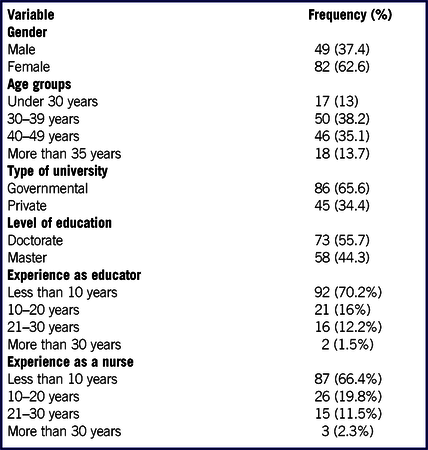
One hundred thirty-one (131) questionnaires distributed were returned with a response rate of 87%. Around two-thirds (62%) of participants were female, ages 25-26, and two-thirds (66%) currently worked in governmental universities with approximately two-thirds (68%) reporting more than 5 years of experience in clinical nursing. Seventy-three held a doctoral degree, and 58 held a master’s degree in nursing. Most of the participants (65%) had more than 5 years’ teaching experience. Nearly half (48%) teach adult health nursing, 23 (17.5%) teach women’s health, 21 (16%) teach community health, 14 (10.7%) teach mental health, and only 9 (6.8%) teach children’s health (Table 1).
Nurse Educators Demographics Characteristics (N = 131)

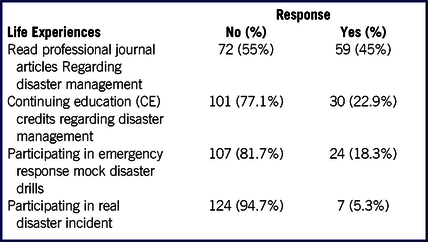
To find out the training received by nursing educators related to disaster management, participants were asked to indicate their response to particular questions related to reading professional journal articles regarding disaster, undergoing continuing education regarding nursing disaster management, participating in emergency response mock disaster drills, and participating in real disasters. Seventy-two (55%) of participants had read no articles about disasters or disaster management, and 59 (45%) had read such articles. Only 30 (23%) participants had participated in continuous education programs regarding disaster management. The majority (81.7%) of participants had never participated in emergency response or mock disaster drills. Only 7 (5.3%) participants had participated in real disaster events (Table 2).
Life Experiences Regarding Disaster Incidents as Reported by Nurse Educators (N = 131)

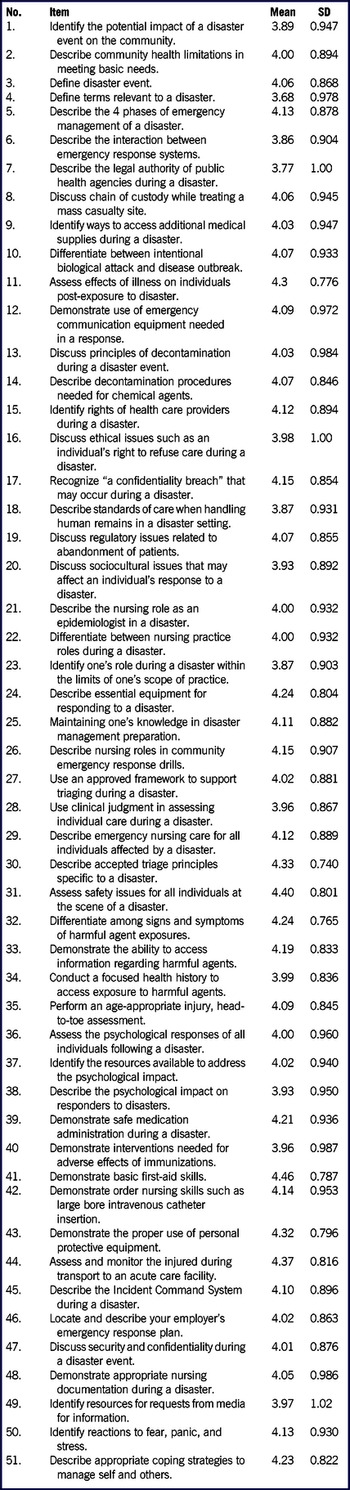
In order to find out Jordanian nursing educators’ perceptions regarding the importance of incorporating a disaster management course in the nursing curriculum, participants were asked to rate their responses to 51 items on a 5-point scale of the Likert scale with the following values: 1= not at all important, 2 = slightly important, 3 = fairly important, 4 = quite important, and 5 = very important. Responses indicated that the majority of participants perceived the integration of disaster courses in the nursing curriculum as quite important. According to their responses, the least important item was “Define terms relevant to disaster” (M = 3.68, SD = 0.978). The most important item was “Demonstrate basic first aid skills” (M = 4.46, SD = 0.787). Table 3 shows the mean of all items.
Importance of Integrating Disaster Management in Nursing Curriculum (N = 131)

To examine the differences in the total mean in the primary teaching area, years of teaching experience, years of nursing experience, and age, it was intended to use analysis of variance (ANOVA). However, it was inappropriate because of the violation of the ANOVA assumption of “equal group and homogeneity of variance.” The Kruskal-Wallis test was used instead, which showed no significant differences among nursing educators in terms of their primary teaching area, years of teaching, years of nursing, and age (H [4] = 3.29, P = 5.11; H [3] = 4.37, P = 0.224; H [3] = 5.9, P = 0.117).
To examine the differences between males and females regarding the total mean score, a t-test was conducted; it showed significant differences (t = 2.29, P = 0.024) with females doing better than males. However, no significant differences were found regarding the type of university (private or public) or the level of education (masters or doctorate). Finally, no correlation was found between total mean and participants’ ages (r = 07, P = 4.08).
DISCUSSION
This study demonstrated a lack of nursing educators’ life experiences in terms of reading professional journal articles regarding disasters, engaging in continuous education regarding nursing disaster management, participating in emergency responses and mock disaster drills, and participating in a real disaster. These findings were supported by Whitty and BurnettReference Whitty and Burnett22 who found that nursing educators have limited life experiences in all of these events. Another study indicated that previous experience appears to be the best determinant of perceived competence in disaster preparedness.Reference Baack and Alfred12,Reference El-Hosany and Ghonem20 Furthermore, participation in a real disaster situation will involve learning, experiencing, and engaging in the reflection process, which are significantly increased by the level of disaster preparedness and management.Reference Sangkala and Gerdtz25 However, our findings may be related to the fact that disaster nursing was a new subject to them because disaster preparedness is a new subject in Jordan.
The participants of this study showed a low level of preparedness to respond to disastrous events; these results were similar to the findings of previous studies.Reference Al Thubaiti, Hamouda and El Seesy14,Reference Öztekin, Larson and Altun Uğraş19-Reference Bajow, Djalali and Ingrassia21,Reference Alshehri26-Reference Vaughan29 In 2 studies conducted in Turkey and Egypt, nursing educators reported low levels of disaster preparedness.Reference Öztekin, Larson and Altun Uğraş19,Reference El-Hosany and Ghonem20 Furthermore, in a study conducted in the United States on deans of nursing programs, the majority of the participants reported that their faculty did not have the expertise to teach content on disaster preparedness. Contrary to this, it was found that the majority of nursing educators reported good knowledge and experience of disaster nursing and good experiences in disaster education.Reference Siemon, Hackwith and Monson30
In any disaster, the demand for prepared nurses is immense. Most participants indicated that they were willing to integrate a disaster course into the nursing curriculum. These results were consistent with previous studies.Reference Baack and Alfred12,Reference Al Khalaileh, Bond and Alasad17,Reference Alshehri26,Reference Aliakbari, Hammad, Bahrami and Aein31 While in another study, nursing educators reported limited interest in addressing disaster nursing as an important element of nursing education programs.Reference Stanley, Polivka and Gordon32 However, it was not clear whether the obstacle of introducing such a course is because of regulations of higher education in Jordan, which limits the credit hours in bachelor nursing programs. Indeed, Schmidt et al.Reference Schmidt, Davis and Sanders33 indicated that adding new content to nursing curricula is a major challenge because of accreditation requirements. Nevertheless, integration of disaster content into the nursing curriculum would promote personal preparedness and an effective professional response.Reference Loke and Fung16-Reference Öztekin, Larson and Altun Uğraş19
The results of this study showed no significant differences between nursing educators in terms of their primary teaching area, years of teaching experience, and years of nursing experience. Moreover, no significant differences were found regarding the type of university (private or public) and the level of education (master or doctorate). These results were consistent with the findings of studies in 2009 and 2015,Reference Öztekin, Larson and Altun Uğraş19,Reference Whitty and Burnett22 which found no significant differences between nursing educators in terms of years employed as a nurse, years employed as a nurse educator, level of education completed, or primary teaching area.
The results revealed significant differences between male and female nursing educators (t = 2.29, P = 0.024), with the females doing better than males. To date, there have been no studies conducted on nursing educators to discuss the issues that were found in literature, except Whitty and Burnett’s,Reference Whitty and Burnett22 which found that there were no significant differences in terms of gender on the participants’ knowledge of disaster management. The results of this study showed no significant differences between nursing educators in terms of age. In a 2015 study conducted in Turkey, it was found that younger nursing faculties showed higher levels of basic disaster knowledge than those who were older.Reference Öztekin, Larson and Altun Uğraş19 In contrast, Whitty and BurnettReference Whitty and Burnett22 found that older nursing educators had a propensity to perceive a higher level of importance of incorporating core competency items.
Strength and Limitations
This study is the first to evaluate Jordanian nursing educators’ attitude toward integrating disaster management in nursing curricula. Furthermore, it uses a research design that is suitable and feasible to achieve the study’s purposes. All nursing educators were invited to participate in this study, which may help in the generalization of the results.
The limitation of this study could be using a self-administered questionnaire, which may affect the actual response of the participants. Another limitation is related to the sampling. The sample in this study was a convenience sample.
CONCLUSION
Nurses represent the largest component of health professionals in terms of their readiness to respond to disastrous events, as well as their participation in planning for disaster management, which will enhance resilience against disasters. Although education provides the basis for nurses, the knowledge and the skills required, as well as being energetic in a disaster situation, may require that many nursing students need additional education and practice to be prepared to respond during disasters. Nursing educators had a low level of knowledge in disaster management, and this highlights the necessity for preparing nursing educators for disasters by encouraging participation in disaster management training to enhance their own knowledge of disaster management and, accordingly, to circulate this information adequately to students. Nursing educators perceive that the integration of disaster content in nursing curricula is quite important, and this may serve as realistic evidence for higher education institutions to re-examine the nursing curriculum and plan for incorporating disaster content in nursing curricula in all nursing programs in Jordan in the near future. Moreover, further studies need to be conducted in this field to explore barriers and facilitators to integrating disaster management in nursing curricula.
Acknowledgments
The author would like to acknowledge Mohammad Al Qadire, PhD, RN, for his valuable assistance and guidance in writing this article.
Conflict of Interest Statement
The author has no conflict of interest to declare.