Introduction
Although English is one of the two official languages in Cameroon, it is seldom used out of official circles where indigenous languages, French, and Pidgin English reign supreme (Jikong & Koenig, Reference Jikong, Koenig, Koenig, Chia and Povey1983). This has made the language a matter of concern for teachers, learners, and researchers. An aspect of the language which has so far been little investigated, but which is significant to English proficiency, is question tags. In fact, question tags contribute tremendously to the flow of language. They are ‘a very conspicuous phenomenon of spoken language’ (Tottie & Hoffman, Reference Tottie and Hoffman2006: 284). These short questions (tags), tagged onto a main statement (the anchor) play an important role in spoken English. While the question tag is taught from Sixième to Terminale (Grade 8 to Grade 13, i.e. the first to last years of secondary education in the Francophone subsystem of education), and from primary to secondary school in the Anglophone subsystem of education in Cameroon, researchers are still to question its teaching against the backdrop of its actual use in a country where the nativisation process of English is generally agreed upon (Schneider, Reference Schneider, Harrow and Mpoche2009). Also, given that the canonical ‘type of tag question with reversed or constant polarity, (. . .) is typical of English’ (Tottie & Hoffman, Reference Tottie and Hoffman2006: 283), its teaching (textbooks focus solely on question tags with reversed or constant polarity) in a non-native setting like Cameroon is likely to foretell a conscious or unconscious desire to keep a certain standard of English. If one concurs with Schneider (Reference Schneider, Harrow and Mpoche2009) that Cameroon is on Phase Three of the Dynamic model (at least in the Anglophone part of the country) – that is, Nativisation where ‘structural nativization has made substantial progress’ (p. 298) – then keeping a native-like standard on school programmes (Ministry of Secondary Education, 2014), textbooks (see for illustration the English textbook Forbin et al., Reference Forbin, Paizee, Muluh Tezeh and Moto Zeh2019), and official examinations would be likely to indicate some contradictions as per the apparent desire to cut the umbilical cord with the former colonial power. In fact, sample question tags in textbooks and official examination questions are as follows:
Sample grammar question
- The teacher was absent during the Maths lesson yesterday, ________________?(weren't they, were they, wasen't she) (sample official examination question)
-
Sample textbook presentation 1
- It isn't difficult to use a computer, is it?
- No, it isn't.
-
Sample textbook presentation 2
- Computers are amazing, aren't they?
- Yes, they are
(Nama et al., Reference Nama, Forbin, Paizee and Muluh Tezeh2019: 168)
The present study aims at perusing the use of question tags in Cameroon English, with a focus on the tokens used as tags and the functions of the tokens thus used. This intends to underscore the gap between formal teaching and ordinary-everyday use of this linguistic aspect in Cameroon. It starts with an overview of question tags. Next, methodological procedures are described. Then, the data are analysed. Finally pertinent theoretical, sociolinguistic, and pedagogical implications in relation to the findings are discussed.
Question tags: An overview
Question tags have generally been studied in connection with their grammar, their functions, their frequency of use in different varieties of English around the world, as well as their innovative forms in New Englishes.
A question tag comprises an anchor and a tag, also labelled basic clause, host clause, matrix clause, stem clause and reference clause (Tottie & Hoffman, Reference Tottie and Hoffman2009). Like Wong (Reference Wong2007) and Tottie and Hoffman (Reference Tottie and Hoffman2009), we use the term ‘anchor’ in this work to mean all these appelations. Tags are mainly of two categories: canonical and non-canonical tags also called ‘anomalous’ forms (Algeo, Reference Algeo2006). The grammar of question tags seems quite easy to figure out, especially because of its very simple rules. As a matter of fact, the anchor-tag predicate match and the polarity rules that govern the construction of the most common tags are quite easy. The anchor-tag match rule states that the modal auxiliary of the anchor, which is most often than not a declarative, must be the same in the tag. The polarity rule stipulates that an anchor with positive or negative elements should have a specifically positive/negative tag counterpart (Kimps, Reference Kimps2006). Canonical tags usually abide by the anchor-tag match and polarity rules. Typical cases as reported by Tottie and Hoffman (Reference Tottie and Hoffman2006) and Kimps (Reference Kimps2006) include
– Positive-negative: (anchor) Makes you really think, (tag) doesn't it?
– Negative-positive: (anchor) Oh it's not very valuable, (tag) is it?
– Constant positive (positive-positive): (anchor) So this is the letter he sent you, (tag) is it?
– Constant negative (negative-negative): (anchor) So they don't come cheap, (tag) don't they?
However, these rules are far too simplistic to account for the whole body of question tag structures found in English. Actually, although an overwhelming majority of tags (90%) follow the canonical pattern, around 10% do not (Kim & Ahn, Reference Kim and Ahn2008). Non-canonical tags move from an unusual positioning of the tag, to a verb non-match. These are usually situational and invariant tags. Situational tags occur on specific occasions, such as focusing on a listener's ‘want’, or the situational complexity of a conversation. In invariant tags, the rules are breached without a situational trigger to ignite the use of a tag. An epitome of invariant tags in British English is ‘innit’, a slang form of ‘isn't it’ as outlined by Torgersen et al. (Reference Torgerson, Gabrielatos, Hoffman and Fox2011).
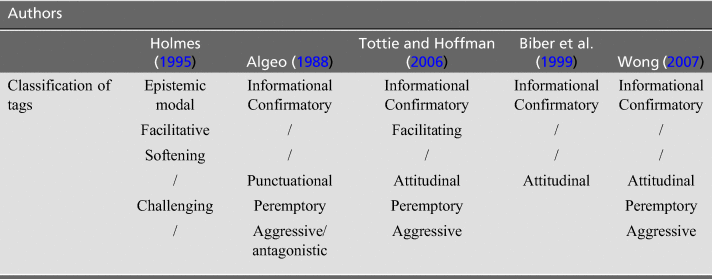
From a pragmatic perspective, Holmes (Reference Holmes1983, Reference Holmes1984, Reference Holmes1986, Reference Holmes1995) Algeo (Reference Algeo1988, Reference Algeo, Ricks and Michaels1990, Reference Algeo2006), and Tottie and Hoffman (Reference Tottie and Hoffman2006) have proposed one of the most complete analyses of the functions of tag questions in Western English, while Wong (Reference Wong2007) and Takahashi (Reference Takahashi2014) have explored their functions in Asian Englishes (Hong Kong, The Philipines, India, etc.) Although the taxonomies vary across the literature, there seems to emerge a common bottom line in the classifications. These are summed up in Table 1 below.
The pragmatic functions of question tags across the literature

Despite the different labels proposed in Table 1 above, two main functions of tags seem to emerge, namely epistemic and affective tags. Epistemic tags aim at seeking for information or confirming information; they ‘express genuine speaker uncertainty rather than politeness’ (Holmes, Reference Holmes1995: 80). In such cases, the speaker is not sure of what s/he is saying. This group comprises Holmes's (Reference Holmes1995) epistemic modals, and Algeo (Reference Algeo1988), Biber et al. (Reference Biber, Johansson, Leech, Conrad and Finegan1999), Tottie and Hoffman (Reference Tottie and Hoffman2006), and Wong's (Reference Wong2007) informational and confirmatory tags. Affective tags on the other hand serve in expressing opinions or attitudes, challenging someone, or maintaining engagement with a speaker. They comprise facilitating/facilitative, attitudinal, peremptory, and aggressive tags, with labelling varying from one author to another as the table shows.
With an informational tag, the speaker makes a real request for information. In a confirmatory tag, the speaker is not sure of what s/he says, and seeks corroboration of his/her guess. Facilitating tags aim at involving the listener in a conversation, where the speaker is sure of the truth of the proposition of his/her utterance. An attitudinal tag emphasizes what the speaker says, and does not require the involvement or reply of the listener. It is closer to Algeo's (Reference Algeo, Ricks and Michaels1990: 446) punctuational tag which ‘merely points up what the speaker has said’. It is vocally tantamount to ‘an exclamation point or of underlining for emphasis’. A peremptory tag closes off the debate after a statement of generally acknowledged truth. Finally, an aggressive tag functions as an insult or provocation. The first two sub-categories fall under the epistemic modal tag, while the four remaining are all affective. The following examples are taken from Tottie and Hoffman (Reference Tottie and Hoffman2006).
Informational
Stuart: You're getting paid for this, are you?
Mark: Twenty-five quid.
Confirmatory
A: I'm gonna try to go walking for a little bit. I don't need a jacket, do I?
B: No, it's still pleasant.
Facilitating
Teacher: Right, it's two, isn't it?
Pupil: Mm.
Attitudinal
Larna: Yeah she'll be in trouble, won't she, she often gets her own drinks anyway, she sort of like, she's at that age she can, it's only when they get out there together.
Pauline: mh.
Peremptory
Kathleen: How old's your mum and dad?
Unknown: (laughs)
Kathleen: He don't know neither.
Unknown: They're in their forties anyway, I think.
Enid: That's what I said.
Kathleen: Well, we come to that conclusion, didn't we?
Unknown: Me dad's think me dad's forty seven. Me mum's about forty three, forty four. (BNC-SDEM)
Aggressive
Ernest: . . . well I put, I thought you were staying to tea so I put six eggs on.
Arthur: oh aye, yeah, alright.
Peggy: you put what?
Ernest: put six eggs on, didn't I? Anyhow, I'm putting, I'm putting two on.
A comparative study of British English and American English by Tottie and Hoffman (Reference Tottie and Hoffman2006), based on the British National Corpus (BNC) and the Longman Spoken American Corpus (LSAC), revealed that question tags occurred 4,384 times every million words in British English and 455 times in American English in the same proportion. The two varieties were also found to differ with respect to auxiliary preference. Be, do, will, have, and can were found to occur in the same descendent order in the two languages, but with do being far more important in the Longman Spoken American Corpus (41%) than in the spoken demographic subpart of the British National Corpus (25%). As concerns verb/pronoun combinations, while 200 different verb/pronoun combinations were found in the two languages, you scored higher in the LSAC than in the BNC. Tottie and Hoffman (Reference Tottie and Hoffman2006) also found a relationship between gender and question tags. However, given the quality of the samples used, this relationship is to be vetted further. On the other hand, age was found to matter a lot in the two languages, with younger people using fewer canonical tags than the older people. Regardless of the variations between the two languages, this comparison is significant so long as it can tremendously influence the teaching of English as a Second/Foreign Language depending on the purpose of learning. In many former British colonies (like Cameroon, the setting of the present study), British English, even without being enshrined in the Constitution as the variety of English to be taught in schools, is usually the de facto standard adopted. In that respect, question tags are usually a key grammatical element taught throughout the learning chain (impressionistic findings).
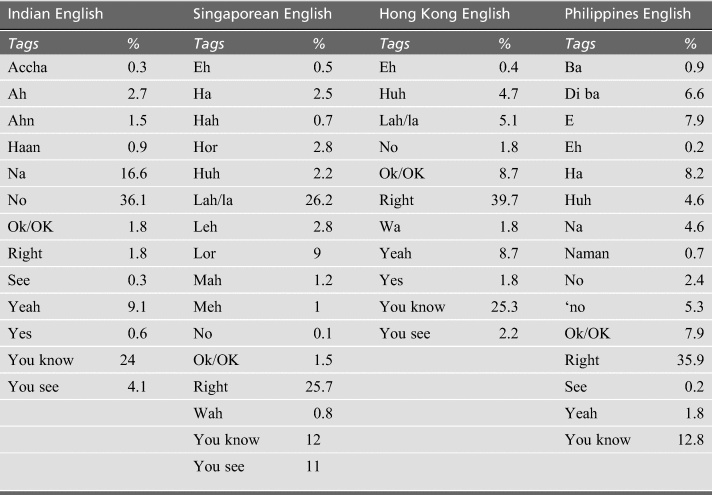
Research on the use of invariant tags in Asian Englishes has been very revealing. Takahashi (Reference Takahashi2014) compared the use of invariant tags in four Asian countries, namely India, Singapore, Hong-Kong, and the Philippines. The following tags were reported to have occurred at least once in the corpora of the Asian Englishes investigated: accha, ah, ahn, ba, di ba, e, eh, ha, haan, hah, hor, huh, lah/la, leh, lor, mah, meh, na, naman, no, ‘no, OK/OK, right, see, wah, yeah, yes, you know, and you see, the author says. These were distributed as follows:
Distribution of invariant tags in Asian Englishes (Takahashi, Reference Takahashi2014)

The existence of so many different invariant tags in these non-native settings has to be reckoned with as a factor that highlights the specificities of New Englishes, as well as the tremendous pedagogical concerns the teaching of English in such settings can raise. This pedagogical concern is highlighted in Brazil (Reference Brazil1984). The author concurs that a lot has been said concerning tags, this being justified by the anxiety they cause to foreign learners, whereas their treatments have seldom yielded positive results. These traditional treatments have mainly underscored three variables related to tags, namely syntax (grammar), intonation (phonology), and the communicative significance of intonational permutations that places tags within ‘the arena of recent work on the analysis of interactive discourse’ (p. 29). He proposes to bring these three variables ‘to a single focus upon a single topic’, in an attempt to ‘explore the circumstances and the effects of their interrelationship’. His work shows the difficulty in handling question tags, especially when the three variables are not combined, as it is usually the case in the foreign language class. In fact, using three syntactically defined ‘sentence types’, the author made various simulations of ‘rising’ and ‘falling’ intonation in order to examine the relationship between grammar and intonation as a starting point. The sentences were
1. I've decided to buy the red one.
2. Have you decide to buy the red one?
3. (so . . .), we've decided to buy the red one?
Next, he discussed the communicative values of each combination. Interesting propositions were made. First, from a Gricean co-operative principle perspective, these exchange types were found to all depend, for their successful working, upon the appropriate behaviour of two people, so that Speaker A must act upon an assumption of shared knowledge with Speaker B. Secondly, Speaker B should have the corresponding apprehension about what Speaker A's intentions are, and B must act in accordance with his interpretation of A's intention. Secondly, the fact that ‘decontextualised’ sentences have usually been the focus of both grammarians and language teachers has usually led to the belief that the syntactically distinguished types above have some preferred functions as statement or question. But the author thinks that all these three sentence types can realise any of the initiation types, ‘and can moreover realise any of the non-initiating moves’ included in the samples (p. 33). Finally, ‘the effect of intonational treatment is captured if we associate it, not with a given range of syntactic types, but with a range of initiation types’. These conclusions have tremendous pedagogical significance as they appeal to a contextualisation of the teaching of question tags, something which is seldom found in the English as a Foreign Language class. This lapse is also raised in the treatment of question tags by researchers who use existing database such as the British National Corpus or the Longman Spoken American Corpus. These corpora, although they are based on spoken data, usually do not underscore intonational features in their transcriptions, a situation that complicates the analysis of question tags to some extent (Tottie & Hoffman, Reference Tottie and Hoffman2006).
Methods
Corpus
Although a corpus of Cameroon written English has been used in previous works (Nkemleke, Reference Nkemleke, Harrow and Mpoche2009), a corpus of spoken Cameroon English is still to be developed in Cameroon (Polzenhagen & Wolf, Reference Polzenhagen, Wolf, Sharifian and Palmer2007). To compile this corpus, naturally occurring utterances were recorded from a wide range of domains, including schools (primary, secondary), universities, offices, markets, homes, and television programmes, covering both formal and informal topics. In the case of casual conversations, ethics was respected as the subjects were informed of the purpose of the records. This resulted in a 21,785-word corpus. We used both participant and non-participant observation in classrooms, market places, and shops, such that in a few cases we were part of the conversation, and surreptitiously tape-recorded the event. However, upon the conversation concluding, we informed the participants that the whole conversation would be used for research. Although they usually complained about having been taped, they eventually allowed us to use it. In addition, all proper names were changed to protect privacy. Classroom tape-recording was usually agreed upon with the teacher, while casual student to student interactions, did not require prior agreement. The students were informed of the activity only later.
Tools and procedure
The data were collected mainly through tape recording. In addition, official textbooks and syllabuses (described in Ministry of Secondary Education, 2014) were searched to check how question tags are taught or supposed to be taught.
The texts were processed through the AntConc software, which is a free-access word-processing program whose concordance tool was mainly used to isolate tags in the corpus. Given that the retrieval of question tags is not easy (Tottie & Hoffman, Reference Tottie and Hoffman2006), a manual selection was implemented before this automated search so as to avoid the occurrence of auxiliaries that do not function as tags, and which were counted as irrelevant instances. The constraints proposed by Tottie & Hoffman were adopted as follows:
– The exclusion of wh-questions where a wh-word immediately precedes a potential question tag.
– The exclusion of sentences where a verb immediately follows the pronoun.
– The exclusion of instances where an adjective immediately follows the pronoun of the potential question tag.
The study being mainly qualitative, the tags were discussed according to their type (canonical vs anomalous) and function. However, contrary to Wong (Reference Wong2007), the corpus not having been classified into spoken/written or formal/informal, the work did not classify polarity. The pragmatic functions of tags were further analysed following conversation analysis methods based on the Speech Act Theory (Searle, Reference Searle1969), with a focus on felicity instead of the truth of the utterance. The meanings of tags were therefore worked out from the context of occurrence through pragmatic inference (Verschueren, Reference Verschueren1999: 30). Although the taxonomy used in the analysis is mostly based on Algeo (Reference Algeo1988), Biber et al. (Reference Biber, Johansson, Leech, Conrad and Finegan1999), Tottie and Hoffman (Reference Tottie and Hoffman2006), and Wong (Reference Wong2007), Holmes (Reference Holmes1984) is also convoked when necessary, just as unusual functions are highlighted.
Results
The analysis of the data revealed very interesting findings on the use of question tags in Cameroon English. This use was found to vary very significantly from other situations recorded in previous works (Kimps, Reference Kimps2006; Tottie & Hoffman, Reference Tottie and Hoffman2006; Wong, Reference Wong2007; Schneider, Reference Schneider, Harrow and Mpoche2009; Takahashi, Reference Takahashi2014). While question tags were found to occurr 4,384 times every million words in British English and 455 times in American English in the same proportion (Tottie & Hoffman, Reference Tottie and Hoffman2006), they occurred 147 times in the 21,785 words of our corpus, which for parallelism of figures would amount to about 6,747 times every million words in Cameroon English, far beyond the two native varieties. Yet this is to be mitigated given the size of the corpus used as compared to those used by the above-mentioned works. However,contrary to these two varieties where canonical tags account for 90% of the tags and non-canonical ones for 10% (Kimps, Reference Kimps2006), our corpus featured only one occurrence of canonical tags. Although the use of question tags in Cameroon English shared many similarities with other New Englishes of Asia and Africa, the present case was found to be very revealing with many respects. First, the different domains investigated showed some usage uniformity in terms of non-canonical tags, while they varied according to the dominant type of tag. Secondly, the types of tags found were significantly atypical. Finally, Cameroonian linguisitic uniqueness was highlighted in a few tags used.
The various tags which occurred in our corpus are listed in Table 3 below.
Tags found in our corpus

As displayed in Table 3 canonical tags were almost insignificant in our corpus. With the exception of did you, all the tags found in our corpus were non-canonical. This tag is found in Excerpt 1 below.
Excerpt 1
You did it in Class 4, did you?
Yes, Sir.
Although from the framework used in this work, the tag in Excerpt 1 above looks informational, the context of the conversation shows that the speaker (the teacher) seems to be checking a guess instead. In fact, the teacher is checking his learners’ previous knowledge as a prerequisite to the lesson of the day. Therefore, the question is more likely to be a facilitative than an informational one. Thus, this tag is not going to be discussed alongside other non-canonical tags in this work.
As in Singaporean English, Huh, You know, You see, OK, and Right were used. The corpus also shows similarities with Indian and Philippines English, as the Englishes specifically have the tag Na in common. Apart from Indian English, Huh occurs in the four Asian Englishes investigated by Takahashi (Reference Takahashi2014). This also occurred in Cameroon.
We turn now to the analysis of the functions of the tags in our corpus. The tags were found to play mainly facilitative, attitudinal, and confirmatory functions in our corpus. The size of our corpus notwithstanding, these findings can contribute to sparking the debate on this under-searched issue.
The use of facilitative tags
Facilitative tags were found to occur in different settings, and involved different non-canonical tags as in the following excerpts.
Excerpt 2
So the first person did not use the soap, right? And the second person did not scrub the hands well . . . did not follow all the steps you need to follow when washing your hands.
This excerpt is a primary school interaction (as is Excerpt 1), where the teacher makes sure that his pupils have understood a principle he had earlier explained. The facilitative function here is seen in the fact that by uttering Right, the speaker wants to make sure that the listeners are grappling well with what s/he says, and are following up, a normal situation in a learning setting. Two main tags were found to mostly occur in this domain, namely Right (5 times), and All right (8 times). Others included Huh (3 times), OK (2 times), Isn't it (2 times), Na (1 time), and Yeah (1 time).
The following excerpt with OK confirms this tendency in the educational setting.
Excerpt 3:
Senior discipline masters, OK? The teaching staff . . . the teaching staff. Voilà! The teaching Staff, so these are the steps involved, OK?
In the same vein, OK here sounds like ‘Is it clear?’ through which the speaker ensures that the message has gone through. OK is used here with the same facilitative function, but in a secondary school environment. It was used 24 times in school, out of the overall 27 occurrences. This highlights the preference of the speakers for this tag in that domain, mainly to explain, and ascertain comprehension from a person in a lower position, language being used in the organisation of talk (Sidnell, Reference Sidnell2010), and grouping ‘social systems’ (Goffman, Reference Goffman1967).
Na usually happened when a student addressed another one, as in the following excerpt:
Excerpt 4
Teacher: It is not a disorder, you should discuss in order. What is the origin of the strike in Bamenda?
Student 1: What?
Student 2: Your parent. (speaking to a fellow classmate)
Student 3: He said that we discuss, na? (Speaking to a fellow classmate)
Teacher: Go ahead! Yes it is good; go ahead.
In Excerpt 5 below, the speaker uses Hein to mildly threaten the learners (this sounds more like a warning than a real threat). She specifically warns them against time wasting.
Excerpt 5
We don't have time, hein? You don't register and you want to waste time.
The speaker knows that there is little time, and intends to make it known to the students that they should be more proactive in their studies. This specifically soft-aggressive function seems to be hardly expressed with other tags, which may explain the use of a French tag. It can be seen as a sub-type of facilitative tags, since it adds a specific feature to the facilitative one.
Non (2 times), Na (4 times), Huh (4 times), Right (2 times), and Isn't it (1 time) in the corpus revealed the desire to be understood by catching the attention of the audience. This usually took place during explanations.
Non surprisingly occurs in our corpus in Excerpt 6 below:
Excerpt 6
This you see now, yeah? So have_ do you know the Importance of this oil? Yeah, the importance of this oil huh is for oilment, non? For you to oil your skin for when you took_ take your bath you oil your skin with so that your skin should not got dry it should be moist so_ yes and the importance there are too many importance.
Excerpt 6 features Non used by a trader to simply keep the ball rolling between him and his customer, the use of the product being clearly known to both participants. It may be associated with Holmes's (Reference Holmes1986) softening function. In fact, the speaker seems to be annoyed by the customer's question, and tries to keep calm despite the somewhat negative attitude of the latter.
The use of punctuational/attitudinal tags
The bargaining aspect of You know (13 occurrences), underscores a desire to convince the listener. Used by a trader, it serves the purpose of convincing by emphasizing the points made. In fact, by pretending not to say anything the listener ‘does not know’ (implied in You know) the speaker hedges the importance of what s/he says as being a point of general knowledge, which the listener may not refute for face-saving reasons. Excerpt 7 illustrates this.
Excerpt 7
You know, I've been_ you go to court, a whole big hall, they are reading judgement, somebody is far behind, there is no microphone, there is nothing to talk with. How are you hearing your judgement behind?
This is even more so when the tag is fronted, as in the excerpt above, where the speaker is sure of the facts, and tries to point up those facts. The latter is in so doing engaged in a conversation in a way far more important than heretofore. A similar situation is described in Excerpt 8.
Excerpt 8
Customer: CFA 7000?
Trader: It is even cheaper, you know, me . . . they call me . . . here they call . . . that . . .
Customer: I think all those things are coming from Nigeria?
Trader: Yes, but these bags that you see, even in Nigeria they are very expensive.
It is therefore not surprising that it is the most used tag in markets in our corpus. The use of Huh (nine occurrences) and Na/Non (five/three occurrences) is also pertinent in that respect.
The occurrence of the French forms Hein (twice) and Non (three times) are also worthy of interest, as will be discussed later. The use of Now (three occurrences), which is still very much used in Nigeria can be accounted for by the high number of Nigerian traders in Cameroonian markets. Although it used to be widespread a decade ago in Cameroon (perhaps due to the influence of Nollywood movies which invaded the Cameroonian media landscape one or two decades back), Now seems to have disappeared from the linguistic repertoire of Cameroonians tags to the benefit of Na/Non. The role-relation showcased here is one of equality, which requires a certain degree of politeness on the part, especially of the trader. A very awkward form like It's so also occurred which expressed more of an idiosyncratic form than a tendency.
Unlike the Na of the university classroom, the dominant use of Na at home seems to indicate a plea, express casualness rather than an equal term negotiation. Its attitudinal/punctuational function is made easier to implement because of the role-relation involved in this setting. Observations show that although one can invite a relative, as in the following excerpts, with a question tag, Cameroonians would more readily use Please to invite a stranger to come in or to do something. ‘Na’ appears as a major attitudinal tag in Cameroon English.
Excerpt 9
Come in, na?
Excerpt 10
Favour, bring a bedsheet, na?
Take, na? Take.
In Excerpts 9 & 10, Na seems to indicate two different purposes. In the first occurrence, it seems to mark a plea, while in the second it seems to highlight the casual aspect of informal communication. Similarly to Swan's (Reference Swan1996) imperative tags, ‘Na’ in these excerpts invites (Excerpt 9) and asks (Excerpt 10) in the way English would have used ‘would/will you?’. Obviously therefore, non-canonical tags were to be expected in these cases.
The use of confirmatory tags
Many tags were also confirmatory in our corpus. A few excerpts are used to illustrate this.
Excerpt 11
Customer: I wanted to ask the price of your product.
Trader: Which type of product?
Customer: That one there.
Trader: The orange, huh?
Customer: Is how much?
Very interestingly, Huh was quite specific in our corpus, since it was never used with a punctuational meaning, just as Hein usually had an attitudinal meaning only. In Excerpt 11, for example, the trader seeks confirmation of a guess, which was indicated by the customer pointing at a given item in the shop.
Na plays a similar role in Excerpt 12 below:
Excerpt 12
- Pa, you are going for the retreat also, na?
- Yes . . .
The first speaker is clearly checking confirmation of her guess with the use of this tag. Na seems to be used invariably in different domains, while others are not. The following unusual tag also has this confirmatory function:
Excerpt 13
Means that you are not gardening tomatoes; but you are going somewhere and buy it to come and sell, it's so?
Although this looks canonical, it is definitely not, and functions as a confirmatory tag in the excerpt, since the speaker checks his guess.
Discussion
The present findings can significantly inform both the evolution of Cameroon English and the teaching of English as a foreign language, especially in the Cameroonian context.
On trends in New Englishes
Many scholars have proposed descriptions of New Englishes around the world. These are usually Englishes which have emerged in former British colonies. In General, in addition to lexicological peculiarities, especially borrowings from local languages (Todd, Reference Todd1982a, Reference Todd, Bailey and Görlach1982b; Ayafor, Reference Ayafor and Kortmann2004), researches have also focused on the phonology and phonotactics of these varieties (Atechi, Reference Atechi, Harrow and Mpoche2009; Schmied, Reference Schmied1991; Simo Bobda, Reference Simo Bobda2002). One major feature which has so far been agreed upon is their tendency for oversimplification (Melchers & Shaw, Reference Melchers and Shaw2011) Oversimplication is usually seen as a feature of New Englishes phonology. Regarding question tags, recent works on Asian Englishes have revealed that this linguistic item is also prone to oversimplification (Takahashi, Reference Takahashi2014). Despite the relatively small size of our corpus (which is however mitigated by the wide array of domains involved) our findings contend with this oversimplication trend in New Englishes. In fact, the overreliance on non-canonical tags attests to the tendency for this variety to oversimplify rules. Only one tag out of 147 tag tokens in our corpus was canonical. In fact, there is oversimplification because, by freeing the speaker of the grammatical constraints imposed by canonical tags, non-cannonical tags allow her/him to simply avoid the burden of polarity rule, pronoun-match rule, etc. Also, non-canonical tags make the utterance definitely shorter than their canonical counterparts which consist of an auxiliary plus a pronoun. Therefore, instead of
– You are going for a retreat, aren't you?
The speaker can simply say
– You are going for a retreat, na?
According to Schneider (Reference Schneider, Harrow and Mpoche2009), Cameroon English is definitely on Phase 3 of the Dynamic Model which is referred to as Nativisation. This is a phase where a ‘country begins to be going her own way, culturally and linguistically’ (Schneider, Reference Schneider, Harrow and Mpoche2009: 286). This process has been substantiated by Hoffmann, Blass & Mukherjee (Reference Hoffmann, Blass, Mukherjee, Filppula, Klemola and Sharma2017) in the use of canonical tag questions in three New Englishes in Asia, namely Hong Kong, India, and Singapore Englishes. Although these authors focused on canonical tags in those three varieties, their conclusion that there is clear structural nativisation in New Englishes is corroborated by the present findings where the influence of French and local indigenous languages can be felt in the significant oversimplification of question tags.
The impact of French and other local languages
Although French has, for a long time, been by far the numerically most important language in Cameroon, it cannot claim to be the only language influencing Cameroon English. The embryonic Gallicisation (by Gallicisation is meant the introduction of French forms into English) of this variety can be said to be the result of the long contact between the two languages in bilingual Cameroon. It highlights the deep structure of the mind of the Cameroonian English speaker. S/he seems to base her/his reasoning on a French paradigm which usually simplifies the question tag structures. Moreover, these French forms seem to have gone through a process of appropriation in the local languages. In that vein, it is not rare to hear Cameroonian speak their mother tongue with a Non tag at the end of many sentences. Yet, most African languages do not make their tags at the end of the sentence, nor do they vary it as much as English. As an illustration, an English sentence like
Eng: I told you to do your homework, didn't I?
Would go as follows in Medumba, a Cameroonian language coded 277 in Ethnologue (Grimes, Reference Grimes2000):
Medumba: Mi’ me tchoup wu mbe u zi’ ju à?
As this example shows, Mi’ is likely to occur in most tag-like situation, with à occurring at the end in a structure where the tag seems to open and close the sentence. An example of a punctuational tag in that language will use the tag ‘Lah’, which has been substantiated in Hong Kong and Singapore Englishes (Takahashi, Reference Takahashi2014). Although the absence of culturally oriented studies with regard to question tags does not allow us be conclusive, one can intuitively claim that cultural schemes clearly contribute to the absence of epistemic tags in our corpus, and may therefore explain the specific use of question tags in Cameroon English.
All in all, French-form tags occurred 16 times (out of 147 tags) as follows: Hein (ten times) and Non (six times). This Gallicisation of English is very representative of the context of the use of English in Cameroon. Despite official efforts to make the country an integrated bilingual one, it has remained a French-dominant territory, due to a policy strongly criticized by many researchers (Echu, Reference Echu, Echu and Grundstrom1999). Most of the administration is carried out in French; official documents are first written in French and then translated into English. In major towns, even Pidgin English is strongly influenced by French.
The teaching of question tags and their real-life use
The present findings also reveal a marked difference between the question tag models presented in school, and those used in real-life situations. Canonical tags were almost absent from our corpus, its size notwithstanding. Yet the teaching of question tags is limited to these canonical ones, as found in textbooks, official examination, and classroom practice experience. This raises two fundamental questions. First, is question tag appropriately taught? The question seems obviously negative from the sample textbook presentations above. In fact, as long as the function of question tags is overlooked, as is the case here, learners will be unable to contextualize the grammatical token. Two, should canonical question tags type be the only point of focus? Here too, we believe it should not, given the high degree of structural nativisation English has undergone in Cameroon.
English has been gaining more and more speakers in Cameroon in recent years. This has led to two categories of English speakers: those who are born to English-speaking parents and those who are born to French-speaking parents. The first category usually pursues an education in English through the Anglophone subsystem of education, just as does the second. However, being immersed in a French speaking environment, the second category usually has French as either the mother tongue or the first language, while English is limited to the educational setting. Naturally, they cannot avoid the dangers of linguistic transfer from their first to their second language. In the same vein, the first category being in a French-dominant environment, their language seems to be shaped by French conceptual schemes. There is an even more extreme case which concerns a marginal category of French speaking Cameroonians who undergo a French-based primary and secondary education, and who later decide to read English at tertiary level, while others take English courses in either public or private language institutions that are found in the country (British Council, Pilot Linguistic Centre, etc.). This explains an emergence of French forms in Cameroonian English, which may be said to be specific to what is being referred to as Cameroon Francophone English (Tagne Safotso, Reference Tagne Safotso2012).
Although Cameroon English seems to make little use of canonical tags, as revealed by this study, it appears that they are still functionally organized, such that ‘Huh’ was much more confirmatory than ‘Hein’, which was more attitudinal. Thus, basing the teaching of this notion on the existing knowledge of, be it, a non-canonical form of question tags, teachers can better organize their programmes, as can be alluded to from Brazil (Reference Brazil1984).
Conclusion
The present study aimed at investigating the actual use of question tags by Cameroonian users of English. The objective was to parallel such uses with classroom norms which are usually based on canonical tags, as well as the use of tags in native settings. The findings revealed that the overwhelming majority of the tags used in our corpus were non-canonical. In addition, tags seemed to self-select settings. Moreover, the emergence of a few French tags accounted for the strong influence of French in the country as well as for the existence of a CamFE. Finally, there were far more tags in our corpus than in AmE and BrE (Tottie & Hoffman, Reference Tottie and Hoffman2006). These findings question the teaching of English in Cameroon and opens new research avenues alongside pedagogical and sociolinguistic implications in such a multilingual setting as Cameroon.
Conflict of interest
There is no conflict of interest reported in this work
Funding
This research did not receive any specific grant from funding agencies in the public, commercial, or not-for-profit sectors.
 ANTOINE WILLY NDZOTOM MBAKOP is assistant professor of English language and linguistics at the University of Maroua, Cameroon. He is mainly interested in language use, which he has investigated in religion, education, and the family. His works have appeared in renowned journals including International Journal of Multilingualism, Pragmatics and Society, Corpus Pragmatics, and Journal of Language and Education. Email: awnmbakop@gmail.com