Introduction
Demands for soybean as a protein source in poultry production are globally high but soybean production is not free of negative environmental and social implications particularly in Latin American countries that export large volumes of soybeans (Semino et al., Reference Semino, Paul, Tomei, Joensen, Monti, Jelsøe, Basse, Svenning and Olesen2009; von Witzke et al., Reference von Witzke, Noleppa and Zhirkova2011). Feed soybean production requires large areas of arable land, while the competition between livestock and humans for consumption of arable crops is a problem of growing importance (Wilkinson, Reference Wilkinson2011; Cassidy et al., Reference Cassidy, West, Gerber and Foley2013). Therefore, alternatives reducing the dependency on soybean imports are needed in regions where pork, chicken meat and eggs are produced and especially in organic production systems where the need for alternative protein sources is high (Laudadio and Tufarelli, Reference Laudadio and Tufarelli2010; Dotas et al., Reference Dotas, Bampidis, Sinapis, Hatzipanagiotou and Papanikolaou2014).
The crude protein (CP) self-sufficiency for organic livestock and poultry production in selected European countries was calculated to be on average below 60%; in Switzerland and the Netherlands it is even far below 20% (Früh et al., Reference Früh, Schlatter, Isensee, Maurer and Willer2015). This results in an annual net import of 130,000 tons CP into the organic animal production systems of Austria, Denmark, Finland, France, Germany, Lithuania, the Netherlands, Sweden, Switzerland and the UK (Früh et al., Reference Früh, Schlatter, Isensee, Maurer and Willer2015).
In organic systems of Switzerland, around 500,000 broilers are reared per annum and 330,000 laying hens are kept, requiring more than 3000 tons of CP (Früh et al., Reference Früh, Schlatter, Isensee, Maurer and Willer2015). In the EU 27, estimations are between 26 Mio (European Commission, 2013) and more than 35 Mio (estimated from Früh et al., Reference Früh, Schlatter, Isensee, Maurer and Willer2015) heads of poultry, which were reared in organic systems in 2011. Approximately half of them are broilers. Poultry production requires approximately one-third of the total CP needed for European organic livestock production (Früh et al., Reference Früh, Schlatter, Isensee, Maurer and Willer2015). Poultry feed protein must have particularly high methionine concentrations, and synthetic methionine is not allowed in European organic standards (Willke et al., Reference Willke, Hartwich, Reershemius, Jurchescu, Lang, Vorlop, Rahmann and Schumacher2010). Therefore soybean cake, comprising a suitable amino acid profile (National Research Council, 1994) is used for poultry feed to a large extent (von Witzke et al., Reference von Witzke, Noleppa and Zhirkova2011).
On the other hand, organic livestock systems should be based on closed nutrient cycles and on farm feed production as defined by the organic standards, which would better correspond to consumer expectations (von Meyer-Höfer et al., Reference von Meyer-Höfer, Nitzko and Spiller2015). Therefore, the present globalized trading and shifting of nutrients for organic production is only acceptable as a temporary compromise and requires a sustainable solution.
The challenge for organic poultry nutrition is to establish alternative protein sources with amino acid profiles comprising sufficient concentrations of lysine and methionine in order to gain high protein conversion efficiency. One alternative protein source could be grain legumes such as faba bean (Vicia faba), sweet lupine (Lupinus angustifolius) and pea (Pisum sativum). Their anti-nutritive compounds may be a limiting factor, but it was shown for ground peas (P. sativum) that even high proportions up to almost 500 g kg−1 dry matter (DM) could be fed to broiler chickens without adverse effects if free amino acids are added (Laudadio and Tufarelli, Reference Laudadio and Tufarelli2010; Dotas et al., Reference Dotas, Bampidis, Sinapis, Hatzipanagiotou and Papanikolaou2014). However, synthetic amino acids are not allowed in organic agriculture (Willke et al., Reference Willke, Hartwich, Reershemius, Jurchescu, Lang, Vorlop, Rahmann and Schumacher2010) and are expensive for smallholder farms. Therefore the question remains, whether and how peas can be integrated into broilers, diets without amino acid supplements.
Another alternative protein source could be forage legumes such as alfalfa, which can be harvested up to three times per season. Alfalfa has considerably high concentrations of lysine and methionine within its protein fraction (National Research Council, 1994; Purwin et al., Reference Purwin, Fijalkowska, Pysera, Lipinski, Sienkiewicz, Piwczynski and Puzio2014). Dried alfalfa has been successfully used as feed component for laying hens (Laudadio et al., Reference Laudadio, Ceci, Lastella, Introna and Tufarelli2014) and for growing ducks, turkeys and broilers (Ponte et al., Reference Ponte, Mendes, Quaresma, Aguiar, Lemos, Ferreira, Soares, Alfaia, Prates and Fontes2004; Krauze and Grela, Reference Krauze and Grela2010; Jiang et al., Reference Jiang, Song, Huang, Zhou, Wu, Zhu, Zheng and Jiang2012), replacing up to 25% of the concentrate (Jiang et al., Reference Jiang, Song, Huang, Zhou, Wu, Zhu, Zheng and Jiang2012). Also silage from alfalfa proved to be a suitable feedstuff for slow growing broilers if offered in addition to a usual organic diet (Weltin et al., Reference Weltin, Sundrum, Bellof, Häring, Hörning, Hoffmann-Bahnsen, Luley, Luthardt, Pape and Trei2015). Additionally, feeding alfalfa reduces cholesterol concentrations in blood and meat of birds (Ponte et al., Reference Ponte, Mendes, Quaresma, Aguiar, Lemos, Ferreira, Soares, Alfaia, Prates and Fontes2004; Krauze and Grela, Reference Krauze and Grela2010), and the fiber from alfalfa meal has positive effects on digestion and metabolism of poultry, which may increase feed conversion (Krauze and Grela, Reference Krauze and Grela2010).
Finally, insect-based products are currently in discussion to be a valuable protein source for animals, especially for poultry (Sun et al., Reference Sun, Long and Liu2013; Kenis et al., Reference Kenis, Koné, Chrysostome, Devic, Koko, Clottey, Nacambo and Mensah2014; Makkar et al., Reference Makkar, Tran, Heuzé and Ankers2014; Verbeke et al., Reference Verbeke, Spranghers, De Clercq, De Smet, Sas and Eeckhout2015). In particular, meal from larvae of the black soldier fly (Hermetia illucens) appears to be an interesting option because it can be grown on food industry by-products and has a particularly advantageous amino acid profile with high proportions of lysine and methionine (Diener et al., Reference Diener, Zurbrügg and Tockner2009; Maurer et al., Reference Maurer, Holinger, Amsler, Früh, Wohlfahrt, Stamer and Leiber2015; Tschirner and Simon, Reference Tschirner and Simon2015). However, knowledge about the actual feeding value of insect products for poultry is limited. There is still no legal basis for the inclusion of insect meal into commercial feedstuffs for livestock and poultry in Europe (Vantomme, Reference Vantomme2015), thus its use is also not allowed under organic certification, yet. However, due to the potential ecological advantages and a good acceptance among farmers and consumers (Verbeke et al., Reference Verbeke, Spranghers, De Clercq, De Smet, Sas and Eeckhout2015), it seems likely that the political frameworks may change in the future and make the utilization of insect protein possible. This would imply a valuable potential also for organic systems.
The aim of this study was to evaluate strategies for the partial replacement of soybean cake in an organic diet for fattening broilers by measuring growth, feed efficiency and meat quality. To lower the anti-nutritive effects of peas and alfalfa meal and the unknown palatability of the black soldier fly, we produced different mixtures of these alternative protein sources. Two of the tested soybean replacers comprised extruded meal from larvae of H. illucens, and the two others were based only on leguminous plants (dried alfalfa forage and peas). The general investigation of the study was to determine if such diets are accepted by chickens, how they influence fattening performance and their general and protein-related conversion efficiencies. A further question was the potential effect on physical meat quality in broilers fed with the alternative diets.
Animals, Materials and Methods
Animals
Seventy-five broiler chickens (Hubbard S757, male and female 1:1, organically certified origin) were fattened with five different diets from days 7 to 82 of life. For each diet, 15 animals (7–8 males; 7–8 females) were kept in a separate pen (3 × 2.5 m2, equipped with perches and warming lamps) and maintained as that specific diet group throughout the experiment. Animals were marked individually with leg rings. The animals had permanent access to feed meal, separate wheat grains and water, and the pens were separated from each other with mesh-wire providing adequate distribution of daylight in the stable. The experiment was approved by the local veterinary authorities (Veterinary Office of Canton Aargau, approval No. 75663).
Experimental diets
Black soldier fly larvae were produced based on the methods of Sheppard et al. (Reference Sheppard, Tomberlin, Joyce, Kiser and Sumner2002) with some modifications. Larvae of H. illucens were fed for maximum 10 days after hatching with chicken feed powder. Subsequently, from the larval stage L2/L3 they were fattened for 3–4 weeks on vegetarian by-products of the pasta and convenience-food industry (wheat products, oils and vegetables) until the end of larval stage L5. Due to logistical constraints, this substrate was not organic. At stage L5, the larvae were harvested, killed (by freezing) and stored at −20°C for a minimum of 48 h. Later, the larvae were washed with water, dried at 60°C for 24–34 h, depending on the water content, and defatted by pressing with a commercial oil press (‘KK 20 F Universal’, manufactured by ‘Screw Press’ Reut/Germany). The end product was a meal with a crude fat concentration of 110 g kg−1 and a CP concentration of 590 g kg−1. Organic alfalfa meal was purchased from Northern Italy. It was pure, dried and milled alfalfa, containing 220 g kg−1 CP. Peas were from Swiss organic production (CP concentration 200 g kg−1).
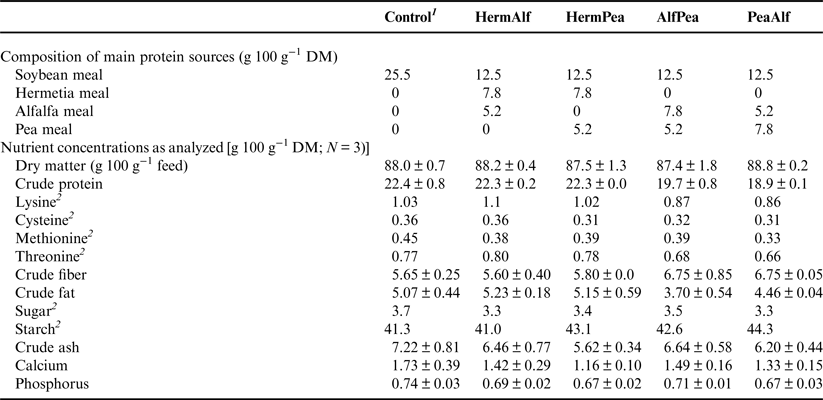
Four experimental broiler diets were tested against a control (a commercial organic broiler feed, No. 7038C, Mühle Rytz, Flamatt, Switzerland), which contained 255 g kg−1 soybean cake, providing 224 g kg−1 CP in the diet. In each experimental diet, 130 g kg−1 soybean cake was replaced by different combinations of Hermetia meal (dried and defatted larvae of the black soldier fly, H. illucens), dried alfalfa (Medicago sativa) meal and ground field peas (P. sativum). Replacement protein sources were tested in combination in order to avoid potential disadvantages, such as anti-nutritive factors in peas or poor acceptance of the insect protein. With the above described components the experimental diets were designed. The basis was always the control diet. Diet HermAlf contained 78 g kg−1 Hermetia meal and 52 g kg−1 alfalfa meal (CP: 223 g kg−1). Diet HermPea contained 78 g kg−1 Hermetia meal and 52 g kg−1 pea groats (CP: 223 g kg−1). Diet AlfPea contained 78 g kg−1 alfalfa meal and 52 g kg−1 pea groats (CP: 197 g kg−1). Diet PeaAlf contained 78 g kg−1 pea groats and 52 g kg−1 alfalfa meal (CP: 189 g kg−1). Thus, diets HermAlf and HermPea had a similar nutrient composition compared with the control diet (Table 1), while the diets AlfPea and PeaAlf had lower CP concentrations.
Diet composition 1 and nutrient concentrations of the control and four alternative diets.

1 The basis of all diets was the control diet. It was the commercial organic broiler diet No 7038C (Mühle Rytz, Flamatt, Switzerland) containing corn, soybean cake, wheat, sunflower cake, corn gluten, soybean oil and a standard mineral premix. The alterations of the experimental diets were only regarding the soybean cake proportion.
2 N = 1.
Sampling
Feeds were analyzed twice (weeks 1 and 7 of the experiment) with wet chemistry methods according to the standards defined by AOAC (1997), and the averages from both weeks were calculated.
Feed refusals were weighed weekly and individual body weights were measured biweekly. Feed intake could only be calculated group-wise. Body weight was measured individually. At day 82 of life, chickens were weighed and slaughtered in a commercial slaughterhouse with standard procedures (Barbut, Reference Barbut, Devine and Dikeman2004). The next day, intact carcasses were weighed. Subsequently, breast muscle, legs and wings were separated and weighed. The right breast muscle of all chickens was analyzed 1 day later for physical meat quality, according to the methods described by Willems et al. (Reference Willems, Kreuzer and Leiber2013). Briefly, meat color and lightness were measured according to the L*a*b* color space with a Minolta photometer (model 300CR, Minolta, Dietikon, Switzerland). Water loss during cooking was determined by heating sealed pieces of meat at 72°C for 45 min and subsequent measuring weight loss. A Warner-Bratzler shear force reading (a measure for tenderness of the meat) was carried out with a texture analyzer (Stable Micro Systems Ltd, Surrey, UK).
Data analysis
Variance of data was analyzed with the software R (Version 3.0.2—Frisbee Sailing, 25.09.2013) in a general linear model with group as the fixed effect. Group differences were calculated post hoc with Tukey's test (Freedman et al., Reference Freedman, Pisani and Purves2007). Since it was impossible to measure individual intake rates due to group feeding, all parameters which are directly or by calculation related to intake are expressed as group averages. For these values, no statistical evaluation could be carried out.
Results and Discussion
Intake and growth
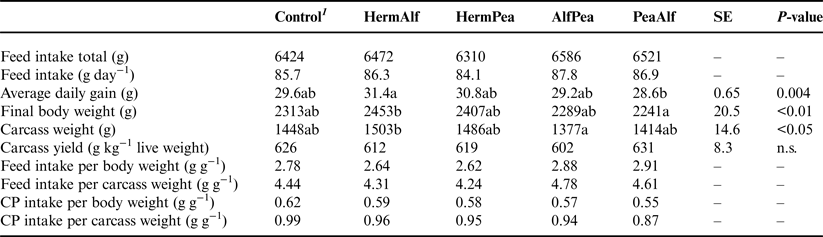
Numerically, the intake in the experimental groups differed from the control group by 1.0–2.5% (Table 2). The highest intakes were found in groups AlfPea and PeaAlf, which were those with the lowest dietary CP concentration. Average daily weight gain in all experimental groups was not different from the control group. A significant difference occurred between group HermAlf (higher daily gain) and group PeaAlf; corresponding differences were also found for final body weight. Group AlfPea had low carcass weights which were significantly different from group HermAlf. The growth performance of all four experimental diets was similar to the control. This confirms the expectations based on published results with peas (Dotas et al, Reference Dotas, Bampidis, Sinapis, Hatzipanagiotou and Papanikolaou2014) and alfalfa meal (Ponte et al., Reference Ponte, Mendes, Quaresma, Aguiar, Lemos, Ferreira, Soares, Alfaia, Prates and Fontes2004; Jiang et al., Reference Jiang, Song, Huang, Zhou, Wu, Zhu, Zheng and Jiang2012; Laudadio et al., Reference Laudadio, Ceci, Lastella, Introna and Tufarelli2014) and demonstrates the potential use of these diet components, as well as Hermetia meal as a partial soybean replacer in broiler diets.
Effect of diet on feed intake, growth performance and feed conversion efficiency in Hubbard chickens over 82 days.

SE, standard error.
1 The control diet was a commercial organic broiler diet, No. 7038C (Mühle Rytz, Flamatt, Switzerland), containing corn, soybean cake, wheat, sunflower cake, corn gluten, soybean oil and a standard mineral premix. The alternative diets are based on the control, but 130 g kg−1 of soybean cake are replaced by: HermAlf: 78 g kg−1 Hermetia meal and 52 g kg−1 alfalfa meal; HermPea: 78 g kg−1 Hermetia meal and 52 g kg−1 pea groats; AlfPea: 78 g kg−1 alfalfa meal and 52 g kg−1 pea groats; PeaAlf: 78 g kg−1 pea groats and 52 g kg−1 alfalfa meal.
Feed conversion and protein efficiency
Feed efficiency was below 3.0 in all groups (Table 2) and therefore somewhat better than the results of Castellini et al. (Reference Castellini, Mugnai and Dal Bosco2002) for an 81-day organic broiler fattening diet, where it had been 3.29. The numerically similar feed intake of all groups and the numerically lower final body weights in groups AlfPea and PeaAlf led to higher intake per body weight and per carcass weight, suggesting a poorer feed efficiency (Table 2). However, the lower CP concentration in the AlfPea and PeaAlf diets, suggests that the efficiency based on feed CP might be higher with these diets compared with the control. At generally lower dietary CP concentrations, Carrasco et al. (Reference Carrasco, Bellof and Schmidt2014) also found no effect of diets with decreasing CP contents including decreasing levels of lysine (from 8.9 to 7.3) and methionine (from 3.4 to 2.7) on growth and protein deposition in slow-growing broiler chickens. Comparable results with diets reduced in CP and enriched in dietary fiber were reported for laying hens (Roberts et al., Reference Roberts, Xin, Kerr, Russel and Bregendahl2007). As our present results and those of Carrasco et al. (Reference Carrasco, Bellof and Schmidt2014) indicate, these effects are not necessarily due to improved amino acid profiles of the low-CP diets. This suggests that it is possible to reduce feed CP in broiler diets down to about 190 g kg−1 DM without resulting in reduced performance and efficiency.
As reported by Picoli et al. (Reference Picoli, Murakami, Duarte, Eyng, Ospina-Rojas and Massuda2014), restrictions of concentrate feed may improve dry matter-based feed conversion rates in slow-growing broiler chickens. However, this effect can be off-set when additional dietary fiber sources are supplemented, which reduce feed conversion rates and cause morphological changes in the intestines (Picoli et al., Reference Picoli, Murakami, Duarte, Eyng, Ospina-Rojas and Massuda2014). Such negative effects of increased crude fiber contents were not observed after slaughter in the present study, where the diets AlfPea and PeaAlf contained fiber concentrations of up to 70 g kg−1 DM.
Carcass and meat quality
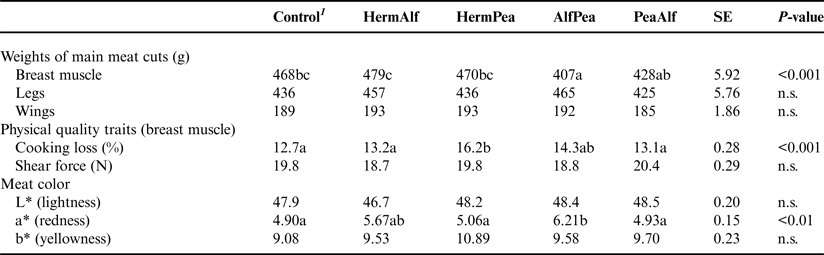
In relation to carcass weights, the weights of different meat cuts (breast, leg and wing) (Table 3) were high across all groups of the present study, compared with other conventional or organic broiler fattening systems (Castellini et al., Reference Castellini, Mugnai and Dal Bosco2002; Leiber et al., Reference Leiber, Messikommer and Wenk2009; Laudadio and Tufarelli, Reference Laudadio and Tufarelli2010). Group AlfPea developed the lowest breast muscle weight, which was the only carcass parameter in which an experimental group (AlfPea) showed a significant disadvantage compared with the control group.
Effect of diet on meat cut weights and meat quality in Hubbard chickens after 82 days of growth.

SE, standard error.
1 The control diet was a commercial organic broiler diet, No. 7038C (Mühle Rytz, Flamatt, Switzerland), containing corn, soybean cake, wheat, sunflower cake, corn gluten, soybean oil and a standard mineral premix. The alternative diets are based on the control, but 130 g kg−1 of soybean cake are replaced by: HermAlf: 78 g kg−1 Hermetia meal and 52 g kg−1 alfalfa meal; HermPea: 78 g kg−1 Hermetia meal and 52 g kg−1 pea groats; AlfPea: 78 g kg alfalfa meal and 52 g kg−1 pea groats; PeaAlf: 78 g kg−1 pea groats and 52 g kg−1 alfalfa meal.
The cooking loss of the breast muscle (Table 3) was generally in the lower range of published values for chicken (Castellini et al., Reference Castellini, Mugnai and Dal Bosco2002; Perenlei et al., Reference Perenlei, Tojo, Okada, Kubota, Kadowaki and Fujimura2014). A decreased cooking loss may increase the juiciness of the meat (Toscas et al., Reference Toscas, Shaw and Beilken1999), which could constitute a sensory advantage. Group HermPea had a significantly higher cooking loss than the control and group PeaAlf. The reason for this difference remains unclear, since it did not appear to be related to any of the experimental diet components, as neither Hermetia meal (in HermAlf) nor a higher concentration of pea groats (in PeaAlf) had the same effect as in HermPea.
The meat color of the breast muscle showed no diet effects on lightness (L*) and yellowness (b*). Only for redness (a*) an increased value was found in group AlfPea. This might have been an effect of beta-carotene or other pigments in the alfalfa (Smith et al., Reference Smith, Lyon and Lyon2002); however, these compounds had not been analyzed in the feed. Again, the variation was not very large and well within reported a* values for chicken breast meat (Laudadio and Tufarelli, Reference Laudadio and Tufarelli2010; Dotas et al., Reference Dotas, Bampidis, Sinapis, Hatzipanagiotou and Papanikolaou2014).
This experiment confirmed the potential of all tested experimental alternative protein sources to serve as partial soybean cake replacers in organic poultry broiler diets. Further studies are needed to assess the ecological and economical sustainability of alfalfa and Hermetia meal, as production costs and energy requirements (for drying alfalfa) and gaseous C and N emissions (from the metabolism of the black soldier fly larvae) might be specific challenges to solve. Further, agricultural policies do not allow the use of insect protein as feed for agricultural animals in some countries due to food safety questions, which remain to be clarified (Belluco et al., Reference Belluco, Losasso, Maggioletti, Alonzi, Paoletti and Ricci2013; Charlton et al., Reference Charlton, Dickinson, Wakefield, Fitches, Kenis, Han, Zhu, Kone, Grant, Devic, Bruggeman, Prior and Smith2015). At the moment, the estimations for the costs of Hermetia meal production result in higher prices compared with soybean. However, there is globally rapidly growing interest in insect protein production for poultry feed (Makkar et al., Reference Makkar, Tran, Heuzé and Ankers2014; Maurer et al., Reference Maurer, Holinger, Amsler, Früh, Wohlfahrt, Stamer and Leiber2015; Verbeke et al., Reference Verbeke, Spranghers, De Clercq, De Smet, Sas and Eeckhout2015) and future technological developments may lead to decreasing costs of production.
Conclusion
Our results suggest that diets containing CP from soybean replacers (e.g., alfalfa, pea and black soldier fly larvae) can result in similar or even improved protein conversion efficiency in organic poultry systems with slow-growing genotypes. The partial replacement (e.g., half) of soybean cake with different combinations of meal from black soldier fly, alfalfa meal and pea groats in a diet for broilers did not affect growth performance when compared with a standard commercial organic feed.
Meat quality traits were not affected by the replacement of dietary soybean meal with any of the alternative mixtures. Therefore, the use of mixtures of regionally available legumes, as well as a defatted meal from black soldier fly larvae, may have good potential as protein rich feed components in broilers' diets. The leguminous components (peas and alfalfa) would immediately be implementable based on regional crop rotations, while the use of insect proteins is still limited by legislative issues and a lack of appropriately developed production chains. Our study indicated that it may prove relevant to reassess the protein conversion efficiency in broiler diets with lower CP concentrations.
Acknowledgement
This study was supported by MIGROS, Zurich.