From the winter of 1740 into the next spring, Martha Underwood, a servant, perused London’s newspapers. Here she followed the awful career of Henry Cook, a shoemaker from her native Stratford who had reputedly murdered one of his victims in the course of committing highway robbery.Footnote 1 By late July 1741, she was pursuing him, not just in print but on foot: because it was “the Law of the Land, and … Justice to my Country,” she dogged Cook through urban byways. Stopping now and then to enlist help, Underwood assumed others had been reading about Cook too. She cited the newspapers in her attempts to convince porters, alehouse patrons, a butcher, a cheesemonger, and a constable of Cook’s identity.Footnote 2 Upon the bandit’s detention by some of these fellow readers, John Zachary, a silkman, asserted that this was the person who had robbed him near Stoke Newington and whom Zachary had characterized in the London Evening Post as “a thin Man about five Feet three Inches high, with Pock Holes in his Face.”Footnote 3 At the Old Bailey, Cook offered alternative explanations for why the stolen property was found in his possession and dismissed his accuser’s advertisement, averring that “I am not like the person, for I am 5 feet 7 inches and an half.”Footnote 4 We can imagine Cook drawing himself up to a fuller height in the dock, trying either to fashion a loophole from the doubtful numeracy that was the early modern norm or to “brave” it by achieving an imposing, above-average stature.Footnote 5 The defendant well knew the importance of such descriptive notices. Cook had previously used them to evade capture, and even to establish an alibi, but in this instance the physical description would be his undoing.Footnote 6 Like his pursuers, he may also have read the front-page reports of his exploits. Colorful as it was, however, this reporting had not included a physical profile. Cook’s criminal career was therefore derailed by a quite ordinary text: his victim had paid for a description to be placed among the back-page advertisements, and this privately subscribed bulletin had triggered a citizen’s arrest. Cook challenged the precision of that description to be sure, but he failed and was duly stretched out at Tyburn.
We cannot tell exactly how the court responded to Cook’s last challenge to the evidence presented against him, for the record, otherwise unusually detailed, ends as summarily as the convicted man’s life. We do know the means by which Cook had been captured were not at all uncommon. Every year scores of similar physical profiles were published in the newspapers. Policing, especially detection, was not yet professional, and authorities had neither a dedicated communications network nor a comprehensive archive that could be used to identify suspects or track down repeat offenders on the basis of a systematic indexing of their physical characteristics. Instead, victims authored ad hoc descriptions of wanted persons and promised rewards for their apprehension. They then tapped into the so-called news revolution, hoping to make readers their eyes and ears.Footnote 7 Civil War–era newsbooks had heralded a profound if hesitant shift whereby private knowledge became both public information and commodity courtesy of weekly journals, periodic gazettes, and daily news-sheets. By the mid-eighteenth century not only provincial English cities like York and Norwich but also Edinburgh and Dublin, Boston and Philadelphia, had newspapers whose own readers drew upon and continued to feed the metropolitan press. Serial publication made possible an information dragnet, which people routinely used to locate criminals, fugitives, and the missing.
Historians, too, can benefit from this premodern web of information. Examining these notices in series allows us to witness not only early modern print culture or criminal justice in action but also physical discrimination at work. We can reconstruct lines of sight, establish the most commonly drawn bodily contrasts, and evaluate their contemporary meaning. Everyday understandings of the human form, particularly as they relate to gender, sexuality, and ethnicity, have been the subject of considerable discussion.Footnote 8 Yet there is much we can still learn about ordinary people’s perceptions of their bodies as well as the ramifications for daily life.Footnote 9 Sampling “wanted” notices is one way to extend our knowledge of how people viewed themselves and identified one another. Press notices have been used before to engage with questions about corporality and identity, but such studies have preferred sampling provincial or colonial publications from after 1750 and have done so on a relatively small scale.Footnote 10 By contrast, I examine notices in London newspapers across the period 1651–1750 for what they tell us about how and why people made physical distinctions. Those distinctions relied on the dominant physiological paradigm of the time. This paradigm held that the human body’s vitality composed not living cells but fluids in dynamic combination, comprising the four humors of blood (sanguine), phlegm, choler (yellow bile), and melancholy (black bile).
So when it comes to popular assumptions about the body, advertisements allow us to hear the word on the street. This essay contends that the social depth of newspaper advertising was considerable and its reception deeper still. Individually, impressions of skin color, facial contours, stature, and comportment may seem unremarkable. The lexicon used to make these observations suggests, however, that ordinary folk (those below the gentry) persistently took the measure of bodily appearance in humoral terms, while believing that certain contrasts signaled inherent differences of physical aptitude, intellectual ability, and moral character.Footnote 11 This surveillance was preoccupied with the evaluation of health and social standing. As we will see, these twin preoccupations, not any shortcomings of the humoral paradigm itself, explain why people so often assessed strangers’ skin tones with especial vigilance. They scrutinized complexions intensively yet very rarely recognized one another as “white.” They could discriminate to iniquitous effect but had yet to cleave to any simple racial binary.
Sampling Advertisements
Demonstrating how the English and their nearest neighbors saw themselves, notices for almost 10,700 individuals comprise the main texts analyzed here.Footnote 12 This sample was derived from a database of advertisements for wanted persons appearing in London news-sheets, bulletins promising benefit to anyone sighting their subjects. Creation of the database involved reading all issues from 1651 to 1750 that are reproduced on the Early English Newspapers microfilm. Details provided in the notices were then disaggregated into two main subsets. One subset tracked the description of physical characteristics: height, hair, facial features, build, skin, and distinguishing marks like tattoos. The other linked all available identifiers: the subject’s name, birthplace, occupation, sex, age, distinctive clothing, reason for advertisement, author’s name, business, location, and contact details for remuneration.
The microfilm archive has limitations. It captures, not always perfectly, the collections of Charles Burney, the Regency bibliophile, and John Nichols, scion of an eighteenth-century publishing dynasty. Titles appeared according to an often-confounding schedule, in misnumbered or multiple editions, and under pirated mastheads. Extant copies are also marred by bleed-through and foxed by time. Some advertisements have been torn or cropped from issues, apparently saved for their still visible front-page news. Despite an effort to achieve completeness, these collections betray what is, to this very day, not there.
Substitutes are available to improve legibility and fill some of the lacunae, or at least assist with reconstructing the history of the advertisements. So the celebrated collection of Civil War–Interregnum ephemera compiled by bookseller George Thomason augments coverage for this study’s first decade. It is also now possible to reexamine high resolution digital facsimiles of both the Thomason and Burney series.Footnote 13 And as Henry Cook’s appearances at the Old Bailey demonstrate, some advertisements were proffered as forensic evidence. The full-text searchable archive of the court’s published proceedings enables us to correlate the names of persons first appearing in newsprint with those subsequently brought to book by such bulletins, providing crucial insight into how these notices functioned.Footnote 14
The database compiled for this study does not record every “wanted” notice from the century in question. As some notices had a simple name-and-shame function, particularly those for bankrupts or estranged wives (who might run up debts on their husbands’ accounts if creditors were not forewarned), so reference to any physical characteristic in these notices is rare. Notices also mention groups, with their members described to varying degrees of detail or in relative terms. Victims’ frightened recollection of suspects, especially when encountered disguised and after dusk, or a jailer’s limited capacity to register an escape en masse, made for partial description. Notices therefore had to recognize two physical characteristics, when identifying an individual, to be included in the database.Footnote 15 Nor is the sample examined here the raw sum of all printed references made to people’s bodies. As best it can, the sample includes discrete descriptions of individuals. Ensuring individuality can prove difficult if subjects are unnamed or if their names were transcribed with less than bureaucratic accuracy. It is usually a benefit but occasionally a curse that advertisements were repeated, appearing in successive issues of one newspaper or rival titles simultaneously. Notices have been cross-matched to set aside these duplicates or reappearances.
Writing and Reading Advertisements
Details of the author or, literally, the subscriber, the last person named at the bottom of the advertisement, were very often included in some fashion. At the same time, information was frequently abbreviated or deliberately withheld. On the one hand, a subscriber’s business, status, or location might be assumed so well known to locals that its exposition was redundant. On the other, authors’ identities were obscured or omitted if reputations were at stake.
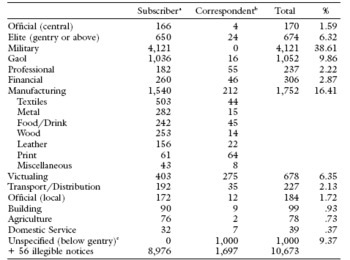
Having quite loosely stipulated lengths of six to ten lines, advertisements cost an average 2s. 6d. (approaching half a London laborer’s weekly wage) and had additional indirect costs if the subscriber resided beyond the metropolis (see table 1).Footnote 16 Given these expenses, subscribers typically aimed to retrieve property of greater value, whether in the form of chattel or an employee’s labor.Footnote 17 One might be forgiven for thinking this circumstance not immediately conducive to recovering popular perceptions, but we can venture that the majority of those formulating the notices were of modest property, from the middling or skilled laboring sorts (see table 2).
Members of the middling ranks routinely sought vanished apprentices and domestic
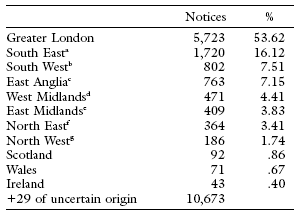
Geographic Origin of “Wanted” Advertisements Published in London Newspapers (1651–1750) Based on Subscriber Information
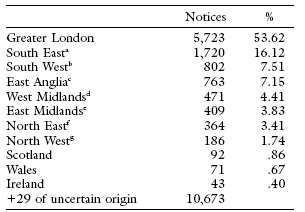
a Kent (619), Hants (389), Berks (202), Surrey (172), Sussex (125), Oxon (101), Bucks (77), Isle of Wight (35).
b Somerset (266), Wilts (185), Devon (158), Gloucs (114), Dorset (49), Cornwall (30).
c Essex (274), Herts (123), Suffolk (101), Cambs (85), Norfolk (85), Beds (66), Hunts (29).
d Warwicks (181), Worcs (131), Staffs (71), Salop (53), Hereford (35).
e Lincs (114), Leics (95), Northants (86), Notts (67), Derbys (39), Rutland (8).
f Yorks (and Westmorland) (283), Northumberland (68), Durham (13).
g Cheshire (83), Lancs (81), Cumberland (22).
servants. Not only might their social credit rely on restoring the household order of which these miscreants were a part, but also at risk could be several years’ training and terms of indenture yet to be completed.Footnote 18 Some servants were casual employees; others had been schooled in the now-disrupted household routine. Many had become felons, having used insider knowledge to steal clothes, plate, and other movables from their employers, even their coworkers.Footnote 19 With publication, masters staked their claim and warned others not to accept unwittingly a new worker who might prove a liability. Craftspeople went after shoplifters, fraudsters,
Occupational Distribution of “Wanted” Advertisements Published in London Newspapers (1651–1750) Based on Subscriber Information

a Notices where subscriber states occupation.
b Where the subscriber is unnamed, we can estimate the social location of the notice on the basis of the reason for seeking out the individual and contact details for correspondence.
c Notices can be anonymous, naming neither subject, subscriber, nor correspondent. However, the fundamental social distinction (gentle or not) is invariably indicated by social descriptors used.
and burglars.Footnote 20 Tavern keepers and ostlers, or those in the provisioning trade to supplement their incomes, sought those who made off with horses or tankards.Footnote 21 Jail keepers advertised people detained on suspicion and escapees from what were otherwise private enterprises.Footnote 22
Crucially, those who signed and paid for the advertisements were not necessarily in charge of their formulation. Given the constant prospect if not reality of war in this period, it is little surprise that notices of military deserters account for nearly 40 percent of the sample. The names of senior officers occur repeatedly as “authors” of these notices, yet the work of tracking the absent rank-and-file was the task of sergeants, quartermasters, or clerks. Enlistment records either lacked certain details or were inaccessible when a regiment was on the march. Therefore, these administrators fleshed out descriptions on the basis of their own recent contact with the absconded or perhaps relied on the recollections of those who knew them best, their former comrades.Footnote 23 Secretaries of state endorsed bounties on those breaching the monarch’s peace (highway robbers, counterfeiters, smugglers, some murderers), yet testimony had first to come from victims, eyewitnesses, or those turned informer.Footnote 24 The social elite appeared as victims of crime, but their employees played a substantial role in organizing notices, and stewards and housekeepers may well have been responsible for the composition of notices. Footmen, porters, or other attendants were similarly asked to describe subjects.Footnote 25 If not themselves newspaper agents,Footnote 26 urban professionals, merchants, retailers, victualers, and the artificers of the property stolen acted as correspondents, or points of contact, for those answering advertisements that concerned elite patrons and their (provincial) households.Footnote 27
Notices were not designed solely for or by Londoners. Approximately 45 percent of the notices originated beyond greater London. Editions were published to coincide with stagecoach schedules because coaches bore news from the provinces and could deliver it afresh upon their return. Particularly for the first half of the century, London papers were literally media, the midpoint in a vector linking provincial locations without their own journals.Footnote 28 Even from towns that had acquired their own mastheads by the early eighteenth century, metropolitan publication was still routine because the wanted were known to be London-born, and might have kin resident there on whom they could call, or they were younger and assumed to be wide-eyed fortune seekers joining the migration stream that saw one in six people live in the metropolis at some point in their lives.Footnote 29 Smaller flows ran in the opposite direction. Notices chased the homesick or deprived who had abandoned unwelcoming city streets and criminals seeking refuge in the rural hinterland.Footnote 30
Both provincial notices mediated by the London press and advertisements that hoped to trap fugitives coming to the capital would have required indirect communication between author and printer. This circumstance suggests it was advertisers who devised much of the often idiosyncratic content without prompting from a Fleet Street wordsmith.Footnote 31 One subscriber in fact used a rival paper to lambaste another’s small editorial license, whereby rephrasing of the notice had created the false impression that its subject was a suspected felon rather than missed by relatives.Footnote 32 There is the distinct possibility that advertisers, whether from the counties or the metropolis, built on their own experiences as newsprint readers. Circumstances for reception are arguably more important than those of authorship.
Notices captured the gaze of erstwhile comrades and collaborators, fretful masters or parents, articulating perceptions of others’ bodies, so that a considerable readership might become lookers and lay hands upon the wanted. Citizens were wary of harboring the wrong employee or stocking stolen goods.Footnote 33 These same people had an eye on their rates, hoping to moderate the expense of supporting the young and shiftless or even the aged and worthy vagrant. Under the Poor Laws, responsibility for such people lay with their native parishes.Footnote 34 Moreover, middling householders were expected to do their civic duty as constables or headboroughs, watchmen, churchwardens, overseers, or vestrymen. If they were upper-middling, elected positions involved prevention as well as prosecution of misdemeanor. These watchful townsfolk were stalwarts of the newspapers’ primary distribution node, the coffeehouse.Footnote 35 While individual subscription, purchase from hawkers, bookstalls, and coffeehouses themselves were all possibilities, a main attraction of the latter was communal readership gratis.Footnote 36 Patrons expected to exchange and discuss all kinds of intelligence. The beverages and tobacco purchased were “drugs”—commonplace consumables. To encourage a conversing, knowing clientele, proprietors were obliged to supply a range of titles. One customer might digest several papers’ worth of announcements. A single copy of a single issue, among tens of thousands produced each week, had multiple readers as it made the rounds of the tables. Editions were also collated to form part of a coffeehouse library, or information repository, whence Burney’s own collection had its start.Footnote 37 Featuring prominently as ancillary contact points for respondents, there are several cases where the advertised were apprehended at or near coffeehouses.Footnote 38 One witness at the Old Bailey testified that he took himself to a coffeehouse newspaper collection—possibly at William Unwin’s famed establishment, Will’s—to research a promissory note and the defendant’s history. Sure of the facts, he then helped effect the arrest, which led to a capital conviction.Footnote 39
The lower sort could also become concerned residents. After all, those people described in notices came mainly from this milieu. At alehouses and workplaces, group reading overcame expense and illiteracy.Footnote 40 Newspapers, and sometimes separate notices, were cried in the streets, making for added aural awareness.Footnote 41 Customers anticipated establishing contact with hackney drivers or lowly porters to recover misplaced belongings.Footnote 42 Advertisements assumed that humble subjects and their friends would get word of an amnesty.Footnote 43 As the daring of Martha Underwood hints, the lower sort had a role in policing, too. If insufficiently propertied to serve their wards and parishes, men might become hired substitutes for their superiors.Footnote 44 The delinquent would also come into contact with those whose livelihoods’ licensing required they both prevent and report illegal doings, including vagrancy itself. Particularly if they came from the provinces, runaways needed transport. Under penalty of fines, coachmen, carriers, carters as well as Thames watermen were not to carry vagrants into London, regardless of whether such people had cadged a ride or paid for it.Footnote 45 Publicans, in whose establishments multifarious crimes were allegedly orchestrated, were, paradoxically, meant to stay on the right side of the law,Footnote 46 so, too, ships’ captains who might convey fugitives abroad.Footnote 47
One might assume that the aforementioned had an interest in paying customers or a share of goods off the back of the proverbial cart and, therefore, turned a blind eye. Yet there was often greater benefit in arresting the wanted. Rewards promised for apprehending servants, apprentices, and especially military deserters and felons, were substantial.Footnote 48 Constables, watchmen, and porters received gratuities for stopping people whose behavior might otherwise have taxed the community.Footnote 49 By the eighteenth century, diligence promised a “Tyburn ticket,” a transferable exemption from parish or ward service.Footnote 50 On the heels of statutory bounties for the conviction of felons, thief taking became a lucrative if perilous pursuit.Footnote 51 People like Jonathan Wild facilitated the recapture of property and perpetrators, exploiting the press to market their services and achieve results.Footnote 52 Meanwhile, crooks used notices to return items they themselves had stolen for reward.Footnote 53 Like Henry Cook, they scoured the papers to plan their next moves.Footnote 54
By contrast, elite individuals at the level of the gentry and above were a minority when it came to reading wanted notices. Genteel periodicals like the Tatler and Spectator carried few bulletins despite, in their day, probably surpassing the London Gazette for sheer volume printed and sold.Footnote 55 The paucity of personal notices in such publications can be explained by their studied cultivation of a fashionably polite clientele—broad but not especially deep in social reach. Laying hands upon truants was a dirtier, pedestrian affair and a makeshift trade for some. Advertisements worked only if they were both informative and informed. That is, they achieved specificity by deploying a language that ordinary folk themselves used and understood. While there was a bias toward middling subscribers, texts had to be comprehensible to as big a crowd as possible. To be effective they needed to use a popular somatics, a language of the body which most anyone could recognize and pass along. This grammar of appearance might usefully be considered a combination of the humoral, physiognomic, and stigmatic.
Diagnosing Humors: In Sickness and in Health
“Complexion” was central to understanding bodily appearance yet it was of ambivalent meaning. Complexion traditionally referred to the overall conformation of an individual’s body, its contours explained by the mixture of the four elemental humors—phlegm, choler, melancholy, and the sanguine. A fallen humanity could not experience absolute equilibrium in terms of either humoral quantity or quality, and much vernacular medical literature encouraged the idea that people inherited a specific and lasting combination of humors, their “constitution,” “temperament,” or “complexion,” which was in some ways peculiar to themselves. To remain healthy, their bodies had to keep producing the mixture of humors with which they had been born and which explained their physique. Failure to maintain this relative balance within which one humor was usually thought prevalent caused disease. By the same logic, what was a healthy blend for one person could be morbid if it occurred in somebody of a different native complexion.Footnote 56
An individual’s current humoral temperature was made manifest by contours of head and limbs, condition of hair or eyes, and by color of skin. We now associate complexion with this last characteristic. Newspaper notices likely contributed to this refinement in complexion’s meaning. Every second notice spoke of the body’s skin or used facial tone as its metonym.Footnote 57 The descriptors employed when people visualized the temper, texture, and tint of an individual’s skin can be analyzed by incidence and lexical proximity or their relative shades of meaning.
However, a vital initial distinction to make is that these terms had either a pathological or an ontological significance.Footnote 58 Many notices offered a virtual humoral pathology and were anxious to remark on the body’s present condition, whether it was fit as opposed to frail, rather than assay its normal hue or name an abiding native temperament. “Fresh” was used repeatedly to refer to a skin tone that, in its vibrancy, suggested a person currently enjoyed good health. Samuel Prince, found guilty in absentia of his wife’s murder, was therefore deemed a “lusty Man, of a fresh Complexion, stoops in the Shoulders, near Six Foot high, above Fifty Years of Age, has pretty long Legs, not large for his Height, and remarkable long flat Feet. … Has a smooth Face for his Age, having never had the Small Pox.”Footnote 59 A chapman wanted by creditors could be described as “was fresh looked but at present has the yellow Jaundice,” or an absent footman was “thin-faced but fresh-colour’d.”Footnote 60 The term was also associated with positive remarks about other aspects of physique. Hence the aptly named Thomas Rozey was “a fresh-colour’d round-faced well-set Lad, of about 19 Years of Age, … an Apprentice Clerk to Mr Macnemara of Maryland … [who] has lately absented himself from his Master’s Service, purloined several of his Master’s Goods … and is now in or about London.”Footnote 61 The fresh-complexioned had “clean” or “good” limbs, were “well made every way,” or “strong made … with a fresh and comely Visage.”Footnote 62 Occasionally, the traditional and newer meanings of complexion were merged. Thus a soldier’s description as deserter joined “of a plump fresh complexion” with the standard details of height and hair.Footnote 63 “Fresh” might be used synonymously or in tandem with such terms as “blooming,” “ruddy,” “good,” “well,” “solid,” “round,” “clear,” “smooth,” “clean,” and, simply, a “healthful” or “healthy” complexion.Footnote 64
It is tempting to equate “fresh” and its synonyms with the hue now labeled peaches and cream. This would be a mistake. Freshness could easily occur in conjunction with terms observing something other than an ivory-pink coloration. These estimations included “a fresh-colour’d Lad … of a sandy Complexion,” a Sheerness servant “of a dark brown Complexion but fresh colour’d,” the “smooth Skin, brown Complexion, and a fresh Colour” for a missing Bluecoat schoolgirl, a Thames waterman’s “brown but ruddy Complexion,” and the “black Complexion, and fresh Colour” of a robber.Footnote 65 Failure to take account of pathology led, in one instance, to a partial retraction. In July 1750, the Clerkenwell bridewell’s keeper posted a £20 reward for an escaped detainee but “through Mistake, in the said Advertisement wrongly described the said Patterson, as a Man of a brown Complexion, though he is rather of a fair Complexion, but a little ruddy or fresh coloured.”Footnote 66 Such phrases suggested pellucidity and vigor of no single, particular hue.
In the opposite fashion (though with not quite the same consistency, as I will explain), “pale” might refer to the presence of distemper and the loss, or short-term absence, of an unnamed native temperament. Hence a thief was “somewhat pale, by reason of late sickness.”Footnote 67 Sufferers of smallpox or an ague might exhibit a “pale greasy Complexion,” or a “thin and pale” visage.Footnote 68 Less insipid synonyms for the pallor of an ill complexion included “whitely,” “dull,” “wan,” “sickly,” and “tallow”Footnote 69—the last borrowing from the pasty preparations of the chandler’s workshop.Footnote 70 Distemper could also result in feverish tints, variously described as “sallowish,” “yellow,” “tawny,” “dusky,” “dun,” “cloudy,” “muddy,” “sour,” “wainscot,” “swarthy,” or “adust”—a faintly clinical prognostication of a visceral dehydration of the humors.Footnote 71
Once again, notices might rely on the double meaning of complexion to describe enfeebled frames as much as a dermis defaced by disease. Thus a young soldier was “very slender, with short thin lank black Hair, pale and thin Complexion, much disfigur’d with the Small Pox.”Footnote 72 In a similar vein, William Burridge, an apprentice wigmaker, was targeted for return as “a pale Boy, and thin complection’d.”Footnote 73 A last example demonstrates how different descriptions of the same individual allow us to establish the lexical proximity if not synonymity of these descriptors. John Rogers, a bankrupt broker, was identified in the Daily Post and Daily Journal as being “of a thin pale Complexion, about five Foot nine Inches high … had a Wen, or Excrescence, about the Bigness of a Walnut, on the Right Side of his Forehead, on which he usually wore a large Patch, or Plaister … He bends in his Back very much, and has a Shuffling-Gate.”Footnote 74 Yet a second round of appearances in the Daily Courant, London Gazette, and Evening Post advised readers to watch for his “pale sallow Complection.”Footnote 75
As with “fresh,” qualification and juxtaposition indicate that paleness and its cognates were not necessarily observing a particular shade, nor assessing a normal complexion. If the subject was fortunate these unhealthy tones were short-lived symptoms of humoral imbalance or crisis, not indicative of any abiding native temperament. How else do we explain oxymoronic reference to a complexion “som[e]what yellow, swarthy, pale,” “pale and swarthy,” or persons otherwise described in piebald terms?Footnote 76 For example, a servant was of “a dark Complexion, … and pale Fac’d” or Thomas Currill, a fugitive from his master’s workshop, was a “pale thin Youth, about 18 Years of Age, Brown Complection’d.”Footnote 77
The reference to a “look,” as in the phrase “of a dark-brown Complexion, a fresh looking Man,”Footnote 78 hints at a further way that somatics pathological in meaning were syntactically distinct from those describing native temperament. Phrases used to characterize either temporarily invigorated or presently tired complexions relied more often on verbal and adverbial phrasing. Faces were variously, and transitively, “coloured” or bodies “complexioned.” While quite a number of the words already mentioned may be the subject of nominal or adjectival use today, such was not invariably the case in the early modern era. One might tallow a ship, greasing its hull. A craftsman could tawn a hide, that is, tan it. In the sense of rendering it opaque, one might dun, dusky, or muddy water just as easily as clear or clean it. To ruddy was to render red or cause to blush. To fresh (not freshen) was to renew or strengthen the state of something. To swart(h) meant to cover over.Footnote 79
“Looking” suggested passing judgment on an individual’s current but temporary bodily texture, a glance that was not presumed consistent with, nor necessarily indicative of, the person’s native complexion. So one apprentice was pronounced a “fresh Complection well looking Lad,” another considered a “pretty fresh looking strait young man.”Footnote 80 Pessimistic parallels include the depiction of a suspect in the theft of plate from an inn as a “short, thin-faced, white-look’d Man, his Lips broke out.”Footnote 81 An absent infantryman was portrayed as “a thin, dark, dirty-looking Man, brown Complexion.”Footnote 82 Another was “pale-faced, … has an ill Look.”Footnote 83 Warning of a fraudster-at-large with a “fair well-looking Complexion,” one bulletin carried a pointed qualification of its own description when it stressed the individual concerned was “naturally” of this appearance.Footnote 84 In other words, he enjoyed the rare good fortune of always seeming healthy such that his potential victims could watch out for him with reference to this same unusual characteristic.
It was also to register a contrast between superficial diversity in appearance, or literally a temporary disguise, and intrinsic continuity of humoral temperament that some advertisements explicitly considered environmental exposures that had compromised skin tone. Thus a six-year-old boy’s brown complexion was said to have become “somewhat weather-beaten.”Footnote 85 Advertisers used similes suggesting that they were describing the epidermis and, in so doing, saw its state as both transient and somehow distinct from the normal range of temperamental types. Hence a suspected horse thief was reported to have a “swarthy Complexion, like a sailor,” while another man arrested for a similar crime had the same complexion “Gypsie-like.”Footnote 86
By comparison, ontological pronouncements concerning normal, natal temperament made more frequent use of nominal or adjectival phrases and adopted a possessive idiom. People were, for instance, usually said to be of a black complexion rather than black complexioned. As we have seen, it was common to speak about the fresh-colored; to assume people’s burnished skin was the result of environmental accident or external, topical agency. By contrast, no one was said to be black colored, and few of the other terms that we will now examine were used in this manner either, and then only rarely. The fundamental distinction at work was that almost as many notices aimed to classify native complexions, which were considered entrenched not superficial, essential rather than acquired, permanent not transitory.
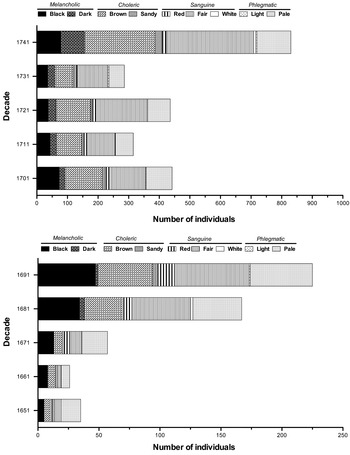
Several words routinely judged both a person’s skin color and their underlying humoral temperament. The spectrum ran as follows (see also fig. 1):

At first sight the different shades might seem arrayed according to common sense, their order as plain as the nose on one’s face. However, they are placed in their proximate positions according to use within advertisements. Where a high level of synonymity is evident there is a double connection (=) and, by contrast, terms of moderate incidence are (in parentheses).
Terms have been included and arranged on the basis of two kinds of usage: positive and alternative. Earlier scholarship assumed that the color black, not to mention apparently “black” skin, invariably carried negative associations in this period.Footnote 87 We might also wonder whether a certain contemptuousness did not also adhere in the term “brown.” Could it instead have been a pathological signifier of, say, a skin browned by the sun, even a complexion burned by humoral imbalance from the inside out? Yet there are advertisements where these terms are used normatively, to indicate an innate complexion.Footnote 88 Hence the grenadier Richard Harrison was reported as “a Yorkshire-man, about 6 Foot high, of a good Black Complexion, with a Roman Nose and long Black Hair, aged about 28 Years.”Footnote 89 Or a brother-in-arms was of a “brown pleasant Complexion.”Footnote 90
Subjects were represented by notices published in different papers. Yet these were not always verbatim copies, and sometimes alternative descriptors were used to assess complexion, implying that they shaded into one another. The author, or authors, had used associated if not synonymic terms when the notice was recomposed. Hence the London Evening Post first observed that William Drury, an absconded soldier, was “of a black Complexion” and “well-set.” Three days later the paper listed him as “of a dark brown Complexion” and “well built.”Footnote 91 That these colors were a shorthand for the typing of their subjects’ native humoral temperaments can also be seen from slippage between texts focusing on the same person. For example, the advice “Joseph Powel, Clerk … is run away; he is tall, Pretty Fat, full fac’d, grey Eyes, of a fair Complexion, 28 Years of Age” was printed a week later in a rival paper with the substitution of the more recondite “sanguine”
Distribution of references to skin color in London newspaper advertisements for wanted persons, 1651–1750.

for “fair.”Footnote 92 “Sanguine” itself appeared with small frequency, its counterparts, melancholic, choleric, phlegmatic, almost never.Footnote 93 One reason for this silence was the ambiguity of such terms. In some hands they could refer to both pathological and ontological states, and a basic color coding was surely more memorable. Of course, this is a difficulty with “pale.” While medical literature could confidently correlate pallid skin (i.e., a skin lacking pigment) with those who were by their very nature phlegmatic, we have to read the broadsheets for further bodily signs normally associated with this temperament. Idiosyncrasy again proves helpful. For instance, an anonymous highwayman was identified as “a short squat Fellow, full faced, and of a pale sodden Complexion,” implying the stature, frame, and bulk of someone whose temperament was ruled by cold, wet phlegm. That his partner in crime was of a “sanguine Complexion” suggests that humoral typecasting of both men was being indulged.Footnote 94
Scrutinizing Physiques: From Head to Toe
Reference to facial features, and sometimes bodily contours generally, joined humoral with physiognomic logic. A welter of ancient science and exacting humanistic scholarship, oral lore, and plebeian custom, early modern physiognomy was the art of judging a person’s character, their moral and mental capacity, with reference to physical appearance.Footnote 95
If we can say that half the advertisements characterized the skin’s pigmentation, then virtually all the remainder were pronouncements reliant on a different coloring: the hue of a person’s hair. Hair color and texture were considered an outgrowth of humoral complexion.Footnote 96 In contrast to skin, hair was most often an ontological rather than pathological marker, probably because it was thought less readily distempered. This explains why individuals were frequently characterized in terms of their locks. For example, we read of “a little fair Man,” “a middle siz’d light brown Man,” and “a thin black Man about 30 years old, wears his own Hair.”Footnote 97
If early modern people believed that hair’s color and texture were indicative of humoral temperament, then both were understood, in turn, to reveal and condition an individual’s personality. Physiognomy taught that different tonsorial tones betrayed different characters. This lore was perpetuated by diverse types of cheap print, including broadsheet ballads that were an older cousin of the newspaper. For example, maids were warned to avoid choleric men:
Similarly, a bulletin for a youth believed led astray by a city-wise confederate painted a picture of cherubic innocence yet one compromised by a rustic simplicity: “Thomas Naish, a Boy about 15 Years … born in Tring in Hertfordshire, put Prentice to a … Freeman of the City of London … [had] a pleasant Countenance, comely Features, and fair Complexion, but grey Eyes and light brown Hair, a large Scar on his right Breast.”Footnote 99
As much as this last example might foreshadow a twenty-first-century biometrical surveillance privileging iris color, early moderns often preferred the eyes’ conformation. Characterological significance was discerned in eyes that were “round,” “large,” “full,” “google,” “vigorous,” “lively,” “rowling,” “twinkling,” “shining,” “sparkling,” “staring,” “wild,” “little,” “hollow,” “small,” “brisk,” and “heavy,” and which had “remarkable Narrowness at the Corners,” “much White,” or, in keeping with human-animal analogies common to physiognomy, were “pig.”Footnote 100
Other physiognomic combinations could assume priority and prove deserving of discriminating attention, which suggests that physiognomy was not, at least at the popular level, merely a “bawdy parlour game” by the early 1700s.Footnote 101 This attention was prejudicial in that the contrasts drawn were not often quantifiable or otherwise measurable against any uniform, objective standard. Rather, these characterizations registered abnormality, literally making their subjects’ bodies stand out from the crowd in the same way that their behavior had removed them from the community. Indeed, authors sometimes interpreted bodies retrospectively for physiognomic signs they now realized they themselves should have discerned earlier. “Flat” noses with “wide” nostrils implied a snouty brutishness, particularly a rapacious pugnacity.Footnote 102 “Sharp,” hooked noses betrayed crafty mendacity.Footnote 103 “Hanging,” “blubber” lips, or mouths said to be “out,” “wide,” and “thick,” were thought to belong to dullards.Footnote 104 So after apprentice Robert Rayner withdrew his labor from his master’s Southwark factory in late 1706, his employer’s description assumed he was now actually at work, contentedly plodding along in a rural occupation more suited to his temperament: “He is a short, well set Boy, aged about 17, with strait yellowish Hair, of a Sandy Complexion, hath a Cast with his Eyes, very thick Lips of a dull heavy Disposition; supposed to have gone into some part of Cambridgeshire, Essex or Norfolk, following Plough and Cart.”Footnote 105
Many advertisements recognized social stigmata, bodily habits indicative of a subject’s assigned place in society and their present transgression from it. Much consideration was given to carriage, especially of the head, as well as to lesions, particularly in the hands.
The most prevalent references to deportment were the “down look” and the “stoop,” or roundness, of shoulders. Both were ironic in the context of delinquency because they otherwise implied social deference.Footnote 106 The “down look” signaled diffident submission; doing as one was told, silently averting one’s gaze and not meeting superiors eye to eye. Hence a notice for a young apprentice asserted that he was “down Look’d, but streight in Person,” obeisant yet not permanently gibbous.Footnote 107 John Rea was described as “middle sized, aged about 30, of a down look, but clear complexion.”Footnote 108 That is, his master testified Rea’s visage was not disguised by dirt or disease even though it was typically downcast in dutiful bashfulness. While congenital problems and the arthritic strains of manual labor might explain some references to stooping, many of these same subjects were otherwise considered tall, well-set, or stoutly built.Footnote 109 When a lofty, upright, and perhaps lissome stature was associated with higher social rank, there is surely the suggestion that plebeians had learned to carry themselves in a suitably submissive, not to say shortened, fashion. Anything else was social presumption and smacked of the impudence probably displayed by Henry Cook in court. Thus the Gazette remarked that fraudsters who made off with hired mounts had, to the ostler, initially appeared the embodiment of social credit. Their cover story passed because it seemed physiognomically plausible: “One tall and slender, a black Wig; the other short and thick, pretending to be a Servant to the tall one.”Footnote 110
That people had recursive expectations of seeing bodies both borne down by crude labor and, at exactly the same time, cruder bodies born disposed to labored subordination is also evident in the language with which musculature was observed. Occasional heed was lent the posterior, with people described as “hopper” or “bottle-arsed.”Footnote 111 Both terms were borrowed from the workplace. A hopper was a cone-shaped grinding mill and, fittingly, bottle-arsed was printers’ slang for type appearing wider on one side than the other. Greater regard was had for legs. Contemporaries claimed to be able to identify certain tradesmen from the sinews of their lower limbs. Subjects were described as “baker-kneed,”Footnote 112 and, in at least one instance, the line of sight was inverted. The explanation for a person’s present impairment was assumed to lie with their longer occupational history: “George Mathers, aged 36 Years, and about five Feet ten Inches high … , wears a Wig, but dark brown Hair, and is of a ruddy Complexion, has a Scar above his Right Eye joining to the Hair of his Head, is flat footed, his Ancles turning much in, by Trade a Baker, but practices House and Sign Painting.”Footnote 113 Similar assumptions were made about the stereotypical cross-legged pose of tailors altering permanently their bearing.Footnote 114 Even more frequent were comments scrutinizing the fitness of male legs. Hence Nathaniel Child’s description as deserter damned with faint praise, he being “thin Shoulder’d, and slender made, but good Legs.”Footnote 115 Another notice offered an unflattering comparison between one soldier with “small legs” and his “well legged” comrade.Footnote 116 The fleshiness of legs, especially the calves, bespoke virility.Footnote 117 Debility in the lower limbs was a symptom of syphilis; the pox could attack cartilage, making for “bandy” legs.Footnote 118
Hands indexed wrongdoing of a different kind. A decentralized early modern jurisdiction tracked offenders by branding felons, usually on the ball of the thumb. Scars and tattoos were reported not simply as distinguishing marks in their own right but also as possible disguises of former transgressions.Footnote 119 Hands were the mainstay of premodern work, and masters who had lost manual labor were keen to claim it back. Runaways could not survive without the semblance of work, and masters listed crafts to which the absent might turn their hands or, perhaps, explained in myriad detail how these hands were turned.
In addition to conveniently hideous growths, glaring wounds, and scars,Footnote 120 authors were attentive to intricate distinctions like “third Finger on Right Hand very thick,”Footnote 121 “the forefinger of his Right hand a little crooked and shorter than that of his Left,”Footnote 122 “the two middle fingers of both his hands are a little shorter than usual,”Footnote 123 “small brown Mole or Spot near the Middle of the Back of one of his Hands,”Footnote 124 “the back of one of his hands a Bone started, which makes a Bump,”Footnote 125 “Dent on the Middle of the Back of his right Hand,”Footnote 126 nail on right forefinger “like a Hawk’s Bill,”Footnote 127 and “a high Ridge of Flesh grows down the End of one of her Thumbs.”Footnote 128 Some considered that the condition of nail beds, and location of moles, also offered vital clues to a person’s complexion.Footnote 129 A tendency to contravene custom by favoring the sinister side made left-handedness a revealing singularity.Footnote 130 So too were hands, male or female, that tapered delicately or bore a snowy smoothness not in keeping with hard, clumsy fingers further swollen, stunted, and dyed by the labor for which they were destined, if not designed, by nature.Footnote 131
This is not to say that all miscreants and the socially humble were condemned as plain looking, much less ugly tout court. The worst offenders might be “handsome” or “well-favoured”; “fair” complexions could be observed in the lowliest subjects.Footnote 132 Yet that was often the point. Many of these seemingly laudatory descriptors functioned as admonitory exceptions proving the rule. They cautioned people not to rush to judgment, not to be beguiled by a somatic sign contradicting the person’s true nature, their real social and moral character. Readers were advised to take a longer, harder look than the authors had done. Notices warned people to be suspicious of these individuals because their features did not quite add up, sent mixed messages, and did not meet expectations of how the downtrodden, menial, or morally deviant should appear. Thus soldier John Stevens was portrayed as “upwards of five Feet nine Inches high … has light Hair, a fair Complexion, and an honest innocent Look, is well set, and square shoulder’d.”Footnote 133 Yet his advertisement stressed he had gained a reputation in his neighborhood as a poacher. Or Margaret Rowland “something Tall, of a light Complexion … with a long thin Nose, and a long slender Hand” passed convincingly for a gentlewoman heiress but was, to those who could with prior knowledge penetrate her phiz, a nobody; a “notorious Cheat.”Footnote 134
Bodily Discrimination—an Early Modern Racism?
Essential distinctions on the basis of bodily variation were clearly being drawn, but the resulting patterns are unfamiliar to modern readers. We can explain their peculiarity once we understand their reliance on humoral typing. This typing was fundamentally concerned with questions of bodily fitness and social identity, and it was a process of categorizing appearances that usually relied on a number of somatic signs even as skin tone was becoming the single most important indicator for establishing difference.
A principal axis of discrimination was, therefore, diagnostic. Evaluating the skin’s condition allowed people to weigh up the likelihood that an individual carried infection. As Henry Cook’s spare published image suggests, smallpox scarification (or its absence) was routinely remarked by notices well into the eighteenth century.Footnote 135 Similar scrutiny underpinned Poor Law interrogations too: was an individual a “sturdy” beggar able to work (and bear illegitimate children) or “impotent” and “deserving” of alms?Footnote 136 Description relying on a pathological idiom was bigoted, but fear of contagion was not its only impetus. Equally worrisome was a “swarthy” skin, say, which hindered estimation of a person’s native complexion and thus their underlying social and moral temperament.
To put it at its most basic, pathological terms like swarthy did not denote an abiding color but rather its obscuring.Footnote 137 Their use registered uncertainty concerning a person’s native complexion, the observer’s frustrating inability to discern the subject’s innate humoral balance and thereby type, or fix, their identity. However, this indeterminacy rebounded, ultimately making for a comforting self-fulfilling prophecy. When it was commonly believed that a shift in environment could temporarily upset an individual’s temperament,Footnote 138 a sullied skin was proof that its bearer was out of place, on the move and up to no good. In a culture obsessed with fixedness, fugitive skin tones betrayed transience both spatial and social. The same must be said for apparently favorable pathological assessments. These were mostly snide contrasts, and the majority to whom they applied were disparaged. Absent laborers who were “freshly” complexioned must surely be physically capable, have work left in them but be work shy.Footnote 139 “Ruddy”-skinned migrants and highwaymen were flushed, either from the hale and hearty toil of the fields they had abandoned or the exhilarating exercise of the pursuit.Footnote 140
Once we acknowledge the dual character of bodily discrimination, this habit of making first pathological then ontological judgments, we can begin resolving questions about early modern English perception of foreigners. These estimations are often ambiguous. For example, were Jews “swarthy” or “black,” and what are we to make of this apparent confusion?Footnote 141 Should we infer that the different terms nonetheless registered that Jews had a less-than-white skin and they were therefore victims of a racial cleft? Alternatively, if early moderns could not settle on one skin color for a particular group, then should we assume that a definitive physical classification and an attendant racism had not yet subsumed older ethnic prejudice?
Much of this contradiction is more apparent than real. We have not made sufficient allowance for the pathological idiom of early modern somatics and must not conflate it with the ontological, intimately related and occasionally confused by early moderns though the two were. To return for a moment to the association of Jews and swarthiness, this cliché could be used to describe a British-born Christian subject without a second thought. Ironically, however, few advertised Jews were deemed swarthy.Footnote 142 Use of this descriptive was derogatory to be sure, discriminating simultaneously against swarms of homeless men and masterless women, tribes of diasporic immigrants or footloose seafarers. But “swarthy” and its ilk were not being used to mark an inherent property that, in this case, Jewish migrants and Anglo-Christian plebeians would always share.Footnote 143 Rather, what these people presently had in common was an equivocal, shifty appearance, which made them stand out precisely because humoral typing had been attempted but faltered. In these instances typing had been forestalled by the diseased, superficially unsettled condition of the subject’s skin, which covered over (swarthed) the true color of the humoral balance beneath.Footnote 144
This said, there are almost as many notices where the naming of an intrinsic color, itself a referent penetrating to native temperament, occurs. Recent scholarship has revisited the idea that from the mid-seventeenth century, and in the context of a burgeoning Anglo-Atlantic empire, a black-white binary was becoming the preferred way to identify people and discriminate among them. Privileging skin color over other bodily contrasts, the English during our period came, in this view, to perceive themselves and perhaps other Europeans as “white(s),” completing a racial divide that, insidiously, had already denigrated Africans, especially the enslaved, as “black(s).”Footnote 145 On which group we should bestow the dubious honor of first scoring this modern racial trajectory is uncertain. One thought-provoking study has suggested that London bureaucrats and merchants played, if not the primary role, at least as important a one as the usual suspects, American-Caribbean colonists and slave owners.Footnote 146 Yet in our metropolitan sample, fewer than a dozen people are described as positively “white” or having apparently robust, “white” complexions, as opposed to unhealthy “whitish,” “whitely,” or
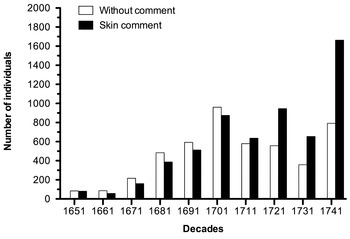
Distribution of comment on skin in London newspaper advertisements for wanted persons, 1651–1750.

“white-looking” ones.Footnote 147 However, skin per se did receive more frequent scrutiny as time marched on (see fig. 2). From the 1710s comment on skin became more common than not and was almost de rigueur for notices by 1750. Across this half-century there were also, of course, more issues being printed and perhaps more notices surviving. So if a larger number of subscribers wrote proportionately more lines describing pigmentation, why did they not discern “white” skin more frequently too? Why does whiteness remain all but invisible (see fig. 1)?
One answer might be the obvious difference between American plantations worked by slaves and a European metropolis, the latter not yet having a pressing need to recognize whiteness or use it in a racial formulation.Footnote 148 But this is too easy a solution. Apart from the unrelenting depiction of non-Europeans, in everything from the front-page news reports to outlandish shop signs,Footnote 149 contact with foreigners, Africans included, had become commonplace for Londoners if not English people generally. Booming Atlantic trade, including in slaves themselves, saw to that.Footnote 150 Notices sometimes put us at this very juncture, only to retreat from a simple binary in favor of resorting to the traditional, humoral kaleidoscope of color. For instance, we find “James Frith, a Boy, aged upwards of fourteen Years, a round Face, of a brownish Complexion, … little pitted with the Small-Pox, did … absent himself from his Master, John Hancock, a Baker, in St. Olive’s Hart-street. … N.B. He was supposed to be seen with a Black Boy belonging to Mr Mandlove, in Flask-Walk in Hampstead, on Monday or Tuesday last.”Footnote 151 Young James, British-born, is not characterized as “white” even though part of the strategy for locating him was to alert readers to the possibility that he was keeping company with an African lad. There was a profound reluctance to appropriate whiteness when identifying Britons. The last term—Britons—deserves emphasis. One does not have even the vaguest sense that the English might have exercised a prejudice that burnished or whitened their own appearances first, ahead of conceding that the Welsh, Scots, or Irish could be fitted into the same category. Only if bulletins articulated no appraisal of skin could we begin to surmise that authors were abridging what most thought readers themselves already knew—that Britons were a “white” people. Such an argument from silence is unsustainable when attention to skin was evidently growing in intensity over time, yet assessments continued to resort to the same broader array of descriptors for all subjects, both men and women.Footnote 152
Whiteness had long been spoken for and it would continue to be, helplessly muddling the advent of identities that were whitened racially. Whiteness was still the preserve of the genteelly born, the blue-blooded elite who were oftentimes implicitly the most sanguine.Footnote 153 How did the common folk know this? Or how can we if the elite, already a minority, were underrepresented as subjects in the advertisements? Aside from accounts of noble personages on the reverse,Footnote 154 the back pages of newspapers were awash with promotions directed at the wellborn and reliant on a flattering version of the notion that those of “quality” were both already the embodiment of beauty and not born for labor that marred appearance. While even they could not escape distemper, there were ways to help “Gentlemen and Ladies whose Skin being of a finer Texture than ordinary, [is] so subject to Chafing or Soreness upon riding,” or to “[make] a red or rough Hand exceedingly smooth, fine, and delicately White … [taking] away all disagreeable … Roughness, Freckles, Morphew, Worms in the Face, Sunburn, or any other discolouring … and yet it is nothing of Paint … for it brings the Skin … to its natural Beauty and Perfection.”Footnote 155
As long as whiteness registered this allegedly natural perfection and finer texture of wellborn complexions, the identification of “whites,” or Britons as members of a single, “white” race, was checked. Observing whiteness on the grounds of being British evidently contradicted status prerogatives and entrenched social beliefs. At the same time, such a grouping did not easily fit humoral thinking, which offered a long-lived paradigm for making sense of human variation, whether contingent and pathological or abiding and ontological. Rather than break out of this paradigm, when foreign visages were contemplated there remained a strong tendency to improvise assessments consistent with it, assessments that cut across the sorts of racial distinctions we have since come to expect. Thus Jews might be typed as “black” if their native temperaments were assessed and thought dominated by melancholy.Footnote 156 Thus some Irish, Scots, Welsh, and English complexions could be ruled by black bile, too. And vice versa—there was nothing tautologous in advising that a “Negro Man, named Pall, out of a Ship at Ratcliff” with “bushy hair [and a] swarthy countenance” had “run away.”Footnote 157
This is not to deny that the day was coming when a simple binary, rather than a color spectrum, would be deployed more frequently to evaluate human diversity and to discriminate. Indeed, there are subtle pointers in this very direction within our sample. For instance, when describing the melancholy color of complexions, over time there is a bias favoring “dark” rather than “black” (see fig. 1), suggesting that the latter term was gradually being revalued. So I agree with historians of the eighteenth century who argue that the transition to a recognizably modern racial divide was a slow and complex affair.Footnote 158 Change was neither immediate nor simply dictated from above.Footnote 159 If the view from below offered by London newspapers is anything to go by, the tempo of this shift varied socially and geographically. However, I would caution against one assumption regarding the reasons for this uneven transformation. We should be careful of assuming the humoral physiological paradigm made for entirely variable, unstable, and permeable bodies, thereby impeding the advent of a bounded, innate personhood, which was durable in a manner that a novel racial typology would both require and encourage. In short, some accounts suggest that the switch to a rigid racial hierarchy became conceivable only once the allegedly “fluid” humoral paradigm entered a terminal decline or was overwhelmed by contradictory data flooding in from the New World.Footnote 160
Certainly complexions, or humoral balances, were precarious things and therefore difficult to judge. Oftentimes, according to the paradigm, contemporaries could go no further than gauge a person’s present, unsettled condition rather than pin down a native constitution. However, this stinting should not blind us to the fact that early modern folk were typecasting, trying their utmost to register contrasts deemed innate, enduring, and essential to identity. As a sociocultural process this typing was, on the one hand, fundamentally like what we now call race, if by that we mean grouping people according to perceived bodily contrasts, which are believed to signal inherent (because inherited) distinctions in terms of physical aptitude, intellectual ability, or moral competence. Identifications based in the humors had broadly similar effects, making for inequality and disempowerment. In the hustle and bustle of the early modern city, discrimination was as much aided as arrested by humoral understanding of the body. Simply because many assessments in the newspapers were shallow—able to speak only of a pathological tinge rather than an intrinsic color—does not mean people before the later eighteenth century were unable to conceive of cardinal bodily contrasts. Native humoral temperaments were neither removed nor changed chameleon-like. Rather they were clouded, creating an epistemological problem that many bulletins resolved with their terse yet intricate descriptions.