Introduction
Psychotherapists are expected to behave ethically towards clients. The most important and generally accepted ethical principle is to avoid behaviour that could harm or exploit a client, such as sexual relationships or non-sexual dual relationships, being a combination of a professional and another (often more personal) kind of relationship (American Psychiatric Association, Reference American Psychiatric Association2013; American Psychological Association, 2016; European Association of Psychotherapy, 2018; European Federation of Psychologists’ Association, 2015). The question arises whether other intimate and informal behaviour (IIB), such as giving a lift to a client, is to be considered harmful as well by definition. Although this behaviour could be a precursor to sexual or non-sexual dual relationships, it may also just be innocent kindness or behaviour aimed at building a rapport. Therefore, what exactly constitutes harmful behaviour is not always clear. There is no such thing as a reference list of prohibited and permitted behaviour. Ultimately, each therapist will have to decide sincerely and individually what is and what is not ethically acceptable, depending on the uniqueness of each situation, the context and specific characteristics of the client and on the basis of their own experience, knowledge, therapeutic orientation, personal opinion, etc. (Barnett, Reference Barnett2014, Reference Barnett and Zur2017; Barnett, Lazarus, Vasquez, Moorehead-Slaughter, & Johnson, Reference Barnett, Lazarus, Vasquez, Moorehead-Slaughter and Johnson2007).
Although some studies in the 1980s and 1990s focused on the ethical acceptability of sexual and non-sexual dual relationships in psychotherapy (Borys & Pope, Reference Borys and Pope1989; Holroyd & Brodsky, Reference Holroyd and Brodsky1977; Kardener, Fuller, & Mensh, Reference Kardener, Fuller and Mensh1973; Pope, Tabachnick, & Keith-Spiegel, Reference Pope, Tabachnick and Keith-Spiegel1987; Stake & Oliver, Reference Stake and Oliver1991), current research on this topic is very scarce, especially about the acceptability of other IIB that is not explicitly mentioned in ethical codes (Stake & Oliver, Reference Stake and Oliver1991).
Studying the therapists’ opinions about the acceptability of such behaviour will inform us about their attitude to this theme. More insight into these attitudes, their association with the therapists’ characteristics and actual intimate events, may help us to understand the therapists’ behaviour and choices in their daily work with clients. These findings can also be valuable to reflect on the existing ethical codes and to fuel evidence-based educational programmes.
Therefore, this study aims (1) to describe the opinions of therapists about the acceptability of IIB in Flanders (the Dutch-speaking part of Belgium), (2) to investigate whether specific attitude groups of therapists can be distinguished based on these opinions, (3) to investigate associations between attitude groups and (a) characteristics of the therapist, and (b) actual intimate and informal events.
Method
A cross-sectional study was conducted, from November 2016 to June 2018, among Flemish Dutch-speaking psychotherapists (hereinafter: therapists) who received a self-administered questionnaire.
Population
Therapists were included in this study if they were in practice or in their last year of training at the time, and members of the following large, accredited associations in Flanders (Belgium): Flemish Association for Person-Centred Psychotherapy (N = 288); Flemish Association for Behavioural Therapy (N = 568); Flemish Association for Psychoanalytic Psychotherapy (N = 205) and Flemish psychiatrists registered with the National Institute for Health and Disability Insurance (NIHDI) (N = 910). The accredited association of systemic therapy did not participate in this study.
Data collection
The presidents of the aforementioned groups were contacted to distribute the questionnaire among their members, thereby adjusting the recruiting strategy slightly for each group. Therapists received the questionnaire in different modes: first online through a link in an e-mail and/or an announcement in a digital newsletter and then, a few weeks later, by regular post with a return freepost addressed envelope to the researchers. Reminders were sent at least once, both after the online version and after sending the hard copy by post. An information letter from the researchers accompanied the questionnaire, which informed respondents thoroughly about the aim and method of the study and the anonymity procedure (see section ‘Ethics’). Furthermore, it was pointed out that respondents only had to fill out and return the questionnaire once, and by doing so they declared that they were well informed and willing to participate in the study. Finally, key figures highlighted the importance of the study and encouraged participation in a recommendation letter that also accompanied the questionnaire.
Questionnaire
To explore the attitude of therapists towards intimate and informal behaviour (hereinafter abbreviated to IIB), we asked their opinion about the general acceptability of 11 statements on a 4-point scale, going from completely unacceptable, rather unacceptable, rather acceptable to completely acceptable. Furthermore, we investigated the occurrence of five intimate and informal events that happened in the past 12 months.
These statements and events were based on previous studies (Borys & Pope, Reference Borys and Pope1989; Pope et al., Reference Pope, Tabachnick and Keith-Spiegel1987; Stake & Oliver, Reference Stake and Oliver1991), and on discussions with a client, an ombudsperson, therapists and educators of several theoretical orientations (who were thereafter not included in this study).
Furthermore, data on the demographical context of the therapists, such as gender, sexual orientation and age, and on some educational items, such as basic education and psychotherapy training, was collected.
Analysis
The answers to the IIB statements were subjected to a k-means cluster analysis to distinguish attitude groups of therapists regarding IIB. Options with two to four groups were explored, and the best interpretable option was chosen. χ2 tests were used to compare group differences on the statements, and to label the groups.
To investigate associations between demographic and educational variables of the therapists and the attitude groups they belonged to, as well as between the attitude group and recent intimate and informal events, χ2 tests were also used or fisher exact tests when suitable.
IBM SPSS Statistics, version 25.0, was used for all analyses.
Ethics
This study was approved by the Medical Ethics Committee UZ Brussels – VUB (B.U.N. 143201524243).
To establish anonymity, measures were taken with regards to the content of the questionnaire and the data collection. With regards to the content, no questions were asked that, in combination, could lead to identification of the respondent, such as the specific age or workplace of the respondents. With regards to the data collection, no identification code was printed on the hard copy questionnaire or envelope, nor were IP addresses or email addresses captured by the survey website settings. Furthermore, the completed questionnaires were sent directly to the researchers, who had no contact data of the participants.
Results
Response rate
Of the 1971 therapists that were contacted, 786 therapists completed and returned the questionnaire (response rate: 39.8%), by post (n = 610) or online (n = 176). In total, 37 postal questionnaires were returned blank to the researchers, mainly due to wrong addresses.
Regarding the occurrence of intimate and informal events, only therapists who at that time had given therapy during the last 12 months were included in this analysis (N = 698 of the 786 therapists).
Characteristics of respondents
Of the 786 responding therapists, 69% were female (n = 541), 89% were heterosexual (n = 696), 43.6% were in the age group of 20–39 years (n = 342) and 39.6% in the age group 40–59 years (n = 311). In the oldest age group, there were more men than women (60 years or older: gender ratio: 1.6/1), while in the younger age groups the opposite was true (20–39 years: gender ratio 0.5/1, and 40–59 years: gender ratio 0.2/1). Concerning basic education, 53.6% were trained as psychologists (n = 421) and 40.8% as psychiatrists (n = 320). Therapists who followed or completed person-centred therapy training (n = 173) made up 22.1%, whether or not combined with another training; 39.3% (n = 308) were behavioural therapists and 19.2% (n = 150) were psychoanalytic therapists. Although the systemic therapy association did not participate in this study, 156 (19.9%) of the respondents, mostly psychiatrists, reported having followed or completed a systemic therapy training.
Therapists’ opinion of the acceptability of IIB statements
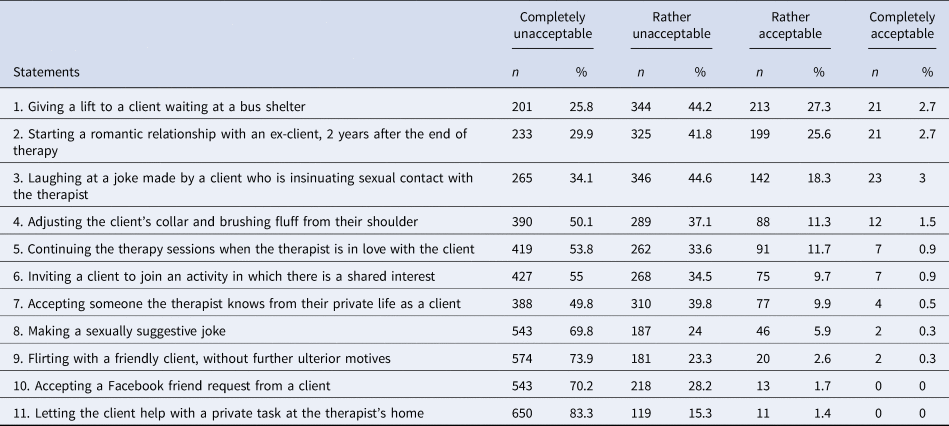
Most responding therapists found the behaviour described in each of the 11 IIB statements (completely or rather) unacceptable (Table 1). However, almost a third found it rather or completely acceptable to give a lift to a client waiting at a bus shelter (30%), or to start a romantic relationship with an ex-client, 2 years after the end of the therapy (28.3%). A fifth (21.3%) found it rather or completely acceptable to laugh at a joke made by a client who insinuates sexual contact with the therapist. One out of ten thought it was acceptable to accept someone as a client they already knew from their personal life (10.4%), and to continue therapy sessions when the therapist is in love with the client (12.6%). Almost all therapists agreed that flirting with a friendly client (97.2%), accepting a Facebook friend request (98.4%) and letting the client help with a private task at the therapist's home (98.6%) is unacceptable.
Therapists’ opinion about the acceptability of IIB statements (N = 780)a

a Due to missing data N per statement varies from 776 to 780.
Three attitude groups, based on therapists’ opinions about the acceptability of IIB statements
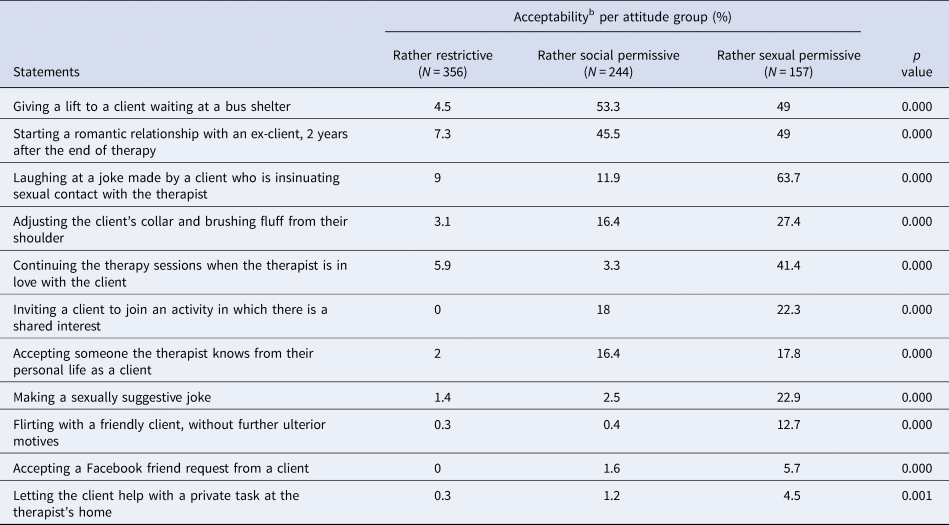
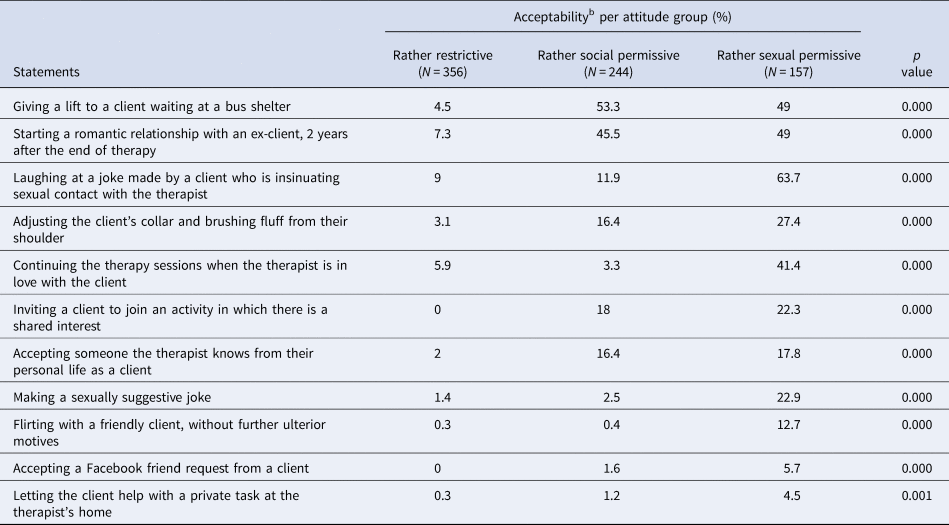
A k-means cluster analysis based on therapists' answers to the 11 statements revealed three interpretable groups of therapists in their attitude towards IIB (Table 2). Labelling of groups was based on a cross-tabulation with the statements. The attitude groups can be labelled as follows: ‘rather restrictive’, ‘rather socially permissive’ and ‘rather sexually permissive’. Almost half of the therapists belong to the rather restrictive group, a third to the rather socially permissive group and a fifth to the rather sexually permissive group. Twenty-nine therapists were not classified in any of the three attitude groups, because of missing answers to at least one of the 11 statements.
Three attitude groups, based on therapists’ opinion about the acceptability of IIB statements (N = 757)a
a Due to missing data N per statement varies from 776 to 780.
b Combines rather acceptable and completely acceptable.
The label ‘rather restrictive’ is justified by the lowest percentages on almost all statements. The label ‘rather sexually permissive’ is justified because more than half of the group (63.7%) found it acceptable to laugh at a joke made by a client insinuating sexual contact, almost half of the group found it acceptable to start a romantic relationship with an ex-client 2 years after the end of therapy (49%) and to continue therapy sessions when the therapist is in love with the client (41.4%), almost a quarter (22.9%) found it acceptable to make a sexually suggestive joke and more than one out of ten therapists in this group thought flirting was acceptable (12.7%). The group ‘rather socially permissive’ is an intermediate group. Overall, it has higher frequencies than the ‘rather restrictive group’, but lower frequencies than the ‘rather sexually permissive group’, although on some more socially oriented statements the frequencies are comparable, for example giving a lift to a client (53.3%), accepting a client from their personal life (16.4%) and inviting a client to join an activity in which there is a shared interest (18%).
Attitude groups according to characteristics of therapists
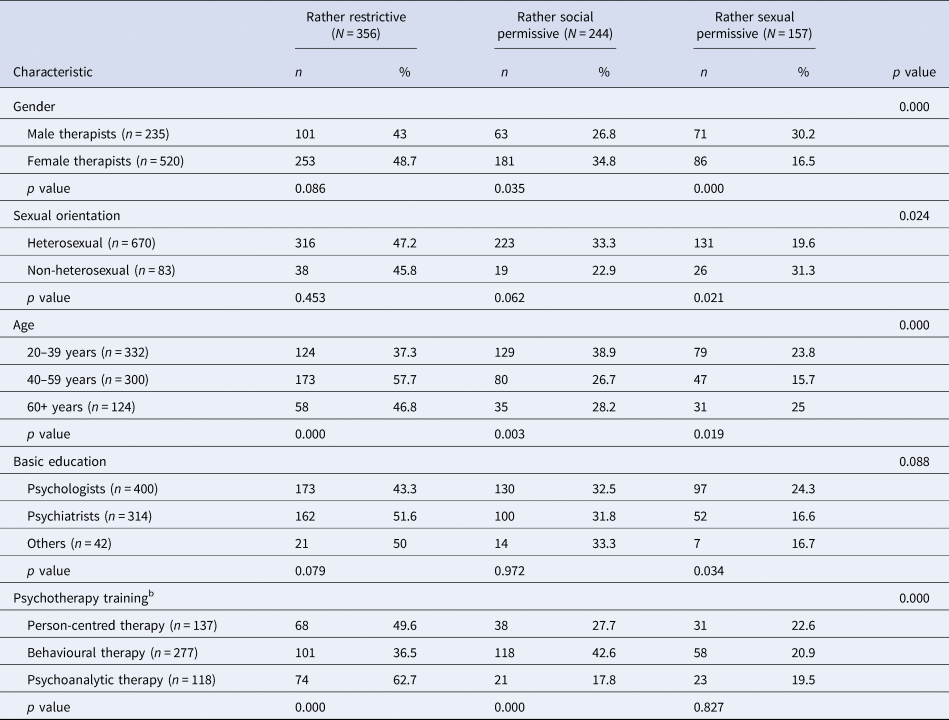
With regards to the ‘rather restrictive group’, more therapists from the middle age group, 40–59 years (57.7%), belonged to this group compared to the oldest group of 60 years and above (46.8%) or the youngest group (37.3%), and more psychoanalytic therapists (62.7%) compared to person-centred therapists (49.6%) and behavioural therapists (36.5%) (Table 3).
Attitude groups according to characteristics of therapists (N = 757)a

a Due to missing data, N for respondent characteristics varies from 753 to 756.
b Only therapists solely educated in person-centred, or behavioural or psychoanalytic psychotherapy training are included (N = 546). Combinations of these were excluded. Due to missing data, N for psychotherapy training is 532.
With regards to the ‘rather socially permissive group’, female therapists (34.8%) belonged to this group more often than male therapists (26.8%); therapists from the youngest age group (38.9%) more often than the older age groups (26.7% and 28.2%), and behavioural therapists (42.6%) more often than person-centred (27.7%) and psychoanalytic therapists (17.8%).
With regards to the ‘rather sexually permissive group’, male therapists (30.2%) and non-heterosexual therapists (31.3%) belonged to this group more often than female therapists (16.5%) and heterosexual therapists (19.6%), respectively; the younger and older therapists (23.8% and 25%) more often than the middle age group of 40–59 years (15.7%); and psychologists (24.3%) more often than psychiatrists (16.6%) and therapists with another basic education than psychology or psychiatry (16.7%).
Further analyses revealed that in the middle age group of 40–59 years, there were more psychoanalytic therapists than person-centred and behavioural therapists (52% v. 45.4% and 25.5%), and in the youngest age group of 20–39 years, more behavioural therapists than person-centred and psychoanalytic therapists (64.7% v. 38.6% and 25%).
Occurrence of intimate and informal events during the last 12 months, according to attitude group
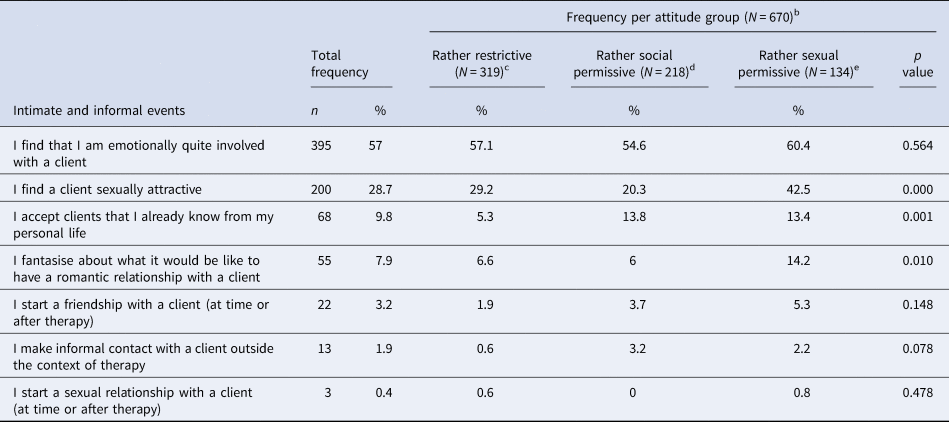
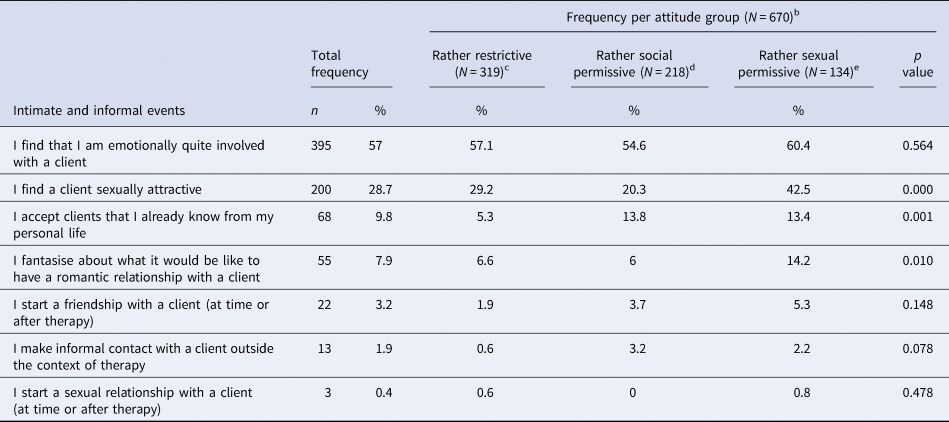
Of those therapists who have given psychotherapy during the last 12 months (N = 698), more than half of them (57%) reported that they had been quite emotionally involved with a client during that year, more than a quarter (28.7%) found a client sexually attractive and about one out of ten therapists indicated that they had accepted clients from their personal life (9.8%), or to have fantasised about what it would be like to have a romantic relationship with a client (7.9%), 3.2% started a friendship with a client at time of therapy or after the therapy had ended, and 1.9% made informal contact with clients outside the context of therapy. Three therapists started a sexual relationship with a client at time of therapy or after the therapy had ended (Table 4).
Occurrence of intimate and informal events, during the last 12 months, according to attitude group (N = 698)a
a Due to missing data N per ‘intimate and informal events’ varies from 686 to 698.
b Due to missing data N is lower compared to total frequency (N = 698).
c Due to missing data N in the ‘rather restrictive’ group varies from 317 to 319.
d Due to missing data N in the ‘rather social permissive’ group varies from 216 to 218.
e Due to missing data N in the 'rather sexually permissive' group varies from 131 to 134.
Three of the intimate and informal events were related to attitude (Table 4). Therapists with a ‘rather sexually permissive’ attitude (42.5%) reported higher occurrences of finding a client sexually attractive compared to ‘rather restrictive’ (29.2%) and ‘rather socially permissive’ therapists (20.3%), and for fantasising about a romantic relationship with a client (14.2% v. 6.6% and 6%). ‘Rather restrictive’ therapists (5.3%) reported a lower occurrence of accepting clients they already knew from their personal life than ‘rather socially permissive’ and ‘rather sexually permissive’ therapists (13.8% and 13.4%).
Discussion
This study shows that therapists in Flanders (Belgium) are rather restrictive in their attitude to IIB in the psychotherapeutic relationship. Flirting with a client, accepting a Facebook friend request from a client and letting the client help with a private task at home were defined as unacceptable by almost all therapists. However, almost a third found it acceptable to start a romantic relationship with a former client 2 years after the end of the therapy. One out of ten thought it was acceptable to continue therapy sessions when the therapist is in love with the client and to accept someone they already knew from their personal life as a client. Based on their opinion, the responding therapists could be divided into three attitude groups, namely rather restrictive therapists, rather socially permissive therapists and rather sexually permissive therapists. Belonging to one of the three attitude groups was related to gender, age and type of psychotherapy training of the therapist. The rather sexually permissive therapists found a client sexually attractive more often during the last year and fantasised more often about a romantic relationship with a client than the rather restrictive and rather socially permissive therapists, but they did not start a sexual relationship more often.
This is one of the first studies that extensively investigates attitudes of therapists regarding IIB in the psychotherapeutic relationship. Previous studies are outdated and have mainly focused on the aspect of sexual and non-sexual dual relationships. The response rate of this study is similar to the studies mentioned above (Borys & Pope, Reference Borys and Pope1989; Kardener et al., Reference Kardener, Fuller and Mensh1973; Pope et al., Reference Pope, Tabachnick and Keith-Spiegel1987; Stake & Oliver, Reference Stake and Oliver1991). A limitation is that it cannot be ruled out that socially desirable answers were given, and neither can response bias be excluded. Furthermore, the direction of some associations is unclear. For example, does a rather sexually permissive attitude make therapists more vulnerable to feeling sexually attracted to a client or does this feeling change the attitude, or do therapists with a more sexually permissive attitude more readily report such feelings?
An important finding is that most of the IIB presented in the 11 statements were perceived as unacceptable by the majority of therapists, which is consistent with previous studies about sexual and non-sexual dual behaviour (Borys & Pope, Reference Borys and Pope1989; Pope et al., Reference Pope, Tabachnick and Keith-Spiegel1987). In general, this points towards a rather cautious attitude among psychotherapists and a high sense of morality towards such behaviour. However, 30% to 40% of the therapists found most of these behaviours ‘rather’ unacceptable instead of ‘completely’ unacceptable, indicating that there is some willingness to consider these behaviours as acceptable in certain circumstances. Maybe it is not so surprising that therapists left some ‘negotiable space’ for acceptability, because of their deep awareness of the unique complexity of each situation where they have to determine how to flesh out their therapeutic relationship with a client (European Federation of Psychologists’ Association, 2015). Such relationships demand a nuanced approach.
Whereas some variance in the degree of acceptability was usually found, some behaviours were almost unanimously regarded as unacceptable, e.g. accepting a Facebook friend request from a client and letting the client help with a private task at home. Possibly this shows that a certain degree of intimacy and informality is only acceptable as long as it occurs within the realm of the psychotherapeutic relationship, and therapists by no means want to give clients the impression they can be part of their private life. This is consistent with the overall idea of avoiding dual relationships.
Furthermore, this study shows that only 1 out of 10 therapists find it acceptable to continue therapy when being/falling in love with the client, probably because it would interfere with the therapeutic process, caused by being distracted or overly involved (Rodolfa et al., Reference Rodolfa, Hall, Holms, Davena, Komatz, Antunez and Hall1994). However, starting a romantic relationship with a former client after a waiting period of 2 years is deemed to be acceptable by more than a quarter of therapists. Probably the rationale for not starting a sexual or romantic relationship with a current client does not remain intact concerning former clients who ended therapy ‘properly’ some time ago. Although the decision-making ability of former clients may still be impaired, the magnitude of that impairment seems to be in question (Appelbaum & Jorgenson, Reference Appelbaum and Jorgenson1991). This is in line with the ethical codes that in general discourage but do not prohibit relationships with former clients, although a waiting period of at least 2 years after termination of therapy is sometimes recommended (American Psychiatric Association, Reference American Psychiatric Association2013; American Psychological Association, 2016; European Association of Psychotherapy, 2018; European Federation of Psychologists’ Association, 2015).
Another main finding is that differences in having a rather restrictive or rather socially permissive attitude are mainly related to the type of psychotherapy training, whereas differences in having a rather sexually permissive attitude are mainly related to personal characteristics, such as being male and non-heterosexual. Differences in being rather sexually permissive possibly reflect the more general attitude differences in intimacy and sexuality based on gender and sexual orientation that we see in society (Baumeister, Catanese, & Vohs, Reference Baumeister, Catanese and Vohs2001; Grollman, Reference Grollman2017; Petersen & Hyde, Reference Petersen and Hyde2010). The difference between types of psychotherapy training and having a rather restrictive or socially permissive attitude can probably be explained by differences in the extent to which – for instance – the concept of boundaries is highlighted in these trainings. Traditionally, psychoanalytic therapists tend to be more restrictive and more trained in these concepts (Borys & Pope, Reference Borys and Pope1989; Gabbard, Reference Gabbard2016).
Finally, an important finding is that therapists being categorised as ‘rather sexually permissive’ more often found a client sexually attractive or fantasised about a romantic relationship, but did not started a friendship or sexual relationship more often than the ‘rather restrictive’ or ‘rather socially permissive’ therapists, seeming to indicate that experiencing and disclosing these intimate feelings not immediately means acting out on them.
Financial support
This research received no specific grant from any funding agency, commercial or not-for-profit sectors.
Conflict of interest
None.