There is still a high risk of terror attacks in Western Europe and North America. Emergency response services, such as the fire brigade, police, and ambulance services, are always highly present at such incidents. Thus, measures that can be used to prevent unwanted psychological reactions are of great interest, because major premeditated incidents can lead to increased mental stress among rescue workers.Reference Bromet, Atwoli and Kawakami1 However, specified crisis interventions and preliminary measures for increasing mental resilience are currently unavailable.
Crisis interventions have a relatively short history compared with other therapeutic treatments. In Germany, the Critical Incident Stress Management (CISM) according to Mitchell and EverlyReference Mitchell and Everly2 is implemented in many large organizations, such as the German Armed Forces and the fire brigade. However, the effectiveness of this intervention program is disputed; some argue that it is indeed helpful,Reference Mitchell3 while other results indicate it may actually be harmful.Reference Rose, Bisson, Churchill and Wessely4 This has led to polarization within many organizations that are committed to providing or implementing crisis intervention.
There is currently no conclusive scientific explanation for the contradictory results of the CISM. One possibility could be the approach of the 7-stage Critical Incident Stress Debriefing (CISD). The CISD is a debriefing session for small homogeneous groups of up to 20 participants, which should be completed 24-72 hours after the incident. In the fourth stage of CISD, “Reactions,” participants are asked about emotions they experienced during the incident.Reference Mitchell and Everly2 While a therapeutic component is explicitly excluded, this can be considered equivalent to in sensu (ie, mental) exposure, which is undoubtedly a therapeutic approach. In sensu exposure is an imaginative technique of behavioral therapy, where patients are subjected to an exposition in their imagination. This introductory exercise serves as a precursor to “real-world exposure” (in vivo).
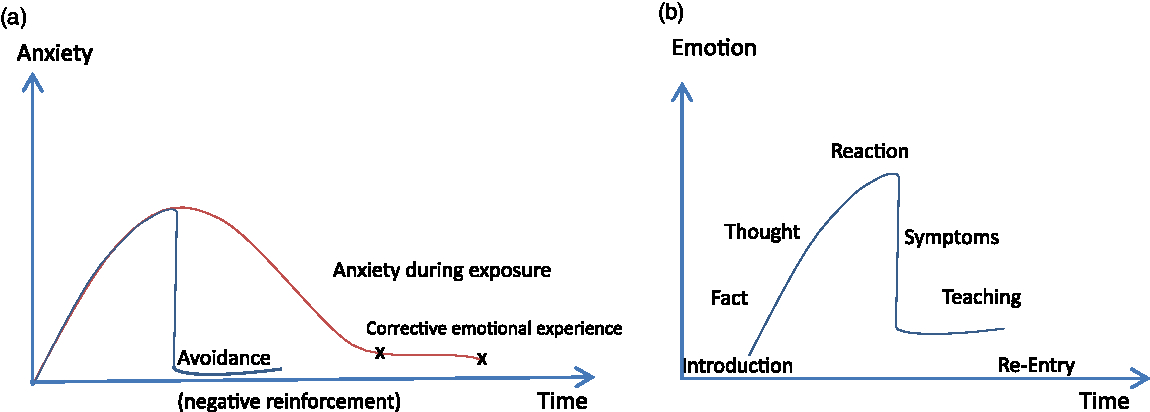
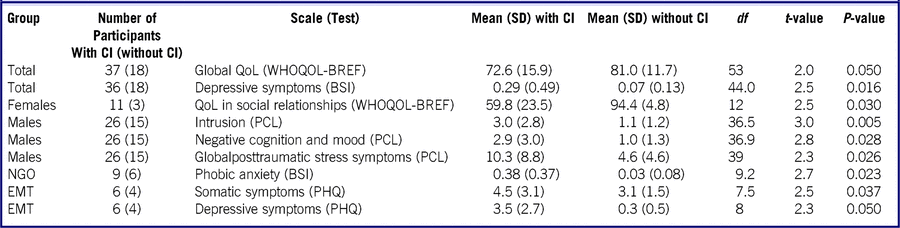
This CISD “reaction” phase is completed when no one in the group wishes to express any further issues or concerns. However, it cannot be guaranteed that the emotions experienced during this phase subside for all participants, and, in the case of premature termination of strong emotions, some participants may develop avoidance behavior due to negative reinforcement. This may explain why some people feel better afterward but develop more anxiety and posttraumatic stress symptoms in the long term. Negative reinforcement refers to the increase in some behavior when negative stimuli (ie, anxiety-inducing stimuli) are no longer or less proffered. In this case, the behavior is followed by an absence of an unpleasant reaction (eg, anxiety). Avoidance behavior is especially maintained by negative reinforcement; for example, avoidance behavior occurs in frightening situations and is exacerbated by the resulting rapid decrease in anxiety. This prevents the fear reaction from becoming extinct. A representation of the 7 phases of CISD and the potential negative reinforcement can be found in Figure 1.
(A) Trajectories of Anxiety During Exposure. (B) Negative Reinforcement and CISD.
Outcomes of crisis interventions after terror attacks in Germany are still unknown. One difficulty with the evaluation of such programs is the lack of a baseline measurement. In military contexts, there are efforts to monitor mental health through regular screenings and to implement appropriate treatments when necessary.Reference Wesemann, Willmund and Ungerer5 The inclusion of such screening data in studies investigating crisis interventions would alleviate the problem regarding baseline measurements. A further complication is a potential selection effect among participants, which may arise because participants seek out crisis intervention themselves. For this, the stress load of the respective incident would need to be included; appropriate and validated measures for this are already available. The inclusion of childhood events would also be useful, because such experiences could also affect whether or not an individual seeks out crisis intervention.
To our knowledge, a comparative analysis of crisis interventions, differentiating between occupational groups, genders, or types of events, has not yet been carried out. In this pilot study, we tested whether occupational group- and gender-specific differentiation is informative. To this end, we evaluated the psychological stress of emergency responders deployed at the terror attack at Breitscheidplatz in Berlin, a portion of whom had undergone crisis intervention.
The main objective was to identify differences between different occupational groups as well as between genders, and investigate the effect of crisis intervention on these differences. A secondary goal of this study was to examine whether participation in a crisis intervention leads to systematic differences in psychological stress.
METHODS
All emergency responders who were directly involved with the response effort at the terror attack at Breitscheidplatz, Berlin, were invited to participate in the study, including dispatchers and those not immediately at the scene. Recruitment took place through the incident commanders. Participation was voluntary, and written informed consent was collected from all participants. The study was approved by the Ethics Committee of the Charité. Questionnaires (described in the next paragraphs) were filled out 4 months after the terror attack (December 19, 2016), at which time all crisis interventions had been completed. Each organization administered crisis interventions independently, because there is not yet a centralized approach with a uniform time frame for implementing crisis interventions; the fire brigade, police force, German Armed Forces, emergency medical technicians (EMTs), and non-governmental organizations (NGOs) each have their own crisis intervention teams. Because the number of soldiers was low (n = 2), they were placed in the group of EMTs. This corresponds to their occupation and activity during the mission at Breitscheidplatz.
Following the exclusion of n = 5 participants due to lack of information on participation in crisis interventions, N = 55 rescue workers took part in the study; n = 37 underwent crisis intervention and n = 18 did not. The questionnaire packet consisted of a demographic section, which inquired about sex, occupation, and active involvement at the scene of the attack. Stress and quality of life were assessed with the following questionnaires:
Stress was assessed using the stress module of the German version of the Patient Health Questionnaire (PHQ-D). The PHQ-D is a psychodiagnostic questionnaire used to measure psychosocial stressors based on 10 questions; these stressors can be considered triggers or maintenance factors for mental disorders. Each question has 3 answer options: 0, meaning not affected; 1, meaning somewhat affected; and 2, meaning strongly affected.Reference Kroenke, Spitzer and Williams6
Quality of life was evaluated using the brief version of the World Health Organization Quality of Life Questionnaire (WHOQOL-BREF) in German. The WHOQOL-BREF comprises 26 questions on a 5-level Likert scale. It is a disease-independent instrument that considers the 2 weeks leading up to the date of administration. Four domains are assessed: physical health, psychological, social relationships, and environment. As a summary, a global scale of quality of life can be derived. The internal consistency, calculated in a large German sample of N = 2073,Reference Angermeyer, Kilian and Matschinger7 is “acceptable” to “good,” with a Cronbach’s alpha between 0.77 and 0.87 for each of the domains.
Posttraumatic stress symptoms were recorded using the German version of the Posttraumatic Stress Disorder (PTSD) checklist for DSM-5 (PCL-5). It contains 20 items on a 5-level Likert scale, which comprises clusters of intrusion, avoidance, cognition and mood, and hyperarousal, as well as an overall score.Reference Weathers, Litz and Keane8
Current mental state was assessed with the Brief Symptom Inventory (BSI). The BSI consists of 53 questions that assess symptoms of psychiatric disorders. The 9 subscales measure the areas of somatization, obsessive-compulsive, interpersonal sensitivity, depression, anxiety, hostility, phobic anxiety, paranoid ideation, and psychoticism.Reference Derogatis and Melisaratos9
Statistical analysis was conducted in IBM SPSS for Windows, Version 21.0 (IBM Corp, Armonk, NY). To test for differences on the clinical scales, independent-samples t-tests with α = 0.05 were performed. Occupational groups were dichotomized by crisis intervention participation. A Levene’s test was used to ensure homoscedasticity before running comparisons. In cases of significance, that is, no homoscedasticity, the degrees of freedom were corrected downward and a Welch’s t-test for unequal variances was conducted. A comparison of police officers and soldiers was not possible due to the small sample size.
RESULTS
To examine whether groups with and without crisis intervention differed in the questionnaires, independent-sample t-tests were conducted.
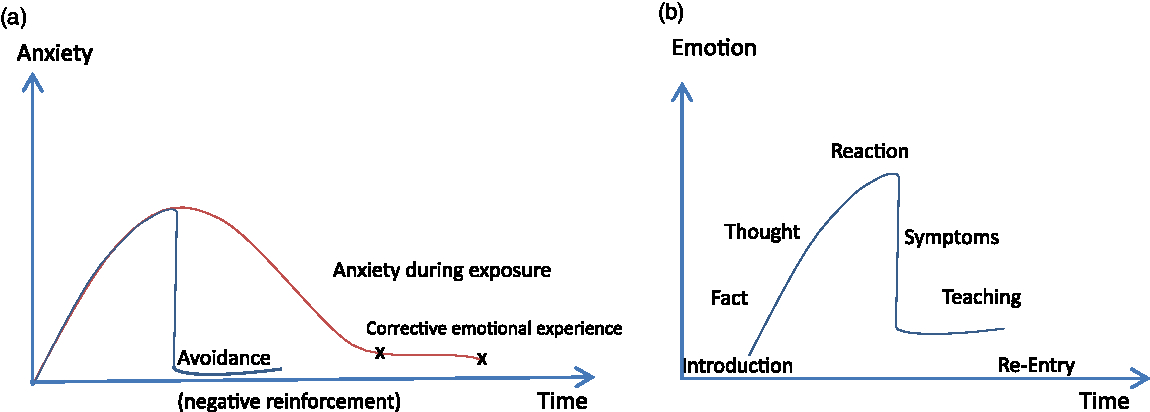
The total group with crisis intervention scored lower than the group without on psychological quality of life according to the WHOQOL-BREF, t(53) = 2.01, P = 0.050, and showed more depressive symptoms according to the BSI, t(44) = 2.51, P = 0.016.
Subsequently, gender-specific differences were investigated. Female participants with crisis intervention showed significantly lower quality of life (WHOQOL-BREF) in social relationships than females without crisis intervention, t(12) = 2.46, P = 0.030.
Male participants with crisis intervention reported more intrusions, t(39) = 2.47, P = 0.018, and negative cognition and mood on the PCL-5, t(39) = 2.28, P = 0.028, and had a higher overall score on posttraumatic stress symptoms, t(39) = 2.32, P = 0.026 than males without crisis intervention.
Finally, occupation-specific differences were analyzed. No significant differences between the groups with and without crisis intervention were found within the fire brigade.
Within NGOs, the crisis intervention group scored higher on phobic anxiety on the BSI, t(9.2) = 2.72, P = 0.023.
Within EMTs, the crisis intervention group showed more somatic, t(7.5) = 2.52, P = 0.037, and depressive symptoms on the PHQ, t(8) = 2.30, P = 0.050.
A summary of the results can be found in Table 1.
Significant Results of Group and Subgroup Differences Among Emergency Responders With and Without Crisis Intervention Using Independent-Samples t-tests
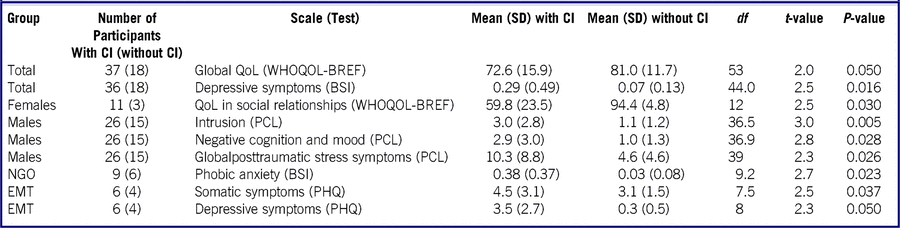
BSI = Brief Symptom Inventory; CI = crisis intervention; df = degrees of freedom (with decimal if corrected due to lack of homoscedasticity); EMT = emergency medical technician; NGO = non-governmental organization; PCL = Post-traumatic Stress Disorder Checklist; PHQ = Patient Health Questionnaire; QoL = quality of life; SD = standard deviation; WHOQOL-BREF = World Health Organization Quality of Life Questionnaire.
DISCUSSION
Lower psychological quality of life and greater depressive symptomatology were found in the group who had undergone crisis intervention, which could be an indication of the need for improved treatments, as a selection effect may explain this difference. That is, emergency responders with higher stress burdens may be more likely to seek out crisis interventions.Reference Wesemann, Zimmermann and Mahnke10 It seems unlikely that the interventions would worsen scores on these 2 scales, which are not specifically susceptible to negative reinforcement of anxiety symptoms. However, a negative effect of crisis interventions cannot be ruled out. At the very least, the crisis intervention did not work efficiently.
However, crisis intervention may contribute to specific differences in subgroups. For example, reductions in social relationships among females who had participated in crisis intervention could have resulted from this negative reinforcement, as a withdrawal from social relationships may be explained by avoidance behavior. For males with crisis intervention, this negative reinforcement of avoidance may be reflected in the increase of negative cognition and mood, intrusions, and posttraumatic stress symptomatology overall. Stronger phobic anxiety among NGO workers further supports this hypothesis. In contrast, the more pronounced somatic and depressive symptoms are found in EMTs indicate a higher need for treatments due to a greater overall impairment before crisis intervention. These symptoms are not attributed to a negative influence of crisis intervention.
Due to the small sample size, lack of baseline measures, and omission of alpha-error corrections in this pilot study, these data should be seen as provisional. Nevertheless, there is an indication that crisis interventions should be more sensitive to gender and occupational group-differences, precisely because of the significant differences found in even this small sample. Future investigations should consider that such differences may be obscured when looking at heterogeneous groups. Research in this area should be continued, as well as the development of specific measures for affected emergency service workers and civilians.
To this end, data from emergency response workers are currently being collected at 4 different time points after major emergencies, so that differences existing before crisis interventions, the influence of early childhood traumas, trait psychological vulnerability, and peri-traumatic stress can be considered. However, potential differences existing before the critical event still cannot be assessed with these data. Due to ethical principles, no randomization is done; crisis intervention is available to all emergency responders on a voluntary basis.
CONCLUSION
The implementation of CISM has become established, and the practicality of this crisis intervention is quite high. The treatment also seems to be viewed as highly acceptable among those who administer and receive it. However, the sections concerning emotions experienced by those affected during the event in question are highly problematic and should be replaced. This would only require minor modifications of an already established program.
In future research, it is recommended that studies look at differences between genders and occupation types. Otherwise, there is a high risk of overlooking the symptoms for specific subgroups due to averaging effects.
Acknowledgments
Special thanks to Charlyn Löpke and Jan Ukena for their smooth organization, both from the Bundeswehr Hospital Berlin.
Conflict of Interest Statement
The authors have no conflicts of interest to declare.