Introduction
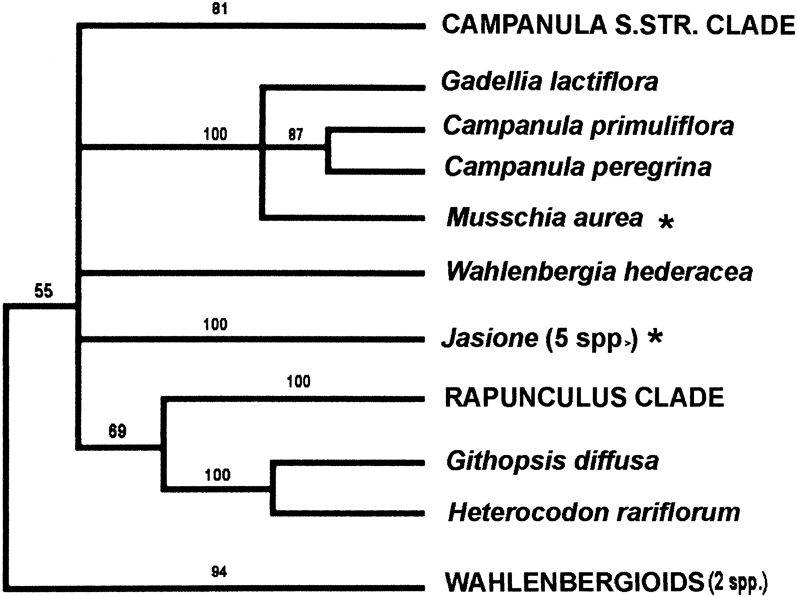
Recent molecular investigations of the Campanulaceae (Eddie et al., Reference Eddie, Shulkina, Gaskin, Haberle and Jansen2003; Cupido, Reference Cupido2009; Haberle et al., Reference Haberle, Dang, Lee, Peñaflor, Cortes-Burns and Oestreich2009; Roquet et al., Reference Roquet, Sanmartin, Garcia-Jacas, Sáez, Susanna, Wikström and Aldasoro2009; Prebble et al., Reference Prebble, Cupido, Meudt and Garnock-Jones2011) have shown that the European species Wahlenbergia hederacea (L.) Rchb. is distant from the remainder of the wahlenbergioids, and its inclusion with them renders the tribe Wahlenbergieae Endl. (Endlicher, Reference Endlicher1838) non-monophyletic (Fig. 1). These findings prompted a re-investigation of the morphology of this species and we conclude that, based on both molecular and morphological evidence, Wahlenbergia hederacea is best included in the Campanuloideae. Thus, its inclusion in the Wahlenbergieae is also unsustainable and its removal from Wahlenbergia Schrad. ex Roth necessitates a new generic name (Lammers, Reference Lammers2007). [Note: Eddie et al. (Reference Eddie, Cupido and Skvarla2010) treated the Campanulaceae as a separate family from the Lobeliaceae and Cyphiaceae. Their recommendation was to divide the Campanulaceae into three subfamilies: Campanuloideae, Canarinoideae and Wahlenbergioideae. This treatment will be formalised in a future publication. In this scheme, their ‘Wahlenbergioideae’ will be very similar in composition, but not identical to, Wahlenbergieae Endl., and will include both Wahlenbergioideae Kolak. and Prismatocarpoideae Kolak.]
Strict consensus of 2629 most parsimonious trees of selected taxa of the Campanulaceae based on ITS sequence data, showing the topological position of Wahlenbergia hederacea (Hesperocodon hederaceus comb. nov.) in a polytomy with the two major campanuloid clades and the ‘transitional’ taxa (indicated by asterisks). The wahlenbergioid outgroup comprises Craterocapsa congesta and Roella ciliata. Numbers above branches are bootstrap percentages for 1000 replicates. After Eddie et al. (Reference Eddie, Shulkina, Gaskin, Haberle and Jansen2003).

Wahlenbergia hederacea is first mentioned by Bauhin (1596) under the synoptic phrase Campanula Cymbalariae folio (De Candolle, Reference Candolle1830: 141), which was later expanded by Tournefort (1700) as Campanula Cymbalariae foliis vel folio hederaceo. It was included in the first edition of Species Plantarum by Linnaeus (1753) as Campanula hederacea but was subsequently transferred to Wahlenbergia by Reichenbach (Reference Reichenbach1827), a move adopted by De Candolle (Reference Candolle1830), who included it within his Wahlenbergia sect. Aikinia. A glance at other 19th-century works suggests that occasionally there has been some doubt about Wahlenbergia hederacea being included in Wahlenbergia. For example, it was treated as a separate genus by Roth (Reference Roth1827) (Schultesia Roth nom. illeg.) and by Fourreau (Reference Fourreau1869) (Aikinia Salisb. ex Fourr. nom. illeg.), or included as part of the genus Roucela Dumort. (Dumortier, Reference Dumortier1822).
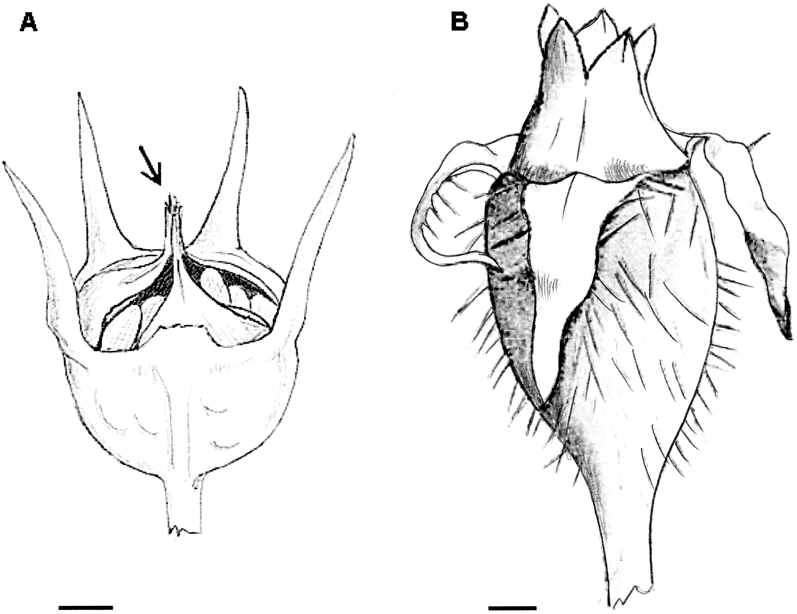
Throughout the Campanulaceae, primary generic characters depend upon fruit structure (Hilliard & Burtt, Reference Hilliard and Burtt1973). The classification of Wahlenbergia hederacea in the Wahlenbergieae rests largely on the mode of dehiscence of the capsule, which is reported to be loculicidal by valves above the calyx lobes (De Candolle, 1830), a mode commonly found in many of the wahlenbergioids, particularly Wahlenbergia (Clapham et al., Reference Clapham, Tutin and Warburg1962; Rix, Reference Rix2004). However, the dehiscence mechanism of Wahlenbergia hederacea is not strictly identical to that of Wahlenbergia (Fig. 2A). In Wahlenbergia, the sclerenchymatous septa (the ‘Dehiscenzkörper’ of Feer, Reference Feer1890) bend outwards hygroscopically, splitting the capsule apex and forming a crown-like structure with 2–5 points depending on the species (Fig. 2B) (von Brehmer, Reference Brehmer1915: fig. 3, p. 23; fig. 6, p. 29; Thulin, Reference Thulin1975), whereas in W. hederacea the capsule is membranous, the septa are not sclerenchymatous, and the valves do not form a pointed crown.
A. Mature capsule of Hesperocodon hederaceus Eddie & Cupido comb. nov. showing rupture of the ovary apex (pars superior), with the seeds visible inside. Nearest calyx lobe removed. Arrow shows attached style base. Scale bar = c.0.25 mm. Modified from Stella Ross-Craig, Drawings of British Plants, Part XIX, plate 4(C) (1963); B. Mature capsule of Wahlenbergia capensis (L.) A.DC. showing the 5-pointed crown of the ovary apex. Scale bar = c.1 mm. From a photograph, Kirstenbosch Botanic Gardens, South Africa, i 2012 (W.M.M.E.).
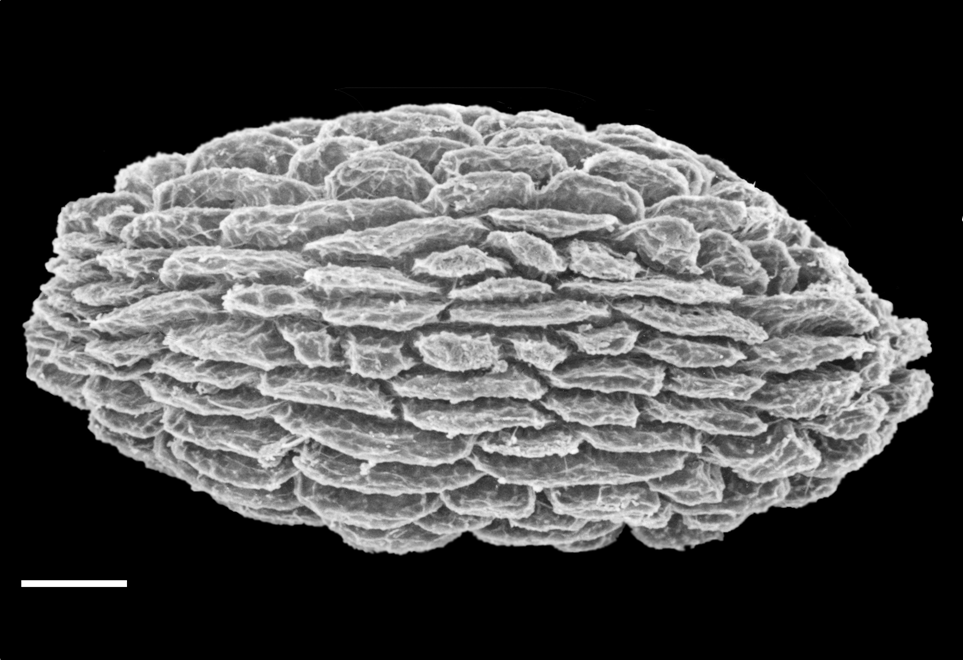
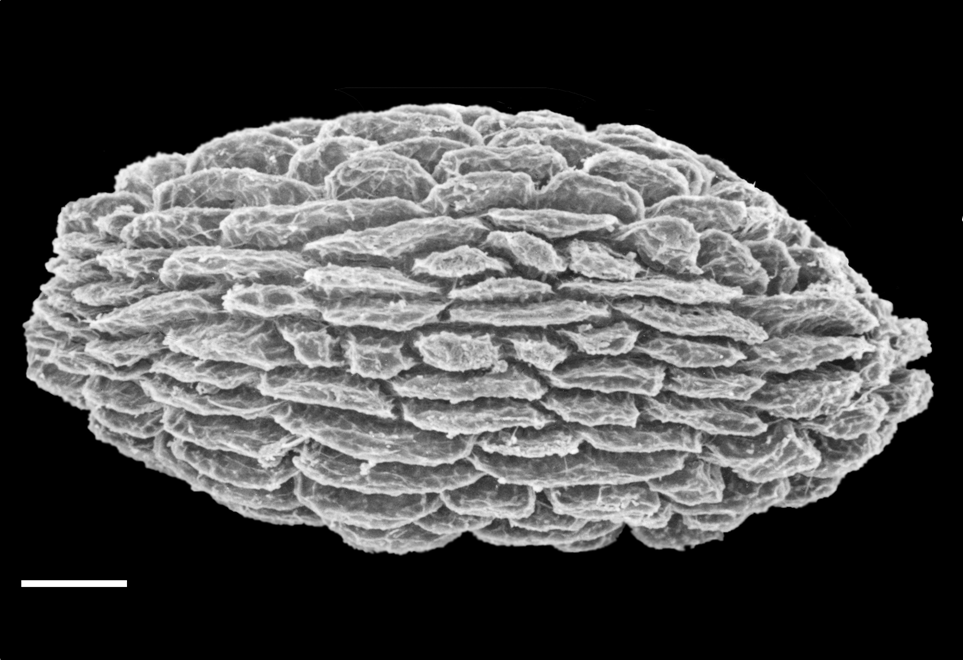
Seed of Hesperocodon hederaceus Eddie & Cupido comb. nov. showing the wedge-shaped hilum and the coarsely verrucate testa, each cell of the reticulum with a conspicuously raised lumen. Scale bar = 100 µm. Electronmicrograph No. 8139, University of Reading, viii 1984 (W.M.M.E.). Sample from the Royal Botanic Garden, Kew: No. 266-6626609.
At maturity the corolla is deciduous and the tumescent apex of the ovary (pars superior), together with the remnant base of the style, ruptures along lines of weakness to form three valves in line with the locules. Yet, the whole mechanism is still essentially wahlenbergioid and the septa may play a role (if somewhat reduced) in the rupture of the ovary apex. The mechanism is probably homologous with that of Wahlenbergia, but it is decidedly unlike the capsule of Edraianthus, which opens by irregular rupture of the flattened ovary apex. According to Kolakovsky (Reference Kolakovsky1986, Reference Kolakovsky1987), the rupture of the capsule apex in Edraianthus is achieved by means of the axicorn, which performs a similar function on the hypanthial walls of Campanula spp., and is, therefore, very different from the mechanism found in Wahlenbergia. Edraianthus has also traditionally been associated with the wahlenbergioids (De Candolle, 1830; Endlicher, Reference Endlicher1838; Bentham, Reference Bentham, Bentham and Hooker1876; Schönland, Reference Schönland, Engler and Prantl1889; Kovanda, Reference Kovanda and Heywood1978; Takhtajan, Reference Takhtajan1987) but molecular investigations (Eddie et al., Reference Eddie, Shulkina, Gaskin, Haberle and Jansen2003; Cosner et al., Reference Cosner, Raubeson and Jansen2004; Stefanović et al., Reference Stefanović, Lakušić, Kuzmina, Mededović, Tan and Stevanović2008), and growth and seedling morphology (Shulkina et al., Reference Shulkina, Gaskin and Eddie2003), have now shown Edraianthus to be a core component of the European Campanuloideae, as was intimated by Hilliard & Burtt (Reference Hilliard and Burtt1973). Fedorov (Reference Fedorov, Shiskin and Bobrov1972) and Kolakovsky (Reference Kolakovsky1987) also included this genus in the tribe Campanuloideae based on its overall morphology.
Apical dehiscence mechanisms are to be found in at least three other genera of the Campanulaceae: Jasione L., Feeria Buser and Githopsis Nutt., which, on the basis of molecular analyses, may have distant affinity with Wahlenbergia hederacea, although all are radically different genera and none is generally thought to be closely related to it. These genera are discussed below, principally in order to highlight the diversity of capsule morphology within the Campanulaceae and the degree of convergence that has resulted in apparent taxonomic confusion and mis-classification.
Jasione and Feeria both possess loculicidal valvate dehiscence mechanisms that, indeed, are reminiscent of Wahlenbergia. Following De Candolle (1830), who classified it in a subtribal group (unnamed) that included Wahlenbergia, Jasione has traditionally been classified as belonging to the tribe Wahlenbergieae (Endlicher, Reference Endlicher1838) or subtribe Wahlenbergiinae [as Wahlenberginae] (Schönland, Reference Schönland, Engler and Prantl1889), whereas Feeria angustifolia (Schousb.) was originally included in the genus Trachelium L. in the Campanuloideae Burnett (Reference Burnett1835) by Schousboe (Reference Schousboe1800), and transferred to the monotypic genus Feeria by Buser (Reference Buser1894). Its position next to Trachelium in the Campanuloideae has subsequently been maintained, mostly on account of the supposed resemblance of their inflorescences to each other despite radical differences in capsule dehiscence mechanisms. Feeria dehisces loculicidally and distally by three apical valves, which form a 3-pointed crown, whereas Trachelium dehisces laterally and proximally by rupture of the hypanthial walls at the base of each sulcus. Although the chromosome number of Feeria (2n = 34) and its geographical distribution in the western Mediterranean also supports association with Trachelium (2n = 32, 34), its overall inflorescence morphology equally resembles Jasione (2n = 12, 14, 18, 24, 36, 48, 60), although the latter lacks a terminal flower. The majority of Jasione species are also western Mediterranean in distribution, so it may ultimately prove to have greater affinities with Jasione, as was shown by Olesen et al. (Reference Olesen, Alarcón, Ehlers, Aldasoro and Roquet2012). The western North American genus Githopsis (2n = 18, 20, 36, 38, 40) also has apical dehiscence by irregular rupture and was included by Schönland (Reference Schönland, Engler and Prantl1889) in his subtribe Wahlenbergiinae [as Wahlenberginae], but, as Morin (Reference Morin1983) astutely observed, ‘Except for its mode of capsule dehiscence, which is no more like that of Wahlenbergieae than it is like that of Campanuleae, Githopsis fits well into Campanuleae.’
The form of the mature capsule in diverse lineages of Eurasian bellflowers seems to be under intense selection pressure and may be an insular/montane phenomenon associated with a loss of dispersibility and portioned seed release. For example, tardy dehiscence and/or irregular rupture of the capsule has apparently evolved independently in the Campanula s.str. clade (Eddie et al., Reference Eddie, Shulkina, Gaskin, Haberle and Jansen2003) among several of the endemic species and segregates of Campanula/Edraianthus in the Balkan mountains and the Aegean region (e.g. Halacsyella parnassica (Boiss. & Spruner) Janch., Petkovia orphanidea (Boiss.) Stef., Campanula sartorii Boiss. & Heldr., C. incurva Aucher ex A.DC.), plus species in Campanula sect. Quinqueloculares Phitos, and in Anatolia (e.g. C. ptarmicifolia Lam. and C. scoparia (Boiss. & Hausskn.) Damboldt) (Hartvig, Reference Hartvig1991; Eddie, Reference Eddie1997).
In general, throughout the Campanulaceae, there also seems to be a correlation between mode of dehiscence and inflorescence structure. The ‘Protoedraianthus’ group of Edraianthus (Lakušić, Reference Lakušić, Sliskovic, Sijaric, Silic and Obratil1988), which has both poricidal and loculicidal modes occurring in the same individual plants (Stefanović et al., Reference Stefanović, Lakušić, Kuzmina, Mededović, Tan and Stevanović2008), may allow us to determine the factors that have precipitated the evolution of different dehiscence modes. This may be illustrated by Edraianthus tarae Lakušić (= Protoedraianthus tarae Lakušić nom. inval.), which has dichasia (rarely polychasia) composed of one central (sub-)sessile flower and several lateral flowers found at the tips of relatively long pedicels. As a consequence of their respective positions, the central fruits open apically, as in other Edraianthus spp., while the pedicellate fruits open laterally, reminiscent of those typically found in Campanula (Stefanović et al., Reference Stefanović, Lakušić, Kuzmina, Mededović, Tan and Stevanović2008). Another type of seed presentation mechanism (secondary presentation) is found in Campanula glomerata, which is superficially very similar to Edraianthus and also has an inflorescence surrounded by an involucre of bracts. In this species the lateral pores of the capsules are proximal and the seeds collect on the subtending bracts before finally being dispersed by wind (Leins & Erbar, Reference Leins and Erbar2010).
The departure from typical wahlenbergioid characteristics in Wahlenbergia hederacea inevitably invites speculation about its relationships. On a cursory inspection, it may be considered vaguely similar in habit and general appearance to Wahlenbergia procumbens (L.f.) A.DC. or even Prismatocarpus sessilis Eckl. ex A.DC. In his seminal monograph of 1830, Alphonse de Candolle stated: ‘Manifeste in genere Wahlenbergia Schrad. locanda est, prope W. procumbentem’, but any notion of a relationship with living wahlenbergioids is soon dispelled, for W. hederacea is most unlike the majority of the Wahlenbergieae in almost all aspects of floral and, especially, vegetative morphology. In recent studies using ITS and trnL-F molecular markers (Cupido, Reference Cupido2009), Wahlenbergia procumbens and Prismatocarpus sessilis, although both are isolated morphologically from other South African species, were shown to be well-supported components of the wahlenbergioid clade.
In marked contrast, Wahlenbergia hederacea is essentially campanuloid in both floral and vegetative characteristics. The long pedicels, floral morphology, and foliage recall Peracarpa Hook.f. & Thomson more than any other taxon and they also share certain similarities in habit and habitat. Wahlenbergia hederacea is a ‘boundary-layer’ plant of rainy, windswept habitats where it threads its way through patches of moss and short grass, and it is possible that the long pedicels are an adaptation to aid seed dispersal. A similar function for the long pedicels of Peracarpa may also be postulated. Their pollen is similar, being of low relief and with very short spinules (Eddie, Reference Eddie1984), but both genera are also characterised by marked differences in capsule and seed morphology, dehiscence mechanisms and chromosome number. Peracarpa (2n = 28, 30) has a torulose, membranous capsule that splits irregularly at the base, and more elongate seeds with lengthwise compressed reticula. [Note: The mode of capsule dehiscence in Peracarpa is probably not homologous with the lateral ruptures which characterise the majority of species of non-rapunculoid Campanula (= Campanula s.str. clade of Eddie et al., Reference Eddie, Shulkina, Gaskin, Haberle and Jansen2003).]
Wahlenbergia hederacea also distantly resembles several of the European isophylloid campanulas, particularly in vegetative morphology, but the flowers are most similar to those of North American rapunculoid species such as Campanula aparinoides Pursh (2n = 34), C. californica (Kellogg) A.Heller, as well as C. robinsiae Small and the California annuals (C. exigua Rattan (2n = 34) and C. angustiflora Eastw. (2n = 30), etc.). Many of these North American species also have a predilection for damp habitats. A possible relationship between Wahlenbergia hederacea and these taxa, as well as with genera such as Heterocodon Nutt., and the Chinese Homocodon D.Y.Hong (Hong, Reference Hong1980; Hong & Ma, Reference Hong and Ma1991), should be examined more closely, although existing molecular data suggest otherwise. Surprisingly, Homocodon is apparently not as closely related to the North American Heterocodon as their morphology implies, but, based on molecular data, is in fact closer to Adenophora (Lu et al., Reference Lu, Ding, Xu and Wang2007; Zhou et al., Reference Zhou, Wen, Li and Sun2012), whereas, also based on molecular data, Peracarpa is allied to both Heterocodon and Githopsis. In spite of these new findings, all these lineages belong to the Rapunculus clade (Zhou et al., Reference Zhou, Wen, Li and Sun2012). The chromosome number of Wahlenbergia hederacea (2n = 36, Gadella, Reference Gadella1966), its topological position on molecular cladograms, unusual seed morphology (Fig. 3), and geographical distribution should make us wary of a facile assumption of a close relationship with these rapunculoid lineages.
All molecular studies place Wahlenbergia hederacea more or less between the core campanuloids and core wahlenbergioids, along with genera such as Jasione and Musschia Dumort. These two genera were called ‘transitional taxa’ by Eddie et al. (Reference Eddie, Shulkina, Gaskin, Haberle and Jansen2003), implying that they were, in a sense, neither proto-typically campanuloid nor wahlenbergioid. In a study by Roquet et al. (Reference Roquet, Sanmartin, Garcia-Jacas, Sáez, Susanna, Wikström and Aldasoro2009), using combined rbcL and trnL-F data, Wahlenbergia hederacea forms part of an unresolved polytomy involving Jasione and Feeria, plus several southern hemisphere wahlenbergioid taxa. Similarly, in a combined four-gene study of Olesen et al. (Reference Olesen, Alarcón, Ehlers, Aldasoro and Roquet2012), Wahlenbergia hederacea also formed part of a clade with both Jasione and Feeria, albeit with 87% bootstrap support. In the ITS studies of Eddie et al. (Reference Eddie, Shulkina, Gaskin, Haberle and Jansen2003) and in the three-gene study of Haberle et al. (Reference Haberle, Dang, Lee, Peñaflor, Cortes-Burns and Oestreich2009), Feeria occupied a clade comprising Azorina vidalii (H.C.Watson) Feer, Campanula edulis Forssk. and C. mollis L. Therefore, the relationships of Wahlenbergia hederacea and the ‘transitional taxa’ are still not fully resolved and should be further investigated by fine-honing molecular analyses using a diversity of sequence data, in addition to refined morphological examination.
If we retain classical Linnaean categories, which are characterised solely by the properties shared by their members, then studies of chloroplast genome rearrangements suggest that Jasione is best treated as campanuloid and should be classified accordingly (Cosner et al., Reference Cosner, Raubeson and Jansen2004) (for an interesting discussion on categories, see Lakoff, 1987). We recommend that Wahlenbergia hederacea also be included in the Campanuloideae and its phylogenetic position based on molecular results be regarded as co-basal within this lineage. On consideration of the distribution of the ‘transitional taxa’, including both Feeria and Wahlenbergia hederacea, we hypothesise that they are all relatively relictual in the Mediterranean Basin, Macaronesia and western Europe, and are likely to be very old elements of the Campanulaceae as a whole. This conclusion is corroborated by all molecular investigations of these taxa to date (Eddie et al., Reference Eddie, Shulkina, Gaskin, Haberle and Jansen2003; Haberle et al., Reference Haberle, Dang, Lee, Peñaflor, Cortes-Burns and Oestreich2009; Roquet et al., Reference Roquet, Sanmartin, Garcia-Jacas, Sáez, Susanna, Wikström and Aldasoro2009, etc.). Therefore, it may be descended from a proto-campanuloid component of a palaeoflora that occupied the North Atlantic region of Eurasia in early Tertiary times prior to the evolution and spread of the rapunculoid lineages of Campanula in Eurasia and North America. From this perspective, the capsule dehiscence mechanism should be regarded as a plesiomorphic character. As yet, we have no concrete evidence for the actual age of the early branching events in the evolutionary history of the Campanulaceae despite the tone of recent claims (e.g. Roquet et al., Reference Roquet, Sanmartin, Garcia-Jacas, Sáez, Susanna, Wikström and Aldasoro2009; Olesen et al., Reference Olesen, Alarcón, Ehlers, Aldasoro and Roquet2012), but our current research indicates that the age of the Campanulaceae is much older than current estimates (Eddie & Cupido, in prep.). Leaving aside biogeographic, phylogenetic and ecological conjecture, Wahlenbergia hederacea requires a new generic name. Consequently we propose the following:
Taxonomic Treatment
Hesperocodon Eddie & Cupido, gen. nov.
Herb with affinities in Campanulaceae, but somewhat resembling Anagallis tenella (Primulaceae) in habit.
Leaves almost peltate, resembling tiny juvenile leaves of Hedera helix (Araliaceae). Flowers more or less nodding, often appearing partially closed at night or after rain. Corolla tubular-campanulate with three prominent purplish veins extending from the tube to the base of each lobe. Filaments broadened at the base, long and tapering, with long, downward-pointing awl-like unicellular hairs on the margins of the lower half, but filaments not forming a nectar-dome. Pollen oblate-spheroidal, tri-zonoporate, with low surface relief and few small spinules; 26 µm equatorial diameter. Ovary swelling at the apex at maturity. Capsules dehiscing above the calyx by apical rupture. Seeds few (c.12–15), relatively large (0.6 mm long), ovate, flattened; seed-coat coarsely verrucate. – Type species: Campanula hederacea L.
Hesperocodon hederaceus (L.) Eddie & Cupido, comb. nov. – Campanula hederacea L., Sp. Pl. 1: 169 (1753). – Campanula hederifolia Salisb., Prodr. Stirp. Chap. Allerton 127 (1796) as ‘hederaefolia’, nom. illeg. – Wahlenbergia hederacea (L.) Rchb., Icon. Bot. Pl. Crit. 5: 47 (1827). – Schultesia hederacea (L.) Roth, Enum. Pl. Phaen. Germ. 1: 690 (1827). – Roucela hederacea (L.) Dumort., Fl. Belg. 58 (1827). – Campanula pentagonophylla Vuk., Linnaea 26: 325 (1854), nom. illeg. – Valvinterlobus filiformis Dulac, Fl. Hautes-Pyrénées 459 (1867), nom. illeg. – Aikinia hederacea (L.) Fourr., Ann. Soc. Linn. Lyon (n.s.) 17: 112 (1869). – Campanopsis hederacea (L.) Kuntze, Revis. Gen. Pl. 2: 379 (1891). – Cervicina hederacea (L.) Druce, Fl. Berkshire 324 (1898). – Wahlenbergia hederifolia Bubani, Fl. Pyren. 2: 18 (1899), nom. illeg. – Type: Löfling s.n. Herb. Linn. No. 221.77 (lecto LINN, designated here). Fig. 4.
Hesperocodon hederaceus comb. nov. A. Side-view of corolla showing tubular-campanulate shape and coloured veins on the outside of tube reaching to the corolla lobes. Scale bar = 0.5 cm; B. View showing flower in ‘male’ phase, coloured veins inside tube, whitish pollen, and ivy-like leaves. On short grass and moss, Poltalloch, Argyll, Scotland, 23 viii 2012 (W.M.M.E.).
Hesperocodon hederaceus (ivy-leaved bellflower) has few unambiguous features that can be used as a basis for a new generic name. The specific epithet is adequate, although the tiny leaves only superficially resemble those of ivy. We have based the name Hesperocodon on its unique Atlantic distribution, the prefix ‘Hespero’ being derived from the Greek word έσπερος (hesperos) for ‘western’, and the suffix κωδων (codon), for ‘bell’. Since the generic name is masculine, the specific epithet now becomes ‘hederaceus’. The name Hesperocodon was used by Webb & Berthelot (1844) for a section of the genus Specularia Heister ex A.DC. (= Legousia Durande), but priority does not extend across different levels in the taxonomic hierarchy.
Distribution and habitat. Hesperocodon hederaceus has an odd distribution from sea level to about 485 m along the Atlantic seaboard of western Europe from Spain and Portugal to the Netherlands and Germany, and a predilection for wet, windswept acidic heathlands, and bogs, mossy or grassy areas bordering streams and flushes, or Salix carrs and woodland clearings. It is frequently naturalised on mossy lawns. At the height of the glacial maximum, approximately 20,000 years ago, it presumably was relictual in western France and the Iberian Peninsula. From a historical perspective its distribution can be described as ‘Oceanic southern-temperate type’ or Lusitanian. Several other species have similar distribution patterns, including Erica mackaiana Bab., E. ciliaris L. and Daboecia cantabrica (Huds.) C.Koch (Ericaceae), Pinguicula grandiflora Lam. (Lentibulariaceae) and Saxifraga hirsuta L. (Saxifragaceae) (Ingrouille, Reference Ingrouille1995). The highly localised distribution of Wahlenbergia hederacea in the British Isles, particularly in western Ireland and southwest Scotland, may have resulted from random re-colonisation events following the retreat of the ice, although the species has been declining in the British Isles during much of the 20th century due to habitat loss (Preston et al., Reference Preston, Pearman and Dines2002). There is no evidence of this species ever having occurred in North Africa or Macaronesia and it is unlikely, as has been recently suggested, that it is a relictual component of an Afroalpine flora (Rix, Reference Rix2004). Virtually nothing is known of its biology. In cultivation it displays some self-compatibility (Eddie, pers. obs.) and its persistence in small patches in scattered localities is, in all likelihood, linked to its capacity for vigorous vegetative reproduction. The genetics of its scattered populations would be interesting for future investigation and for their conservation (Kay & John, Reference Kay and John1995).
Acknowledgements
We are grateful to Ian Hedge, Martin Ingrouille and Thomas G. Lammers for comments on an earlier draft of this paper and for suggestions leading to its improvement.