Introduction
Many important Cambrian Burgess Shale-type biotas have yielded the problematic medusiform fossils collectively referred to as eldonioids. Described taxa include Eldonia eumorpha Sun and Hou, Reference Sun and Hou1987 and Rotadiscus grandis Sun and Hou, Reference Sun and Hou1987 from the Chengjiang Biota of Yunnan Province, South China (Sun and Hou, Reference Sun and Hou1987; Chen et al., Reference Chen, Zhou, Zhu and Ye1996; Chen and Zhou, Reference Chen and Zhou1997; Hou et al., Reference Hou, Bergström, Wang, Feng and Chen1999, Reference Hou, Aldridge, Bergstrom, Siveter, Siveter and Feng2003; Zhu et al., Reference Zhu, Zhao and Chen2002; Chen, Reference Chen2004; Zhu, Reference Zhu2010); Eldonia ludwigi Walcott, Reference Walcott1911 from the Burgess Shale, Spence Shale, and Marjum biotas of western North America (Walcott, Reference Walcott1911; Conway Morris and Robison, Reference Conway Morris and Robison1986, Reference Conway Morris and Robison1988; Briggs et al., Reference Briggs, Erwin and Collier1994; Caron and Jackson, Reference Caron and Jackson2008); Eldonia sp. from the Sinsk Biota of Siberia (Ivantsov et al., Reference Ivantsov, Zhuravlev, Leguta, Krassilov, Melnikova and Ushatinskaya2005); and Pararotadiscus guizhouensis (Zhao and Zhu, Reference Zhao and Zhu1994) from the Kaili Biota of Guizhou Province, South China (Zhao and Zhu, Reference Zhao and Zhu1994; Dzik et al., Reference Dzik, Zhao and Zhu1997; Zhu et al., Reference Zhu, Erdtmann and Zhao1999; Zhu et al., Reference Zhu, Zhao and Chen2002; Cheng et al., Reference Cheng, Fu and Zhao2009). All of the aforementioned eldonioids are characterized by a disc-shaped body with radial canals and concentric structures, a large alimentary canal, and well-developed tentacles. Specimens are typically preserved as carbonaceous compressions in mudstones, in some cases accompanied by molds of the disc (Gaines et al., Reference Gaines, Briggs and Zhao2008). Most researchers have considered eldonioids to have had a planktonic mode of life (Sun and Hou, Reference Sun and Hou1987; Zhao and Zhu, Reference Zhao and Zhu1994; Zhu et al., Reference Zhu, Zhao and Chen2002; Yang et al., Reference Yang, Zhu, Zhao, Mao and Wang2007; Chen et al., Reference Chen, Zhou and Ramsköld1995, Reference Chen, Zhou, Zhu and Ye1996; Cheng et al., Reference Cheng, Fu and Zhao2009), although others have interpreted them as benthic (Dzik et al., Reference Dzik, Zhao and Zhu1997) or nekto-benthic (Wang et al., Reference Wang, Zhao, Lin and Wang2004, Reference Wang, Lin, Zhao and Orr2009).
Some eldonioids from Burgess Shale-type biotas are preserved with other taxa. For example, the brachiopod Linguella chengjiangensis Jin, Hou, and Wang, Reference Jin, Hou and Wang1993 and the lobopods Microdictyon sinicum Chen, Hou, and Lu, Reference Chen, Hou and Lu1989 and Paucipodia inermis Chen, Zhou, and Ramsköld, Reference Chen, Zhou and Ramsköld1995 are found on the discs of Eldonia eumorpha in the Chengjiang Biota (Chen and Zhou, Reference Chen and Zhou1997). In addition, the hyolithid Haplophrentis reesei Conway Morris and Robison, Reference Conway Morris and Robison1988 and the echinoderm Ctenocystis utahensis Robison and Sprinkle, Reference Robison and Sprinkle1969 are found on the discs of Eldonia ludwigi in the Spence Shale Biota (Conway Morris and Robison, Reference Conway Morris and Robison1986, Reference Conway Morris and Robison1988), and trace fossils are associated with an eldonioid in the Emu Bay Shale of South Australia (Schroeder et al., Reference Schroeder, Paterson and Brock2018). Here, we examine the paleoecological significance of taxa associated with specimens of Pararotadiscus guizhouensis from the Cambrian Kaili Biota in Guizhou, South China (Zhao and Zhu, Reference Zhao and Zhu1994; Dzik et al., Reference Dzik, Zhao and Zhu1997; Zhu et al., Reference Zhu, Zhao and Chen2002; Cheng et al., Reference Cheng, Fu and Zhao2009).
Research material and preservation
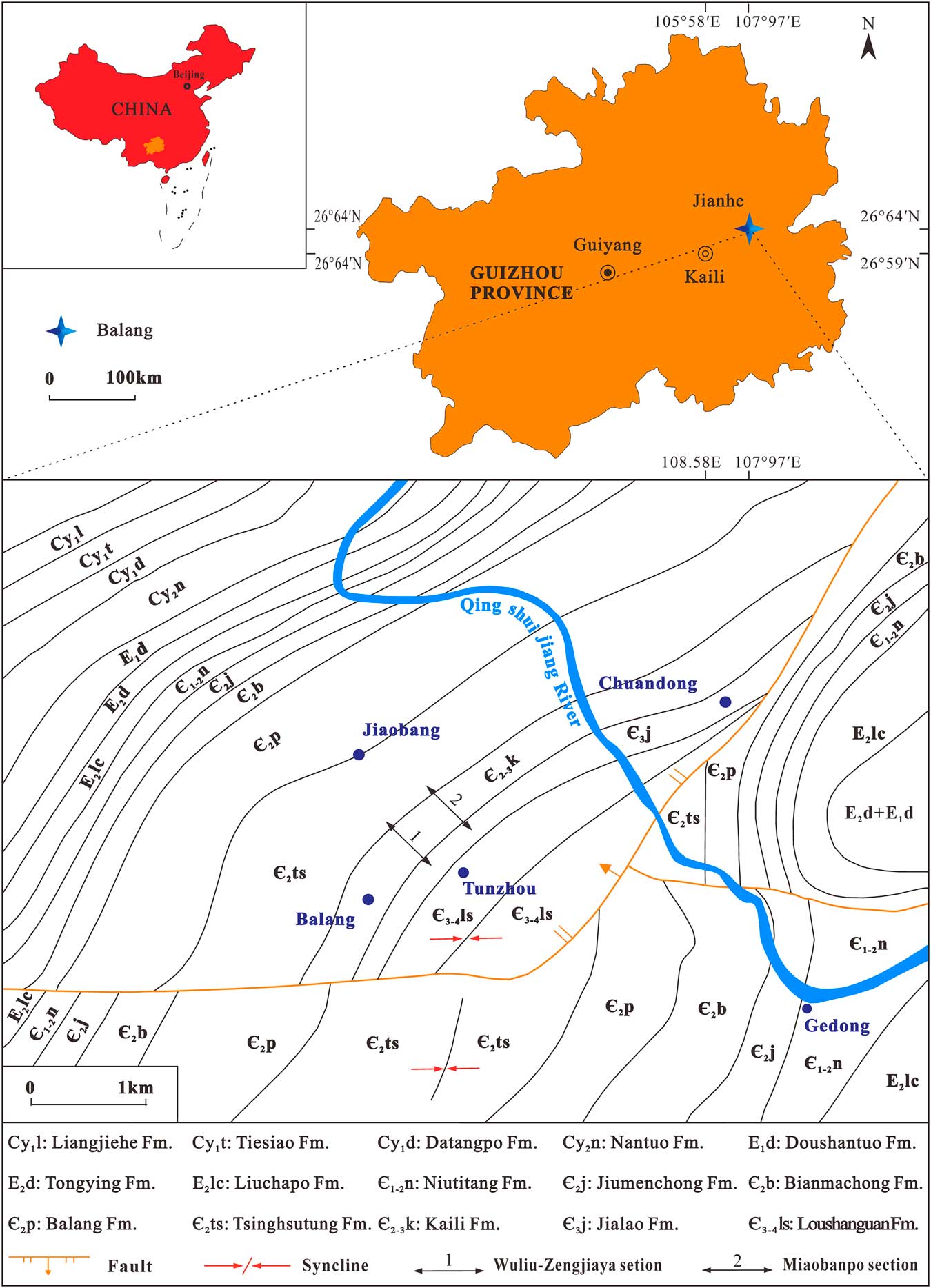
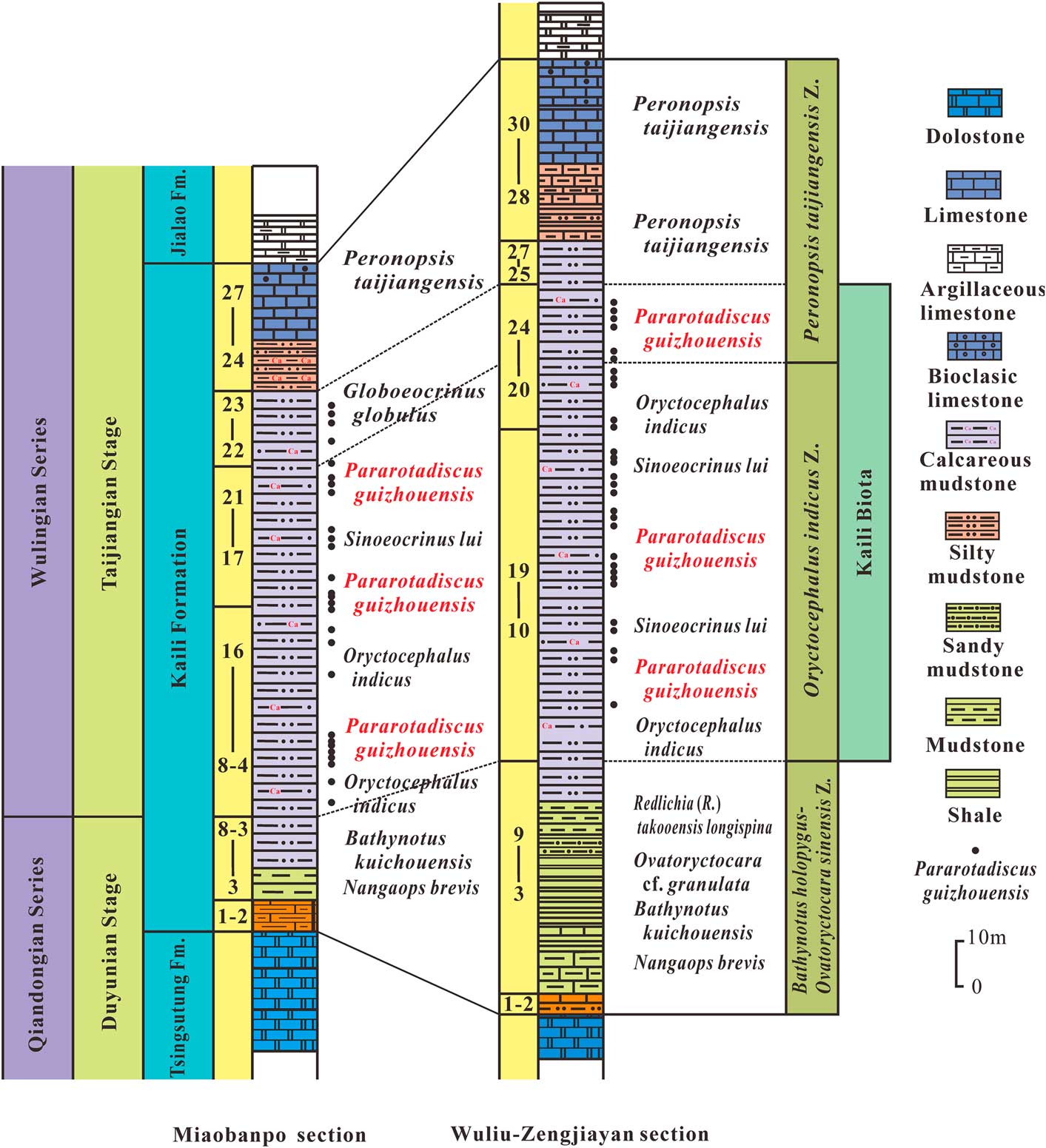
Pararotadiscus guizhouensis is very abundant in the Kaili Biota at the lowermost Cambrian Stage 5 (ca. 509 million year old) and is the only species of medusiform fossil known from the Kaili Formation (Zhao et al., Reference Zhao, Zhu, Babcock and Peng2011). This organism is found throughout the stratigraphic interval that bears the Kaili Biota, as well as in other horizons in the middle to upper part of the Kaili Formation at the Miaobanpo and the adjacent Wuliu-Zengjiayan (26°44.843’ N, 108°24.830’ E) sections at Balang village, Jianhe County, Guizhou Province, South China (Figs. 1, 2) (Zhao and Zhu, Reference Zhao and Zhu1994; Zhu et al., Reference Zhu, Zhao and Chen2002; Cheng et al., Reference Cheng, Fu and Zhao2009; Zhao et al., Reference Zhao, Zhu, Babcock and Peng2011, Reference Zhao, Yang, Peng, Yuan, Sun, Yan and Zhang2012). The present study examined 628 specimens (with associated taxa) from the Kaili Formation at the Miaobanpo and Wuliu-Zengjiayan localities. The formation in the study area shows conformable contacts with the overlying Jialao Formation and the underlying Tsinghsutung Formation (Fig. 2).
Geological map showing the locations of the Mianbanpo and Wuliu-Zengjiayan sections at Balang, Guizhou Province, China.

Stratigraphic columns of the Kaili Formation at the Miaobanpo and Zengjiayan sections at Balang, Guizhou Province, China, showing the stratigraphic distribution of Pararotadiscus guizhouensis.

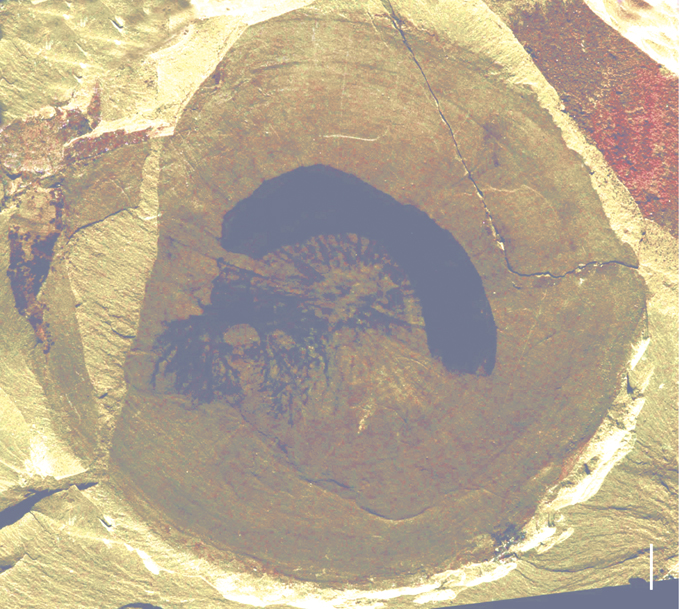
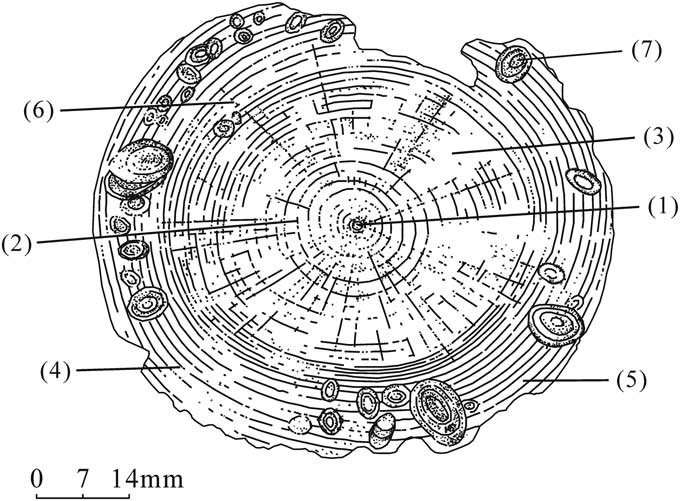
Almost all specimens of P. guizhouensis in the Kaili Biota are preserved as composite molds of the upper and lower portion of the disc, with organic preservation of the alimentary canal evident in many specimens (Zhu et al., Reference Zhu, Erdtmann and Zhao1999, Reference Zhu, Zhao and Chen2002; Gaines et al., Reference Gaines, Briggs and Zhao2008; Cheng et al., Reference Cheng, Fu and Zhao2009) (Fig. 3). The disc is divided into four zones from the center to the edge: a central ring, an inner ring, a middle ring, and an outer ring (Zhao and Zhu, Reference Zhao and Zhu1994) (Fig. 4). Ventral and dorsal portions of the disc are difficult to distinguish from each other. Although numerous specimens exhibit obvious plastic deformation resulting from compaction, folding of discs is rare, indicating that the disc of P. guizhouensis was probably softer than that of Rotadiscus grandis (Zhu et al., Reference Zhu, Zhao and Chen2002). Specimens of P. guizhouensis range from 15–155 mm in diameter, with most having a diameter of 40–70 mm; the mean diameter is 55 mm (Zhu et al., Reference Zhu, Zhao and Chen2002).
Pararotadiscus guizhouensis with alimentary canal and tentacles from the Kaili Biota at the Jinyinshan section, Guizhou Province, China (GTBJ-12-3-22b). Scale bar=10 mm.

Line drawing of a Pararotadiscus guizhouensis specimen showing key features and associated brachiopods (GTB-23-3-103a). Abbreviations as follows: (1) central ring; (2) inner ring; (3) middle ring; (4) outer ring; (5) concentric ring and ridge; (6) radial canal; (7) associated brachiopods.

Repository and institutional abbreviation
All study specimens are deposited at Guizhou University. Specimen numbers with the GTB prefix are from the Wuliu-Zengjiayan section, and those with the GTBM prefix are from the Miaobanpo section.
Relationships between Pararotadiscus guizhouensis and associated taxa
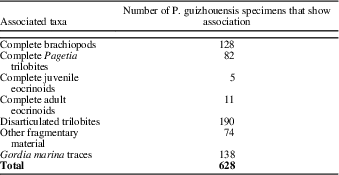
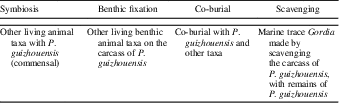
More than 2,500 specimens of P. guizhouensis have been collected from the Kaili Biota, of which ~40% are closely associated with other fossils, including trilobites, brachiopods, echinoderms, Wiwaxia, algae, and the trace fossil Gordia marina (Emmons, Reference Emmons1844). Detailed quantitative data for the 628 specimens with associated taxa examined in the present study are provided in Table 1. Four types of relationships between P. guizhouensis and associated fossils are recognized herein: symbiosis, co-burial, attachment of benthic taxa on P. guizhouensis carcasses, and scavenging of P. guizhouensis carcasses (Table 2). Each relationship is described in detail below.
Quantitative data for associations between Pararotadiscus guizhouensis and other taxa in the Kaili Biota at Balang village, Guizhou Province, China.

Four types of relationships between Pararotadiscus guizhouensis and associated organisms.

Symbiosis
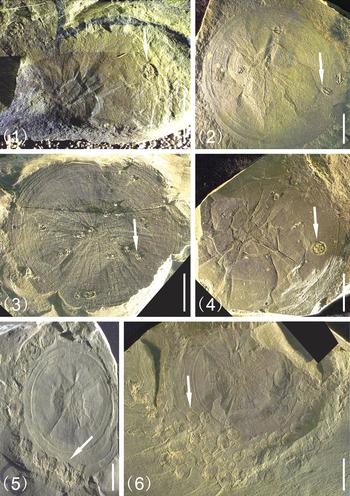
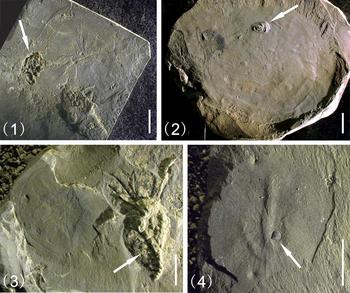
Animals including brachiopods, Pagetia (trilobite), individual juvenile gogiids, and edrioasteroids (echinoderms) engaged in commensalism and mutualism with Pararotadiscus guizhouensis. As noted in a previous study (Zhu et al., Reference Zhu, Erdtmann and Zhao1999), a brachiopod of uncertain affinity, initially interpreted as the bradoriid ostracode Chuandianella? subovata (Yuan and Huang, Reference Yuan and Huang1994), appears to have had a commensal relationship with P. guizhouensis. The valves of this small brachiopod are elongate and oval in shape; one end is rounded and appears to be the anterior, the other end is subtriangular (Zhu et al., Reference Zhu, Erdtmann and Zhao1999, pl. 3, fig. D). Commonly, large numbers of these brachiopods are densely distributed on the outer ring of P. guizhouensis, each with the long axis oriented perpendicular to the adjacent portion of the rim and the apparent anterior end placed closest to the perimeter (Figs. 4, 5.5, 5.6). This distinctive arrangement suggests that the brachiopods were attached to live specimens of P. guizhouensis and benefitted from this relationship by gaining access to currents at a level well above the bottom. Complete specimens of the diminutive trilobite Pagetia and juvenile individuals of the echinoderms Globoeocrinus globouensis Zhao et al., Reference Zhao, Parsley and Peng2008 and Kailidiscus chinensis Y.L. Zhao et al., Reference Zhao, Zhu and Hu2010 are associated with P. guizhouensis. They are mainly restricted to the edge and middle ring of the disc (Fig. 5.1–5.4). As with the aforementioned brachiopod specimens, this distribution, together with the planktonic habit of Pagetia (Lu et al., Reference Lu, Qian and Zhu1963; Zhang et al., Reference Zhang, Lu, Zhu, Qian, Cin, Zhou and Yuan1980), suggests that these species, too, had a commensal relationship with P. guizhouensis. Notably, brachiopods and lobopods associated with eldonioids in the Chengjiang Biota have also been interpreted to represent a similar type of symbiosis (Chen and Zhou, Reference Chen and Zhou1997).
Symbiotic relationships between Pararotadiscus guizhouensis and other taxa (indicated by arrows): (1) with juvenile Kailidiscus chinensis Zhao et al., Reference Zhao, Zhu and Hu2010 (GTBM-17-2908); (2) with Pagetia (GTBM-9-4-2172b); (3) with Pagetia (GTBM-8-5-1054);(4) with Pagetia and Kailidiscus chinensis (GTBM-21-576); (5) with brachiopods (GTB-21-105); (6) with brachiopods (GTB-23-365). Scale bars=10 mm.

Co-Burial
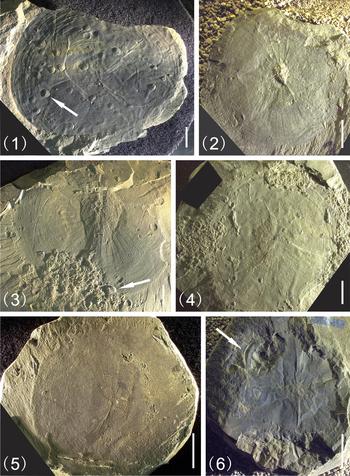
On the discs of many specimens of P. guizhouensis are found a variety of fragmentary and partial fossils. Examples of this material include cranidia and pygidia of trilobites, disarticulated brachiopod valves, Wiwaxia sclerites, echinoderm plates, and algal fragments (Table 1; Fig. 6.1, 6.3–6.6). Among this material, trilobite debris is the most common, fossil brachiopods valves also are commonly preserved on P. guizhouensis and account for 24% of the 628 specimens. The fragments and individuals of these taxa settled on the carcasses of P. guizhouensis that were lying on the seafloor. The taphonomic characteristics of this material are such that they indicate a post-mortem relationship (i.e., taphocoenoses), whereby remains, including carcass of other organisms, became associated shortly before or during final burial.
Examples of Pararotadiscus guizhouensis with associated taxa (indicated by arrows): (1) with dissociated brachiopod valves (GTB-9-3-4207); (2) with complete Sinoeocrinus lui and Pagetia cranidia and pygidia (GTBM-9-3-5004b); (3) with dissociated brachiopod valves and cranidia and pygidia of Pagetia (GTB-9-4-512); (4) with dissociated brachiopod valves and cranidia and pygidia of Pagetia (GTBM-9-5-3462); (5) with Haplophrentis cf. H. carinatus (Matthew, Reference Matthew1899) (Mao et al., Reference Mao, Zhao, Yu and Qian1992) and pygidia of Pagetia (GTB-9-4-2256); (6) with trilobite cranidia (GTBM-17-433). Scale bars=10 mm.

Benthic fixation on P. guizhouensis carcasses.—
Following death, carcasses of Pararotadiscus guizhouensis sank to the seabed and lay at the sediment-water interface. Many benthic taxa were attracted by of carcass of Pararotadiscus guizhouensis. These included eocrinoids with holdfasts, brachiopods with pedicles, monoplacophora, and hyolithids, all of which took up life habits on the disc of P. guizhouensis carcasses. After they were buried by sediments, through compaction and lithification, the shells of brachiopods occupied a portion of the disc of P. guizhouensis (Figs. 7, 8.1) (Dzik et al., Reference Dzik, Zhao and Zhu1997). Some specimens of P. guizhouensis show adult specimens of the gogiids Globoecrinus globulus Zhao, Parsley, and Peng, Reference Zhao, Parsley and Peng2008 and Sinoeocrinus lui Zhao, Huang, and Gong, Reference Zhao, Huang and Gong1994 attached with holdfasts (Zhao et al., Reference Zhao, Parsley and Peng2008; Yan et al., Reference Yan, Mao, Zhao, Peng and Wu2010; F.C. Zhao et al., Reference Zhao, Zhu and Hu2010) (Table 1; Figs. 6.2, 7.1, 7.3). Because these echinoderms are quite large relative to the discs, the surfaces in such cases are interpreted to have been colonized by the eocrinoids after the P. guizhouensis specimens died, sank to the seabed, and lay exposed for a time at the sediment-water interface. In this context, carcasses of P. guizhouensis formed localized “oases” of relatively hard substrate amid a backdrop of soft mud.
Examples of Pararotadiscus guizhouensis with associated taxa (indicated by arrows): (1) with Sinoeocrinus lui with holdfast (GTBM-10-10122); (2) with the monoplacophoran Oelandiella cf. O. accordinononta Runnegar and Jell, Reference Runnegar and Jell1976 (GTB-9-5-2884); (3) with Sinoeocrinus lui with holdfast (GTBM-20-1-32a); (4) with brachiopods (GTBM-9-3-2a). Scale bar=10 mm.

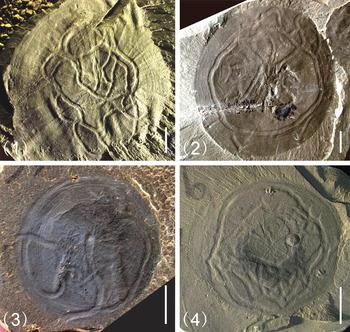
Associations between Pararotadiscus guizhouensis and the trace fossil Helminthoidichnites sp. (1) GTBM-9-4-1934; (3) GTBM-9-5-1085; (4) GTBM-10-1-7715. Association between Pararotadiscus guizhouensis and the trace fossil Gordia marina Emmons, Reference Emmons1844; (2) GTBM-10-1-9010. Scale bar=10 mm.

Scavenging of P. guizhouensis carcasses.—
Some specimens of P. guizhouensis show a distinct association with the meandering horizontal ichnofossil Gordia marina (Fig. 8), the most common ichnotaxon in the Kaili Biota (Yang, Reference Yang1993, Reference Yang1994; Zhu et al., Reference Zhu, Erdtmann and Zhao1999; Wang et al., Reference Wang, Zhao, Lin and Wang2004, Reference Wang, Lin, Zhao and Orr2009; X.G. Zhang et al., Reference Zhang, Huang, Wang, Emig and Shu2010). Among the 628 study specimens, 138 (~25%) are preserved in association with G. marina (Cheng et al., Reference Cheng, Fu and Zhao2009; Wang et al., Reference Wang, Lin, Zhao and Orr2009) (Table 1). In most of these cases, G. marina traces are largely or entirely confined to the area of the disc, with the highest degree of sinuosity and greatest number of self-crossings at the middle and outer rings (Wang et al., Reference Wang, Zhao, Lin and Wang2004). This distinctive pattern suggests a scavenging relationship between the G. marina tracemaker, presumably a worm-like animal (Yang, Reference Yang1994; Wang et al., Reference Wang, Zhao, Lin and Wang2004), and carcasses of P. guizhouensis, thereby forming a distinctive example of thanatocoenosis. No other evidence of scavenging has been detected for specimens of P. guizhouensis.
Associations of uncertain paleoecological significance
In addition to the associations mentioned above, some specimens of P. guizhouenesis are associated with individual complete brachiopods with preserved pedicles, monoplacophorans, and hyolithids (Table 1; Fig. 7.2, 7.4). Because the associated specimens are small relative to the discs and do not show a distinctive spatial pattern, it is uncertain whether the associations represent additional examples of symbiosis as opposed to attachment to discs of dead individuals of Eldonia on the sea floor.
Discussion
Complex associations between the eldonioid Pararotadiscus guizhouensis and other fossils in the Kaili Biota provide an opportunity to gather important additional information about organismal interactions during the Cambrian. Details of these associations, as documented herein, reflect: (1) relationships between living organisms, (2) relationships between living and dead organisms, and (3) juxtaposition that arises purely from mixing during burial. Thus, examples in our study would seem to represent biocoenoses, thanatocoenoses, and taphocoenoses. Notably, the particular examples of symbioses and scavenging behavior documented herein are unique among Cambrian biotas. As such, they contribute to a growing body of evidence that points to a greater degree of ecological complexity among Cambrian marine communities than previously suspected. This view is supported by recent studies that document the attachment of specimens of the linguloid brachiopod Diandongia to other animals in the Chengjiang Biota (Z.F. Zhang et al., Reference Zhang, Han, Zhang, Liu and Shu2003, Reference Zhang, Huang, Wang, Emig and Shu2010) and an ecological association between the brachiopod Nisusia and the annelid Wiwaxia in the Burgess Shale (Topper et al., Reference Topper, Holmer and Caron2014, Reference Topper, Strotz, Skovsted and Holmer.2017). Further studies of the Kaili Biota hold the promise of yielding additional insights concerning the ecology of the Cambrian biosphere.
Acknowledgments
This study was supported by grants from the Major State Basic Research Development Program of China (2015FY310-100) and the National Natural Science Foundation of China (41330101, 41772021, 41702022, 41662001). We are grateful to M. Zhu and H. Sun (Nanjing Institute of Geology and Palaeontology, Chinese Academy of Science, Nanjing, China), Z. Zhang (Northwestern University), and R. Parsley (Tulane University) for linguistic revision.