


Political parties compete during elections on the basis of policy platforms, their records of past performance in office, and very frequently, by engaging in electoral irregularities. When engaging in irregularities is the chosen strategy, how do other parties defend themselves from such actions? Although a growing literature has investigated how electoral manipulation occurs, we still do not have answers to this question. The study of electoral manipulation has focused on the decisions made by the party that engages in the irregularities, while giving only a passive role to its competitors. This overlooks the fact that the party that is the victim of manipulation is the actor most interested in counteracting it. In this paper, we address these issues by studying the competitive allocation of resources by parties that seek to prevent and offset electoral irregularities.
We focus on the levels of monitoring chosen by parties that are carried out by their polling station representatives. In many countries, these representatives constitute the first, and sometimes, the only line of defense against ballot stuffing, tampering with ballots, multiple voting, and other election-day irregularities. The importance of their role is recognized by those involved in campaigns where malpractice is common. “A polling station without a representative is a stolen polling station,” declared Andrés Manuel López Obrador, Mexican presidential candidate, in front of a crowd of followers during the 2012 campaign. “We don’t want to repeat 2006, when we were robbed because we didn’t have representatives and many polling stations were not guarded,” he continued, alluding to the disputed 2006 election in which he lost by 0.58% of the vote.Footnote 1 The role of party representatives emphasized by López Obrador is clear. Along with independent observers, party representatives protect the integrity of elections.
Paradoxically, the quality of the electoral process can be compromised by these same actors. Party representatives can use their position to harass voters, to enforce turnout buying transactions by keeping track of who has shown up to vote, or to even participate in the disappearance of election materials.Footnote 2 This dual role of representatives—as protectors and manipulators—creates an opportunity to study how parties allocate campaign resources in the face of potential irregularities. In particular, if parties fear that rivals’ representatives may engage in electoral malpractice, their choice of representation will be influenced by the expected levels of representation of their rivals. Do parties increase their representation when they expect no monitoring from their opponents, which might facilitate manipulation attempts of their own, or do they try to counteract actions against their interests by having a presence where other parties have their own monitors?
Answering these questions can help protect the integrity of elections. Political parties want to reduce actions that hurt their electoral prospects and will use their resources optimally to this end. Knowledge of what induces parties to cover certain precincts and how representatives influence election results can indicate to domestic and international independent monitors where they are most needed.
Our analysis begins by illustrating how party representatives influence electoral outcomes in Mexico, a country that, despite its transition to democracy and major reforms, continues to endure electoral irregularities (e.g., Cantú Reference Cantú2014; Cantú and García-Ponce Reference Cantú and García-Ponce2015; Magaloni Reference Magaloni2006; Nichter and Palmer-Rubin Reference Nichter, Palmer-Rubin, Domínguez, Greene, Lawson and Moreno2015). We use a rich dataset with information from elections for the Chamber of Deputies focusing on the two largest parties at the national level, the Partido Acción Nacional (PAN-National Action Party) and the Partido Revolucionario Institucional (PRI-Institutional Revolutionary Party).Footnote 3 We find that there is a robust positive correlation between the presence of party representatives and the vote share of their party. The presence of competitors’ representatives is, on the other hand, negatively associated with a party’s vote share. We also find that representatives increase turnout and reduce the share of null votes, especially when their rivals’ representatives are not present. Moreover, representatives weaken the effects on turnout and null votes of poll-workers who are not selected by the election commission and might be suspected of being political-party agents. Finally, we see that where PRI representatives are present, the likelihood of observing a recount is smaller. All these findings are aligned with the case study literature and our own conversations with party activists that describe how representatives enforce turnout buying, try to influence counting decisions when ballots are not clearly marked, and prevent irregularities like partisan poll-workers tampering with ballots.
Since an alternative explanation for some of the observed patterns is that it is easier for a party to recruit representatives where the party is popular, we undertake a number of checks that suggest such an explanation is not driving the results. We first estimate the effect of representatives on electoral outcomes while controlling for invariable confounders linked to the group of voters in a precinct by including precinct fixed effects. We check the robustness of these results to specifications that account for characteristics of a given campaign by controlling for district-year fixed effects and estimate autoregressive models to see whether the presence of representatives is capturing previous voting behavior. Additionally, we gather information on the preelection registration of party representatives, which allows us to compare precincts where registered representatives were present with those where the representatives were supposed to be present, but were not. If, conditional on registration, actual presence of representatives is determined by idiosyncratic factors, the results would get us a more accurate estimate of the effect of representatives. The findings also rule out that time-varying unobserved determinants of the intended location and availability of representatives explain the findings. Finally, we undertake a sensitivity analysis finding that in order to produce a null effect of PAN representatives on PAN’s vote shares, selection on unobservables would have to be 4.5 times larger than selection on observables, while to produce a null finding for the PRI, selection on unobservables would have to be 5.5 times larger than selection on observables.
After gathering evidence on how representatives affect electoral outcomes, we analyze the strategic considerations driving their presence at a local level. Our goal is to obtain estimates of how the levels of representation from one party influence its rival’s representation choices in a precinct. As a first approach, we write a simple game in which the PRI and the PAN decide on their levels of representation using the vote share regressions’ estimates to define the game’s payoffs. A key assumption behind this analysis is that parties’ payoffs are exclusively reflected by their vote shares. We find that, regardless of their rivals’ choices, parties are at least as well off having representatives in most polling stations of a precinct.
We extend this analysis to a setting in which the PRI and the PAN are uncertain on how the rivals’ representation choices affect their rivals’ payoffs and where they do not exclusively maximize vote shares. In this setting, parties optimize their utility function that takes into account electoral benefits and costs of having their representatives at the polls. Despite the absence of disaggregated campaign expenditures data, the observed location of representatives allows us to structurally estimate the augmented model’s parameters and its best responses.Footnote 4
We find that the PAN tries to match the representation choices of the PRI, choosing full coverage when it expects full coverage from the PRI, but is less likely to cover all polling stations if it expects the PRI to have only partial coverage. We also find that the PAN delegates its watchdog role to third parties, being less likely to send representatives where smaller parties have sent theirs. The PRI—a party with more resources and higher organizational capacity—does not have to do this and is less responsive to expected changes in actions from the PAN. When we include the third largest party, the PRD (Partido de la Revolución Democrática), as a separate strategic player, we find that it tries to reach representation levels that, match, but not exceed that of its rivals. These patterns coincide with the image of the PRD as a party who battles two richer challengers that are known to engage more effectively in irregularities (Larreguy, Marshall, and Querubin Reference Larreguy, Marshall and Querubin2016).
The estimation of the strategic model together with the findings from the simpler game based on vote shares suggests that even when parties would like to cover all polling stations in a precinct, regardless of the presence of rivals, a fixed budget forces them to prioritize precincts where their rivals are present. The fact that parties prefer to monitor precincts where their rivals are also present indicates that representatives are not predominantly used to engage in activities that are best carried out in the absence of rivals’ monitoring.
Although our evidence comes from Mexico, we believe our theoretical framework and findings can be applied more broadly. Our work is particularly relevant for developing democracies where electoral manipulation is common and where parties can guard the polls. As some of our findings are explained by the difference in organizational capacity between the parties, our conclusions are more informative for developing democracies where some parties enjoy an organizational advantage, but where there is still meaningful competition.
Our work is part of the growing literature on electoral manipulation. Poverty, undereducated citizens, inequality, small electorates, and institutions that encourage intraparty competition have been linked to fraud, vote buying, and legal restrictions to free competition (Lehoucq and Molina Reference Lehoucq and Molina2002; Hicken Reference Hicken and Schaffer2007; Ziblatt Reference Ziblatt2009; Birch Reference Birch2011; Stokes et al. Reference Stokes, Dunning, Nazareno and Brusco2013).Footnote 5 A smaller group of papers has examined the effects of electoral manipulation (Gingerich Reference Gingerich2014; Imai, Park, and Greene Reference Imai, Park and Greene2015; Simpser Reference Simpser2012, Reference Simpser2013; Vicente Reference Vicente2013). This paper contributes to this literature by studying how parties competitively allocate resources at a local level to offset and engage in irregularities.
The focus on interparty strategic behavior separates this paper from work that treats a party or political machine as the only actor engaging in irregular practices or that gives a passive role to its rivals. The “one-machine” assumption has been used to study interactions that occur within a party, such as the control of unaligned party operatives who carry out the mobilization efforts or irregularities (Larreguy, Marshall, and Querubin Reference Larreguy, Marshall and Querubin2016; Rundlett and Svolik Reference Rundlett and Svolik2016; Stokes et al. Reference Stokes, Dunning, Nazareno and Brusco2013; Szwarcberg Reference Szwarcberg2012, Reference Szwarcberg2014), or between the party and voters, as theories of self-enforcing clientelistic strategies (Stokes Reference Stokes2005; Nichter Reference Nichter2008; Smith and Bueno de Mesquita Reference Smith and Bueno de Mesquita2012; Gans-Morse, Mazzuca, and Nichter Reference Gans-Morse, Mazzuca and Nichter2013; Gingerich and Medina Reference Gingerich and Medina2013; Rueda Reference Rueda2015, Reference Rueda2017) and excessive fraud (Little Reference Little2015; Rundlett and Svolik Reference Rundlett and Svolik2016). Other work treats the manipulator’s competitor as a relevant strategic actor (Nichter and Peress Reference Nichter and Peress2017; Rozenas Reference Rozenas2016; Simpser Reference Simpser2013), but unlike this paper, their empirical analysis does not focus on the parties’ efforts to counteract opponents’ actions. We do this by first documenting patterns in the data that are consistent with the role of representatives as protectors and manipulators and then presenting empirical estimates of how opponents’ representation levels drive a party’s own representation choices.
This paper is also closely related to the literature that studies election monitoring (Beaulieu and Hyde Reference Beaulieu and Hyde2009; Brancati Reference Brancati2014; Cantú and García-Ponce Reference Cantú and García-Ponce2015; Casas, Díaz, and Trindade Reference Casas, Díaz and Trindade2017; Chernykh and Svolik Reference Chernykh and Svolik2015; Hyde Reference Hyde2007; Hyde and Marinov Reference Hyde and Marinov2014; Ichino and Schundeln Reference Ichino and Schundeln2012; Kelley Reference Kelley2012; Simpser and Donno Reference Simpser and Donno2012). Although we present evidence of the importance of partisan monitors for electoral outcomes that is in line with previous findings, our goal is to use these estimates to inform the study of the level of monitoring chosen by parties with a focus on interparty strategic considerations.
ELECTIONS IN MEXICO
There are a number of institutional features in Mexico that inform our empirical strategy. This section briefly describes them.
The Mexican Chamber of Deputies is elected every three years through a mixed-member electoral system. Of the 500 deputies, 300 are elected in single-member districts by plurality rule, whereas the remaining 200 are elected by closed list proportional representation. Electoral districts are divided into precincts that typically group voters into units of 1,500 people. Within each of these precincts there must be a polling station for every 750 voters. Voters are assigned to polling stations in alphabetical order by last name, and all polling stations in a precinct are placed in the same building.Footnote 6 Voters in Mexico express their voting preferences by marking a party symbol in the ballot. Failing to mark any party symbol or marking more than one opposing parties invalidates the vote.
The electoral law allows parties to send up to two representatives per polling station. To do so, parties have to register the names of those representatives before the election with the Instituto Nacional Electoral (INE-National Electoral Institute), and this registration information is neither available to the general public nor rival parties. The registration process takes place after parties have nominated and registered their candidates and up to thirteen days before the election day.Footnote 7 Representatives’ official responsibilities involve verifying that the electoral law is being followed and reporting irregular activities at any stage of the process.Footnote 8 Party officials in a district distribute campaign resources across local party cells that are in charge of a precinct or small groups of precincts. The local cells then allocate these resources between the recruitment of representatives and other campaign activities. This local-level allocation represented by the levels of monitoring chosen by the local party cells is the object of our study.
Besides party representatives, there are four registered voters, who we will call poll-workers, present in the polling station: a president, a secretary, and two tellers. These poll-workers and their substitutes are selected through a process that consists of sequentially and randomly restricting the universe of registered voters. On election day, if any of the appointed poll-workers are missing, they are replaced by the substitutes. Any remaining missing positions are filled by people from the line of voters at that particular polling station.
We first focus our analysis on the two largest parties. The PRI, which dominated Mexican politics for seventy-one years, and the PAN, the long-standing opposition party during the PRI’s autocratic regime and the incumbent party in the period covered by this study (2000–12). Recent research suggests that the PAN and the PRI, but not the PRD, are the main beneficiaries of irregular practices such as turnout buying (Larreguy, Marshall, and Querubin Reference Larreguy, Marshall and Querubin2016). We later extend the analysis by including the PRD.
THE ROLE OF PARTY REPRESENTATIVES
Party representatives can influence election results in multiple ways. First, they protect their parties from electoral irregularities. These irregularities include, among other things, multiple voting, early polling station closures, miscounting, and tampering with the ballots. The ways by which they prevent such actions vary. For example, a common way for representatives to prevent multiple voting is by checking those voters who have already cast their ballots against the lista nominal (list of registered voters). This is possible as poll-workers are instructed to read the names of voters out loud as they approach the polling station and party representatives are given the list of registered voters.
A key concern of parties is the possibility of polling stations in which all poll-workers and representatives support their rival. Emmanuel, an activist with the PAN, explains, “if there is a polling station in which you know you might win and you don’t send a representative, but there is only a representative from the other party, the party that is tied with us… then, I would be worried.”Footnote 9
Parties try to gain control over the polling stations by exploiting the rule that allows voters in line at the polling station to serve as poll-workers (Larreguy, Olea, and Querubin Reference Larreguy, Montiel Olea and Querubin2017). To do this, party activists place supporters first in the line to replace the assigned poll-workers who are prevented from showing up to the polls. Once a party member is operating as teller, secretary, or president of the polling station, the chances of altering the results increase.
One way for a partisan poll-worker to alter the results is to spoil ballots by marking two or more opposing party symbols. This tactic is easier to carry out than to mark leftover ballots after the polls close, or filling the tally sheets incorrectly, as those actions generally require collusion with all other poll-workers. A party representative can prevent or report any of these actions. Importantly, in cases in which ballots are not clearly marked by voters, representatives are urged to “defend the party’s vote” by trying to convince poll-workers that the disputed vote counts for their party or that it is invalid for their rivals. Such pressure at the counting stage is more likely to influence poll-workers when only one party has representation.
Preventing manipulation is not the only way by which representatives affect electoral outcomes. They play a critical role in mobilization efforts like turnout and vote buying, both of which are illegal under Mexican law.Footnote 10 Besides access to the list of registered voters at the polling stations, party representatives have lists of voters who are supposed to vote for their party. The list includes legitimate supporters and people who have previously received bribes from party brokers in exchange for their vote. Given their unique position within the polling station, party representatives can verify whether those on the list have shown up to vote. This process, known as the “bingo system” (Larreguy, Marshall, and Querubin Reference Larreguy, Marshall and Querubin2016; Mercado Reference Mercado, Ugalde and Loret de Mola2013; Ugalde and Rivera Reference Ugalde and Rivera2014), is described in detail by a party activist from the PRI:
If on the list it turns out there are 100, and by 3:00 p.m. only 30 of the 100 have voted, they [the representatives] tell the activist to keep working. [The representative tells the activist] Look, go find these 70. They said they were going to come to vote for the PRI.
He also mentioned that when all the voters on the list had voted, the representatives can instruct activists working outside the polling station to engage in turnout suppression. Starting fights, planting firecrackers, or disseminating rumors about vandalism, theft, and violence around the polling station are some of the tactics used. Intentionally spreading false information about the development of the election is also illegal.Footnote 11
It is important to note that such turnout suppression efforts make sense if the party has information about the expected levels of support of its rival. This is likely to happen when one of its representatives sees the “bingo cards” (the lists of expected supporters) of the rival parties’ representatives. If the rivals are not expecting many supporters to come by later in the day, reducing turnout would not benefit the party. In this way, while the bingo system cannot be prevented by other parties’ representatives, it can be undermined when rival representatives are also present in the polling station.
The bingo system is facilitated by the fact that poll-workers are reading the name of the person casting her ballot out loud.Footnote 12 Paradoxically, doing so was conceived as a way to increase transparency by reducing the opportunities for multiple voting.Footnote 13 As one PRI activist commented, “parties have used the goal of transparency for their own strategic ends,” and the reading of the names out loud becomes a tool to irregularly control voting behavior.
There are two important roles that representatives play in facilitating these mobilization efforts: the representatives transmit to party higher-ups whether brokers and activists are mobilizing enough voters based on the lists and also help brokers identify those voters who are not complying with the brokers’ instructions (Mercado Reference Mercado, Ugalde and Loret de Mola2013). In this way, polling station representatives ameliorate the moral hazard and selection problems that arise when unaligned brokers work for a party (Larreguy, Marshall, and Querubin Reference Larreguy, Marshall and Querubin2016; Rundlett and Svolik Reference Rundlett and Svolik2016; Stokes et al. Reference Stokes, Dunning, Nazareno and Brusco2013) and partially solve the commitment problems of vote and turnout buying transactions (Smith and Bueno de Mesquita Reference Smith and Bueno de Mesquita2012; Gingerich and Medina Reference Gingerich and Medina2013; Rueda Reference Rueda2015, Reference Rueda2017).
These accounts reflect that party representatives not only guard against malpractice but, occasionally, engage in irregularities themselves. They also indicate that some of the representatives’ actions are best carried out in the absence of the rivals’ representatives. In what follows, we statistically analyze the influence of representatives on election outcomes and show evidence consistent with these observations. Moreover, if parties know that their rivals representatives’ presence hurt their interests and can counteract their actions with their own representatives, they should also take into account representation levels of their opponents when determining their own. The second part of the paper shows that this is the case.
DATA
Our dataset has information on electoral results and the presence of party representatives in polling stations for the Chamber of Deputies’ elections during the period 2000–12. The INE keeps records of all the information contained in polling station tallies, including whether or not they were signed by the representatives of each party. This information is used to create indicators of the presence of representatives.
For the analysis, we define the vote shares and the representatives of the PAN, PRI, and the PRD to be those of the coalitions in which these parties were members. If in a given district there was no coalition, the representatives and votes variables are those of the individual parties.Footnote 14
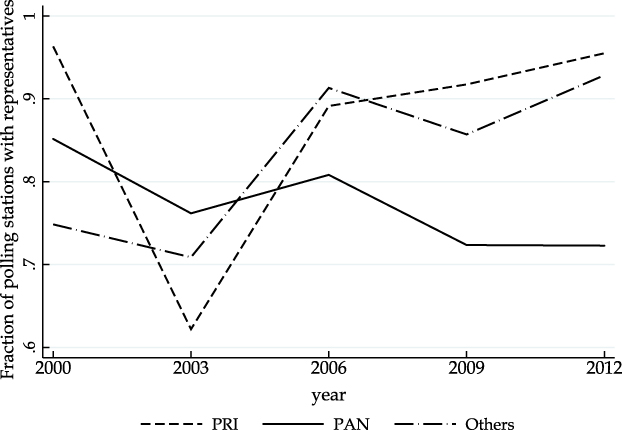
Figure 1 presents the fraction of polling stations with representatives from each party by year. With the exception of the 2003 congressional elections, the PRI covers a larger fraction of polling stations than the PAN. We also see that, relative to years in which only congressional elections are held (2003 and 2009), in presidential election years (2000, 2006, and 2012), parties tend to cover a larger fraction of polling stations. The main difference between the two largest parties is that, unlike the PAN, the PRI has increased the share of polling stations that it monitors. Although these figures show a clear dominance of the PRI in terms of representation at polling stations, there is geographic variation in that coverage. In 75 districts, the PRI has a coverage of less than 80%, with the lowest being 45%.
Fraction of Polling Stations with Representatives

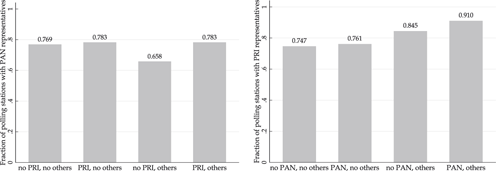
Figure 2 shows the fraction of polling stations with representatives, but we now condition on whether other parties have representatives of their own.Footnote 15 Both parties have the highest probability of sending representatives to polling stations in which the other major party and at least one other party also have representatives (0.783 for the PAN and 0.910 for the PRI). Moreover, both major parties prefer to send representatives where the other major party sends theirs in the presence of third parties (this is also the case when third parties are not present but the differences are smaller). As for the differences across parties, the PAN less frequently sends representatives to stations in which there are no PRI representatives, but where other parties have representation. The PRI, on the other hand, has a high probability of sending representatives where smaller parties are present, even in the absence of the PAN (0.845).
Representation Conditional on Rivals’ Presence

PARTY REPRESENTATIVES AND ELECTORAL OUTCOMES
To look for evidence of party representatives influencing electoral outcomes, we estimate equations of the form
 $$v_{s,t}^i = r_{s,t}^i\;{\gamma _i} + r_{s,t}^{ - i}\;{\gamma _{ - i}} + r_{s,t}^{{\rm{others}}}\;{\gamma _{{\rm{others}}}} + {\bf{z}}_{s,t}^{i\prime }\zeta + {\delta _s} + {\eta _t} + {\varepsilon _{s,t}},$$
where  $v_{s,t}^i$ is the vote share of party i ∈ {PAN, PRI} in sección (precinct) s in election t,
 $r_{s,t}^i$ is the fraction of polling stations in the precinct where party i has a representative, and
 $r_{s,t}^{{\rm{others}}}$ is the fraction of polling stations in the precinct where at least one party other than the PRI or PAN has a representative. The major party whose vote share is not the dependent variable is denoted by −i. The vector
 ${\bf{z}}_{s,t}^i$ includes the margin of victory in the previous election, the logged number of polling stations in the precinct, logged population, the average number of years of schooling in the municipality where the precinct is located, a dummy for whether there are concurrent regional elections, and a dummy indicating whether the governor belongs to party i.Footnote 16 In addition, the δs’s denote precinct fixed effects and the ηt’s capture common shocks to all precincts in a given election.
We cluster standard errors at the district level. Because of redistricting in 2005 and the use of precinct fixed effects models, our sample includes all precincts in the years from 2006 to 2012, and those that did not change districts from 2000 and 2003 (69% of all precincts in those years). The main results are still maintained if we use all precincts from 2000 and 2003 while clustering at the precinct level or if we restrict the sample to the post-2005 elections when there is no redistricting.
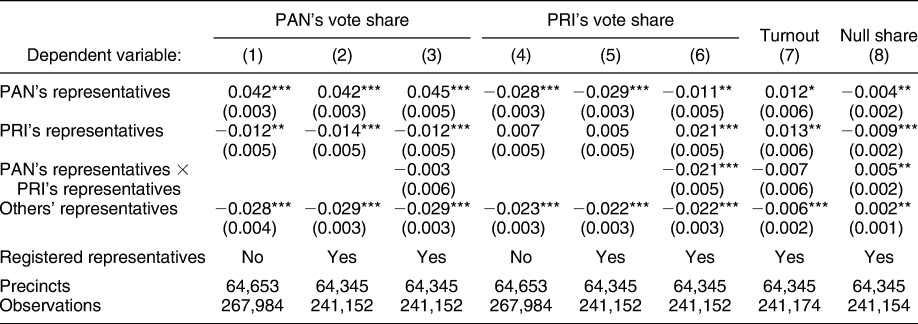
Table 1 presents the results. In columns 1 and 4, we see that both parties’ vote shares are lower when representatives of other parties are in the precinct. Increasing the fraction of PAN representatives by one standard deviation is associated with a reduction of 1 percentage point (≈ −0.028 × 0.37) in the vote share of the PRI. An increase of one standard deviation in the fraction of PAN representatives, on the other hand, is associated with a 1.55 percentage points (≈0.042 × 0.37) increase in its vote share. The coefficient on the PRI’s representatives in its vote share model is not significant. Below, we show, however, that when the effects of representatives vary with the presence of other representatives, this coefficient is larger and precisely estimated. This suggests that, conditional on the PAN not monitoring, the PRI’s representatives positively influence the PRI’s votes.
Party Representatives and Electoral Outcomes (Precinct Level)

All models include precinct and election year fixed effects. Additional controls are: logged number of polling stations, margin of victory in the previous election, a dummy for whether the governor belongs to the same party, a dummy for whether there is a local election, logged population in the municipality where the precinct is located, and average number of years in school. “Registered representatives” denotes specifications that control for the fraction of polling stations in the precinct where representatives of the PAN, PRI, and smaller parties had been registered. Standard errors clustered at the district level are in parentheses.
* significant at 10% level, ** significant at 5% level, *** significant at 1% level.
The magnitudes of the estimated coefficients are substantively important. In all elections in the sample, the margin of victory has been less than two percentage points in at least 20 races, and less than three percentage points in at least 30. In some districts, elections are so competitive that it is common to find elections decided by just a few hundred votes. Moreover, because our indicators of representatives’ presence come from their signatures on the final tally sheets, it is possible that our measures indicate that no representative was present even when they were there for a fraction of the day. This would tend to understate the true effects of representatives in all of our regressions.
A separate challenge in interpreting the previous estimates as causal effects is the potential presence of omitted variables like partisan preferences. In particular, in an area where a party expects to do well, it is easier for that party to recruit representatives. The precinct fixed effects specification would rule out that explanation if the voters who vote in a particular precinct have stable political preferences. Mexico has characteristics that make this plausible: it has a relatively well-institutionalized party system and most of the voters in a precinct are the same as those who have voted there before. Nevertheless, campaign-specific factors not controlled for could influence the parties’ support and the availability of representatives over time.
We adopt three different strategies to address this concern. We first examine district-year fixed effects models. These regressions exploit variation across precincts in the same district in a given election and therefore hold constant all characteristics of a particular campaign. Potential confounders like candidates’ characteristics, or the quality of the campaign management, would be accounted for in these models. We find that representatives are positively associated with their party’s vote shares and negatively with that of their rival with coefficients of similar magnitudes.Footnote 17
We also estimate models that control for the lag of the dependent variable to account for the possibility that in places where the party did better in the past, it is easier to find representatives. Although the negative coefficient on the PAN’s representatives in the PRI’s vote share model is not significant, we see a stronger positive effect of representatives on their own vote shares and a stronger negative one of other parties’ representatives for both parties. The autoregressive models’ results, however, tend to overstate the effects of representatives when there is unobserved heterogeneity at the precinct level and when the previous vote shares are positively correlated with the presence of the party’s own representatives (Angrist and Pischke Reference Angrist and Pischke2009, 246). Because of this, Table 1 gives more conservative estimates of the effects of interest.Footnote 18
The third strategy is to control for the fraction of polling stations where party representatives were registered while still including precinct fixed effects. The rest of the models in Table 1 have this specification. These regressions compare the same precinct in different periods in which the same fraction of their polling stations were supposed to have representation, but where the actual level of representation differed. Since parties are required by law to register their representatives before the election, the inclusion of registered representatives allows us to indirectly control for all unobservable factors related to the availability of party representatives as well as those that determine the willingness of parties to have representation. Thus, the coefficient of interest in these regressions should capture the influence of representatives on the results and not the party’s ability to have the representatives there (at least at the time of registration). Columns 2 and 5 of Table 1 show that the magnitudes and significance of the coefficients of interest change little when we add the registration controls.
The models in columns 3 and 6 include an interaction term between the representatives of the PAN and the PRI. If there are representatives from both parties, it is possible that they would attempt to neutralize actions against their own party taken by the rival’s representatives. Take, for example, the practice of monitoring the lists of supporters who have voted in a polling station. If one representative is not expecting a large turnout by her party’s supporters but knows that her rival’s representatives are (perhaps because she saw the bingo card of the opponent), she could call for turnout suppression efforts. We see that the coefficient on the interaction is negative for both parties’ vote share models, but the one in the PRI’s model is much larger and precisely estimated. The results show that the positive effect of the PRI representatives on its own vote share is offset by the presence of PAN representatives. The difference in results across parties could be explained if the PRI is more likely than the PAN to use its representatives for practices that are harder to carry out in the presence of rivals’ representatives. The fact that, according to surveys, the PRI is the party that engages in the most vote buying (Mercado Reference Mercado, Ugalde and Loret de Mola2013) and the PRI’s long history of electoral irregularities (Cornelius and Craig Reference Cornelius and Craig1991; Magaloni Reference Magaloni2006) are in line with this interpretation.
The models in columns 7 and 8 give us information about how representatives are influencing the results. In column 7, we see that the estimated coefficients on representatives in a turnout model are positive and the one on the interaction term has a smaller magnitude and is negative. If all the polling stations in a precinct had representation from one major party in the absence of the other party’s representative, turnout would increase by about 1 percentage point. Even if representatives of different parties seem to partially offset their impact on turnout when both parties cover all polling stations, the turnout of the precinct will be 1.8 percentage points higher than what it would be without major parties’ representatives.Footnote 19
Column 8 shows that the presence of either PAN or PRI representatives decreases the share of null votes, but that these effects are weakened by the presence of their rival’s representatives. These patterns would be observed if representatives are preventing poll-workers from tampering with the ballots or if they are influencing poll-workers’ decisions when ballots are not clearly marked. In the latter case, convincing poll-workers to count a disputed ballot in favor of the party is much easier when other parties’ representatives are not present.
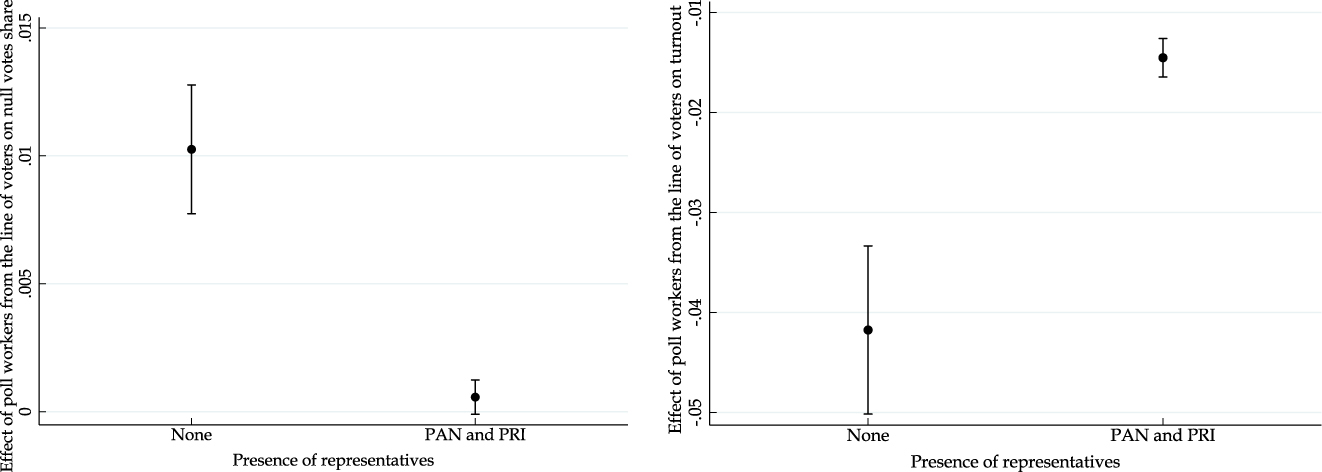
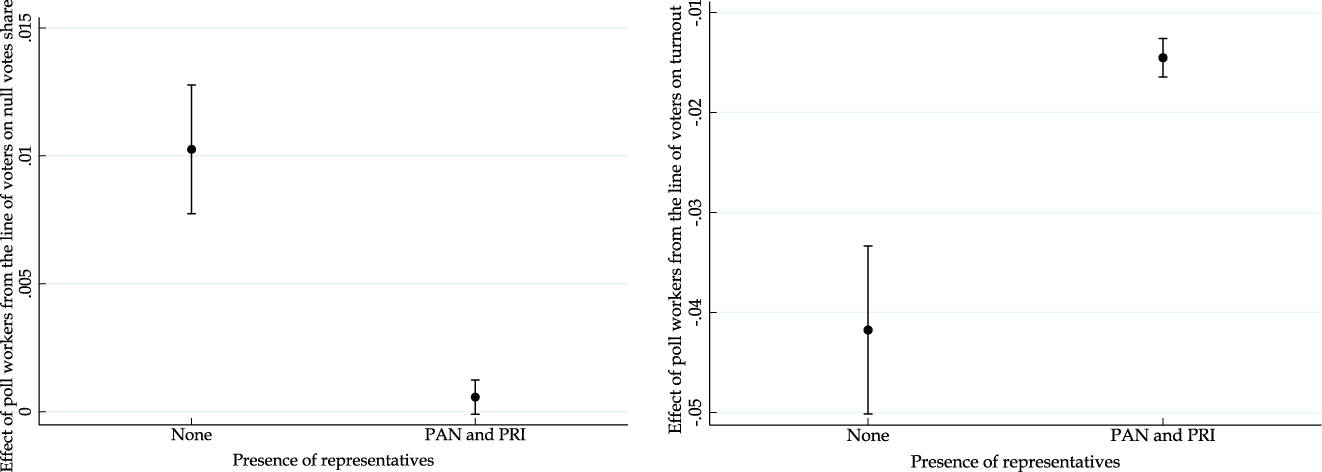
To gather more evidence on whether representatives influence results by counteracting actions carried out by partisan poll-workers, we examine models in which we include the presence of poll-workers from the line of voters (those that replaced the officially assigned ones) as an explanatory variable and allow its partial effects to vary with the presence of party representatives. Consistent with the idea of representatives defending their vote from poll-workers’ malpractice, Figure 3 shows that the share of null votes increases by about one percentage point when there are poll-workers from the line in the absence of representatives from a major party. However, the impact of having a poll-worker from the line on null votes is almost zero when both parties completely cover the precinct. We also find a negative association between turnout and the presence of poll-workers from the line that is weakened by the presence of representatives of both parties. Poll-workers are more likely to come from the line of voters where polling stations are less accessible and where officially assigned poll-workers will not show up. This is precisely where parties need to enforce turnout buying the most.Footnote 20
Null Vote Shares, Turnout and Poll-Workers from the Line of Voters
For the year 2009, for which we have information on recounts, we find a negative relationship between the likelihood of observing a recount and the presence of representatives of the PRI (for the PAN, the coefficients on representatives is negative as well but not significant). In our most conservative estimate, a precinct with full monitoring by the PRI has a probability of observing a recount that is 3.2 percentage points lower than one without representatives. This result, however, needs to be interpreted with caution as a recount is only a very imperfect measure of suspected irregularities. A recount does nothing to address common forms of manipulation like the tampering with individual ballots or vote and turnout buying. Moreover, the measure could be subject to underreporting, especially when the party that is cheating is the only one monitoring the precinct. In this case, the representatives from the party that is present at the precinct might be preventing irregularities from the other party, but if they hide their own party’s manipulation, we would be even less likely to see a recount. We see some support for this reasoning. The estimated effects of representatives of the PRI and PAN on the likelihood of a recount are negative 4.9 and 3.4 percentage points in the absence of the other party’s representative, which are stronger than the negative effects when both parties have representation. The coefficient on the interaction of representatives in these models, however, is significant at conventional levels in only some of our specifications. Even when the two parties are present, however, the association is negative and significant for the PRI in all our models, which suggests that representatives of the PRI could be playing a role in preventing irregularities that would be exposed with a recount.Footnote 21
Robustness
In addition to the precinct-level analysis, we explored models that use polling-station-level data. An advantage of these more disaggregated data is that it allows us to account for unobserved heterogeneity at the level of the smaller group of people voting in a polling station. However, models that use polling station data could be affected by spillovers. Such spillovers can occur given that the polling stations within a precinct are sometimes installed right next to each other.Footnote 22 Because of this, turnout suppression efforts started by a representative in one polling station can affect other polling stations in the same precinct. It is also possible that poll-workers, by reading the name of the person casting her ballot out loud, could facilitate turnout buying enforcement by representatives in contiguous polling stations.
Besides aggregating the data to the precinct level, an alternative to account for spillovers while still using the more disaggregated data is to control for representation in the other polling stations in the precinct. In these regressions, we also control for polling station fixed effects and indicators of registration of representatives in the polling station of interest and contiguous ones in the same precinct.Footnote 23 Consistent with the existence of spillovers, we find that the presence of PAN representatives in adjacent polling stations is associated with larger PAN vote shares and smaller PRI vote shares. Also, we see that the presence of PRI representatives in adjacent polling stations increases turnout. The main findings regarding the relationship between vote shares, turnout, null votes, poll-workers from the line of voters, recounts, and the presence of representatives are consistent with the precinct-level analysis.Footnote 24
Despite our previous efforts, it is still difficult to say that the attendance of representatives at polling stations is as-if-random. While registered representatives might not show up to the polls for purely idiosyncratic reasons (weather, sickness, family commitments, and unexpected events), there could be factors driving their presence related to overall support for the party. For example, the party could have more resources available in a precinct, improving mobilization efforts directed at the voters and, because the party can pay more, increasing the chances that registered representatives show up.
To see whether these concerns are important in practice, we carry out a sensitivity analysis (Oster Reference Oster2017). We find that in order to produce a null effect of PAN representatives on PAN’s vote shares, selection on unobservables would have to be 4.5 times larger than selection on observables, while to produce a null finding for the PRI, selection on unobservables would have to be 5.5 times larger than selection on observables. These results critically depend on assumptions about how much of the variance in vote shares is explained by observed and unobserved confounders (R max). We follow Oster by setting this R-squared to  $1.3\tilde{R}$, where
 $\tilde{R}$ is the R-squared from the regression of vote shares on our full set of controls.Footnote 25 Intuitively, this number assumes that the variance of the outcome explained by unobservables is less than that explained by treatment and controls, which were chosen with an eye to including the most important variables. Even when we assume that the variance of the outcome explained by unobservables is the same as that explained by observables, we still find that selection on unobservables would have to be larger than selection on observed controls to explain away the effects of representatives on their parties’ vote shares.
STRATEGIC DRIVERS OF PARTISAN MONITORING
So far, we have been interested in the presence of representatives as a determinant of electoral outcomes. We now turn our attention to the strategic drivers of representation making our key dependent variable the levels of representation chosen by parties. Consider the decision of local party officials in a precinct. The party officials would want to avoid leaving the precinct unmonitored if they believe their representatives can counteract the rivals’ representatives from harming their interests. Similarly, if representatives can take actions in favor of their parties that are more easily carried out in the absence of the rivals’ representatives, the party officials should send representatives to a precinct if it is not guarded by the competition. These observations suggest that, parties should monitor the precinct regardless of their rivals’ representation choices. Figure 4 presents the payoffs of a simple representation game that is aligned with these expectations.Footnote 26 These payoffs come from the expected vote shares predicted by the models in Table 1 (columns 3 and 6).Footnote 27
Representation Based on Electoral Outcomes

In this game, regardless of what the PRI chooses, the PAN is better off having full representation, but the PRI has full coverage as a clear choice when the PAN does not cover all polling stations.Footnote 28 When the PAN is fully present, sending representatives is not effective for the PRI since the PAN’s representatives neutralize the effects of the PRI’s representatives. Given this, the PAN has a flat best response function, always choosing full representation. Full representation is also the PRI’s unique best response for all levels of the PAN’s representation except 100%, where not having representatives is also optimal.
This first approximation to exploring the drivers of representation assumes that the chosen representation levels by the parties maximize vote shares. Just as firms in a market do not maximize revenues but seek to increase profits, parties are likely to consider the costs of having representatives at the polls in addition to their impact on vote shares. Representatives’ wages fall in the range of 150 to 300 pesos per day (7–15 US dollars) and there are also bonuses for good performance (Mercado Reference Mercado, Ugalde and Loret de Mola2013).Footnote 29 The local party officials might find it more cost-effective to allocate resources to other campaign activities. Costs are also affected by strategic considerations. A richer party that gives higher salaries to their representatives puts pressure on its rival to do the same, especially in areas with uncommitted voters.
Even without detailed information on campaign costs at the precinct level, we can still examine the nature of the strategic interaction accounting for the costs of representation as well as the benefits by using the observed variation in representatives’ locations. This is possible since the observed location of representatives in the data reflects the optimal decision of a party that simultaneously considers effects on electoral returns and costs of representatives. In what follows, we formulate and estimate the parameters of an augmented formal model of representation giving a precise structure for the parties’ optimization problem. Our modeling framework follows Bajari et al. (Reference Bajari, Hong, Krainer and Nekipelov2010), who provide a general setup for estimation of static games with discrete actions.Footnote 30
Strategic Model
Suppose that the PRI and the PAN compete in a district that contains S precincts. Here, we describe the parties’ interaction in one precinct, and in the appendix, we generalize the model to include data from multiple precincts. Parties decide what fraction of polling stations within a precinct should have representatives. Given the observed distribution of representation, we assume that parties take one of three actions: low representation (L), medium representation (M), or high representation (H). A party has low representation if its representatives cover less than 20% of the precinct’s polling stations, high coverage if the party’s coverage is 80% or higher, and medium representation otherwise. The action taken by party i will be denoted by a i.
Parties maximize precinct-level payoffs by choosing simultaneously their representation level. The payoffs are given by
 $${\pi _i}\left( {{a_i} = k,{a_{ - i}},{{\bf{x}}_i},{\epsilon _i}} \right) = {\bf{x}}_i^\prime {\beta _{i,k}} + 1\left\{ {{a_{ - i}} = M} \right\}{\alpha _{i,k,M}} + 1\left\{ {{a_{ - i}} = H} \right\}{\alpha _{i,{{k}},H}} + {\epsilon _i}\left( k \right),$$
with i ∈ {PAN, PRI}, k ∈ {L, M, H}, and 1{·} denoting the indicator function. These payoffs capture the electoral benefits as well as the costs of running a campaign in the area (e.g., finding brokers, representatives, or advertising). The α parameters tell us how the rival’s actions affect the party’s payoffs, whereas βi,k captures the impact of contextual variables.Footnote 31
Finally, there are action-specific shocks to the payoffs, εi(k). We can think of these shocks as all factors that make the party more (or less) likely to succeed in its efforts to influence the results when using a given representation level. We assume these shocks are private information. Furthermore, they are i.i.d. across parties and across actions and drawn from a Type I Extreme Value distribution. The previous assumptions make this a game of incomplete information with simultaneous moves and the equilibrium concept we use is Bayesian Nash Equilibrium. A strategy in this game is a function that gives the party’s level of representation for a given set of payoff-relevant characteristics and private shocks.Footnote 32
In equilibrium, parties will choose the action that maximizes their expected payoffs so the probability of i choosing a i is
 $${p_i}\left( {{a_i}} \right) = {\it{Pr}} \left\{ {{{\tilde{\pi }}_i}\left( {{a_i},{{\bf{x}}_i},{\epsilon _i},{{\bf{p}}_{ - i}}} \right) \,\ge \,{{\tilde{\pi }}_i}\left( {a_i{\prime},{{\bf{x}}_i},{\epsilon _i},{{\bf{p}}_{ - i}}} \right)\;{\rm{for}}\;{\rm{all}}\;a_i^\prime \ne {a_i}} \right\},$$
where we denote the expected payoffs of party i by  ${\tilde{\pi }_i}$ and p−i gives the other party’s ex-ante probabilities for each action. The vector of equilibrium probabilities of both parties’ actions is denoted by p = (pPAN, pPRI) and θ is a vector that includes all parameters. We write the system of equations implied by (1) compactly as p = Ψ(p, x; θ).
Given expression (1) and the known distribution of the private shocks, we can write the likelihood function of the model and estimate θ using the Mexican data.Footnote 33
Estimation
Following Hotz and Miller (Reference Hotz and Miller1993), we estimate in a first stage the action probabilities that enter the likelihood,  ${\bf{\hat{p}}}$, using a multinomial logit with a flexible specification that only includes exogenous variables.Footnote 34 Then, in the second stage, we estimate the structural parameters, θ, by maximizing the likelihood derived from equilibrium conditions.
One immediate challenge for estimation is that there could be several probability vectors that satisfy the fixed point equilibrium equation. Without taking the multiplicity of equilibria into account, the two-stage estimation procedure would generate inconsistent estimates (see, e.g., de Paula Reference de Paula2013). Consistency can be achieved, however, if only one equilibrium is played in the data. That is, given the same observables in a group of precincts where there are multiple equilibria, parties would play the same equilibrium in all of these precincts. This assumption is sensible in settings in which the same players interact with each other over time under the same set of rules, as in the case of Mexico.
We also need to satisfy exclusion restrictions to identify the effects of expectations about other players’ actions on observed players’ choices (Bajari et al. Reference Bajari, Hong, Krainer and Nekipelov2010). In particular, we need to include in xi a continuous variable that affects each party’s payoff directly but that is excluded from the payoff equation of its rival.Footnote 35 Using geo-referenced locations of the parties’ headquarters in each district, we compute the distance from each of them to the precinct.Footnote 36 In this way, the distance from a PRI (PAN) headquarters to the precinct is an explanatory variable in the first stage when estimating the PRI’s (PAN’s) action probabilitites, but it is not included in the set of variables that affect the PAN’s (PRI’s) payoffs in the second stage.
More distant precincts impose greater logistical challenges on the party that could make representation less likely. The distance from the rival’s headquarter could, however, potentially affect the party’s own payoff directly. For example, the distance from a PAN headquarter might be correlated with how rural the precinct is, which directly changes the composition of the electorate. For this reason, we control for demographics, previous election characteristics, and the distance to the nearest city out of the two most populous ones in the state. We later confirm that the main results hold once we use an extended set of controls, which make the identification assumption more plausible. The results of the first stage confirm that distance to a party headquarters is negatively related to the chances of that party choosing medium or high representation (relative to low) after controlling for all explanatory variables, their pairwise interactions, and square terms of continuous variables.Footnote 37
Given that the distances to the parties’ headquarters are computed based on their 2015 location, we use the two most recent elections in our sample for estimation.Footnote 38 Finally, we bootstrap across districts to account for the uncertainty introduced in the first stage when computing the standard errors.Footnote 39
Strategic Model Results
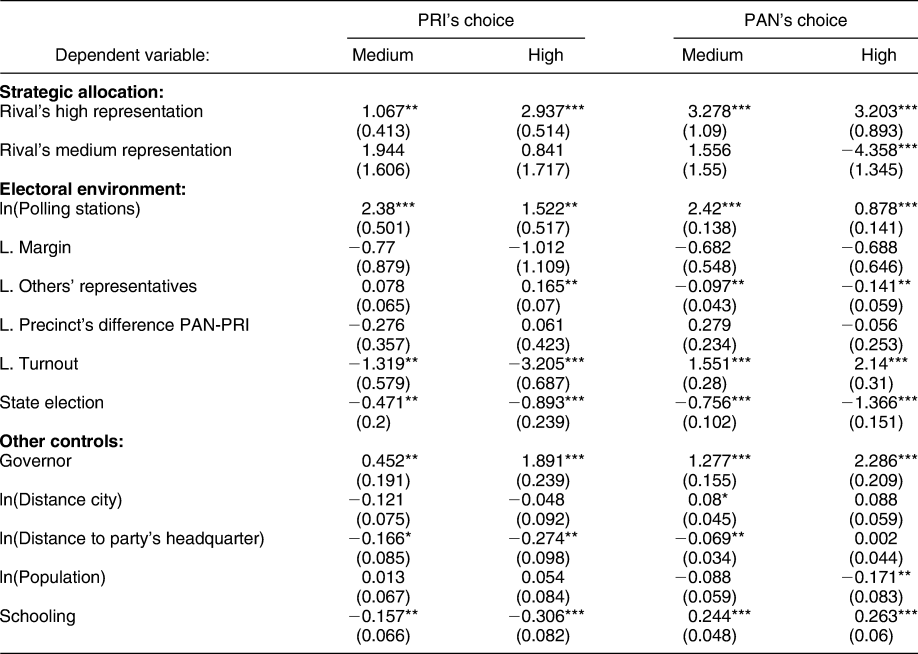
Table 2 presents the estimated parameters. A coefficient can be interpreted as the change in the log odds for choosing medium (or high) representation relative to low representation when an explanatory variable changes by one unit. We see that both parties are more likely to choose high representation over low when they expect their rival to cover most polling stations in the precinct. The PAN is also less likely to choose high (over low) representation when it expects the PRI to have only medium representation, reflecting a desire not to exceed the representation level of its rival.
Representation Model Estimates

This table presents maximum likelihood estimates of the parameters of the representative allocation game. Lags are denoted by ‘L.’ Bootstrapped standard errors are in parentheses.
* significant at 10% level, ** significant at 5% level, *** significant at 1% level.
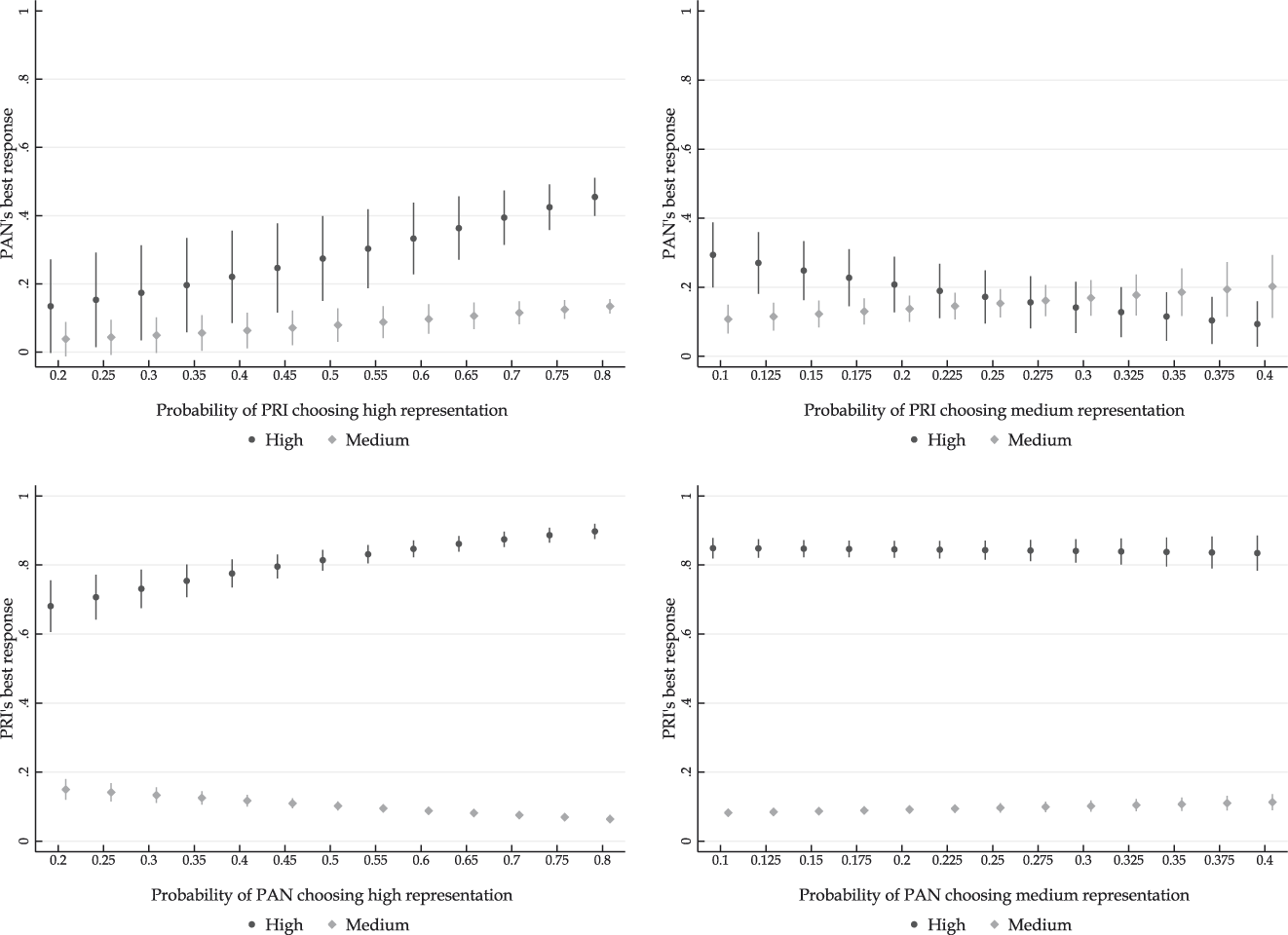
To see more clearly the overall patterns of party interaction, Figure 5 presents the parties’ best responses.Footnote 40 Although both parties try to cover all polling stations when they expect full representation from their rivals, the PAN’s response is stronger than the PRI’s. A second difference between the parties is how they react to expected medium levels of representation. The PRI maintains its representation levels constant to changes in expected medium representation while the PAN matches the PRI by being less likely to fully cover only partially covered precincts by the PRI, but increasing the likelihood of choosing partial coverage in the same precincts.
Best Responses to Rivals’ Expected Representation

Recall that in the analysis based on vote shares (Figure 4), it was a dominant strategy for the PAN to have full representation.Footnote 41 Although the PAN would like to have full representation in precincts with and without representation of the PRI, this is expensive, and it cannot be done everywhere. The PAN is forced to be more selective in deciding where to send its representatives and it only bears the costs of more extensive monitoring where it expects the PRI to do the same. The PRI, on the other hand, has more resources as well as an established network of activists and brokers. This is consistent with the PRI not mimicking the PAN’s choices to the same degree as its rival regarding medium representation.
Results regarding the presence of third parties in Table 2 show that the PAN avoids sending representatives where third parties have sent theirs in previous elections. This indicates that the PAN relies on smaller parties to play the watchdog role in precincts where it is difficult to send its own representatives. The PRI, on the other hand, is more likely to fully cover the precinct where third parties sent their representatives in the previous election. These findings are again consistent with the PRI’s superior organizational capacity.
There is weak evidence that representatives concentrate in more competitive areas. Although the coefficients on the margin of victory and the vote share difference between the PRI and the PAN in the precinct are negative, they are not significant.Footnote 42 Intuitively, we see that the parties are more likely to cover precincts with more polling stations, where a governor of their own party is in power, and in places that are closer to their headquarter in the district. The coefficients on schooling suggest that parties have representation in their natural constituencies, as higher income and more educated voters traditionally support the PAN. Finally, we see that parties are less likely to cover precincts in states where the federal and state elections are held on the same day. In those states the number of polling stations increases as federal and regional elections have their own polling stations. This makes it harder for parties to find enough representatives.
The previous estimations rely on the assumption that, if the game has multiple equilibria, only one of them is played in the data. We partially relax this assumption and allow different equilibria to be played in precincts with the same observed characteristics that are in different states.Footnote 43 As a second robustness test, we use an alternative two-step estimator proposed by Pesendorfer and Schmidt-Dengler (Reference Pesendorfer and Schmidt-Dengler2008) that minimizes the distance from actions to best responses, obtaining substantively similar results.Footnote 44 Similar strategic responses are also found when we add as precinct-level controls the share of the illiterate population, government employees, and the share of dwellings without basic amenities. This is also the case if we include indicators of whether there were poll-workers from the line of voters and the number of polling stations in the precinct where results were recounted in the previous election.Footnote 45 The appendix also shows that the estimated equilibrium-action probabilities from the first stage are similar to those computed with the best response functions. Reassuringly, this diagnostic shows that our results are compatible with the fixed point equilibrium equation that is not imposed by the estimation procedure.
THE PRD AS A STRATEGIC ACTOR
So far, we have focused on the strategic choices of the two main parties at the national level. The third largest party, the PRD, however, has played an important role in national politics, even recently disputing the presidency in close elections. Unlike the PRI and the PAN, the PRD has consistently campaigned against electoral manipulation and recent evidence shows that the PRD does not benefit from practices like turnout buying (Larreguy, Marshall, and Querubin Reference Larreguy, Marshall and Querubin2016). Including the PRD in the analysis allows us to see how the PRI and the PAN adapt their strategies to the presence of a rival that is not known to be effective when attempting irregularities.
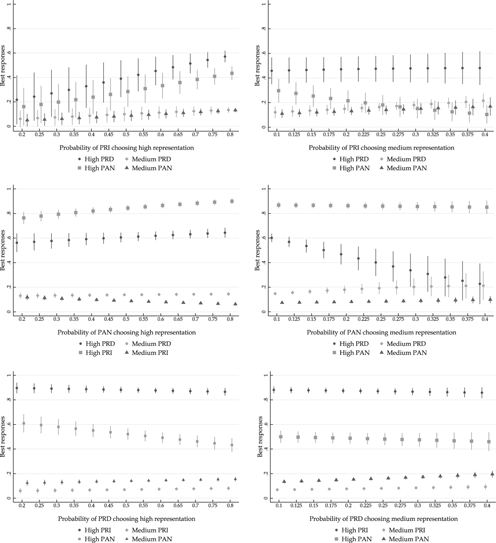
Although Vuong tests and Bayesian information criterion support the more parsimonious two-player model, there are some interesting findings when adding the PRD as a player.Footnote 46 Figure 6 presents the best responses of all parties. The results indicate that the PRD’s main competitors do not seem to fear the PRD choosing full representation, as they either do not react to increases in the probability of the PRD filling all polling stations (the PRI) or actually decrease their own representation levels as a response (the PAN). Moreover, the PRD seems aware of the disadvantages of not having a presence in precincts where both of its rivals are and tries to reach representation levels that match, but not exceed, that of its rivals. These patterns coincide with the image of the PRD as a party who battles two richer challengers that are known to engage in more irregularities. Interestingly, the only party for which simultaneously both of its rivals increase medium and high representation reacting to its higher probability of full coverage is the PRI. This again supports the qualitative accounts that place the PRI as the party that is expected to engage in more irregularities.
Best Responses to Expected Rival’s Representation (Three Player Game)

CONCLUSION
This paper presents an empirical study of how parties competitively allocate resources seeking to offset actions against their interest taken by their rivals. Our empirical approach deviates from work on electoral manipulation that gives a passive role to the parties that are victims of irregularities and it accounts for the inherently strategic considerations in these environments. We focus on the levels of monitoring chosen by parties carried out by their polling station representatives. We find that although parties would like to have representation regardless of their rivals’ choices, they have to be more selective, choosing to fully cover a precinct when a rival that is known to cheat chooses full representation as well.
Methodologically, the estimation of the formal model allows us to take into account the costs of representation when characterizing its strategic drivers in the absence of accurate and disaggregated campaign-costs data. A simpler analysis based on estimates of vote shares linear models would predict parties choosing high representation levels regardless of their opponents’ actions. This simpler electoral outcomes analysis gives us a description of how parties would react in the absence of budget constraints, which helps interpret the results of the augmented model. It also allows us to see the importance of representatives on electoral results and it presents evidence of how representatives affect vote shares and counteract rivals representatives’ actions.
In the electoral outcomes analysis, we find that precincts with representatives have higher votes shares for their parties, lower ones for their opponents, higher turnout, and lower null vote shares. We also see a weaker positive association between poll-workers from the line of voters and null shares when representatives are present, and that the probability of observing a recount in a precinct is lower when PRI representatives are present. These patterns are consistent with qualitative accounts of representatives enforcing turnout buying and preventing tampering with ballots by partisan poll-workers.
The fact that parties tend to follow their rivals’ expected representation choices rather than avoiding the rival’s monitors, however, indicates that the main role of representatives is to protect the interest of their parties and not to engage in actions that can more easily be carried out in the absence of competitors’ representatives. It also implies that there is a tendency toward having fewer polling stations where only one major party is represented. This can facilitate the job of independent monitors, who can concentrate their efforts in the polling stations where only one party is present.
The paper also highlights some difficulties when it comes to the design of electoral administration rules. While reading the names of voters who approach a polling station out loud inhibits multiple voting, it facilitates the control of voting behavior as carried out by party representatives in Mexico. Similarly, allowing voters from the line to serve as poll-workers guarantees the continuation of the electoral process when official poll-workers are not present at the polls, but it opens the door to party agents to be directly in charge of the vote count. More work should be done to assess whether the costs of parties exploiting these rules to their advantage outweigh the benefits sought with their initial application.
SUPPLEMENTARY MATERIAL
To view supplementary material for this article, please visit https://doi.org/10.1017/S0003055419000108.
Replication materials can be found on Dataverse at: https://doi.org/10.7910/DVN/D7ZXZI.







Comments
No Comments have been published for this article.