Introduction: Reinterpreting the History of Turkey's Industrial Relations from a Historical-institutionalist Perspective
The 1960s, the beginning of which witnessed a full-scale military coup in Turkey, set the stage for some remarkable transformations in the political, economic, and social arenas, which resulted in significant advancements in the field of industrial relations. Politically, the country adopted a new constitution, which delivered a more pluralistic and liberal democracy, thus granting workers a series of collective labor rights and freedoms, including the right to strike. This, for the first time in the Republic's history, placed labor on an equal footing vis-à-vis the state and employers. Economically the country was involved in import substitution industrialization, which required increasing labor numbers in the factories. In parallel, socially Turkey witnessed a rapid phase of urbanization accompanied by an on-going process of proletarianization, unprecedented in its history. All these nearly simultaneous changes facilitated the ascendance of workers to the politico-economic domain as a powerful interest group in Turkey and introduced a greater dynamism to the country's industrial relations.Footnote 1
According to a widely held consensus amongst scholars of Turkish industrial relations,Footnote 2 the initial years of the 1960s represent, in historical institutionalist terms, a critical juncture that marked the beginning of a new era in the history of Turkey's industrial relations, during which labor redefined its class-based interests and maneuvered to strengthen its position vis-à-vis capital and the state. However, historical evidence suggests that progress achieved in this era has its roots in the pre-1960 period, especially during the two decades preceding the 1960s. The early post-World War Two era, which is widely referred to as the multi-party periodFootnote 3 in Turkish political literature, witnessed the lawmakers’ adoption of the Trade Unions Act No. 5018 in 1947, which regulated the establishment of trade unions in Turkey for the first time in its Republican history. Following this, trade unions emerged as representatives of the worker in work-related matters, exercised the legal rights granted to them, and pursued national-level interests of the working-class, all of which helped them establish their presence in the country's politico-economic domain and gain valuable experience in the class struggle.Footnote 4
Despite the multi-party period having set the stage for the trade unions’ emergence as actors in Turkish industrial relations, until the early 2000s, most studies on Turkey's labor-capital relations ignored the importance of this period in explaining the post-1960 industrial relations landscape.Footnote 5 Hakan Koçak also emphasized that most of the early research conducted on the history of Turkey's labor movement overemphasized trade unions’ actions in the political and economic sphere from the early 1960s onwards, following the country's transition to a more pluralist democratic order.Footnote 6 Indeed, by giving prominence to the post-1960 years, this body of literature overlooked the workers and their trade unions’ untiring perseverance for recognition of the right to strike from the mid-1950s onwards and their role in institutional development, continuity, and change in the history of Turkey's industrial relations. For instance, according to Cahit Talas et al., “the 1960 military coup represents a milestone in Turkish trade unionism. It would not be an exaggeration to argue that trade unionism started in a real sense in this period.”Footnote 7 Similarly, for Şehmus Güzel, during the years preceding 1960, “trade unions were only involved in social assistance activities and they left out economic and political … activities.”Footnote 8 In a similar manner, Gülten Kutal stated that: “Turkish trade unionism could not display the expected development in the 1950–1960 period, it could not go beyond a trade unionism that was limited in rights, extremely weak in finances, open to pressures coming from the political power and lacked any character.”Footnote 9
One important consequence of this historical fallacy has been the wide acceptance of the idea that the collective rights and freedoms the working-class enjoyed in the post-1960 period were granted without their having to fight for them.Footnote 10 For example, Toker Dereli argued that the pro-labor philosophy of the 1961 constitution was the result of the coalition established between the intelligentsia and the bureaucracy during the 1960 coup.Footnote 11 Günseli Berik and Cihan Bilginsoy purported that the post-1960 gains for labor were the mere outcomes of political, economic, and legal changes that were effected in that period independent of any struggle waged by the working-class.Footnote 12 In a similar manner, Çağlar Keyder, asserted that: “Neither through increasing wage demands nor as a political force was organized labor active during the 1960 transformation … The right to unionization, collective bargaining and strikes, obtained by the workers … [was] handed out to workers in accordance with the requirements of the new model of accumulation.”Footnote 13
However, a body of recent research has undertaken the mission of enriching our knowledge and understanding of Turkey's labor history. Indeed, the turn of the twenty-first century witnessed, as Mehmet Ö. Alkan and Y. Doğan Çetinkaya aptly put it, “a spring in the studies on the history of Turkish working class.”Footnote 14 This blooming academic interest in the labor history of Turkey encouraged many young historians to utilize previously unused or understudied archival records and reinterpret the working-class history of modern Turkey in the years preceding the post-1960 era, by approaching it from the bottom up. For example, in one of her 2014 articles, Görkem Akgöz provided a detailed review on the role of the utilization of nationalist and anti-communist discourses by the ruling cadres and workers in the discursive formation of the working class during the early years of the multi-party period.Footnote 15 In his highly controversial research, Yiğit Akın challenged the mainstream literature's assumptions on the formation of the working class and their living and working conditions during the early years of the Turkish republic.Footnote 16 In his Ph.D. thesis, where he scrutinized the non-institutional and informal patterns of peasant and working class politics during the early years of the Turkish republic, Murat Metinsoy depicted the discontent, struggle, and coping mechanisms of workers against their poor living and working conditions.Footnote 17 Likewise, in a recent article, Barış Alp Özden investigated the experiences of workers in small-scale textile workplaces in the Mahmutpaşa district of Istanbul, and portrayed their collective responses against inhumane working conditions.Footnote 18
This body of research provides a vivid account of how workers appeared as the subject of history rather than being a mere object in the hands of the privileged classes. It also enriches our understanding of the way workers, either individually or in small groups, experienced, interpreted, and coped with unfairness in their working conditions, utilized the language in matters concerning labor rights, and constructed their identities, according to the priorities and values of Turkish society. However, this strand of literature helps us little, if at all, in seeing the bigger picture, depicting how these individualized images from the past complement each other and constructing a compelling narrative of the position of the working-class as an actor in industrial relations at a national level and its role in institutional development, change, and continuity. In other words, the bottom-up approach to the working-class history of the early post-Second World War period has a narrow focus that cannot capture the wider landscape of industrial relations, whereby the interests of individuals and small groups of workers were translated into national level interests and the collective power of labor pushed towards a transformation in the institutions of industrial relations.
Therefore, we contend that piecing together this scholarly jigsaw puzzle of Turkey's industrial relations history requires an institutional approach to the topic. Nevertheless, it appears that the abovementioned spring in the bottom-up historical accounts of Turkey's working class is yet to arrive at an institutional approach on its industrial relations history. One important reason for this lies in the fact that there is a decreasing interest in industrial relations research in Turkey.Footnote 19 However, more importantly, there appears to be a dominant argument in the recent research on the labor history of the Ottoman Empire and modern Turkey, which emphasizes the merits of a bottom-up approach for this topic.Footnote 20 In its enthusiasm to consider “workers as agents in their own right and not pliable and hapless tools of the state,”Footnote 21 this prevailing view degrades the institutionalist approaches to labor history to a study of collective movementsFootnote 22 and an elitist intellectual pursuit.Footnote 23 In doing so, this dominant discourse almost completely ignores the utility of an institutionalist methodology in understanding the role of trade unions in the early post-war era in steering the institutions of industrial relations towards a change in favor of workers’ rights and freedoms.
Despite the constant criticism of the proponents of the bottom-up approach to Turkish labor history, available research reveals that there is only a scant number of detailed studies on Turkey's industrial relations history from an institutional level that have focused on the period preceding the post-1960 era. This body of research was pioneered by Kemal Sülker's detailed accounts of the period, among which are his two comprehensive works, one on the history of trade unionsFootnote 24 and the other on the right to strikeFootnote 25 in Turkey, and represent early scholarly efforts to shed light on the role of interests and power relations between the state and trade unions in the institutionalization of industrial relations in early post-World War Two Turkey. Sülker witnessed the era firsthand, and for these two works, he drew upon his own notes from the period as well as making use of various journals of trade unions and newspapers published during the multi-party years. Ahmet Makal's meticulous studies on the history of Turkish industrial relations in the era preceding the 1960s, similarly draw on a wide range of historical evidence to provide a vivid account of the interests and interactions between state and labor at the national level during these years.Footnote 26 Likewise, Aziz Çelik's study, for which he investigated the Turkish labor movement by making use of various archival records, delivers to his audience a clear and critical understanding of the way the power relations between trade unions and ruling circles were shaped in the context of the prevailing political ideology in Turkey during the years of the early post-war period.Footnote 27
However, studies scrutinizing modern Turkey's industrial relations in the pre-1960 era at a national institutional level are not limited to those above.Footnote 28 Moreover, their findings support the minority opinion in scholarly literature that the gains of the working-class in the post-1960 period need to be interpreted by considering labor's perseverance for the right to strike in the pre-1960 period together with the socioeconomic and political circumstances of that era.Footnote 29 This argument markedly contrasts with the abovementioned perceived wisdom that the collective rights and freedoms the working-class enjoyed in the post-1960 period were granted without their having to fight for them. For example, according to Koçak, indoor meetings and congresses, lobbying activities, and the de facto strikes that trade unions organized in the period constituted Turkish trade unions’ repertoires of collective action,Footnote 30 by means of which they brought forward the necessity of recognition of the right to strike to the agenda. These actions, as he purported, when interpreted within the social and political circumstances of the period, indicate that trade unions in Turkey were actively engaged in a class struggle in favor of the right to strike in the pre-1960 era.Footnote 31 Nevertheless, despite the existence of such opinions, there is still much to be done regarding how to construe the history of industrial relations in the pre-1960 period in a way that brings to the fore the role of trade unions in institutional development and change. Consequently, this study contributes to the ongoing efforts at better understanding this topic.
This investigation involves considering the industrial relations history of the early Republican period spanning from the birth of the modern Turkish republic in 1923 until the year 1960 by taking into account the socioeconomic and legal-political environment during these years. It provides insights regarding the role of the interests of trade unions and the state over the recognition of the right to strike in the institutional development of Turkey's industrial relations, by placing the topic under the optic of historical-institutionalism.Footnote 32 However, the focus of the work rests more on the post-World War Two years given that during this era, Turkey moved to a multi-party democratic political order that allowed freedom of association, thus paving the way for establishment of various trade unions across the country.Footnote 33
The contributions of this study are threefold. First, by drawing on parliamentary proceedings, newspapers, and trade union publications of the period, it adds to the continuing efforts towards providing a critical account of the trade unions’ emergence as an actor of industrial relations in the pre-1960 period. Specifically, it enriches the understanding of the early efforts of trade unions in representing the Turkish working-class at a national level. Second, in its explanation of the narrative regarding the industrial relations of the period, this study stands out from similar research in that it employs a historical-institutionalist approach, with its primary focus being the interests of the ruling cliques and trade unions over the issue of recognition of the right to strike. Therefore, by placing the state and workers against the background of the socioeconomic and legal-political circumstances of the period, this study investigates the role of the ideas and interests of the ruling circles and trade unions in relation to institutional continuity, development, and change. In doing so, the content in this paper is an exercise that, to the best of our knowledge, has previously received scant attention.Footnote 34 Third, by placing the state and trade unions in time and in a broader socio-economic and legal-political context, this study provides a causal explanation for the institutional change in Turkey's industrial relations during the early 1960s. To achieve this, contrary to the mainstream opinion that considers the 1960s the first critical juncture for Turkey's industrial relations history, it is argued that the initial critical juncture occurred in 1947, when the ruling cliques permitted the establishment of trade unions. This newly gained right, albeit having come with the maintenance of the illegal status of strike action, provided Turkish labor with a suitable environment to organize around class-based interests and to campaign for the right to strike. Hence, in positioning Turkey's industrial relations history in between two critical junctures, this paper provides a historical narrative of the way incremental steps constructed transformative outcomes,Footnote 35 and in doing so, it challenges the conventional wisdom that Turkish trade unions became an independent actor of industrial relations with class-based interests only after the 1961 constitutional reform.
This paper, in presenting labor as a collective actor and examining the state-labor relations during early the years of Republican Turkey in a national-institutional setting, acknowledges the peculiarity that a top down/institutional methodological preference entails. Indeed, its sole emphasis is on the ideas and interests of labor and the state at the national-institutional level. In performing such institutional research, trade unions are taken as the unit of analysis and the ways their leaders represented the national interests as well as how they voiced the wider concerns of the working class vis-à-vis the nationwide political interests of the state are investigated. As such, this study neither gives agency or voice to the individual worker, nor does it scrutinize the interest representation at the workplace level. We, however, identify this particularity as a necessary characteristic of research employing the institutional approach to history rather than a limitation.
The paper is structured in two sections. In both sections, we place the state, workers, and trade unions against the background of socioeconomic and legal-political circumstances of the periods under consideration. In the first section, we analyze the institutional history of Turkey's industrial relations from its establishment in 1923 until its transition to a multi-party political system in 1945. In the second section, we investigate the institutionalization of industrial relations during Turkey's multi-party period which lasted from 1945 to 1960. We conclude by challenging the perceived wisdom that Turkish trade unions became an independent actor of industrial relations with class-based interests only after the 1961 constitutional reform.
I. The Early Efforts Towards Institutionalization of Modern Turkey's Industrial Relations: The Single-party Period (1923–1945)
The Republic of Turkey was established on 29 October 1923 under the leadership of Mustafa Kemal Atatürk, in the aftermath of the Turkish independence struggle of 1919–1923, which followed the defeat and break-up of the Ottoman Empire during World War One. The country, from its establishment until 1946, was ruled by an authoritarian and paternalist single party, the Republican People's Party (Cumhuriyet Halk Partisi, hereafter, CHP), the politics and ideology of which shaped the early Republican period's politico-economic and socio-cultural structure to a considerable extent.Footnote 36
Starting from the early years of the Turkish republic, Atatürk and his friends steered the country's economic policy towards a capitalist economic industrialization. However, despite their dedicated efforts at creating an industrialized economy within a framework of capitalist rationality, the political leaders of the young republic did not accept the growth of a proletarian class in this process. That is, in the Kemalist view, labor needed to wait their turn in the process of forging a robust national capitalist economy, for, according to Atatürk himself, “there could be no working class without a developed industry.”Footnote 37
In fact, Atatürk and his ruling cadres, drawing on the experiences of already industrialized countries, took for granted that the capitalist industrialization process would bring class awareness, antagonism, and ideological conflict, which would seriously challenge the recently established Republican regime and its fragile capitalist economic order. In Asim Karaömerlioğlu's words, “They feared the formation of a dynamic, organized society, and the growth of working class political activity, all of which could threaten the ruling circles’ monopoly of political power.”Footnote 38 Many even carried the idea so far as to believe that any advance in working class awareness would immediately give way to a potential communist revolution. As Niyazi Berkes puts it, “While on the one hand, industrialization was desired, on the other hand, a fear towards workers and a hostility against labor was evoked as if Turkey had been completely proletarianized and the country was about to give way to a proletariat revolution.”Footnote 39 In this regard, it is worth noting a warning by Halil Menteşe, a large landowner and a member of parliament, during one of the parliamentary debates in 1935, when he stated that:
“… our country is industrializing … a few years later from now, we will have factories that will bring thousands of workers together. For this reason, if we realize the truth [and] take measures beforehand, we will save the country from the influences of international movements … Even today, the workers of our country have started to be harmed by communism.”Footnote 40
In consonance with the interests of the ruling circles, the socioeconomic organization of the Turkish society was not conducive to producing dispossessed masses who would subsequently become waged workers and threaten to start a conflict with the process of capitalist industrialization. Therefore, in the single-party period, Turkish labor remained under the tutelage and watchful eyes of the ruling cadres, who worked with a single-minded devotion to prevent the development of working class awareness among industrial workers. These issues are scrutinized next.
I.1 Labor, Industry, and Industrial Relations in the Single-party Period
Scholars studying the social history of early Republican Turkey depict labor in the single-party period as large masses of peasants who had very little in common with a capitalist economic system. According to these accounts they were self-sufficient,Footnote 41 the overwhelming majority of them had secure access to small or medium sized family lands,Footnote 42 and cultivated mostly by employing family labor, using primitive methods.Footnote 43 Specifically, agriculture featured in the lives of nearly all Turkish people, employing up to ninety percent of the population.Footnote 44 Consequently, the organization of society was largely based around agrarian needs, leaving almost no room for proletarianization in the industrial sector during this period.Footnote 45
Industrialization in the single-party period, on the other hand, was in its infancy and its progress remained slow. This situation occurred despite the implementation of an ambitious state-led industrial development strategy throughout the 1930s,Footnote 46 through which the ruling cadres directed most of the state's resources towards launching an industrialization movement for catching up with the capitalist industrial economies.Footnote 47 These economic policies, however, did not have a major impact on the number of employed people in the industry sector, the numbers increasing marginally from 265,341 in 1937 to 275,083 in 1943.Footnote 48 Moreover, industry's contribution to the gross national product remained substantially lower than that of agriculture throughout the period.Footnote 49
Although most of the country's population was composed of peasants and industrial development was slow, the Kemalist cadres deemed the working class a crucial group to be taken care of in the process of industrialization. In fact, workers were considered an essential component of their national development project. “The Turkish worker,” as stated by the then General Secretary of the CHP Recep Peker, “is not a destroyer, or a troublemaker but a complementary element of the profound national artwork which has just started to be built.”Footnote 50 Similarly, Halil Menteşe, a CHP deputy, in one of his addresses to the parliament stated:
The labor problem today has become one of the most important problems for all the states of the world. I emphasize this because it should teach us a lesson… Working classes started tyrannizing and causing trouble to the states. For us not to get to this point, because … working masses [in our country] are increasing in leaps and bounds each year… I would like to bring forward this lesson from history. The working classes’ acquisition of their rights by force undermines the state's existence.Footnote 51
Against this background of dominant ideas and discourses, it should come as no surprise that, beginning from the establishment of the republic, the ruling cadres of the young country were hostile towards all class-based organizations and activities representative of class interests. The first step in the crackdown on their operations was the enactment of the Law for the Maintenance of Order (Takriri Sükûn Kanunu) in 1925, which, despite having been initially supported by the Worker's Advancement SocietyFootnote 52 (Amele Teali Cemiyeti) and the Turkish Communist Party (Türkiye Komünist Partisi), brought a bitter end to both very soon afterwards.Footnote 53
Following from this, borrowing from the penal code of Mussolini's Italy,Footnote 54 the ruling cadres made various amendments to their own in the year 1936. Among the most conspicuous actions against the working class were the introduction of prison sentences for those who caused work stoppages with the aim of making changes to wage levels and the prohibition of “pernicious propaganda” aimed at the infringement of society's economic and social order.Footnote 55 However, these were not all, for having been inspired by Italy's fascist-corporatist labor regulation,Footnote 56 the lawmakers passed the first Turkish Labor Code Law No. 3008 in 1936, which made no mention of trade unions or employers’ associations, prohibited strikes and lockouts, and imposed penalties should they occur.Footnote 57 This law only covered the manual workers at industrial establishments and regulated those workplaces that required, due to their qualifications, the employment of ten or more workers on a daily basis.Footnote 58 By promulgating this law, the lawmakers, on the one hand, ensured that labor relations in larger industrial establishments were brought under the state's control, while on the other, they were poised to shape the actions of the Turkish working class in the decades to come. In fact, as the then General Secretary of the CHP Recep Peker, in his speech during the parliamentary discussion of this law, aptly put it, the new labor law was designed to place the world of work in Turkey on “the path of harmony and consensus which is projected by the new Turkish regime”Footnote 59 and was projected to “wipe away all the clouds that would allow room for the emergence and development of class consciousness.”Footnote 60 Much in a complementary way, not long after the adoption of this law, in 1938, the lawmakers introduced the Law on Associations (Cemiyetler Kanunu) through which they totally banned the establishment of any class-named and class-based organizations, while at the same time prohibiting the engagement of any association in political activities.Footnote 61
All these laws and regulations blocked labor from having its interests represented and those who wanted to organize had to work with the banned Turkish Communist Party through underground activities,Footnote 62 or become involved in accepted social assistance and mutual aid organizations.Footnote 63 Consequently, it should come as no surprise that the policy and practices implemented in the domain of industrial relations, when combined with the impacts of socioeconomic circumstances surrounding the workforce, prevented the emergence of trade unions that were capable of independently defining and defending labor's class-based interests during the single-party period.Footnote 64 However, the situation was about to change as the country entered a new period in the aftermath of World War Two.
II. The Multi-party Period (1945–1960): A Series of Remarkable Transformations
Turkey's single-party period ended with the conclusion of World War Two. The post-war period, with its overwhelming defeat of fascism and the emergence of the superpowers, witnessed major transformations in many countries. Turkey was no exception, for its political, social, and economic structures underwent a gradual renewal. Politically, right after the end of the war, the country chose the path of multi-party electoral politics, with the president, İsmet İnönü, granting permission for the establishment of opposing political parties. Economically, the nation's focus on fast-track industrialization shifted from state-led industrial development to private sector-driven development, and Turkey witnessed a steady growth in industrial production, the value of which almost tripled from 1948 to 1960.Footnote 65 Socially, a substantial outmigration from rural to industrialized urban areas took place. However, all these changes were distinct to the country.
Indeed, on the political front, despite Turkey's transition to a multi-party political system, with the existence of different political parties throughout the period, two competed for and held political power: the already present CHP and the newly founded Democratic Party (Demokrat Parti, hereafter, DP). Moreover, these two parties, regardless of their fierce rivalry, shared similar principles and values around political issues.Footnote 66 Thus, the country's new political system, while marking a new era in political life, remained short of bringing competing philosophies and practices into politics.Footnote 67 On the economic front, the ruling cadres’ strenuous efforts directed towards industrialization started to bear fruit, and the number of large industrial establishments substantially increased during the period.Footnote 68 In this process of industrial leap, in addition to the private sector receiving a great deal of input from the ruling cadres, the state sector grew parallel to it, with the latter receiving a considerable proportion of the new investment in industry.Footnote 69 This period also witnessed an increased emphasis on specialization in agriculture and rapid mechanization,Footnote 70 as a result of which its total production exceeded that of the industrial sector.Footnote 71 Finally, on the social front, despite the aforementioned migration combined with the increasing industrialization process bringing with it a progressive increase in the number of workers in large industrial establishments, the proletarianization process of migrant workers proceeded at a snail's pace, the reasons for which are investigated below.
II.1 Workers and Trade Unions in the Multi-party Period: Industrial Relations at the Crossroads
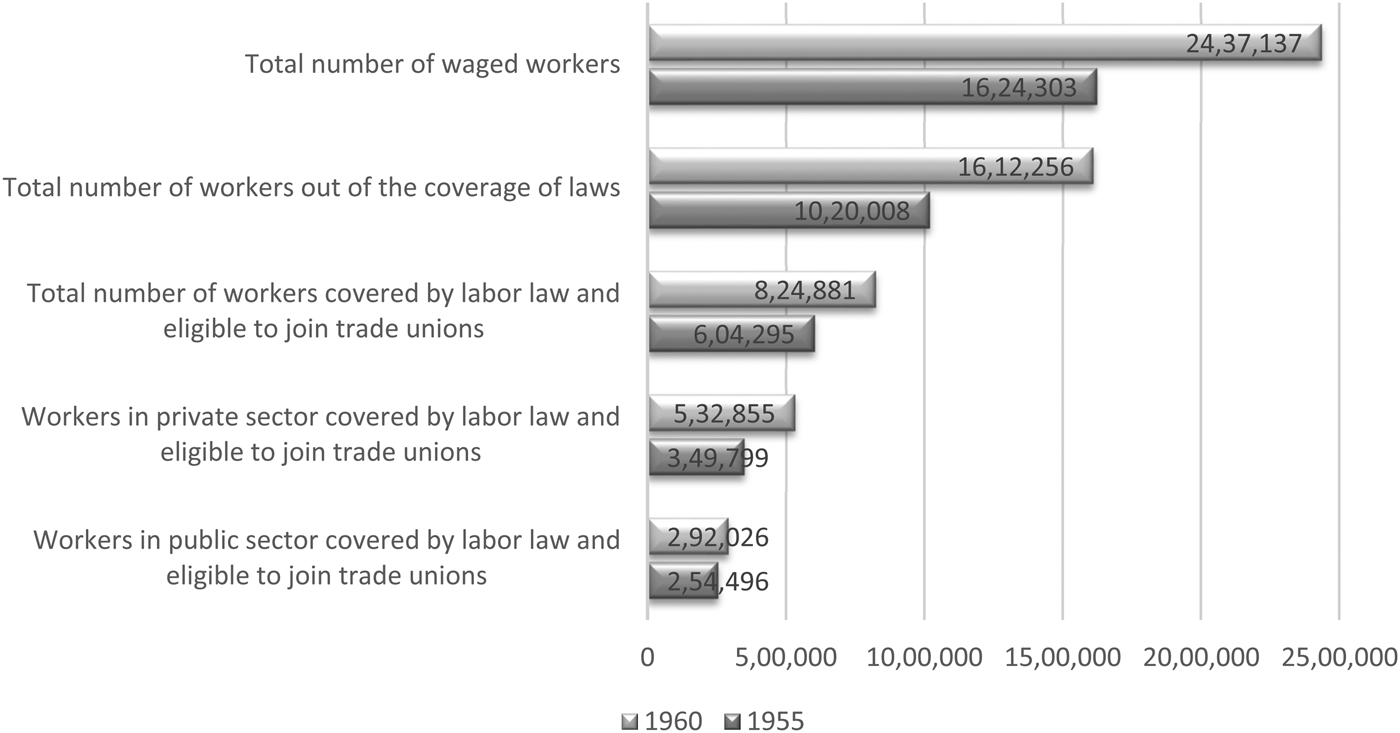
Migration to urban areas from rural districts increasingly turned into a more attractive option for some rural households throughout the multi-party period. This process was facilitated by expanding economic opportunities in urban areasFootnote 72 and improving transportation facilities throughout the country,Footnote 73 which guaranteed a much-needed source of labor supply for the developing urban economy. Despite the statistical data gathered in this period being pitifully inadequate, some information summarizing the changes in the labor markets during the multi-party period are shown in Figure 1.
A statistical overview of labor markets in the multi-party period. Source: Calculated from Makal, Türkiye'de Çok Partili Dönemde, 155 and 165.

As per Figure 1, the total number of waged workers rose from 1,624,303 to 2,437,137, displaying a fifty percent increase from 1955 to 1960. However, a breakdown of this increase between the number of workers covered by labor law and thus eligible to join trade unions and those who lacked any legal protection, reveals that most came from the latter cohort. Specifically, throughout the period, while the total number of workers remaining outside any legal protection at work grew by fifty-eight percent and rose from 1,020,008 to 1,612,256, those who could benefit from available labor protection grew by only thirty-six percent, going up from 604,295 to 824,881. This sluggish increase in the latter group also suggests that the number of jobs created in larger industrial establishments lagged far behind smaller ones in the services sector and the informal sector, all of which fell outside the scope of the labor law. Figure 1 also indicates that the increase in the number of workers who could benefit from the available labor protection was mostly a result of employment growth achieved in the private sector. Indeed, according to this figure, during the period in question, while the number of workers employed in private establishments grew by fifty-two percent from 349,799 to 532,855, public sector employment experienced a more modest fifteen percent growth from 254,496 to 292,026.Footnote 74 Such a difference between the growth rates in public and private sector employment is important to highlight, since throughout the period, the majority of unionized workers were employed by state-led industrial establishments, where the conditions and prospects of unionization were less challenging compared to the private sector.Footnote 75
In consonance with this lopsided growth in urban employment, the post-war migration was not conducive of a proletarianization that would lead to the rapid establishment of a modern working class with ideologies and interests fundamentally set apart from those of the capital and the state. Three important reasons explain this situation. First, although the multi-party period marked a turning point in the history of Turkish labor, its socioeconomic structure displayed hardly any difference from that of the single-party period. Throughout this period, more than eighty percent of the total labor force continued to engage in agricultural work,Footnote 76 which became possible due to the new job opportunities that emerged in rural areas, following the aforementioned spread of mechanization in agricultureFootnote 77 and the survival strategiesFootnote 78 the peasant families came up with to remain in their villages.Footnote 79 Second, many of those who migrated to cities in pursuit of urban jobs had to remain outside the industrial sector, the primary reason being that industrial jobs created in the period lagged behind the numbers available for the urban workforce.Footnote 80 As previously mentioned, the increase in the total number of waged workers came mostly from those outside the coverage of legal protection. Therefore, most of these new urbanites were left with no option but to engage in low-income, low-productivity, and socioeconomically insecure activities related to the urban informal service sector, such as street vending, petty trade, and portage, commonly known as marginal jobs.Footnote 81 Even those who could secure a job in the formal industrial sector were new arrivals from rural areas with little or no sense of class-consciousness.Footnote 82 They were, according to a report published by the International Labor Office in 1950, unable to “easily be transformed into a factory worker possessing the outlook, the ambitions, the skill, the persistence and the occupational conscience that should characterize industrial workers in a technological society.”Footnote 83
However, from the above, it should not be interpreted that the workers did not show any interest towards their fundamental rights and the freedom to engage in collective action, since the multi-party period witnessed labor's gradual discovery of its own power. Underpinning this, in the first place was the lawmakers’ lifting of the abovementioned ban on the establishment of associations on class-based interests in 1946, which provided Turkish labor with a liberal environment for establishing and joining trade unions, as well as for fostering relationships with political parties. Indeed, following the removal of this ban, which prohibited workers from raising their voices on matters of work and employment after its introduction in 1938,Footnote 84 many trade unions were established. These organizations, what is more, forged close relationships with the Turkish Socialist Party (Türkiye Sosyalist Partisi) and with the Turkish Socialist Workers’ and Peasants’ Party (Türkiye Sosyalist Emekçi ve Köylü Partisi). This period of freedom, which is commonly referred to as “1946 trade unionism” in Turkish industrial relations literature, however, only lasted for six months, as the political activities of the aforementioned parties together with those unions associated with them were suspended indefinitely by the CHP government on 16 December 1946.Footnote 85
The steps taken in the domain of industrial relations during this period were continued with the lawmakers’ enactment of the Trade Unions Act No. 5018Footnote 86 in 1947, which regulated the establishment of trade unions and allowed them to conclude collective agreements that were binding for their members. In this paper, it is argued that the adoption of this law represents the first critical juncture in the history of Turkey's industrial relations, since, as further explained below, trade unions emerged as the representatives of workers in work-related matters, exercised the legal rights granted to them, and pursued national level interests of the working class. All these helped the trade unions establish their presence in the country's politico-economic domain and gradually steer industrial relations towards the second critical juncture that followed the promulgation of the 1961 constitution.
However, some provisions of this regulation significantly limited the influence of trade unions in the politico-economic domain. Most importantly, having been prepared with the main motive of provision of “benefit and security to the country,”Footnote 87 as the then Minister of Labor Sadi Irmak stated in one of his parliamentary speeches, one underpinning goal of this law was to prevent the penetration of socialist movements into the trade unions. This was exercised through the prohibition of any type of political activities by the trade unions. Furthermore, the lawmakers maintained the illegal status of strike action and lockout practices already set out in the abovementioned Labor Law No. 3008 enacted in 1936, and placed even heavier sanctions by stipulating closure for those unions supporting such actions.Footnote 88 Moreover, it was not only the Trade Unions Act that diminished the politico-economic influence of trade union activities, for the ruling cadres made various amendments to the Turkish penal code, particularly increasing prison sentences for so-called dangerous associational activities, in the same way as their predecessors did.Footnote 89
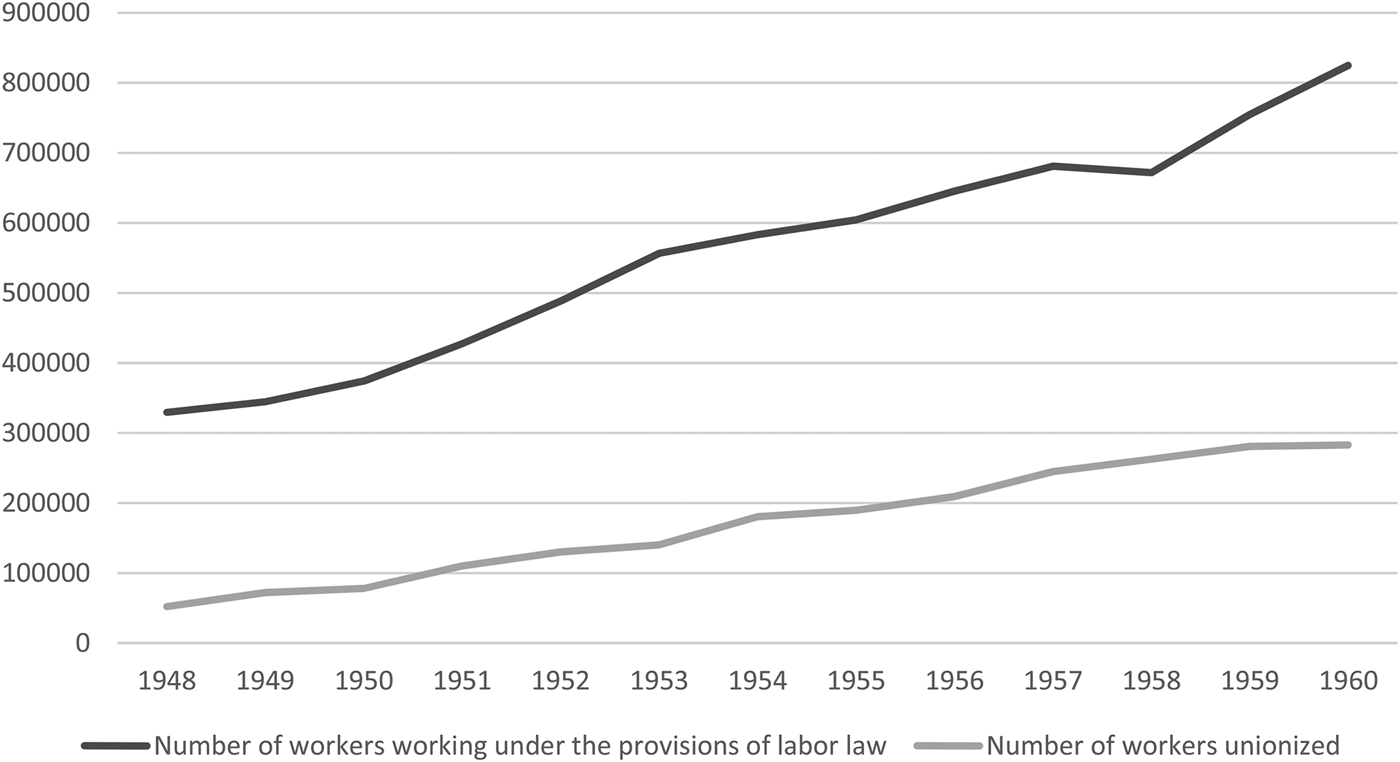
Regardless of the drawbacks of the new institutional framework of industrial relations, this newly found freedom for workers, as per Figure 2 above, paved the way for a gradual increase in trade union membership. However, organization of workers around trade unions, while first appearing to be a progressive move toward their empowerment, was not without shortcomings. First, workers’ efforts directed toward unionization were constantly subjected to the guidance and supervision of the DP and the CHP, despite the lawmakers’ prohibition on trade union engagement in political activities. In fact, in practice, this limitation was only applied to relationships between the workers’ organizations and left-leaning parties during the period,Footnote 90 since the ruling cadres could excuse themselves from being subjected to it.Footnote 91 As one of the internal reports prepared for the CHP on trade unions pointed out, “The law bans the trade unions from any engagement in political activities. This is what the law implies nominally and there is no such thing, neither in our country nor abroad, as an independent union which is free from any political influences.”Footnote 92
Trade union membership in the multi-party period. Source: Makal, Türkiye’de Çok Partili Dönemde, 276.

Second, as briefly mentioned above, for most of the period, the majority of workers exhibited a low level of working class consciousness, as many of them were migrants from rural areas, poorly educated, and even illiterate.Footnote 93 “Many workers in this period did not see waged employment as an occupation” asserted Halil Tunç, a former chairman of the Confederation of Turkish Labor Unions (Türkiye İşçi Sendikaları Konfederasyonu), when portraying his memories of the multi-party period. For him, “Working class awareness was not developed; they [workers] had one foot in their villages.”Footnote 94 In a similar manner, in his account regarding the early post-World War Two years, Recai Emre, a former vice-chairman of the Turkish Union of Road, Building and Construction Workers (Türkiye Yol, Yapı, İnşaat İşçileri Federasyonu), stated that: “Workers … were also working on their lands. This was one of the reasons for their low levels of working class awareness.”Footnote 95
Third, numerous workers hesitated to seek trade union membership as they either worried about losing their jobs or being flagged as communists. When recalling the past, Halit Mısırlıoğlu, a former chairman of the abovementioned Turkish Union of Road, Building and Construction Workers, said “No one signed up for the unions in the early days … People considered unions as communist dens.”Footnote 96 In a similar fashion, Hikmet Alcan, a former chairman of the Union of Workers of the Sugar Industry (Türkiye Şeker İşçileri Sendikası) remarked that “During the 1950s and 1960s, people's opinions about the unions were not very positive. People considered unions somewhat political.”Footnote 97
The precarious position of workers in urban labor markets and the aforementioned shortcomings that members of trade unions suffered from during the period inevitably exerted a significant impact on the formulation and representation of workers’ interests over their collective rights and freedoms at national level. The interests of the ruling cadres and the organized labor over this issue are scrutinized next.
II.2 Institutional Continuity, Development and Change: The Debates Over Recognition of the Right to Strike in the Multi-party Period
Archival resources, when critically reviewed, reveal that the ruling cadres, regardless of which political party's administration was in power, demonstrated a single-minded determination to maintain the ban on the right to strike during the multi-party period. To reflect their position, they either claimed that strike action would impair capitalist industrialization or argued that trade unions were not strong enough to protect the workers against the financial damages of the strike. One speech by CHP deputy Hulusi Oral, delivered in a parliamentary meeting on 20 February 1947, that was held to discuss the draft Trade Unions Act during the incumbency of his party, provides a straightforward example of the general view of the ruling cadres regarding the association of the right to strike with capitalist industrialization:
“Is a strike a right or coercion, an oppression to claim someone's rights? … This, directly from the viewpoint of public interest … as much as being against the [interests of] public economic enterprises, consistently damages the existing circumstances of individuals, of the capitalists whom we call employers [and] poses dangers to such a degree that it undermines all their [capitalist's] interests together with the public interest.”Footnote 98
On the other hand, an electoral speech from May 1950 by the CHP's chairperson İsmet İnönü, while his party was still in power, provides a notable example to the ruling circles’ justification of the ban on right to strike as a necessary precaution for workers’ protection. In his address to the public, İsmet İnönü asserted that:
Today our workers and their organizations are protected against the capital owners with the arbitration system. Lockout being the natural response to right to strike is the most efficacious method to oppress our workers in a few days who make their livings daily and who do not have any savings to resist … It is our duty to not permit exposure of our workers’ organizations to the miseries of lockouts.Footnote 99
In a similar manner, during the time CHP held the power, Tahsin Bekir Balta, the Minister of Labor, in a press conference organized on 2 March 1948 stated that:
Recognition of right to strike requires workers’ professional development [sic]. The issue of right to strike is not as easy as it is assumed to be. Before anything else, trade unions, which are established with the aim of engaging workers with employers and providing social assistance to workers, need to be strong and rich so as they can provide financial assistance to their workers in the future [during strike].Footnote 100
A careful overview of parliamentary proceedings reveals that little changed when the DP took power. An excerpt from a speech by one of the Ministers of Labor, Mümtaz Tarhan, offers a remarkable example on how the ruling parties, during their seizure of power, associated the ban on strikes with industrial development. In his address to the parliament on 28 February 1956, Tarhan, after asking, “Why did we not recognize the right to strike until now?” answered his question as follows:
First of all, we do not have a developed industry to organize strikes. Our industry has been a baby in a bundle. We could not have killed this industry with a dispute resolution mechanism, with the most extreme dispute resolution mechanism of all, like strikes, while it was still in its bundle.Footnote 101
The continuation of Mümtaz Tarhan's speech, on the other hand, provides a good example as to how the ruling circles resorted to the rhetoric on the vulnerability of workers and their organizations to strike actions in justification of the ban, regardless of the political party. According to Tarhan:
… the ground has not yet appeared which would necessitate granting of right to strike. Because financial circumstances of trade unions need to be sound to call a strike… On the other hand, workers need to be skilled. Without having skilled workforce … those coming from villages will replace the workers [on strike] and this will play into the hands of employers.Footnote 102
However, it is intriguing to see that, the spokespersons of the CHP and the DP fiercely defended the necessity of recognition for the right to strike when their parties were in opposition. When the DP was in opposition, Suphi Batur, as a Member of the Parliament, expressed the views of his party during the parliamentary debate on the draft Trade Unions Act held on 20 February 1947, as follows: “We are of the opinion that it is a democratic necessity to incorporate the right to strike into our regulations without allowing room for its exploitation.”Footnote 103 The words of İsmet İnönü, in his capacity as the CHP's leader, seem to offer another stark example of the political actors’ shifting discourses regarding the right to strike during their party's time in opposition. During the budgetary discussions in the Turkish parliament on 28 February 1956, İnönü pointed out that: “Finally we have been convinced [of the idea that] the right to strike can be and should be recognized in our country. This is not a political issue, this is … evolution of an opinion.”Footnote 104
Against this background of socioeconomic and legal-political conditions that surrounded Turkish trade unions and in the overwhelming presence of the interests pursued by the ruling cadres over the recognition of the right to strike, the development of ideas and interest representation on the part of labor over this right displayed peculiar characteristics during the multi-party period. That is, despite the ban on trade unions’ participation in politics, these organizations became involved in the ongoing heated arguments at the highest political level, between advocates and opponents of the recognition of the right to strike. Hence, they became party to the intense struggle over the claim to represent the true views of the majority on this issue. Moreover, especially in the early years of the multi-party period, trade unions’ views on the necessity and urgency of the recognition of this right varied considerably, according to the position adopted by the political party they were supervised by.
During the early years of the multi-party period, when the CHP was still in power, the Association of Trade Unions of Istanbul (İstanbul İşçi Sendikaları Birliği), for example, devoted strenuous efforts towards convincing workers of the unnecessary nature of strike actions. Regarding the association's adopted position against such action, its operation directly under the CHP's guidance and supervision, without doubt, was an influential factor.Footnote 105 In support of its stance on the matter of the right to strike, the association published many articles in its journal, Hürbilek. For instance, in Hürbilek’s seventy-fourth issue, the Minister of Labor Reşat Şemsettin Sirer's statement against strike action appeared on the first page with a note that his speech was well-received by the workers. In the same article, Hürbilek further proclaimed that in hundreds of demonstrations organized by various trade unions the number of workers who stood in favor of strikes remained limited, with only a few expressing this view.Footnote 106 Similarly, during the heat of its anti-strike campaign, Hürbilek, in its seventy-fifth issue, referred to the words of Naci Bilgin, a former trade unionist as follows:
What? Strike? There is nothing more unreasonable than asking for a strike in our day. I regard those people asking for such a thing as the workers’ enemy. Neither today, nor in the future, we never should come up against the employers. The state should never relinquish its role as an arbitrator.Footnote 107
However, historical accounts of the period reveal that not all the trade unions were under the influence of the CHP during its incumbency. For instance, the Association of Free Trade Unions (Hür İşçi Sendikaları Birliği), established in March 1950, had taken a position in favor of the DP opposition's stance on the right to strike.Footnote 108 In a declaration issued by the association and dated 2 April 1950, it was stated that:
Our aim will be … demanding the right to strike from the new parliament that will be formed following the upcoming elections. The Republic of Turkey will never deny the right to strike, which was even granted to the black people in the United States [sic], from patriotic and conscious Turkish workers.”Footnote 109
Similarly, in February 1950, seven trade unions in a letter addressed to the Minister of Labor, the speaker of the Turkish Grand National Assembly, and to the presidents of the political parties stated that:
Except for Soviet Russia, which does not guarantee freedom of conscience and does not recognize any civil rights for its citizens, all civilized countries in the world recognize the right to strike for their workers and have written it into the top of their constitutions. For this reason, there cannot be any intentional unfairness more than being reluctant to giving this right to us … Striking, unlike some people's interpretations that it is an outdated weapon, is a weapon for defense that preserves its power and capability, which will never go out of date.Footnote 110
Debates on the right to strike between trade unions continued following the DP's rise to power in the aftermath of the 1950 elections. Nevertheless, this time, especially from the mid-1950s onwards, a growing dissatisfaction with the ruling cadres and their politico-economic agendas came to fruition among labor. Scrutinizing the details of such discontent is outside the scope of this paper. However, it should be pointed out that during these years, trade unions gained more awareness regarding the importance of the right to strike in their relationship with the state and the employers.Footnote 111 To add to this, ruling circles’ reluctance to recognize the right to strike created a lingering bitterness among Turkish labor.Footnote 112 As a result, a consensus among the trade unions regarding the necessity of the recognition of the right to strike appeared, regardless of their political orientation. For example, the abovementioned Association of Trade Unions of Istanbul, which following the CHP's loss of power in 1950, established closer links with the ruling party, the DP began demanding the recognition of the right to strike using the argument of it having a century old history in western democracies.Footnote 113 They also argued that “trade unions without the right to strike are no different to an electric bulb without electricity.”Footnote 114 Further, in a meeting held by this association in January 1955 to discuss the right to strike, Celal Beyaz, representing one of the affiliated trade unions, stated that: “We want the right to strike. Because the circumstances require this… . We want the right to strike in order [to prevent] exploitation of our labor.”Footnote 115 In the same meeting, Süreyya Birol, the president of another affiliated labor organization, emphasized that:
We were against the right to strike during the years 1948–1949… By not wanting right to strike maybe we made a mistake maybe we acted right. We tried to serve the interests of labor even if just a bit. Today we are of the opinion that the right to strike is necessary.Footnote 116
Perusal of two daily national newspapers Milliyet and Cumhuriyet, circulating in the period, also provide ample evidence that, starting from the mid-1950s, the necessity of the recognition of right to strike became the overarching interest of trade unions at a national level and they vigorously campaigned for it. Indeed, entering the key words “right to strike” and “trade unions” in the archival database of these newspapers yielded more than a hundred reports in total between the years 1955 and 1960, with more than fifty for both.Footnote 117 All these reports summarized the meetings and press releases of trade unions where the workers and leaders of trade unions articulated their concerns regarding the world of work, and demanded recognition of the right to strike as an effective solution to insurmountable problems at work. Similarly, drawing on trade union publications and local and national newspapers circulating in the period, Koçak's research offers persuasive evidence that Turkish trade unions persistently demanded the recognition of the right to strike in the multi-party period. His research also reveals that, to voice this interest, the trade unions, notably from mid-1950 onwards, organized campaigns, meetings, and congresses, undertook lobbying activities with political parties, and issued press releases.Footnote 118 Nuri Beşer's speech as the president of the Confederation of Turkish Trade Unions in this regard is worth citing, as it offers a quintessential example of the position adopted by most trade unions during those years. During the 1959 annual congress of the Confederation, Beşer declared that: “Denying recognition of the right to strike for Turkish workers means disbelieving its political maturity… . A system of free collective bargaining cannot be established in our country without recognition of the right to strike.”Footnote 119 Strike action, however, remained illegal throughout the period despite trade unions’ dogged perseverance to obtain its legal recognition.Footnote 120
Concluding Remarks: Reinterpreting the History of Turkish Industrial Relations through Historical-institutionalism
Conventional wisdom holds that Turkish trade unions became independent of the state power, with class-based interests only after the 1961 constitutional reform, which granted workers a series of collective labor rights and freedoms, including the right to strike. That is, it is widely accepted that this transformation came into place in the country's industrial relations in historical institutionalist terms, as the first critical juncture across mainstream literature. However, the historical evidence presented in this paper suggests that Turkish trade unions established their presence even when the persecution of the state severely limited their activities in the pre-1960 era. Moreover, starting from the mid-1950s, the necessity of the right to strike became their overarching class-based interest and they persistently voiced it, independent of the state.
This paper provided a critical account of the institutional continuity, development, and change in Turkey's industrial relations starting from its establishment as a republic in 1923 until the end of the 1950s. The ideas and interests of the state and trade unions over the recognition of the right to strike are positioned at the core of the analysis, thereby disclosing their role in the early efforts towards the institutionalization of industrial relations under the optic of historical institutionalism. In light of the historical evidence employed, it is argued that the first critical juncture in the country's industrial relations occurred in 1947, when the ruling cliques permitted the establishment of trade unions. Nevertheless, this initial institutional transformation did not create sudden changes in the ideas and interests of the ruling cadres and trade unions. On the contrary, Turkish industrial relations in the early post-World War Two years were steered by path dependencies shaping the interests of ruling circles and historical legacies stipulating the advancement of labor's organization around trade unions. The historical data in this study suggests that the success of Turkish trade unions in driving institutions towards a favorable transformation lies not in bloodshed, but in the peaceful class struggle they waged against the ruling cadres through reaching a consensus on the right to strike from the mid-1950s onwards and through tireless campaigning for this right. This, coupled with the socioeconomic and legal-political changes of the period, gradually steered industrial relations towards the second critical juncture that followed the promulgation of the 1961 constitution. Hence, in positioning Turkey's industrial relations in between two critical junctures, this paper provides a historical narrative of the way incremental steps constructed transformative outcomes and challenges the perceived wisdom that Turkish trade unions gained the right to strike without any struggle and became actors with independent interests and agendas only in the post-1960 period.