INTRODUCTION
Barnacles are an important intertidal organism and one of the dominant components of the macrofouling community. Larval development of this organism includes planktonic naupliar stages followed by a pre-settling cyprid instar. Successful recruitment of barnacles is governed by the naupliar developmental history. Their sessile nature and planktotrophic larval development give them the dual capability of dispersion either as a fouling organism or through their journey inside the dark ballast tanks. There has been a growing body of evidence showing that decreases in larval energetic reserves can strongly impose upon post-metamorphic performance of the larvae (Jarrett, Reference Jarrett1997; Pechenik et al., Reference Pechenik, Wendt and Jarrett1998; Miron et al., Reference Miron, Walters, Tremblay and Bourget2000; Anil et al., Reference Anil, Desai and Khandeparker2001). Another facet to larval dispersion is their capability to survive such dispersion as they are dependent on the availability of food. Experiments carried out earlier have shown the starvation capability of larvae of the barnacle Balanus amphitrite (=Amphibalanus amphitrite) is influenced by temperature and the type of food available (Anil et al., Reference Anil, Chiba, Okamoto and Kurokura1995; Desai & Anil, Reference Desai and Anil2000, Reference Desai and Anil2004).
Barnacle Balanus amphitrite (=Amphibalanus amphitrite) is a favoured candidate organism in antifouling assays and its larvae are raised with a rich supply of mono-algal food coupled with optimum incubating conditions whereas larvae in the natural habitat have to survive wide variations in environmental parameters as well as the availability of food. Information on the food consumed by the barnacle nauplii in the wild is very much lacking in spite of its importance in larval energetics, dispersion, settlement and recruitment (Turner et al., Reference Turner, Levinsen, Nielsen and Hansen2001; Vargas et al., Reference Vargas, Manriquez and Navarrete2006). Technical difficulties when working with these small nauplii may also explain the scarcity of information on their feeding habits. Work on laboratory rearing of nauplii, fed on unialgal cultures demonstrates that nauplii feed efficiently on cells over a different size-range (Vargas et al., Reference Vargas, Manriquez and Navarrete2006). However, our knowledge is derived from incubation experiments, most of them using laboratory cultured phytoplankton as food (Qiu & Qian, Reference Qiu and Qian1997; Anil et al., Reference Anil, Desai and Khandeparker2001; Desai & Anil, Reference Desai and Anil2004; Desai et al., Reference Desai, Khandeparker and Shirayama2006; Nasrolahi et al., Reference Nasrolahi, Sari, Saifabadi and Malek2007).
The present study deals with the food consumed by the barnacle nauplii in a natural environment, assessed by the quantification of faecal pellets egested by a freshly captured individual, which were reckoned to represent a measure of feeding status at the time of capture. The method provides information on in situ feeding rates or conditions immediately prior to collection. Until now, this method has not been used with nauplii of barnacles collected from the field mostly due to technical difficulties like handling these small size nauplii. Studies related to the use of this method in the case of crustaceans are mostly available with adult copepods which are collected from the field as well as from laboratory reared copepods fed with different mono-algal cultures (Honjo & Roman, Reference Honjo and Roman1978; Morales, Reference Morales1987; Urban-Rich et al., Reference Urban-Rich, Hansell and Roman1998; Fleddum et al., Reference Fleddum, Kaartvedt and Ellertsen2001; Frangoulis et al., Reference Frangoulis, Belkhiria, Goffart and Hecq2001; Schnetzer & Steinberg, Reference Schnetzer and Steinberg2002; Bathmann & Liebezeit, Reference Bathmann and Liebezeit2008; Ploug et al., Reference Ploug, Iversen, Koski and Buitenhuis2008). The aim of the present study was to assess the food consumed by the barnacle nauplii in the natural environment by quantifying the larval defaecation rates and their variations over a temporal scale and also to assess the contents of the faecal pellets using scanning electron microscopy. Further, the consequences of changes in the food availability as indexed through faecal pellets egested are discussed with respect to settlement and recruitment variations of the barnacle Balanus amphitrite (=Amphibalanus amphitrite) in a tropical estuarine environment influenced by monsoons.
MATERIALS AND METHODS
In order to ascertain the food consumed by the barnacle nauplii in the natural environment, a study on temporal variations of larval defaecation and its contents was carried out over a period of two years (June 2005–May 2007) in a tropical estuarine environment influenced by monsoons (Dona Paula bay, Goa, west coast of India) which is known for its characteristic temporal variations in the phytoplankton abundance and diversity. Nauplii collected from the Dona Paula bay were incubated in the laboratory for the evaluation of food consumed.
Larval samples were collected monthly using a 100 µm mesh net towed horizontally with the help of a boat. They were immediately brought to the laboratory after collection in live conditions and IV–VI instar nauplii (N = 24) were isolated individually in to multi-wells (24 well) containing 0.22 µm filtered seawater. The number of defaecated pellets by a larva after 12 hours of incubation at room temperature and the proportion of the larvae defaecating was quantified. After the observations, pellets were preserved in ethanol for scanning electron microscope (SEM) photography to find the signatures of food. Ethanol preserved samples were filtered on to 0.22 µm polycarbonate membrane filters, rinsed with deionized water to remove salt and ethanol and then air dried. Filters were then placed on SEM stubs and sputtered with gold/palladium for 3 minutes and the photographs were taken at different magnifications.
Observations were also carried out with the laboratory hatched larvae by providing phytoplankton cultures of Chaetoceros calcitrans and Skeletonema costatum as food and the pellets defaecated by the larvae were collected and processed for SEM photography for the evidence of ingested food and to compare them with the pellets defaecated by field collected larvae.
Settlement and recruitment observations of the barnacles in the vicinity of the study area were also carried out on a monthly basis from June 2005 to May 2007 by immersing aluminium panels. Every month new sets of panels were immersed in triplicate and observations were taken from six marked quadrats within the panels of size 25 cm2 each. Settled and recruited barnacles on the panels were counted at the end of a month with the help of a magnifying glass. Zero to 2 mm size-classes were considered as settlers and above 2 mm size-classes were considered as recruits. Settlement and recruitment of the barnacles is expressed in terms of numbers per decimetre square (No./dm2).
Data analysis
Percentage of defaecating larvae collected during different sampling months was subjected to two-way analysis of variance (ANOVA) (Sokal & Rohlf, Reference Sokal and Rohlf1981) to evaluate the variance between different sampling months. Settlement and recruitment of the barnacles monitored during different sampling months was also subjected to two-way ANOVA. Data were log transformed before being subjected to ANOVA to ensure normality of means and homogeneity of variance.
RESULTS
Faecal pellets
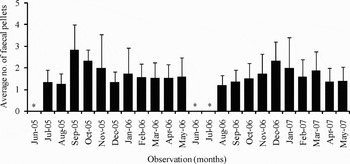
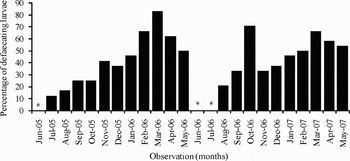
Average number of faecal pellets defaecated by a larva remained more or less constant throughout the period of observation (July 2005–May 2007) (Figure 1). The % of larvae defaecating was comparatively higher during February–May (pre-monsoon) period of the year and the highest was observed during March 2006 (Figure 2). Analysis of variance also indicated a significant variation among different sampling months (ANOVA: P ≤ 0.0005).
Average number of faecal pellets defaecated by a larva during different sampling months. *, indicates the absence of sample collection during that particular month. Error bar indicates the standard deviation from the mean.

Percentage of larvae defaecating during different sampling months. *, indicates the absence of sample collection during that particular month.

Scanning electron microscope photographs of the pellets collected during October–January (post-monsoon) indicated the presence of pennate diatoms. The pellets produced during February–May (pre-monsoon) did not show any diatom frustules. They were mostly in the form of particulate matter or in some cases unidentifiable (Figure 3B, C).
Scanning electron microscope photographs: (A) faecal pellets produced by the laboratory reared larvae; (B) faecal pellets produced by the field collected larvae (pre-monsoon, February–May); (C) faecal pellet contents from the field collected larvae (post-monsoon, October–January).

Laboratory experiments
The pellets produced from the laboratory raised larvae with centric diatoms as food (Chaetoceros calcitrans and Skeletonema costatum) indicated the presence of diatom frustules in the remnants of food provided (Figure 3A).
Settlement and recruitment of barnacles
Settlement and recruitment of the barnacles varied throughout the sampling period. Settlement was less during the monsoon season (June–September). Peak in settlement was observed during February 2006 followed by November 2006 (Figure 4). Analysis of variance also indicated a significant variation in barnacle settlement among different months. (ANOVA: P ≤ 0.05). Recruitment of barnacles was also less during the monsoon season except for August and it peaked during pre-monsoon season (February–May) (Figure 5). Analysis of variance also indicated a significant variation in barnacle recruitment among different sampling months (ANOVA: P ≤ 0.05).
Settlement of the barnacle Balanus amphitrite (=Amphibalanus amphitrite) during different sampling months. Error bar indicates the standard deviation from the mean.

Recruitment of the barnacle Balanus amphitrite (=Amphibalanus amphitrite) during different sampling months. Error bar indicates the standard deviation from the mean.

DISCUSSION
The mode of nutrition in larval forms plays an important role in their capability to survive and disperse. In the case of larval forms, which have a feeding requirement essential for their growth and development, the rate of their survival is dependent on food availability, life span and their capability to tolerate starvation. Barnacles have both feeding and non-feeding stages in their larval life span. The chances of survival of non-feeding stage larvae (cyprid stage) depend upon the stored energy of the larvae or the naupliar developmental history. On the other hand survival of the feeding stage larvae depends upon the food available for the larvae in the environment or their capability to tolerate starvation (Desai & Anil, Reference Desai and Anil2004).
As the success of a population of barnacles in any given environment is determined by the events during larval life period it is important to ascertain the type of food the nauplii consume. Such an effort made in this study through larval defaecation experiments showed that the average number of faecal pellets defaecated by a larva remained constant in spite of possible variations in the type of phytoplankton available in the environment. Results also indicated that the percentage of defaecating larvae (an indicator of food consumed) was comparatively higher during the pre-monsoon season (Figure 2). However, the average number of faecal pellets defaecated by a larva remained constant irrespective of the season (Figure 1).
The signatures of food found during the pre-monsoon season in the faecal pellets were elusive, indicating altered food consumption (i.e. other than diatoms) as compared to the post-monsoon months. SEM photographs of the pellets which were collected during the post-monsoon season indicated the presence of pennate diatoms not among the common food organisms employed in the laboratory rearing. The pellets produced during the pre-monsoon season did not have any diatom remains whereas the pellets produced during the post-monsoon season showed some frustules of diatoms. This indicates that during the pre-monsoon season the larvae survived on food material other than diatoms. It has been reported that the phytoplankton community in the study area changes with the season and dinoflagellates form a substantial part (~30%) during the pre-monsoon season (Patil & Anil, Reference Patil and Anil2008).
Earlier studies have also indicated that the food preferred by barnacle larvae in the wild includes small flagellates at relatively high rates along with diatoms (Turner et al., Reference Turner, Levinsen, Nielsen and Hansen2001). In accordance with their feeding mechanisms and body size, barnacle nauplii were also able to feed on autotrophic picoplankton (<5 µm) and did not consume the largest phytoplankton cells (Vargas et al., Reference Vargas, Manriquez and Navarrete2006). Experiments by Nejstgaard et al. (Reference Nejstgaard, Tang, Steinke, Dutz, Koski, Antajan and Long2007) also indicated that they can feed on Phaeocystis but it was pointed out by these authors that this needs to be treated with caution and further investigation is required.
Microcosm rearing of the larvae in this tropical bay by Desai & Anil (Reference Desai and Anil2002) indicated that the naupliar duration of larvae is prolonged by only two days as compared to those raised in the laboratory. It was also observed that chlorophyll-a content of the seawater in the bay during the experiment was in the range of 0.3–4.0 µg l−1 (Desai & Anil, Reference Desai and Anil2002). Even at the lowest concentration of food provided in the laboratory rearing, the chlorophyll-a content is 15 times higher than the maximum values observed in the field. This shows the capability of larvae to survive in the field in spite of observed low chlorophyll-a concentration in the water column, though the larvae raised in the microcosm experienced nutritional stress which was shown by lower RNA:DNA ratios (Desai & Anil, Reference Desai and Anil2002).
This study further indicates their capability to feed on food materials other than diatoms. As the faecal pellets did not always have remnants of diatom frustules, it is possible to say that the larvae survived on food material other than diatoms. This indicates a shift in the food available for the larvae in the environment and such shifts can influence development and metamorphosis capability of the barnacles. Settlement and recruitment of the barnacles in the vicinity indicated a seasonal variation in the rate of settlement and recruitment. Settlement and recruitment during the monsoon season were inconsistent, whereas during the pre-monsoon season, settlement and recruitment occurred throughout the season. The consistency in settlement and recruitment observed during the pre-monsoon season coincides with the higher percentage of defaecating larvae and the absence of diatom frustules in the faecal pellets.
Success of larval development in the natural environment in spite of altered food availability can have greater implication from the point of survival and translocation of larvae to different habitats through dispersion and other physical processes. Settlement behaviour of the larvae also has the potential to affect larval dispersion. ‘Desperation’ of the larvae is one source of variation in larval settlement behaviour. It has been proposed that as larvae grow old, they become less discriminatory in their selection of settlement substrate (Knight-Jones, Reference Knight-Jones1953; Toonen & Pawlik, Reference Toonen and Pawlik2001). A number of workers have suggested that the maximum planktonic period of non-feeding larvae is determined by the energetic reserves (Lucas et al., Reference Lucas, Walker, Holland and Crisp1979; Anil & Kurian, Reference Anil and Kurian1996; Anil et al., Reference Anil, Desai and Khandeparker2001; Thiyagarajan et al., Reference Thiyagarajan, Nair, Subramoniam and Venugopalan2002; Desai & Anil, Reference Desai and Anil2004 and references therein). Another source of variation in settlement behaviour may be the size of larvae. There are some evidences that larval size does influence larval life span in some invertebrates, with larger larvae remaining active for longer than smaller larvae (Marshall & Keough, Reference Marshall and Keough2003; Marshall et al., Reference Marshall, Pechenik and Keough2003; Isomura & Nishihira, Reference Isomura and Nishihira2001). However, these issues have not been addressed in the case of barnacles from the point of settlement of larvae or dispersal of larvae to different bioregions. If larval size affects larval settlement behaviour, then variation in larval size could also indirectly affect the dispersal potential. Larger larvae will have greater nutritional reserves than smaller larvae and they can swim for longer duration than smaller larvae and would be less desperate to settle. In this context, it is possible for the larger larvae to remain planktonic for a longer period of time hence there is a greater dispersal potential.
Most of the limited information on feeding characteristics of the barnacle nauplii comes from experimental or rearing studies where laboratory cultured phytoplankton are offered as food. Also, primarily herbivorous feeding by barnacle nauplii is in agreement with numerous observations using laboratory cultured diatoms as food, but there is in fact very limited information on feeding by barnacle nauplii on natural plankton assemblages. The attempt made in this study indicates the capability of nauplii to feed on food materials other than diatoms and also shows that the rate of larval defaecation remained constant throughout the year in spite of reported seasonal variations in phytoplankton community in the water column by Patil & Anil (Reference Patil and Anil2008). In view of this it is important to consider the consequences of such changes to the availability of food for the nauplii when one postulates the risk of translocation of organisms with such planktotrophic naupliar developmental pathways.
Quantitative analysis of faecal pellet production and its content would also provide insights about the preference of larval food in the wild. This is a difficult task to be accomplished and requires molecular techniques to identify the signatures of food organisms consumed. Nevertheless, this observation shows the need to study in detail the larval food preference in the natural environment.
ACKNOWLEDGEMENTS
We are grateful to Dr S.R. Shetye, Director, National Institute of Oceanography for his support and constant encouragements. The Ballast Water Management Programme, India (Directorate General of Shipping, Government of India) and the project on Molecular Characterization of Microbial and Invertebrate Diversity of Indian West Coast (Department of Biotechnology, Government of India) supported this work. We thank Dr S.S. Sawant and Mr K. Venkat and other members of the project for their ever-willing help. The first author acknowledges the Research Fellowship provided by the Council of Scientific and Industrial Research (CSIR), India. This is a NIO contribution 4636.