Vascular rings are developmental abnormalities of the aortic arch, in which the trachea and oesophagus are encircled by the aortic arch and its branches or remnants. Common types of vascular rings include double aortic arch and right aortic arch associated with aberrant left subclavian artery and left ductus arteriosus.Reference Backer, Mavroudis, Rigsby and Holinger 1 Circumflex aortic arch, a rare anomaly in which the aortic arch has a retro-oesophageal segment connecting to the descending aorta contralateral to the aortic arch, also forms a vascular ring when there is ductus arteriosus on the opposite side of the aortic arch.Reference Smith, Lu, Dorfman, Mahani and Agarwal 2 , Reference Philip, Chen, Wu, Wang and Lue 3 Although vascular rings usually occur as an isolated anomaly, there are reports of d-transposition of the great arteries associated with double aortic arch,Reference Kupferschmid, Burns, Jonas, Keane, Spevak and Wernovsky 4 , Reference Zhou, Song, Tao and Zhou 5 or with circumflex aortic arch.Reference Watanabe, Kawasaki and Sato 6 If unrepaired, vascular rings could cause various respiratory symptoms and dysphagia during infancy owing to tracheo-oesophageal compression. Early diagnosis of the arch anomaly is essential in such patients. Herein, we describe the case of a neonate with d-transposition of the great arteries, in whom left circumflex aortic arch and right-sided ductus arteriosus was detected before the arterial switch operation.
Case report
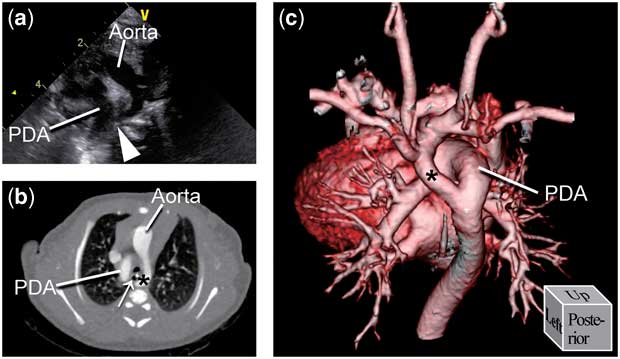
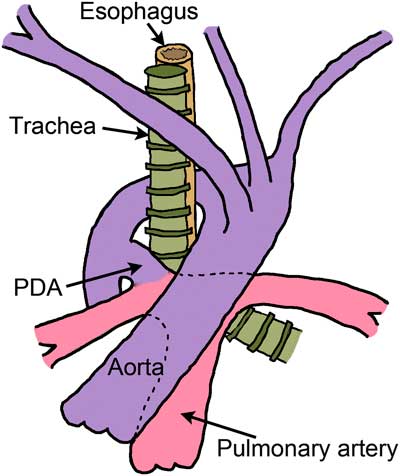
A male infant with the fetal diagnosis of d-transposition of the great arteries and ventricular septal defect was delivered at 38 weeks of gestation. His birth weight was 3376 g. Echocardiography after birth confirmed the fetal diagnosis. In addition, the suprasternal view showed an obscured aortic isthmus (Fig 1, panel A), and raised a suspicion of coarctation of the aorta. Although duct-dependent systemic circulation seemed unlikely because of a large patent ductus arteriosus with bidirectional blood flow, continuous infusion of prostaglandin was initiated. Contrast-enhanced CT at 2 days of age (Fig 1, panels B and C) negated coarctation of the aorta, and demonstrated the left-sided aortic arch connecting to the right-sided descending aorta via a retro-oesophageal segment. Together with the right-sided ductus arteriosus, the aortic arch anomaly presented a vascular ring encircling the trachea and oesophagus. Schematic drawing of the aortic arch anomaly is depicted in Figure 2. We terminated prostaglandin infusion. The patient underwent surgical repair at 6 days of age, which included arterial switch operation, ventricular septal defect closure, and right ductus arteriosus division. No fibrous ligament between the right subclavian artery and the right ductus arteriosus was noted during surgery. Postoperatively, there was no difference in blood pressure between the upper and lower limbs, although flow velocity at the aortic arch was elevated to 2.3 m/second because of acute aortic arch angulation. At discharge at 22 days of age, there were no feeding problems, and the patient’s respiratory condition was stable without any stridor.
Postnatal imaging studies. ( a ) The suprasternal view of echocardiography shows an obscured aortic isthmus (arrowhead). ( b and c ) Contrast-enhanced CT at 2 days of age. A left-sided aortic arch connects to the right-sided descending aorta via a retro-oesophageal segment (*). Together with a right-sided ductus arteriosus, a vascular ring is formed, which encircles the trachea and oesophagus (arrow). PDA=patent ductus arteriosus.

Schematic drawing of the aortic arch anomaly in this patient—that is, d-transposition of the great arteries associated with left circumflex aortic arch and right-sided ductus arteriosus. PDA=patent ductus arteriosus.

Discussion
The diagnosis of vascular rings is challenging when a vascular ring is completed with a ligamentum arteriosum or fibrous cord of an atretic arch.Reference Smith, Lu, Dorfman, Mahani and Agarwal 2 Our experience highlighted the importance of a high level of suspicion for vascular rings during the initial echocardiographic evaluation after birth. In our patient, the echocardiographic demonstration of partially obscured aortic arch was a clue to the detection of the vascular ring. Contrast-enhanced CT clearly showed that the left circumflex aortic arch connected to the right-sided descending aorta via a retro-oesophageal segment. The abnormal retro-oesophageal course of the aortic arch hindered its clear visualisation by echocardiography, which led to echocardiographic findings mimicking coarctation of the aorta. Suboptimal visualisation of the aortic arch by echocardiography in neonates should prompt physicians to consider differential diagnosis for circumflex aortic arch.
Circumflex aortic arch is occasionally associated with hypoplasia of a retro-oesophageal segment, in which surgical reconstruction of the aortic arch is required.Reference Bleakney, Zafar and Fraser 7 , Reference Bader, Walayat, Smith, Davidson, Maroo and Danton 8 Although initial echocardiographic findings mimicked coarctation of the aorta, we considered that the circumflex aortic arch was not hypoplastic in this patient. Furthermore, a case of circumflex aortic arch associated with double aortic arch has also been reported.Reference Binsalamah, Chacon-Portillo and Sanyahumbi 9 Therefore, we recommend that during surgery the surgeons check whether there is a fibrous remnant of distal right aortic arch between the right subclavian artery and the right ductus arteriosus.
Acknowledgement
None.
Financial Support
This study was supported by a grant-in-aid (KAKENHI, 18K07835) from the Japan Society for the Promotion of Science.
Conflicts of Interest
None.
Ethical Standards
The authors assert that all work reported complies with the ethical standards of the Helsinki convention, and consent for publication has been granted by the patient’s family.