Implications
The housing system for gestation sows has attracted considerable attention in terms of animal welfare issues in recent years. To compare the influence of the housing system on the behaviour of gestation sows and the physiological indices of the offspring, we investigated the behaviours, colostrum composition and salivary cortisol content of sows housed in stalls or in groups, and the biochemical indices of their offspring. The results will demonstrate the influence of group housing during gestation on the sows and their offspring.
Introduction
The housing system for sows during gestation has attracted considerable attention in terms of sow welfare in recent years. Although from 1 January 2013, EU legislation only permits stall housing of sows for 4 weeks post-service in the belief that it is beneficial to the pigs’ welfare (Anil et al., Reference Anil, Bhend, Baidoo, Morrison and Deen2003), the performance of group-housed sows and their offspring is still debated (Bates et al., Reference Bates, Edwards and Korthals2003; Anil et al., Reference Anil, Anil, Deen, Baidoo and Walker2006b; Chapinal et al., Reference Chapinal, Ruiz de la Torre, Cerisuelo, Gasa, Baucells, Coma, Vidal and Manteca2010). Definitive assessment of pregnant sow welfare is difficult because of its multi-dimensional nature.
Stall housing and group-housing systems for pregnant sows each have advantages and disadvantages. Individual stalls allow producers to focus on individual sow nutrition and proper body condition scoring, and stalls also offer protection for the sows from each other, at least in terms of the physical effects of aggression. However, individual housing in stalls restricts the sows’ opportunities to exercise; sows cannot turn around or walk, or easily engage in non-agonistic social interaction or resolve aggression. Anil et al. (Reference Anil, Anil, Deen and Baidoo2006a) showed that the welfare of sows in gestation stalls appears to be more compromised during early and late stages of gestation. On the contrary, group pens provide more space to move and exercise, and more opportunity for normal social interactions. However, group housing also makes individual feeding more difficult and supervision more laborious, and increases the stress and injuries caused by aggression, particularly after mixing and for feed access (Chapinal et al., Reference Chapinal, Ruiz de la Torre, Cerisuelo, Gasa, Baucells, Coma, Vidal and Manteca2010).
Some previous studies have compared the reproductive performance and behaviour of pregnant sows housed in groups and individual stalls (Den Hartog et al., Reference Den Hartog, Backus and Vermeer1993; Bates et al., Reference Bates, Edwards and Korthals2003; Karlen et al., Reference Karlen, Hemsworth, Gonyou, Fabrega, Strom and Smits2007; Chapinal et al., Reference Chapinal, Ruiz de la Torre, Cerisuelo, Gasa, Baucells, Coma, Vidal and Manteca2010); however, there has been little attention given to their piglets’ physiological performance and no report on the milk composition of the sows as far as we know. Therefore, the objectives of the present study were to compare the behaviour, milk composition and salivary cortisol content of sows housed in stalls v. groups and to evaluate the differences in serum biochemical indices of their offspring to comprehensively determine the advantages and disadvantages of group housing for pregnant sows.
Material and methods
Animals and housing
The experiment was conducted following the guidelines of the regional Animal Ethics Committee. A total of 28 primiparous Large White sows of good health and similar age (Yong Kang Agriculture and Animal Husbandry Technology Co., Ltd, Jiangsu Province, China) were used. All sows were randomly distributed to stalls and groups at the age of 5 months, with 12 sows in groups (four sows per group) and 16 sows in individual stalls. Two months later, artificial insemination was carried out twice for all sows (in the afternoon and then the following morning). Stalls had half-slatted floors and half-solid concrete floors with individual feeders and drinkers and had dimensions of 210 (length)×60 (width)×97 (height). Group pens had fully slatted floors ((435 cm (length)×255 cm (width)×105 cm (height)) with a feed trough ((120 cm (length)×40 cm (width)×20 cm (height)) and a drinker. Sows in stall housing and groups were fed twice daily, 2.5 and 3 kg/day at 0500 h and 1400 h, respectively. The nutrition composition of the diet for pregnant sows included 15.5% CP, 3.10 Mcal/kg digestible energy, 0.65% lysine, 0.72% calcium and 0.68% phosphorus. All sows were transferred to the farrowing houses 1 week before the predicted farrowing date. The nutrition composition of the lactating sow diet included 17.0% CP, 3.25 Mcal/kg digestible energy, 0.95% lysine, 0.74% calcium and 0.68% phosphorus. Live litter size, birth weight and weaning weight were recorded to evaluate sow reproductive performance. Sows’ back fat depth at 30, 60 and 90 days of pregnancy was measured using an ultrasound device (PIGLOG105, Carometec, Denmark)
Data collection
Salivary cortisol concentrations
Saliva samples were collected from the sows at 0900 h at 30, 60 and 90 days of pregnancy and 1, 7, 14 and 21 days after farrowing. A cotton wool swab was used. Sows were allowed to chew the swab until it was thoroughly moistened. The saliva was squeezed out and then centrifuged at 400×g for 5 min. Approximately 4 ml of saliva was obtained from each swab. Freeze-drying was carried out before sow salivary cortisol concentration measurement: 1 ml saliva was dried and then dissolved in 125 μl PBS buffer for radioimmunoassay (RIA). Cortisol concentration was measured in duplicate using a commercially available 125I-RIA kit (Beijing Research Institute of Biotechnology, Beijing, China) according to the manufacturer’s instructions. The detection limit was 2 ng/ml. The intra-assay and inter-assay CV were 7.6% and 8.7%, respectively.
Colostrum composition
Colostrum samples were obtained at 1 h after the birth of the last piglet; they were then centrifuged at 4000 r.p.m./min for 20 min to separate the whey. Triiodothyronine (T3), thyroxine (T4) and prolactin concentrations were measured by RIA using commercial kits (Beijing North Biotechnology Institute) according to the manufacturer’s instructions. The detection limit of T3 and T4 was 0.2 and 5 ng/ml, respectively, and the intra-assay and inter-assay variation coefficients of both hormones were 10% and 15%, respectively. The detection limit of prolactin was 1 ng/ml, and the intra-assay and inter-assay CV were 10% and 15%, respectively. Protein was detected using a bicinchoninic acid protein quantitative kit according to the manufacturer’s instructions. A triglyceride (TG) detection kit (Nanjing Jiancheng Bioengineering Institute, Nanjing, China) was also used according to the manufacturer’s instructions. Milk samples were diluted 20-fold with anhydrous alcohol for full mixing, and then centrifuged at 4000 r.p.m. for 10 min to obtain a clear supernatant.
Piglets’ serum biochemical indices
At 0900 h on day 28 just before weaning, a male piglet with the mean BW of the litter was chosen to obtain a blood sample from the jugular vein. Piglets’ serum biochemical indices were analysed in Nanjing General Hospital by an Automatic Chemistry Analyzer (Beckman Coulter Au680, Beckman Coulter, USA). RIA was used to measure piglets’ serum cortisol, T3 and T4 concentrations. T3, T4 and cortisol RIA kits were provided by Beijing North Biotechnology Institute as above.
Behaviour analysis
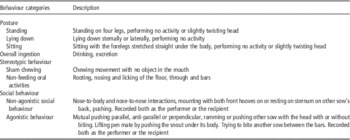
Hikvision cameras (Hikvision Digital Technology Co., Ltd, Hangzhou, China) attached to digital video recorders were used to record behaviour, and the cameras were mounted to view the behaviours of the sows in the stalls and groups, with each camera including four to five sows in the view. Numbers were painted on the sows’ backs for individual identification. Videotapes were analysed for the duration and frequency of behaviours using continual observation. Postures, overall ingestion, social behaviour and stereotypical behaviour were recorded, and all behaviours were mutually exclusive. Sham chewing and other non-feeding oral activities were considered stereotypical behaviour (Van der Peet-Schwering et al., Reference Van der Peet-Schwering, Spoolder, Kemp, Binnendijk, Den Hartog and Verstegen2003). The definition of each behaviour is described in the ethogram (Table 1). Sow behaviour was analysed at weeks 2, 9 and 14 of pregnancy. The duration of recording was 1 h/day, including half an hour before feeding and then half an hour after feeding had finished in the afternoon. During this hour, the frequency of drinking, excretion, agonistic, non-agonistic, sham chewing, and the duration (second) of standing, sitting, lying, agonistic and non-feeding oral activities were recorded, respectively. Finally, the frequency or duration for 6 days was summed to obtain the results of the behaviour per week as shown in the figures.
Ethogram showing definitions of recorded behaviours

Statistical analysis
The data are presented as the mean±s.e.m. in the Figure and the mean±r.s.d. in the Table. The salivary cortisol content, back fat depth and behaviour of the sows were assessed using the GLM procedure for repeated measures analysis with unstructured covariance matrix and housing system was used as the main effect. For reproductive performance, colostrum composition and serum biochemical indices of piglets, the data were analysed using independent-samples t-test with SPSS 13.0 for windows. Differences were considered significant when P<0.05.
Results
Sow reproductive performance and colostrum composition
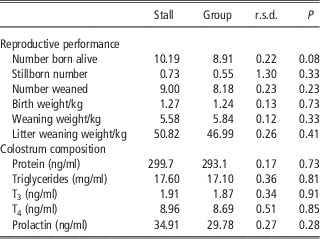
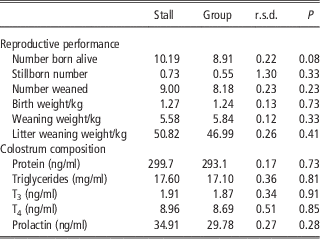
As shown in Table 2, the number born alive tended to be lower in group housing compared with stalls (P=0.08). However, the number weaned, birth weight, weaning weight and litter weaning weight were not different between housing systems.
Effect of stall and group housing on sows’ reproductive performance and colostrum composition
T3=triiodothyronine; T4=thyroxine.
For the reproductive performance, n=12 (group) and n=16 (stalls); For colostrum composition, n=10 (both treatments).
The colostrum protein and TG content showed no difference between the individual stall and group-housing system. T3, T4 and prolactin content in the colostrum also did not differ.
Salivary cortisol concentration and back fat depth of the sows
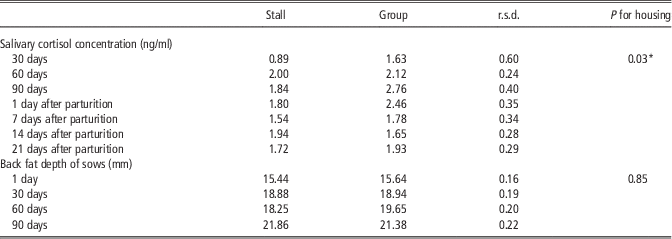
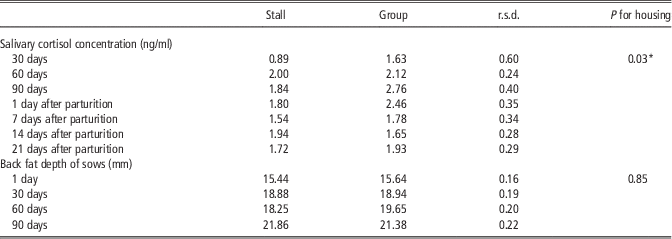
There was no difference between housing systems in back fat depth, but salivary cortisol concentration was higher in group-housed sows compared with stalled sows (P=0.03, Table 3).
Effect of stall and group housing on sows’ salivary cortisol concentrations and back fat depth
For the back fat depth, n=12 (group) and n=16 (stalls); for salivary cortisol concentration, n=10.
*Values differ significantly at P<0.05.
Serum biochemical indices of offspring
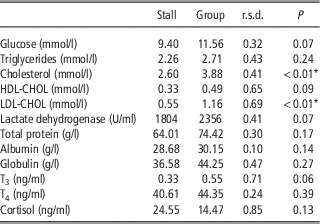
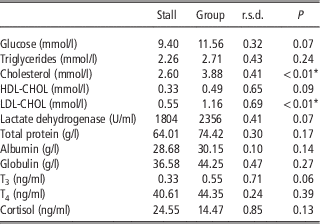
As shown in Table 4, serum total cholesterol and low-density lipoprotein (LDL) cholesterol was significantly higher in piglets from sows housed in groups compared with those housed in stalls. In addition, serum LDH (P=0.07), HDL cholesterol (P=0.09), glucose (P=0.07) and T3 (P=0.06) tended to be higher in piglets from sows housed in groups compared with those from sows housed in stalls. There was no difference in the other biochemical indices between the piglets from the two housing systems.
Effect of stall and group housing of sows on the concentration of piglets’ serum biochemical indices and hormone concentrations
HDL-CHOL=high-density lipoprotein cholesterol; LDL-CHOL=low-density lipoprotein cholesterol; T3=triiodothyronine; T4=thyroxine.
For all measures n=10 (both treatments).
*Values within a row differ significantly at P<0.05.
Housing system effect on the behaviour of pregnant sows
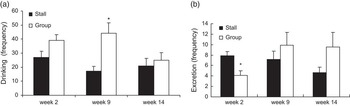
The GLM for repeated measures analysis showed a significant housing system effect for drinking frequency (Figure 1a). Drinking frequency of pigs housed in groups was significantly higher than those in stalls, especially at week 9 of pregnancy. Generally, there was no consistent housing system effect on excretion frequency (Figure 1b). At week 2 of pregnancy, stall-housed sows excreted more than group-housed sows; however, at weeks 9 and 14, there was no significant difference.
Effects of stall and group housing on the frequency of drinking and excretion in pregnant sows (bar chart). GLM repeated measures analysis for drinking frequency: P<0.05; for excretion frequency: P>0.05. Values are presented as the mean±s.e.m. * indicates a significant difference between stall and group housing at the same pregnancy stage (P<0.05). n=6 to 8.

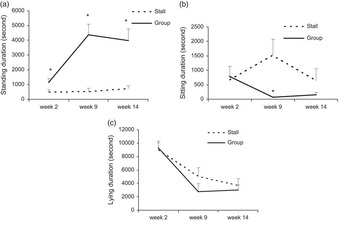
Standing and sitting duration differed between the two housing systems. The standing duration at all three time points was significantly higher in groups than in stalls (Figure 2a). At week 9, sows in stalls spent longer sitting than group-housed sows (Figure 2b). There was no housing system effect on lying duration (Figure 2c).
Effects of stall and group housing on the duration of posture behaviour in pregnant sows (line chart). GLM repeated measures analysis for standing duration: P<0.01; for sitting duration: P<0.05; and for lying duration: P>0.05. Values are presented as the mean±s.e.m. * indicates a significant difference between stall and group housing at the same pregnancy stage (P<0.05). n=6 to 8.

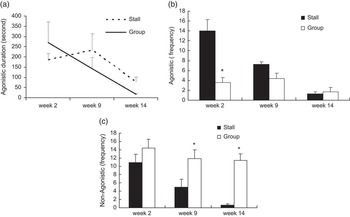
The GLM for repeated measures analysis showed that there were significant housing system effects on the frequency of agonistic and non-agonistic social behaviours, but no effect on the duration of agonistic behaviour. At week 2 of pregnancy, the frequency of agonistic behaviour was significantly lower for sows housed in groups compared with sows housed in stalls (Figure 3b), whereas at weeks 9 and 14 of pregnancy the frequency of non-agonistic social behaviour was higher in group-housed sows (Figure 3c).
Effects of stall and group housing on agonistic behaviour duration (line chart) and the frequency of agonistic and non-agonistic behaviour (bar chart) in pregnant sows. GLM repeated measures analysis for agonistic behaviour duration: P>0.05; for agonistic behaviour frequency: P<0.01; and for non-agonistic behaviour frequency: P<0.01. Values are present as the mean±s.e.m. * indicates a significant difference between stall and group housing at the same pregnancy stage (P<0.05). n=6 to 8.

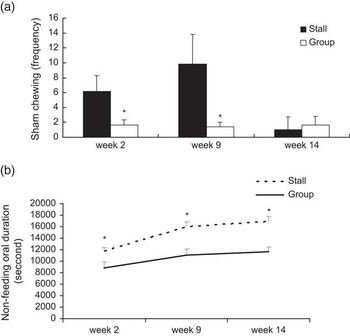
A significant housing system difference was generally observed for sham-chewing frequency and non-feeding oral activities duration. The frequency of sham chewing was significantly higher in stalls at weeks 2 and 9 of pregnancy (Figure 4a), and the duration of non-feeding oral activities was significantly higher in sows housed in stalls than those in groups at all three time points (Figure 4b).
Effects of stall and group housing on sham-chewing frequency (bar chart) and non-feeding oral activities duration (line chart) in pregnant sows. GLM repeated measures analysis for sham-chewing frequency: P<0.05; and for non-feeding oral activities duration: P<0.01. Values are presented as the mean±s.e.m. * indicates a significant difference between stall and group housing at the same pregnancy stage (P<0.05). n=6 to 8.

Discussion
The narrow, metal-barred, gestation stalls restrain the movement of sows and induce chronic long-term stress in sows, whereas sows housed in group pens were relatively less stressed. Regarding sow reproduction, McGlone et al. (Reference McGlone, VonBorell, Deen, Johnson, Levis, Meunier-Salaün, Morrow, Reeves, Salak-Johnson and Sundberg2004) reported that sows kept in stalls had greater or equal reproductive performance compared with sows in other housing systems, whereas Bates et al. (Reference Bates, Edwards and Korthals2003) suggested that gestating sows housed in groups with electronic feeding had either similar or improved performance compared with sows gestated in stalls. Often in modern group-housing systems, groups contain large numbers of sows. In the present study, we used a small group size consisting of four sows in each pen. Although it is not typical for commercial group-housing systems, it was convenient for observing individual behaviour and sampling the saliva of sows in the study. We originally assigned 20 sows to the group-housing system (five pens) at the beginning of the experiment; however, as one or two pigs returned to oestrous in two pens, we discarded the data from these two pens to keep the pregnancy time consistent in each pen. The present study was focused on the behaviour of sows and the biochemical indices of the offspring, and a conclusion on the reproductive performance based on the numbers of sows in the present study could not be drawn.
Back fat thickness was measured by ultrasound, which is considered a good measure of sow body condition (Kapell et al., Reference Kapell, Ashworth, Walling, Lawrence, Edwards and Roehe2009). Chapinal et al. (Reference Chapinal, Ruiz de la Torre, Cerisuelo, Gasa, Baucells, Coma, Vidal and Manteca2010) showed there was no significant difference in the back fat depth of sows during pregnancy between the two housing conditions. The present study demonstrated the same results as that of the previous study. Colostrum is critical for piglets and nutrition composition directly influences piglet growth. In the present study, we were the first to compare colostrum composition of sows between the two housing systems. The results showed that there was no significant difference in proteins, TG, T3, T4 and prolactin content between the two housing systems.
An animal’s hypothalamic–pituitary–adrenal response to different physical or social conditions based on cortisol content is often used in stress assessment. It has been confirmed that cortisol can be detected in saliva, and has a strong relationship with plasma cortisol concentration (Bushong et al., Reference Bushong, Friend and Knabe2000; Sorrells et al., Reference Sorrells, Eicher, Harris, Pajor and Richert2007). Moreover, the collection of saliva does not require forcing or restraining the sow, and thus determination of salivary cortisol concentrations has become a popular tool in studies on pregnant sows. Karlen et al. (Reference Karlen, Hemsworth, Gonyou, Fabrega, Strom and Smits2007) found a trend for higher salivary cortisol concentration in sows housed in a hoop structure in week 1 of gestation (P=0.06) compared with those housed in stalls and suggested that this increase may be because of the effect of mixing sows to form the group. It has been shown that aggression declined rapidly after mixing and became stable after 7 days, but remained high when the sows had to compete for food in group-housing conditions (Arey, Reference Arey1999). Furthermore, previous studies suggest that female sows housed in groups during gestation have a more difficult time adapting to farrowing stalls (Boyle et al., Reference Boyle, Leonard, Lynch and Brophy2000 and Reference Boyle, Leonard, Lynch and Brophy2002). In the present study, we collected the saliva from sows at different pregnancy and lactation periods. The results showed that salivary cortisol concentration was significantly higher in the groups compared with the sows in stall. The reason of the higher salivary content in groups than in stalls may be complex. One possible reason for the difference may be the housing environment; yet another possible reason may be the stress from the sampling. Obtaining salivary samples was easier from the sows housed in stalls than in groups, but this requires further study to clarify it.
In recent years, a number of epidemiological and experimental studies have demonstrated that environmental factors exerting their influence during embryonic development may have the potential to induce a variety of metabolic changes later in life (Petry and Hales, Reference Petry and Hales2000; Zambrano et al., Reference Zambrano, Bautista, Deas, Martinez-Samayoa, Gonzalez-Zamorano, Ledesma, Morales, Larrea and Nathanielsz2006). Concerning the influence of the housing system during gestation on the offspring growth, Sorrells et al. (Reference Sorrells, Eicher, Scott, Harris, Pajor, Lay and Richert2006) found that there were no significant differences in plasma tumour necrosis factor, α1-acid glycoprotein, haptoglobin and IgG concentrations in piglets from gilts housed individually or in groups during gestation. In the present study, we compared the serum biochemical indices of piglets from sows housed in different systems. The results showed that the concentrations of serum TG, total protein, albumin and globins in piglets revealed no significant difference between systems. However, cholesterol and LDL cholesterol content were significantly higher in the serum of piglets from sows housed in groups (P=0.006 and 0.005, respectively), and serum glucose also tended to be higher (P=0.07) in these piglets in the present study. The different cholesterol content may indicate the different food intake behaviour of offspring (Rauw et al., Reference Rauw, Portolés, Corella, Soler, Reixach, Tibau, Prat, Diaz and Gómez-Raya2007). Similarly, Estienne and Harper (Reference Estienne and Harper2010) showed that gilts from female sows gestated in groups tended (P<0.09) to have more back fat than gilts from female sows gestated in crates throughout gestation. In addition, among the detected serum hormones of the offspring piglets T3 concentration tended to be higher in piglets from group-housed sows (P=0.06). T3 is a critical hormone for animal growth. These changed biochemical indices in the offspring may indicate body condition differences, which may possibly lead to differences in growth in later life.
In addition to physiological changes, animal behaviour also demonstrated responses to environment stressors (Hicks et al., Reference Hicks, McGlone, Whisnant, Kattesh and Norman1998). Sows housed in groups demonstrated significantly higher drinking frequency than those in the stalls. Although some previous studies suggested that drinking is considered a type of stereotypy if it persists after metabolic requirements are satisfied (Rushen, Reference Rushen1984; Terlouw et al., Reference Terlouw, Lawrence and Illius1991), Chapinal et al. (Reference Chapinal, Ruiz de la Torre, Cerisuelo, Gasa, Baucells, Coma, Vidal and Manteca2010) showed a similar result in which sows housed in small groups were most frequently observed performing drinking behaviour, owing to both thirst and social facilitation. There was no difference in excretion between the two housing groups. Regarding postural behaviour, Haley et al. (Reference Haley, de Passillé and Rushen2001) showed that a reduction in time spent lying with a subsequent increase in time spent standing without eating indicates discomfort. Although there are still different opinions, Anil et al. (Reference Anil, Anil and Deen2002) suggested that there are no optimum values for these postural indicators under different housing conditions. Karlen et al. (Reference Karlen, Hemsworth, Gonyou, Fabrega, Strom and Smits2007) showed that sows housed in stalls spent more time lying in week 9 than sows in the hoops treatment, possibly as a result of increasing foot and leg injuries owing to the increasing live weight, the restriction of movement and possibly the lack of bedding. In the present study, the duration of standing was significantly higher in sows housed in groups than those in stalls; yet the duration of sitting demonstrated the opposite trend. Although it is difficult to determine which housing system is welfare-friendly, posture behaviours definitely demonstrated a difference between the two housing systems.
Agonistic behaviour is a natural behaviour that is required to establish a dominance hierarchy, and has been sometimes viewed as a problem in group-housing systems. However, aggression does not only happen in groups, sows kept in stalls also show aggressive behaviour towards their neighbours (Barnett et al., Reference Barnett, Hemsworth and Winfield1987). Broom et al. (Reference Broom, Mendl and Zanella1995) showed that sows confined to stalls demonstrated more agonistic behaviour than group-housed animals, and this more often escalated into high-intensity yet unresolved aggression. Although such aggressive behaviour does not typically lead to physical body injury, it still causes stress and frustration. In the present study, the agonistic behaviour was significantly higher in stalls than in groups, although the duration of agonistic behaviour was not different. In group housing, most of the agonistic interactions occur before and after feeding once social hierarchy has been established. In the present study, the time point for behavioural video analysis was the half hour before feeding and then a half hour after feeding had been completed in the afternoon. Therefore, the agonistic behaviour at the time of feeding is not included. It may be one of the reasons why the frequency of agonistic behaviour is lower in the group-housed sows. Non-agonistic social interactions included nose-to-body and nose-to-nose interactions performed or received (Anil et al., Reference Anil, Anil, Deen, Baidoo and Walker2006b); other behaviours such as pushing, mounting (both front hoofs resting on another sow’s back) and being mounted were also included in the non-agonistic social interactions. In the present study, the frequency of non-agonistic social behaviour was significantly higher in groups than in stalls.
Sham chewing and other non-feeding oral activities were classified as stereotypical behaviour, and sham chewing is most likely the most detrimental stereotypy because it is considered to be in a more advanced stage of development (Stolba et al., Reference Stolba, Baker and Wood-Gush1983; Lawrence and Terlouw, Reference Lawrence and Terlouw1993; Vieuille-Thomas et al., Reference Vieuille-Thomas, G and Signoret1995). Stereotypical behaviour was mainly performed during 2 h following feeding, and it is always higher in the stalls (Jensen, Reference Jensen1988; Chapinal et al., Reference Chapinal, Ruiz de la Torre, Cerisuelo, Gasa, Baucells, Coma, Vidal and Manteca2010). In our results, the duration of non-feeding oral activities and the frequency of sham chewing were significantly higher in the stalls than in the groups, which was consistent with the previous results.
In conclusion, sows in the two systems may face different challenges. Group housing may increase the difficulty of daily management, but it can decrease stereotypical behaviour and increase non-agonistic social behaviour of the sows. Meanwhile, although the housing system has no influence on the measured colostrum composition, serum total cholesterol and LDL cholesterol in the offspring showed significant difference between the two systems. Nevertheless, group housing may have beneficial effects on the sows’ welfare.
Acknowledgements
This work was supported by the Special Fund for Agro-scientific Research in the Public Interest (201003011), the National Basic Research Programmer of China (2012CB124703), Science and Technology Innovation Fund for the Youth of Nanjing Agricultural University (0906J0385), the Program for New Century Excellent Talents in University (NCET-12–0889) and a project funded by the Priority Academic Program Development of Jiangsu Higher Education Institutions.