

Introduction
Over the past three decades, the establishment and restoration of wetlands have served as key instruments in reducing nutrient runoff in Denmark. Since the adoption of the 2nd Danish Action Plan on the Aquatic Environment (APAE II) in 1998 (Ærtebjerg et al. Reference Ærtebjerg, Andersen and Hansen2003), wetland recreation has been a central strategy for naturally converting nitrates into gaseous nitrogen, thereby mitigating their impact on aquatic ecosystems (Hoffmann and Baattrup-Pedersen Reference Hoffmann and Baattrup-Pedersen2007; Hermansen et al. Reference Hermansen, Petersen, Hoffmann, Kjeldgaard and Thodsen2026). Although the primary objective of most restored wetlands has been to reduce nutrient flux into freshwater and marine environments, many also function as reservoirs for surface water during periods of heavy precipitation, offer human recreational opportunities, and provide habitat for species associated with freshwater ecosystems (Zedler and Leach Reference Zedler and Leach1998; Climate Change Adaptation Reference Adaptation2012). When well-designed, such newly created wetlands can simultaneously address multiple societal and conservation goals, including the future preservation of waterbird species (Chovanev Reference Chovanev1994; Clausen et al. Reference Clausen, Grøn, Larsen, Clausen and Fox2024).
In the heavily cultivated landscape of Denmark, the vast majority of restored lakes have been created by flooding of former agricultural land (Hoffmann and Baattrup-Pedersen Reference Hoffmann and Baattrup-Pedersen2007). The approach used for recreation has differed slightly in terms of design, planning and project aims, but as a rule the lakes are eutrophic and relatively shallow. These waterbodies are, at least initially, best thought of as artificially created sites, often located on areas that were wetlands historically, but might with time develop into more natural ecosystems. The early years following restoration are often marked by prolific growth of fast-growing algae or macrophytes such as Elodea canadensis and Potamogeton berchtoldii that thrive in nutrient-rich conditions (e.g. Sø et al. Reference Sø, Sand-Jensen and Baastrup-Spohr2020; Clausen et al. Reference Clausen, Grøn, Larsen, Clausen and Fox2024), and a colonisation phase of associated invertebrate fauna that may vary substantially depending on context, but generally consist of efficient dispersers (Ruhí et al. Reference Ruhí, Boix, Gascón, Sala and Quintana2013; Coccia et al. Reference Coccia, Vanschoenwinkel, Brendonck, Boyero and Green2016). Fish species, in particular, may only immigrate or otherwise colonise created wetlands after a few years, permitting more highly dispersive predators, such as waterbirds, to exploit potential prey in their absence. In Denmark, the only two studies available on early fish colonisation suggest that three-spined stickleback Gasterosteus aculeatus and roach Rutilus rutilus are often among the first arriving species (Hvidt and Bech Reference Hvidt and Bech2004; Kristensen et al. Reference Kristensen, Sand-Jensen, Kristensen, Pedersen, Baastrup-Spohr and Kragh2020). Dynamics of the ecological community following restoration may vary substantially from site to site depending on landscape context, sources of dispersal and the physical basis for lake formation (Matthews and Endress Reference Matthews and Endress2010; Matthews and Spyreas Reference Matthews and Spyreas2010; Ruhí et al. Reference Ruhí, Boix, Gascón, Sala and Quintana2013), and stable ecological conditions only emerge after several years (Grøn Reference Grøn2009; Charles et al. Reference Charles, Chase, Pociask, Bhattarai and Matthews2023). During this transitional phase, the biotic community may undergo substantial shifts in species composition and abundance, driven by changes in nutrient levels, species-specific colonisation rates, and altered biotic interactions. By creating “new” wetlands in essentially agricultural landscapes, many previous studies have shown positive effects on nesting waterbird communities by creating sites that promote colonisation from the outset. However, the subsequent ecological succession processes and the turnover in associated species may, over time, adversely affect pioneer species (e.g. Vera et al. Reference Vera, Dies, Ferrís and Valentín2024). Despite the fluctuating conditions in the early years following restoration, certain species appear to benefit from the incomplete development of aquatic ecosystems in newly restored lakes. In particular, some aquatic plant and insect species respond rapidly to habitat creation and dominate the early colonisation phase of wetland communities (Matthews and Endress Reference Matthews and Endress2010; Ruhí et al. Reference Ruhí, Fairchild, Spieles, Becerra-Jurado, Moreno-Mateos, Batzer and Boix2016), potentially facilitating the establishment of pioneer vertebrate species that exploit the sudden increase in food availability (Hapner et al. Reference Hapner, Reinartz, Fredlund, Leithoff, Cutright and Mueller2011).
Such pioneering species can be found among waterbirds, some of which possess a marked ability to rapidly exploit newly restored wetlands. High mobility and a preference for shallow, dynamic water regimes allow dabbling ducks, grebes, and waders to respond quickly and positively to restoration efforts (Bregnballe et al. Reference Bregnballe, Amstrup, Holm, Clausen and Fox2014; Fan et al. Reference Fan, Wang, Wu, Chen, Ma and Ma2021; Kačergytė et al. Reference Kačergytė, Pärt, Berg, Arlt, Zmihorski and Knape2022). Yet this responsiveness is far from uniform. Waterbirds constitute a taxonomically and functionally diverse assemblage, and variation in diet, habitat requirements, and sensitivity to disturbance means that some species colonise readily, whereas others show delayed or limited use of restored sites (Hapner et al. Reference Hapner, Reinartz, Fredlund, Leithoff, Cutright and Mueller2011; Clausen et al. Reference Clausen, Grøn, Larsen, Clausen and Fox2024). Consequently, overall species richness in restored wetlands often remains lower than in natural waterbodies, particularly for taxa with more specialised ecological requirements (Ortega-Álvarez and Lindig-Cisneros Reference Ortega-Álvarez and Lindig-Cisneros2012; Anderson and Rooney Reference Anderson and Rooney2019). Examples of early colonisers in restored freshwater wetlands in northern Europe include Black-headed Gull Chroicocephalus ridibundus, Garganey Spatula querquedula, Shoveler Spatula clypeata, Little Ringed Plover Charadrius dubius and Black-necked Grebe Podiceps nigricollis (Bregnballe et al. Reference Bregnballe, Amstrup, Holm, Clausen and Fox2014; Kačergytė et al. Reference Kačergytė, Pärt, Berg, Arlt, Zmihorski and Knape2022; Vera et al. Reference Vera, Dies, Ferrís and Valentín2024).
In Denmark, observations from restoration projects suggest that especially the Black-necked Grebe is strongly associated with newly established wetlands (Grøn Reference Grøn2021; Andersen Reference Andersen2022). This species is an uncommon migratory breeding bird in Denmark (Christensen et al. Reference Christensen, Hansen, Rasmussen, Nyegaard and Eskildsen2022) and currently listed as vulnerable (VU) on the Danish red list (Moeslund et al. Reference Moeslund, Nygaard, Ejrnæs, Alstrup and Baagøe2023). Consequently, recurring reports of high numbers associated with newly established lakes have drawn attention to the potential role of these wetlands in the future conservation of the species in Denmark. Data series from individual wetlands show that Black-necked Grebe often exhibit a short-lived breeding occurrence at most sites (Andersen Reference Andersen2022; Gwiazda et al. Reference Gwiazda, Flis, Ledwon and Wiehle2023) and expanding our understanding of these colonisation–extinction dynamics is vital for future management and conservation of the species.
In this paper, we examine the role of restored wetlands in supporting populations of Black-necked Grebes in Denmark on a national scale. Specifically, we aim to determine: (1) whether breeding Black-necked Grebes show a preference for restored wetlands over natural waterbodies; (2) the relative contribution of restored and natural wetlands to support the overall national population; and (3) the short-term occurrence of the species following the creation of new lakes. Describing these patterns might guide possible management actions going forward and point at further studies needed to advance our understanding of Black-necked Grebe breeding ecology and habitat requirements.
Methods
Study species
The Black-necked Grebe exhibits a high degree of ecological specialisation, often occupying shallow freshwater and hypersaline wetlands with extensive emergent or floating vegetation (Jehl Reference Jehl2001, Andersen Reference Andersen2022). Breeding typically occurs in loose colonies, with nests constructed on floating substrates anchored to aquatic plants, often in association with colonies of Black-headed Gulls (Bochenski Reference Bochenski1961, Lamekhov Reference Lamekhov2022). Like other small grebes, food availability of the Black-necked Grebe is probably greatly affected by competition from fish (Kloskowski et al. Reference Kloskowski, Nieoczym, Polak and Pitucha2010). In Denmark the species is uncommon, and rough estimates of the population size have historically fluctuated between 125–350 pairs (Olsen Reference Olsen1992) and recently between 200–250 pairs (Christensen et al. Reference Christensen, Hansen, Rasmussen, Nyegaard and Eskildsen2022). During the breeding season, its diet consists primarily of aquatic invertebrates, supplemented by small fish and amphibians (Fjeldså Reference Fjeldså2004).
Wetland information
Data on the origin of individual wetlands (restored vs. natural) were compiled from the waterbird monitoring platform www.fugledata.dk, which form the basis for wintering waterbird censuses in the national nature monitoring program NOVANA. This database includes 1,638 counting units (polygons) across Denmark, covering the majority of wetlands recognised as being important to staging and wintering waterbirds in the country, and probably likewise for breeding waterbirds, including grebes. For all wetlands, the database provides information on whether it is natural or restored. No data exist on the type of restoration or flora and fauna of the individual lakes, and the database was merely used to create a binary variable defining whether a certain wetland existed on the basis of a restoration project or not.
To ensure that only potential breeding areas of Black-necked Grebes were included in our comparison of natural vs. restored wetlands, the following steps were taken: 1) All counting units with only terrestrial habitats were omitted from the analysis, 2) All counting units containing only coastal, salt water habitats were excluded, as the species breeds only in fresh or brackish waters in Denmark and not by the sea, and 3) all counting units holding only small waterbodies <1 ha were omitted, as no records of breeding Black-necked Grebes were confirmed in lakes below this size in the bird dataset described in the next section. Collectively, this procedure intended to remove obviously unsuitable breeding habitats prior to the overall comparison between natural and restored lakes, but a detailed, fine-scale assessment of habitat suitability at individual sites could not be included based on the available data. The procedures were conducted in QGIS 3.26 using the “select by location” function, the vector layer of the NOVANA counting units and a vector layer of all Danish lakes obtained from the Danish Geodata Agency (https://eng.gst.dk). This resulted in a dataset of 651 potential breeding sites for Black-necked Grebes among the areas covered by the NOVANA monitoring scheme, each with information on the wetland area and whether the wetland was natural (N = 511) or restored (N = 140). Besides a few case studies with numerically important numbers (see “Data analyses” below), the exact year of establishment was not known for all the included restored sites, but the total number of restorations has increased steadily from the late 1990s until today.
Black-necked Grebe presence and abundance
In Denmark there is no systematic monitoring of breeding numbers of Black-necked Grebes. Consequently, we relied on data from DOFbasen, the national citizen science web portal of Birdlife Denmark, as a source of information on the presence and abundance of grebes in Danish waterbodies. This database holds all submitted sightings of birds reported by volunteer bird watchers in Denmark. Due to the challenges associated with counting breeding Black-necked Grebes (Hansen Reference Hansen1999) and the general lack of systematic monitoring, reported numbers cannot be considered comprehensive breeding surveys, but serve merely as an approximation of the actual numbers in individual lakes. Furthermore, submissions to DOFbasen have grown substantially over time, and data coverage is relatively sparse in the initial years. To compare the relative importance of restored and natural sites over time, we therefore relied on the proportional distribution of grebes between these two types rather than absolute numbers (see “Data analyses” below). All records in DOFbasen are georeferenced to site with centre coordinates in latitude and longitude. Using the wetland dataset as a spatial mask, we extracted all observations of breeding Black-necked Grebes within these sites from 1990 to 2024, covering three decades of wetland restoration in Denmark.
Breeding records in DOFbasen were reported either as breeding pairs or breeding birds and all figures were converted to breeding pairs for consistency, by dividing observations reported as breeding birds by two. For each site with a presence of breeders in a given year, the annual number of breeding pairs was defined as the maximum count of pairs reported with a status of breeding. Records of higher numbers without a clear indication of breeding status were excluded to ensure inclusion of confirmed breeders only. While this approach could occasionally lead to including non-breeding migratory birds (pre- or post-breeding aggregations) occurring alongside breeding pairs, this would probably affect restored and natural wetlands equally and was unlikely to bias our result. Maximum counts were validated by comparing them to other records from the same site and year, and no obvious outliers were detected. In cases where a single NOVANA counting unit encompassed multiple DOFbasen localities (more than one site for volunteer reporting within a single wetland), the record with the highest count was retained. Based on this dataset, we defined 1) a binary presence/absence variable indicating whether Black-necked Grebes had bred at a site during the 1990–2024 period, and 2) an abundance variable representing the annual number of breeding pairs per site. Of the 651 wetlands included, 108 had confirmed breeding records during the study period. Throughout the study period, a small fraction of the breeding occurrences was found outside wetlands covered by the NOVANA monitoring program (and hence not included in our study), but these accounted for only 9% of the total number of pairs submitted to DOFbasen and were therefore unlikely to bias the comparison between natural and restored sites.
Data analyses
To assess whether Black-necked Grebes exhibit a preference for natural or restored wetlands, we used a contingency table and a chi-squared test to evaluate the association between breeding presence and wetland origin (restored or natural) across the entire study period. Due to incomplete information about the exact year of establishment for the restored wetlands, we were unable to account for the fact that these sites had only been available for parts of the study period. This means that a potential relationship between breeding occurrence and wetland type must be considered conservative for the restored sites, as these were only established during the course of the study period.
To evaluate the contribution of restored wetlands to overall breeding numbers, we calculated 1) the proportional distribution of breeding pairs across natural and restored wetlands in 5-year intervals over the past four decades, and 2) the proportional distribution of natural and restored lakes among occupied breeding sites in the same periods. Within each 5-year period the number of breeding pairs and number of occupied breeding sites were summed across wetlands of the same type. To contextualise the absolute numbers of pairs currently breeding in restored sites included in our analysis, we compared recent totals to two contemporary national estimates of the Danish breeding population: 1) the most recent estimate from Birdlife Denmark in 2023 (Lange Reference Lange2024) and 2) the 2024 article 12 reporting to the EU (Fredshavn et al. Reference Fredshavn, Holm, Bregnballe, Sterup and Pedersen2025).
To explore temporal patterns in the establishment and abandonment of individual colonies, we focused on the most numerically significant sites, defined as clearly delimited waterbodies with peak counts exceeding 50 breeding pairs and known restoration dates. For these lakes, we contacted local authorities for information on the year of establishment and plotted annual breeding estimates against years since restoration to investigate population trajectories. In addition, the average number of years with records of breeding Black-necked Grebe was estimated across all restored sites.
To test whether variation in breeding numbers was related to wetland area, we examined both linear and monotonic relationships between wetland size and peak breeding numbers using Pearson’s r and Spearman’s ρ. All analyses were conducted in R version 4.2.2 (R Core Team Reference Team2022), and visualisations were produced using the ‘ggplot2’ package (Wickham Reference Wickham2016).
Results
On average, 111 breeding Black-necked Grebes were reported to DOFbasen annually during the study period. However, this average masks an increase over the period, resulting from the more widespread use of the digital reporting platform. In the 1990s, the annual average number of reported pairs was 53, whereas after 2020 it was 139. The average area of the 511 natural wetland counting units included in the analysis (mean ± SD) was 2.01 ± 4.25 km2, and confirmed breeding attempts by Black-necked Grebes were recorded at 55 (11%) sites during the study period. In comparison, counting units with restored wetlands averaged 1.33 ± 2.42 km2, and 53 of the 140 restored sites (38%) hosted breeding attempts. This distribution revealed a strong positive association between breeding presence and restored wetlands (χ2 = 58.30, P < 0.001), indicating a clear preference for restored habitats in the contemporary Danish landscape.
The relative importance of restored wetlands for breeding Black-necked Grebes increased steadily over the past four decades. The proportion of breeding pairs reported in restored lakes rose from approximately 6% in the early 1990s to around 83% in the most recent decade (Figure 1). Likewise, the proportion of restored areas among all occupied breeding sites increased from roughly 20% in the 1990s to approximately 64% in the most recent period (Figure 1). Based on recent maximum estimates of the total Danish population — 148 pairs in 2023 and 139 pairs in 2024 — our corresponding counts from restored lakes (142 and 122, respectively) suggested that 88–96% of the national population has recently been found in restored wetlands.
The proportions of breeding Black-necked Grebes Podiceps nigricollis reported from natural and restored wetlands in Denmark during 5-year intervals in the period 1990-2024 (above), and proportions of occupied breeding sites belonging to natural and restored wetlands in the same period (below). Sample sizes for each period (number of pairs and number of wetlands respectively) are indicated at the top of bars.

Figure 1. Long description
Two vertically stacked bar charts compare data across seven 5-year intervals from 1990-1994 to 2020-2024. Both charts use a Y-axis representing 0 to 100 percent and a legend indicating Restored wetlands in orange and Natural wetlands in grey.
Top Panel: Proportion of birds.
* The X-axis lists 5-year intervals with sample sizes (number of pairs) above each bar: 232, 925, 1128, 1535, 1560, 1089, and 1392.
* In 1990-1994, natural wetlands account for nearly 95 percent of birds.
* There is a steady decline in the proportion of birds in natural wetlands, dropping to approximately 25 percent by 2005-2009 and reaching its lowest point of roughly 15 percent in 2015-2019.
* Conversely, the proportion of birds in restored wetlands increases from roughly 5 percent to over 80 percent by the final period.
Bottom Panel: Proportion of breeding sites.
* The X-axis lists the same intervals with sample sizes (number of wetlands) above each bar: 13, 32, 43, 72, 86, 59, and 66.
* In 1990-1994, natural wetlands make up about 75 percent of sites.
* There is a consistent downward trend for natural sites, falling to approximately 35 percent by 2020-2024.
* Restored sites show a corresponding increase, starting at roughly 25 percent and growing to represent the majority (about 65 percent) of breeding sites by the final interval.
The temporal development in Black-necked Grebe numbers at the numerically most important, restored sites revealed a consistent pattern. Grebes typically arrived immediately following restoration, often during the first season after a new water body was formed. The presence of breeding grebes was generally short-lived, lasting only a few years at most sites (Figure 2). At one extreme, a colony established at Årslev Engsø lasted only with substantial numbers for a single year, while lake Birkesø supported breeding for seven consecutive years to date. The average number of years with reports of breeding grebes across all restored sites (mean ± SD) was 4.7 ± 4.3, which is very similar to the mean across our seven numerically important sites (mean ± SD = 4.7+2.7), indicating that these lakes were representative of the general pattern. Overall, these examples suggest that even the largest Danish colonies of Black-necked Grebes rarely persist for more than a handful of years following wetland restoration (Figure 2).
Change in the numbers of breeding Black-necked Grebe Podiceps nigricollis in seven Danish restored waterbodies with >50 reported breeding pairs. The first possible breeding season after the restoration event is indicated as year zero, and for newly established lakes “NA” indicate that the lake was too young for data to be available at the time of the analysis. The year of restoration is indicated in brackets.
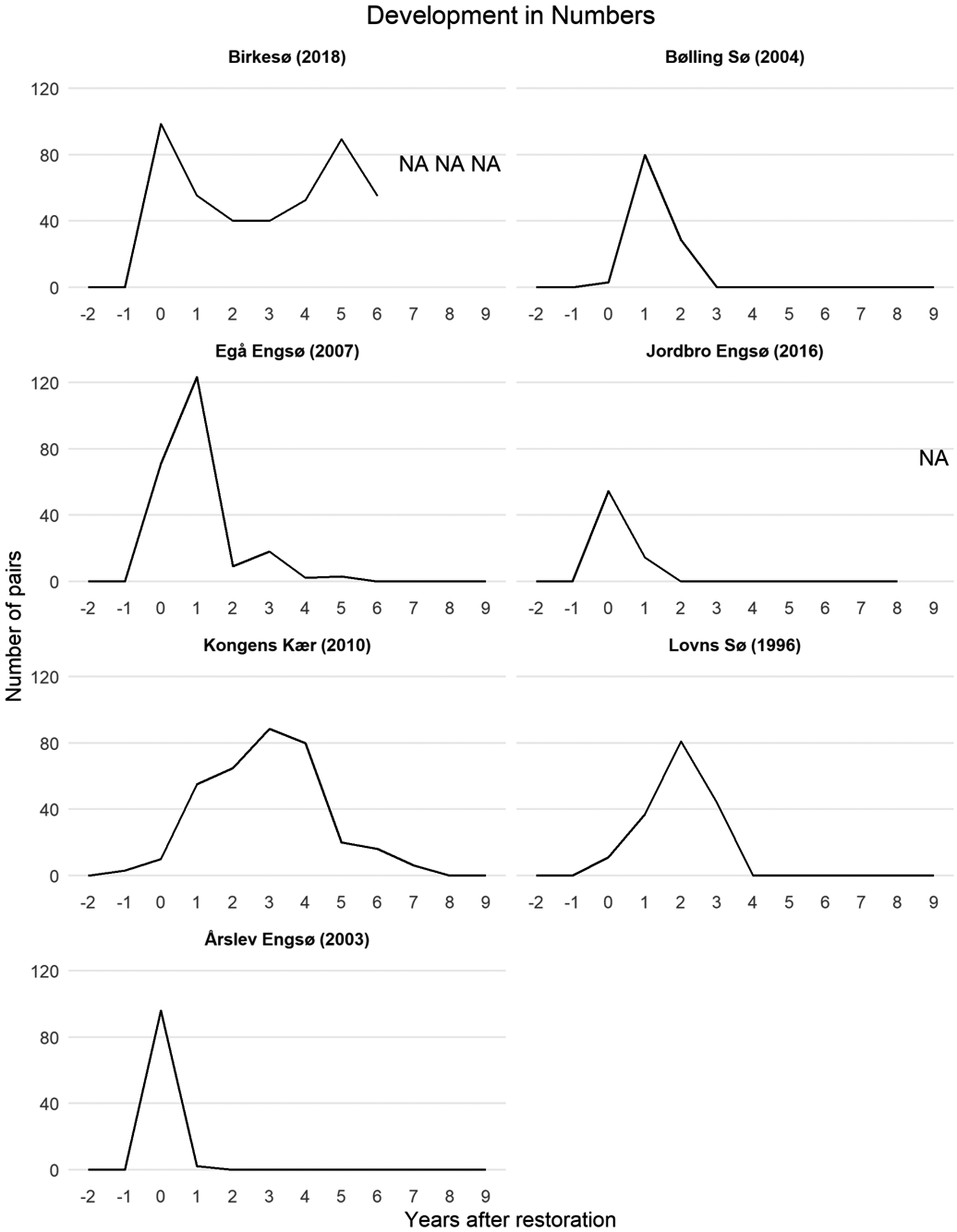
Figure 2. Long description
A multi-panel figure containing seven line graphs arranged in two columns. The shared Y axis is labeled Number of Birds, ranging from 0 to 250 in increments of 50. The shared X axis is labeled Years after restoration, ranging from negative 2 to 9, where 0 is the first possible breeding season.
* Birkesø (2018): Sharp peak at year 0 (200 birds), a dip to 80 at years 2 and 3, a second peak at year 5 (180 birds), followed by N A labels for years 7 through 9.
* Bølling Sø (2004): Sharp peak at year 1 (160 birds), dropping to 0 by year 3 and remaining at 0 through year 9.
* Egå Engsø (2007): Sharp peak at year 1 (250 birds), dropping to near 0 by year 4 and remaining at 0 through year 9.
* Jordbro Engsø (2016): Peak at year 0 (110 birds), dropping to 0 by year 2, with an N A label at year 9.
* Kongens Kær (2010): Gradual increase to a broad peak between years 3 and 4 (180 birds), dropping to near 0 by year 8.
* Lovns Sø (1996): Peak at year 2 (160 birds), dropping to 0 by year 4 and remaining at 0 through year 9.
* Årslev Engsø (2003): Sharp peak at year 0 (190 birds), dropping immediately to near 0 by year 1 and remaining at 0 through year 9.
Peak numbers of breeding pairs were not significantly correlated with lake size (Pearson’s r = -0.037, P = 0.698; Spearman’s ρ = 0.145, P = 0.133.
Discussion
Our analysis suggests that Black-necked Grebes currently rely heavily on wetland restoration projects to sustain their breeding population in Denmark. The results indicate that 1) in the present Danish landscape, the species shows a clear preference for restored wetlands over natural ones, and 2) the importance of these restored sites has increased markedly over recent decades, to the point where they now support most of the national population. Although estimating breeding numbers for Black-necked Grebes is notoriously difficult (Hansen Reference Hansen1999), and both the national population estimates and DOFbasen site-specific counts are subject to considerable uncertainty, the overall pattern strongly supports the significance of restored waterbodies to overall annual abundance. Given that natural lakes have been available throughout the entire study period, whereas restored lakes only became available from the year of restoration onward, the observed association between grebe numbers and restored sites is likely biased low, underscoring the species’ strong selection for these habitats. Our finding is supported by observations of increasing numbers locally in areas flooded following restoration efforts, and in Denmark this has been documented by Kjeldsen (Reference Kjeldsen2008) for the “Vejlerne” nature reserve and by Andersen (Reference Andersen2022) for several lakes in Northern Denmark. Termine (Reference Termine2017) describes a similar case from southern Europe.
Population trajectories at individual restored sites consistently revealed that Black-necked Grebes occupy these ecosystems only temporarily, typically abandoning them after a few years. Birkesø represents the most persistent colony among the examples, but was established only recently, and a decline in numbers may be expected in the coming years. The species has previously been characterised by high breeding site infidelity and a preference for unstable aquatic environments (Cramp and Simmons Reference Cramp and Simmons1977; Bankovics Reference Bankovics1991; Andersen Reference Andersen2022). While our dataset does not directly identify the drivers of colonisation and abandonment, the ephemeral presence following lake creation strongly suggests reliance on early successional stages in newly created aquatic systems. Studies of the diet of breeding Black-necked Grebes are generally lacking, but abundance of macroinvertebrates probably play an important role for habitat suitability (Fjeldså Reference Fjeldså2004). As proposed by Andersen (Reference Andersen2022), the short-lived breeding occupancy following colonisation of restored wetlands may involve a peak in food resources such as macroinvertebrates and reduced food competition from predatory fish and other vertebrates (Kloskowski et al. Reference Kloskowski, Nieoczym, Polak and Pitucha2010). Historically, such dynamic aquatic systems may have been more widespread in Denmark’s pre-industrial landscape, which featured extensive shallow wetlands and ephemeral pools (Suggate Reference Suggate1955; Hansen Reference Hansen2008; Dixon et al. Reference Dixon, Loh, Davidson, Beltrame, Freeman and Walpole2016). Today, however, these habitats are rare. Land reclamation, drainage, and dike construction have produced a static landscape dominated by permanent lakes and diminished hydrological variability, even within natural wetlands. In this context, restored wetlands may act as surrogate habitats, temporarily replicating the ecological conditions of naturally dynamic systems. Unfortunately, studies of Black-necked Grebes during the breeding season are sparse, and future investigations should aim to couple grebe abundance with habitat characteristics (e.g. plant communities), food availability (e.g. macroinvertebrate richness and densities) and important species associations (e.g. fish as competitors or colonial birds for nest defence).
Throughout much of its breeding range, the species occupies highly eutrophic (including hypersaline) shallow lakes and ponds in steppe and prairie biotopes, frequently in the absence of fish (Cullen et al. Reference Cullen, Jehl, Nuechterlein and Billerman2020). Hence from a habitat and biogeographical perspective, the Danish breeding population represents a peripheral group at the northern edge of the species’ range (Keller et al. Reference Keller, Herrando, Voříšek, Franch and Kipson2020). For this reason, the species in Denmark may therefore be particularly sensitive to fluctuating ecological conditions and demographic fluctuations driven by climate variability.
From a management standpoint, conservation efforts aimed at protecting the species in existing breeding areas are unlikely to be effective. The grebes appear to depend on the early successional stages of wetland development, which would require periodic resetting of habitat conditions (e.g. draining, seasonal desiccation). Given the broader societal goals associated with restored wetlands, such as nutrient retention, flood mitigation, and human recreation, such interventions are likely to be unacceptable in most cases.
We found no association between numbers and lake size, indicating that factors other than wetland area influenced the variation in breeding abundance across occupied sites. Black-necked Grebes are known to associate closely with colonies of Black-headed Gulls (Andersen Reference Andersen2022; Lamekhov Reference Lamekhov2022), and although we lack detailed data on gull numbers across all study sites, our findings generally support this affiliation and a potential influence on grebe abundance. As such, all the major breeding occurrences of Black-necked Grebes included as examples of population trajectories were linked to Black-headed Gull colonies. This may partly reflect a shared niche in terms of ecological conditions but, in addition, the grebes are known to benefit from the protection of cooperative nest defence provided by the gulls (Gwiazda et al. Reference Gwiazda, Flis, Ledwon and Wiehle2023). Consequently, the presence of Black-headed Gulls may very well affect the speed and likelihood of colonisation of Black-necked Grebes in potential breeding areas. Hence, creating features to support nesting gull colonies (such as the provision of islands) may help attract nesting birds to sites with suitable conditions for the grebes. However, our data also show that the persistence of gull colonies alone does not guarantee continued breeding by Black-necked Grebes. Several wetlands that once held significant grebe populations still host large gull colonies, despite the grebes having disappeared. Among the examples included in this paper, Egå Engsø and Årslev Engsø are clear examples of this pattern.
More passively, as long as new restoration projects continue, Black-necked Grebes seem capable of locating and exploiting these sites. Their rapid colonisation, often within the first year of restoration, suggests a high dispersal capacity and a strongly explorative behaviour prior to the breeding season. This aligns with historical observations of the earliest records of Black-necked Grebes in Denmark, breeding in ephemeral dune lakes with fluctuating water levels (Andersen Reference Andersen2022). Yet the persistence at two sites, Birkesø and Kongens Kær, show that if conditions are suitable, large numbers of breeding pairs can be retained for several years. This might indicate that suitable management interventions could maintain nesting grebes over longer periods. For this reason, we urge more research to understand precisely which ecological factors attract and support nesting Black-necked Grebes over longer time spans. An investigation of actual food items and the impact of competition from fish appears to be obvious next steps. The same applies to understanding the role of plant communities in lakes of different ages and the importance of nest protection provided by colony-nesting gulls. Despite the encouraging upsurge in wetland restoration in Denmark, biological surveys following construction are generally lacking. We therefore urge future restoration projects to incorporate appropriate monitoring schemes that enable robust investigations of the biological processes needed to test hypotheses about ecological drivers. In the current absence of such knowledge, a long-term conservation strategy might include the continued creation of new wetlands together with the reinvigoration of dynamic wetlands otherwise governed by natural hydrological processes designed to support Black-necked Grebes.
Acknowledgements
We owe great thanks to all the volunteer bird watchers reporting their sightings to DOFbasen and to Rasmus Due Nielsen and Jørgen Staarup Christensen for assisting the collection of historic data. Two anonymous reviewers provided valuable comments to an earlier draft.
Competing interests
The authors declare none


 Open access

