Introduction
Neonates and infants with CHD who require surgical intervention experience postoperative pain requiring proactive management, often involving the use of opioids. Both untreated pain and opioid exposure have been associated with significant consequences to the developing brain. Reference Visoiu1,Reference Walker2 Neonates, ≤ 30 days of age, are particularly vulnerable when undergoing cardiac surgery. Newborn sensory circuits are highly excitable, while neuroinhibitory pathways continue to develop postnatally, limiting the ability to filter external stimuli and increasing susceptibility to pain. Reference Visoiu1,Reference Bollen, Van den Brande and Bernagie3 Disruptions in state regulation caused by surgical or environmental stress, opioid use, and prolonged ICU stay may contribute to lasting developmental impairments, including motor and cognitive deficits, and emotional and behavioural challenges. Reference Bollen, Van den Brande and Bernagie3–Reference Selvanathan and Miller5
Current pain management strategies typically rely heavily on opioid analgesia to address postoperative pain in critically ill infants following cardiac surgery. However, prolonged opioid exposure is associated with tolerance, withdrawal, and potential long-term cognitive and neurological effects. Reference Bollen, Van den Brande and Bernagie3,Reference O’Byrne, Baxelbaum and Tam6 A recent retrospective cohort study of infants with CHD examined the association between opioid exposure in the first year of life and neurodevelopmental outcomes at 2 years. Reference O’Byrne, Baxelbaum and Tam6 Higher cumulative opioid doses in the first year of life, were independently associated with lower cognitive, language, and motor scores, emphasising the significant impact that early-life opioid exposure may have on brain development. Reference O’Byrne, Baxelbaum and Tam6 This study adds to the growing concern that, while necessary for pain control, opioid therapy in early infancy may contribute to adverse neurodevelopmental outcomes.
To our knowledge, no study has evaluated opioid exposure in neonates compared to infants following cardiac surgery. Comparison of postoperative opioid exposure in these distinct age groups may help to further risk-stratify patients. The objective of this study was to describe and compare opioid exposure in neonates and infants undergoing cardiac surgery. Specifically, to quantify differences in total opioid burden within the first 5 postoperative days.
Materials and methods
Study design and setting
This study is a secondary analysis of infants less than 1 year who underwent cardiac surgery and were included in the study to describe preliminary results of a comfort intervention. Reference Jones, Caprarola and Gordish7 The original study was conducted in accordance with the Declaration of Helsinki and was approved by the Institutional Review Board (IRB) at Children’s National Hospital). This secondary data analysis was IRB-exempt as it included only de-identified data.
Participants
All cardiac surgical patients less than one year of age at the time of their first operation over an 18-month period were included. Infants in both the pre- and post-intervention groups of the original study were included. Patients who required ECMO or reinterventions within the 5 days of surgery were excluded. Patients were categorised into two groups based on their age at the time of surgery. Neonates were defined as patients 30 days or younger at the time of surgery, and infants were defined as patients 31 days to one year of age at the time of surgery. Patients were excluded if they had incomplete or missing records regarding opioid administration or if key outcome data—specifically, opioid dosing within the first five postoperative days were unavailable.
Data collection and variables
Data were manually extracted from electronic medical records using a standardised protocol and were managed using REDCap electronic data capture tools hosted at Children’s National Hospital. Reference Harris, Taylor, Thielke, Payne, Gonzalez and Conde8 REDCap (Research Electronic Data Capture) is a secure, web-based application designed to support data capture for research studies, providing 1) an intuitive interface for validated data entry; 2) audit trails for tracking data manipulation and export procedures; 3) automated export procedures for seamless data downloads to common statistical packages; and 4) procedures for importing data from external sources. Reference Harris, Taylor, Thielke, Payne, Gonzalez and Conde8
Data collected included demographic and clinical characteristics, e.g. age at surgery, surgical weight, gestational age, gender, race, ethnicity, and the presence of genetic abnormalities. In addition, the classification of CHD was recorded based on the Clancy Classification. Reference Clancy, McGaurn and Wernovsky9 Clinical data collected included the duration of mechanical ventilation and the lengths of stay in both the cardiac ICU and the hospital. Opioid exposure was assessed by recording the total opioid dose administered within the first five postoperative days (including infusion and bolus dosing), which was standardised as milligram morphine equivalents per kilogram of body weight (Total milligram morphine equivalents = Fentanyl/10 + Hydromorphone/0.15 + Morphine). Detailed information on the opioid dosing regimen included the initial and maximum opioid infusion rates (expressed as MME/kg/hr) and the number of as-needed or PRN opioid doses administered during the postoperative period. Data regarding the administration of adjunctive agents, such as benzodiazepines (measured in milligrams per kilogram) and dexmedetomidine (micrograms/kilogram), and the prescribing of methadone at discharge were also collected. Routine pain and sedation assessments performed by clinical staff were collected.
Statistical analysis
Descriptive statistics were used to summarise the data. Continuous variables are presented as medians with corresponding minimum and maximum values, while categorical variables are expressed as frequencies and percentages. The primary comparisons between neonates and infants were performed using the Wilcoxon rank-sum test for continuous variables due to non-normal data distributions, and chi-square or Fisher’s exact tests for categorical variables, as appropriate. A p-value of < 0.05 was considered statistically significant. Statistical analyses were conducted using STATA V17 (College Station, TX).
Results
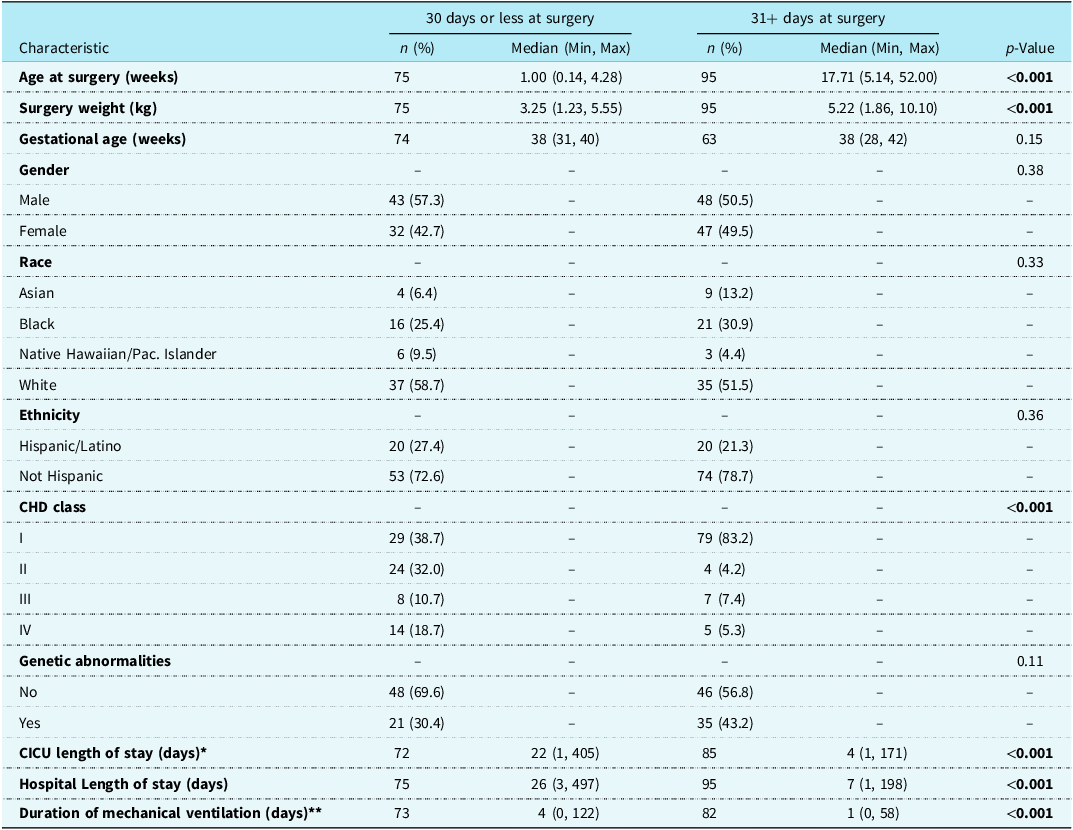
A total of 170 patients under one year of age who underwent cardiac surgery for CHD were included in the analysis, comprising 75 neonates and 95 infants. Baseline demographic and clinical characteristics are summarised in Table 1.
Demographic and clinical characteristics

Table 1. Long description
The table presents demographic and clinical characteristics of 170 patients under one year of age who underwent cardiac surgery for congenital heart disease (CHD). The patients are divided into two groups: those who had surgery within 30 days or less and those who had surgery after 31 days. The table includes 11 rows and 7 columns, with column headers such as Characteristic, 30 days or less at surgery, and 31+ days at surgery. Key characteristics include age at surgery in weeks, surgery weight in kilograms, gestational age in weeks, gender, race, ethnicity, CHD class, genetic abnormalities, C I C U length of stay in days, hospital length of stay in days, and duration of mechanical ventilation in days. Notable trends include significant differences in age at surgery, surgery weight, CHD class, C I C U length of stay, hospital length of stay, and duration of mechanical ventilation between the two groups, with p-values indicating statistical significance for these characteristics.
* CICU LOS and mechanical ventilation duration were not available for all patients due to limitations in documentation during retrospective chart review.
** A duration of 0 days indicates patients were extubated in the operating room and did not require postoperative mechanical ventilation.
The median surgical weight was significantly lower in neonates (3.25 kg [range: 1.23–5.55]) than in infants (5.22 kg [range: 1.86–10.10]; p < 0.001). There were no statistically significant differences between the two groups with respect to gestational age, genetic abnormalities, or gender distribution. Racial and ethnic distributions were comparable between the groups (p = 0.33 and p = 0.36, respectively). Notably, the complexity of CHD differed significantly between the groups. CHD severity was categorised into four classes: Class I included biventricular lesions without arch obstruction, Class II comprised biventricular lesions with arch obstruction, Class III represented single ventricle without arch obstruction, and Class IV consisted of single ventricle with arch obstruction. Reference Keane, Ourshalimian and Lakshmanan10 Neonates exhibited a more complex disease distribution, with 24 (32.0%) having Class II lesions, 8 (10.7%) having Class III, and 14 (18.7%) having Class IV lesions. The majority of infants (79 [83.2%]) had Class I disease, whereas only 29 (38.7%) of neonates fell into this category (p < 0.001). In contrast, the infant group had fewer severe cases, with only 4 (4.2%) Class II, 7 (7.4%) Class III, and 5 (5.3%) Class IV lesions. Neonates experienced significantly longer durations of mechanical ventilation (median 4 days [range: 0–122] vs. 1 day [range: 0–58]; p < 0.001), longer cardiac ICU stays (median 22 days [range: 1–405] vs. 4 days [range: 1–171]; p < 0.001), and longer overall hospitalisations (median 26 days [range: 3–497] vs. 7 days [range: 1–198]; p < 0.001). Neonates had significantly longer cardiopulmonary bypass times (median 137 minutes [range 44–277] vs. median 94 minutes [range 22–279 minutes]; p < 0.001). Thirty-five neonates (80%) and 74 (88%) of infants required aortic cross-clamp. Cross-clamp times were not significantly different between neonates and infants (median 69 minutes [range 15–181 minutes] versus median 55 minutes [range 9–196 minutes]; p = 0.21). Seven neonates (16%) and 1 infant (1%) required circulatory arrest, and circulatory arrest times were not significantly different (median time 33 minutes [range 7–49 minutes vs. 49 minutes]; p = 0.50). Compared to infants, significantly more neonates had delayed sternal closure (28 neonates (37%) vs. 7 infants (8%); p < 0.001) and required neuromuscular blockade in the first 5 postoperative days (54 (72%) neonates vs. 37 (39%) infants; p < 0.001). Additionally, neonates had a longer duration of chest tubes compared to infants (median 4.5 days vs. 2 days; p < 0.001).
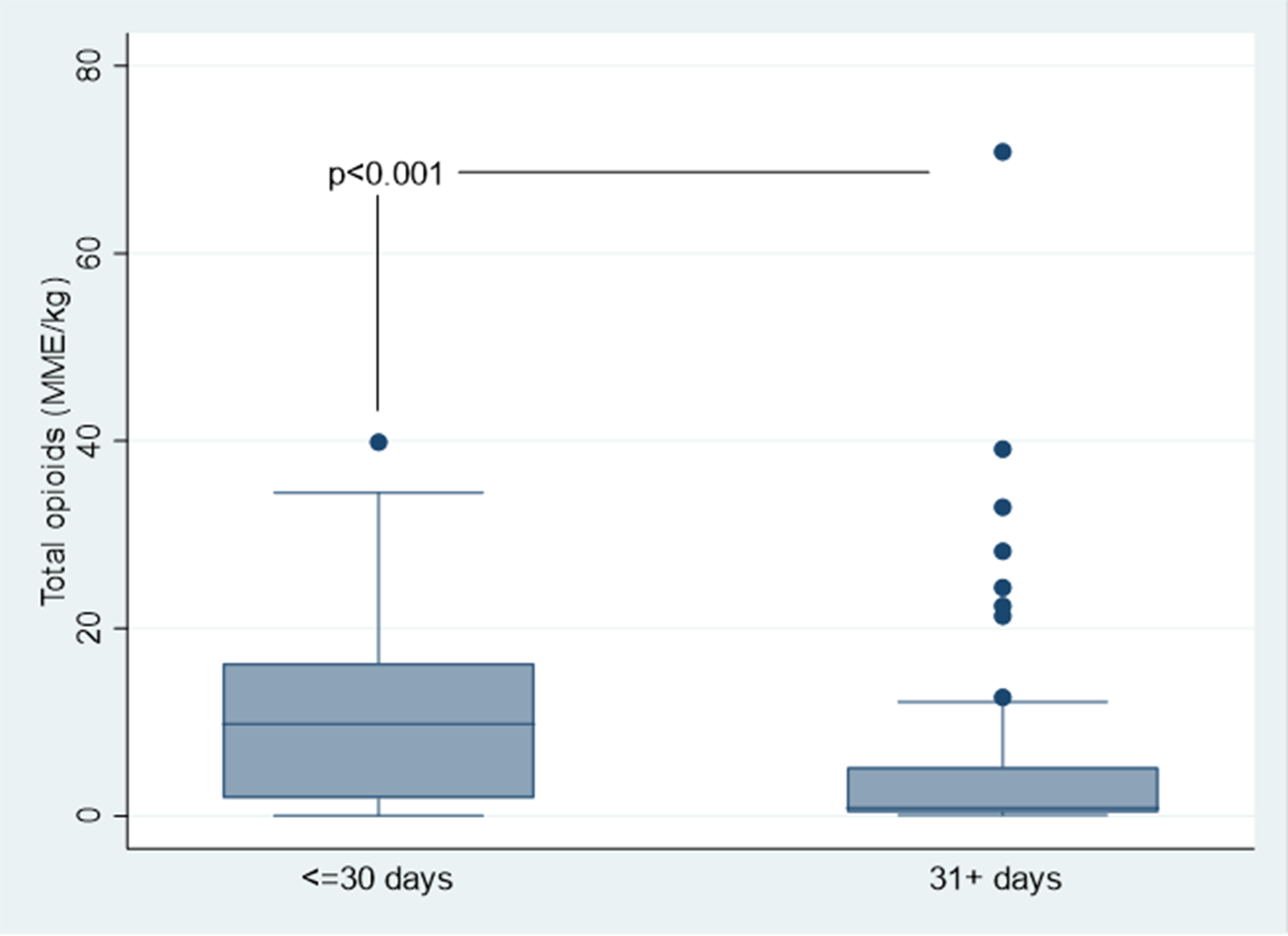
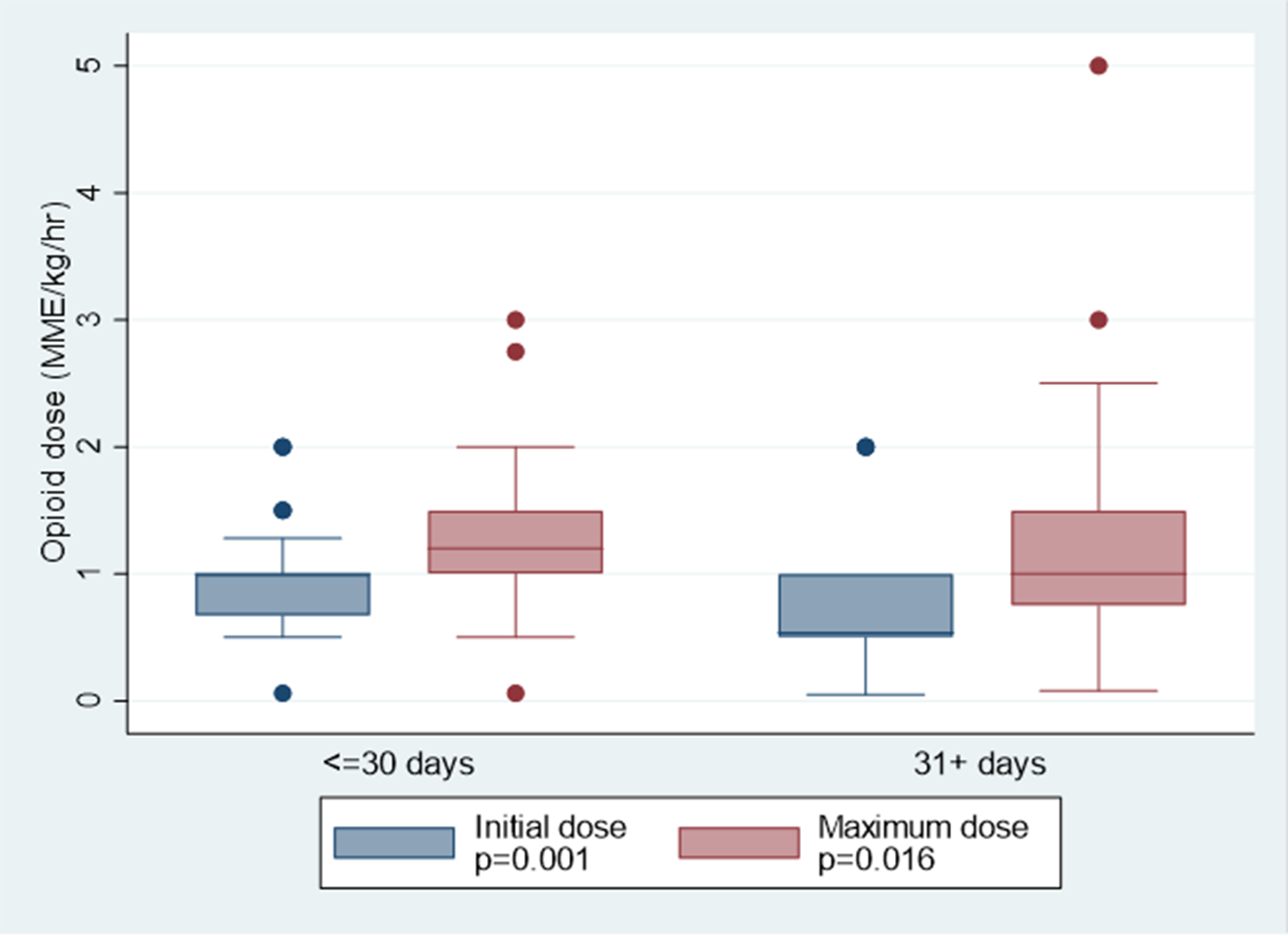
Neonates received significantly higher total opioid doses within the first five postoperative days compared with infants (see Figure 1). Specifically, the median total opioid exposure in neonates was 10.39 mg morphine equivalents/kg (range: 0.05–39.86 MME/kg) compared with 0.89 MME/kg (range: 0.10–70.83 MME/kg) in infants (p < 0.001). Initial and maximum opioid infusion doses were higher in neonates than in infants (0.93 versus 0.74 MME/kg/hr; 1.32 vs. 1.13 MME/kg/hr) (see Figure 2). Furthermore, neonates received a greater number of PRN (as-needed) opioid doses over the five-day postoperative period (median of 22 doses) relative to infants (median of 13 doses; p < 0.001).
Total opioid exposure in first 5 postoperative days.

Figure 1. Long description
A box-and-whisker plot compares total opioid exposure in milligrams per kilogram for two groups of patients based on age. The x-axis represents two age groups: patients 30 days of age or younger and patients older than 30 days. The y-axis represents total opioid exposure in milligrams per kilogram, ranging from 0 to 80. The box plot for patients 30 days of age or younger shows a median opioid exposure around 10 milligrams per kilogram, with the lower quartile around 5 milligrams per kilogram and the upper quartile around 20 milligrams per kilogram. The whiskers extend from approximately 0 to 40 milligrams per kilogram, with several outliers extending up to 80 milligrams per kilogram. The box plot for patients older than 30 days shows a median opioid exposure around 5 milligrams per kilogram, with the lower quartile around 2 milligrams per kilogram and the upper quartile around 10 milligrams per kilogram. The whiskers extend from approximately 0 to 20 milligrams per kilogram, with several outliers extending up to 80 milligrams per kilogram. The plot indicates a statistically significant difference in opioid exposure between the two age groups, with a p-value of less than 0.001.
Initial and maximum opioid infusion doses.

Figure 2. Long description
A box-and-whisker plot compares initial and maximum opioid infusion doses for neonates and infants with congenital heart disease (CHD), grouped by treatment duration. The plot features two sets of vertical box plots, one for treatment durations of 30 days or less and another for durations of 31 days or more. The x-axis represents the treatment duration categories, while the y-axis measures the opioid dose in milligrams of morphine equivalents per kilogram per hour (MME/kg/hr), ranging from 0 to 5. Each group contains two box plots: one for the initial dose and one for the maximum dose. The initial dose box plots are colored blue, and the maximum dose box plots are colored red. For the >=30 days group, the initial dose box plot shows a median around 1 MME/kg/hr, with a lower quartile near 0.5 and an upper quartile around 1.5. The maximum dose box plot for this group has a median around 1.5 MME/kg/hr, with a lower quartile near 1 and an upper quartile around 2. For the 31+ days group, the initial dose box plot shows a median around 1 MME/kg/hr, with a lower quartile near 0.5 and an upper quartile around 1.5. The maximum dose box plot for this group has a median around 2 MME/kg/hr, with a lower quartile near 1.5 and an upper quartile around 2.5. Outliers are present in both groups, with some values reaching up to 5 MME/kg/hr. The plot indicates that the maximum opioid dose tends to be higher than the initial dose, particularly for longer treatment durations. All values are approximated.
Additional analyses revealed that neonates had significantly higher exposure to dexmedetomidine, with a mean total dose of 45.39 ± 39.09 micrograms per kilogram (mcg/kg) compared with 29.01 ± 33.50 mcg/kg in infants (p = 0.002). While total benzodiazepine exposure was not significantly different between groups (p = 0.43), a greater number of infants (n = 30, 31%) received benzodiazepines compared to neonates (n = 8, 11%). A significantly higher proportion of neonates (31.3%) were discharged on methadone compared with infants (10.8%; p = 0.001).
This secondary data analysis included a combination of patients in cohorts both before and after implementation of a guideline that included a standardised pain and sedation protocol and guidelines for non-pharmacologic support. Before implementation of the pathway, there was significant variation in unit-wide practice related to pain management, and after the implementation of the standardised practice, we noted a non-statistically significant reduction in total opioid exposure in neonates; however, the initial dose of opioids was significantly lower in the post-implementation cohort. Reference Jones, Caprarola and Gordish7
Discussion
In this retrospective analysis comparing neonates and infants with CHD undergoing cardiac surgery, we found that neonates experienced significantly higher opioid exposure during the first five postoperative days compared with infants. Neonates received higher total opioid dose and a greater number of as-needed or PRN opioid doses within the first five postoperative days. Additionally, neonates were discharged from the hospital on methadone more frequently than infants, suggesting that the higher need for opioids in the neonatal group likely extends beyond the first 5 postoperative days.
The observed differences in opioid exposure between postoperative infants and neonates are likely multifactorial. Not surprisingly, we found that neonates had higher complexity of heart disease and experienced longer durations of cardiopulmonary bypass, mechanical ventilation, chest tubes, cardiac ICU and hospital stays compared to infants. Neonates also require delayed sternal closure and neuromuscular blockade more often than infants. These factors likely contribute to the increased need for analgesia during the postoperative period. Reference Keane, Ourshalimian and Lakshmanan10,Reference Sood, Newburger and Anixt11 Additionally, the immaturity of neonatal pain pathways and age-dependent pharmacokinetics may lead to heightened sensitivity to pain and alter opioid metabolism, necessitating higher or more frequent dosing to achieve adequate comfort. Reference Nandi and Fitzgerald12–Reference Bouwmeester, Hop, van Dijk, Anand, van den Anker and Tibboel14 .
Previous literature has demonstrated an association between early-life opioid exposure and adverse neurodevelopmental outcomes in children with CHD. Reference O’Byrne, Baxelbaum and Tam6 Our findings build on this work and suggest that this subgroup of neonates may be at greater risk for opioid-related adverse neurodevelopmental outcomes. They illuminate the heightened vulnerability of neonates to potential neurotoxic effects of prolonged opioid exposure. Though the neurodevelopmental risk profile is complicated in neonates, identifying specific potentially modifiable risk factors is a step towards developing targeted interventions to optimise long-term outcomes. Incorporating non-pharmacologic practices and nurse-driven sedation protocols guided by validated pain and sedation assessment tools may reduce opioid exposure in critically ill infants. Reference Curley, Wypij and Watson15–Reference Lisanti, Vittner and Peterson17
Prior studies have demonstrated that excessive auditory stimulation and elevated environmental noise levels increase infant stress and sedation requirements. Reference Caprarola, Jones and Yurasek18,Reference Garcia Guerra, Joffe and Sheppard19 Recognising that discomfort may result from sensory overstimulation and sensory deprivation (lack of positive touch, holding, parental voice) creates an opportunity to expand non-pharmacologic interventions, such as skin-to-skin care, caregiver holding, swaddling, and environmental modifications. Both skin-to-skin care and caregiver holding have been associated with improved comfort, autonomic regulation and haemodynamic stability in neonates with CHD. Reference Elhoff, Acosta and Flores20,Reference Lisanti, Demianczyk and Costarino21 Additionally, protocolised pain management has been associated with reduced opioid requirements by enabling individualised titration based on the infant’s behavioural cues and clinical status. Reference Curley, Wypij and Watson15,Reference Donnellan, Sawyer, Peach, Staveski, Nelson and Pratap22 High opioid exposure is only one of many complicated threats to the developing neonatal brain after cardiac surgery, however identification of this specific risk elevates the urgency to expand pain management practices beyond pharmacologic interventions.
The retrospective approach of the analysis poses several important limitations, particularly due to reliance on existing clinical documentation. Specifically, adjunct medications that may have influenced opioid exposure were not available in the dataset. Additionally, patients with greater illness severity may have required higher opioid doses due to factors not fully captured in the dataset, such as intraoperative complexity or post-operative complications. Furthermore, as this study was conducted at a single, high-volume tertiary care centre with specialised cardiac surgical and ICU teams, the generalisability of these findings to other institutions, particularly those with differing sedation practices or resource availability, may be limited. Finally, our analysis focused on short-term postoperative opioid exposure and did not evaluate long-term neurodevelopmental outcomes, which will be important to assess in future studies to determine the clinical significance of these exposure differences.
Future research should focus on prospective, multicentre studies that validate these findings across diverse care settings and institutional practices. Studies are also needed to evaluate multimodal pain management approaches, including the role, feasibility and safety of implementing non-opioid pharmacologic adjuncts in patients in the post-operative period who experience more hemodynamic instability and require more devices such as catheters and tubes that carry a risk if inadvertently removed with movement. It will also be important to study the effectiveness of such non-pharmacologic strategies for minimising pain and stress in neonates and infants recovering from cardiac surgery. Long-term follow-up is needed to better characterise the neurodevelopmental consequences of early-life opioid exposure across the CHD population.
Conclusion
Neonates with CHD who underwent cardiac surgery were exposed to significantly higher doses of opioids in the postoperative period compared to older infants, likely reflecting their greater disease complexity and heightened perioperative risks. Given the known neurodevelopmental consequences of prolonged opioid exposure in the developing brain of neonates and infants, these findings emphasise the heightened vulnerability of neonates compared to infants undergoing cardiac surgery. Though the risks in neonates undergoing cardiac surgery are complicated, characterising distinct risk factors is an important step to developing tailored interventions. The implementation of non-pharmacologic protocols such as environmental modifications, parental engagement, as well as standardised pharmacologic sedation protocols may be needed to optimise pain management and reduce unnecessary opioid exposure, particularly in neonates. Multicentre collaboration will be essential to inform best practices for the management of pain in neonates following cardiac surgery.
Acknowledgements
None.
Financial support
The Clinical and Translational Science Institute at Children’s National has grant support to help support REDCap (UL1TR001876).
Competing interests
None.