Psychopathy, or psychopathic personality, refers to a pathologic syndrome involving prominent behavioral deviancy in the presence of distinctive emotional and interpersonal features. The phenomenon of psychopathy has been of longstanding interest to psychological researchers because it offers an intriguing referent for the study of basic affective and behavioral–control processes (i.e., psychopathic individuals exhibit marked deficits in inhibitory control and are theorized to be deficient in basic emotional reactivity). Psychopathy has also been of longstanding interest to practitioners because of the important impact that psychopathic behavior has on society as a whole (e.g., offenders diagnosed as psychopathic account for a disproportionate amount of criminal offending; in particular, violent criminal offending). Especially for this latter reason, a great deal of attention has been devoted in recent years to how psychopathy develops and what can be done to prevent it. However, despite the many years of study devoted to the topic and the wealth of published research that exists on it (cf. Patrick, Reference Patrick and Patrick2006), heated controversies are still underway regarding the appropriate definition and scope of the psychopathy construct, and the optimal means for assessing it (Cooke, Michie, & Hart, Reference Cooke, Michie, Hart and Patrick2006; Hare & Neumann, Reference Hare, Neumann and Patrick2006; Skeem & Cooke, in press). The current review advances a novel conceptualization of psychopathy based on the central recurring themes evident in historic and contemporary accounts of the disorder, and discusses how established concepts and empirical findings from the developmental literature can be applied to this conceptualization.
The traditional counterpart to psychopathy in the general child psychopathology literature, preceding the introduction of specific inventories for the assessment of psychopathy in youth, has been the concept of “externalizing” psychopathology (cf. Achenbach & Edelbrock, Reference Achenbach and Edelbrock1978). The phenomenon of psychopathy can be considered distinct from the concept of externalizing in that it entails a deficiency rather than an excess of affective reactivity. That is, psychopathy is distinguished from general externalizing by “emotional detachment,” which is a lack of normal emotional sensitivity and social relatedness (Cleckley, Reference Cleckley1976; Lykken, Reference Lykken1995; McCord & McCord, Reference McCord and McCord1964; Patrick, Bradley, & Lang, Reference Patrick, Bradley and Lang1993). From this perspective, understanding the phenomenon of psychopathy requires elucidation of factors that give rise to disinhibited behavior in the company of emotional detachment (i.e., distinctive manifestations of externalizing deviancy in which emotional detachment is salient).
Toward this end, considerable effort has been devoted over the past 15 years to the study of psychopathy in childhood and adolescence. The major focus of work in this area has been on so-called “downward extensions” of the adult psychopathy construct (e.g., Forth, Kosson, & Hare, 1996; Frick & Hare, Reference Frick and Hare2001; Lynam, Reference Lynam1997). This work has yielded important advances, but uncertainties remain regarding what psychopathy in youth entails, how it should be measured, and how it intersects with normal and abnormal development. We argue that work in this area can be advanced by conceptualizing psychopathy in terms of more elemental phenotypic constructs with clearer psychological and neurobiological referents. Further, we believe that progress in this area can be advanced by considering how established concepts and findings from the general developmental literature with potential relevance to these key phenotypic constructs can be “upwardly extended” to inform the psychopathy literature.
Thus, one objective of the current review is to describe contemporary research pertaining to the assessment of psychopathy in adults as well as youth as a basis for defining core phenotypic constructs of disinhibition, boldness, and meanness. A second major objective is to discuss how established concepts and findings from the general developmental literature can be tied to these core phenotypic constructs.
Historical Perspectives on Psychopathy
Early accounts of the syndrome of psychopathy assigned prominent emphasis to violent and antisocial behavior, presumably owing to the salience of such behavior in otherwise rational-appearing individuals. Explosive, impulsive, reckless, and irresponsible actions, which were often accompanied by alcohol or drug problems (e.g., Partridge, Reference Partridge1928a, Reference Partridge1928b; Prichard, Reference Prichard1835) and sometimes by suicidal behavior (e.g., Partridge, Reference Partridge1928a; Pinel, Reference Pinel and Davis1962), emerged repeatedly as themes. As described further below, these features reflect the disinhibitory (Gorenstein & Newman, Reference Gorenstein and Newman1980) or externalizing (Krueger et al., Reference Krueger, Hicks, Patrick, Carlson, Iacono and McGue2002; Patrick, Hicks, Krueger, & Lang, Reference Patrick, Hicks, Krueger and Lang2005) component of psychopathy included in modern conceptualizations. For Pinel (Reference Pinel and Davis1962), explosive violence (“abstract and sanguinary fury”) was the most salient clinical feature. Partridge's (1928a, 1928b) description of the “sociopathic” individual in particular emphasized tendencies toward emotional instability, feelings of inadequacy or inferiority, alienation, and angry aggression. This pattern of emotional volatility and impulsive–reactive violence appears characteristic of high externalizing individuals (cf. Patrick & Bernat, Reference Patrick, Bernat, Hodgins, Viding and Plodowski2009) rather than individuals who would be considered psychopathic according to contemporary definitions.
A second set of attributes emphasized in these early accounts, which appears somewhat at odds with the features just mentioned, consists of charm, self-assurance, interpersonal dominance, attention seeking, persuasiveness, and affective shallowness. For example, a subgroup labeled “swindlers” by Kraepelin (Reference Kraepelin1904) were characterized as glib and charming but lacking in basic morality or loyalty to others; they typically specialized in fraudulence and con artistry and invariably accumulated large debts that went unpaid. “Self-seeking” psychopaths as described by Schneider (Reference Schneider1934) were described as pleasant and affable, but egocentric, demanding of attention, and superficial in their emotional reactions and their relations with others. Like Kraepelin's swindlers, Schneider's self-seeking types were pathologically deceitful and prone to fraudulent behavior. As described below, this set of features was central to Cleckley's (1976) conception of psychopathic personality.
A third prominent emphasis in early historical accounts consists of features relating to brutality, emotional coldness, and callous exploitation of others. For example, one of three illustrative cases presented by Pinel (Reference Pinel and Davis1962) was characterized as efficacious and successful in his financial dealings but self-centered and viciously antagonistic in his interactions with others. Rush (Reference Rush1812) emphasized cruelty and viciousness in his account of the psychopath and posited that a deep-rooted “moral depravity” lay at the core of the disorder. Schneider's (Reference Schneider1934) “active affectionless” type was characterized as unscrupulous, cold, and unfeeling. Schneider attributed these tendencies, which he saw as emerging early in life, to a core deficit in emotional sensitivity rather than to a weakness in moral judgment.
Cleckley's classic treatise The Mask of Sanity (1976) served as the foundation for modern conceptualizations and measures of psychopathy. Central to Cleckley's account, which was based on his direct experiences with psychopathic individuals in a large inpatient psychiatric facility, was the idea that psychopathy entails the presence of severe underlying pathology masked by an outward appearance of robust mental health. In contrast with other psychiatric patients who present as irrational, agitated, dysphoric, socially withdrawn, or otherwise disturbed, psychopaths impress as confident, personable, and psychologically well adjusted on first contact. It is only through continued observation across a range of settings that the psychopath's underlying pathology reveals itself. To provide a basis for diagnostic clarity and specificity, Cleckley set forth a list of 16 specific criteria for the disorder, which can be grouped into three categories (Patrick, Reference Patrick and Patrick2006): (a) positive adjustment indicators (good intelligence and social adeptness, absence of delusions or irrationality, absence of nervousness, and low incidence of suicide); (b) behavioral deviance indicators (“unreliability,” i.e., irresponsibility, sexual promiscuity, impulsive antisocial acts, failure to learn from experience, absence of any clear life plan, and enhanced recklessness when intoxicated); and (c) indicators of emotional unresponsiveness and impaired social relatedness (lack of remorse or shame, poverty in affective reactions, egocentricity and inability to love, deceitfulness and insincerity, absence of loyalty, and deficient insight).
Notably, Cleckley (Reference Cleckley1976) did not describe psychopathic patients as antagonistic, violent, or cruel, and few (only 3 of 15) of his clinical case examples showed strong indications of interpersonal aggressiveness. Indeed, Cleckley maintained that the characteristic emotional unresponsiveness of psychopaths mitigates against angry, vengeful reactions. Furthermore, Cleckley's concept of psychopathy extended beyond individuals who engaged repeatedly in antisocial acts that caused them problems. Cleckley also described examples of “successful psychopaths” who established careers as physicians, scholars, or businessmen. His perspective on the etiology of psychopathy was that it reflected a deep-rooted impairment in emotional processing akin to semantic aphasia (in the realm of language processing) or colorblindness (in the realm of perceptual processing; cf. Maudsley, Reference Maudsley1874). From this perspective, it was the occurrence of this core underlying impairment that defined the presence of the disorder, as opposed to a particular overt behavioral expression.
However, in contrast, other writers of Cleckley's time concerned with psychopathy in criminal offender samples presented a somewhat different picture of the disorder. McCord and McCord's (Reference McCord and McCord1964) volume The Psychopath: An Essay on the Criminal Mind emphasized features of emotional coldness, social detachment, and dangerousness, along with behavioral disinhibition. Like Cleckley, McCord and McCord considered psychopaths to be deficient in anxiety and emotional responsiveness. However, in their view, these affective impairments were a reflection of profound social disconnectedness (“lovelessness” and “guiltlessness”) rather than of a global deficit in affective-motivational capacity. In particular, McCord and McCord maintained that psychopathic individuals, lacking in social conscience and inhibitions against aggression, characteristically responded with rage as opposed to fear in frustrating or threatening situations. Thus, in contrast with Cleckley, who described psychopathic inpatients as neither “deeply vicious” nor “volcanically explosive,” McCord and McCord characterized psychopathic criminals as cold, vicious, and predatory.
Writers of Cleckley's era concerned with psychopathy in criminal samples also highlighted cruelty and aggressiveness as features. Lindner (Reference Lindner1944) characterized criminal psychopaths as truculent and antagonistic. Craft (Reference Craft and Craft1966) identified a “vicious” criminal psychopathic subtype, whom he described as “affectionless, impulsive, and persistently aggressive.” (p. 212). Robins (Reference Robins1966, Reference Robins1978) likewise emphasized early and persistent aggressive antisociality in her empirical accounts of maladjusted youth who developed into adult “sociopaths.” Robins' work served as the cornerstone for the modern notion of antisocial personality disorder (APD) included in the third and fourth editions of the Diagnostic and Statistical Manual of Mental Disorders (DSM-III, DSM-IV; American Psychiatric Association, 1980, 2000), which emphasizes aggression, destructiveness, and other forms of delinquency in childhood and behavioral evidence of impulsivity, deception, recklessness, aggressiveness, and criminal deviancy in adulthood.
In terms of core phenotypic constructs discussed in detail below, Cleckley and his contemporaries similarly highlighted disinhibition (proneness to externalizing behavior) in their accounts of psychopathy, but differed in the emphasis they assigned to boldness versus meanness in conceptualizing the disorder. The most obvious explanation for this difference is that Cleckley's psychopathic case examples consisted of psychiatric inpatients rather than incarcerated criminal offenders. The antisocial acts they perpetrated were generally of a lesser, nonviolent nature and appeared irrational (“unmotivated”) in ways suggestive of an underlying mental disorder. In addition, Cleckley's patients tended to come from higher rather than lower socioeconomic backgrounds and in many cases possessed familial and other sources of social support that buffered them against legal consequences. In contrast, writers of Cleckley's time concerned with youthful and adult criminals sought to delineate a specific subgroup whose antisocial deviancy was distinguished by its amorality, severity, persistence, and recalcitrance to treatment. Individuals of this kind were notable for their aggressiveness, emotional coldness, indifference to the feelings and welfare of others, and predatory victimization. They tended to come from impoverished, abusive backgrounds (e.g., McCord and McCord identified parental abuse and neglect as distinctively pathogenic for criminal psychopathy) and engaged in serious forms of antisocial behavior that provoked harsh legal penalties.
Summary
Differing conceptualizations of psychopathy are evident in historic accounts of the disorder. One perspective, advanced by Cleckley in his account of hospital inpatients considered to be psychopathic, portrays the disorder as a paradoxical condition in which an outward veneer of positive adjustment (absence of obvious mental disturbance, high social efficacy, emotional resiliency) masks a severe underlying pathology manifested by persistent impulsive, irresponsible behavior without regard for consequences to oneself or others. As discussed in the next section, this conceptualization appears to be operationalized less effectively by assessment instruments that index psychopathy as a putatively unitary (unidimensional) construct, and more effectively by instruments that measure psychopathy in terms of separate components. In contrast with this, the other major perspective evident in historic writings is of psychopathy as a distinctly affectionless and predatory form of criminal deviancy (cf. McCord & McCord, Reference McCord and McCord1964). In contrast with Cleckley's portrayal of psychopathic patients as personable and ostensibly well meaning but feckless and untrustworthy, this latter perspective conceptualizes psychopathic individuals as cold, abrasive, and aggressively exploitative in their interactions with others. As discussed in the next section below, contemporary clinical diagnostic instruments for the assessment of psychopathy in youth and adults reflect this conceptualization of psychopathy more so. Assessment instruments of this kind, although designed to assess psychopathy as a unitary construct, nonetheless evidence distinguishable affective–interpersonal and behavioral deviance factors.
Contemporary Approaches to Conceptualizing and Assessing Psychopathy
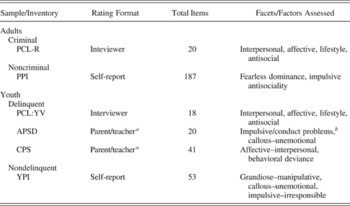
Table 1 provides a summary of major current inventories for the assessment of psychopathy in adult and youthful participant samples. Relevant empirical findings for each are reviewed below.
Summary of inventories for the assessment of psychopathy in differing participant samples

Note: PCL-R, Psychopathy Checklist—Revised (Hare, Reference Hare2003); PPI, Psychopathic Personality Inventory (Lilienfeld & Andrews, Reference Lilienfeld and Andrews1996); PCL:YV, Psychopathy Checklist: Youth Version (Forth et al., Reference Forth, Kosson and Hare2003); APSD, Antisocial Process Screening Device (Frick & Hare, Reference Frick and Hare2001); CPS, Child Psychopathy Scale (Lynam, Reference Lynam1997); YPI, Youth Psychopathic Traits Inventory (Andershed et al., Reference Andershed, Kerr, Stattin, Levander, Blau and Sheridan2002).
aSelf-report version available also.
bSeparates into distinct “impulsive” and “narcissistic” subfactors in some work (e.g., Frick, Boden, & Barry, Reference Frick, Boden and Barry2000).
Psychopathy in adult offender samples
Currently, the dominant instrument for assessing psychopathy in adult criminal offender samples is Hare's (2003) Psychopathy Checklist—Revised (PCL-R). Before the PCL-R was developed, Hare's empirical research employed a global rating approach in which a diagnostic rating from 1 to 7 was assigned to indicate the participant's degree of resemblance to Cleckley's description of the prototypic psychopath (1 = clearly nonpsychopathic, 7 = definitely psychopathic). The original PCL, which consisted of 22 items, was developed to clarify and systematize the assessment of psychopathy in correctional and forensic samples based on Cleckley's conceptualization. The items of the PCL were distilled from a larger candidate pool by selecting those that best discriminated between high versus low scorers on the 1–7 Cleckley Global Scale. Two items were omitted from the revised version (Hare, Reference Hare1991, Reference Hare2003) and the scoring criteria for the remaining 20 items were modified in various ways. Regarding the item content of the PCL-R, the affective–interpersonal and behavioral maladjustment features described by Cleckley are well represented. However, the positive adjustment features are not. In particular, absence of nervousness/neuroticism is not part of the PCL-R, nor is “absence of delusions or irrationality” or immunity to suicide. Further, although ostensibly similar to Cleckley's “superficial charm and good intelligence,” “glibness and superficial charm” in the PCL-R (Item 1) is defined in a more deviant manner, that is, reflecting an excessively talkative, slick, and insincere demeanor.
Patrick (Reference Patrick and Patrick2006) attributed this omission of positive adjustment indicators to the strategy that was used to select items for the original PCL. Items were chosen to index psychopathy as a unitary construct in criminal offenders using overall Cleckley prototype ratings as the criterion, and items were retained that demonstrated high internal consistency with one another as well as effective discrimination between low and high Cleckley groups (Hare, Reference Hare1980). Because more of Cleckley's criteria reflect deviancy (12 of 16) as opposed to positive adjustment (4 of 16) and because participants in the PCL development sample were criminals rather than nonincarcerated patients or nonpatients, it seems likely that the initial candidate pool included many more deviance-related items, such that positive adjustment indicators dropped out in the selection process. The result is that the PCL-R, compared with Cleckley's original diagnostic criteria, contains items that are uniformly indicative of deviancy and psychological maladjustment. In addition, the overall scores on the PCL-R show robust positive relations with varying measures of deviancy and maladjustment including extent and severity of criminal acts, antagonism and aggression, and alcohol and drug problems, but negligible associations with measures of positive adjustment such as verbal ability, anxiousness, internalizing symptoms, and suicide immunity (Hall, Benning, & Patrick, Reference Hall, Benning and Patrick2004; Hare, Reference Hare2003; Lynam & Derefinko, Reference Lynam, Derefinko and Patrick2006; Smith & Newman, Reference Smith and Newman1990; Verona, Patrick, & Joiner, Reference Verona, Patrick and Joiner2001).
However, despite the fact that the PCL-R was developed to index psychopathy as a unitary syndrome, factor analytic and correlational-validation research indicates that it nonetheless taps distinguishable component factors. The best-known structural model of the PCL-R is the two-factor model (Harpur, Hakstian, & Hare, Reference Harpur, Hakstian and Hare1988; Hare et al., Reference Hare, Harpur, Hakstian, Forth, Hart and Newman1990), in which Factor 1 encompasses the interpersonal and affective features of psychopathy and Factor 2 encompasses the antisocial deviancy features. However, Cooke and Michie (Reference Cooke and Michie2001) proposed an alternative three-factor model in which Factor 1 is parsed into two components (“arrogant and deceitful interpersonal style,” marked by charm, grandiosity, deceitfulness, and manipulation; and “deficient affective experience,” consisting of absence of remorse, callousness, shallow affect, and failure to accept responsibility) and Factor 2 is pared down to an “impulsive–irresponsible behavioral style” factor consisting of five items (boredom proneness, parasitism, impulsivity, irresponsibility, and absence of goals) considered to reflect underlying traits as opposed to behavioral outcomes associated with those traits. In addition, Hare and Neumann (Reference Hare, Neumann and Patrick2006) advanced a four-factor model in which Factor 1 is parsed into two “facets” mirroring Cooke and Michie's interpersonal and affective factors, and Factor 2 is divided into a “lifestyle” facet identical to Cooke and Michie's impulsive–irresponsible factor and an “antisocial” factor encompassing aggressiveness, early behavior problems, juvenile delinquency, revocation of conditional release, and criminal versatility.
Reflecting the unitary conception of psychopathy that guided the PCL-R's development, constituent factors within each of these factor models show moderate (~.5) correlations with one another. Nonetheless, these separable factors also show diverging relations with various external criterion measures. In the two-factor model, high scores on Factor 1 are associated with higher scores on indices of selfishness and exploitativeness such as narcissism and Machiavellianism (Harpur, Hare, & Hakstian, Reference Harpur, Hare and Hakstian1989; Hare, Reference Hare1991; Verona et al., Reference Verona, Patrick and Joiner2001), heightened use of proactive (instrumental/premeditated) aggression (Patrick & Zempolich, Reference Patrick and Zempolich1998; Porter & Woodworth, Reference Porter, Woodworth and Patrick2006), and lower scores on measures of empathy (Hare, Reference Hare2003). In addition, scores on Factor 1 (in particular, the variance in Factor 1 that is unrelated to Factor 2) show some relationship with adaptive tendencies. For example, Factor 1 shows positive correlations with measures of social dominance (Hare, Reference Hare1991; Harpur et al., Reference Harpur, Hare and Hakstian1989; Verona et al., Reference Verona, Patrick and Joiner2001) and negative correlations with measures of fearfulness, distress/anxiety, and depression (Harpur et al., Reference Harpur, Hare and Hakstian1989; Hicks & Patrick, Reference Hicks and Patrick2006). Evidence of diminished physiological responsiveness to fearful and aversive stimuli has also been reported specifically in relation to Factor 1 of the PCL-R (cf. Patrick, Reference Patrick1994, Reference Patrick, Herve and Yuille2007). In contrast, Factor 2 of the PCL-R shows selective positive relations with trait measures of aggression, impulsivity, and general sensation seeking (Harpur et al., Reference Harpur, Hare and Hakstian1989; Hare, Reference Hare1991), as well as child symptoms of DSM APD, and is correlated to a markedly higher degree than Factor 1 with adult APD symptoms and variables reflecting frequency and severity of criminal offending (Hare, Reference Hare2003; Verona et al., Reference Verona, Patrick and Joiner2001). In contrast with Factor 1, Factor 2 is associated more with angry-reactive forms of aggression (Patrick & Zempolich, Reference Patrick and Zempolich1998; Porter & Woodworth, Reference Porter, Woodworth and Patrick2006). Factor 2 also shows robust positive associations with measures of alcohol and drug dependence, whereas Factor 1 shows negligible relations (Hare, Reference Hare2003; Smith & Newman, Reference Smith and Newman1990).
Studies of the external correlates of components of the PCL-R identified by the three- and four-factor models have also begun to appear. Skeem, Mulvey, and Grisso (Reference Skeem, Mulvey and Grisso2003) reported that the impulsive–irresponsible (“Lifestyle”) factor was most related to overall frequency and severity of criminal offending, incidence of property crimes, and substance-related disorders. The Affective factor was most related to historic and future violence and crimes against people, and the Interpersonal factor was associated to a lesser degree with past and future criminal deviancy than either the Affective or Lifestyle factors. Hall et al. (Reference Hall, Benning and Patrick2004) reported that the Interpersonal factor accounted for aforementioned associations between PCL-R Factor 1 and measures of social efficacy and emotional resilience. The unique variance in the Interpersonal factor (i.e., that unrelated to the Affective and Lifestyle factors) was associated positively with five-factor model (FFM) extraversion, openness, and conscientiousness, and negatively with FFM neuroticism. This factor also showed distinctive positive associations with verbal intelligence and personal and parental socioeconomic status. In contrast, scores on the Lifestyle factor showed selective relations with varying measures of externalizing deviancy and maladjustment including traits of impulsivity, sensation seeking (disinhibition and boredom facets, in particular), anger, alienation, high neuroticism and dysphoria/distress, and low conscientiousness and achievement motivation; fighting in childhood and adulthood; drug and alcohol problems; and low personal socioeconomic status. Replicating Skeem et al. (Reference Skeem, Mulvey and Grisso2003), scores on the Affective factor were associated selectively with violent criminal offending (including incidence of assault, weapons possession, kidnapping, and murder). The most salient personality correlates of this factor were aggressiveness, low agreeableness, and low affiliation (low social closeness/communality). Scores on this factor also predicted a reduced incidence of specific fears. The antisocial facet of the PCL-R (cf. Hare & Neumann, Reference Hare, Neumann and Patrick2006), although generally paralleling the lifestyle facet in its associations with criterion measures, showed higher correlations with aggression-related than impulsivity-related personality traits and stronger associations with violent criminal charges. In other work with female offenders, Verona, Hicks, and Patrick (Reference Verona, Hicks and Patrick2005) reported the antisocial and (to a lesser degree) lifestyle facets of the PCL-R to be positively associated with past suicidal attempts, whereas the interpersonal facet showed a selective negative association with suicidality. Similar results were reported by Douglas et al. (Reference Douglas, Lilienfeld, Skeem, Poythress, Edens and Patrick2008) for a male offender sample.
Summary
Hare's PCL-R was developed to assess the syndrome of psychopathy as described by Cleckley in adult criminal offender samples. The development strategy for the PCL-R emphasized measurement of psychopathy as a unitary construct, resulting in a generally interrelated set of behavioral indicators. Nonetheless, factor analyses of the PCL-R items indicate the presence of distinctive (albeit correlated) affective–interpersonal and behavioral deviance factors. In terms of concepts discussed below, the item content of the PCL-R appears to tap disinhibition and meanness primarily, and boldness only secondarily. In particular, the positive adjustment features of psychopathy emphasized by Cleckley (e.g., absence of psychotic symptoms; lack of anxiety or nervousness; immunity to suicide) are weakly represented in the PCL-R.
The meanness and disinhibition components of psychopathy (preferentially reflected in Factors 1 and 2 of the PCL-R, respectively) are important to distinguish because research on psychopathy in youth (cf. Frick & Marsee, Reference Frick, Marsee and Patrick2006; Frick & Morris, Reference Frick and Morris2004; see below) indicates that these components have different etiologic substrates, with the former theorized to derive (at least in part) from diminished fear capacity, and the latter from impairments in inhibitory control.
Psychopathy in adult noncriminal samples
To date, only a few studies have been conducted in which adults from the community have been assessed for psychopathy using clinical diagnostic procedures (Ishikawa, Raine, Lencz, Bihrle, & lacasse, Reference Ishikawa, Raine, Lencz, Bihrle and Lacasse2001; Raine et al., Reference Raine, Ishikawa, Arce, Lencz, Knuth and Bihrle2004; Vanman, Mejia, Dawson, Schell, & Raine, Reference Vanman, Mejia, Dawson, Schell and Raine2003; Widom, Reference Widom1977). However, participants identified as psychopathic in these studies evidenced high levels of antisocial deviancy and thus could more accurately be labeled “subclinical” than “noncriminal” or “successful” (cf. Hall & Benning, Reference Hall, Benning and Patrick2006). Some other published studies have assessed psychopathy in student (e.g., Forth et al., Reference Forth, Brown, Hart and Hare1996), civil psychiatric (e.g., Skeem, Miller, Mulvey, Tiemann, & Monahan, Reference Skeem, Miller, Mulvey, Tiemann and Monahan2005), or at-risk community samples (e.g., Farrington et al., Reference Farrington, Coid, Harnett, Joliffe, Soteriou, Turner and West2006) using a screening version of the PCL-R (PCL:SV; Hart, Cox, & Hare, Reference Hart, Cox and Hare1995). However, the range of PCL:SV scores in general community samples tends to be highly restricted, and concerns have been raised regarding the sensitivity of PCL-based ratings for assessing core features of psychopathy in nonincarcerated individuals, particularly in view of the strong emphasis on criminal deviancy in the scoring of most PCL items (Skeem & Cooke, in press; Widiger, Reference Widiger and Patrick2006; see also Widiger et al., Reference Widiger, Cadoret, Hare, Robins, Rutherford and Zanarini1996).
The other major assessment approach that has been used to identify psychopathic individuals in nonincarcerated adult samples is self-report. A variety of self-report measures have been developed and utilized over the years (Lilienfeld & Fowler, Reference Lilienfeld, Fowler and Patrick2006), but for the most part these index mainly the antisocial deviance (Factor 2) component of psychopathy (Hare, Reference Hare1991, Reference Hare2003; Harpur et al., Reference Harpur, Hare and Hakstian1989; Lilienfeld & Fowler, Reference Lilienfeld, Fowler and Patrick2006). A notable exception is the Psychopathic Personality Inventory (PPI; Lilienfeld & Andrews, Reference Lilienfeld and Andrews1996; Lilienfeld & Widows, Reference Lilienfeld and Widows2005), which was developed to assess psychopathy as described by Cleckley in nonincarcerated samples. Unlike the PCL-R, the PPI was not developed to index psychopathy as a unitary construct. Instead, an inclusive personality-based approach was taken with the aim of capturing the full spectrum of trait constructs embodied in Cleckley's description. Eight unidimensional subscales were developed to assess these varying constructs, and exploratory factor analyses of these subscales have revealed two distinct higher order factors (Benning, Patrick, Hicks, Blonigen, & Krueger, Reference Benning, Patrick, Hicks, Blonigen and Krueger2003; Benning, Patrick, Salekin, & Leistico, Reference Benning, Patrick, Salekin and Leistico2005; Ross, Benning, Patrick, Thompson, & Thurston, Reference Ross, Benning, Patrick, Thompson and Thurston2009). Social potency, stress immunity, and fearlessness subscales load preferentially on one factor (PPI-I), and impulsive nonconformity, blame externalization, Machiavellian egocentricity, and carefree nonplanfulness subscales load on a second factor (PPI-II). Benning, Patrick, Blonigen, Hicks, and Iacono (Reference Benning, Patrick, Blonigen, Hicks and Iacono2005) labeled these factors fearless dominance and impulsive antisociality. Unlike PCL-R Factors 1 and 2, which are moderately correlated, the two higher order factors of the PPI are uncorrelated. The eighth PPI subscale, coldheartedness (reflecting low sentimentality and imaginative capacity, and low responsiveness to others' distress), does not load appreciably on either PPI factor but instead defines a separate factor in an expanded three-factor solution (Benning et al., Reference Benning, Patrick, Hicks, Blonigen and Krueger2003).
Like the two PCL-R factors, the higher order factors of the PPI show meaningful, diverging relations with a variety of external criterion variables (Benning et al., Reference Benning, Patrick, Hicks, Blonigen and Krueger2003; Benning, Patirck, Bloigen, et al., 2005; Benning, Patrick, Salekin, et al., 2005; Blonigen et al., Reference Blonigen, Hicks, Patrick, Krueger, Iacono and McGue2005; Douglas et al., Reference Douglas, Lilienfeld, Skeem, Poythress, Edens and Patrick2008; Patrick, Edens, Poythress, & Lilienfeld, Reference Patrick, Edens, Poythress and Lilienfeld2006; Ross et al., Reference Ross, Benning, Patrick, Thompson and Thurston2009). In general, the correlates of PPI Factors 1 and 2 mirror those of the unique variance in PCL-R Factor 1 (its interpersonal component, in particular) and of Factor 2, respectively. That is, high scores on PPI-I are associated with positive psychological and social adjustment as well as with tendencies toward narcissism, thrill seeking, and low empathy, whereas scores on PPI-II are more generally indicative of psychological and behavioral maladjustment, including impulsivity and aggressiveness, child and adult antisocial behavior, alcohol and drug problems, high anxiousness and somatic complaints, and suicidal ideation. The two higher order factors of the PPI, despite their independence from one another and differential relations with external criteria, show comparable robust associations with scores on Miller, Lynam, Widiger, and Leukefild's (Reference Miller, Lynam, Widiger and Leukefeld2001) FFM personality-based psychopathy prototype (Ross et al., Reference Ross, Benning, Patrick, Thompson and Thurston2009), indicating that the PPI factors capture differing elements of the prototypic psychopath defined in terms of FFM constructs: PPI-I is associated with low neuroticism (N) and agreeableness (A) and high extraversion (E) and openness (O); PPI-II is associated with high N, low A, and low conscientiousness (C). Notably, the coldheartedness subscale of the PPI (which, as mentioned, is relatively independent of PPI-I and II) also evinces a robust positive association with FFM prototype scores, the basis of the association being low N, low E, low A, and low O (Ross et al., Reference Ross, Benning, Patrick, Thompson and Thurston2009).
Despite showing parallel associations with criterion measures, the two factors of the PPI differ in essential ways from PCL-R Factors 1 and 2 (e.g., they are assessed via self-report vs. clinical rating; they are uncorrelated vs. moderately correlated; they show stronger, more direct, i.e., zero order, associations with adjustment-related variables), and direct comparisons of the PPI and PCL-R factors have revealed only modest and somewhat asymmetric correspondence. PPI-I is related mainly to the interpersonal component of the PCL-R, to a modest degree (r ~ .3; Benning, Patrick, Blonigen, et al., Reference Blonigen, Hicks, Patrick, Krueger, Iacono and McGue2005). Scores on PPI-II show a somewhat stronger relationship to PCL-R Factor 2 scores as a whole (r ~ .4; Benning, Patrick, Blonigen, et al., Reference Blonigen, Hicks, Patrick, Krueger, Iacono and McGue2005). Regarding the PPI Coldheartedness scale, which as noted appears to tap something distinct from PPI-I and II, available data indicate that this scale shows moderate and modest associations (.37 and .21), respectively, with PCL-R Factors 1 and 2 (Poythress, Edens, & Lilienfeld, Reference Poythress, Edens and Lilienfeld1998).
Summary
Historically, measures of psychopathy developed for use in adult nonoffender samples have focused mainly on the salient behavioral deviancy component of the syndrome (Lilienfeld & Fowler, Reference Lilienfeld, Fowler and Patrick2006). A notable exception is the PPI, which was designed to comprehensively assess trait constructs embodied in Cleckley's descriptive account of the disorder. In contrast with the PCL-R, the subscales of the PPI were developed without assuming or requiring coherence around a unitary higher order construct. Consistent with Cleckley's portrayal of psychopathy as a configuration of disparate tendencies, structural analyses of the PPI subscales reveal two broad, largely uncorrelated factors: one reflecting social efficacy, imperturbability, and tolerance of danger, and the other reflecting impulsivity, rebelliousness, alienation, and aggression. In terms of concepts discussed below, PPI-I (the Fearless Dominance factor) predominantly reflects boldness, whereas PPI-II (the Impulsive Antisociality factor) reflects disinhibition and to a lesser extent meanness. An eighth PPI subscale, Coldheartedness, does not load preferentially on either of these broad factors; this subscale can be viewed as tapping elements of meanness not captured by PPI-II (i.e., elements reflecting a lack of empathic concern).
The boldness component of psychopathy, which is tapped weakly and incompletely by the items of the PCL-R, is important to distinguish in turn from the meanness component, which is well represented in the PCL-R. One reason is that the distinction between boldness and meanness is crucial to reconciling Cleckley's conception of psychopathy with that advanced by more criminologically oriented theorists (e.g., McCord & McCord, Reference McCord and McCord1964; Robins, Reference Robins1966). Another is that boldness, although phenotypically distinct from meanness, appears to share a key etiologic substrate (i.e., diminished fear capacity). This raises the important developmental question, discussed in the last major section below, of what intersecting etiologic factors give rise to meanness as opposed to boldness in temperamentally fearless individuals. Yet another reason is that the construct of boldness is likely to be of unique importance in understanding so-called “successful psychopaths”: individuals exhibiting high levels of charm, persuasiveness, imperturbability, and venturesomeness who achieve success in society as military, political, or corporate-industrial leaders (cf. Lykken, Reference Lykken1995).
Psychopathy in conduct-disordered youth
Historically, research on psychopathy in childhood and adolescence (e.g., Robins, Reference Robins1966, Reference Robins1978) has emphasized the behavioral deviance (externalizing) features of psychopathy more so than the core affective–interpersonal features. However, researchers over the past 15 years have devoted systematic effort to indexing these core features in order to identify a distinct subgroup of conduct-disordered youth who qualify as psychopathic. Much of this work has employed youth-adapted versions (or “downward extensions”; Salekin, Reference Salekin and Patrick2006) of Hare's PCL-R. The earliest of these was the PCL Youth Version (PCL:YV; Forth, Brown, Hart, & Hare, Reference Hare2003; Forth et al., Reference Forth, Brown, Hart and Hare1996), a modified 18-item variant of the PCL-R developed for use with adolescent offenders ages 13–18. Research findings to date indicate that the PCL:YV largely parallels the PCL-R in terms of its factor structure and associations with external criterion measures (Forth et al., Reference Forth, Kosson and Hare2003).
Frick and colleagues (Frick & Hare, Reference Frick and Hare2001; Frick, O'Brien, Wooten, & McBurnett, Reference Frick, O'Brien, Wooten and McBurnett1994) developed the Antisocial Process Screening Device (APSD) to assess psychopathic tendencies in younger children (ages 6–13 years) with conduct problems. The APSD consists of a 20-item rating scale completed by parents or teachers. (A newer self-report version for use with adolescents aged 13–18 is also available; Loney, Frick, Clements, Ellis, & Kerlin, Reference Loney, Frick, Clements, Ellis and Kerlin2003.) Its item content was patterned after the PCL-R with the goal of representing all features of psychopathy embodied in the PCL-R that could be assessed meaningfully in children (Frick et al., Reference Frick, O'Brien, Wooten and McBurnett1994). An initial structural analysis of the items of the APSD (Frick et al., Reference Frick, O'Brien, Wooten and McBurnett1994) revealed two distinctive factors: an Impulsive/Conduct Problems (I/CP) factor reflecting impulsiveness, behavioral deviancy, and inflated self-importance; and a Callous–Unemotional (CU) factor reflecting tendencies toward emotional insensitivity and interpersonal callousness. Scores on these two factors were correlated moderately (.5). Subsequent work by Frick, Boden, and Barry (Reference Frick, Boden and Barry2000) suggested that the I/CP factor could be parsed into distinctive “impulsive” (e.g., bored easily, acts without thinking, fails to plan) and “narcissistic” (e.g., high self-importance, brags, uses/cons others) subfactors.
An extensive literature has accumulated regarding psychological and behavioral differences between impulsive conduct-disordered (i.e., high I/CP) children exhibiting low versus high levels of CU tendencies (for recent reviews, see Frick & Dickens, Reference Frick and Dickens2006; Frick & Marsee, Reference Frick, Marsee and Patrick2006; Frick & White, Reference Frick and White2008). Compared with nonclinic control children and high CU clinic-referred youth, high I/CP children with low levels of CU features show evidence of intellectual (in particular, verbal IQ) impairment and difficulty in regulating their emotions (e.g., enhanced reactivity to negative emotional stimuli of varying types and higher reported levels of trait anxiety). In addition, they are prone to reactive (angry–impulsive) aggression, but not proactive (instrumental–strategic) aggression. By comparison, children high in CU as well as I/CP tendencies score lower on self-report measures of anxiety and neuroticism, are attracted to activities entailing novelty and risk, show reduced behavioral responsiveness to threatening or affectively distressing stimuli of various types, and exhibit impairments in passive avoidance learning (i.e., reduced ability to inhibit behavior that results in punishment). In addition, compared with control children, high CU conduct-problem children exhibit high levels of proactive as well as reactive aggression. Relatedly, there is evidence that the presence of CU traits prospectively predicts later incidence of aggression and violence over and above I/CP tendencies (Frick, Stickle, Dandreaux, Frrrell, & Kimonis, Reference Frick, Stickle, Dandreaux, Farrell and Kimonis2005).
A third approach to capturing the PCL-R concept of psychopathy in youth with conduct problems is that of Lynam and colleagues. Lynam's (1997) Child Psychopathy Scale (CPS) was developed by identifying items from two established child behavior problem inventories that appeared to tap features similar to items of Hare's PCL-R. Item analytic procedures were used to narrow these candidate indicators down to a set of 41 that provided coverage of 13 of the 20 PCL-R items with high internal consistency. A factor analysis of these items in the CPS development sample (430 boys from the Pittsburgh youth study, a cohort that included a high proportion of individuals at risk for delinquency; Lynam, Reference Lynam1997) revealed evidence of two distinguishable item subsets that paralleled the affective–interpersonal and behavioral deviance factors of the PCL-R. However, in contrast with the PCL-R factors which are correlated only moderately (~.5), the two factors of the CPS were correlated very highly (r = .95).
Lynam (Reference Lynam1997) reported that high overall scores on the CPS distinguished a subgroup of stable, seriously delinquent boys. Overall CPS scores were associated positively with scores on various self-report, other-report, and behavioral measures of impulsivity, and with self- and teacher-reported levels of aggression, delinquency, and externalizing problems. In addition, controlling for levels of externalizing psychopathology, higher scores on the CPS were associated with lower levels of anxiety, withdrawal, and internalizing problems. More recently, Lynam et al. (Reference Lynam, Caspi, Moffitt, Raine, Loeber and Stouthamer-Loeber2005) examined relations of self- and mother-reported scores on a revised 55-item version of the CPS with FFM personality traits. The two factors of the revised CPS were not so highly interrelated in this study sample (which consisted of two separate cohorts from the Pittsburgh Youth Study), and thus correlations were reported separately for CPS factor scores (affective–interpersonal, behavioral deviance) and total scores. Overall scores on the CPS (whether based on self- or mother report) showed marked negative associations with FFM A and C, and modest positive and negative associations, respectively, with N and openness. In one of the two study cohorts, overall CPS scores based on mother report showed a significant negative association with extraversion (E). In addition, hierarchical regression analyses revealed that, across informants and cohorts, the unique variance in the affective–interpersonal factor of the CPS (i.e., that unrelated to the behavioral deviance factor) was associated negatively with A and (consistently, but to a lesser degree) N. In contrast, the unique variance in the antisocial deviance factor of the CPS was associated positively with N, and negatively with C and (consistently, but to a lesser degree) A.
Summary
The best-known inventories for assessing psychopathic tendencies in children and adolescents (PCL:YV, APSD, CPS) were constructed to emulate the item content of the PCL-R. Like the PCL-R, these youth-oriented psychopathy inventories appear to tap constructs of disinhibition and meanness primarily, with limited representation of boldness; the same can be said of the self-report based Youth Psychopathy inventory, described in the next subsection. The growing literature on distinct external correlates of the Fearless Dominance factor of the PPI (PPI-I), which include aspects of positive adjustment (e.g., reduced incidence of internalizing disorders and suicidal behavior) as well as deviancy (e.g., narcissism, thrill seeking, and deficient empathic concern), point to assessment of dispositional boldness as a ripe area of opportunity in the child psychopathy literature. Some key questions of interest that might be addressed through the construction of developmentally appropriate measures of boldness are: what factors early in life contribute to the emergence of dispositional boldness versus meanness in temperamentally fearless individuals? What developmental interplay exists between each of these distinct phenotypic styles and disinhibitory (externalizing) tendencies? What moderating factors contribute to successful versus unsuccessful outcomes in high bold individuals? Is there a late-onset form of persistent criminality associated selectively with high dispositional boldness?
The youth psychopathy measure that has been investigated most extensively to date, the APSD, includes distinguishable I/CP and CU factors. Youth high on both of these factors show reduced emotional reactivity, greater physical daring, and high levels of proactive aggression compared with youth who score high on the I/CP factor alone. As discussed in the next major section below, the unique variance in the CU factor of the APSD can be conceptualized as tapping meanness, whereas the I/CP factor can be considered an index of general disinhibition. The final major section considers developmental–etiologic processes that give rise to these two distinctive components of psychopathy, along with factors that may contribute distinctively to the boldness component.
Psychopathy in nondelinquent youth
As is true of research to date on psychopathy in adults, the study of psychopathy in children and adolescents has focused predominantly on individuals with conduct problems, and the phenomenon of psychopathy in nondelinquent youth remains understudied. An inventory developed quite recently for assessing psychopathic tendencies in nondelinquent as well as delinquent youth is the 50-item, self-report based Youth Psychopathic Traits Inventory (YPI; Andershed, Kerr, Stattin, & Levander, Reference Andershed, Kerr, Stattin, Levander, Blau and Sheridan2002). The item content of the YPI was designed to capture the coherent trait domains represented in Cooke and Michie's (2001) three-factor model of the PCL-R: arrogant–deceitful interpersonal style, deficient affective experience, and impulsive–irresponsible behavior. Like the items of the PCL-R, the items of the YPI are largely indicative of deviancy (i.e., dishonesty, grandiosity, lying, manipulation; callousness, unemotionality, remorselessness; impulsivity, thrill seeking, irresponsibility), with factor analysis revealing distinct but moderately interrelated interpersonal (“grandiose–manipulative”), affective (“callous–unemotional”), and behavioral (“impulsive–irresponsible”) factors (Andershed et al., Reference Andershed, Kerr, Stattin, Levander, Blau and Sheridan2002). An initial investigation of nondelinquent youth revealed significant associations for all three YPI factors with various criterion measures of externalizing deviancy. Research with clinic-referred youth (Andershed, Hodgins, & Tengstrom, Reference Andershed, Hodgins and Tengstrom2007) has demonstrated moderate statistical convergence between the factors of the YPI and the corresponding factors of the PCL:YV. Other work with delinquent youth (Poythress, Dembo, Wareham, & Greenbaum, Reference Poythress, Dembo, Wareham and Greenbaum2006) has replicated the finding of robust associations for all three YPI factors with measures of externalizing deviancy. Paralleling results for the PCL-R (Hicks & Patrick, Reference Hicks and Patrick2006), this work also revealed evidence of suppressor effects for the interpersonal (and to a lesser degree, affective) factor of the YPI in relations with internalizing problems.
Conceptual integration
The PCL-R, which was developed to assess psychopathy as a unitary construct in criminal offender samples, indexes a distinctly different phenotypic variant of psychopathy than that emphasized by Cleckley in his clinical descriptions of psychopathic hospital inpatients (cf. Patrick, Reference Patrick and Patrick2006). High scores on the PCL-R as a whole are associated with aggressive externalizing tendencies including low FFM agreeableness (high antagonism), low affiliation/communality, low empathy, Machiavellianism, impulsive sensation seeking, and persistent violent offending (Hare, Reference Hare2003; Harpur et al., Reference Harpur, Hare and Hakstian1989; Lynam & Derefinko, Reference Lynam, Derefinko and Patrick2006; Verona et al., Reference Verona, Patrick and Joiner2001). This descriptive picture is more in line with the conception of criminal psychopathy advanced by Cleckley's contemporaries than with Cleckley's own portrayal of psychopathic inpatients as charming ne'er-do-wells who harm others incidentally rather than deliberately. At the same time, factor analytic studies indicate that the PCL-R item set taps distinguishable interpersonal, affective, and impulsive–irresponsible components (Cooke & Michie, Reference Cooke and Michie2001; Hare & Neumann, Reference Hare, Neumann and Patrick2006; Patrick, Hicks, Nichol, & Krueger, Reference Patrick, Hicks, Nichol and Krueger2007) that exhibit diverging relations with external criterion variables.Footnote 1 The unique variance in the interpersonal component (that associated with the “glibness/charm” and “grandiose self-worth” items in particular; Patrick et al., Reference Patrick, Hicks, Nichol and Krueger2007) appears to capture some of the adaptive elements of psychopathy emphasized by Cleckley. Furthermore, subtyping studies (Hicks, Markon, Patrick, Krueger, & Newman, Reference Hicks, Markon, Patrick, Krueger and Newman2004; Skeem, Johansson, Andershed, Kerr, Eno, & Louden, 2007) have revealed that high PCL-R scorers comprise two distinct subgroups: a (smaller) low anxious, surgent subgroup akin to the type described by Cleckley and a (larger) aggressive, unconstrained, socially detached subgroup more akin to that described by McCord and McCord.
The best-known instruments for assessing psychopathy in children and adolescents, which were devised for use with adjudicated and clinic-referred populations, were constructed to mirror the item coverage of the PCL-R. Accordingly, overall scores on these inventories appear to tap the same aggressive–externalizing variant of psychopathy indexed by overall scores on the PCL-R. Again, however, these instruments contain distinctive subsets of items that exhibit diverging relations with external criterion measures. The child psychopathy inventory that has been studied most extensively in terms of its distinctive factors is Frick's APSD. Whereas the I/CP factor of the APSD (paralleling Factor 2 of the PCL-R; Patrick et al., Reference Patrick, Hicks, Krueger and Lang2005) appears to index general externalizing tendencies, the CU factor is associated uniquely with a lack of anxiety and negative emotional reactivity and with venturesomeness, thrill seeking, and use of proactive (strategic, goal-oriented) aggression. In addition, research with the APSD has reliably demonstrated that conduct problem children with high levels of CU traits are less responsive to treatment and more likely to persist in their deviant behavior; in particular, behavior entailing violence toward others (Frick & Dickens, Reference Frick and Dickens2006). Based on the emotional and behavioral correlates of the CU factor, Frick and colleagues have postulated that this phenotypic component of child psychopathy reflects the pathologic expression of an underlying fearless temperament.
In contrast with the PCL-R and its youth-adapted variants, the PPI, which was developed to comprehensively assess trait constructs embodied in Cleckley's conceptualization, indexes psychopathy in terms of two orthogonal higher order factors: one reflecting social dominance, stress immunity, and fearlessness, and the other reflecting externalizing deviancy. As discussed in the next section below, the first PPI factor appears to reflect a purer, more benign expression of underlying temperamental fearlessness (termed “boldness”) than Factor 1 of the PCL-R or the CU factor of the APSD, which can be viewed as tapping “meanness” more so than boldness. The construct of boldness indexed by PPI-I is likely to be particularly relevant to the conceptualization and measurement of psychopathy in noncriminal samples, including identification of individuals with psychopathic tendencies who ascend to positions of leadership and influence in society (cf. Cleckley, Reference Cleckley1976; Lykken, Reference Lykken1995).
Distinct Phenotypic Components of Psychopathy: Disinhibition, Boldness, and Meanness
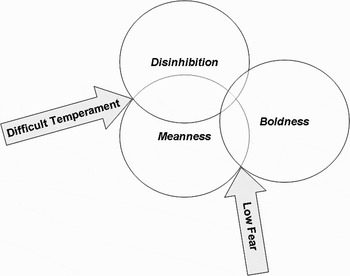
The foregoing review of historic and contemporary efforts to conceptualize the syndrome of psychopathy reveals three prominent recurring themes, which for ease of reference can be designated disinhibition, boldness, and meanness. Consideration of the broader personality, psychopathology, and neurobiological literatures indicates that these three constructs, although interrelated at some levels empirically and in terms of their mutual connections with the phenomenon of psychopathy, have distinctive phenotypic identities and can be conceptualized, measured, and understood separately. Our view is that these three phenotypic constructs represent the key to understanding psychopathy in its varying manifestations: criminal and noncriminal, primary, and secondary (cf. Karpman, Reference Karpman1941; Lykken, Reference Lykken1957, Reference Lykken1995; Skeem et al., Reference Skeem, Johansson, Andershed, Kerr and Eno Louden2007), stable and aggressive (Hicks et al., Reference Hicks, Markon, Patrick, Krueger and Newman2004), unsuccessful and successful (Hall & Benning, Reference Hall, Benning and Patrick2006). Below, we consider each of these key constructs in turn.
Disinhibition
The term “disinhibition” is used here to describe a general phenotypic propensity toward impulse control problems entailing a lack of planfulness and foresight, impaired regulation of affect and urges, insistence on immediate gratification, and deficient behavioral restraint. Related concepts include externalizing (Achenbach & Edelbrock, Reference Achenbach and Edelbrock1978; Krueger et al., Reference Krueger, Hicks, Patrick, Carlson, Iacono and McGue2002), disinhibitory psychopathology (Gorenstein & Newman, Reference Gorenstein and Newman1980; Sher & Trull, Reference Sher and Trull1994), and low inhibitory control (Kochanska, Murray, and Coy, Reference Kochanska, Murray and Coy1997).Footnote 2 In personality terms, disinhibition can be viewed as the nexus of impulsivity and negative affectivity (Krueger, Reference Krueger1999a; Sher & Trull, Reference Sher and Trull1994). Prominent behavioral manifestations of disinhibition include irresponsibility, impatience, impulsive action leading to negative consequences, alienation and distrust, aggressive acting out (in particular, angry–reactive aggression), untrustworthiness, proneness to drug and alcohol problems, and engagement in illicit or other norm-violating activities (Krueger, Markon, Patrick, Benning, & Kramer, Reference Krueger, Markon, Patrick, Benning and Kramer2007).
Historic conceptualizations of psychopathy have emphasized this externalizing component to varying degrees, and to an important extent, differences of opinion regarding the appropriate definition and boundaries of the psychopathy construct can be traced to this component. Externalizing encompasses a broad range of pathologic behavioral phenomena including child conduct problems, adult criminal deviance, angry aggression, and addictive behaviors of varying sorts (Krueger et al., Reference Krueger, Hicks, Patrick, Carlson, Iacono and McGue2002, Reference Krueger, Markon, Patrick, Benning and Kramer2007; Young, Stallings, Corley, Krauter, & Hewitt, Reference Young, Stallings, Corley, Krauter and Hewitt2000). Some historic writers defined psychopathy broadly to include substance-related addictions and other nonnormative behaviors (e.g., sexual deviancy of varying kinds) that intersect with the externalizing spectrum (e.g., Prichard, Reference Prichard1835); other writers characterized psychopathy in terms that appear more applicable to externalizing individuals (e.g., Arieti, Reference Arieti1963, Reference Arieti1967; Partridge, Reference Partridge1928a, Reference Partridge1928b); and others described subtypes of psychopaths who would more aptly be classified as high externalizers (e.g., Craft, Reference Craft and Craft1966; Kraepelin, Reference Kraepelin1915). The traditional notion of the “symptomatic” or secondary psychopath (Karpman, Reference Karpman1941; Lykken, Reference Lykken1957) appears consistent with the clinical presentation of the high externalizing individual. Contemporary research demonstrates that the distinct variance associated with the antisocial deviance (Factor 2) component of the PCL-R largely reflects the externalizing factor (Patrick et al., Reference Patrick, Hicks, Krueger and Lang2005) and the impulsive antisociality component of the PPI (PPI-II) exhibits a robust genetic association with scores on the externalizing factor (Blonigen et al., Reference Blonigen, Hicks, Patrick, Krueger, Iacono and McGue2005). Based on its known correlates, the I/CP component of Frick and Hare's (2001) APSD also appears to index the externalizing factor.
However, contemporary researchers in the field would generally not view disinhibition or externalizing as equivalent to psychopathy. In particular, as mentioned, externalizing is associated with heightened negative affectivity as opposed to an absence of anxiety or fear. High externalizing is also associated with an increased rather than reduced incidence of internalizing (anxiety, mood) problems in childhood and adulthood (Achenbach & Edelbrock, Reference Achenbach and Edelbrock1978; Krueger, Reference Krueger1999b) and with a higher rather than lower incidence of suicidal behavior in adult offenders and community participants (Verona & Patrick, Reference Verona, Patrick and Joiner2000; Verona, Sachs-Ericsson, & Joiner, Reference Verona, Sachs-Ericsson and Joiner2004). It is when externalizing tendencies are coupled with dispositional boldness or meanness that a diagnosis of psychopathy would be considered applicable.
Boldness
The term bold is used here to describe a phenotypic style entailing a capacity to remain calm and focused in situations involving pressure or threat, an ability to recover quickly from stressful events, high self-assurance and social efficacy, and a tolerance for unfamiliarity and danger. Terms related to boldness include fearless dominance (Benning, Patrick, Blonigen, et al., Reference Blonigen, Hicks, Patrick, Krueger, Iacono and McGue2005), daringness, audacity, indomitability, resiliency (Block & Block, Reference Block, Block and Collins1980), and hardiness (Kobasa, Reference Kobasa1979). In personality terms, boldness can be viewed as the nexus of social dominance, low stress reactivity, and thrill–adventure seeking (Benning et al., Reference Benning, Patrick, Hicks, Blonigen and Krueger2003; Benning, Patrick, Blonigen, et al., Reference Blonigen, Hicks, Patrick, Krueger, Iacono and McGue2005). Prominent behavioral manifestations of boldness include imperturbability, social poise, assertiveness and persuasiveness, bravery, and venturesomeness.
As used here, boldness is not considered synonymous with the term “fearless.” Rather, fearlessness is conceptualized as an underlying constitutionally based (genotypic) disposition entailing reduced sensitivity of the brain's defensive motivational system to cues signaling threat or punishment (Fowles & Dindo, Reference Fowles, Dindo and Patrick2006; Patrick & Bernat, Reference Patrick, Bernat, Krueger and Tackett2006, in press). Boldness is one way in which genotypic fearlessness can be expressed phenotypically. However, as discussed in the next subsection, genotypic fearlessness may also contribute to phenotypic meanness. Cleckley's conceptualization of psychopathy emphasized phenotypic boldness together with disinhibitory (externalizing) tendencies. Boldness was evident in his case descriptions and diagnostic criteria in terms of poise and high social efficacy, absence of anxiety or neurotic symptoms, diminished emotional responsiveness, imperviousness to punishment (“failure to learn by experience”), and low suicidality. Other historic writers concerned with psychopathy in psychiatric patients as opposed to criminal samples (e.g., Kraepelin, Schneider) also identified bold externalizing types. More contemporaneously, fearlessness, and unresponsiveness to punishment cues were emphasized prominently in Hare's classic psychophysiological studies of the 1960s and 1970s (cf. Hare, Reference Hare, Hare and Schalling1978) in influential theories of psychopathy advanced by Fowles (Reference Fowles1980) and Lykken (Reference Lykken1995).
Lilienfeld's self-report PPI, which was developed to index traits embodied in Cleckley's conception, includes a broad factor (PPI-I) that directly reflects the construct of boldness. The subscales that define this factor are stress immunity, social potency, and (to a lesser degree) fearlessness.Footnote 3 Notably, this factor of the PPI is uncorrelated with tendencies toward impulsive antisocial deviance tapped by PPI-II. In this respect, the construct of boldness tapped by PPI-I can be viewed as indexing a more benign expression of dispositional fearlessness: one that is phenotypically distinct from aggressive externalizing deviance and likely of importance to conceptualizing psychopathy in nonviolent, noncriminal samples (cf. Lykken, Reference Lykken1995). The construct of boldness also appears to be tapped somewhat by Factor 1 of the PCL-R (Benning, Patrick, Blonigen, et al., Reference Blonigen, Hicks, Patrick, Krueger, Iacono and McGue2005), in particular, by items comprising its interpersonal facet, most notably Items 1 (charm/glibness) and 2 (grandiose sense of self-worth; Patrick et al., Reference Patrick, Hicks, Nichol and Krueger2007). However, the PCL-R interpersonal facet overlaps with the PCL-R's Affective, Lifestyle, and Antisocial facets, indicating that the PCL-R indexes the construct of boldness less directly and less distinctively than the PPI-I. As described next, Factor 1 of the PCL-R as a whole appears to index meanness more so than boldness.
Meanness
The term mean describes a constellation of phenotypic attributes including deficient empathy, disdain for and lack of close attachments with others, rebelliousness, excitement seeking, exploitativeness, and empowerment through cruelty. Terms related to meanness include callousness (Frick et al., Reference Frick, O'Brien, Wooten and McBurnett1994), coldheartedness (Lilienfeld & Widows, Reference Lilienfeld and Widows2005), and antagonism (Lynam & Derefinko, Reference Lynam, Derefinko and Patrick2006). With respect to basic dimensions of interpersonal behavior (Leary, Reference Leary1957; Wiggins, Reference Wiggins, Kendall and Butcher1982), meanness can be viewed as occupying a position midway between (high) dominance and (low) affiliation (Blackburn, Reference Blackburn and Patrick2006; Harpur et al., Reference Harpur, Hare and Hakstian1989). Consistent with this, Saucier (Reference Saucier1992) identified a construct akin to meanness (represented by adjective descriptors such as rough, tough, unemotional, and insensitive) as the nexus of high dominance, low affiliation, and low neuroticism (high emotional stability); notably, this configuration of traits mirrors the FFM correlates of PPI coldheartedness, which include low A, low E, and low N (as well as low O; Ross et al., Reference Ross, Benning, Patrick, Thompson and Thurston2009). From this perspective, meanness can be viewed as agentic disaffiliation, which is a motivational style in which pleasure and satisfaction are actively sought without regard for and at the expense of others (cf. Schneider's, Reference Schneider1934, “active affectionless” type). In contrast with social withdrawal, which entails passive disengagement from others (“moving away from people”; Horney, Reference Horney1945), meanness entails active exploitativeness and confrontation (“moving against people”; Horney, Reference Horney1945). Characteristic behavioral manifestations include arrogance and verbal derisiveness, defiance of authority, lack of close personal relationships, aggressive competitiveness, physical cruelty toward people and animals, predatory (proactive, premeditated) aggression, strategic exploitation of others for gain, and excitement seeking through destructiveness.
The notion of meanness is central to conceptions of psychopathy in criminal and delinquent samples. McCord and McCord (Reference McCord and McCord1964) identified lovelessness and guiltlessness as central to criminal psychopathy. Quay (Reference Quay1964) listed lack of concern for others, an absence of normal affectional bonds, and destructive and assaultive behavior as characteristic features of psychopathy (later dubbed “undersocialized aggressive delinquency”; Quay, Reference Quay, Quay and Werry1986) in juvenile offenders. The affective facet of Hare's PCL-R consists of items that cover McCord and McCord's lovelessness (Item 7, “shallow affect,” which includes reference to a lack of genuine attachments/love relationships with others; and Item 8, “callous/lack of empathy,” which encompasses cruel/sadistic treatment of others, contemptuousness, and destructiveness) and guiltlessness (Item 6, “lack of remorse or guilt,” and Item 16, “failure to accept responsibility for own actions”). Notably, the interpersonal items of the PCL-R also include elements of meanness in their definitions: Item 1 (“glibness and superficial charm”) includes reference to excessive slickness and is assigned a score of 1 (out of 2) in cases where the examinee exhibits a “macho” or “tough guy” demeanor; Item 2 (grandiose sense of self-worth) includes reference to arrogance and a sense of superiority over others; the criteria for Item 4 (pathological lying) describe an individual who is routinely deceptive in interpersonal interactions and who enjoys deceiving others; Item 5 (conning/manipulative) refers to predatory exploitation of others for personal gain without concern for the welfare of victims. The best-known instruments for assessing psychopathy in youth (PCL:YV, CPS, and APSD) were modeled after the PCL-R and likewise emphasize meanness (social and emotional detachment, callousness, and exploitativeness) in their affective–interpersonal items.
A key question is whether meanness can be measured separately from criminal or antisocial behavior. In the case of the PCL-R, a hierarchical (bifactor) analysis revealed that the majority of its items are primarily indicators of a general overarching factor that reflects aggressive externalizing deviancy (Patrick et al., Reference Patrick, Hicks, Nichol and Krueger2007). The strongest and purest indicators of this factor were items reflecting aggressive criminal behavior (i.e., items associated with the antisocial facet of the PCL-R): early behavioral problems, poor behavioral controls, criminal versatility, and juvenile delinquency. In addition, most of the affective and interpersonal items of the PCL-R also loaded appreciably on this general factor with two of four items from each facet loading more strongly on the general factor than on distinguishable affective or interpersonal subfactors. Specifically, the pathological lying and conning/manipulative items loaded more strongly on the general factor than on the interpersonal subfactor (on which glibness/charm and grandiosity showed their primary loadings), and the shallow affect and callous/lack of empathy items loaded more strongly on the general factor than on the affective subfactor (on which lack of remorse and failure to accept responsibility showed their primary loadings). As noted earlier, the heavy saturation of most PCL-R items with externalizing deviancy reflects the fact that the scoring criteria for most of its items include reference to antisocial behavior.
However, recent research on the scope and structure of the externalizing spectrum suggests that the meanness component of psychopathy can be disaggregated from its disinhibitory (externalizing) component. Specifically, using data collected across multiple iterative waves from samples including male and female prisoners as well as nonincarcerated men and women, Krueger et al. (Reference Krueger, Markon, Patrick, Benning and Kramer2007) developed self-report scales to comprehensively index the domain of externalizing problems and traits in terms of elemental constructs. Unidimensional scales were developed to measure 23 separate constructs including: varying facets of impulsivity, differing forms of aggression (physical–reactive, relational–proactive, and destructive), irresponsibility, rebelliousness, excitement seeking, blame externalization, and alcohol, drug, and marijuana use/problems. Confirmatory factor analyses of these 23 scales yielded evidence of a superordinate factor (externalizing) on which all subscales loaded substantially (.45 or higher), and two subordinate factors that accounted for residual variance in particular subscales. The strongest and purest indicators of the overarching externalizing factor were scales indexing irresponsibility and problematic impulsivity (i.e., proneness to impulsive acts resulting in harm to oneself or others). One of the two subordinate factors was defined by residual variance in subscales measuring callousness, aggression (relational/proactive and destructive, in particular; physical/reactive aggression loaded more substantially on the superordinate externalizing factor), excitement seeking, rebelliousness, and (low) honesty. The other subfactor was defined by residual variance in subscales indexing alcohol/drug use and substance-related problems. It is important to note that the variance defining each of these subfactors consisted of variance in common among specific scales that was unrelated (orthogonal) to the broad externalizing factor.
These findings indicate that a separate propensity entailing low empathy and stimulation-seeking tendencies, distinguishable from the general externalizing factor, contributes independently to aggressive behavior, particularly aggression that involves instrumental coercion and abuse of others. Other variables that loaded to some extent on this callous–aggression subfactor included dishonesty and rebelliousness. Notably, these indicator variables closely parallel the item content and known correlates of the CU factor of the APSD. Specifically, (a) the items of the APSD CU factor reflect lack of concern for the feelings of others, disregard for formal responsibilities (schoolwork), shallow affect and insincerity, lack of guilt, and lying/conning (Frick et al., Reference Frick, O'Brien, Wooten and McBurnett1994); and (b) among youth exhibiting symptoms of conduct disorder (CD), those high in CU traits show increased levels of proactive aggression (along with comparable levels of reactive aggression) and enhanced thrill-seeking tendencies compared with those low in CU traits (Frick & Dickens, Reference Frick and Dickens2006; Frick & White, Reference Frick and White2008).
In turn, the known external correlates of the APSD CU factor point to low dispositional fear as one contributor to phenotypic meanness. Specifically, as noted earlier, higher scores on this factor of the APSD are associated with lower scores on measures of anxiety and neuroticism, diminished responsiveness to threatening and affectively distressing stimuli, and heightened tolerance of unfamiliarity and risk (Blair, Reference Blair and Patrick2006; Frick & Dickens, Reference Frick and Dickens2006; Frick & White, Reference Frick and White2008; Marsh et al., Reference Marsh, Finger, Mitchell, Reid, Sims and Kosson2008). However, to the extent that meanness constitutes a phenotypic expression of underlying fearlessness, it is a malignant expression of low fear in comparison with boldness.
Established Developmental Constructs Relevant to an Understanding of These Distinctive Psychopathy Components
As suggested above, it is potentially valuable to examine established concepts and findings from the developmental psychopathology literature that bear on the phenotypic constructs of disinhibition, boldness, and meanness. In so doing, one must expect complexity rather than simple relationships. The constructs of equifinality and multifinality (Cicchetti & Rogosch, Reference Cicchetti and Rogosch1996), fundamental to developmental psychopathology, underscore that multiple pathways lead to a given phenotype (equifinality) and that early etiological risk factors interact with other influences in complex causal chains to yield varied phenotypes (multifinality) (e.g., Hinshaw, Reference Hinshaw, Beauchaine and Hinshaw2008). Similarly, etiological pathways involve a host of complex mechanisms such as gene–environment interactions, gene–gene interactions, reciprocal or mutually interactive individual–environment processes, gene–environment correlations, genetic and environmental influences on gene expression, genetic effects on environments, and environmental influences on brain development (plasticity), making it more appropriate to think in terms of risk factors than causal factors and to expect modest contributions from any given risk factor (Hinshaw, Reference Hinshaw, Beauchaine and Hinshaw2008; Rutter, Reference Rutter2006).
An important context for this literature is Moffitt and Lynam's (e.g., Moffitt, Reference Moffitt1993; Lynam, Reference Lynam1998; Moffitt & Lynam, Reference Moffitt, Lynam, Fowles, Sutker and Goodman1994) distinction between early-onset and adolescent-onset antisocial behavior in which early onset is associated with a risk of life-course persistent antisocial behavior, including some individuals who meet adult criteria for psychopathy. The early-onset trajectory involves oppositional defiant disorder that “matures” into CD around age 10 and is associated with comorbid attention-deficit/hyperactivity disorder (ADHD) involving hyperactivity (i.e., not the predominantly inattentive subtype). One very large and one smaller literature attempts to articulate two temperament-based pathways to severe conduct problems in children. Frick and Morris (Reference Frick and Morris2004) provide a comprehensive review of these literatures, and the current summary is adapted from their review unless otherwise noted. The larger literature encompasses the notion of “difficult temperament” in infants, and somewhat interrelated developmental concepts of “failure of secure attachment” and “coercive exchanges.” These concepts, discussed in the first subsection below, appear most relevant to phenotypic constructs of disinhibition and meanness. The smaller, more recent literature focuses on dispositional fearlessness as a pathway to psychopathy. This concept appears most relevant to phenotypic constructs of boldness and meanness.
Factors contributing to disinhibition and meanness
Difficult temperament
The developmental concept of “difficult temperament” is a complex one involving high negative affect and irritability, high activity, withdrawal from novel stimuli, poor performance where sustained attention is required, and difficulty adapting to changes in the environment, characteristics found to be associated with a risk of conduct problems that begin early in childhood with a risk of life-long antisocial behavior. Frick and Morris (Reference Frick and Morris2004) suggest that the intense negative emotional reactions of anger and frustration are the core risk factor, consistent with the clinical picture of irritability, low tolerance for frustration, and angry outbursts in oppositional defiant disorder, the early childhood syndrome associated with a high risk of early onset conduct problems and chronic antisocial behavior. Almost by definition, these excessive negative emotional reactions point to difficulties in emotion regulation, or more specifically regulation of anger. The development of emotion regulation abilities involves both child characteristics and the efforts of parents and other socializing agents to help the child learn to manage emotions (e.g., Cole & Hall, Reference Cole, Hall, Beauchaine and Hinshaw2008; Frick & Morris, Reference Frick and Morris2004; Thompson, Reference Thompson, Vasey and Dadds2001).
An important, relatively recent distinction between automatic and effortful dimensions of emotional responsiveness is important to appreciating the multiple influences on emotion regulation. Automatic reactivity refers to involuntary or passive reactions to emotional stimuli with separate dimensions for reactions to cues for positive (rewards) and negative (punishment, threatening emotional stimuli) events. Effortful or voluntary control refers to inhibiting dominant or prepotent behavioral and emotional responses and to directing attention in adaptive ways in order to regulate behavior and emotions. Given that effortful control helps to inhibit a tendency to strong automatic negative reactivity, both dimensions are relevant to emotion regulation. The most severe difficult temperament will involve a combination of strong automatic negative reactivity with weak effortful control. The separate assessment of automatic and effortful responsiveness is not well developed, although Frick and Morris offer suggestions as to how to achieve it. Because effortful control strategies often are seen as components of the broader concept of executive functions, it is not clear whether difficulty in regulating anger and hostility is the core risk factor for conduct problems or whether a broader deficit in executive functions is the critical risk factor.
The deficit in emotion regulation increases the risk of conduct problems in a variety of ways: interfering with the acquisition of appropriate social cognitions and behavior, increasing peer rejection with subsequent reduction in positive socializing experiences and increased deviant peer association, facilitating the development of reactive aggression regarding peers, producing excessively strong negative affect to punishment that undermines the efficacy of skilled maternal gentle discipline, and increasing the probability of mutually coercive exchanges with parents. Thus, difficult temperament involving poor emotion regulation and/or poor executive functions (attributes embodied in the construct of disinhibition) increases the risk of severe antisocial behavior and aversive interactions with caretakers and peers, setting the child on a pathway that may develop into behavior that meets the criteria for psychopathy as defined by the PCL-R in adulthood.
Failure of secure attachment
A second relevant (and overlapping) literature concerns the developmental concept of “secure attachment” (Campbell, Reference Campbell, Ollendick and Hersen1998), assessed at 1 year of age and viewed as providing the infant with a secure base for exploring the environment and a major source of comfort when distressed, fearful, or ill. This literature, too, focuses on difficult temperament as a risk factor, but the issue of secure attachment is applicable to any factors that affect early parenting and it has direct implications for relationships with others. The basic model suggests that a difficult temperament is a challenge for the parent, requiring much greater parenting skill than infants with a pleasant, happy, and easily soothable temperament. Absent such unusually good parenting skill or strong social support, adverse effects on parent–infant interactions are likely to result in an insecure or “anxious or ambivalent attachment characterized by excessive anger, clinging, and/or avoidance behavior on the part of the infant” (Campbell, Reference Campbell, Ollendick and Hersen1998, p. 13). Contextual factors of poverty and stressful life events increase the risk of insecure attachment (probably by disrupting parenting). Extreme environments such as abuse and neglect or chronic maternal psychopathology can produce insecure or even disorganized attachments (more severe than insecure attachment), quite apart from the infant's temperament.
There is some, but mixed, evidence that attachment problems at age one year are predictive of later internalizing and externalizing problems (Campbell, Reference Campbell, Ollendick and Hersen1998). The primary point in the present context is that temperamental and other factors that challenge or disrupt optimal parent–child interactions during the first year likely have an adverse impact on the infant's attachment to the primary caregiver. This development is hypothesized to produce “internal working models” of social interactions that are less adaptive, coloring the infant's subsequent social interactions. Optimal environments probably effectively reverse or attenuate this effect, but the development of poor attachments in infancy sets the stage for further failures to develop positive relationships with others. The range of negative orientations to others in psychopaths (i.e., hostile, angry, callous, exploitive) can be argued to reflect at least in part a failure to develop positive attachments. If so, the failure of secure attachment constitutes a risk factor for some of the affective–interpersonal aspects of psychopathy, that is, those embodied in the concept of meanness.
Coercive exchanges
A major line of research on the development of antisocial behavior by Patterson and his colleagues (e.g., Dishion, French, & Patterson, Reference Dishion, French, Patterson, Cicchetti and Cohen1995; Patterson, Reid, & Dishion, Reference Patterson, Reid and Dishion1992; Patterson, Reid, and Eddy, Reference Patterson, Reid, Eddy, Reid, Patterson and Snyder2002; Snyder, Reid, Patterson, Reference Snyder, Reid, Patterson, Lahey, Moffitt and Caspi2003) focused on the “coercion hypothesis.” According to this now well-established model, when there is conflict between parent and child (e.g., the parent urges the child to stop something the child wants to do or to do something the child does not want to do), if the child's coercive response (e.g., noncompliance, temper tantrums, generally aversive behavior) causes the parent to give in, the child's coercive response is negatively reinforced. Similarly, when the parent gives in and the child terminates the coercion, the parent is negatively reinforced. In Patterson's social learning model, thousands of these coercive exchanges produce a response repertoire in which coercion is a dominant and strongly reinforced behavior. Coercive exchanges generalize to peers and teachers, with subsequent immediate rewards but delayed negative consequences in the form of rejection. The combination of coercive behavior and rejection by normal peers facilitates association with deviant peers and subsequent socialization into a wide range of antisocial behaviors.
These investigators view an infant temperament associated with a risk for developing ADHD involving hyperactivity as a risk factor for coercive exchanges (Patterson, DeGarmo, & Knutson, Reference Patterson, DeGarmo and Knutson2000). In the actual study, a structural equation model was presented to support their hypothesis that the comorbidity of ADHD and CD reflects an early (ADHD) and late (CD) manifestation of a shared process. Although their own research has involved older children, these authors hypothesize that the combination of an extremely active and difficult (irritable) infant and a nonresponsive (noncontingent) caretaker initiate this process, which probabilistically results in coercive and socially unskilled behavior by age 24 months, consistent with a diagnosis of hyperactivity between the ages of 2 and 4 years. Thus, the literature on coercion points to a temperament strongly similar to that described above for difficult temperament and for poor emotion regulation, and it focuses on the etiology of coercive, antagonistic social interactions, followed by socialization into an antisocial subculture by deviant peers. Like the Frick and Morris review, Patterson and colleagues link this developmental model to early-onset, chronic severe antisocial behavior.
In summary, this developmental approach combines a hyperactive, irritable temperament, parenting that is not up to the challenge of such a temperament, family interactions that facilitate the characteristics of hyperactivity, comorbidity of ADHD and antisocial behavior, and the early-onset of antisocial behavior associated with later psychopathy by Moffitt and Lynam.
Low fear as a substrate for meanness and boldness
Given the emphasis on affective–interpersonal (Factor 1) features in classic views of psychopathy and the association of those features with low fear in the adult psychopathy literature, there should be an additional etiological pathway for more classic, emotionally detached psychopaths in the childhood literature. As described earlier, the APSD developed by Frick and colleagues can be used to identify youth high on CU traits, which capture many of the affective–interpersonal features of psychopathy and are characterized by such low fear attributes as low scores on anxiety and neuroticism scales, reduced sensitivity to stressful stimuli and situations, and a dominance of reward-seeking approach over passive avoidance of punishment in conflict situations (cf. Frick & Morris, 2006). High CU youth are characterized by high levels of instrumental, premeditated, or proactive aggression (directed toward acquisition of goods, services, or dominance) as well as by high levels of reactive, hostile, or impulsive aggression (usually an angry response to threat or provocation), whereas antisocial youth low on CU (those with “difficult temperaments,” as described above) show predominantly reactive aggression. Of interest in the present context, Frick (Frick & Marsee, Reference Frick, Marsee and Patrick2006; Frick & Morris, Reference Frick and Morris2004) cites research on the development of internalized conscience in children by Kochanska and her colleagues (Reference Kochanska1993, Reference Kochanska1995, Reference Kochanska1997; Kochanska, Gross, Lin, & Nichols, Reference Kochanska, Gross, Lin and Nichols2002) as relevant to the low fear pathway for psychopathy.
Based on initial classifications of fearful temperament at toddler age, Kochanska identified two pathways to the development of internalized conscience by age 4. Using a median split for fearful temperament, maternal gentle discipline (“good” discipline: parental gentle discipline deemphasizing power and capitalizing instead on internal discomfort) predicted internalized conscience for fearful but not fearless children. Thus, this discipline-based pathway was ineffective for fearless children, consistent with the hypothesis that poor fear conditioning impairs mild punishment-based socialization. In contrast, security of attachment (a stand-in for a close, mutually positive parent–child relationship) predicted internalized conscience for fearless children. These results demonstrate that a low fear temperament does not inevitably lead to a failure of conscience development. With sufficient skill on the part of the parent, a mutually positive relationship capitalizes on the child's fully functional reward-based learning to promote socialization, a process likely to foster boldness as opposed to meanness (see next section). Quite possibly, however, extremely low fear may make the child more difficult to control with a potential for conflict that would interfere with the development of a mutually positive relationship. Combined with other risk factors (e.g., low genotypic affiliativeness; parental abuse or neglect), this may push genotypic fearlessness in the direction of phenotypic meanness.
Implications for Conceptualizing Pathways to Psychopathy
Although the developmental psychopathology literature does not directly address the implications of the aforementioned etiologic factors for distinctive phenotypic components of adult psychopathy (disinhibition, boldness, meanness), some reasonable extrapolations from existing data can be advanced. Figure 1 provides a graphic depiction of interrelations among these distinct phenotypic constructs, and illustrates aforementioned ideas as to how factors of difficult temperament and low dispositional fear presumably contribute to these phenotypic outcomes. The remainder of this section elaborates further on contributory processes/pathways.
A schematic depiction of hypothesized interrelations among phenotypic constructs of disinhibition, boldness, and meanness (circles) and contributions made to each by underlying etiologic-dispositional factors of difficult temperament and low fear (arrows), as described in the developmental literature. Disinhibition and meanness are depicted as moderately interrelated, based on findings for various existing psychopathy inventories that include coverage of these constructs. Difficult temperament is depicted as contributing to each of these constructs, as discussed in the final section of the main text. Disinhibition and boldness are depicted as minimally interrelated, based on findings for the Psychopathic Personality Inventory, in which fearless dominance (boldness) represents a separate factor from impulsive antisociality. Meanness and boldness are depicted as somewhat interrelated, based on evidence for a contribution of low dispositional fear to each (see text). The triarchic model conceives of psychopathy as encompassing these three distinct phenotypic dispositions. The syndrome of psychopathy as defined clinically entails disinhibition in conjunction with either boldness or meanness. Cleckley's (Reference Cleckley1941, 1976) conceptualization of psychopath emphasized boldness more so than meanness. Criminologic conceptions, and instruments developed to assess psychopathy in adult criminals and delinquent youth, emphasize meanness more so than boldness. Lykken's (1995) conception of the successful (high achieving, or “heroic”) psychopath places predominant emphasis on boldness.

One notable point, implied in the foregoing section, is that both the attachment and coercion trajectories probably contribute to psychopathic outcomes in low fear as well as difficult temperament youth, by promoting tendencies toward antagonism and callousness (i.e., meanness). To the extent that a low fear temperament creates a challenge for parents, there may well be interference with the development of positive (secure) attachments and emergence of coercive processes within the family that then generalize to peers and teachers and result in deviant peer association, consistent with the principle of equifinality. Thus, these developmental influences will be common to the two temperament-based risk factors, and will tend to produce overlapping phenotypes in important respects (i.e., individuals exhibiting tendencies toward interpersonal antagonism and exploitative behavior). To be sure, the affective components will differ in clear cases, but poor attachments, coercive repertoires, and exploitative attitudes would characterize both groups.
A second point, also alluded to earlier, is that the difficult temperament involving poor emotion regulation/poor executive functions maps most clearly onto the phenotype of disinhibition or externalizing. The inept or unskilled impulsivity and the irritable high negative affect combine with developmental experiences of adversarial interactions with caregivers, peers, and teachers to promote high levels of anger, hostility, fighting, drug and alcohol problems, academic and occupational failure, and so forth, in the context of high scores on anxiety and neuroticism. To distinguish the concept of difficult temperament from that of fearless temperament, which as noted can also be construed as “difficult,” and to highlight its relevance to the phenotypic construct of disinhibition described earlier, we advocate use of the alternative expression “disinhibited temperament.”
Although there are few direct data in the developmental literature that speaks to alternative phenotypic outcomes of boldness versus meanness, there can be reasonable speculation. Consistent with aforementioned suggestions, one hypothesis is that boldness reflects a phenotypic orientation that evolves more naturally from the low fear genotype (“a purer, more benign expression of underlying temperamental fearlessness”), whereas meanness likely reflects an overlay because of developmental experiences gone awry. The low stress reactivity element of boldness can be viewed as a direct manifestation of low defense-system sensitivity, with high social dominance and thrill–adventure seeking representing affiliated phenotypic expressions of reward seeking unrestrained by fear and anxiety. In contrast, the meanness attributes of deficient empathy, disdain for and lack of close attachments with others, rebelliousness, exploitativeness, and empowerment through cruelty can be viewed as outcomes of a low fear temperament (fearless genotype) in which the processes of socialization have failed. As suggested above, the failure of positive attachment combined with the experience of coercive interactions with others is likely to promote a callous, exploitive attitude toward others, and these attitudes are likely to be supported and strengthened through deviant peer association. However, these features may also be associated with the disinhibited (“difficult”) developmental trajectory, causing a blurring of phenotypes. Consistent with the traditional adult literature, when associated with a low fear temperament the interpersonal callousness and exploitation will occur in the context of emotional coolness and indifference, whereas in association with a disinhibited temperament they will occur with stronger emotions, especially pronounced anger and hostility.Footnote 4
Finally, it cannot be emphasized too strongly that continuous rather than discrete variables and processes are involved. Consequently, parameters of temperament and of various developmental experiences vary continuously, producing a broad array of phenotypic outcomes. Thus, the phenotypes will vary not only in severity but also in configuration. For example, should deviant peer association be minimized, consequences of that developmental experience will also be minimized, or should parental reactions be especially harsh (abuse), the consequences of those experiences will be greater.