1. Introduction
English binominal NPs (BNPs) display quite distinctive syntactic and semantic properties (for previous discussions, see Aarts Reference Aarts1998, Foolen Reference Foolen, Radden and Panther2004, and Keizer Reference Keizer2007, among others). The examples in (1) are naturally occurring BNP data extracted from the British National Corpus (BNC):
- (1)
(a) It's been [a hell of a day] at the office.
(b) And it introduced her to Budapest[, a jewel of a city].
(c) And you won't be saying anything to [that ponce of a boss] you've got, Howard?
(d) Rune nodded [his shaven dome of a head].
(e) She had [a skullcracker of a headache].
(f) A door opened; and into the assessment room stepped [a giant of a man].
As illustrated here, these bracketed BNPs involve two nominals, the preposition of, and certain determiners. Payne & Huddleston (Reference Payne, Huddleston, Huddleston and Pullum2002: 442), citing examples like her stupid nitwit of a husband, also point out the peculiarities of the construction as follows:
[This is] a distinctive syntactic construction where the oblique [the PP] is constrained to be determined by the indefinite article a. The relation between the oblique and the head is like that between predicand and the predicative complement in the clausal construction Her husband is a stupid nitwit.
This construction is not unique to English but can also be found in Germanic and Romance languages (data from Foolen Reference Foolen, Radden and Panther2004: 79):
(2) Dutch
(a) een boom van een kerel
‘a tree of a man’
(b) een juweeltje van een universiteit
‘a jewel(dim) of a university’
(3) French
(a) un diable d'homme
‘a devil of a man’
(b) cet imbécile de Jules César
‘this idiot of a Julius Caesar’
(4) German
(a) ein Engel von einer Frau
‘an angel of a woman’
(b) so ein Apparat von Karton
‘such a monster of a box’
All these examples are similar to their English counterparts, and have the following template:
(5) Det1–N1–of/van/de–Det2–N2
The BNP links two NPs by a semantically neutral prepositional or case expression (as in German).Footnote 2
The BNP construction raises several analytic and theoretical questions (noted in e.g. Aarts Reference Aarts1998, Foolen Reference Foolen, Radden and Panther2004, Keizer Reference Keizer2007). One main syntactic issue concerns the headedness of the phrase: even though N1 seems to be the syntactic head, there are many cases where N2 behaves like the head, in particular as the semantic head of the whole construction. The status of the preposition of is also controversial (see Napoli Reference Napoli1989, Van Eynde Reference Van Eynde, Villavicencio and Kordoni2005b, Owen Reference Owen2007 for different approaches). Is the of-marked PP selected by the N1 or is it a linker for a special grammatical purpose (Aarts Reference Aarts1998, den Dikken Reference Den Dikken2006)? Semantic issues also arise: what is the semantic relation between N1 and N2? Does the first noun, N1, function as a predicate of the second noun, N2? What kind of constraint can ensure such a semantic relation while respecting some kind of semantic compositionality?
In this paper, we try to answer these questions about the BNP construction, starting from a review of its grammatical properties based on previous literature and using data from our corpus search. We then offer a construction-based analysis in which the preposition of is formally meaningless but functions as a juxtaposition linker between the two NPs.
2. Some basic properties
English BNP constructions, of the form ‘Det1–N1–of–Det2–N2’, have intriguing properties which cannot fully be reduced to those generally true of all English NPs. We outline some of the syntactic, semantic, and pragmatic properties here.
2.1 Property 1
The preposition of is obligatory. Consider the following naturally occurring data:Footnote 3
- (6)
(a) I had a hell *(of) a time on this tour.
(b) And it introduced her to Budapest, a jewel *(of) a city.
(c) I don't think it will be too bad a dose, but it's a beast *(of) a complaint.
In these examples, the preposition of can be neither replaced by another preposition nor omitted, unlike other NP constructions such as a couple (of) problems or both (of) these problems. The obligatoriness of the of-PP suggests that it is a subcategorized element (see Napoli Reference Napoli1989: 224).
2.2 Property 2
The types of the first determiner, Det1, can vary. The canonical Det1 is an indefinite, but definite articles are also possible, as in the following attested examples:
- (7)
(a) He is [a hulk of a man] in his middle fifties.
(b) [Some dragon of a receptionist] refused to let him see her boss without an appointment.
(c) This situation would be [one humdinger of a funny story] to tell his city friends over a drink or two.
- (8)
(a) [The ghost of a smile] glimmered in his eyes.
(b) I suspect she'd been following [that fool of a carrier].
(c) She was to marry this mountebank[, this hypocritical toad of a Sir Thomas].
(d) And she was old, antique. Deep lines grooved [her prune of a face].
As seen in (7) and (8), Det1 can be not only an indefinite but also a definite article, including a possessive or demonstrative determiner. It seems that any determiner can function as Det1, if the semantics are carefully controlled. Foolen (Reference Foolen, Radden and Panther2004: 87) notes that *no angel of a child sounds bad, but even the negative determiner can appear in the BNP, as pointed out to us by an anonymous JL referee and further observed from the following Google data:
- (9)
(a) [No slip of a girl] has the right to answer back to the Lord of the Manor.
(b) I only hope that if one of my family ever needs a blue flashing light ambulance[, no plonker of a driver] blocks its way …
Another peculiar property, noted in Austin (Reference Austin1980) and Aarts (Reference Aarts1998), is that when N2 is a proper name, then Det1 cannot be an indefinite article:
- (10)
(a) *a creep of a James
(b) *an egotist of an Alex
However, this restriction disappears when Det1 is a demonstrative determiner as in that creep of a James or that clever little wretch of a Rebecca.
2.3 Property 3
Det1 can be in many different forms, but the type of Det2 is fixed. Det2 must be the indefinite article a/an, and no other indefinite determiner is possible.
- (11)
(a) a hell of a/*some/*any/*one day
(b) this slip of a/her/*that/*this/*some/*any/*the/*one girl
For some speakers, Det2 need not appear when N1 and N2 are plural (Austin Reference Austin1980). The BNC corpus provides us with some plural examples with the zero indefinite article (ø) in Det1 and Det2:
- (12)
(a) It also has [ø jewels of ø villages] like West Burton and Askrigg and the fine falls of Hardraw and Aysgarth.
(b) The all-powerful International Cricket Council showed themselves to be [ø wobbly jellies of ø men] by shaking uncontrollably under pressure from the tainted tourists.
(c) There was a shadowy vagueness about the rest with [its hulks of ø desks] and clutter of baskets and papers.
In these examples, both N1 and N2 are plural. The corpus search yields few examples where the two nominals differ in number. Primarily, what this means is that there is a strong agreement relationship between the number values of N1 and N2.
2.4 Property 4
As previously noted (e.g., Aarts Reference Aarts1998, Keizer Reference Keizer2007), N2 canonically functions as the semantic head that satisfies selectional restrictions of the governing verb. Observe the following attested data:
- (13)
(a) She's a frightened little mouse of a woman, who makes a fierce stand and won't back down.
(b) It was a monster of a machine – plugged into the wall, a great big apparatus full of vacuum tubes.
The examples here do not mean that she was a frightened little mouse in (13a), or that it was a monster in (13b). The examples concern a frightened woman and a machine. N2 thus contributes to the core meaning of the overall NP structure. It is N2 that satisfies selectional restrictions of the verb, or that serves as the conceptual or semantic head of the BNPs.
However, it is not difficult to find examples where either N1 or N2 can satisfy selectional restrictions. Consider the following:
(14)

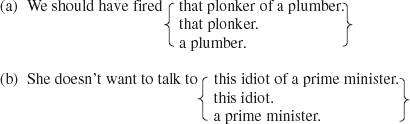
In both examples here, where N1 has rather a figurative reading, we can say that both Ns can satisfy selectional restrictions. That is, we can fire either a plonker or a plumber, or we can talk about the idiot or the prime minister. Such data thus show that the semantic headedness can be distributed to both N1 and N2, in particular when N1 has a figurative use.
2.5 Property 5
In terms of meaning, N1 and N2 are in a reverse subject–predicate relation. That is, the first noun, N1, denotes a property or quality that is predicated of the second noun, N2. The evidence of this reverse subject–predicate relation can be seen from the possibility of paraphrasing – with varying degrees of naturalness – the BNPs as copular constructions (see Quirk et al. Reference Quirk, Greenbaum, Leech and Svartvik1985: 1285; also Payne & Huddleston Reference Payne, Huddleston, Huddleston and Pullum2002: 442, quoted above):Footnote 4
- (15)
(a) a jewel of a city – The city is a jewel.
(b) a martinet of a mother – The mother is a martinet.
As noted by Napoli (Reference Napoli1989), this kind of predication relation also explains why examples like the following are semantically anomalous:
- (16)
(a) #this nitwit of a building – #This building is a nitwit.
(b) #a prince of a woman – #A woman is a prince.
The predication relation between the two nouns means that the first noun, N1, ascribes a property to the second noun, N2. When we interpret the property as evaluative, we can also paraphrase in a pronominal modifying construction (Quirk et al. Reference Quirk, Greenbaum, Leech and Svartvik1985: 1285):
- (17)
(a) a fool of a policeman – a foolish policeman
(b) that idiot of a prime minister – that idiotic prime minister
(c) a devil of a row – a devilish row
All of these data suggest that N2 is the semantic head.
A similar conclusion can be derived from referential properties. We can observe that N1 alone cannot serve as the antecedent of a pronoun (see also Asaka Reference Asaka2002):
- (18)
(a) He's [an absolute gem of a person]. He/*the gem/*it became the youngest scoring champion in league history.
(b) The hostler is a tree of a man, with wrists as thick as my leg, and he/*the tree/*it can be trusted.
In both examples, the N1 gem or tree is not directly referential and cannot be referred to as an individual. It is thus not N1 but N2 that determines the reference of the whole BNP phrase. This again shows that the semantic locus of the BNP is N2.
2.6 Property 6
The first determiner, Det1, can scope over not only N1 but also N2. Consider examples where the Det1 is a possessive pronoun or possessive nominal form (Austin Reference Austin1980, Keizer Reference Keizer2007):
- (19)
(a) He had been sitting quietly in [his hovel of a home].
(b) You are old enough to get your own food, like [your fool of a father].
(c) The boy knelt down by [Philip's wreck of a trap].
In terms of meaning, the possessive pronoun his or the possessive form Philip's in the Det1 position cannot be linked to hovel or wreck. Each is linked to the second noun, N2, home and trap. This kind of scope relation can be further attested by the predicative paraphrases (Quirk et al. Reference Quirk, Greenbaum, Leech and Svartvik1985, Aarts Reference Aarts1998, Payne & Huddleston Reference Payne, Huddleston, Huddleston and Pullum2002, Keizer Reference Keizer2007):
- (20)
(a) His home is a hovel.
(b) Your father is a fool.
(c) Philip's trap is a wreck.
2.7 Property 7
Just like the possible scope of Det1, the pre-N1 modifier can also scope over either N1 or N2. We can first observe that either N1 or N2 can have a premodifier:
- (21)
(a) But I ain't scared of that [great [ox]] of a matron.
(b) This [little [mouse]] of a girl really appeared to be scared of him.
- (22)
(a) That fool of a [fairy] Lucinda did not intend to lay a curse on me.
(b) I remember running into a giant of a [young] man at our Buffalo stamping plant.
Postmodification of N1 is in general quite difficult:
- (23)
(a) *that great ox with long horns of a matron
(b) *this little mouse with a hat of a girl
However, there may be cases where such modification is possible, as suggested by an anonymous JL referee:
(24) my defender in need of a husband
This implies that the grammar should not rule out examples with postmodification of N1.
When the pre-N1 modifier has an intensifying function as in (25a), it scopes over N1 only, but when it has a descriptive use as in (25b), it can scope over the overall construction (Keizer Reference Keizer2007: Chapter 5):
- (25)
(a) But I ain't scared of that [great [ox]] of a matron.
(b) She was not being told the truth by [that [apologetic] mouse of a [doctor]].
The intensifying adjective great in (25a) is linked to the N1 ox whereas the descriptive apologetic in (25b) modifies the entire following structure. Aarts (Reference Aarts1998: 133) also provides examples where the pre-N1 modifier is linked to N2:
- (26)
(a) another bitchy iceberg of a woman
(b) that clumsy oaf of a newscaster
(c) that senseless maniac of a driver
In pragmatic terms, the adjectives bitchy, clumsy and senseless are linked to the N2, woman, newscaster and driver, respectively.
In addition, other corpus examples also give us what appear to be truly ambiguous cases:
- (27)
(a) I can see [that [little] bastard of a chaplain] laughing again.
(b) He didn't want to sit gossiping in the kitchen with [that [old] slob of a cousin].
In these examples, the adjectives little and old could plausibly be linked either to N1 or N2. Like the possible scope of Det1, the pre-N1 modifier is flexible in terms of what it can scope over. This means that we need to have a flexible structure with respect to the scope of a prenominal expression in N1.
2.8 Property 8
The PP containing NP2 and the NP2 itself are frozen in terms of syntactic operations (Napoli Reference Napoli1989, Aarts Reference Aarts1998, den Dikken Reference Den Dikken, Alexiadou and Wilder1998). For example, neither can be clefted whereas the whole BNP can:
- (28)
(a) You need to create [a monster of a machine].
(b) It is [a monster of a machine] that you need to create __.
(c) *It is a machine that you need to create a monster of __.
(d) *It is of a machine that you need to create a monster __.
- (29)
(a) She had [a skullcracker of a headache].
(b) It was [a skullcracker of a headache] that she had __.
(c) *It was a headache that she had a skullcracker of __.
(d) *It was of a headache that she had a skullcracker __.
We also observe that neither the PP nor the NP2 can be wh-questioned or relativized:
- (30)
(a) *What did you need to create a monster of __?
(b) *What did she have a skullcracker of __?
(c) *Of what did she have a skullcracker __?
- (31)
(a) *You need to create a machine which is a monster of __.
(b) *She had a headache which was a skullcracker of __.
(c) *She had a headache of which was a skullcaracker __.
Considering that the PP complement and its object can undergo syntactic processes as illustrated in (32) and (33), the BNP's behavior is quite unusual.Footnote 5
- (32)
(a) What is this a good solution of __?
(b) Of what is this a good solution __?
- (33)
(a) a problem which this is a good solution of __
(b) a problem which this is a good paper about __
A similar fact is observed with extraposition.
- (34)
(a) A monster of a machine was delivered.
(b) *A monster was delivered [of a machine].
As illustrated here, the PP of the BNP cannot be extraposed to the sentence-final position.
The freezing effect can also be observed from the impossibility of coordinating the of-PP (Aarts Reference Aarts1998):
- (35)
(a) *I had a hell [[of a day] and [of a time]].
(b) *Into the assessment room stepped a giant [[of a man] and [of a woman]].
It is not possible to coordinate the N or NP inside the PP, either:
- (36)
(a) *I had a hell of [[a day] and [a time]].
(b) *Into the assessment room stepped a giant of [[a man] and [a woman]].
These observations once again indicate that the BNP is really a fixed construction with high-level morpho-syntactic constraints. However, as suggested to us by a JL referee, and as further discussed in Section 5.1 below, N2 or NP2 can be coordinated or disjoined, as in (37):
- (37)
(a) I've had a hell of [a day or at least an afternoon].
(b) We have that miracle of a [friend and colleague].
As is evident here, the coordination is possible if there is just a single referent of the whole phrase.
2.9 Property 9
In terms of its usage, N1 in the BNP construction has a figurative use. In particular, it has the function of a simile. Consider the following attested examples:
- (38)
(a) She is [an angel of a girl], always ready to help others.
(b) His mouth twisted into [a ghost of a smile].
(c) He is described as [a blocky bulldog of a man].
The example in (38a) does not mean that she is a spiritual or heavenly being. The phrase refers to the qualities of the girl. In the same way, (38b) and (38c) do not mean that the smile is a ghost or the man is a bulldog. Each means that the smile was ghost-like and the man was like a bulldog. That is, N1 expresses the evaluation of N2 in a figurative sense. This is why most of the nouns in N1 are connotational. In this sense, N1 can be said to have an expressive meaning, as pointed out by Foolen (Reference Foolen, Radden and Panther2004).Footnote 6
Many examples involve negative assessments of the individual referred to by N2, as in a fool of driver, a bitch of a secretary, a slut of a schoolteacher. However, with an appropriate N1, the construction can be used for positive assessment, as shown by the following corpus examples:
- (39)
(a) Pig farming can be [a pearl of a job], even without a hankering.
(b) The character Othello is [a giant of a man], full of love and decency, admirable in every way, lover, soldier, poet and statesman.
The BNPs here are intended to convey complimentary remarks in evaluating the individuals denoted by N2.
In sum, the BNP construction displays quite distinctive morpho-syntactic, semantic, and pragmatic properties. What makes the construction even more intriguing is that some of the formal properties are quite idiosyncratic and construction-specific, even though the BNP is presumably a member of a family of more general or related constructions.
3. On headedness and the preposition of
In dealing with the BNP construction, the first issue concerns the head in the overall structure. As we have discussed so far, the two nominals in the BNP show some head properties and the issue of headedness has led to different treatments of the preposition of. The three main approaches that have been proposed so far are as follows:
(40) Treatments of the preposition of
(a) as a preposition selecting the following NP headed by N2 (Abney Reference Abney1987, Napoli Reference Napoli1989)
(b) as a pragmatic marker forming a unit with a/an and not the following N2 but the preceding N1 (Aarts Reference Aarts1998, Keizer Reference Keizer2007)
(c) as a prepositional complementizer F selecting a small clause AgrP (Kayne Reference Kayne1994, den Dikken Reference Den Dikken2006)
Each of these approaches, assigning a different status to the element of, has its own motivations.
3.1 N1 as the head and canonical P
Considering the canonical structure of NP, we could take a natural step in which N1 functions as the head of the whole phrase. This is in fact the analysis suggested by Napoli (Reference Napoli1989), as represented in the following:
(41)
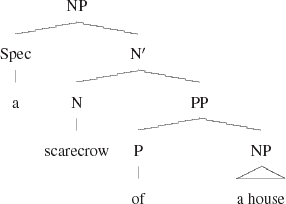
The basic motivation for this structure stems from the obligatoriness of the PP, as we have noted earlier. A major obstacle for the analysis is, though, that there are many examples suggesting that N2 functions as the semantic locus. N2 typically determines what the overall phrase is ‘a kind of’ (Zwicky Reference Zwicky1985: 5). For example (42a) refers to a kind of a head, not a kind of dome.
- (42)
(a) He nodded [his shaven dome of a head].
(b) It is [a jewel of a city].
The scope possibilities of Det1 and any pre-N1 modifier also might suggest that N2 is the semantic head:
- (43)
(a) our sod of a cleaner (‘our cleaner’)
(b) your jerk of a brother (‘your brother’)
The possessives our and your here specify N2, cleaner and brother, respectively.
As we saw above, patterns of omissibility of either of the two nominals with respect to selectional restrictions also indicate that headedness is not confined to N1. In examples like (44), the semantic head can be either N1 or N2, depending on context:
(44)

However, in most BNP constructions, N2 serves as the locus of the semantic argument, which we can show through omission of one noun:Footnote 7
- (45)
(a) Lou recalled the scarecrow of a house, the solitude, …
(b) Lou recalled the scarecrow, the solitude, …
(c) Lou recalled the house, the solitude, …
The sentence in (45a) is synonymous with (45c) but not with (45b). The next two examples illustrate the same point:
(46)
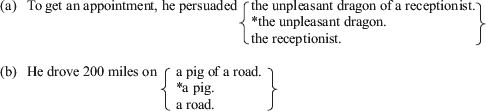
In both examples, the main verb selects N2, not N1, as its semantic argument. In general, it is N2 which satisfies the selectional restrictions of any higher predicate. This property would be hard to capture if N1 were taken to function as the sole syntactic and semantic head.
3.2 N2 as the head and grammaticalized P
As we have just seen, semantic facts direct us to N2 as the head. On the basis of the criteria for headedness put forward by Zwicky (Reference Zwicky1985) and Hudson (Reference Hudson1987), Aarts (Reference Aarts1998) assumes that the syntactic and semantic head of the BNP is the second noun (N2), as represented in the structure in (47):
(47)
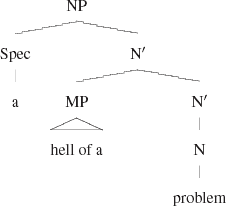
Together with the assumption that the sequence N1–of–a as a whole behaves like a modifier phrase (MP), the analysis Aarts (Reference Aarts1998) proposes can solve the issues raised for the N1-as-head analysis. First of all, it can account for the scope properties of any pre-N1 adjective as well as Det1. Since the sequence N1–of–a is a type of modifier, the higher Det1 or pre-N1 modifier can be linked either to N1 or to N2. Another advantage of this kind of analysis seems to come from coordination and extraction data. In accordance with the structure, there is no PP or NP constituent within the BNP since of and a are within the MP. This explains why there is neither PP coordination nor PP extraposition (Aarts Reference Aarts1998), which we identified above as Property 8.
Even though this analysis reflects the intuitive idea of semantic headedness and explains the freezing effects, it faces some challenges. The immediate question is whether the sequence N1–of–a really forms a constituent. There is no obvious synchronic or diachronic evidence for this position. Aarts (Reference Aarts1998) assumes that of–a is a unit functioning as a pragmatic marker which can be left out, existing as a syncategorematic form in adjunct position. Unless we accept the view that a sequence like hell of a corresponds to the adjective hellish (see Aarts Reference Aarts1998), nothing indicates that the former is a constituent.
Other issues arise from examples like the following (data from Austin Reference Austin1980: 359):
- (48)
(a) those Chinese chopsticks of knitting-needles
(b) his matchsticks of fingers
Even though such plural N2 examples are not frequent, the grammar needs to be open to the possibility of generating them, which is not possible under Aarts' proposal. In addition, treating the sequence of N1–of–a as a syntactic unit raises a question with respect to agreement. Even though the Det2 a has no quantificational force over the whole phrase, it places a restriction on the countability of N2. No non-count noun can be N2:
- (49)
(a) *That's a jewel of an information.
(b) *That is a dome of an evidence.
This means that the indefinite and the following N2 need to be in an agreement relation, which cannot be easily captured within the N1–of–a sequence analysis.
3.3 Functional head and prepositional complementizer P
As mentioned earlier, one clear semantic relation between N1 and N2 in the BNP construction is a subject–predicate relation (Kayne Reference Kayne1994, Aarts Reference Aarts1998, den Dikken Reference Den Dikken2006). To reflect this subject–predicate relation between N1 and N2, Kayne (Reference Kayne1994) assumes that N1 undergoes predicate inversion within a small clause, as represented in the following structure for the BNP that idiot of a doctor:
(50) that [D/PP [NP idiotj] [of [IP a doctor I0 tj]]] …
In this structure, Kayne (Reference Kayne1994: 102) takes the preposition of as a ‘prepositional complementizer’ selecting an IP. In the same spirit, den Dikken (Reference Den Dikken1995, Reference Den Dikken, Alexiadou and Wilder1998, Reference Den Dikken2006) develops this idea by further specifying the functional projections:Footnote 8
(51)
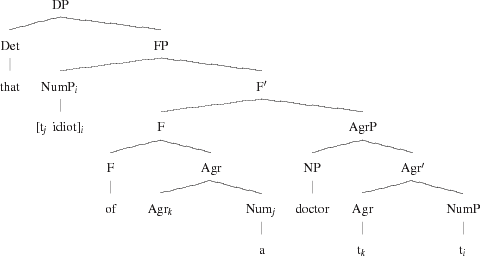
As shown here, and similar to Kayne (Reference Kayne1994), the preposition of, designated as F, selects the small clause AgrP in which the nominal doctor is the subject and its predicate is NumP an idiot. Movement first adjoins Agr to the functional head F, followed by adjoining the head Num a to Agr again. In the meantime, the remnant of NumP idiot moves to the specifier position of FP. As such, the generation of the BNP that idiot of a doctor is notionally from that doctor is an idiot and involves at least the following four movement operations in this predicative-inversion analysis:Footnote 9
- (52)
(a) movement of Agr to F
(b) movement of the indefinite article a preceding N2 to F
(c) movement of NumP to Spec-of-FP
(d) movement of AgrP to Spec-of-DP at LF via Spec-of-AgrP
This analysis assigns a special status to the preposition of. It is not a simple preposition or syncategorematic element, but a functional element selecting the small clause AgrP. This assumption places no further commitment on the headedness of the entire structure. Leaving out the issue of the exact status of the functional category F, the analysis is straightforward in representing the predication relation between N1 and N2.
However, other than this advantage, as also pointed out by Aarts (Reference Aarts1998), the analysis appears to be driven mainly by theory-internal considerations.Footnote 10 It is not clear to us what precise mechanisms trigger the assumed movement operations, and further elaboration is needed to ensure the semantic properties of Det2 or the evaluative function of N1. The analysis also requires extension to capture the syntactic freezing effects.Footnote 11 Without additional constraints, it may not follow from this analysis that the BNP cannot be involved in extraposition or coordination. Thus, this semantic-based movement analysis may not fully account for the properties of the BNP construction.
4. A constructional perspective: BNP as a juxtaposition construction
We now turn to our account of the BNP, which takes a slightly different direction from previous accounts. What we propose here is that the BNP is a type of nominal juxtaposition construction associated with certain specified properties.Footnote 12 That is, we assume that the BNP is a juxtaposition of two nominal expressions linked by the preposition of in the following syntactic skeleton:
(53)
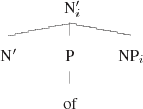
This syntactic form is associated with higher morphysyntactic, semantic and pragmatic constraints such as Det2 needs to be realised as a/an, N1 and N2 are in a predication relation, and so forth. This implies that Det1 can be any indefinite or definite determiner. As we have seen earlier, this is borne out by corpus data. Some additional examples are in (54):
(54) a hulk of a man, some dragon of a receptionist, one humdinger of a funny story, the ghost of a smile, that fool of a carrier, this hypocritical toad of a Sir Thomas, her prune of a face
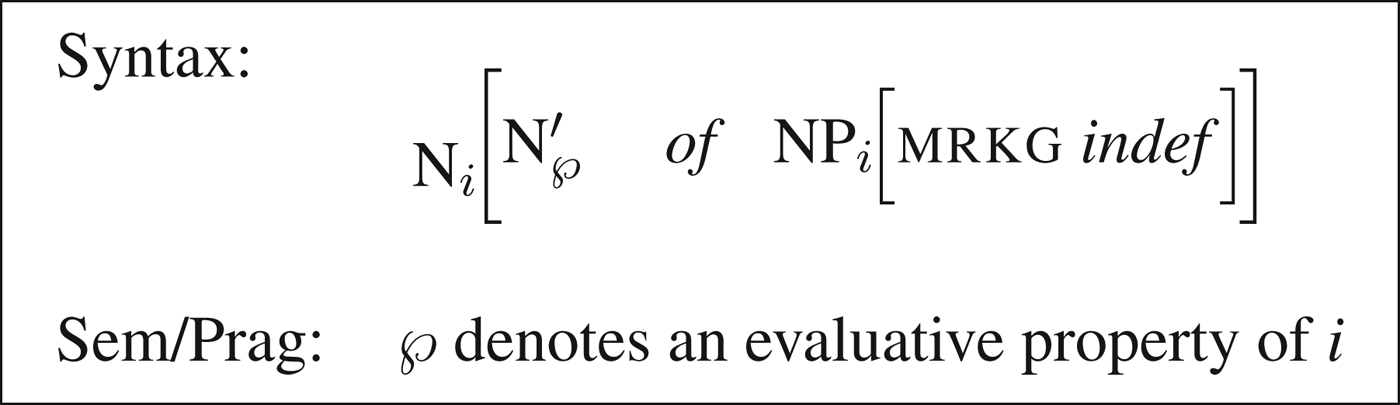
Our approach here is that the English BNP links syntactic and semantic constraints, as shown in Figure 1.
BNP construction in English.

The constructional constraint in Figure 1 links two nominal phrases. The two nominal phrases, N′ and NP, denote a property ( ) and an individual (i), respectively (Jackendoff Reference Jackendoff1977). The constructional constraint can be reinterpreted in a rule-like format within the framework of Head-driven Phrase Structure Grammar (HPSG):Footnote 13
(55) BNP construction (bnp-cx) in English
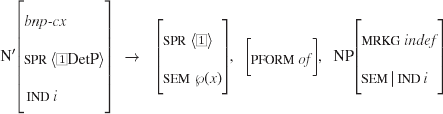
This is a more formal way of representing the constraint given in Figure 1.Footnote 14 The style of representation is similar to that of Sign-Based Construction Grammar (SBCG), a formal implementation of Construction Grammar (see Michaelis Reference Michaelis, Hoffman and Trousdale2013 and Sag Reference Sag, Boas and Sag2013 for an introduction to SBCG).
The construction ensures the preposition of to link the two nominals (Property 1), generating an N′ expression that can combine with any determiner (Property 2). This resulting juxtaposition induces a predicative relation in which the first nominal (N1) denotes an evaluative property () of the second nominal (Property 5). This will eventually yield a proposition-like meaning for the construction, in addition to the nominal meaning from the second NP (Property 4). The second NP has the marking (or marker) MRKG value indef, to be realized either as a(n) or as ø for bare plurals (Property 3). The indefiniteness constraint easily predicts the fact that a pronoun cannot appear in the NP2 position and, further, that a proper noun can appear in the N2 position only when it is accompanied by an indefinite determiner:
- (56)
(a) *a bastard of him/*a monster of it
(b) a fool of a James/a monster of a Frankenstein
As an anonymous JL referee suggests, the constraint on the pronoun in the NP2 position is not a prohibition on anaphora, as seen from He may not be a bear of a man, but he is certainly an ox of one, where the N′ anaphor one can refer to the NP2. Note that this juxtaposition does not assign any specific syntactic headedness property, except for specifying that N2 is the semantic head: the index value of the composite N′i is that of the NPi. One additional thing to note here is that the first nominal requires a specifier (DetP) which is also identical to the required specifier (SPR) value of the whole BNP. The structure in (57) illustrates the analysis:
(57) his wretched hovel of a home
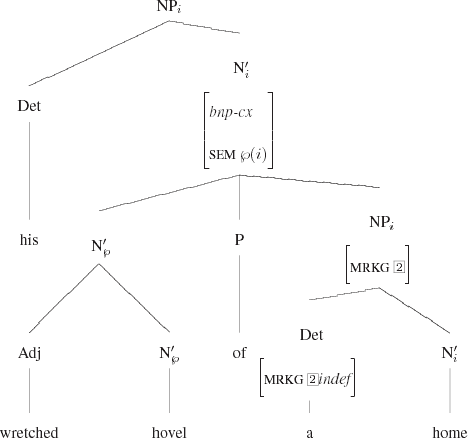
The two nominal phrases wretched hovel and a home are linked by the preposition. The constructional constraint in Figure 1 also requires that the second NP is marked with the indefinite article a/an.Footnote 15 The index value of the whole NP structure (i) is identical with the second NP, ensuring its primacy with regard to semantic headedness. The semantic value (SEM) also shows that the value of the first N′ is predicated of the index of the second NP.
One thing to note is that Det1 is the determiner of the whole construction while Det2 (which can be either a(n) or ø for bare plurals) has no apparent quantificational force over the whole phrase (Property 6 and 7). The scope facts are very clear, as seen in examples such as those in (58):
- (58)
(a) I have met every scumbag of a lawyer in this town.
(b) Deep lines grooved her prune of a face.
The example in (58a) does not mean that I have met every scumbag; it means that I have met every lawyer who also has a set of properties which are characterized by the evaluative part scumbag. The sentence in (58b) means that her face is grooved, not her prune. Thus, the present analysis captures the fact that Det1 can have only wide scope over the following N1 alone or over the combination of N1–of–NP2.
The present analysis also directly allows for examples where an AP scopes over the rest of the structure, as shown in (59):
(59) another bitchy iceberg of a guy
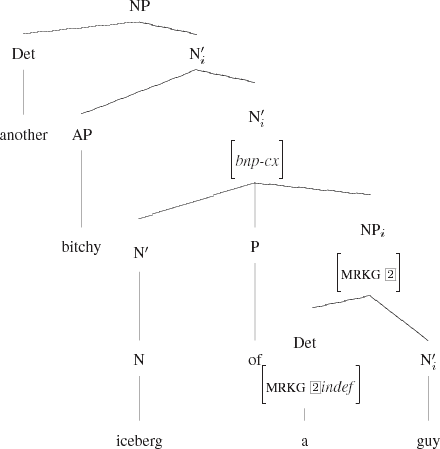
As already noted (in Section 2.7), it is also possible to have an AP modifier inside the first N′, e.g., that great ox of a matron.
5. Further complexity of the construction
5.1 Structural complexity and agreement facts
Note that the present analysis allows a more complex BNP structure like the following (data from Aarts Reference Aarts1998):
- (60)
(a) that destroyer of education of [a minister]
(b) this manipulator of people of [a mayor]
(c) my true defender in need of [a husband]
The nouns destroyer and manipulator require their own complements, e.g., of education and of people. Examples like (60) raise questions for the N1-as-head analysis. Given destroyer or manipulator as the head N, there is no direct way for it to select the final PP in a direct way unless the head selects two complements, as in (61) for (60a):
(61) N1-as-head structure
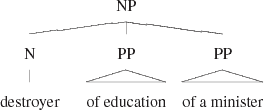
In terms of semantics, destroyer is directly linked to a minister, but it is against traditional wisdom to assume that the noun destroyer selects two PP complements. This fact leads Aarts (Reference Aarts1998) to claim that the of–NP sequences here are not constituents, but that the N1–of–a sequence forms a constituent MP (modifier phrase). We cannot assume that education of a forms an MP constituent since this does not reflect the meaning of this BNP, that it is the minister who is the destroyer of education. In the MP constituent analysis of Aarts (Reference Aarts1998), the expression destroyer of education of a would form one single MP constituent. This would then miss the relationship between destroyer and its PP complement of education. Complex BNP examples like (60) seem to weaken the simple complement analysis as well as Aarts's (Reference Aarts1998) MP approach unless we have a refined MP-internal structure for such complex cases.
In the present juxtaposition analysis, it is quite possible for the first N′ to be internally complex.
- (62)
(a) that [destroyer of education] of [a minister]
(b) this [manipulator of people] of [a mayor]
(c) my [true defender in need] of [a husband]
This structure then yields the desired meaning, in which the N2 minister and the N1 destroyer of education are in a subject–predicate relation. We can see that these are the correct structures as the final NP still shows the restriction to indef:
- (63)
(a) *that [destroyer of education] of [the minister]
(b) *this [manipulator of people] of [the mayor]
(c) *my [true defender in need] of [the husband]
Other complex examples, in which the complexity resides in N1, are given in (64):
- (64)
(a) Don't forget we've both done this [a [hell] of [a lot more times]] than you have!
(b) That is [a [hell] of [a number of dead soldiers]] among an American population which stood at …
(c) You have to stand atop [a [mountain] of [a lot of ‘no's’]] in order to get a successful ‘yes’.
Even though one could take hell of a as a collocational pattern or a unit as in Aarts (Reference Aarts1998) (see (47)), it seems likely that a lot or a number in (64a) and (64b) are sub-parts of the second NP.
Note that our juxtaposition construction shares the syntactic properties of the coordinated constructions in that neither nominal can be clearly identified as the pure syntactic head of the phrase. Like other types of juxtaposed constructions, the BNP has sequences of nominals fulfilling the same grammatical function, neither of which is syntactically dependent on the other. Two nominals of the same type are combined into a larger unit, and the BNP can internally iterate, as in (65) (data from den Dikken & Singhapreecha Reference Den Dikken and Singhapreecha2004: 14):
- (65)
(a) [My bastard of [an idiot of a math tutor]] decided it wasn't important.
(b) It was [a monster of [a giant of a game]].
The generation of such a recursive BNP is straightforward within the juxtaposition approach proposed here. One of the strong constraints in the BNP construction is that the second determiner, Det2, is indefinite. This makes the examples in (66) quite unnatural (compare (65)):
- (66)
(a) ??that bastard of the idiot of a tutor
(b) ??that bastard of the idiot of the tutor
Aarts (Reference Aarts1998) offers coordination examples as evidence for treating the PP in the BNP as a non-constituent, and he posits the string N1–of– a as a constituent:
- (67)
(a) *She called him a bastard [of a husband] and [of a father].
(b) *I can talk about that idiot of a referee or/and a linesman.
This also follows in our analysis, but it is quite possible that N2 can be coordinated:
- (68)
(a) We have that miracle of a friend and colleague.
(b) We spent a hell of a day and night.
For coordinating within NP2, it is necessary to have coordination of plural NPs as in (69): as in (67b), we cannot coordinate two indefinite NPs in the NP2 position.
- (69)
(a) those scumbags of politicians and lobbyists
(b) those fools of bosses and lawyers
With disjunction, this restriction is not necessary:
- (70)
(a) a hell of a day or a night
(b) an angel of a friend or a colleague
The difference between (70b) and (67b) seems to be the deictic Det in (67b) and the indefinite Det1 in (70b).
Considering that N1 is predicated of N2, there are also some constraints on number agreement due to the subject–predicate relationship. Compare the following:
- (71)
(a) *A friend and a colleague are an angel.
(b) A friend and a colleague are angels.
(c) Politicians and lobbyists are scumbags.
There appears to be a number agreement condition between subject and predicate. In the BNP, the NP2 has one strong constraint that it is marked with an indefinite (Det2). A singular indefinite Det2 forces the entire NP2 to be singular. As noted earlier, the Det2 has an agreement feature even though it has no quantificational force, as shown by examples like the following, where a mass N2 is blocked:
- (72)
(a) *This is a jewel of (a) furniture.
(b) This is a jewel of a piece of furniture.
However, a collective noun, which can denote a singular group or plural individuals, can appear as N2 (Keizer Reference Keizer2007: Chapter 5):
- (73)
(a) What to do with [those fools of a crew]?
(b) He would have been acquitted by [12 absolute fools of a jury] by now.
It seems that the key contribution of the indef Det2 is to ensure that NP2 is interpreted in an individuated manner. For example, those fools of a crew attributes the ‘fool’ evaluation to each member of the crew. In this regard, the BNP contrasts with other complex nominal measurement constructions where count nouns are used without a determiner in a mass sense, in examples such as 240 pounds of pure linebacker and six minutes of wailing guitar.
The agreement pattern is particularly intriguing compared to regular subject–verb agreement, with a BNP subject:
- (74)
(a) Those fools of a crew were/*was expelled from the ship.
(b) Those fools of a jury were/*was totally unreliable.
Given that the N2 is the semantic head in the current approach, and singular in these examples, one might assume that the verb needs to be singular too. Such agreement facts motivate two different levels of agreement, morpho-syntactic and index agreement, as argued by Kathol (Reference Kathol, Levine and Green1999) and Kim (Reference Kim2004). The former is sensitive to syntactic (or form) agreement values while the latter concerns what the entity in question refers to in context. This hybrid approach to agreement allows the analysis where crew is morpho-syntactically singular, agreeing with the singular Det2, while semantically it refers to a group of people. This is why it agrees with those fools and also with the main verb were. Consider the following cases, where we observe mismatches in agreement:
- (75)
(a) [Four pounds] was quite a bit of money in 1950 and it was not easy to come by.
(b) In preparation for the return fixture [this team] have/has trained more efficiently than they had in recent months.
In (75a), with the measure noun, the plural subject combines with a singular verb. An apparent conflict arises from the agreement features of the head noun. For proper agreement inside the noun phrase, the head noun has to be plural, but for subject–verb agreement the noun has to be singular. The noun pounds here is morphologically plural and thus must select a plural determiner, in accordance with the morpho-syntactic agreement constraint. But when these nouns are anchored to the group as a whole – that is, conceptualized as referring to a single measure – the index value has to be singular, in accordance with the index agreement constraint. A similar mismatch between subject and verb is also found in cases like (75b), with a collective noun like team. The head noun team here is singular so that it can combine with the singular determiner this. But the conflicting fact is that the singular noun phrase can combine even with a plural verb have as well as with a singular verb has. This is possible since the index value of the subject can be anchored either to a singular or to a plural kind of entity.Footnote 16 Given this hybrid agreement, consider the BNP structure in (76):
(76) those fools of a crew
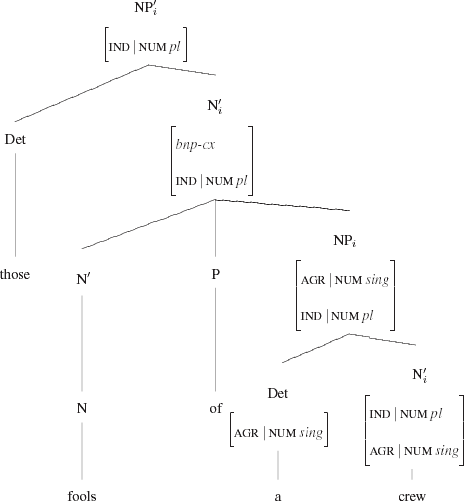
As we have noted, the Det2 a has no quantificational force, but agrees with the head noun crew in terms of the morpho-syntactic AGR (agreement) feature. However, the head noun crew refers to a plural index value, agreeing with the main verb are. This way of looking at agreement in terms of two different levels of agreement (morpho-syntactic and index) can capture the agreement facts in the BNP in a rather straightforward manner.
5.2 Relatedness to other constructions
In this paper we have shown that the BNP is a type of NP–of–NP construction with high-level constraints on (morpho-syntactic) form and (grammatical) functions. This kind of construction-based approach builds upon one of the main Construction Grammar tenets (see, among others, Fillmore, Kay & O'Connor Reference Fillmore, Kay and O'Connor1988, Goldberg & Jackendoff Reference Goldberg and Jackendoff2004, Goldberg Reference Goldberg2006, Jackendoff Reference Jackendoff2008, Kim & Sells Reference Kim2011, Sag Reference Sag, Boas and Sag2013). Each construction is a pairing of forms with sui generis formal properties and grammatical functions with its own non-compositional constructional meaning. A strong argument for this constructional approach for the BNP comes from the semantic relation between the two NPs. Nothing in the structure particularly indicates that the two NPs are in a predicate relation: as noted in Zwicky (Reference Zwicky1995), Payne & Huddleston (Reference Payne, Huddleston, Huddleston and Pullum2002), and others, there are numerous uses of the preposition of, as illustrated in (77) and (78):
(77) a few of these problems, two/some of your best friends, both (of) these problems, all (of) your best friends, a lot of problems/nonsense, a couple (of) problems, a cup of tea, three sheets of paper, etc.
All these constructions appear to be alike but are different with respect to the restrictions on the prepositional object NP. In addition, we can observe that possible semantic relations are highly varied:Footnote 17
(78) a skirt of leather, a vase of flowers, the problem of bank failures, the department of student affairs, the secretary of the society, the last pages of my novel, a photograph of my dog, the restoration of old paintings by artisans, the disappearance of the dodo, the perseverance of the Greeks, etc.
The possible semantic relation between two nominals at least includes part–whole, possessive, membership, internal argument of transitive, or subject of intransitive. The BNP is one of these constructions linked by the preposition of and associated with a particular semantic relation. It is an open question as to how many of these examples are also sub-types of juxtaposition.
An interesting point to note here is Jackendoff's (Reference Jackendoff2008: 10) observation that English has a liking for N–P–N constructions:
- (79)
(a) house by house, inch by inch (succession)
(b) line for line, snake for snake, syllable for syllable (matching, exchange)
(c) house to house, door to door, face to face (transition)
(d) day after day, telephone pole after telephone pole (succession)
(e) hundreds upon hundreds, argument upon argument (large quantity, succession)
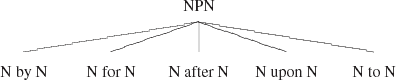
Each of these constructions has its own associated meaning such as succession, matching, transition, and comparison.Footnote 18 These constructions also license phrasal juxtaposition:
- (80)
(a) [one telephone pole] after [another]
(b) [miserable week] after [miserable week]
(c) [picture of Bill] after [picture of Bill]
Such examples show that English has a variety of nominal juxtaposition constructions, related as in (81).Footnote 19
(81) Inheritance hierarchy for the family of NPN (N′–P–N′)
Given the juxtaposition analysis, another possible question arises of where is this construction located in the grammar. Matthews (Reference Matthews1981) assumes four different syntactic dependency relations: complementation, modification, coordination, and parataxis. In addition to these four, he places ‘juxtaposition’ as an additional dependency that lies between modification and coordination. Of the cases of juxtaposition, one exemplar construction is the comparative correlative construction, another is the OM (one more) construction, and others (Culicover & Jackendoff Reference Culicover and Jackendoff1997, Reference Culicover and Jackendoff1999):
- (82)
(a) The less I do, the better I feel.
(b) One more can of beer and I am leaving.
(or: You drink another can of beer and I am leaving.)
Following Matthews' idea together with the Construction Grammar view of English, we can posit the following hierarchy for English:
(83) Inheritance hierarchy for headedness-cx
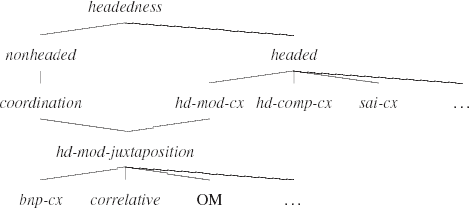
The construction-based framework captures linguistic generalizations within a particular language via the inheritance hierarchies in which cross-cutting generalizations are captured by inheritance constraints. The hierarchy in (83) represents hierarchical classification of headed phrasal types. The headed phrases relate to syntax and include constructions such as head–modifier (hd-mod-cx), head–complement (hd-comp-cx), and subject–aux-inversion (sai-cx), while the nonheaded phrases include coordination constructions which give rise to the overall juxtaposition pattern that the BNP has.
Note from the hierarchy that the juxtaposition construction is taken to be a subtype of both coordination and head–modifier construction.Footnote 20 This means that the juxtaposition construction may inherit some of the constructional properties of its supertypes such as the coordination and head–modifier constructions. In particular, we suggest that the juxtaposition inherits some combinatorial properties from the coordination construction and some semantic properties from the modifier–head construction. This also implies that, in addition to the typical combinatorial X′ rules (e.g., head–complement, head–modifier), English has the juxtaposition rule sketched in (84b), similar to the coordination rule in (84a), where + means one or more instances of X, X ranges over a lexical or phrasal expression and Y is a linker.Footnote 21
- (84)
(a) X → X+ Conj X
(b) X → X (Y) X
As can be seen in these simplified two rules, the juxtaposition rule is similar to the coordination in that two identical syntactic categories are combined.Footnote 22 The difference comes from the presence of the linker Y. For the NPN construction, the linker Y will be one of several prepositions while the linker in the BNP is the preposition of. With respect to headedness, at this point we assume that the second element NP2/N2 functions as the syntactic as well as semantic head while the first one serves as the modifier. As we noted in Section 4, the construction does have its own semantic properties, overriding the typical inheritance mechanism from the head–modifier construction.Footnote 23
Similar mixed properties can be found in the comparative correlative juxtaposition construction, showing both coordination and subordination (as head–modifier) properties (Culicover Reference Culicover1999, Culicover & Jackendoff Reference Culicover and Jackendoff1999, Abeillé & Borsley Reference Abeillé and Borsley2008, Kim Reference Kim2011; examples are from Culicover & Jackendoff Reference Culicover and Jackendoff1999: 12):
- (85)
(a) The more we eat, the angrier you get, don't you?
(b) *The more we eat, the angrier you get, don't we?
The examples in (85) show us that it is the second clause that is sensitive to the tag questions, indicating that the first clause is a subordination while the second one is the head. The examples in (86) show that both clauses behave alike with respect to island constraints:
- (86)
(a) *[The more food] Mary knows a man that eats __, the poorer she gets.
(Complex NP Constraint)
(b) *The more he eats, [the poorer] he knows a woman that gets __.
(Complex NP Constraint)
As Culicover and Jackendoff Reference Culicover and Jackendoff1999: 565) point out, such extraction possibilities show us that each of the clauses in the comparative correlative construction displays an ordinary long-distance dependency. However, the connection between the two clauses is ‘paratactic’ at syntax, though the first clause is interpreted as a subordinate clause. We may interpret the paratactic combination of the two clauses with no connective word as a coordination structure property while the semantic interpretation is a modifier structure property. These dual properties of English comparative correlatives can be a direct consequence of the way phrasal types are organized as sketched in (84). The BNP displays both modifier and coordination properties.Footnote 24
Subordination properties can be found from its meaning. Given that the second N2 or nominal expressions function as semantic locus, the first N1 or nominal expressions is a modifier to the N2. Such subordination properties, in a sense, led to an analysis like that of Aarts (Reference Aarts1998). Coordination properties are rather syntactic, evoking freezing effects (Property 8). Given the hierarchy in (84), since the BNP is a sub-type of coordination, many of the constraints relevant to coordination will also hold in juxtaposition constructions. As noted earlier (Section 2.8), no part of a BNP can be involved in dislocation constructions such as extraposition or wh-fronting (recall Property 8 above):
- (87)
(a) [A monster of a machine] was delivered.
(b) *A monster was delivered [of a machine].
- (88)
(a) *What (kind of politician) do we have an idiot of __?
(b) *What was there a hell of __?
The impossibility of extraposing of a machine in (87a) may seem to support an idea that this sequence is a PP, a complement in the BNP, considering the similar behavior of a straightforward PP complement in a student of linguistics for example:
- (89)
(a) A student of linguistics came to see me yesterday.
(b) *A student came to see me yesterday [of linguistics].
However, the wh-question in (90) appears to support an entirely different conclusion since extraction is possible out of a complement but not out of a modifier:
- (90)
(a) What branch of physics are you a student of __?
(b) *With what kind of hair are you a student with __?
The extraposition and wh-question data (89)–(90) once again show that the of-flagged sequence cannot be simply identified either as a complement or a modifier. The solution that Aarts (Reference Aarts1998) and Keizer (Reference Keizer2007) offer is that since the string N1–of–a is a constituent, no string involving parts of this constituent can be dislocated, as that string would not itself correspond to a constituent.
6. Conclusion
In this paper we have seen that the English BNP lends itself to an account in the spirit of Construction Grammar, as it combines different aspects of different construction types. We have proposed that the BNP is a type of N′–of–NPi construction with high-level constraints on (morpho-syntactic) form and (grammatical) functions. In particular, we have claimed that the BNP is a nominal juxtaposition construction involving a linker of. This proposal departs from previous analyses, which treat the preposition of as a canonical preposition (Napoli Reference Napoli1989) or as a special grammatical marker included in the complex unit N1–of–Det2 (Aarts Reference Aarts1998, Keizer Reference Keizer2007). Our view is also different from ones in which the preposition is taken to be a prepositional complmentizer (Kayne Reference Kayne1994) or a functional element F (den Dikken Reference Den Dikken2006).
Our juxtaposition analysis treats the BNP similarly to the coordinated construction in that the headedness properties are distributed accross the two nominals, N1 and N2, with the first nominal being predicated of the second. We have argued that this provides an account preferable over the alternatives in its empirical coverage and in terms of a theory which places BNP within a family of constructions.
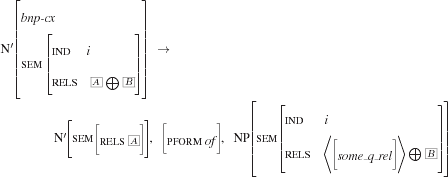
 ) and that of the NP (
 ) by the list union operator ⊕. However, the final BNP meaning does not include an existential quantification relation (some_q_rel) coming from the indefinite article (Det2), nor any meaning of of when it is used as a linker. (It is possible that the HPSG analysis could represent special ‘linker’ entries for these items, without the standard semantics associated with them.) The form in (i) also specifies that the index value (i) of the BNP is identical with that of the NP, indicating that NP2 functions as the semantic locus. See