Introduction
A growing number of papers have shown that candidates and parties in modern democracies increasingly rely on negative campaigning. Attempts to gain electoral advantage by attacking an opponent rather than emphasizing one's own positive attributes or policies is indeed a phenomenon that has become manifest in several different contexts (see Mayer, Reference Mayer1996, Sigelman and Shiraev, Reference Sigelman and Shiraev2002; Hansen and Pedersen, Reference Hansen and Pedersen2008; Elmelund-Præstekær, Reference Elmelund-Præstekær2010).
One of the most interesting questions in this regard is to investigate the conditions under which parties or candidates may have more incentive ‘to go negative’ (see Damore, Reference Damore2002; Theilmann and Wilhite, Reference Theilmann and Wilhite1998). Among others, Skaperdas and Grofman (Reference Skaperdas and Grofman1995) speculate that candidates with a lower level of support are more likely to attack, while Harrington and Hess (Reference Harrington and Hess1996) underline the role of the public's perception of a candidate's personal characteristics.
The role of spatial considerations has not received much attention in this literature (with the partial exception of Doron and On, Reference Doron, On and Arian1983). However, since negative campaigning involves blaming alleged insufficiencies of one's rival, it can be treated as a particular case of valence competition, i.e. competition about commonly shared values. This is a topic already covered by a number of contributions on spatial voting (Ansolabehere and Snyder, Reference Ansolabehere and Snyder2000; Groseclose, Reference Groseclose2001). In these works, nonetheless, the ‘valence endowment’ that parties enjoy is usually considered exogenously fixed, meaning that parties or candidates cannot act strategically in order to win valence competition. We relax this assumption here to present an intuitive model that allows us to link the debate on valence issues with the literature on negative campaigning in a spatial framework. Adopting a simple one-dimensional model, our main result is that the parties’ incentive to ‘attack’ each other increases with their ideological proximity.
We test our hypothesis by considering the long period without cabinet alternation that characterized both Italy and Japan over almost 50 years (up to 1994 in the Italian case; up to 1993 in Japan). In particular, we investigate the incentives of the Italian Communist Party (PCI) and the Japanese Socialist Party (JSP) to stress a particular topic related to negative campaigning in their electoral manifestos, i.e. political corruption issues. As we will discuss below, the status of perennial opposition held by both parties, together with the existence of several political corruption scandals during the period considered, makes the Italian and Japanese political systems particularly apt to test our hypothesis in a longitudinal setting. The statistical results, based on an analysis of party electoral programs codified by the Comparative Manifesto Project (Budge et al., Reference Budge, Klingemann, Volkens, Bara and Tanenbaum2001), are largely consistent with our theoretical insight. Some more general implications of our findings will be discussed in the conclusion.
1. Negative campaigning and ideological proximity
In a basic ‘Downsian’ world, voters care only about the party programs (Downs, Reference Downs1957). The examples Downs gives of party competition are indeed street policing, road maintenance, garbage removal, coastal defence, etc., i.e. government activities over which electors have given preference distributions according to their various needs. For instance, given a limited budget, intense road repair is carried out to the detriment of some other public activities. Moreover, setting aside some budget for road repair implies neglecting other spending. In short, Downs’ analysis refers to public decisions, which propose definite solutions to conflicts of interest among groups of electors represented by their different positions in the policy space.
Although these policy issues are important, they by no means exhaust all aspects relevant to electoral competition. Empirical research has long established this, pointing out the importance of, for example, party identification (Campbell et al., Reference Campbell, Converse, Miller and Stokes1960) and personalisation of politics (Sears, Reference Sears, Lindzey and Aranson1969).
Similarly, in a highly influential contribution, Stokes proposed a distinction between ‘position issues’ as ‘those that involve advocacy of government actions from a set of alternatives over which a distribution of voter preferences is defined’, and ‘valence issues’, as ‘those that merely involve the linking of the parties with some condition that is positively or negatively valued by the electorate’ (Stokes, Reference Stokes1963: 373). Enelow and Hinich elaborated Stokes’ point, defining valence issues as those candidate or party characteristics that all electors value in the same way, although they may have different perceptions as to how different candidates and/or parties are associated with such characteristics (Enelow and Hinich, Reference Enelow and Hinich1982: 117). An example of valence advantage is the acknowledged reputation of a party's staff and activists as being more honest or competent than their competitors.
In recent years, a growing number of contributions on spatial voting have begun to incorporate the aforementioned valence issues into the analysis. Their aim is to explore the implications of valence advantages on parties’ strategies and how valence considerations can fundamentally alter them (see Ansolabehere and Snyder, Reference Ansolabehere and Snyder2000; Groseclose, Reference Groseclose2001; Schofield, Reference Schofield2003; Adams et al., Reference Adams, Merrill and Grofman2005). As already pointed out, in these models the ‘valence endowment’ that parties enjoy is considered as exogenously fixed. However, this is an assumption that can be relaxed if we recognize that parties can invest in valence issues in both a positive as well as negative way, as we will discuss below.
Let us consider an electorate having policy preferences along the left–right spectrum, say the segment [0,1]. Moreover, let us suppose that the electorate is evenly distributed and the total consent of the whole electorate is 1, so that for every z ⊆ [0,1] there is a voter with ideal point z.Footnote 1 As to policy preferences, let us assume that all electors have single-picked utility functions, which are all identical apart from their ideal point, and linearly decreasing with the distance from it. Let us further consider two parties in this left–right space, L and R, that choose their electoral positions x and y on the segment [0,1]. Each party location represents an outline of its policy positions that we call party ideology. In this situation, each party gets a share of votes that depends on its own ideology, the ideology of the other party, and the distribution of voters’ preferences over the ideological space. In particular, in case of pure ideological competition, i.e. when both parties have equal value endowment, party L gets all votes from the extreme left to the middle point between x and y, while the reverse happens to party R.
Let us assume that the two parties now differ in terms of valence characteristics as perceived by the electorate. As a result, the utility of voting for a party is no longer merely a function of the distance between the positions of that party and a voter, but also of the level of valence enjoyed by the party. More formally, z's utilities to vote for L and R become uL(z) = u 0L– | x – z | and uR(z) = u 0R– | y – z |, respectively, where u 0L and u 0R are the levels of valence endowments.Footnote 2
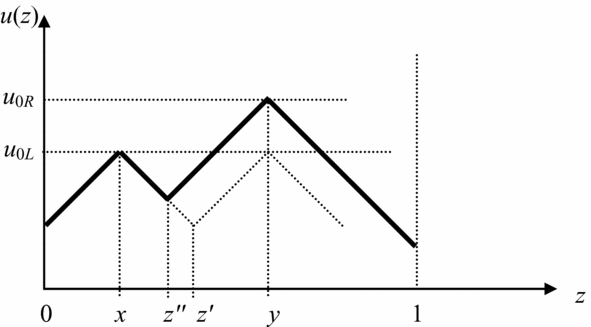
In this respect, if a given party enjoys a valence advantage, then the utility of voting for it can be considered to rise uniformly (Groseclose, Reference Groseclose2001). When this happens, the party with valence superiority gains votes depending on the amount of its moral advantage. An illustration is given in Figure 1, where the curve u(z) = Sup[(uL(z), uR(z)] represents the elector z's utility to vote for the preferred party. The figure – in which we assume u 0R > u 0L – shows that, due to the difference u 0R−u 0L≠ 0, the distance between the ideal point and party proposals is no longer the only element determining voting behavior. Instead, electors with ideal points between z′ and z” = z′ – (u 0R– u 0L)/2 now present a higher utility to vote for R in spite of the larger distance of its position from the voter's preferred policies.
The valence superiority of party R (u 0R– u 0L) produces an increased electoral support (z” – z’)
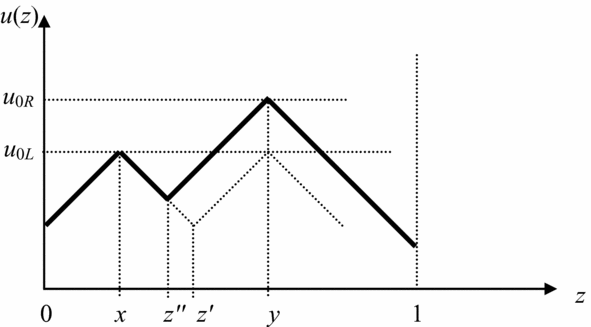
What the figure nicely illustrates is that parties can compete, at least theoretically, in two different ways: not only by moving their locations in the left–right space, but also by trying to influence their level of vertical position in a valence competition. Both kinds of moves may however be costly for a party: activists’ ties to established ideology (Aldrich, Reference Aldrich1983), a concern for party reputation whenever voters ‘remember’ a party's past positions (Cox, Reference Cox1990; Plümper and Martin, Reference Plümper and Martin2008), as well as the presence of uncertainty about popular preferences (Budge, Reference Budge1994) can make any spatial displacement difficult; while detecting the opponent's failures on shared values and organizing negative campaigns increases the costs of valence competition, and raises the possibility of retaliation. We can simply assume that, in a given competitive setting, parties select the campaign strategy that is more promising in terms of votes.
Focusing on valence competition, the nomination of popular candidates is one strategy parties can adopt, whether the candidates’ popularity stems from previous political activities or other sources of renown (for example, a war hero or a movie star). More generally, the deliberate exploitation of a valence issue as a competitive strategy includes all the actions aimed at impressing the entire electorate. Therefore, negative campaigning on valence issues can be considered a particular case of valence competition, where a party claims that the rival is somehow unfit to hold the office, i.e. an illegitimate competitor. In this regard, what is really at stake is harming or discrediting the opponent's reputation, and blaming its alleged insufficiencies concerning a universally supported cause.Footnote 3
A question that deserves investigation is under what spatial conditions parties have the largest incentive to invest in negative campaigning. If we acknowledge that detecting the opponent's misuse of political power and mounting a negative campaign is costly for a party – including in terms of opportunity costs deducted from other profitably competitive activities (see Damore, Reference Damore2002: 672–3) – then we can conclude that parties will have greater incentive to adopt a negative strategy when their marginal benefit is higher in terms of expected vote-gains.
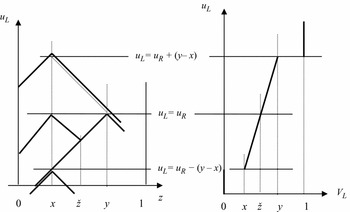
Figure 2 presents an illustration of the impact that ideological distance between the parties may have on their incentive to spend resources for valence competition. The left part of Figure 2 is a strategic version of Figure 1, where, as an example, vertical moves of party L are considered, while party R remains firm; in the right part, corresponding values of party L's votes are depicted, from which we can derive the following expression:

where Δu ≡ uL − uR is written for brevity. A similar expression is true for VR = 1–VL.
The electoral returns of a valence superiority for party L

From (1) it is apparent that the winner of a valence competition is determined by the sign of Δu: L wins if Δu > 0, R wins if Δu < 0, and parties are tied if Δu = 0. However, the votes taken by the two parties depend also, and crucially, on the given locations x and y, and interesting considerations can be drawn from this dependence.
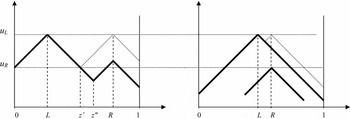
Consider the scenario depicted in Figure 3. Both sides of the figure show the same reputational advantage for party L concerning valence issues, owing to a successful negative campaign aimed at decreasing the utility of voting for the rival. However, on the left, a large distance between parties’ locations can be observed, while, on the right, the same situation is illustrated with a much smaller ideological distance. A further examination of the figure reveals that the consequences in a vote competition are very different: when the distance is large, the valence superiority gives a modest advantage to party L, but, when the distance is small, the advantage is enormous, giving the party all the votes.
For the same amount of success in negative campaigning (uL− uR), party L gains a few votes (z”−z′) if party distance is large (left in the figure) while L gets all votes (1− 0) if party distance is small (right in the figure)

As a result, as long as parties’ ideological positions are sufficiently apart (Figure 3, left), a competitive move concerning values cannot be very profitable, because accusations must be numerous and relevant to bring some significant benefits in votes, which increases the opportunity cost of negative campaigning. In this situation, a possible conclusion is that both parties may reach an implicit agreement on a low level of mutual negative campaigning, and instead adopt more promising competitive moves along the left–right space aimed at improving their capacity to win votes from the large electorate between them.Footnote 4
In contrast, when party policy programs are very close (Figure 3, right), and, consequently, when a smaller number of voters are found between the parties’ locations on the ideological space, fighting on the left–right dimension may not be very profitable, while even a limited valence advantage can give all the votes to one party. Therefore, in this scenario parties are strongly induced to discredit each other's moral reputation, publicly denouncing any characteristic of the opponent that the electors might perceive as a disvalueFootnote 5 According to the aforementioned discussion, we can therefore state the following hypothesis:Footnote 6
The spatial ‘mudslinging’ (SM) hypothesis: parties’ incentive to negative campaigning on valence issues increases with parties’ proximity on the ideological space
Although drawn from a bipartisan model, we argue that the validity of this hypothesis can be cautiously applied also to multiparty systems, once we have acknowledged some necessary simplifications. First of all, with respect to the dependent variable (i.e., negative campaigning on valence issues), it is worth while noting that parties belonging to the government coalition cannot attack each other on moral reputation (which implies that the attacked ally is declared unfit to govern), as this would quickly break down the alliance. To a lesser extent, this is also true for opposition parties, because an open contrast among them on such matters would lessen their potency against the government in terms of both public reputation and opportunity costs. Negative campaigning on valence issues can therefore effectively exist only between government coalition and opposition parties. As to the independent variable (i.e., proximity), government parties, while presenting the same program, may seek to preserve their ideological identity; this is even truer for opposition parties. However, when both government coalition and opposition parties are dominated by a single large party, the proximity between these dominant parties may be a reasonable substitute for the independent variable. Moreover, if one or more parties effectively challenge the supremacy of the dominant party within one bloc, a reasonable substitute for proximity could be that between the weighted means of the two coalitions, where the means should take into account dominant and challenging parties. Therefore, in such cases, adequate measures can be found to control the SM hypothesis also for multiparty systems.
As we will see, this reasoning allows us to test the SM hypothesis by analyzing the Italian and the Japanese cases during their long period without cabinet alternation. Negative campaigning on valence issues may be directed towards various parties’ alleged value failures, such as economic incompetence, weakness against crime or terrorism, leaders’ lack of charisma. Having chosen the Italian and Japanese case, we have decided to draw attention to the incentives of the parties to invest in a particular aspect of negative campaigning, i.e. political corruption.
2. The Italian and Japanese cases: the reasons for a comparison
The Italian case (up to 1994), i.e. the period popularly known as the Italian First Republic, and the Japanese case (up to 1993) share two political features that make them particularly attractive as case studies for testing our hypothesis. First, media chronicles as well as scholarly literature affirm that corruption scandals involving political parties (in particular government ones) and their representatives were of great importance in shaping party competition in both countries (for the Italian case see Della Porta and Vannucci, Reference Della Porta and Vannucci1997, Reference Della Porta and Vannucci1999; Nelken, Reference Nelken1996; for the Japanese case see Reed, Reference Reed1996; Johnson, Reference Johnson1986).Footnote 7 Indeed, major corruption scandals affected almost half of all Japanese general elections up to 1993 (see Nyblade and Reed, Reference Nyblade and Reed2008). Just to list a few of them: the Lockheed affair in the late 1970s, the recruit affair in the late 1980s, and the Sagawa Kyubin affair in the early 1990s. Moving to the Italian case, in addition to the enquiry popularly known as ‘mani pulite’ (‘clean hands’), it is worth recalling the two oil scandals in 1973 (Rhodes, Reference Rhodes1997) and 1980, the Lockeed affair in 1976–79 (same time as in Japan), party financing by an illegal Masonic lodge during the 1970s (Teodori, Reference Teodori1999), and several other cases of national and local corruption before that decade (Della Porta and Vannucci, Reference Della Porta and Vannucci1999).
The lack of any credible expectation of cabinet replacement (a situation that applies to both countries, see below) obviously played a crucial role in such widespread corruption scandals, given that electoral uncertainty is one of the strongest factor that helps to discipline politicians (in particular incumbents) (Chang, Reference Chang2005). Moreover, fewer alternations in power meant greater payoffs for political connections, thus attracting more investment by those seeking privileged treatment by the state (Milanovic et al., Reference Milanovic, Hoff and Horowitz2008).Footnote 8
Our attempt here is not however to explain the reasons behind such widespread political corruption in the two countries. Instead, we want to examine the incentives that can push parties to invest in negative campaigning centered on political corruption. It is precisely the existence of an underlying, and almost constant, flow of corruption scandals both in Italy and in Japan that makes these cases into a fertile ground for our aim, as it gives us the opportunity of searching for an explanation of any relevant variation in the rate of allegations that political actors make about such issues.
This last point brings us to the second main reason for focusing on Italy and Japan. Indeed, both countries in the period under study were well known for being two examples of dominant party systems in democratic polities (Pempel, Reference Pempel1990; Bogaards and Boucek, Reference Bogaards and Boucek2010), where the adjective ‘dominant’ refers to a party uninterrupted in government, either alone or as the senior partners of a coalition, for a long period of time (i.e., over three decades; see Cox, Reference Cox1997: 238).
On one side, from 1948 till 1994 Italy recorded the lowest turnover ratio of cabinet parties among all Western European democracies, with the exception of the short-lived French Fourth Republic (Mershon, Reference Mershon2001). The Christian Democratic party (DC), the largest party in Italy, was always the most important member of the cabinet, governing either by itself or in coalition, while the second largest party, the Communist party (PCI), was always excluded from it. This situation lasted until the abrupt collapse of the traditional Italian party system in 1993–1994 following judicial investigations precisely on political corruption issues (Morlino, Reference Morlino1996).
On the other side, analogous to the Italian case, Japan did not experience any significant cabinet turnover between 1955 and 1993, with the Liberal Democratic Party (LDP) firmly controlling government and relegating the second largest party (the Japan Socialist Party: JSP) to perennial opposition. It was not until after the 1993 election that a coalition of parties, including the JSP as the major partner, formed a non-LDP government. This coalition lasted barely one year, and was followed by a government headed by the JSP leader but, surprisingly, in coalition with its long-time rival, the LDP (Christensen, Reference Christensen2000).
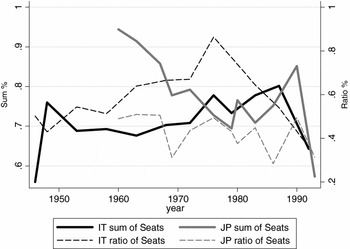
Before proceeding with testing the SM hypothesis, however, a preliminary step is in order. It is necessary to see whether these two cases belong to the set of multiparty systems to which the SM hypothesis (derived for a bipartisan model as shown in the previous section) can be applied. Figure 4 plots the sum of the percentage of seats controlled by the two largest parties in each country in the period analyzed (using the sum of votes does not change the shape of the figure). Footnote 9 As can be seen, in neither case does this sum fall below 56%. Moreover, the average sum of seat-share obtained by two largest parties in Japan is quite similar to the one obtained in Italy: respectively 77% and 71%. The main difference between the two cases is that in Italy the average ratio between the seats controlled by the PCI (later the PDS) and the DC is 60%, while in Japan this measure decreases to 43%, a contrast that clearly appears from the two dashed lines in Figure 4. This is why Italy has been frequently mentioned in the literature as a case of ‘imperfect bipartism’ (Galli, Reference Galli1967; Bardi and Ignazi, Reference Bardi, Ignazi, Ignazi and Ysmal1998),Footnote 10 while the Japanese case constituted a ‘one and half party system’ (Scalapino, and Masumi Reference Scalapino and Masumi1962; see also: Kohno, Reference Kohno1997; Christensen, Reference Christensen2000).
The evolution of the percentage of seats controlled by the two largest parties in Italy (1946−1993) and Japan (1960−1993) (left axis) and their ratio (right axis)

Given therefore the extraordinary relevance enjoyed by the two largest parties in both countries, we argue that, in a very general sense, both Italy and Japan can be analyzed using the theoretical framework proposed in the previous section. No government was realistically possible in Italy without DC, and no significant opposition without PCI. The same was true of LDP and JSP in Japan.
The political reasons for the absence of government alternation are somewhat different in the two countries. In the Japanese case, a number of factors have been shown to play a relevant role: factors linked to political culture (Richardson and Flanagan, Reference Richardson and Flanagan1984), to clientelism (Scheiner, Reference Scheiner2006), to the coordination failures prompted by the SNTV electoral system among the opposition parties to LDP (Kohno, Reference Kohno and Grofman2001; Cox, Reference Cox1997), as well as to system support attitudes (Tanaka and Martin, Reference Tanaka and Martin2003; Tanaka, Reference Tanaka2009). According to this latter explanation, in particular, the difficulty to replace the LDP government was connected to the fact that its main alternative, the JSP, was perceived by a large number of Japanese voters as an anti-system party, given its radical ideological stance in the economic (and, to a lesser extend, foreign policy) sphere. This latter explanation also fits the case of the Italian Communist party, an ‘anti-system party’ almost by definition, at least according to Sartori (Reference Sartori1976) (see also Farneti, Reference Farneti1980). Furthermore, international factors also played a crucial role in Italy, namely the perceived American veto on Communist participation in government in a key NATO ally (Mastropaolo and Slater, Reference Mastropaolo, Slater, Laver and Budge1992).
Regardless of the reasons underpinning the long period without cabinet alternation, the status of perennial opposition held by both the Italian Communist party and the Japanese Socialist party simplifies our empirical test. We assume that the incentive to invest in negative campaigning, centered on corruption, motivates opposition parties the most, because government parties are much more often presented with offers of corruption, thus encounter more chances to become corrupt. Thus, in a democratic system in which alternation in government is normal, the incentive to invest in negative campaigning are higher for some parties than others, depending on its position in government or opposition. Consequently, in the case of the Italian First Republic and of Japan up to 1993, it must be assumed that the emphasis on political corruption issues is a competitive strategy that is attractive mostly to the PCI and JSP. We seek to test our SM hypothesis based on this unidirectional meaning, which recognizes the long-standing opposition parties (PCI and JSP) as actors more systematically motivated to invest resources in negative campaigning centered on corruption.Footnote 11
3. The electoral emphasis on political corruption by PCI and JSP
To build the variables needed to test our hypothesis, we use data from the Comparative Manifesto Project (CMP). As it is well know, the CMP has analyzed and codified the contents of party electoral programs in various democracies (including Italy and Japan) (see Budge et al., Reference Budge, Klingemann, Volkens, Bara and Tanenbaum2001 for a detailed description). In the case of Japan, however, the CMP dataset considers summaries of parties’ election pledges reported in the Ashai Shimbun newspaper, given the absence of a well-established tradition of publishing specific documents before each election to explain party programs (see Inoguchi, Reference Inoguchi, Budge, Robertson and Hearl1987).Footnote 12 Moreover, this procedure has been employed consistently only since the 1960 general election. Therefore, we cannot include in our analysis elections preceding this year.
Focusing on party manifesto data as a way to understand the incentives of parties to invest in negative campaigning presents two main advantages. On one side, in ‘party controlled’ channels such as precisely the manifestos, parties can communicate directly without any interference, which is why such channels can be considered to reflect the parties calculus to go negative or stay positive better than other channels, such as ‘media controlled’ sources (i.e., news, TV programs, articles), in which the tone is affected by multiple contextual factors (on this point: Elmelund-Præstekær, Reference Elmelund-Præstekær2010; Ridout and Franz, Reference Ridout and Franz2008).
Secondly, this selection allows us to circumvent the fact that rules controlling campaign regulations can be (very) different across countries. For example, Japan is known for having one of the strictest campaign regulations among advanced democracies making it difficult, compared to Italy, to buy TV ads at the pleasure of the party's or the candidates’ purse (see Curtis, Reference Curtis1971; Christensen, Reference Christensen1998; for the Italian case: Mazzoleni, Reference Mazzoleni1991). This of course would make any comparison between the two countries based on the analysis of media coverage quite problematic. The same limit, however, does not apply to dealing with party programs.
For each party manifesto, CMP identifies the number of quasi-sentences that are considered as coding units, and assigns them to 56 pre-established policy categories. This CMP classification scheme allows us to extract the two pieces of information needed to control the SM hypothesis. First, among the 56 categories mentioned, one (the category per304) is explicitly devoted to record the emphasis placed by parties in their own manifestos on the ‘need to eliminate corruption and associated abuse in political and public life’, i.e. on political corruption issues. Accordingly, the weight placed by the Italian Communist party and the Japan Socialist Party on this topic constitutes our dependent variable (labeled CORRUPTION).Footnote 13
In addition, the database identifies 13 categories as indicators of policy positions representing the ‘left’ and another 13 as indicators of policy positions representing the ‘right’. These categories generally contrast emphases on peaceful internationalism, welfare, and government intervention on the left, to emphases on strong defence, free enterprise, and traditional morality on the right. Starting from these 26 categories, we followed the ‘ratio measure’ proposed originally by Kim and Fording (Reference Kim and Fording1998) to estimate the left–right position of parties. That is, for each party in each election we subtracted the sum of its left statements from the sum of its right statements, and then we normalize this subtraction with the salience each party assigns to the sum of the categories comprising the left–right scale. As a result, this scale ranges from between –1 (i.e., a party stressing in its programme just left-wing issues) and +1 (i.e., a party stressing in its programme just right-wing issues).
Note that by using such a measure, instead of the more common index based on the simple subtraction between right and left categories (see Laver and Budge, Reference Laver and Budge1992), we assure that any change in the saliency of the corruption issue does not affect the way we estimate the left–right scores. As a result, any risk of endogeneity is neutralized.Footnote 14
Estimating the left–right scores of parties is the necessary preliminary step to assess the spatial distance between the PCI (and JSP) and their government counterpart(s) that represents our principal independent variable (labeled DISTANCE).
In the Italian case, DISTANCE is estimated as the absolute distance between the left–right placements of PCI and DC in each election until June 1979. However, since the 1983 election, we consider the distance between the Communist party and the mean position of the dyad formed by the Christian Democrats and the Socialist party, weighted by their respective share of seats. This reflects the already mentioned increasing role achieved by the Socialist party that, owing to a new leadership, not only moved toward a harsher confrontation with the PCI as well as toward a strengthened relationship with the DC (Bull and Newell, Reference Bull and Newell2005),Footnote 15 but also challenged the Christian Democrats as the government rulers, succeeding in taking the office of Prime Minister for its leader Bettino Craxi for quite a long period of cabinet stability (August 1983–April 1987). Finally, since the transformation of the PCI into the Democratic Party of the Left (PDS) following the fall of communism in Eastern Europe and the collapse of the Soviet Union at the end of 1980s, we consider the distance between the weighted position of DC and PSI and the position of PDS. In the Japanese case, on the contrary, DISTANCE is always estimated as the absolute difference between the left–right placements of JSP and LDP.
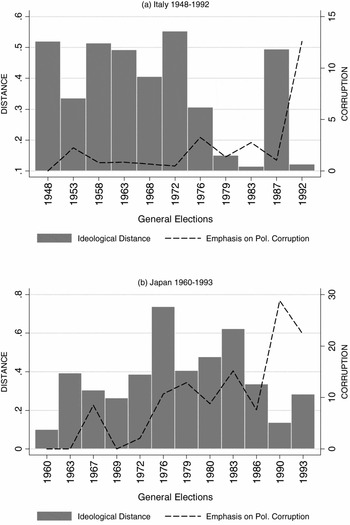
Figure 5 presents the evolution of CORRUPTION against DISTANCE in the two countries. The figure clearly shows the highly dynamic nature of both variables over time, and how the trends of the two variables roughly mimic each other. Moreover, the figure also illustrates the appropriateness of both the Italian First Republic as well as the Japanese case as a test for the SM hypothesis. Indeed, in both countries the spatial polarization of the system undergoes with time important variations, showing a tendency, albeit far from being linear, toward a decrease. On one side, this implies that our case studies can be a crucial test for measuring the importance of valence issues, as their ideological divide should instead emphasize the spatial competition on policy issues. On the other, it gives us the opportunity of controlling the functional relation between these variations and the number of allegations of corruption, which is exactly the task of the empirical side of this work. The next section investigates this relationship in a more formal way.
(a) Emphasis on political corruption by PCI/PDS and the evolution of the spatial distance between PCI/PDS and DC (DC-PSI since 1983): 1948−1992 (b) Emphasis on political corruption by JSP and the evolution of the spatial distance between JSP and LDP: 1960−1993

4. The statistical analysis
Our dependent variable CORRUPTION, i.e. the relative emphasis given to the political corruption issues by the Italian Communist party and the Japanese Socialist Party in their manifestos, is a fractional response data, bounded between 0 (no reference at all to this category) and 1 (the entire party program is dedicated to this topic). Under these conditions, a linear functional form for the conditional mean might miss important non-linearities, creating a problem of heteroskedasticity. Papke and Wooldridge (Reference Papke and Wooldridge1996, Reference Papke and Wooldridge2008) propose to direct models for the conditional mean of the fractional response through a logistic form that allows to keep the predicted values in the unit interval. They also applied the method of quasi-maximum likelihood estimation to obtain robust estimators of the conditional mean parameters with satisfactory efficiency properties. This model, called ‘fractional logit’, can be easily implemented through Stata software and it is precisely the model we fit for our analysis.
According to our SM hypothesis, we expect a negative relationship between CORRUPTION and our principal explanatory variable, i.e. DISTANCE. However, we are inclined to think that the incentive of a party to invest in negative campaigning can be influenced by other variables. To begin with, it can be a function of the opportunities that arise from the external environment (e.g., scandals reported in the press or highlighted by other parties and then debated publicly). Once these opportunities increase, the same should happen with the aforementioned incentive. As a proxy for these opportunities, we have considered the average emphasis given by parties (others than PCI/PDS and JSP) in both countries to political corruption issues. Specifically, we weighted this average emphasis by parties’ vote shares, to reflect the fact that the existence of scandals become increasingly significant once larger parties start to recognize and mention the issue in their electoral programs (variable label: OTHER PARTIES EMP. ON CORRUPTION). The weighting procedure does not substantially affect our results. In general, we expect this variable to be positively related to CORRUPTION.
Secondly, the literature on negative campaigning repeatedly stresses that candidates and parties would be inclined to apply negative campaigning to a greater degree when they are behind in the polls (see Hansen and Pedersen, Reference Hansen and Pedersen2008; Skaperdas and Grofman, Reference Skaperdas and Grofman1995; Harrington and Hess, Reference Harrington and Hess1996). Several studies have empirically confirmed this thesis (see Damore, Reference Damore2002). The reasoning behind this assumption is that negative campaigning is used to reducse the support of the opponent. In this regard, the party lagging behind in the polls, having not succeeded in attracting enough undecided voters, seeks to dishearten the opponent's voters (see Elmelund-Præstekær, Reference Elmelund-Præstekær2010). Given that no temporal series of polls are available in our case studies, we have therefore decided to take as a proxy the difference in terms of votes recorded in each election between the long-standing opposition party (PCI and JSP) and the likewise long-standing dominant party. We have labeled this variable VOTE DIFFERENCE Footnote 16.
Finally, to control for any remaining idiosyncratic reason that could explain the variance in CORRUPTION based on some peculiar feature of Italy (contra Japan), and vice-versa, we have included in our model a dummy that takes value of 1 for the Italian observations (variable name: ITALY). Note that by including this fixed effect, our model actually explains the variance within each of the two countries.
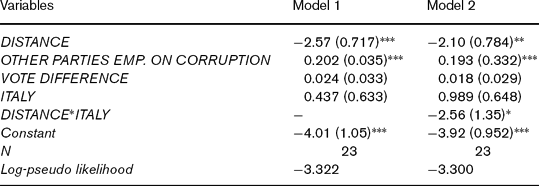
The results of the two models we have estimated are reported in Table 1.Footnote 17
Explaining the incentives of the largest opposition party to emphasize political corruption issues using the Italian and Japanese CMP data – fractional logit estimations
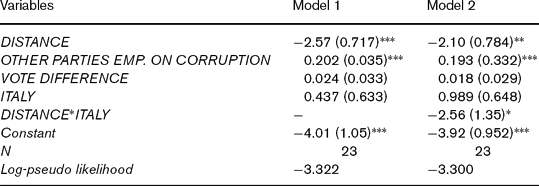
Notes. The data to estimate both the dependent variable and the independent variables come from the CMP dataset (Budge et al., Reference Budge, Klingemann, Volkens, Bara and Tanenbaum2001). The elections covered in the Italian case run from the 1948 to 1992; in the Japanese case since 1960 to 1993.
Significance (two tailed): * <0.1, ** <0.05, *** < 0.01.
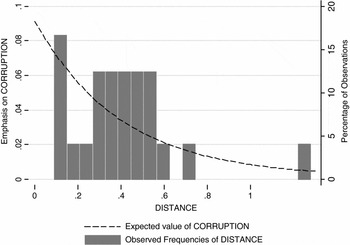
Our SM hypothesis finds a sound empirical confirmation in the data. Indeed, DISTANCE is highly significant and presents, as expected, a negative sign. In other words, the emphasis on CORRUPTION by the main (and perennial) opposition party in both Italy and Japan appears to increase when it gets closer to the respective dominant party. Figure 6 plots the expected value of CORRUPTION as DISTANCE changes holding all the other variables constant at their mean. We also superimpose a histogram portraying the frequency distribution of observations for DISTANCE (scale on the right-hand side of the vertical axis). As can be seen, the impact of DISTANCE is far from being trivial. Indeed, the expected value of CORRUPTION decreases rapidly as DISTANCE increases, becoming approximately 0 for values higher than 1. On the contrary, for values of DISTANCE lower than 0.3, the opposition party is expected to devote on average around 6% of its manifesto to emphasize political corruption issues, i.e. one possible instance of negative campaigning. This implies a threefold increase in the average emphasis on corruption issues recorded in the dataset.
Expected value of CORRUPTION as DISTANCE changes (from Model 1)

Regarding the control variables, the emphasis by the other parties on corruption yields the expected (and significant) sign. That is, the behavior of PCI and JSP seems to be affected by what happens in their environment, aside from any spatial consideration. Confirming the previous findings in the literature, the incentives to invest in negative campaigning (centered about corruption allegation) increases as the opposition party is lagging behind more in the pools, i.e. when VOTE DIFFERENCE gets larger. However, its statistical sign is not significant. The same happens for the country-dummy ITALY.
In our second model, we have added an interaction between ITALY and DISTANCE. This allows us to assess if the relationship between CORRUPTION and DISTANCE varies systematically across the two countries. As can be seen, by looking at the sign (and at the magnitude) of the interaction term, the strength of the relationship between DISTANCE and CORRUPTION is almost the double in Italy compared to Japan.
This difference can be understood by taking the electoral rules of the two countries into consideration. Until the electoral reform of 1994, members of the Japanese Lower House (House of Representatives) were indeed elected by single non-transferable votes from a multi-member district system. This electoral rule, compared to the proportional system employed in Italy during the First Republic, strongly encouraged candidate-based competition (Reed and Thies, Reference Reed, Thies, Soberg Shugart and Wattenberg2001), in contrast to the almost purely party-based competition in Italy. Therefore, a hypothesis like ours that rests primarily on incentives working at the party level should work comparably better in the latter context. This is exactly what we find.
Finally, note that the large (and significant) coefficient of DISTANCE for the Italian case does not depend on any ‘clean hands’ effect. Indeed, the 1992 Italian general election was held at the beginning of April, before the judicial investigations (which started only in late February 1992) were able to take their full effect on voters’ perception of the vast amount of corruption characterizing the Italian party system. In this sense, the relationship between CORRUPTION and DISTANCE highlighted by our SM hypothesis is able to capture a durable underlining feature of party-system competition that is not merely due to important, but extemporaneous, exogenous shocks.Footnote 18
Conclusion
In the present paper, we have considered the Italian and Japanese cases as two insightful examples of competitive use of negative campaigning centered on political corruption. By employing party manifesto data, we have shown that the propensity of the largest opposition party in each country to adopt a strategy of denouncing the corruption of their rivals was inversely related to the ideological distance separating that party from its main opponent in government (i.e., the Christian Democracy in Italy; the LDP in Japan). This result corroborates our SM hypothesis – derived from a simple model of valence competition in a spatial framework – which maintains that, when ideological differences shrink, parties make larger use of socially shared values as a supplementary competitive tactic.
The two countries examined in the present study are somehow unique, in the sense that in the period under analysis no cabinet alternation ever took place in either of them. This is a factor that, on its own, should induce the ‘permanent’ opposition party to focus on political corruption issues as a way to denounce the equally ‘permanent’ government party, especially when the evidence about political scandals is far from scarce. The choice of our two cases was partly driven exactly with this expectation in mind. However, as long as the ideological polarization in modern democracies continues to decline, as predicted by the end-of-ideology hypothesis (Bartolini and Mair, Reference Bartolini and Mair1990), we suspect that the use of negative campaigning (in one form or another) would become more and more prevalent as a strategy employed by parties in their everyday confrontation, even in contexts in which cabinet alternation is expected. After all, the more the parties look ideologically similar, the more they are induced to avoid any denigration of the policy program of the rival, which is, by default, so similar to its own. However, they are still pressed to find a way to distinguish themselves for electoral reasons. This is precisely what negative campaigning (and valence competition in general) allows them to do. Given these premises, it may therefore be interesting to extend (and control) our SM hypothesis to other countries in future studies.
Acknowledgements
The author thanks Paolo Martelli, Airo Hino, Willy Jou and the participants at GLOPE II Tuesday Seminar, Waseda University of Tokyo, for their helpful comments. Curini's work was supported by the Japan Society for the Promotion of Science (JSPS), grant number S-09131, and by the Italian Ministry for Research and Higher Education, Prin 2007, prot. 2007 scrwt4.
About the author
Luigi Curini is Associate Professor at the Department of Social and Political Studies, Università degli Studi di Milano. His research focuses on spatial theory of voting, party systems and electoral systems. He has published a number of books and has contributed to such journals as: British Journal of Political Science, Electoral Studies, European Journal of Political Research, Party Politics, and Rivista Italiana di Scienza Politica.