Introduction
As societies and economies progress, companies operate within increasingly dynamic external environments, face increasingly vigorous competition and encounter unpredictable technological changes. To respond successfully to these changes, most managers have realized that they should encourage employee creativity (Shalley & Gilson, Reference Shalley and Gilson2004; Zhang & Bartol, Reference Zhang and Bartol2010). Indeed, enhancing employee creativity has become an important method of improving organizational innovation and attaining a competitive advantage (Zhou, Reference Zhou2003; Hirst, van Knippenberg, & Zhou, Reference Hirst, van Knippenberg and Zhou2009). Previous studies have shown that personality factors, cognitive factors, intrinsic motivation and knowledge combine with social and contextual factors to influence employee creativity (Woodman, Sawyer, & Griffin, Reference Woodman, Sawyer and Griffin1993). Many researchers have focused on the personality factors that affect employee creativity such as self-identification and self-efficacy (Farmer, Tierney, & Kung-McIntyre, Reference Farmer, Tierney and Kung-McIntyre2003; Prabhu et al., 2008). In recent years, some scholars have used learning theory and self-efficacy theory to investigate goal orientation in a similar way (Gong, Huang, & Farh, Reference Gong, Huang and Farh2009; Hirst, van Knippenberg, & Zhou, Reference Hirst, van Knippenberg and Zhou2009). Although learning orientation has been found to be positively related to employee creativity, performance orientation and employee creativity may not have the same relationship (Hirst, van Knippenberg, & Zhou, Reference Hirst, van Knippenberg and Zhou2009). Some studies in educational settings have shown that two dimensions of performance orientation, self-regulation and mood, can enhance an individual’s creativity (Baas, De Dreu, & Nijstad, Reference Baas, De Dreu and Nijstad2011; Roskes, De Dreu, & Nijstad, Reference Roskes, De Dreu and Nijstad2012). However, other psychological factors that affect the relationship between goal orientation and employee creativity need to be explored in workplace settings.
Creative role identity has a positive effect on employee creativity (Farmer, Tierney, & Kung-McIntyre, Reference Farmer, Tierney and Kung-McIntyre2003). Within the scope of role identity theory, this construct has been defined as ‘a self-attributed meaning in relation to the role of performing creatively in the workplace’ (Wang & Cheng, Reference Wang and Cheng2010). Farmer, Tierney, and Kung-McIntyre (Reference Farmer, Tierney and Kung-McIntyre2003) also found that perceived expectations of co-worker creativity, self-views of past creative behaviour and exposure to the stronger creativity culture in the United States, have positive and significant effects on creative role identity, which enhances employee creativity (Farmer, Tierney, & Kung-McIntyre, Reference Farmer, Tierney and Kung-McIntyre2003). Some studies have explored the effects of creative role identity on employee creativity further (Wang & Cheng, Reference Wang and Cheng2010; Wang & Zhou, Reference Wang and Zhu2011). For example, Wang and Cheng (Reference Wang and Cheng2010) found that creative role identity moderated the relationship between benevolent leadership and employee creativity. Similarly, Wang and Zhou (Reference Wang and Zhu2011) found that the construct positively mediated the relationship between transformational leadership and employee creativity. However, few studies have focused on the effects of other creativity-enhancing personality factors on creative role identity. Therefore, the antecedents of creative role identity need to be discussed.
The objective of this study is to use role identity theory to analyse and test the relationship between goal orientation and employee creativity. According to achievement motivation theory, goal orientation influences how individuals approach, interpret and react to achievement situations (Eilliot & Church, Reference Elliot and Church1997; Hirst, van Knippenberg, & Zhou, Reference Hirst, van Knippenberg and Zhou2009). Goal orientation reflects an individual’s awareness of self-development, which affects how he or she comprehends and responds to the external environment (Hirst, van Knippenberg, & Zhou, Reference Hirst, van Knippenberg and Zhou2009). Indeed, goal orientation may be an important influence on employee creative role identity, and through it employee creativity. We attempt to determine whether goal orientation does affect employee creative role identity, and to describe the possible mechanism by which creative role identity mediates the link between goal orientation and employee creativity.
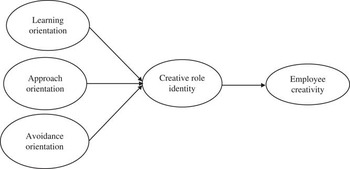
This study contributes to the literature on creativity and organizational behaviour in three main ways. First, we build and test a conceptual model that uses role identity theory to integrate goal orientation and employee creativity in the workplace. We also explore the relationship between performance orientation and employee creativity, which helps us to understand that how performance orientation improves employee creativity in certain situations. Second, we empirically explore the relationship between goal orientation and creative role identity for the first time, which contributes to role identity theory. Third, we explore how creative role identity mediates the influence of goal orientation on employee creativity, which provides an enhanced understanding of how an employee’s learning orientation and performance orientation can improve his or her creativity. Figure 1 shows the theoretical framework of our study.
Model of goal orientation, creative role identity, and employee creativity

In the remainder of this paper, we first review the relevant literature and develop our hypotheses. We then discuss our methodology in detail and evaluate the results of our hypotheses. In the conclusion, we discuss the theoretical and practical implications of our study.
THEORETICAL BACKGROUND AND HYPOTHESES
Goal orientation and creative role identity
Goal orientation is believed to create a perceptual-cognitive framework that affects how individuals approach, interpret and respond to achievement situations (Van Yperen, Reference Van Yperen2003; Janssen & Van Yperen, Reference Janssen and Van Yperen2004). It reflects an individual’s awareness of self-development, which may influence his or her understanding of and response to the external environment (Hirst, van Knippenberg, & Zhou, Reference Hirst, van Knippenberg and Zhou2009). Vande Walle (Reference VandeWalle1997) developed the ‘two dimensions’ of goal orientation: learning goal orientation and performance goal orientation. Learning goal orientation is characterized by a desire to develop the self by acquiring new skills, mastering new situations and improving competence. Performance goal orientation is centred around the demonstration of competence to others (Vande Walle, Reference VandeWalle1997). Learning goal orientation cultivates an intrinsic interest in the task itself, which increases the probability that the employee will invest efforts and persevere to accomplish a complicated task in the absence of external incentives (Dweck, Reference Dweck1999; Hirst, van Knippenberg, & Zhou, Reference Hirst, van Knippenberg and Zhou2009). Elliot and Harackiewicz (Reference Elliot and Harackiewicz1996) divided performance goal orientation into two categories: approach performance orientation, which encourages individuals to seek favourable judgements, and avoidance performance orientation, which encourages individuals to avoid unfavourable judgements.
A role identity is defined as a self-view, or a meaning attributed to oneself in relation to a special role (Burke & Tully, Reference Burke and Tully1977; Burke, Reference Burke1991), which is generated reflexively by perceived appearance to others, and by self-judgement of one’s own appearance (McCall & Simmon, Reference McCall and Simmons1978). If an individual’s role identity is closely linked to his or her sense of self or personal identity, the individual will tend to behave in accordance with this role identity (Callero, Howard, & Piliavin, Reference Callero, Howard and Piliavin1987; Wang & Cheng, Reference Wang and Cheng2010). Failing to fulfil a role may lead to an individual incurring considerable social and personal cost (McCall & Simmon, Reference McCall and Simmons1978). Thus, if the individual has a high level of role identity, he or she will tend to avoid negative behaviour that is inconsistent with his or her own role to protect his or her self-view (McCall & Simmon, Reference McCall and Simmons1978; Burke, Reference Burke1991; Wang & Cheng, Reference Wang and Cheng2010).
Building on role identity theory, Farmer, Tierney, and Kung-McIntyre (Reference Farmer, Tierney and Kung-McIntyre2003) argued that some employees consider personal creativity to be a central part of ‘who they are’, developing the construct of creative role identity and analysing the relationship between creative role identity and employee creativity. McCall and Simmon (Reference McCall and Simmons1978) found that when employees had high levels of creativity in their roles, they are likely to make active efforts to maintain the role’s consistency. Although few researchers have focused on the relationship between learning orientation and creative role identity, we suggest that learning orientation is positively related to creative role identity. First, learning new knowledge and skills is an important way of fulfilling the obligations of a creative role, and to avoiding punishment or poor performance (Farmer, Tierney, & Kung-McIntyre, Reference Farmer, Tierney and Kung-McIntyre2003). Learning orientation can improve the development of domain- and creativity-relevant skills (Hirst, van Knippenberg, & Zhou, Reference Hirst, van Knippenberg and Zhou2009). Such skills provide the essential knowledge and basis for creativity (Amabile, Reference Amabile1996), which would enhance individual’s confidence and role awareness. When individuals have high level of creative role identity, they are likely to seek to protect their self-image and avoid negative behaviour (McCall & Simmon, Reference McCall and Simmons1978; Burke, Reference Burke1991; Wang & Cheng, Reference Wang and Cheng2010). Second, learning-oriented employees may try their best to attain new knowledge and skills, which will add to their awareness of ‘who they are’, maintaining their creative role identity (Hirst, van Knippenberg, & Zhou, Reference Hirst, van Knippenberg and Zhou2009). Because individuals no longer fulfilling such a role may suffer considerable social and personal costs (McCall & Simmon, Reference McCall and Simmons1978). Especially, when an individual with high level of creative role, he or she avoid suffering this costs, which would enhance employees’ motivation to seek for skills (McCall & Simmon, Reference McCall and Simmons1978). Third, learning-oriented employees tend to overcome obstacles by unremitting efforts to improve and to learn new skills (Vande Walle, Cron, & Slocum, Reference VandeWalle, Cron and Slocum2001). During the process of innovation employees may meet many difficulties, which may damage their creative roles (Farmer, Tierney, & Kung-McIntyre, Reference Farmer, Tierney and Kung-McIntyre2003). Employees can increase their confidence by learning new skills and knowledge that deal with problems successfully, which may in turn protect their creative role identity. Therefore, we propose:
Hypothesis 1: Employee learning orientation is positively related to creative role identity.
A role identity reflects an internalized set of role expectations. The importance of a role identity is related to the individual’s level of commitment to the role. In that way, role identity reflects self-expectation or an internal standard (Farmer, Tierney, & Kung-McIntyre, Reference Farmer, Tierney and Kung-McIntyre2003), whereas approach performance orientation reflects the selection of appropriate behaviour as a way of maximizing potential rewards and minimizing potential punishments (Hirst, van Knippenberg, & Zhou, Reference Hirst, van Knippenberg and Zhou2009). Although the relationship between approach performance orientation and creative role identity has not yet been empirically tested, we have two explanations for the influence of approach performance orientation on employee’s creative role identity.
First, from a sense-making perspective, before employees behave creatively they are likely to estimate the reasonable response to their actions (Ford, Reference Ford1996; Drazin, Glynn, & Kazanjian, Reference Drazin, Glynn and Kazanjian1999). Employees with high levels of creative role identity and creative awareness are extremely sensitive to the perceived reception of their creativity, especially when they are expected to succeed at a creative performance (Farmer, Tierney, & Kung-McIntyre, Reference Farmer, Tierney and Kung-McIntyre2003). when creative employees have levels of approach orientation, they would expect to demonstrate their competence and are evaluated by other employees or managers that they are creative employees (Hirst, van Knippenberg, & Zhou, Reference Hirst, van Knippenberg and Zhou2009). And these expectations would enhance employees’ self-perception and further strength their self-awareness. This could allow the employees to convince themselves that they are creative (Farmer, Tierney, & Kung-McIntyre, Reference Farmer, Tierney and Kung-McIntyre2003), contributing to their sense of ‘who they are’, and maintaining their creative role identity (Hirst, van Knippenberg, & Zhou, Reference Hirst, van Knippenberg and Zhou2009).
Second, approach-oriented employees focus on attaining favourable judgements of normative competence (Rawsthorne & Elliot, Reference Rawsthorne and Elliot1999). Self-confidence in one’s own competence can improve creative role identity (Hirst, van Knippenberg, & Zhou, Reference Hirst, van Knippenberg and Zhou2009). When employees have high levels of approach orientation, they would be expected to have competence and be creative employee by others evaluation (Hirst, van Knippenberg, & Zhou, Reference Hirst, van Knippenberg and Zhou2009). According to role identity theory, role identity reflects the way in which a person likes to see him- or herself, and be seen by others, being or acting as occupants of particular social positions or roles (McCall & Simmon, Reference McCall and Simmons1978). Employees with high levels of creative role identity pay more attention to their creative roles and to how other people assess their creative roles (Petkus, Reference Petkus1996). When assessed as ‘creative employees’, approach-oriented employees enhance their confidence and ability by dealing with challenging problems successfully (Hirst, van Knippenberg, & Zhou, Reference Hirst, van Knippenberg and Zhou2009). And these approach-oriented employees would have more confidence, competence and maintain their creative role identity (McCall & Simmon, Reference McCall and Simmons1978; Farmer, Tierney, & Kung-McIntyre, Reference Farmer, Tierney and Kung-McIntyre2003).
Furthermore, avoidance performance orientation may protect creative role identity, because it suggests a tendency to avoid failure and the appearance of incompetent, which may protect the creative role identity (Vande Walle, Reference VandeWalle1997; Janssen & Van Yperen, Reference Janssen and Van Yperen2004; Hirst, van Knippenberg, & Zhou, Reference Hirst, van Knippenberg and Zhou2009). First, when employees have high levels of avoidance orientation, they try their best to avoid failure and to elicit positive reactions of their ability and creative performance (Hirst, van Knippenberg, & Zhou, Reference Hirst, van Knippenberg and Zhou2009). Especially creative employees pay more attention to their role identities, and they have commitments to protect his or her sense of identity (Burke, Reference Burke1991). Thus, avoidance performance orientation preserves employees’ confidence, and helps them to meet others’ expectations, and maintain their creative role identity by avoiding failures and setbacks (Janssen & Van Yperen, Reference Janssen and Van Yperen2004).
Second, according to role identity theory, the maintenance of meaningful identities should be very important in almost any society (Farmer, Tierney, & Kung-McIntyre, Reference Farmer, Tierney and Kung-McIntyre2003). Particularly in China, fulfilling the identity expectations of relevant others is a strong behavioural motivation (Yang, Reference Yang1981). Chinese has a word for the prestige aspect of ‘gaining face’, mianzi, which is very important to employee role identity (Farmer, Tierney, & Kung-McIntyre, Reference Farmer, Tierney and Kung-McIntyre2003). When employees have high levels of avoidance performance orientation, they avoid failure and the appearance of incompetence, thus avoiding losing mianzi. It may strengthen an employee’s creative role identity to ‘gain face’, and the loss of mianzi may do harm to employee creative role identity. Thus, avoidance performance orientation can help protect employees from failures and punishments, and enhance employees’ creative role identity. In accordance with the above reasons, we propose:
Hypothesis 2: Employee approach performance orientation is positively related to creative role identity.
Hypothesis 3: Employee avoidance performance orientation is positively related to creative role identity.
Creative role identity and employee creativity
Previous studies have found that an individual’s behaviour is usually consistent with his or her role identity (Stryker, Reference Stryker1980). Role identity can be used to predict behaviour (Riley & Burke, Reference Riley and Burke1995; Grube & Piliavin, Reference Grube and Piliavin2000; Farmer, Tierney, & Kung-McIntyre, Reference Farmer, Tierney and Kung-McIntyre2003), which suggests that a creative role identity may improve creativity in employees. However, this hypothesis has not been verified (Farmer, Tierney, & Kung-McIntyre, Reference Farmer, Tierney and Kung-McIntyre2003).
In general, role identities are validated and maintained by role-consistent behaviour (McCall & Simmon, Reference McCall and Simmons1978). According to role identity theory, a role identity will lead to role-consistent performances only when the demands of a situation are consistent with the enactment of the individual’s identity (McCall & Simmon, Reference McCall and Simmons1978). When this is the case, role support can help to persuade the individual to confirm his or her identity, thus increasing the probability of such role performance (Farmer, Tierney, & Kung-McIntyre, Reference Farmer, Tierney and Kung-McIntyre2003). For example, someone with a ‘creative employee’ role identity will undertake corresponding role performances, such as offering new ways to deal with problems, and developing innovative approaches. This allows the person to be seen as a ‘creative employee’. In other words, role identity is consistent with role performance (McCall & Simmon, Reference McCall and Simmons1978).
Individuals with high levels of creative role identity are more creative at work (Farmer, Tierney, & Kung-McIntyre, Reference Farmer, Tierney and Kung-McIntyre2003). Employees with strong creative role identities are sensitive to the perceived reception of their creativity; when employees perceive a context as unreceptive to creativity, they will avoid creative activities (Farmer, Tierney, & Kung-McIntyre, Reference Farmer, Tierney and Kung-McIntyre2003). In this situation, individuals will be motivated to avoid role-consistent performance, so they can protect or hide their role identity (Farmer, Tierney, & Kung-McIntyre, Reference Farmer, Tierney and Kung-McIntyre2003). Although few empirical studies have focused on the relationship between creative role identity and employee creativity, Farmer, Tierney, and Kung-McIntyre (Reference Farmer, Tierney and Kung-McIntyre2003) found that strong creative role identity in employees is positively related to employee creativity when employees believe that their organization values creativity. Thus, when an individual has high level of creative role identity, he or she is consistent with his or her creative performance. Based on prior research, we propose:
Hypothesis 4: Employee creative role identity is positively related to employee creativity.
Creative role identity as a mediator
As presented above, employee learning orientation is important to employee creative role identity, which provides the essential personality factors that are required for creativity (Farmer, Tierney, & Kung-McIntyre, Reference Farmer, Tierney and Kung-McIntyre2003). Previous research has shown that employee learning orientation is positively related to employee creativity (Gong, Huang, & Farh, Reference Gong, Huang and Farh2009; Hirst, van Knippenberg, & Zhou, Reference Hirst, van Knippenberg and Zhou2009). However, few studies have explored how learning orientation affects employee creativity via creative role identity. We believe that creative role identity is an important mediator affecting the relationship between the two factors. According to role identity theory, ‘a creative role identity thus entails an individual liking to see him or herself, and be seen by others, as someone who is creative in that particular role’ (Petkus, Reference Petkus1996). When employees have high levels of creative role identity, they have the internal motivation to learn and to avoid losing their creative role identity due to a lack of knowledge or skills (Hirst, van Knippenberg, & Zhou, Reference Hirst, van Knippenberg and Zhou2009). When individuals are considered to be creative employees by others, they will maintain their roles using various methods to show their creativity (Petkus, Reference Petkus1996). In this way, learning new knowledge and skills can improve employees’ creative role identity, which can make them more confident and more able to generate new ideas. Thus, we propose:
Hypothesis 5: Creative role identity mediates the positive relationship between employee learning orientation and employee creativity.
Many scholars have proven that approach performance orientation is positively related to creative performance (Friedman & Förster, Reference Friedman and Förster2000, Reference Friedman and Förster2002). They have found that intrinsic motivation and task enjoyment are important mediating factors affecting employee creativity (Friedman & Förster, Reference Friedman and Förster2000, Reference Friedman and Förster2002). These psychological factors play important roles in the relationship between performance orientation and employee creativity (Friedman & Förster, Reference Friedman and Förster2002). We believe that creative role identity is an important mediating factor influencing the relationship between approach performance orientation and employee creativity.
Individuals with approach performance orientation are generally concerned with achieving goals to demonstrate their normative competence (Elliot & Harackiewicz, Reference Elliot and Harackiewicz1996; Elliot, Reference Elliot1999). Striving to achieve goals could give them more of a sense of ‘who they are’ and increase their role awareness. When employees have high levels of creative role identity, they try to accomplish tasks using internal and external resources (Farmer, Tierney, & Kung-McIntyre, Reference Farmer, Tierney and Kung-McIntyre2003). Thus, performance approach-oriented employees could create new methods or learn new skills to deal with difficulties in the process of achieving goals. Thus, we believe that approach performance orientation could improve employee creative role identity, which will then enhance employee creativity.
Performance avoid-oriented employees are more focused on avoiding demonstration of normative incompetence (Friedman & Förster, Reference Friedman and Förster2002). Such employees have a tendency to avoid challenges that carry the risk of errors or failure, and try their best to attain the highest chance of success (Vande Walle, Reference VandeWalle1997; Hirst, van Knippenberg, & Zhou, Reference Hirst, van Knippenberg and Zhou2009). Employees gain new knowledge and skills and apply them in the development of creative solutions to work out problems. They may face the risk of setbacks, errors and failures in these tasks (Hirst, van Knippenberg, & Zhou, Reference Hirst, van Knippenberg and Zhou2009), which can hinder their confidence and creative awareness. In turn, their creative role identity could be impaired. When employees have a high level of avoidance performance orientation, they choose the most appropriate behaviours to maximize rewards and minimize potential punishments (Hirst, van Knippenberg, & Zhou, Reference Hirst, van Knippenberg and Zhou2009). This may protect employees’ creative role identity and avoid impairing their confidence and creative awareness. Prior research has shown that creative role identity is positively related to employee creativity (Farmer, Tierney, & Kung-McIntyre, Reference Farmer, Tierney and Kung-McIntyre2003). Therefore, according to achievement goal theory and role identity theory, we propose:
Hypothesis 6a: Creative role identity mediates the positive relationship between employee approach performance orientation and employee creativity.
Hypothesis 6b: Creative role identity mediates the positive relationship between employee avoidance performance orientation and employee creativity.
METHOD
Sample and procedure
To reduce common-method variance (Podsakoff, MacKenzie, Lee, & Podsakoff Reference Podsakoff, MacKenzie, Lee and Podsakoff2003), we collected data from two sources: subordinate employees and their immediate supervisors. The questionnaire answered by the subordinate employees contained items measuring goal orientation, creative role identity, and demographic information. On a separate questionnaire, the supervisors rated their subordinates’ creativity.
We collected data from a part-time MBA programme at a university in Shanghai, which had a total of 250 enrolled working adults. The participants were each given a pair of numbered, white envelopes and a large, brown envelope. We then asked them to complete the subordinate questionnaire, and to invite their immediate supervisors to complete the other questionnaire. Each participant was given a gift before completing the questionnaire. The students and their supervisors sealed their completed questionnaires in their respective white envelopes before placing them in the brown envelope. We then checked the accuracy of the pairing based on the pre-assigned numbers on the questionnaires. A total of 215 sets of questionnaires were collected, representing a return rate of 86%. The final sample comprised 197 supervisor–subordinate dyads.
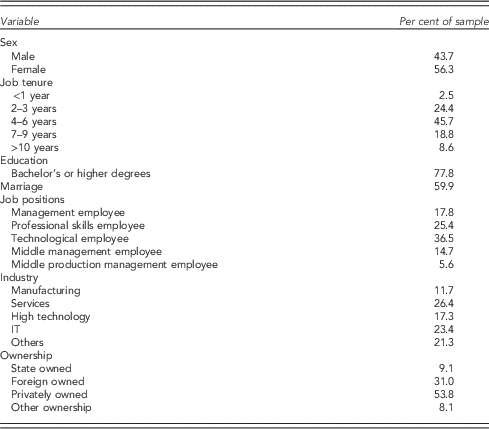
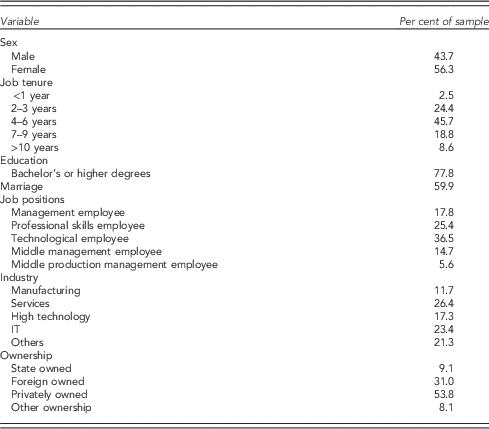
The sample consisted of 86 (43.7%) male and 111 (56.3%) female employees. Job tenure ranged from less than a year to more than 10 years (2.5%, <1 year; 24.4%, 2–3 years; 45.7%, 4–6 years; 18.8%, 7–9 years; and 8.6%, >10 years). Employees have different job positions, management employee constituted 17.8% of the sample, professional skills employee constituted 25.4%, technological employee represented 36.5%, middle management employee comprised 14.7%, middle production management employee represented 5.6%. In terms of education, 77.8% of the employees held Bachelor’s or higher degrees. In terms of marital status, 59.9% were married. The participants came from a variety of industries, including manufacturing (11.7%), services (26.4%), high technology (17.3%), IT (23.4%) and others (21.3%). Of the firms for which they worked, 9.1% were state owned, 31.0% were foreign owned, 53.8% were privately owned and 8.1% had other ownership arrangements. The descriptive statistics for the sample are shown in Table 1.
The description of sample
Measures
Goal orientation
The three dimensions of goal orientation developed by Vande Walle (Reference VandeWalle1997) were used to measure individual difference on employee goal orientation behaviours. Participant responses were recorded on a 5-point scale ranging from 1 ‘strongly disagree’ to 5 ‘strongly agree’. To measure learning orientation, a scale with six items was used (Cronbach’s α=0.87). An example item is ‘I often read material related to my work to improve my ability’. An approach performance orientation scale with five items was used (Cronbach’s α=0.80). One example statement from this scale is ‘I try to figure out what it takes to prove my ability to others at work’. A scale measuring avoidance performance orientation with five items was also used (Cronbach’s α=0.86), with an example item being ‘I prefer to avoid situations at work where I might perform poorly’. The fit indices for two first-order factors plus one second-order factor fell within an acceptable range (χ2=193.64, df=99, RMSR=0.07, CFI=0.93, GFI=0.89, IFI=0.94, TLI=0.90).
Creative role identity
The three-item scale from Farmer, Tierney, and Kung-McIntyre (Reference Farmer, Tierney and Kung-McIntyre2003) was used to assess creative role identity. Items were measured using a 5-point scale ranging from 1 ‘strongly disagree’ to 5 ‘strongly agree’. The Cronbach’s α for the scale is 0.80, which is >0.7 in accordance with the reliability criterion recommended by previous researchers (Nunnally, Reference Nunnally1978; Churchill & Peter, Reference Churchill and Peter1984). The reliability value of creative role identity is thus acceptable. A sample statement from the scale: ‘To be a creative employee is an important part of my identity’.
Employee creativity
Employee creativity was measured using a 13-item scale developed by Zhou and George (Reference Zhou and George2001). Items were again measured on a 5-point scale ranging from 1 ‘strongly disagree’ to 5 ‘strongly agree’. Cronbach’s α for the scale is 0.88. A sample item is ‘Suggests new ways to achieve goals or objectives’. Confirmatory factor analysis indicated a satisfactory fit (χ2=123.22, df=61, RMSR=0.07, CFI=0.93, GFI=0.92, IFI=0.93, TLI=0.90)
Control variable
We controlled for four variables: gender, marriage, educational levels, job tenure and job positions. To control for the factors that potentially affect employee creativity through task-related skills and knowledge (Amabile, Reference Amabile1988), we controlled educational level. We also controlled for job tenure because it was included as a variable in previous creativity research (Tierney & Farmer, Reference Tierney and Farmer2002).
RESULTS
Descriptive statistics
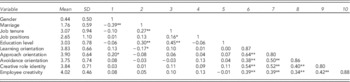
The means, standard deviations and correlations of all of the variables are shown in Table 2. The three dimensions of goal orientation were significantly correlated with employee creativity (r=0.39, p<.01; r=0.39, p<.01; r=0.34, p<.01, respectively). Creative role identity was significantly correlated with employee creativity (r=0.42, p<.01). Positive correlations for the link between three dimensions of goal orientation with creative role identity were found (r=0.54, p<.01; r=0.52, p<.01; r=0.40, p<.01, respectively).
Means, standard deviations, and correlations of the variables

Note. Internal consistency reliabilities are given in parentheses.
*p<.05, **p<.01
Hypothesis testing
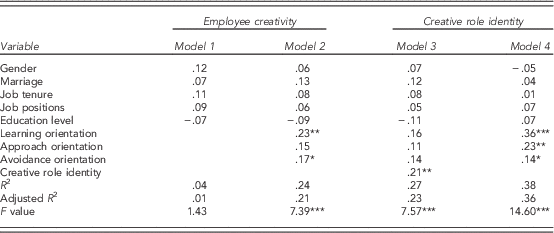
Hierarchical regression analysis was applied to test the hypotheses, because we wished to examine the relationship between goal orientation and employee creative role identity, the results are shown in Table 3. In model 4, learning orientation, approach orientation and avoidance orientation were examined. The results indicated that learning orientation was positively associated with creative role identity (β=0.36, p<.001), thus supporting Hypothesis 1. Approach performance orientation was significantly related to creative role identity (β=0.23, p<.01), supporting Hypothesis 2. Avoidance performance orientation was significantly associated with creative role identity (β=0.14, p<.05), supporting Hypothesis 3. In model 3, creative role identity was examined, with the results indicating that creative role identity was positively related to employee creativity (β=0.21, p<.01), thus supporting Hypothesis 4.
Regression analysis for creative role identity and employee creativity
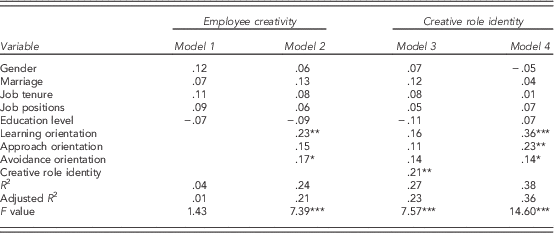
Note. *p<.05, **p<.01, ***p<.001.
To assess the mediating effect of creative role identity, we used a set of three requirements recommended by Baron and Kenny (Reference Baron and Kenny1986). First, the independent variable should be significantly related to the dependent variable; second, the independent variable should be positively related to the mediator; and third, both the mediating variable and the independent variable should be related to the dependent variable. If the independent variable has a significant beta weight in the third step, then partial mediation is present. Otherwise, complete mediation is present.
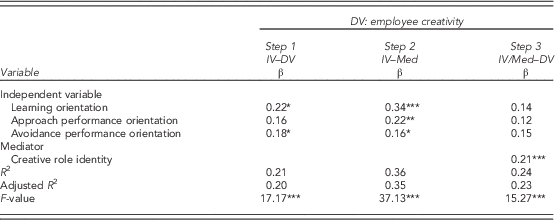
The results of this approach are shown in Table 4. In step 1, we analyse the relationship between the independent variable and dependent variable, then learning orientation, approach performance orientation and avoidance performance orientation were tested. The results indicated that learning orientation and avoidance performance orientation are positively associated with employee creativity (β=0.22, p<.05; β=0.18, p<.05). The approach performance orientation was not significantly related to employee creativity (β=0.16, NS), so Hypothesis 6a was not supported. In step 2, we analysed the relationship between the independent variable and the mediating variable, then we found that learning orientation, approach performance orientation and avoidance performance orientation were positively related to creative role identity (β=0.34, p<.001; β=0.22, p<.01; β=0.16, p<.05), supporting Hypothesis 6b. In step 3, we analysed the link between goal orientation and employee creativity when considerate the mediation of creative role identity, the results shown that learning orientation was not positively related to employee creativity (β=0.14, NS). From step 1 to step 3, we discovered that creative role identity fully mediated the link between learning orientation and employee creativity, which supports Hypothesis 5.
Regression analysis for mediation
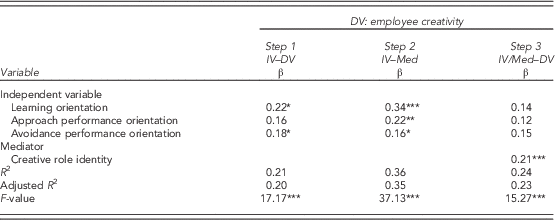
Notes. Standardized βs are shown.
DV=dependent variable; IV=independent variable; Med=mediator.
n=254, *p<.05, **p<.01, ***p<.001.
DISCUSSION
Summary
We explored the relationship between goal orientation and employee creativity though creative role identity. Our findings make significant contributions to role identity theory and employee creativity research. They suggest that learning orientation facilitates employee creative role identity, which in turn enhances employee creativity. In our sample, creative role identity fully mediated the relationship between learning orientation and employee creativity. We also found that approach performance orientation was an important antecedent to creative role identity, and that avoidance performance orientation was positively related to creative role identity. Interestingly, we also found that avoidance performance orientation was positively related to employee creativity in the workplace.
Contributions to scholarship
Our research makes four contributions to the literature on employee creativity and role identity theory. First, we built and tested a conceptual model that integrates goal orientation and employee creativity in the workplace. Previous studies have investigated the link between learning orientation and employee creativity. Our findings indicated that learning orientation was positively related to employee creativity, which is consistent with the findings of recent studies (Gong, Huang, & Farh, Reference Gong, Huang and Farh2009; Zhang & Bartol, Reference Zhang and Bartol2010). Surprisingly, performance orientation has not been considered in empirical studies on the workplace. Hence, we explored the effects of two dimensions of performance orientation on employee creativity. Interestingly, we found that approach performance orientation was not positively related to employee creativity, which is consistent with the findings of previous studies (Hirst, van Knippenberg, & Zhou, Reference Hirst, van Knippenberg and Zhou2009). However, other studies have found positive relationships between approach performance orientation and creative performance (Elliot & Harackiewicz, Reference Elliot and Harackiewicz1996; Harackiewicz et al., 2002). Our findings indicated that in different situations, approach performance played different roles in determining creative performance. Many scholars have agreed that performance orientation motivates employees to work hard (Steele-Johnson, Heintz, & Miller, Reference Steele-Johnson, Heintz and Miller2008; Lu, Lin, & Leung, Reference Lu, Lin and Leung2012), which may not necessarily lead to higher creativity (Hirst, van Knippenberg, & Zhou, Reference Hirst, van Knippenberg and Zhou2009).
Surprisingly, we found that avoidance performance orientation was significantly related to employee creativity, which is not consistent with the findings of previous studies conducted in workplace settings (Hirst, van Knippenberg, & Zhou, Reference Hirst, van Knippenberg and Zhou2009). An avoidance-motivated individual can only be as creative as an approach-motivated individual when creativity is useful for goal achievement. This motivates the individual to exert extra effort (Roskes, De Dreu, & Nijstad, Reference Roskes, De Dreu and Nijstad2012). Creative behaviour is difficult and depleting, carrying high cognitive costs, which must be paid to maintain creative performance and achieve goals (Roskes, De Dreu, & Nijstad, Reference Roskes, De Dreu and Nijstad2012). Our results are consistent with recent work, which has shown that avoidance performance orientation stimulates creativity in educational settings under some circumstances (Baas, De Dreu, & Nijstad, Reference Baas, De Dreu and Nijstad2011; Roskes, De Dreu, & Nijstad, Reference Roskes, De Dreu and Nijstad2012).
Second, we ascertained the relationship between learning orientation and creative role identity through empirical study. Farmer, Tierney, and Kung-McIntyre (Reference Farmer, Tierney and Kung-McIntyre2003) developed the concept of creative role identity using role identity theory. They found that social context factors were positively related to creative role identity. However, few studies have focused on the personal factors that affect creative role identity. Our results showed that learning orientation, approach performance orientation and avoidance performance orientation were significantly correlated with creative role identity. This indicates that employee goal orientation and personal factors are important antecedents that can enhance an employee’s creative role identity. Especially, when an individual is inconsistent with his or her role, he or she will express stress, become dissatisfied and may have bad performance, which causes further role conflict (Rizzo, House, & Lirtzman, Reference Rizzo, House and Lirtzman1970). when an individual was evaluated as a ‘creative employee’, he or she is more likely to work hard and learning more skills knowledge, which in turn improves his or her confidence and prevents the role conflict. And their behaviours are consistent with their roles, which make them confidence that they are creative employees (McCall & Simmon, Reference McCall and Simmons1978). Our findings indicated that employees’ work context may influence their decisions. The findings are also consisted with role identity theory when individuals have high level of role identity and encounter negative reactions in a particular setting, they will be motived to avoid role-consistent performance in that setting to protect, or hide, a core part of themselves (Farmer, Tierney, & Kung-McIntyre, Reference Farmer, Tierney and Kung-McIntyre2003). All of these findings contributed to role identity theory.
Third, we further explored the mediating mechanism of goal orientation on employee creativity using role identity theory. Learning orientation has been recognized as an important personal factor that affects employee creativity (Hirst, van Knippenberg, & Zhou, Reference Hirst, van Knippenberg and Zhou2009). Our study verified that creative role identity fully mediates the link between learning orientation and employee creativity, which indicates that employee creative role identity affects employee creativity. This study thus provides a new perspective on understanding how individual learning behaviour influences employee creative role identity, which improves employee creativity. Our results also showed that approach performance orientation was not positively related to employee creativity. Although approach performance orientation was significantly related to creative role identity, the mediating effects of creative role identity were not present. Interestingly, we proved that creative role identity mediates the relationship between avoidance performance orientation and employee creativity. These findings contribute to employee creativity theory and role identity theory.
To summarize, we examined creative role identity as the mediator between learning orientation and employee creativity, drawing on role identity theory and observations of intrinsic motivation (Amabile, Reference Amabile1997; Payne, Youngcourt, & Beaubien, Reference Payne, Youngcourt and Beaubien2007; Hirst, van Knippenberg, & Zhou, Reference Hirst, van Knippenberg and Zhou2009). In particular, we examined the psychological factors underlying the effects of learning orientation on employee creativity though role identity theory. Previous studied have found other mediators, such as creative self-efficacy (Gong, Huang, & Farh, Reference Gong, Huang and Farh2009) and feedback seeking (VandeWalle & Cummings, Reference VandeWalle and Cummings1997). Future research should consider other mediators, such as psychological safety and psychology ownership, which could provide a complete picture of the mechanisms by which goal orientation interacts with these psychological factors. Other personality factors that affect creative role identity such as the big-five personality factors should also be considered.
Regarding the relationship between the two dimensions of performance orientation and employee creativity, we found that approach performance orientation was not positively related to employee creativity, inconsistent with results from previous studies in educational settings (Elliot & Harackiewicz, Reference Elliot and Harackiewicz1996; Harackiewicz et al., 2002). Many scholars have recognized that performance orientation motivates employees to work hard (Steele-Johnson, Heintz, & Miller, Reference Steele-Johnson, Heintz and Miller2008; Lu, Lin, & Leung, Reference Lu, Lin and Leung2012), which may not necessarily lead to higher creativity (Hirst, van Knippenberg, & Zhou, Reference Hirst, van Knippenberg and Zhou2009). Surprisingly, we found that avoidance performance orientation was significantly related to employee creativity, indicating that under some circumstances avoidance performance orientation can enhance employee creativity (Baas, De Dreu, & Nijstad, Reference Baas, De Dreu and Nijstad2011; Roskes, De Dreu, & Nijstad, Reference Roskes, De Dreu and Nijstad2012). Thus, future studies should consider other contextual factors that may influence the relationship between performance orientation and employee creativity.
Applied implications
We have shown that employee creativity was likely to benefit organizations, and reinforced the practical value of examining the antecedents of employee creativity. Consistent with the findings of previous researches (Gong, Huang, & Farh, Reference Gong, Huang and Farh2009), our results indicated that learning orientation could enhance employee creativity. Thus, managers should provide facilitating conditions for learning-oriented employees. In practice, managers should pay more attention to goal orientation when selecting personnel, invest in employee development programmes and seek to strengthen employees’ learning orientation (Hirst, van Knippenberg, & Zhou, Reference Hirst, van Knippenberg and Zhou2009). Interestingly, we found that approach performance orientation was not positively related to employee creativity, but avoidance performance orientation positively influenced employee creativity. This indicated that employees with high level of avoidance performance orientation focused on avoiding normative incompetence, they may exert more effort to completed their missions (Elliot, Reference Elliot1999; Roskes, De Dreu, & Nijstad, Reference Roskes, De Dreu and Nijstad2012). Thus, managers should not only pay attention to employee learning orientation, but should also focus on employee avoidance performance orientation. Manager should seek to alleviate employees’ fear and anxiety and encourage them to complete the missions (Gong, Huang, & Farh, Reference Gong, Huang and Farh2009).
Our results also expand on previous findings by highlighting the important roles of creative role identity in transmitting the effects of learning orientation. Managers who wish to cultivate creativity should focus on improving employee creative role identity by creating positive learning environment and supporting employees’ learning behaviours. As our results showed that approach performance orientation was significantly related to employee creative role identity. The results indicated that managers should regularly encourage and praise employees, and provide them with adequate resources and supports to enhance their confidence in accomplishing the missions. This will in turn improve employee creative role identity. Interestingly, we found avoidance performance orientation was significantly related to employee creative role identity. This result suggested that manager should consider the roles of their employees’ personality factor and ability in a work setting, and assign the mission based on their abilities. And avoid setting tasks that do not suit their capabilities. In addition, the practical contribution of this research is that we propose some specific means to foster and develop employee creative role identity. To strengthen employee creative role identity, managers should pay more attention to employee needs and facilitate the open sharing of information and cultivate a climate supportive of creativity.
Limitations and future research directions
Notwithstanding the importance of its findings, this study has certain limitations. First, our participants worked in a range of in various industries. We intended that this would ensure the generalizability of our results, but a major limitation is that we do not know whether our findings are more applicable to certain types of certain industries. A possible direction for future research would be to focus on one particular industry, which may yield different results.
Second, our data were collected in China during a period of rapid economic growth. We believe that our results are not tied to any specific cultural context, and they are consistent with those of prior studies indicating that learning orientation is positively related to employee creativity (Gong, Huang, & Farh, Reference Gong, Huang and Farh2009; Hirst, van Knippenberg, & Zhou, Reference Hirst, van Knippenberg and Zhou2009). However, our results showed that avoidance performance orientation was positively related to employee creativity, which is not consistent with Western findings. It is possible that current social and economic conditions in China may have an effect on the relationship between performance orientation and employee creativity. Future studies should consider this relationship in different cultural contexts.
In conclusion, our results suggested that learning orientation is positively related to creative role identity, which in turn positively affects employee creativity. Further we found significant direct effects of avoidance performance orientation on employee creativity, which is not consistent with previous studies. In particular, we found that approach performance orientation was an important personal factor affecting creative role identity, thus contributing to role identity theory. We also found that creative role identity played an important role in the relationship between learning orientation and employee creativity. These findings are very important to creativity theory and offer a new perspective from which to understand the psychological factors that affect employee creativity.
Acknowledgements
This research was supported by the National Natural Science Foundation of China under agreement (No. 71032003; No. 71172163).