Colorectal cancer (CRC) is the third most common cancer in the world and the second most common cause of death by cancer in France, with over 37,000 new cases diagnosed each year and 17,000 deaths (Reference Belot, Grosclaude and Bossard2). In the 1990s, several randomized trials established that detection of adenomas and early-stage cancers in average risk populations using the guaiac fecal occult blood test (G-FOBT) generated a significant reduction in CRC-related mortality ranging from 15 percent to 33 percent (Reference Hardcastle, Chamberlain and Robinson11–Reference Mandel, Bond and Church13). Henceforth, most industrialized countries including France undertook to generalize CRC screening using G-FOBT. However, the sensitivity of this test for the detection of invasive cancer and adenomas limits expected gain in mortality and the subsequent success of screening campaigns. To improve CRC screening sensitivity, researchers consequently focused on a new type of FOB test based on the use of a specific antibody of human hemoglobin (immunochemical fecal occult blood test (I-FOBT)). The first generation of I-FOBT which, similarly to G-FOBT, provided qualitative results, has been shown to be more effective, but also more costly, than G-FOBT (Reference Allison, Tekawa and Ransom1;Reference Castiglione, Sala and Ciatto5;Reference Guittet, Bouvier and Mariotte9;Reference Saito15;Reference Sieg, Hertel and John16). The extra cost was due to increased laboratory expenses and to the number of colonoscopies associated with such a high positivity rate. In certain studies, the I-FOBT positivity rate was so high that it led to confirmatory colonoscopies for a large number of patients, the majority of which proved to be unnecessary. This was not only expensive—in France, the mean cost of a colonoscopy ranges from €150 to €1,000 depending on whether it is conducted in an outpatient surgery department or in a private clinic (Reference Berchi, Bouvier and Réaud3)—but also risky. According to American research, perforation can occur during colonoscopy in 1 case of 1,000 and death in 1 case of 10,000 (Reference Gatto, Frucht and Sundararajan8).
New generation I-FOBT tests benefit from an automated reading technique which considerably reduces laboratory costs and time. Moreover, this quantitative reading technique allows the positivity cutoff to be chosen, hence offering an excellent opportunity for decision makers to establish the best balance between health outcomes, risk, and cost.
The aim of this study was to compare the cost and the clinical performance of one round of CRC screening using I-FOBT at different positivity thresholds, to those obtained using G-FOBT. These results could contribute to establishing the optimal positivity threshold from both a clinical and an economical point of view.
MATERIALS AND METHODS
The Calvados Screening Experiment
Economic assessment was essentially based on a screening experiment conducted in Calvados. This screening campaign was conducted from June 2004 to December 2005. 112,866 inhabitants from Calvados (France) aged 50–74 years were systematically invited by local screening organizers and/or GPs to participate to the conventional screening campaign using the G-FOBT or joining the experiment on condition that perform both I-FOBT and G-FOBT. Participants to the experiment were asked to obtain two fecal samples at home on two different days for the IFOBT and two fecal samples each from three consecutive stools for the conventional GFOBT. No specific dietary restriction was stipulated. 20,322 people accepted to join the experiment and performed both tests whereas 3.8 percent of participants refused to join the experiment and realized only the G-FOBT. G-FOBT tests with at least one positive oval out of six were considered positive. I-FOBT was processed using an automated reading technique (Magstream 1000) allowing quantitative measurement of the hemoglobin content (in ng/ml) in stools. The I-FOBT was considered positive when stools contained at least 20 ng/ml of hemoglobin. G-FOBTs with at least one positive oval out of six were considered positive. All subjects with at least one positive test result performed a confirmatory colonoscopy. True positives received treatment appropriate to the stage of extension of the screened tumor. Study design details and preliminary results have been described in full in a previous publication (Reference Guittet, Bouvier and Mariotte10).
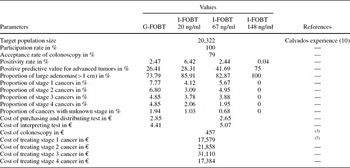
This experimental campaign provided all of the clinical data required to perform an economic assessment, such as I-FOBT and G-FOBT positivity rates for large adenomas (>1 cm) and cancers, I-FOBT and G-FOBT positive predictive values (the proportion of individuals with a positive test result and for whom disease is confirmed) and distribution of cancer stage at diagnosis. The I-FOBT quantitative reading technique enabled us to assess all positivity rates and positive predictive values corresponding to each of the machine's possible positivity thresholds, ranging from 20 ng/ml to 148 ng/ml. Data are summarized in Table 1.
Values of the Main Parameters of the G-FOBT Model and Extreme Positivity Thresholds of I-FOBT

G-FOBT, guaiac fecal occult blood test; I-FOBT, immunochemical fecal occult blood test.
Cost-Effectiveness Analysis
Comparison between the two screening alternatives was obtained by the estimation of an incremental cost-effectiveness ratio (ICAR) given by:

Where ΔI–G Cost was the incremental cost of the screening program when using I-FOBT instead of G-FOBT and ΔI–G Effectiveness was the incremental effectiveness of the screening program when using I-FOBT instead of G-FOBT.
Costs Data
The total cost of the screening program was assessed from the payer's perspective, that is, the French Social Security Board. This total cost included all direct costs related to cancer management: (i) the cost of organizing the campaign (ccamp) which was mainly comprised GP fees and public information expenses; (ii) the cost of offering screening tests (ctest) including the cost of purchasing, distributing, and interpreting the tests; (iii) the cost of performing confirmatory colonoscopies (ccolo); (iv) the cost of treating screened tumors (ctreat). Unit costs of treating cancers with regard to stage at diagnosis have been estimated in a previous study (Reference Bouvier, Réaud and Gignoux4). They include hospital care (both public and private) and care given within the medical departments of retirement homes; outpatient care (specialized or nonspecialized medical consultations, medical and paramedical acts); transport for medical reasons; medical purchases such as pharmaceutical products and prosthesis (colostomy bags); and assistance provided to patients, such as statutory sick pay and other allowances (disability with or without third party assistance).
The incremental cost was: ΔI–G Cost = [ΔI–G ccamp + ΔI–G ctest + ΔI–G ccolo + ΔI–G ctreat], where ΔI–G ccamp = 0 because organization expenses were the same independently of the test used; ΔI–G ctest = Nk(I – G), where N designates the size of the cohort, k represents the compliance rate, I and G are, respectively, the unit cost of purchasing, distributing, and interpreting I-FOBT and G-FOBT; and ΔI–G ccolo = NktC(pI – pG), where pI and pG are respectively the positivity rates associated with I-FOBT and G-FOBT, t represents the acceptance rate of colonoscopy and C is the unit cost of colonoscopy,

treating the tumor stage i, niI, and niG are the proportion of tumor stages i, respectively, detected by I-FOBT and G-FOBT.
Values for the main parameters are presented in Table 1.
Effectiveness Estimation
The clinical performance of a screening program is usually measured by the reduction in mortality observed 10 years after the start of the campaign. An estimation of the reduction in mortality can be more rapidly obtained thanks to simulation models based on Markov chains. However, some essential inputs to these models, such as the collection of all interval cancers, may not be available until 3 years after the end of the program. Given that the latency period required to observe or assess reduction in mortality was not complete in our study, an intermediate criterion had to be chosen. Effectiveness was assessed by the number of advanced tumors screened, including large adenomas (>1 cm) and cancers. This criterion is commonly used in epidemiological studies because mortality reduction is directly (strongly) correlated to the number of large adenomas and cancers screened (Reference Guittet, Bouvier and Mariotte10;Reference Nakama, Zhang and Zhang14).
The incremental effectiveness was:

Sensitivity Analysis
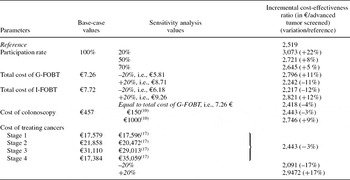
Sensitivity analysis was performed to assess the ranges of the cost-effectiveness ratios using different assumptions on participation, the cost of tests, the cost of colonoscopy, and the cost of CRC treatment. Testing the sensitivity of results to variations in the participation rate was essential because the 100 percent participation rate used in the base-case model was based on an experimental context and did not reflect real screening conditions. (Assumptions are presented in Table 3.)
RESULTS
The cost-effectiveness graph presented in Supplementary Figure 1, which is available at www.journals.cambridge.org/thc2010004, shows that for thresholds ranging from 100 ng/ml to 93 ng/ml, I-FOBT did not offer an attractive alternative to G-FOBT because, although it was less costly, it was also less effective. Conversely, screening using I-FOBT resulted in better health outcomes and lower costs than screening using G-FOBT for thresholds ranging from 75 ng/ml to 93 ng/ml. Below 75 ng/ml, screening using I-FOBT resulted in better health outcomes, however, proved also to be more expensive than G-FOBT.
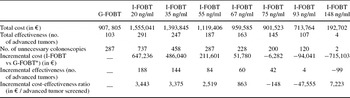
Table 2 details the incremental cost-effectiveness for six different positivity thresholds ranging from 93 to 20 ng/ml. At 93 ng/ml, the incremental cost-effectiveness ratio was –€47,555/ advanced tumor screened, that is, screening with I-FOBT would cost €194,041 less than one round of screening with G-FOBT and would allow the detection of four additional advanced tumors. At 75 ng/ml, the incremental cost-effectiveness ratio was –€148/advanced tumor screened, that is, one round of screening with I-FOBT would cost €6,282 less than one round of screening with G-FOBT and would allow the detection of forty-two additional advanced tumors. For both thresholds, the positivity rate of I-FOBT was lower than that of G-FOBT. Consequently, I-FOBT enabled the detection of a higher number of tumors without increasing the risk inherent to confirmatory colonoscopy. The threshold at which I-FOBT and G-FOBT positivity rates were almost identical was 67 ng/ml. Using this threshold, screening with I-FOBT resulted in better health outcomes than screening with G-FOBT, but was also more costly (€863/advanced tumor screened).
Incremental Cost-Effectiveness Ratios (in Euros per Number of Advanced Tumors screened) when Replacing G-FOBT with I-FOBT

G-FOBT, guaiac fecal occult blood test; I-FOBT, immunochemical fecal occult blood test.
Decision makers are also likely to pay an interest to the 55 ng/ml threshold, because it offered an identical rate of unnecessary colonoscopies for both I-FOBT and G-FOBT. At this threshold, one round of screening with I-FOBT would cost €211,601 more than one round of screening with G-FOBT and would allow the detection of eighty-four additional advanced tumors giving an incremental cost-effectiveness ratio of €2,519/advanced tumor screened without increasing the number of unnecessary colonoscopies.
As shown in Supplementary Figure 2, which is available at www.journals.cambridge.org/thc2010004, cost distribution according to the screening test used indicates that the use of I-FOBT between 75 ng/ml and 93 ng/ml offered an economy both on the cost of treating cancers and the cost of performing colonoscopies. Treatment cost economy can be explained by the larger proportion of early stage cancers detected by I-FOBT (the proportion of stage 1 cancers detected by I-FOBT at 75 ng/ml was 33.3 percent against 29.66 percent for G-FOBT), which are generally less expensive to treat than more advanced cancers. Economy on the cost of colonoscopy is simply due to the lower number of confirmatory examinations required when using I-FOBT. On the contrary, the cost of purchasing, distributing, and interpreting the tests was always higher for the I-FOBT due to higher unit costs.
The validity of our results is strengthened by the coherence of the sensitivity analysis concerning both the sense and the range of variations. Table 3 shows the results of sensitivity analysis performed setting the I-FOBT threshold at 55 ng/ml, one of the most interesting thresholds for decision makers, as previously demonstrated. The incremental cost-effectiveness ratios were particularly low because (i) the participation rate was high, (ii) the unit cost of G-FOBT was high, (iii) the unit cost of I-FOBT was low, (iv) the unit cost of colonoscopy was low, and (v) the unit cost of treating cancers was low. As expected, cost-effectiveness ratios were mainly sensitive to variations in the participation rate which is acknowledged in international literature to be a key parameter in such analysis. Ratios were also noticeably and logically influenced by treatment cost values, the most important expenditure item.
Results of Sensitivity Analysis

G-FOBT, guaiac fecal occult blood test; I-FOBT, immunochemical fecal occult blood test.
DISCUSSION
This cost-effectiveness study was carried out to enlighten health authorities in their choice of the (best) I-FOBT threshold for CRC mass screening. Results suggest that the use of I-FOBT at 75 ng/ml would guarantee more efficient and more safe screening than that currently offered by G-FOBT. However, certain decision makers may well be interested in improving screening health outcomes even if this involves extra cost. In the case in point, I-FOBT at 55 ng/ml offers a satisfactory alternative to G-FOBT because it is 1.8-fold more performing than G-FOBT without increasing the number of unnecessary colonoscopies and at an extra cost of €2,519/advanced tumor screened. The final choice will depend on the price that authorities are willing to pay to obtain performing CRC screening.
Our results should be interpreted with caution, bearing in mind that estimations are limited to one round (2 years) of screening. Because the first round of a screening program is not systematically representative of subsequent rounds, our results cannot wholly prejudge the final efficiency expressed in €/life-year saved. Final efficiency will be assessed using a Markov model when the false negative results of screening tests will be identified. False negative results will influence both cost and health outcomes. For each strategy, they may increase the costs involved in treating cancers, whereas they may decrease the potential number of life-years saved by the cohort. Based on previous studies (Reference Allison, Tekawa and Ransom1;Reference Castiglione, Sala and Ciatto5;Reference Guittet, Bouvier and Mariotte9;Reference Guittet, Bouvier and Mariotte10), the false negative rate is expected to be greater for G-FOBT than for I-FOBT. If this is indeed the case, the trend underlined in this preliminary study will be reinforced in the long-term model.
Despite these drawbacks, our intermediate health outcome criterion has the advantage of being more explicit and understandable than the usual life expectancy criterion and renders the final message to health authorities and GPs far clearer.
To our knowledge, the Taiwanese study implemented by Chen et al. is the only one to have previously investigated the optimal threshold for I-FOBT using cost-effectiveness analysis (Reference Chen, Liao and Chang6). However, there are too many differences in the design of the two studies to authorize any comparison. The main differences concern the type of I-FOBT experimented, the frequency of screening and the cost analysis methodology. First, the I-FOBT reagents used in the Taiwanese study and supplied by EIKEN Chemical Co are different from those used for Magstream; consequently, standard cutoff is 100 ng/ml for the test supplied by EIKEN, compared with 20 ng/ml for the Magstream test. In addition, Chen et al. adopted an inter-screening interval of 1 year, despite the fact that all other published studies applied biennial screening. Finally, their cost simulation took into account indirect costs, whereas our own analysis was limited to direct costs. Chen et al. acknowledged that the optimal threshold they identified may only be applicable to their population-based study. Consequently, the external validity of our study is rather difficult to establish.
POLICY IMPLICATIONS
The high performance of I-FOBT based on qualitative assay has been demonstrated in many studies (Reference Allison, Tekawa and Ransom1;Reference Castiglione, Sala and Ciatto5;Reference Guittet, Bouvier and Mariotte9;Reference Sieg, Hertel and John16;Reference Zappa, Castiglione and Paci17) and would appear to be confirmed by recent works based on quantitative assay (Reference Guittet, Bouvier and Mariotte10;Reference Nakama, Zhang and Zhang14). Our study offers additional information indicating that I-FOBT with thresholds ranging from 75 ng/ml to 93 ng/ml could lead to better health outcomes and lower costs than G-FOBT which is currently the standard screening test in most industrialized countries. These preliminary results imperatively need to be strengthened by means of a long-term model estimating the mortality reduction attributable to I-FOBT. However, I-FOBT could offer a good option for CRC screening and health authorities in industrialized countries should get ready for the possibility of a future replacement of G-FOBT by automated I-FOBT. Certain European countries such as Latvia are already considering the generalization of large-scale CRC screening using I-FOBT. To help decision makers in the choice of the I-FOBT to be implemented, further studies comparing the cost-effectiveness of the leading I-FOBTs currently on the market require to be conducted.
SUPPLEMENTARY MATERIALS
Supplementary Figure 1
Supplementary Figure 2 www.journals.cambridge.org/thc2010004
CONTACT INFORMATION
Célia Berchi, PhD (celia.berchi@unicaen.fr), Assistant Professor, Department of Economics, University of Caen, Esplanade de la Paix, Caen 14032, France; Researcher, Cancers & Populations, INSERM, Avenue de la côte de Nacre, Caen, 14032, France
Lydia Guittet, MD, ScD (guittet-l@chu-caen.fr), Assistant, Caen University Hospital (CHU), Avenue de la Cote de nacre, F-14033 CAEN cedex 9, France; ERI3 – EA 3936 “Cancers & Populations,” INSERM–University of Caen (UCBN), Faculty of Medicine, Avenue de la Cote de Nacre, F-14032 Caen cedex, France
Véronique Bouvier, MD (bouvier-v@chu-caen.fr), ERI3 INSERM “Cancers & Population,” Avenue de la côte de Nacre, 14032 CAEN cedex, France
Guy Launoy, MD, PhD (guy.launoy@unicaen.fr), Professor, ERI3 INSERM, Caen University, Côte de Nacre, 14000 Caen France; Professor, ERI3 INSERM, University Hospital, Côte de Nacre, 14000 Caen, France