Repetitive Negative Thinking (RNT) is assumed to be a transdiagnostic variable that may account for the high levels of comorbidity observed between emotional disorders especially depression and anxiety (Kertz, Koran, Stevens, & Björgvinsson, Reference Kertz, Koran, Stevens and Björgvinsson2015; Watkins, Reference Watkins2015). Rumination significantly mediates the association between negative affect and depressive symptoms (e.g., Verstraeten, Bijttebier, Vasey, & Raes, Reference Verstraeten, Bijttebier, Vasey and Raes2011). The general description of rumination as repetitive thinking on a theme related to personal goals and concerns (Martin & Tesser, Reference Martin, Tesser and Wyer1996) implies both constructive and unconstructive consequences (Watkins, Reference Watkins2008). However, in the literature on consequences of rumination for depressive symptoms, researchers typically measure negative depressive rumination. Depressive rumination is defined as “behavior and thoughts that focus one’s attention on one’s depressive symptoms and on the implications of these symptoms” (Nolen-Hoeksema, Reference Nolen-Hoeksema1991, p. 569). Depressive rumination is a core variable in the onset and maintenance of clinical diagnosis of depression (Williams et al., Reference Williams, Barnhofer, Crane, Herman, Raes, Watkins and Dalgleish2007).
Explanatory theories of depressive rumination were initially developed under the response styles theory (Nolen-Hoeksema, Reference Nolen-Hoeksema1991) where rumination is considered a possible consequence of mood answer to distress focused on passive thinking about one´s symptoms of depression. The tendency to engage in a ruminative process when distressed is a stable individual difference (Nolen-Hoeksema & Davis, Reference Nolen-Hoeksema and Davis1999). According to this theory, this form of rumination increases the likelihood that the symptoms of depression become chronic evolving into episodes of major depression. The mechanisms by which rumination may prolong depression are: Activation of negative thoughts, decreases effective problem solving, interferes with instrumental behavior and loss of social support.
Other theories have linked rumination to self-regulation within a multilevel approach. The Self-Regulatory Executive Function (S-REF, Wells & Matthews, Reference Wells and Matthews1996), emphasizes the role of metacognitive beliefs in perpetuating ruminative thought. In this model, rumination is considered a generic dysfunctional process not only present in depression. Rumination is also considered as the engagement in mental activities to get consistent feedback about the progress toward our goals in the control theory (Martin & Tesser, Reference Martin, Tesser and Wyer1996). More recently, Watkins & Nolen-Hoeksema (Reference Watkins and Nolen-Hoeksema2014) conceptualized rumination as a mental habit to explain the relationship between habits and goals.
Rumination can be distinguished from negative automatic thoughts or private self-consciousness because rumination is a process of turning attention to one´s symptoms and analysis of the causes and consequences of those symptoms. Brooding, a frequently used term in rumination research, reflects a passive comparison of one´s current situation with some unachieved standard (e.g., ‘‘Why do I have problems other people don’t have?’’) (Treynor, González, & Nolen-Hoeksema, Reference Treynor, González and Nolen-Hoeksema2003). Thus, brooding is more similar to a self-blame construct (Roberts, Gilboa, & Gotlib, Reference Roberts, Gilboa and Gotlib1998) than depressive rumination. In fact, when an individual presents extreme difficulty in disengage attention from that perceived discrepancy, this results in self-regulatory perseveration (Pyszczynski & Greenberg, Reference Pyszczynski and Greenberg1987). Thus, although similar maladaptive repetitive thinking constructs can activate self-negative comparisons and self-schemas; in depressive rumination, the contents of repetitive thinking are focused on depression symptoms.
Ruminative thought occurs in both normal individuals and clinical patients and is also a feature of anxiety disorders. Although rumination can be initially used as a cognitive strategy to control distress, the continued use of rumination may led to intrusions, impaired problem-solving and a perpetuation of mood disturbance (Matthews & Wells, Reference Matthews, Wells, Papageorgiou and Wells2004). Worry and rumination may overlap between a 16–21% in both non-clinical and clinical samples (Segerstrom, Tsao, Alden, & Craske, Reference Segerstrom, Tsao, Alden and Craske2000) and rumination may increases both depression and anxiety (Fresco, Frankel, Mennin, Turk & Heimberg, Reference Fresco, Frankel, Mennin, Turk and Heimberg2002). However, although rumination and worry have several overlapping features, they also represent distinct cognitive processes that makes rumination more closely related to depression and past events while worry is more closely related to anxiety and future thinking, respectively (Papageorgiou & Wells, Reference Papageorgiou and Wells1999).
Gender differences in rumination mediates the gender difference in depression (Butler & Nolen-Hoeksema, Reference Butler and Nolen-Hoeksema1994). In other words, the fact that women are more likely to suffer from major depression than men could be, among other causes, grounded on the presence of higher levels of rumination in women than men. This greater tendency to ruminate may keep women stuck in cycles of passivity. Females consistently report higher trait rumination than males (Lopez, Driscoll, & Kistner, Reference Lopez, Driscoll and Kistner2009). In fact, rumination significantly mediates the association between gender and depression scores (Ricarte, Navarro, Latorre, Ros & Watkins, Reference Ricarte, Navarro, Latorre, Ros and Watkins2016). Regarding age, older adults ruminate less than young counterparts (Ricarte, Ros, Serrano, Martínez-Lorca, & Latorre, Reference Ricarte, Ros, Serrano, Martínez-Lorca and Latorre2016). In fact, the reduction of rumination in old age has been suggested as a possible mechanism of the increased positivity affect which increases with age (Erskine, Kvavilashvili, Conway, & Myers, Reference Erskine, Kvavilashvili, Conway and Myers2007) and may be used with therapeutic purposes in older adults (Ekkers et al., Reference Ekkers, Korrelboom, Huijbrechts, Smits, Cuijpers and van der Gaag2011).
Depressive rumination is typically assessed with the 22-item Ruminative Response Scale (RRS) subscale from the Response Styles Questionnaire (RSQ; Nolen-Hoeksema & Morrow, Reference Nolen-Hoeksema and Morrow1991). The RSQ is a 71-item, self-report instrument designed to assess an individual’s characteristic tendency to engage in ruminative, distracting, problem-solving, or dangerous coping behavior in the presence of a dysphoric or stressful situation. Considerable evidence indicates that the RRS subscale consists of items confounded with the construct of depression as well as a heterogeneous factor structure (Armey et al., Reference Armey, Fresco, Moore, Mennin, Turk, Heimberg and Alloy2009; Bagby & Parker, Reference Bagby and Parker2001). In response to these shortcomings, Treynor et al. (Reference Treynor, González and Nolen-Hoeksema2003) eliminated items related to the symptoms of depression and developed a non-affectively-confounded, two-factor (brooding and reflection) solution. Brooding, defined as negative self-reflection as well as a focus on obstacles to problems (e.g., Nolen-Hoeksema, Wisco, & Lyubomirsky, Reference Nolen-Hoeksema, Wisco and Lyubomirsky2008), represents a component of depressive rumination (Haigh, Fresco, & Armey, Reference Haigh, Fresco and Armey2004) and shows more psychopathological consequences than reflection (Watkins, Reference Watkins2008). In fact, the reflection component of rumination has not emerged consistently in psychometric factor analyses studies (e.g. Griffith & Raes, Reference Griffith and Raes2015).
To avoid confusion between components of rumination, Conway, Csank, Holm, and Blake (Reference Conway, Csank, Holm and Blake2000) developed the Rumination on Sadness Scale (RSS). This 13-item self-report questionnaire that includes items such as “I repeatedly analyze and keep thinking about the reasons for my sadness”, was originally developed to assess only the construct of rumination on current feelings of distress. It excludes social sharing on sadness as part of rumination. Although initial research confirmed the one-factor structure, Raes, Hermans, Williams, Bijttebier, and Eelen (Reference Raes, Hermans, Williams, Bijttebier and Eelen2008), found a three-factor solution after confirmatory factor analyses. Regarding its convergent validity, the RSS correlated positively with depression severity and shared more unique variance with depression than the RRS. Subsequently, Raes et al. (Reference Raes, Hermans, Williams, Bijttebier and Eelen2008) revised and extended the RSS in the Leuven Adaptation of the Rumination on Sadness Scale (LARSS) in a 17-item self-report questionnaire. The LARSS consists of three subscales: Causal analysis (causes of sadness), understanding (meaning of one’s sadness), and uncontrollability (lack of control over sad thoughts). The uncontrollability subscale showed the highest association with depression symptomatology. A 4-item short version of the LARSS was tested by Raes, Hermans, Williams, and Eelen (Reference Raes, Hermans, Williams and Eelen2007), showing promising results in terms of internal consistency and validity.
The first main aim of the current research is to further examine the psychometric properties of the one-factor, 4-item reduced version of the LARSS which we have named the Short Depressive Rumination Scale (SDRS). The SDRS was initially tested in a non-clinical Belgian sample (Raes, et al., Reference Raes, Hermans, Williams and Eelen2007). In that study, Cronbach’s alpha for the four items was .84. Total scores on the SDRS correlate highly with scores on widely used rumination scales as the Rumination on Sadness Scale (RSS; Conway et al., Reference Conway, Csank, Holm and Blake2000) and the Ruminative Response Scale (RRS; Nolen-Hoeksema & Morrow, Reference Nolen-Hoeksema and Morrow1991), respective rs being .82 and .77 (Raes, Hermans, de Decker, Eelen, & Williams, Reference Raes, Hermans, de Decker, Eelen and Williams2003). In a Spanish sample of non-clinical young and older adults, the SDRS was positively correlated with depression and with functional avoidance (Ros, Latorre, Serrano, & Ricarte, Reference Ros, Latorre, Serrano and Ricarte2017). Second, due to the limited presence of validated measures of rumination in Spanish speaker samples, the current research aims to provide an efficient tool for assessing rumination in those samples. There is a need to test whether the structure of rumination is consistent across languages and communities. Finally, due to the time-related constraints in assessment settings and the association of rumination on sadness with a poor treatment prognosis, the rapid identification of individuals scoring high on this construct may become a useful screening tool in non-clinical samples.
Based on the functioning of this construct in previous research, in addition to an association with depression, we expect a higher presence of depressive rumination in women than in men (e.g. Ros et al., Reference Ros, Ricarte, Serrano, Nieto, Aguilar and Latorre2014) and a negative association of rumination with age (Ricarte, Navarro et al., Reference Ricarte, Navarro, Latorre, Ros and Watkins2016). We expect our data analysis confirm a single factor structure as well as a positive association between the total score of the scale and both depression and rumination scores as measured by other instruments.
Method
Participants
The study sample comprised 649 volunteer participants, 399 women and 250 men. Ages ranged between 18 and 81 years. The mean age of males was 29.12 (SD = 17.73) and 31.45 (SD = 19.49) for females. A total of 68.2% had university studies, 21.3% secondary studies, and 10.5%, primary studies. Inclusion criteria were aged between 18 and 85, with at least primary studies. Participants were recruited through advertisements placed on the Universidad de Castilla-La Mancha (UCLM) website and in the local newspaper, giving a telephone number and an email address to contact the researchers. Exclusion criteria were chronic illness, cognitive impairment or a current episode of psychiatric illness. All participants were assessed using the Mini International Neuropsychiatric Interview (Sheehan et al., Reference Sheehan, Lecrubier, Sheehan, Amorin, Janaus, Weiller and Dunbar1998) to rule out psychiatric disorders.
Variables and Measure
Short Depressive Rumination Scale (SDRS)
Participants were requested to rate on a scale of 0 (never) to 10 (very often) how often they experienced the following situations when feeling sad, down or depressed: (a) “I have difficulty getting myself to stop thinking about how sad I am”; (b) “I get absorbed in thinking about why I am sad and find it difficult to think about other things”; (c) “I repeatedly try to figure out, by doing a lot of thinking, what might be the causes of my sadness”; and (d) “I keep thinking about how I feel, to understand myself and my sad feelings better”. These items were taken from the Leuven Adaptation of the Rumination on Sadness Scale (LARSS; Raes et al., Reference Raes, Hermans, Williams, Bijttebier and Eelen2008), which has a three-factor structure. The first two items of the SDRS stem from the LARSS-Uncontrollability factor, while the other two stem from the Causal Analysis and Understanding factors. The sum of the scores for each item gave a total score ranging between 0 and 40. Raes et al. (Reference Raes, Hermans, Williams and Eelen2007) reported a .84 Cronbach’s alpha for this 4-item scale. The items were translated from Spanish to English by the first author of this study. A native English speaker then translated them back into English. The translation matched with the initial English version in the article by Raes et al. (Reference Raes, Hermans, Williams and Eelen2007). See Appendix for instructions and items in Spanish. Direct addition of all items is necessary to obtain the total score.
Ruminative Response Scale (RRS; Treynor et al., Reference Treynor, González and Nolen-Hoeksema2003)
This self-report questionnaire asks participants to rate the frequency with which they think or do certain things when they feel sad, down or depressed. It comprises two subscales assessing two subtypes of rumination: brooding and reflection. Statements are rated on a four-point Likert-type scale ranging from almost always to almost never. The Spanish validated version was used in the current study (Hervás, Reference Hervás2008). The complete scale obtained a Cronbach’s alpha value of .81. Cronbach’s alpha in this study was .74 for the Brooding subscale and .73 for the Reflection subscale.
The Response Styles Questionnaire to Depression (RSQD; Lima, Fernández-Berrocal, Extremera & Queirós, Reference Lima, Fernández-Berrocal, Extremera and Queirós2006)
The RSQD was based on the RRS (Nolen-Hoeksema & Morrow, Reference Nolen-Hoeksema and Morrow1991). It has 25 items and was validated for a Spanish population (Extremera & Fernández-Berrocal, Reference Extremera and Fernández-Berrocal2006). The RSQD assesses three facets: rumination with 10 items (e.g. I think about how sad I feel), problem solving with 4 items (e.g. I make a plan of action and follow it), and distraction with 11 items (e.g. I help someone else with something so I don’t think about my own problem). All items are rated on a Likert-type scale from 1 (never) to 4 (always). Higher scores represent greater use of rumination, distraction and problem solving when feeling sad. A Cronbach’s alpha of .79 was obtained for the total scale in the current sample with Cronbach’s alpha values for rumination, problem solving and distraction being .82, .67, and .79, respectively.
Beck Depression Inventory (BDI–II; Beck & Steer, Reference Beck and Steer1984)
The BDI–II is a widely used and well-validated, 21-item self-report questionnaire for depressive symptoms. Participants are asked to appraise their feelings over the last two weeks regarding each item. Each item is rated on a four-point scale. The Spanish validated version of this instrument was used (Sanz, Perdigón & Vázquez, Reference Sanz, Perdigón and Vázquez2003). Tested in adults from general population, this adaptation obtained a unique depression dimension formed by two highly related factors (cognitive-affective and somatic-motivational) and a Cronbach´s alpha of .87. The Cronbach’s alpha in the present study was .80.
Procedure
Two psychology doctoral students answered the phone calls and emails from possible candidates and provided information on the general characteristics of the study (objective, test types, place and length of test application). During these conversations, a short sociodemographic questionnaire was conducted to check inclusion and exclusion criteria. If respondents were university students, they were offered the options of completing the questionnaire with an experimenter at their own school or at the School of Psychology. The tests were administered in small groups with a minimum of 5 and a maximum of 20 participants. A period of two years was required to complete the final study sample. On arrival at the School of Psychology, participants were provided with a summary of the information previously offered by phone or email. It was stressed that they could end their participation at any point and that participation was voluntary and unremunerated. Once it was clear that participants had understood the instructions and the conditions, informed consent was obtained. The tests were administered by 7 psychologists (all Ph. D) forming part of the academic and research staff of the UCLM Department of Psychology who had previously been trained in the test administration. The SDRS scale was administered first to avoid cognitive contamination from other scales. Following this, the BDI-II was administered, which collects information on mood state over the past two weeks. Finally, the other two scales including rumination variables, the RSQD and the RRS, were applied.
Data analysis
The factor validity of the scale was verified using confirmatory factor analysis. Since the asymmetry results (β1,p = 2.57, p < .001) and kurtosis results (β2,p = 34.22, p < . 001) indicated that multivariate normality was not satisfied, the parameters were estimated using the maximum likelihood mean adjusted (MLM) procedure in Mplus 7.4 (Muthén & Muthén, 2012). In accordance with the recommendations in the literature, the goodness of fit was assessed using absolute and relative indicators. The methods used were the chi-squared test, the comparative fit index (CFI), the Tucker-Lewis Index (TLI), the standardized root-mean-square residual (SRMR) and the root-mean square error of approximation (RMSEA). We considered indicative of a good fit to the model values higher than .90 for CFI and TLI and values lower than .08 for SRMR and lower than .06 for RMSEA (Hu & Bentler, Reference Hu and Bentler1999). Comparison between nested models was conducted using the Satorra-Bentler scaled chi-square difference test (Satorra & Bentler, Reference Satorra and Bentler2001).
Internal consistency of the scale was measured using Cronbach’s alpha while the relationships of the scale to other instruments was analyzed using Pearson’s correlation coefficient. We compared the scores obtained on the SDRS by males and females using the t-student test for independent samples. The results were complemented by measuring the effect size using Cohen’s d. Finally, an Analyses of Covariance (ANCOVA) was conducted to test whether SDRS scores varied by age group.
Results
Factor Analysis Validity
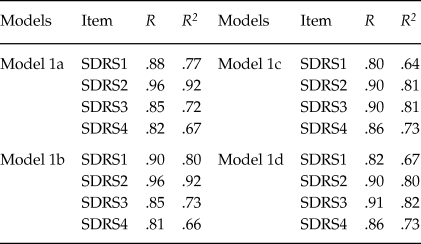
A total of 110 multivariate outliers were identified using the robust Mahalanobis distance (RMD) (Rousseeuw & Leroy, Reference Rousseeuw and Leroy1987). The factor analysis was then conducted on the complete sample (N = 649) and the sample minus outliers (n = 539). In both cases (Models 1a and 1b), the parameters were statistically significant (t > 1.96), the factor loadings were high (over .60) and the factor explained between 66% and 91% of the variance of each indicator (Table 1).
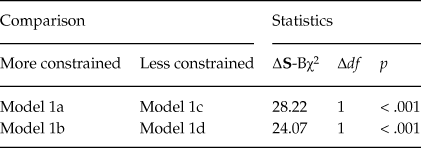
Results of Testing for Differences between Nested Models of the SDRS Scale

Note: Model 1a = complete sample; Model 1b = Outliers excluded; Model 1c = complete sample, correlated errors permitted; Model 1d = Outliers excluded, correlated errors permitted.
Table 2 shows the indices of goodness of fit for the two models proposed. All the measures of fit were higher than the commonly accepted cutoff values (CFI > .90; TLI > .90; SRMR <. 08), with the exception of the RMSEA, with values below the .06 threshold. Considering items SDRS1 and SDRS2 were taken from the same uncontrollability dimension of the LARSS, the model was respecified to allow the correlation between its error terms (Models 1c and 1d). After respecification, the indicators showed an adequate fit to the model in both the complete sample (Model 1c), and in the sample minus outliers (Model 1d). The Satorra-Bentler scaled chi-square difference test (Satorra & Bentler, Reference Satorra and Bentler2001) between nested models was statistically significant (p < .001), suggesting that the models allowing correlation between error terms show a better fit to the data (see Table 3). As can be seen in Table 3 in models 1c and 1d, all the indices are within the accepted limits of error, the factor loadings are equal to, or higher than, .8, and explained variance is high (R 2 > .70).
Indicators of Goodness of Fit for the SDRS with Four Indicators

Note: SB-χ2: Satorra-Bentler scaled chi-square difference test; χ2 = Chi Square; CFI = Comparative Fit Index; TLI = Tucker-Lewis Index; SRMR = Standardized Root-Mean-Square Residual; RMSEA = Root-Mean Square Error of Approximation.
** p < .01
Factor Loadings and Coefficients of Determination

Note: Model 1a = complete sample; Model 1b = Outliers excluded; Model 1c = complete sample, correlated errors permitted; Model 1d = Outliers excluded, correlated errors permitted.
Concurrent validity
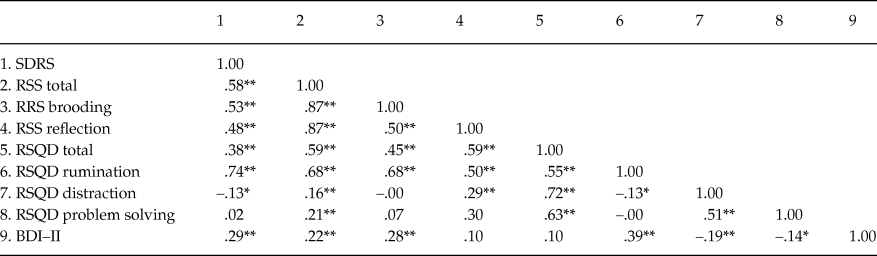
To verify the concurrent validity, we calculated the correlations between the SDRS and other theoretically related instruments (see Table 4). As expected, the relationship with the Ruminative Response (RRS) scale and its subscales were positive and large. Although the coefficient was slightly higher for the brooding subcomponent (r xy = .53, p < .001) than for the reflection one (r xy = .48, p < .001), they did not differ significantly (z = .88, p = .19).
Correlations between the SDRS, RRS and RSQD

** p < .01. *p < .05
The correlations between the SDRS and the RSQD total score and its Rumination subscale were positive and large (r xy = .38, p < .001 and r xy = .73, p < .001, respectively). In contrast, the correlation between the SDRD and the Distraction subscale was negative and in the small-to-moderate range (r xy = –.13, p < .05). As shown in Table 4, no correlation was found for the Problem Solving subscale (r xy = .02, p = .680).
As expected, there was a moderate-to-strong correlation between the Beck Depression Inventory (BDI–II) and the SDRS (r xy = .29, p < .001).
Analysis of the items
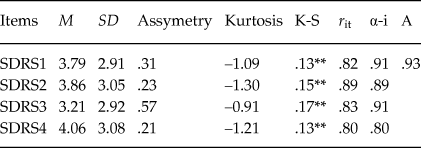
Table 5 shows the descriptive statistics of the indicators and the corrected item-total correlation, Cronbach’s alpha if the item is eliminated from the test and the total Cronbach’s alpha for the scale. As can be seen, the highest mean corresponds to Item 4 (“I keep thinking about how I feel, to understand myself and my sad feelings better”), while the lowest is in Item 3 “I repeatedly try to figure out, by doing a lot of thinking, what might be the causes of my sadness”). The indicators have a positive asymmetry and negative kurtosis. Hence, the hypothesis of normality is rejected in all cases. The correlations between each item and the scale are high (r it > .70) and the internal consistency of the total scale is excellent (α = .93).
Psychometric Properties of the Items Comprising the Scale

Note: M = mean; SD = Standard deviation; K-S = Kolmogorov Smirnov with Lilliefors correction; rit = corrected item-total correlation; α-I = α if item is eliminated.
** p < .01
Differences by gender and age
Finally, we analyzed the differences by gender in the total score and the score for each of the indicators. The results show that women scored higher (M = 17.02; SD = 10.94) than men (M = 11.53; SD = 9.89) on the global scale. The difference in the means, 5.49, 95% CI [3.86, 7.12], was statistically significant (t = 6.46, p < .001) and the effect size was medium (Cohen’s d = 0.52). Nevertheless, the size effect was greater for the items representing the dimension of Uncontrollability.
Regarding age, scores decreased as age increased (r xy = –.33, p < .001). To further explore the effect of age on rumination scores, respondents were classified into three groups: 20 and younger (48.15% of participants), 21 to 30 years old (27.47%), and 31 and older (24.38%). To assess whether rumination varied by age group, an Analysis of Covariance (ANCOVA) was performed using the SDRS total score as the outcome variable while controlling for the respondents’ sex. There was a significant age group effect after controlling for the effect of sex, F(2, 644) = 39.95, p < .001, partial n 2 = .11. Planned contrasts revealed that the oldest group had lower scores than the youngest group (t = 8.53, p < .001, partial n 2 = .10) and the middle group (t = 7.22, p < .001, partial n 2 = .08). However, those in the youngest and middle groups did not differ significantly in their SDRS scores (p = .662).
Discussion
The results of this study confirm that the one-factor structure of this depressive rumination scale functions well. Furthermore, the one-factor structure remained robust and significant even when outliers were included in the analysis. Consequently, this scale can be administered in the presence of outliers and the high explained variance is maintained. Internal consistency was excellent (α = .93), despite the low number of items. The internal consistency was, in fact, higher than that obtained for the original version of the scale (α = .84) proposed by Raes et al. (Reference Raes, Hermans, Williams and Eelen2007) and higher than that of the Brooding subscale from the RRS (α = .74).
Regarding the individual performance of each item, the results were also excellent, yielding internal reliability values of .80 or higher for all items. However, the results yielded little statistical difference between scores for Items 1 and 2 and the total score. This might be due to the somewhat similar nature of the items (“I have difficulty getting myself to stop thinking about how sad I am”; “I get absorbed in thinking about why I am sad and find it difficult to think about other things”). However, exclusion of one of these items impedes the correct functioning of the scale as the model became not statistically significant when one of those items was not included in the analyses. Furthermore, the uncontrollability of sad thoughts, from which these two items were taken, is the subscale with the most robust association with depression scores (Raes et al., Reference Raes, Hermans, Williams, Bijttebier and Eelen2008). Hence, we advise against these two items being excluded on both statistical and theoretical grounds. However, because models allowing measurement errors to correlate tend to be more unstable, further validation of this scale with other samples will be beneficial.
The results for the convergent validity were as expected. Especially noteworthy was the high correlation with the RRS Brooding subscale (Treynor et al., Reference Treynor, González and Nolen-Hoeksema2003). Both scales were designed with the intention of excluding specific depressive symptoms for the measurement. In fact, the correlations between these scales and depression are similar and lower than the correlation between depression and the RSQD rumination subscale. Hence, the SDRS has a high correlation with the construct of brooding and a low overlap with diagnostic assessment of depression. However, compared to the RRS brooding subscale, the SDRS items represent uncontrollability, causal analysis and understanding factors. Furthermore, repetitive thinking, as measured by the SDRS, acts as a cognitive strategy for coping with negative feelings which differs from distraction (negatively correlated) and is unrelated to coping strategies focused on problem solving (not significantly correlated). Though our results provide evidence for the validity of the scale, one limitation of this study is that we only assessed convergent validity. A sub-sample of 71 participants completed the State-Trait Anxiety Inventory (Spielberger, Gorsuch, & Lushene, Reference Spielberger, Gorsuch and Lushene2011), and although the correlation with the SDRS was significant (r xy = .38, p < .001), this correlation was smaller than the correlation with other rumination subscales. This result is consistent with expected results regarding divergent validity (depressive rumination and anxiety may be related but not so strongly as with other rumination scales). Future studies should advance in this direction, assessing its discriminant validity more consistently.
The results of this study are also useful to identify the normative function of depressive rumination according to sociodemographic variables. Several studies have shown the onset of gender differences in the frequency of rumination initiating at the age of 13 (Jose & Brown, Reference Jose and Brown2008). In our sample, with a mean age of around 30 years, women scored 5.9 points higher than males (d = .52). Moreover, these differences were even greater for the items from the Uncontrollability dimension. These results suggest the importance of prevention of negative rumination in women with intervention specially focused on lack of control of negative thoughts which is, in turn, the factor which most highly correlates with depressive symptoms. In fact, depression is more prevalent in women than in men (Nolen-Hoeksema, Reference Nolen-Hoeksema1990). Regarding age and use of rumination, our data support previous studies showing a decrease in the use of rumination with age (Ricarte, Ros et al., Reference Ricarte, Ros, Serrano, Martínez-Lorca and Latorre2016). Although there are few studies on the subject and the explanatory mechanisms of this association are unknown, a number of studies suggest that the decrease in rumination is one explanation for the higher levels of psychological well-being in older adults (Erskine et al., Reference Erskine, Kvavilashvili, Conway and Myers2007).
In addition to a lack of an appropriate measure of divergent validity, the main limitation of this study is the absence of a clinical group. Although considered as a transdiagnostic variable, the functioning of depressive rumination through different diagnosis and clinical status is still scarce. The correlational nature of our data is also a shortcoming; thus, more experimental and longitudinal assessments are in need to test the real impact of depressive rumination on emotional state. Finally, the SDRS items may appear complex asking about two things at once. Future versions of this questionnaire should advise participants about it to ensure a clear response.
In short, the SDRS appears to be a highly reliable instrument for measuring depressive rumination. Administration is especially quick and simple. Consequently, it could be used to screen for repetitive negative thinking in a Spanish-speaking population in non-clinical settings (e.g. educational settings). Given the demonstrated association between depressive rumination and depression, the potential for prevention and prognosis of depression justifies the use of this short scale.
Appendix
SDRS
A continuación, debe indicar en una escala de 0 a 10, donde 0 indica nunca y 10 muy a menudo, cuánto hace lo que se describe en las siguientes frases cuando se siente triste, desanimado o deprimido:
1- Me cuesta conseguir parar de pensar sobre lo triste que estoy:

2- Me quedo pensando sobre por qué estoy triste y me cuesta pensar en otras cosas:

3- Paso bastante tiempo intentando encontrar cuáles podrían ser las causas de mi tristeza:

4- Me quedo pensando sobre cómo me siento, para entenderme a mí y a mis sentimientos de tristeza mejor: