INTRODUCTION
Legal scholars have long sought to explain the origins of the postwar “rights revolution” in the United States (Sunstein Reference Sunstein1990; Epp Reference Epp1998; Scheingold Reference Scheingold1974) and, with it, the rise of litigation as a regulatory tool (Farhang Reference Farhang2009, Reference Farhang2010). The dominant view is that the American penchant for rights-based, litigation-enforced regulatory approaches is a species of the broader American embrace of “adversarial legalism,” which is itself the product of a political culture that demands activist governmental solutions to problems and a constitutional structure that sharply limits the government’s ability to deliver them (Kagan Reference Kagan2001; Burke Reference Burke2002). A more specific line of argument links the rise of the “litigation state” to American separation of powers and a congressional desire to end-run an uncooperative executive branch, particularly administrative agencies controlled by partisan opponents (Farhang Reference Farhang2008, Reference Farhang2009). Still another explanation tracks the literature on public versus private enforcement and adopts a functionalist tack: private litigation’s merits (for example, the ability to leverage privately held information about liability and harm) make it especially well suited to the regulatory initiatives, such as civil rights and environmental protection, at the heart of the postwar rights revolution (Glover Reference Glover2012).
While each of these explanations has spurred substantial scholarly work testing core claims, a fourth explanation has long sat alongside them. The theory goes that the rights revolution and the postwar litigation turn are part of a cynical legislative effort to shift regulatory costs away from public budgets and onto the private sector (McCubbins & Schwartz Reference McCubbins and Schwartz1984; Sage Reference Sage1996; Melnick Reference Melnick1997; Burke Reference Burke2001, Reference Burke2002; Kagan Reference Kagan2001; Farhang Reference Farhang2008). More specifically, by shifting policy away from on-budget, publicly financed social provisions or regulations by public agencies and toward off-budget, rights-based statutory duties enforced via private lawsuits, legislators can claim credit from statutory beneficiaries while freeing up scarce resources for other, preferred legislative ends (Melnick Reference Melnick1997; Burke Reference Burke2001; Farhang Reference Farhang2008, Reference Farhang2009). Moreover, litigation’s decentralized nature obscures implementation costs, permitting strategic legislators to duck the blame from regulated parties while insulating programs from retrenchment by political opponents (Burke Reference Burke2001; Morriss et al. Reference Morriss, Bruce and Dorchak2009). The end result is covert redistribution outside the strictures of the budgeting process.
Yet despite its frequent airing in debate about the American regulatory state’s postwar evolution, this fourth, “cost-shift” explanation has largely evaded rigorous theoretical scrutiny or empirical testing. This article aims to remedy that shortcoming. It does so by focusing sustained attention on a regulatory area where debate has prominently featured the cost-shift hypothesis: disability discrimination laws. The best-known exemplar is the federal-level Americans with Disabilities Act (ADA), which requires that private employers “accommodate” employees with disabilities and, thus, in effect, eat the cost of any shortfall in productivity between them and employees without disabilities (Jolls Reference Jolls2000).Footnote 1 By structuring the ADA as a privately enforced “accommodation mandate,” critics claim, Congress shifted the cost of social provision for people with disabilities from on-budget forms to off-budget forms via a privately funded, privately enforced regulatory mandate, thus freeing up public resources for legislative use that would otherwise be spent on costly income-maintenance and other social welfare programs (Burke Reference Burke and Pietro1997, Reference Burke, Martin and Shapiro2004).Footnote 2 The result, critics continue, is an unduly opaque regulatory regime (Epstein Reference Epstein1992; Burke Reference Burke and Pietro1997; Verkerke Reference Verkerke2003). Worse, the regime may do more harm than good by creating perverse incentives for employers to evade liability by avoiding hiring people with disabilities in the first place (Acemoglu and Angrist Reference Acemoglu and Angrist2001).
Importantly, however, the analysis that follows does not assess the cost-shift hypothesis by examining the federal-level political economy of the ADA. Rather, it focuses attention at the state level and exploits a little-known fact: by the time Congress passed the ADA in 1990, forty-seven states in total had already enacted disability discrimination laws and, in many cases, revisited and strengthened them, requiring that employers accommodate disabilities and adding incentives for private enforcement. The resulting variation in the timing and strength of state-level legislative enactments provides a rich empirical context in which to test the cost-shift hypothesis. If state disability discrimination laws were enacted as part of a cynical legislative effort to shift social provision for people with disabilities from on- to off-budget forms, then we would expect that states experiencing greater fiscal stress, particularly given the rapid growth of social welfare programs serving people with disabilities at the time, should have been more likely to enact disability discrimination laws, particularly stronger versions of such laws.
However, our analysis finds only an inconsistent, muddyFootnote 3 relationship between the timing and the strength of state disability laws and trends in the states’ Medicaid budgets (a growing proportion of which were going to individuals with disabilities at the time) or broader measures of fiscal health, such as state tax receipts. Specifically, we find no relationship between fiscal stress and the timing of disability enactments, though we do find limited evidence that states were more likely to pass laws providing incentives for litigation—attorneys’ fees, compensatory damages, and punitive damages—in the years in which their revenue was falling. Our qualitative evidence, drawn from legislative history and archival materials, further suggests that enactments were relatively low-profile political events with only rare mentions of cost savings. Instead, the enactment of the nation’s first disability discrimination laws appears to have been driven, at least in part, by a more pedestrian factor: the presence of veterans. Other key aspects of the states’ political environment, including a state’s level of political competition and patterns of partisan control across branches of government, do not appear to have been significant drivers of the legislative process.
These findings contribute to two distinct literatures. First, we offer the first full-dress theoretical and empirical examination of the cost-shift hypothesis. Robert Kagan’s (Reference Kagan2001) influential work on “adversarial legalism” sits at the center of a wide-ranging theoretical and empirical debate—a virtual cottage industry of academic effort investigating the origins and consequences of the American predilection for rights and litigation (for example, Scheingold Reference Scheingold1974; Handler Reference Handler1978; Bumillier Reference Bumillier1988; Tushnet Reference Tushnet1984; Rosenberg Reference Rosenberg1991; McCann Reference McCann1994; Epp Reference Epp1998). More specifically, the idea that American separation of powers, especially during periods of divided government, creates incentives to push policy implementation into the courts has generated rigorous empirical testing (Farhang Reference Farhang2008, Reference Farhang2009). Not so the cost-shift hypothesis. To our knowledge, this analysis is the first focused and sustained test of a long-standing and core explanation for the rights- and litigation-centered evolutionary path that the postwar American regulatory state has taken. Importantly, our findings suggest that substantial additional work must be done before the cost-shift theory can join the pantheon of explanations for that path.
Second, our analysis speaks to a range of debates about the shape of American disability law and policy, both past and present. In rejecting the cost-shift account, our analysis offers a partial antidote to critics’ claims that strategic legislators deliberately designed American disability discrimination laws, including the ADA, as accommodation mandates to shift costs off budget. To be sure, it might still be the case that disability discrimination laws in their present form render costs more opaque than regulatory alternatives, and our findings cannot speak to whether obscuring programmatic costs—as opposed to shifting those costs—motivated legislators. But our rejection of cost shifting as a legislative strategy can nonetheless help to refocus the debate on other potential reasons for the design choices made and the pros and cons of those choices.
Relatedly, our analysis sits on a key fault line in debates about how courts should interpret the nation’s disability discrimination laws. Legal scholars (for example, Bagenstos Reference Bagenstos2003) have deployed a version of the cost-shift theory in arguing that courts should interpret the ADA not merely as an effort by Congress to further the dignity and independence of individuals with disabilities but also as a type of “welfare reform” designed to reduce reliance on social welfare programs. Because “welfare reform” was a central animating purpose of the ADA, the argument goes, courts should interpret it as mandating relatively deep accommodations that draw people with disabilities (who otherwise could not find work) into the labor market, but not lower-value accommodations that address dignitary concerns by permitting people with disabilities to work more comfortably or to perform their chosen job. Our analysis, however, points away from cost shifting or “welfare reform” as a valid interpretive lens. Indeed, if, as we find, there is little empirical basis for cost shifting as an explanation for the postwar enactment of disability discrimination laws, then there may also be less warrant for courts to construe disability discrimination laws in deeper ways that shift more costs onto employers.
Finally, our analysis contributes to a debate about the relationship of disability politics to other rights-based politics, particularly those focused on identity-based issues of gender, sexuality, and race and ethnicity. A standard view is that disability politics are different in kind from these other civil rights crusades because they are peculiarly non-partisan (for example, Switzer Reference Switzer2003; Waterstone Reference Waterstone2015), middle class in orientation (for example, Kelman and Lester Reference Kelman and Lester1997), and highly sensitive to political “framing” effects (Bagenstos Reference Bagenstos2009). Others hold that disability advocacy tends to operate beneath the political radar, with signal legislative achievements coming without substantial public outreach or via the “stealth” insertion of provisions into bills as opposed to more conventional forms of public advocacy (Shapiro Reference Shapiro1994; Krieger Reference Krieger2000; Switzer Reference Switzer2003; Burke Reference Burke, Martin and Shapiro2004). Our finding that the size of a state’s veteran population may have driven antidiscrimination enactments but that other stock predictors of political outcomes in the state politics literature, such as political competition, did not drive those enactments, is consistent with these views about the distinct nature of disability politics. Our analysis therefore adds to a literature parsing the complex political economy of disability and highlights the possibilities and limits of disability advocacy going forward (Longmore and Goldberger Reference Longmore and Goldberger2000, 921; Krainz Reference Krainz2003, 227; Kornbluh Reference Kornbluh2011).
The remainder of this article proceeds as follows. The first part places the growing critique of privately enforced regulatory approaches in a broader theoretical context. The second part then links that context to the standard accounts of the political economy of disability discrimination. The third part makes the case for using state-level disability discrimination laws as an empirical laboratory. The fourth part uses a rich mix of archival and other primary materials to test the cost-shift theory by painting a rich portrait of state-level legislative drives. The fifth part presents the quantitative leg of the analysis, using a novel panel dataset that contains every disability enactment and litigation incentive passed by a state legislature from 1956 to 1990. The sixth part steps through some interpretive challenges in our analysis and draws out some wider implications of our results.
RIGHTS, LITIGATION, AND THE COST-SHIFT THEORY
Cost-Shift Theory Overview
While the cost-shift hypothesis has issued from multiple quarters, a representative version of the argument comes from Thomas Burke (Reference Burke2001, 1264–65):
A major motivation for entrenching duties is to push off the costs of a policy onto others. It is a commonplace observation that policymakers like to create “unfunded mandates”—laws that require the private sector and other levels of government to fulfill some duty. The policies of the rights revolution typically involved such mandates. For example, the pioneering environmental statutes pushed costs of compliance off onto private actors, along with states and localities. If a policy initiative is characterized as a social goal, then it follows that the costs of the policy should be socialized. But if the initiative is characterized as a matter of rights, then every individual has a duty, and should bear on her own the costs of fulfilling this duty…. Thus, the rhetoric of rights is attractive to policymakers, who want to take public action without dipping into their budgets.
Note that there are several aspects to Burke’s rehearsal of the theory. To begin, while Burke focuses on environmental regulation as a motivating example, the cost-shift theory is a general one. It has been applied to a wide range of substantive regulatory interventions, including antidiscrimination laws of all stripes, health care regulation, and constitutional torts under section 1983 of the US Code.Footnote 4
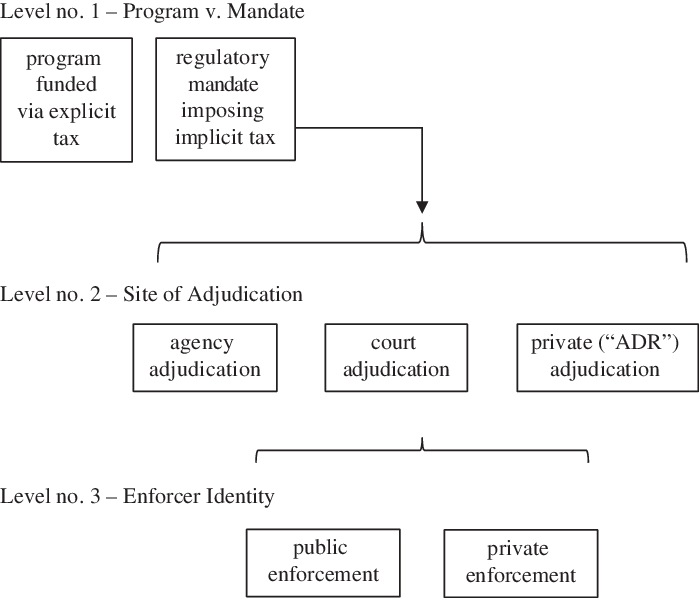
Moreover, the various articulations of the theory span at least three distinct modes of cost shifting, as depicted in Figure 1.Footnote 5 First, legislators who wish to achieve certain social ends can realize budgetary savings by forgoing government action financed by explicit taxes and, instead, impose a regulatory mandate—that is, a duty to do or not do something—that operates as an implicit, or “regulatory,” tax (Kelman Reference Kelman1999). The “accommodation mandates” at the heart of the ADA, as already noted, provide an obvious example. Another example comes in the environmental context. Legislators who are concerned about pollution and prefer explicit taxation as a regulatory approach could impose a general tax (on all citizens) or a targeted tax (on polluters only) and then use the proceeds to compensate those affected by pollution or subsidize their relocation away from emitters. Alternatively, legislators who wish to avoid explicit taxation and minimize on-budget costs could impose a regulatory mandate requiring heavy industry to deploy particular technologies to abate pollution. The result would be an off-budget, implicit tax on production.
Three levels of cost shifting via regulatory choice. Note that cost shift is reflected in moves from left to right.

Once legislators have chosen a regulatory mandate over a tax-financed redistributive or other program, legislators can move regulatory costs off budget in two further ways: a shift in the institution charged with adjudicating the enforcement efforts or a shift in the identity of the enforcer (Burke Reference Burke2002).Footnote 6 With the first method, budget-conscious legislators can move enforcement efforts from “in-house” agency adjudications to agency-filed suits in the courts, or they can shift adjudication entirely off budget by relocating it from public bodies (agencies, courts) to private arbitration or other forms of privately funded “alternative dispute resolution.” With the second, legislators can shift responsibility for enforcement from public actors (agency administrators, prosecutor’s offices) to private actors (civil litigants). Combining both cost-shifting approaches yields budget-protecting moves that go well beyond the simple move from explicit to implicit tax financing. As a concrete example, cost shifting might entail a move from a scheme in which a public agency initiates and prosecutes enforcement actions against regulatory targets inside the agency before an administrative law judge—a power currently enjoyed by agencies like the Securities and Exchange Commission and the Federal Trade Commission—to one in which private litigants alone initiate and litigate civil actions against regulatory targets, whether in court or before private arbitrators.
Finally, and of critical importance for the present study, the cost-shift theory contains a key and empirically testable implication: cost shifting should be more attractive to legislators who face a “tight budgetary constraint” (Burke Reference Burke2001, 1265; see also Farhang Reference Farhang2008, 827). Legislators with a choice of regulatory instruments with which to achieve policy ends should, all else equal, prefer statutory mandates enforced via private litigation over on-budget regulatory approaches during lean economic times, when public budgets are stretched thin.
Critiques of the Cost-Shift Theory
Anatomizing the theory in this way suggests that the cost-shift theory is not without its problems. First, the theory lacks a limiting principle since virtually any regulatory mandate designed to mitigate social harms will realize on-budget savings in the modern social welfare state. To provide just one example, regulations designed to abate pollution may reduce costs incurred via publicly financed health care for poor children suffering from asthma.
Second, one might question the potency of cost shifting as a legislative strategy. For instance, the move from in-house administrative enforcement and adjudication to private lawsuits in court is not, as Sean Farhang (Reference Farhang2008, 828) puts it, a “free lunch.” Courts are expensive to run, especially where thick judicial procedures lead to more protracted proceedings than in a more procedurally streamlined administrative context. More fundamentally, the move from programs financed via explicit taxes to regulatory mandates that operate as implicit taxes may not yield on-budget cost savings at all except in the short term. This is because regulatory costs, whether borne by regulated entities alone or by regulatory beneficiaries via higher consumer prices or lower employee wages, can depress public tax receipts by reducing taxable production, consumption, or both (Kelman Reference Kelman1999; Donohue Reference Donohue2001). Where the reduction in receipts equals or exceeds the amount of explicit taxes that would have been necessary to fund alternative policies or programs, legislators who choose regulatory mandates over explicit taxation will realize only temporary budgetary savings. In other words, to the extent that we observe legislators acting with a cost-shifting motivation, they may be aiming to reduce visible short-term costs rather than reduce long-term budgetary pressure.Footnote 7 Such short-term motivations are consistent with the generally accepted view among political scientists that politicians are single-minded seekers of reelection (D. Mayhew Reference Mayhew1974). Even if the cost-shift strategy may not yield durable budgetary benefits, it may explain legislative decision making.
Third, a thorough conceptual mapping of the cost-shift hypothesis suggests that whether and when the hypothesis holds will turn on context-specific aspects of the interest-group environment and the regulatory intervention at issue. In particular, budgetary constraints, which often reflect poor macroeconomic performance, can also create political constraints. Economic downturns stretch public and private budgets alike, leaving regulated entities especially resistant to new and costly statutory mandates. To that extent, we might expect that sagging macroeconomic fortunes, far from pushing legislators toward off-budget regulatory approaches, can have the precise opposite effect, making legislative adoption of such approaches less likely rather than more likely. Similarly, the validity of the cost-shift hypothesis is likely to turn on the extent to which regulatory costs are in fact shouldered by regulated entities or, instead, are passed through to regulatory beneficiaries, whether consumers (via higher prices) or employees (via lower wages) (Kelman Reference Kelman1999; Donohue Reference Donohue2001). At the theoretical limit, where pass-through of regulatory costs is relatively frictionless and complete, it is the regulated entities who might prove indifferent to an on- or off-budget regulatory approach, while the regulatory beneficiaries may have quite strong design preferences that are relatively immune to fiscal or economic health. (We recognize that this scenario is largely theoretical.)
In short, the cost-shift theory is hardly without theoretical and empirical ambiguities. It is thus highly problematic that the theory has never been subjected to rigorous empirical test (with one limited exceptionFootnote 8 ), despite being a mainstay in the scholarly literature on the rise of the American litigation state. The remainder of this article offers the first rigorous empirical test of the theory by focusing on an area where the cost-shift theory has been especially prominent: disability discrimination laws.
THE COST-SHIFT DEBATE AND THE MAKING OF DISABILITY DISCRIMINATION LAWS
Upon its enactment in 1990, champions hailed the ADA as an “Emancipation Proclamation” for people with disabilities and the beginning of the end of their persistent exclusion from American social and economic life.Footnote 9 Others cheered the law as the culmination of a heroic effort by disability advocates to forge a civil rights-based movement across disability types and to challenge an incumbent view of disability that had long produced institutionalization, medicalization, and segregation rather than personal autonomy and independence (O’Brien Reference O’Brien2001; Scotch Reference Scotch2001). A further note sounded by disability advocates is especially relevant in light of the cost-shift critique of the ADA. In the glow of the ADA’s enactment, advocates made optimistic predictions, echoing a frequent talking point during earlier legislative debate, that the law’s antidiscrimination protections would save the government money by reducing dependency on public programs serving people with disabilities (Bagenstos Reference Bagenstos2003, 957; Pelka Reference Pelka2012, 506). More specifically, because protected individuals would earn a paycheck they otherwise might not, and because doing so would render them eligible for employer-provided health care and also ineligible for means-tested social welfare benefits such as the Social Security Disability Insurance (SSDI) program or Medicaid, the ADA would relieve mounting pressure on the federal budget. Some advocates suggested that the savings would total as much as sixty billion dollars per annum (National Council on Disability 1997; Bagenstos Reference Bagenstos2003.Footnote 10 Even Congress’s preamble to the ADA joined the chorus, noting that discrimination against people with disabilities “costs the United States billions of dollars in unnecessary expenses resulting from dependency and nonproductivity.”Footnote 11
Few opponents of the ADA, whether before or after enactment, directly contested the notion that integrating people with disabilities more fully into American society would bring a salutary reduction in dependency upon costly public assistance programs. But even in the run-up to passage, critics had begun to vigorously question its chosen structure as a litigation-enforced accommodation mandate as the best way to achieve such integration. Even the often liberal editorial board of the New York Times said in 1989: “No one wishes to stint on helping the disabled. It requires little legislative effort, however, to write blank checks for worthy causes with other people’s money.”Footnote 12 Since then, commentators have put more formal structure on the critique of the ADA’s rights- and litigation-centered design. Leading the charge was Richard Epstein (Reference Epstein1992, 484), who, in a book published shortly after the ADA’s enactment, argued that the ADA’s litigation-enforced mandated-benefit model “should be scrapped” in favor of a regime in which government “make[s] grants to certain firms to allow them to offer employment to particular classes of disabled workers.” A grant system would, by making explicit the costs of social provision, subject programmatic transfers to constant democratic deliberation and ensure concentration of scarce public resources where they are needed most. By contrast, the ADA’s “off-budget subsidies,” Epstein argued, effected a form of redistribution that was “covert,” “capricious,” “expensive,” and “wasteful” (494).
Concerns about the ADA’s structure as an accommodation mandate have only deepened during implementation. One source of concern has been empirical studies showing that the ADA’s enactment had a substantial disemployment effect as employers culled workers with disabilities in advance of the law’s effective date. More worrying, studies suggest that the labor market outcomes of people with disabilities worsened even after the law took effect (DeLeire Reference DeLeire2000; Acemoglu and Angrist Reference Acemoglu and Angrist2001; Jolls and Prescott Reference Jolls and Prescott2003; but see Stapleton and Burkhauser Reference Stapleton and Burkhauser2003), seemingly confirming the predictions of many about the impact of a legal mandate that compels employers to provide costly accommodations to workers with disabilities but only imperfectly protects them from discriminatory hiring and firing (Jolls Reference Jolls2000). As the Orange County Register (1989, B10), a publication as conservative as the New York Times is liberal, put it in the run-up to the ADA’s enactment: “Some companies doubtless will be bullied into treating them better. But many other companies, though now favorably disposed toward them, may look on hiring the disabled as an invitation to lawsuits.”
When combined with the mounting critique of the ADA’s mandated-benefit structure, these empirical findings about the ADA’s labor market effects have in turn fueled a powerful counter story that casts the ADA not as a towering legislative achievement but, rather, as the flawed product of American political pathologies. On this view, the ADA’s mandated-benefits structure was essential to its passage because it allowed legislators to shift the costs of social provision for people with disabilities from on-budget to off-budget forms (for example, Burke Reference Burke, Martin and Shapiro2004). Worse, the allure of cost shifting crowded out potentially superior regulatory approaches that Congress might have adopted instead, such as a Disabled Earned Income Tax Credit or even an explicit quota regime of the European sort that required employers to hire a certain proportion of employees with disabilities or else pay into a public fund (Burke Reference Burke and Pietro1997; Deleire Reference DeLeire2000; O’Brien Reference O’Brien2001; for a general exposition of these approaches, see Heyer Reference Heyer2002, Reference Heyer, Nielsen and Nelson2005). These alternative approaches, the argument goes, would have achieved substantial integration and cost savings but in a transparent way and without perverse disemployment effects.
Finally, debate over the cost-shift hypothesis is not limited to optimal regulatory design. As noted previously, legal scholars such as Samuel Bagenstos (Reference Bagenstos2003) have invoked cost shifting in debate over the proper interpretation of the ADA. In particular, Bagenstos highlights the substantial legislative history lauding the potential budgetary savings from reduced welfare dependency among people with disabilities as evidence that the ADA was, from the perspective of its legislative champions, a kind of “welfare reform.” Framing the ADA as “welfare reform,” he continues, compels an interpretive approach in which the ADA mandates deep accommodations where employer expenditures would draw workers with disabilities into the workforce who could not otherwise find work, but not shallower accommodations that merely permit people with disabilities to work in their chosen field or perform a given job better or more comfortably. The result would be an interpretive shift away from the dignitary ends that disability rights activists articulated upon its passage and toward a view of the ADA as focused primarily on increasing disabled labor force attachment. Thus, the cost-shift theory is not just an abstract argument about regulatory paths taken or not taken. It also has implications for legal-interpretive debates in the present.
STATE-LEVEL DISABILITY DISCRIMINATION LAWS AS AN EMPIRICAL TEST OF THE COST-SHIFT THEORY
Does cost shifting explain the legislative choice of a rights- and litigation-centered regulatory approach to disability discrimination over alternative approaches? In the context of the federal-level ADA, the cost-shift theory is plausible but hard to test. As already noted, a frequent talking point among the ADA’s champions was relieving pressure on social welfare programs serving people with disabilities, and many erstwhile opponents of job discrimination laws came to support the ADA as a politics of fiscal austerity that settled in during the 1980s (Bagenstos Reference Bagenstos2003). Equally plausible is the notion that the allure of cost shifting crowded out consideration of regulatory alternatives along European lines, such as a quota-based hiring regime with subsidies and penalties for employers who do and do not hire mandated numbers of employees with disabilities (Burke Reference Burke and Pietro1997). Interestingly, such alternatives to the ADA’s approach were in circulation in the American political system as early as 1946, when the newly formed American Federation of Physically Handicapped forwarded a bill in Congress requiring employers to employ a defined percentage of employees with disabilities or else pay a fine.Footnote 13 Four decades later, Congress did not consider any approach other than the ADA’s accommodation mandate (O’Brien Reference O’Brien2001, 75).
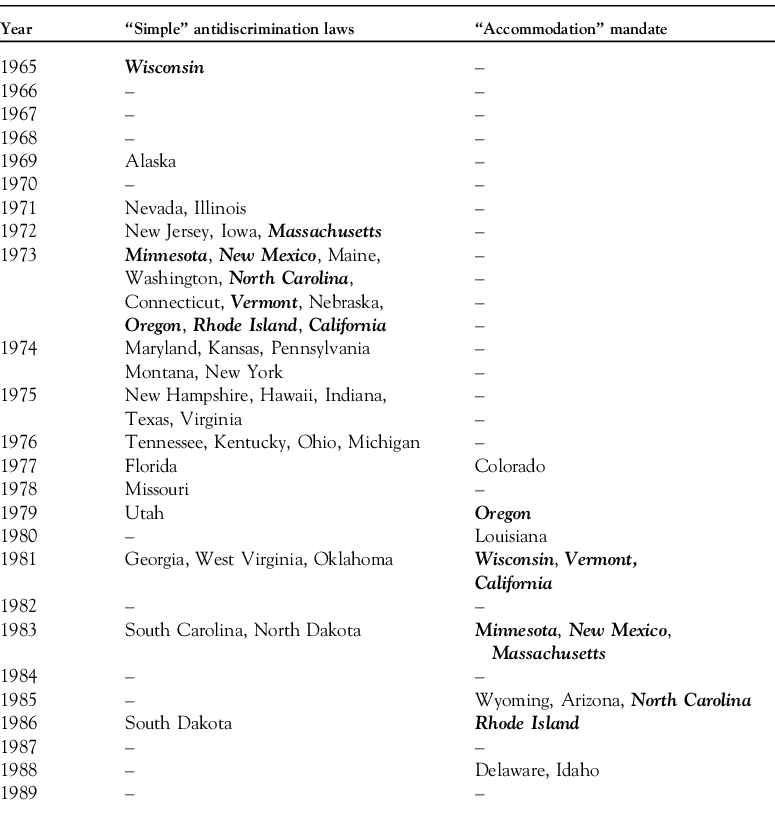
While the history of the ADA’s passage thus broadly supports the cost-shift account, the problem is that a single and rapid legislative campaign without competing bills or competitive committee or floor votes offers the analyst precious little empirical traction. Fortunately, far better traction can be had by dropping down to the state level and exploiting a little-known fact: by the time Congress passed the ADA in 1990, forty-seven states had already enacted disability discrimination laws, typically by adding disability to the list of protected categories under state antidiscrimination laws, and many had even revisited and strengthened them. Table 1 provides detail on the two main dimensions of state-level variation. First, states varied in the timing of their enactment of disability discrimination provisions, with the earliest coming in Wisconsin in 1965, and the latest coming just before the ADA’s enactment, in Delaware and Idaho in 1988.
The state drive to enact disability discrimination laws

Notes: Double-enactment states are bolded and in italics. The table includes legislative enactments only. Thus, the second column excludes three states in which courts, rather than the legislature, imposed an accommodation mandate: Washington (1978); Pennsylvania (1985); Iowa (1987).
Second, states varied substantially in the strength of the disability discrimination laws they enacted. Some states passed what have been dubbed “simple” discrimination protections, while others enacted stronger “accommodation” requirements (Kelman Reference Kelman1999). The former, “simple” type of provision prohibits purely invidious discrimination against individuals with disabilities who are just as productive—in economic terms, who have the same net marginal product—as individuals without disabilities.Footnote 14 Put another way, a “simple” antidiscrimination protection enjoins an employer from treating an individual with a disability “impersonally” by considering traits that are irrelevant to her economic function.Footnote 15 By contrast, an “accommodation” requirement cuts deeper, mandating that employers take reasonable steps to permit even less productive employees with disabilities to work at the relevant job. To fix the distinction between the two as concretely as possible, a “simple” antidiscrimination provision prohibits an employer from refusing to hire a blind lawyer who is able to do the same legal work as a sighted lawyer. By contrast, an accommodation provision requires an employer to hire a blind lawyer even if the employer must provide a “reasonably” costly reader or invest in voice-recognition computer technology in order to achieve the same amount of work as sighted lawyers do without such assistance (Kelman Reference Kelman1999, 844).
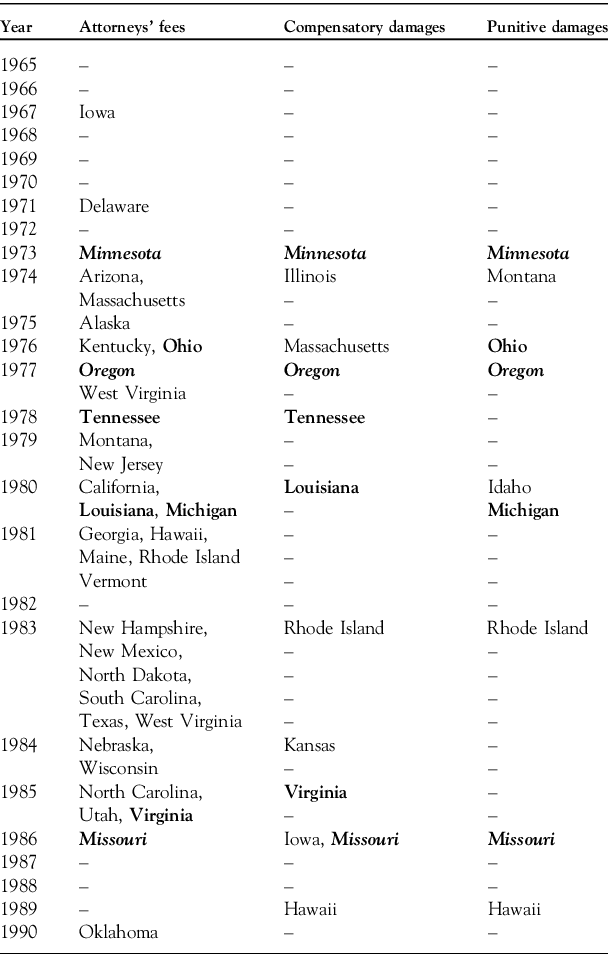
Importantly, it is not the case that only the latter “accommodation” type of antidiscrimination provision can achieve cost shifting. Indeed, even weaker, “simple” antidiscrimination provisions should lead risk-averse employers to hire employees with disabilities who they might not, for instance, by inducing employers to pay the information costs necessary to learn the true extent of an employee’s disability rather than by relying on unfounded assumptions about her productive capacities (Kelman Reference Kelman1999; Jolls Reference Jolls2000). To that extent, “simple” antidiscrimination protections can have regulatory bite and may thereby realize substantial on-budget savings by reducing reliance among people with disabilities on social welfare programs. Indeed, legal scholars have debated whether the difference between the two types of provisions is more apparent than real (Kelman Reference Kelman1999; Donohue Reference Donohue2001; Jolls Reference Jolls2000). Finally, states that enacted disability discrimination laws varied along a third dimension: whether conditional on having a disability discrimination law (whether simple or accommodation mandates), the law contained provisions designed to spur the private enforcement of those laws. We collected novel data tracking when and whether each state enacted the three main types of incentives for litigation: attorneys’ fees, compensatory damages, and punitive damages.Footnote 16 Table 2 shows when states enacted these various litigation incentives for disability discrimination suits.
Disability discrimination laws and litigation incentives

Notes: Double-enactment states are bolded and triple-enactment states are bolded and in italics.
The multidimensional nature of the disability enactments we study allows us to take advantage of several different types of variation. We not only measure the strength of the enactments (that is, whether they included accommodation requirements) but also the degree to which states incentivized their enforcement by private litigants. This distinction allows us to track the conceptual distinction, described in the third level of cost shifting between private and public enforcement, which is illustrated in Figure 1. The variation on display in Tables 1 and 2 offers two kinds of empirical opportunities. Most obviously, three decades’ worth of state-level drives to enact disability discrimination laws and accompanying litigation incentives are a rich source of qualitative evidence. In addition, state-level variation in the timing and strength of disability discrimination laws permits a quantitative test of a core implication of the cost-shift hypothesis noted previously. In other words, if state legislators enacted disability discrimination laws at least in part to shift the cost of social provision for people with disabilities from on-budget to off-budget forms, then, all else equal, we should expect earlier and stronger laws in states experiencing greater fiscal stress and budgetary constraints. The remainder of this article deploys a mix of qualitative and quantitative evidence to offer the first empirical test of this cost-shift hypothesis.
DESCRIPTIVE AND QUALITATIVE EVIDENCE ON THE COST-SHIFT THEORY: TRENDS IN NATIONAL DISABILITY POLICY AND STATE-LEVEL CAMPAIGNS TO ENACT DISABILITY DISCRIMINATION LAWS
Two kinds of descriptive and qualitative evidence offer an initial appraisal of the cost-shift theory. The first comes from juxtaposing the enactment history set forth in Table 1 with larger postwar trends in federal and state social provision for people with disabilities. In other words, is it plausible that states were experiencing increasing fiscal stress relating to social provision for people with disabilities as they enacted disability discrimination laws in the postwar period? The second type of evidence mines legislative history from particular state legislative campaigns in search of support for the cost-shift theory. The rest of this part examines each type of evidence in turn.
Postwar Trends in Social Provision for People with Disabilities and the Cost-Shift Hypothesis
Turning first to evidence of postwar policy trends, the cost-shift hypothesis finds support in the fact that the state-level drive to enact disability discrimination laws came amidst a seismic shift in the shape of American social provision for people with disabilities. The main development was a move away from publicly controlled rehabilitation programs centered around the provision of “curative” medical services and, for those deemed incurable, a system of state- and privately run residential institutions, which was part of a vast “rehabilitation empire,” in the words of a one historian (O’Brien Reference O’Brien2001, 98), or “an insular and extensive disability gulag,” according to a less forgiving account (Pelka Reference Pelka2012, 49). Gradually replacing it was a regime with three components: a more streamlined, voucher-based, privatized system of rehabilitation; community-based services and integrated public school education; and income-maintenance programs. The centerpiece of the latter was the creation in 1956 of the SSDI program, financed via payroll taxes and available to workers with disabilities who had paid into the system. It was strengthened in 1972 with the Supplemental Security Income (SSI) program, a means-tested income-maintenance program available to indigent people with disabilities and, among others, those who were disabled at birth or before they were old enough to hold a job.
Such a fundamental shift in policy emphasis did not come easily. Disability activists had to break the grip of a small army of “rehabilitation professionals” who populated, and benefited from, the incumbent regime and so actively opposed any legislation charting a new course (O’Brien Reference O’Brien2001, 63–65, 113–16; Pelka Reference Pelka2012, 16, 179). Paving the way for fundamental policy change was concern about the mounting costs of rehabilitation services. A key moment came during the Senate hearings in 1966 regarding federal disability programs, including testimony by Health, Education, and Welfare chief Wilbur Cohen that federal expenditures on behalf of people with disabilities had reached nine billion dollars per annum, spanning some eighty different programs and accounting for more than 12 percent of total federal outlays (Treanor Reference Treanor1993, 40).
Just as important were efforts by disability activists to effect a shift in prevailing conceptual approaches to disability, from the “medical” model that had underpinned the reigning curative-rehabilitative approach to a “civil rights” model that pushed away from concepts of dependency and capacity and instead saw autonomy and independence for people with disabilities as human rights (Scotch Reference Scotch2001; O’Brien Reference O’Brien2001; Bagenstos Reference Bagenstos2009). An important component of this view was that high rates of joblessness and poverty among people with disabilities were not the result of physical or mental impairments but, rather, societal attitudes and a built environment that did not take into account the needs of people with disabilities, thus violating those rights (O’Brien Reference O’Brien2001, 14; Scotch Reference Scotch2001; Bagenstos Reference Bagenstos2009). Bound up with this changing conception of disability was a new direction in disability politics. The disability community had long been riven by internal disputes among siloed, medically defined disability groups, much of it fueled by concern among organizational leaders that a cross-disability movement would not fully serve the needs of their particular members (Pelka Reference Pelka2012, 23, 468; Scotch Reference Scotch1989). The rights-based approach helped bridge differences among disability groups and removed the collective-action barriers that had long muted the voice and influence of people with disabilities within American politics (Treanor Reference Treanor1993, 33, 61; Scotch Reference Scotch1988, 161; Reference Scotch2001, 6; O’Brien Reference O’Brien2001, 11; Bagenstos Reference Bagenstos2009).
A secondary shift in American disability policy as legislative campaigns got underway in the 1960s and 1970s took the form of rapid federalization. A good example is the Vocational Rehabilitation Act Amendments of 1965, which expanded federal funding to the states for vocational rehabilitation programs to three hundred million dollars and reduced the required state “match” from fifty–fifty to seventy-five–twenty-five, which then dropped further, to eighty–twenty in 1968 (Scotch Reference Scotch2001, 23).Footnote 17 Two other examples, detailed previously, are the creation of the SSDI program in 1956 and the SSI program in late 1971 and early 1972, which substantially increased federal funding of income-maintenance programs. Interestingly, both of these seismic shifts in American disability policy—the move away from rehabilitation and state-run residential facilities and creeping federalization—tend to cut against the cost-shift theory as an explanation for the enactment of state disability discrimination laws. Indeed, both shifts suggest a state-level fiscal burden that was decreasing, not increasing, as state legislative campaigns gathered momentum. However, any such conclusion ignores a third seismic development in social provision for people with disabilities that posed a significant threat to state budgets and thus offers far stronger support for the cost-shift hypothesis: the creation of the Medicaid program in 1966.
Two distinct phases of the Medicaid program’s evolution offer support for the cost-shift hypothesis. The first phase came during the first half of the 1970s, when states enacted an initial wave of disability discrimination laws. The years 1966–71 were startup years for Medicaid, with some states creating programs immediately and others needing several years to get underway (Klemm Reference Klemm2000). Only three states—Alaska, Nevada, and Illinois—enacted disability discrimination laws during this span. Soon after, however, the Medicaid program entered a period of rapid expansion, spurred by the amendments to the Social Security Act that created the SSI program in 1972.Footnote 18 As noted previously, those amendments continued the trend of federalizing the costs of income-maintenance programs for people with disabilities and so likely reduced certain state expenditures.Footnote 19 But they also had a key collateral effect: federal law required states to cover SSI recipients under Medicaid, and the SSI program’s launch was accompanied by extensive federal outreach efforts designed to identify and enroll eligible recipients. The result was “significant increases” in Medicaid enrollment among people with disabilities (Klemm Reference Klemm2000, 107). Driven in significant part by the inflow of enrollees with disabilities, total Medicaid enrollment increased by almost 5 percent per year over the period 1972–76. More importantly, total Medicaid expenditures grew by an average of 18 percent per year over the same period, as large numbers of people with disabilities—“among the most expensive groups in Medicaid”—flowed into the program (Klemm Reference Klemm2000, 107).
With Medicaid rolls swelling among people with disabilities, states were highly vocal about the resulting budgetary pressures. A signal example came in the litigation effort leading to the US Supreme Court’s decision in Alexander v. Choate.Footnote 20 In this case, the US Supreme Court rejected a challenge by disability activists who sought to use section 504 of the Rehabilitation Act of 1973 to challenge Tennessee’s effort to cut back on Medicaid expenditures by reducing the number of inpatient hospital days provided to each eligible recipient.Footnote 21 The policy was discriminatory, the plaintiffs unsuccessfully argued, because Medicaid enrollees with disabilities had “greater medical needs,” to use the court’s phrasing, and so would be disparately affected by the state’s cost-saving measures.Footnote 22 What is most revealing about the case is the state’s detailed articulation of the budgetary pressures it was facing from Medicaid enrollees with disabilities in particular. More than one-quarter of Medicaid recipients, the state reported to the court, were disabled (90,668 out of 341,960), and they were heavy users.Footnote 23 Enrollees with disabilities who used hospital services were four times as likely to require more than fourteen days of care than users without disabilities (27.4 percent versus 7.8 percent).Footnote 24 Similarly, enrollees with disabilities were nearly one-and-a-half times more likely (18.6 percent versus 13.6 percent) to use inpatient hospital care each year.Footnote 25 Though Tennessee conceded that federal-state matching meant it paid only 30 percent of total Medicaid reimbursements, the “astronomical growth” in Medicaid expenditures had been a “financial calamity” for the state, which could not be addressed via deficit spending because of the state constitution’s balanced-budget requirement.Footnote 26
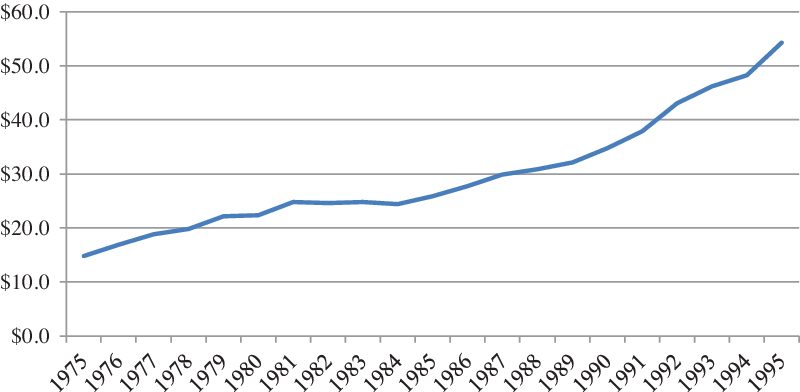
Budgetary pressures in the first phase of Medicaid expansion were plainly felt well beyond Tennessee. Figure 2 plots the explosive growth of Medicaid spending for people with disabilities from 1975 (the first year for which disability-specific data is available) to 1995, five years after the ADA was enacted. During that roughly twenty-year span, total Medicaid costs for people with disabilities more than tripled, from $14.8 billion to $49.4 billion.Footnote 27 Medicaid rolls also grew quickly during this time: total Medicaid enrollees with disabilities grew from 2.4 million to nearly 5.4 million, and the proportion of Medicaid recipients defined as “disabled” rose from 11 percent to more than 16 percent.Footnote 28
Total Medicaid payments on behalf of people with disabilities, 1975–95 (reported in billions of 2009 dollars).

The resulting budgetary pressures only worsened as the Medicaid program entered a second distinct phase during the 1980s. After ten years of rapid program growth, the 1980s saw a new turn in American welfare state politics, as rising concern about runaway entitlement spending and Ronald Reagan’s election fueled a range of efforts to retrench the social welfare state (Pierson Reference Pierson1994). Medicaid retrenchment came most prominently in the Omnibus Budget Reconciliation Act of 1981, in which Congress instituted a three-year reduction in federal financial participation by substantially cutting the federal matching rates that states enjoyed (Klemm Reference Klemm2000, 108).Footnote 29 The result was that states were shouldering a growing share of rising Medicaid costs just as states enacted a new wave of disability discrimination laws, many of them of the stronger “accommodation mandate” variety, during the period from 1981 to 1985. As with the first phase, this second phase of Medicaid’s evolution offers suggestive support for the cost-shift hypothesis.
State-Level Legislative History and the Cost-Shift Hypothesis
In contrast to evidence from national policy trends, legislative history materials drawn from particular state-level campaigns to enact disability discrimination laws are sparser and more mixed in their support for the cost-shift hypothesis. In reviewing this evidence, we are conscious that legislators might have been motivated by the cost-shifting consequences of disability enactments without saying so; indeed, it is possible that some might have tried to hide that motivation. For that reason, we draw not only on records of public legislative debates but also on other records, which are unlikely to be salient to the public, on which cost-shifting legislators might have relied, such as committee reports and letters from interest groups.
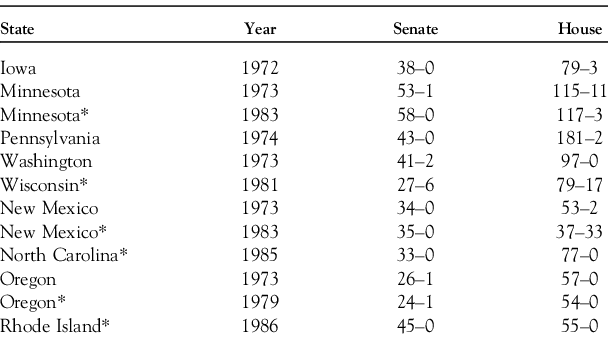
We have sought to collect as comprehensive a legislative record as possible. Our research drew on state archives, state libraries, and the Library of Congress. We were able to find far more comprehensive legislative materials in some states than in others. We have dedicated our qualitative discussion below to the states in which we were able to find more comprehensive materials. The evidence is scarce because few states, even to this day, systematically record or maintain formal legislative history. Perhaps more importantly, what little formal legislative history exists suggests that the legislative debate over state disability discrimination laws was not especially heated, at least not publicly so, leaving little occasion for protracted and potentially revealing back-and-forth discussion of the sort that accompanies more contested legislative efforts. As reflected in Table 3’s accounting of the few states for which voting records are available, legislative votes at final enactment of disability discrimination laws were rarely close, even for laws that were imposing an accommodation mandate. The sole exceptions include New Mexico’s enactment of an accommodation mandate in 1983 and also an indication in legislative testimony in Vermont that the bill that ultimately made it into law in 1973 had only narrowly passed the House.Footnote 30
Final legislative votes in enacting states

Note: Asterisk (*) denotes “accommodation” law.
Nor did the state-level drives exhibit a strong partisan cast. For instance, during Pennsylvania’s 1974 campaign, legislators described a bipartisan process, with a House committee chairman noting that the bill was “an example of effort on both sides of the aisle to pass a much needed piece of legislation.”Footnote 31 Indeed, as we show in Tables 5 through 7, partisan control of the legislature was not a significant predictor of enactment. This is not to say that the laws did not draw opposition. Business groups opposed them in many states, suggesting a standard left-right pattern of support and opposition that characterized legislative campaigns to enact other kinds of job discrimination laws (Chen Reference Chen2009). In Oregon, a representative of Associated Oregon Industries appeared at a hearing of the House Committee on State and Federal Affairs to warn that the bill would lead to affirmative action for the handicapped and might place employees with disabilities at risk of injury.Footnote 32 However, the company was alone in opposition among those registered to testify, leading the committee chair to cut short the hearing and turn immediately to a unanimous vote of all six committee members present.Footnote 33 In other states, some business groups actively supported the proposed law. As Wisconsin considered a bill transforming its disability discrimination law from a simple antidiscrimination provision to an accommodation mandate in 1982, the Wisconsin Merchants Federation and the Wisconsin Association of Manufacturers and Commerce were in favor.Footnote 34 No group—business or otherwise—appeared or registered against the bill that would ultimately win passage. Finally, an atmosphere of consensus prevailed in Rhode Island, where the Governor’s Commission on the Handicapped heard testimony from state representatives who unanimously supported the bill. Partisanship seemed relatively unimportant. Although four of the five representatives who presented were Democrats, Representative Gilbert Indeglia, a Republican, spoke in support of broadening the definition of handicap to include mental disabilities, in line with the federal definition.Footnote 35
The lack of publicly voiced opposition meant that floor debate was brief and rarely strayed beyond the invocation of the dignitary interests of people with disabilities. In Pennsylvania, one representative spent a day on the House floor in a wheelchair “to dramatize the plight of the handicapped in our society,”Footnote 36 noting afterward that the simple difficulties of moving in a wheelchair were more trying than expected.Footnote 37 Other Pennsylvania legislators drew attention to veterans returning home from Vietnam and noted the special obligations owed to those with service-related disabilities. “It is a poor welcome home [for veterans],” Representative Ivan Itkin, the sponsor of the 1974 Pennsylvania legislation said, “when our buildings prohibit them from taking a chemistry class.”Footnote 38
The few states with more extensive legislative records offer at best mixed evidence that budgetary dynamics and cost shifting played a key role in the debate. In some states, budgetary and social welfare dynamics do not appear to have registered at all. During North Carolina’s passage of an accommodation mandate to replace its simple antidiscrimination provision in 1985, the otherwise voluminous legislative record contains no discussion of cost shifting at all. According to the minutes summarizing the North Carolina’s House Judiciary Committee’s deliberations on the ultimately successful bill, the main subject of discussion was the statement of the Governor’s Advocacy Council targeting three “trouble areas” in the prior simple antidiscrimination legislation.Footnote 39 These areas were: “(1) no true definition of handicapped people; (2) no provisions for reasonable accommodations for handicapped people; (3) no viable means of enforcing the [law’s provisions].”Footnote 40 Also discussed was the inclusion of “reproduction” disabilities in the definition of handicap as well as the affirmative defenses of employers. Nowhere were budgetary or redistributive issues noted.
In other states, the few statements by legislative supporters and disability advocates that explicitly raised budgetary costs were mostly brief and unelaborated, suggesting that reducing pressure on social welfare programs was not central to their messaging. In California, an “Enrolled Bill Report,” a document prepared for the governor by the legislative counsel upon an enacted bill’s presentment for signature, reported that a disability discrimination law would “make it possible to obtain more job opportunities for disabled citizens who are now on welfare rolls.” Somewhat more detailed evidence on cost questions comes from New York’s 1974 campaign and the packets of materials that accompanied transmittal of the bill to Governor Malcolm Wilson for his signature. For instance, the executive director of the New York State Nurses Association noted in a telegram to the governor when the bill was still under legislative consideration that the proposed law would not only provide for equal rights and social integration of people with disabilities but would also “decrease need for public welfare.”Footnote 41 Similarly, when a New York assembly member sent a letter to the governor apparently intended to defuse possible objections to the bill, he argued, first, that the bill contained sufficient protections for employers and, second, that “[m]illions of public dollars could be saved by giving the handicapped an opportunity to work.”Footnote 42 Neither letter, however, offered specifics.
A few more detailed statements about budgetary issues can be found in the memoranda and letters sent to the New York governor by executive departments and interest groups urging that he sign or veto the enacted bill. Only five of the twenty-one agency memos in the file made any mention of the budgetary implications of the bill. Of these, only two mentioned possible savings from social services. The others emphasized increased costs to the New York Human Rights Division, the state agency that would adjudicate disputes where a complainant asserting disability discrimination elected to proceed administratively rather than by filing a lawsuit in court. Similarly, of the eighteen letters in the file from interest groups, only two mentioned budget consequences. A lawyer representing a coalition of handicapped organizations argued that, if the bill became law, “[m]illions of dollars in public welfare and private support payments to the jobless, disabled or handicapped will be saved by giving them new hope and opportunities for employment, which they desperately seek.”Footnote 43 Another organization supporting the bill argued that it would save money by reducing enrollment in state mental institutions.Footnote 44 No other individuals mentioned any possible fiscal implications. Together, these communications suggest that cost-based arguments were plainly in play in the legislative debate but may not have occupied a central place therein (Appendix 1 catalogs these memos and letters and summarizes their comments on the bill’s budget effects).
A similar story emerges in Vermont, one of few states for which relatively intact legislative history is available due to unusually detailed records of hearings before the Senate General Affairs Committee in 1981. The hearings featured representatives from a wide range of government agencies and interest groups, including the Office on Aging, the Coalition of Vermont Elders, the Vermont Coalition of the Handicapped, the Vermont Association of Business Industries and Rehabilitation, as well as the State Chamber of Commerce and Retail Association. Yet, as in other states, the bulk of the debate either centered on the dignitary interests of people with disabilities or else tracked other concerns about antidiscrimination laws: whether state prosecutors and agency administrators might prove to be overzealous enforcers or whether a small employer could be liable for hiring his or her own child over an applicant with a disability.Footnote 45
When Vermont bill supporters addressed the cost of social welfare programs serving people with disabilities, their statements only skirted the possible fiscal benefits of disability discrimination laws. Lee Viets, the president of the Vermont Coalition of the Handicapped, testified that “[s]ociety can no longer afford the questionable luxury of rehabilitating and providing education and training for handicapped children and adults only to relegate them to the sidelines cast aside as non-productive children unable to repay the effort expended on them.”Footnote 46 But Viets did not directly articulate public cost savings as a benefit of the proposed law, and this portion of her testimony produced no follow-up from committee members. Similarly, no senators followed up on the issue when Betsy Hummell of the Vermont Association of Business and Rehabilitation noted in passing that the people with disabilities she knew who were now employed had previously been on public assistance.Footnote 47
Perhaps most revealing in the Vermont legislative drive is that, when cost questions surfaced most explicitly, the focus was on how to mitigate employer costs, even where doing so would increase, not decrease, pressure on government programs and public budgets. In a letter to Vermont House Labor Committee, chair John Murphy, a lawyer for an employer association called Vermont Life, noted that, in contrast to companies that contract with the federal government and can pass on to it the costs of section 554’s requirement of reasonable accommodation, a Vermont company covered by the proposed accommodation mandate would not have “a choice” but to accept the “costs it will incur in meeting obligations to accommodate the handicapped” and, moreover, would not “be able to pass on its costs to its customers if competing manufacturers from other states do not have a similar handicapped law.” “The effect the ‘reasonable accommodation’ aspect of this bill,” the letter concluded, “is to shift to Vermont business many of the costs and expenses of meeting the needs of the handicapped in our society.”Footnote 48 Testimony by a representative of the Vermont Retail Association sounded the same note, asking rhetorically:
[W]hy don’t you put these burdens on the state government for a while and see how it works before you ask the private employers of the state to share this burden. Business is bad enough in the country and is extremely bad in the northeast? … If we are going to encourage businesses and young people to stay in Vermont, I don’t think you can ask the public to be the employer of last resorts and expect that it is not going to be costly in terms of our own economic growth.Footnote 49
A similar line of argument aired during Washington’s successful drive to enact a disability discrimination law in 1973. One senator asserted that the bill in question would reduce the burden on the state, but he quickly noted that his main concern was employers: “Shouldn’t any increased health care cost, he asked, be borne by the state rather than employers?”Footnote 50 The senators quickly settled on a solution, adding the following amendment:
PROVIDED, FURTHER, That it shall not be an unfair practice for an employer to reasonably exclude or restrict participation of handicapped employees from, or reasonably restrict their participation in, life insurance, medical or disability benefits programs.Footnote 51
In both states, these dynamics suggest that, even if legislators had a cost-shifting strategy in mind, they faced formidable political constraints in acting on it.Footnote 52 This underscores a possibility raised previously: there may be basic political limits on cost shifting as a legislative strategy.
Canvassing available state legislative materials permits a final observation: while state legislative campaigns featured substantial debate about implementation choices, such as whether to grant government agencies the authority to enforce the new disability discrimination laws or, instead, to provide an aggrieved individual with a private right of action, rarely did actors expressly frame the choice in budgetary or cost-shifting terms. Thus, in Oregon, legislators unsuccessfully sought to move the determination of what constitutes a “reasonable accommodation” to the Bureau of Labor, rather than to the courts, on the grounds that such a technical and potentially evolving consideration “lends itself to administrative rule.”Footnote 53 But the resulting debate made no mention of budgetary dynamics. Similarly, the legislative drive in Massachusetts featured dueling bills, with some providing for purely administrative enforcement by the Massachusetts Commission against DiscriminationFootnote 54 —established in the 1940s when the state enacted one of the first laws prohibiting job discrimination on the basis of race, national origin, and religion (L. Mayhew Reference Mayhew1968)—and others providing for civil actions for damages. However, at no point did the public debate explicitly reference possible budgetary cost savings from judicial adjudication compared to the agency adjudication of complaints.Footnote 55 Only in California did the debate about institutional choices even implicitly connect the choice of enforcer to budgetary dynamics: when California’s new disability discrimination law was presented to the governor for signature, the “Enrolled Bill Report” noted previously contained a “veto” recommendation from the state’s Department of Industrial Relations and the Fair Employment Practices Commission on the ground that the agencies did not want to be responsible for the law’s implementation without additional resources.Footnote 56
In short, the qualitative evidence drawn from state-level legislative campaigns in support of the cost-shift theory is mixed. Cost shifting plainly figured, though not prominently, in at least some state-level debates. But cost shifting was forcefully articulated, not by disability rights advocates touting budgetary savings but, rather, by employers who stood to most directly shoulder the antidiscrimination mandate’s costs. To that extent, the debate suggests tight political limits on the ability of legislators to deploy a cost-shifting strategy.
QUANTITATIVE ANALYSIS OF THE COST-SHIFT THEORY
The descriptive and qualitative evidence to this point suggests that state-level enactments were often low-salience events, with most of the discussion focused on the concerns of people with disabilities. That is not to say that the enactments had no consequences; we have identified a substantial number of published opinions concerning disability discrimination claims before the passage of the ADA.Footnote 57 But the number of state cases before the ADA is certainly dwarfed by the number of state and federal cases after that act, and the relatively low salience of the state laws might be understood as a limitation of our analysis: if the state laws were purely symbolic, then the cost-shift hypothesis would have little meaning. We believe that the substantial number of published opinions before 1990—which are themselves only a subset of all of the cases—indicates that these debates were not purely symbolic.
Yet it remains possible that cost-shift concerns quietly motivated legislators, particularly in states experiencing fiscal stress. As another way to test the cost-shift hypothesis, we collected data regarding a number of key features of each state’s fiscal and political environment from 1960 to 1990 in order to put the cost-shift hypothesis to quantitative test. We tested two hypotheses: first, that fiscal stress made state legislatures more likely to pass disability antidiscrimination laws and, second, that fiscal stress made legislatures more likely to provide incentives for private litigation to enforce those laws. We found no evidence for the first hypothesis and limited evidence for the second one.
Variable Construction
We tested the cost-shift hypothesis using four distinct measures designed to capture the degree to which each state was experiencing fiscal stress throughout the study period. First, we collected data on each state’s total annual tax receipts. The theory is that tax receipts tend to increase in times of economic health and decrease during economic downturns. To facilitate cross-state comparisons, we used revenue per capita.Footnote 58 Second, we collected census data on each state’s per capita welfare expenditures during the study period. Crucially, these welfare expenditures include Medicaid expenditures as well as SSI and Temporary Assistance for Needy Families.Footnote 59 As noted previously, Medicaid expenditures on behalf of enrollees with disabilities posed perhaps the most significant budgetary threat to states as the state-level drive to enact disability discrimination laws unfolded. Third, we used each state’s unemployment rate, which aims to capture budgetary strain not reflected in revenue changes. Finally, we constructed a hybrid variable that captured each state’s welfare spending as a proportion of its total tax revenues. We also collected data on whether each state had a statute or constitutional provision requiring a balanced budget. We determined that every state in our sample had such a provision as of the time it passed its first disability discrimination law (Smith and Hou Reference Smith and Hou2013). As a result, we did not include that variable in the models.
Additional independent variables were designed to control for key features of each state’s political environment beyond fiscal health. The first was political competition, which political science research has established is a key determinant of a political system’s receptivity to interest group demands for legislation.Footnote 60 We used a composite measure of political competition pioneered by Theda Skocpol and colleagues (Reference Skocpol, Abend-Wein, Howard and Lehmann1993). Using a data series available from the Inter-University Consortium for Political and Social Science Research (ICPSR) titled Partisan Divisions among the States, 1830–1985 and supplementing it with data from various volumes of America Votes, we averaged the percentage of seats in the lower house controlled by the majority party for each legislative session, the percentage of seats in the upper house controlled by the majority party, and the percentage margin of victory for the sitting governor in the most recent gubernatorial election. We then subtracted the average of the three ratios from one hundred. A score of one hundred indicates a highly competitive state, while a score of zero represents a grossly non-competitive state.
A second key variable relating to each state’s political environment was partisanship. Past research has established that, at least since the 1960s, Democrats have been the more enthusiastic backers of laws prohibiting discrimination against women and minorities (Chen Reference Chen2007; Farhang Reference Farhang2009).Footnote 61 To account for party control, we constructed a variable taking a value of one when Democrats controlled all three veto points—the governorship and the upper and lower houses of the state legislature—and zero otherwise. As with the political competition measure, this measure was constructed from the ICPSR dataset.
A third variable was a proxy for the size of the population of people with disabilities in each state and, therefore, for the level of demand for legislation: the number of veterans. We collected historical data on the number of veterans in each state from the National Center for Veterans Analysis and Statistics. Although the number of veterans is an imperfect proxy for the size of a state’s disabled population, it has advantages over other likely measures. For example, we could have employed (1) the number of SSDI recipients in each state or (2) the number of SSI recipients with disabilities in each state. SSDI is a “previously paid up individual insurance program” wherein the qualified worker with a disability pays into, and then collects benefits from, the Disability Insurance Trust Fund. SSI is a means-tested benefit program available to children and adults with disabilities who have limited income and resources and also people sixty-five years old and older without disabilities who meet the financial limits. The use of these measures in our analysis, however, would have raised a difficult problem. These measures, while controlling for political demand, may also capture fiscal strain. It would be impossible to disentangle a positive coefficient, which could reflect budgetary stress, political clout, or a mix of the two. We therefore used the presence of veterans instead.
A final control variable aimed to capture “contagion effects” across states via a measure of the proportion of a state’s immediate neighbors that had already enacted a disability discrimination provision for each year in the study period. Contagion effects are a standard control in the state politics literature. It is also noteworthy that state-level legislative debates preceding the enactment of disability discrimination laws contain substantial evidence that the actions of a state’s neighbors mattered. Thus, during the drive to enact a disability discrimination law in Vermont in 1981, testimony noted that Vermont was “the only New England state that does have [one].”Footnote 62
Multivariate Analysis of Cost Shifting and Fiscal Stress
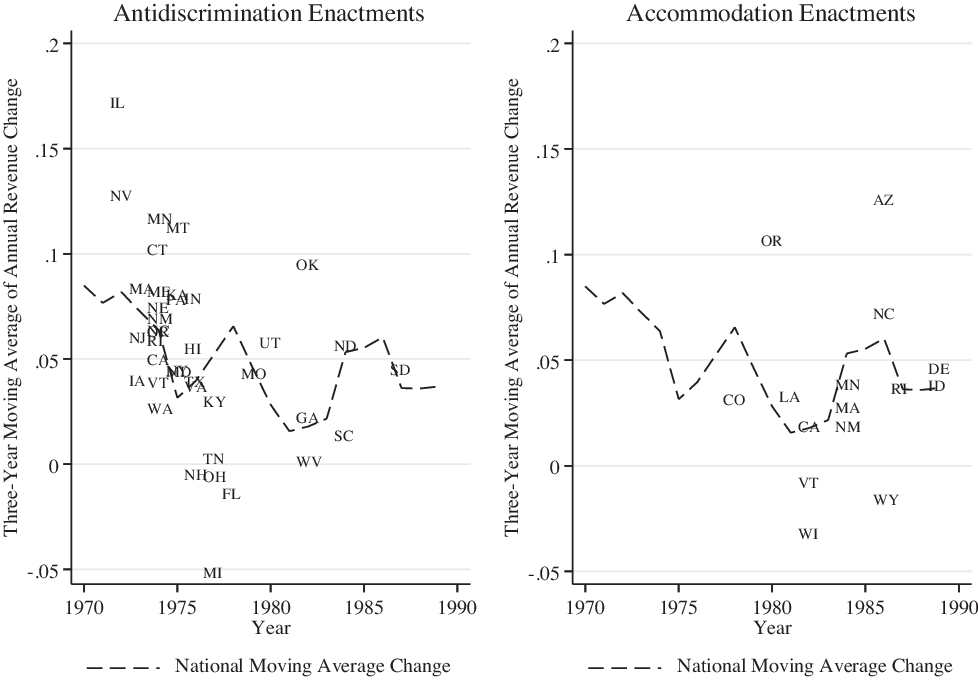
Before our regression analysis, we offer a time-varying visualization of the relationship between enactments and fiscal stress, using one of our principal independent variables—the three-year moving average of change in per capita revenue. Figure 3 shows when each state passed antidiscrimination and accommodation enactments; the vertical axis displays the three-year average percentage change in revenue. The dashed line, meanwhile, plots the three-year moving average percentage revenue change across all states: states below the line passed legislation in times of decreased revenue (compared to other states). The cost-shift hypothesis predicts that most enacting states will be below the line. As in the simple bivariate confidence-interval plots above, the results are mixed, and we do not draw firm conclusions.
Enactments and revenue change over time.

We turn, then, to regression analysis. Our ability to leverage both the timing and the strength of state-level disability discrimination laws is a virtue of our empirical study, but it also poses significant modeling challenges. An initial modeling puzzle concerns the proper dependent variable and how best to account for the fact that states enacted two different types of disability discrimination provisions of different strengths. We addressed this puzzle in two ways. First, we estimated the effect of fiscal stress separately for simple and accommodation enactments. In the set of models presented here, we coded state years as one when an antidiscrimination enactment occurred, zero beforehand, and missing afterwards; in a second set of models, we took the same approach for accommodation enactments but included a control variable that is one in states with previous antidiscrimination enactments and zero otherwise. For each dependent variable, we estimated linear probability models of the form described in Equation 1, provided below.
Second, as a way of retaining as much of the data as possible for our models, we combined the two types of provisions in a simple index. We coded years in which no change occurred with a zero; years in which a state passed a simple enactment or shifted from a simple to an accommodation enactment with a one; and years in which states enacted an accommodation law where no simple enactment was present with a two. In other words, we understood the passage of a simple enactment and the shift from a simple to an accommodation enactment as similar one-unit changes in the dependent variable. In both approaches, once a state has enacted an accommodation law, it drops out of the dataset. This reflects the data structure for a discrete event history model—a hazard model adapted to a context in which time is measured in discrete units (here, years).Footnote 63 Discrete event history models often employ logistic regression, but we used linear ordinary least squares regression instead. We made this choice in order to avoid the problems associated with including multiple fixed effects in logit regressions.Footnote 64 We estimated panel regressions of the form:
 $${Y_{it}} = {\beta _0} + {\beta _1}{X_{it}} + {\beta _2}{J_{it}} + {e_{it}}$$
where Y it is a three-level outcome variable for state i in year t, J is the independent variable of interest (revenue, unemployment, welfare, and welfare/revenue, respectively), X is a vector of control variables (Democratic control, political competition, contagion, and veterans per capita), and ┌ represents fixed effects for states and years. We omit state years after accommodation enactments since those states are no longer at risk of enacting or strengthening a law. An advantage of this approach is that it estimates the effect of changes in our independent variables on changes in the probability of enactment; the model produces an average of individual difference-in-difference effects (Goodman-Bacon Reference Goodman-Bacon2019).
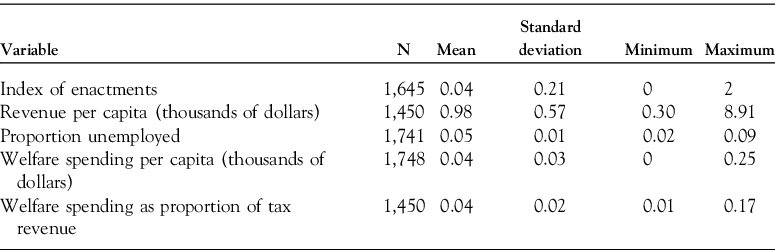
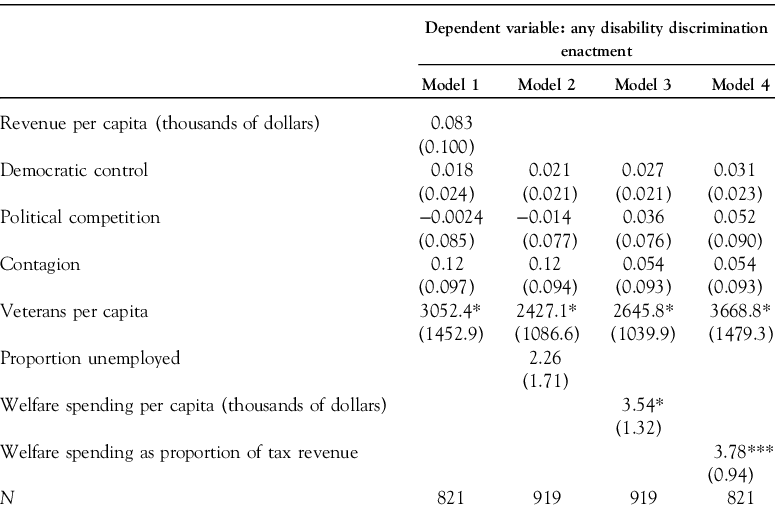
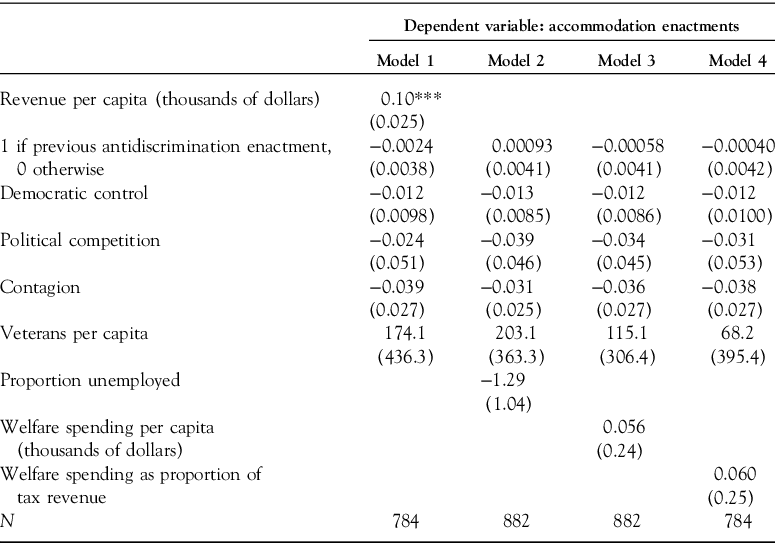
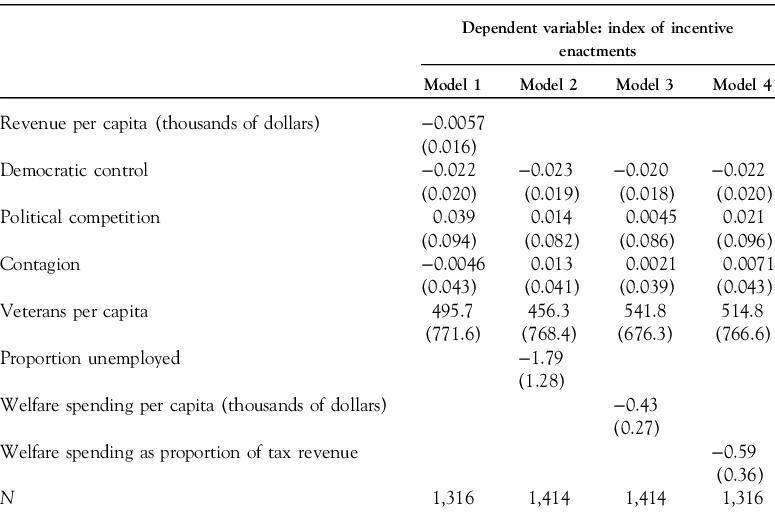
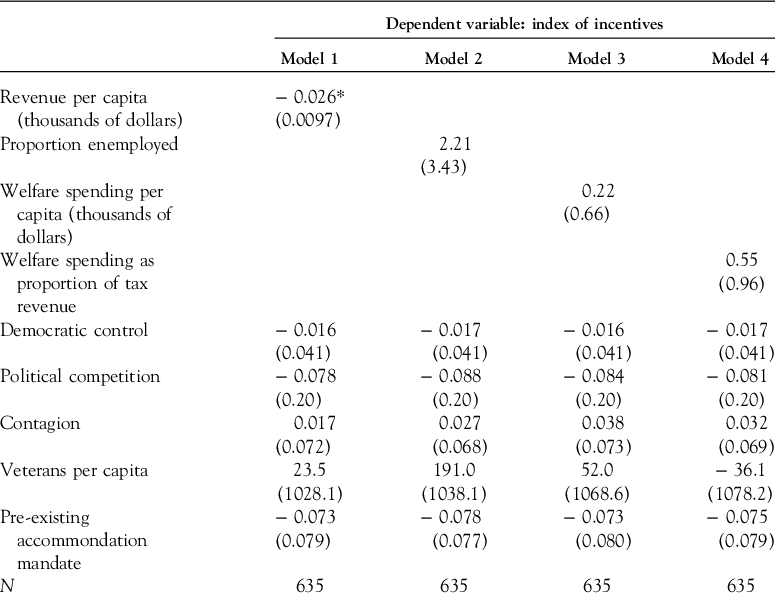
We readily acknowledge the central weakness of this approach: none of our independent variables is exogenously determined. For example, if welfare expenditure is associated with enactments (as our models suggest is the case), this could be the result of a third variable—perhaps, to name just one possibility, growing social concern for vulnerable populations. In the absence of a plausible quasi-experimental research design, we presented these admittedly muddy results as the best available approach. Given the absence of any previous empirical research on the cost-shift hypothesis or causes of disability enactments, we believe that these results have significant descriptive value. Table 4 presents simple descriptive statistics on our independent and dependent variables. Tables 5 and 6 present the results of models that examine the relationship between our four principal independent variables and the enactment of simple and accommodation disability antidiscrimination laws, respectively.
Descriptive statistics

Antidiscrimination enactments

Notes: * p < 0.05; ** p < 0.01; *** p < 0.001.
Standard errors are in parentheses.
Models include state and year fixed effects, and standard errors are clustered by state.
Models 1 and 4 have fewer observations given limited revenue data.
Accommodation enactments

Notes: * p < 0.05; ** p < 0.01; *** p < 0.001.
Standard errors in parentheses.
Models include state and year fixed effects, and standard errors are clustered by state.
Models 1 and 4 have fewer observations given limited revenue data.
For simple enactments, welfare expenditure (both alone and as a proportion of revenue) is the only significant predictor of enactments.Footnote 65 More precisely, Model 3 in Table 5 suggests that a one thousand dollar increase in per capita welfare expenditure would increase the probability of an enactment by over three hundred percentage points. That is obviously not a realistic prediction, but in the context of a median per capita welfare expenditure of twenty-seven dollars, this implies that moving from the twenty-fifth to the seventy-fifth percentile in welfare expenditure increases the probability of an enactment by six percentage points. This association supports the cost-shift hypothesis, but it must be balanced against the lack of any association of enactments with sinking revenue or rising unemployment.Footnote 66 One of the control variables also stands out: the number of veterans per capita is associated with enactments in all specifications.Footnote 67 This may offer some support for a political demand theory of these enactments. Given the unanimity of many of the votes on enactments, this association could suggest that legislators from both parties perceived these enactments as politically beneficial.
Table 6 presents similar results for accommodation enactments, including a control variable for the presence of previous antidiscrimination enactments. There is only one significant relationship in this table, and it is in the opposite range of the predicted direction: higher state tax revenue predicts enactments. This result runs directly counter to the cost-shift hypothesis, but it is subject to the same caveats that we raised with respect to the more intuitive welfare expenditure result regarding the endogeneity of independent variables. Table 7, finally, presents the results of models that examine the relationship between our four principal independent variables and the enactment or strengthening of disability antidiscrimination enactments. In this specification, none of the independent variables is a significant predictor of enactments. One way to understand this lack of results is that the results in Tables 5 and 6 largely wash one another out when combined. The lack of any statistically significant associations also suggests that any large associations are unlikely. For example, a one standard deviation decrease in revenue would increase the probability of an enactment by only about 2 percent, even if one were to assume that the estimate here is two standard errors smaller than the actual effect.
Index of enactments

Notes: * p < 0.05; ** p < 0.01; *** p < 0.001.
Standard errors in parentheses.
Models include state and year fixed effects, and standard errors are clustered by state.
Models 1 and 4 have fewer observations given limited revenue data.
Cost Shifting and Public versus Private Enforcement
So far, our models have only evaluated the hypothesis that states sought to shift costs from social services to employers by enacting disability discrimination laws. But, as explained above, a second version of the hypothesis is equally plausible: that states facing budgetary stress also sought to shift costs off-budget by incentivizing more private enforcement of antidiscrimination mandates. We tested that hypothesis with novel data on state litigation incentive enactments (see Table 2). We constructed a simple index: in a year in which a state enacts any single litigation incentive (attorneys’ fees, compensatory damages, or punitive damages), we coded the state as a one in that year; if it enacts no incentives, we coded it as a zero. If the state enacts two incentives in the same year, we coded the state as a two in that year, and if it enacts three incentives in the same year, we coded it as a three in that year. We only considered years beginning with the first year in which a state enacted either a simple or accommodation enactment. We omitted state years after states had enacted all three incentives. We then estimated a regression of the same form as Equation 1, but now with this incentive index as the dependent variable. We also added a control variable for whether the state has a simple or accommodation enactment on the books.
Table 8 shows the results, again including a column for each independent variable as well as the political and demographic control variables discussed above.Footnote 68 The results in Table 8 largely match our main results predicting the probability of simple and accommodation enactments. Some of our results are consistent with the cost-shift hypothesis, but they provide only qualified support for it. The only statistically significant association is between revenue per capita and litigation incentives: our model suggests that a one thousand dollars per capita decrease in revenue leads to a 2.6 percentage point higher chance of passing a litigation incentive. Since that chance is lower in any given year—about 6.5 percent across all eligible state years—that 2.6 percentage point change is about a 40 percent increase.Footnote 69 None of the other associations between fiscal stress and the passage of litigation incentives is distinguishable from zero, however.
Litigation incentives

Notes: * p < 0.05; ** p < 0.01; *** p < 0.001.
Standard errors in parentheses.
Models include state and year fixed effects, and standard errors are clustered by state.
In sum, the models offer only highly qualified evidence for the cost-shift hypothesis. Although we do find a statistically significant association between welfare expenditures and enactments, this association does not hold for accommodation enactments, and, in fact, we find that decreasing revenue has the opposite effect in the context of accommodation enactments. Finally, in our models examining the association between fiscal stress and the passage of litigation incentives, we find that decreases in revenue are associated with the passage of litigation incentives—but that our other measures of fiscal stress are not. Together with our qualitative analysis of the discussions that occurred around the passage of the relevant bills, these results suggest that cost shifting did not play a large role in spurring the adoption of disability discrimination statutes.
DISCUSSION AND IMPLICATIONS
The qualitative and quantitative analysis offered above finds weak support for the cost-shift theory in the timing of antidiscrimination and accommodation laws, but some limited support for that theory in the timing of statutory incentives for litigation under these statutes. To recount the main findings, while the postwar drive to enact disability discrimination laws came amidst increasing fiscal strain from rising expenditures on social provision for people with disabilities, particularly Medicaid, budgetary concerns and cost shifting were only episodically invoked during state-level legislative debates. Moreover, cost shifting, when it arose most explicitly during debates, came from employers and opponents of the new laws, not from disability rights advocates or legislative champions, suggesting that there are built-in political constraints on cost shifting as a legislative strategy.
Turning to the quantitative analysis, measures designed to capture state-level fiscal stress had only an inconsistent relationship to the enactment of disability discrimination laws. Fiscal stress did not predict the enactment of disability laws, although decreasing revenue did predict the enactment of statutory incentives for the private enforcement of those laws’ mandates. Taken together, the empirical portrait we paint, while ambiguous, points away from the cost-shift hypothesis as a significant driver of the enactment of disability discrimination laws. Clearly, more work must be done before the cost-shift theory can join the pantheon of other explanations for the postwar rise of rights-based, privately enforced regulatory approaches.
These findings hold a number of implications for ongoing debates about the shape of American disability law and policy. First, our rejection of the cost-shift hypothesis can help redirect attention away from the legislative motivations that underpinned the postwar drive to enact disability discrimination laws and toward a more focused and productive discussion of the wisdom of the mandated-benefits structure of the resulting regime compared to regulatory alternatives. This would include whether the regime’s mandated-benefits structure occludes benefits and costs to an unacceptable degree or has other undesirable distributive effects.
Second, and relatedly, our findings call into question the use of cost shifting or “welfare reform” as an interpretive lens for interpreting current disability discrimination laws. Our rejection of the cost-shift theory in the disability context tends to undercut the argument that the ADA and its state-level predecessors should be construed to provide only “deep” legal protections that draw persons with disabilities into the labor market who would otherwise remain outside it. Instead, our analysis suggests that courts should ascribe to legislatures a wider set of goals and purposes, including the protection of the dignitary interests of people with disabilities. This would entail accommodations that are both “deep” and “shallow.”
Third, our analysis enriches a wider debate about the relationship of disability politics to other rights-based social and political movements, particularly around civil rights. For instance, potent predictors of political outcomes within political science—including a state’s level of political competition, which has been shown to make the system more responsive to minority group demands—held no explanatory power at all. By demonstrating disability’s lack of conformity to the usual frameworks of analysis, our findings lend support to widespread views about the exceptional nature of disability politics. The issue is an important one, whether for disability advocates seeking ways to expand their political reach and influence going forward or for scholars seeking to understand the role of disability in the evolution of the American regulatory and social welfare state.
A final interpretive issue concerns the generalizability of our empirical findings. That is, to what extent do our findings travel beyond disability to other policy areas and undercut the cost-shift theory as an explanation for the evolution of the American regulatory state? One possibility has already been noted: if disability politics is qualitatively different from other policy contexts, then our analysis offers only the most liberal test of the cost-shift theory. The same might be true if the civil rights context more generally, not just disability, is exceptional compared to other, more workaday policy areas. For instance, if civil rights issues are highly salient and deeply felt relative to other policy contexts, then creedal passions may swamp the budgetary calculus that the cost-shift theory assumes, making the enactment of disability discrimination laws one of the least likely policy contexts in which we would expect to find evidence of cost shifting. If so, then a test of the cost-shift hypothesis that is limited to the disability context would tell us little about the role of cost shifting in the broader evolution of the American regulatory state.
But a contrary argument that the disability context offers a stringent test of the cost-shift theory seems just as plausible. One could argue that cost shifting should have been an especially attractive legislative strategy as states considered disability discrimination laws because the budgetary shift necessary to move the social provision for people with disabilities off budget aligned perfectly with legislative champions’ message that the new laws were necessary to reduce the dependency of people with disabilities on social welfare programs. Indeed, the availability of an argument that the new antidiscrimination laws promoted the autonomy of individuals with disabilities by moving them off of welfare rolls may have made it easier for legislators to deflect criticism from regulated parties that they were engaged in a budget-freeing gimmick. If true, then the relatively weak evidence of cost shifting in the disability discrimination area would call into question the potency of cost shifting in other policy contexts where no constituency affirmatively supports the move. In other words, if cost shifting does not explain enactment patterns in the disability discrimination context, then it is unlikely to have much explanatory power elsewhere. Only future work testing the cost-shift theory in other policy contexts can reveal whether our focus on disability amounts to a liberal or a stringent test.
SUPPLEMENTARY MATERIAL
To view supplementary material for this article, please visit https://doi.org/10.1017/lsi.2020.25