INTRODUCTION
Physical exercise is increasingly being promoted as a means to achieve both physical and psychological benefits as part of the rehabilitation for oncological patients (Cheville, Reference Cheville2001). The main body of studies has been directed toward middle-aged cancer survivors, mostly breast cancer patients and those undergoing curative treatment (Courneya, Reference Courneya2003). Recently, a few studies have been published concerning palliative cancer patients and the effects of physical activity and exercise (Adamsen et al., Reference Adamsen, Midtgaard and Rorth2003, Reference Adamsen, Quist and Midtgaard2006; Oldervoll et al., Reference Oldervoll, Loge and Paltiel2005, Reference Oldervoll, Loge and Paltiel2006). However, limited research exists concerning the possible psychosocial mechanisms by which exercise might improve quality of life (Courneya, Reference Courneya2001; Midtgaard et al., Reference Midtgaard, Stelter and Rorth2007).
Decline in physical function is experienced by most cancer patients with advanced and incurable disease, and this affects most aspects of life. Two of the palliative patients' main concerns are loss of function and being a burden on their caregivers (Breitbart et al., Reference Breitbart, Chochinov, Passik and Doyle2004). Physical strength and living a normal life as long as possible are ranked as highly important (Sutherland et al., Reference Sutherland, Lockwood and Boyd1990; Axelsson & Sjoden, Reference Axelsson and Sjoden1998; Merluzzi et al., Reference Merluzzi, Nairn and Hegde2001; Clayton et al., Reference Clayton, Butow and Arnold2005). Patients with advanced cancer report being an active participant in their own treatment as opposed to passive recipient as positive (Porock et al., Reference Porock, Kristjanson and Tinnelly2000; Crevenna et al., Reference Crevenna, Schmidinger and Keilani2003). Possible strategies and interventions to prevent loss of physical functioning are therefore important to investigate.
Standard quantitative outcome measures have often been used to measure various aspects of physical performance and capacity following a physical exercise intervention among cancer patients. Examples of these are oxygen consumption, muscular fitness, walk test, and use of different health-related quality-of-life questionnaires measuring specific self-reported symptoms and functions. Few studies have explored the patients' own experiences of physical exercise intervention studies using qualitative methodology. One qualitative study of cancer patients in a curative setting showed that patients prefer group exercise to individual exercise (Midtgaard et al., Reference Midtgaard, Rorth and Stelter2006). Another showed that women with breast cancer attending group exercise report that they valued exercising with women in the “same boat” because of the empathy and acceptance they experienced in addition to the opportunity to exchange information and form friendships. The action-oriented format of this group was preferred to a talk-based format such as a support group (Emslie et al., Reference Emslie, Whyte and Campbell2007).
Physical exercise studies among palliative care cancer patients are few, but tentative results from a prospective Phase II intervention study showed that palliative cancer patients were willing and able to take part in a group exercise program. Furthermore, physical performance and emotional functioning were improved and physical fatigue was reduced (Oldervoll et al., Reference Oldervoll, Loge and Paltiel2005, Reference Oldervoll, Loge and Paltiel2006). However, for patients in the palliative trajectory, their perception of attending an exercise program may be as important as the physiological effects and the quantitative outcomes of the program. Qualitative studies can aim to capture the patient's perspective, providing valuable knowledge for treatment and care providers.
This article reports the findings from qualitative interviews of palliative cancer patients who participated in a group exercise program twice a week for a 6-week period. The objective of the current study was to gain a comprehensive understanding of the patients' perceptions and experiences of taking part in a group exercise program and to explore the meaning of such an intervention for the individual patient in order to provide valuable knowledge necessary for shaping future interventions in clinical practice.
METHODS
Participants
Thirty-four palliative cancer patients with a life expectancy of less than 1 year completed a group exercise program at two centers in Norway (Oldervoll et al., Reference Oldervoll, Loge and Paltiel2006). The inclusion criteria were palliative cancer patients with 3–12 months life expectancy, intact cognitive function, Karnofsky performance status of ≥60, ability to walk, adequately controlled pain (defined as less than 3 on a numerical rating scale where 0 = no pain and 10 = unbearable pain) and residing within 30 minutes of the hospital. Eleven of the 20 patients who completed the program in one center were alive at the time of sampling. Seven of these were randomly chosen and contacted by telephone. They were given a brief synopsis of the purpose of the study, were told what it required of them, and were asked if they were willing to participate. Two declined due to an overall high burden of symptoms. Hence five patients were interviewed. The sampling and interviews were conducted 7 months after the exercise intervention was completed.
Theme Identification and Development of an Interview Guide
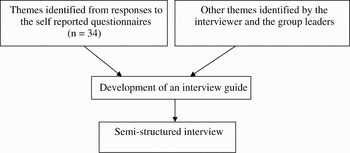
A semistructured interview is based on an interview guide. The interview guide acts as an aid for the interviewer to encompass themes. A self-report evaluation questionnaire (SRQ) was designed for the Phase II study to obtain information from the patients' perspective. It contained five questions with response alternatives, one open question, and a last item elicting comments. These results are reported in another paper (Oldervoll et al., Reference Oldervoll, Loge and Paltiel2005). The analysis from the SRQ identified themes that gave some insight into the patients' perspective. These themes were the most suitable venue for the group, how suitable the exercise program was for the individual patient, and the group as a support system. Other areas of interest were identified by the interviewer and the physiotherapists who led the group. These themes were motivation for participation in the group, how the individual understood the concept of “physical activity,” and their attitude toward being physically active. The interview guide for the present study was developed from these themes. This process is illustrated in Figure 1.
Methodological process.

Semistructured Interviews
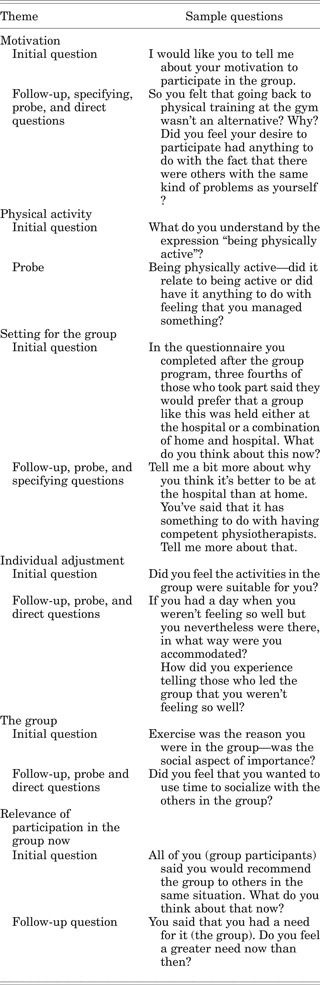
In the semistructured interview, the interviewer used the interview themes as open-ended questions with the possibility of follow-up questions. The interviewer was not bound to ask the questions in the same way or exactly the same questions at each interview (Kvale, Reference Kvale1996; Hansen, Reference Hansen2006). Interview themes and examples of questions are shown in Table 1. The interviews were conducted at the Cancer Department where all patients received their oncological and palliative treatment. The interviews were face to face and audiotaped with permission from the participants. Each interview was scheduled to last a maximum of 45 minutes. The individual participant was informed that the interview could be terminated at any time. An independent, qualified researcher (the second author) interviewed the five patients individually.
Interview themes and examples of questions

Data Analysis
The interviews were transcribed verbatim by the first and second authors. Repetitions are included. One author transcribed three interviews, the other two. Subsequently both authors read each others transcripts comparing them to the audiotapes. Potential discrepancies were discussed and agreement met. A phenomenological–hermeneutical perspective was chosen to analyze the data. Phenomenology strives to give a direct description of a phenomenon as it is experienced before reflection around the phenomenon begins. Hermeneutics is the science of interpretation, that is, the meaning of a text. It is closely connected to phenomenology and contributes to the interpretation of the described experiences (Kvale, Reference Kvale1996). Both the audiotapes and the transcripts were used actively throughout the analysis. Recurring themes were identified independently through multiple readings by the first two authors, compared, and discussed. Texts were then divided and individually clustered, subsequently compared and compiled. Files of verbatim passages were created under themes. In addition, two independent researchers read all transcripts and gave input on themes. Once the final research report was written, the audiotapes from the interviews were deleted.
The study was conducted according to the guidelines of the Helsinki Declaration and approved by the Regional Medical Research Ethics Committee in Central Norway. Written informed consent was obtained from all the participants.
RESULTS
The participants consisted of three men and two women ranging in age from 42 to 76. Their primary diagnoses were colon cancer (n = 2), leiomyosarcoma (n = 1), rectum cancer (n = 1), and ovarian cancer (n = 1). Three were receiving palliative chemotherapy concurrent with the group exercise program. Karnofsky performance status (KPS) at the time of entry into the group exercise program ranged from 70 to 90.
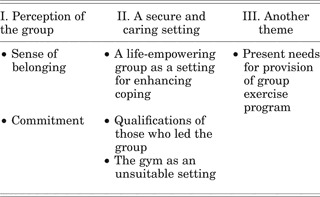
The analysis of the interviews revealed two main themes with subcategories. The two main themes were: “perceptions of the group” and “a secure and caring setting for the group” (Table 2). The theme “perceptions of the group” is divided into two subcategories: a sense of belonging and commitment. The theme “secure and care setting for the group” is divided into three subcategories: a life-empowering group as a setting for enhancing coping, the qualifications of those who led the group, and a public gym as an unsuitable setting. Another theme that emerged from the interviews was the present need for participation in the exercise group at the time of interview.
Themes from interviews

Perceptions of the Group
Sense of Belonging
The participants identified the presence of cancer and being in the same situation as unifying factors with the other members of the group: “We had cancer, all of us [pause] we were in the same boat.”
They experienced a sense of belonging in the group setting and expressed well-being in this setting: “I wanted to get together with others with the same sort of thing. [pause] We were a well-knit group when you're in poor condition.”
Some of the participants voiced at first indifference regarding the age and gender of the other participants, but, when probed, modified their response by voicing a preference for a group with diversity. The participants attached no importance to differences in performance level within the group but differentiated the group's performance level with “healthy” people in the public gym:
Mentally, I wasn't in the best condition, so I preferred to get together with others with the same sort of thing [cancer]. [pause] We were a more united group than if you turned up in poor condition at the gym where everyone's in good condition.
Commitment
The “commitment” of participation in the group seemed to be a motivational factor for the individual participants.
[It was] good to get “forced” into doing something.
[I]t was a goal, an appointment you had to keep.
[I[t's a problem to get started by yourself. It's really getting more and more of an effort. [pause] It's easier to exercise with others than to do it alone, that's my opinion.
They voiced that they attended for their own good. Social interaction was stated as an important factor by all participants. The content of social interaction was voiced as being associated with being together, having others present, a possibility to verbally interact but with noncommittal relationships. The desire for anonymity was also voiced. Participants had not established contact with other participants outside of the group sessions. Rolling admission policy to the group, on-going medical treatment, and changes in symptoms resulted in gaps in individual attendance. This “noncontinuity” in the group was not seen as a problem by any participants. The majority stated it was positive to have a nonstatic and nonuniform group:
It was sort of social, but that was in the background. It was nevertheless training that was the whole point. [pause] But in the breaks, we chatted a bit one-to-one [pause] and in the changing rooms.
I was there for my own good.
I felt it was good that people came and went, that there was variation, new people.
A Secure and Caring Setting
A Life-Empowering Group as a Setting for Enhancing Coping
The primary motivation to join the group seemed to be a desire to be more physically active in a setting that the participants anticipated would be well suited for them. They established a goal of physical gain. Some voiced the expectation of social interaction with others as a factor of importance.
They observed the other participants' physical limitations and expressed how they perceived the program was adjusted to meet their individual needs. The individual participants described how the group provided the possibility for various aspects of coping. Some participants described directly how the group helped them to cope with their everyday lives, others in an indirect manner. The participants described a setting where there was a change of focus from sickness to health, no matter how ill they felt or observed the other participants to be:
The healthy me appears.
[y]ou've been out in throbbing life and taken part in something. You've got visual impressions and felt that you've used your body. That's when you feel you're alive, more alive.
They experienced an environment where acceptance of sickness and varying performance from day to day and within the group gave the individual the possibility to experience control:
You feel you're in control and that you're maybe a little bit more healthy than before.
This is for people who want to be able to do a little bit more and try to get into better shape as fast as possible. It's something to help to lift you. It's something to help you get started. You can do things at your own speed so you don't need to dread that you won't manage it, you don't need to think about that. You decide yourself.
The presence of the group provided a motivation to enhance individual performance. The participants experienced no form of interparticipant competition, which they voiced as positive. Several described a high level of individual performance, that they stretched themselves to their own limits and discovered they could do more than they previously believed they could. Several described clearly how physical activity helped relieve mental stress:
When you're riddled with disease and go to bed at night, you can … [pause] think about yourself, and then you never get to sleep. But if you start to think, well today I've been to gymnastics and we did this and that, then you get your thoughts directed to what you experienced there, and then, sure enough, you get to sleep!
Being drawn outside of their home environment was viewed as positive by all:
Just to get out and do something else, you almost forget things are so bad.
I discovered it's much better to get out and do something physical even if you're in a situation where you're not feeling in good shape.
Yes, everything you do which makes you think about other things is positive. If you're left to sit and mull over and think about the illness, I believe you'll hardly get healthy. You have to get out, or change your thoughts and make yourself do what you can. Even if it's very little, it makes no difference, just that you do something.
The common knowledge that all participants knew that everyone in the group had cancer and hence probably shared experiences left some expressing the feeling that there was a possibility to talk to relieve anxiety if the need arose.
Qualifications of Those Who Led the Group
All stated that those who led such a group should have knowledge about physical activity and training in addition to knowledge of cancer. Physiotherapists were viewed as health professionals with the necessary knowledge:
I felt it was good it was a physiotherapist who led the group, someone who knew something. I would prefer it was a health professional. I felt reassured [pause] to get professional guidance.
[I]f you wanted to talk about your diagnosis, it's good that they have knowledge and understanding about your illness … and that they can answer things you wonder about … and if they weren't able to answer, they could find out … or they could help me to get in contact with other health professionals.
They viewed the hospital as a practical setting for such a group, as a trip there could be combined with other appointments in addition to having access to physiotherapists with necessary knowledge. Other settings inside the established health services were viewed by some as an alternative, as long as the conditions above were met, that is, that the physiotherapists had knowledge of cancer and its consequences for their life situation as well as knowledge of basic physiotherapy skills. Nevertheless, the possibility for close liaison with other health professionals in the hospital setting had all stating that this was the desired alternative.
Several of the participants elaborated on how the leaders should have the ability to relate and communicate with the participants. The participants perceived the leaders as attentive to their and the other participants' verbal and body language. In addition, they experienced an atmosphere open to discussing sickness and sickness-related topics:
You feel they all [those who led the group] actually care and they spoke to each and every one of us who was there … [T]hey are people who care about others, about us patients. That all was well with us, that we thrived and we got something out of the session.
Both [to be caring and a health professional] are important. [pause] [Y]ou [the health professional], of course, have to know what you've to do, not just be a caring person.
The Gym as an Unsuitable Setting
Three of the participants who had utilized and thrived in a public gym environment prior to their cancer diagnosis defined it as an unsuitable setting to continue training in their present situation. They described it as an environment where visible high performance was “essential” and that their present physical appearance was not compatible with the concept of health and fitness at the gym. In addition they perceived that key personnel at the gym did not possess adequate knowledge:
[I]t wasn't an alternative to go back to the gym … in a gym where everyone's in good condition, that wasn't an alternative.
It's more impersonal, you're really a nobody at the gym.
Another Identified Theme: Present Needs
All participants described a need for the group at the time of interview, an even greater need than when participating in the group. The more pronounced their disease progression and the worse their perceived physical and mental conditions, the greater was their described need.
DISCUSSION
Our study indicates psychosocial factors such as perceptions of the group and the experience of a secure and caring setting as themes of importance for the participants in an exercise group for palliative cancer patients. To our knowledge, this is one of the first studies to look specifically at how patients in a palliative setting experience participation in a group exercise program.
Although one-time interviews can elicit neither complete information nor implicit meanings, they can help to gain an inner view of our participants and how they view their worlds (Lofland & Lofland, Reference Lofland and Lofland1994; Charmaz, Reference Charmaz1999). Though small, our sample was heterogeneous, representing different diagnoses, performance status, age, and both genders. Nevertheless, our sample may not have been representative of the group as a whole; 11 of the 20 participants who completed the program at our center were not alive at the time of sampling. Our sample may consist of those who were most healthy at the time of group program.
The participants pinpointed unifying factors in the group, the “cancer experience” being the crucial foundation. Our participants richly described the presence of others, both other participants and leaders, as an empowering element for participation and performance. Group theorists describe how, through meeting and sharing of common ground, social interactions arise between individuals or the group as a whole (Yalom, Reference Yalom2005; Forsyth, Reference Forsyth2006). As reported in our sample, these interactions can become motivational and inspirational.
The commitment to attend the group sessions was expressed as an appointment that helped structure the day. This confirms the statement in Merluzzi's stress management scale for cancer patients that maintaining a daily routine is critical in the lives of cancer patients as an element in self-efficacy (Merluzzi et al., Reference Merluzzi, Nairn and Hegde2001).
Although our study was primarily a physical group intervention, the participants voiced that the group provided psychosocial support. A bond between the participants developed during the group session but did not extend beyond the group sessions. The group seemed to provide an informal support system, but relationships within the group were noncommittal. The participants also utilized the group leaders as informants, supporters, and contacts toward the Palliative Medicine Unit and the Department of Oncology.
To our knowledge, no other studies with a physical group intervention relate solely to patients in a palliative phase. However, several studies with group exercise intervention have included some participants in a palliative phase, and they report aspects relating to psychosocial support. Cohesion and attempting to or maintaining contact with other group participants after completion of the group exercise intervention is reported (Turner et al., Reference Turner, Hayes and Reul-Hirche2004). In our study, no time was specifically allocated to interaction between the participants, and there was no direct focus on psychosocial issues; nevertheless, the sample reported psychosocial support. This model that permits noncommittal relationships seems to provide support suitable for this patient population.
In our study, the participants described how the group provided the possibility for various aspects of coping. Folkman and Greer (Reference Folkman and Greer2000) define variables that contribute to psychological well-being in the face of serious illness, cancer, and HIV AIDS. In keeping with these, our exercise group provided conditions for challenge for the individual participant and a possibility to experience control.
Our participants clearly voiced what they viewed as necessary qualifications for leaders: knowledge about physical activity and training in addition to knowledge about cancer. Several studies have reported expectations cancer patients have to physiotherapists and other professionals regarding guidance and supervision of exercise. Of importance was competent and consistent guidance and an understanding of how to provide a suitable challenge (Adamsen et al., Reference Adamsen, Rasmussen and Pedersen2001). Another study documented counseling preferences where face-to-face counseling and counseling from an exercise specialist affiliated with a cancer center were cited preferences (Jones & Courneya, Reference Jones and Courneya2002). Turner et al. (2004) reported that provision of “skilled supervision” increased the participants' feeling of security. These studies relate to cancer patients in various stages of the disease trajectory. Hence, findings cannot be seen as directly applicable for patients with advanced cancer. Nevertheless clinical experience indicates that the more pronounced the illness, the greater is the perceived need for guidance. Based upon clinical experience, it would appear that the further along the palliative trajectory, the greater is the need for the leaders to recognize participants' symptoms and liaise with medical and nursing staff for suitable follow-up. In our study, the group leaders had an established liaison with the Palliative Medicine Unit and the Department of Oncology. The participants were aware of this liaison, and this underlying fact in itself provided a sense of security.
Several of the participants elaborated on how the leaders should have the ability to relate and communicate with the participants. Communication and counseling skills are recognized as essential for health professionals working in cancer care in general and in palliative care specifically. There is a growing body of knowledge regarding communication with the seriously ill and methods of training health professionals for the task (Maguire & Pitceathly, Reference Maguire, Pitceathly and Doyle2004; Weiner & Efferen, Reference Weiner and Efferen2005; Koropchak et al., Reference Koropchak, Pollak and Arnold2006; Weiner et al., Reference Weiner, Arnold and Curtis2006). Our participants described the provision of a setting with attentive and knowledgeable leaders that enhanced the feeling of security and an “open door” for communication.
To our knowledge, no studies have solely examined exercise intention and behavior in palliative cancer patients. Several studies have, though, demonstrated the utility of the theory of planned behavior in cancer survivors (Blanchard et al., Reference Blanchard, Courneya and Rodgers2002; Courneya et al., Reference Courneya, Segal and Reid2004; Hunt-Shanks et al., Reference Hunt-Shanks, Blanchard and Baker2006). This theory proposes intention, that is, motivation, as one of the prime determinants of behavior. Our participants' motivation to start in the group intervention seemed to be highly influenced by their anticipation that it would be tailored to their individual needs, and their motivation to continue, despite fluctuating ability to perform, was voiced as made possible by new attainable goals being established.
Three participants who had utilized a gym previously stopped attending during cancer treatment and did not recommence. They anticipated social pressure to perform at a “noncomfort” level and voiced changed appearance as a compounding factor for not recommencing. In Coates et al.'s (Reference Coates, Abraham and Kaye1983) survey of 99 patients receiving chemotherapy, appearance-related side effects were often ranked as more severe than physical symptoms. White (Reference White2000) suggested a model for understanding body image dimensions in cancer. He proposed that patients with a combination of perceived or actual appearance change and a threat to the “ideal self” would experience negative appearance-related assumptions, thoughts, emotions, and behaviors. This applies if the self-discrepancy relates to a physical attribute that has had personal significance. For the three participants in our study who had previously utilized a gym, our group intervention was, perhaps, a setting with a reduced threat to their ideal selves.
All participants stated a present need for a physical exercise program. Those with the greatest degree of disease progression at the time of interview described the greatest need for such a group. To our knowledge there are no studies that specifically address “exercise needs” along the full length of the palliative trajectory.
Conclusions and Suggestions for Clinical Practice
Our study indicates that an individually adjusted group exercise program, with competent leaders, can provide a setting to enhance psychological well-being in cancer patients with a life expectancy below 1 year. Perceptions of the group and the expectation and experience of a secure and caring setting were of prime importance for the participants.
In promoting an exercise group program, focus should be placed on how the group is adjusted for differing levels of physical ability. Concerns about appearance should be broached. A simple, practical method for symptom assessment may be implemented prior to each session. To provide a safe and secure setting, we suggest that certain basic requirements should be met. The leader should have adequate oncological and palliative knowledge and skills to better understand the participants' situation, recognize changing symptoms, and be able to adjust the program accordingly. This knowledge is also essential to enable the leader to recognize when referral to and/or liaison with other professionals is indicated. During the group session, the leader should support all possibilities for personal control, encourage positive group dynamics, and attempt to maintain a positive background mood.
ACKNOWLEDGMENTS
We are indebted to the participants who agreed to be interviewed. Without them there would have been no study. This study was funded by the Physiotherapy Department at St. Olavs University Hospital, the Department of Physiotherapy, Sør-Trøndelag University College, and the Regional Centre for Palliative Care Education and Research, Central Norway.