INTRODUCTION
With climate change and land use projected to drive unprecedented rates of environmental change and biodiversity loss in Mediterranean-climate ecosystems by the end of this century (Sala et al. Reference Sala, Chapin, Armesto, Berlow, Bloomfield, Dirzo, Huber-Sanwald, Huenneke, Jackson, Kinzig, Leemans, Lodge, Mooney, Oesterheld, Poff, Sykes, Walker, Walker and Wall2000), successful conservation planning needs to address the potential future impacts of both drivers. While many studies focus on projected climate change impacts (Midgley et al. Reference Midgley, Hannah, Millar, Rutherford and Powrie2002; Loarie et al. Reference Loarie, Carter, Hayhoe, McMahon, Moe, Knight and Ackerly2008; Yates et al. Reference Yates, Elith, Latimer, Le Maitre, Midgley, Schurr and West2010), land-use change may pose a more immediate and equally significant threat (Forister et al. Reference Forister, McCall, Sanders, Fordyce, Thorne, O’Brien, Waetjen and Shapiro2010; Barbet-Massin et al. Reference Barbet-Massin, Thuiller and Jiguet2012; Jongsomjit et al. Reference Jongsomjit, Stralberg, Gardali, Salas and Wiens2013). Modelling the future impacts of both land use and climate change could provide critical information to guide and support conservation and natural resource management decisions in a rapidly changing environment (Sala et al. Reference Sala, Chapin, Armesto, Berlow, Bloomfield, Dirzo, Huber-Sanwald, Huenneke, Jackson, Kinzig, Leemans, Lodge, Mooney, Oesterheld, Poff, Sykes, Walker, Walker and Wall2000; Underwood et al. Reference Underwood, Viers, Klausmeyer, Cox and Shaw2009). Mediterranean-climate ecosystems, which contain high species richness, high endemism, and a high number of species on the International Union for Conservation of Nature (IUCN) Red List (Myers et al. Reference Myers, Mittermeier, Mittermeier, da Fonseca and Kent2000), are regions of high concern for conservation planning (Santos & Thorne Reference Santos and Thorne2010).
The California Floristic Province is a Mediterranean-climate biodiversity hotspot that has experienced a rapid transformation of native ecosystems over the last 200 years (Pincetl Reference Pincetl, Rhymer and Simberloff2003). Human impacts in California will continue to intensify this century, with population projected to grow from its current 38 million to as high as 147 million by the end of the century (Sanstad et al. Reference Sanstad, Johnson, Goldstein and Franco2011), and general circulation models (GCMs) project a mean surface temperature increase of 1.7–5.8 °C state-wide by the end of the century (Mastrandrea & Luers Reference Mastrandrea and Luers2012). Climate change alone has the potential to cause considerable losses in over two-thirds of California's endemic plant species by 2100 (Loarie et al. Reference Loarie, Carter, Hayhoe, McMahon, Moe, Knight and Ackerly2008). Furthermore, threatened and endangered species, which are already heavily impacted by human activities, may be at particularly high risk to continued anthropogenic change.
Species distribution modelling, which predicts a species range with respect to environmental variables such as climate (Guisan & Thuiller Reference Guisan and Thuiller2005), is a valuable and rapidly evolving tool for modelling current species distributions and habitat requirements, as well as forecasting the future impacts of climate change on species distributions (Midgley et al. Reference Midgley, Hannah, Millar, Rutherford and Powrie2002; Loarie et al. Reference Loarie, Carter, Hayhoe, McMahon, Moe, Knight and Ackerly2008; Yates et al. Reference Yates, Elith, Latimer, Le Maitre, Midgley, Schurr and West2010). Typically, species distribution modelling algorithms require two types of data: locality information of known species occurrences, often from field surveys or museum records, and environmental information across those occurrence locations (Graham et al. Reference Graham, Ferrier, Huettman, Moritz and Peterson2004; Guisan & Thuiller Reference Guisan and Thuiller2005; Elith & Leatherwick Reference Elith and Leathwick2009). Powerful, yet still user-friendly, modelling algorithms (such as Maxent; Merow et al. Reference Merow, Smith and Silander2013) and the increasing availability of high quality environmental data make species distribution model applications for conservation planning more approachable and feasible.
We assess the relative future impacts of land use and climate change on two vulnerable tree species native to southern California (USA): southern California black walnut (Juglans californica) and Engelmann oak (Quercus engelmannii), each of which are a high concern for conservation planning in the state. Both species occur in southern California, a region where high biodiversity coincides with high human impact. The south-western counties of California (Ventura, Los Angeles, Orange and San Diego counties) contain nearly half (45%) of the state's 38 million population, yet only account for seven per cent of the state's total land area (CA-DOF [California Department of Finance] 2011). Additionally, southern California is expected to become warmer and drier by the end of the century, such that the current Mediterranean-type climate could contract or disappear (Klausmeyer & Shaw Reference Klausmeyer and Shaw2009; Ackerly et al. Reference Ackerly, Loarie, Cornwell, Wiess, Hamilton, Branciforte and Kraft2010).
Using a species distribution modelling approach, we first map current climatically suitable habitat in southern California and assess current levels of human land use impact. Second, we compare the future impacts of climate change under two possible trajectories of change (warmer-wetter and warmer-drier), and land-use change on suitable habitat for each species. Finally, we assess the level of protection of current and future habitat for each species in California's existing protected areas. As conditions shift with climate change, species may lose suitable habitat from protected areas, which are geographically fixed.
METHODS
Target species
Juglans californica is a winter deciduous tree that can reach a height of 15 m (Keeley Reference Keeley1990). The species occurs in the southern California foothills of the Outer South Coast Ranges, Transverse Ranges and Peninsular Ranges, typically on north- and east-facing slopes with deep soils having a high water-holding capacity, though it also occurs in riparian areas (Keeley Reference Keeley1990; Anderson Reference Anderson2002). Although it can be locally abundant within its restricted range, J. californica occurs primarily on private land and land fragmented by nearby urban areas (Anderson Reference Anderson2002) and has been identified as vulnerable on the International Union for the Conservation of Nature (IUCN) Red List (IUCN 2011). J. californica is threatened in several counties by urbanization, grazing and possibly by the lack of natural reproduction (World Conservation Monitoring Centre 1998). Quercus engelmannii, also identified as vulnerable, is a semi-evergreen tree that can be drought-deciduous during the summer and can reach a height of 18 m (IUCN 2011). It has the smallest range of any California oak, occurring in the foothills of southern California to northern Baja California (Scott Reference Scott1991; Roberts Reference Roberts1995). It is typically found in interior foothills and woodlands below 1300 m in the San Gabriel Mountains, Santa Ana Mountains, and Peninsular Ranges and south to the border area of northern Baja California. Extensive declines in the habitat of the species have been observed over the past 50 years (Scott Reference Scott1990). Regeneration of the species is poor and the remaining habitat is under threat from grazing, and urban, agricultural and industrial developments (IUCN 2011).
Species records
We obtained species occurrence point localities of Quercus engelmannii and Juglans californica from georeferenced herbarium specimen records and an additional 165 records for Q. engelmannii sampled from 20 locations throughout the species’ range from 2008–2011 (Ortego et al. Reference Ortego, Riordan, Gugger and Sork2012). We searched three herbaria databases: the Consortium of California Herbaria (CCH 2011), which compiles records from 16 participating institutions in California; the Southwest Environmental Information Network (SEINet 2011), which compiles records from 21 herbaria throughout the south-western USA and Baja California; and the Global Biodiversity Informatics Facility (GBIF 2011), an organization which compiles records from hundreds of data publishers worldwide. Prior to modelling, all records were mapped and examined to identify and exclude any records of cultivated plants, errors in georeferencing, obvious misidentifications, and duplicate collections. Duplicate records falling within the same climate data grid cell were also removed. Finally, only records collected from 1950 to present were retained for modelling, as earlier occurrence records could represent climates that do not reflect the current environmental conditions used in our models. This resulted in 169 unique occurrence records for Q. engelmannii and 93 for J. californica.
Land use data
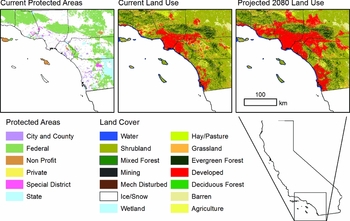
We obtained current (2005) and projected future (2080) land use-land cover data for California from the LandCarbon Project of the United States Geological Survey (USGS 2013) (Fig. 1). USGS has developed spatially-explicit high-resolution (250 m) land use-land cover projections for 84 ecoregions across the conterminous USA that follow the future socioeconomic scenarios outlined by the Intergovernmental Panel on Climate Change Special Report on Emission Scenarios (IPCC-SRES) (Sleeter et al. Reference Sleeter, Sohl, Bouchard, Reker, Soulard, Acevedo, Griffith, Sleeter, Auch, Sayler, Prisley and Zhu2012). This dataset allowed us to match the socioeconomic assumptions of our future land use projections to that of our future climate projections (see below). This scenario represents one possible future storyline: a future characterized by rapid economic growth, global population that peaks in mid-century and declines thereafter, rapid technological innovation, balanced energy sources, and active management of resources (Meehl et al. Reference Meehl, Stocker, Collins, Friedlingstein, Gaye, Gregory, Kitoh, Knutti, Murphy, Noda, Raper, Watterson, Weaver, Zhao, Solomon, Qin, Manning, Chen, Marquis, Avert, Tignor and Miller2007). Projected urban growth is high, particularly in coastal areas and near urban centres, and large increases in biofuel and food production drive large expansions in agricultural lands (Sleeter et al. Reference Sleeter, Sohl, Bouchard, Reker, Soulard, Acevedo, Griffith, Sleeter, Auch, Sayler, Prisley and Zhu2012). The LandCarbon projections categorize land cover into 17 categories with five categories of human land use: developed, cultivated crops, mechanically disturbed (clear-cut logging), mining, and hay/pasture; which were combined into a single anthropogenic land use category. We resampled the 250 m resolution land cover data using the nearest neighbour method in ArcMap 10.0 (ESRI, Redlands, CA, USA) to match the 1-km resolution of our climate data.
Current protected areas, current (2005) land use and land cover, and future projected land use and land cover in 2080 in southern California. Protected areas are from the California Protected Area Database (CPAD). Current and future land use and land cover projections are from the USGS LandCarbon project (Sleeter et al. Reference Sleeter, Sohl, Bouchard, Reker, Soulard, Acevedo, Griffith, Sleeter, Auch, Sayler, Prisley and Zhu2012).

Climate data
We obtained current climate data from WorldClim (2011) version 1.4, a set of global climate layers derived from weather station monthly mean temperature and precipitation data (Hijmans et al. Reference Hijmans, Cameron, Parra, Jones and Jarvis2005). These 19 derived bioclimatic variables represent biologically meaningful climate conditions (Nix Reference Nix and Longmore1986): annual trends, seasonality and extremes. A subset of variables was selected to maximize variable contribution to models: annual mean temperature, temperature seasonality, maximum temperature of the warmest month, minimum temperature of the coldest month, precipitation seasonality, precipitation of the warmest quarter, and precipitation of the coldest quarter. WorldClim was chosen over other current climate datasets (such as PRISM; http://www.prism.oregonstate.edu/), for its global coverage. It is not restricted to the USA's political boundaries and thus encompasses the entire area of our species’ current ranges, which extend into Baja California (Mexico).
We chose two general circulation models (GCMs) to represent two trajectories of climate change in California at the end of the 21st century (2080s: 2079–2100): a warmer-drier future (National Center for Atmospheric Research [NCAR] CCSM 3.0; http://www.cesm.ucar.edu/models/ccsm3.0/) and a warmer-wetter future (Canadian Centre for Climate Modelling and Analysis [CCCMA] CGCM 3.1; http://www.ec.gc.ca/ccmac-cccma/). The NCAR model predicts warmer and drier conditions throughout California, while the CCCMA predicts similar warming with increased precipitation in central and northern California. We obtained statistically downscaled GCM outputs under the IPCC-SRES A1B scenario from the International Center for Tropical Agriculture and the Climate Change Agriculture (CIAT) and Food Security Organization (CCAFS 2011). This scenario represents a future of moderate-high future emissions. All current and future climate layers used for this analysis were 30 arcsec (c. 1-km) resolution.
Modelling approach
We used Maxent (version 3.3.3a), a maximum entropy algorithm (Phillips et al. Reference Phillips, Anderson and Schapire2006), to model the current species-climate relationship for each tree species and to map climatically suitable habitat under current and future conditions. Maxent is a modelling algorithm tailored for presence-only species data with high performance (Elith et al. Reference Elith, Graham, Anderson, Dudik, Ferrier, Guisan, Hijmans, Huettmann, Leathwick, Lehmann, Li, Lohmann, Loiselle, Manion, Moritz, Nakamura, Nakazawa, Overton, Peterson, Phillips, Richardson, Scachetti-Pereira, Schapire, Soberon, Williams, Wisz and Zimmermann2006) that has found wide use in modelling current and future species distributions. Current species-climate models were fit using all species locations and default settings. These models were then projected onto future climate layers from the two downscaled GCMs. Statistics of model performance were calculated using a 10-fold cross-validation replication. Overall model performance was evaluated using the area under the receiving operator characteristics curve (AUC). When using presence-only data, the AUC represents the model's ability to classify presence more accurately than a random prediction and ranges from 0.5 (random prediction) to 1.0 (perfect prediction).
The output of Maxent consists of a gridded distribution map with each cell having a logistic index of suitability, or probability of presence, between 0 and 1. We used a maximum training sensitivity plus specificity threshold (Liu et al. Reference Liu, Berry, Dawson and Pearson2005) to convert the logistic suitability maps to binary current and future habitat maps for each species (1 = suitable, 0 = unsuitable). We calculated future suitable habitat using two dispersal scenarios, unlimited dispersal and no dispersal, to determine potential future habitat gains and losses with respect to current models. The unlimited dispersal scenario assumes no restriction on dispersal to future suitable habitat and represents a best-case scenario of species responses to climate change. It also estimates the maximum distances that species may need to disperse or migrate in order to keep track with changing climate conditions and the maximum potential climate-driven habitat gain. The no dispersal scenario assumes a species cannot disperse and future habitat is restricted to areas that geographically overlap with currently suitable habitat. It represents a worst-case scenario response to climate change and identifies the maximum potential habitat loss driven by 21st century climate change. Model predictions were visualized in ArcMap 10.0.
Habitat transformation and protection
We overlaid habitat suitability maps from Maxent with current and future land use to identify habitat loss due to anthropogenic land conversion (sum of all human land uses). We calculated the current (2005) degree of existing unconverted and climatically suitable habitat. We calculated the change in habitat due to climate change as the per cent loss, per cent gain, and net per cent change relative to existing current climatically suitable habitat. Finally, we calculated the geographic overlap of both drivers: habitat loss from projected climate change and projected land use to ensure calculations of habitat loss under combined land use and climate change scenarios did not artificially inflate habitat losses from co-occurring drivers.
In order to assess the current and future level of protection of each species in California's existing protected areas, we overlaid current and future habitat suitability maps from Maxent with a map of protected areas from California's Protected Area Database (CPAD 2012) (Fig. 1). CPAD is a freely available GIS inventory of all fee-protected open space in California which totals over 198 295 km2 across over 980 owning agencies and land trusts. For each tree species, we calculated the current percentage of suitable habitat falling within protected areas, as well as the change in protected habitat (km2) lost and gained under future climate and dispersal scenarios.
RESULTS
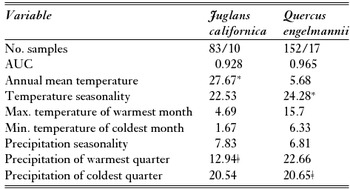
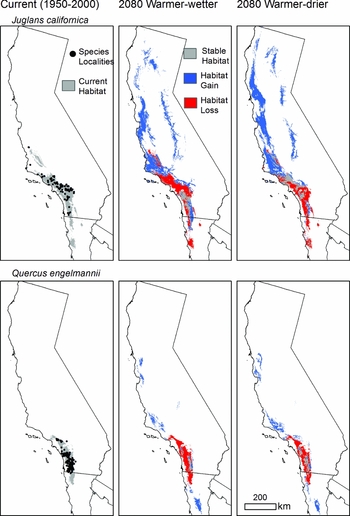
Maxent models for both species corresponded well to presence localities (Fig. 2) and had high overall performance (J. californica AUC = 0.9279 ± 0.0288 and Q. engelmannii AUC = 0.8648 ± 0.0089 [mean ± SD]), suggesting models were able to identify current climatically suitable habitat (Table 1). The model AUC scores were significantly higher than that of a random model according to a one-tailed Wilcoxon signed rank test (J. californica: p = 0.001, Q. engelmannii: p = 0.003). Current models identified 20 493 km2 of climatically suitable habitat in southern California for J. californica and 10 527 km2 for Q. engelmannii. For J. californica, annual mean temperature had the greatest per cent contribution, resulting in the greatest increase in model gain, and precipitation of the warmest quarter had the greatest unique contribution, or largest drop in model gain when excluded, indicating that it provides unique information to the model not included in the other climate variables. Temperature seasonality had the greatest per cent contribution and precipitation of the coldest quarter had the greatest unique contribution to the model for Q. engelmannii (Table 1).
Sample size of localities (train/test), model mean test AUC, and mean per cent contribution of each variable to the model from 10-fold cross validation for each species. *Variable with greatest per cent contribution. ǂVariable with greatest unique contribution to the model.

Species localities, current suitable habitat, and 2080 future suitable habitat under warmer-wetter and warmer-drier climate change scenarios for southern California black walnut (Juglans californica; top row) and Engelmann oak (Quercus engelmannii; bottom row). Current and future habitat maps were calculated using the maximum training sensitivity plus specificity threshold (Juglans californica probability of occurrence > 0.1931, Quercus engelmannii probability of occurrence > 0.2253).

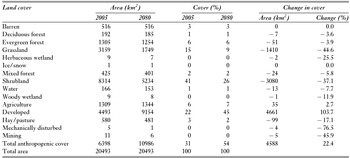
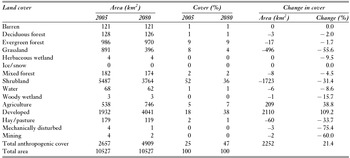
Both species are already heavily impacted by human land use: 31% and 25% of current climatically suitable habitat for J. californica (Table 2) and Q. engelmannii (Table 3), respectively, have been converted to some type of human land use. Development is the greatest contributor to current habitat conversion, covering 22% and 18% of the current climatically suitable habitat for J. californica and Q. engelmannii, respectively. Cultivated crops and lands used for hay/pasture are the next largest contributors of current habitat loss for both tree species. Under a scenario of moderate-high future land use (IPCC-SRES scenario A1B), human activities alone will drive additional losses of 33% (J. californica) and 29% (Q. engelmannii) of existing, unconverted climatically suitable habitat by 2080 after taking into account current land use (Table 4). Under this scenario, development will continue to be the largest driver of anthropogenic habitat conversion for both species. By 2080, anthropogenic land use will have driven a cumulative total habitat loss of 54% for J. californica, with 45% contributable to development alone (Table 2). Similarly, anthropogenic land uses will drive a cumulative total habitat loss of 47% for Q. engelmannii, with 38% contributable to development alone (Table 3).
Breakdown of current (2005) and projected future (2080) land cover of current climatically suitable habitat for Juglans californica.

Breakdown of current (2005) and projected future (2080) land cover of current climatically suitable habitat for Quercus engelmannii.

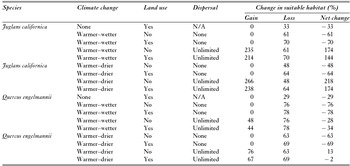
Projected future change in climatically suitable habitat driven by projected land use and climate change. All calculations are based upon current existing, unconverted and climatically suitable habitat.

Under the two climate models, projected climate change will drive considerable habitat losses for both species, and may drive some habitat gains if existing individuals can fully disperse into newly suitable habitat (Fig. 2). Climate change alone could cause losses of 48–61% of existing, unconverted suitable habitat for J. californica and 63–76% for Q. engelmannii by the end of the century (Table 4). These losses increase to 64–70% for J. californica and 69–78% for Q. engelmannii after factoring in projected habitat conversion to anthropogenic land uses (Table 4). For J. californica, considerable climate-driven habitat gains could offset habitat losses driven by both projected land use and projected climate change, assuming scenarios of unlimited dispersal. Suitable habitat for J. californica could increase as much as 218% (net change) under climate-change only scenarios and could increase as much as 174% under combined land use and climate change scenarios (Table 4). In contrast, Q. engelmannii could experience a net habitat loss even under best-case unlimited dispersal scenarios of 2–34% under combined future land use and climate change scenarios by the end of the century.
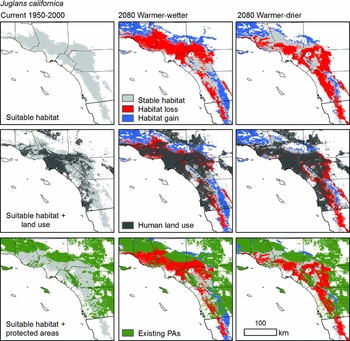
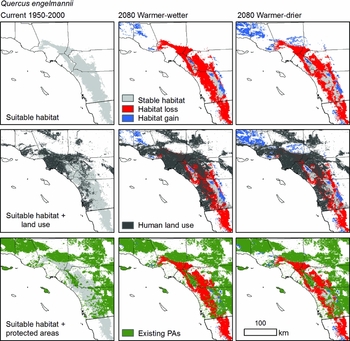
Areas of potential habitat gain for J. californica are in the Coast Ranges in central and northern California, as well as the Sierra Nevada foothills (Fig. 3). Areas of unconverted climatically-stable suitable habitat for J. californica include portions of the southern Coast Range, Transverse Ranges and Peninsular Ranges (Fig. 3). We find considerable habitat losses throughout the entire range of Q. engelmannii, despite modest habitat gains into the southern Coast Range and mountains in the San Francisco Bay Area (Fig. 4). Areas of unconverted, climatically-stable suitable habitat for Q. engelmannii are located in the Peninsular Ranges. Both tree species may lose considerable habitat throughout southern California, including the Los Angeles Basin. Our models show high geographic overlap of habitat losses from both drivers in southern California, particularly in lowland and basin areas (Figs 3 and 4).
Current and future southern California habitat suitability maps with land use and existing California protected areas for southern California black walnut (Juglans californica).

Current and future southern California habitat suitability maps with land use and existing California protected areas for Engelmann oak (Quercus engelmannii).

Habitat protection
Nearly 40% of existing unconverted climatically-suitable habitat for both species currently occurs within existing protected areas, primarily those federally owned (Figs 3 and 4, Appendix 1, Table S1, see supplementary material at Journals.cambridge.org/ENC). We predict climate change could drive protected habitat losses of 43–60% (J. californica) and 56–67% (Q. engelmannii) relative to current levels of protection by the end of the century if species are unable to track suitable climate through dispersal. Assuming unlimited dispersal, however, species could gain habitat in protected areas, increasing overall habitat protection. This potential is greatest for J. californica, which could experience a net increase of 178–210% of protected habitat relative to current protection levels under unlimited dispersal scenarios. In contrast, potential gains are much lower for Q. engelmannii and may not be able to compensate for climate-driven losses in protected habitat with net gains in protected habitat only 8–71%.
DISCUSSION
In the face of mounting environmental change, projections of future land use and climate change impacts on vulnerable species are critical for guiding management actions. By incorporating newly available, scenario-based land use projections (Sleeter et al. Reference Sleeter, Sohl, Bouchard, Reker, Soulard, Acevedo, Griffith, Sleeter, Auch, Sayler, Prisley and Zhu2012) we were able to directly compare the threats of both drivers under the same suite of assumptions (SRES A1B) for two key tree species in southern California. The exclusion of either driver provides an inadequate representation of future impacts across the landscape. We present one possible future trajectory of change for southern California (A1B SRES-IPCC scenario) and our results should be viewed as a hypothesis of how climate change and land use may impact our two focal species in southern California.
Our study highlights both the difference in sensitivities between the two species and the importance of dispersal in moderating the future impacts of both land use and climate change. The high performance of Maxent models suggests climate plays an important role shaping regional patterns of J. californica and Q. engelmannii distribution. Under the future land use and climate change models considered, climate change posed the greatest future threat to the two tree species, close to twice that posed by projected land use, but only under scenarios of no dispersal. In addition, patterns of projected future land use overlap geographically with areas of climate-driven habitat losses, which may create compounding negative impacts for both species. By the end of the century, the greatest land use threat will likely continue to be development, which may be the case broadly in Mediterranean-climate ecosystems with their high biodiversity and large human populations.
Under assumptions of unlimited dispersal, climate change could also drive considerable gains in suitable habitat that may offset some of the losses projected by both land use and climate change. However, the degree of habitat gain, and thus the ability of dispersal to moderate future habitat losses from climate and land use change, was strikingly different between tree species. Assuming J. californica is able to fully disperse into areas of newly climatically suitable habitat, its projected climate-drive habitat gains could be large enough to fully offset the combined losses from both climate change and land use, resulting in a potential net habitat gain by the end of the century. The much lower potential habitat gain for Q. engelmannii, in contrast, may not be large enough to offset the particularly large habitat losses from both drivers projected by the end of the century. These findings highlight the need to consider species individually, as responses to changing conditions and sensitivities to different anthropogenic threats are not necessarily transferable across taxa.
The ability of dispersal to successfully moderate habitat loss from climate change and land use will also depend on a number of factors. For both species, seeds are animal dispersed and current patterns of land development and habitat degradation throughout Southern California pose formidable barriers to species movements. Modelling the dynamics of threatened species along corridors or across barriers is not without uncertainty, especially given the number of irregularities of annual seed establishment and mortality for many species within one site (Keeley Reference Keeley1990; Scott Reference Scott1991; Phillips et al. Reference Phillips, Williams, Midgley and Archer2008). This problem becomes more complex when a spatial component of recruitment and climate are modelled to cover future projections of a species’ entire range. Competition with already established species may also prevent the focal species in this study from successful establishment in newly suitable conditions. If we had assumed that these species were unable to disperse and track favourable conditions outside of their current ranges, as may be the case under runaway development scenarios, we would paint a far less optimistic future.
While an unlimited dispersal scenario may identify some areas that are unrealistic for a species to encounter in light of dispersal limitations and barriers, it identifies candidate areas that could be successful sites for species establishment when paired with human assisted migration. Habitat suitability under unlimited dispersal scenarios can also be tested experimentally by the translocation of threatened species into suitable habitat areas identified by the models followed by monitoring for establishment and mortality. Unlimited dispersal scenarios also show the maximum distance that a species may need to migrate in order keep pace with changing conditions, which can be refined based on species-specific information about dispersal distances. Similarly, while the no-dispersal scenario may overestimate future habitat losses, as it assumes no dispersal or human-assisted migration, it identifies areas likely to be suitable under both current and future conditions, which could serve as critical refugia for maintaining populations.
An additional conservation concern arises as species shift in distribution as a result of climate change: an increased potential for contact with hybridizing species. Hybridization can have serious negative implications for rare and endangered species, including species extinction, which can result from the disruption of ecological species barriers (Levin et al. Reference Levin, Francisco-Ortega and Jansen1996; Rhymer & Simberloff 1996; Wolf et al. Reference Wolf, Takebayashi and Rieseberg2001; Zamudio et al. Reference Zamudio, Harrison, Matocq, DeWoody, Bickham, Michler, Nichols, Rhodes and Woeste2010). Our models for Juglans californica show potential habitat expansion into the foothills of northern California with climate change, assuming unlimited dispersal. If J. californica expands its range into these areas, it could come into contact with the native northern California black walnut, Juglans hindsii, with which it could potentially form interspecific hybrids. Juglans hindsii occurs in the southern Inner North Coast Ranges, southern Sacramento Valley, northern San Joaquin Valley, and San Francisco Bay area of northern California, and is considered critically endangered in the state. J. californica may also be threatened by hybridization with horticultural varieties of walnut (CNPS Rare Plant Program 2014). Quercus engelmannii currently forms hybrids with other scrub oaks with which its distribution overlaps, including Quercus berberidifolia and Quercus cornelius-mullerii. Habitat destruction, such as that driven by anthropogenic land use, can also disrupt ecological species barriers (Levin et al. Reference Levin, Francisco-Ortega and Jansen1996). Hybridization could become an increasingly important management concern for vulnerable species given the high degree of land use and climate change likely this century.
We recommend caution in interpreting future species distributions given the degree of uncertainty underlying climate models and species distribution modelling methodology (Araújo & Guisan Reference Araújo and Guisan2006; Kueppers et al. Reference Kueppers, Snyder, Sloan, Zavaleta and Fulfrost2005; Heikkinen et al. Reference Heikkinen, Luoto and Araújo2006; Wiens et al. Reference Wiens, Stralberg, Jongsomjit, Howell and Snyder2009; Willis & Bhagwat Reference Willis and Bhagwat2009; Garcia et al. Reference Garcia, Ortega-Huerta and Martinez-Meyer2013). Although increasing temperatures have been well established in future climate change scenarios, the magnitude and direction of precipitation are less well documented over different spatial scales (Kueppers et al. Reference Kueppers, Snyder, Sloan, Zavaleta and Fulfrost2005; Tebaldi et al. Reference Tebaldi, Hayhoe, Arblaster and Meehl2006; Seager et al. Reference Seager, Ting, Held, Kushnir, Lu, Vecchi, Huang, Harnik, Leetmaa, Lau, Li, Velez and Naik2007). We selected two future climate variables from two GCMs in order to span both warmer-wetter and warmer-drier climate change projections. An alternative approach that addresses uncertainty in the trajectory of projected climate change is ensemble modelling (Araújo & New Reference Araújo and New2007), which identifies consensuses in forecasted species distributions from multiple modelling algorithms and GCMs. We chose to focus on two possible directions of climate change rather than to average across many different GCMs that may differ dramatically in projected precipitation. Maxent was appropriate for the presence-only data and its high performance compared to other modelling algorithms (Elith et al. Reference Elith, Graham, Anderson, Dudik, Ferrier, Guisan, Hijmans, Huettmann, Leathwick, Lehmann, Li, Lohmann, Loiselle, Manion, Moritz, Nakamura, Nakazawa, Overton, Peterson, Phillips, Richardson, Scachetti-Pereira, Schapire, Soberon, Williams, Wisz and Zimmermann2006), GAM and GLM requiring information on both presences and absences of species and thus not appropriate for our data.
Correlative species distribution models such as Maxent also make assumptions that can be challenging for conservation applications. They assume species distributions are in equilibrium with the environment, which cannot take into account the inability of an individual to reach a suitable habitat (dispersal limitation) and thus can lead to under-prediction of species current ranges, or the ability of an individual to persist in an unsuitable habitat, which can lead to an over-prediction of species current ranges. Furthermore, climate change could cause species to no longer be in equilibrium with climate, resulting in lags in migration at the leading (expanding) edge of range shifts, and time lags or delayed losses at the trailing edge of range shifts (Svenning & Sandel Reference Svenning and Sandel2013). These potential disequilibrium dynamics were not represented in our models. Our no-dispersal scenarios might overestimate habitat losses if our long-lived tree species fell into disequilibrium with climate, persisting in areas that were not climatically suitable. In addition, our models do not incorporate adaptation or acclimation to changing conditions at the population level, which could also moderate losses under climate change. In forecasting species distributions under climate change, we assume model transferability to future conditions (Wenger & Olden et al. Reference Wenger and Olden2012). Appropriate selection of predictor variables in models can improve transferability (Verbruggen et al. Reference Verbruggen, Tyberghein, Belton, Mineur, Jueterbock, Hoarau, Gurgel and Clerck2013), however issues may arise when extrapolating into novel future climates.
Because they are climate-based, our models reflected a climatic niche for each species that was typically larger than the species’ actual ranges (Scott Reference Scott1991; USDA [United States Department of Agriculture] 2011). Environmental variables or factors acting at finer scales, such as topography, soils, disturbance and/or biotic interactions, likely limit the species within its climatic niche (Pearson & Dawson Reference Pearson and Dawson2003; Araújo & Guisan Reference Araújo and Guisan2006; Soberón Reference Soberón2007). For example, J. californica requires areas with high subsurface soil moisture, such as steep slopes with well-developed soils and high water holding capacities, or areas with water input, such as springs or riparian habitats (Anderson Reference Anderson2002). Quercus engelmannii requires deep soils and typically occurs on low angle slopes (<10°) (Scott Reference Scott1991). Additional information about the fine-scale habitat requirements of each species should be coupled with our models when being applied to conservation planning. The 1-km resolution of our climate data does not capture fine-scale microclimate variability (Ackerly et al. Reference Ackerly, Loarie, Cornwell, Wiess, Hamilton, Branciforte and Kraft2010). Steep microclimatic gradients, such as those due to rugged topography can facilitate species range shifts over shorter distances, making it more likely that a species could keep pace with changing climate.
Habitat protection
The Mediterranean-type climate may undergo considerable contraction in southern California under projections of 21st century climate change (Klausmeyer & Shaw Reference Klausmeyer and Shaw2009; Ackerly et al. Reference Ackerly, Loarie, Cornwell, Wiess, Hamilton, Branciforte and Kraft2010). Our models suggest areas in the Peninsular Ranges of southern California will remain climatically stable for both species and could be high priorities for protection. The federally-owned Cleveland National Forest, Los Padres National Forest, and Angeles National Forest provide the greatest degree of protected habitat in this region. Many of the protected areas in southern California within species current ranges, however, are relatively small and highly fragmented. As available habitat becomes increasingly unsuitable through climate change and continued conversion to human land uses, these protected areas could become increasingly isolated. While it is possible that species may gain new habitat in additional existing protected areas under climate change, a highly fragmented landscape will pose a formidable barrier to species migrations to these areas. Species persisting on small isolated fragments may also be at greater risk of extinction as conditions become increasingly unsuitable. Private lands are currently very important for protecting existing populations of both J. californica and Q. engelmannii (Scott Reference Scott1990; Anderson Reference Anderson2002), but may face development pressures given the cost of land and the high degree of projected land for this century. Thus, there is a need for increased habitat protection from the high levels of human land use projected in southern California, including the protection of habitat corridors between key protected areas, not just for the two species considered in this study, but other vulnerable species distributed in southern California.
ACKNOWLEDGEMENTS
We thank Katherine Deuel, Corey Rovzar, Kristin O’Neill, Phillip Rundel, and Victoria Sork for comments on this manuscript. We thank the National Science Foundation (NSF-HSD-0624177) and the Environmental Protection Agency (EPA-G2006-STAR-H1) for funding this research. We thank the Associate Editor and two anonymous reviewers for comments and suggestions that greatly improved the manuscript.
Supplementary material
To view supplementary material for this article, please visit Journals.cambridge.org/ENC.