Introduction
In most mammalian species, females care for their offspring entirely on their own. Humans, in contrast, are part of a small group of mammals that engage in extensive alloparental caregiving (reviewed in Hrdy, Reference Hrdy2009; Rosenbaum & Gettler, Reference Rosenbaum and Gettler2018). Across and within cultures, there is considerable flexibility in who cares for children: fathers, siblings, members of the extended family, and even unrelated individuals make important contributions to children’s upbringing in many, if not most, families (e.g. Bogin et al., Reference Bogin, Bragg and Kuzawa2014; Gettler et al., Reference Gettler, Boyette and Rosenbaum2020; Hawkes et al., Reference Hawkes, O’Connell, Jones, Alvarez and Charnov1998; Kramer, Reference Kramer2005; Nelson, Reference Nelson2020; Scelza, Reference Scelza2009; Shwalb et al., Reference Shwalb, Shwalb and Lamb2013; Starkweather & Keith, Reference Starkweather and Keith2019). Humans’ extreme cooperative caregiving practices are likely what allow us to raise slow-growing, energetically expensive, and closely spaced offspring under a wide variety of ecological conditions (e.g. Gettler, Reference Gettler2010; Kramer & Otárola-Castillo, Reference Kramer and Otárola-Castillo2015; Sear & Mace, Reference Sear and Mace2008).
Given the rarity of this behavior, along with its importance for humans’ unique life histories, there is considerable interest in identifying the socioecological conditions that lead to alloparental care in mammals. The taxonomically widespread (if sparse) distribution of alloparental care mammals suggests that there may not be a single answer to this question (Rosenbaum & Gettler, Reference Rosenbaum and Gettler2018). However, a recent metanalysis motivated by tradeoff perspectives derived from life history theory suggests that, across human societies, harsher and/or less predictable ecological conditions tend to be associated with more alloparental care (Martin et al., Reference Martin, Ringen, Duda and Jaeggi2020). In a study of 141 non-industrialized societies, Martin and colleagues found that greater climate unpredictability, along with harsher conditions (e.g. cold temperatures, lower precipitation), predicted greater investment by alloparents.Footnote 1 Others have found a similar relationship between ecological factors and alloparenting in nonhuman animals. For example, cooperative breeding occurs more often in mammalian species that inhabit arid climates (Lukas & Clutton-Brock, Reference Lukas and Clutton-Brock2017).
While behavioral ecologists have typically focused on the links between current environmental features and caregiving strategies (e.g. Martin et al., Reference Martin, Ringen, Duda and Jaeggi2020; Quinlan, Reference Quinlan2007), a parallel developmental science literature has explored the role that early life environments play in shaping reproductive strategies, including adult caregiving behavior. This research builds from the premise that humans exhibit adaptive developmental plasticity in life history strategies in response to early life conditions (e.g. Belsky & Pluess, Reference Belsky and Pluess2009; Belsky et al., Reference Belsky, Steinberg and Draper1991; Del Giudice et al., Reference Del Giudice, Ellis and Shirtcliff2011; Ellis et al., Reference Ellis, Figueredo, Brumbach and Schlomer2009; Frankenhuis et al., Reference Frankenhuis, Panchanathan and Nettle2016). While there is considerable debate about the evolutionary reasons that organisms are so sensitive to early-life environments (which we define here as occurring any time before the switch from an investment in growth to an investment in reproduction), it is clear that there must be significant costs to long-term plasticity maintenance that preclude continually ‘updating’ across the lifespan (e.g. Fawcett & Frankenhuis, Reference Fawcett and Frankenhuis2015; Lea & Rosebaum, Reference Lea and Rosebaum2020).
For humans, caregiving is a key component of how reproductive effort is allocated. Early life environments could help determine how much and what kinds of care people provide as adults, once they have children of their own (Belsky, Reference Belsky1984; Belsky et al., Reference Belsky, Jaffee, Sligo, Woodward and Silva2005; de Baca & Ellis, Reference de Baca and Ellis2017; Sroufe et al., Reference Sroufe, Coffino and Carlson2010; Szepsenwol et al., Reference Szepsenwol, Simpson, Griskevicius and Raby2015). According to traditional framings of this developmental calibration framework, harsh or unpredictable early environments, which convey signals about extrinsic morbidity and mortality risk (harshness) or how that risk is distributed in time and space (unpredictability) (Ellis et al., Reference Ellis, Figueredo, Brumbach and Schlomer2009), are theorized to produce reproductive strategies that emphasize quantity over quality. This means more resources devoted to securing reproductive opportunities, leading to more offspring and less care for each one (e.g. Brumbach et al., Reference Brumbach, Figueredo and Ellis2009; Ellis & Garber, Reference Ellis and Garber2000; Quinlan, Reference Quinlan2003; Simpson et al., Reference Simpson, Griskevicius, Kuo, Sung and Collins2012).
Although this framework has stimulated a large and productive area of human behavioral research (reviewed in Ellis & Del Giudice, Reference Ellis and Del Giudice2019), recent empirical and theoretical work has called some assumptions of this approach into question, including its application across a diverse range of human cultures (Baldini, Reference Baldini2015; Kyweluk et al., Reference Kyweluk, Georgiev, Borja, Gettler and Kuzawa2018; Sear et al., Reference Sear, Sheppard and Coall2019; Weibel et al., Reference Weibel, Tung, Alberts and Archie2020; Zietsch & Sidari, Reference Zietsch and Sidari2020). For example, the studies that have found evidence for (e.g.) faster reproductive pacing or other proxies of a life history strategy that prioritizes greater reproductive output (and thereby likely de-emphasizes high-investment caregiving) in response to paternal absence have typically focused on Euro-American contexts in which the nuclear family is often highlighted as the primary caregiving unit (Sear, Reference Sear2016; Sear et al., Reference Sear, Sheppard and Coall2019). Additionally, the few studies that have examined associations between early life experiences and later caregiving have focused on individual parental behavior – disproportionately mothers – or the co-parenting relationship between mothers and fathers (e.g. Julian et al., Reference Julian, Rosenblum, Doom, Leung, Lumeng, Cruz and Miller2018; Lotto et al., Reference Lotto, Altafim and Linhares2021; Moehler et al., Reference Moehler, Biringen and Poustka2007; Szepsenwol, Reference Szepsenwol2020; Szepsenwol et al., Reference Szepsenwol, Simpson, Griskevicius and Raby2015).
Expanding the focus of this perspective by testing for links between environmental conditions and the roles of a broader array of potential caregivers (i.e., alloparents) can help us better understand the plasticity of human life histories and reproductive strategies. Behavioral ecology data suggest that alloparental caregiving is a behavioral strategy that mitigates the effects of environmental risk and uncertainty, which presumably helps ensure minimal loss of quality or quantity of care from the perspective of offspring. A relationship between harsh and/or unpredictable conditions and alloparental care is then observable in current conditions at the inter-society or inter-species level. Focusing on a different level of analysis, the developmental perspective proposes that individuals will adapt their life history strategies to maximize biological fitness in response to the environmental conditions they experience early in life.
While to our knowledge this has not been previously explored, these combined ideas generate an emergent, testable set of predictions. Specifically, they lead to the predictions that 1) within societies, individuals who live in harsh or unpredictable conditions will be more reliant on alloparenting when caring for their own children than peers living in more hospitable/predictable ones, and 2) people who grow up in harsh or unpredictable environments will be more reliant on alloparenting when caring for their own children, compared to people who grew up in more hospitable/predictable conditions. Though this is an unexplored topic in the human literature, complimentary work on rodent models suggest that early experiences, including potential environmental harshness cues, could lead to longer-term adoption of alloparenting and alloparenting reliance (reviewed in Kenkel et al., Reference Kenkel, Perkeybile and Carter2017). It is important to note that the behavioral ecology and developmental perspectives are not mutually exclusive: both current and early life environmental conditions could simultaneously influence the caregiving strategies that families employ. So long as there is sufficient variation between early life and later life environments, the two generate distinguishable predictions.
However, given the different levels of analysis the behavioral ecology and developmental psychology perspectives focus on, predictors that indicate harshness/unpredictability at one level – e.g. climate unpredictability across global ecologies – may not translate conceptually to other levels. Additionally, ostensibly relevant predictors may function differently at different levels of analysis. For example, changes in parental employment status are a commonly-used indicator of children’s individual-level environmental unpredictability that have been linked to later-life behavioral patterns in Euro-American contexts. As a source of child psychosocial stress and adversity, it may also be relevant to caregiving behavior in adulthood (e.g. Belsky et al., Reference Belsky, Schlomer and Ellis2012; Simpson et al., Reference Simpson, Griskevicius, Kuo, Sung and Collins2012). However, one side effect of unemployment is that parents may also have more time available to care for children, lessening the demand for alloparental care, and potentially generating an unemployment-alloparental care relationship that runs counter to theoretical predictions. One of our goals in the present article is to explore some of these conceptual issues regarding current versus developmental inputs using a multigenerational framewor, which we discus in more detail below.
Finally, in addition to engaging in different levels of analysis (i.e. inter-population or inter-specific, versus intra-population), the behavioral ecology and life history-focused developmental psychology literatures have also frequently emphasized subsets of the contemporary global human population which are pursuing different subsistence regimes. While the developmental literature (often in psychology) has focused on intra-population variation, specifically in large-scale industrialized settings like the USA and western Europe (e.g. Belsky et al., Reference Belsky, Steinberg, Houts, Friedman, DeHart, Cauffman and Network2007; Ellis et al., Reference Ellis, Bates, Dodge, Fergusson, John Horwood, Pettit and Woodward2003; Nettle, Reference Nettle2010; Nettle et al., Reference Nettle, Coall and Dickins2010; Quinlan, Reference Quinlan2010), the behavioral ecology metanalyses mentioned above address inter-population variation in nonindustrialized, smaller-scale societies, or variation across species (e.g. Martin et al., Reference Martin, Ringen, Duda and Jaeggi2020; Quinlan, Reference Quinlan2007). As far as we are aware, there have been no attempts to evaluate whether the finding that environmental harshness and unpredictability are associated with more alloparenting replicates within (rather than across) human populations, nor if it applies to environmental measures such as (e.g.) socioeconomic status (SES), crowding, or parental unemployment, that are relevant to much of the world’s current population. While the specifics of harshness and unpredictability may be different in industrialized and non-industrialized populations, large-scale industrialized societies create their own set of difficulties that families must navigate.
Here, we use data from the Cebu Longitudinal Health and Nutrition Survey (CLHNS) to explore the relationship between harsh and unpredictable environments (hereafter, HUEs) across the lifecycle, and reliance on alloparental care. Specifically, we evaluate the relative and additive effects of HUEs experienced during infancy and childhood, which could motivate a life history strategy that is less reliant on parental care, along with the better-studied effect of concurrent HUEs in adulthood. The CLHNS is a population-representative birth cohort study of infants born in 1983 and 1984 in randomly selected rural and urban neighborhoods in and around metropolitan Cebu, Philippines (Adair et al., Reference Adair, Popkin, Akin, Guilkey, Gultiano, Borja and Hindin2011). The study has since followed this cohort through multiple survey waves across their lives. It includes extensive information not only on their early life environments, but also on their own family dynamics and caregiving practices in adulthood (Adair et al., Reference Adair, Popkin, Akin, Guilkey, Gultiano, Borja and Hindin2011; Kuzawa et al., Reference Kuzawa, Adair, Bechayda, Borja, Carba, Duazo and McDade2020). In lower-middle-income countries (LMICs) like the Philippines (Philippine Statistics Authority, 2020), there is considerable diversity in measures of HUEs such as pathogen exposure, resource access (i.e. SES), and unemployment (e.g. Adair et al., Reference Adair, Popkin, Akin, Guilkey, Gultiano, Borja and Hindin2011; Carba et al., Reference Carba, Tan and Adair2009; Gultiano, Reference Gultiano1990; McDade et al., Reference McDade, Rutherford, Adair and Kuzawa2010; Miles-Doan & Brewster, Reference Miles-Doan and Brewster1998). This diversity is representative of a large and quickly-growing subset of the world’s population, who increasingly live in metropolitan areas of LMICs (The World Bank, 2020). Moreover, unlike in many Euro-American contexts where caregiving is heavily nuclear-family focused, alloparental caregiving is culturally valued and has historically been an important source of childcare in the Philippines (Medina, Reference Medina2001; Rosenbaum et al., Reference Rosenbaum, Kuzawa, McDade, Avila, Bechayda and Gettler2021; Tiefenthaler, Reference Tiefenthaler1997). Data from such settings provides an opportunity to test predictions derived from behavioral ecology and developmental psychology theories about the relationship between HUEs and alloparental caregiving, within the context of a single large-scale population.
Methods
Study population
We used CLHNS data from three different survey periods: 1983–1986, when the male focal subjects were 0–2 years old; 1994, when they were 10 years old (range = 9–11); and 2014, when the subjects were 30 years old (range = 29–31). In 2014, when the male focal subjects themselves had children, the sample was restricted to families that had two co-resident parents (i.e., the focal male and a spouse) and at least one biological child under the age of 10 living with them. The 1980s and 1994 data were restricted to families where information about both the mother and child(ren) were available, though two parents were present in the majority of the sample population (1980s: 1,108 of 1,327 families; 1994: 885 of 984 families). Our data do not differentiate between biological children and the small number of step and adopted children in the CLHNS families (e.g., in 2014, 5 families had adopted children and 11 had stepchildren, out of 428 families total), because survey questions about caregiving did not distinguish between them. All research was conducted under conditions of written informed consent with Institutional Review Board oversight by Northwestern University and the University of North Carolina-Chapel Hill.
Data collection
During in-home interviews, Cebuano-speaking interviewers collected questionnaire data about sociodemographic information and caregiving behavior. In the surveys conducted in the 1980s and 1994, the infants’ mothers were the targeted participants. They answered questions about caregiving, income, employment, household resident composition, and education. In the 2014 survey, the second generation (the birth cohort born in 1983–84) male focal subjects and their wives were interviewed; the male participants reported sociodemographic data, and their spouses reported on alloparental caregiving. Information about environmental hygiene (e.g. evidence of open defecation in the area, amount of garbage near the home) and crowding (e.g. how many homes were within 50 m, how many rooms the home contained) were recorded by the interviewers (Carba et al., Reference Carba, Tan and Adair2009).
Homes were visited in multiple waves during 1983–86, and the same questions were asked in the same way each time. The caregiving data were specifically collected when the infants were 2, 6, and 14 months old (Gettler et al., Reference Gettler, Kuo, Bas and Borja2019). For these years, we used the averages derived from these 1980s questionnaires. By 1994 and 2014, some survey questions had changed, so one of the limitations of our study is that not all variables are identically defined across time. For the two later decades, we chose variables from the questionnaires that were the closest matches to the data collected in the 1980s. There was an additional CLHNS survey in 1991, but caregiving data were not collected during that wave. We drew on limited data from the 1991 survey pertaining to paternal presence in the household, maternal employment status, and residence changes, which we describe in further detail below.
One important difference between the 1980s surveys and the later surveys is that in the 1980s, mothers were asked specifically about caregiving provided by people in their home. The later two surveys did not restrict responses to co-resident alloparents. For the 1980s data, we therefore present results from all surveyed families in the main text, and provide an additional model in the supplementary materials that limits the analysis to the subset of families who had potential alloparents living with them.
Measuring alloparental care
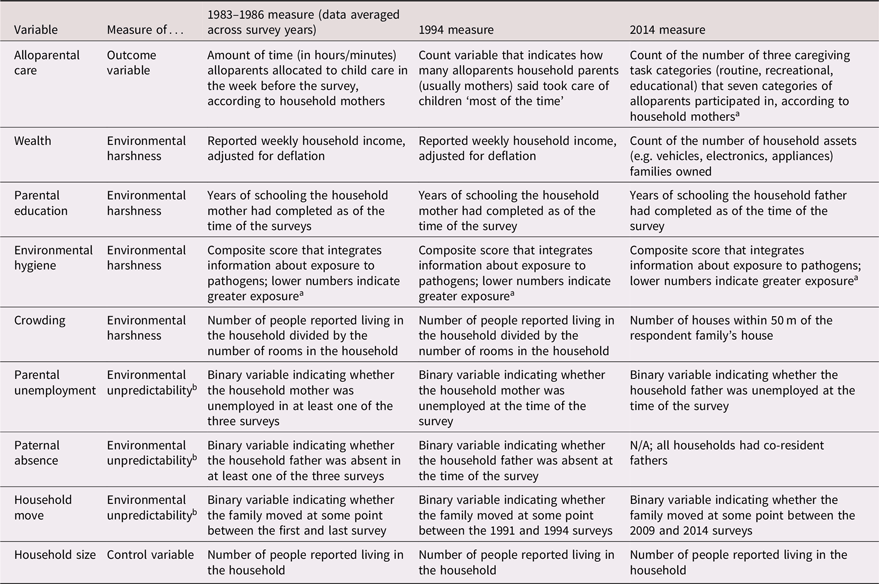
Brief descriptions and definitions of the variables we used are provided in Table 1. Wherever possible, these are consistent with definitions used in previously-published analyses (e.g. Carba et al., Reference Carba, Tan and Adair2009; Gettler et al., Reference Gettler, Kuo, Bas and Borja2019; Rosenbaum et al., Reference Rosenbaum, Kuzawa, McDade, Avila, Bechayda and Gettler2021). Amount of alloparental care was quantified in different ways in the three survey waves, consistent with the questionnaires that were administered at the time (see Table 1 and supplementary materials).
Variable descriptions

a Additional details are available in the supplementary materials. For the 2014 alloparenting outcome variable, this includes lists of caregiving tasks and the categories of alloparents that were considered.
In the 1980s, mothers were asked which household members engaged in caregiving in response to the question “Did [household member] care for children in the household last week?” If the answer was yes, she was asked to estimate how many minutes the caregiver in question spent caring for child[ren] in the week before the survey. This estimate, translated to hours, is used as the outcome variable for the 1980s data.
In 1994, parents (primarily mothers) were asked “Who takes care of the children most of the time?” They were allowed to list up to four people, including themselves. Our outcome variable for 1994 is a count of the number of non-parents they listed. Though the question phrasing meant there was a ceiling of 4 (if they only listed non-parents), in our data no one reported that more than three alloparents took care of children most of the time (Table S2).
In 2014, mothers were asked who helped with a specific set of 12 different caregiving behaviors (see Table S1 in the supplementary materials for the full list). Our 2014 outcome variable was a count of the number of alloparental helpers who assisted with different task categories – specifically, routine caregiving tasks (e.g. bathing, feeding), recreational tasks (e.g. telling stories, going on outings), and educational tasks (e.g. taking to school, helping with homework). While the theoretical ceiling was 33, in our 2014 data no household had an alloparental caregiver count of >12. A more complete description of the 2014 alloparental care variable is provided in the supplementary materials. This includes lists and categorization of caregiving tasks families were asked about, and categories of alloparents who were included (e.g. grandmothers, uncles, siblings).
In all survey years, mothers had the option of reporting that unrelated individuals, including paid caregivers, helped take care of the children. Paid care is relatively uncommon in Cebu, especially at daycare facilities or other similar sites outside the home (Rosenbaum et al., Reference Rosenbaum, Kuzawa, McDade, Avila, Bechayda and Gettler2021). However, small numbers of families in all three time periods had live-in help who either directly assisted with childcare, or whose help with other tasks may have freed up other potential caregivers to do more (1980s: 123 of 1327 families; 1994: 37 of 984; 2014: 12 of 428). The use of paid care could potentially obscure a relationship between HUEs and alloparental care because wealthier families are more likely to be able to afford to pay for this assistance. We present SES summary statistics for families with and without paid, live-in help in supplementary Tables S3(a–c), which confirm that these families are indeed higher-SES than other families. Therefore, we present an additional set of models in the supplementary materials that excludes the families who had live-in help. As a potential alternative, we experimented with models that removed care by unrelated individuals from the outcomes. However, due to the rarity of care by unrelated alloparents, the extremely high correlation between overall alloparental care and alloparental care provided solely by related individuals, plus high overlap in reporting care by unrelated individuals and having paid, live-in help, the results were nearly identical, and thus were dropped from further consideration. For example, in the overall sample in 2014, the correlation between alloparental helper counts with and without unrelated alloparents was 0.987, while among the families who did not have live-in help, this correlation was 0.993.
Defining environmental harshness and unpredictability
Predictor variables that capture environmental harshness fall into three categories: wealth and parental educational attainment (respective SES measures); environmental hygiene; and crowding (Table 1). A complete description of the environmental hygiene variable is provided in the supplementary materials. Briefly, this composite score included information about exposure to trash, human excrement, and spoiled food. Lower numbers indicate poorer hygiene (and thus greater pathogen exposure), while higher numbers indicate better hygiene. Crowded household conditions have been linked to elevated cortisol responses and blood pressure in children, particularly in lower income settings, and are among a host of physical/social hardships commonly considered indicative of a harsh early life environment (Ellis et al., Reference Ellis, Bianchi, Griskevicius and Frankenhuis2017; Evans & Kim, Reference Evans and Kim2007).
Previous analyses with the CLHNS data have used sibling death as a measure of environmental harshness (Gettler et al., Reference Gettler, McDade, Bragg, Feranil and Kuzawa2015; Kyweluk et al., Reference Kyweluk, Georgiev, Borja, Gettler and Kuzawa2018). We chose not to do so here because we wanted to investigate more specific sources of harshness; sibling death may be a function of any or all of the types of harshness included in the present analyses. Second, child death information was not available for the 2014 sample, and we wanted to include similar measures of environmental harshness at all three time points.
Variables that capture environmental unpredictability fall into three categories: parental unemployment (in the 1980s and 1994, maternal, and in 2014, paternal); paternal absence (for the 1980s and 1994 survey waves only, since all 2014 households contained two parents based on the recruitment criteria for men’s spouses in that survey); and household moves. Parental unemployment is commonly used as an indicator of family-based stressors (e.g. Pillas et al., Reference Pillas, Marmot, Naicker, Goldblatt, Morrison and Pikhart2014). Some studies focusing on unpredictability have specifically used parental employment transitions as well as changes in the presence/absence of caregivers as predictor variables (Ellis et al., Reference Ellis, Figueredo, Brumbach and Schlomer2009; Simpson et al., Reference Simpson, Griskevicius, Kuo, Sung and Collins2012; Szepsenwol, Reference Szepsenwol2020). The structure of the CLHNS data do not easily lend themselves to such transition measures within single years or year-to-year. However, transition measures are likely to be highly correlated with cross-sectional measures of father absence and unemployment in our sample. Bi-parental residence is extremely common in this population so children living in homes where the father is absent likely went through at least one caregiver transition, and unemployed parents are unlikely to stay that way permanently, since few CLHNS families have the resources to remain perpetually unemployed.
For the longitudinal models that predict later alloparental care usage from early life HUEs, we used two different sets of independent variables that capture information about two different points during development. We did this because there is some evidence that the specific developmental stage at which HUEs are experienced may impact later outcomes (Simpson et al., Reference Simpson, Griskevicius, Kuo, Sung and Collins2012). The first set was our cross-sectional 1980s variables, to determine whether HUEs experienced very early in life had an effect on adult alloparental care use. The second set used cross-sectional 1994 harshness variables along with integrated information from the 1980s and 1990s surveys for the unpredictability variables. We did this to better capture information about unpredictability across the course of childhood (i.e., something closer to the transition variables used in the studies cited above).
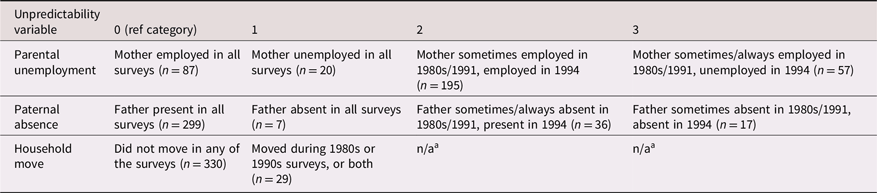
These integrated, across-childhood unpredictability variables were coded as described in Table 2; in brief, we created categories with differing combinations of unpredictability across the course of childhood. In all cases, the reference category was the combination that represented the greatest stability (i.e. continuous employment, father present, and no household moves). For maternal unemployment and paternal absence the next category represented maximum unpredictability (i.e. mothers being unemployed and fathers being absent in all surveys), while the last two represented combinations of unemployment/employment and paternal absence/presence across time (Table 2). For our residential move variable, we did not have a sufficient sample of families who had moved in both the 1980s and in 1990s to perform statistical analyses (n = 1), so we used a binary categorization of moved/did not move (Table 2). This is likely driven at least in part by the limitations of CLHNS data collection, since families who move outside of the Cebu metropolitan area are lost to follow-up.
Coding of unpredictability variables for model examining the relationship between childhood experiences and later alloparental care usage (see Table 5)

a Due to an insufficient sample of families who moved in both the 1980s and the 1990s (n = 1), we were only able to create a binary categorization of the household move variable.
While paternal absence is far from a universal signal of environmental unpredictability (Sear et al., Reference Sear, Sheppard and Coall2019), Cebu’s population is predominately Catholic, similar to the Philippines more broadly. With some influence from Catholicism, many Filipino families have traditionally adhered to cultural norms that emphasize the importance of two-parent households and include valued roles for fathers. Moreover, divorce is also illegal, which has historically constrained one potential source of parental absence. This means that paternal absence is relatively uncommon compared to some other settings, though it does still occur via (e.g.) separations that occur without formal divorce as well as parents departing for long-term employment abroad (see Table S2; Gettler, Reference Gettler2016; Gettler et al., Reference Gettler, Ryan, Eisenberg, Rzhetskaya, Hayes, Feranil and Kuzawa2017; Medina, Reference Medina2001). However, its relative rarity means that paternal absence was therefore likely an indicator of social instability for children in the context of Cebu in the 1980–90s (Gettler et al., Reference Gettler, McDade, Bragg, Feranil and Kuzawa2015). Both parental unemployment and parental absence were highlighted as precipitating factors for children entering residential care facilities in the Philippines in a recent qualitative analysis (Roche, Reference Roche2020), highlighting the utility of these variables as markers of environmental unpredictability.
In all models, we included a current household size variable. While household size is not of central interest to the frameworks we are testing, this was included because it controls for inter-household differences in both supply of and demand for care, and implicitly adjusts our wealth variable to account for the number of people sharing in that wealth. The summary statistics associated with both the predictor and outcome variables are provided in Table S2, broken out by the statistical model(s) each appeared in.
Statistical models
To improve comparability across surveys, we standardized all predictor variables, along with the outcome variable that measured alloparental care as hours per week (in 1983–1986). For this outcome, we used linear regression models. For all others (i.e. those evaluating alloparenting in 1994 and 2014), the outcome variables were right-skewed counts of alloparental support (described in Table 1 and in the supplementary materials). We left these unstandardized and used negative binomial regression models to analyze them, because they were over-dispersed count data. In the relevant tables, the results from these models are reported as incident rate ratios. In all cases, we used robust standard errors to correct for minor violation of underlying model assumptions. Checks of the raw correlation coefficients between variables (Table S4 in the supplementary materials) and the variance inflation factors associated with our models indicated little collinearity (highest VIF = 2.02, mean VIF for all models <1.33). All analyses were performed using Stata 16 (StataCorp, College Station, TX).
Results
Question 1: Do environmental harshness and/or unpredictability predict alloparental care?
Measures of harshness
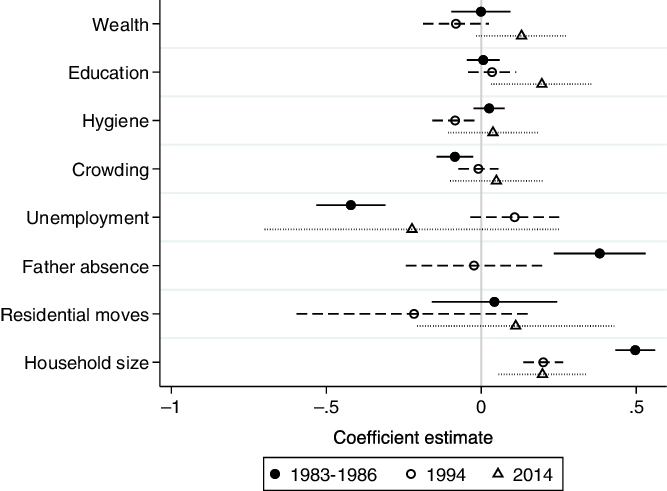
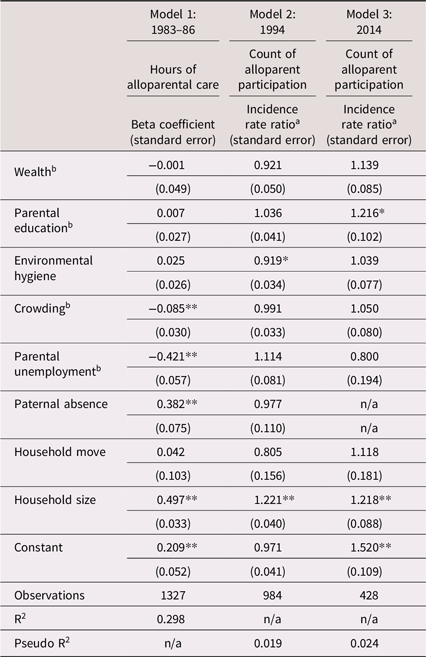
The links between household wealth and alloparental care usage were inconsistent (Table 3, Figure 1). In the 1980s and 1994, there was no significant relationship between wealth and how many minutes/week alloparental caregivers helped. In 2014, wealthier families reported receiving more alloparental assistance than poorer ones (where p = 0.082; Table 3, Figure 1). Holding all else constant, families whose asset count was in the 10th percentile of the distribution would be expected to have an alloparental helper count of 1.39, while for those in the 90th percentile, the expected count would be 1.94.
The relationship between harshness and unpredictability variables and alloparental care use during three survey waves (1980s, 1994, 2014; visualization of model results from Table 3). The effects of all variables on measures of alloparental care were inconsistent, with the exception of household size. Larger household size predicted greater alloparental care use in all three time periods. Maternal unemployment was associated with less alloparenting, and paternal absence with more, in the 1980s, but these relationships were not observed in later survey periods. All predictor variables were standardized within time periods, to facilitate coefficient comparison. 1994 and 2014 used a count of alloparental helpers as the outcome variable, so Table 3 reports the coefficients from these two models converted to incidence rate ratios instead of the standardized coefficients shown here.

Relationship between harshness and unpredictability measures and alloparental care use in 1983–86 (Model 1), 1994 (Model 2), and 2014 (Model 3)

Robust standard errors are in parentheses.
a Negative binomial regression model; coefficients are reported as incidence rate ratios (IRR).
b See Table 1 for further information on how predictor variables were quantified in a given outcome year.
* p < .05.
** p < .01.
In the 1980s and 1994, there was no significant or meaningful relationship between parental education and alloparental care usage. In 2014, families where the father had more education reported more assistance from alloparents than families where the father had less education (Table 3, Figure 1). A family whose father had completed 2 years of college would be expected to report an alloparental caregiver count of 1.86, while for a family whose father had only 3 years of elementary school education, the expected count would be 1.02.
There was no evidence that greater crowding predicted greater alloparental care. In the 1980s, the relationship was the opposite: families with less-crowded households reported more alloparental care, while in 1994 and 2014 there was no significant relationship between these variables (Table 3, Figure 1). Environmental hygiene did not predict alloparental care in the 1980s or in 2014, but it did in 1994. Families whose environments were least hygienic reported that more alloparents helped take care of the children “most of the time” (Table 3, Figure 1). Those in the bottom environmental hygiene quartile are expected to have an alloparental helper count of 1.11, while for those in the top quartile, the expected count was 0.88, after controlling for other factors.
Measures of unpredictability
None of our measures of environmental unpredictability were significantly related to alloparental care use in 1994 or 2014, but maternal unemployment and father absence both were in the 1980s. In these surveys, households where mothers were unemployed had less alloparental help than those where mothers were working, while households where fathers were absent had more alloparental help than those where fathers were present (Table 3, Figure 1). Households with unemployed mothers would be expected to receive 9.79 h/week of alloparental care, after controlling for other factors, while for households where mothers were employed, the expected value would be 14.32 h. Households where fathers were present would be expected to use 11.00 h/week of alloparental care, while households where fathers were absent would be expected to use 16.95 h.
Control variables and supplemental models
The most consistent effects were related to household size. In all three study periods, larger households reported receiving more alloparental help (Table 3, Figure 1). This is unsurprising, since larger households likely have both greater demand for alloparental help and a greater supply of potential alloparents.
The results of a model that limits the 1983–86 sample to families who had at least one potential alloparental helper living with them (n = 1095 families) are reported in the supplementary materials (Table S5), since in this time period, the questions specifically asked about caregiving provided by people in the household. The results of this model are very similar to the ones presented here (Table 3, Model 1). The supplementary materials also contain results for models that are limited to families that did not have paid help living with them. There were two differences between these models and the ones presented in Table 3. In 1994, families where mothers were unemployed relied less on alloparental care than families where mothers were unemployed (where p = 0.080). In 2014, the p value associated with wealth went from 0.082 to 0.129, meaning there was no longer evidence at the p < 0.10 level that greater wealth predicted more alloparental care in this survey (Table S6).
Question 2: Do environmental harshness and/or unpredictability experienced early in life predict alloparental care usage later on?
Measures of harshness
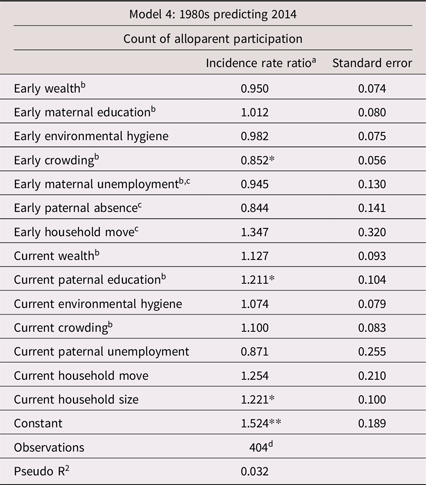
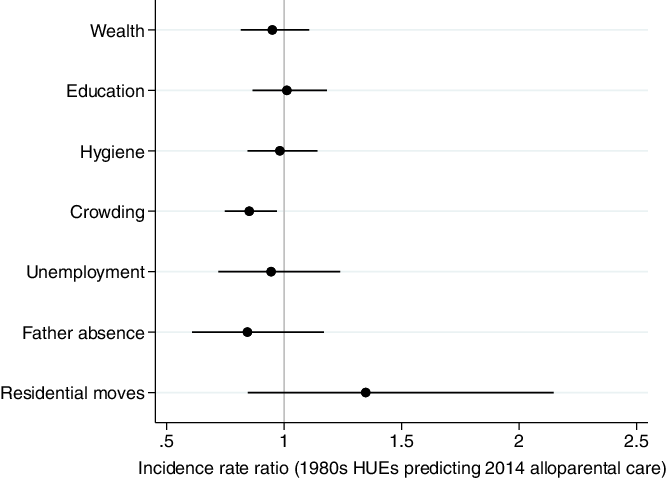
Our data do not provide support for the prediction that if men experienced greater environmental harshness early in life, their families would be more reliant on alloparental care once they grew up (Tables 4 and 5, Figure 2). Only one early-life harshness variable predicted later alloparental care use, and the relationship was the opposite of the theoretical prediction. After controlling for the same set of HUEs in 2014 (i.e., for current conditions), men who lived in more-crowded conditions when they were 0–2 years old (in the 1980s) received less alloparental help once they had their own children (Table 4, Figure 2). Results of models that excluded families who had live-in help in 2014 were very similar (supplementary materials Table S7).
Relationship between harshness and unpredictability experienced in 1983–1986, and alloparental care use in 2014

Robust standard errors are in parentheses.
a Negative binomial regression model; coefficients are reported as incidence rate ratios (IRR).
b See Table 1 for further information on how predictor variables were quantified in a given outcome year
c Reference category is mother employed/father present/no household move, according to the definitions of these variables provided in Table 1.
d Sample size shrinks due to families who did not have complete information available in both the 1980s and 2014.
* p < .05.
** p < .01.
The relationship between harshness and unpredictability variables in early life (1980s) and alloparental care use in adulthood (2014; visualization of model results from Table 4). Measures of environmental harshness and unpredictability the focal men experienced when they were young children (0–2 years old, in the 1980s) were not significant predictors of their own alloparental care usage once they themselves were adults with children. The one exception was crowding, but the relationship was the opposite of what theory would predict. All predictor variables were standardized within time periods, to facilitate coefficient comparison. Models controlled for the same set of harshness and unpredictability variables experienced in 2014. Since the outcome (alloparenting usage in 2014) was a count of alloparental helpers, the coefficients from this model were translated to incidence rate ratios both in here in Figure 2 and in Table 4. Confidence intervals are not symmetric in all cases due to Stata’s use of the delta rule when calculating standard errors/confidence intervals for transformed beta coefficients (StataCorp, 2021).

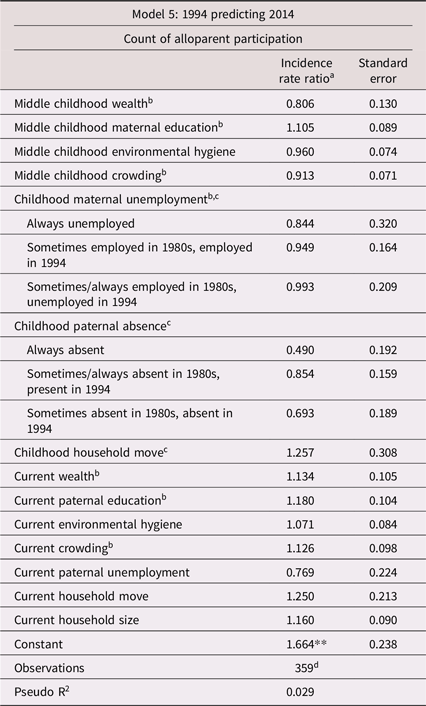
Relationship between harshness experienced in 1994, unpredictability experienced across childhood through 1994, and alloparental care use in 2014

*p < .05.
a Negative binomial regression model; coefficients are reported as incidence rate ratios (IRR).
b See Table 1 for further information on how predictor variables were quantified in a given outcome year
c Reference category is mother employed in all surveys (i.e. all three surveys in the 1980s, plus in 1994)/father present in all surveys/no household moves in any surveys.
d Sample size shrinks due to families who did not have complete information available in all three time periods (i.e. the 1980s, 1994, and 2014).
** p < .01.
Measures of unpredictability
Unpredictability experienced between 0 and 2 years old (i.e., in the 1980s) did not significantly predict greater alloparental care use in adulthood (Table 4, Figure 2). Having a father who was absent throughout childhood (in the 1980s and 1990s) predicted less reliance on alloparental care in adulthood, although the finding was not statistically significant at the p < 0.05 level (p = 0.069; Table 5). Families where the father’s own father was absent during every childhood survey had an expected alloparental caregiver count of 0.90 (SD = 0.34), while for families where boys grew up with a consistent paternal presence in the household during every survey, the expected count was 1.84 (SD = 0.13). Results of models that excluded families who had live-in help in 2014 were very similar (supplementary materials Tables S7 and S8).
Discussion
Overall, we found little support for the prediction that HUEs predict greater reliance on alloparental care, or for the prediction that men who grew up in HUEs would rely more on alloparental help once they were grown up and had children of their own. In two of our three measured time periods – the 1980s and 2014 – the few statistically significant associations between our harshness variables and alloparental care ran counter to theoretical predictions. In 1994 families living in less hygienic environments reported relying more on alloparental care, but this was the only measure of environmental harshness that conformed to theoretically derived predictions, and it only did so in one of our three study periods. Two commonly-used measures of environment unpredictability, parental unemployment and paternal absence, predicted less and more alloparental care use in the 1980s, respectively. While the paternal absence finding is consistent with theoretical predictions, the most parsimonious explanation for these results is simply that unemployed mothers have less need for alloparental care because they can spend more time at home, and households where fathers are absent have greater need for alloparental care because these fathers cannot participate in care. This is consistent with the common human pattern of caregiver substitutability for many forms of care (Hrdy, Reference Hrdy2009; Sear, Reference Sear2016; Sear & Mace, Reference Sear and Mace2008).
Metanalyses indicate that HUEs correspond to greater alloparental care across human societies and across species (Lukas & Clutton-Brock, Reference Lukas and Clutton-Brock2017; Martin et al., Reference Martin, Ringen, Duda and Jaeggi2020). However, predictors that matter at the inter-specific or inter-population level may not necessarily translate to intra-population predictive power. This observation has helped spur recent questions about the role of developmental environments in shaping the emergence of cohesive suites of traits characterizing life history strategies (Baldini, Reference Baldini2015; Zietsch & Sidari, Reference Zietsch and Sidari2020). Individual-level traits that life history theory predicts will be associated with variation in reproductive strategies (e.g., number of children, timing of reproductive events, extra-pair mating), and are thereby potentially also linked to alloparental care use, are likely explained by a complex mix of inter-individual genetic variation (reviewed in Zietsch, Reference Zietsch2016; Zietsch & Sidari, Reference Zietsch and Sidari2020) and experiences of cultural, demographic, and political-economic conditions. For example, in the USA, for multiple decades higher SES families have been more likely to have their pre-school aged children enrolled in paid childcare, as opposed to in the care of relatives, compared to lower SES families (Meyers & Jordan, Reference Meyers and Jordan2006). This pattern contrasts somewhat with our findings for 2014 in Cebu, where higher SES is linked to more alloparental care usage, typically provided by family members.
Given the weak support we found for associations between current levels of harshness and alloparental care use in Cebu, particularly for waves between 1983 and 1994, it is unsurprising that early life harshness did not significantly predict later alloparental care use. The idea of the adaptive developmental perspective is that individuals are calibrating their later-life behaviors to their early-life environment (e.g. Brumbach et al., Reference Brumbach, Figueredo and Ellis2009; Del Giudice et al., Reference Del Giudice, Ellis and Shirtcliff2011; Figueredo et al., Reference Figueredo, Vásquez, Brumbach, Sefcek, Kirsner and Jacobs2005; Nettle et al., Reference Nettle, Frankenhuis and Rickard2013). This premise is rooted in the extensive research demonstrating early-life plasticity, later-life canalization, and a robust connection between early life experiences and later outcomes across species (e.g. Belsky & Pluess, Reference Belsky and Pluess2009; Gluckman et al., Reference Gluckman, Hanson, Spencer and Bateson2005; Kuzawa & Quinn, Reference Kuzawa and Quinn2009; Lea et al., Reference Lea, Tung, Archie and Alberts2018; Tung et al., Reference Tung, Archie, Altmann and Alberts2016). But, if a basic cross-sectional association between environmental characteristics and the calibrated behavioral response does not hold in a population, then it is much less likely that a lag between early life exposure and a later response would be observed. Other mechanisms are, of course, possible (e.g., perhaps people who grow up in harsh early environments develop a specific set of relationship preferences that mean they have strong bonds with extended family or friends, who then become alloparents), but are beyond the scope of the present analysis. Although we note that one must be cautious in interpreting null results, our results predicting adult alloparental care usage from early harshness had some combination of wide confidence intervals, effect sizes close to zero or, alternatively, for early life crowding, were in the opposite direction of the theorized relationship.
One unpredictability variable – consistent paternal absence across infancy and childhood – did non-significantly predict fathers’ decreased reliance on alloparental caregiving in adulthood, compared to men who had a consistent fatherly presence in their childhood homes. This is the opposite of the theoretical prediction that greater unpredictability in childhood should lead to greater reliance on alloparental care in adulthood. Conceptually, one possibility is that this result reflects a compensatory effort by the second-generation fathers (in 2014) in response to their own childhood experiences (Floyd & Morman, Reference Floyd and Morman2000). Specifically, rather than recapitulating the parenting behavior/style of their own fathers, they may try to compensate for perceived deficiencies in their own upbringing by being more directly involved with care themselves (Gettler et al., Reference Gettler, Kuo, Bas and Borja2019). This could reduce the need for alloparental care. However, using these 2014 data, we recently found that fathers report doing more childcare when they receive more help from alloparental caregivers, suggesting this is unlikely to explain the link between 1994 paternal absence and 2014 alloparental care usage (Rosenbaum et al., Reference Rosenbaum, Kuzawa, McDade, Avila, Bechayda and Gettler2021).
A primary feature of human caregiving strategies, of which alloparental care is a key component, is their extreme flexibility and contextual responsiveness (Mace & Sear, Reference Mace, Sear, Voland, Chasiotis and Schiefenhoevel2005; Nelson, Reference Nelson2020; Sear, Reference Sear2016). This feature, however, also means that life history theory-derived predictions may be less applicable in certain contemporary contexts, where economic and societal constraints, combined with cultural norms, may play an outsized role in determining components of life history strategies. As one clear example, for many contemporary families living in industrialized societies, caregiving practices are highly dependent on the demands imposed by formal labor force participation (e.g. Morrissey, Reference Morrissey2017; Nelson, Reference Nelson2020; Posadas & Vidal-Fernandez, Reference Posadas and Vidal-Fernandez2013; Schacht et al., Reference Schacht, Davis and Kramer2018). In Cebu, mothers are typically children’s primary caregivers – as is true in most places around the world – and, as in much of the rest of the Philippines, many women work in the service and hospitality industries (ADB, 2013; Medina, Reference Medina2001). Our 1980s data appear to strongly reflect the reality of labor force participation/caregiving tradeoffs, since families where mothers were employed were more reliant on alloparental care than families where they were not (Gultiano, Reference Gultiano1990). However, this pattern did not emerge in the two later survey waves. The 1980s data are specifically made up of families with very young children, since these were the initial CLHNS surveys of mothers with new infants. It is plausible that the relationship between reliance on alloparental care and female labor force participation was not evident in the two later survey waves because more families had children who were old enough to be going to school, and/or be overall less reliant on adult care.
Female labor force participation may also help shed light on the finding from 2014 that higher SES families were somewhat more reliant on alloparental assistance than counterparts with lower educational attainment, and to some degree, less wealth. In a previous analysis of 2014 data, we found that men who worked more hours outside the home spent less time on parenting, although we did not find evidence of a paternal care/alloparental care tradeoff (Rosenbaum et al., Reference Rosenbaum, Kuzawa, McDade, Avila, Bechayda and Gettler2021). This does not preclude the possibility that such a tradeoff exists for mothers in Cebu, or for combined parental effort. Unfortunately, limitations of the 2014 survey data, which did not contain information about maternal work, prevent a direct test of this idea.
If this is the case, however, it highlights the problems with predicting a straightforward relationship between HUEs and alloparenting in industrialized societies. Greater and/or more consistent labor force participation – i.e., greater predictability and stability – can lead to less environmental harshness, at least if harshness is operationalized as SES, but also necessitates greater reliance on caregivers other than parents. In a setting like Cebu where paying for childcare is still relatively uncommon, this leads to an SES-alloparental care relationship different from what has been found in contexts like the United States. The fact that our results remained largely unchanged when the families who relied on paid, live-in help were removed, confirms that the lack of the expected relationship between HUEs and alloparenting in Cebu is not simply a byproduct of the increased use of paid care among higher-income families.
Our data have limitations that are important to acknowledge. First, both alloparental caregiving and some of our HUE predictor variables were measured in different ways at different points in time. This makes it challenging to interpret differences in predictor-outcome relationships across the survey years. In particular, alloparental caregiver counts, used for the 1994 and 2014 data, are likely not as precise a measure of alloparental help as the time estimates that were available in the 1980s. Second, self-report/recall data are unlikely to be as accurate as direct behavioral observation, though the kinds of short recall durations used here have proven to be well correlated with actual behavior in studies with similar methodologies (e.g. Burke et al., Reference Burke, McKee, Wilson, Donahue, Batenhorst and Pathak2000; Wijndaele et al., Reference Wijndaele, De Bourdeaudhuij, Godino, Lynch, Griffin, Westgate and Brage2014). Third, the sample size for our 2014 analyses was constrained relative to earlier time periods, potentially limiting our ability to detect statistically significant results with small effect sizes. Finally, there is a potential for selection issues specifically relating to the residential move variables. Families who leave the Cebu area – potentially a bigger signal of uncertainty and a larger source of psychosocial adversity to children than within-city moves – are lost to follow-up, limiting our ability to measure the entire real-world range of this predictor.
In sum, the data presented here suggest that variables known to predict inter-population and inter-specific variation in alloparental care, environmental harshness and unpredictability, generally do not predict alloparental care use in the theorized direction within the context of this large-scale, industrialized society. This was true whether household conditions were observed concurrent to the need for care (in adulthood), or in relation to early-life cues that are theoretically predicted to motivate differences in future life history strategies. In Cebu, the intersection of distinct cultural traditions and political economic conditions likely help explain the observed links (or lack thereof) between HUEs and alloparental care. Thus, we suggest that our multi-generational insights on the use of alloparental care help to illustrate some potential challenges of attempting to translate evolutionary and life history perspectives that provide insights across ecologies and species to the intra-population level.
Supplementary material
For supplementary material accompanying this paper visit https://doi.org/10.1017/S0954579421001711
Acknowledgements
The authors wish to thank B. Ellis, K.A. McLaughlin, and D. Cicchetti for inviting us to participate in this special issue. We thank the participants in this study for their time and commitment over the years, and collaborators at the Office of Population Studies for overseeing and conducting data collection.
Funding statement
This study was funded by the National Science Foundation (BCS-1317133).
Conflicts of interest
None.