Introduction
Scholars today have nearly a decade of experience with carbon emissions trading programmes. In the past few years alone, scholars have witnessed the ascendancy of carbon trading markets at the international, national, subnational, state, regional and municipal levels. Markets are currently being utilised to cost-effectively reduce greenhouse gas emissions in Europe, the United States, China, New Zealand, Canada, South Korea and Japan. In addition, in June of 2014, the US Environmental Protection Agency outlined plans to regulate greenhouse gases under the Clean Air Act, and has encouraged states to consider the use of market-based approaches modelled after existing markets in nine Northeastern states and California.
These markets stem from the pioneering work of Nobel Laureate Ronald Coase (Reference Coase1960). Since that time, scholars have understood that gains from trade can be realised in the management of public goods when heterogeneous firms have clearly defined property rights. Emissions trading, also referred to as a Coasian market, a transferable property rights programme or a cap-and-trade programme, is based upon Coase’s fundamental principle of tradeable property rights. A regulator, broadly defined, sets an aggregate cap on the use of a public good, and then allocates property rights to the use of that public good in a quantity that does not exceed that cap. Those firms that can reduce their use of the public good in a more cost-effective manner than others can trade their property rights with firms that are less cost effective in the use of the public good. This market-based approach has long since been shown to be more efficient than direct governmental intervention, such as through regulatory mandates (Dales Reference Dales1968; Montgomery Reference Montgomery1972; Tietenberg Reference Tietenberg2006; Ellerman et al. 2010; Tietenberg and Lewis Reference Tietenberg and Lewis2012). Since Coase’s seminal work, market-based approaches have been used by regulators to cost-effectively reduce negative production externalities, such as oxides of nitrogen and sulphur that cause smog and acid rain, respectively. In addition, more recently, this market-based approach has been used to reduce the emissions of greenhouse gases, including carbon dioxide, which contribute to man-made climate change.
Carbon cap-and-trade programmes work in the same manner as previous emissions trading programmes with one important difference. Regulators still set an aggregate cap on the level of greenhouse gases that can be emitted by firms under the regulator’s jurisdiction, issue tradeable property rights (i.e. permits, allowances) equal to that cap on a per annum basis and allow firms to trade those allowances on an open market to minimise compliance costs. The difference is that, due to the global nature of greenhouse gases, these markets often make use of an additional compliance instrument in the form of carbon offsets. Offsets are a type of emissions allowance that are generated when an additional unit of carbon dioxide or another greenhouse gas is reduced, sequestered or avoided through a verifiable project. They serve an important programme design function in that they provide firms with a flexible alternative through which to comply with the programme’s requirements. Whereas a carbon allowance entitles the owner to emit a unit of greenhouse gas into the atmosphere, a carbon offset reduces the quantity of greenhouse gases in the atmosphere by that same unit.
Because firms in these markets are statutorily permitted to use (i.e. surrender) both allowances and offsets as equivalent instruments for programme compliance, one would expect these instruments to behave as substitutes, with market prices that more or less correspond. However, due to the features of policy design and external market influences discussed in this paper, offsets have been consistently discounted relative to allowances – at present by a margin between 30% in California and 5,000% in Europe. In addition, in the markets established in the aforementioned nine Northeastern U.S. states under the Regional Greenhouse Gas Initiative (RGGI), as of the date of this paper, no offset projects have been registered since the programme’s inception in 2008. As such, offsets and allowances behave far more like imperfect substitutes for which there is less than perfect correspondence in demand between the two goods. Simply put, firms would prefer to hold allowances rather than offsets in their portfolio by a significant margin, even though both are permissible for purposes of programme compliance.
No analysis to date has provided a comprehensive assessment of the drivers of demand for substitute tradeable property rights. Scholars have provided several econometric analyses of price drivers (Mansanet-Bataller et al. Reference Mansanet-Bataller, Pardo and Valor2007; Alberola et al. Reference Alberola, Chevallier and Chèze2008a; Hintermann Reference Hintermann2010; Bredin and Muckley Reference Bredin and Muckley2011; Creti et al. Reference Creti, Jouvet and Mignon2012) and of offset price drivers (Mansanet-Bataller et al. Reference Mansanet-Bataller, Chevallier, Herve-Mignucci and Alberola2011; Nazifi Reference Nazifi2013) in the European Union Emissions Trading System (EU ETS), but none of them address the issue of imperfect substitution between compliance instruments. This paper provides a comprehensive synthesis of extant scholarship to help clarify for both policymakers and scholars what factors affect the demand for offsets relative to allowances. Moreover, this paper seeks to explain why carbon allowances and carbon offsets behave like imperfect substitutes, despite the fact that they are statutorily substitutable short of any programmatic limitations.
Both scholars and policymakers are seeking to understand the fundamental dynamics inherent in market-based approaches to climate policy, and public policy more generally, particularly when there is such a substantial divergence between theory and practice. This paper draws upon insights from the literature, market data and the regulatory frameworks of the world’s major carbon markets to provide a comprehensive assessment of how procedural costs in the generation of offsets (section 3), key policy design features in the construction of market rules (section 4) and extra-statutory factors (section 5) affect the demand and supply of offsets relative to allowances. This paper provides practical lessons that will enable programme designers and policymakers to more effectively accomplish their central goal of designing a market-based programme that reduces greenhouse gases in the most cost-effective manner possible.
Imperfect substitutes in the EU ETS
The use of offsets in the EU ETS, the world’s largest source of offset demand, provides an illustrative case of imperfect substitution between climate policy instruments. In general, imperfect substitutes allow for opportunities to arbitrage that may not contribute towards the intended goal of a policy. A brief case review of imperfect substitution between offsets and allowances in the EU ETS offers lessons to help avoid creating perverse incentives that undermine the intended climate policy goals. It also highlights the need for a comprehensive synthesis of the drivers of demand for carbon offsets.
The European Commission (EC), the regulator of the EU ETS, can choose which types of offsets to allow into the EU ETS, but relies upon United Nations-appointed bodies to regulate the suppliers of the two types of international offset credits: Certified Emissions Reductions (CERs) and Emission Reductions Units (ERUs). In January 2011, the EC enacted a ban (beginning in 2013) on surrendering “grey CERs,” a type of CER generated from the destruction of the gases HFC-23 or N2O (EC 2011a). This ban was put in place for two primary reasons. First, due to low production costs (IPCC/TEAP 2005) and perverse incentives in producing grey CERs (Schneider Reference Schneider2011), the market was flooded with cheap grey CERs that depressed the market price of offsets. Second, the EC wanted the “advanced developing” countries that produced grey CERs (primarily China and India) to finance these projects themselves (EC 2011b, 2013a).
The substitutability between allowances and CERs as permitted by the EC created a system of perverse incentives for suppliers of grey CERs. These emerged because suppliers could earn substantial profits from selling grey CERs in addition to the profits suppliers earned from selling their primary product. For example, HFC-23 is a byproduct in the production of HCFC-22, a refrigerant.Footnote 1 Suppliers of HFC-23 offsets actually earned more from selling grey CERs than from selling HCFC-22 (Wara Reference Wara2008; EC 2011b). Suppliers were, therefore, incentivised to heavily overproduce HCFC-22 for the purpose of creating and subsequently destroying HFC-23. From 2008 to 2010, grey CERs comprised 75% of all offsets surrendered by EU ETS firms, representing 62% of the total quantity of grey CERs issued (Point Carbon 2012; UNFCCC 2013). Although this perverse incentive increased supply, the ban on grey CERs also dramatically increased the demand for offsets to be utilised before 2013 when the ban was to take effect.
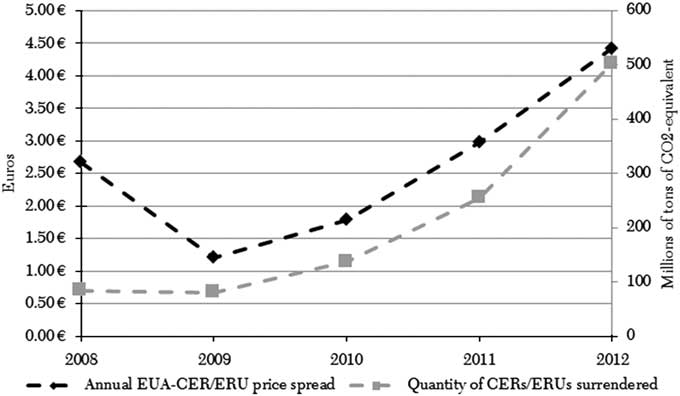
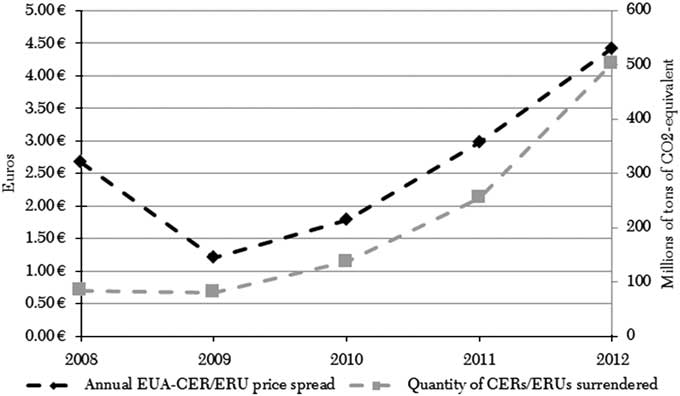
The substantial increase in the supply of CERs and ERUsFootnote 2 led to a glut of offsets on the market, while at the same time the allowance (EUA) price decreased in conjunction with the recent economic downturn. The CER/ERU price (weighted average CER and ERU price) declined even further than the EUA price, widening the spread between the EUA price and the CER/ERU price. In response to the large price spread, the quantity of offsets surrendered increased by 84.9% in 2011 and increased again in 2012 by 98.6% (see Figure 1). The existence of such a price spread provides some evidence that the two instruments behave as imperfect substitutes. That is, prices for statutorily substitutable instruments should more or less correspond. The change in magnitude of the price spread, from €1.79 in 2010 to €2.98 in 2011 and €4.42 in 2012, also suggests that the substitutability of offsets for allowances has changed over time. Finally, future prices for secondary CERs (sCERs) carry a larger discount than that for EUAs, suggesting that entities subject to the EU ETS are less willing to hold offsets over time than allowances .
Price spread and offset demand in Phase II of the ETS.
Sources: European Commission and BlueNext.
Near-zero prices for sCERs reflect the lack of demand from EU ETS firms facing stricter offset limits in Phase III (2013–2020), as well as lower-than expected demand from signatories to the Kyoto Protocol.Footnote 3 Combined with the growing trend of new cap-and-trade programmes choosing to create their own domestic offset protocols, such as those in California and Quebec, the Clean Development Mechanism (CDM), which produces CERs, is losing its primacy as the major supplier of offsets. However, due to the CDM’s historically central role, the regulatory structure of these much smaller domestic programmes was informed by the process the CDM implemented to regulate the production of offsets. The next section details this regulatory process to illustrate how transaction costs and other costs arise and increase the cost of offsets. Although the present oversupply of CERs dwarfs the effect of these costs on offset demand, in programmes with stricter offset protocols, these costs will be highly relevant.
Procedural costs in the CDM process
The CDM Executive Board has instituted a rigorous and lengthy process in order to promote offset quality criteria such as additionality, which is the requirement that emissions reductions achieved by the offset project are additional to a baseline scenario. This process takes an average of two years and four months and results in issuing CERs to only 52% of projects (Cormier and Bellassen Reference Cormier and Bellassen2012). The large number of registered projects (~7,500) and the heterogeneous nature of CDM projects currently in operation make such a process necessary, although as the previous section detailed, it is not always sufficient to ensure offset quality. The procedural costs incurred through the lengthy process by which CERs are generated, bring significant transaction costs and other costs on suppliers of offsets. These costs can reduce offset supply and cause suppliers to increase the price of offsets, diminishing the market demand for offsets.
Procedural costs, if exceedingly large, can negatively affect both project developers and participating firms. Procedural costs include typical transaction costs such as search and information and negotiation costs (Williamson Reference Williamson1975), as well as monitoring, reporting and verification (MRV) costs (Stavins Reference Stavins1995; Jaraite et al. Reference Jaraite, Convery and Di Maria2010). Also included in this category are “approval costs,” which are the fees and taxes paid to the CDM Executive Board, lawyers, debt and equity investors and the host country’s local and federal government (Carbon Retirement 2009). Finally, procedural costs include the costs of investing in a project that may or may not fail at each successive stage in the approval and operation process.
Inefficient governance, corruption or ill-defined property rights can also result in transaction costs and other risk premia on generated offsets. The regulatory environment can adversely affect offset project developers through bureaucratic delays in project approval or the non-issuance of credits. For example, 95% of Chinese projects that were approved by the Chinese government and appropriate third-party verifiers were issued CERs by the CDM Executive Board, but only 50% of projects in some African countries that received equivalent approvals were issued CERs (Cormier and Bellassen Reference Cormier and Bellassen2012). As the CDM Executive Board, EU ETS and various NGOs seek to increase investment in offset projects in Least Developed Countries, the lack of institutional capacity in these nations will complicate this goal.
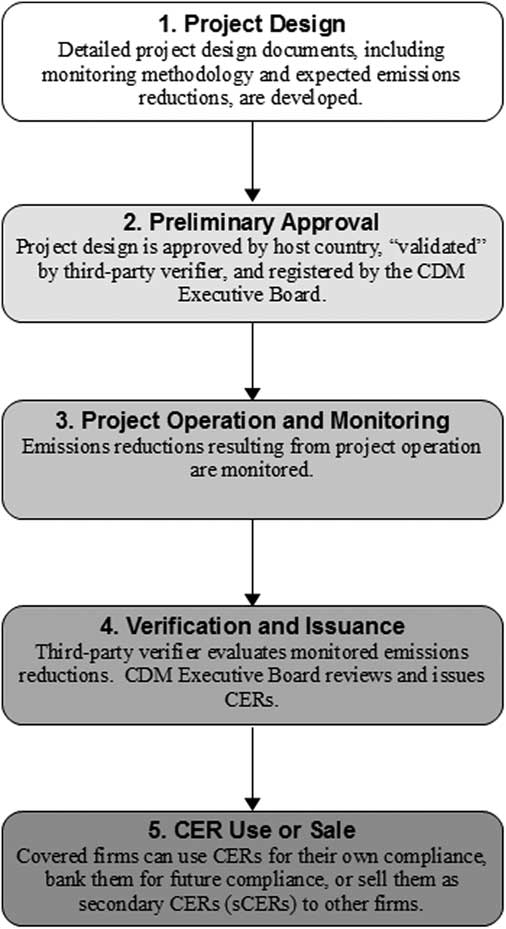
Procedural costs imposed on offsets but not on other compliance instruments widen the demand disparity and result in programme inefficiencies. Understanding the procedural costs that arise at each stage of the CDM process informs the degree to which these costs impact the demand for CERs from covered firms, and provides a more general understanding of how the offset project approval process contributes to offsets being treated as imperfect substitutes for allowances. The costs described below apply to primary CERs, which are CERs that have been sold only once and directly from the offset producer. However, these costs are also relevant to covered firms that purchase secondary CERs from another firm or trader (the most common way of obtaining CERs), because they are included in the final price (Figure 2).
The CDM process.
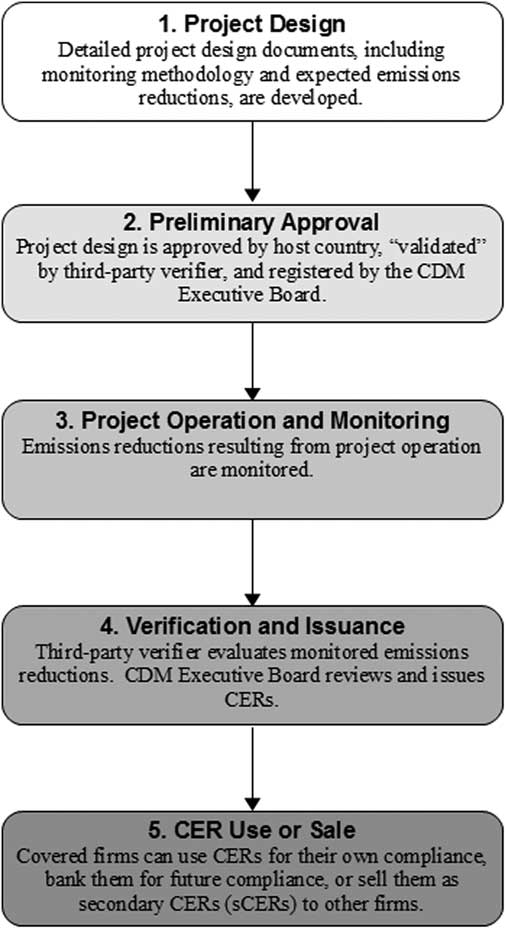
In the initial project design process, a detailed plan must be developed by the project developer that includes the quantity of emissions reductions (and corresponding quantity of CERs) expected to result from the project. Procedural costs are incurred by the project developer within this plan when the methodology to measure a baseline emissions scenario and to monitor emissions reductions is developed (UNFCCC 2006). If an existing methodology for that project type does not presently exist, then the project developer must absorb the cost of developing and obtaining approval for a new methodology.
Next, in the preliminary approval stage, the project design must be approved by the host country and by a third-party verifier. The project developer pays taxes and fees to these parties and incurs approval risk – the risk that the project will be rejected or significantly delayed. The third-party verifier’s initial review of the project design, known as validation, takes approximately one year. This is the most vulnerable sub-stage in the CDM process for the project developer, with 33% of total projects being rejected (Cormier and Bellassen Reference Cormier and Bellassen2012). Following validation, the project is reviewed and registered with the CDM Executive Board. If the project is registered, the project developer pays a fee of €0.10 per ton of expected CO2-equivalent emissions reductions for the first 15,000 tons and €0.20 per ton for “any amount in excess of 15,000 tons” (UNFCCC 2006, 99).
After it is registered, the offset project begins operating and generating emissions reductions. MRV costs are incurred by the project developer through the monitoring of the quantity of emissions reductions generated by the project. Delivery risk, the risk that the quantity of emissions reductions achieved will differ from expectations outlined in the project design documentation, is also incurred at this stage.
Each year, the project developer incurs further MRV costs when he/she pays a third-party verifier to conduct an ex post evaluation of the emissions reductions claimed by the project developer. This ex post evaluation constitutes an average of 4% of the final CER price (Carbon Retirement 2009). Finally, the CDM Executive Board reviews the ex post evaluation and issues CERs to the project developer. The project developer pays the CDM Executive Board an issuance fee for each CER issued (same cost-structure as the registration fee). The CDM Executive Board deducts 2% of the total CERs issued, using the proceeds to fund climate change adaptation in developing countries. At this stage, the project developer again faces approval risk and the potential for extended delays from the third-party verifier and from the CDM Executive Board. The project developer also faces regulatory risk, arising from the uncertainty that the project type, geographic location or methodology used in the project will continue to be accepted by the CDM Executive Board and the regulators for covered firms (e.g. the EC ban on grey CERs).
When covered firms purchase CERs from the project developerFootnote 4 and choose an offset project from many potential alternatives, they incur search and negotiation costs. Long-term contracts that fix a CER price before CERs have been issued (i.e. “pre-issuance”) expose covered firms and project developers to price risk, the risk that the market price at the time CERs are issued will differ from the contract price. For example, the recent collapse of the sCER price has caused some firms that signed such contracts to attempt to re-negotiate with project developers or to simply renege on their obligation to purchase the credits (Point Carbon 2013). Furthermore, contracts negotiated pre-issuance, as in any capital investment, expose covered firms to delivery risk, which is not incurred through acquisition of statutorily substitutable compliance instruments.
The covered firm can surrender CERs for compliance or bank them for future use. If the covered firm negotiated pre-issuance, it can also choose to sell its primary CERs to other firms (making them secondary CERs), usually through a brokerage, at a premium that includes the procedural costs the firm incurred by contracting pre-issuance. There is no mechanism in the EU ETS for ex post invalidation of CERs (unlike in the Western Climate Initiative); therefore, sCERs are essentially riskless (Michaelowa Reference Michaelowa2012).
Many of these procedural costs can be minimised by larger firms, which disincentivise smaller firms from purchasing offsets (Trotignon Reference Trotignon2012). Smaller-scale firms that do purchase offsets, however, tend to purchase proportionately larger quantities. Over time, procedural costs should decrease, and as maturation increases the number of firms trading offsets (Tietenberg Reference Tietenberg2006), the approval process becomes more uniform and regulatory uncertainty risk decreases (Woerdman Reference Woerdman2004; Jaraite and Kažukauskas Reference Jaraite and Kažukauskas2012). This paper now turns to a discussion of factors impacting offset demand after offsets have been issued, beginning with policy design features.
Institutional drivers of demand
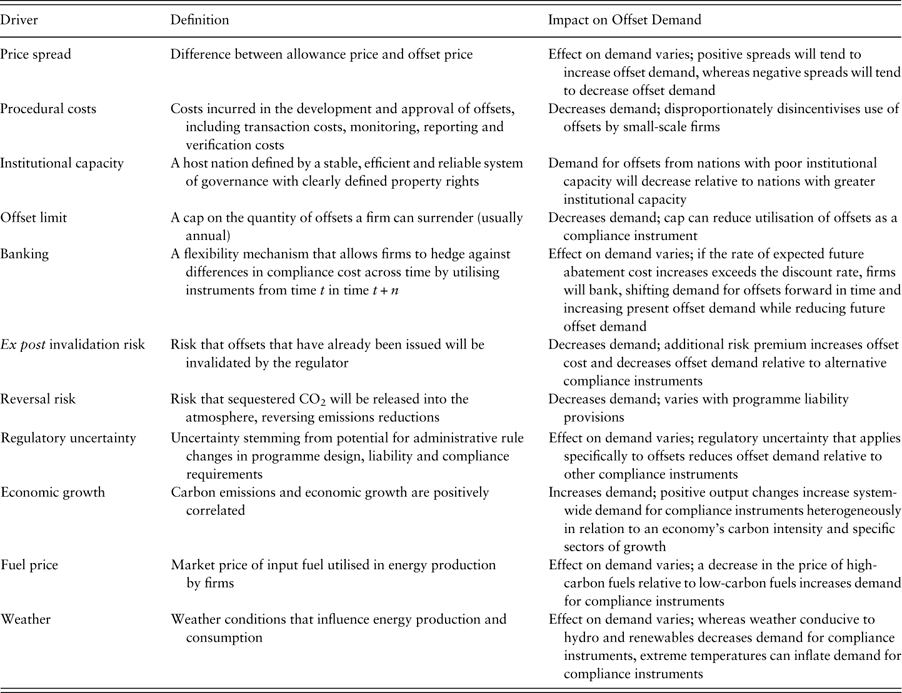
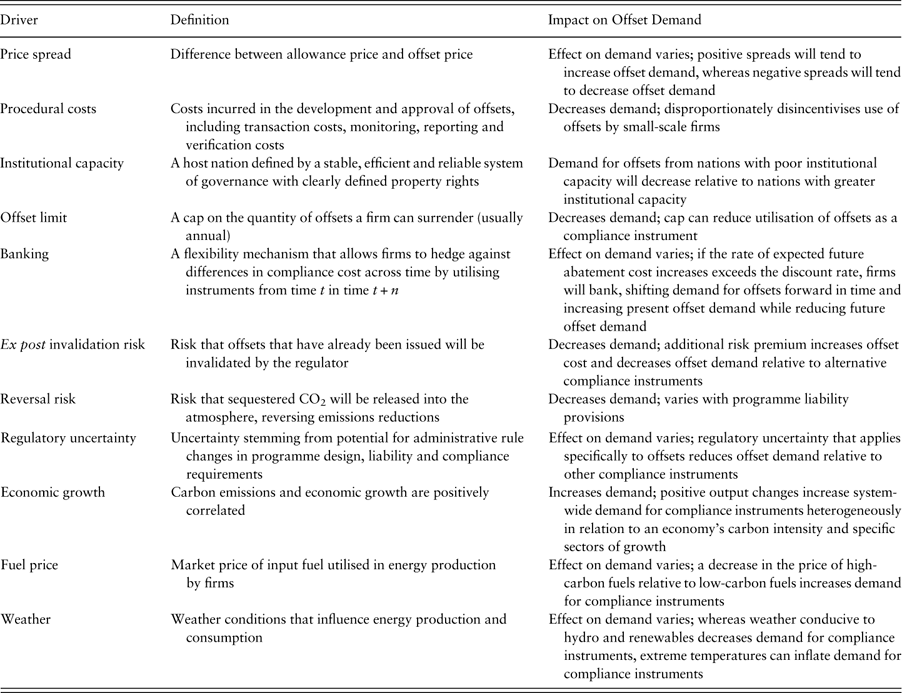
Much of the divergence in demand between compliance instruments can be attributed to the structural design of the trading market. The structural design includes the institutional parameters of the market as imposed by the regulator. These design features inherently impact the incentives of firms, and as a result impact the demand for both instruments. The degree to which a design feature applies only to one instrument and not another, or alternatively, influences the demand for one instrument over the other, further impacts the substitutability between the instruments. Table 1 provides a summary of each of these drivers, as well as those provided in section 5, and their expected impact on the demand for carbon offsets.
Drivers of offset demand
Offset limits
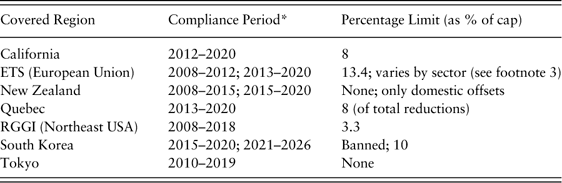
Offset limits consist of a categorical restriction on the quantity of offsets that firms can surrender for compliance. These limits are a prime programme-related design parameter that significantly contributes to the imperfect substitution. The offset limit is usually an ex ante cap relative to emissions allowances (see Table 2 for a comparison among extant programmes). The purpose of setting quantitative limits on offsets is to balance the potential for compliance cost reduction with the regulator’s desired level of abatement by covered firms. Without a quantitative offset limit and with a large supply of inexpensive offsets (relative to allowance price and abatement cost), the amount of abatement undertaken by covered firms can decrease as the oversupply of compliance instruments drives down the market price. Because it is difficult for the regulator to ascertain the legitimacy of offsets, an offset limit of 10%, for example, serves a public interest by ensuring that 90% of compliance instruments remain under direct public control. Under RGGI and California’s programme, the offset limit was calculated to satisfy the pre-condition of “supplementarity”: that at least 50% of emissions reductions resulting from the declining cap are achieved by covered firms (Langrock and Sterk Reference Langrock and Sterk2004; RGGI 2006).Footnote 5
Offset limits in carbon emissions trading programmes
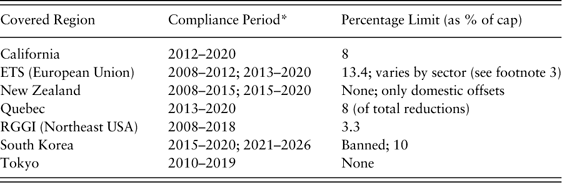
* Compliance period refers to the time range of the carbon emissions trading programme under a certain regime. Subsequent compliance periods may include tighter emissions caps or different offset requirements.
A binding quantitative offset limit constrains the ability of covered firms to optimise across compliance periods (inter-temporally), as they make demand decisions between allowances, offsets and abatement. For example, if a firm determines that it is more profitable to take a long position in offsets because of a recent price spike in the allowance market, that firm’s long position would be constrained by the offset limit. Demand for offsets beyond that limit must be met by alternative compliance options (i.e. abatement or allowances). This likewise translates into increased demand for allowances, which further exacerbates the price spread.
However, an offset limit that allows firms to exceed their annual cap in certain years, as long as the limit is not exceeded over the entire compliance period, increases temporal flexibility. For example, the 13.4% offset limit in the EU ETS is calculated across the period 2008–2020, which allowed offsets to constitute 27.3% of compliance instruments surrendered in 2012 (and contributed to the problems discussed in section 2). A quantitative offset limit also reduces liquidity in trading offsets between covered firms, because firms that hold sufficient offsets to meet their quantitative limit for that compliance period will not demand further offsets.
Without corresponding qualitative restrictions, quantitative limits can reduce offset quality by cutting off demand for the “most additional” (most expensive) offsets (Wara and Victor Reference Wara and Victor2008; Bushnell Reference Bushnell2010). Similarly, an alternative policy that “discounts” the emissions reductions achieved by an offset project by issuing a proportionately smaller quantity of offsets can also lower offset quality. In both cases, reducing revenue to offset projects renders the offset projects most dependent on offset revenue (i.e. the most additional projects) less viable compared with those projects less dependent on offset revenue (Kollmuss and Lazarus Reference Kollmuss and Lazarus2011).
To address the concern of low-quality offsets, regulators often enact qualitative restrictions in conjunction with a quantitative limit to promote offset quality and to pursue other policy objectives. These qualitative restrictions are enacted in addition to the rigorous approval process described in section 3, which contributes to the regulatory uncertainty and approval risk described in that section. Qualitative restrictions are typically placed on project type, size, location of project origination and methodologies for measuring baseline emissions and monitoring emissions reductions. Qualitative restrictions influence the supply of offsets and vary by programme according to the regulator’s policy goals. For example, Quebec allows only three types of offset projects – destruction of livestock methane, small landfill gas and Ozone Depleting Substances – and all offset projects must be located within Quebec. This relatively restrictive policy is expected to limit the offset supply to 21% of the total allowable offset limit in the programme (Point Carbon 2014).
Banking
Although a quantitative offset limit reduces liquidity and the ability of firms to optimise inter-temporally, allowing firms to bank increases both price stability of compliance instruments and temporal flexibility, significantly reducing compliance costs (Tietenberg Reference Tietenberg2006). Banking is a flexibility mechanism that allows firms to inter-temporally adjust to differences in compliance cost. Banking enables both allowances and offsets to be surrendered or traded to other firms in any forward compliance year in addition to the current compliance year. This is an explicit forward hedge, whereas a backward hedge, referred to as “borrowing,” is not allowed in most cap-and-trade programmes. This temporal flexibility reduces compliance costs, as many covered firms, such as utilities subject to rate-of-return regulation, make long-term capital and abatement decisions.
Ceteris paribus, the declining cap combined with economic growth increases future abatement costs because, in the future, covered firms will have to implement more costly abatement technologies to comply with a more stringent cap (Stevens and Rose Reference Stevens and Rose2002). When the expected future abatement cost is increasing at a rate greater than the discount rate, firms demand greater quantities of allowances and offsets. Banking enables firms to respond to this short-run demand by purchasing compliance instruments early on for use towards future compliance, leading to a greater than optimal quantity of emissions reductions in the early years of a programme and increased aggregate emissions in a programme’s later years (Burtraw and Mansur Reference Burtraw and Mansur1999; Chan et al. Reference Chan, Stavins, Stowe and Sweeney2012). If expectations are realised, firms that bank reduce long-run compliance costs by surrendering banked compliance instruments in lieu of purchasing compliance instruments at the higher future market price or incurring comparatively higher future abatement costs (Chevallier Reference Chevallier2012).
Ex post invalidation risk and liability provisions
Carbon emissions trading programmes vary widely in statutory design pertaining to the mechanisms that allow for ex post invalidation of issued offsets and the provisions that assign liability to replace invalidated offsets. In California’s programme, the regulator can invalidate offsets if emissions reductions from the offset project are found to be overstated, non-additional, double counted or if the project has violated any environmental, health or safety regulation (Erickson et al. Reference Erickson, Gephart, Goldstein and Stevenson2013). Even if a specific project is not found to be in violation of these criteria, the regulator in California’s programme can choose to invalidate all offsets issued from a certain project type (CARB 2013). Programmes with an ex post invalidation mechanism must also incorporate a liability provision specifying the party liable to replace invalidated offsets with valid offsets or allowances. Regulators can assign liability to the buyer (the firm that surrendered or is holding invalidated offsets), producer, “system” or some combination of these.
Although the general impact of a liability provision is to decrease offset demand relative to other compliance instruments as covered firms account for ex post invalidation risk, programmes vary widely in their liability provisions, as do the strategies available to the potentially liable party or parties. In a programme with buyer liability, firms large enough and capable of measuring ex post invalidation risk can discount offsets according to the risk of ex post invalidation, shift the burden of liability to a private insurance company by purchasing insurance or bank extra offsets to act as a hedge against ex post invalidation risk (Morris and Fell Reference Morris and Fell2012). This first strategy decreases the value of offsets relative to other compliance options, and the second and third strategies increase the cost of offsets. Next, in a programme with seller liability, producers can charge a risk premium for their offsets to account for the risk of ex post invalidation, purchase private insurance or bank extra offsets to act as a buffer. These strategies increase the price at which offset producers are willing to sell their offsets, reducing the overall quantity of offsets. In a programme with system liability, the regulator can claim a percentage of all offsets for a buffer account, can hold the host country or region liable to replace invalidated offsets or can incorporate private insurance into the programme. Finally, liability can be shared between the buyer, seller or system, with the degree of responsibility for each party varying upon the manner and reason for the ex post invalidation (Murray et al. Reference Murray, Galik, Mitchell and Cottle2012).
The carbon emissions trading programmes in California and Quebec, which were formally linked in 2014 under the Western Climate Initiative (WCI), are the only programmes to include an ex post invalidation mechanism for non-forestry offsets (Kachi et al. Reference Kachi, Taenzler and Sterk2012; Michaelowa Reference Michaelowa2012). California’s programme implements buyer liability, whereas the Quebec programme claims 4% of total offsets issued for a buffer pool that is used to replace invalidated offsets as needed.Footnote 6 Buyer liability in California is intended to encourage covered firms to purchase high-quality offsets. If covered firms wish to shift liability to another party, two strategies are available to date. First, one private insurance company announced in 2013 that it would offer insurance against the risk of ex post invalidation (Climate Action Reserve 2013). Second, covered firms can shift liability to the seller by purchasing “golden” offsets whereby sellers agree to accept liability for invalidated offsets. The difference between the price of golden offsets and offsets that retain buyer liability represents the risk premium that offset suppliers charge to accept liability. This difference has so far varied between 15 and 25% (Evolution Markets 2012; Climate Connect 2013; California Carbon 2014).
The lack of an ex post invalidation mechanism in the EU ETS left the EC unable to remove grey CERs and low-quality ERUs from the market. If such a mechanism had existed and was employed by the EC, many of the problems detailed in section 2, such as the suppressing effect on allowance and offset price, could have been alleviated. The ex post liability mechanisms incorporated into California’s and Quebec’s programmes will leave regulators with an additional tool to prevent a similar scenario from occurring, but will also reduce offset demand due to the risk of ex post invalidation.
In May 2014, California regulators used this power for the first time when they froze four million offsets (almost half the total issued to date) generated by an Arkansas firm that may have operated in violation of a 1976 federal environmental law. Although California regulators found the offsets produced by this firm to be “real, quantified, and verified [emissions] reductions,” they opted to invalidate a small portion of the offsets, 89,000, that comprised the reductions achieved during the two-day period of non-compliance with this law (CARB 2015).
Reversal risk in forestry projects
Offsets from land use, land use change and forestry projects (LULUCF) are discounted further by covered firms because of reversal risk: the risk that emissions reductions achieved by an offset project will be unintentionally reversed by fires and other naturally occurring events, from management and financial failure of the project or from institutional changes that cause the project to stop operating. Although a ton of HFC-23 can be destroyed with no chance of the resulting emissions reductions re-entering the atmosphere, a LULUCF project would need to continue to operate indefinitely in order to ensure equivalent permanence.
In order for regulators to issue permanent, statutorily substitutable offsets for LULUCF activities that satisfy offset quality criteria (e.g. additionality, permanence, etc.), they also implement specific liability provisions that account for this reversal risk. The RGGI, California and several voluntary offset programmes issue permanent offsets for LULUCF activities (mainly forestry) and use buffer accounts to replace offsets that are lost to unintentional reversals [Mignone et al. Reference Mignone, Hurteau, Chen and Sohngen2009; California Environmental Protection Agency (EPA) 2010, 2011; Murray et al. Reference Murray, Galik, Mitchell and Cottle2012]. Regulators can give suppliers an incentive to take measures that reduce reversal risk by tying the percentage of offsets claimed to a project-specific risk evaluation (California EPA 2010).Footnote 7
To recover the value of the offsets claimed for the buffer account, project developers may increase the price of offsets, thereby decreasing the quantity demanded. However, for covered firms in California, the benefit of shifting from buyer liability (for non-forestry offsets) to system liability will increase demand for forestry offsets if the price premium charged by the seller of forestry offsets is less than the ex post invalidation risk discount applied to non-forestry offsets and less than the cost of the liability-shifting strategies discussed in section 4.3.
A second approach to LULUCF offsets is to issue temporary credits that must be replaced by the buyer after a period of time. Although the two types of temporary offsets the CDM issues for afforestation and reforestation activities are not valid compliance instruments in any of the major carbon emissions trading programmes, demand for temporary offsets would still be expected to be low unless the discount rate is greater than the expected increase in the price of permanent offsets and the abatement cost (Dutschke and Schlamadinger Reference Dutschke and Schlamadinger2003; UNFCCC 2006). Hybrid approaches such as “renting” offsets or incrementally issuing permanent offsets have also been developed that remove reversal risk, but they have not been incorporated into any of the major carbon emissions trading programmes (Marland et al. Reference Marland, Fruit and Sedjo2001; Sohngen and Mendelson Reference Sohngen and Mendelsohn2003; Mignone et al. Reference Mignone, Hurteau, Chen and Sohngen2009).
Regulatory uncertainty
Offset demand from utilities is especially relevant, because the power sector often constitutes the largest emitting sector operating within carbon emissions trading programmes. Although all covered firms must ensure that they meet the standards of an emissions programme, utilities are also required to continually assess the degree to which their compliance strategies will be permissible under a state or sub-national regulatory commission. Despite the fact that many electricity markets have undergone restructuring, restructuring has mainly taken place in the wholesale markets (e.g. the sale of generation to retailers). Retail markets remains very much a product of traditional price and cost regulation. Retail markets refer to the sale of electricity from public utilities to households and businesses. State public service/regulatory commissions review the appropriateness of the market actions taken by utilities and permit changes in regulated rates paid by businesses and households on the basis of costs incurred both in the wholesale market and in utility-owned generation.
In deregulated markets, as a positive price on carbon incentivises abatement and a shift in production away from carbon-intensive fuels, the costs of both abatement and this production shift will be first incurred in wholesale markets. Retailers will pass these costs on to the consumers (e.g. businesses and households). Should a utility’s request to pass through additional costs be considered “imprudent,” its shareholders may be on the hook for those costs and unable to recoup those costs in the rate base. This naturally creates market uncertainty regarding the range of options that are considered most permissible by a state’s regulatory commission.
At the same time, the planning horizon for retrofits and abatement spending on the part of utilities can be quite long. That is, certain fuel switching activities and their accompanying transmission siting and construction can require a planning horizon of up to three decades or longer. In that time, the temperament and political disposition of the regulatory commission, which has discretion over which actions are in fact permissible, can change dramatically.
In the event that a non-restructured regional market would come under a carbon emissions trading programme, options for compliance may be limited by a subset of available strategies favoured by state regulators (Averch and Johnson Reference Averch and Johnson1962; Arimura Reference Arimura2002). For example, it is not clear that a public utilities commission would be likely to allow utilities to invest in offset projects before offsets have been issued, even if doing so would reduce long-run compliance costs. This is because offset projects are not generally issued offset credits for several years. Similarly, it is unclear whether regulatory commissions would find investing in offset projects in nations with diminished institutional capacity imprudent or to what degree they would require offsets from such nations to be indemnified.
Extra-statutory drivers
Although section 4 focused on drivers within the policy design and its implementation, the demand for offsets can also be influenced by conditions exogenous to the offset market. Although many exogenous factors exist, this section will focus on three key drivers. Both programme design parameters and external influences affect the substitution between compliance instruments and ultimately programme efficiency. As a result, the degree to which these factors influence the programme can play heavily into the decisions of policymakers deciding whether or not a market-based mechanism is appropriate for their policy context.
Economic growth
Economic growth and offset demand are positively associated. Ceteris paribus, economic growth is positively correlated with energy consumption and increasing demand for carbon-based inputs, and thus compliance instruments (Alberola et al. Reference Alberola, Chevallier and Chèze2008b). However, two complexities define this relationship. First, covered sectors are defined by heterogeneous levels of output in relation to aggregate economic growth. Second and most importantly, changes in output have a heterogeneous effect on offset demand from each covered sector depending on the carbon intensity of each sector’s production process. In other words, economic growth may not influence demand for offsets and allowances equally across economic sectors of different carbon intensities. For example, the effect on demand for offsets and allowances of 4% annual growth in the output of the petroleum refining sector is undoubtedly different than the effect of 4% annual growth in the output of the services sector. This heterogeneity, in part, helps to explain the nature of substitution between the two compliance instruments.
Some descriptive analyses of EU data provide some support for this assertion. A sectoral comparison based upon a nine-sector aggregation scheme of EU ETS covered firms in Phase II (2008–2012) reveals significant heterogeneity in marginal offset use. This was calculated by dividing annual sectoral output by each sector’s relative offset use (quantity of offsets surrendered divided by total emissions). From this, Gini coefficients were calculated for each year to measure the heterogeneity of marginal offset use. From 2008 to 2011, the Gini coefficients were 38.51, 32.29, 41.56 and 37.07, respectively. Although marginal offset use declined each year, as each sector increased its relative use of offsets, significant heterogeneity remained. In 2012, the Gini coefficient was very low, as relative offset use doubled for all sectors as firms took advantage of near-zero CER and ERU prices.
Although heterogeneity across sectors tends to result in heterogeneous demand for compliance instruments, the marginal use of offsets relative to allowances would tend to be less disparate across sectors if allowances and offsets were more perfectly substitutable. Explanations for this heterogeneity include the emissions intensity of each sector’s production process, the degree of each sector’s familiarity with trading offsets (Trotignon Reference Trotignon2012), the number of firms in a sector and the difference between the quantity of emissions and quantity of freely allocated allowances. Sectors with fewer firms are subject to greater variance in marginal offset use, and sectors that are allocated more allowances than their emissions have a decreased need for additional compliance instruments.
Fuel price
The extent to which a positive carbon price alters the relative cost of using one input fuel over another depends inherently on the relative base marginal cost of those inputs (e.g. excluding a carbon price). Because of this, analyses of the demand for carbon offsets must consider the dynamics associated with the relative prices of fuels utilised by firms within the market. They should also consider the relative portfolio of fuels available within the regional market of those firms. Considering both of these dynamics, a number of ceteris paribus hypotheses can be provided. In resource rich regions where all fuel inputs are readily available, an increase in the price of a high-carbon fuels relative to low-carbon fuels should signal a decrease in the demand for carbon offsets. Alternatively, an increase in the price of low-carbon fuels relative to high-carbon fuels should signal an increase in the demand for carbon offsets. In regions where the production portfolios vary in their resource mix, a variety of alternatives may ensue.
Where a region’s energy portfolio is favourable to the production of high-carbon fuels, or where exogenous market forces signal a switch to higher-carbon forms of production, a socially efficient carbon price is integral to achieving the socially optimal outcome. However, even under conditions in which the regional resource mix and the market for those fuels are favourable to decreased carbon intensity, an inherent paradox remains. That is, policymakers often assert that markets will somehow immediately respond to a positive carbon price by switching production away from carbon-intensive fuels. A firm’s ability to respond to a positive carbon price is tied both to the market dynamics of the input fuel as well as the physical constraints inherent to a firm’s production process (Delarue and D’Haeseleer Reference Delarue and D’Haeseleer2007; Considine and Larson Reference Considine and Larson2012; Moeller et al. Reference Moeller, Balmann and Kataria2012). As such, “fuel switching” is not an inherently short-run activity.
The role of fuel price in influencing offset demand is also affected by firm-level policies. Firms may be tied into a long-term contract for the supply of power. These contractual obligations are often incentivised in deregulated markets as a mechanism to reduce volatility. Firms may have already taken a long position in their current input fuel, or may be heavily invested in the current production technology. Convincing shareholders who are expecting a return on investment in the long run from the current capital mix that they should consider switching production technologies in response to short- or medium-term price dynamics may be difficult. Firms may also be locked into a long-term fuel purchasing agreement. Similarly, firms that are part of a regional reliability market, or ISO, may hold contractual supply obligations, may be incurring payments for available capacity or may be limited by ramping requirements or load-following obligations inherent to the regional market. Finally, regulatory distortions such as the incentivising of locally produced fuels, union preferences and citing approvals may also limit switching.
Given that typical carbon market designs include compliance horizons of one to three years, short-run drivers of demand and suitable instruments to respond to them are particularly important to covered firms. Matching short-run drivers of demand to short-run compliance instruments is key to the vitality of carbon markets. Because fuel switching is less of a short-run activity, firms will ultimately seek compliance instruments that can be similarly responsive in the short run. In the context of a regional energy portfolio, because fuel price is a critical driver of the demand for compliance instruments, and because firms cannot respond to fuel price easily within the short run window of a typical compliance period, firms tend to avoid investing in offset projects and will instead purchase allowances or offsets that have already been issued.
Weather
Fluctuations in weather can provide a significant year-to-year driver of demand for carbon offsets, particularly in regional energy markets influenced heavily by hydro and renewable resources. Some of the key variables include variation in temperature, precipitation, wind and cloud cover. Weather can inherently influence the demand for carbon compliance instruments on both the production and consumption side.
On the production side, climatic variations that necessitate increases in regional utilisation of high-carbon fuels for electricity generation in the short run can influence the demand for carbon compliance instruments. On the consumption side, extreme temperatures (Mansanet-Bataller et al. Reference Mansanet-Bataller, Pardo and Valor2007) and deviations from seasonal averages (Alberola et al. Reference Alberola, Chevallier and Chèze2008a) are found to be statistically significant allowance price drivers because of their impact on demand for heating or air conditioning. However, Alberola and Chevallier (Reference Alberola and Chevallier2009) and Lutz, Pigorsch and Rotfuss (Reference Lutz, Pigorsch and Rotfuss2013) do not find extreme temperature to be a statistically significant influence. In addition, the level of precipitation (including snowpack) influences the availability of hydroelectric power, and in extreme cases can reduce the amount of electricity available from nuclear energy if sufficient water is not readily available for cooling (Benz and Trück Reference Benz and Trück2009).
An interesting interaction is seen between two drivers of demand for offsets – namely, between weather and forestry reversal risk (see section 4.4). The level of precipitation can impact both regional hydrology and snowpack, which can play an integral role in the risk of fires. Depending upon the liability provisions of a programme’s trading system, this can similarly impact the demand for forestry offsets.
California provides a salient example of these effects. In California, hydroelectric power is imported to municipalities from sources such as the Bonneville Power Authority in Oregon, through long-term power procurement contracts. Hydroelectric power is the state’s second largest energy import by type (excluding coal imports). Annual fluctuations in precipitation directly impact the state’s supply of this key energy import. During years of low hydro output, the state is forced to rely more heavily on gas generation. Low hydro in 2000 and 2001 also provided market manipulators like Enron and AES Corp. with a highly inelastic demand for gas resources, and allowed producers operating within the RECLAIM cap-and-trade market to leverage energy-emissions market linkages to inflate both energy prices and the price of RECLAIM credits (Borenstein et al. Reference Borenstein, Bushnell and Wolak2002). In 2012, below-average precipitation decreased the amount of electricity generated from hydro by 36% (California Department of Water Resources 2012). The reduction in available electricity from hydro, increased emissions from substitute sources. For instance, electricity generated from natural gas increased by 34%.
In deregulated electricity markets, generation units are dispatched in order of price and are subject to reliability constraints, and only the most economically efficient units produce. When low-cost hydro resources are limited from reduced rainfall or insufficient snowpack, higher marginal cost units are dispatched more frequently and average wholesale prices can increase dramatically (Hunt Reference Hunt2002). Even in the event of a sufficiently high carbon price, wholesale markets will regularly dispatch high-carbon generation units when low-cost units have already been utilised. Regional generation portfolios that rely heavily on energy sources that fluctuate with climatic changes will ultimately vary in demand for compliance instruments in response to these fluctuations. The impact of climatic fluctuations on offset demand will, therefore, depend on the degree to which offsets are substitutable for allowances.
Conclusion
Emissions trading programmes, also referred to as transferable property rights markets, are defined by the issuance of a limited quantity of tradeable property rights. In addition to the property right itself (i.e. the allowances or permits), regulators generally allow the utilisation of an alternative compliance instrument in the form of offsets. Despite the fact that offsets and allowances are statutorily substitutable, they behave far more like imperfect substitutes. The degree to which the substitution of these instruments is constrained can affect the efficiency and the overall effectiveness of the trading programme, which may ultimately affect the societal benefit of the programme more broadly.
This paper has focussed on the issue of substitution by providing a comprehensive synthesis of the drivers of demand for carbon offsets in the world’s major carbon markets. As such, it identified the key distinction between issuance and production and its impact on substitution. Allowances are issued by the regulator in a fixed quantity, whereas offsets are produced and subject to the uncertainties and risks inherent to the production process. This important distinction is at the heart of the relationship between the two compliance instruments, and ultimately influences the decisions of firms engaging in market trading and substitution between them. Simply put, allowances are a sure thing. They are issued by the regulator and not subject to much risk. In comparison, offsets are costly to produce, subject to the uncertainties of a lengthy approval process and uncertain foreign governance and are potentially reversible. Moreover, to the regulator, offsets represent a difficult programme design challenge. On one hand, offsets are a key flexibility mechanism that allow firms another compliance option to minimise costs; however, on the other hand, the overuse of offsets could weaken the stringency of the cap and imperil the abatement incentives of firms.
Given the difficulty the regulator faces in the design of an efficient trading market, this paper provided a menu of available policy tools from extant programmes that can be utilised as policy levers to craft future carbon markets in a more efficient manner. This paper also identified extra-statutory influences – those key drivers that exist outside of the regulator’s control. Regulators should be keenly aware of these influences when considering programme design criteria. These include the nature of economic growth and its influence on the demand for compliance instruments, the interrelationships between the carbon market and the input fuel choices of firms given the available fuel portfolio of the region or state, as well as the impact of weather on the demand and supply of hydro resources that are critical to markets such as California.
This paper began with a case of exploitation in the European ETS market for “grey” offsets. In this case, lax programme design and a supplemental industrial benefit led to a system of perverse incentives in which offsets were overproduced and the production of greenhouse gases was subsidised abroad. This case illustrates how substitution between the compliance instruments can create perverse incentives, which can ultimately undermine the environmental benefit of the trading programme as well as its ability to incentivise economically efficient greenhouse gas reductions. Since then, programmes designed in California, Quebec and South Korea have opted for their own domestic offset protocols rather than rely on the CDM, in order to reduce the likelihood of similar scenarios in their programmes.
The trend towards domestic offset protocols is reducing the primacy of the CDM as the major source of offsets. However, this paper described the significant procedural and transaction costs inherent in the production of carbon offsets through the CDM, because these new domestic offset protocols are based upon the design of the CDM. As new offset protocols are developed and lessons are learned and internalised, offset protocols are becoming ever more restrictive relative to the CDM. As such, the procedural costs detailed in this paper are expected to increase and further constrain offset demand.
One key policy design feature not discussed in this paper is the cap itself. Policymakers determine the socially efficient quantity of emissions ex ante and issue allowances in a manner consistent with that cap. However, the stringency of this cap and the time horizon under which it must be achieved heavily influence the demand for all compliance instruments. For example, the size of the cap in the Northeast U.S. (RGGI) market was recently reduced by 45%. Although it is too early to determine the magnitude of the effect this reduction will have on the programme, before the adjustment, prices of allowances were consistently at or near the lowest permissible price (auction reserve price) of ~$2.00 per ton CO2e, and no offset projects were registered with the programme (RGGI 2013).
One key exogenous driver not discussed, but of growing importance, is energy efficiency. Energy efficiency has been shown to have the potential to meet a large portion of aggregate energy demand at or below current energy costs (Roberto and Dormady Reference Roberto and Dormady2013). In applicable programmes, carbon auction revenue is spent in part on energy efficiency investments. As energy efficiency increases naturally or through induced policy and investment, the demand for compliance instruments will likewise decrease.
Although there is no single best method for the design of climate policy and its implementation, the ever-changing tide of environmental policy is moving towards policy mechanisms that are increasingly market-based. This includes the recent directive in Europe to increase the use of auctions to allocate allowances and the implementation of cap-and-trade programmes in South Korea and at the sub-national level in China. Furthermore, most recently, this includes the proposed EPA rule to regulate greenhouse gases under the Clean Air Act with significant consideration given to existing state and regional programmes in the United States. Given this overwhelming predilection for market-based approaches to environmental and energy policy, it is expected that a maturation will occur in the domestic and international carbon offset marketplace. Over time, this maturation will result in drivers like regulatory uncertainty and institutional capacity playing a decreasing role in the demand for offsets, and drivers pertaining to policy design and implementation playing an increasing role in the demand for offsets.
Acknowledgements
The authors gratefully acknowledge funding from the Ohio State University’s Undergraduate Research Office and material support from the John Glenn School of Public Affairs and the Battelle Center for Science and Technology Policy. They also thank Lawrence MacDonald, Douglas Southgate, Samantha Sekar and the anonymous referees for their helpful insights and comments.