Introduction
The Kepler mission has discovered an abundance of confirmed and candidate planets orbiting close to their host stars (Batalha et al. Reference Batalha2013). Many of these are in tightly packed planetary systems. A significant number of these contain pairs that are close to first-order resonances. Lissauer et al. (Reference Lissauer2011) found Kepler candidates in short-period orbits in multiresonant configurations. The four planet system KOI-730 exhibits the mean motion ratios 8 : 6 : 4 : 3 and KOI-500 is a (near-) resonant five-candidate system with two three-body mean motion resonances 2n 2−5n 3+3n 4~0 and 2n 3−6n 4+4n 5~0, with n i being the mean motion of planet i. More recently Steffen et al. (Reference Steffen2013) confirmed the Kepler 60 system which has three planets with the inner pair exhibiting a 5 : 4 commensurability and the outer pair a 4 : 3 commensurability. The case when the period ratio between consecutive pairs is 2 : 1 is termed a Laplace resonance. This configuration occurs in the Solar system for the Galilean satellites Io, Europa and Ganymede. The configuration of the Kepler 60 system can be regarded as a generalization of this case to the situation where the 2 : 1 resonances are replaced by alternative first-order resonances.
Tightly packed resonant planetary systems are of interest on account of what their dynamics can tell us about their origin. In particular, the formation of resonant chains is believed to require convergent migration induced by interaction with the protoplanetary disc (e.g. Cresswell & Nelson Reference Cresswell and Nelson2006). In addition tidal interaction with the central star leading to orbital circularization can be significant in producing tidal heating and determining post formation evolution (Papaloizou Reference Papaloizou2011; Batygin & Morbidelli Reference Batygin and Morbidelli2012; Lithwick & Wu Reference Lithwick and Wu2012). From this it is potentially possible to estimate tidal quality factors which are in turn related to the composition and state of the planetary interiors. We remark that systems with observed adjacent pairs of first-order resonances may have avoided a form of long-term orbital instability, associated with higher order many body resonances that could cause evolution away from them in other systems (Migaszewski et al. Reference Migaszewski, Sĺonina and Goździewski2012).
Migration due to tidal interaction with the disc is a possible mechanism through which planets end up on short-period orbits, as in situ formation implies very massive discs (e.g. Ward Reference Ward1997; Raymond et al. Reference Raymond, Barnes and Mandell2008). When several protoplanets in the super-Earth mass range are considered, resonant chains are readily produced that contain multi-body resonances (Cresswell & Nelson Reference Cresswell and Nelson2006). Terquem & Papaloizou (Reference Terquem and Papaloizou2007) adopted a scenario for forming hot super-Earths in which a population of cores that formed at some distance from the central star migrated inwards due to interaction with the disc. These collided and merged as they went. This process could produce planetary systems located inside an assumed disc inner edge, on short-period orbits with mean motions of neighbouring planets that frequently exhibited near commensurabilities. Note that the extent of radial migration is not specified and does not need to be large in order to produce commensurabilities. Later evolution due to circularization of the orbits induced by tidal interaction with the central star, together with later close scatterings and mergers, caused the system to move away from commensurabilities to an extent determined by the effectiveness of these processes.
The GJ 876 system, which contains a 1 : 2 : 4 Laplace resonance, has been studied by (e.g. Correia et al. Reference Correia2010; Gerlach & Haghighipour Reference Gerlach and Haghighipour2012; Marti et al. Reference Marti, Giuppone and Beauge2013). Gerlach & Haghighipour (Reference Gerlach and Haghighipour2012) give a detailed account of the history of the system and show that it is dynamically full. Marti et al. (Reference Marti, Giuppone and Beauge2013) remark that such a resonant system occupies small islands of stability. Papaloizou & Terquem (Reference Papaloizou and Terquem2010) considered the system around HD 40307 (Mayor et al. Reference Mayor2009) for which the pairs consisting of the innermost and middle planets and the middle and outermost planets are near but not very close to a pair of 2 : 1 resonances. In spite of this it was found that secular effects produced by the action of the resonant angles coupled with the action of tides from the central star could cause the system to increasingly separate from commensurability.
In this paper, we study the evolution of a three-planet system with masses in the super-Earth regime that is close to a three-body resonance under the influence of tidal effects. We develop a simple analytic model that describes the evolution of the system, derived from a time averaged set of equations, that describes the increasing departure of the system from commensurability with time once a state where resonant angles undergo small amplitude librations has been attained. We give analytic expressions from which this evolution can be obtained for pairs of general first-order resonances when either four resonant angles or three resonant angles are in a state of small amplitude libration. This can be regarded as a generalization of the treatment of two planet resonances given in Papaloizou (Reference Papaloizou2011).
We perform numerical simulations to study how a three-body resonance is attained as a result of the operation of circularization tides as well as confirm many of the scalings. Unlike in Papaloizou & Terquem (Reference Papaloizou and Terquem2010), we do not suppose that the initial system is already in a three-body resonance as a result of disc-induced migration, but start with the initial orbital configuration reported for the Kepler 60 system as an example to provide focus. We go on to indicate how the results can be applied to put constraints on the amount of tidal dissipation that has occurred in the system.
The plan of the paper is as follows. In the section ‘Model and basic equations’, we describe the multi-planetary system model and give the basic equations used. We describe the incorporation of orbital circularization resulting from tides due to the central star and discuss the possible relevance of migration induced through interaction with the protoplanetary disc when that was present, although it is not included in our modelling.
We go on to develop a simple analytic model for a system in a three-planet resonance undergoing circularization in the section ‘Semi-analytic model for a system in a three-planet resonance undergoing circularization’. This is based on adopting a time-averaged Hamiltonian for which contributions from a maximum of four resonant angles are retained. These are associated with the first-order resonances between the inner pair and the outer pair of planets in the three-planet system. Dissipative effects due to orbital circularization are then added. These cause secular evolution of the period ratios of the system.
We consider the case when all four angles undergo small amplitude libration in the subsection ‘The case when four angles undergo small amplitude libration’. In this case we obtain a solution for which the generalized three-body Laplace relation is maintained throughout the evolution while the period ratios increasingly depart from strict commensurability. We then go on to consider the case when only three of the resonance angles undergo small amplitude libration in the subsection ‘The case when three angles undergo small amplitude libration’. In this case, the evolution is qualitatively similar. However, the generalized three-body Laplace relation is not maintained, being replaced by a different relation between the period ratios which depends on details of the configuration.
In order to confirm predictions of the analytic model related to how the evolution timescale scales with planet masses and tidal dissipation we carry out numerical simulations of a three-planet system with masses in the super-Earth regime and which starts out close to a three-planet resonance in the section ‘Numerical simulations’. In order to provide a focus, in most cases the initial orbital parameters were taken to be those announced for the Kepler 60 system (Steffen et al. Reference Steffen2013) together with the assumption of zero eccentricities. Thus we do not strictly model the actual system but rather consider it for the purpose of demonstrating the application of the analytical formulation.
Finally, we discuss our results and their application in providing constraints on tidal dissipation, focusing again on the Kepler 60 system, and conclude in the section ‘Discussion and conclusion’.
Model and basic equations
We consider a system of N=3 planets moving under their mutual gravitational attraction and that due to the central star. The equations of motion are
 $$\displaystyle{{{\rm d}^2 {\bf r}_i} \over {{\rm d}t^2}} = - \displaystyle{{GM{\bf r}_i} \over {|{\rm r}_i |^3}} - \mathop \sum \limits_{\,j = 1 \ne i}^N \displaystyle{{Gm_j ({\bf r}_i - {\bf r}_j )} \over {|{\bf r}_i - {\bf r}_j |^3}} - {\rm \Gamma} + {\rm \Gamma} _i + {\rm \Gamma} _r, $$
where M, m i, mj and r j denote the mass of the central star, the mass of planet i, the mass of planet j, the position vector of planet i and the position vector of planet j, respectively. The acceleration of the coordinate system based on the central star (indirect term) is
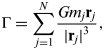 $${\rm \Gamma} = \mathop \sum \limits_{\,j = 1}^N \displaystyle{{Gm_j {\bf r}_j} \over {|{\bf r}_j |^3}}, $$
Tidal interaction with the central star is dealt with through the addition of a frictional damping force taking the form (see e.g. Papaloizou & Terquem Reference Papaloizou and Terquem2010)
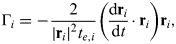 $${\rm \Gamma} _i = - \displaystyle{2 \over {|{\bf r}_i |^2 t_{e,i}}} \left( {\displaystyle{{{\rm d}{\bf r}_i} \over {{\rm d}t}} \cdot {\bf r}_i} \right){\bf r}_i, $$
where t e,i is the timescale over which the eccentricity of an isolated planet damps. Thus it is the orbital circularization time (see below).
Relativistic effects are included through Γr (see Papaloizou & Terquem Reference Papaloizou and Terquem2001). Note that in the formulation above, eccentricity damping causes radial velocity damping, which results in energy loss at constant angular momentum. As a consequence, it causes both the semi-major axis and the eccentricity to be reduced.
Orbital migration
It is likely that systems of close orbiting planets were not formed in their present locations but were formed further out and then migrated inwards while the protoplanetary disc was still present (see e.g. Papaloizou & Terquem Reference Papaloizou and Terquem2006; Nelson & Kley Reference Kley and Nelson2012 for reviews of orbital migration). However, the rate and extent of such migration are unclear mainly because of uncertainties regarding the effectiveness of coorbital torques (e.g. Paardekooper & Mellema Reference Paardekooper and Mellema2006) which can be sensitive to the detailed local disc structure. We note that convergent disc migration leads naturally to multiple systems in resonant chains of the type considered here (e.g. Cresswell & Nelson Reference Cresswell and Nelson2006; Papaloizou & Terquem Reference Papaloizou and Terquem2010). Note that if they start out close to resonance, these configurations may be produced with the system as a whole undergoing little net radial migration.
As we are mainly interested in the post-formation evolution of the system, we shall assume that although migration may have played a role in evolving the system into a configuration that is close to commensurability, during or just subsequent to planet formation, the protoplanetary disc has dispersed. This has the consequence that migration torques, orbital circularization and changes to the orbital inclination arising through disc–planet interaction are then absent. Dissipative effects are assumed to arise only through orbital circularization occurring as a result of tidal interaction of the planets with the central star.
Orbital circularization due to tides from the central star
The circularization timescale due to tidal interaction with the star was obtained from Goldreich & Soter (Reference Goldreich and Soter1966) in the form
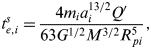 $$t_{e,i}^s = \displaystyle{{4m_i a_i^{13/2} Q'} \over {63G^{1/2} M^{3/2} R_{\,pi}^5}}, $$
where m i and a i are the mass and the semi-major axis of planet i, respectively. Here M is the mass of the central star and R pi is the radius of planet i. The quantity Q′=3Q/(2k 2), where Q is the tidal dissipation function and k 2 is the Love number. For Solar system planets in the terrestrial mass range, Goldreich & Soter (Reference Goldreich and Soter1966) give estimates for Q in the range 10–500 and k 2~0.3 which correspond to Q′ in the range 50–2500. However, Ojakangas & Stevenson (Reference Ojakangas and Stevenson1986) argue that, in the context of their episodic tidal heating model for Io, Q can attain values of around unity at the solidus temperature. This is because the response to tidal forcing becomes more like that of a fluid with high viscosity than an elastic solid. The rate of dissipation is accordingly larger. The value of Q is expected to be a function of tidal forcing frequency as well as temperature that can attain a minimum value ~1 (see Ojakangas & Stevenson Reference Ojakangas and Stevenson1986 and references therein). Although this parameter must be regarded as being very uncertain for extrasolar planets, we should accordingly consider that Q may be of order unity under early post-formation conditions where they may be near to the solidus temperature.
We remark that, in our formulation, tidal interaction with the star does not change the angular momentum of a single orbit but causes its energy to decrease. The physical basis for this is that the planets rapidly attain pseudo-synchronization (e.g. Ivanov & Papaloizou Reference Ivanov and Papaloizou2007), after which they cannot store significant angular momentum changes through modifying their intrinsic angular momenta. For the low-mass planets considered here, we neglect tides induced on the central star (see e.g. Barnes et al. Reference Barnes, Jackson, Raymond, West and Greenberg2009; Papaloizou & Terquem Reference Papaloizou and Terquem2010). Thus the orbital angular momentum and inclination are not changed by the application of Γi in equation (1).
Semi-analytic model for a system in a three-planet resonance undergoing circularization
We develop a semi-analytic model that shows how a three-planet system undergoes orbital evolution driven by tidal circularization. The coupling between the planets occurs because resonant angles are assumed to librate. But note that there may be significant deviations from exact commensurability. We begin by formulating equations governing the system without dissipation, which is Hamiltonian; we then go on to add in effects arising from orbital circularization.
Coordinate system
We adopt Jacobi coordinates (e.g. Sinclair Reference Sinclair1975) for which the radius vector of planet i, ri, is measured relative to the centre of mass of the system comprised of M and all other planets interior to i, for i=1, 2, 3. Here i=1 corresponds to the innermost planet and i=3 to the outermost planet.
Hamiltonian for the system without dissipation
The Hamiltonian, correct to second order in the planetary masses, can be written for the system without dissipation, in the form:
 $$\eqalign{H = & \mathop \sum \limits_{i = 1}^3 \left( {\displaystyle{1 \over 2}m_i |{\bf \dot r}_i |^2 - \displaystyle{{GM_i m_i} \over {|{\bf r}_i |}}} \right) \cr & - \mathop \sum \limits_{i = 1}^3 \mathop \sum \limits_{\,j = i + 1}^3 Gm_i m_j \left( {\displaystyle{1 \over {{\rm |}{\bf r}_{ij} {\rm |}}} - \displaystyle{{{\bf r}_i {\rm \cdot} {\bf r}_j} \over {{\rm |}{\bf r}_j {\rm |}^3}}} \right).} $$
Here M i=M+m i and rij=ri−rj.
Assuming that the planetary system is strictly coplanar, the equations governing the motion within a fixed plane, about a dominant central mass, may be written in the form (see e.g. Papaloizou Reference Papaloizou2003; Papaloizou & Szuszkiewicz Reference Papaloizou and Szuszkiewicz2005)
 $$\dot E_i = - n_i \displaystyle{{\partial H} \over {\partial {\rm \lambda} _i}}, $$
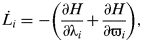 $$\dot L_i = - \left( {\displaystyle{{\partial H} \over {\partial {\rm \lambda} _i}} + \displaystyle{{\partial H} \over {\partial {\rm \varpi} _i}}} \right),$$
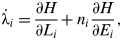 $${\rm \dot \lambda} _i = \displaystyle{{\partial H} \over {\partial L_i}} + n_i \displaystyle{{\partial H} \over {\partial E_i}}, $$
 $${\rm \dot \varpi} _i = \displaystyle{{\partial H} \over {\partial L_i}}. $$
Here and in what follows until stated otherwise, m i is replaced by the reduced mass so that m i→miM/(M+m i). The orbital angular momentum of planet i is L i and the orbital energy is E i. The mean longitude of planet i is λ i=n i(t−t 0i)+ϖi, with 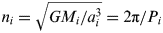 $n_i = \sqrt {GM_i /a_i ^3} = 2{\rm \pi} /P_i $ being the mean motion, and t 0i denoting the time of periastron passage. The semi-major axis and orbital period of planet i are a i and P i, respectively. The longitude of periastron is ϖi. The quantities λ i, ϖiLi and E i can be used to describe the dynamical system described above.
However, we note that for motion around a central point mass M we have
 $$L_i = m_i \sqrt {GM_i a_i (1 - e_i^2 )}, $$
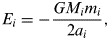 $$E_i = - \displaystyle{{GM_i m_i} \over {2a_i}}, $$
where M i=M+m i, and e i the eccentricity of planet i. Thus by a simple transformation, we alternatively adopt λ i, ϖi, ai or equivalently n i, and e i as dynamical variables. We comment that the difference between taking m i to be the reduced mass rather than the actual mass of planet i when evaluating M i in the expressions for L i and E i is third order in the typical planet to star mass ratio and thus it may be neglected in the analysis below.
Averaged Hamiltonian
The Hamiltonian may quite generally be expanded in a Fourier series involving linear combinations of the five angular differences  ${\rm \varpi} _1 - {\rm \varpi} _2, $${\rm \varpi} _2 - {\rm \varpi} _3 $ and λ i−ϖi, i=1, 2, 3.
Here we are interested in the effects of first order p+1 : p and q+1 : q commensurabilities associated with the outer and inner pairs of planets, respectively. In this situation, we expect that any of the four angles Φ1=(q+1) λ 2−qλ 1−ϖ1, Φ2=(q+1)λ 2−qλ 1−ϖ2, Φ3=(p+1)λ 3−pλ 2−ϖ2 and Φ4=(p+1)λ 3−pλ 2−ϖ3 may be slowly varying. Following standard practice (see e.g. Papaloizou & Szuszkiewicz Reference Papaloizou and Szuszkiewicz2005; Papaloizou & Terquem Reference Papaloizou and Terquem2010), high-frequency terms in the Hamiltonian are averaged out. In this way, only terms in the Fourier expansion involving linear combinations of Φ1, Φ2, Φ3 and Φ4 as argument are retained.
Working in the limit of small eccentricities that is applicable here, terms that are higher order than first in the eccentricities can also be discarded. The Hamiltonian may then be written in the form:
 $$H = E_1 + E_2 + E_3 + H_{12} + H_{23}, $$
where
 $$H_{ij} = - \displaystyle{{Gm_i m_j} \over {a_j}} \left[ {e_j C_{i,j} \cos {\rm \;} ({\rm \Phi} _{i + j - 1} ) - e_i D_{i,j} \cos {\rm \;} ({\rm \Phi} _{2i - 1} )} \right],$$
with
 $${C_{i,j} \!= \displaystyle{1 \over 2}\bigg( {x_{i,j} \displaystyle{{{\rm d}b_{1/2}^k (x)} \over {{\rm d}x}}\left\vert_{x = x_{i,j}}\! + (2k + 1)b_{1/2}^k (x_{i,j} ) - (2k + 2)x_{i,j} {\rm \delta} _{k,1} \bigg),}$$
 $$D_{i,j} = \displaystyle{1 \over 2}\bigg( {x_{i,j} \displaystyle{{db_{1/2}^{k + 1} (x)} \over {dx}}\left\vert_{x = x_{i,j}} + 2(k + 1)b_{1/2}^{k + 1} (x_{i,j} )} \bigg).$$
Here the integer k=q for the inner pair (i=1, j=2) and k=p for the outer pair (i=2, j=3) with  $b_{1/2}^k (x)$ denoting the usual Laplace coefficient (e.g. Brouwer & Clemence Reference Brouwer and Clemence1961; Murray & Dermott Reference Murray and Dermott1999) with the argument x i,j=a i/a j.
Incorporation of orbital circularization due to tidal interaction with the central star
Using equations (6)–(9) together with equation (12), we may first obtain the equations of motion without the effect of circularization due to tidal interaction with the central star. Having obtained the former, the effect of the latter may be added in (see e.g. Papaloizou Reference Papaloizou2003). Following this procedure, we obtain
 $$\displaystyle{{{\rm d}e_1} \over {{\rm d}t}} = \displaystyle{{m_2 a_1 n_1 D_{12}} \over {a_2 M_1}} \sin {\rm \Phi} _1 - \displaystyle{{e_1} \over {t_{e,1}^s}}, $$
 $$\displaystyle{{{\rm d}e_2} \over {{\rm d}t}} = - \displaystyle{{n_2} \over {M_2}} \left( {m_1 C_{12} \sin {\rm \Phi} _2 - \displaystyle{{a_2} \over {a_3}} m_3 D_{23} \sin {\rm \Phi} _3} \right) - \displaystyle{{e_2} \over {t_{e,2}^s}}, $$
 $$\displaystyle{{{\rm d}e_3} \over {{\rm d}t}} = - \displaystyle{{m_2 n_3 C_{23}} \over {M_3}} \sin {\rm \Phi} _4 - \displaystyle{{e_3} \over {t_{e,3}^s}}, $$
 $${\dot n_1 = - \displaystyle{{3qn_1^2 m_2 a_1} \over {M_1 a_2}} \left( {C_{12} e_2 \sin {\rm \Phi} _2 - D_{12} e_1 \sin {\rm \Phi} _1} \right) + \displaystyle{{3n_1 e_1^2} \over {t_{e,1}^s}},} $$
 $$\eqalign{\dot n_2 = & \displaystyle{{3(q + 1)n_2^2 m_1} \over {M_2}} \left( {C_{12} e_2 \sin {\rm \Phi} _2 - D_{12} e_1 \sin {\rm \Phi} _1} \right) \cr & - \displaystyle{{3pn_2^2 m_3 a_2} \over {M_2 a_3}} (C_{23} e_3 \sin {\rm \Phi} _4 - D_{23} e_2 \sin {\rm \Phi} _3 ) + \displaystyle{{3n_2 e_2^2} \over {t_{e,2}^s}},} $$
 $${\dot n_3\! =\! \displaystyle{{3(p + 1)n_3^2 m_2} \over {M_3}} \left( {C_{23} e_3 \sin {\rm \Phi} _4 - D_{23} e_2 \sin {\rm \Phi} _3} \right) + \displaystyle{{3n_3 e_3^2} \over {t_{e,3}^s}},} $$
 $${\rm \dot \Phi} _1\! = (q + 1)n_2 - qn_1 + \displaystyle{{n_1} \over {e_1}} \displaystyle{{m_2 a_1} \over {M_1 a_2}} D_{12} \cos {\rm \Phi} _1, $$
 $${\rm \dot \Phi} _2 = (q + 1)n_2 - qn_1 - \displaystyle{{n_2} \over {e_2}} \left[ {\displaystyle{{m_1} \over {M_2}} C_{12} \cos {\rm \Phi} _2 - \displaystyle{{m_3 a_2} \over {M_2 a_3}} D_{23} \cos {\rm \Phi} _3} \right],$$
 $${\rm \dot \Phi} _3 = (\,p + 1)n_3 - pn_2 - \displaystyle{{n_2} \over {e_2}} \left[ {\displaystyle{{m_1} \over {M_2}} C_{12} \cos {\rm \Phi} _2 - \displaystyle{{m_3 a_2} \over {M_2 a_3}} D_{23} \cos {\rm \Phi} _3} \right],$$
 $${\rm \dot \Phi} _4 = (p + 1)n_3 - pn_2 - \displaystyle{{n_3} \over {e_3}} \displaystyle{{m_2} \over {M_3}} C_{23} \cos {\rm \Phi} _4. $$
At this point, we note that in the analysis below we use equations (16)–(25) to calculate perturbations to the orbital elements and resonant angles correct to first order in the typical planet to central star ratio. For this purpose from now on we adopt the actual mass of planet i for m i, rather than the reduced mass and replace M i by M, as any associated corrections will be second order. Similarly the difference between using actual or reduced masses when evaluating the circularization times may be neglected as any corrections to those will also be correspondingly small. Accordingly m i will be identified as being the actual mass of planet i everywhere from now on.
The terms involving the circularization times  $t_{e,i}^s $ are associated with effects arising from the tides raised by the central mass on planet i. Notably, the terms
 ${\rm \propto} e_i^2 /t_{e,i}^s $ in equations (19)–(21) arise on account of the orbital energy dissipation occurring as a result of circularization at the lowest order in e i, and the disturbing masses, for which this appears. We shall assume throughout that such terms, through being retained, can be of lower order than those proportional to the disturbing masses, m i. However, we shall assume that expressions that are of second or higher order in the ratio of these quantities may be neglected.
Energy and angular momentum conservation
In the absence of circularizing tides  $\left( {t_{e,i}^s \to \infty} \right)$, the total energy E ≡H and angular momentum L=L 1+L 2+L 3 are conserved. When circularizing tides act, the total angular momentum is conserved but energy is lost according to
 $$\displaystyle{{{\rm d}H} \over {{\rm d}t}} = \mathop \sum \limits_{i = 1}^3 \displaystyle{{2e_i^2 E_i} \over {t_{e,i}^s}}. $$
Equation (26) follows from the averaged equations, with H being the unperturbed Hamiltonian, provided the relative commensurabilities are assumed to be satisfied to within the order of the perturbing masses and relative corrections of the order of the squares of the perturbing masses are neglected.
The case when four angles undergo small amplitude libration
In practice, we find that a quasi-stationary solution is possible for which Φ1 and Φ3 librate about angles close to zero and Φ2 and Φ4 librate about angles close to π. We describe this in this section. We begin by relating the resonance angles to the eccentricities.
Specification of the resonance angles in terms of the eccentricities
We assume that the system governed by equations (16)–(25) undergoes very slow secular evolution on a time scale very much longer than either the characteristic circularization time or the characteristic timescales associated with perturbations being of the order of M(n imi) −1. We suppose that under these conditions a quasi-steady state exists, for which the time derivatives of the eccentricities may be neglected. From equation (16) we obtain
 $$e_1 = \displaystyle{{m_2 a_1 n_1 D_{12} t_{e,1}^{\,s}} \over {a_2 M}}\sin {\rm \; \Phi} _1 \equiv {\rm \gamma} _1 \sin {\rm \Phi} _1. $$
Similarly from equation (18) we obtain
 $$e_3 = - \displaystyle{{m_2 n_3 C_{23} t_{e,3}^{\,s}} \over M}\sin {\rm \Phi} _4 \equiv {\rm \gamma} _3 \sin {\rm \Phi} _4, $$
and from equation (17) we obtain
 $$e_2 = \displaystyle{{n_2 t_{e,2}^{\,s}} \over M}\left( {\displaystyle{{m_3 a_2 D_{23}} \over {a_3}} \sin {\rm \Phi} _3 - m_1 C_{12} \sin {\rm \Phi} _2} \right) \equiv - {\rm \gamma} _{22} \sin {\rm \Phi} _2 + {\rm \gamma} _{23} \sin {\rm \Phi} _3. $$
For the case when all the resonant angles are stationary or undergo small amplitude librations, equations (23) and (24) give the generalized three-body Laplace resonance condition (p+q+1)n 2−qn 1−(p+1)n 3=0. Using equations (19)–(21), we find that the time derivative of this condition implies that
 $$\eqalign{ & {\rm \beta} _1 e_1 \sin {\rm \Phi} _1 + {\rm \beta} _{22} e_2 \sin {\rm \Phi} _2 + {\rm \beta} _{23} e_2 \sin {\rm \Phi} _3 + {\rm \beta} _3 e_3 \sin {\rm \Phi} _4 \cr & \quad= \displaystyle{{n_1 qe_1^2} \over {t_{e,1}^s}} + \displaystyle{{n_3 (\,p + 1)e_3^2} \over {t_{e,3}^s}} - \displaystyle{{n_2 (q + 1 + p)e_2^2} \over {t_{e,2}^s}},} $$
where
 $${\eqalign{ & {\rm \beta} _1 = - D_{12} \left( {\displaystyle{{(q + 1)\;(p + q + 1)n_2^2 m_1} \over M} + \displaystyle{{q^2 n_1^2 m_2 a_1} \over {a_2 M}}} \right), \cr & {\rm \beta} _{22} = - \displaystyle{{{\rm \beta} _1 C_{12}} \over {D_{12}}}, \cr & {\rm \beta} _{23} = D_{23} \left( {\displaystyle{{p(p + q + 1)n_2^2 m_3 a_2} \over {a_3 M}} + \displaystyle{{(p + 1)^2 n_3^2 m_2} \over M}} \right),}} $$
and
 $${\rm \beta} _3 = - \displaystyle{{{\rm \beta} _{33} C_{33}} \over {D_{33}}}. $$
Now we use equations (27)–(30) to eliminate the angles Φi in favour of the eccentricities e i. After having done this we determine the rate of change of the separation of the system from precise commensurability. To do this we begin using equations (19) and (20) to obtain
 $${\eqalign{ & \displaystyle{{\rm d} \over {{\rm d}t}}\left( {(q + 1)n_2 - qn_1} \right) \hskip-1pt=\hskip-1pt {\rm \alpha} _1 e_1 \sin \Phi _1 + {\rm \alpha} _{22} e_2 \sin \Phi _2 + {\rm \alpha} _{23} e_2 \sin \Phi _3\hskip-42pt \cr & \quad+ e_3 {\rm \alpha} _3 \sin \Phi _4 + \displaystyle{{3n_2 (q + 1)e_2^2} \over {t_{e,2}^s}} - \displaystyle{{3qn_1 e_1^2} \over {t_{e,1}^s}},}} $$
where
 $${\eqalign{ & {\rm \alpha} _1 = - 3D_{12} \left( {\displaystyle{{(q + 1)^2 n_2^2 m_1} \over M} + \displaystyle{{q^2 n_1^2 m_2 a_1} \over {a_2 M}}} \right),\;{\rm \alpha} _{22} = - \displaystyle{{{\rm \alpha} _1 C_{12}} \over {D_{12}}},\hskip-12pt \cr & {\rm \alpha} _{23} = 3D_{23} \displaystyle{{\,p(q + 1)n_2^2 m_3 a_2} \over {a_3 M}}{\rm,} \ {\rm and}\ {\rm \alpha} _{23} = - \displaystyle{{{\rm \alpha} _{23} C_{23}} \over {D_{23}}}.}} $$
We can now use the specification of the resonant angles in terms of the eccentricities given through equations (27)–(30) in equation (32) which will then express the rate of change of the mean motion separation from resonance of planets 1 and 2 in terms of the eccentricities and semi-major axes in the form
 $$\displaystyle{{\rm d} \over {{\rm d}t}}\left( {(q + 1)n_2 - qn_1} \right) = - A_1 \displaystyle{{n_1 e_1^2} \over {t_{e,1}^s}} - A_2 \displaystyle{{n_2 e_1^2} \over {t_{e,2}^s}} - A_3 \displaystyle{{n_3 e_3^2} \over {t_{e,3}^s}}, $$
where
 $$A_1 = - \displaystyle{{{\rm \alpha} _1 t_{e,1}^s} \over {n_1 {\rm \gamma} _1}} + 3q + \left( {\displaystyle{{{\rm \beta} _1 t_{e,1}^s} \over {n_1 {\rm \gamma} _1}} - q} \right)\displaystyle{{({\rm \alpha} _{23} {\rm \gamma} _{22} + {\rm \alpha} _{22} {\rm \gamma} _{23} )} \over {({\rm \beta} _{22} {\rm \gamma} _{23} + {\rm \beta} _{23} {\rm \gamma} _{22} )}},$$
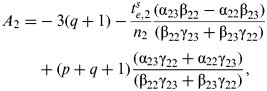 $$\eqalign{A_2 = & - 3(q + 1) - \displaystyle{{t_{e,2}^s} \over {n_2}} \displaystyle{{({\rm \alpha} _{23} {\rm \beta} _{22} - {\rm \alpha} _{22} {\rm \beta} _{23} )} \over {({\rm \beta} _{22} {\rm \gamma} _{23} + {\rm \beta} _{23} {\rm \gamma} _{22} )}} \cr & + (p + q + 1)\displaystyle{{({\rm \alpha} _{23} {\rm \gamma} _{22} + {\rm \alpha} _{22} {\rm \gamma} _{23} )} \over {({\rm \beta} _{22} {\rm \gamma} _{23} + {\rm \beta} _{23} {\rm \gamma} _{22} )}},} $$
 $$A_3 = - \displaystyle{{{\rm \alpha} _3 t_{e,3}^s} \over {n_3 {\rm \gamma} _3}} + \left( {\displaystyle{{{\rm \beta} _3 t_{e,3}^s} \over {n_3 {\rm \gamma} _3}} - (\,p + 1)} \right)\displaystyle{{({\rm \alpha} _{23} {\rm \gamma} _{22} + {\rm \alpha} _{22} {\rm \gamma} _{23} )} \over {({\rm \beta} _{22} {\rm \gamma} _{23} + {\rm \beta} _{23} {\rm \gamma} _{22} )}}.$$
Note that we can use the definitions of the coefficients αi, αij, βi, βij, γi, γij given by equations (27)–(29), (31) and (33) to substitute for them, in terms of the semi-major axes and the circularization times, in equation (34).
Specification of the eccentricities in terms of the deviation from commensurability
In order to complete the calculation of the orbital evolution away from commensurability, we need to specify the eccentricities as a function of the semi-major axes. To do this we use equations (22)–(25) together with the assumption that the angles Φi are close to their equilibrium values. Later we shall present numerical simulations for which Φ1 and Φ3 are close to zero and Φ2 and Φ4 are close to π. Accordingly, we adopt those values for the Φi while setting their time derivatives to be zero. Equations (22)–(25) then specify the eccentricities through
 $$e_1 = - \displaystyle{{n_1} \over {((q + 1)n_2 - qn_1 )}}\displaystyle{{m_2 a_1} \over {Ma_2}} D_{12}, $$
 $$e_2 = - \displaystyle{{n_2} \over {((q + 1)n_2 - qn_1 )}}\left( {\displaystyle{{m_1} \over M}C_{12} + \displaystyle{{m_3 a_2} \over {Ma_3}} D_{23}} \right),$$
 $$e_3 = - \displaystyle{{n_3} \over {((\,p + 1)n_3 - pn_2 )}}\displaystyle{{m_2} \over M}C_{23}. $$
When all four angles librate, we have the generalized three-planet Laplace resonance condition that (p+1)n 3−pn 2=(q+1)n 2−qn 1 (see above). This state applies to systems slightly more widely spaced than would be the case for precise commensurability, so that (p+1)n 3−pn 2=(q+1)n 2−qn 1≡Δ21 is negative, the period ratios exceed the commensurable values and the eccentricities will be positive.
We remark that for the alternative librating state for which Φ1 and Φ3 are close to π, and Φ2 and Φ4 are close to zero, equations (38)–(40) hold with a reversal of sign. Thus that situation applies when (p+1)n 3−pn 2=(q+1) n 2−qn 1≡Δ21 is positive, so that the period ratios are smaller than the commensurable values, ensuring again that the eccentricities will be positive. Bearing in mind this proviso, as it depends only on the squares of the eccentricities obtained from equations (38)–(40), the analysis presented below can be applied to both librational states.
We are now able to use equation (34) together with equations (38)–(40) to obtain an equation governing the evolution of Δ21 in the form
 $$ {\eqalign{ {\rm \Delta} _{21}^2 \displaystyle{{{\rm d}\Delta _{21}} \over {{\rm d}t}} = & - \displaystyle{{A_1 n_1^3} \over {t_{e,1}^s}} \left( {\displaystyle{{m_2 a_1 D_{12}} \over {Ma_2}}} \right)^2 - \displaystyle{{A_2 n_2^3} \over {t_{e,2}^s}} \left( {\displaystyle{{m_1} \over M}C_{12} + \displaystyle{{m_3 a_2} \over {Ma_3}} D_{23}} \right)^2\hskip-42pt \cr & - \displaystyle{{A_3 n_3^3} \over {t_{e,3}^s}} \left( {\displaystyle{{m_2 C_{23}} \over M}} \right)^2,}} $$
where after eliminating the αi, αij, βi, βij, γi, γij using equations (27)–(29), (31) and (33) as indicated above, we may write
 $$\eqalign{ A_1 = & 3(q + 1)\left( {(q + 1)\displaystyle{{n_2^2 m_1 a_2} \over {n_1^2 m_2 a_1}} + q} \right) \cr & - (q + 1)A\left( {(\,p + q + 1)\displaystyle{{n_2^2 m_1 a_2} \over {n_1^2 m_2 a_1}} + q} \right),} $$
 $$A_2 = - 3(q + 1) - B + (p + q + 1)A,$$
 $$A_3 = - 3p(q + 1)\displaystyle{{n_2^2 m_3 a_2} \over {n_3^2 m_2 a_3}} + pA\left( {(\,p + q + 1)\displaystyle{{n_2^2 m_3 a_2} \over {n_3^2 m_2 a_3}} + p + 1} \right),$$
with
 $$B = - \displaystyle{{3Mm_2 X} \over {n_2^2 a_2 D}},$$
and
 $$A = \displaystyle{{Y} \over D},$$
with
 $$X = p^2 q^2 m_3 Ma_1 a_2 n_1^2 n_2^2 + (\,p + 1)^2 q^2 m_2 Ma_1 a_3 n_1^2 n_3^2 + (\,p + 1)^2 (q + 1)^2 m_1 Ma_2 a_3 n_2^2 n_3^2, $$
 $${Y = 3M^2 \left( {q^2 m_2 m_3 a_1 n_1^2 + (q + 1)(q + 1 + p)m_1 m_3 a_2 n_2^2} \right),}$$
and
 $$D = (\,p + q + 1)^2 m_1 m_3 M^2 a_2 n_2^2 + (\,p + 1)^2 m_1 m_2 M^2 a_3 n_3^2 + q^2 m_2 m_3 M^2 a_1 n_1^2. $$
Time-dependent evolution of the separation from resonance
Equation (41) governs the time-dependent evolution of Δ21=(q+1)n 2−qn 1=(p+1)n 3−pn 2 as a function of time. We first remark that each of the three contributions to the right-hand side of equation (41) is readily seen to be non-negative and so Δ21 decreases monotonically with time. When Δ21<0, this means that |Δ21| will subsequently increase with time, corresponding to an increasing departure from strict resonance. The expression of the conservation of the total angular momentum of the system can be used to enable each of the n i to be expressed in terms of Δ21 which may then be found by integration. However, when the system still remains close to resonance, the situation may be simplified by noting that the relative period separation from resonance may increase significantly while the mean motions themselves change negligibly. Under these conditions the right-hand side of equation (41) may be approximated as being constant. To simplify notation, we define a quantity T by writing this equation as
 $${\rm \Delta} _{21}^2 \displaystyle{{{\rm d}\Delta _{21}} \over {{\rm d}t}} = - n_1^3 /(3T).$$
Under the assumption of a constant right-hand side, the solution is given by
 $$\displaystyle{{\Delta _{21}} \over {n_1}} = - \left( {\displaystyle{{(t - t_0 )} \over T}} \right)^{1/3}, $$
where t 0 is a constant of integration. This is such that at a putative time t=t 0, Δ21=0. |Δ21| is then monotonically increasing for t>t 0. We remark that corresponding tendency for the departure of the relative period ratio from strict commensurability to increase ∝ t 1/3, for systems comprising two planets close to resonance, has been noted by Papaloizou (Reference Papaloizou2011), Lithwick & Wu (Reference Lithwick and Wu2012) and Batygin & Morbidelli (Reference Batygin and Morbidelli2012).
The case when three angles undergo small amplitude libration
We have considered quasi-stationary solutions for which the angles Φ1 and Φ3 librate about angles close to zero and Φ2 and Φ4 librate about angles close to π. In this case, the generalized three-body Laplace resonance condition (p+1)n 3−pn 2=(q+1)n 2−qn 1 applies. However, we can also consider the possibility that this relation is relaxed with only three of the angles in a state of libration, whereas the fourth circulates. This situation is of interest as it was found by Papaloizou & Terquem (Reference Papaloizou and Terquem2010) to occur in simulations of the tidal evolution of the HD40307 system away from a 4 : 2 : 1 resonance (p=q=1).
There are two possible choices for the circulating angle that allow secular evolution without the generalized three-body Laplace resonance condition holding, namely Φ2 or Φ3. We shall consider both these cases below assuming that liberating angles remain close to the same values as in the previous case, although it is relatively simple to generalize the discussion to other examples. We proceed by closely following the analysis of the previous section, noting that terms involving the circulating angle are omitted as this is assumed to make no contribution to the time-averaged dynamics. Thus equations (27)–(29) hold but with the contribution from the circulating angle set to zero. They then suffice to determine the three remaining angles in terms of the eccentricities without having to add the constraint given by equation (30) which expresses the fact that the generalized three-body Laplace resonance condition holds for all time.
However equation (32) for d((q+1)n 2−qn 1)/dt still holds but again with the contribution from the circulating angle omitted. Using this with the modified forms of equations (27)–(29) described above being used to eliminate the librating angles in favour of the eccentricities, we obtain
 $$\displaystyle{{\rm d} \over {{\rm d}t}}\left( {(q + 1)n_2 - qn_1} \right) = - B_1 \displaystyle{{n_1 e_1^2} \over {t_{e,1}^s}} - B_2 \displaystyle{{n_2 e_2^2} \over {t_{e,2}^s}} - B_3 \displaystyle{{n_3 e_3^2} \over {t_{e,3}^s}}, $$
where
 $$B_1 = 3(q + 1)^2 \displaystyle{{n_2^2 m_1 a_2} \over {n_1^2 m_2 a_1}} + 3q(q + 1),$$
 $$B_2 = - 3(q + 1) +Z $$
and
 $$B_3 = - 3p(q + 1)\displaystyle{{n_2^2 a_2 m_3} \over {n_3^2 a_3 m_2}}. $$
Here, either
 $$Z = \displaystyle{{3q^2 n_1^2 a_1 m_2} \over {n_2^2 a_2 m_1}} + 3(q + 1)^2 $$
if Φ2 librates, or alternatively, Z=−3p(q+1) if Φ3 librates.
In order to complete the determination of the evolution, as before we may use equations (22)–(25) to specify the eccentricities in terms of the semi-major axes. However, as above, we must omit the equation derived from setting the time derivative of the circulating angle to zero as well as contributions potentially arising from the circulating angle in the remaining equations. One then finds that equations (38) and (40) can be taken over unaltered. On the other hand, equation (39) has to be replaced by
 $$e_2 = - \displaystyle{{n_2} \over \Delta} F_2, $$
where either F 2=m 1C 12/M with Δ=(q+1)n 2−qn 1=Δ21, when Φ2 librates, or F 2=m 3a 2D 23/(Ma 3) with Δ=(p+1)n 3−pn 2=Δ32 when Φ3 librates.
The relation between Δ32 and Δ21
As the generalized three-body Laplace relation is no longer satisfied, we must find an alternative means of relating Δ32=(p+1)n 3−pn 2 and Δ21=(q+1)n 2−qn 1. This can be done by writing down the equation for the time derivative of Δ32 obtained from equations (19)–(21). Proceeding in the same manner as for dΔ21/dt, we can write this in terms of the semi-major axes and eccentricities in the form:
 $$\displaystyle{{{\rm d}\Delta _{32}} \over {{\rm d}t}} = - K_1 \displaystyle{{n_1 e_1^2} \over {t_{e,1}^s}} - K_2 \displaystyle{{n_2 e_2^2} \over {t_{e,2}^s}} - K_3 \displaystyle{{n_3 e_3^2} \over {t_{e,3}^s}}, $$
where
 $$K_1 = - \displaystyle{{3p(q + 1)n_2^2 a_2 m_1} \over {n_1^2 a_1 m_2}}, $$
 $$K_2 = 3p + S_2, $$
and
 $$K_3 = 3p(\,p + 1) + \displaystyle{{3p^2 n_2^2 a_2 m_3} \over {n_3^2 a_3 m_2}}. $$
Here, either
 $$S_2 = - 3p(q + 1),$$
if Φ2 librates, or alternatively,
 $$S_2 = \displaystyle{{3(\,p + 1)^2 n_3^2 a_3 m_2} \over {n_2^2 a_2 m_3}} + 3p^2, $$
if Φ3 librates. Equations (52) and (58) together with the conservation of angular momentum determine the evolution of the system. This is qualitatively similar to the case when the strict generalized three-body Laplace resonance applies. Here we focus on the relation between Δ32 and Δ21 which can be obtained by dividing equation (58) by equation (52). This gives
 $$\displaystyle{{{\rm d}\Delta _{21}} \over {{\rm d}\Delta _{32}}} = \displaystyle{{B_1 n_1 e_1^2 /t_{e,1}^s + B_2 n_2 e_2^2 /t_{e,2}^s + B_3 n_3 e_3^2 /t_{e,3}^s} \over {K_1 n_1 e_1^2 /t_{e,1}^s + K_2 n_2 e_2^2 /t_{e,2}^s + K_3 n_3 e_3^2 /t_{e,3}^s}}. $$
Equations (38), (40) and (57) can be used to specify the eccentricities. Equation (64) then determines the ratio Δ32/Δ21. This depends on the ratios of the circularization times for the different planets. When the circularization time is proportional to a power of the semi-major axis and the system is close to resonance, such that the ratios of the semi-major axes of the different planets can be taken to be fixed, we can approximate the ratio as being constant. As an example, we consider the case when Φ3 librates and t e,3→∞. This is the case that was found by Papaloizou & Terquem (Reference Papaloizou and Terquem2010) to occur in their simulations of the tidal evolution of the HD40307 system. It is also a reasonable limit to consider as circularization is reasonably expected to be significantly less effective for the outermost planet. In this case, we obtain
 $$\displaystyle{{\Delta _{21}} \over {\Delta _{32}}} = \displaystyle{{D_1} \over {D_2}}, $$
where
 $$D_1 = \displaystyle{{(q + 1)^2 n_2^2 a_2 m_1} \over {n_1^2 a_1 m_2}} + q(q + 1) - (q + 1)(\,p + 1)W,$$
and
 $$D_2 = - \displaystyle{{\,p(q + 1)n_2^2 a_2 m_1} \over {n_1^2 a_1 m_2}} + \left( {\,p(\,p + 1) + ((\,p + 1)^2 n_3^2 a_3 m_2 )/(n_2^2 a_2 m_3 )} \right)W,$$
where
 $$W = \left( {\displaystyle{{m_3 n_2 a_2^2 D_{23}} \over {m_2 n_1 a_1 a_3 D_{12}}}} \right)^2 \left( {\displaystyle{{n_2 t_{e,1}^s} \over {n_1 t_{e,2}^s}}} \right)\left( {\displaystyle{{\Delta _{21}} \over {\Delta _{32}}}} \right)^2. $$
Equation (65) is seen to provide a cubic equation for the ratio, x=Δ32/Δ21. This is readily seen to have one positive real root that is appropriate for the assumptions we have made. This has a particularly simple form when the ratio of the circularization times,  $t_{e,1}^s /t_{e,2}^s $, is assumed to be small. Then as x vanishes in the limit that this approaches zero, we see that the denominator on the right-hand side of equation (65) must vanish in this limit. This gives an expression for x through
 $$x^2 = \left( {\displaystyle{{\,p\;(\,p + 1) + (\,p + 1)^2 n_3^2 a_3 m_2 )/(n_2^2 a_2 m_3 )} \over {\,p(q + 1)}}} \right)\left( {\displaystyle{{m_3^2 n_2 a_2^3 D_{23}^2 t_{e,1}^s} \over {m_1 m_2 n_1 a_1 a_3^2 D_{12}^2 t_{e,2}^s}}} \right).$$
Thus when three angles librate as considered above, when the circularization times scale as a power of the semi-major axes, x can also be approximately constant during the evolution as was indicated by Papaloizou & Terquem (Reference Papaloizou and Terquem2010). However, the magnitude of the constant depends on the ratios of the circularization times for different planets. It is accordingly uncertain, although the above discussion shows that x→0 when the circularization time for the innermost planet is very much shorter than the corresponding time for the next innermost planet which is in turn very much shorter than the corresponding time for the outermost planet.
Once the value of x has been determined, the evolution of the system can be obtained by solving equation (52) in the same way as for the case when the strict generalized three-body Laplace resonance condition holds. As in that case, we find that the deviation from exact commensurability increases ∝ t 1/3. However, as we consider simulations of cases where the four angles ultimately librate with the Laplace resonance holding, below, we shall not consider the case of three angle libration in any further detail in this paper.
Comparison with previous work
Batygin & Morbidelli (Reference Batygin and Morbidelli2012) have considered the evolution of a three-planet system under orbital circularization towards a librating state. They considered systems for which three angles circulated and one librated. Most of the analytic discussion and all of the numerical work in this paper are concerned with systems where four angles librate. However, systems for which only three angles librate were considered in the subsections ‘The case when three angles undergo small amplitude libration’ and ‘The relation between Δ32 and Δ21’ above.
Batygin & Morbidelli (Reference Batygin and Morbidelli2012) give equations governing the evolution of such a system once it has attained a librating state although no analytic solutions were subsequently discussed. However, solutions of the kind considered in the subsections ‘The case when three angles undergo small amplitude libration’ and ‘The relation between Δ32 and Δ21’ are readily obtained from their equation (47). These give three equations for the quantities  $m_1 \sqrt {a_1}, m_2 \sqrt {a_2} $ and
 $m_3 \sqrt {a_3}. $ These can be readily converted into two equations for Δ21 and Δ32 as defined above. The ratio of these equations will then lead to the equivalent of equation (64) above.
Numerical simulations
In this section, we give the results of numerical simulations of three planet systems close to a three-planet resonance under the influence of tidal circularization due to the central star. We focus on systems with parameters with initial conditions near to, or corresponding to those appropriate to the Kepler 60 system. Thus the initial conditions were taken to correspond to the tabulated orbital elements given by Steffen et al. (Reference Steffen2013) with the added stipulation that the initial eccentricities are zero. In doing this we remark that the actual eccentricities cannot be strictly zero with the consequence that we model a system that is close to rather than identical to the actual system. This should be adequate for illustrating the general theory and determining the characteristic evolutionary time scales.
As values for the masses are not available, in order to estimate plausible values, unless specified otherwise, we use the fiducial mass–radius relation (see Lissauer et al. Reference Lissauer2011)
 $$m/M_ \oplus \propto (R_p /R_ \oplus )^{2.06}. $$
We use equation (4) to calculate the circularization time. In order to implement this we need to specify the tidal parameter Q′. We note that according to equation (4),  $t_{e,i}^s {\rm \propto} Q'{\rm \bar \rho} ^{5/3} $, where
 ${\rm \bar \rho} _i^{5/3} $ is the mean density of planet i. Quoted standard deviations in the radii amount to about 3% for the inner two planets and 6% for the outermost planet. To within these limits, using the masses calculated from equation (70), we may take the mean density,
 ${\rm \bar \rho} _i = 2.4\,{\rm g}\,{\rm cm}^{ - 3} \equiv {\rm \bar \rho} $, for each of the planets. Then, if we choose Q′=C Q′(
 ${\rm \bar \rho} $/2.4)−5/3 for planet i, with C Q′ being a constant we can scale our results to apply to hypothetical planets with the same masses but with lower mean densities and thus larger Q′. Recall that C Q′≡Q′ for the masses and radii given in Table 1.
The radii, estimated masses, estimated mean densities and orbital periods in days for the three planets in the Kepler 60 system are given in the second to fifth columns, respectively. The sixth column contains the period ratio with the next innermost planet where applicable

The simulations were by means of N-body calculations using the method described in e.g. Papaloizou & Terquem (Reference Papaloizou and Terquem2001). From the consideration of numerical tractability we are unable to consider very large values of Q′. In practice, we took either C Q′=2.5 or C Q′=7.5 for each planet. However, in one case considered below, tidal dissipation was only applied to the innermost planet. Our general finding is that tidal dissipation causes the system to evolve into a state where a strict generalized Laplace resonance condition holds with all resonant angles maintained in a state of libration. The period ratios then increase with time with the system steadily separating from strict commensurability. This type of evolution is very similar to that obtained for two planet systems under similar circumstances (e.g. Papaloizou Reference Papaloizou2011).
Numerical results
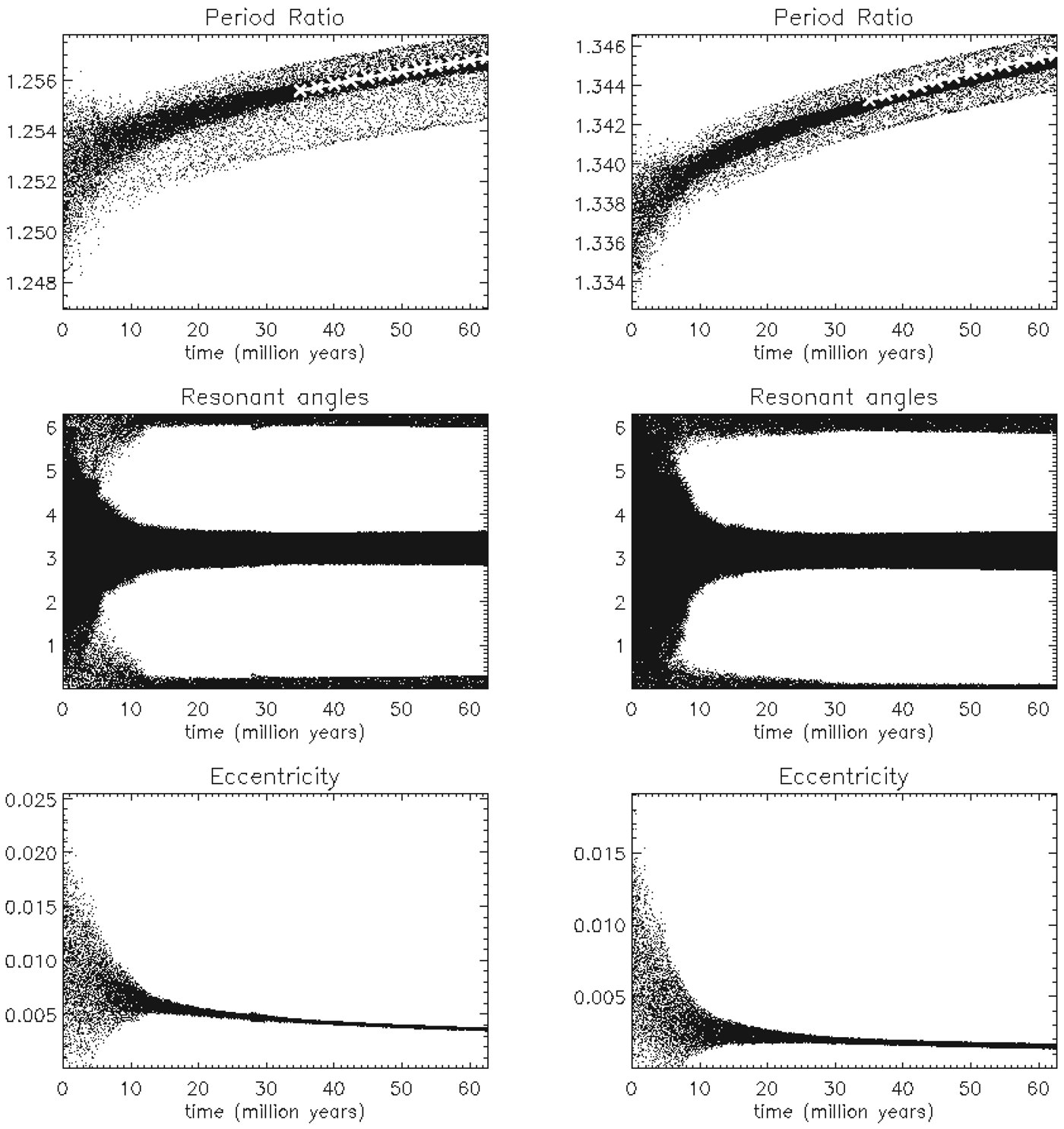
The results obtained for a simulation with  $Q{\rm \prime} = {\rm \;} 2.5({\rm \bar \rho} /2.4)^{ - 5/3} $ are shown in Fig. 1. The angles Φ1 and Φ2 initially circulate with the action of dissipation through tides ultimately causing them to librate with diminishing amplitude about 0 and π, respectively. This evolution is well underway after a few million years. If the simulation was performed without tidal dissipation, variations in all quantities would remain at the same level with no tendency towards libration of the resonant angles. The angles Φ3 and Φ4 behave similarly to Φ1 and Φ2, ultimately librating about 0 and π, respectively. This is all in accordance with the analytic model of the subsection ‘The case when four angles undergo small amplitude libration’. The lower left and right panels of Fig. 1 show the evolution of the eccentricities on the middle and outermost planet, respectively. As the librational state is attained, the eccentricities approach slowly decreasing values with superposed small oscillations. The period ratios of the middle to innermost planet and the middle to outermost planet then secularly increase as expected from the analytic model of the subsection ‘The case when four angles undergo small amplitude libration’ for which the generalized three-body Laplace relation is assumed to hold exactly. We have plotted expressions for the period ratios as a function of time obtained from equation (51) with 1/T=1.81×10−13 yr−1, being the value calculated from the analytic model, and the integration constant t 0=3.5×10⁶ yr. We recall that in this case q=4, and the period ratios can be found from |Δ21| using 16/5(P 2/P 1−5/4)~|Δ21|/n 1 and then the generalized three-body Laplace relation to obtain the quantity P 3/P 2−4/3. The curves marked with crosses represent these expressions which track the numerical data quite well. It is not clear exactly how the temporal fluctuations in the period ratios should be averaged when considering such fits. However, we remark that the lightly shaded regions in the period ratio plots are found to be associated with high-frequency perturbations that are not represented in the analytic model. On the other hand, the darkly shaded regions are associated with longer period librations. Thus the fits should apply to the darkly shaded regions. We remark that the above analytically determined curves for P 2/P 1 and P 3/P 2, as well as others discussed below, obtained from equation (51), were calculated for positive values of t 0 that are comparable to the time for the resonant angles to begin circulating and which may be regarded as a characteristic time for transient behaviour. However, adopting t 0=0 produces curves that appear only slightly shifted from those presented.
Results for  ${\bi Q'} = 2.5({\rm \bar \rho} /2.4)^{ - 5/3} $. The upper left panel shows the evolution of the period ratio of the middle to innermost planet and the upper right panel shows the evolution of the period ratio of the outermost to middle planet. The curves marked with crosses are obtained from the analytic theory. Equation (51) was used as described in the text. The central left panel shows the evolution of the angles Φ1 and Φ2 which ultimately librate about 0 and π, respectively. The central right panel shows the evolution of the angles Φ3 and Φ4, which ultimately librate about 0 and π, respectively. The lower left and right panels show the evolution of the eccentricities on the middle and outermost planets, respectively.

We also performed a simulation with the same parameters except that tidal circularization applied only to the innermost planet. The evolution is similar to that described for the previous case but with the librational state taking longer to attain. We have evaluated expressions for the period ratios as a function of time obtained from equation (51), for C Q′=2.5 but with tidal effects acting only on the inner planet. For this case, we found that the numerical results were reasonably well represented when 1T=8.99×10⁻¹⁴ yr−1 as calculated from the analytic model, together with t 0=3.5×10⁶ yr. From this, we see that the secular evolution of the librating state occurs at a rate that is a factor of two slower when tides are applied only to the innermost planet.
Dependence on Q′
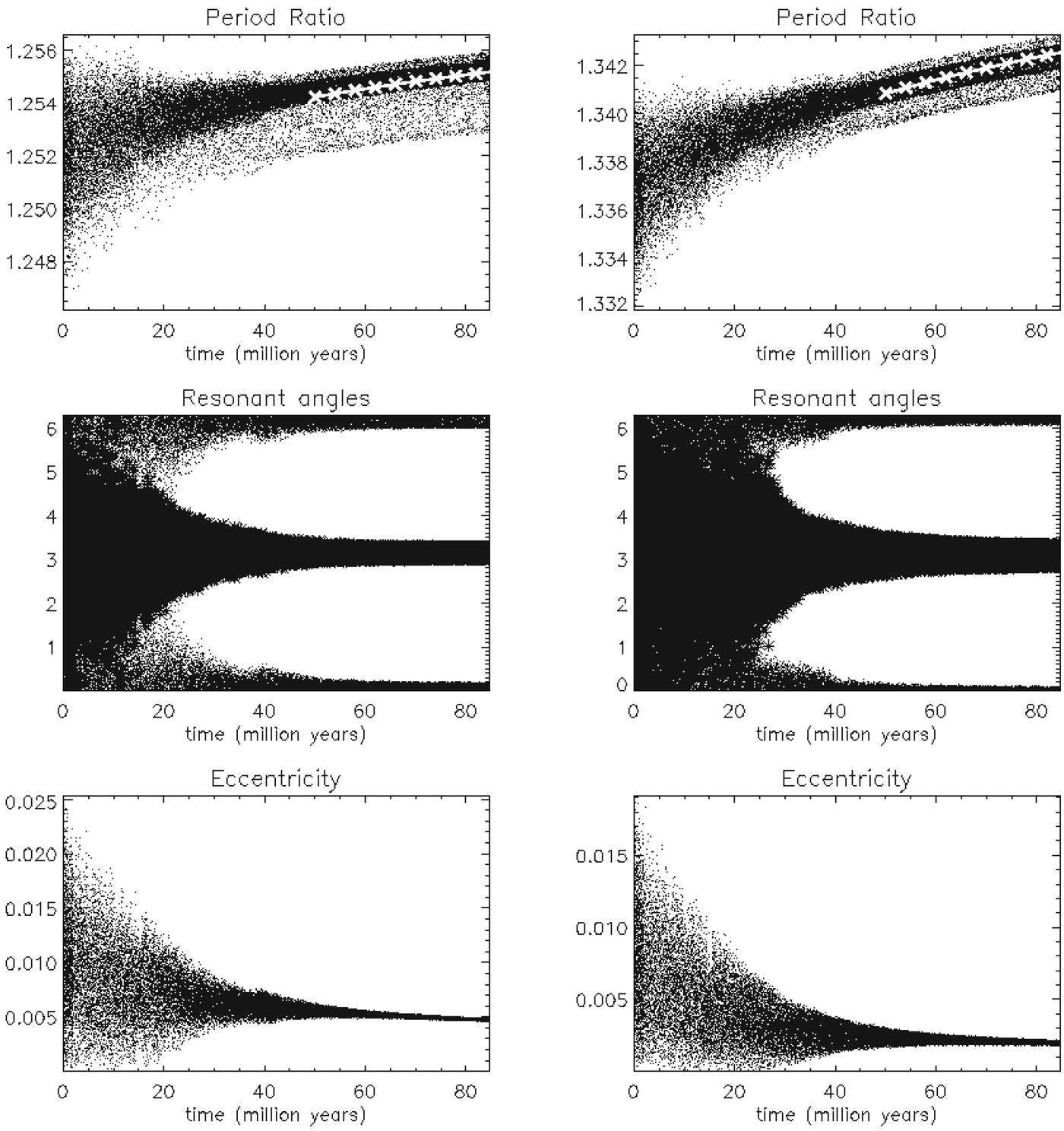
In order to study the dependence of the evolution on Q′, we show results for Q′=7.5( ${\rm \bar \rho} $/2.4)−5/3, with tidal effects applied to all the planets in Fig. 2. In this case, the evolution towards the librational state is as for the case with Q′=2.5(
 ${\rm \bar \rho} $/2.4)−5/3 but three times slower as expected. This is apparent from the analytic curves obtained from equation (51). Thus we found that
 $1/T = 6.04 \times 10^{ - 14} {\rm \;} \,{\rm yr}^{ - {\rm 1}} $ and adopted t 0=1.05×10⁷ yr for this case. In a similar manner, we have also confirmed the applicability of equation (51) for a run with Q′=0.75(
 ${\rm \bar \rho} $/2.4)−5/3, so that the range of Q′ considered spans one order of magnitude.
The same as for Fig. 1 but for Q′=7.5( ${\rm \bar \rho} $/2.4)−5/3.
Dependence on planet mass
We have explored the dependence of the evolution on planet mass by rerunning the case for which Q′=7.5( ${\rm \bar \rho} $/2.4)−5/3 with all of the planet masses increased by a factor of two while retaining a constant mean density. The results were found to be qualitatively similar but the evolutionary timescale is shorter. We see from equation (4) that the circularization time for each planet scales as m i−2/3 and so will be reduced by a factor of 22/3. Equation (41) then implies that T scales as m i−8/3 and so should be reduced by a factor of 28/3. This is accurately confirmed by our curves determined from (51) that track the numerical data. These had
 $1/T = 3.83 \times 10^{ - 13} \,{\rm yr}^{ - 1} $ and t 0=5.5×10⁶ yr. We remark that if we had increased the planet masses by a factor of two while keeping their radii and Q′ constant, equations (4) and (41) would imply that T scales as m i−1 leading to a relatively weaker reduction in the evolution time. We also attempted simulations with the planet masses increased by a factor of four. However, these were found to lead to disruption of the system through instability within a time <106 yr.
A small variation of the initial period ratios
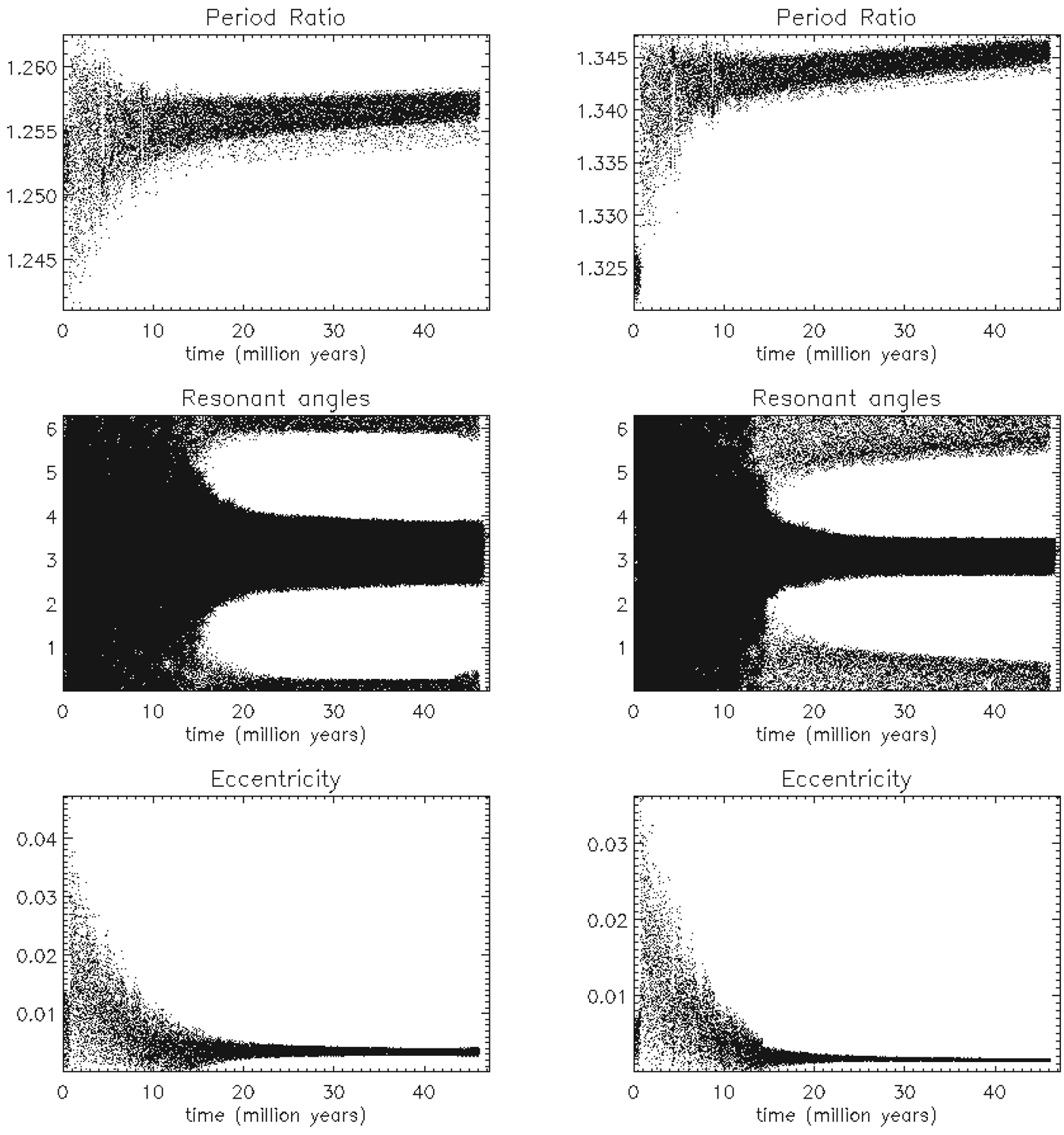
In this paper, we have focused on initial conditions near to those appropriate to the Kepler 60 system. We remark that Marti et al. (Reference Marti, Giuppone and Beauge2013) found that the Laplace resonance in the non-dissipative GJ876 system is defined by a tiny island of regular motion surrounded by unstable highly chaotic orbits (see also Gerlach & Haghighipour Reference Gerlach and Haghighipour2012). We comment that we found that some runs starting with slightly different initial conditions led to the same type of evolution as described above but took significantly longer to arrive at the librating state. We give results for the case with C Q′=2.5, but with different initial conditions than those used previously, in Fig. 3. These were such that the semi-major axis of the outermost planet was decreased by a factor of 1.0050, while the semi-major axis of the central planet was decreased by a factor of 1.0007. With these changes the initial value of the period ratio P 2/P 1 changes from 1.2507 to 1.2493 and the initial value of the period ratio P 3/P 2 changes from 1.3344 to 1.3259. Accordingly these are both below the values required for strict commensurability. This simulation ultimately attains the same libration state, with secular increasing period ratios, as in the case with the original initial conditions. However, the initial period of time during which the resonant angles circulate and there are relatively large eccentricity oscillations are seen to last about twice as long at around ~1.5×10⁷ yr in this case.
The same as in Fig. 1 but with different initial conditions described in the text.
Discussion and conclusion
In this paper, we have constructed a simple analytic model that describes the evolution of a three-planet system in a three-body resonance under the influence of tidal circularization. This is based on adopting a time-averaged system for which contributions from a maximum of four resonant angles, associated with the first-order resonances between the inner pair and the outer pair of planets, are retained.
When all four angles undergo small amplitude libration the generalized three-body Laplace relation is maintained while the period ratios increasingly depart from strict commensurability. But when only three of the resonance angles undergo small amplitude libration, the generalized three-body Laplace relation was found to be replaced by a different relationship between the period ratios which depends on details such as the planet mass ratios and their orbital circularization time ratios.
Features of the analytic model such as the scaling of the evolution timescale with the planet mass scale, its dependence on tidal dissipation and the form of the evolution of the period ratios away from commensurability were reproduced by our numerical simulations that were carried out for a three-planet system with masses in the super-Earth regime that were focused on the Kepler 60 system for which the inner pair exhibits a 5 : 4 resonance and the outer pair exhibits a 4 : 3 resonance. However, we remark that much of the discussion should be generic.
We now briefly discuss how our results can be used to provide constraints on the amount of tidal dissipation that has occurred in such interacting systems. This discussion again adopts working parameters appropriate to the Kepler 60 system, although its form should again be generic. We remark that although Steffen et al. (Reference Steffen2013) confirmed the Kepler 60 system by observing anti-correlated transit-timing variations, low signal-to-noise parabolic, rather than periodic, variations are seen. Accordingly masses have not been determined and it is unclear whether resonant angles are in a librating state.
However, at the present time the inner and outer pairs of planets are very close to 5 : 4 and 4 : 3 resonances, respectively, with fractional deviations ~10−3. Such resonant chains are readily produced through convergent migration of protoplanets driven by interaction with the gas disc. Accordingly, it is commonly assumed that they were produced in this way while the gas disc was present (e.g. Cresswell & Nelson Reference Cresswell and Nelson2006; Terquem & Papaloizou Reference Terquem and Papaloizou2007; Thommes et al. Reference Thommes, Bryden, Wu and Rasio2008; Libert & Tsiganis Reference Libert and Tsiganis2011; Beaugé & Nesvorny Reference Beaugé and Nesvorny2012, Cossou et al. Reference Cossou, Raymond and Pierens2013) rather than through in situ formation, which tends to avoid resonances (Hansen & Murray, Reference Hansen and Murray2013). However, as noted by the former authors such resonant chains may be broken after the gas disperses by dynamical interactions and/or collisions with remaining planetesimals. Thus at a later time, but still shortly after formation, the system may differ to some extent from a putative initial resonant liberating state formed through convergent migration.
Although the above scenario forms a plausible basis for the origin of planetary systems that are very close to comprising a resonant chain, in principle the system could have started from a state that underwent tidal evolution of the type described here, with low Q′, in such a way that the exact resonant state has been passed through only recently. However, noting that the evolution is most rapid in the resonant state this would seem to be unlikely. Accordingly, for the purposes of discussion, we shall assume that the system was formed close to the resonant state and consider how it would subsequently evolve as a result of tidal interactions with the central star.
We begin by estimating the time required for the system to attain a generalized three-body Laplace resonance with all four resonance angles liberating with small amplitude. For simplicity in the discussion below, we assume that the same Q′ applies to all of the planets, noting that extension to consider more general cases should be straightforward.
As expected, the evolution timescales in our simulations have been found to scale with the tidal dissipation parameter Q′. From the results presented in Figs. 1 and 2, the time required to attain a state in which the four resonant angles attain a state of small amplitude libration can be estimated to be ~6.7×10⁶C Q′ yr. Here we assume, as indicated by these results, that this time is in general proportional to C Q′. Recall that C Q′ for 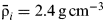 ${\rm \bar \rho} _i = 2.4\,{\rm g}\,{\rm cm}^{ - 3} $ as assumed here.
Although they do not provide an estimate of the age of the system, the stellar parameters given by Batalha et al. (Reference Batalha2013) indicate that the star of mass  $1.09\,M_ \odot , $ radius
 $1.5\,R_ \odot $ and luminosity
 $2.5\,L_ \odot $ is evolved. Accordingly, we shall adopt an age of 5×10⁹ yr in order to make illustrative estimates. Then failure to attain the librating state implies that Q′>~750. This applies if Q′ does not vary with time and the same for all planets (but see below). Should tides only operate on the innermost planet, the estimated bound on Q′ should be reduced by a factor of two.
We now consider the expected evolution assuming that the system was formed in the four angle librating state. Then we note that if the system was actually in a three-body resonance with small amplitude librations, the observed small deviations from exact commensurability would indicate a larger value of Q′ than is given by the above bound. To show this, we consider the evolutionary timescale, t ev, defined as the characteristic time required for Δ21 to undergo a relative change of order unity. Using equation (50), we find that
 $$t_{{\rm ev}} = \left| {\displaystyle{{\Delta _{21}} \over {{\rm d}\Delta _{21} /{\rm d}t}}} \right| = 3\left( {\displaystyle{{\Delta _{21}} \over {n_1}}} \right)^3 T = \displaystyle{{122\,88} \over {125}}\left( {\displaystyle{{P_2} \over {P_1}} - \displaystyle{5 \over 4}} \right)^3 T.$$
Using equations (41) and (50) while noting the scaling that T∝C Q′, we find that  $T = 2.21 \times 10^{12} C_{Q'} $ yr. Thus
 $$t_{{\rm ev}} = 2.17 \times 10^{14} \left( {\displaystyle{{P_2} \over {P_1}} - \displaystyle{5 \over 4}} \right)^3 C_{Q} \prime\,{\rm yr}.$$
Adopting the masses and period ratios in Table 1 we then obtain
 $$t_{{\rm ev}} = 7.44 \times 10^4 C_{Q'} \,{\rm yr}.$$
We recall that for the mean density 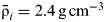 ${\rm \bar \rho} _i = 2.4\,{\rm g}\,{\rm cm}^{ - 3} $ adopted C Q′≡Q′. In addition for fixed Q′, planetary radii and planet mass ratios, t ev is inversely proportional to the planetary mass scale. Equation (73) implies that the system could not have begun in a three-body resonance with four librating resonance angles and have its present period ratios if C Q′<~6.7×10⁴, this bound scaling with the mass scale. On the other hand, if C Q′>~103 the librating state would not have been attained through circularization.
Up to now we have assumed that Q′ is constant. If Q′ varies with time, as evolution rates are ∝(Q′) −1, provided changes are slow enough for the system to respond adiabatically, the above estimates should relate to 〈(Q′) −1〉−1, where the angle brackets indicate a time average. This is effectively a statement that the amount of tidal dissipation should have been limited. Thus although periods of strong episodic tidal heating of the type considered by Ojakangas & Stevenson (Reference Ojakangas and Stevenson1986) may have occurred, their integrated effect is constrained. We emphasize that the above estimates are provisional and that it should be possible to extend and refine the above discussion as more information about systems of this kind becomes available.