Introduction
Self-rated health (SRH) is a simple assessment of general health status. However, it has been recognized as a useful health indicator (Jylha, Reference Jylha2009). Many studies have reported that SRH is a strong independent predictor of mortality especially in the aged population (DeSalvo et al., Reference DeSalvo, Bloser, Reynolds, He and Muntner2006). Although the mechanisms underlying the SRH-mortality association are unclear, recent studies suggest that functional decline may be an intermediate step (Martinez et al., Reference Martinez, Kasl, Gill and Barry2010; Ashburner et al., Reference Ashburner, Cauley, Cawthon, Ensrud, Hochberg and Fredman2011; Brenowitz et al., Reference Brenowitz, Hubbard, Crane, Gray, Zaslavsky and Larson2014). However, there are a smaller number of studies on the association between SRH and subsequent functional ability (Haga et al., Reference Haga1995; Idler et al., Reference Idler, Russell and Davis2000; Lee, Reference Lee2000; Brenowitz et al., Reference Brenowitz, Hubbard, Crane, Gray, Zaslavsky and Larson2014). It has been reported that rating of poor SRH predict decline in activities of daily living (ADL) (Haga et al., Reference Haga1995; Idler et al., Reference Idler, Russell and Davis2000; Lee, Reference Lee2000), gait speed (Martinez et al., Reference Martinez, Kasl, Gill and Barry2010; Ashburner et al., Reference Ashburner, Cauley, Cawthon, Ensrud, Hochberg and Fredman2011), and performance-based physical functioning (Brenowitz et al., Reference Brenowitz, Hubbard, Crane, Gray, Zaslavsky and Larson2014), even after adjustment for potential confounding factors.
SRH can reflect various aspects of health status, including physiological and psychosocial factors (Mora et al., Reference Mora, DiBonaventura, Idler, Leventhal and Leventhal2008; Jylha, Reference Jylha2009; Hirosaki et al., Reference Hirosaki2010). Thus, it is important to comprehensively control for variables that may influence the association between SRH and functional ability. In previous studies that have examined the association between SRH and physical functioning (objective measure) (Martinez et al., Reference Martinez, Kasl, Gill and Barry2010; Ashburner et al., Reference Ashburner, Cauley, Cawthon, Ensrud, Hochberg and Fredman2011; Brenowitz et al., Reference Brenowitz, Hubbard, Crane, Gray, Zaslavsky and Larson2014), and the association between SRH and disability retirement events (Pietilainen et al., Reference Pietilainen, Laaksonen, Rahkonen and Lahelma2011), psychological variables such as depression were included as confounding variables. In contrast, psychological variables were not adjusted in previous studies that have reported the predictive ability of SRH for decline in ADL (subjective measure) (Haga et al., Reference Haga1995; Idler et al., Reference Idler, Russell and Davis2000; Lee, Reference Lee2000). Psychological factors could influence both SRH and ADL. In the present study, we focus on examining whether SRH predicts decline in basic activities of daily living (BADL), even after adjustment for depressive symptoms.
Previous study has reported that there are cross-country differences in the association of SRH with demographic and socioeconomic factors, and medical conditions among older adults in 15 countries located in North America, South America, Asia, and Africa (Assari and Lankarani, Reference Assari and Lankarani2015). For example, the association between high age and better SRH were found in China, Costa Rica, and Argentina, while in Barbados, India, South Africa, and Russia, the association between high age and low SRH were found. The association between age and SRH were not found in Puerto Rico, United States, Mexico, Brazil, Chile, Cuba, and Uruguay. Studies on the association between SRH and functional ability across countries would be useful to establish the generalizability of the association. To our knowledge, however, little is known about the relationship between SRH and subsequent functional ability in Japan.
In most previous studies examining the predictive ability of SRH on future health outcomes, SRH was answered with four or five response options and dichotomized into high and low responses for analysis. A recent study reported the “dose-dependent” relationship between five categories of SRH and mortality (Bopp et al., Reference Bopp, Braun, Gutzwiller and Faeh2012). However, the adjectival rating of SRH is not on an evenly spaced interval scale, so a numerical scale or a visual analogue scale (VAS) might be a better alternative (Perneger et al., Reference Perneger, Gayet-Ageron, Courvoisier, Agoritsas and Cullati2013). For example, the EQ-VAS use a VAS ranging from 0 (worst possible health status) to 100 (best possible health status) to assess SRH (Brooks, Reference Brooks1996). To our best knowledge, however, there are few studies that assessed SRH using a VAS to investigate the association between SRH and mortality (Cavrini et al., Reference Cavrini, Broccoli, Puccini and Zoli2012), and no studies explore the relationship between SRH using a VAS and functional ability in elderly people. In the present study, SRH was assessed using a 100-mm VAS and whether SRH predicts subsequent functional decline was examined.
In addition, previous studies have shown inconsistencies regarding gender differences in the SRH-mortality association. While many studies have reported that the SRH-mortality association is stronger among men than women (Spiers et al., Reference Spiers, Jagger, Clarke and Arthur2003; Nishi et al., Reference Nishi, Kawachi, Shirai, Hirai, Jeong and Kondo2012), other studies have reported that it is stronger among women than men (Grant et al., Reference Grant, Piotrowski and Chappell1995), and a meta-analysis found that the association was similar for men and women (DeSalvo et al., Reference DeSalvo, Bloser, Reynolds, He and Muntner2006). Although few studies have investigated the association between SRH and functional decline separately by gender (Haga et al., Reference Haga1995; Idler et al., Reference Idler, Russell and Davis2000; Lee, Reference Lee2000; Ashburner et al., Reference Ashburner, Cauley, Cawthon, Ensrud, Hochberg and Fredman2011; Pietilainen et al., Reference Pietilainen, Laaksonen, Rahkonen and Lahelma2011), they have also shown inconsistent results regarding gender differences for this association.
The purpose of this study was to investigate whether lower SRH assessed using VAS independently predicts an increased risk of functional decline when adjusting for various psychosocial and medical factors based on a comprehensive geriatric assessment. The gender difference in the association between SRH and subsequent functional ability was also examined. We hypothesized that (1) low SRH using VAS is associated with subsequent decline in ADL, (2) depressive symptoms reduce the association, and (3) the association is stronger among men than women, because it has been reported that the SRH-mortality association is stronger among men than women in Japan (Nishi et al., Reference Nishi, Kawachi, Shirai, Hirai, Jeong and Kondo2012).
Method
Participants
Data were collected through a community-based study, which has been conducted annually to assess comprehensive health status of residents aged 65 years and older in Tosa Town, Kochi prefecture, Japan. The protocol was approved by the Ethical Committee of the Faculty of Medicine, Kyoto University.
In 2006, 1,818 residents aged 65 and older were registered in Tosa Town. A self-administered questionnaire was mailed to 1,668 of these residents who lived in the community, because 150 people were in long-term care health facilities or hospitals. Of these, 1,660 people returned the questionnaires and 1,398 people completed the questionnaires (response rate: 84.2%). Of these, 1,016 elderly people were independent in BADL. The follow-up study was conducted annually and the same self-administered questionnaire was mailed to the participants. The final study population consisted of 654 participants who completed the three-year follow-up (follow-up proportion: 64.4%).
Measurements
SRH
SRH was assessed with the following question, ‘‘How would you rate your current health status?’’ using a horizontal 100-mm VAS (worst = 0 to best = 100). The VAS was a simple straight line. Left side of this line is marked as “worst” and “0,” while right side is marked as “best” and “100.”
Functional status
To evaluate functional status, each subject rated his or her independence in seven items: walking, ascending, and descending stairs, feeding, dressing, using the toilet, bathing, and grooming. Each BADL item was rated using the following scores: 3 = completely independent, 2 = requires some help, 1 = requires much help, and 0 = completely dependent. Each item score was summed to generate the total BADL score ranging from 0 to 21. Those scoring 21 were considered to be functionally independent in BADL (Matsubayashi et al., Reference Matsubayashi, Okumiya, Osaki, Fujisawa and Doi1999). The variable was dichotomized; those who were functionally independent were compared to those who had one or more functional impairments (those who scored 0–20) for the analysis.
Covariates
Baseline sociodemographic variables included age, gender, marital status, and living conditions. Smoking habits and alcohol consumption were also assessed.
The Japanese version of the 15-item Geriatric Depression Scale (GDS-15) (Sheikh and Yesavage, Reference Sheikh, Yesavage and Brink1986) was used to assess depressive symptoms; participants with a score of six or higher were likely to have depressive symptoms.
Higher-level functional ability was assessed using the Tokyo Metropolitan Institute of Gerontology Index of Competence (TMIG-IC) rating scale of 0 to 13 (Koyano et al., Reference Koyano, Shibata, Nakazato, Haga and Suyama1991). The scale was developed to measure the competence required for older adults to live independently in the community. It consists of a 13-item index including three sublevels of activities; instrumental self-maintenance, which is equivalent to instrumental ADL (0–5), intellectual activity (0–4), and social role (0–4).
Assessment of medical conditions involved self-reported medication use for hypertension, diabetes and hyperlipidemia, and past medical history of stroke, fracture, osteoarthropathy, ischemic heart disease, and cancer.
Statistical analysis
Using the median SRH score of 60, we defined participants with a SRH score greater than 60 as the high SRH group (reference group) and those with a score of 60 or less as the low SRH group. To assess the associations of baseline variables with SRH, the Student's t-test was used for continuous variables and the χ 2 test was used for categorical variables.
An unadjusted logistic regression analysis estimated the crude odds ratio of reporting one or more limitations in ADLs (from BADL = 21 to BADL < 21) at the three-year follow-up interview from SRH at baseline. A multiple logistic regression analysis after adjustment for other confounding variables was conducted to estimate the odds ratio of reporting one or more limitations in ADLs at the three year follow-up from SRH at baseline. All of the variables significantly associated with reporting one or more limitations in ADLs in the univariate analyses were considered as potential confounding variables. The models were sequentially adjusted. Model 1 was adjusted for traditional potential covariates which were included in previous studies, such as age, gender, and medical conditions. Model 2 was additionally adjusted for psychosocial factors including depression. Depression was not adjusted in previous studies that have examined the predictive ability of SRH for decline in BADL (Haga et al., Reference Haga1995; Idler et al., Reference Idler, Russell and Davis2000; Lee, Reference Lee2000) and we focused on it in this study. Model 3 was additionally adjusted for three sublevels of higher-level functional ability (instrumental self-maintenance, intellectual activity, and social role) which was also considered potential covariate and was not included in previous studies. First, the association between SRH (low versus high) and functional decline was estimated. Then, the association using raw scores of SRH (0–100) and functional decline was estimated. To examine gender differences, subgroup analyses were also conducted.
In addition, multiple linear regression analysis was conducted to examine the association between baseline SRH and functional decline using the BADL raw scores (per 10-point change) at the three-year follow-up as the outcome variable. All predictors including baseline SRH, age, gender, medical conditions, psychosocial factors, and higher-level functional ability were entered the model, using forced entry. Variance inflation factors (VIF) was used to check for multicollinearity. To test differences in trajectories of BADL over the three years according to level of baseline SRH, generalized linear mixed models (Gamma distribution with a log link) was used and group (low SRH, high SRH) × time (baseline, 2007, 2008, 2009) interaction was evaluated. All analyses were conducted using the SPSS statistical software package, version 20.0 for Windows (SPSS Inc., Chicago, IL). A p value of less than 0.05 was considered statistically significant.
Results
Of 1,016 elderly people who were independent in BADL in 2006, 31 participants died during the three-year follow-up. 331 participants did not return the questionnaire at the three-year follow-up and the final number followed up was 654.
At baseline, the mean SRH score of participants was 59.6 (standard deviation: 18.9, range: 7–100).
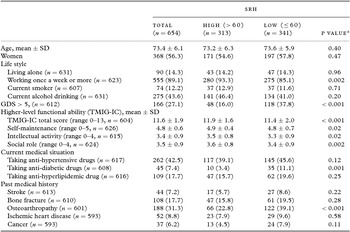
Baseline characteristics of participants are provided in Table 1. The mean age of participants was 73.4 years and 56.3% were women. Participants with low SRH were less likely to work regularly, had a higher level of depressive symptoms, and lower scores for each higher-level functional capacity compared to those with high SRH. There were also differences in the use of anti-diabetic drugs and the history of osteoarthropathy between participants with high and low SRH.
Baseline characteristics of participants

a p values were calculated using a Student's t-test for continuous variables and a χ 2 test for categorical variables. Data are presented as number (%) of participants for categorical variables.
SD = standard deviation; GDS = geriatric depression scale; TMIG-IC = Tokyo Metropolitan Institute of Gerontology Index of Competence; SRH = self-rated health.
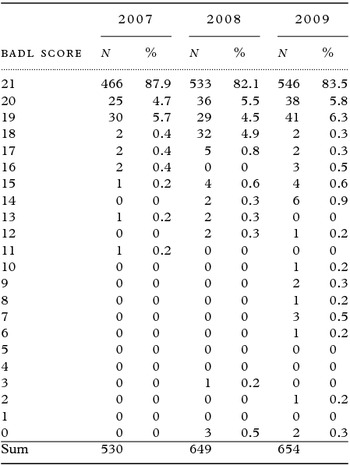
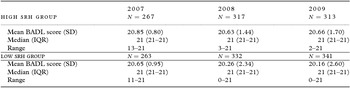
The distribution of BADL scores at follow-up is provided in Table 2. The mean BADL scores at each year by level of baseline SRH are shown in Table 3. Of the 654 participants without disability in BADL at baseline, 108 (16.5%) participants reported a decline in BADL at the three-year follow-up. In the low SRH group, 79 (23.2%) people reported a decline in BADL and the mean BADL score was 20.16 ± 2.60 at the three-year follow-up. In contrast, in the high SRH group, 29 (9.3 %) people reported a decline in BADL and the mean BADL score was 20.66 ± 1.70 at the three-year follow-up.
Distribution of basic activities of daily living scores at follow-up

BADL = basic activities of daily living.
Descriptive statistics of BADL scores by level of baseline SRH at follow-up

BADL = basic activities of daily living; SRH = self-rated health; SD = standard deviation; IQR = interquartile range.
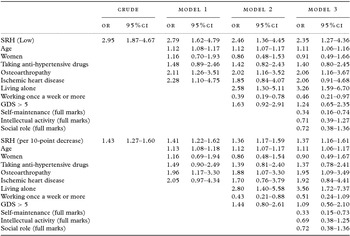
The results of a logistic regression analysis are shown in Table 4. Low SRH significantly predicted reporting one or more limitations in ADLs (OR = 2.95, 95% CI = 1.87–4.67). Age, living alone, working status, depressive symptoms, higher-level functional capacity, taking anti-hypertensive drugs, and history of osteoarthropathy and ischemic heart disease were also associated with reporting one or more limitations in ADLs (data not shown). In Model 1, age, gender, and medical condition were included as potential confounding factors. In Model 2, living arrangement, working status, and depressive symptoms were added. In Model 3, higher-level functional capacity was also added. In each model, low SRH still significantly predicted reporting one or more limitations in ADLs even after adjusting for potential confounding factors. Similar results were obtained when a logistic regression analysis was performed using baseline raw scores of SRH as the independent variable and reporting one or more limitations in ADLs as the dependent variable. A 10-point difference in SRH significantly predicted higher risk of reporting one or more limitations in ADLs (crude OR: 1.43, 95% CI: 1.27–1.60). In multivariable models, the 10-point decrease in SRH still significantly predicted reporting one or more limitations in ADLs after adjusting for potential confounding factors (Table 4).
Odds ratios for reporting one or more limitations in ADLs (from BADL = 21 to BADL < 21) at three-year follow-up from baseline SRH (high/low and per 10-point) in logistic regression analyses

OR = odds ratio; CI = confidence interval; SRH = self-rated health; GDS = geriatric depression scale.
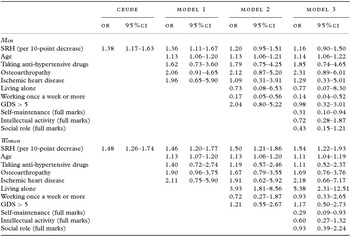
There was no significant gender difference for mean scores of SRH (men: 60.4; women: 59.0). Although the interaction effect is not significant, subgroup analyses by gender revealed a difference (Table 5). SRH was significantly associated with subsequent reporting one or more limitations in ADLs after controlling for potential confounding factors among women. In contrast, the association did not remain statistically significant after adjusting for psychosocial factor (working status) among men.
Odds ratios for reporting one or more limitations in ADLs (from BADL = 21 to BADL < 21) at three-year follow-up from baseline SRH score in logistic regression analyses among men and women

OR = odds ratio; CI = confidence interval; SRH = self-rated health; GDS = geriatric depression scale.
In the multiple linear regression analysis, using forced entry, baseline SRH (per 10-point) was significantly associated with subsequent BADL scores (ΔR2 = 0.10, F = 5.90, p < 0.001). None of the VIF values were up to two, which mean there was no collinearity in the model. The standardized regression coefficient of SRH was −0.12 (p = 0.013). Age, working status, and self-maintenance were also significantly associated with subsequent BADL scores (data not shown).
The generalized linear mixed models indicated that there was a significant group × time interaction on BADL scores (F = 5.303, p = 0.001). The change in BADL was greater for participants with low baseline SRH scores compared to participants with high SRH scores. A significant interaction was also found between time and baseline SRH (per 10-point) (p < 0.001).
Discussion
The results of this study showed that SRH assessed using a VAS predicted a risk of functional decline among community-dwelling older adults in Japan. Similar results were obtained using both dichotomized (high/low) SRH and the raw score (10-point difference) to estimate the association between SRH and functional decline. The risk of functional decline was higher for those who assessed their SRH less favorably, even after adjusting for age, gender, medical conditions, and psychosocial factors. Depressive symptoms did not reduce the association between baseline SRH and ADLs at three-year follow-up. Subgroup analyses by gender revealed that in men, the association between SRH and functional decline did not remain statistically significant after adjusting for working status.
The relationship between SRH and subsequent functional decline is consistent with previous studies that have found the predictive value of SRH for decline in BADL (Haga et al., Reference Haga1995; Idler et al., Reference Idler, Russell and Davis2000; Lee, Reference Lee2000). In these studies, psychological variables were not included as confounding factors. In contrast, psychological variables were adjusted in recent studies that have examined the predictive value of SRH for functional decline using objective assessments (Martinez et al., Reference Martinez, Kasl, Gill and Barry2010; Ashburner et al., Reference Ashburner, Cauley, Cawthon, Ensrud, Hochberg and Fredman2011; Brenowitz et al., Reference Brenowitz, Hubbard, Crane, Gray, Zaslavsky and Larson2014). It would be also needed to include psychological variables as covariates in the studies using subjective functional assessments. Previous studies have suggested psychological factors can influence the judgment of SRH (Mora et al., Reference Mora, DiBonaventura, Idler, Leventhal and Leventhal2008). In this study, there was a significant association between SRH and depressive symptoms at baseline, and participants with depressive symptoms (GDS > 5) at baseline were also likely to report ADL problems (BADL < 21) at three-year follow-up (unadjusted OR = 2.04, 95% CI = 1.31–3.20, data not shown). Although adding depressive symptoms as covariates reduced the magnitude of the association between SRH and subsequent BADL, the association remained statistically significant. The current study adds to previous knowledge by showing that poor SRH predicts functional decline after controlling for psychological factors. However, the only psychological factor assessed in the study was depression. Previous studies have found that positive psychological variables, such as self-esteem and sense of coherence were associated with the rating of SRH (Kristenson et al., Reference Kristenson, Olsson and Kucinskiene2005). Benyamini et al. (Reference Benyamini, Idler, Leventhal and Leventhal2000a) also showed that positive, rather than negative, factors strongly influence elderly people's judgment of SRH (Benyamini et al., Reference Benyamini, Idler, Leventhal and Leventhal2000a). These positive psychological factors may serve as a resource that contributes to the maintenance of good health and resilience to stress. Recent reviews and our previous study have reported the health benefits of positive psychological factors (Chida and Steptoe, Reference Chida and Steptoe2008; Hirosaki et al., Reference Hirosaki2013), supporting a “salutogenic pathway” proposed by Bopp et al. (Reference Bopp, Braun, Gutzwiller and Faeh2012). Although the mechanisms underlying the predictive ability of SRH for future health outcomes are still unclear, positive self-evaluation might be very helpful for older adults to maintain an active lifestyle. Previous studies have reported that older people with more positive self-perceptions of aging subsequently tended to engage in more preventive health behaviors and lived longer than those with less positive self-perceptions of aging (Levy et al., Reference Levy, Slade, Kunkel and Kasl2002; Levy and Myers, Reference Levy and Myers2004). Further studies including various positive psychological factors as covariates would be useful to better understand the association between SRH and subsequent health outcomes.
In the current study, SRH was assessed using a 100-mm VAS and the findings were consistent with previous studies using a 5-point Likert scale to assess SRH. Participants in the low-SRH group were more likely to report functional decline at three-year follow-up compared to those in the high-SRH group. Furthermore, the results showed the risk for functional decline increased as the SRH score decreased by 10 points. A previous study found a “dose-dependent” relationship between five categories of SRH (from very poor to excellent) and mortality (Bopp et al., Reference Bopp, Braun, Gutzwiller and Faeh2012). The present study adds to previous knowledge that there might be a “dose-dependent” relationship between SRH and subsequent functional decline.
No gender difference was found in the predictive value of SRH on ADLs in this study. To our knowledge, few studies have analyzed SRH as a predictor of functional ability separately by gender. One study reported a significant effect only for men (Lee, Reference Lee2000), while another found the effect was stronger for men than women (Idler et al., Reference Idler, Russell and Davis2000). Two studies observed this association for both men and women (Haga et al., Reference Haga1995; Pietilainen et al., Reference Pietilainen, Laaksonen, Rahkonen and Lahelma2011). Another study that investigated only women participants reported an association between poor SRH and a decline in walking speed (Ashburner et al., Reference Ashburner, Cauley, Cawthon, Ensrud, Hochberg and Fredman2011).
In the current study, the significant association between poor SRH and functional decline was eliminated after adjusting for working status in men. Although it might be due to a small sample size, working status may to some extent explain the association between SRH and functional decline. Working status might be reflected in the current health status and associated with judgment of SRH and also influence subsequent functional ability, particularly among men in Japan. Psychosocial factors might more strongly influence judgment of SRH or functional decline among older men, compared to older women. It has been reported that depressive symptoms had a stronger influence on ratings of SRH among men (Nishi et al., Reference Nishi, Kawachi, Shirai, Hirai, Jeong and Kondo2012). It has also been suggested that psychological distress is an important explanatory variable in the SRH-mortality association among men (Larsson et al., Reference Larsson, Hemmingsson, Allebeck and Lundberg2002). Another study reported that good SRH is associated with “more protective psychosocial resources,” “less over-commitment and vital exhaustion,” lower saliva cortisol levels, and a stronger cortisol response to stress among men (Kristenson et al., Reference Kristenson, Olsson and Kucinskiene2005). Previous studies have suggested that judgment of SRH may reflect different factors between men and women (Benyamini et al., Reference Benyamini, Leventhal and Leventhal2000b; Nishi et al., Reference Nishi, Kawachi, Shirai, Hirai, Jeong and Kondo2012). Further studies are needed to investigate gender differences in the association between SRH and subsequent functional ability.
The present study had several limitations. First, the study population lived in a small rural town in Japan. Therefore, generalizability may be limited. Replication in a population-based sample would be needed to support our findings. In addition, loss to follow-up might affect the generalizability of the findings. A comparison of baseline characteristics (in 2006) between those who participated in the three-year follow-up (654 people) and those who did not participated in the three-year follow-up (362 people) showed that those who completed the three-year follow-up were likely to be women and reported a higher intellectual activity score than those who did not participate in the follow-up survey (data not shown). Although most of the participants (92%) reported that they had no difficulty with daily activities with their glasses on (or without glasses) at baseline, those who experienced vision decline during the follow-up also might not respond the questionnaire. Second, the association between SRH and functional decline might be a result of some unmeasured confounding factors. Third, information about functional ability was obtained from self-reports. The correlation between self-report measures of functional status and performance-based measures can be moderate, and self-reported measures of physical function was associated with physiologic, as well as psychosocial factors (Bean et al., Reference Bean, Olveczky, Kiely, LaRose and Jette2011). Further studies are required to examine the association between SRH and functional decline using an objective measure of functional status in Japan.
The strengths of this study are the community-based sample, the use of a VAS to assess SRH, and various medical and psychosocial factors based on comprehensive geriatric assessment as covariates. To our best knowledge, the predictive value of SRH (using a VAS) on functional decline in a dose dependent manner has not previously been described.
In conclusion, the findings suggest that SRH was an independent predictor of subsequent loss or maintenance of functional ability among community-dwelling older adults in Japan. Positive self-evaluation might be helpful for older people to maintain a healthy and active lifestyle. Although there might be a gender difference, SRH could be a useful tool for screening high-risk groups among older people.
Conflict of interest
None.
Description of authors’ role
MH: research question, data analysis, interpretation of the results, and writing the manuscript; All authors: data collection and preparation of the manuscript; K.Okumiya, TW, MI, K. Otsuka, and KM: designing the study.
Acknowledgments
We would like to thank all of the research participants and the public health nurses in Tosa Town. This study was partly supported by the Grant-in-Aid of the JSPS Global COE Program (E-04) and the Grant-in-Aid for Scientific Research 26860425 from the Ministry of Education, Culture, Sports, Science, and Technology, Japan.