INTRODUCTION
Egyptian historical chronology is based on a synthesis of various king-lists and their reign lengths, records of festivals, and genealogical data (Hornung et al. Reference Hornung, Krauss and Warburton2006). Written and material synchronisms link this detailed timeline with various Near Eastern and eastern Mediterranean chronologies (Warren and Hankey Reference Warren and Hankey1989; Bietak Reference Bietak2013). Generally, the timeline may be extended back from modernity through dead-reckoning to at least the beginning of the New Kingdom, ~1550 BCE (Kitchen Reference Kitchen2007). Prior to this point, an unreliable historical record severs the earlier chronology, leaving it “floating” in absolute time (Kitchen Reference Kitchen2007). Temple records of celestial observations from Illahun, Egypt, offer astro-chronological data by means of which this MK section may be anchored (Luft Reference Luft1992; Hornung et al. Reference Hornung, Krauss and Warburton2006). The most important datum is the heliacal rising of the star Sirius (Greek Sothis) mentioned in Papyri 10012A and 10012B, now in the Egyptian Museum, Berlin (Luft Reference Luft1992). Various calculations date this occurrence to specific years between 1882 and 1830 BCE, making this event Egypt’s, and indeed the world’s, earliest chronological datum (Krauss Reference Krauss2006), and one that has never previously been independently verified.
BACKGROUND
The ancient Egyptians used a 365-day “civil” calendar of 30 days × 12 months plus five epagomenal days (Hornung et al. Reference Hornung, Krauss and Warburton2006). In theory, the first day of the civil year was intended to coincide with the rising at dawn of Sothis for 4 days after a 70-day disappearance, as it is recorded as doing in 139 CE (Ward Reference Ward1992). As the Egyptian calendar had no correction for being 0.24 days short of a solar year, a single day was lost every 4 yr. The result was an incremental shift of 1 day every 4 yr, with approximately 1460 yr (4 × 365) passing before it returned to its original position, creating what is known as the Sothic cycle. Retrojecting from 139 CE, this event would also have taken place around 1317 and 2773 BCE. Thus, any document including both a civil date and a Sothic observation can be assigned an absolute date. The earliest such observation is Papyrus 10012A, which records the anticipated heliacal rising of Sothis in the fourth month of prt, day 16 (Luft Reference Luft1992). Papyrus 10012B notes the offerings given for Sothis on day 17 (Luft Reference Luft1992). Despite apparently precise Egyptian record-keeping, numerous unknowns remain, including the geographical location of the observation, the observer’s altitude, and meteorological conditions and to which of the 4 days of helical rising the observation referred. These, together with the need to refine this datum with lunar observations, has resulted in various computed year dates: 1872 (Parker Reference Parker1950), 1866 (Luft Reference Luft1992), and 1831–1830 (Hornung et al. Reference Hornung, Krauss and Warburton2006; Krauss Reference Krauss2006).
SAMPLES
Both pieces of Papyrus 10012 (labeled A and B) are housed in the Egyptian Museum, Berlin. A 20-mg section of Papyrus 10012B was obtained for analysis at the Oxford Radiocarbon Accelerator Unit (ORAU). The piece was split first in two in order to obtain duplicate dates. No glues or preservatives were observed on the fragments, but for robustness they were subjected to a triplicate solvent wash to eliminate such contamination. The duplicate samples were treated using sequential acetone (45°C, 45 min), methanol (45°C, 45 min), and chloroform (RT, 45 min) rinses interspersed with three washes in distilled water. After air-drying overnight, the samples were subjected to ORAU’s standard aqueous pretreatment process (see Brock et al. Reference Brock, Higham, Ditchfield and Bronk Ramsey2010). This treatment is designed to isolate the holocellulosic fraction. This comprised washing in acid (1M HCl, 80°C, 20 min), base (0.2M NaOH, 80°C, 20 min), and acid (1M HCl, 80°C, 20 min), with a final oxidation step (acidified NaClO2, 0–5%, 20–80°C, 20 min). The strength of the oxidant employed in the final step was based on the fragility of the sample. Again, washing in ultrapure water was applied between each pretreatment step. The resultant holocellulose fractions were freeze-dried overnight. Approximately 4-mg samples were then combusted in an elemental analyzer coupled to a mass spectrometer, which measured the δ13C value. The CO2 produced was collected cryogenically, graphitized, and dated at ORAU’s AMS facility (see Bronk Ramsey et al. Reference Bronk Ramsey, Higham and Leach2004).
RESULTS AND INTERPRETATION
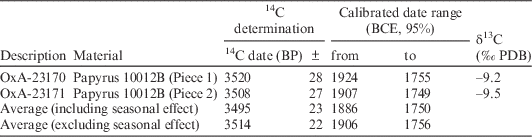
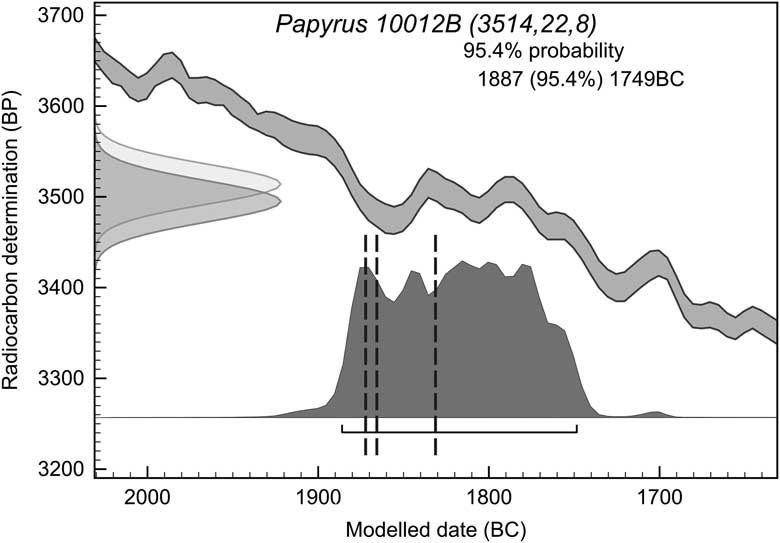
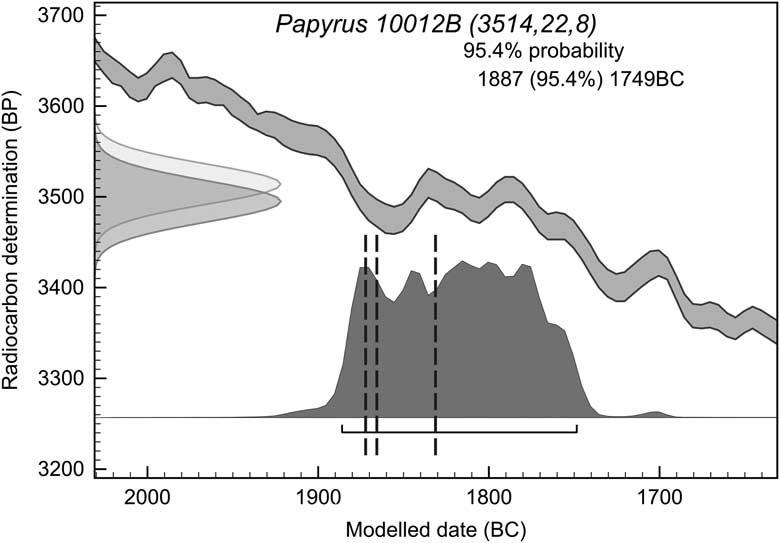
Duplicate 14C measurements made on a fragment from Papyrus 10012B were combined into one 14C determination (see Table 1). In order to correctly calibrate this result, we employed the additional “growing season offset” proposed by Dee et al. (Reference Dee, Brock, Harris, Bronk Ramsey, Shortland, Higham and Rowland2010) The calibrated date range produced was 1886–1750 BCE (95.4% probability, Figure 1). Owing to the plateau on the calibration curve, this calendrical range easily encompasses all suggested single-year estimates for this Sothic date, with no preference for any one particular solution. These results compare extremely well with results from other previously published samples of inscribed and dated papyri from Illahun, including from proximal regnal years (Bronk Ramsey et al. Reference Bronk Ramsey, Dee, Rowland, Higham, Harris, Brock, Quiles, Wild, Marcus and Shortland2010). They also demonstrate that the absolute position of the Egyptian chronology during the first half of the 2nd millennium BCE is correct. Clearly, any radical shifts in Egyptian chronology, as have been seemingly noted in the past (Bietak and Höflmayer Reference Bietak and Höflmayer2007: 14, Figure 1) find no support in the 14C data presented here or previously (Bronk Ramsey et al. Reference Bronk Ramsey, Dee, Rowland, Higham, Harris, Brock, Quiles, Wild, Marcus and Shortland2010). In addition, the upper bound of the probability distribution (1886 BCE) shows that the true date cannot be much higher than that posited by the highest estimate.
The isotopic measurements obtained on the papyrus sample. Note that a correlated error of ±8 BP was also included in the averaging process to allow for intra-annual 14C variation.

Calibrated age ranges for Papyrus 10012B
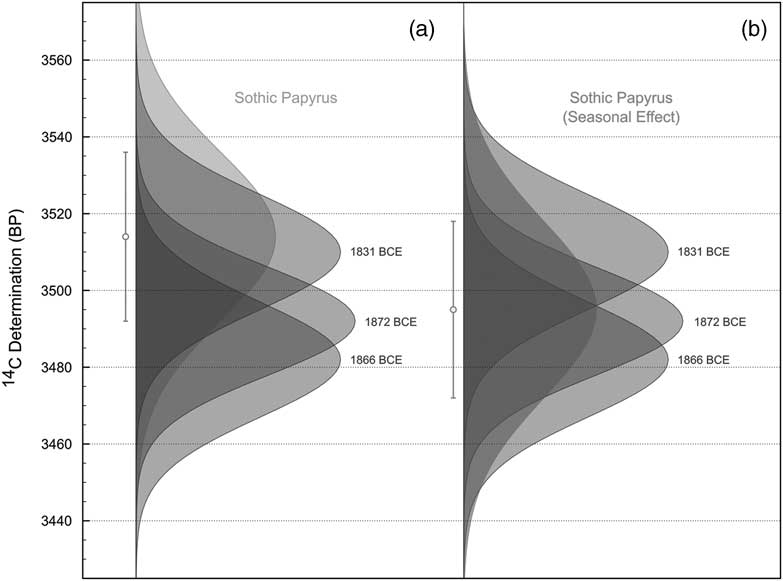
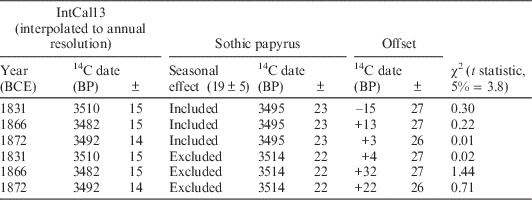
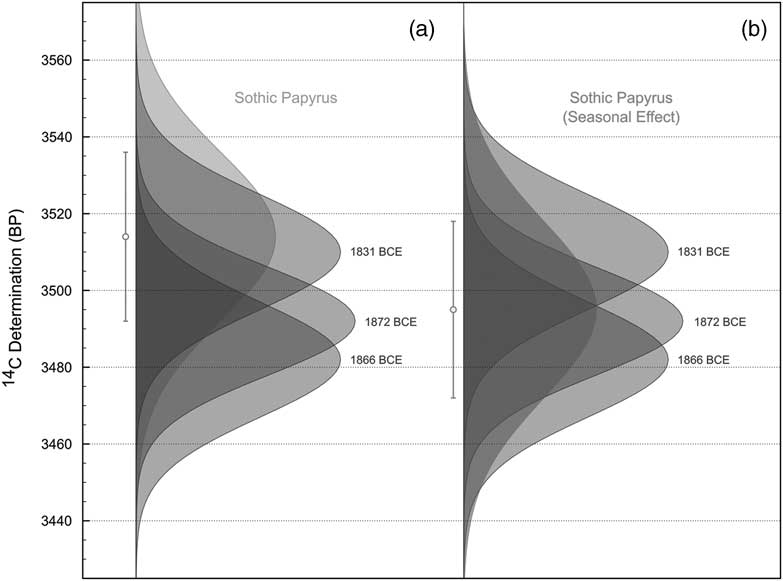
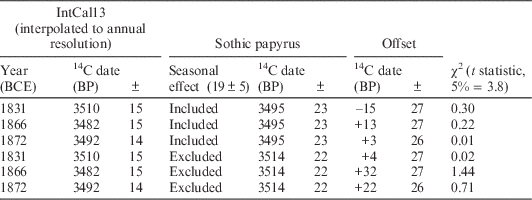
Further insight may be gained into the consistency of this result with the three leading historical estimates of the document’s age by comparing the measurement directly with values taken from the calibration curve for these specific years. In order to do this, we interpolated IntCal13 (Reimer et al. Reference Reimer, Bard, Bayliss, Beck, Blackwell, Bronk Ramsey, Buck, Cheng, Edwards, Friedrich, Grootes, Guilderson, Haflidason, Hajdas, Hatté, Heaton, Hoffmann, Hogg, Hughen, Kaiser, Kromer, Manning, Niu, Reimer, Richards, Scott, Southon, Staff, Turney and van der Plicht2013) to annual resolution using the software OxCal (Bronk Ramsey Reference Bronk Ramsey1995). The values obtained and their uncertainties are given in Table 2. As both the annual calibration values and the Sothic papyrus measurement are realizations of normally distributed random variables, they may be readily compared using classical statistical techniques. The right-hand column of Table 2 shows the t statistics obtained by applying the test described in Ward and Wilson (Reference Ward and Wilson1978). Such data follow a χ2 distribution, whereby two results are considered statistically indistinguishable if t < 3.8 (at 95% probability, df=1). The t statistics obtained for each candidate year all easily meet this criterion. The same comparison was made without including the seasonal effect, in order to evaluate its contribution. Once more, the t statistics showed the result was still compatible with all three candidate years, although the values were slightly higher overall. This approach also revealed an interesting dichotomy. If the seasonal effect is included, our measurement is slightly more compatible with the atmospheric 14C concentration corresponding to the date of Parker but, if it is ignored, the lower date of Krauss and Hornung is more favored. This pattern is clearly illustrated in Figure 2.
Calibration with and without the seasonal effect for the Sothic papyrus
Comparison of the 14C determination on the Sothic papyrus with IntCa13 interpolated to annual resolution. The test statistics are given in the right-hand column. If t <3.8 (n=2, df =1), the IntCal and Sothic measurements may be considered statistically indistinguishable at 95% probability (see Ward and Wilson Reference Ward and Wilson1978). The t statistics are given for each year, with and without the proposed seasonal effect for Egypt (Dee et al. Reference Dee, Brock, Harris, Bronk Ramsey, Shortland, Higham and Rowland2010). Note that 1831 BCE was used for the date of Krauss and Warburton.
CONCLUSIONS
Overall, the results confirm the accuracy of the calculation method for the Sothic date and, more precisely, indicate that astro-chronological and radiometric methods are congruent. Likewise, any chronologies of the Near East and eastern Mediterranean cross-linked with that of Middle Kingdom Egypt are also bolstered by this finding. 14C dating is, however, unable to distinguish which of the main historical estimates is most probable. Whether allowance is made for a possible seasonal effect or not, all three estimates are encompassed by the calibrated date ranges (95% probability). An interesting outcome, however, is that the inclusion of a growing season effect ever so slightly shifts the compatibility of our 14C determination from the lowest to the highest of the three dates.
ACKNOWLEDGMENTS
The authors gratefully acknowledge the following for support: German-Israel Fund Grant No. I-2069-1230.4/2004 (awarded to E Marcus); The Leverhulme Trust (Michael Dee’s Early Career Fellowship); Dietrich Wildung former director of the Egyptian Museum Berlin; Dr. Ingeborg Müller and Ms. Miriam Kreutsch of the Papyrussamlung; U Luft; and M Bietak.