A complex interplay between a fetus's genome and the intrauterine environment equips a newborn with a range of neurobehavioral competences that may contribute to emotion regulation (Lester et al., Reference Lester, Miller, Hawes, Salisbury, Bigsby, Sullivan and Padbury2011; Monk & Hane, Reference Monk, Hane and Wenzel2016). Early caregiving experiences may then transact with critical aspects of neurobehavior to shape development of emotion regulation across childhood (Beauchaine, Reference Beauchaine2015a; Beauchaine & Crowell, Reference Beauchaine and Crowellin press). Effective emotion regulation enables a child to flexibly modulate emotional responses in service of goal-directed behaviors, an essential skill for social and emotional well-being (Beauchaine & Zisner, Reference Beauchaine and Zisner2017; Gross, Reference Gross1998; Thompson, Reference Thompson1993). In contrast, even among infants, emerging emotional experiences may exceed rudimentary regulatory capacities and interfere with adaptive behavior, giving rise to identifiable antecedents of emotion dysregulation.
Emotion dysregulation is characterized by a failure of emotional responses to aid in goal-directed behavior, due to either inappropriately adjusting one's expressed emotions or incorrectly matching regulatory strategies to circumstances (Beauchaine, Reference Beauchaine2015a; Fernandez, Jazaieri, & Gross, Reference Fernandez, Jazaieri and Gross2016). Emotion dysregulation is prevalent in internalizing and externalizing disorders, and is consequently considered a transdiagnostic vulnerability for psychopathology across the life span (Beauchaine, Reference Beauchaine2015b; Beauchaine & Thayer, Reference Beauchaine and Thayer2015; Cole, Hall, & Hajal, Reference Cole, Hall, Hajal, Beauchaine and Hinshaw2013; Crowell et al., Reference Crowell, Baucom, Yaptangco, Bride, Hsiao, McCauley and Beauchaine2014; McLaughlin, Hatzenbuehler, Mennin, & Nolan-Hoeksema, Reference McLaughlin, Hatzenbuehler, Mennin and Nolen-Hoeksema2011). This behavioral trait emerges early in life and continues to develop across childhood in transaction with maturational and social influences (Crowell, Puzia, & Yaptangco, Reference Crowell, Puzia and Yaptangco2015). Despite its early emergence, the role of prenatal influences on an infant's risk for emotion dysregulation remains poorly understood.
We argue that foundational aspects of emotion dysregulation may be established in utero and evident at birth. Through a detailed and multifaceted assessment of neurobehavioral function (e.g., Lester et al., Reference Lester, Tronick, LaGasse, Seifer, Bauer, Shankaran and innegan2002), researchers have identified patterns of newborn neurobehavior predictive of temperamental vulnerabilities to emotion dysregulation as well as childhood psychopathology (Lester et al., Reference Lester, Bagner, Liu, LaGasse, Seifer, Bauer and Das2009; Liu et al., Reference Liu, Bann, Lester, Tronick, Das, Lagasse and Bada2010; Sheinkopf et al., Reference Sheinkopf, Lester, LaGasse, Seifer, Bauer, Shankaran and Wright2006). This approach may be well suited for characterizing specific early neurobehavioral markers of emotion dysregulation. The ability to distinguish critical aspects of emotion dysregulation among neonates may ultimately uncover perinatal prevention targets to ameliorate childhood psychopathology risk. One such target may be an expectant mother's own emotion dysregulation, as the neurobehavioral consequences of prenatal maternal mood are already apparent among fetuses and neonates (Alder, Fink, Bitzer, Hösli, & Holzgreve, Reference Alder, Fink, Bitzer, Hösli and Holzgreve2007; DiPietro, Costigan, Nelson, Gurewitsch, & Laudenslager, Reference DiPietro, Costigan, Nelson, Gurewitsch and Laudenslager2008; Field et al., Reference Field, Diego, Hernandez-Reif, Schanberg, Kuhn, Yando and Bendell2003; Monk et al., Reference Monk, Fifer, Myers, Sloan, Trien and Hurtado2000).
Clarifying prenatal origins of newborn neurobehavior may also contribute to identifying mechanistic pathways by which emotion dysregulation is transmitted from mother to child. Informed by embryology, perinatology, and developmental psychobiology (Hinshaw, Reference Hinshaw, Beauchaine and Hinshaw2017), the developmental psychopathology perspective offers a cohesive, multilevel framework for linking fetal programming theories, such as the developmental origins of health and disease hypothesis (Wadhwa, Buss, Entringer, & Swanson, Reference Wadhwa, Buss, Entringer and Swanson2009), to normative and aberrant childhood behavior. This perspective recognizes the complex nature of development and attempts to identify key biosocial mechanisms driving psychopathology risk and resilience (see Cicchetti, Reference Cicchetti1984, Reference Cicchetti, Beauchaine and Hinshaw2008, Reference Cicchetti2016; Cicchetti & Rogosch, Reference Cicchetti and Rogosch1996; Hinshaw, Reference Hinshaw, Beauchaine and Hinshaw2017). It also complements recent efforts from the National Institute of Mental Health's Research Domain Criteria (RDoC) initiative, which is aimed at understanding how dysfunction across levels of analysis contributes to the onset and trajectory of psychopathology (Insel et al., Reference Insel, Cuthbert, Garvey, Heinssen, Pine, Quinn and Wang2010). The developmental psychopathology framework may be particularly useful for advancing the less established developmental dimension of RDoC, which notes that “many areas of the child psychopathology literature (e.g., reward sensitivity, cognitive and emotional dysregulation, behavioral inhibition) serve as a more compatible model for a dimensionally-based approach compared to the highly specified categories of adult psychopathology” (National Institute of Mental Health, 2018). As recently touted by Doyle and Cicchetti (Reference Doyle and Cicchetti2018), extending RDoC to the womb will allow for a more precise characterization of the intergenerational transmission of psychiatric disorders that have prenatal origins. In the present study, we examined whether neurobehavioral markers of emotion dysregulation are evident in neonates, as well as whether the identified markers associated with prenatal exposure to maternal emotion dysregulation (Part II). These findings extend results on maternal psychopathology and emotion dysregulation (Part I; Lin et al., 2019 [this issue]).
Detecting Emotion Dysregulation in Neonates
All infants possess rudimentary regulatory strategies at birth (Johnson, Posner, & Rothbart, Reference Johnson, Posner and Rothbart1991), although some infants are better able to utilize these strategies to effectively modulate their distress. Paired with a biological vulnerability (e.g., irritability), infants who are unable to effectively recruit basic regulatory strategies may be more difficult to parent, due to heightened reactivity and poor regulation (Rothbart, Ahadi, & Hershey, Reference Rothbart, Ahadi and Hershey1994). These individual differences may be reinforced over the first years of life, placing children at elevated risk for childhood psychopathology (Beauchaine, Reference Beauchaine2015a; Bohlin & Hagekull, Reference Bohlin and Hagekull2009; Crowell, Yaptangco, & Turner, Reference Crowell, Yaptangco, Turner, Dishion and Snyder2016; Eisenberg et al., Reference Eisenberg, Sadovsky, Spinrad, Fabes, Losoya, Valiente and Shepard2005; Gartstein, Putnam, & Rothbart, Reference Gartstein, Putnam and Rothbart2012). Fortunately, foundational neurobehavioral aspects of emotion dysregulation (e.g., arousal and attention) may be evident in the neonate, paving the way for intervention.
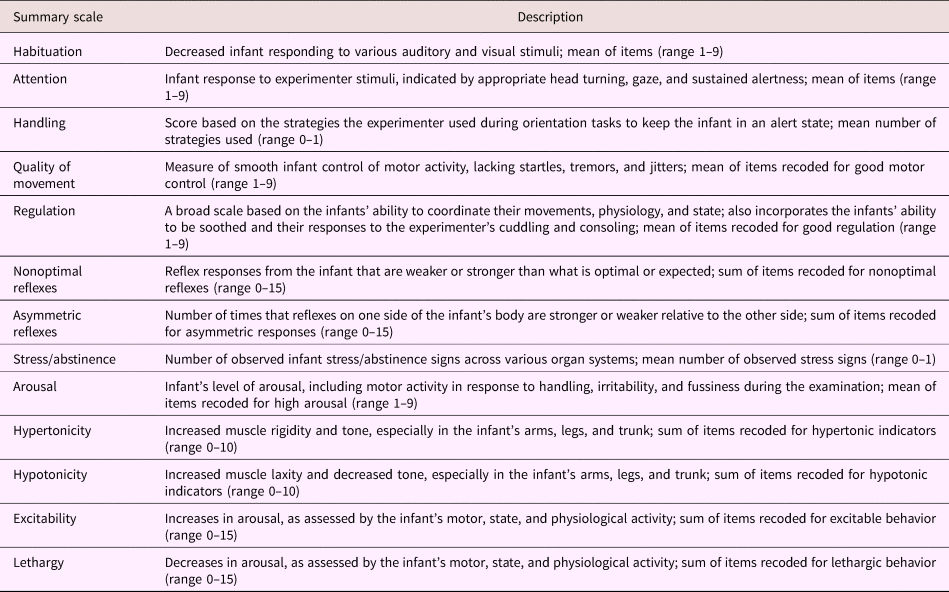
The term “neurobehavior” acknowledges that behavior and physiology are intrinsically linked through neurophysiological mechanisms. Neurobehavioral competencies, then, are the observable outcomes of a dynamic interplay between behavioral and physiological processes. The constellation of these neurobehavioral competencies reflects a newborn's neural, cognitive, and behavioral function, and provides practitioners (and parents) with a holistic view of the developing child (Lester, Tronick, & Brazelton, Reference Lester, Tronick and Brazelton2004). Researchers and clinicians can evaluate neurobehavioral competencies using the NICU Network Neurobehavioral Scale (NNNS), a reliable, valid, and standardized measure of individual differences in a newborn's neurological integrity and behavioral function (Lester et al., Reference Lester, Tronick, LaGasse, Seifer, Bauer, Shankaran and innegan2002, Reference Lester, Tronick and Brazelton2004). Performance across a variety of functional domains are considered when assessing a newborn (Table 1). Initially designed for a study on effects of prenatal substance exposure (Lester et al., Reference Lester, Tronick, LaGasse, Seifer, Bauer, Shankaran and innegan2002), this procedure can be administered to infants at risk due to prenatal stress exposure as well as full-term, low-risk infants. The NNNS has been shown to be sensitive to variation in prenatal exposures (Salisbury, Fallone, & Lester, Reference Salisbury, Fallone and Lester2005; Salisbury et al., Reference Salisbury, Lester, Seifer, LaGasse, Bauer, Shankaran and Poole2007; Stroud et al., Reference Stroud, Paster, Papandonatos, Niaura, Salisbury, Battle and Lester2009), and is useful for identifying early cognitive and socioemotional dysfunction (Liu et al., Reference Liu, Bann, Lester, Tronick, Das, Lagasse and Bada2010; Stephens et al., Reference Stephens, Liu, Lester, Lagasse, Shankaran, Bada and Higgins2010), lending support to its clinical utility.
NICU Network Neurobehavioral Scale summary scales

Salisbury et al. (Reference Salisbury, Lester, Seifer, LaGasse, Bauer, Shankaran and Poole2007) found that 1-month-olds who had been exposed to high levels of prenatal maternal depression performed worse in domains such as arousal, excitability, and regulation, compared to their unexposed peers (see Conradt, Sheinkopf, et al., Reference Conradt, Sheinkopf, Lester, Tronick, LaGasse, Shankaran and Hammond2013; Law et al., Reference Law, Stroud, LaGasse, Niaura, Liu and Lester2003; Napiorkowski et al., Reference Napiorkowski, Lester, Freier, Brunner, Dietz, Nadra and Oh1996; and Stroud et al., Reference Stroud, Paster, Papandonatos, Niaura, Salisbury, Battle and Lester2009, for similar results related to prenatal substance exposure). Heightened reactivity and poor regulation among newborns are associated with a variety of developmental outcomes, namely, temperamental irritability and fearfulness in infancy and problem behavior in early childhood (Lester et al., Reference Lester, Bagner, Liu, LaGasse, Seifer, Bauer and Das2009; Liu et al., Reference Liu, Bann, Lester, Tronick, Das, Lagasse and Bada2010; Sheinkopf et al., Reference Sheinkopf, Lester, LaGasse, Seifer, Bauer, Shankaran and Wright2006). Liu et al. (Reference Liu, Bann, Lester, Tronick, Das, Lagasse and Bada2010) found that infants who were exposed to more illicit substances prenatally tended to be highly reactive and lacked effective regulatory abilities (e.g., high arousal and excitability, poor self-regulation, and poor attention with more handling strategies required to maintain appropriate state). Approximately 40% of these infants showed significant problems in behavior and school readiness at 3 and 4 years of age, respectively (Liu et al., Reference Liu, Bann, Lester, Tronick, Das, Lagasse and Bada2010). Using the same sample of children, Lester et al. (Reference Lester, Bagner, Liu, LaGasse, Seifer, Bauer and Das2009) found that prenatal substance exposure was associated with higher newborn behavioral reactivity, which in turn predicted higher levels of infant difficult temperament (i.e., irritability and fearfulness). Difficult temperament in infancy was then related to behavioral problems when the child was 3- and 7-years old (Lester et al., Reference Lester, Bagner, Liu, LaGasse, Seifer, Bauer and Das2009). It may be that newborn neurobehavior (measured at birth via the NNNS) is influenced by prenatal insults, and can distinguish children who are at elevated psychopathology risk. Whether individual differences in newborn neurobehavior portend early signs of emotion dysregulation remains to be seen.
We acknowledge that emotion dysregulation per se is not present at birth. It is widely agreed that emotion dysregulation is a consequence of biologically based behavioral vulnerabilities transacting with high-risk familial environments (Beauchaine, Reference Beauchaine2015a; Crowell et al., Reference Crowell, Puzia and Yaptangco2015). With this in mind, we argue that foundational aspects of emotion dysregulation—namely, early emerging, biologically based vulnerabilities (e.g., irritability and arousal) and rudimentary regulatory behaviors (e.g., vigilance)—may begin developing in utero, and manifest as individual differences in newborn neurobehavior. These differences may then be reinforced over early childhood, which may contribute to risk for early emotion dysregulation (Beauchaine, Reference Beauchaine2015a). Newborn neurobehavioral markers of emotion dysregulation may ultimately point to prevention targets for reducing a child's psychopathology risk. For instance, clinicians may be able to identify infants at birth who have a proclivity toward heightened reactivity and poor self-regulation, thereby enabling early dissemination of parenting interventions to ameliorate familial risk. In support of a precision-medicine approach, interventions could be aimed at teaching parents about their newborn's unique characteristics, while bolstering caregiving strategies that support emotion regulation development.
However, before interventions can be developed, researchers must be able to reliably identify aspects of emotion dysregulation in early infancy. The NNNS provides a detailed and multifaceted assessment of neurobehavioral function and may shed light on early neurobehavioral markers evident among neonates (Lester et al., Reference Lester, Tronick, LaGasse, Seifer, Bauer, Shankaran and innegan2002, Reference Lester, Tronick and Brazelton2004). Understanding the prenatal factors that contribute to individual differences in these neurobehavioral markers may also be useful for future preventative services. An expectant mother's own proneness to emotion dysregulation may be one particularly potent prenatal influence that warrants further attention.
A Multiple-Levels-of-Analysis Approach to Maternal Emotion Dysregulation During Pregnancy
Fetal programming theories posit that an expectant mother's mental and physical health influences her offspring by altering the fetus's neural and behavioral development (Gluckman & Hanson, Reference Gluckman and Hanson2004; Gluckman, Hanson, Cooper, & Thornburg, Reference Gluckman, Hanson, Cooper and Thornburg2008; Lucas, Fewtrell, & Cole, Reference Lucas, Fewtrell and Cole1999; Wadhwa et al., Reference Wadhwa, Buss, Entringer and Swanson2009). Prenatal experiences, including an expectant mothers’ psychological distress (e.g., stress and depression), influence fetal neurodevelopment, even when controlling for postnatal maternal mood (Monk, Lugo-Candelas, & Trumpff, Reference Monk, Lugo-Candelas and Trumpffin press). Maternal psychological distress has been related to a number of obstetric complications and adverse newborn outcomes, including premature delivery, low birth weight, admission to neonatal care units, smaller head circumference, lower Apgar scores, and less optimal scores on the Brazelton Neonatal Behavior Assessment Scale (Alder et al., Reference Alder, Fink, Bitzer, Hösli and Holzgreve2007; Field et al., Reference Field, Diego, Hernandez-Reif, Schanberg, Kuhn, Yando and Bendell2003). Unfortunately, the sequelae of a pregnant woman's distress typically do not end in infancy, as emotional and behavioral difficulties may persist into childhood and adolescence (O'Donnell, Glover, Barker, & O'Connor, Reference O'Donnell, Glover, Barker and O'Connor2014; O'Donnell et al., Reference O'Donnell, Glover, Jenkins, Browne, Ben-Shlomo, Golding and O'Connor2013; Stein et al., Reference Stein, Pearson, Goodman, Rapa, Rahman, McCallum and Pariante2014).
Examining prenatal exposure to mood disorders and related constructs has furthered our understanding of the intergenerational transmission of psychopathology; however, mounting evidence suggests that diagnostic categories do not align well with findings from clinical neuroscience, or appropriately capture underlying biosocial mechanisms (Insel et al., Reference Insel, Cuthbert, Garvey, Heinssen, Pine, Quinn and Wang2010). We have therefore adopted an alternative approach that focuses on an expectant mothers’ transdiagnostic vulnerability, chiefly emotion dysregulation (Beauchaine, Reference Beauchaine2015a; Fernandez et al., Reference Fernandez, Jazaieri and Gross2016). Pregnant women's emotion dysregulation has received minimal attention, despite its relevance for a developing fetus. Biological processes related to emotion dysregulation (e.g., respiratory sinus arrhythmia) may also have important implications for the developing fetus. Understanding how a pregnant woman's autonomic functioning relates to infant outcomes may complement her self-reported emotion dysregulation.
Respiratory sinus arrhythmia (RSA) is frequently used as a noninvasive index of inhibitory cardiac control by the vagus nerve, and is considered a reliable biomarker of emotion dysregulation (Beauchaine, Reference Beauchaine2001, Reference Beauchaine2015b; Beauchaine & Thayer, Reference Beauchaine and Thayer2015; Porges, Reference Porges2007; reviewed in Balzarotti, Biassoni, Colombob, & Ciceri, Reference Balzarotti, Biassoni, Colombo and Ciceri2017). RSA refers to rhythmic oscillation of heart rate across the respiratory cycle. Modest decreases to emotional evocation indicate a shift in attentional and behavioral resources (via reduction of inhibitory cardiac control) to cope with environmental demands (Porges, Reference Porges2007). Exaggerated RSA reactivity, however, appears to reflect a core physiological dysfunction underlying emotion dysregulation and, consequently, psychopathology (Beauchaine, Reference Beauchaine2001; Beauchaine, Gatzke-Kopp, & Mead, Reference Beauchaine, Gatzke-Kopp and Mead2007; Beauchaine & Thayer, Reference Beauchaine and Thayer2015). Little is known about associations between a pregnant woman's physiological reactivity and her newborn's neurobehavior.
As pregnancy advances, a woman's cardiovascular activity attenuates (e.g., reduced blood pressure and heart rate variability; De Weerth & Buitelaar, Reference De Weerth and Buitelaar2005; DiPietro, Costigan, & Gurewitsch, Reference DiPietro, Costigan and Gurewitsch2003; Entringer et al., Reference Entringer, Buss, Shirtcliff, Cammack, Yim, Chicz-DeMet and Wadhwa2010; Klinkenberg et al., Reference Klinkenberg, Nater, Nierop, Bratsikas, Zimmermann and Ehlert2009; Matthews & Rodin, Reference Matthews and Rodin1992). The magnitude of pregnancy-related decreases in autonomic activity and acute reactivity relative to dramatically increased blood volume may differ as a function of maternal-specific factors (e.g., anxiety and stress; Braeken et al., Reference Braeken, Jones, Otte, Widjaja, Van Huffel, Monsieur and Van den Bergh2015; Herbell, Reference Herbellin press). Ablow, Marks, Feldman, and Huffman (Reference Ablow, Marks, Feldman and Huffman2013), for example, found that pregnant women with secure-autonomous attachments showed modest RSA decreases in response to an infant cry, a pattern of physiological adaptation that may facilitate approach behaviors. In contrast, expectant women with insecure–dismissing attachments did not show this response to the infant cry, which may inhibit their ability to mobilize and soothe the infant. An expectant mothers’ modest parasympathetic flexibility, in the context of an overall attenuated response, may buffer the developing fetus from the effects of maternal prenatal stress and psychopathology; deviations from this pattern may affect fetal neurobehavioral development (Braeken et al., Reference Braeken, Jones, Otte, Widjaja, Van Huffel, Monsieur and Van den Bergh2015; Christian, Reference Christian2012; Entringer et al., Reference Entringer, Buss, Shirtcliff, Cammack, Yim, Chicz-DeMet and Wadhwa2010; Glynn, Dunkel Schetter, Hobel, & Sandman, Reference Glynn, Dunkel Schetter, Hobel and Sandman2008; Monk, Myers, Sloan, Ellman, & Fifer, Reference Monk, Myers, Sloan, Ellman and Fifer2003; O'Connor, Monk, & Fitelson, Reference O'Connor, Monk and Fitelson2014; O'Donnell, O'Conner, & Glover, Reference O'Donnell, O'Connor and Glover2009; Posner et al., Reference Posner, Cha, Roy, Peterson, Bansal, Gustafsson and Monk2016; reviewed in Van den Bergh, Mulder, Mennes, & Glover, Reference Van den Bergh, Mulder, Mennes and Glover2005). No studies, to our knowledge, have examined how a pregnant woman's autonomic reactivity relates to her newborn's neurobehavior. RSA reactivity is one index of emotion dysregulation that, in conjunction with self-report measures, may help to better characterize a pregnant woman's dysregulated mood across levels of analysis.
While emotion dysregulation is often thought to manifest across levels of analysis, the role of external stressors remains poorly understood (Beauchaine et al., Reference Beauchaine, Gatzke-Kopp and Mead2007; Crowell et al., Reference Crowell, Puzia and Yaptangco2015). A pregnant woman's dysregulation does not, however, exist devoid of contextual influences. Stress and emotion dysregulation, while unique constructs, are highly related and have interdependent processes across the life span (e.g., Herts, McLaughlin, & Hatzenbuehler, Reference Herts, McLaughlin and Hatzenbuehler2012). Researchers have rarely examined these constructs simultaneously, partly because the construct of prenatal stress is amorphous and ill-defined (Conradt et al., Reference Conradt, Adkins, Crowell, Raby, Diamond and Ellis2018; Doyle & Cicchetti, Reference Doyle and Cicchetti2018). Most stress research to date has utilized self-report measures despite concerns about the reliability and validity of doing so. In response, Hammen et al. (Reference Hammen, Adrian, Gordon, Burge, Jaenicke and Hiroto1987), among others (e.g., Monroe, Reference Monroe2008; Rudolph et al., Reference Rudolph, Hammen, Burge, Lindberg, Herzberg and Daley2000), have argued that experiences of stress should be discussed with an interviewer who can subsequently provide an objective evaluation of chronicity and severity. A goal of this approach is to increase the validity of this construct (Hammen, Reference Hammen2005).
A woman who is highly dysregulated may experience both chronic and episodic stress throughout her pregnancy (e.g., Crowell et al., Reference Crowell, Puzia and Yaptangco2015), supporting the importance of assessing stress and dysregulation simultaneously. This effect is likely bidirectional, given that a woman who experiences relatively high levels of stress during pregnancy may be more likely to become dysregulated and vice versa. Unfortunately, little is known about how these constructs operate when considered concurrently during this sensitive period for a woman and her developing child. These constructs are not mutually exclusive, and do show overlap in their occurrence and manifestation across the life span (e.g., Herts et al., Reference Herts, McLaughlin and Hatzenbuehler2012). However, given its relevance as a transdiagnostic vulnerability for psychopathology (Beauchaine, Reference Beauchaine2015b; Cole et al., Reference Cole, Hall, Hajal, Beauchaine and Hinshaw2013), it is possible that emotion dysregulation is an important risk factor above and beyond general prenatal stress exposure. Thus, a thorough examination of the intergenerational transmission of psychopathology risk warrants consideration of both emotion dysregulation and prenatal stress.
Present Study
Our primary aim for the present study was to identify neurobehavioral markers of emotion dysregulation among neonates. We accomplished this aim through use of the NNNS (Lester et al., Reference Lester, Tronick and Brazelton2004), a standardized procedure for assessing a newborn's neurological integrity and behavioral function. We hypothesized that two neurobehavioral markers would emerge from a factor analysis of the NNNS summary scales. Specifically, and in line with preliminary analyses of the NNNS data (see osf.io/nf5p3/), we predicted that one factor would include the arousal, excitability, handling, and self-regulation summary scales, while a second factor would include the attention and lethargy scales (Table 1). These neurobehavioral markers would index individual differences in newborn arousal and attention, respectively, two critical aspects of emotion dysregulation (Beauchaine, Reference Beauchaine2015a; Beauchaine et al., Reference Beauchaine, Gatzke-Kopp and Mead2007; Cole, Martin, & Dennis, Reference Cole, Martin and Dennis2004).
A secondary aim for this study was to investigate whether (and how) differences in a mother's emotion dysregulation while pregnant were related to NNNS neurobehavioral markers. Based on extant theory and burgeoning evidence, we hypothesized that high levels of maternal-reported emotion dysregulation during pregnancy would be associated with more arousal and less attention among neonates. Moreover, we hypothesized that pregnant women who exhibited larger RSA decreases in response to an infant cry paradigm would have newborns with higher arousal levels and less attention. We expected these findings to remain after accounting for prenatal exposure to maternal chronic and episodic stress, suggesting a unique role for emotion dysregulation in the intergenerational transmission of psychopathology risk. We also predicted that effects of an expectant mother's physiological reactivity on newborn outcomes would be moderated by prenatal chronic stress exposure and self-reported emotion dysregulation. Specifically, newborns whose mothers had more RSA reactivity and experienced high chronic stress prenatally would show greater arousal and low attention. Similarly, newborns whose mothers had more RSA reactivity and had high emotion dysregulation prenatally would show greater arousal and low attention. From a multiple-levels-of-analysis perspective (Cicchetti, Reference Cicchetti, Beauchaine and Hinshaw2008), understanding how a pregnant woman's dysregulation (assessed via self-report and physiological reactivity) relates to her newborn's neurobehavior may provide insight into specific mechanisms through which risk for emotion dysregulation is transmitted across generations (Doyle & Cicchetti, Reference Doyle and Cicchetti2018).
Method
Participants
One hundred and sixty-two Spanish- and English-speaking pregnant women were recruited with the goal of achieving a uniform distribution of scores on the Difficulties in Emotion Dysregulation Scale (DERS), a self-report measure of emotion dysregulation (Gratz & Roemer, Reference Gratz and Roemer2004). Women with high levels of emotion dysregulation were oversampled relative to the general population to better characterize the intergenerational transmission of emotion dysregulation. To be considered for participation women had to be 18–40 years of age and at minimum 26 weeks into their pregnancy. Women were excluded if they had a multiple pregnancy, were diagnosed with preeclampsia or gestational diabetes, or used illicit substances during pregnancy.
Research assistants approached women for recruitment during prenatal care appointments at obstetrics and gynecology clinics affiliated with the University of Utah Healthcare System. Recruitment materials were also posted throughout the community (i.e., flyers and advertisements). Pregnant women were provided with study details and were administered the DERS questionnaire (Gratz & Roemer, Reference Gratz and Roemer2004). If eligible based on DERS score, women were contacted via phone or email, screened for additional eligibility criteria, and scheduled for the prenatal portion of the study. A detailed description of our recruitment procedure is presented elsewhere (Lin et al., 2019 [this issue]).
Procedures
Consented participants completed a series of questionnaires (e.g., DERS) online prior to the laboratory visit, which took place after the 25th week of pregnancy. At the prenatal laboratory visit, continuous measures of autonomic nervous system activity (e.g., heart rate, RSA, pre-ejection period, and electrodermal activity) were collected during the Trier Social Stress Test (TSST) and an infant cry task. The TSST consisted of a 10-min baseline followed by a series of psychosocial stress tasks and a recovery period (see Kirschbaum, Pirke, & Hellhammer, Reference Kirschbaum, Pirke and Hellhammer1993, for details); data from the initial 10-min baseline were used for the present study, but TSST reactivity was not examined. After sufficient recovery between tasks, the infant cry task was administered. This included a series of 60-s video clips. Each clip was presented in the following order: a neutral seascape, a baby playing, a baby crying, and another clip of the neutral seascape. Participants were then administered several semistructured clinical interviews, including the UCLA Life Stress Interview (Hammen et al., Reference Hammen, Adrian, Gordon, Burge, Jaenicke and Hiroto1987).
The second phase of the study, the hospital visit, occurred a minimum of 24 hr after the participant gave birth. At the hospital visit, a trained examiner administered the NNNS to the newborn. Administration of the exam takes approximately 20 min, and scoring is completed upon conclusion of the exam. Each newborn exam was conducted by one of five certified examiners.
Measures
Demographics
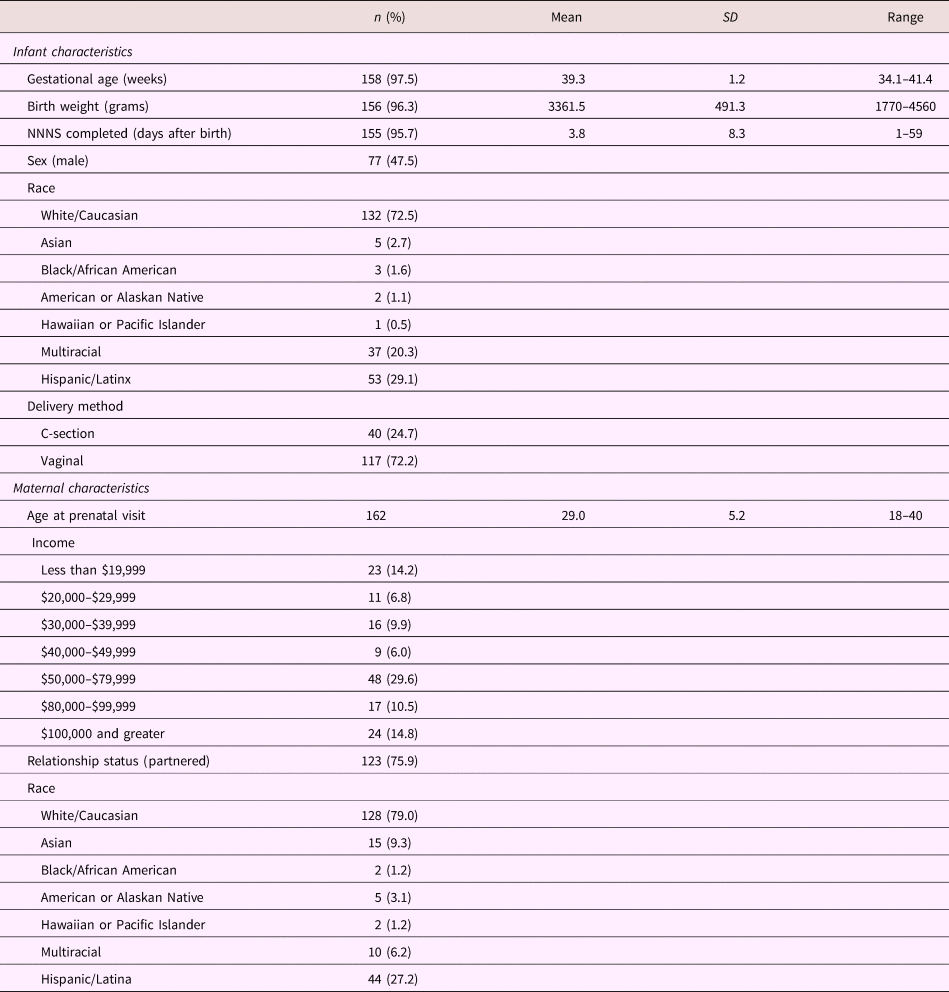
Participants completed a demographics form during the prenatal period as part of an online questionnaire packet. This form included questions regarding the participant's age, socioeconomic status, health, any pregnancy complications, medications, work status, and educational background. There were also questions regarding both mother's and baby's race and ethnicity. Because many pregnancy complications manifest late in pregnancy or during labor (e.g., preeclampsia), information concerning pregnancy complications was also collected via medical records after birth to maximize measurement accuracy. Demographic information on the sample is presented in Table 2 (see Lin et al., 2019 [this issue] for additional information).
Descriptive information

Note: NNNS, NICU Network Neurobehavioral Scale.
Prenatal maternal emotion dysregulation
The DERS (Gratz & Roemer, Reference Gratz and Roemer2004) was used to assess emotion dysregulation when women were screened for eligibility in the study. The DERS consists of 36 questions that are scored on a 5-point Likert scale, ranging from 1 (almost never) to 5 (almost always). A total score is computed, as well as scores for six subscales (nonacceptance of emotional responses, difficulty engaging in goal-directed behavior, impulse control difficulties, lack of emotional awareness, limited access to emotion regulation strategies, and lack of emotional clarity; Gratz & Roemer, Reference Gratz and Roemer2004). The DERS total score was used for the current study, and showed strong internal consistency (α = 0.96).
Prenatal stress
At the prenatal laboratory visit, participants were administered a semistructured interview, the UCLA Life Stress Interview (Hammen et al., Reference Hammen, Adrian, Gordon, Burge, Jaenicke and Hiroto1987), which measures both chronic and episodic stress over the last 6 months. Participants were evaluated on the following domains: close friendships, relationship with partner, co-parenting with baby's father, dating, relationship with family (mother, father, and siblings), finances, work status, neighborhood environment, school, and health (self and family). Interviewers rated each domain on a 5-point Likert scale, with a score of 1 representing positive circumstances and 5 representing exceptionally poor or adverse circumstances. All domains were averaged together to create the chronic stress score.
Participants also reported on significant life events, or episodic stressors, in each domain. Following a description of the event, mothers were asked to rate how stressful the event was using a 1- (none) to 5-point (severe) Likert scale. Interviewers gathered detailed information so each event could later be evaluated by a team of trained coders. The team reached a consensus on an objective rating for each episodic stressor utilizing the same 5-point Likert scale. This rating is intended to represent the impact the event should have on a typical person experiencing the same conditions. The total number of events a participant experienced that were rated by a team of trained experimenters as 2 (mild) or greater were summed to create a total episodic stress score (Hammen et al., Reference Hammen, Adrian, Gordon, Burge, Jaenicke and Hiroto1987).
The team of experimenters rating episodic stress participated in reliability checks every 3 months. Interrater reliability of the episodic stress ratings was assessed using a two-way mixed, consistency, average-measures intraclass correlation (McGraw & Wong, Reference McGraw and Wong1996). The intraclass correlation was calculated in R using code modeled after Hallgren (Reference Hallgren2012), and the estimated value was 0.89, which is in the “good” range (Cicchetti, Reference Cicchetti1994).
RSA reactivity
Parasympathetic functioning was assessed via RSA reactivity. RSA was recorded in 30-s epochs during the infant cry task using Mindware (Mindware Technologies, Ltd., Gahanna, OH, USA). Initial scoring of the physiology data was completed by trained research assistants. Data outside the expected range for RSA (i.e., values between 2 and 10) were marked and later reviewed with a senior investigator to determine whether they should be retained. The data were rescored to determine whether they reflected a valid response and should therefore be retained. If not, then the data were dropped. An entire 30-s epoch was considered missing if more than one-third of the epoch (i.e., 10 s) was unusable (e.g., noisy signal).
Change scores were calculated using the difference from baseline to task, that is, the baby cry segment minus the first neutral seascape segment. We also included the 10-min baseline completed prior to the TSST into the preliminary analysis, in order to examine associations with a prestress measure of baseline RSA.
Newborn neurobehavioral assessment
The NNNS (Lester et al., Reference Lester, Tronick and Brazelton2004) was used to assess newborn neurobehavior. All examinations were completed between 24 hr and 2 months postdelivery (M days = 3.8, Mdn days = 1.0, SD = 8.3, range: 1–59 days), and were therefore considered valid assessments (Boukydis, Bigsby, & Lester, Reference Boukydis, Bigsby and Lester2004; Lester et al., Reference Lester, Tronick and Brazelton2004). The entire NNNS (i.e., 115 items with 13 summary scales) was administered by five trained experimenters. The NNNS always begins with an observation of the infant's arousal state followed by a standard protocol involving assessment of both neurological and behavioral functioning (Lester et al., Reference Lester, Tronick and Brazelton2004). In most instances, the five experimenters were blind to data pertaining to adult participants. However, due to staff turnover, there were brief periods in which Experimenter One (lead author) completed both the prenatal and the newborn assessments (n = 16). Experimenter One was also responsible for administering the majority (57.4%) of NNNS examinations. The remaining NNNS assessments were administered by the other four experimenters (Two: completed 9.0% of examinations; Three: 5.8%; Four: 13.5%; and Five: 14.2%).
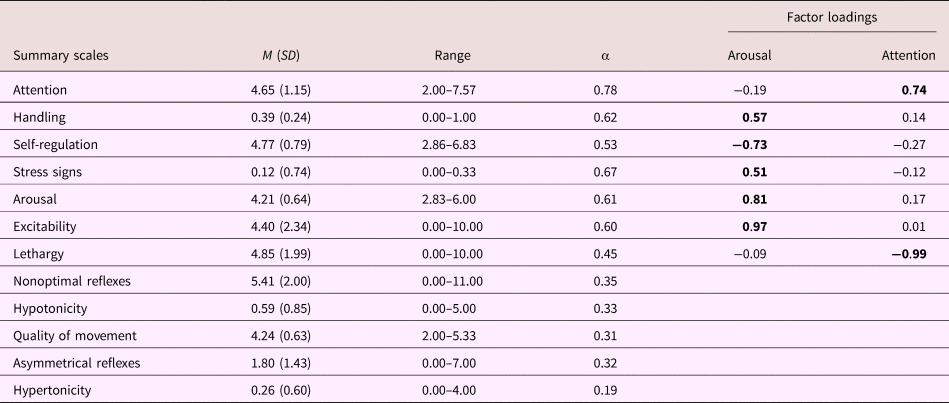
The 13 summary scales are defined in Table 1 (see also Boukydis et al., Reference Boukydis, Bigsby and Lester2004). These scales demonstrated variable internal consistency (Table 3). The scales more directly related to motor activity and reflexes (i.e., quality of movement, nonoptimal reflexes, asymmetrical reflexes, hypertonicity, and hypotonicity) demonstrated the poorest internal consistency (Cronbach's αs: 0.19–0.35). Other scales (i.e., attention, handling, self-regulation, stress/abstinence, arousal, excitability, and lethargy) demonstrated adequate internal consistency (αs: 0.45–0.78). The low alpha values may be attributable to the exam's ability to detect discrete neurologic and medical problems, as it was originally designed for a sample with high levels of prenatal stress and substance exposure (Lester et al., Reference Lester, Tronick, LaGasse, Seifer, Bauer, Shankaran and innegan2002). Other psychometric properties (e.g., test–retest reliability) for the NNNS have been well established (see Lester et al., Reference Lester, Tronick and Brazelton2004).
NICU Network Neurobehavioral Scale descriptive information and factor loadings from exploratory factor analysis

Note: For the exploratory factor analysis, N = 155. Factor loadings greater than +/– 0.50 are in bold.
NNNS data were available for 155 newborn infants. Among newborns for whom we were unable to collect data (n = 7), 3 mothers declined the NNNS assessment at the hospital, 1 mother was unable to be contacted, 1 mother was incarcerated, 1 mother withdrew from the study, and 1 mother experienced a fetal demise. Out of the 155 newborn infants included in the analyses, only 37% were in the appropriate state to administer items related to the habituation summary scale. As is the case in other studies (Liu et al., Reference Liu, Bann, Lester, Tronick, Das, Lagasse and Bada2010), this scale was excluded from all analyses. Moreover, due to the low alpha coefficients, quality of movement, nonoptimal reflexes, asymmetrical reflexes, hypertonicity, and hypotonicity were excluded from the analyses. These summary scales were not central to our preregistered hypotheses on the intergenerational transmission of emotion dysregulation (osf.io/nf5p3/). Thus, the analyses for the present study are based on the 7 remaining NNNS summary scales: attention, handling, regulation, stress/abstinence signs, arousal, excitability, and lethargy.
Results
Descriptive data for the NNNS summary scales are presented in Table 3. We examined the data for normality and outliers (≤3 SD from mean) prior to primary analyses. No outliers were identified. Each of the study variables appeared normally distributed with the exception of prenatal episodic stress, which is a low occurring count variables and was therefore expected to have slight positive skew. Item-level missingness was minor across our predictor variables of interest (<1%), and was therefore handled with mean imputation.
Detecting neurobehavioral markers of emotion dysregulation in the neonate
We first examined the factor structure of the NNNS via exploratory factor analysis, which was conducted using maximum likelihood estimation with robust standard errors and an oblique rotation (direct oblimin) in Mplus 8.0 (Muthén & Muthén, Reference Muthén and Muthén2017). Our analytic approach and interpretation of the newborn neurobehavioral factors was influenced by preliminary analysis conducted with a subset of newborns (see osf.io/nf5p3/ for information on prior data analysis).
The decision about the number of underlying factors was based on an examination of the scree plot as well as the results of a parallel analysis (Fabrigar, Wegener, MacCallum, & Strahan, Reference Fabrigar, Wegener, MacCallum and Strahan1999). In parallel analysis, reference eigenvalues are generated and compared to the existing data. The reference eigenvalues are based on random data with the same number of observations as the existing data assuming no underlying latent factors exist. Eigenvalues from the existing data that are larger than the reference eigenvalues are considered reliable and retained. The scree plot and the results of the parallel analysis suggested that a two-factor solution would be optimal (Table 4). Model fit statistics indicated that the one-factor solution had a worse fit to the data compared to the two-factor solution (comparative fit index = .65 and .96, respectively; root mean square error of approximation = .29 and .13, respectively). The two-factor solution had a worse fit to the data compared to the three-factor solution (comparative fit index = .96 and .99, respectively; root mean square error of approximation = .13 and .08, respectively), although both solutions showed adequate fit to the data. Thus, results indicate that a two-factor solution provides the most parsimonious account of the factor structure of the NNNS data. Results did not differ when hypertonicity, hypotonicity, asymmetric reflexes, nonoptimal reflexes, and quality of movement were included in the exploratory factor analysis (data available upon request).
Eigenvalues from parallel analysis

Factor loadings for the two-factor solution are presented in Table 3. Summary scales with loadings greater than +/–0.50 were considered indicators of the latent factor. The first factor consisted of NNNS summary scales related to behavioral reactivity, and included excitability, arousal, self-regulation (negative loading), handling, and stress/abstinence signs. We labeled this factor “arousal” given its resemblance to the arousal construct in RDoC's arousal and regulatory systems domain. The second factor included lethargy (negative loading) and attention. We labeled this factor “attention” given its resemblance to the construct with the same name in RDoC's cognitive systems domain. With the exception of stress/abstinence signs loading on arousal, the identified factors match what was hypothesized in our preregistration (see osf.io/nf5p3/). Composite measures representing newborn arousal and attention were created by standardizing and calculating the average of the relevant indicators (αs = 0.84 and 0.85, respectively).
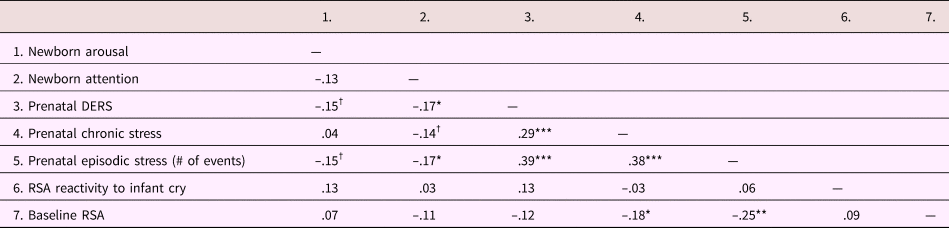
Bivariate correlations among study variables and the newborn factors are presented in Table 5. The newborn neurobehavioral factors were not significantly correlated with one another (r = –.13, p = .12). Newborn arousal and attention were unrelated to gestational age, birth weight, number of days after birth the NNNS was conducted, infant sex, maternal race, family income, maternal education level, or a mother's use of psychotropic medication while pregnant (ps > .11). Whether a mother had been diagnosed with gestational diabetes was, however, negatively associated with newborn attention (p = .04), and was therefore included in subsequent analyses related to this neurobehavioral factor.
Correlations among study variables

Note: DERS, Difficulties in Emotion Dysregulation Scale. RSA, respiratory sinus arrhythmia. † p < .10. *p < .05. **p < .01. ***p < .001.
Association between newborn neurobehavioral markers and prenatal exposure to maternal emotion dysregulation
Next, we examined whether an expectant mother's own emotion dysregulation while pregnant associated with individual differences in newborn arousal and attention. Path models were estimated using full information maximum likelihood in Mplus.
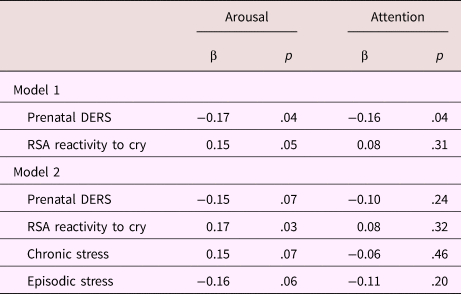
Maternal emotion dysregulation was negatively associated with newborn arousal (β = –0.17, p = .04), suggesting that infants whose mothers self-reported higher levels of emotion dysregulation while pregnant exhibited less arousal at birth. An expectant mother's RSA reactivity to the infant cry paradigm was positively associated with newborn arousal (β = 0.15, p = 0.05), such that newborns whose mothers showed a larger RSA decrease in response to the cry exhibited lower levels of arousal at birth. These findings differed, however, when prenatal chronic and episodic stress were included in the model (Table 6). Specifically, the negative association between maternal-reported emotion dysregulation and newborn arousal was no longer significant when concurrent levels of stress were considered (β = –0.15, p = .07). Mothers’ RSA reactivity, in contrast, continued to be positively associated with newborn arousal (β = 0.17, p = .03). Newborn arousal was not significantly associated with the number of episodic stressors a pregnant woman experienced (β = –0.16, p = .06). Chronic stress was also not significantly associated with newborn arousal (β = 0.15, p = .07; Table 6).
Predicting newborn neurobehavior from prenatal maternal emotion dysregulation and stress

Note: N = 155. Analyses related to the newborn attention factor included whether a mother was diagnosed with gestational diabetes in the model as a covariate. DERS, Difficulties in Emotion Dysregulation Scale. RSA, respiratory sinus arrhythmia.
Maternal emotion dysregulation was negatively associated with newborn attention (β = –0.16, p = .04), with infants of mothers who self-reported higher levels of emotion dysregulation while pregnant exhibiting less attention at birth. Maternal RSA reactivity to an infant cry was not significantly associated with newborn attention (β = 0.08, p = .31). The association between self-reported emotion dysregulation and newborn attention was not significant when prenatal chronic and episodic stress were included in the model (Table 6).
Informed by these results, we explored whether chronic or episodic stress during pregnancy mediated the association between maternal self-reported emotion dysregulation and maternal RSA reactivity and each of the newborn neurobehavioral factors. The indirect effect from maternal reported emotion dysregulation to newborn arousal via prenatal episodic stress was not significant (β = –0.06, p = .08). None of the other indirect effects from this model were significantly associated with either newborn neurobehavioral factor (p > .11). We then examined whether the maternal emotion dysregulation or RSA reactivity mediated the association between prenatal chronic and episodic stress and each of the newborn factors. The indirect effect from prenatal episodic stress to newborn arousal was not significant (p = .10). None of the other indirect effects from this model were significantly associated with either newborn neurobehavioral factor (p > .17).
Finally, we tested whether the association between RSA reactivity to an infant cry and the newborn arousal and attention was moderated by either a pregnant woman's self-reported emotion dysregulation or her experience with stress during pregnancy. The interaction between maternal prenatal RSA reactivity and self-reported emotion dysregulation was not significantly associated with newborn arousal (β = –0.12, p = .16) or attention (β = 0.09, p = .28). Similarly, the interaction between RSA reactivity and chronic stress was not significantly associated with newborn arousal (β = –0.10, p = .23) or attention (β = 0.02, p = .86).
Discussion
We provide the first evidence that a woman's emotion dysregulation while pregnant is associated with aspects of dysregulation in her newborn. Specifically, we found that newborns who were prenatally exposed to high levels of maternal emotion dysregulation exhibited inattention and, unexpectedly, blunted arousal at birth. Our findings lend credence to theories that maternal emotionality may have a formative role on fetal development, and support the utility of assessing newborn neurobehavior to identify markers of emotion dysregulation risk.
We identified two newborn neurobehavioral markers that were strikingly similar to specific RDoC constructs, namely, arousal and attention. Newborns who scored high on arousal were acutely sensitive to the environment during the assessment, exhibiting a lower threshold for stimulation and a proneness to irritability and excitability (e.g., fussiness), relative to their less aroused peers. They also required more experimenter handling, showed a relatively limited ability to maintain homeostasis (across numerous physiological systems), and displayed greater motor agitation in response to challenges. We predicted that these sensitive infants would be the offspring of women who were emotionally dysregulated while pregnant. Contrary to our prediction, it was actually infants whose mothers reported lower levels of prenatal emotion dysregulation who showed high levels of arousal at birth. Newborns who had been prenatally exposed to high levels of maternal emotion dysregulation showed a blunted pattern of sensitivity to the environment, which may be adaptive for an infant whose caregiver is prone to emotional intensity and lability.
Infants who were high on arousal showed a pattern of physiological instability, motor agitation, and irritability, which is consistent with research examining effects of prenatal depression on fetal and newborn neurobehavioral maturity (Figueiredo, Pinto, Pacheco, & Field, Reference Figueiredo, Pinto, Pacheco and Field2017; Van den Berg et al., Reference Van den Bergh, Mulder, Mennes and Glover2005). For instance, Figueiredo et al. found that fetuses whose mothers reported high depressive symptoms while pregnant had lower fetal heart rate variability. Low fetal heart rate variability was in turn related to poorer performance on the Neonatal Brazelton Assessment Scale, particularly in regard to behavioral and autonomic stability (Figueiredo et al., Reference Figueiredo, Pinto, Pacheco and Field2017). These findings, however, are inconsistent with what we found among newborns of pregnant women with high levels of emotion dysregulation. Given that it is a complex transdiagnostic phenotype (e.g., emotional lability, intense emotional experiences, and prolonged and/or rigid expression), it may be that, compared to depression, prenatal emotion dysregulation has a more drastic effect on fetal neurobehavioral development. In this case, exposure to emotion dysregulation in the womb may persistently strain fetal neurobehavioral systems as they are being organized, which may lead to lower levels of observed arousal at birth.
Findings related to an expectant mothers’ parasympathetic reactivity were consistent with her self-reported emotion dysregulation. Newborns of women who showed an RSA decrease to an infant cry exhibited lower levels of arousal during the newborn assessment. In contrast, pregnant women whose RSA increased in response to an infant cry had newborns with higher levels of arousal. Although RSA increases often support self-regulation in response to challenge (Beauchaine, Reference Beauchaine2001; Porges, Reference Porges2007), this pattern of physiological reactivity may be less adaptive in the context of early parenting when a behavioral response is necessary to facilitate coregulation (Ablow et al., Reference Ablow, Marks, Feldman and Huffman2013; Ham & Tronick, Reference Ham and Tronick2006; Hill-Soderlund et al., Reference Hill-Soderlund, Mills-Koonce, Propper, Calkins, Granger, Moore and Cox2008; Moore et al., Reference Moore, Hill-Soderlund, Propper, Calkins, Mills-Koonce and Cox2009). It is worth noting that we did not find the anticipated association between self-reported emotion dysregulation and RSA reactivity despite their established relation at other points in the life span (Beauchaine, Reference Beauchaine2001, Reference Beauchaine2015a). Teasing apart the impact of subjective versus physiological dysregulation in the transition to parenthood requires further examination from a multiple-levels-of-analysis perspective (Cicchetti, Reference Cicchetti, Beauchaine and Hinshaw2008).
The second newborn neurobehavioral factor that we identified was labeled attention due to its resemblance to its namesake in the RDoC cognitive systems domain. RDoC defines attention as a set of cognitive processes through which organisms control their use of capacity-limited systems (e.g., awareness and sustained attention). In the present study, newborn infants with high attention showed more engagement with the experimenter, an increased ability to engage with auditory and visual stimulation while regulating their behavioral state, and greater sustained alertness and coordinated visual tracking. Fernandez et al. (Reference Fernandez, Jazaieri and Gross2016) have argued that cognitive processes, such as attentional deployment, play a central role in modulating activity within and between RDoC's systems in service of self-regulation. Moreover, fundamental components of attention that emerge in the first months of life have been shown to support early engagement with the environment (Rothbart & Bates, Reference Rothbart, Bates, Damon, Lerner and Eisenberg2006).
Posner, Rothbart, and colleagues have outlined three neural attentional networks associated with early reactivity and regulation: the alerting (arousal and vigilance), orienting (task shifting), and executive attention (attentional control) networks (Posner, Reference Posner2012; Posner & Rothbart, Reference Posner and Rothbart2009; Rothbart, Sheese, Rueda, & Posner, Reference Rothbart, Sheese, Rueda and Posner2011). The constellation of newborn neurobehavioral competencies we identified may rely on maturation of the alerting and orienting networks, and equip an infant with the building blocks for emotion regulation development (Lester et al., Reference Lester, Miller, Hawes, Salisbury, Bigsby, Sullivan and Padbury2011; Monk & Hane, Reference Monk, Hane and Wenzel2016). Furthermore, we found that, along with low levels of arousal, newborns who were exposed to higher prenatal maternal emotion dysregulation showed greater inattention at birth. Newborns with low attentional capacities may be more likely to struggle to maintain behavioral and autonomic stability (Boukydis et al., Reference Boukydis, Bigsby and Lester2004), a correlate of poor developmental outcomes (Liu et al., Reference Liu, Bann, Lester, Tronick, Das, Lagasse and Bada2010). Our findings are consistent with the possibility that a pregnant woman's dysregulation affects her newborn's attentional capacity, perhaps by hindering maturation or organization of the alerting and orienting networks. Attentional capabilities are refined and consolidated over the first years of life through interactions with caregivers and broader environmental stimulation (Rothbart & Bates, Reference Rothbart, Bates, Damon, Lerner and Eisenberg2006). Examining the origins and trajectories of emotion dysregulation in relation to functional maturation of early emerging (alerting and orienting) and later developing (executive) attention networks may clarify why some children exhibit attentional patterns that sustain reactivity or thwart regulation from infancy to childhood whereas others do not.
Charting the trajectories of psychopathology risk is a core objective for the field of developmental psychopathology. Some foundational aspects of emotion dysregulation may be shaped in utero through a complex interplay between a fetus's genome and the intrauterine environment (Doyle & Cicchetti, Reference Doyle and Cicchetti2018; Glover, Reference Glover2014; Lester et al., Reference Lester, Miller, Hawes, Salisbury, Bigsby, Sullivan and Padbury2011; Monk & Hane, Reference Monk, Hane and Wenzel2016). We identified two such neurobehavioral markers critical to emotion dysregulation that were evident at birth. It is worth noting that the identified markers are composed of neurobehavioral competencies that resemble early temperament dimensions (Table 1; Stifter & Dollar, 2016). These similarities may be attributable to the shared neurobehavioral underpinnings that have been proposed for each construct (Lester & Tronick, Reference Lester and Tronick2004; Rothbart, Derryberry, & Posner, Reference Rothbart, Derryberry, Posner, Bates and Wachs1994; Shiner et al., Reference Shiner, Buss, McClowry, Putnam, Saudino and Zentner2012). However, whether the identified newborn factors reflect the same manifest traits evident at birth (e.g., DeSantis, Harkins, Tronick, Kaplan, & Beeghly, Reference DeSantis, Harkins, Tronick, Kaplan and Beeghly2011), or are basic components of a complex developmental process that leads to differences in infant temperament (e.g., Lester et al., Reference Lester, Bagner, Liu, LaGasse, Seifer, Bauer and Das2009), has proven difficult to test empirically and thus remains an open question. Nevertheless, these early neurobehavioral differences may transact with potent contextual influences (e.g., coercive parenting) to amplify a child's psychopathology risk over time (Beauchaine, Reference Beauchaine2015a). Individual differences in newborn neurobehavior may therefore be a key link in a transactional chain from the womb to later childhood emotion dysregulation.
Findings from the present study add to burgeoning evidence highlighting how experiences in utero may have a lasting influence on a child's emotional, behavioral, and cognitive functioning (see Graignic-Philippe, Dayan, Chrokron, Jacquet, & Tordjman, Reference Graignic-Philippe, Dayan, Chokron, Jacquet and Tordjman2014; Van den Bergh et al., Reference Van den Bergh, van den Heuvel, Lahti, Braeken, de Rooij, Entringer and Schwab2017, for reviews). It is becoming clear that the womb is a source of both protection and potential risk for the developing fetus. This is due, in part, to the fact that a fetus's neurobehavioral systems are active during organization and are responsive to environmental stimulation (Kinsella & Monk, Reference Kinsella and Monk2009), a combination that makes the developing fetus highly susceptible to prenatal insults. We showed that a pregnant woman's emotion dysregulation may serve as one such factor, evidenced by its association with blunted arousal and inattention among neonates. What this neurobehavioral profile means for developmental outcomes for the child remains to be seen, though evidence suggests that deficits in these domains may be linked to an increased likelihood of childhood psychopathology (Lester et al., Reference Lester, Bagner, Liu, LaGasse, Seifer, Bauer and Das2009; Liu et al., Reference Liu, Bann, Lester, Tronick, Das, Lagasse and Bada2010).
Despite potential links with childhood problem behavior, our identified patterns of underarousal and inattention among newborns exposed prenatally to emotion dysregulation could also be adaptive. Fetal programming theories suggest that a pregnant woman's mental and physical health influences her offspring by altering the fetus's neurobehavioral development (Gluckman et al., Reference Gluckman, Hanson, Cooper and Thornburg2008; Wadhwa et al., Reference Wadhwa, Buss, Entringer and Swanson2009). The “signals” a fetus receives from his or her mother (via uteroplacental mechanisms; Rakers et al., Reference Rakers, Rupprecht, Dreiling, Bergmeier, Witte and Schwabin press) are thought to adjust the trajectories of neurobehavioral development as a means to promote survival in the immediate extrauterine environment, possibly at the expense of long-term mental and physical health (Gluckman & Hanson, Reference Gluckman and Hanson2004). For instance, a pregnant woman's emotion dysregulation may signal that the postnatal environment is going to be characterized by greater chaos and uncertainty. Adapting to the intrauterine environment posed by a dysregulated pregnant woman may lead to a blunted neurobehavioral repertoire (i.e., underarousal and inattention). This is potentially protective as the developing child may be less attuned or reactive to the chaotic environment.
However, it is equally likely that prenatal exposure to emotion dysregulation may negatively affect fetal neurobehavioral systems while they are becoming organized, resulting in the same profile of blunted arousal and inattention at birth. While both the adaptive and the deficit explanations are plausible, neither could be directly tested in the present study, which will require further longitudinal research. It is also possible that potential adaptive outcomes associated with prenatal emotion dysregulation exposure were not assessed sufficiently using the NNNS (e.g., vigilance to changes in the environment vs. sustained attention). Limits on the range of neurobehavioral competencies among newborns may hinder examination of these traits in the first days of life.
Finally, it is worth noting that, contrary to our prediction, maternal emotion dysregulation was not associated with newborn neurobehavior once chronic and episodic stress were considered simultaneously. Prenatal stress is associated with decreased maturity, emotion regulation, and cognitive functioning during infancy (e.g., Sandman, Davis, Buss, & Glynn, Reference Sandman, Davis, Buss and Glynn2012), and has been related to fetal neurobehavioral maturation (Amiel-Tison et al., Reference Amiel-Tison, Cabrol, Denver, Jarreau, Papiernik and Piazza2004; DiPietro et al., Reference DiPietro, Kivlighan, Costigan, Rubin, Shiffler, Henderson and Pillion2010). One possible explanation for our findings is that the inclusion of the stress variables reduced our statistical power to detect the effect of prenatal emotion dysregulation. Another possibility is that stress and maternal emotion dysregulation are accounting for shared variance in newborn arousal, which is indicative of a potential mediational association. It may be that a pregnant woman's dysregulation incites stress, which then results in diminished arousal and attention as a newborn (Van den Bergh et al., Reference Van den Bergh, Mulder, Mennes and Glover2005). Alternatively, it could be that stress leads to greater emotion dysregulation, which in turn influences neurobehavioral development in domains related to newborn arousal and attention. Although we explored these associations, the current study may have been limited in its ability to detect mediation (and moderation) effects due to sample size, leaving this issue unresolved.
Findings from the present study ought to be considered within the context of limitations. First, in regard to the NNNS, a majority of the assessments were conducted by one experimenter (n = 89; 57.4%), while a second experimenter was responsible for all assessments with newborns who were preterm or medically fragile. There was also a very brief period when one experimenter was conducting both the prenatal and the newborn assessments. Although the NNNS is a standardized procedure that is robust to potential variation in administration, and four of the five experimenters completed the intensive NNNS training together, future research should consider evenly distributing newborn assessments between experimenters while ensuring that there is never overlap in experimenters for the prenatal and newborn assessments. Second, Cronbach's alpha for several of the NNNS scales was lower than the commonly accepted cutoff value (0.70), which suggests modest correlations between scale-level items. Although not ideal, the NNNS scales demonstrated strong loadings on their respective newborn factors, which provides support that they were meaningful indicators of the latent constructs that were of primary interest. Furthermore, the NNNS is a well-validated measure that has shown concurrent and predictive associations with a myriad of theoretically relevant variables, as well as acceptable test–retest reliability (e.g., Conradt, Lester, Appleton, Armstrong, & Marsit, Reference Conradt, Lester, Appleton, Armstrong and Marsit2013; Lester et al., Reference Lester, Tronick, LaGasse, Seifer, Bauer, Shankaran and innegan2002, Reference Lester, Tronick and Brazelton2004; Liu et al., Reference Liu, Bann, Lester, Tronick, Das, Lagasse and Bada2010; Salisbury, Fallone, & Lester, Reference Salisbury, Fallone and Lester2005; Salisbury et al., Reference Salisbury, Lester, Seifer, LaGasse, Bauer, Shankaran and Poole2007; Sucharew, Khoury, Xu, Succop, & Yolton, Reference Sucharew, Khoury, Xu, Succop and Yolton2012).
An additional limitation is that we cannot rule out the potential genetic effects that may link a pregnant woman's and her newborn's proclivity toward reactivity and regulation (see, e.g., Monk, Spicer, & Champagne, Reference Monk, Spicer and Champagne2012). We also are limited in our determination of the direction of effects, even though temporal precedence would suggest that a pregnant woman's experiences influenced her offspring. Finally, it is worth noting that we did not find the association between maternal-reported emotion dysregulation and RSA reactivity that was reported by a complementary study in this Special Issue (Lin et al., 2019 [this issue]). Our primary aim was to identify intrauterine correlates of newborn neurobehavior rather than comprehensively characterizing maternal physiological reactivity. We therefore utilized a simpler analytical approach (i.e., change scores vs. the multilevel model estimated by Lin et al.). Both analytical approaches have strengths and weaknesses as relates to maternal physiological assessment that warrant comparison in future studies.
Despite these limitations, the present study had a number of strengths worth highlighting. First, some of our findings support the hypotheses we preregistered on the Open Science Framework. Participating in open and transparent science is likely to increase the reproducibility of findings in our field, which may ultimately support design and judicious distribution of preventative services to reduce psychopathology risk. Second, our study was strengthened by examining several constructs relevant to emotion dysregulation across multiple levels of analysis in regard to pregnancy and birth. Our extensive perinatal battery examined several validated indicators of dysregulation, including self-reported behavior, autonomic activity, experimenter-assessed objective stress, and, among newborns, a standardized neurobehavioral protocol. Continuing to incorporate multiple levels of analysis will further our understanding of the prenatal origins of emotion dysregulation (Doyle & Cicchetti, Reference Doyle and Cicchetti2018). Finally, we examined newborn neurobehavior using the NNNS, a standardized protocol for assessing individual differences in a newborn infant's neurologic integrity and behavioral function (Lester et al., Reference Lester, Tronick and Brazelton2004). The NNNS is widely used and relatively easy to adapt for research or clinical purposes. Given its ability to identify neurobehavioral markers of emotion dysregulation in neonates, the NNNS appears to be a valuable tool for identifying which infants are at elevated psychopathology risk (Lester et al., Reference Lester, Bagner, Liu, LaGasse, Seifer, Bauer and Das2009; Liu et al., Reference Liu, Bann, Lester, Tronick, Das, Lagasse and Bada2010). Early identification may ultimately facilitate targeted prevention services to reduce the likelihood of emotion dysregulation development.
Conclusion
Our findings advance knowledge about developmental origins of emotion dysregulation in two important ways. First, we provide evidence that neurobehavioral markers pertinent to emotion dysregulation can be identified in the first days of life and are related to prenatal insults. Individual differences in newborn arousal and attention may transact with contextual influences to set an infant on a path toward emotion dysregulation in childhood. Second, rather than relying on a single clinical diagnosis, we demonstrated that critical aspects of a transdiagnostic vulnerability were associated across generations. We also showed that aspects of maternal dysregulation were uniquely associated with newborn neurobehavioral markers, a finding only possible through a multiple-levels-of-analysis approach (Cicchetti, Reference Cicchetti, Beauchaine and Hinshaw2008). By identifying patterns of heightened reactivity (i.e., arousal) and poor regulation (i.e., attention), our results may point to perinatal preventative targets to ameliorate childhood psychopathology risk.
Data
The hypotheses and methods for the current study were formally preregistered though Open Science Framework on November 14, 2018, and are available at: osf.io/nf5p3/. Code will be uploaded to Open Science Framework postpublication. All data were uploaded to NIMH data sharing platform per NIMH data sharing requirements.
Acknowledgments
We would like to thank all of the families who generously donated their time to participate in our study. We would also like to thank the dedicated research assistants from the CAN Lab. We are indebted to Mike Varner and Bob Silver for their support of the BABY study and for providing their dedicated OBGYN Research Network staff to help with screening and recruitment. We thank Connie Hammen for her assistance with training and scoring the UCLA Life Stress Interview. We would also like to thank the University of Utah Vice President's Clinical Translational Research Scholars program for their mentorship and grantsmanship assistance.
Financial support
This manuscript was supported by the National Institute of Mental Health under Award Number R21MH109777 (to S.C. and E.C.), a Career Development Award from the National Institute on Drug Abuse 7K08DA038959-02 (to E.C.), and grants from the University of Utah Consortium for Families and Health Research and Interdisciplinary Research Pilot Program. The content is solely the responsibility of the authors and does not necessarily represent the official views of the National Institute of Mental Health, the National Institute on Drug Abuse, or the National Institutes of Health.
Conflict of Interest
The authors report no conflicts of interest.