Introduction
End-of-life communication includes both verbal and nonverbal messages that occur from the diagnosis of an advanced illness, during the illness trajectory and until after death. There is no single, unanimous definition of “good” end-of-life communication. Studies have presented factors facilitating efficient end-of-life communication, such as structural factors, time, availability, and willingness to discuss end-of-life issues, as well as the relationship with and friendliness of the healthcare provider. It has been argued that a lack of time, reluctance to discuss end-of-life issues, and not being prepared for such discussion obstruct efficient end-of-life communication (Murray et al., Reference Murray, McDonald and Atkin2015). Communication at the end of life is a crucial factor affecting whether the patient will die with dignity or not, and can facilitate patients’ control over their final wishes and involvement in decision making (Keeley, Reference Keeley2016). Communication — including timely communication, involvement in decision making about the care and being treated with respect and dignity — are key aspects of end-of-life care. Communication to determine patient goals for care at the end of life is associated with higher satisfaction with care and decision making; however, few patients and family members receive end-of-life communication (You et al., Reference You, Dodek and Lamontagne2014). The timing, content and setting of communication is important to help persons deal with difficult issues near the end of life (Stephen et al., Reference Stephen, Skirton and Woodward2013). Timely and adequate communication is also crucial for involvement in and planning of end-of-life care (Johnson et al., Reference Johnson, Attree and Jones2014; Roza et al., Reference Roza, Lee and Meier2015). Involvement in decision making requires access to adequate information about disease progression, treatment options, available support, etc. Most patients wish to be involved in decision making about the care, but for this to occur, encouragement from healthcare professionals is needed (Emmanuelle et al., Reference Emmanuelle, Charo and Danielle2011). Previous studies have indicated that being treated with dignity and respect is crucial for satisfactory end-of-life care (Koskenniemi et al., Reference Koskenniemi, Leino-Kilpi and Suhonen2015; Donnelly et al., Reference Donnelly, Prizeman and Coimín2018; O'Sullivan et al., Reference O'Sullivan, Alvariza and Öhlen2018). Respect and dignity toward the patient can be shown by listening and having a good tone, ensuring independence and providing adequate information (Kennedy, Reference Kennedy2016).
The place of care can influence whether and how communication with the patient about end-of-life issues takes place. Patients cared for in specialized palliative home care or palliative care units often receive more timely communication than those cared for in hospitals, nursing homes, or primary healthcare (Addington-Hall and O'Callaghan, Reference Addington-Hall and O'Callaghan2009; Ong et al., Reference Ong, Brennsteiner and Chow2016). Regarding care in nursing homes, a lack of end-of-life conversations and involvement in decision making has been reported (Bollig et al., Reference Bollig, Gjengedal and Rosland2016; Smedback et al., Reference Smedback, Öhlen and Arestedt2017). Shortcomings regarding timely communication about the transition from curative to palliative treatment, dying and death have also been reported in studies regarding end-of-life care in hospitals (Al-Qurainy et al., Reference Al-Qurainy, Collis and Feuer2009; Houttekier et al., Reference Houttekier, Reyniers and Deliens2014; Witkamp et al., Reference Witkamp, van Zuylen and Borsboom2015).
The diagnosis influences access to specialized care services, resulting in less palliative care; e.g., people with chronic diseases or old age have poorer access than those with cancer (Burt et al., Reference Burt, Shipman and Richardson2010; Payne, Reference Payne2010; Hall et al., Reference Hall, Petkova and Tsouros2011). This results in, e.g., less informative communication about end-of-life issues and less involvement in decision making about the care, through approaches such as advance care planning (Brännström et al., Reference Brännström, Hägglund and Fürst2012; Evans et al., Reference Evans, Pasman and Donker2014; Ahmadi et al., Reference Ahmadi, Lundström and Janson2015; Eriksson et al., Reference Eriksson, Milberg and Hjelm2016; Penders et al., Reference Penders, Onwuteaka-Philipsen and Moreels2018).
Evaluations of the end-of-life care from the patients’ and family members’ perspectives are increasingly receiving more attention (Bausewein et al., Reference Bausewein, Daveson and Currow2016). Bereaved family members are an important source of knowledge for evaluating the care a deceased person received at the end of life (McPherson and Addington-Hall, Reference McPherson and Addington-Hall2003; Henoch et al., Reference Henoch, Lövgren and Wilde-Larsson2012). Few studies focus on the influence of care place and diagnosis on aspects of care communication at the end of life — such as being informed in a respectful way about imminent death, being treated with respect and dignity by the care staff, and involvement in decision making regarding care during the last months of life for persons with advanced illness. This study aims to investigate the influence of place of care and diagnosis on care communication, over the last 3 months of life for people with advanced illness, from the bereaved family members’ perspective.
Methods
Design
This study employed a retrospective cross-sectional survey design. It was approved by the Regional Ethical Board in Stockholm, Sweden (Approval number: 2017/265-31).
Study context and sample
The sample consisted of bereaved family members of persons who died in four hospitals, in two Swedish healthcare regions between August 2016 and April 2017. The hospitals were used as recruitment settings since approximately half of all people in Sweden die in hospital regardless of the last care place before death (Håkanson et al., Reference Håkanson, Öhlen and Morin2015). People in Sweden are cared for in various ways at the end of life, both within in-patient and out-patient care and in municipal care. Most people receive care from several care providers during their last period of illness and life (N.B.H.W., 2016). The deceased persons included in the study had all died in hospital but had before death received care in several different care places.
Criteria for inclusion were as follows: an identifiable bereaved family member of the deceased person; only the person listed as the primary contact in the patient's data record was invited to participate in the study; aged 18 years or older (both deceased persons and bereaved family members); underlying causes of death (ICD-10 codes) in accordance with the Murtagh et al. (Reference Murtagh, Bausewein and Verne2014) model; and time of death no less than 4 and no more than 12 months before recruitment to the study. The following disease categories are included in the Murtagh model: HIV/Aids, Malignant Neoplasm (Cancer), Alzheimer's, Dementia and senility, Neurodegenerative disease, Heart disease, including cerebrovascular disease, Respiratory diseases, Liver disease, and Renal disease.
The questionnaires were sent to the bereaved family members 4–12 months after the death of the deceased person, as this time frame have been considered optimal in previous studies using VOICES(SF), regarding grief and ability to recall (Young et al., Reference Young, Rogers and Addington-Hall2008; Addington-Hall and O'Callaghan, Reference Addington-Hall and O'Callaghan2009; Young et al., Reference Young, Rogers and Dent2009; Hunt et al., Reference Hunt, Shlomo and Richardson2011, Reference Hunt, Richardson and Darlington2019).
Recruitment and data collection
The inclusion criteria were met by 74% (n = 1,277) of all patients who died in the recruitment hospitals during the study period. Hospital administrators identified the deceased persons based on the inclusion criteria. Their bereaved family members were identified via the hospital's patient records, by one health care professional at each hospital (assigned to assist Author 1). The addresses of the bereaved family members were retrieved from publicly available address databases. Author 1 sent written information about the study — including the fact that the study was performed in cooperation with the hospital that their family member had died at, contact information for one of the researchers (Author 1), the VOICES(SF) questionnaire and a pre-paid return envelope — to the included bereaved family members. The written information assured the participants that the data would be confidential and that they could withdraw from the study at any time without any explanation. No separate written consent was requested; a returned questionnaire was considered consent for study participation. No reminders were sent out for ethical reasons, i.e., sensitivity toward the receivers who were considered potentially vulnerable due to bereavement and may not have wished to participate.
The VOICES(SF) questionnaire
The VOICES(SF) questionnaire — Views of Informal Carers — Evaluation of Services (Short Form) — retrospectively evaluates bereaved family members’ experiences of the quality of care during the last 3 months of life of a deceased family member. Care received in several places is evaluated through items about symptom relief, communication, support, involvement in decision making, being treated with respect and dignity by care staff, and satisfaction with care, along with items about individual characteristics (age, sex, educational attainment, country of birth, relationship to the deceased person, etc.). The Swedish version (O'Sullivan et al., Reference O'Sullivan, Öhlen and Alvariza2017) comprises 75 items divided into several domains: e.g., care at home; care homes; hospital care; specialized palliative care units. VOICES(SF) aims to cover as many of the care places and care providers a person may have had during the last 3 months of life, it contains both general items answered regardless of care place and specific items for each care place/provider, hence not all items are relevant for all the participating bereaved family members. VOICES has previously been used for different patient groups and in various healthcare settings, mainly in the UK, where it was developed (Hunt et al., Reference Hunt, Shlomo and Richardson2011, Reference Hunt, Richardson and Darlington2017). The full version of VOICES(SF) has been translated into other languages and validated (Hughes et al., Reference Hughes, Saleem and Addington-Hall2005; Ross et al., Reference Ross, Neergaard and Petersen2018).
Study variables
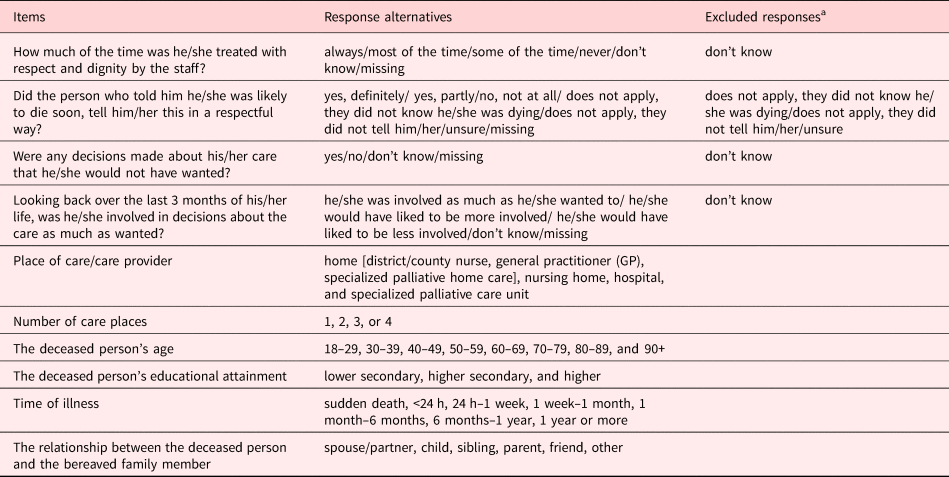
The following four items were used as study variables: how much of the time the deceased person was treated with respect and dignity, communication about imminent death in a respectful way to the deceased person, the deceased person's involvement in decision making about the care, and decisions made about the care that the deceased person would not have wanted. Additional study variables were different places of care/different providers, the number of care places, diagnosis, the deceased person's age, sex, and educational attainment, length of illness before death, and the relationship between the deceased person and the family member (Table 1).
Study variables

a Excluded responses and missing responses were excluded entirely from the regression analyses.
Analysis
Explorative descriptive analyses and regression analyses were performed. Descriptive statistical analyses were used to explore the characteristics of the bereaved family members and the deceased persons and for the division of different places of care, as well as the number of care places. The dependent variables were also explored descriptively.
Due to the small sample size, the dependent and independent variables were dichotomized and merged to permit regression analyses. Place of care was used as an independent variable, as was the number of care places. District/county nurse was used as a reference category for the different care settings, since it was considered “middle-sized.” The number of care places was split into 1−2 and 3−4 places for the analyses. The variable for diagnosis was created based on the underlying causes of death and dichotomized into cancer/noncancer, with persons dying from an illness ICD coded as C00−C99 categorized as cancer and all other diagnoses noncancer.
We divided the sample into <85 and >85, partly due to sample size, but also since very old people represent a group with the increased prevalence of multi-morbidity and frailty. Length of illness before death was dichotomized into “less than 1 year” or “1 year and over.” The variable “relationship between the deceased person and the bereaved family member” was categorized into — spouse (including partner), child, and other (e.g., sibling, parent, and friend).
The dependent variables were time the deceased person was treated with respect and dignity; communication about imminent death in a respectful way to the deceased person; the deceased person's involvement in decision making about the care; and decisions made about the care that the deceased person would not have wanted. Ordinal regression analysis with a mixed model approach was performed to explore influences of care place and diagnosis on bereaved family members’ reports regarding whether the deceased person was treated with respect and dignity by the staff, also controlled for the characteristics of the deceased persons and their relationship with the bereaved family members. A mixed model approach was applied for the analysis to account for the dependency and correlation within the family members of deceased persons that had multiple care places. This could be considered the same as re-estimating the model multiple times with each care place as the reference variable (Seltman, Reference Seltman2018). For the dependent variable “Communication about imminent death,” ordinal regression analysis was performed. For items without a dependent variable on an ordinal scale (involvement in decision making about the care and whether any decisions were made about the care that the deceased person would not have wanted), logistic regression analyses were performed. The dependent variable then had only two values — yes and no. For all analyses, a forward selection method was used; the variables were entered stepwise. AIC (Akaike information criteria) was used as a measure of model-fit. An association between co-variables and outcome was considered significant if p < 0.05. For statistical computations, we used Statistical Package for the Social Sciences (SPSS) version 21.0 (IBM Corp., Armonk, NY, USA) and the environment R, version 3.6.1 (R Foundation, GNU General Public License) for statistical computing and techniques.
Results
The response rate was 37.9%; a total of 485 bereaved family members participated in the study. The non-responding family members’ characteristics were not available. The deceased persons’ profiles (age, sex, and diagnosis), linked to the non-responders, did not differ from the sample.
Characteristics of the deceased persons, the bereaved family members and the use of different care places
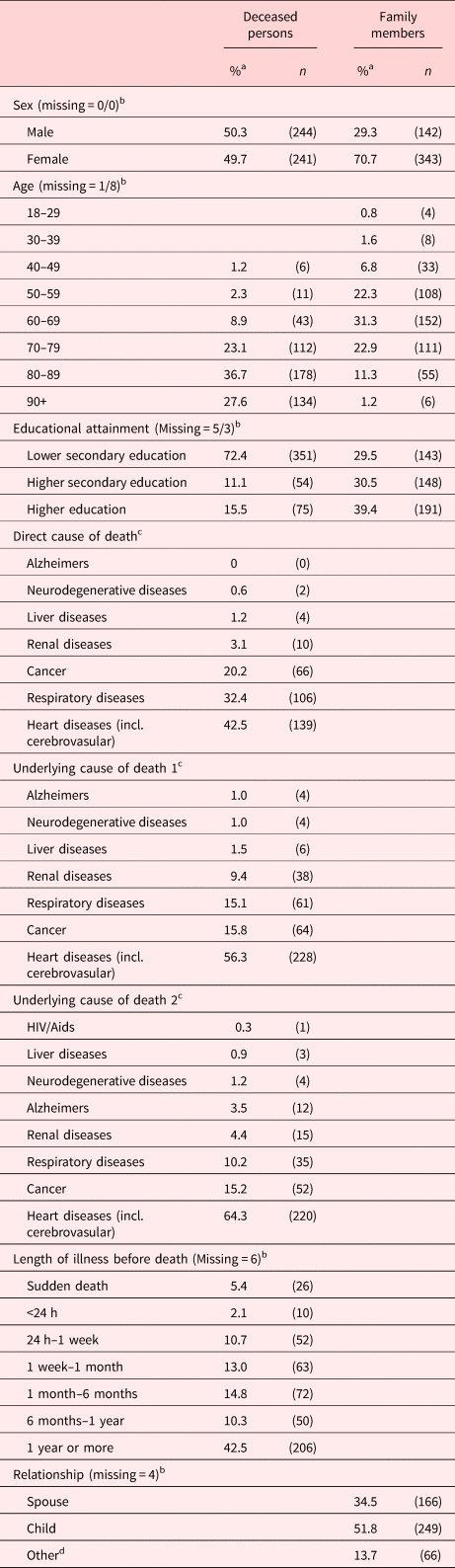
The majority (70.7%) of the 485 participating family members were women, aged between 18 and 90 years or older. Of the family members, 51.4% were children of the deceased person and 34.3% were spouses/partners. The deceased persons ages ranged between 40 and 90 years or older (64% were 80 years or older) and 50.3% were men. The direct causes of death were heart diseases including cerebrovascular diseases (42.5%), respiratory diseases (32.4%), and cancers (20.2%). The largest underlying cause of death was heart diseases (56.3%) (Table 2).
Characteristics of the deceased persons and their family members

a Column percentage displayed.
b Missing = 0/0 number of missing cases for deceased persons/bereaved family members.
c Underlying causes of death according to Murtagh's (Reference Murtagh, Bausewein and Verne2014) model for potential palliative care needs.
d For example, parent/sibling/friend.
Of the deceased people, 79.2% had at some point received care at home, provided by general practitioners (GPs) (52%), district nurses (36.7%), or specialized palliative home care (17.9%), 27.4% were cared for in a nursing home, and 15.7% in a specialized palliative care unit. The deceased persons had spent time in one to four care places during their final 3 months of life. Most common was two places of care (63.4%), followed by three places (20.4%), one place (12.9%) and, least commonly, four places (3.3%).
Bereaved family members’ reports on respect and dignity toward the deceased person
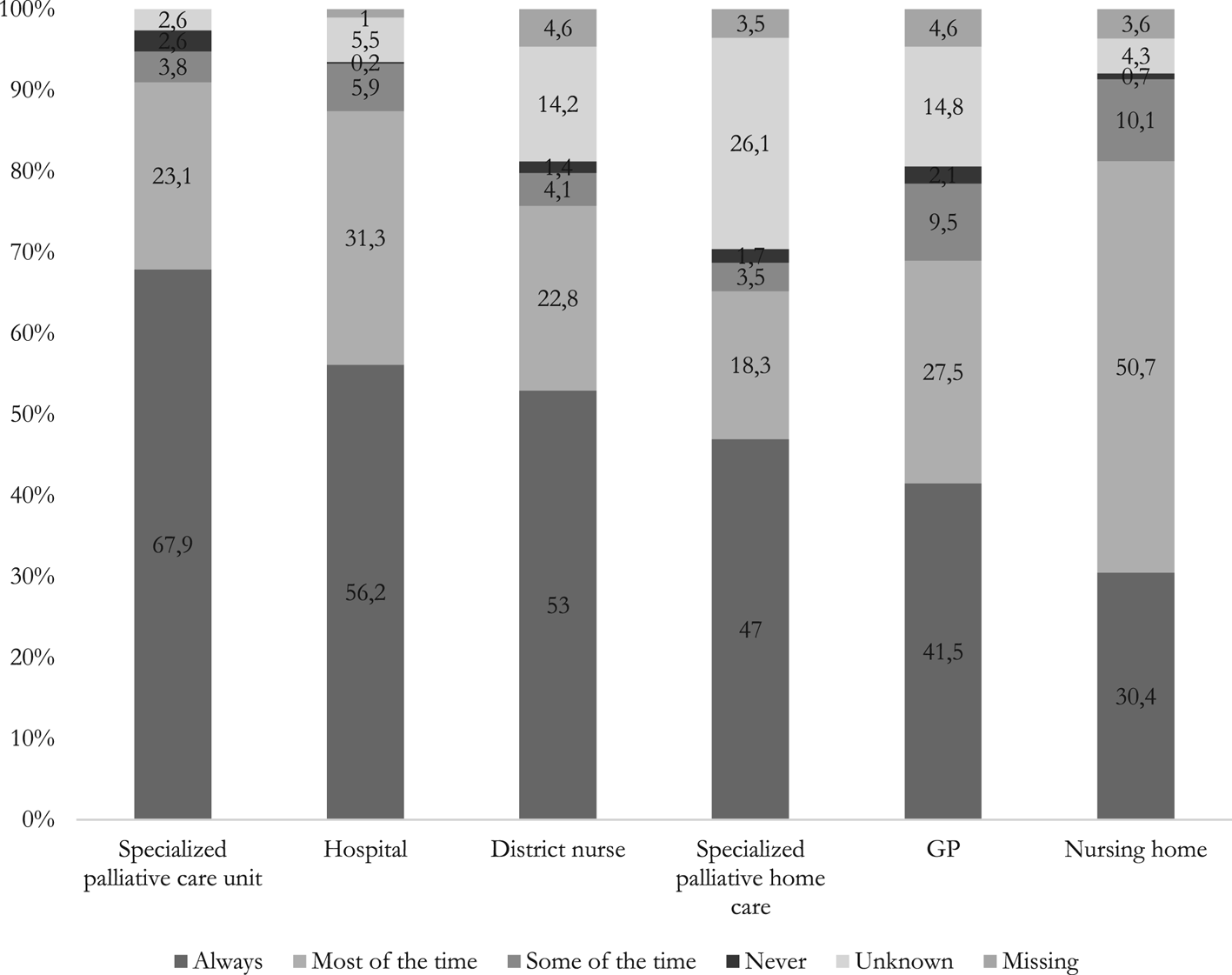
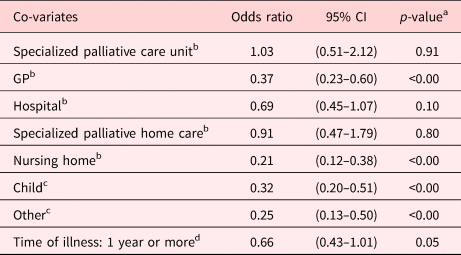
The percentage of family members reporting that the deceased person was always treated with respect and dignity for each type of care were included as follows: specialized palliative care unit (67.9%), hospitals (56.2%), district/county nurses (53.0%), specialized palliative home care staff (47.0%), and GP (41.5%), with nursing home staff being the lowest percentage reported (30.4%) (Figure 1). In line with this, the ordinal mixed model analysis showed that the bereaved family members were less likely to have reported that the deceased person had been treated with respect and dignity when cared for by nursing home staff and the GP. There was no significant influence of the diagnosis on the bereaved family members’ reports on whether the deceased person was treated with respect and dignity by the care staff. Additionally, the regression analysis showed that a bereaved family member other than the spouse/partner was less likely to report the deceased person having been treated with respect and dignity (Table 3).
Percentage of bereaved family members’ reports on respect and dignity toward the deceased person, from staff in different care places.

Final model — part of time that the deceased person was treated with respect and dignity by the staff and influences of place of care, diagnosis and characteristic of the deceased person controlled for

a Significance if p< 0.05 for Chi-square.
b District/county nurse is used as a reference category for places of care/care providers.
c Reference category: spouse.
d Reference category: less than 1 year.
Communication about imminent death
Of the bereaved family members, 20.1% replied “yes, definitely” the deceased person had been informed that he/she was going to die soon in a respectful way, 14% replied “yes, partly” and 9% replied “no, not at all”; while 20.5% reported that the deceased person was not informed his/her death was imminent and 24.3% did not know if the deceased person had been informed. Another 12.1% reported that this was not applicable due to an unexpected death. Neither place of care nor diagnosis significantly influenced bereaved family members’ reports on whether the deceased person had been informed about imminent death in a respectful way, nor for any of the other characteristics controlled for.
Involvement in decision making about the care
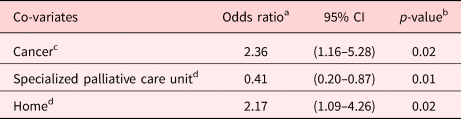
Of the bereaved family members, 59.5% reported that the deceased person was involved as much as he/she would have wanted in decision making about the care. Another 28.7% did not know if the deceased person had been involved as much as he or she had wanted and 10.8% reported that the deceased person would have liked to be more involved, and 1% would have liked to be less involved. The logistic regression analysis showed that a cancer diagnosis (OR: 2.36, CI: 1.16−5.28) increased the likelihood of involvement in decision making regarding care. Furthermore, the bereaved family members’ reports showed that the deceased person was less likely to have participated as much as desired in decision making about the care if cared for in a specialized palliative care unit (OR: 0.41, CI: 0.20−0.87), while this was more likely if cared for at home (OR: 2.17, CI: 1.09–4.26). No other co-variables were significant (Table 4).
Final model for the deceased person's involvement in decision making about the care and influences of place of care, diagnosis and characteristic of the deceased person controlled for

a Ratio above 1 indicates a higher probability for being involved as much as wanted.
b Significance if p < 0.05 for Chi-square.
c Reference category: all other diseases.
d District/county nurse is used as a reference category for places of care/care providers.
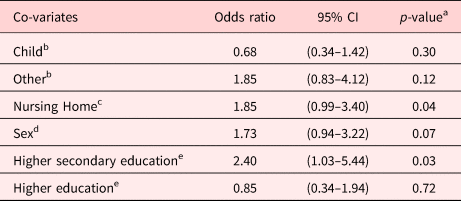
Of the bereaved family members, 13.6% reported that decisions about the care that the deceased person would not have wanted had been made, 62.9% reported that no unwanted decisions were made and 23.5% did not know. The logistic regression analysis showed that if the deceased person had been cared for in a nursing home, there was a higher likelihood of unwanted decisions being made (OR: 1.95, CI: 0.99−3.40) and if the deceased person had a higher secondary education (OR: 2.40, CI: 1.03–5.44). There was no significance for the other co-variables (Table 5).
Final model for unwanted decisions about the care being made and influences of place of care, diagnosis and characteristic of the deceased person controlled for

a Significance if p < 0.05 for Chi-square.
b Reference category: spouse.
c District/county nurse is used as a reference category for places of care/care providers.
d Reference category: male.
e Reference category: lower secondary.
Discussion
The results show that whether the deceased person was treated with respect and dignity and the deceased person's involvement in decision making about the care was related to care place and diagnosis. The likelihood of decisions being made about the care that the deceased person would not have wanted was higher if cared for in a nursing home and if the deceased person had a higher education. If the deceased person had been informed about imminent death in a respectful way was not influenced by the place of care or diagnosis. Previous studies have also demonstrated the influence of the place of care on being treated with respect and dignity by the staff. In a UK study (Addington-Hall and O'Callaghan, Reference Addington-Hall and O'Callaghan2009), bereaved family members of persons that died from cancer were more likely to report that the deceased person had been treated with dignity and respect when the care was provided in in-patient hospice care units compared with in hospitals. Another study, comparing specialized in-patient palliative care units with palliative consultants and regular care, also found a higher likelihood of being listened to and being treated with respect and in a caring manner in an in-patient unit (Roza et al., Reference Roza, Lee and Meier2015).
Our study revealed little difference between hospital care and specialized palliative care units. Staff knowledge, awareness, and the availability of time are of importance to improve end-of-life care in places that are not specialized in this type of care. Additionally, is an organizational structure geared toward end-of-life care essential in care for the dying (van Riet Paap et al., Reference van Riet Paap, Vernooij-Dassen and Brouwer2014; N.B.H.W, 2016; Mousing et al., Reference Mousing, Timm and Lomborg2018). It may be that the hospitals included in the present study have procedures in place for end-of-life conversations and that the staff had been educated in end-of-life care, thus explaining why there is no difference with respect to the specialized palliative care units. In this study, the deceased person was significantly less likely to have been treated with respect and dignity by the GP and if cared for in nursing homes compared to all other care places. In Sweden, education and training in palliative care for healthcare professionals varies depending on care place and geographical location within the country, but also depending on profession; physicians and nurses receive more education than other care professions (N.B.H.W, 2016). This clearly affects the end-of-life care provided in different care places. It has earlier been suggested that staff in nursing homes and GPs have less education and training in end-of-life conversations and circumstances are not optimal for end-of-life care, resulting in poorer communication and less likelihood that the person will be treated with respect and dignity by staff (Snyder et al., Reference Snyder, Allen and Hazelett2011; Malik et al., Reference Malik, Goldman and Kevork2017; Smets et al., Reference Smets, Pivodic and Piers2018). Previous studies have also shown a lack of end-of-life communication in nursing homes (Bollig et al., Reference Bollig, Gjengedal and Rosland2016; Smedback et al., Reference Smedback, Öhlen and Arestedt2017), which may also partly account for a higher likelihood of decisions being made about the care that the deceased person would not have wanted in nursing homes.
A cancer diagnosis was shown to be associated with a higher likelihood of the deceased person having been involved in decision making about the care. It may be that the use of advance care planning, which may increase involvement in decision making, is more common in patients with cancer, since the hospice movement initially started with cancer patients and has only been extended to other diagnoses more recently (Clark, Reference Clark2007). The illness trajectory might be clearer in cancer than in, e.g., some chronic diseases or in the case of older persons (van der Steen et al., Reference van der Steen, Radbruch and Hertogh2014; Hendriks et al., Reference Hendriks, Smalbrugge and Deliens2017).
In our study, neither place of care or diagnosis were found to have influenced whether the deceased person was informed about imminent death in a respectful way. However, the majority reported that the person had not been informed. Of the respondents, 24.3% did not know whether the ill person had been informed about imminent death. Additionally, 28.7% of the family members reported not knowing whether the ill person was involved as much as they would have liked in decision making regarding care. This indicates that the ill person and family members did not discuss these topics and suggests that their communication could be improved. Previous studies on end-of-life communication between family and patients have revealed barriers for efficient communication, e.g., differing views on preferences for disclosure about prognosis, difficulties in approaching conversations about end-of-life issues due to not being prepared to have such conversations and not having opportunities to discuss (Wallace, Reference Wallace2015; Jung and Matthews, Reference Jung and Matthews2021). Healthcare providers can encourage and assist end-of-life communication between family and patient, through early discussions, but both parties may be reluctant to contemplate death and dying (Brighton and Bristowe, Reference Brighton and Bristowe2016).
About 43% of the bereaved family members reported believing that the deceased person had been informed he/she was going to die soon. Lundquist et al. (Reference Lundquist, Rasmussen and Axelsson2011) found that being informed of imminent death increased the likelihood of dying in one's preferred place of death, of having an informed family and of bereavement support for the family.
Despite the importance of end-of-life communication, for many patients and family members it does not occur. Barriers to end-of-life communication expressed by healthcare professionals are, for example, prognostic uncertainty, fear of upsetting, and not feeling sufficiently skilled and prepared to discuss end-of-life issues (Brighton and Bristowe, Reference Brighton and Bristowe2016). In Sweden, an end-of-life conversation occurs for 58% of the patients, although this number says nothing about the manner in which the communication occurred or the involvement of family members (N.B.H.W, 2016). The current target for end-of-life conversations occurring is set at 98% of all patients in Sweden (N.B.H.W, 2016). Considering the results of this study, it may be some time before this target is reached. It is also important to consider the way the communication about end-of-life issues takes place; in this study, almost 10% of the bereaved family members reported that the deceased person had not been informed in a respectful way of his/her imminent death.
Methodological limitations
The response rate was moderate (37.9%) and could potentially have been improved by using reminders and repeated mail-outs. Unfortunately, the VOICES(SF) does not provide information on how many times in the last 3 months a person has been in a care place, nor the reason for care admissions, the chronological order of or length of care in each place of care. Hence, although one of the advantages of VOICES(SF) is that it enables evaluation of most places of care used during the last 3 months of life, it does have limits regarding the possibilities of studying care trajectories.
Of the respondents, 70.7% were women. The majority were children of the deceased persons, followed by spouses. In Sweden, women provide informal care more often than men do (Ulmanen, Reference Ulmanen2013; Ulmanen and Szebehely, Reference Ulmanen and Szebehely2015); hence, the larger proportion of female bereaved family members participating. This could be considered a limitation. Another is that the whole sample involved hospital deaths. Although hospital is the most common place of death in Sweden, several places of care are involved at the end of life. The death occurring in hospital may have affected bereaved family members’ retrospective recall of care in other places and the care in general during the last 3 months of life.
The results of this study cannot be generalized on a population level, since the sample consisted of bereaved family members of persons who died in four hospitals in only two Swedish healthcare regions. However, the study does provide new and important knowledge about the influence of place of care and diagnosis on care communication during the last 3 months of life.
Conclusion
This study confirms previous research about differences that indicate inequalities in end-of-life care — in this case from the bereaved family members’ perspective. The place of care and diagnosis can influence if the deceased person is treated with respect and dignity as well as his/her involvement in decision making regarding care. The Swedish target for end-of-life conversations to occur for 98% of relevant patients seems a long way off, considering the results from this study. Finally, whether communication occurs is not the only consideration; the way in which it takes place is also critically important.
Acknowledgments
We would like to thank the hospitals involved and the study participants for their co-operation. Our thanks also go to the contributing foundations that made this study possible: Ersta Sköndal Bräcke University College, Sven and Dagmar Salén's foundation, and Ulrica Croné's foundation.
Conflicts of interest
None.