Introduction
The acoustic reflex is the most important protective mechanism against acoustic trauma to the cochlea. The stapedial muscle, one of the two muscles in the middle ear, responds to acoustic stimuli. In healthy people, this muscle usually contracts reflexively in response to acoustic stimuli over the 70–90 dB hearing threshold. This contraction increases the stiffness of the ossicular chain and tympanic membrane, thereby attenuating sounds less than approximately 2 kHz. Increases in the stiffness of the ossicular chain and tympanic membrane can be shown by tympanometry.
Contractions of the stapedial muscle as a result of acoustic stimuli occur bilaterally. Acoustic energy causes neuronal electrical stimuli at the cochlear nerves and these stimuli are transmitted to the ventral cochlear nucleus, trapezoid body, medial superior olivary body and medial part of the motor nucleus of the facial nerve.Reference Akyıldız 1 The stapedial nerve, which arises from the facial nerve, causes contractions of the stapedial muscle. This reflexive arch provides an opportunity to evaluate the VIIth and VIIIth cranial nerves and brainstem upon which the reflexive arch exists.
Noise is described as sound that is above a certain intensity which can be harmful to hearing. Socially, it is described as unwanted sound.Reference Akyıldız 2 The acoustic reflex is the only known mechanism to protect the cochlea from damage due to noise. Some previously investigated factors that may impair this reflexive response include neuromuscular diseases (e.g. myasthenia gravis, amyotrophic lateral sclerosis), chemicals (e.g. paints, paint thinners, solvents), drugs and alcohol abuse.Reference Şahin 3
Muscle relaxant drugs can affect the acoustic reflex arch and stapes muscle because of their central neurological effects. Thiocolchicoside, which is often used in orthopaedic, traumatic and rheumatological disorders, is a muscle relaxant drug that acts on the central nervous system.Reference Artusi, Nicoli, Colombo, Bettini, Sacchi and Santi 4 It influences the inhibitory glycine and γ-aminobutyric acid type A receptors, and its muscle relaxant effects are provided without sedative effects.Reference Patat and Klein 5 It also has strong analgesic and anti-inflammatory effects.Reference Janbroers 6
This study investigated the effects of thiocolchicoside on the threshold of the acoustic reflex and examined whether susceptibility to acoustic trauma is caused indirectly by the administration of this drug.
Materials and methods
This prospective study, approved by the ethical review board of our institute, was conducted at our institute between January 2013 and December 2013. Patients prescribed thiocolchicoside for various reasons in our neurosurgery and physical therapy rehabilitation clinics were enrolled in the study.
Patients were evaluated in the otolaryngology department by an ENT physician prior to thiocolchicoside treatment. Patients with normal otoscopic examination findings and no hearing problems were included in the study after providing a signed consent form. All patients’ pure tone averages were in the normal ranges (as per American National Standards Institute) and the patients had normal middle-ear pressures (±50 daPa) typical of a type A tympanogram. Acoustic reflex thresholds at 500, 1000, 2000 and 4000 Hz were obtained for all patients.
Hearing measurements and tympanometry were respectively carried out using the Interacoustics AC-40 audiometer (Interacoustics, Assens, Denmark) and Amplaid A766 middle-ear analyser (Amplifon, Milan, Italy). Devices were calibrated annually by the manufacturers.
The patients employed in the study were prescribed thiocolchicoside (Thiospa 8 mg tablet; Eczacıbaşı, Levent, Istanbul) twice a day, orally, for 5–7 days. Tympanometry and acoustic reflex tests were carried out before treatment and on the 5th day of therapy. Acoustic reflex thresholds at 500, 1000, 2000 and 4000 Hz were determined as ipsilateral and contralateral. Pre-treatment acoustic reflex thresholds were compared with thresholds at the 5th day of treatment.
Statistical data were analysed using SPSS 17.0 software (SPSS Statistics for Windows, version 17.0; SPSS, Chicago, Illinois, USA). The Wilcoxon signed rank test was used to compare the change in acoustic reflex threshold between pre-treatment and the 5th day of treatment. A p-value of 0.05 or lower was considered statistically significant.
Results
Forty-two patients (5 females and 37 males), aged 20–48 years (mean, 35 years), were included in the study. The pure tone averages and tympanogram findings were within normal ranges (as per American National Standards Institute) for all patients.
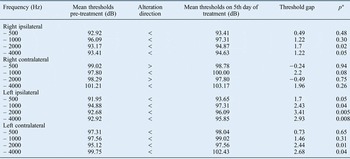
The acoustic reflex thresholds for both ears were determined at the desired frequencies pre-treatment and on the 5th day of treatment, and their means were calculated (Table I). Increases in acoustic reflex thresholds were observed on the 5th day of treatment when compared to pre-treatment, except for the right contralateral thresholds at 500 and 2000 Hz. These increases were statistically significant for the right ipsilateral thresholds at 2000 and 4000 Hz, the left ipsilateral thresholds at 500, 1000, 2000 and 4000 Hz, and the left contralateral thresholds at 2000 and 4000 Hz (p ≤ 0.05); other increases were not significant (p > 0.05). Statistically significant increases ranged from 1.22 dB to 3.41 dB.
Mean acoustic reflex thresholds pre-treatment and on 5th day of treatment

* p-values ≤ 0.05 are statistically significant.
Discussion
The acoustic reflex is recognised as a protective mechanism against acoustic trauma to the cochlea. Disruption of this mechanism by different causes may increase susceptibility to acoustic trauma. Previous literature has reported that anaesthetics,Reference Borg and Moller 7 ethyl alcoholReference Robinette, Alper and Brey 8 and solventsReference Venet, Rumeau, Campo, Rieger, Thomas and Cour 9 can increase sensitivity to acoustic trauma by suppressing the acoustic reflex. However, no studies have investigated the potential effects of thiocolchicoside, which is frequently used for its muscle relaxant effect. This possibility is particularly important for individuals who work in noisy environments.
A study published in 1967 mentioned that drugs may impair the acoustic reflex and increase susceptibility to acoustic trauma; the authors confirmed the suppressive effects of alcohol and pentobarbital.Reference Borg and Moller 10 Another study, published in 1977, showed that alcohol increased the acoustic reflex threshold by about 11 dB above the normal values at 100 minutes from intake, but values returned to normal by 200 minutes.Reference Cohill and Greenberg 11 In 1978, researchers reported that increases in blood alcohol levels to 0.09–0.15 per cent decreased the protective effect of the acoustic reflex.Reference Robinette and Brey 12
A recent study investigated the effects of alprazolam, an anxiolytic drug, on the acoustic reflex by comparing the acoustic reflex thresholds prior to and following medication.Reference Ozturk, Ila, Erdogan, Polat and Topdag 13 There was a statistically significant increase only for the left ipsilateral and contralateral thresholds. Consequently, the authors concluded that the evidence was insufficient to confirm an effect of alprazolam on the acoustic reflex.
-
• Thiocolchicoside, a commonly used myorelaxant, may have a deteriorating effect on acoustic reflexes
-
• In this study, the deterioration was not clinically significant because of small differences in the results (1.22–3.41 dB)
-
• Extra precautions may only be necessary for those who work in noisy environments, to prevent occupational hearing loss
Apart from alcohol, the most intensively investigated agents that have effects on the acoustic reflex are anaesthetic drugs. Some authors have suggested that tympanometry could be carried out in newborns and babies under general anaesthesia because of a lack of co-operation.Reference Farkas 14 However, these authors also stated that this procedure could yield faulty results under general anaesthesia because of the suppressive effects of anaesthetics. They confirmed that the acoustic reflex could not be observed when thiobutabarbital, propanidid and diazepam were used, whereas the acoustic reflex was observed when ketamine hydrochloride and alphaxalone-alphadolone acetate were used. A study published in 2005 showed that muscle relaxants (atracurium, cisatracurium and suxamethonium), which are anaesthesia components, had a suppressive effect on the acoustic reflex in all cases.Reference Ciardo, Garavello, Leva, Graziano and Gaini 15 Curare has been reported to suppress the acoustic reflex by deteriorating stapedial muscle contractions, but has no effect on the reflexive arch.Reference Ruth, Arora and Gal 16
Solvents used in the paint and adhesive industry are also suggested to increase the harmful effects of noise by suppressing the acoustic reflex.Reference Kemaloğlu and Tutar 17 The effects of toluene on the acoustic reflex were investigated in rats under anaesthesia.Reference Campo, Venet, Thomas, Cour, Castel and Nunge 18 According to that study, toluene suppressed the acoustic reflex in anaesthetised rats. Toluene has both anticholinergic and anti-glutamatergic effects, and it also inhibits voltage-dependent calcium (Ca2+) channels. Acetylcholine and glutamate play an important role in the afferent and efferent systems of the auditory pathway. The same study also showed that isoflurane, another solvent used in general anaesthesia, has a similar effect to that of toluene.Reference Campo, Venet, Thomas, Cour, Castel and Nunge 18
Some studies have emphasised that the acoustic reflex may be deteriorated in neuromuscular diseases such as myasthenia gravis, amyotrophic lateral sclerosis and myotonic dystrophy.Reference Yamane and Nomura 19 , Reference Shimizu, Hayashida, Hayashi, Kato and Tanabe 20 Many studies have investigated the effects of central nervous system depressants such as alcohol and anaesthetic drugs on the acoustic reflex; however, no studies in the English-language literature have investigated the effects of oral forms of muscle relaxants commonly used to treat orthopaedic, traumatic and rheumatological disorders.
Our study confirmed that thiocolchicoside increased the acoustic reflex threshold on the 5th day of treatment when compared to the pre-treatment state, except for the right contralateral thresholds at 500 and 2000 Hz. However, the clinical significance of this increase in the acoustic reflex threshold is uncertain.
These increases in the acoustic reflex thresholds were never higher than 3.41 dB for each frequency, but the findings nevertheless indicate that thiocolchicoside treatment may deteriorate the acoustic reflex. The statistically significant increases observed in the present study, especially in the left ipsilateral and contralateral thresholds and at the high frequencies (2000–4000 Hz), show that thiocolchicoside has a minimal effect on the acoustic reflex. These findings are in line with the results of Ozturk et al.Reference Ozturk, Ila, Erdogan, Polat and Topdag 13 Further extensive investigations are required to provide results with greater objectivity.
The absence of similar studies in the English-language literature precluded a comparison of our data with other studies. However, many published studies confirm that muscle relaxants used in general anaesthesia have suppressive effects on the central nervous system and may suppress the acoustic reflex.Reference Ozturk, Ila, Erdogan, Polat and Topdag 13 – Reference Ruth, Arora and Gal 16 Therefore, muscle relaxant drugs, especially those affecting the central nervous system, could be anticipated to weaken the stapedial muscle. However, this weakening effect was not significant clinically in the present study because of small differences in the acoustic reflex threshold between measurements pre-treatment and on the 5th day of treatment. Hence, extra precautions may only be necessary for those who work in noisy environments, in order to prevent occupational hearing loss.