Introduction
The fight against HIV and AIDS in Nigeria started after the first known case was discovered in 1986 in a 13-year-old girl. Since then, responses to combat the disease and its ravaging effects have gradually progressed, and are presently targeting factors and risk groups that could influence HIV prevalence, using a multi-sectoral approach. This approach has produced a web of preventive efforts and interventions which is led by strong political will from the three arms of government in Nigeria (federal, state and local governments). The international community and donor agencies are also involved, resulting in various funded HIV and AIDS prevention programmes in the country. Other interventions include the media, which is the channel for disseminating key preventive messages, the active involvement of faith-based organizations (FBOs), workplace interventions and private sector participation.
Other noticeable interventions include those from community and traditional institutions, civil society organizations and networks of people living with HIV and AIDS (PLWHAs). Recent interventions have also included home-based care and treatment for PLWHAs, the improved capacity of the nation's health workers and facilities to manage the disease, especially the prevention of mother-to-child transmission of HIV and AIDS (PMTCT). However, to enhance the impact of HIV prevention interventions, accepting attitudes must be shown towards PLWHAs.
From the moment scientists identified AIDS, social responses of fear, denial, stigma and discrimination have accompanied the epidemic. HIV-related stigma includes various forms of prejudice, discounting and discrimination that are directed towards people living with HIV and AIDS and their families, close associates, social groups and communities (Herek et al., Reference Herek, Mitnick and Burris1998; Brimlow et al., Reference Brimlow, Cook and Seaton2003). Among other things, stigma and discrimination make people less likely to adopt HIV-preventive behaviour, less likely to get tested, and less likely to disclose their HIV status to partners and caregivers (Babalola, Reference Babalola2007). In addition to being globally pervasive, stigma and discrimination operate at multiple levels throughout society (UNAIDS, 2008). Shame, avoidance and disapproval continue to plague persons diagnosed with HIV and AIDS two decades after its emergence (Brimlow et al., Reference Brimlow, Cook and Seaton2003).
People living with HIV and AIDS (PLWHAs) often face stigma and discrimination, especially in the developing countries where in-depth knowledge of HIV is low and treatment and care of persons living with HIV and AIDS is not optimal. People living with HIV and AIDS are to varying degrees stigmatized throughout the world. Usually, HIV stigma is expressed through ostracism, personal rejection, direct and indirect discrimination and sometimes laws that deprive people living with, and affected by, HIV and AIDS of their basic rights. Many communities direct unfavourable attitudes, beliefs and policies toward people who have, or who are associated with, HIV and AIDS. In the early years of the epidemic, HIV-related stigma was fuelled by community ignorance about the epidemiology of the disease and lack of effective treatment, which earned HIV the reputation of a ‘death sentence’ (Adedokun et al., Reference Adedokun, Okonkwo, Ladipo, Adeyi, Kanki, Odutolu and Idoko2006). Since the beginning of the epidemic, HIV- and AIDS-related discrimination have often been reported in employment, health care, insurance and education. Discriminatory behaviours and attitudes towards PLWHAs have also been reported to be fairly common among Nigeria health workers (Reis et al., Reference Reis, Heisler, Amowitz, Moreland, Mafeni, Anyamele and Lacopino2005). Discrimination is the unfair treatment meted out on people on the basis of their actual or suspected HIV status. Examples of discriminatory practices include pre-employment HIV testing, denial of employment to people who test positive, harassment in the workplace and pressure to resign. The consequences of stigma and discrimination could hinder motivation to practise HIV-preventive practices (Nyblade & MacQuarrie, Reference Nyblade and MacQuarrie2006).
Although literature on HIV- and AIDS-related stigma in Nigeria is available, and the existence of HIV-related stigma has been widely documented, unfortunately data monitoring changes and trends in HIV-related stigma have not been readily available until recently. Most studies in the past have measured levels of HIV-related stigma, basically due to the fact that they were designed as one-off or ad hoc studies. Furthermore, stigma and discrimination have been identified as part of the main challenges in the fight against the spread of the disease. In Nigeria therefore, the HIV Emergency Action Plan (Federal Ministry of Health, 2001), the National Policy on HIV and AIDS (National Action Committee on AIDS, 2003), the National AIDS Behaviour Change Communication Strategy (National Action Committee on AIDS, 2004) and the National Strategic Framework for HIV and AIDS control (National Action Committee on AIDS, 2006) have highlighted the need to effectively address stigma and discrimination through communication and related interventions (Babalola et al., Reference Babalola, Fatusi and Anyanti2009). This paper, therefore, focuses on monitoring trends in the level of accepting attitudes towards PLWHAs using certain indicators, and evaluates the impact of exposure to mass-media campaigns on HIV and AIDS and social support (Bandura, Reference Bandura1986) received by individuals on levels of stigma.
Methods
The data used for this study were obtained from three waves of the National HIV and AIDS and Reproductive Health Survey (NARHS) conducted in Nigeria between 2003 and 2007. The NARHS consists of a nationally representative sample of females aged 15–49 years and males aged 15–64 years. The primary objective of these surveys was to provide quantitative data for monitoring the impact of reproductive health interventions in Nigeria. Survey participants were selected across the 36 states and the Federal Capital Territory (FCT) of Nigeria through a multi-stage probability cluster sampling technique at three levels. The sample is nationally weighted for states, rural–urban locations and gender. Similar sampling frames were employed in each of the study waves to ensure comparison of results. Selection was based on the sampling frame of localities, which is maintained by the Nigerian National Population Commission (NPC). A total of 31,692 respondents were included in the analysis: 10,090 from the 2003 wave, 10,081 from 2005 and 11,521 from 2007.
The NPC provided a list of localities in the country stratified into major or big towns, medium towns and rural localities. Localities where the surveys were conducted were selected from this list comprising of a mixture of the three main categories with more rural localities. Enumeration areas (EAs) within these localities were also selected randomly, while eligible respondents were selected from households within the EAs. Structured questionnaires, which were pre-tested and revised, were used. Research personnel were trained with the aim of acquainting them with survey instruments. Questions were adapted from UNAIDS general population HIV and AIDS indicator and the Nigeria Demographic and Health Survey questionnaires. Due to the language complexity in Nigeria (with over 250 languages) questions were primarily in English. Translation of keywords into local languages was carried out at a central level to enhance uniformity and standardization of questionnaire administration. Enumerators who were versed both in English and the local languages of the communities where they worked were used. For ethical appropriateness, the survey instruments and materials received the approval of the Federal and State Ministries of Health in Nigeria prior to implementation. Consent of the respondents was obtained individually, and they were adequately informed of the survey objectives and the rights of the respondent, upon which an individual has the right to participate or otherwise without any fear of intimidation.
Dependent variable
The outcome variable of interest in this study is a measure of ‘accepting attitudes towards PLWHAs’ using the UNAIDS stigma composite indicator for measuring stigma and discrimination against PLWHAs. Various questions on attitudes towards PLWHAs were included in the survey. However, the UNAIDS stigma and discrimination indicator is based on the proportion of respondents who expressed their willingness to eat from the same dish with a person who had HIV, willingness to care for a female relative who is ill with AIDS, and willingness to allow a female teacher who has HIV but is not sick to continue teaching in school. Others include expression of willingness to buy food from a shopkeeper or food seller who has HIV, and the readiness not to keep a member of family who becomes ill with the virus that causes AIDS secret. For the purpose of this analysis, a response indicating an accepting attitude was scored ‘1’ and ‘0’ otherwise.
Independent variables
The key independent variables in this paper are: ‘year of study’ and ‘exposure to mass media messages on HIV and AIDS’. Year of study was categorized into 2005, 2007 and 2003. Mass media exposure was measured based on viewer-ship, listener-ship and intensity (frequency) of being exposed to all or some of the HIV and AIDS messages aired in Nigeria prior to the conduct of the surveys. The scale items on mass media exposure were checked for internal validity. Cronbach's alpha for these items was 0.81. A propensity score was created based on these items. Appropriate weights were attached to the propensity score based on the level of intensity of exposure. For ease of analysis, the total propensity score was categorized into ‘no’, ‘low’ and ‘high’ level of exposure. Respondents with 0 total propensity score from these items are considered to have ‘No’ exposure. Low exposure was created based on respondents whose propensity score was below the average total propensity score. In addition to assessing influence of time (trend) and exposure on level of accepting attitudes towards PLWHAs, background characteristics (demographic variables) that are important predictors of the tendency to show accepting attitudes towards PLWHAs were adjusted for. These include: sex (male, female); age in groups (15–19, 20–24, 25–34, 35–44, 45–49, 50 years and above); education (no education, Qur'anic only, primary, secondary and higher); religion (Muslim, Protestant, Catholic, Traditionalist/others); place of residence, i.e. locality (urban, rural); length of stay in the community (below two years, two years and above); geopolitical zone (North West, i.e. Kebbi, Jigawa, Sokoto, Zamfara, Katsina, Kaduna and Kano States; North East, i.e. Adamawa, Bauchi, Borno, Gombe, Yobe and Taraba States; North Central, i.e. Plateau, Kogi, Nassarawa, Niger, Kwara and Benue States with the Federal Capital Territory (FCT); South West, i.e. Ogun, Oyo, Ekiti, Osun, Ondo and Lagos States; South East, i.e. Imo, Enugu, Ebonyi, Anambra and Abua States; South South, i.e. Delta, Rivers, Cross River, Akwa Ibom, Edo and Bayelsa).
Knowledge about HIV and AIDS
Questions on knowledge of modes of prevention and knowledge of modes of transmission of HIV were included in the survey. A composite index for correct knowledge of modes of prevention and correct knowledge of modes of transmission was included in this study. A respondent who has correct knowledge must respond in affirmative to all the questions on correct modes of transmission and be scored ‘1’, otherwise the respondent gets a score of ‘0’. An incomplete correct knowledge is scored ‘0’ as there was no partial correct knowledge. In a similar manner, correct knowledge of modes of prevention was treated in the same way. Other knowledge indicators explored in this paper include ‘knowledge that a healthy looking person can be HIV positive’, ‘knowledge that AIDS has no cure’ and ‘knowledge of someone who has died of AIDS’.
Perceptions about social support for HIV activities
The literature suggests that perceived institutional and organizational support for HIV and AIDS activities leads to an understanding that allows for tolerant attitudes towards HIV-positive persons. This is based on the belief that those who feel that there is support for HIV and AIDS activities are less likely to show discriminating attitudes (see Bandura (Reference Bandura1986) for impact of perceived social support). Eleven questions on perceptions about social support received by the respondent were included in the survey and were fully explored in this paper. Such questions include: do you feel that the following institutions support or do not support HIV and AIDS activities?: Christian religious groups, Islamic religious groups, political parties, traditional rulers, media, federal government, private companies, state government, local government, non-governmental organizations/community-based organizations (NGOs/CBOs) and community leaders. Respondents were expected to answer ‘support’, ‘do not support’ or ‘don't know’ to each of the questions. A Cronbach's alpha of 0.94 was obtained for these items. The propensity score for social support was also created based on these questions. The values of social support range between 0 and 11. Again, for ease of analysis, social support was categorized into three: ‘no’ (if a respondent gets a total propensity score of 0), ‘low’ (if the total propensity score is less or equal to 6) and ‘high’ (if the total propensity score is 7 and above).
Results
Bivariate analyses
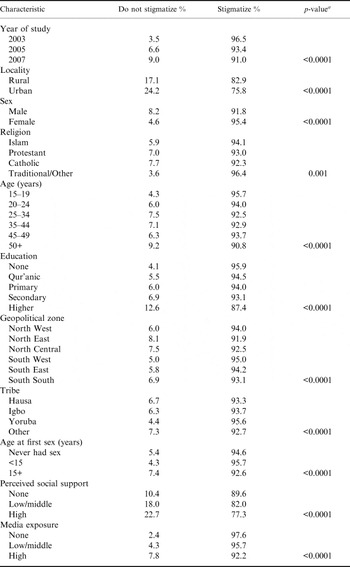
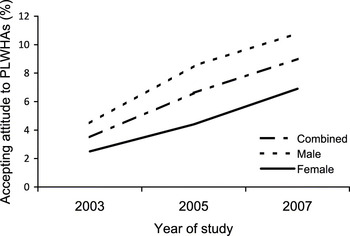
Bivariate analysis of these data revealed an increment in the level of accepting attitudes towards PLWHAs in Nigeria from 3.5% in 2003 to 9.0% in 2007 (see Table 1 and Fig. 1, and Federal Ministry of Health (2009) for brief information on this) . In order to assess possible trend in possible accepting attitudes towards PLWHAs, Pearson's χ 2 test of association between the dependent variable and year of study was used. Table 1 presents findings on the bivariate analyses. A significant trend from 2003 to 2007 was evident (p<0.0001). Subsequently, the UNIANOVA command in SPSS was used to further evaluate possible trend in the level of accepting attitudes towards PLWHAs between 2003 and 2007. This command permits pair-wise comparison between 2003 & 2005, 2005 & 2007 and 2003 & 2007 while adjusting for relevant covariates. For the purpose of this paper, only demographic characteristics of the respondents were adjusted for in the pair-wise comparisons. The findings showed a significant and positive trend on all the pair-wise comparisons (p<0.0001).
Percentage distributions of the level of accepting attitudes towards PLWHAs according to selected background characteristics

a Tests were based on Pearson's χ 2 or Fisher's exact test.
Accepting attitudes towards PLWHAs by year of study and sex.

Exposure to mass media on HIV activities was found to be significantly related to reduced stigma and discrimination against PLWHAs. The impact of exposure to mass media messages on level of accepting attitudes towards PLWHAs was further assessed using the UNIANOVA command in SPSS. This provided the opportunity to discern whether respondents who were highly exposed to messages on HIV and AIDS activities will be more tolerant or have accepting attitudes towards PLWHAs compared with those with ‘low’ level of exposure and ‘no’ exposure at all. The findings further established the positive significant association with exposure as all the pair-wise comparisons were significant (p<0.0001).
Individual perception about social support from various institutions and organizations was explored and the results are presented in Table 1. A positive and significant association between level of perception about social support and accepting attitudes towards PLWHAs was evident. The respondents who perceived to have received high level of social support are more likely to show more tolerant attitudes towards PLWHAs than those with low perceived level of social support. Similarly, those with low perceived level of social support are more likely to demonstrate tolerance towards PLWHAs than those who did not perceive to have received any social support. Pair-wise comparisons for social support were positively significant (p<0.0001). The higher the level of perceived social support, the more likely is the level of accepting attitudes towards PLWHAs.
In this paper, possible associations between level of accepting attitudes towards PLWHAs and other demographic characteristics and knowledge indicators were also explored. Male respondents are almost twice more likely to demonstrate accepting attitudes compared with their female counterparts (8.2% vs 4.6%, p<0.0001). Furthermore, Christians (Protestants and Catholics) are less likely to stigmatize and discriminate against PLWHAs (p=0.001) compared with others (Muslims, Traditional and others). Positive associations between respondent's age, educational attainment and accepting attitudes towards PLWHAs were evident, as older respondents are less likely to stigmatize and discriminate (p<0.0001). Substantial geographical variations were evident at geopolitical zonal level of analysis, with South West most likely to stigmatize and discriminate against PLWHAs (p<0.0001), while North is most likely to demonstrate accepting attitudes towards PLWHAs.
Multivariate analysis
In an attempt to simultaneously evaluate possible trend, exposure to mass media messages on HIV, individual perceptions about institutional support on HIV and AIDS and controlling for other covariates, multiple logistic regression was employed in a systematic manner with attitudes towards PLWHAs being the outcome variable. Firstly, Model 1 explores the association between trend, exposure, social support and the outcome variable. In Model 2, in addition to the independent variables controlled for in Model 1, the effect of other covariates such as the respondents' demographic characteristics and knowledge indicators were simultaneously estimated. Hosmer and Lemeshow statistics (Hosmer & Lemeshow, Reference Hosmer and Lemeshow1989) were used as a test of goodness-of-fit for model checking. The first stage of analysis was done for the combined (male and female) data. However, as shown in Table 1, a gender differential in accepting attitudes towards PLWHAs was evident. Therefore, separate analyses were done for male and female data at another stage of analysis.
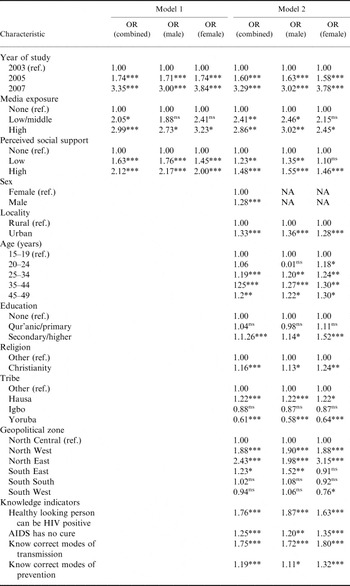
Table 2 presents the results of Models 1 and 2 for the combined and separate datasets for males and females. Turning attention to Model 1 (combined), a positive significant trend was evident. The level of accepting attitudes in 2005 was almost double, as respondents were about 1.8 times more likely to show accepting attitudes compared with 2003 (OR=1.74, p<0.0001). Similarly, respondents were about 3.4 times more likely to show accepting attitudes towards PLWHAs in 2007 compared with those in 2003 (OR=3.35, p<0.0001). A significant positive association exists between level of accepting attitudes towards PLWHAs and exposure to mass media. Respondents with a high level of exposure are almost three times more likely to demonstrate tolerant attitudes compared with those with no exposure (OR=2.99, p<0.0001). Similarly, those with low level of exposure are about two times more likely to show accepting attitudes compared with those with no exposure (OR=2.1, p<0.05). Perception about social support on HIV activities is significantly related to HIV-related stigma. Respondents who perceived that low social support was available are about 1.6 times more likely to show accepting attitudes (OR=1.63, p<0.0001); while those who perceived that there was a high social support are about two times more likely to show accepting attitudes towards PLWHAs (OR=2.12, p<0.0001).
Estimates of adjusted odds ratios for accepting attitudes towards PLWHAs from multiple logistic regression

* p<0.05,
** p<0.01,
*** p<0.001;
ns not significant.
NA, not applicable.
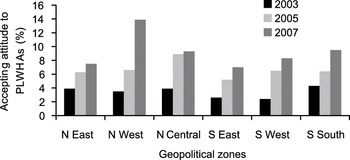
In Model 2, an attempt was made at controlling for further covariates. Here demographic characteristics and knowledge indicators were simultaneously adjusted for. The findings were similar to Model 1. For the combined data, males (OR=1.28, p<0.0001), those living in an urban area (OR=1.33, p<0.0001), Hausa (OR=1.22, p<0.0001) and Christians (OR=1.16, p<0.0001) were more likely to demonstrate tolerant attitudes towards PLWHAs. Education is also positively associated with tolerant attitudes as respondents with secondary/higher education (OR=1.26, p<0.0001) were more likely to have higher levels of accepting attitudes towards PLWHAs compared with those with no formal education. All knowledge indicators are positively and significantly associated with accepting attitudes towards PLWHAs. Respondents with correct knowledge of modes of HIV transmission (OR=1.75, p<0.0001), correct knowledge of modes of HIV prevention (OR=1.19, p<0.0001), who know that a healthy looking person can be HIV positive (OR=1.76, p<0.0001) and who know that AIDS does not have a cure (1.25, p<0.0001) are significantly and more likely to demonstrate accepting attitudes towards PLWHAs. Evidence of significant geographical variations at the geopolitical level on HIV-related stigma was apparent. While the North East zone of Nigeria was associated with positive significant accepting attitudes towards PLWHAs, respondents from South West are less likely to demonstrate accepting attitudes towards PLWHAs. Figure 2 displays further details on level of accepting attitudes towards PLWHAs at the level of geopolitical zones.
Accepting attitudes towards PLWHAs by geopolitical zone and year of study.

The findings were similar for separate and combined analyses for Model 1. A noticeable difference was the association between HIV-related stigma and level of exposure. In Model 2 for separate analyses, the results were also similar when compared with the combined analysis, especially the direction of associations. However, there were a few situations where the relationships were not significant.
Discussion and Conclusions
This study examines HIV-related stigma with the aim of assessing the impact of exposure to HIV and AIDS mass media messages and individual perceptions about availability of social support on accepting attitudes towards persons living with HIV and AIDS. While simultaneously adjusting for other predictors of HIV-related stigma and discrimination, the paper further explores the influence of key knowledge indicators about HIV and AIDS. The aim is to provide more insight into HIV-related stigma, with a view to providing more information to policy-makers and stakeholders interested in the health and quality of life of Nigerians.
The United Nations AIDS (UNAIDS) stigma index for reduction in stigma and discrimination at the national level rose from 3.5% in 2003 to 6.6% in 2005, and further rose to 8.8% in 2007 (Federal Ministry of Health, 2006). The positive trend could be attributable to a number of reasons: stronger demonstrable political will and a mix of effective behaviour change communication strategies, including mass media targeted at risk groups and the general population. Government and non-government organizations, civil society organizations, community-based organizations and faith-based organizations (FBOs) have been at the forefront of HIV and AIDS interventions in the area of stigma reduction. This has led to an increase in knowledge and awareness and the gradual erosion of fear associated with acquiring HIV through everyday contact with persons who are infected. The tendency of linking people with HIV with behaviour that is considered improper and immoral was also significantly mellowed as part of the impact.
Mass media has been employed to present HIV and AIDS messages and provide participating and interactive education between PLWHAs and key audiences through media campaigns and edutainment programmes. This has been useful to dispel myths, which in turn has led to a change in people's attitudes (UNAIDS, 2008). HIV-positive persons' testimonials of positive living and other messages through the media, unlike the fear messages of the past, have also served as reinforcement, and are probably responsible for stigma and discrimination reduction. Most of the independent variables considered were significantly associated with stigma and discrimination at the bivariate level of analysis. These relationships were further established at the multivariate level. Accepting attitudes towards PLWHAs increased significantly between 2003, 2005 and 2007 (see Fig. 1). This provides evidence that past interventions are achieving desired results.
The findings reveal geographical variations in stigma and discrimination across geopolitical zones, and consequently among different ethnic clusters within the country. Less-tolerant attitudes were more observed in the southern geopolitical zones than in the north, and among the Igbos and Yorubas than other tribes. Therefore, effective programming on HIV-related stigma is needed to target and reduce the level of stigma among these sub-groups. To gain better insight into geographical variations in HIV-related stigma, an analysis at a highly disaggregated level of states would be useful for policy formulation. This is consequent on the fact that information may be masked at the geopolitical level since each geopolitical zone comprises six to seven states. Furthermore, since no two states come together to develop a strategy to address their health issues or formulate policies on health issues, future study on HIV-related stigma should focus on state-level analysis. This will provide policy-makers with adequate tools for enhancing effective HIV and AIDS preventive interventions. A key insightful finding from this study suggests that on-going efforts by FBOs should be sustained to continue to improve accepting attitudes among religious groups.
Finally, the findings confirm the hypothesis that those who are exposed to HIV and AIDS mass media messages are more likely to be tolerant towards PLWHAs. Many explanations may be proffered; this is in tandem with other effective intervention strategies such as inter-personal education, community mobilization, political support and personal testimonials of PLWHAs on the mass media. Consequently, programming that focuses on the use of effective mass media messages, including the use of testimonials by PLWHAs, will continue to reduce stigma and discrimination.
The study has certain limitations. The data were obtained through cross-sectional surveys, so causal relationships cannot be ascertained. Furthermore, information on HIV-related stigma was based on self-reported responses by the respondents. In order to assess sustainability of this changed behaviour (increased accepting attitudes towards PLWHAs), data at more time points would be desirable.
Acknowledgments
The authors would like to thank the Federal Ministry of Health of Nigeria for granting permission to use the 2003 and 2005 NARHS datasets. The grants from DFID and USAID to implement these surveys are gratefully acknowledged. Appreciation goes to colleagues for thoroughly reading the first draft of this paper. Their comments have improved this manuscript substantially. Comments from the paper's reviewers and editorial board are much appreciated.