1 Introduction
The current article has two aims: to provide a quantitative analysis of the realisation of the price and mouth vowels preceding nasal–obstruent clusters in Liverpool English (Scouse); and to present empirical evidence that the phonetic variation of nasal–obstruent clusters influences the realisations of the preceding vowels. Price and mouth phonological variation is not typically analysed in connection with nasal–obstruent clusters; and the phonetic variation of the context, in this case nasal–obstruent clusters, is not generally considered when determining the phonetic variation of the preceding vowels. This article provides a better understanding of variation by looking at the target vowel and contextual phonetic variation in conjunction with each other.
Previous research shows that Liverpool English (LE) has price and mouth phonological variation similar to Canadian Raising (Knowles Reference Knowles1973). Canadian Raising is a phonological pattern in Canadian English, whereby price and mouth have a raised nucleus diphthong before voiceless obstruents and a non-raised nucleus diphthong elsewhere (Joos Reference Joos1942; Chambers Reference Chambers1973). Some research suggests that, in addition to raised nuclei, more peripheralised offglides occur before voiceless obstruents (Moreton Reference Moreton2004; Moreton & Thomas Reference Moreton, Thomas, Cole and Hualde2007; Bermúdez-Otero Reference Bermúdez-Otero2014). The few current investigations of this pattern in LE indicate that price and mouth vowel realisations vary preceding voiceless obstruents, voiced obstruents and nasals. Previous research on Canadian-Raising-type patterns has suggested that raised variants may occur before an /nt/ cluster (Gregg Reference Gregg1957; Harris Reference Harris1960; O'Cain Reference O'Cain1997; Idsardi Reference Idsardi2006). Other reports suggest that a raised realisation does not occur before /nt/ clusters (Chambers Reference Chambers2006; Rosenfelder Reference Rosenfelder2007). In the varieties where raised realisations before /nt/ may occur, nasal deletion in the /nt/ cluster may also occur. Therefore, a hypothesis may be suggested that if vowel raising occurs before /nt/ clusters it is the result of nasal deletion, allowing the voiceless obstruent to influence (the) vowel production(s). However, the proposal that raised realisations of price coincide with nasal deletion of the /nt/ cluster has not been investigated empirically. The current research explores the interaction between price and mouth phonological patterns and variation in nasal–obstruent clusters, which may have implications on future research focusing on price and mouth phonological patterns in general. This relationship is explored through price and mouth realisations before nasal–obstruent clusters in Liverpool English, which have not previously been investigated.
Variation in nasal–obstruent clusters has garnered attention from linguists working on many different languages, including English. In particular, there is a wide range of research dealing with variation in the realisation of nasal–stop clusters in American English (see, for example, Malécot Reference Malécot1960; Selkirk Reference Selkirk1972; Ali et al. Reference Ali, Daniloff and Hammarberg1979; Fujimura Reference Fujimura, Myers, Laver and Anderson1981; Cohn Reference Cohn1993; Guy & Boberg Reference Guy and Boberg1997; Zue & Laferriere Reference Zue and Laferriere1997; Warner Reference Warner2002). However, there has been comparatively little research on nasal–obstruent clusters in British English varieties (Docherty Reference Docherty1992; Buizza & Plug Reference Buizza and Plug2012).
Price and mouth conditioning environments in Liverpool English provide an opportunity to determine the precise details of how nasal–obstruent clusters influence the realisations of target vowels within phonological variation. In the Liverpool English pattern, nasals and obstruents produce different realisations of the price and mouth vowels. Therefore, it is possible to see whether the nasal–obstruent clusters produce vowel realisations similar to the nasal context, the obstruent context or a combination of both consonants. In this article, I discuss the results of an acoustic study of LE speakers, which determines the realisations of price and mouth before nasal–obstruent clusters and relates those results to the variation found in nasal–obstruent cluster productions. That is to say, the current article presents evidence that variation in nasal–obstruent clusters influences the preceding vowel productions. Price vowel productions before nasal–obstruent clusters are similar to those before singleton obstruents as nasal deletion occurs more following price. On the other hand, the nasal in nasal–obstruent clusters influences mouth vowel productions more strongly, leading to vowel productions similar to those found before singleton nasals.
Section 2 provides an overview of the literature on price and mouth phonological variation in Liverpool English, the interaction of similar price and mouth phonological variation with nasal–obstruent clusters in different dialects (section 2.1), and details of variation in nasal–obstruent clusters in English (section 2.2). A description of the methods and procedures used in the current acoustic study are discussed in section 3, as vowel trajectories, amount of diphthongisation and duration measurements are all used to determine the target vowel realisations. The results are presented in section 4, which begins with a description of how the graphical representations used in the current article should be interpreted. The results are then divided into findings that relate to the price vowel before nasal–obstruent clusters (section 4.1), findings that relate to the mouth vowel before nasal–obstruent clusters (section 4.2) and variation that is found in nasal–obstruent clusters in Liverpool English (section 4.3). Section 5 discusses the relationship between the common realisations found for price and mouth before nasal–obstruent clusters and the variation found within nasal–obstruent clusters. Conclusions are presented in section 6.
2 Literature review
2.1 Price and mouth phonological variation in Liverpool English
The first mention of price and mouth phonological variation in Liverpool English is in Knowles (Reference Knowles1973). He surveyed 100 participants in order to give a general description of English ‘as it is spoken in Liverpool, to relate Liverpool speech . . . to other varieties of contemporary English, and to discuss variation in the dialect’ (Knowles Reference Knowles1973: 1). Given the large number of features Knowles (Reference Knowles1973) researched, the results for price and mouth constitute only a small part of the entire manuscript. The main finding from his and subsequent research is that price and mouth behave differently in the following three environments: before voiceless obstruents, before voiced obstruentsFootnote 2 and before nasals. Specifically, a raised nucleus diphthong occurs before voiceless obstruents, a non-raised nucleus diphthong occurs before voiced obstruents and monophthongal productions occur before nasals (Knowles Reference Knowles1973; Cardoso Reference Cardoso2011). As obstruents and nasals have different effects on price and mouth productions in Liverpool English, it is reasonable to study how the vowels are affected when both nasals and obstruents are present. Vowel productions before the singleton consonants can be compared to the realisations before nasal–obstruent clusters to tease apart the influence of the nasal and obstruent on the preceding vowel. Specifically, if the target vowel is produced with a raised nucleus diphthong preceding nasal–voiceless obstruent clusters then it is likely that the voiceless obstruent has a greater effect on the vowel production than the nasal within the cluster. If it is realised as monophthongal then the nasal in the nasal–obstruent cluster has more influence on the production of the vowel.
The conditioning environments of this phonological variation are reminiscent of other price and mouth phonological patterns in English. As mentioned above, Canadian Raising in Canadian English is a phenomenon whereby price and mouth are produced with a raised realisation before voiceless consonants, and a non-raised diphthong elsewhere (Joos Reference Joos1942; Chambers Reference Chambers1973). Other similar price and mouth phonological patterns in Ann Arbor (O'Cain Reference O'Cain1997) and South Durham (West Reference West2009) feature monophthongisation before nasals as in Liverpool English. A few Canadian Raising studies mention the realisations of price and mouth before nasal–obstruent clusters: Gregg (Reference Gregg1957) in Canadian English and O'Cain (Reference O'Cain1997) in Ann Arbor (US) find that some speakers variably produce price and mouth as a raised diphthong before /nt/. Other studies did not find a raised realisation in this environment (Chambers Reference Chambers2006; Rosenfelder Reference Rosenfelder2007). The findings of Gregg (Reference Gregg1957) and O'Cain (Reference O'Cain1997) suggest that in nasal–obstruent clusters the vowel is being conditioned by the voiceless obstruent and not the nasal. Both of these dialects are North American varieties, which have variable production of nasal–voiceless obstruent clusters, including deletion of the nasal (see section 2.2 for a detailed description). This offers a potential explanation for the variability of price and mouth realisations in this environment. That is to say, the phonetic variation of the nasal–obstruent cluster may influence the realisation of price and mouth.
2.2 Nasal–obstruent clusters
Previous research on nasal–obstruent clusters in English generally focuses on American varieties (see, for example, Malécot Reference Malécot1960; Selkirk Reference Selkirk1972; Lovins Reference Lovins1978; Ali et al. Reference Ali, Daniloff and Hammarberg1979; Zue & Laferriere Reference Zue and Laferriere1979; Ohala Reference Ohala and Lass1980; Fujimura Reference Fujimura, Myers, Laver and Anderson1981; Cohn Reference Cohn1993; Guy & Boberg Reference Guy and Boberg1997; Warner Reference Warner2002). These studies suggest that there is a large amount of interspeaker and intraspeaker variation in the production of nasal–obstruent clusters in American English.
One of the prevailing results found in research on nasal–obstruent clusters is that the most common phonetic realisation of the nasal–obstruent cluster differs depending on the voicing of the obstruent. Fujimura (Reference Fujimura, Myers, Laver and Anderson1981) finds that the articulatory transition from the nasal to the voiced stop in pined is slower than in pint. The velum is raised for longer in nasal–voiced obstruent clusters resulting in prolonged nasalisation in comparison to nasal–voiceless obstruent clusters. This corresponds well with the finding that nasals are retained more frequently and tend to be longer in duration before voiced stops than before voiceless ones in nasal–obstruent clusters (Malécot Reference Malécot1960; Zue & Laferriere Reference Zue and Laferriere1979; Ohala Reference Ohala and Lass1980; Cohn Reference Cohn1993). The studies further describe two common realisations of /nd/ clusters: one that retains both the nasal and stop and one that retains the nasal and deletes the stop. However, previous research has found more variation in the realisations of nasal–voiceless stop clusters.
Zue & Laferriere (Reference Zue and Laferriere1979) find the following productions in nasal–voiceless obstruent clusters:
- (1)
(a) Vowel + Nasal + Obstruent: [bɛnt]
(b) Nasalised Vowel + Obstruent: [b
 t]
(c) Vowel + Nasal: [bɛn]
(d) Nasalised Vowel + Flap: [b
ɾ]

They further suggest that nasal duration in the nasal–stop clusters might serve as a cue for voicing, as nasal productions are longer before /d/ than /t/. Malécot (Reference Malécot1960) and Cohn (Reference Cohn1993) report that cases where the nasal is perceived as deleted may actually indicate a considerable shortening of the nasal with a preceding nasalised vowel rather than a full deletion of the nasal. Malécot (Reference Malécot1960) also finds that stop closure durations are much longer in /nt/ than /nd/. Furthermore, Cohn's (Reference Cohn1993) results suggest that anticipatory vowel nasalisation in American English is a gradient phonetic process in that the vowel is only partially nasalised. This process occurs in words, such as den. However, in words like dent where nasal deletion in the nasal–obstruent cluster variably occurs, vowel nasalisation is a categorical phonological process in that the vowel is fully nasalised.
Concerning British English varieties, there is comparatively little research in this area. As a consequence, nasal–obstruent clusters are generally described without deletion of either the nasal or obstruent. In a description of variation in American English nasal–voiceless obstruent clusters, Wells (Reference Wells1982: 252) mentions one of the possible variants as ‘a British-style [nt]’. This description is meant to represent a nasal–voiceless stop cluster where no deletion has occurred. By specifying ‘British-style’, Wells (Reference Wells1982) demonstrates the belief that nasal–obstruent clusters in British English do not vary to the same degree as in American English. There are some limited comments on the realisations of the stop in nasal–stop clusters in British English. Glottalisation (Docherty Reference Docherty1992) or affrication (Buizza & Plug Reference Buizza and Plug2012) of the stop may occur in nasal–stop clusters. While lenition of final stops is a well-known feature of Liverpool English (Wells Reference Wells1982; Hughes & Trudgill Reference Hughes and Trudgill1996; Honeybone Reference Honeybone2001), recent studies have shown that final stops preceded by nasals are unlikely to lenite (Honeybone Reference Honeybone2001; Watson Reference Watson2006).
Previous research suggests that the voicing of the obstruent in nasal–obstruent clusters affects the realisations of the nasal in American English. Nasal deletion occurs more frequently in nasal–voiceless obstruent clusters, while obstruent deletion occurs more frequently in nasal–voiced obstruent clusters. Furthermore, it is thought that deletion of neither the nasal nor the obstruent occurs in British English varieties.
3 Methods
3.1 Participants
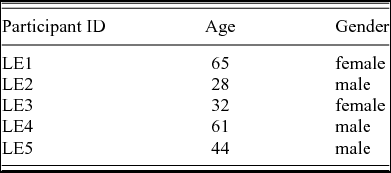
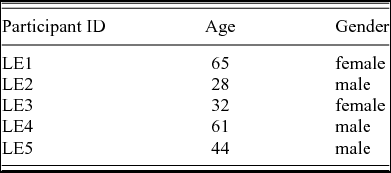
The current investigation is an acoustic study of Liverpool English speakers. I recorded five participants from Liverpool, who have lived in the Liverpool area for almost their entire lives and self-identified as Scouse speakers. All of the participants’ parents and grandparents were also from the Liverpool area, with the exception of one whose father was from Manchester. There are three male participants and two female participants ranging in age from 28 to 65 (see table 1 for details of the speakers). The sample size and age range for this investigation is similar to other investigations on variation of nasal–obstruent clusters. Zue & Laferriere (Reference Zue and Laferriere1979) had six participants between the ages of 21 and 52 and Fujimura's (Reference Fujimura, Myers, Laver and Anderson1981) study includes five speakers; three of which were recorded for six to eight minutes and two were recorded for approximately thirty minutes.
Participants’ age and gender
3.2 Materials
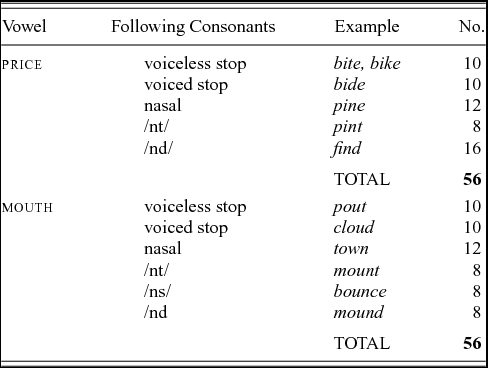
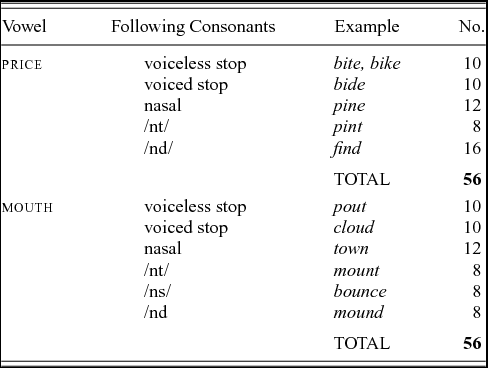
The stimuli consisted of monosyllabic price, mouth and distractor (trap, dress) tokens before voiceless obstruents, voiced obstruents, nasals, nasal–voiceless obstruent clusters and nasal–voiced obstruent clusters. Tokens were randomised and embedded in the carrier sentence Say x. Table 2 provides details of the tokens relevant to this article.Footnote 3 There were approximately 10 tokens for each environment, some of which were repeated productions of the same word. The numbers in the rightmost column of table 2 reflect the number of tokens read by each speaker. Therefore, before nasal–obstruent clusters there are a total of 120 price tokens and 120 mouth tokens across all speakers (24 tokens per vowel by five speakers). There are a limited number of lexical items in English that have price or mouth followed by a nasal–obstruent cluster.Footnote 4 The materials of the current investigation utilise as many of those lexical items as possible without frequently repeating lexical items in the elicitation task. That being said, the number of tokens in this study is comparable to other studies on nasal–obstruent clusters. Zue & Laferriere (Reference Zue and Laferriere1979) elicit nasal–obstruent clusters in approximately 60 of the 250 lexical items, which include eight different vowels. Each vowel would have approximately 100 tokens before nasal–obstruent clusters based on the total of 3,000 tokens.
Words list tokens before nasal–obstruent clusters
3.3 Procedure
The participants were seated at a desk with a laptop in front of them and had a head-mounted microphone connected to a Marantz PMD 661 for sound recording. Each token embedded in the carrier sentence was presented individually, and the participant pressed the spacebar to move to the next screen with a new token. Instructions were given both orally and presented on the screen at the beginning of the experiment. Three example tokens were presented immediately following the instruction to familiarise the participants with the task and allow them to ask any questions. Once the example section was complete, the experimenter left the room. There were three breaks during the experiment and the entire process took approximately 30–45 minutes.
3.4 Analysis
Sound files were manually segmented in Praat (Boersma & Weenik 2009) and equally spaced measurements of f1, f2 and f3, and duration measurements were taken for each target vowel using a Praat script. These measurements were then analysed using RStudio (2012) to produce the formant plots, box plots and density plots in section 4. The results presented in this article include the measurements starting from the 20 per cent measurement at 10 per cent increments thereafter until the 80 per cent measurement, i.e. 20, 30, 40 per cent, and so on. In order to ensure that transitions from the preceding and into the following segments are not included in the formant plots, measurements between 0 and 19 per cent and between 81 and 100 per cent were not included. All formant measurements were normalised using the modified Watt and Fabricius method in R (Kendall & Thomas Reference Kendall and Thomas2009–14). All of the formant, density and amount of diphthongisation box plots in the following sections are based on these normalised measurements. They represent the combined results across all speakers and not the individual speakers. The formant values presented on the plots are averaged formant measurements across all tokens in the specified environments.
Duration measurements for the nasal–obstruent clusters were taken manually in Praat following the initial analysis. The division between the nasal and obstruent were determined by sharp changes in the spectral amplitude, similar to the method used by Zue & Laferriere (Reference Zue and Laferriere1979), and visual/auditory inspection of the spectrogram. The duration of the stop is a measurement of the closure phase and does not include the release burst in order to mitigate any potential lenition effects.
Duration measurements of the target vowels and nasal–obstruent clusters are normalised using z-scores, which were developed by Lobanov (Reference Lobanov1971) for formant normalisation, and have been used to normalise vowel duration (Wang & Van Heuven Reference Wang and van Heuven2006). Z-scores are calculated by taking the difference between the raw duration value and the speaker's average value and dividing the difference by the speaker's standard deviation. The products of this equation are positive and negative values, where 0 represents the speaker's average duration. Positive values indicate durations that are longer than the speaker's average and negative values indicate durations that are shorter than the speaker's average. All duration box plots in the following sections are based on these normalised duration z-scores.
4 Results
The results of this study suggest that there are a number of different realisations for nasal–obstruent clusters in Liverpool English and that productions of the price and mouth vowels are influenced differently by these nasal–obstruent cluster realisations. Recent research by the author suggests that the price and mouth phonological patterns in Liverpool English have slightly different conditioning environments, and should be seen as different, potentially related, phonological patterns. Partially due to this new research and the current results, which show differences in realisations of nasal–obstruent clusters and target vowel productions depending on the vowel, price and mouth results will be presented separately.
Formant, density and amount of diphthongisation box plots are used in the following section to present the results of this study. As previously mentioned, these plots contain combined data from all five speakers in the experiment. For the sake of clarity and to assist in the interpretation of the results, I briefly explain how each of these figures should be interpreted.
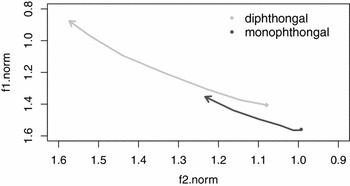
Firstly, formant plots use mean normalised f1 and f2 measurements across all speakers. The measurements are normalised and, therefore, the actual number values given along the axes do not correspond to formant frequencies in Hertz. As this article deals with diphthongs, vowel trajectories are plotted on the formant plot. These vowel trajectories are used to show the movement from the diphthong's initial phonetic position (‘nucleus’) through to the diphthong's final phonetic position (‘offglide’). In the formant plots the 20 per cent f1xf2 measurement is shown by a shape depending on the following environment and the 80 per cent measurement is indicated by an arrowhead (see figure 1). However, all averaged measurements from 20 to 80 per cent at every 10 per cent interval are plotted.
Demonstration of the diphthong formant plots: 20 per cent measurements are represented by a shape and 80 per cent measurements are represented by arrowheads

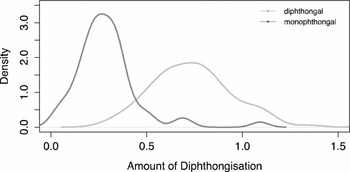
Density plots are similar to histograms in that they show the frequency distribution of a feature along a continuum. In particular, the following density plots demonstrate the extent to which different degrees of diphthongisation are represented in the data set. The degree of diphthongisation is operationalised as the Euclidean distance between the formant values for the nucleus and the offglide. Therefore, if the token is more monophthongal the Euclidean distance will be small as the phonetic distance between the nucleus and offglide would also be small. If the token is more diphthongal the Euclidean distance will be larger. The density plots show the amount of different Euclidean distance values separately for each conditioning environment. The amount of diphthongisation is plotted along the x-axis and the y-axis is proportionate to the number of tokens (see figure 2 for an example).
Demonstration of the density plots showing the amount of diphthongisation of tokens: more monophthongal tokens (dark grey), more diphthongal tokens (light grey)

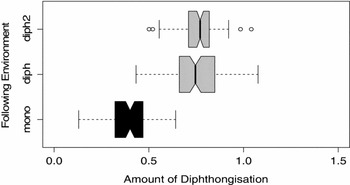
Amount of diphthongisation box plots are similar to the density plots explained above in that they represent the amount of diphthongisation using Euclidean distance. These box plots are used in cases where density plots would be difficult to interpret due to comparing a larger number of conditioning environments. The amount of diphthongisation is plotted along the x-axis and the y-axis is the conditioning environment (see figure 3 for an example). Furthermore, the notches in the sides of the boxes show whether the medians of the boxes differ. If two boxes’ notches overlap that is ‘strong evidence’ that their medians are not different (Chambers et al. Reference Chambers, Cleveland, Kleiner and Tukey1983: 62). That is to say, in figure 3 it is likely that the median amount of diphthongisation differs between the ‘mono’ environment and the two other environments, but ‘diph’ and ‘diph2’ are not likely to differ.
Demonstration of the amount of diphthongisation box plots showing the amount of diphthongisation of tokens and notches: more monophthongal tokens (dark grey) median is unlike diphthongal categories, more diphthongal tokens (light grey)

There will also be a number of duration box plots and spectrograms presented, which will be explained in the sections where they appear.
4.1 Price before nasal–obstruent clusters
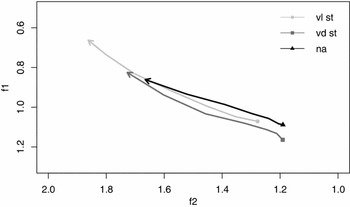
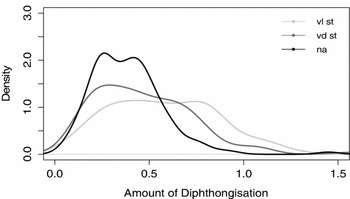
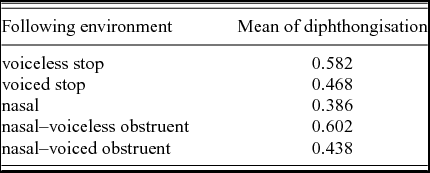
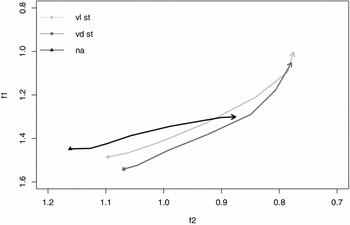
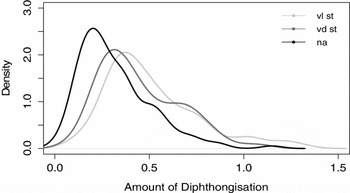
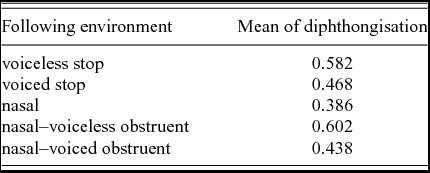
In this section, I present price realisations before singleton obstruents and nasals, and compare these to price productions before nasal–obstruent clusters. Figure 4 demonstrates that price has a raised and fronted nucleus and a raised and fronted offglide before voiceless stops in comparison to voiced stops or nasals. The beginning of the line (indicated by a dot, square or triangle) represents the nucleus, and it is fronter before voiceless stops (light grey line) than in the other environments and higher than before voiced stops. The offglide (indicated by an arrowhead) shows the same pattern of being higher and more front before voiceless stops than the other environments.Footnote 5 The formant plot in conjunction with the density plot (figure 5) demonstrates that the realisations before stops are more diphthongal than those before nasals. The mean values presented in table 3 support this claim, as the average Euclidean distance measurement is closer to 0 before nasals and farthest from 0 before voiceless stops. In other words, these mean values indicate that price is the most diphthongal before voiceless stops and the most monophthongal before nasals.
Price vowel formant measurements between 20 per cent (dot – voiceless stop, square – voiced stop, triangle – nasal) and 80 per cent (arrowheads)

The amount of diphthongisation of price vowel tokens before voiceless stops (light grey), voiced stops (grey), nasals (dark grey)

The mean value for the degree of diphthongisation of price vowel tokens
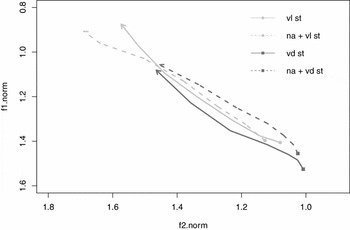
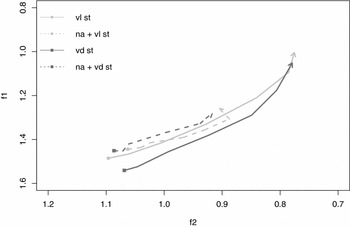
Nasal–obstruent clusters could potentially affect the price vowel in a similar way to singleton nasal consonants if there is no variation in the production of the nasal–obstruent cluster, as the vowel would theoretically be conditioned by the following nasal. However, the current results show that nasal–obstruent clusters actually pattern with singleton obstruents in the case of the price vowel. This suggests a connection between how the nasal–obstruent cluster is produced and the realisations of the target vowel. Specifically, before a nasal–voiceless obstruent cluster the nucleus and offglide are raised and fronted, whereas before a nasal–voiced obstruent cluster they are not (see figure 6). Figure 6 illustrates the similarity of price vowel realisations before the singleton obstruent and the nasal–obstruent cluster with the same voicing. The vowel trajectory before singleton voiced stops is very similar to the vowel trajectory before nasal–voiced obstruent clusters. Nasal–voiceless obstruent cluster realisations are similar to those before singleton voiceless stops, and are even more fronted in both the nucleus and offglide than the price productions before singleton voiceless stops.
Comparison of the formant measurements for price vowel productions before voiceless stops (solid light grey line), nasal–voiceless obstruent clusters (dashed light grey line), voiced stops (solid grey line), nasal–voiced obstruent clusters (dashed grey line)

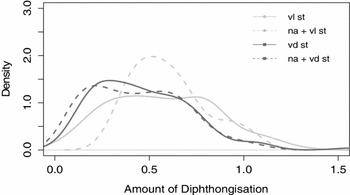
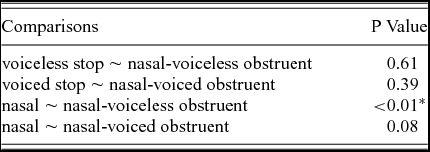
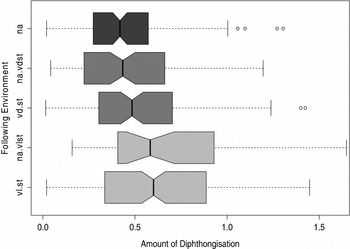
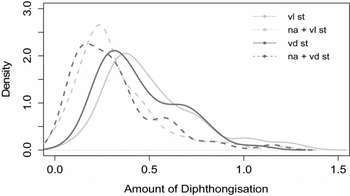
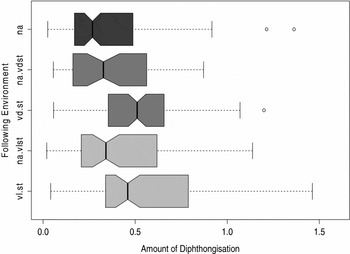
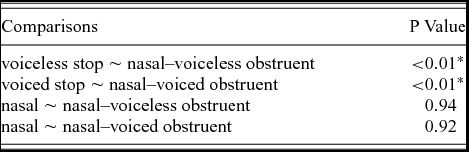
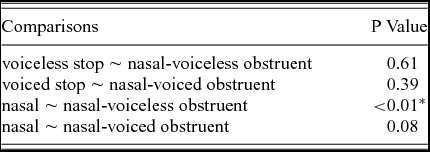
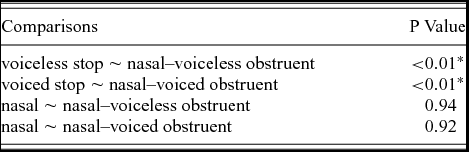
The degree of diphthongisation corroborates these results. Before nasal–voiced obstruent clusters the results are almost identical to the singleton voiced stop distribution (see figure 7). Similarly, before nasal–voiceless obstruent clusters follow the singleton voiceless stop pattern with a much higher degree of diphthongisation than before singleton nasals. The average measurement of diphthongisation before nasal–voiceless obstruents and nasals are 0.602 and 0.386 respectively (see table 3), a difference which was statistically significant (p<0.01). Table 4 shows the results of t-tests on amount of diphthongisation depending on the following context. Figure 8 illustrates that the vowel productions before nasal–obstruent clusters are like those before singleton obstruents of the same voicing and unlike those before singleton nasals. This further supports the findings above that nasal–obstruent clusters influence price vowel productions in a similar way to how the singleton obstruents condition price vowel productions.
The amount of diphthongisation of price vowel tokens before voiceless stops (solid light grey), nasal–voiceless obstruent clusters (dashed light grey), voiced stops (grey), nasal–voiced obstruent clusters (dashed grey)

Results of t-tests for the degree of diphthongisation of price vowel tokens
The amount of diphthongisation of price vowel tokens before voiceless stops (light grey), nasal–voiceless obstruent clusters (light grey), voiced stops (grey), nasal–voiced obstruent clusters (grey), nasals (dark grey)

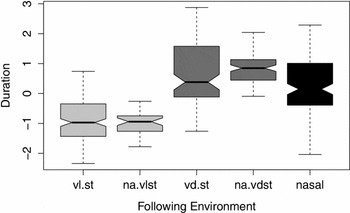
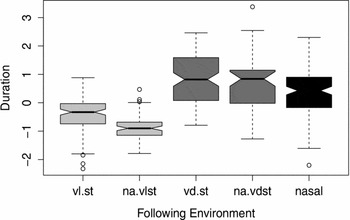
The duration results are similar to those found for both the formant measurements and amount of diphthongisation, in that the price vowel durations before nasal–obstruent clusters are similar to the results for singleton obstruents (see figure 9). Mainly, the target vowel is shorter before a nasal-voiceless obstruent cluster and voiceless stop, but longer before a nasal–voiced obstruent cluster and voiced stop. The duration of the price vowel before nasals is longer than before voiceless stops and not quite as long as voiced stop durations, but closer to the voiced stop. Figure 9 shows the normalised duration measurements across all speakers in this investigation.
Price duration measurements before voiceless stops (vl.st), nasal–voiceless obstruent clusters (na.vlst), voiced stops (vd.st), nasal–voiced obstruent clusters (na.vdst), nasals (nasal)

In summary, the results for the price vowel suggest that nasal–obstruent clusters affect vowel realisations in a similar way to singleton obstruents. All three measures – formants measurements, diphthongisation and duration – demonstrate that the vowel realisations are determined primarily by the obstruents, not the nasals.
4.2 Mouth before nasal–obstruent clusters
As described in section 2.1, mouth productions are somewhat different from those of price in Liverpool English. This difference in behaviour before singleton consonants lies in the realisation of the offglide before singleton obstruents and of the nucleus before singleton nasals. Figure 10 shows that the nucleus of mouth is slightly raised and fronted before voiceless stops, but not before voiced stops. While, this is not to the same extent as is found for the price vowel, the nucleus f1 measurements are statistically significantly different (p=0.039) before voiceless stops and voiced stops. The offglide is in a similar phonetic space before voiceless and voiced stops in mouth. This was not the case for price: the offglide was raised and fronted before voiceless stops, but not before voiced stops. Moreover, the nucleus of mouth before nasals is very fronted and raised, which was not the same as the results for price.
Mouth vowel formant measurements between 20 per cent (dot – voiceless stop, square – voiced stop, triangle – nasal) and 80 per cent (arrowheads)

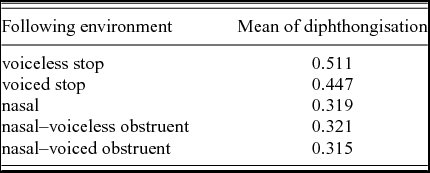
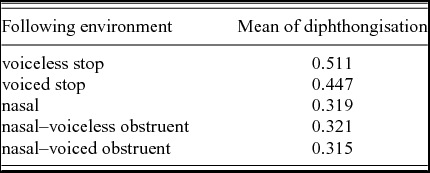
Regarding the amount of diphthongisation, there is much less diphthongisation overall in mouth than there is in price. Nevertheless, the general pattern is the same: the most monophthongal productions occur before nasals and the most diphthongal ones before voiceless stops (see figure 11). Table 5 demonstrates the mean values of diphthongisation in each environment.
The amount of diphthongisation of mouth before voiceless stops (light grey), voiced stops (grey), nasals (dark grey)

The mean value for the degree of diphthongisation of mouth vowel tokens
In the results for the price vowel, there was a clear connection between the productions before nasal–obstruent clusters and those before singleton obstruents. On the other hand, mouth productions seem to be subject to a much stronger influence from the nasal in the cluster. As shown in figure 12, the formant measurements for the nucleus of mouth before nasal–voiceless obstruent clusters are similar to those of the voiceless stop. However, the degree of diphthongisation is similar to productions before singleton nasals (see figure 14). The nucleus of mouth before nasal–voiced obstruent clusters appears to be similar to that before singleton voiced obstruents, but there is a statistically significant difference (p=0.007) between the vowel's f1 measurements of the nucleus before voiced stops and nasal–voiced obstruent clusters. This difference is not found for the f2 measurement at the nucleus. The degree of diphthongisation is not similar to singleton voiced stops, but is more monophthongal, like singleton nasals. The phonetic position of the nucleus corresponds with the singleton obstruents, but the vowel realisations are more monophthongal, like the production before singleton nasals. The offglide reflects the more monophthongal productions, as before both nasal–obstruent clusters it is less raised and backed than before the singleton obstruents. These findings suggest that the nasals in the nasal–obstruent clusters are affecting mouth productions much more than price. This can be explained by less nasal deletion in nasal–obstruent clusters, as seen in section 4.3.
Comparison of formant measurements for mouth vowel productions before voiceless stops (solid light grey line), nasal–voiceless obstruent clusters (dashed light grey line), voiced stops (solid grey line), nasal–voiced obstruent clusters (dashed grey line)

Turning to the specific results on the amount of diphthongisation, it is evident that the nasal influences the production(s) of the mouth vowel (see figure 13). In both nasal–obstruent cluster types, resulting vowel realisations have become more monophthongal than before singleton obstruents (see table 5 for mean diphthongisation values and figure 14). The mean values in table 5 demonstrate the similarity between the target vowel productions before nasal–obstruent clusters and singleton nasals. Table 6 shows the results of t-tests on amount of diphthongisation measurements. Furthermore, the duration measurements show the effect of the obstruent rather than nasal in the nasal–voiceless obstruent cluster. Mouth vowels/tokens before voiced stops, nasal–voiced obstruent clusters and nasals all have a similarly long duration.
The amount of diphthongisation in mouth vowel tokens before voiceless stops (solid light grey), nasal–voiceless obstruent clusters (dashed light grey), voiced stops (grey), nasal–voiced obstruent clusters (dashed grey)

The amount of diphthongisation of mouth vowel tokens before voiceless stops (light grey), nasal–voiceless obstruent clusters (light grey), voiced stops (grey), nasal–voiced obstruent clusters (grey), nasals (dark grey)

Results of t-tests value for the degree of diphthongisation of mouth vowel tokens
Before voiceless stops, and nasal-voiceless obstruent clusters, the target vowels are shorter (see figure 15).
Mouth duration measurements before voiceless stops (vl.st), nasal–voiceless obstruent clusters (na.vlst), voiced stops (vd.st), nasal–voiced obstruent clusters (na.vdst), nasals (nasal)

Mouth vowel productions are more complicated than the price vowel productions before nasal–obstruent clusters, as there is a stronger effect from the nasal. This produces results which show behaviour similar in some aspects to singleton nasals and in others to singleton obstruents. The following section investigates the realisation of the nasal–obstruent clusters themselves to better understand the reason for the difference between price and mouth realisations. In so doing, it also presents empirical evidence that Liverpool English shows variation in nasal–obstruent clusters, as has been attested in American English varieties.
4.3 Nasal–obstruent cluster realisations in Liverpool English
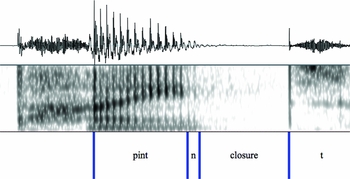
Similar to the results of previous studies on nasal–obstruent clusters, there are a number of ways in which the nasal–obstruent clusters can be realised. While there is some interspeaker variation, the main findings of this article still hold for all speakers in the current dataset. The current study finds that nasal deletion and obstruent shortening can occur in nasal–obstruent clusters in Liverpool English similarly to American English. Nasal deletion results in the preceding vowel being nasalised and the nasal is either completely deleted or considerably shortened. This occurred most frequently in nasal–voiceless obstruent clusters. Figure 16 clearly shows that the nasal has been shortened, especially in comparison to the duration of the stop closure.
Example spectrogram of nasal deletion in the nasal–obstruent cluster: pint

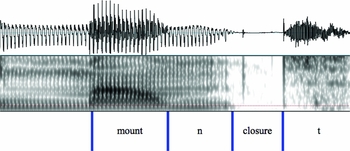
Another possible realisation of nasal–obstruent clusters is to retain both the nasal and the obstruent (see figure 17). This variant occurred equally in nasal–obstruent clusters with voiceless obstruents and in clusters with voiced obstruents, and is reported in nasal–obstruent clusters in British English varieties (Wells Reference Wells1982). The duration of the nasal and the stop closure are similar, suggesting that both consonants have been retained. There is also a clear burst, which suggests that the stop has not been deleted.
Example spectrogram of nasal and obstruent retention in nasal–obstruent clusters: mount

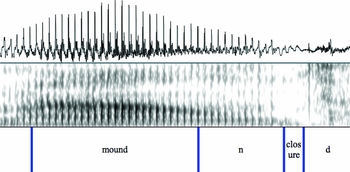
Finally, in some cases it is the obstruent that is shortened or deleted, as has been previously suggested for American English varieties. Obstruent shortening occurs when the nasal duration is considerably longer than the stop closure duration, as in figure 18. Obstruent shortening occurred most frequently in nasal–voiced obstruent clusters. Figure 18 clearly shows that there is a very short closure preceded by a long nasal.
Example spectrogram of obstruent shortening in the nasal–obstruent cluster: mound

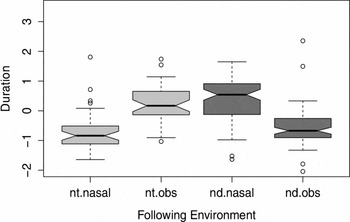
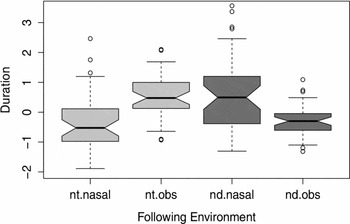
These general observations can be seen in the duration measurement of the nasal and obstruent (closure) overall presented below. Malécot (Reference Malécot1960) discusses the impact of vowels on the production of the nasal–obstruent clusters. Deletion of either the nasal or obstruent within a cluster is more frequent after some vowels than others. The current study provides evidence that nasal deletion occurs more often in nasal–voiceless obstruent clusters than in nasal–voiced clusters (see figures 19 and 20). The duration of the nasal portion (nt.nasal) of the nasal–voiceless obstruent cluster is shorter than the duration of the obstruent portion (nt.obs). However, the nasal duration (nd.nasal) is longer than the obstruent (nd.obs) in the nasal–voiced obstruent clusters. This shows that there is more nasal deletion in the nasal–voiceless obstruent clusters and more obstruent shortening in the nasal–voiced obstruent clusters.
Nasal (nt.nasal, nd.nasal) and obstruent (nt.obs, nd.obs) durations following price: nasal–voiceless obstruent clusters (light grey) and nasal–voiced obstruent clusters (grey)

Nasal (nt.nasal, nd.nasal) and obstruent (nt.obs, nd.obs) durations following mouth: nasal–voiceless obstruent clusters (light grey) and nasal–voiced obstruent clusters (grey)

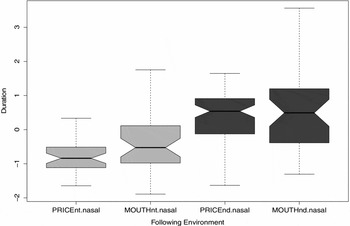
Nasal deletion does also occur after mouth in the nasal–voiceless obstruent clusters, but less often than it does after price. This can be seen in figures 20 and 21, as the duration difference between the nasal and the voiceless stop portions of the nasal–voiceless obstruent clusters is not as large as it is after price. Therefore, nasal deletion in nasal–voiceless obstruent clusters after mouth is less frequent than in price. The difference between the duration of nasals in nasal–voiceless stop clusters following price and mouth is statistically significant according to a t-test (p=0.027).
Comparison of nasal durations following price (pricent.nasal, pricend.nasal) and mouth (mouthnt.obs, mouthnd.obs): nasal–voiceless obstruent clusters (light grey) and nasal–voiced obstruent clusters (grey)

This difference in the frequent realisations of nasal–obstruent clusters after price and mouth is a potential reason for the difference between the realisations of price and mouth before nasal–obstruent clusters. The price vowel realisations before the nasal–obstruent clusters correspond closely to those of the singleton obstruents. In the case of nasal–voiceless obstruent clusters, this is most likely due to the higher incidence of nasal deletion. In other words, frequent nasal deletion encourages nasal–voiceless obstruent clusters to behave like singleton voiceless obstruents and leads to price vowel productions like those before singleton voiceless obstruents. Mouth vowel productions are affected more by the nasal in the cluster, which is due to less frequent nasal deletion in the nasal–voiceless obstruent clusters. While the difference in nasal–voiced obstruent cluster durations is much smaller between price and mouth, it is still evident that the nasal durations in nasal–voiced obstruent clusters preceded by mouth are longer than in price. Therefore, the nasal is able to exert more influence on the vowel productions in mouth than in price.
In the preceding sections, I have shown that phonetic realisations of the price and mouth vowels are affected differently by nasal–obstruent cluster and that this is most likely due to the phonetic realisation of the nasal–obstruent clusters. If the nasal is deleted, it is more likely for the target vowel to be realised similarly to vowels preceding singleton obstruents. However, longer nasal durations will promote target vowel realisations which are more similar to those found before singleton nasal consonants. Finally, nasal–obstruent clusters with no deletion will provide an influence from both the nasal and obstruent. This is demonstrated by mouth vowel productions preceding nasal–voiceless obstruent clusters. The nucleus formant values are similar to those before singleton voiceless stops, but the vowel productions are overall more monophthongal, similar to those before singleton nasals.
5 Discussion
The research on phonologically conditioned vocalic patterns in English does not typically look at the impact of nasal–obstruent clusters on vowel realisations. In particular, nasal–obstruent clusters are rarely considered within the well-researched area of price/mouth phonological patterns. As the current study shows, nasal–obstruent clusters are a particularly interesting environment to research, both in terms of the vowel productions and the realisations of the clusters themselves.
The current investigation presents evidence that price and mouth have different phonological patterns preceding nasal–obstruent clusters and that those patterns directly relate to nasal–obstruent cluster realisations. Some previous research on price/mouth raising patterns in North American varieties have mentioned that ‘[b]efore a nasal–voiceless cluster (pint) /ai/ is also raised 50% of the time’ (O'Cain Reference O'Cain1997: 110). Gregg (1954: 24) lists ‘pint [pəint]’ and ‘mount [mʌʊnt]’ as examples of the raised realisation of price/mouth. Cardoso (Reference Cardoso2011) suggests that nasal deletion in the nasal–obstruent clusters might be responsible for the raised realisations found in these North American varieties, similar to the results before singleton voiceless obstruents. As mentioned in previous sections, nasal deletion in nasal–obstruent clusters is well researched in North American varieties. It is, therefore, likely to contribute to the realisations of the price/mouth vowels in these varieties. However, to my knowledge there is no study that has established nasal deletion in nasal–obstruent clusters as a process in British English varieties. As there is very little research on the price and mouth phonological patterns in Liverpool English in general, the target vowel productions before nasal–obstruent clusters have not been investigated.
While the results presented in section 4 show that price has a raised realisation before nasal–voiceless obstruent clusters – like the productions before a voiceless obstruent – mouth before these clusters is not produced with a raised or fronted nucleus. The results on the realisations of nasal–obstruent clusters in Liverpool English provide a clear explanation for this difference. The frequent realisations of nasal–obstruent clusters following price are different from those following mouth. Nasal–voiceless obstruent clusters after price delete the nasal more frequently than they do after mouth. This establishes Liverpool English as a variety that has nasal deletion in nasal–obstruent clusters. It also provides an explanation for the raised realisation of price; as the nasal is deleted, the price vowel is conditioned by the voiceless obstruent in the same way as it would be by a singleton voiceless obstruent. Conversely, the amount of nasal deletion in nasal–voiceless obstruent clusters is lower after mouth. Mouth productions followed by nasal–voiceless obstruent clusters tend to incorporate aspects of both the nasal and the voiceless obstruent. The nucleus of the vowel is phonetically more similar to productions before voiceless obstruents than before nasals, but there are more monophthongal productions, which is an influence from the following nasal. The nasal–voiceless obstruent clusters after mouth tend to have less deletion of the nasal and no deletion of the obstruent. As both consonants were usually present to a large extent in the cluster, they both influence the production of the vowel.
Price vowel realisations before nasal–voiced obstruent clusters follow closely the results for singleton voiced obstruents, whereas mouth again had a combination of effects from the nasal and the obstruent. The nasal–voiced obstruent clusters after price and mouth again differ in the amount of consonant reduction. Mouth has more equal nasal and obstruent durations in nasal–voiced obstruent clusters than price. This leads to mouth productions with more influence from both the following nasal and obstruent than is found for price. There is more monophthongisation in mouth before nasal–obstruent clusters than is found for price, which demonstrates the greater influence of the nasal portion of the nasal–obstruent cluster.
Obstruent shortening occurs slightly more in nasal–voiced obstruent clusters followed by price than by mouth. However, the realisations of price before nasal–voiced obstruent clusters would suggest more of an influence from the obstruent. If obstruent shortening occurs then the realisation should correspond more to the realisations before singleton nasals. In order to account for this apparent anomaly, more research is required to tease apart how the variation in the nasal–voiced obstruent clusters relate to the realisation of the price vowel.
Variation in the production of nasal–obstruent clusters in Liverpool English is a new finding. The previous research on nasal–obstruent clusters in British English has generally dealt with possible realisations of the obstruent only. One of the characteristic features of Liverpool English is the lenition of final stops, so that like is often produced with either an affricate or fricative (Honeybone Reference Honeybone2001). However, Honeybone (Reference Honeybone2001) and Watson (Reference Watson2006) suggest that lenition is inhibited in nasal–stop clusters. ‘It appears that the sharing of a place element and a manner element in “nasal+stop” clusters is particularly effective in the inhibition of lenition processes’ (Watson Reference Watson2006: 22). This article adds to the current research on consonant productions in Liverpool English by providing empirical evidence for variation in nasal–obstruent clusters in Liverpool English. Specifically, nasal deletion and obstruent shortening is found.
Malécot (Reference Malécot1960) found that certain vowels did not exhibit as much nasal deletion as others in American English. In words like hunt or hint the nasal consonant was rarely deleted, while [æ] had a high frequency of nasal deletion. In a similar vein, the current study finds that price has higher proportions of nasal deletion in nasal–voiceless obstruent clusters than mouth.
Zue & Laferriere (Reference Zue and Laferriere1979) found that the nasal in nasal–obstruent clusters was sensitive to the voicing effect.Footnote 6 That is to say, the vowel length did not vary as much as the nasal duration. Nasal consonants were shorter before voiceless obstruents and longer before voiced obstruents. However, Raphael et al. (Reference Raphael, Michael, Dormann, Freeman and Tobin1975) found that both the vowel and the nasal will lengthen in response to the following voiced obstruent. The current study finds a pattern in line with Raphael et al. (Reference Raphael, Michael, Dormann, Freeman and Tobin1975). It is clear that the voicing effect is present in both the vowels (figures 9 and 15) and the nasals (figure 21), though it is more evident in price than in mouth. Price and mouth vowels before nasal–voiced obstruent clusters are longer than before nasal–voiceless obstruent clusters. Likewise, the nasal consonants in nasal–voiced obstruent clusters are longer than those in the nasal–voiceless obstruent clusters.
6 Conclusion
The present article has shown that productions of price and mouth in Liverpool English differ when following nasal–obstruent clusters. Price realisations before nasal–obstruent clusters were found to be similar to the realisations before singleton obstruents, whereas mouth productions before nasal–obstruent clusters have a greater influence of the nasal consonant, as shown by monophthongisation of mouth in this context. Furthermore, the current article demonstrates that Liverpool English has variable realisations of the nasal–obstruent clusters. The results show that nasal deletion, obstruent shortening, and nasal and obstruent retention all occur in nasal–obstruent clusters in Liverpool English. This variation in the production of nasal–obstruent clusters helps to explain the difference in realisations of price and mouth. Nasal deletion occurred frequently before price, which lead to a stronger influence from the obstruent. On the other hand, retention of the nasal and obstruent occurred frequently following mouth, which produced more monophthongal realisations with the nucleus in the area of the singleton obstruent. The present article demonstrates how nasal–obstruent clusters interact with phonological patterns in general and specifically with the price and mouth phonological patterns in Liverpool English.