1. Introduction
Recently, ‘vulnerability’ and especially ‘resilience’ to disasters have emerged as historiographic topics in their own right. History came late to the field, as geographers, sociologists and economists have focused on these topics for decades; particularly after Quarantelli, in his groundbreaking work, emphasised the social, cultural and political nature of disasters, effectively removing the ‘natural’ from ‘natural disasters’.Footnote 1 The concept of resilience, inspired by ecology and defined by Adger ‘as the ability of communities to withstand external shocks to their social infrastructure’Footnote 2 has not only greatly influenced policymakers, but also scientists. Historians have, up until now, followed other social scientists in focusing mainly on the macro- and meso-level aspects of resilience, by reconstructing the characteristics of societies struck by disasters in order to observe whether, and if so how, adversity was overcome.
A pioneer in the study of these issues in the field of history was Appleby, who noticed a discrepancy in early modern susceptibility to famine between the ‘two Englands’; the famine-prone north-west and the much more resilient lowland south.Footnote 3 Initial research was strongly focused on differences within England and between England and continental Europe, particularly France,Footnote 4 but more recently new paths have been explored. Vanhaute and Lambrecht, for example, have analysed how Flemish communities responded to food crises in the eighteenth and nineteenth centuries, suggesting that there was a shift in the coping mechanisms deployed over time.Footnote 5 Curtis recently claimed that societies that were more egalitarian and open were more resilient when confronted by crises.Footnote 6 The same suggestion has also been made by Van Bavel and Curtis, who argue that there should be greater focus on how (in)equality makes a society less – or more – able to cope with disasters.Footnote 7 In addition, Pfister and Bradzil pointed to the importance of ‘the inherent properties of political systems’, in making authorities more or less prone to intervene when disaster struck.Footnote 8 Most of these studies have been preoccupied with ‘vulnerability’ and ‘resilience’ at the meso- and macro-level; they have tended to have a strong focus on differences over time or between regions, hoping to identify the structural features of societies that make them either vulnerable or resilient when faced with adversity.Footnote 9
However, the tension between the ‘resilience’ of societies on the one hand and the ‘vulnerability’ of people on the other has recently been addressed by Soens, who pointed out that most historical societies were highly resilient; most would recover or adapt to new circumstances and societal breakdown was extremely rare. This argument is linked to recent fierce critiques of the concept of ‘resilience’, especially in the fields of development economics and disaster studies, which suggest that by making socio-ecological factors the focus of attention the importance of socio-economic systems and power relations in creating vulnerability/enabling resilience is obscured. This stands in complete contrast to the concept of ‘vulnerability’.Footnote 10 Sudmeier-Rieux states: ‘poor households may be highly resilient, but continue to be highly vulnerable and highly at risk. In other words, increased resilience does not necessarily decrease vulnerability nor risk.’Footnote 11 This reflects the point made by Soens who views societies as having different degrees of ‘vulnerability of people’; measured by the extent to which members of the population were exposed to potential harm and by the number of people actually suffering harm. From this perspective societies should only be described as ‘resilient’ if they were ‘able to limit the exposure of people to suffering and disruption’.Footnote 12 ‘Vulnerability’, ‘the exposure to contingencies and stress and difficulties coping with them’Footnote 13 therefore seems a more suitable concept with which to approach disasters and crises in the past and can be situated at the individual level, but also – and this is essential – at a collective level, the level of social groups within society.
A focus on the micro-level and the vulnerability of different social groups therefore seems the way forward to overcome a too narrow focus on the macro-level of societies as a whole. Sen's classic work on the strong link between poverty and vulnerability and how this link took on different shapes in different societies has already addressed the strong links between the socio-economic position of individuals and their vulnerability to disasters.Footnote 14 Another important book is At risk, in which both Wisner and Blaikie have emphasised that disasters are not only ‘the product of social, political and economic environments’ but also have clearly differentiated impacts on different social groups within the same society.Footnote 15 Vulnerability is therefore, in their view, emphatically a social condition, rooted in the features of society itself, so the natural event that triggers a particular disaster has to be distinguished from the root causes of vulnerability within the local population. Wisner and Blaikie go on to stress that social differentiation, both in the effect of, and the response to, a crisis can be quite marked.Footnote 16 Such differentiation is, however, highly context dependent. As Tierney suggests: ‘Knowing that social inequalities are correlated with disaster vulnerability is not the same as being able to explain causal linkages and processes that shape vulnerability.’Footnote 17 Research on food crises and famines has considered the issue of the social contexts in which these events take place. Famines are increasingly seen as ‘community crises’, in which the local, regional, and national contexts all influence the precise impact of food deficits.Footnote 18 Walker, for example, linked the vulnerability of victims to three factors: (1) their place in society; (2) their ability to effect change; and (3) the obligations that society has towards them.Footnote 19 This relates to the Famine Vulnerability Analysis Model (FVAM), developed by Engler.Footnote 20 The FVAM focuses on ‘pre-famine vulnerability’, looking at how people's livelihoods and the socio-economic contexts in which particular food crises took place influenced their impact.Footnote 21
However, the Wisner-Blaikie paradigm and the insights it offers into socially differentiated vulnerability, the root causes of vulnerability, and the experiences of those who are vulnerable have not been fully incorporated into historical research, most of which still considers vulnerability to be systemic; a characteristic of societies. The research described in this article seeks to provide a deeper understanding of vulnerability in historical communities by undertaking analysis at the micro-level. As vulnerability could be very unequally distributed within communities, the concept of ‘social vulnerability’, or the variation in the level of vulnerability between social groups formed the core of the investigation. Using the data generated by a particular food crisis in mid-sixteenth-century Flanders, the ‘victims’ of the food crisis, those who were most vulnerable, were identified along with the strategies they adopted in order to cope with the crisis. The results suggest explanations for the social differences in vulnerability can be found in the social and economic structures of the communities studied, as well as in society more generally, and also add nuance to the idea of ‘resilient communities’.
The analysis was possible only because highly detailed source material was available in the shape of a unique corpus of sources: the sixteenth-century inventories of grain preserved for several villages in what was then known as the County of Flanders.Footnote 22 These inventories were drawn up during the grain crisis, which occurred during the harvest of 1556 in several villages located in the Castellany of Oudenaarde and the surrounding districts, and list the stocks of grain held by individual households.Footnote 23 Combined with information from the penningkohieren, a specific type of tax register listing all those tilling the land, the inventories can shed light on the differences in vulnerability between groups within the population and the varied coping strategies they adopted, as well as on how these differences were rooted within the social and economic structures of the particular communities and the wider society in which they sat.
Section 2 below describes the crisis of 1556–1557, the unique corpus of sources it created, the research methodology and the region studied. Section 3 discusses how vulnerable social groups within the communities studied were identified and how the strata who suffered the most were reconstructed. The following two sections assess why particular groups were more vulnerable when adversity struck by looking at their status and power within both the local and wider society. First, section 4 examines the influence of local socio-economic organisation on inequality and vulnerability, and section 5 considers the wider inequalities between town and countryside and the impact of market organisation on vulnerability. Finally, section 6 will focus on the coping mechanisms used by the ‘victims’ of food crises before the conclusions are presented in section 7.
2. The 1556–1557 crisis and the grain inventories of 1557
The summer of 1556 was extremely hot and dry, causing grain and hay harvests across the Low Countries to fail.Footnote 24 The extent of the impact on production of these crops in the County of Flanders is extremely hard to assess, as hardly any data survive, and the few figures that do exist for the sixteenth century – mainly derived from tithe records – group different years together, making it impossible to assess yearly fluctuations.Footnote 25 Rare figures from communities in neighbouring Brabant suggest that the crisis had a limited impact,Footnote 26 but due to the differences in agricultural structure between Brabant and Flanders and the very limited sample size, these data cannot be taken as representative of the Castellany of Oudenaarde, the region in which the grain inventories of 1557 were drawn up. Data gathered for the Castellany of Oudenaarde by Erik Thoen, based on probate inventories and harvest records suggest that the crisis there had a much more significant impact.Footnote 27 In 1555, 1,367 litres of corn were harvested per hectare in the Castellany, somewhat less than the average gross yields for that period, namely 1,416 litres per hectare. The harvest of 1557 was very poor, yielding just 739 litres per hectare, but in 1558 only 639 litres were gathered per hectare. This last severe shortfall may have been less to do with climatology and more to do with the upheavals associated with the Hapsburg-French war being conducted in the region at that time.
Even in normal years, the urbanised Low Countries were strongly dependent on grain imports.Footnote 28 Imports from the north of France and from around the Baltic were particularly important, especially during times of crisis, when local provisions fell short.Footnote 29 French grain imports were haltedFootnote 30 during the Habsburg-French war (1551–1559), so when shortages hit in 1556, the main imports were of cheaper grain that had to be shipped across the Baltic, and did not arrive until the spring of 1557.Footnote 31 The available price data for grains in Flemish and Brabantine cities suggest the magnitude of the ensuing crisis. In Bruges, wheat prices – the dominant food grain – rose significantly during 1556 and 1557, peaking at 235.8 per cent of the average prices seen over the period 1545–1556.Footnote 32 The Diksmuide wheat price series – one of the few that includes monthly price data – suggests that the price of wheat rose dramatically from the autumn of 1556. In the winter and spring months of 1557 the price was double what it had been the year before and only returned to its normal level after the harvest of August 1557.Footnote 33 In Antwerp, the price of the dominant food grain, rye, rose to 256.9 per cent of the average price paid in the previous 11 years. Bread prices in the city, which would have been more relevant to the average townsman, rose to a somewhat lesser extent: 148.2 per cent of the average for the previous 11 years. This was mainly due to the fact that the government of the urban area manipulated prices, by altering the weight of a loaf of bread as prices changed, for example.Footnote 34 The findings from Antwerp clearly suggest that the shortages had an impact on purchasing power. In 1557 a mason labourerFootnote 35 was able to buy 12.8 pounds of rye bread with his daily wage, considerably less than the 15.9 pounds that the same money would have bought him in 1556, or the 18.4 pounds he would be able to buy in 1558. The impact of the rising prices was somewhat mitigated by a wage increase for mason labourers of around 10 per cent in the spring of 1557.Footnote 36 The nature and extent of the grain crisis on the population of the rural areas, and specifically within the Castellany of Oudenaarde – who were much less dependent on formal wage labour and grew most of their own food – will be discussed in this article. Let us first take a look at the grain censuses that survive for the 1556/57 period.
The central government of the Low Countries was not hugely proactive in dealing with grain crises,Footnote 37 but nonetheless implemented measures to ameliorate the disaster. An ordinance of 31 December 1556 prohibited all grain exports from the Low Countries and, for the first time, measures to deal with the problem of speculation were introduced.Footnote 38 Whether these measures were effective is, however, debatable.Footnote 39 The central government also ordained that visitations had to be organised to compile inventories of all grain stored within the cities and villages of the Low Countries. Local councils were to take responsibility for organising the visitations and producing the inventories. The exact goal the inventories were meant to achieve remains somewhat unclear. They were clearly designed to gain an insight into the exact magnitude of the grain shortage, but whether it was intended that regional authorities would use them to identify, requisition, and redistribute any excess grain stocks, or to gauge the extent of the shortage in their areas to enable them to acquire adequate additional provisions, remains unclear. During the food crisis that occurred in the 1740s, the regional government of the Castellany bought grain to provision its villages, allocating grain according to the severity of their need. This was assessed using similar grain inventories, but it is not known whether this also occurred in the sixteenth century. Even if it did, it seems unlikely that it would have had a large impact on relieving the shortage, as in the eighteenth century the Castellany government was only able to reduce the shortage by about 10 per cent.Footnote 40 The 1556/57 grain inventories, form the main source for the current research. Although few from the rest of the Low Countries survive, those from all the villages in the Castellany of Oudenaarde have been preserved. All were compiled in the second half of February 1557, when prices were at their highest.
The Castellany of Oudenaarde was situated in inland Flanders, a region Thoen has labelled a ‘commercial survival economy’. The population were predominantly smallholders who combined farming with proto-industrial activities.Footnote 41 Leasehold was important in the region, and became increasingly so during the later medieval period, when some 50 per cent of land was leased out. Nevertheless, by the sixteenth century, the villages in the Castellany were inhabited by large numbers of small peasants with strong property rights as they still held a significant part of their land in customary rent. Village life was dominated by a small number of higher-status tenant farmers, who leased their large farms from religious institutions or urban dwellers. Proto-industrial activities were essential to the survival of the smallholding peasants. Flax growing and linen weaving were very labour intensive, which perfectly suited peasant families with a surplus of labour. These activities were already important in the fourteenth century, and this importance continued to grow during the sixteenth century. The peasants owned their own means of production and produced goods for local, regional, and even international markets. Van Bavel has estimated that some 38,000 people, some 40 per cent of the rural population of inland Flanders, worked part-time in the textile sector in the third quarter of the sixteenth century.Footnote 42 The surplus value of the end product was relatively limited, however, as, for example, the peasants were not allowed to bleach their linen; this was an urban prerogative.Footnote 43 It was the urban merchants who bought the linen from the rural areas who made the largest profits. The countryside around Oudenaarde was, however, unique within the Southern Low Countries, as the proto-industrial activities there were not limited to linen weaving. In the sixteenth century Oudenaarde was an important centre of tapestry weaving and employed increasing numbers of the rural population through a putting-out system. Peasants involved in this particular type of proto-industrial activity hardly ever owned their means of production; their looms and yarn were provided by the urban tapissiers.Footnote 44
It is within this setting that the grain inventories used in the current research were compiled by local aldermen, who were usually accompanied by either the bailiff or the hoogpointer, a tax official, acting as the local lord's representative. They visited all households and recorded the amount of grain stored, whether it was in barns, attics, or elsewhere. The level of detail that was noted did vary greatly, however. The basic information listed was always the same: the stock of grain held in each household, given in local measures. This makes the household our main unit of analysis. From research that draws mainly on present-day societies, we know that intra-household inequality can be important in creating different levels of vulnerability, but due to the limitations of the sources, we are unable to address this issue.Footnote 45 The dominant grain appearing in the inventories from the villages of the Castellany of Oudenaarde was rye, which made up 80–90 per cent of all the grain listed, but other grains such as buckwheat and oats, were also mentioned along with certain non-grain crops such as peas and beans. Some inventories contained additional information. One for the village of MoenFootnote 46 gave information on the number of members of each household. Several others not only recorded the stock of grain held, but also indicated the amount of rye a household would need to survive to the next harvest and used this information to calculate the net shortage.Footnote 47 The aldermen making these calculations used a fixed ratio to determine how much rye would be needed per month – for an adult this amounted to 27.4 litres, for a child, 13.7 litres.
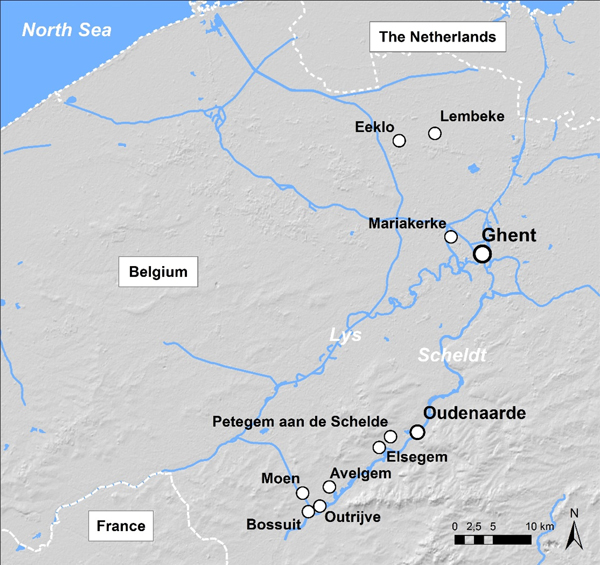
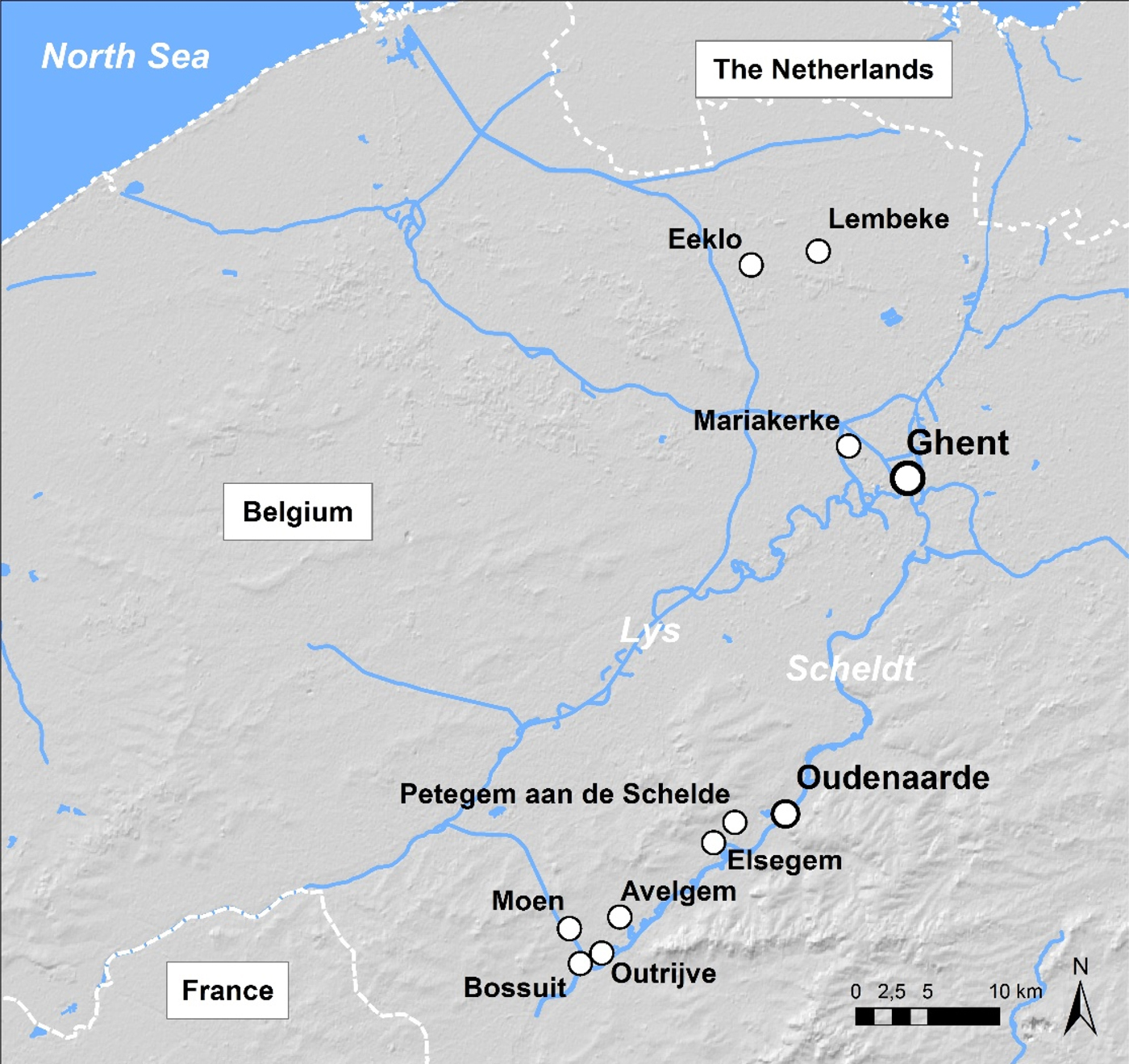
Five villages lying in the Castellany of Oudenaarde with the most detailed inventories from 1557 have been selected to be the focus of discussion in this article: Avelgem, Bossuit, Elsegem, Outrijve and Petegem-aan-de-Schelde. They are shown on the map in Figure 1. The findings from these villages will be compared to those derived from the few other grain inventories that have been preserved from the sixteenth century: the inventory taken in 1556/57 in the village of Mariakerke, which was in the Castellany of Oudburg, close to Ghent, and the inventories taken in 1565 in the village of Moen in the Castellany of Oudenaarde, and the village of Lembeke and the town of Eeklo that lay on the border between the Castellany of Oudburg and the Franc of Bruges.Footnote 48 The names of the household heads listed in the inventories were linked to the names recorded in the penningkohieren of 1571, which list the taxes paid by all landowners and tenants in each village. This allowed the socio-economic position of some of the individuals mentioned in the inventories to be identified, albeit after a delay of 15 years. Minor discrepancies between a man's position in 1556/7 and 1571, mainly due to life-cycle changes in economic position, are, or course, unavoidable.
Map showing the villages in the Castellany of Oudenaarde and inland Flanders (present-day Belgium), which were used as case studies.
One drawback when using the inventories is that they were probably subject to fraud. People may have hidden grain, for example, thinking that it would be confiscated. As it is impossible to assess the extent of any fraud, additional analysis was undertaken to calculate the household grain budgets in two villages, Outrijve and Petegem-aan-de-Schelde. It was possible to calculate yearly income and expenditure for a cross-section of households from all social groups in these villages. This was done for normal harvests – based on the average yields of the period 1545–1565,Footnote 49 and for the crisis of 1556/57, in order to pinpoint the factors that made certain groups vulnerable. The households were drawn from the grain inventories, but their economic position and the amount of land they tilled were taken from the penningkohieren of 1571. By combining several sources and the findings from previous studies,Footnote 50 the incomes – from the production of grain and flax, the leasing out of land and other activities – and expenditure – including amounts paid out on leases, rent and feudal taxes – of the identified households in different property groups were reconstructed. The household budgets and the sources upon which they are based can be found in the supplementary material, to which a link is provided at the end of this article. The level of detail in this study, and its focus on households, distinguishes it from previous historical studies of vulnerability. Furthermore, it provides insight into income strategies and inequalities at the micro-level, which makes it possible to gauge the roles of social organisation, market organisation and of both formal and informal communal solidarity in aggravating or alleviating the crisis of 1556/57.
3. Who was vulnerable?
The main indicator of vulnerability used here is the amount of a household's grain stock, rather than the more usual indicator of vulnerability: mortality. There are two reasons for this. First of all, it is extremely difficult to calculate mortality rates for dates prior to 1600 in the Low Countries as parish registers only became prevalent in the mid-seventeenth century, after the Counter-Reformation. The few mortality-indicators that exist for the region for the mid-sixteenth century suggest that there was some form of severe upheaval, but not its exact extent. For the town of Oudenaarde and the surrounding countryside, a source exists that gives some idea of the evolution of mortality in the district during the 1550s. A series of probate inventories,Footnote 51 from the rural village of Pamele, which date from 1392–1593, amazingly survive.Footnote 52 For the year 1557 the number of probate inventories taken after death was 2.5 times higher than the usual figure in previous years; in 1558 this rose to four times the usual amount.Footnote 53 Such inventories were usually drawn up for members of the middle and upper classes; those belonging to lower social groups had nothing of value to bestow upon their heirs. The fact that heightened mortality was also evident among these higher status groups suggests that it was not necessarily the consequence of hunger-induced starvation, but was more likely to have been due to disease. Chroniclers tell us that Oudenaarde and its vicinity were hit by ‘pest’, or ‘plague’, around 1556, although this word could be used to refer to all kinds of diseases.Footnote 54 The spread of disease is often linked to migration, and the greater number of deaths may imply that the disruption caused by the grain crisis resulted in heightened rural-urban migration which, if the chroniclers are to be believed, spread disease, thus wreaking further havoc, resulting in a continuous rise in mortality from 1556 to 1558.
A second reason for not using mortality as a crisis indicator is that although such use is still very common in historical research,Footnote 55 it is often strongly criticised by those working in Development Studies, who have observed that those experiencing food crisis often perceive the unfolding events to be much more about societal breakdown and loss of livelihood than about hunger and death.Footnote 56 For these reasons, household grain stocks are taken as the main indicator of vulnerability in the following discussion.
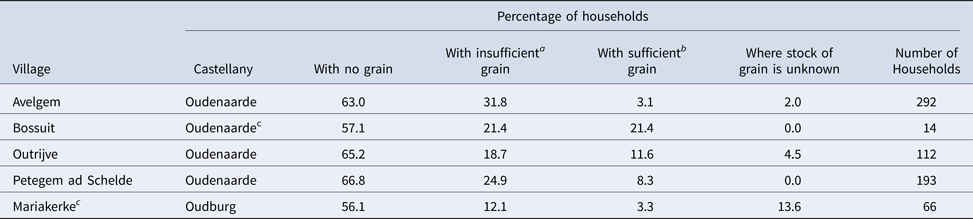
The grain inventories compiled in 1557 give us an idea of the extent of the crisis that was then underway (Table 1). In all of the five villages selected for study over half of the population were reported to have no grain left at the end of February, when they would have months to wait before the next harvest in August. Only a small proportion of people, well below 15 per cent in four of the villages, had enough grain to survive that long. In the fifth village, Bossuit, around 20 per cent of households appear to have had sufficient supplies, but the small number of households in this village may be skewing the numbers. Around a quarter of households in each village had some grain left, but not enough to last until the next harvest. These findings largely tell the same story as the household budgets from Outrijve and Petegem-aan-de-Schelde (see supplementary material). In all the villages, many more households in 1556/7 were confronted with shortages than in normal years. Those households unable to produce enough grain even in the best of times would have faced immense trouble.
The percentage of households in the five study villages, by the amount of grain available in February 1557

Notes: a Insufficient to last until the next harvest in August.
b Sufficient to last until the next harvest in August.
c Part of the document was damaged, so for 14.9 per cent of the population, we cannot be sure of the stock.
Sources: State Archives of Ghent (hereafter RAG), Castellany of Oudenaarde, 470. Grain inventories for the villages of Avelgem, Bossuit, Outrijve, Petegem aan de Schelde, 1556; RAG, Castellany of Oudburg, 2292. Grain inventory for the village of Mariakerke, 1556.
To discover whether there was a net shortage of grain in each village or whether there was there actually enough grain, but this was concentrated in the hands of a small group of people, we can turn to the grain inventory from the village of Outrijve, where, in February 1557, the total stock of grain amounted to 42,880.35 litres. For the inhabitants of the village to survive until the following harvest the aldermen estimated that 72,506.25 litres were needed. This implies that the village was short of 29,625.90 litres of grain, so even if the grain available had been evenly distributed across the population the shortage would not have been entirely eliminated.
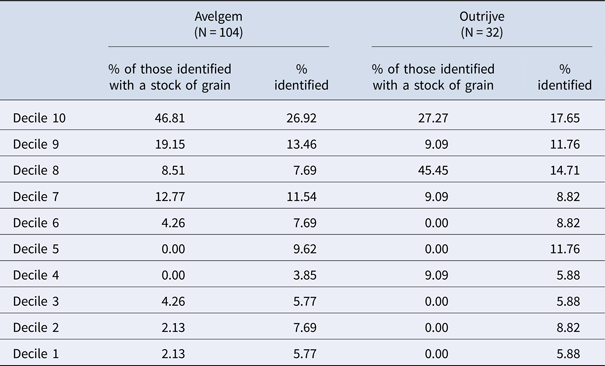
So which groups were hit hardest by the shortages in 1556/7? The inventories of grain indicate that female-headed households were especially vulnerable. In Avelgem, 96 per cent of such households had no grain left in February 1557; in Outrijve the figure was 94 per cent, much higher percentages than those for ‘all households’ in these villages. The precarious position of female household heads seems to have been linked to their lower socio-economic position; poorer groups were much more vulnerable than others, regardless of gender. I was able to divide the total population listed in the tax registers of 1571 from Avelgem and Outrijve in deciles. The names mentioned in the grain inventories from Avelgem and Outrijve were subsequently linked to these tax registers, making it possible to identify a sample of villagers present in the inventories and say to which tax decile – based on the penningkohier tax register – they belonged. Largely because of the time lag between the sources, not all those listed in the grain inventories could be identified in the tax registers. In Outrijve 28.6 per cent of those mentioned in the grain inventories appeared to be listed in the tax registers; in Avelgem the figure was 35.4 per cent.Footnote 57 The percentage of individuals in each economic decile who could be identified in the inventories and the tax registers are listed in Table 2. Those belonging to the higher deciles were much easier to trace than those belonging to the lower ones. As the lower social strata in rural areas were often much more mobile than those of higher status, this is hardly surprising.Footnote 58 The percentage of individuals in each decile who were identified in both sources and were listed as having a stock of grain in 1557 are also given in Table 2. The figures clearly suggest that those belonging to lower deciles were much more likely to have had no grain. The lowest five deciles were clearly overrepresented in the group with no grain left, whereas the upper five deciles – and especially the upper three – were underrepresented.
The percentage in each decile listed as having a stock of grain in the inventories taken in 1557, compared with the percentage identified in the penningkohieren of 1571 for the villages of Avelgem and Outrijve, Castellany of Oudenaarde, Flanders

Notes: The tax registers for 1571 were divided in deciles. Subsequently, I matched names in the grain inventories to the tax registers, thus determining the decile those mentioned in the grain inventories belonged to. The column % identified indicates which percentage of the names in the tax register could also be found in the grain inventory – illustrating that people belonging to higher deciles are easier to trace.
Sources: Grain inventories: RAG, Castellany of Oudenaarde, 470. Grain inventories for the villages of Avelgem, Bossuit, Outrijve, Petegem aan de Schelde, 1556. Tax registers: City Archives of Ghent (hereafter SAG), Reeks penningkohieren, 56/230. Penningkohier Outrijve, 1571 and SAG, Reeks penningkohieren, 57/236. Penningkohier Petegem-aan-de-Schelde, 1571.
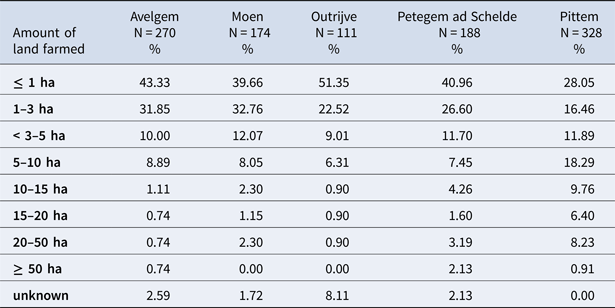
This picture of inequality is confirmed by the household budgets from Outrijve and Petegem (see supplementary material). There too in normal years those with over one hectare of arable landFootnote 59 were able to secure enough grain to feed their families, either by growing it, or by growing flax and weaving linen and acquiring grain from the proceeds. This still implies that over 40 per cent of the population must have relied on other types of income, most likely wage labour, to make ends meet (see Table 3). During the crisis of 1556/57 the household budgets indicate that a much larger segment of the population ran into difficulties. All those tilling less than two hectares of arable land suffered severe shortages. Those tilling over two hectares saw their resources dwindling, but they still had enough grain to make it through to the next harvest. However, as over 70 per cent of the population worked farms of less than three hectares and had less than two hectares of arable land at their disposal, those with sufficient grain were clearly in the minority within these villages. The household budgets suggest that the impression gained from the grain inventories that around half of the village populations were short of grain in February 1557 was, in all likelihood, relatively accurate. Having examined the extent of the crisis and the socio-economic profile of those who were hit hardest we now turn to the reasons why certain sections of the population were particularly vulnerable.
The percentage distribution of farming households by hectares of land farmed in each of the villages of Avelgem, Moen, Outrijve and Petegem, Castellany of Oudenaarde, and Pittem, Castellany of Kortrijk, Flanders, 1571

Note: Only those owning a farmstead (including living) within these villages are included; those owning only a plot of land were omitted.
Sources: SAG, Reeks penningkohieren, 56/230. Penningkohier Outrijve, 1571; SAG, Reeks penningkohieren, 57/236. Penningkohier Petegem-aan-de-Schelde, 1571.
4. The root causes of vulnerability: the local economy
Why were grain stocks so low in and around Oudenaarde in February 1557? The previous summer had been dry, which caused the harvest to fail, creating a severe grain shortage. Food availability clearly declined, but why exactly were the Flemish smallholders – especially those tilling farms of less than three hectares – particularly vulnerable when confronted with such a crisis? Below it will be argued that their vulnerability stemmed from two factors: first, the social and economic structures and inequalities that defined their village communities and, second, the social and economic structures that anchored these communities within the wider society, particular their connections to the markets held in urban areas.
The way in which inland Flemish communities were organised helps to explain why certain groups were particularly vulnerable. Thoen has written extensively on this region and describes it as a ‘commercial survival economy’. From the twelfth and thirteenth centuries onwards, farms in the villages in inland Flanders became increasingly fragmented and this went hand in hand with increasing social and economic polarisation. This process slowed during the fourteenth and fifteenth centuries, as population pressure was reduced, but accelerated again in the sixteenth century. The reasons behind this process are complex. Thoen points to the defining role of the structures of property-holding and power specific to the region during the (late) Middle Ages. Partly due to the power struggles between the Count of Flanders, the nobility, the ecclesiastical lords and the cities, each of which was eager for funds, peasants were able to obtain most of the property rights over their lands. Customary rent was low, as their lords, preferring payment in coin, were quick to abolish rents in kind but were then subsequently unable to adjust rents to match inflation. Taxes were also relatively modest, hardly ever exceeding 5 per cent of an individual's annual income.Footnote 60 This made it easier for peasants to keep control of the land they held in customary rent; so as credit grew in importance they were able to use this land as collateral. Such arrangements meant that holdings could be split up and this, combined with the region's partible inheritance system, led to the predominance of micro-holdings of under three hectares. Middle sized-holdings, between three and ten hectares, came increasingly under pressure as they were split up due to the partible inheritance system. There are some indications that the Castellany of Oudenaarde was a frontrunner in this process, which then spread throughout inland Flanders. In the 1570s the villages around Oudenaarde – Avelgem, Moen, Outrijve and Petegem – had a much bigger group of smallholders than Pittem, which lay in the Castellany of Kortrijk, and still had a substantial ‘middle class’.
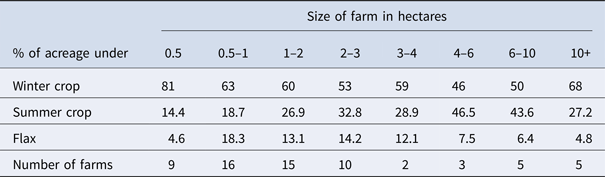
The structural features shaping Flemish village society in the sixteenth century clearly had an impact on the vulnerability of the inhabitants. Grain could be obtained directly by growing it, but there were large inequalities in the ability to do so within the villages around Oudenaarde. Those tilling micro-holdings had very limited options; they had to use most of their arable land for the cultivation of rye, and so could grow only a limited amount of other grains, such as buckwheat or oats (Table 4). When the rye harvest failed, they had no back-up food crop at their disposal. Their direct access to food was thus limited, even at the best of times. It would have been necessary to have at least one hectare of arable land in order to keep a horse,Footnote 61 and a tax register showing animal ownership from the 1590s suggests that those owning horses almost always also owned a cow.Footnote 62 This suggests that those peasants with little land would also have been unable to benefit from animals and their by-products.
The percentage of acreage under winter crops, summer crops and flax, by size of farm in hectares. From a sample of farms mentioned in sixteenth-century probate inventories: Oudenaarde and Flanders

Notes: Winter crops include mostly rye; summer crops include oats and barley.
Source: Sixteenth-century probate inventories from the Castellany of Oudenaarde: E. Thoen, Landbouwekonomie en bevolking in Vlaanderen gedurende de Late Middeleeuwen en het begin van de moderne tijden. Testregio: de Kasselrijen van Oudenaarde en Aalst (Ghent, 1988), 707.
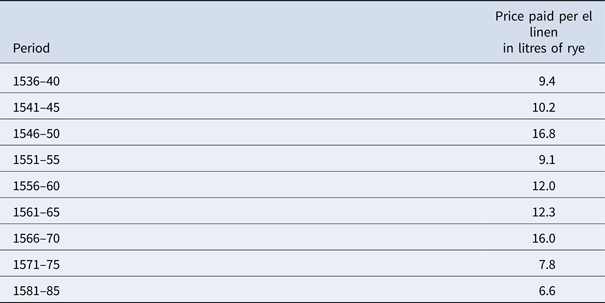
During the harvest failure access to food through labour also came under pressure. For those owning less than 0.5 hectares of land, labour must have been an essential survival strategy. However, when a harvest failed, less labour was needed, thus exacerbating the impact of the poor yield. For those with small farms of between 0.5 and 3 hectares, flax cultivation and linen weaving would have augmented their income, as real prices for their cloth remained relatively stable, guaranteeing a more or less steady flow of extra income (Table 5). The household budgets I reconstructed based on data from the 1550s–1570s indicate that during normal years the proceeds from linen weaving secured survival for those who owned over 0.5 hectares of arable land and were able to grow a significant amount of flax. Linen prices were relatively favourable during the 1556/57 crisis years, but the proceeds from such proto-industrial activities would not have been sufficient to provide a way out of the crisis for those peasants owning between 0.5 and 2 hectares of arable land who faced severe grain shortages. During crisis times the proceeds from flax and linen were not easily converted into grain as the price of the latter rose. In 1557, for example, grain from the village of Pittem, in the Castellany of Kortrijk, was bought at the urban markets for on average 1.05 stuiver per litre, much more than the 0.56 stuiver that was the average price in 1556.Footnote 63 High prices were, however, not the only factor stopping peasants from acquiring grain.
Prices paid per el of linen, in litres of rye: Flanders (1536–1585)

Source: C. Vandenbroeke, ‘Sociale en konjunkturele facetten van de linnennijverheid in Vlaanderen’, Handelingen der maatschappij voor geschiedenis en Oudheidkunde te Gent 32 (1979), 117–74.
5. The root causes of vulnerability: rural-urban inequality
As grain was scarce within the local economy of our case study villages as a whole, urban markets would seem to be an obvious place to try to obtain additional grain. The concept of ‘market failure' – the idea that markets inherently work, but that something hinders their functioning – is often offered as an explanation for food crises and famines, as Slavin suggests for the Great Famine of 1315–1317 in England and Wales.Footnote 64 Here, however, let us focus on the political economy behind market failure, to see how structural inequalities and power imbalances shaped the way markets functioned and determined rural participation in the urban markets. The relationship between the towns and countryside in the County of Flanders was a highly unequal one. The Flemish cities – especially Bruges, Ypres and Ghent – were not only economically powerful, but also possessed impressive political leverage. During the thirteenth and fourteenth centuries they developed a series of measures to control production and consumption in the surrounding countryside.Footnote 65 In the case of production, each city had the power to levy taxes and regulate trade and industry within a certain distance of its walls. This strongly limited the economic opportunities open to those living in the rural areas, as it relegated them to proto-industrial activities and preparatory work for the urban textile industry. The rural and urban economies were thus inextricably linked, but were clearly not equal partners. The same was true of consumption and access to markets. The County of Flanders was unusual in that food markets were held in, and controlled by, the cities and rural markets were almost entirely absent, in contrast to the situation in Holland or England. Fairs and weekly markets, in particular, were an urban prerogative.Footnote 66 Many Flemish cities forced the inhabitants of the surrounding countryside to bring their grain and other produce to the makets held in the town. Thus, even when times were good the relationship between Flemish peasants and the market for the goods they produced was subject to many constraints and highly unequal, but the lack of rural markets created extra obstacles that made the situation even more fraught.
The authorities in the powerful Flemish cities were much better equipped to deal with grain crises than those in the countryside. Cities were logistically easier to provision and had a much wider range of strategies at their disposal to ensure that the supply of provisions continued.Footnote 67 Ghent had an especially privileged position, as it was the County of Flanders’ staple market for grain. Every grain trader who passed through Ghent, whether by land or on the rivers Scheldt or Lys, had to unload and sell part of their freight in the town. This was known as the Ghent staple right.Footnote 68 By the middle of the sixteenth century Ghent had 224 granaries, mostly located on the Korenmarkt, which put the city in a privileged position during times of crisis and shortage. During the crisis of 1556/57 the city authorities held on to their staple right and took additional measures. An inventory was made of all the grain stored in the city and the sales of grain and the price of bread were strictly regulated, mainly to ensure that the townsfolk could buy bread. More importantly, the export of grain beyond the city walls was severely limited; those coming into the city were only allowed to buy 1 meuken (2.2 litres)Footnote 69 of grain, which would have made only two or three loaves, per day, radically reducing the supplies available to the rural population.Footnote 70 In the winter of 1556, a Ghent chronicler noted that a multitude of people fled the surrounding countryside and arrived at the city gates, desperately looking for food. However, not all of those who set out were able to reach the gates, as many ‘sijn op den wech flau gheworden ende ghestorven’ (they fainted, and later died, on the road).Footnote 71
Ghent retained its monopoly on staple rights throughout the entire late medieval and early modern period. Despite not having this advantage, other Flemish towns were able to develop well-considered grain policies. Peasants and farmers from the neighbouring rural areas had to bring their grain to sell within the town walls, and town authorities actively discouraged the trading of grain within the rural areas. The authorities in the town of Dendermonde, for example, obtained a royal privilege, which allowed them to regularly take action against those trading grain and linen in the countryside during the sixteenth century.Footnote 72 When grain was scarce, the small town governments tried their best to guarantee an inflow of grain, although they were often hindered in this by Ghent's privileged access to supplies. In the small town of Eeklo (see Figure 1), for example, the town aldermen turned to the courts to challenge Ghent's staple rights in an attempt to gain access to grain during several fifteenth-century crises,Footnote 73 in order to prevent uproar and food riots. It was not only the towns and cities that had privileged access to grain in Flanders; the same held true for the central government and the army, which had to be provisioned during the French-Habsburg war. An Antwerp Compagnie, funded by the government to organise the provisioning of the army, was set up in 1556. It managed to deliver large quantities of grain, earmarked for the garrisons, to Antwerp in February 1557, at a time when the population of the city and the surrounding countryside were starving. Whether the large-scale purchases and deliveries influenced market prices remains unclear, however.Footnote 74
The inhabitants of Flemish villages, and lower- and middle-class peasants in particular, thus suffered twice over in the crisis of 1556/57; they not only lost their harvest, they also had much less leverage and fewer opportunities to obtain food grains and bread than urban dwellers. The power balance between the cities and the countryside was clearly skewed. Nevertheless, those living in the villages in the Castellany of Oudenaarde appear to have been able to deal with the crisis. The coping strategies they adopted were determined by the same social, economic, and political structures that made them vulnerable. In the next section, we turn to examine the strategies they employed.
6. Coping mechanisms
Vanhaute and Lambrecht have shown, in their study of the 1740 crisis, that eighteenth-century Flemish proto-industrial villages were quite capable of overcoming harvest failure and grain crises.Footnote 75 During the crisis of the 1740s, the Castellany of Oudenaarde was also severely hit, much more so than the environs of Bruges, which were characterised by commercial polder agriculture. However, thanks to formal and informal networks of entitlement and support, the 1740s grain crisis never turned into a full-blown famine.Footnote 76 The same was true of the 1556/57 crisis. Even though mortality went up and, in all likelihood, migration also increased, a real breakdown of village community never occurred. Famine is often described as a community crisis, and it would seem that the vulnerable peasants of Oudenaarde were able to use institutions and networks within their own community to mitigate the effects of a crisis, but, as we shall see, the channels available were firmly shaped by the social and economic structures of the region.
The literature often suggests that vulnerable groups found the ‘strength’ to develop strategies to overcome crises, often adapting strategies that they would have used to deal with seasonal stress. These strategies would have been based on extensive knowledge of food crises, as these were, and still are, relatively common in peasant societies.Footnote 77 In his work, Walker distinguishes a pattern in the way coping strategies were used over a crisis, in which the measures used to alleviate seasonal distress gave way to measures that traded short-term gain for long-term problems, such as the selling of land or animals.Footnote 78 It is difficult to be certain of the exact strategies smallholders deployed as several likely candidates, such as kinship solidarity and borrowing from others within and outside the community are impossible to trace in the sixteenth-century sources. We can be certain, however, that the most stringent measures, such as selling off land in order to buy grain, were absent in the 1556/57 crisis. Scrutiny of the aldermen's registers during the 1550s, which contain the registration of sales of land, from the Flemish villages of Kalken, Zele, and Petegem-aan-de-Schelde indicates that stress-sales of land were completely absent. The land market during the crisis years hardly differed from normal years, suggesting that there were mechanisms in place to keep distress at bay.Footnote 79
First of all, there were the ‘poor tables’. These bodies, governed by the elite of each village,Footnote 80 provided support for those in need. Research on the proto-industrial Flemish village of Pittem, situated in the Castellany of Kortrijk, suggests that this is exactly what their poor table did during the crisis of 1556/57,Footnote 81 even though they had more people than usual to support; 98 compared to the average of 59 for the period 1552–1568. The table's expenditure skyrocketed, as grain had to be bought at ever-increasing prices. They spent 2.14 times more in the crisis year than was spent in the previous or the following year, but could only purchase 0.89 times the amount of bread it bought in a normal year. As poor table income was very inflexible the Pittem poor table had to borrow extra money in order to be able to distribute the bread; they obtained the sum of 48 livres parisis from Canon Anthuenis Destrez, at a yearly interest rate of 6.25 per cent, the official rate at that period. The poor tables in inland Flanders were at a disadvantage, however, when compared with those in much less commercialised peasant regions, such as the Campine area, where the tables received their income mostly in kind, including grain. The poor tables in inland Flanders had to find the means to buy their grain in the marketplace.Footnote 82
Formal poor relief was, thus, by no means sufficient to alleviate the needs of hard-hit smallholders and the support offered dropped, in real terms, during 1556/57. Peasants in Flanders had few other resources at their disposal. Common land and common rights in the region were rare and often limited to pasture. This was of limited use to smallholders without animals and they had to turn to an alternative means of help. Vanhaute and Lambrecht describe one such option in their work on the crisis of the 1740s.Footnote 83 In the eighteenth-century villages that they studied, there was a highly unequal system of ‘reciprocal exchange’, in which the great majority of smallholders were dependent on a limited number of large tenant farmers.Footnote 84 The peasants traded their labour, which the farmers needed during the harvest season for access to ploughs, credit and grain, at other times of the year. The farmers were thus able to trade grain for labour when prices were high, just before the harvest, which, of course, tipped the exchange very much in their favour. Lambrecht points out that similar arrangements were also put in place during times of crisis, when the peasants received grain on credit, promising to pay for it by future work.Footnote 85 Credit thus involved a social, as well as an economic relationship, and elite farmers were obliged, by their status, to engage in such arrangements.Footnote 86 Even in the nineteenth century, the bulk of grain produced in the villages of inland Flanders was not exported to the cities but exchanged between farmers and peasants within the closed circuit of the village economy.Footnote 87 Under such a system the tenant farmers obtained labour extremely cheaply. It is clear why they were happy to maintain this system, and also why they were willing to invest in poor relief.
It seems highly likely that a similar system of reciprocal exchange was already present in sixteenth-century inland Flanders. Hard evidence, such as that in the eighteenth-century account books used by Lambrecht, is lacking for this earlier period but, based on an assessment of the labour needs of large farms, it seems reasonable to suppose that a similar system might have already being functioning two centuries earlier. In the village of Petegem, in 1571, for instance, it is estimated that the 21 large farms with more than 10 hectares needed a total of 122 labourers during the harvest season.Footnote 88 There were 127 farms of less than three hectares in the village, and 70 of these had less than one hectare, so it seems likely that most of the extra labour could be supplied from within the village. Co-dependency between large farmers and the ever-increasing class of smallholders thus may well have had its roots in the sixteenth century, at a time when the population was rising again after the late medieval crisis, and middling groups – especially in and around Oudenaarde – were disappearing. What remains unclear, however, is how the large farmers secured the grain that they passed on to their fellow villagers. As indicated above, there was a net shortage of grain at the village-level during the crisis years, which suggests that the grain would have had to be obtained from elsewhere. It is possible that the tenant farmers had connections in urban areas, such as their landlords, to whom they could apply for grain. This was certainly what happened in seventeenth- and eighteenth-century inland Flanders,Footnote 89 and the close ties between urban landowners and their tenant farmers have been recently highlighted by Vervaet.Footnote 90 Canon Destrez's loan to the Pittem Poor Board certainly suggests that members of the elite in Pittem had close credit ties to members of the urban elite elsewhere in the region. Research on the topic of rural credit and its urban ties is, however, still in its infancy, but it clearly merits more attention.
The coping strategies adopted by the most vulnerable members of society, at least those strategies that can be discovered, were clearly shaped by the economic and social structures underpinning the society in which they were developed. Confronted with adverse climatic conditions and a growing, albeit indirect, dependency on very imperfect markets, small peasants in inland Flanders did not seek support in formal associations – as De Moor has eloquently argued in her work on the ‘Silent Revolution’Footnote 91 – but in more informal co-dependencies shaped by the specific social and economic structures of their region. It is likely that the peasants’ demand for land, exacerbated by low rents and low taxes, meant that land held in common had already disappeared from this part of Flanders by the fourteenth century.
Inequality within the villages was further heightened by the close but unequal relationship with the cities, and more specifically a judicial institution: outburghership. Outburghers lived outside the city walls, but enjoyed a jurisdictional position as if they lived intra muros. They had a right to appeal to city courts and could evade certain feudal claims, such as the mortemain, that is, the right of the lord to claim part of the inheritance of his subjects. Originating in the power struggles between the Count of Flanders and the cities, this legal status was enormously popular in the Flemish countryside. In effect, this created a schism within rural communities, separating those with these ‘urban rights’ (usually the somewhat better-off) from those still subject to feudal jurisdiction. This undermined an equality-based solidarity and introduced one based on unequal exchange, which continued, little changed, until the nineteenth century.Footnote 92
7. Conclusion
This micro-level study of the 1556/57 grain crisis in the rural areas of the Castellany of Oudenaarde clearly indicates that vulnerability was indeed socially differentiated. Peasants with micro-sized farms, along with those in the ‘lower middling’ stratum, were disproportionally hit by the grain shortage. Their vulnerability stemmed from the economic, social, and political structures of the society in which they lived. The particular power and property distribution within inland Flanders led to the creation of a society that was dominated numerically by smallholders who depended on a minority of large tenant farmers and where members of the middle class were constantly under threat of disappearing as society became ever more polarised. The villages around Oudenaarde were frontrunners in this evolution. Even when times were good, smallholders in these villages, particularly the 40 per cent who owned less than one hectare, were unable to produce enough grain to survive; they came to depend on wage labour and proto-industrial activities such as flax growing and linen weaving. When harvests failed, the smallholders' access to food came under threat; unable to access it directly they also found it difficult to access it indirectly through paid labour, as less labour was required to bring in the poor harvest. Structural inequalities within the County of Flanders – most notably those between the towns and the rural villages – meant that it was difficult for ordinary peasants to access grain through the markets in times of crisis, as at such times cities protected their markets and used other means to safeguard their own supplies. Ironically, it is likely that smallholders living in the food-producing countryside were hit much harder in a grain crisis than their urban counterparts, a situation than can still be seen in today's developing countries.
Although the 1556/57 food crisis clearly had an impact on village society in Oudenaarde and its neighbours, with indications of heightened mortality and migration, it never turned into a community crisis; the region's social structures never faced a breakdown, mainly thanks to the coping strategies available to the Flemish peasants. These strategies were, however, intertwined with the same socio-economic structures that made the peasants vulnerable in times of grain crisis in the first place. It would seem that the peasants entered a mutual, if highly unequal, reciprocal exchange with local large farmers in which they traded labour for grain and access to credit. This combined with the efforts of the village Poor Boards, secured the peasants’ survival, although it left them trapped in a cycle of ever-increasing dependency and thus deepened the root causes of their vulnerability. It is likely, therefore, that inequalities in vulnerability became even greater in the seventeenth and eighteenth centuies, as property distribution in inland Flemish villages became even more unequal at that time, but this is a topic for further research.
The work reported here clearly indicates that to label an entire community or communities as ‘resilient’ tends to conceal the socially differentiated vulnerability that may also be present. Vulnerability was clearly very unequally divided within the villages around Oudenaarde, with around three quarters of the populations being extremely vulnerable when harvests failed and the remainder much less so. The 1556/57 crisis clearly had its winners and losers; the profiles of the two groups determined by the structures of the society in which they lived. Neither vulnerability nor resilience were a characteristic of the ‘system’, the society as a whole. The question why vulnerability to hazard differed enormously between different societies needs to be answered by focusing on those at risk and on the root causes of their vulnerability.
Supplementary material
Household budgets for Outrijve and Petegem-aan-de-Schelde
Please see online at: https://doi.org/10.1017/S0268416019000109.
Acknowledgements
Research for this article was funded by FWO Flanders (Grant No. 12N9315N_PO). The author wishes to thank Prof. dr. Tim Soens and Prof. dr. Bas van Bavel for their suggestions and support.