1. Introduction
Electroacoustic music and recorded popular music present a common challenge to music analysis: how do we describe music that cannot be captured by notation and whose sources are unseen and often also unfamiliar? In his ground-breaking study Traité des objets musicaux (1966), Pierre Schaeffer proposed a methodology for describing sound through aural analysis, formulating a new musical ‘language’ or sound topology (‘typomorphology’) that would enable the analysis of music at an ‘abstract’ level. Schaeffer's influence is evident in many studies of electroacoustic music but is less so in analyses of recorded popular music. Part of the reason for this is that recorded popular music often alludes to (and derives its meaning from) a world outside itself – it is therefore less easily adjusted to Schaeffer's typomorphological agenda and investigative strategy of ‘reduced listening’. When analysing popular music, then, we have to, quoting from Smalley and Camilleri's critique of Schaeffer, recognise the ‘attempt to reconcile and relate the internal world of the work with the outside world of sonic and non-sonic experience’ (Camilleri and Smalley Reference Camilleri and Smalley1998: 7) in order to answer ‘what aspects of the sound materials and their relations are bearers of meaning’ (Camilleri and Smalley Reference Camilleri and Smalley1998: 6).
In the present article, we wish to explore how ‘sound’ in popular music, understood as a whole set of defining sonic characteristics, can be a bearer of meaning. In a popular music context, sound can supply the very identity of a tune, a band or a musician. Identifying and describing a particular popular music sound thus involves a process through which the temporal unfolding of music is collapsed into a static spatial whole that encapsulates the ‘global spatial style’ of the recording, to borrow from Denis Smalley (Reference Smalley1997). Not surprisingly, then, popular music sound is often conceptualised as a spatial environment by both the musician/producer and the listener. Drawing on Smalley's theory of source-bonding and James J. Gibson's theory of ecological perception, we might conclude that in order to make sense of the virtual space projected by a given popular music sound, we unconsciously compare it to previous experiences with actual spatial environments, such as a stage or an enclosed room. One possible consequence of such a process is that the virtual space can become utterly surreal, displaying sonic features that could never occur in real physical environments.
A related and important aspect of this development in recorded sound is how the perception of the surreal changes over time. What was at one point in time experienced as completely weird, supernatural or uncanny might later be regarded as the very norm against which new uncanny sonic environments are measured. The elasticity as to what is regarded as ‘natural’, in other words, is enormous, and in this article, in addition to looking at potentially surreal aspects of sound, we will look at what we call processes of naturalisation. As a particularly interesting example of the complexity of these processes, we will discuss ‘the music sound stage’. This hybrid category is a pliant environment that belongs somewhere between the actual spatial environment of a stage (with its strict acoustic laws) and the virtual spatial environment between the loudspeakers of the PA (where everything goes). The music sound stage has undergone marked changes during the last decades, and new effects have become naturalised within it at a remarkable rate. It represents an evocative opportunity to highlight the fact that it is cultural context, in the end, that dictates what is heard as conventional and natural as opposed to highly artificial or surreal.
We will start here by pointing out a few crucial aspects of the notion of sound as it is used in popular music discourse and discuss some previous analytical contributions from this field to conceptualising sound as various ‘space-forms’. Then we will briefly introduce some key aspects of Smalley's theory of source-bonding as well as Gibson's theory of ecological perception, taking a special look at the music sound stage and some of the changes that this particular environment has undergone. In the last section we will analyse three songs by Prince, Suede and Portishead in terms of the possibly surreal aspects of their sounds. We will discuss how the virtual space projected by popular music sound might be used as an artistic tool, and why such sound designs might sometimes be perceived as surreal. We are, in other words, interested in what Smalley calls ‘interventionist works’, where ‘the composer's hand is in evidence, and the stamp of the technology and techniques is apparent in the kind of material and the way it is manipulated’ (Smalley Reference Smalley2007: 54). Using Brøvig-Hanssen's terminology, this means musical pieces in which the processes of mediation are opaque (Brøvig-Hanssen Reference Brøvig-Hanssen2010, Reference Brøvig-Hanssen2013). Our focus is on space-forms created for a stereo sound system by means of various forms of digital processing and/or recording of different actual room ambiences, since this has been and still is the norm in popular music productions.Footnote 1 Some of the theories we present in this article might, however, also be applied to space-forms created by other means, such as, for example, surround sound, ambisonics and wave-field synthesis (see, for example, Monacchi Reference Monacchi2011).
The purpose of our discussion is to point out, on the one hand, some of the ways in which the increased possibilities for creating spatially surreal sound, thanks to new technological tools, have been explored within the field of popular music during the past few decades, and, on the other, the ways in which the effect of such ‘surreal’ features may have changed over time as a consequence of processes of naturalisation.
2. Sound as Space-form
Per Erik Brolinson and Holger Larsen define sound as the fundamental character of the particular musical elements that can be identified and described in a relatively short time sample but are nevertheless characteristic of a significant portion of the song (Brolinson and Larsen Reference Brolinson and Larsen1981: 181–2). This definition rightfully emphasises that a very brief sonic experience often sums up the sound of a whole song and evokes Smalley's concept of ‘space-form’ (the aesthetically created spatial environment) in his discussions of acousmatic music. Particularly relevant for the present context is Smalley's observation that even though the perception of sound, or space-form, is a product of time, such a notion of sound means that time's formative role is set aside: ‘Possibly the most important strategy in arriving at an holistic view of the space-form of this experience [the experience of listening to an Orbieu soundscape] is that I disregard temporal evolution: I can collapse the whole experience into a present moment, and that is largely how it rests in my memory … . Time becomes space’ (Smalley Reference Smalley2007: 37–8). The term ‘sound’ understood in this holistic sense can be applied to a single sound, a group of sounds or even a type of sound signature.
Scholars have proposed various analytical models for conceptualising sound as virtual space-forms, virtual here simply denoting a spatial environment that, rather then actually existing as physical space, is solely implied by the sound. In Rock: The Primary Text (1992, revised 2001), Allan F. Moore introduces a ‘sound box’ model in his analyses to account for the organisation of sound in various pop/rock productions, mostly ‘progressive rock’ from the 1960s and 1970s. He describes the height, or vertical dimension, of the sound box as the sound's register; the breadth, or horizontal dimension, as the construction of the stereo image; and the depth as exactly that – a textual foreground, middleground and background (Moore Reference Moore2001: 121). With it he hopes to map what he sees as ‘the most important features of the use of this [musical] space’ – namely the ‘holes’ or spaces left unfilled. In more recent works by Moore and colleagues (Moore and Dockwray Reference Moore and Dockwray2008; Moore, Schmidt and Dockwray 2009; Dockwray and Moore Reference Dockwray and Moore2010), the sound box is further described as ‘a heuristic model of the way in which the positioning of sound sources is perceived in recordings’ (Moore et al. Reference Moore, Schmidt and Dockwray2009: 83). What is also made clear is that the sound box is not a description of the virtual sonic space per se. Rather, it is a music-analytical tool that can be used as a matrix to map the placement of the different elements of a mix and to reveal differences in, for example, ‘width’ between mixes from the position of the listener. In this sense, the space discussed by Moore complies with what Smalley calls the music's ‘external space’ – that is, the space within the stereo window or between the speakers that the music in itself inhabits or produces. As Smalley points out, ‘There can be no music without it [external space]’ (Smalley Reference Smalley1997: 122), which makes this form of spatiality relevant to all discussions of music.
Much in parallel to Brolinson and Larsen's contribution from the early 1980s, Moore et al. deal with music in which there is, for the most part, the same sound throughout an entire song. Although there are some important exceptions to this rule (The Beatles’ ‘A Day in a Life’ is one example), this was, in the historical context of their musical examples, both an aesthetic norm and a consequence of technological constraints. Another characteristic of this sound ideal was that the room surrounding the principal elements in the mix was mostly left alone, or, more precisely, left to the reverberation of these elements. In the 1980s, the advent of the sampler and MIDI technology encouraged further exploration of the design of the virtual spaces of popular music. Intending to capture this development in a scholarly sense, Anne Danielsen (Reference Danielsen1993, Reference Danielsen1997) analysed the result of various production processes employed on Prince's Diamonds and Pearls album (1991) by way of a similar three-dimensional model.Footnote 2 Her conceptualisation of the sound box (originally described with the Norwegian term lydrom, which means sound room) was an attempt to capture processes within the sound – for example, radical change and the lack of continuity in time and/or space caused by the montage-like aesthetics encouraged by the MIDI/sampler development. Another typical feature of 1980s pop production discussed in Danielsen's work was the way in which the use of digital reverb enabled the creation of clearly non-natural spatial environments. Whereas Moore's sound box is intended to accommodate a musicological procedure for analysing sound in general (the sound box is a fixed entity that could almost be regarded as a notational grid by which various mixes can be represented), Danielsen contrasted the virtual environments in Prince's productions with the acoustics of an actual enclosed space in order to reveal the aesthetic effects of the non-natural virtual spaces created with this new digital technology.
The first extended studies on how we conceptualise sound in popular music recordings as a simulation of actual spatial environments are ‘Listen to My Voice’: The Evocative Power of Vocal Staging in Recorded Rock Music and Other Forms of Vocal Expression (2000) by Serge Lacasse and Echo and Reverb: Fabricating Space in Popular Music Recording, 1900–1960 (2005) by Peter Doyle. Both contribute to our understanding of how music – in particular the audio effects of echo and reverberation ‘sets up a virtual geography, a coherent, highly specific sense of place and space’ (Doyle Reference Doyle2005: 2). They are, in other words, concerned with what Smalley describes as ‘internal spaces’, which occur when the sound itself seems to enclose or represent a space: ‘Internal space is therefore source bonded in that one needs this sense of an actual or imagined sounding body’ (Smalley Reference Smalley1997: 122). Whereas Lacasse is most interested in spatiality that simulates actual spaces, we are interested in how music, in Doyle's words, sometimes ‘uses its spatialities in order to evoke a sense of disordered space’, in which listeners ‘encounter the real in an exhilaratingly re-formed, nonrealist configuration’ (Doyle Reference Doyle2005: 2–3). Although Doyle provides us with some examples of this possibility of creating spatially surreal sound in pre-digital music (see Doyle Reference Doyle2005: 143–62; further examples are given in Zak Reference Zak2001: 79–83 and Zak Reference Zak2010), it was enhanced by the advent of digital music technology, which will be exemplified in our analyses.
3. Making Sense of Virtual Space
As human beings, we have, as Smalley points out, a ‘natural tendency to relate sounds to supposed sources and causes, and to relate sounds to each other because they appear to have shared or associated origins’ (Smalley Reference Smalley1997: 110, emphasis in original). Sounds are, in other words, generally source bonded. Since we have a great deal of experience with interpreting sound as signifying space, musical sound is often conceptualised as a virtual space as well.Footnote 3 As Smalley puts it, ‘Sounds in general, and source-bonded sounds in particular … carry their space with them – they are space-bearers’ (Smalley Reference Smalley2007: 38). When a recording simulates or points to actual spaces we draw upon the structure and logic of a previous experience with a particular spatial environment to make sense of a new one. In this way, music functions as a ‘mediator between material and imaginative worlds’ (Atkinson Reference Atkinson2007: 117).
The listening process of comparing virtual spatial environments, consciously or unconsciously, to experienced spatial environments responds very well to James J. Gibson's theory of ecological perception. Eric Clarke (Clarke Reference Clarke2005) introduced Gibson's theories about visual perception to music psychology, emphasising Gibson's assumption that perception is always-already intentional – those who ‘perceive and behave’ (Gibson Reference Gibson1979: 7) are not processing masses of undifferentiated information but rather engaging with the environment to gather only that information that is meaningful given their purposes and context. Applying one of Gibson's key terms, then, we perceive what the environment affords according to our needs. In the case of a new virtual space on a musical recording, this means that we will first of all engage with those aspects of it that are most meaningful to us, given our range of experience. Thus a founding principle of the present discussion is that our experience with one sound environment becomes an immediate resource for the structuring and comprehension of a similar environment.
When we experience sound on a musical recording as virtual space, the models that we apply might derive in turn from two fundamental categories: enclosed spaces (that is, a hall, small room, tunnel, etc.) and open ones (various rural and urban landscapes). Physical spaces operate with strict acoustic laws, and in an enclosed space, such as a room, sound travels until it meets a surface (such as the walls, floor or the ceiling), bounces off (mostly), and then travels until it meets another surface. It gradually weakens as the air and the surfaces absorb it, until it dies out entirely. If a sound hits its first surface (preferably a hard one) after 50–100 milliseconds, its reflection will be audible as a distinct, separate sound – what we refer to as an echo. Enclosed spaces that produce an echo might include large empty buildings or wells. On the other hand, if a sound hits a surface immediately and promptly hits many others as well (a ping-pong effect), it will be experienced as reverb. When it comes to open spaces, we find both reflection-free environments – so-called ‘free fields’ (see Rossing Reference Rossing, Moore and Wheeler2002: 525–45) – and environments with diverse kinds of obstacles. For instance, the forest will produce particular reflection patterns depending on the placements of trees in relation to the sound source, while obstacles that are more distant from the sound source, such as neighbouring mountains or tall concrete walls, might produce echo. The shape of the reflecting obstacle's surface (whether it is flat, curved or irregular) determines the ways the sound is reflected, while its texture determines to what extent the sound is absorbed.
When we engage with the acousmatic character of musical sound (whereby the sounds have no visible sources), we recognise these different acoustic reflection patterns from our previous experiences, which allow us to imagine specific actual spaces. As Smalley points out, this process is automatic and unconscious: ‘We cannot separate space itself from what produces it, nor from our experience of space in nature and culture’ (Smalley Reference Smalley2007: 54). In the following, we will take a closer look at this process in relation to the ‘sound stage’.
3.1. The sound stage
In William Moylan's work (2002), the virtual space of popular music recording is compared to the sound stage used in live performance.Footnote 4 His sound stage helps him to unpack the virtual sound environment according to the qualities and characteristics of this very familiar spatial environment. Written in the early 1990s, however, Moylan's book does not address the changes that the sound stage has gone through since the early 1990s. Clearly, this analytical metaphor will work differently depending upon whether one thinks of the sound stage in terms of an unplugged live musical performance or a densely electronically mediated (but still live) one, for example. Nevertheless, ‘live music’ is often bluntly contrasted with ‘mediated music’. In many instances, in fact, the latter is understood as equal to recorded music, which illustrates the deep roots of the concept of ‘live’ in the traditional understanding of musical performance as electronically unmediated (despite the fact that such performance has always contained a high level of technological mediation with regard to its instrumental design). While the sound stage initially followed the same acoustic laws as any other physical environment, it has over the years become a thoroughly technologically ‘mediatised performed space’, to use Smalley's terminology. Thanks to the advent of amplification in the 1920s, for example, it has long relied upon a fundamental double-crossing of the human ability to locate sounds spatially – that is, to understand distant sounds as signs of a faraway source and nearby sounds as signs of an intimate (or at least proximate) source. Thus, though a vocalist might be standing on the stage and singing softly, her voice reaches every ear in the audience. Moreover, the vocalist could be standing on the right side of the stage while her voice emerged from an amplifier on the left side. Amplified sounds escaped the acoustic law of physical spaces and were therefore no longer trustworthy signs of their source's placement in space. The advent of the public address system (or PA, which includes a mixer, an amplifier and loudspeakers) enhanced the opportunity to process the sound produced on stage and furthered the progressive relocation of sound sources in the mix relative to how they might appear visually on the stage. When ‘staged’ sounds are sent through a mixer and then output via PA speakers, none of them in fact seem to come from either a musician or an individual amplifier; instead, they come from the same huge speakers. Moreover, the MIDI music sequencer and various digital audio editing applications, which were embraced by the music industry in the 1990s, have facilitated the use of drum loops and other programmed or pre-recorded musical elements in live performances. The relationship between live and recorded music is no longer technologically determined; live and recorded music may in fact sound identical (even if this is not always the case).Footnote 5
The sound stage, then, rather than serving as an adequate metaphor for the virtual recorded space, has become just such a space itself. As with the virtual recorded space, the possibility for fabricating space as part of a live setting has been accompanied by a desire to mould spatial environments that overtly defy physical acoustic laws in one way or another. Using the sound stage as a fixed model for understanding recorded sounds can thus give rise to dangerously glib assumptions, because it is obviously not the same today as it was only a few decades ago. A listener who mainly attended concerts in the 1970s may have a different perceptual model for making sense of sound from that of a listener born in the 1990s who mostly has attended electronica concerts. In short, Gibson's notion that the same environment might afford different things to different people rings especially true when using the sound stage as a metaphor to describing sound. In what follows we will discuss how new effects gradually become naturalised and point out that what is conventional and natural in one genre or time frame may be highly inaccurate, artificial or surreal in another.
3.2. Naturalised or surreal?
A virtual sonic space will only be experienced as supernatural, uncanny, weird or surreal to the extent that what is heard departs from the convention for normal sound production within a particular context. Such conventions may contain many sonic phenomena that are completely weird compared to actual spaces, but if the effects employed have been naturalised no surrealistic effect might occur.
The historical character of such naturalisation processes is especially obvious in relation to what is thought of as the ‘natural’ voice or vocal space. When vocalists first started to use the microphone as an instrument, they were introducing a new and unfamiliar sound, because the intimate voice had never before been able to penetrate in a concert hall. As Michael Chanan notes, this new voice was no longer intended to reach every listener in a public space; instead, it was designed to sound like each listener's best friend (Chanan Reference Chanan1995: 109–10). While this use of the voice, often recognised as ‘crooning’, is in fact closest to how people hear the voice in unmusical contexts (face-to-face conversations, for example), it was at first often regarded as profoundly surreal or uncanny (see Toynbee Reference Toynbee2000: 75–6). One of the reasons for this was that the technique foregrounded the technology of the microphone, which was at that time not seen to be part of a ‘natural’ vocal performance. Moreover, the sound it made did not correspond to the microphone's spatial location. According to Smalley, the ‘microphone space’ is a special kind of intimate performed space that has the ability to create ‘proximate spaces which beam to us small and microscopic presences and details of spectral space’ (Smalley Reference Smalley2007: 43). This particular kind of vocal or microphone space is thus paradoxical: though it is actually situated within a large concert hall, or within what Edward Hall calls the ‘public zone’, listeners might nevertheless have the feeling that they are situated within the ‘intimate’ or ‘personal zone’ of the vocalist (see Smalley Reference Smalley2007: 40 for a description of Hall's proxemic classifications of distances).
In From Tin Foil to Stereo (1959), Oliver Read and Walter L. Welch write that, when the recording technique of close-up microphone placement was promptly adapted to stage performances, it soon induced performers ‘to accentuate the trends in popular taste towards acceptance of the unreal’ (Read and Welch Reference Read and Welch1959: 238–9). As listeners became accustomed to live performance with microphone and amplifier, the microphone-staged voice gradually came to stand for the voice itself, and the mediated vocal space became increasingly transparent, in the sense that, perceptually, it blended naturally with the rest of the music. Writing in the late 1930s, Walter Benjamin observed that what is ‘standard’ in a technologically mediated reality may in fact be so normalised that when a mimetic representation of the unmediated reality appears in this mediated reality, it may be experienced in turn as ‘unstandard’, or even mediated anew (Benjamin Reference Benjamin1936: 233). The voice in today's popular music is generally highly mediated in terms of compression, equalisation, reverb and so on, yet this intense and voluminous high-definition sound has become the standard. If the voice sounds otherwise in a live setting, we blame the sound engineer, even as we claim to favour relatively unmediated performances.
Standards vary across genres as well. What may appear surreal or inauthentic in the context of the bluegrass scene, for example, may be perceived as completely natural or authentic in the context of the electronica scene. For instance, while the performances of the brostep/post-dubstep musician Skrillex (Sonny John Moore), who is leisurely pushing some buttons on his laptop in order to activate pre-recorded music, are highly appreciated by his fans, supporters of the bluegrass-country group Alison Krauss and the Union Station would probably deem their concerts scandalous if they were to use playback or even if any processing effects were to be exposed.
Summing up, in general terms the experience of something as surreal occurs if, and only if, a defined context (with its specific laws or rules) is compared to another defined context (with other laws/rules) from which it departs. Instead of pointing to an inherent quality of the phenomenon in question, then, the impression of a virtual spatial environment as surreal or natural tells us something about what the phenomenon is being compared to. In this sense, everything can, at least in theory, be experienced as ‘natural’ or ‘the real world’, just as everything can be understood as ‘surreal’ or ‘uncanny’. Moreover, what we perceive as ‘natural’ is generally in flux: as listeners adjust to new musical expressions brought about or inspired by new technological inventions, our notion of what is ‘natural’ expands.
Below we will discuss how certain fabricated spatial environments that deviate from any actual space have the potential to be experienced as either natural or surreal, depending on the context, or, potentially, as both natural and surreal at once.
4. Surreal Sonic Environments
Even though our ability to naturalise fabricated spaces is amazing, this does not mean that virtual sonic environments are not able to evoke a feeling of the surreal. In this last section we will analyse three selected popular music recordings in which the sound, and in particular the design of ‘the global spatial style in a work as a whole’ (Smalley Reference Smalley1997: 124), clearly has been subjected to artistic manipulation. The three examples we will discuss parallel the three first categories of Smalley's listing of different global spatial styles, namely (1) a single spatial setting, (2) multiple spatial settings, and (3) spatial simultaneity (Smalley Reference Smalley1997: 124).
The songs we have chosen span from 1986 to 1997, a time period uniquely dominated by the transformation associated with digital technology and its tools, including the sampler, MIDI-based sequencer programmes, and digital processing effects (such as reverb). As an example of a single spatial setting – that is, when the work is ‘set in a single type of space of which the listener is aware at the outset’ – we will analyse Prince's ‘Kiss’ (Parade, Paisley Park/Warner Bros.) from 1986. As an example of multiple spatial settings – that is, when ‘throughout the work, the listener is aware of different types of space which cannot be resolved into a single setting’ – we will analyse Suede's ‘Filmstar’ (Coming Up, Nude Records) from 1996. Finally, we will analyse Portishead's use of different room ambiences in ‘Half Day Closing’ (Portishead, GO! Beat Records) from 1997 as an example of spatial simultaneity – that is, when ‘you are aware of simultaneous spaces’ (all quotations Smalley Reference Smalley1997: 124).
4.1. Single spatial setting: Prince's ‘Kiss’
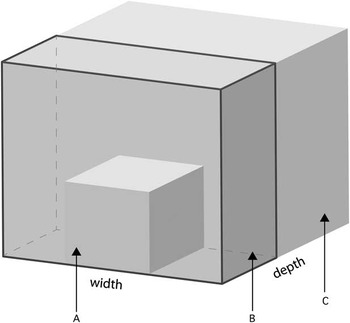
As mentioned, Prince departed from the traditional rock sound by employing digital effect processing to produce virtual spaces with non-natural acoustic characteristics. In several of Prince's recordings from the 1980s, the sound suggests a space that could not possibly conform to the physical laws of sound reflection. In ‘Kiss’ (1986) (and several other of Prince's 1980s recordings) this is due to his use of gated digital reverb, whereby significant reverb is applied to a sound signal and then automatically shut off with a ‘noise gate’ rather than allowed to die out. Contrary to the common use of gated reverb at the time, where the resonance that the sound initiates was allowed to emerge before the gate closed, Prince allowed for only a moment of sound to present a proximate space before he closed the gate, denying the natural recession of the sound into distal space. In effect, then, two of the axes of the sound box, the horizontal and the vertical, display the characteristics of a large hall, while the third axis (the depth) reflects a small, ‘dry’ or dampened indoor environment (see Figure 1). In ‘Kiss’, the lead and background vocals, as well as the drums, create a compact, ‘hi-definition’ proximate space that is almost devoid of spatial qualities. Drawing on Smalley's observation, when listening to ‘Kiss’, ‘one quickly finds that the mixing of sounds can just as easily undermine perspective as create it’ (Smalley Reference Smalley2007: 49).
The sound box of Prince's ‘Kiss’ (B). The horizontal and the vertical axes display the characteristics of a large hall (C), while the depth reflects a small, ‘dry’ or dampened space (A).

The space-form of ‘Kiss’ complies with Smalley's ‘single spatial setting’, but this single space comes forth as surreal if it is compared to an actual single spatial setting. The surrealism here emerges from the recording's incongruent virtual sound room: the hyper-presence and lack of depth imply a small space with almost no reverberation, but the high intensity and voluminous sound imply a larger, resonant one (Figure 1). This particular use of gated reverb attracted attention for the surreal aspect of its sonic design at the time of the release of the recording. However, it soon become a standard for vocal pop production and has, within the context of pop music, today become naturalised to the extent that it will hardly evoke any feeling of surrealism at all. As Smalley points out, ‘The perspective of the acousmatic image has evolved its own conventions’ (Smalley Reference Smalley2007: 49).
4.2. Multiple spatial settings: Suede's ‘Filmstar’
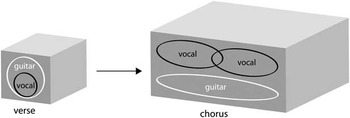
Ten years after Prince's ‘Kiss’, brit-pop band Suede's ‘Filmstar’ (1996) likewise disturbed a 1990s sense of a ‘natural’ sonic environment. Brit-pop in general seems to lean towards ‘artificial’ production practice, favouring avant-garde artistic strategies that distance it from the naturalised production ideals of much American rock (see Frith and Horne Reference Frith and Horne1987). In ‘Filmstar’, Suede foregrounds the artificiality of their in situ performance space – that is, the space in which the music allegedly was produced. For instance, there is a profound contrast between the verse of the song, which suggests a small, narrow space, and the chorus, which suggests a much larger, broader spatial environment (Figure 2). What happens here is what Smalley describes as a rapid realisation of ‘ouverture’ (opening out the perspective) or ‘enclosure’ (closing in the perspective). In the enclosed space represented by the verses of ‘Filmstar’, there is no distal periphery, only proximate space that attempts to approach the listener's personal space. Similarly, the vertical space is relatively compacted, and thus, as Smalley reasons, ‘a feeling of enclosure may be enhanced due to source-bonding factors’ (Smalley Reference Smalley2007: 49). The sudden process of ouverture that happens when the chorus is introduced permits ‘the view to expand into distal space … paralleled by an impression of panoramic extension, thereby creating a more open or transparent view which no longer threatens egocentric space’, to borrow from a similar observation made by Smalley (Smalley Reference Smalley2007: 49).
Multiple spatial settings in Suede's ‘Filmstar’.

In creating this process of ouverture/enclosure, Suede was probably taking advantage of the new possibilities for storing and programming the settings of the digital mixing board. In the previous practice of analogue mixing, changes had to be done manually in real time, which limited the number of simultaneous changes. The possibility of programming the whole mix in advance, on the other hand, allowed the musician or producer to make a momentary, total change in the sound. Most obviously, the settings of the main digital reverb used in the mix of ‘Filmstar’ are completely altered, suggesting ‘multiple spatial settings’. Since this transformation happens subsequently, in the transition from the verse to the chorus, it recalls the space-form process that Smalley describes as the ‘journey’ – that is, ‘a more traditional “narrative” approach where one is aware of passing between spaces’ (Smalley Reference Smalley2007: 54).
There is, of course, nothing actually surreal about the passing between spaces. The multiple spatial settings that ‘Filmstar’ projects may, however, evoke a feeling of surrealism if analogised to a particular type of spatial environment, namely the in situ performance space. The fabricated space on a recording sometimes aims at simulating this, in order to assert the recording's faithfulness to a pre-existing performance that purportedly happened at one specific time in one specific space. As pointed out above in our discussion of the changing sound stage, the acoustic behaviour of sounds within such a space might be just as free of constraints as the sounds of a recording. It is therefore important to clarify that our interpretation of ‘Filmstar’ presupposes a perceptual comparison with a live performance space where the sounds are not sent through a PA system but are in fact bonded with sources. Our privileging of this particular version of the performance space can probably be ascribed to a general – and ecologically reasonable – tendency in human perception towards source bonding. In this vein, the spatiality of ‘Filmstar’ is experienced as surreal because certain important musical elements, most strikingly the vocals and the guitar, change positions entirely within the mix in a way that is not possible given such a presumption. Particularly jarring is the way the guitar moves from a dry, narrow-sounding, distorted transistor sound in the centre of the mix to a wide-open, clean-sounding stereo sound panned hard to left and right, respectively. This abrupt transition both reduces the density of the sound and widens the sound box considerably (see Figure 2). Certainly such a change could not have happened under natural circumstances, since the guitarist (or his gear) would then have had to be split in two or moved from the centre of the stage to its margins almost instantaneously.
Recalling Gibson's insights, however, we as listeners will gather only that information that is meaningful to us given our purposes and context. If the listener's primary experience is with music where a single spatial setting is the norm, ‘Filmstar’ will certainly appear surreal. Conversely, and given the fact that ‘Filmstar’ is a contemporary multitrack musical recording, it could also be perceived as completely natural. Moreover, when listened to by a 1990s-era producer, it could simply mean ‘this tune was made in the 1990s when the automation of the digital mixing board was introduced’. The experience of ‘Filmstar’ as natural or surreal thus depends on the frame of reference, on what the basis for comparison is – or, using Gibson's terms, on what the music affords.
4.3. Spatial simultaneity: Portishead's ‘Half Day Closing’
Each individual sound occupies a subordinate space within a song's all-encompassing spatial environment, or, as Smalley puts it, the ‘holistic’ space of the music comprises ‘zoned spaces’ (and possibly also sub-zones) (Smalley Reference Smalley2007: 37).Footnote 6 Even if a musical production is in fact a montage of zoned spaces, it is not always heard (or intended to be heard) as such. But in some cases it is precisely the point to generate the effect of simultaneous or superimposed spaces, even to surreal ends.
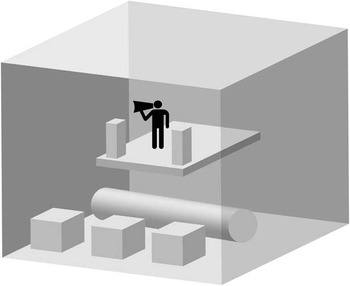
This montage aesthetic of spatial simultaneity characterises the music of the Bristol group Portishead, often described as the band that pioneered the trip-hop movement in the 1990s. In ‘Half Day Closing’, from their second album, Portishead (1997), a relatively dry bass guitar introduces the song, suggesting a proximate zoned space, or more precisely a small room with surfaces that absorb most of the reflections that constitute the reverb. In the distal area of the holistic space, another zoned space is suggested by some synthesised or manipulated sounds (probably produced by a violin and an electric guitar). Though these sounds might be heard as mimicking outdoor sounds, their specific reverb indicates an enclosed large space with hard surfaces, such as stone or concrete. The attacks of these sounds are not clearly defined, and their reverberation suggests a reflection pattern similar to that found in a long, narrow, cylindrical, enclosed environment, like a shaft or a tunnel.
After thirty seconds or so, the voice enters with a sound that evokes a vintage telephone, an old radio or a megaphone. However, in contrast to these monophonic technologies, it is noticeably stereophonic, occupying two channels on the mixing board that are panned hard either way. We might picture a sound stage, then, with a singer performing through a miked-up megaphone whose signal is fed into a mixing board, split and panned hard left and hard right, respectively, before reaching the audience through a PA system. After the first verse, drums enter hard left to accompany the voice, but they present a new spatial zone altogether. Their reverb has a bottled-up quality, and the reflections die out relatively quickly, although not as quickly as the dry sound of the bass guitar. The sound of the drums suggests a small room with hard surfaces, such as an empty classroom. On the second chorus, an electric guitar enters hard right with reverb that is similar to the drums’, but warmer; in this way its spatial zone suggests a classroom like the bass guitar's, but one that is filled with pupils and books.
‘Half Day Closing’ thus complies with what Smalley describes as a space-form process that is ‘occupied with multiple spaces, mixed materials, possibly intercuttings, dislocations, and impressions of simultaneous spaces, although the final view could well be an holistic one’ (Smalley Reference Smalley2007: 54; see Figure 3).
Spatial simultaneity in Portishead's ‘Half Day Closing’; three small rooms, a tunnel, and a sound stage are heard as situated within the all-encompassing environment.

Here, then, it is not our experience with any particular space that will inform our understanding of the virtual one but our experiences with several spatial environments at once. When we project them all onto one virtual environment, this environment comes forth as surreal. However, thanks to the sampler, many listeners have become very familiar with this kind of juxtaposition of different sonic spaces. When such simultaneous multiple spatial settings become naturalised, the surreal effect might vanish, allowing for the spatial ‘patchwork’ of songs like ‘Half Day Closing’ by Portishead to be heard as a completely ‘natural’ spatial design.
In sum, whereas these musical examples will likely be experienced as surreal if compared to actual spaces, such sonic designs generally tend to become naturalised to the extent that listeners no longer compare them to real-world spatial contexts. This does not, however, mean that they aren't able to evoke experiences of surrealism. As Clarke (Reference Clarke2005) points out, music can in fact be experienced as an autonomous set of features and as rooted in the actual world simultaneously. This might explain the richness in our experiences with such sonic designs as they reveal their doubled meaning: even though we know it is music, we still experience the tension between the nature of actual spaces and the virtual space of the music. Consequently, music's spatiality is able to evoke our familiarity with physical spaces at the same time as it subverts it.
5. Conclusion
Because of processes of source bonding and the listener's previous experiences with sound representing space, the sound of a music recording is often conceptualised as a virtual space. In this article we have discussed various forms of spatiality constructed by digital processing tools, which is the typical technological context for popular music productions today. When we listen to recorded sound, we apply our previous experience with the acoustic conditions of various actual environments to it. Such various unconscious perceptual processes may ultimately provide the foundation for our identification and description of some of the unique characteristics of a particular sound. While several other analytical approaches to the sound of popular music involve the comparison of virtual spaces with a range of actual or more abstract spatial environments, we have tried to shed light on the experiential consequences of such projections. Important to our discussion has been that the comparisons of virtual spaces to actual ones form the foundation of our experience of some virtual spaces as surreal. Moreover, as we demonstrated through our example of the vocal space, many long-fabricated sounds on popular music recordings have become so naturalised that they barely evoke any surreal response whatsoever any more, and these presently include even digital interventions.
Smalley rightly points out that ‘the idea of source-bonded space is never entirely absent’ (Smalley Reference Smalley2007: 38). What is interesting, however, is that the source to which we bond the virtual space is unstable. The comparison of the virtual sonic environment of a recording both to actual spatial environments and to contemporary naturalised environments suggests analytical insights into the strategies behind a given sound, as well as the different experiential aspects of it. Ultimately, it may shed light on how we sometimes can experience sound as both surreal and naturalised at once. This distinction between the surreal and the naturalised also informs our situating of the obviously surreal as perfectly appropriate – even ‘natural’ in its own way. In a song's given context of production and reception, almost anything can become naturalised, and from the surreal will emerge a fresh sense of the real.