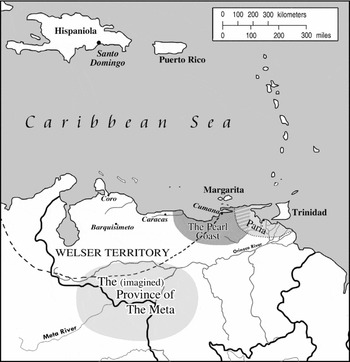
On May 19, 1537, in a region of the Pearl Coast, two armed factions of Spaniards challenged one another on the banks of the Unare River in what would become eastern Venezuela (see Figure 1). Licenciado Juan de Frías and his smaller force of about 80 men confronted a large party under the command of the conquistador Antonio Sedeño.Footnote 1 Frías professed to represent the crown by charge of the Real Audiencia of Santo Domingo, which had bestowed on him a vara del rey (staff of the king, symbolizing royal authority) and sent him off to arrest Sedeño.Footnote 2 Sedeño likewise maintained that he had royal authority, citing his capitulación (contract of conquest) for the nearby island of Trinidad and letters from Empress Isabel, wife of Holy Roman Emperor Charles V (King Charles I of Spain) and regent of Spain from 1529–32 and 1535–39. In their confrontation, both Frías and Sedeño claimed to represent the will of the king.Footnote 3
North Coast of South America and the Southeastern Caribbean

This conflict illustrates much about sixteenth-century Spaniards' conceptions of political legitimacy, as well as the reasoning leaders employed to exercise authority. It also reflected the disjointed nature of political power: the highest branch of government (the monarchs in consultation with the Council of the Indies) and the highest regional court (the Audiencia of Santo Domingo) did not always work in unison. In 1524, Charles V established the Council of the Indies to screen, read, and address communications to the crown from the empire's American colonies. The council was to advise the monarch and supervise the administration of the Indies on his behalf. Spain's conciliar governing structure served the monarchy well, preserving, in the words of historian John Elliott, “the fiction that the King was personally present in each of his territories.”Footnote 4
The Audencia of Santo Domingo
The Spanish crown had long sought to distribute power among the institutions that dealt with the colonies, in a system of checks and balances designed to maintain its own authority. In keeping with this strategy, Ferdinand II established the Audiencia of Santo Domingo in 1511 on the island of Hispaniola to check the power of Viceroy Diego Columbus. Like its later counterparts in other colonies, the Audiencia of Santo Domingo combined political, administrative, and judicial functions, and transmitted the royal will to the Americas.Footnote 5 Audiencias were not the only conduits of royal power, however. Confusion frequently arose because the crown conferred its authority at multiple administrative levels, including governorships, which were typically peripheral regions in need of defense or further conquest. The crown usually chose military men as governors—men willing to conquer or defend marginal but promising territories.Footnote 6 After the crown in 1523 rescinded Columbus's viceroyalty of the Indies, the Audiencia of Santo Domingo often competed for authority with the region's governorships.
The unique geography of the Spanish Caribbean differentiated the Audiencia of Santo Domingo from its later mainland counterparts. According to historian Peter Bakewell, mainland audiencias provided “a unity of judicial and executive functions that mirrored the nature of Spanish monarchy itself.” Audiencias, which were usually based in major towns or cities, thus became politically centralizing institutions.Footnote 7 Like the other audiencias, the Audiencia of Santo Domingo wanted to establish a cohesive political entity, but the fragmentary geography of its Caribbean jurisdiction—consisting of an assortment of islands and remote continental territories—created isolating and centrifugal conditions that frustrated the court's efforts.
Eventually, both the crown and the region's subjects came to view governorships as the most effective governing institutions. By the end of the sixteenth century, distant governorships, such as the governorship of Venezuela, and important town councils, such as the Cabildo of Havana, came to exercise an informal independence from the out-of-the-way Audiencia of Santo Domingo.Footnote 8 Nevertheless, in the 1530s the Audiencia of Santo Domingo could still entertain the illusion that it could exert authority over its unwieldy jurisdiction, while conquistador-governors endeavored to increase their wealth and influence by conquering new civilizations.
Multiple interrelated objectives both unified and divided Spanish authorities. The Spanish monarchs sought wealth through trade or conquest of new subjects and territories, and authority over their realms, no matter how far-flung. The empire's bureaucrats and regional authorities (councilmen, viceroys, audiencia judges, and governors) coveted power, prosperity, prestige, and the crown's unwavering favor. The leaders of the conquistadors—whether titled captains or governors—wanted success foremost for themselves and their men, but they realized that to maintain their leadership and accomplish their goals, they needed to enlist the support of the crown. Governing powers at all levels defended the legitimacy of their authority by maintaining channels of communication with power, and even lower-rung leaders attempted to correspond directly with the crown.Footnote 9 Uniting all levels were common goals, such as proselytizing their Catholic faith and gaining wealth and glory for themselves and their king.
Rationality and Structure
In a 1958 article, Andrew Gunder Frank, a German-American scholar, examined multidimensional bureaucratic decision-making. To analyze his research, Frank used German sociologist Max Weber's distinction between “substantive rationality” (flexible, goal-oriented, decision-making) and “formal rationality” (impersonal, rule-based decision-making). Frank discovered that in bureaucracies with multiple levels of command issuing ambiguous directives, substantive rationality guided decision-makers. Agents, who claimed shared standards with superiors, focused on the achievement of tasks without strict adherence to rules or systematic practices.Footnote 10 In 1960 historian John Leddy Phelan employed Frank's research to describe the administration of Spain's American empire. Phelan argued that Spanish colonial authorities clung to a vague substantive rationality based on shared values and the achievement of common ends, regardless of the means. Subordinates observed authority by being sensitive to their superiors' objectives, but they considered authority to be malleable, in accordance with circumstances and incentives. This understanding of authority benefited both supervisors and subordinates by injecting into the governing system the flexibility needed to create a decentralized, yet resilient, imperial administration.Footnote 11 However, the imprecise structure that gave the administrative system its strength and adaptability also made it prone to misunderstandings, missteps, and infighting.
Scholars of the Spanish conquest have long recognized the ill-defined authority that characterized the empire's administrative structure. In 1988, historian Colin MacLachlan explained that this structure—below the monarch at the top—typically functioned more as competing horizontal layers with overlapping jurisdictions rather than as a vertical hierarchy. Such a configuration generated confusion and conflict, but it allowed the crown to impose its power, even in distant lands, as the final arbiter of jurisdictional disputes.Footnote 12 The crown sought to incentivize conquering governors with capitulaciones that bestowed on them considerable authority, but it also wanted to control these leaders. Such contradictory objectives often led to miscalculations. Indeed, the crown, even with the help of the Council of the Indies, sometimes sent different authorities different messages reflecting different priorities. Distances and corresponding delays in exchanging communications also hampered the crown's ability to receive information, formulate coherent policies, and delineate lines of authority.Footnote 13
The clash between Sedeño and the Audiencia of Santo Domingo, in the person of Frías, resulted from such blurred lines of authority. The engagement was a struggle between two horizontal political layers in a system with overlapping authorities. The political system psychologically linked the monarch directly with his agents. According to MacLachlan, “legally, the king delegated authority (jurisdictio) not command (imperium).”Footnote 14 Sedeño and the Audiencia of Santo Domingo both claimed political legitimacy because each was convinced of possessing the king's jurisdictio and best representing the king's will. Both communicated actively and independently with the crown, reinforcing their faith that their monarch shared their goals and values. The audiencia judges and their agent Frías viewed Sedeño as an impudent subordinate who had violated an injunction.Footnote 15 Sedeño believed that, as a favored conquistador on the brink of founding a wealthy civilization, he best embodied the king's will. His confidence in his jurisdictio mirrored a trait common among conquistadors, but the audiencia also had a powerful claim to political authority as the region's highest royal court.
Sedeño's dispute with the audiencia does not represent the first time Spanish leaders wrangled over conflicting claims to authority. Perhaps the most famous case involved Hernán Cortés. In 1519, Diego Velázquez, the governor of Cuba, appointed Cortés to explore Mexico, where he was to acquire as much gold as possible and then to return to Cuba. Velázquez decided to remove Cortés from the leadership of the expedition (thus revoking Cortés's jurisdictio), but Cortés set sail before Velázquez could stop him. Aware of his near-treasonous position and the need to establish his own power, Cortés cajoled, intimidated, and oppressed the Velázquez loyalists on the expedition. He and his followers then founded the town of Villa Rica de Veracruz near present-day Veracruz and appointed a full complement of municipal officials. The newly created town council elected Cortés as its chief justice and captain-general, giving him the pretense of autonomy from Governor Veláquez and empowering him to appeal directly to the king. According to historian Matthew Restall, Cortés sought royal authority to conquer Mexico, and, “to that end, he betrayed Velázquez, wrote directly to the king, sent agents to argue his case at court, and scuttled the remaining ships to prevent Velázquez loyalists from shipping back to Cuba to warn him—all logical, predictable, standard conquistador responses to the situation.”Footnote 16
Authority and chaos on the Pearl Coast
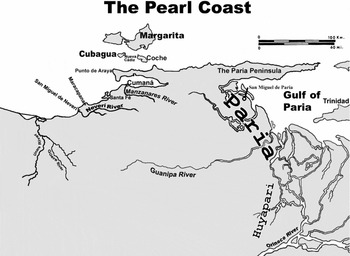
Although scholars are familiar with the case of Cortés and with the empire's ambiguous chain of administrative authority, multiple channels of communication, and overlapping jurisdictions, few are familiar with Sedeño or the Spanish conquest of the Pearl Coast (Figure 2). This protracted conquest included colonists on the island of Cubagua and many conquistadors, including Diego de Ordás, Alonso de Herrera, Gerónimo de Ortal, and Sedeño. The region's history reflects the drama and chaos typical of Spanish frontier societies.
The Pearl Coast, Detail

In 1974, historian Stuart Schwartz observed that applying theories, such as those of Weber, “increased understanding of the past,” but that too often scholars “mechanically applied [such theories] with little concern for the particular nature of the Spanish empire.”Footnote 17 In this paper, I look into some of the theoretical research regarding authority and administrative structure to analyze the fractured nature of Spanish governance in a particular frontier society. The 1537 confrontation between Sedeño and the Audiencia of Santo Domingo exemplified the empire's muddled chain of authority. The Audiencia of Santo Domingo represented a higher authority than Governor Sedeño's. However, Sedeño relied on his jurisdictio and substantive rationality to justify his decisions. Believing that the crown would in due course support his risky expedition into the unknown interior to find a rich native civilization, Sedeño thought he could disregard the agent of the Audiencia of Santo Domingo with orders to halt his enterprise.
In late 1530, nearly seven years before the Sedeño-Frías confrontation on the banks of the Unare River, Antonio Sedeño—the short, stout, and energetic royal accountant of Puerto Rico—left his home island with a force of 70 to 80 men to conquer the island of Trinidad.Footnote 18 The natives fought fiercely, and, after losing nearly two-thirds of his men, Sedeño and his small army retreated to the mainland. There, on the coast of Paria, Sedeño established a settlement, naming it Puerto de las Palmas. Leaving most of his men to build a fort, Sedeño made his way to the island of Cubagua and then to Puerto Rico, seeking recruits and selling Indian slaves in exchange for provisions.Footnote 19 In April 1531, another conquistador, Diego de Ordás, and his force of nearly 600 men arrived in the Gulf of Paria. The crown had granted Ordás a capitulación to explore the territory stretching from the Amazon River to the boundary of the Welsers in central Venezuela.Footnote 20 Outraged to find another conquistador in his designated territory, Ordás seized Puerto de las Palmas with its ships and supplies, incorporated most of Sedeño's men into his own force, and renamed the settlement San Miguel de Paria.Footnote 21
While Ordás explored the interior, Huyapari Indians told him that up the Meta River, significantly outside of their territory, existed “good, rich land and many large towns” that were “very rich.”Footnote 22 Encouraged by this information, Ordás led an expedition up the Orinoco as far as the Meta River before receding waters and a lack of provisions forced him to retreat. During the journey, other natives corroborated the Huyapari Indians' account of a rich realm in the interior, thus inflaming the Spaniards' belief in a golden province somewhere along the Meta River.Footnote 23 Spaniards named this as-yet-undiscovered land the Province of the Meta.Footnote 24
Entreaties from Sedeño prompted Empress Isabella and her advisors in the Council of the Indies to attempt to settle the Ordás-Sedeño dispute by ordering Ordás to return all the goods, ships, and horses that he had appropriated from Sedeño's settlement in Paria.Footnote 25 The letter admonished Ordás to serve the crown by “ceasing all dissension” with Sedeño, “acting brotherly” toward him, and “being a good neighbor.”Footnote 26 Not wanting to repeat the hardships of rowing up the Orinoco, Ordás concluded that he could more easily reach the Province of the Meta from a route further to the west, passing near Cumaná. Disembarking there, he came into conflict with other Spaniards.
Cumaná had long been the mainland outpost for Spaniards living on the nearby pearling island of Cubagua, and Ordás's move angered them. In 1532 these Spaniards from Cubagua routed Ordás's force and sent the conquistador under arrest to Santo Domingo. The Audiencia of Santo Domingo, unsure how to handle the internecine conflict, permitted Ordás to return to Spain to defend himself before the crown. Prior to his departure, Ordás left Alonso de Herrera, his alguacil (constable-deputy), in command of his remaining soldiers, most of whom had reassembled at San Miguel de Paria (formerly Puerto de las Palmas). Soon afterwards, Ordás died en route to Spain.Footnote 27
Herrera saw himself as Ordás's legitimate successor, but the ambitious Sedeño saw his own opportunity in Ordás's departure. He wanted to incorporate Ordás's men—including Herrera—into his command. A letter from the empress and Council of the Indies permitting Sedeño to “rescue and collect” the men Ordás had left in Paria seemed to legitimize Sedeño's plans. The letter instructed Sedeño as follows:
[T]o treat and aid [Ordás's men] as people in our service. . . . If the men want of their own will to go with you to your governorship [of Trinidad], you may take them and entrust them with duties towards our service. However, if, in order to conquer and pacify the said province, you find it necessary to reoccupy and re-garrison the said fort [of San Miguel de Paria] with men who you bring and find there, you may do so as a private citizen [vezino particular] without exercising any official jurisdiction in the said land.Footnote 28
With this letter in hand, Sedeño went to San Miguel de Paria while Herrera was away seeking provisions on Cubagua. There he convinced Agustín Delgado, San Miguel de Paria's temporary commander, to accept his leadership; in return, Sedeño would persuade a local judicial inspector-general to appoint Delgado “governor of Paria.” When Herrera returned, he contested the new state of affairs, but Sedeño would not tolerate any challenge and arrested Herrera on trumped-up charges.Footnote 29 In 1533 Sedeño took 92 men, including the shackled Herrera, to Trinidad in a renewed attempt to conquer that island. Meanwhile, the Audiencia of Santo Domingo dispatched an agent to Trinidad to order Sedeño to release Herrera. The agent and his escribano (secretary) reached Sedeño in March 1534. According to the escribano, Sedeño read the directive and then “kissed it and held it above his head and said that he had acknowledged and would continue to acknowledge it as a letter and directive from his majesties, . . . and that in regard to its fulfillment he said that he would respond [after further inquiry].”Footnote 30 Such circumvention did not last long, however. Some of the expedition's men still harbored loyalty to Herrera and had misgivings about the campaign in Trinidad. After Trinidadian natives fiercely attacked the expedition, killing both Spaniards and their horses with arrows and darts, many of the exhausted men switched sides and aided the audiencia's agent in freeing Herrera and arresting Sedeño.Footnote 31
The struggle between Sedeño and García de Aguilar, the audiencia's agent, was fluid and Sedeño eventually lost the allegiance of his men. Aguilar and the few men who believed Sedeño was improperly defying the authority of the audiencia helped Herrera and his supporters to escape their imprisonment, and together they fled to Paria, where they took over San Miguel de Paria and arrested Delgado. Soon more men abandoned Sedeño's enterprise. According to the chronicler Fray Pedro de Aguado, Sedeño foolishly tried to reverse his fortunes by returning to Paria from Trinidad with only five or six supporters, and Herrera and his men were easily able to arrest the conquistador.
Not surprisingly, Sedeño's versions of events differed. Sedeño claimed he had freed Herrera, even though he knew that Herrera would return to Paria and that his men would therefore stop receiving shipments of supplies from the Indians of Paria. Sedeño also alleged that Aguilar told him that no more supplies or assistance would come from Cubagua or Puerto Rico. According to Sedeño, this bad news encouraged many to leave with Herrera. Soon afterward, some of Herrera's men returned to incite a mutiny and convince many more to leave, taking with them the horses, ships and provisions.Footnote 32 They then returned to Paria where an imprisoned Sedeño became emaciated and gravely ill.Footnote 33
After several months, a few men loyal to Sedeño managed to free him and return with him to Puerto Rico.Footnote 34 Amazingly, Sedeño's ambition remained robust, even though his ill health persisted. En route to Puerto Rico, he gave a resident of the coastal island of Margarita authority to negotiate a deal on his behalf with another conquistador, Gerónimo de Ortal.Footnote 35 The crown had recently granted Ortal (previously Ordás's royal treasurer) a capitulación to renew Ordás's search for the golden Province of the Meta. After recruiting reinforcements, Ortal returned to Paria to take command of what remained of the force that had stayed with Herrera.Footnote 36
The Allure of the Province of the Meta
The imagined riches of the Province of the Meta mesmerized many Spaniards on the increasingly impoverished island of Puerto Rico, where Sedeño rapidly recruited men even while struggling to recover his health. According to Sedeño, the men pleaded with him to lead them on an expedition to the Meta, offering him money, horses, and provisions.Footnote 37 Royal officials in Puerto Rico reported that Sedeño enlisted between 320 and 450 men and acquired between 120 and 190 horses for the expedition.Footnote 38 In February 1535, a procurador of Puerto Rico wrote that “there is not a person who wants to stay on this island. It is such a grand affair that even the oldest and the lamest want to go on the expedition, and, if they were not held back, all would be leaving on the trip.”Footnote 39 That May, the island's royal factor (treasury official) wrote to Charles V that many Puerto Ricans wanted to embark on a journey of conquest some “200 leagues inland from the coast of Cubagua, toward the summit of the Sierra” where there were “two large cities called the Meta and the Manta” that were “very rich in gold.” Sedeño had returned from Trinidad “broken and frustrated,” but his fellow Puerto Ricans' eagerness to launch an expedition reinvigorated his spirits. The recruits named Sedeño as their captain, the royal factor explained, “but in doing so they have obliged [Sedeño] to go to that province [of the Meta] and not to Trinidad.”Footnote 40
Sedeño's expedition ran high on enthusiasm but lacked legality. The conquistador's capitulación to conquer the island of Trinidad arguably gave him the right to secure the coast of the island's adjacent mainland but did not justify an expedition into the continent's interior. Aware of this dubious legitimacy, Sedeño cloaked his intentions with a veneer of legality. On October 12, 1535, he wrote a rambling letter to Charles V in which he explained his past tribulations and his current efforts to organize a new expedition. He claimed that he had intended to re-conquer Trinidad, but, after securing the island, he and his men wanted to join Ortal in discovering “the other Peru.” The problem, argued Sedeño, was that Ortal, after initially accepting his offer of help, had since rejected it.
Sedeño and his men now agreed that they would go to the mainland before conquering Trinidad with the hope of changing Ortal's mind. Sedeño cited his men's sentiments to justify his plans, explaining that “it seems to them that it would be of more service to His Majesty to discover new treasures than to make war on the island of Trinidad, and for this task they have sold their estates.”Footnote 41 Even before writing his letter to the emperor, Sedeño had already sent an advance party to the mainland at Maracapana, only about seven miles from Ortal's outpost of San Miguel de Neverí.Footnote 42
Ortal coveted Sedeño's men, horses, and supplies, but he did not trust Sedeño, whose forces on the mainland remained independent from his own.Footnote 43 In a September 1535 letter to the emperor, Ortal admitted that he had initially agreed to allow Sedeño to join him, but that he now had doubts about the agreement. Not only had Sedeño started sending his men to the mainland, Ortal reported, but also the rival conquistador proclaimed that once he joined his men “he would comply or not comply with the agreement [he had made with Ortal] as he saw fit.”Footnote 44
Sending two advance parties to the Pearl Coast, Sedeño remained in Puerto Rico recuperating from illness and waiting for a royal document that would allow him to appoint a lieutenant to act in his absence as royal accountant.Footnote 45 Meanwhile, Ortal launched two assaults, the first in December 1535 and the second in February 1536, against Sedeño's advance parties, capturing many of his men and confiscating his supplies.Footnote 46 Undaunted, Sedeño continued to recruit men and prepare for his own departure. Worried about their colony's depopulation, Puerto Rican officials asked the Santo Domingo audiencia to block Sedeño's enterprise. The judges responded by ordering Sedeño “not to go outside the limits of his governorship upon penalty of losing half his property.” In March 1536, Puerto Rican officials informed the empress that Sedeño was ignoring the Audiencia de Santo Domingo's directives and had already sent many men and horses to the mainland. Sedeño was also not paying “any attention to Your Majesty's stipulation to carry out his office of accountant personally.” Instead, Sedeño disregarded the welfare of Puerto Rico, meeting “with people from all over [the island], and even with those who are well established, taking them without a license and causing serious damage because many are missing [from their settlements in Puerto Rico] due to the fury caused by [the desire to find another] Peru.”Footnote 47
Uncertain Authority
Although Sedeño ignored the audiencia's directive, he did not see himself as a rebel. Instead, he believed that his interests were in accord with those of the emperor. In April 1536, he expressed his sentiments to His Majesty, reporting that Ortal had attacked his advance parties and asserting that “these shameless acts do not serve Your Majesty.” He now had to go to the mainland, Sedeño claimed, “in order to collect as much as possible that which remains and to protect that which would be of service to His Majesty in sending me to command.”Footnote 48 According to this logic, Ortal's “shameless acts” and disservice to His Majesty now justified Sedeño's departure to the mainland and his appropriation of the expedition's command.
While Sedeño's assumption that he enjoyed royal favor was ardent, his logic was defective. He had a royal capitulación to conquer Trinidad, but he sailed instead to the mainland, supposedly to protect his and the crown's interests against Ortal, the man to whom the crown had granted a capitulación to discover the Province of the Meta. Sedeño realized the weakness of his justification, but (using a rationalization that in Weberian terms was substantive) he chose to proceed, focusing on the goals he sought to achieve for himself, his men, and the crown instead of the limits of his charge. The lure of the Meta had intoxicated him and hundreds of his fellow Puerto Ricans who wanted to achieve feats similar to those of Hernán Cortés and Francisco Pizarro. Sedeño was confident that he shared the same values and abilities as these acclaimed conquistadors and had the same goals.
Moreover, the examples of Cortés and others suggested that success would excuse illegal or politically questionable actions.Footnote 49 Like Cortés, Sedeño believed he would retain the emperor's favor by informing him of events and defending his intentions with accomplishments. He felt justified in undertaking the venture: for him, royal favor was personal and he believed that the prestige and wealth his conquests would bring to the crown would negate any objections to the legality of his expedition. Many of Sedeño's men shared such assumptions and exercised the substantive rationality that focused on the ends. The ends in this case entailed conquering for themselves and the crown a wealthy, native civilization and bringing Christianity to its inhabitants. The goals reflected common values that unified the expedition's men, whose enthusiasm for the enterprise and support of the leadership reinforced Sedeño's ambition, his sense of personal royal favor, and his belief in the campaign's legitimacy.
On August 29, 1536, Puerto Rico's royal factor wrote to the crown to say that Sedeño had recently departed, intending, he feared, to pursue Ortal and exact revenge.Footnote 50 Ortal did lose his command but not to Sedeño. To acquire provisions and porters, Ortal resorted to slave raids. Many natives resisted, and a warrior from the village of Guamba killed Augustín Delgado, Ortal's charismatic second-in-command. As Ortal's men marched for days, lost in rain-soaked marshlands, provisions ran low. Absent Delgado's calming influence, fights erupted over the distribution of captured booty.Footnote 51 A majority of the men mutinied and forced Ortal from command. Humiliated, Ortal and a few loyalists returned to the coast, carefully avoiding Sedeño's expedition.Footnote 52
No sooner had Sedeño landed on the mainland in August than he too encountered difficulties.Footnote 53 Rain kept the expedition from penetrating the marshy interior of the Unare basin, and late October found Sedeño and his army still encamped along the coast, with their provisions nearly exhausted. Hoping to incorporate Ortal's former force into his own, Sedeño sent a small party to chase down Ortal's men and negotiate a deal.Footnote 54 To occupy his men, obtain more provisions, and perhaps to pay off debts, Sedeño sent his men to raid and capture native peoples. The slave raids enraged the town council of Cubagua, which reported to the crown that Sedeño had destroyed the eastern region of the Pearl Coast, “arrogantly enslaving the Indians there.” The council claimed Sedeño had shipped 800 slaves to Puerto Rico, bypassing royal officials in Cubagua and failing to assess or brand the slaves, thus denying the crown its royal fifth. Moreover, Spaniards in Nueva Cádiz (Cubagua) complained that Sedeño's slaving activities had “injured and vexed friendly Indians who had had, until now, peaceful relations with this town.”Footnote 55
The Audiencia of Santo Domingo, angry at Sedeño for disregarding its orders, commissioned the licenciado Juan de Frías to halt his expedition, relocate his men to Trinidad, and bring Sedeño himself to face them in Santo Domingo. Because the audiencia had no money to pay Frías, it gave him instructions to force “the guilty” Sedeño and Ortal to pay him a daily salary of 1,200 maravedís. If they could not pay, Frías was to confiscate his salary from the conquistadors' estates or provisions.Footnote 56
Frías arrived in the province of Maracapana with about 80 men in April or early May 1537 and marched southwest toward the Unare River. Not wanting to surprise Sedeño, he sent ahead three men, including Pedro de Sandoval, whose brother, Diego de Sandoval, was Frías's captain. These messengers carried a letter informing Sedeño that Frías was on his way.Footnote 57 This cautious approach was prudent. Frías was almost certainly aware that the Pánfilo de Narváez's punitive expedition of 1520, sent by Governor Velázquez to arrest Hernán Cortés, had ended with Cortés defeating Narváez and appropriating his men and supplies.
Narváez's force had been larger than Cortés's, but Frías's party was smaller than Sedeño's. Frías relied on his vara del rey to exert authority over Sedeño and his men.Footnote 58 The audencia judges in Santo Domingo, armed with documents verifying that Sedeño had overstepped his jurisdiction and authority, expected him to respect the authority of their royal court and its agent. Their miscalculation suggests that the structure of competing layers of authority had changed little in the 17 years separating the Cortés-Narváez and the Sedeño-Frías confrontations. The vertical chain of command remained ambiguous.
The Sedeño-Frías Conflict
Many details of the Sedeño-Frías conflict are available today, because just weeks after it occurred, Nueva Cádiz municipal officials conducted an investigation. Between June 4 and June 14, 1537, two alcaldes of Nueva Cádiz called nine witnesses to testify about the confrontation.Footnote 59 The following paragraphs draw from these testimonies to recount the story of the clash and to provide insight into the tensions and anxieties that resulted from competing horizontal layers of authority, for the rank and file as well as for the leaders.
Frías's three messengers, led by Pedro de Sandoval, came across two of Sedeño's men in a hut in the pueblo of Canima. One of the men, named Cornejo, confessed that Sedeño had sent them to spy on Frías's force. Pedro de Sandoval released his captives and asked them to inform Sedeño that he wanted to meet with him.Footnote 60 The next day, as Pedro de Sandoval and his companions constructed a raft to cross a swollen river, Sedeño's men seized them.Footnote 61 Meanwhile, Frías and his main party advanced cautiously. A little less than two miles before they reached the Unare River, Frías sent García del Campo ahead to look for Pedro de Sandoval's party. García del Campo found what appeared to be evidence of a struggle at a site with corn from Pedro de Sandoval's party scattered on the ground. Advancing toward the river, Campo continued his reconnaissance “on all fours,” beneath some trees from which he could spy on the opposite bank “the many lances” of Sedeño's forces.Footnote 62
García del Campo's report did not deter Frías, who marched to the swollen Unare River and ordered two of his men to reconnoiter the opposite bank. As the men reached the opposite bank, Sedeño's men appeared and apprehended them.Footnote 63 Frías shouted, “You do this in my presence as traitors to the king!”Footnote 64 He then ordered his crier to proclaim a directive, but just as the crier started to read, the men on the opposite side of the river began shouting “like Indians,” drowning out his voice.Footnote 65 One of Sedeño's followers yelled that the directive was a “heap of lies.” According to a witness, Sedeño's men eventually quieted. Frías then moved closer to the riverbank and asked, “why were they choosing not to support justice and acting as traitors to the king.” According to the witness, the men left without responding.Footnote 66
The next day, Frías drew up an indictment against Sedeño and his men, which his crier announced, calling out the accused by name. Twice during the next two days, a man on horseback appeared on a hill above Frías's camp. Both times, Frías called out, “Ride over here. Why not talk to us?” The man did not respond. Four days later, on May 19, 1537, a man from Sedeño's party named Arce Pérez appeared on the opposite bank and fired his harquebus. Not intimidated, three of Frías's men, including Captain Diego de Sandoval—the brother of the seized Pedro de Sandoval—walked to the riverbank to ask Pérez why he was acting as a traitor by not acknowledging the vara.Footnote 67
Then, a second man from Sedeño's party appeared and fired his harquebus, which prompted Captain Sandoval to shout, “You come here to taunt us, treating us as though we are Paragoto Indians whom you can frighten so that we give you slaves.”Footnote 68
“My God, Señor,” Pérez responded. “You won't even allow us to shoot at some trees?”Footnote 69 He then remarked, “We are doing no one any harm by amusing ourselves shooting at birds.”Footnote 70
“How is it,” Captain Sandoval replied, “that you do not see that Señor Licenciado Frías is here with the vara del rey, which you are scorning?”Footnote 71
Breaking into this scene there came a man on horseback, Diego de Sánchez de Chiclana, looking as if he were ill or hurt. He went immediately to Pérez's side. Sancho del Castillo, Frías's escribano, asked Sánchez de Chiclana, who was an old acquaintance of his from Puerto Rico, why Sedeño had not sent anyone to present himself before Licenciado Frías. Sánchez de Chiclana responded that he did not know.Footnote 72 When Frías arrived at the scene, Sánchez de Chiclana, apparently disconcerted by questions emanating from contending bases of authority, called across the river, “I kiss the hands of the Señor Licenciado [Frías] and of the gentlemen who are with him.”
Irritated, Frías retorted, “What is this? Come here and let's talk.”Footnote 73
Sánchez de Chiclana responded in anguish, “Sir, I am very sick, I have not gotten out of bed for three months and I am blind and deaf with pain. Forgive me, your honor.”Footnote 74
Concerned about his captured brother and comrades and wanting to resolve the standoff, Captain Sandoval asked about the prisoners' condition. He also stressed that “it would be good if you release them and send a person who would talk to Señor Licenciado [Frías]. That way we could see what we should do and how we should handle this so that we won't have to stay here.”Footnote 75
Captain Sandoval inquired as to why Sedeño had arrested Frías's men and why no one in Sedeño's party was willing to mediate between the two leaders.Footnote 76 Sánchez de Chiclana answered: “I do not understand Governor Sedeño. He does not trust anyone. You have brought him to a breaking point because [you and officials] from Cubagua have written him so many letters.”Footnote 77 Sánchez de Chiclana then explained, “He fears your honor has come to stop him and frustrate all he has done up until now.”Footnote 78 Again pleading sickness, Sánchez de Chiclana begged Frías to forgive him. As he turned to leave, Frías shouted, “I promise you [plural] that with this vara del rey I will subdue and remove this tyranny.”Footnote 79
Captain Sandoval then turned to his men and said, “Gentlemen, rise up and take up your arms, for it appears to me they are either going to commit treason or they are coming to surrender.”Footnote 80 Two to three hours later, near the time of vespers, some 150 infantry and 50 cavalry fell upon Frías and his men. According to one witness, Sedeño's men shouted “‘Santiago y a ellos,’” as if they were attacking Turks.Footnote 81 Another witness testified that Sedeño's men cried “Santiago, Santiago, kill, kill the traitors! Fire, fire!”Footnote 82
Seeing the attackers, Frías asked for his vara and called out, “Traitors to the vara del rey! Long live the king!”Footnote 83 One witness saw Frías raise the vara forcefully and say, “Here is the king!” Captain Sandoval grabbed his lance and prepared to defend Frías, shouting, “Oh, you traitors, you come against the vara del rey.” Sedeño's cavalry then advanced to engage Frías's men. As they approached, Captain Sandoval killed a man's horse with his lance and injured another horse as well. At this point, a cavalryman attacked Captain Sandoval with his lance, wounding his neck and hand.Footnote 84
The arrival of Sedeño's numerically superior infantry discouraged further fighting. The soldiers disarmed the injured Captain Sandoval and carried him to a nearby hut. Meanwhile, Sedeño's cavalry fell upon Frías, whose sergeant stepped in front of the mounted men, shouting “Respect the vara del rey; do not go against it!”Footnote 85 Sedeño's men ignored the admonition and grabbed Frías by the shoulders. As Frías fell to the ground with the vara in his hands. Sedeño's infantry seized it, picked Frías up, and flung him back to the ground. In response, Castillo, Frías's escribano, held up some of the audiencia's directives and shouted, “Long live the King!”Footnote 86 Cornejo, in Sedeño's party, yelled back, “God be damned with this long live the king [talk]”Footnote 87 and slashed Castillo twice with his sword, slicing his clothing around the breast and slightly injuring him. The captors mounted Frías on a horse without his shoes or doublet or hat, covered by only a jacket made from old clothes, and took him across the river to Sedeño's camp.Footnote 88 In the meantime, Sedeño's men used their knees to break Frías's vara into pieces.Footnote 89 Witnesses reported that Sedeño's men took the cloaks off the backs of Frías's forces, stole their horses, stole the clothes they had left behind in the camp, and generally “took whatever they wanted.” Sedeño's followers, claiming that their leader had told them they could do what they wanted with their captives, felt justified in confiscating the detainees' possessions.
Sedeño's supporters brought Frías and his men to their camp, but, once there, Sedeño refused to meet with Frías, instead ordering Captain Diego de Losada to take him under arrest to the pueblo of Orocomay, some 20 miles farther inland. Sedeño decided to keep Frías and some of his men as hostages, including the three men he had captured in the advance party. He let others go, free to return to the coast disarmed and in tatters.Footnote 90 Many of Frías's men probably decided to change their status as hostages and free themselves by willingly joining Sedeño's expedition.
After the Conflict
With the threat of Frías's mission neutralized, Sedeño advanced toward the Meta. Near the Valley of Tiznados in what would become the Venezuelan state of Guárico, Sedeño fell victim to a debilitating ailment that caused swelling. According to several chroniclers, Francisca Fernández, Sedeño's morisca slave, gave her master an herbal beverage to treat the sickness, but, shortly after drinking it, he died in agony. The chroniclers concluded that Francisca had poisoned the conquistador, unwilling to believe that his extraordinary pluck could have left him open to a mundane death from mere sickness.Footnote 91 However, Sedeño had first become seriously ill when Herrera imprisoned him in Paria three years earlier, and any new ailment or a flare-up of his previous malady could have taken his life. Royal officials in Puerto Rico were aware of Sedeño's poor health, and none of them seemed surprised or hesitant to report to the crown that he “had died from sickness.”Footnote 92
Sedeño's men, without their leader, seem to have lost the will to keep their enemy under arrest, and Frías along with six or seven of his men returned to the coast. Most of the expedition, probably consisting of some 300 men and 80 horses, continued the search for the Province of the Meta. The men elected a young noble, Pedro de Reinoso, as their captain-general and Captain Losada as their maestre de campo (field commander).Footnote 93 Unimaginable hardships dogged this defiant expedition. Reinoso and his men wandered for over a year in the vast llanos of Venezuela, searching in vain for the province of the Meta. As provisions ran out, the men searched desperately for any native community they could raid. Repelled in battle, on the brink of starvation, and in the middle of seemingly endless grassy plains, the Spaniards faced horrific hardships. The chronicler Castellanos recounts that one starving Spaniard ate a fallen comrade. By mid 1539, death and desertion had reduced the once strong and confident force to only 86 men.Footnote 94
Searching by this time for a way out of the llanos as much as a way to the province of the Meta, the wayward conquistadors wandered into the valley of Barquisimeto in the territory of the German Welsers. There, Philipp von Hutten (Felipe de Utre), a leader of the Welsers' expedition, encountered the ragged party. Von Hutten was also carrying high hopes of finding a rich native kingdom in the Venezuelan interior, and he viewed Reinoso's force as an intruding rival. With only 36 men, Von Hutten attacked and easily disarmed Reinoso's exhausted band.Footnote 95 Most of the men from the failed expedition joined the Welsers' force, and Von Hutten, desperate for men for his own expedition, overlooked his captives' responsibility in Sedeño's insubordination.Footnote 96
Assessing the Conflict
Nearly two years earlier, while Sedeño was out exploring the interior following his confrontation with Frías, the alcaldes of Nueva Cádiz who were investigating the insubordination recorded testimonies that painted Sedeño and his men as traitors. Five of the nine witnesses testified that before they were marched to Sedeño's camp, a captor named Antonio de Campo had told them that “although they well know that there is an emperor and king in Castile, over there [in Sedeño's camp] they know no other king and governor other than that chiquito, Antonio Sedeño.”Footnote 97 If Campo did indeed say this, as witnesses reported, and if Sedeño had consciously asserted authority independent from the king, then Sedeño's actions were treasonous. However, historians have reason to doubt whether Sedeño saw himself or his men viewed him as the ultimate authority or, in fact, a king. All those who testified in the Nueva Cádiz investigation were on the losing side along with Frías; in testifying before officials upset with Sedeño, they had incentive to provide evidence of treason.
The witnesses did not report hearing any treasonous statements directly from Sedeño or his officers; those in Sedeño's ranks who had allegedly committed treacherous acts or voiced treasonous words (Cornejo and Campo) were men of low rank. The witnesses making the accusations were also individuals of low status, one identified as a black man and another as a silversmith, a profession that would have suggested Jewish heritage.Footnote 98 The alcaldes of Nueva Cádiz conducting the investigation may have been content with the marginal status of the witnesses, which might have safeguarded them from a change in the political tides. Such a change would be conceivable if Sedeño were to achieve success and redemption. Nevertheless, based on their investigation, the alcaldes reported that Sedeño and his men “revolted and rebelled against the royal crown,” usurped his Majesty's lands, and “committed very serious crimes.”Footnote 99
Chroniclers and historians also describe Sedeño as a rebel against the crown, although almost surely Sedeño had another version of that story.Footnote 100 It is true that he appropriated to himself a questionable amount of authority and disobeyed injunctions from the Audiencia of Santo Domingo, but he and his men most likely did not disavow the king. Doing so would have alienated them from their larger society. Sedeño and his men wanted to become rich and influential, but success would only be meaningful if society recognized their affluence and power. They thus claimed political legitimacy, believing that their enterprise best represented the will of the king: acquiring riches and territory, as well as new subjects to rule, tax, and Christianize. Many Spaniards interpreted the king's will as a set of shared values, standards, and common ends. They employed substantive rationality, which allowed them to justify questionable means that they could defend after they had achieved the ends they felt were most desired.
As an agent of the audiencia, Frías was fully confident that he represented royal authority and hence the true will of the king. The degree to which Frías, who had the smaller of the two forces, relied on the vara to “subdue and remove” the “tyranny” of Sedeño was striking. Frías and his men thought the vara, as an emblem of royal authority, would persuade Sedeño and his men to submit to Frías's command, but it did not. Physical force prevailed. Nevertheless, the vara remained a powerful symbol. When Sedeño's men captured Frías, they quickly seized and destroyed the vara. Without it, Frías's claim to represent the will of the king symbolically disappeared. The desecration of the vara outraged the audiencia, which informed the crown that Sedeño's men had not only broken the vara but had also burned it. The judges called on the crown to punish Sedeño for rebuffing royal justice.Footnote 101
Conclusion
Even in embarking on their expedition in the first place, Sedeño and his men had disregarded the authority of the audiencia and its agent Frías. Nonetheless, Sedeño and his men were most likely not challenging the audiencia's authority generally, but rather the audiencia's correctness on a particular issue of great consequence to them. Perhaps Sedeño's men were apprehensive about the disputed will of the king. The misgivings of the sickly Sánchez de Chiclana hinted at such apprehension and illustrated the confusion that horizontal layers of authority generated among the rank and file. Frías, with his vara, held a powerful claim to royal authority. However, based on Sedeño's past relations with both the audiencia and the crown, the Puerto Rican conquistador almost surely saw room for negotiation between the audiencia's authority and his jurisdictio. His belief that he knew the king's true will strengthened his resolve. Sedeño also had the support of his men, who were so determined to find the province of the Meta that they continued the expedition even after their leader died. Their devotion to their ends led them to make light of their means.
Spain's abundance of political agents, most of whom felt endowed with the king's favor, clouded the empire's chain of command, and, in the Indies the factor of distance made it even less clear. Moreover, the high-stakes nature of the conquistadors' enterprises made the exercise of political authority unstable and fostered mutinies. A conquistador might possess jurisdictio, but authority had to be earned from his followers. Sedeño had learned this, but apparently Frías and the audiencia had not. The conquistador Ortal also failed to secure sufficient support from his men. Although he had legal authorization to lead, Ortal's reliance on his credentials failed to avert several mutinies against his leadership.Footnote 102 Other conquistadors, Cortés and Pizarro included, knew that to wield authority effectively in the Indies a conquistador needed the loyalty of his men and the favor—or at least perceived favor—of the king. If a conquistador had both of these sources of support, local royal officials would find challenging his authority difficult.
Conflicts between conquistadors and royal officials were not limited to the Pearl Coast. In New Spain after 1524, Cortés had serious differences with royal treasury officials, and later with the audiencia and viceroyalty of New Spain, that led to challenges and tensions. Collectively, these royal officials, judges, and administrators effectively assumed control of Cortés's governance in New Spain, despite the conquistador's protests. Later, tensions in Peru between royal authorities and conquistadors turned violent. In 1546 Gonzalo Pizarro, Francisco Pizarro's youngest half-brother, defeated and beheaded Blasco Núñez Vela, the first viceroy the crown sent to Peru. Sedeño's rebuff of the Audiencia of Santo Domingo occurred chronologically between the reduction of Cortés's power by royal officials in Mexico and Gonzalo Pizarro's beheading of Viceroy Núñez Vela in Peru. Thus, Sedeño's challenge to the audiencia's authority occurred at a time when the crown still viewed conquistadors—with all their ambition and initiative—as mostly beneficial to advancing Spain's interests in the New World. The civil wars in Peru largely changed this perception.
Although Sedeño and other conquistadors most likely did not disavow the king, there was a notable exception in 1560–61, after the crown had ordered a hiatus of new enterprises of conquest. In that year, during a long and hapless expedition of conquest eastward on the Amazon River, the officer Lope de Aguirre murdered his superiors and seized power. Once the desperate party reached the Atlantic Ocean, Aguirre wrote a rambling letter in which he blamed King Phillip II for a long list of injustices and declared himself a rebel “until death” against the king and his “ingratitude.” Aguirre's reign of terror was short-lived, as his followers deserted him at the first auspicious opportunity. When Aguirre's countrymen finally killed him, all but one of his followers had forsaken him.Footnote 103
Although the Sedeño-Frías conflict illustrates the frequent contentions between competing horizontal layers of authority, the incident also presents some differences from other expeditions. Unlike Sedeño, Cortés and Pizarro achieved success. They ruled rich provinces with elaborate social structures that gave them power—so much power that some of their most zealous supporters wanted to see them as kings. Neither the king nor any royal official had granted Aguirre jurisdictio, so the wayward conquistador declared himself in rebellion and appropriated royal authority on his own. Sedeño, however, could claim jurisdictio and thus felt no need to declare himself in rebellion. At the time Frías confronted him in 1537, Sedeño thought he was on the brink of discovering the Province of the Meta, and therefore his decision to disregard the audiencia's authority seemed a rational gamble. After investing his credibility and much of Puerto Rico's resources in the expedition, Sedeño felt he could not turn back, and, if he took into consideration the sentiments of his men, he was probably right. For both economic and psychological reasons, Sedeño and his men decided they would find the Province of the Meta, but they were not in rebellion.
Operating within an empire with blurry lines of authority and employing his conviction (based on a substantive rationality) that he was supported by his jurisdictio from the crown, Sedeño and his men felt justified in launching their expedition into the unknown interior. They rationalized their actions based on the faith that they shared the same values and goals as the king. Their faith gave them confidence that they would retain or regain the favor of the crown with deeds that would bring both them and their king immense wealth and glory.
Major Figures in the Juan de Frías-Antonio Sedeño Conflict
-
• Antonio Sedeño: a conquistador with a capitulación to conquer Trinidad.
-
• Juan de Frías: an official commissioned by the Audiencia of Santo Domingo to arrest Antonio Sedeño and halt his expedition to the province of the Meta.
-
• Diego de Ordás: a conquistador with a capitulación to conquer a vast expanse of northeastern South America.
-
• Gerónimo de Ortal: Ordás's royal treasurer and a conquistador, he was granted a capitulación to renew Ordás's expedition to discover the golden Province of the Meta after Ordás died.
-
• Alonso de Herrera: Ordás's constable-deputy (alguacil). When Ordás departed for Spain, he left Herrera in charge of his men, who encamped in Paria. Herrera conducted a dispute with Antonio Sedeño.
-
• Agustín Delgado: a charismatic and opportunistic conquistador who arrived with Ordás, changed allegiances to Sedeño, and became the second-in-command in the Ortal expedition; he was killed by a native.
-
• Cubaguans: residents of the pearling island of Cubagua who routed Ordás force and arrested Ordás.
-
• Diego de Losada: a captain in Sedeño's expedition.
-
• García de Aguilar: a man commissioned by the Audiencia of Santo Domingo to order Sedeño to release Herrera from arrest. Sedeño did not release Herrera, and Aguilar helped a faction of Spaniards to release Herrera and arrest Sedeño.
-
• Juan de San Pedro: Aguilar's secretary (escribano).
-
• Pedro de Sandoval: Frías's messenger. Juan de Villalobos and the escribano Juan de Quincoces, also messengers, accompanied Pedro de Sandoval. Sedeño's men seized all three of them. Pedro was the brother of Diego de Sandoval, a captain in Frías force.
-
• Diego de Sandoval: Frías's captain and Pedro de Sandoval's brother. Sedeño's cavalryman Hernán Lorenzo attacked and injured Diego de Sandoval; Sandoval, fighting back, killed Antón Sánchez's horse.
-
• Cornejo: A member of Sedeño's party. Pedro de Sandoval captured him as a spy and then released him with a message for Sedeño. In the confrontation with Frías's force, Cornejo slashed Frías's escribano, Sancho de Castillo.
-
• Diego de Sánchez de Chiclana: a member of Sedeño's expedition who had a respectful conversation from the opposite bank of a river with Frías and his men. However, he remained loyal to Sedeño, although perhaps ambiguously so.
-
• Antonio de Campo: a member of Sedeño's expedition who reportedly said that Sedeño's men “know Antonio Sedeño as king and governor.”