We might start with a tale of two operatic legacies. We will call them (in a metaphorical turn that is not entirely beside the point) the House of Wagner and the House of Puccini. The House of Wagner has thrived in the past few years, with an abundance of new productions and something like a reformed critical apparatus: a Wagner for the new age, detached from oppressive totalities and final solutions. In 2010, the Metropolitan Opera began a Ring cycle directed by Robert Lepage in which figured some of the world's finest singers alongside a 45-ton geometrical set and video projections.Footnote 1 In 2011, Francesca Zambello's revisionist Ring, which placed Wagner's cycle in a setting of American economic decline, concluded at San Francisco Opera amidst widespread acclaim.Footnote 2 A little earlier came Katharina Wagner's infamous Die Meistersinger von Nürnberg (2007) at Bayreuth, featuring a contemporary art-school setting and a chorus-line of dead German masters with enormous plastic phalluses.Footnote 3
Katharina Wagner's Meistersinger, like Zambello's and Lepage's Rings and almost every other ‘high-concept’ or ‘deconstructive’ production, allowed music and text to remain entirely intact, respectfully performed. Only what has recently come to be called opera's third element – namely, the mise-en-scène of costumes, settings and stage action – is subject to strategic and carefully confined revision. The perceived ability of Wagner's operas to play host to Warhol and Wall Street bankers relies on their possession of self-sufficient structures of meaning, for which outward appearances are ancillary at best.Footnote 4 (In other words, those bankers ride in on their own, bespoke leitmotifs.) These have been laid bare through analytical processes not unlike that pre-eminent modernist symbol, the x-ray.Footnote 5 Yet the rewards long outlasted the heyday of structuralist analysis. In 2010, the literary critic Alain Badiou announced in Five Lessons on Wagner his project to create a ‘second Wagner’, who is no longer ‘the big mausoleum in the graveyard of impossible grandeur’, but rather a live cultural artefact, representing ‘greatness of a new type’: ‘high art uncoupled from totality’.Footnote 6 Badiou claimed his project to be inspired by the Regieoper he witnessed at Bayreuth: Wieland Wagner's ‘quasi-abstract’ productions of the 1950s and Patrice Chéreau's Industrial Revolution Ring of the late 1970s.
Badiou's offering is welcome (to this author, at least), and in some ways as stimulating as the best revisionist productions. Yet it is worth acknowledging the single principle that underpins both enterprises. The front cover of Five Lessons dispenses with the usual photograph of the composer, opting instead for a fragment of the autograph score of Siegfried. The choice is portentous, as this project is supported by a particular, and ultimately very familiar, ideal of the operatic text – what (say) ‘Wagner's Siegfried’ will tolerate before it becomes something else entirely. ‘Second Wagner’ is, in other words, conjured exclusively from the librettos and music of the Ten Great Operas (or, more specifically, Badiou's readings contra earlier readings by Adorno, Lacoue-Labarthe and others), much as ‘First Wagner’ has been for the last century. Absent, and not missed, are the composer's meticulous instructions for staging, scenery and costumes – ‘antiquarian bric-a-brac and conventional, grandiloquent stage business’, as David Levin calls them in an argument relating ‘figuralist’ staging to the hermeneutic turn within opera scholarship.Footnote 7 In other words, and despite endless lip-service to the Whole Art Work, the visual element has ever been erased through a standard set of mediations: the page of score, the printed libretto, the disc.Footnote 8
It was not always thus. Little more than 100 years ago, an opera by Wagner was produced with only the visuals intact: the silent opera-film Parsifal (1904), made by Edwin Porter for Thomas Edison, boasted ‘Identical Talent, Scenery, and Costumes Used in the Original Dramatic Production’; the musical accompaniment, ordered separately, was just a potpourri of the opera's major themes scored for piano.Footnote 9 Edison's own operatic ideal was articulated memorably in 1894:
I believe that in coming years … grand opera can be given at the Metropolitan Opera House at New York without any material change from the original, and with artists and musicians long since dead.Footnote 10
This statement is often quoted in cinema histories as an augury of film – or ‘photo-play’, as it was originally called. Edison proceeded to list a number of inventor-photographers, including Eadweard Muybridge and Étienne-Jules Marey, whose labours would assist him in making ‘an instrument that does for the Eye what the phonograph does for the Ear’.Footnote 11 Yet it is worth noting that the locus of these imaginings was, in fact, New York's premier opera house. The operatic ideal outlined here by Edison was bound up in mechanical processes of recording and reproduction, bringing the opera much closer to cinema than we can now imagine – its song unfolding identically in every iteration, its visions photographically fixed. That such post-mortem projections are tolerated on screens but not stages is testament to a later bifurcation, unimagined in Edison's day.
The House of Puccini has not enjoyed equal fortune. Puccini has had no recent apologist of Badiou's stature, nor, indeed, has there ever been critical approval to equal the popular one. His operas have long been dismissed as haphazardly constructed and semantically thin: in other words, inhospitable terrain for the hermeneutic wanderer. There is no Bayreuth equivalent. After all, Puccini's amateur enthusiasms did not extend to theatre design, and he had no interest in backwaters when beckoned by the first opera houses of London, Paris, New York, Milan and Rome. It has become more fashionable to find oneself oppressed by Puccini than by Wagner.Footnote 12 His home at Torre del Lago is a mosquito-infested mausoleum, with 100-year-old clothes hanging in the closets and with stuffed birds and hunting rifles gathering dust on the shelves.
A musty odour seems also to emanate from most recent productions of his operas. In 2011, the Rome Opera gave La bohème with ancient sets by Pierluigi Samaritani (who died in 1994), after funds were insufficient to remount Zeffirelli's iconic 1981 production from the Met. The centennial year of La fanciulla del West, which premièred at the Metropolitan Opera in 1910, was marked at that theatre by a revival of Giancarlo del Monaco's 1991 staging, familiar to opera-lovers from the well-known video.Footnote 13 The 2011/12 Met season featured yet another revival of Zeffirelli's La bohème, already performed more than any other production in the history of that house. Widespread outrage in 2009 at Luc Bondy's Tosca at the Met and Nikolaus Lehnhoff's La fanciulla del West at the Netherlands Opera said much about the tolerance of both audiences and critics for Puccini productions that depart from what we might call the Zeffirelli aesthetic.
Puccini's operas – or so the assumption holds – are for spectatorship en masse, a fact that makes them slaves to commerce. After all, in difficult times even the largest houses cannot risk alienating patrons of the most reliable repertory items, and new productions cost more in money and rehearsal time. But there is a textual ideal at work here as well, if one that is altogether messier and less discussed than that Wagnerian one sketched above. This repertory is held to require considerable loyalty in staging: it offers a visual medium that adheres to scenic indications and eschews directorial intervention. Even more than that of his nineteenth-century compatriots, Puccini's operatic universe is thought to deal not in symbols but in mimesis: a brittle substance that yields as little to x-ray as would the photographic portrait.
No work of Puccini's has been more bound to its visual indices than his ‘American opera’, La fanciulla del West. Like Madama Butterfly it is based on a play by David Belasco, that tireless purveyor of pseudo-historical American melodrama and master of realistic stage effects. Belasco's The Girl of the Golden West (1905) is set in the California Gold Rush of 1849, which the playwright claimed (misleadingly) to know from personal experience.Footnote 14 Both play and opera present the story of the tavern girl Minnie, who falls in love with Dick Johnson only to discover that he is in fact the notorious bandit Ramerrez. Despite a spectacular mise-en-scène that included ten live horses, and despite a score full of impressionistic beauties, the opera failed to find purchase within the canon. While Anthony Tommasini could muster little enthusiasm for the Met's ‘old-fashioned and painfully realistic’ centenary staging, he suggested that ‘this opera is still too little known to warrant a reconsidered production from a director with a novel interpretive stance’. (Some might disagree, arguing that opera-goers have not warmed to La fanciulla's stark beauties during a full century of literal productions.) Apologists for Guy Joosten's 2002 uncharacteristically traditional production proclaimed that, in this case, the usual Wild West visual cues were ‘unavoidable’.Footnote 15 One review of Lehnhoff's production suggested that ‘for Fanciulla to work, it has to be played without irony’; another asserted categorically that ‘traditional productions of Puccini's Wild West Opera’ must ‘always’ be preferred.Footnote 16
In one sense, such rhetoric bears the residue of realism. This movement supplies the most immediate aesthetic context for La fanciulla del West, not just via the verismo credentials of its composer but also from the source material – Belasco was the arch-realist of contemporary American staging. In other words, if those critics quoted above were to have insisted that a traditional production had textual authority in the case of La fanciulla del West, they would have been correct: Belasco, Puccini and Arturo Toscanini (who conducted the première) each insisted that all later productions must copy the first. La fanciulla comes, in short, at the tail end of a brief period in Italian opera during which an opera could conceivably be thought to have three equally weighted textual layers: words, music and staging.Footnote 17 In practice, however, staging manuals circulated by music publishers often bore little relation to premières or any other performance; the authority of these and other remnants of staging can thus be difficult to ascertain. In the case of La fanciulla, historians have long known that Ricordi issued a staging manual after the première, and its author – one Jules Speck – is proclaimed on the title-page to have been ‘Régisseur de la scène’ at the Metropolitan Opera. Nonetheless, it is difficult to know what relation, if any, the staging represented here bore to the first; and the language (French), date (1912) and locale (Paris) of the publication have weighed against it. Popular wisdom has held that Speck's livret documents a later staging crafted for those European theatres that were much smaller than the Metropolitan Opera House. But there are other staging artefacts as well for this opera: souvenirs of the acheiropoietic order, and of even more uncertain status within opera history.
In the following pages, I will attempt to establish the scope of La fanciulla's staging text as its creators imagined it, and in particular the provenance and authority of those versions that are preserved. I will also examine the ways in which new technologies of documentation influenced how the opera was staged, recorded and sent into the world. For reasons and in ways that will gradually become clear, La fanciulla del West represents one of the first brushes of Italian opera with cinema: those moments when Edison's dream of dead singers repeating premières at the Metropolitan Opera came closer to realisation than is now imaginable. However, as we shall see, the route from aesthetic object to souvenir was by no means simple or unidirectional, and reality – mechanically reproduced – was an ungainly burden for so metaphysical a genre. This history of an Italian opera in the age of the photo-play is the map of a fault-line within Puccini's late, troubled verismo. But it may, in turn, invite us to examine the stakes in our present-day conceptions of dramatic interpretation.
Exhibit A: The interior of a saloon
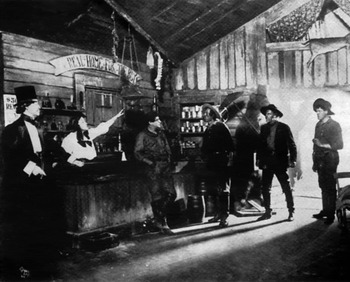
The first item in this exhibit is a photograph – not from La fanciulla del West, but one of the many that survive from the Broadway version of Belasco's The Girl of the Golden West. The production featured theatrical superstars Blanche Bates as Minnie and Robert Hilliard as Johnson/Ramerrez; Frank Keenan was Sheriff Jack Rance, the spurned lover of Minnie who pursues Ramerrez. The play was premièred at the Belasco Theatre in Pittsburgh in October 1905 and arrived on Broadway a month later; there it had a run of over 200 performances, and was admired through a formidable language barrier by Puccini during his 1907 visit.Footnote 18Figure 1 reproduces a still from the first act: the setting is the ‘Polka’ Saloon, shown here to be little more than a capacious cabin, with unfinished planks constituting both surface and structure: walls, roof, diagonal crossbars, floor, bar and even furniture. The shelves are filled with a variety of bottles and cans, a pelt is draped over the balcony railing; textiles are decorated with flowers and stripes. A sign behind the bar proclaims that this is ‘A Real Home for the Boys’; nearby a poster, partially concealed here by Rance's top hat but legible in other stills, offers ‘$5000 Reward for the Capture of Ramerrez’. Minnie (Bates) stands behind the bar, wearing her characteristic plaits, white blouse and dark tie; she salutes the miners standing by the entrance.
The Girl of the Golden West, Act I (New York, 1907). Reproduced in Mike Ashman, ‘“A Heroine Very Naive and Refreshing”: Belasco's Girl and Puccini's Fanciulla’, in La fanciulla del West, Royal Opera House (London, 2005), 20.

It is worth pausing over the degree of clutter: the way in which every inch of background is crammed with texture, pattern, nuance and even writing. Such details were offered in the service of the natural, to reproduce a historical reality as it actually was – as though such excess is itself an argument for truthfulness.Footnote 19 As Marc Robinson has noted, Belasco's sets for The Girl invite an engagement with surface detail that works against dramatic structure. This reading of background is fundamentally distracting, if productively so. Such pitting of plane against time is characteristic of Belasco's theatre, and arguably even subverts the constraints of realism: Robinson invoked Clement Greenberg's description of the splintering of three-dimensional space within avant-garde painting.Footnote 20
There is surely a fragility located somewhere between the second and third dimensions in The Girl – or, to put this another way, a tension between that which reveals its mediated status and that which conceals it. The piece began and ended with what Belasco called ‘Pictures’: when the curtain rose, the audience was greeted with a panorama of the Sierra peaks, followed by the exterior of the ‘Polka’; these moving screens would certainly have recalled the early photographic panoramas that made California visible to Americans on the East Coast in the second half of the nineteenth century.Footnote 21 A ‘Last Picture’, this time of ‘the boundless prairies of the West’, was shown at the end of the play; Minnie and Ramerrez could be seen dimly behind a four-fold layer of scrims.Footnote 22 The placement of these two-dimensional images at The Girl's chronological extremities provided a mediating effect, as though the spectator were engaged through a flat surface. Yet a closer referent than avant-garde painting is surely the photograph itself. Photography has been considered the handmaiden of realism.Footnote 23 If that is true, it also facilitated more than a few sleights of hand. Belasco could re-create the California of ’49 through pictures while claiming to have been there in person: photography came of age alongside the American West, and made it available in miraculous detail for distance viewing.Footnote 24
However – and this is important – the medium of photography or ‘light-writing’ ostensibly pushed artistic agency beyond the frame, causing an atrophy on the level of form. In its mechanised reproduction of visions, photography could not separate the essential from the inessential, as the human hand and eye did naturally. Its vast palette of shades and minutiae made it curiously resistant to narrative, true or otherwise. As one contemporary writer noted, ‘in a photograph [the facts] may be entangled with many other details that are not wanted’. Another even suggested that the medium was ‘literally true’ as a replica of reality, but ‘practically false’ in its lack of discernment.Footnote 25 The implication was that the human eye beholding a photograph had its own judgement suspended, temporarily becoming unable to view subjectively. What is more, the photographic medium's perceived lack of disegno had consequences for its portrayal of human models: they could be displaced, fragmented, repurposed; the result was what Daniel Novak has called a ‘photographic economy of interchangeable bodies and subjects’.Footnote 26 The realist fictional universe is constructed through a technique of collage: no object can be out of place because there is no such thing as a proper place within its frame. (The formulation may bring to mind a critique commonly directed at Puccini: that his motives return in inappropriate places.)
Belasco's cluttered backgrounds do not simply supply realistic detail but evoke the very nuance overload of photographic viewing. They impede the delineation of characters against settings; they flatten subjects to locales. To paraphrase Walter Benjamin, the photographed play became the play designed to be documented photographically.Footnote 27 And it was: dozens of stills survive from The Girl of the Golden West; they were reproduced in newspapers and magazines, collected privately and circulated to other theatres. Puccini seems to have acquired several, and he shared them with his librettist, Carlo Zangarini, when they began their collaboration, promising that the photographs ‘will help and will make the drama more apparent’ (Puccini also included a copy of the play, which his own poor English prevented him from deciphering; Zangarini's linguistic skills turned out to be not much better).Footnote 28 A series of stills from Belasco's original play entered the Ricordi archives in Milan; another is preserved at the Metropolitan Opera House.
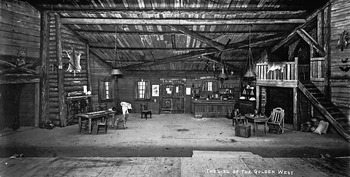
This brings us to the second item in our exhibit. Figure 2 may appear at first glance to document the empty set shown in Figure 1: the same wooden planks and diagonal crossbars, the same hanging lanterns, the same shelves of bottles and cans, and the same balcony with patterned curtain and deer pelt. To the left of the bar is the Ramerrez poster, while the sign above the curtained window affirms ‘A Real Home for the Boys’. The bar shown here, like the one in Figure 1, has a box at its left corner and a barrel at its right. Yet a handful of tiny differences – light lettering on a dark background for the sign above the bar, the shelves near the door slightly further apart, the cans on them stacked to three levels rather than two – reveal that this is not the same stage but a nearly perfect copy.
Interior of the ‘Polka Saloon’ (Metropolitan Opera Archives)

The set in Figure 2 is none other than that constructed at the Metropolitan Opera for the première of La fanciulla del West. The photograph is kept in the Met archives; similar ones document the sets for Acts II and III. These records are not known within the literature on La fanciulla and may have been mistaken for documents pertaining to Belasco's play: both the pictures of Act I and II list the work as The Girl of the Golden West, and credit the firm of Lange, NY, while the other photographs of the opera's cast are signed by White Studios. Indeed, these sets are only identifiable as belonging to La fanciulla through a close examination of the backgrounds of White's stills, and from a detailed caricature of a rehearsal of Act II also housed in the Met archives.
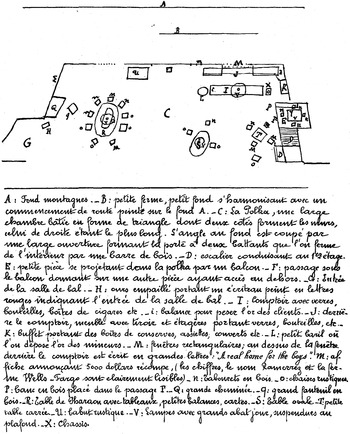
We can now turn to Figure 3, the final item relating to the ‘Polka’ saloon. It is the second page of Speck's staging manual entitled La fille du West, which was published by Ricordi in 1912 to be distributed to those theatres interested in producing La fanciulla. As noted, this manual is generally assumed to be of doubtful authority. However, David Rosen recently determined that the manual could have been written no later than the middle of 1911, as it refers to a version of the music that was in circulation for only a few months after the première.Footnote 29 And it can now be attributed even more exactly, as what Speck sketched on the page reproduced as Figure 3 was certainly the set reproduced in Figure 2: note the location of the bar, shelves, tables and chairs; the balcony on stage left and door to the outside below it; the mention of ‘A Real Home for the Boys’ above the window, a sign next to the door bearing the words ‘Ramerrez’ and ‘Wells Fargo’, and the figure of 5,000 dollars.
Jules Speck, La fille du West (Paris, 1912), 2.

Additional photographs in the Met archives, both of La fanciulla and of The Girl of the Golden West, reveal that the costumes and hairstyles of Puccini's first cast – headed by Emmy Destinn, Pasquale Amato and Enrico Caruso – were modelled exactly on the corresponding figures in the play. Indeed, the Metropolitan's costumier almost certainly designed and made the wardrobes from these very photos of The Girl. Such was the outward similarity that at least one newspaper mistakenly published pictures of Bates, Keenan and Hilliard mislabelled as Destinn, Amato and Caruso. The promotional shots taken of the singers by White's in advance of La fanciulla's première are staged: they do not represent moments in the drama with much accuracy and are not textually authoritative.Footnote 30 (To take one famous instance, there is no moment in Act II when Minnie entertains Johnson while Wowkle sits cross-legged on the floor.) But White's pictures do suggest that the movements of the singers, and their interactions with the scenery, bore significant resemblance to those of their counterparts: Destinn-as-Minnie is shown slouching, sitting or leaning on tables, her gaze cast down to the floor or off to the horizon, as Bates had done. The gentlemen lean casually on the bar and put their legs up on chairs.
Singular and statistical perceptions
The knowledge that one is viewing an object intended for mass consumption may in itself carry perceptual freight. Attempting to explain why Verdian opera should not be subject to revisionist staging, Alex Ross has suggested that Verdi cultivated the ‘art of juxtaposition’; his music appears ‘crude, even vulgar, on the page’ but is compelling when brought to life against the specified locales (and only those). Ross's explanation – namely, Verdi's ‘raging sincerity’ – is difficult to take seriously: was not Wagner also ragingly sincere? Bearing unacknowledged weight are the pervasive accounts of mass audiences: Verdi had ‘populist ideals’; he wrote for ‘limitless crowds’ and ‘saw no shame in the pursuit of public adoration’. Ross found himself powerfully affected by a literalist account of Otello, viewed among the undifferentiated masses in Central Park. He concluded that the composer whose music ‘has sold vast quantities of pasta’ should remain bound in principle to the ordinary.Footnote 31 It is an idea with a distinguished pedigree. As Benjamin warned: ‘there is manifested in the field of perception what in the theoretical sphere is noticeable in the increasing importance of statistics. The adjustment of reality to the masses and of the masses to reality is a process of unlimited scope, as much for thinking as for perception.’Footnote 32 Or, to put it another way, the differentiated observer, faced with a unique object, might have access to a variety of means of understanding – myth, metaphysics, symbolism and so on – while a collective brings into play the constraints of the real. Tom Stoppard's Guildenstern, for example, observes that while a man alone might encounter a unicorn, the accumulation of a group spreads the experience more thinly:
and the more witnesses there are the thinner it gets and the more reasonable it becomes until it is as thin as reality, the name we give the common experience … ‘Look, look!’ recites the crowd. ‘A horse with an arrow in its forehead. It must have been mistaken for a deer.’Footnote 33
The irony is, of course, that such sceptical or ‘statistical’ perception must usually ignore a vast constitutive apparatus. Realist theatre and opera resemble Adorno's phantasmagoria in concealing both their illusoriness and the organising presence of an animateur. Or, at least, such a presence is concealed by the performance: the most compelling theatrical illusions (as, later, in film) give rise to a surfeit of anecdotes recuperating agency for the mastermind at the expense of other participants.Footnote 34 Works designed for mass spectatorship are usually held to resist reading as text, as they appear lifeless on the page (reading, after all, is usually done alone); the critique Ross directs at Verdi was often levelled at David Belasco.Footnote 35
There is another detail worth mentioning in the photograph reproduced in Figure 1: the radiance from stage left, which back-lights the miners and throws the long shadows of evening across the floor. The effect is striking even now for its evocation of a setting sun. It was made possible by an enormous current of electricity, which flowed from the back of Belasco's theatre towards the stage and out into the most elaborate system of stage lights the world had ever seen. The lamps were invisible (he was the first director to conceal his light sources entirely) and controlled by a central switchboard standing fully three stories high, requiring dozens of operators. Belasconian lighting eliminated unrealistic shadows and modified its intensity and colour to create what he called ‘psychological effects’ or ‘spells’.Footnote 36 These spells were infinitesimal nuances of shade, designed to convince even the actors that their make-believe was real. The glare from stage left may serve to remind us of perhaps the most vital distinction between the Wagnerian operatic illusion and the realist one: time. Wagner suspends time; the realist universe is refastened to the clock – to the days and nights in their precise length and colouring.
One such ‘spell’ extends over the entire first act of La fanciulla del West: the gradual setting of the sun. As Helen Greenwald has shown, in 1910 the Metropolitan Opera House was the only theatre capable of re-creating Belasco's lighting effects for the original Girl of the Golden West.Footnote 37La fanciulla's lighting is described in unusual detail in both the libretto and the score: when the curtain opens, the interior of the Polka saloon has ‘violent light from the outside’ (luce violenta dell'esterno) in the manner of Figure 1, and the sky, visible through the window, is suffused in tones of gold and violet. The exterior light diminishes gradually over the course of the act as the sun sets, its illumination replaced for a time with lamps inside the ‘Polka’. The amount named on the poster for Ramerrez – 5,000 dollars – is precisely what Belasco claimed to have spent on his approximation of the real California sky. It is fitting also that this first moment of violent sunlight should reveal a familiar stage, photographically reproduced, and occupied by motionless figures (Jack Rance is smoking his cigar while Larkens, a depressed miner, has his head in his hands).
In Belasco's play, as we have noted, a tension between medium reflexivity and ‘realistic’ three-dimensional space is established by the picture-show frame. Within the opera, this conflict is manifest rather differently. Moments of reflexivity or flatness are buried within, while depth and space are established at the outset. When the curtain opens on the scene described above, for instance, the orchestra supplies a series of repeating figures over bass drone or ostinato; melodies are short and unmemorable. Whole-tone and pentatonic modes forestall harmonic momentum; the 50 bars after the curtain opens contain just one functional chord progression. Arman Schwartz's evocation elsewhere in this volume of a negative ekphrasis in Il tabarro, wherein the orchestra assumes the stasis of the scenery, might equally describe this opening – although here the ambience is, for the most part, unthreatening.Footnote 38 Yet if this is music of space, it is three-dimensional space. An invisible depth of field is evoked by a chorus of cries from off stage, with singers placed at various locations behind the scenes and at various distances.Footnote 39
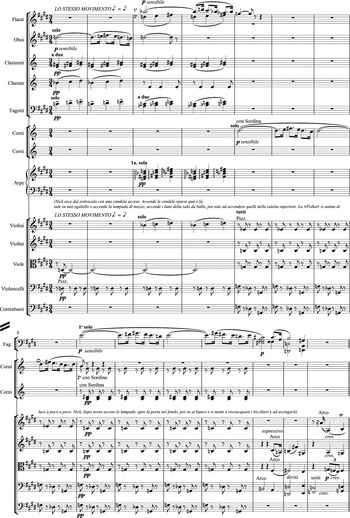
Only one type of musical development seems to have traction in such passages, and that is the colouristic shift. Motifs of one to four bars in length are repeated over ostinatos with minute variations in register and orchestration. Take for instance Example 1, which reproduces bars 57–71 of Act I: a single four-bar motif with syncopated accompaniment is repeated three times, passed between principal oboe, flute, horn and then bassoon; each iteration is a third lower than the previous one, with melody, rhythm and phrasing replicated exactly. Harmonic inertia is established by the whole-tone idiom, underpinned initially by the pedal D in violas and cellos, and by the pizzicato ostinato in all strings thereafter. Particularly between the second and third bars of this passage – as the melody passes from oboe to flute – we may find shifts in instrumentation so tiny as to beggar understanding: note that the bass clarinet stops doubling the first clarinet and joins the violas, and when the first bassoon is joined by a second the tenutos are omitted. These moments are representative of a good portion of the opera: a fact that may explain why so many listeners from Puccini's time to our own have found La fanciulla static, inscrutable and unmelodious.
La fanciulla del West, Act I, bars 57–71.

But to expect La bohème-style Puccinian melody here is surely to miss the point. The opening of La fanciulla fuses the static musical language described above with photographic realism and collective participation. The crowd of miners occupies the stage for much of the first half of Act I: Minnie and Johnson have not yet been seen and Rance has not distinguished himself from the multitude. As in Belasco's play, there is stage music. The minstrel Jake Wallace's ‘Che faranno i vecchi miei’, which sounds early in Act I, is something of a found object within the sound-world of La fanciulla; it adapts a Zuni melody.Footnote 40 With the exception of ‘Che faranno’, this first portion of the opera introduces neither a character nor a melody that will be important later on; in place of subjects, fictional or musical, we are given a series of closed episodes involving the collective. Jake Wallace arrives with his tune and the miners join in; the miners send Larkens home when his fortitude finally deserts him; Sid, who cheats at cards, is discovered and threatened with retribution. These episodes supply occasions for a steady stream of real sounds: the shuffling of cards, banging of tables, clinking of coins, snippets of stage song and even the occasional gunshot. The miners speak or shout on indeterminate notes nearly as often as they sing; notated pitches are frequently marked ‘parlato’.
What follows, though, is a slow progression over the course of the act towards darkness, solitude and illusion: Minnie arrives, then Johnson; the sun sets; Rance and the miners depart in pursuit of Ramerrez, leaving only the two main characters and Nick the bartender. The lanterns are gradually extinguished and the cluttered background fades into darkness. Johnson and Minnie fall in love. The realist sound-world disappears along with the light: as the crowd departs we begin to hear recognisable melodies, diatonic harmonies and vocal lyricism that would not be out of place in La bohème. The law of average perception slips away; a unicorn comes within range of hearing.
Minnie and Johnson speak about how their lives might have been. As a closing gesture to the act, the music begins a wholesale repetition of the theme first heard when Minnie entered; Johnson sings along, telling her that she has the face of an angel. At these words, his voice is joined by a chorus of fifteen off-stage tenors singing in unison. Their dramatic position is not clear; they do not represent characters but rather disembodied vocal sound: Johnson's voice has, in other words, gained an aura. After he leaves, Minnie is on stage: the only moment in the opera when a single character occupies the stage alone. She walks to the proscenium to stand below the one remaining light, which illuminates her face brightly and unrealistically, the imagined face of the angel superimposed on her own; depth vanishes; as she repeats Johnson's words – ‘un viso d'angelo’ – she is just a face, suspended in the darkness.
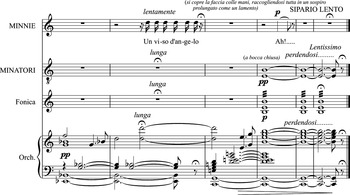
Finally, in the last three bars of the act, she covers her face, breaking the spectator's contact with the object of contemplation as well as suspending her own vision. These moments become the opera's strangest: a second new sound intrudes onto the auditory landscape (see Ex. 2). It was, at least in theory, a brand-new instrument invented by the composer just for this passage. The so-called fonica consisted of three bells (‘campane tubolari’) tuned to b, e' and b', which were kept off stage – not, in other words, in the orchestra pit – and struck with sponge-headed sticks by means of electric current (‘battute elettricamente con bacchetti di spugna’). The instrument most similar to the fonica, in timbre and in design, usually sits out of doors and sounds without human interference. Franklin's bells – an apparatus of two or three bells, consonantly tuned, whose clappers are set into motion by electric charge in the atmosphere – served to warn of an encroaching storm. Few have known what to make of the fonica: for unknown reasons, the Milanese firm of Romeo Orsi that Ricordi assigned to build the instrument did not succeed, and since then most opera houses have made do with a manually operated percussion instrument. When a handful of engineers in the early 1980s tried to create the fonica according to Puccini's specifications, they found it harsh, loud and disconcertingly similar to the electric doorbell or fire alarm. Yet perhaps, given the history recounted here, something of that alarm would not be out of place.
La fanciulla del West, final six bars of Act I.

Exhibit B: Faces
We know that the creators of La fanciulla considered its first staging to be definitive. Toscanini justified the length of rehearsal time devoted to staging, telling the press: ‘We want every detail to be correct, because other theatres in the future must copy this production.’Footnote 41 In an interview with La stampa in 1911, Puccini himself boasted of having insisted that other theatres re-create the ‘environmental reality’ of La fanciulla's première. The actors must appear to be wearing ‘clothes that had been worn a long time’; while Puccini granted that the first production had used chemicals to age its costumes artificially, ‘I made a point of insisting on the use of clay and various dyes in order to achieve the same outcome.’Footnote 42 Photographs were circulated to other theatres and the livret Ricordi published in 1912 provided a detailed description of Belasco's staging. In terms of the textual authority of its mise-en-scène, and the lengths to which its creators went to ensure fixity among revivals, La fanciulla is virtually unique among operas.
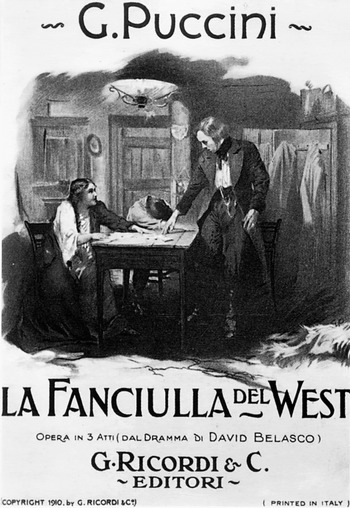
Outside the opera house, on posters and in the earliest librettos and scores put out by Ricordi, the image of the original Minnie had already slid just a little out of focus. This was accomplished by painting over a series of photographs of Blanche Bates, flattening the palettes of nuance, blurring the edges and diminishing the focus of their backgrounds, while keeping the actress recognisable. For instance, the cover of the first vocal score printed in Italy shows Bates-as-Minnie in her nightgown before the characteristic flowered wallpaper of her cottage. And the vocal score printed for Ricordi by Boosey & Hawkes in 1910, reproduced here as Figure 4, shows Bates, Keenan and Hilliard in the famous Act II poker match. Both were done from photographs in the Ricordi archives, lightly stylised to appear as paintings, and then presented as in-house design. This practice continues to the present day. The currently circulating version of La fanciulla's full score boasts a painting of the interior of a saloon, which it identifies as a set design of the ‘Polka’ done by Angelo Parravicini. Parravicini's designs are credited for the first productions of the opera in Rome (Teatro Costanzi, 12 June 1911) and Milan (La Scala, 29 December 1912).Footnote 43 However, it is actually a remediation of a still from the original Girl of the Golden West, with Bates behind the bar and two miners in front; a copy of the original picture is currently held in the New York Public Library.
Portion of title-page, vocal score, La fanciulla del West (Ricordi, 1910)

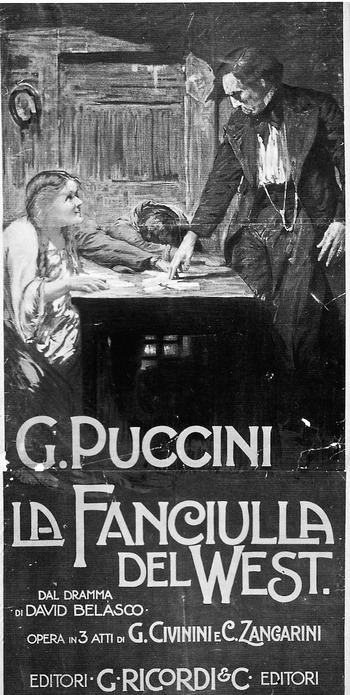
But something strange happened shortly after the première of La fanciulla. It becomes evident in a 1912 poster created by Giuseppe Palanti for Ricordi, reproduced here as Figure 5. In most details it is indistinguishable from Figure 4: Rance and Minnie are playing the famous Act II card game to decide the fate of Johnson; Rance stands over the table, Minnie looks up at him while Johnson slumps unconscious behind them. The background is almost identical, and even the limbs are arranged in the same way. But the faces have been painted over: Rance has gained a heavy brow and even heavier moustache. Blanche Bates is also gone, along with her trademark long straight nose and dark hair, and is replaced with a strange, lighter, almost porcine-featured Minnie who does not appear to have been fashioned from life. Was this erasure of real faces a defensive move, designed to allow La fanciulla's visual text to circulate freely in the future as Bates herself aged? Or was it an acknowledgement that such fixity of visions was unsustainable, and must be cracked open?
Poster for La fanciulla del West (Ricordi, 1910)

This history is paralleled in the reception of The Girl. Belasco's novelised version of the play, published in 1911, included illustrations painted by J. M. Marchand. Each still is identified with a particular moment in the drama by means of captions. Marchand's backgrounds re-create the original sets and costumes in considerable detail, while nudging the principals slightly towards the ideal. Perhaps ironically, movies sounded the death knell for Belasco's fixed visual text for The Girl: the story was filmed in 1915, 1923, 1930 and 1938. A second version of the novel replaced Marchand's illustrations with stills from the 1923 silent movie directed by Edwin Carewe and starring Sylvia Breamer. By 1938, when The Girl of the Golden West became a vehicle for Nelson Eddy and Jeanette MacDonald, the visions are unrecognisable as Belasco's.
* * *
If the première of La fanciulla del West purported to offer the American West as it really once had been, recent productions more commonly take as their point of reference the Spaghetti Western. Never, though, has the Wild West scenery been thrown out entirely like so much ‘antiquarian bric-a-brac’; never have the characters appeared alongside a giant eye or geometric machine; no director has given us those usual trophies of depth reading (doubles, mirrors, genitalia: as predictable as a Schenker graph). In the final analysis, mimesis in this Belasco/Puccini model would seem to traffic not in people but pictures of people; there is not, beneath it all, some base-level recognisable humanity. What is more, authorship and performance in this model are less those ‘modes of doing … of the drastic order’ familiar from recent critical literature than a series of remediations between layers of machine-generated souvenirs.Footnote 44 Where, then, does this leave the House of Puccini? Even our brief hermeneutic turn concerning Act I holds possibilities for a different kind of production: one that Levin could call ‘unsettling’ or ‘polylogical’.Footnote 45 The principal singers – perhaps just Minnie, Johnson and Rance – could perform alongside a chorus of holograms, for instance. The ‘Polka’ might be the interior of an enormous television set, and as the players on stage decrease and the saloon disappears into darkness, the coils and wires of the machine itself could become visible. Alternatively, the entrance of the fonica at the end of Act I could be signalled by the appearance of a giant eye – to be followed by the giant ear imagined by Emanuele Senici for the manhunt in Act III.Footnote 46 To prevent confusion, the production could distribute a lengthy Programmheft, for those North American journalists who ‘have little training in evaluating the creative possibilities of dramatic interpretation’.Footnote 47
But let us be very clear what kind of work such productions would do, and for whom. Laying bare what is perceived to be an opera's hidden content – determining an opera's concerns to be hermeneutic ones – is itself a settling move. It is about as threatening as those biker jackets and miniskirts with which Regieoper loves to clothe its stars; that is, not very, and only in predictable ways. There are, though, genuinely transgressive alternatives. One of these would be an apparatus-free staging of Belasco's sets and costumes in full realist regalia: a production that says, without irony, this was here. These genuinely prefabricated, photographic visions could be offered without verbal mediation and without indices of depth or form. If this is too oppressive for an evening's entertainment – or if no opera house is amenable – the play could be shortened, the music might be arranged for piano and condensed into something of a potpourri; such a production would play well in alternate spaces, like smaller theatres, galleries and church basements. More promisingly, those in the business of putting on operas could approach this work of late verismo with a new sense of its scope; finding all layers of equal authority, they might then take no medium as inviolable, and cause no particular detail to bear an unusual burden of fixity.