Total abnormal pulmonary venous return anomaly is a heart pathology that accounts for less than 1% of all CHDs, in which the pulmonary veins open into the systemic veins, right atrium, or coronary sinus instead of the left atrium. Total abnormal pulmonary venous return anomaly may be isolated or may accompany other complex cardiac defects such as right atrial isomerism and single ventricular physiology.Reference Öztürk, Tanıdır Cansaran and Ayyıldız1–Reference Zhao, Wang and Wang2
The treatment of the disease is surgical, and mortality in the series reported in recent years ranges from 2 to 20%.Reference Kelle, Backer, Gossett, Kaushal and Mavroudis3 Different techniques, such as conventional and primary sutureless, are used in surgical treatment. A side-to-side anastomosis is achieved between the left atrium and pulmonary venous confluence using conventional surgery.Reference Wu, Xin and Zhou4 However, surgical trauma to the intima of pulmonary vein (PVs) is significant using conventional surgery, and postoperative pulmonary venous obstruction, associated with increased mortality.Reference Karamlou, Gurofsky and Al Sukhni5 The sutureless technique was primarily created to relieve secondary pulmonary venous obstruction after initial total abnormal pulmonary venous return anomaly surgery. A neo-left atrium is created by anastomosing the left atrium to pericardium in vivo using the sutureless technique. The sutureless technique not only avoids mechanical stimulus to PVs but also minimises the distortion of the suture line.Reference Wu, Xin and Zhou4–Reference Karamlou, Gurofsky and Al Sukhni5
Arrhythmias, one of the well-known complications that can be seen after total abnormal pulmonary venous return anomaly operations, are transient in most cases and usually regress with medical treatment. Despite this, they may cause significant haemodynamic deterioration in the early postoperative period and affect mortality and morbidity in the intensive care unit.Reference Kabbani, Al Taweel, Kabbani and Al Ghamdi6,Reference Talwar, Patel, Juneja, Choudhary and Airan7 The main cause of arrhythmias developing in the early postoperative period is direct damage to the cardiac conduction system during the operation or oedema and inflammation in the myocardial tissue in the areas close to the conduction system. Also, it was suggested that different conditions such as atriotomy incisions, ischaemia, and reperfusion injury associated with cardiopulmonary bypass, electrolyte disturbance, age at operation, haemodynamics, acidosis, pain, sedation, and inotropic drugs used might affect the development and frequency of arrhythmia.Reference Kabbani, Al Taweel, Kabbani and Al Ghamdi6
Although many studies in the literature investigate the diagnosis and clinical and surgical outcomes of cases with total abnormal pulmonary venous return anomaly, there are limited studies examining the frequency and characteristics of arrhythmia in operative techniques.Reference Wu, Xin and Zhou4–Reference Karamlou, Gurofsky and Al Sukhni5 In this study, we aimed to compare the effects of these techniques on early rhythm problems in patients with total abnormal pulmonary venous return anomaly who were operated on using conventional and primary sutureless techniques.
Material and method
This study included patients younger than 18 years of age who underwent complete correction with conventional or primary sutureless techniques for isolated total abnormal pulmonary venous return anomaly between May 1 2020 and May 1 2022. Patients with total abnormal pulmonary venous return anomaly associated with complex heart diseases, such as right atrial isomerism and hypoplastic left heart syndrome, and patients with preexisting rhythm abnormality or transient rhythm abnormalities in the operation theatre which did not recur postoperatively were excluded from the study. This retrospective study was approved by the institutional ethics committee (ethical approval number: 2022/60) and was conducted per the principles of the Declaration of Helsinki.
The preoperative demographic data (gender, weight, and age), anatomical diagnosis, surgical data, clinical follow-up, and postoperative intensive care unit reports of the study group were evaluated.
All of the operations were performed under general anaesthesia through median sternotomy. Cardiopulmonary bypass was commenced with ascending aortic perfusion and bicaval cannulations. Moderate or deep hypothermia was induced. Measures to ensure myocardial protection included cold blood cardioplegia infusion. Conventional and primary sutureless techniques were performed as specified in the literature.Reference Kelle, Backer, Gossett, Kaushal and Mavroudis3–Reference Wu, Xin and Zhou4 The vertical vein was closed in all cases. A 3 mm opening was left in the interatrial septum. The chest was left open in some patients.
Patients were brought to the intensive care unit intubated and were taken on mechanical ventilatory support. For all patients, central venous pressure, electrocardiogram, invasive arterial blood pressure, end-tidal carbon dioxide and cerebral near-infrared spectroscopy monitoring were achieved.
Inotropic support was typically administered as milrinone (0.5 μg/kg/min) for the first postoperative hours. Epinephrine or norepinephrine treatment was included if necessary. Dexmedetomidine or fentanyl and midazolam were used for sedation and analgesia.
The telemetric record system was utilised through the postoperative follow-up course of the patients during their intensive care unit hospitalisation. The aforementioned data record system contributed additional data by monitoring invasive arterial pressure, central venous pressure, pulse oximetry, core temperature, and near infrared spectroscopy.
Patients were considered arrhythmic if arrhythmia persisted longer than 30 seconds or recurred and/or led to haemodynamic instability. In case of more than one arrhythmia occurrence in the same patient, the initial variety of arrhythmia was evaluated. A further cardiac evaluation was performed with 12-channel ECG, Holter ECG, and atrial ECG in order to overcome diagnostic difficulties.
Arrhythmias that were initially examined by a single paediatric cardiac intensive care doctor (EO) were then confirmed by two different paediatric cardiologists (GTS, YE). Arrhythmias were grouped as supraventricular /ventricular ectopic rhythm, sinus tachycardia, junctional ectopic tachycardia, supraventricular tachyarrhythmia, ventricular tachycardia, ventricular fibrillation, atrial fibrillation-flutter, and atrioventricular block (first, second, complete).
Tachycardia is defined as a heart rate that is in the 95th percentile or greater according to age-specific standard values.Reference Talwar, Patel, Juneja, Choudhary and Airan7 Diagnosis of junctional ectopic tachycardia is made by the typical ECG appearance with narrow QRS-complexes at a rate of 170– 260 bpm and atrioventricular-dissociation where the atrial rate is slower than the ventricular rate.Reference Hoffman, Bush and Wernovsky8 Supraventricular tachycardia was defined as atrioventricular reentrant (retrograde P wave) or 1:1 atrioventricular conduction. Supraventricular tachycardia included atrial ectopic tachycardia, atrioventricular nodal reentrant tachycardia, and atrioventricular reentrant tachycardia. Surgical atrial flutter or intra-atrial reentry tachycardia was indicated by an atrial heart rate between 240 and 400 beats per minute and an atrioventricular node conduction block. Additionally, it is characterised by a sawtooth ECG pattern in leads II, III, and aVF.Reference Tunca Sahin, Ozturk, Kasar, Guzeltas and Ergul9 Atrial ectopic tachycardia, which is a long RP tachycardia with a different p-wave axis and morphology from the sinus p-wave, displays a gradual acceleration (warm-up) after tachycardia onset and slow down (cool-down) before cessation. Other arrhythmias were identified according to standard definitions.Reference Kabbani, Al Taweel, Kabbani and Al Ghamdi6–Reference Talwar, Patel, Juneja, Choudhary and Airan7
For all patients, serum electrolytes (sodium, potassium, magnesium, and ionised calcium) and lactate were measured at four hourly intervals from the time of paediatric cardiac intensive care unit admission. The mean values of the serum electrolyte levels measured within the first 72 hours of the paediatric cardiac intensive care unit admission were used for statistical analysis. The highest value of serum lactate levels measured during the first 72 hours after the paediatric cardiac intensive care unit admission was used for statistical analysis.
The echocardiographic assessment was performed as recommended by the American Society of Echocardiography guideline. A shortening fraction of less than 28% or an ejection fraction of less than 55% indicated systolic dysfunction.Reference Pearlman, Gardin and Martin10 Inotropic support was applied in patients with ventricular dysfunction and low cardiac output syndrome. Inotropic agent usage grade was scored daily.
Vasoactive inotropic score was calculated using the following formulae: Vasoactive inotropic score = dopamine dose (μg/kg/min) + dobutamine dose (μg/kg/min) + 100 × epinephrine dose (μg/kg/min) + 10 × milrinone dose (μg/kg/min) + 10,000 × vasopressin dose (μg/kg/min) + 100 × norepinephrine dose (μg/kg/min).Reference Wernovsky, Wypij and Jonas11
In all patients with cardiopulmonary bypass or median sternotomy, atrial and ventricular temporary epicardial pacing wires were placed postoperatively. The decision to treat arrhythmias was made by the management team on a case-by-case basis. A simple algorithm was used while approaching the treatment.
The algorithmic approaches were based on the reported literature. The mainstay elements of the treatment were defibrillation, pain and fever control, elimination of electrolyte imbalance and acidosis, decremental inotropic support, antiarrhythmic drug therapy, and temporary and permanent pacemaker support.Reference Brugada, Blom and Sarquella-Brugada12
The patients were called for control at 1, 3, 6, and 12 months after discharge. At the control, the clinical status was evaluated with transthoracic echocardiography, 12-channel ECG, and 24-hour Holter ECG monitoring if necessary.
Statistical analysis
Data were analysed using SPSS for Windows version 15.0 software (SPSS Inc., Chicago, IL, USA). Median with range was used to describe continuous data, whereas absolute count with percentage was used for categorical data. Data were analysed for correlation between the scores and outcome using Spearman’s rho.
Univariate analysis was performed for demographic and clinical characteristics of patients to predict our arrhythmia using Mann–Whitney U-test, Chi-square test, or Fisher’s exact test as appropriate for individual variables. p < 0.05 was considered significant.
Results
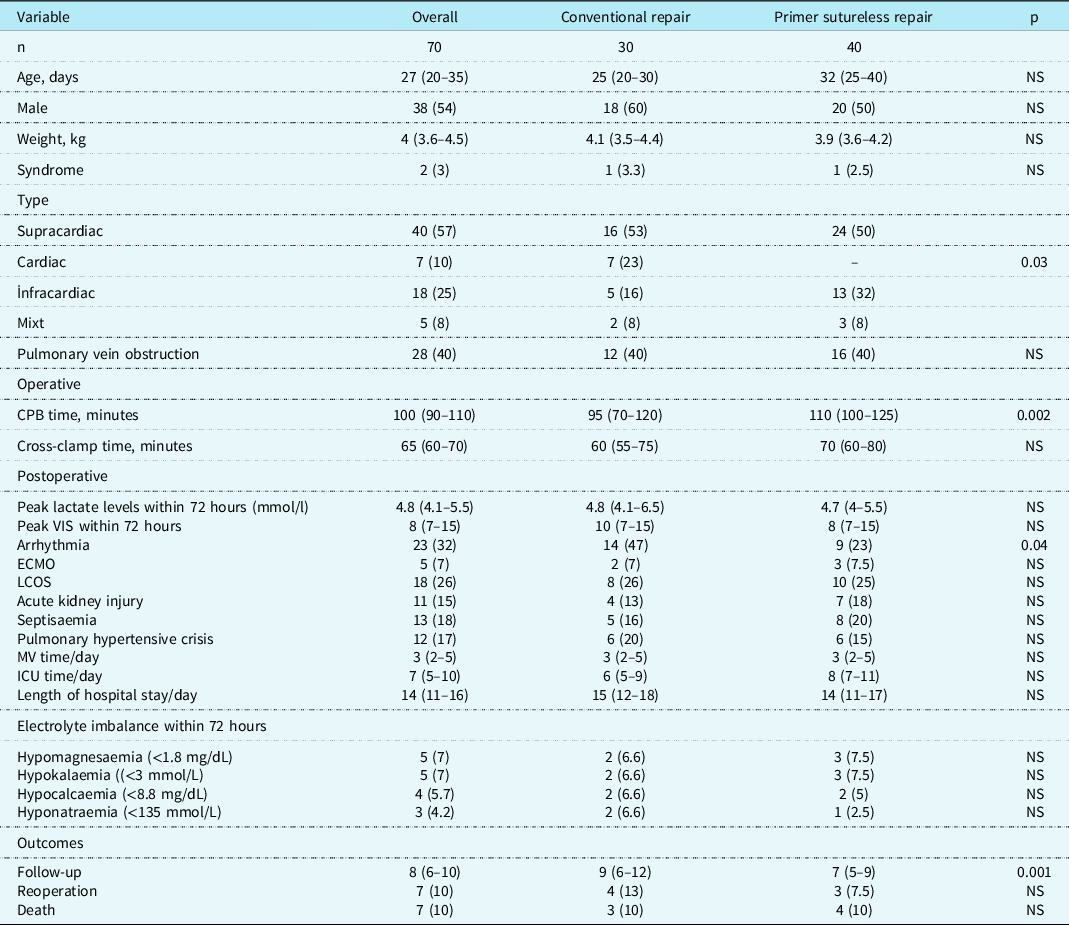
Seventy consecutive cases (median age 1 month, median weight 4 kg) who underwent total abnormal pulmonary venous return anomaly repair with the conventional or primary sutureless technique were evaluated. When the total abnormal pulmonary venous return anomaly subgroups of 70 cases were evaluated, 40 cases were supracardiac, 18 cases were infracardiac, 7 cases were cardiac, and 5 cases were mixed type. Twenty-eight cases (40%) had a pulmonary venous obstruction. Primary sutureless technique (57%, supracardiac n = 24, mixed = 3, infracardiac = 13) was used in 40 patients. Median cardiopulmonary bypass time (110 versus 95 minutes) and median aortic clamp time (70 versus 60 minutes), median peak lactate (4.7 versus 4.8 mmol/l) in the first 72 hours, and median peak vasoactive inotropic score in the first 72 hours of the primary sutureless and conventional technique used cases value (8 versus 10) were similar. The general characteristics of the cases are shown in Table 1.
Patient preoperative, operative, postoperative, and outcomes data

CPB = cardiopulmonary bypass; ECMO = extracorporeal membrane oxygenation; ICU = intensive care unit; LCOS = low cardiac output syndrome; MV = mechanical ventilation; VIS = vasoactive inotropic score.
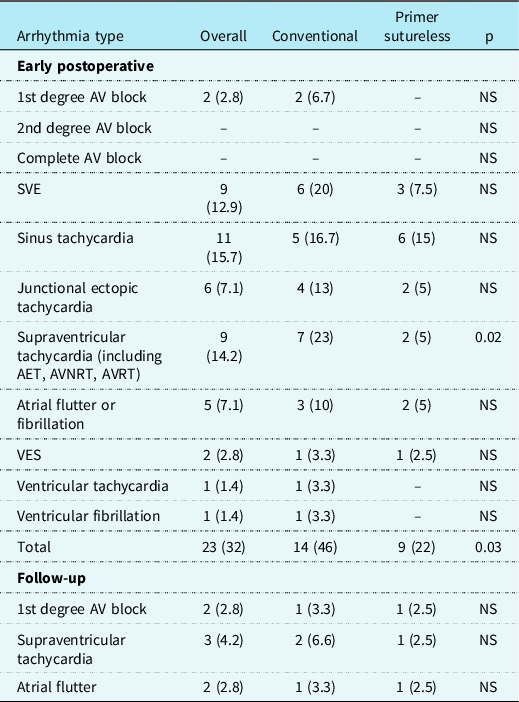
The types and incidences of arrhythmia observed in conventional or primary sutureless cases are summarised in Table 2. The total incidence of arrhythmias in the conventional group was significantly higher than in the primary sutureless group (46.7% versus 22.5%, p = 0.04).
Arrhythmia type

AV = atrioventricular; AET = atrial ectopic tachycardia; AVNRT = atrioventricular nodal reentry tachycardia; AVRT = atrioventricular reentry tachycardia; SVE = supraventricular ectopic beat; VES = ventricular extrasystoles.
Two junctional ectopic tachycardia cases in the primary sutureless group returned to sinus rhythm on the third day with amiodarone treatment. Intra-atrial reentry tachycardia case was returned to normal sinus rhythm with overdrive pacing. The supraventricular tachyarrhythmia case was returned to sinus rhythm with adenosine and did not recur. Propafenone treatment was given to the atrial ectopic tachycardia case for 4 weeks, and then the treatment was stopped.
In the conventional group, two junctional ectopic tachycardia cases returned to sinus rhythm with amiodarone and one case with dexmedetomidine within 4 days. No medical treatment was required for the fourth case. Two of the three intra-atrial reentry tachycardia cases were converted to sinus rhythm with overdrive pacing and one case with cardioversion. Two of the three atrial ectopic tachycardia cases returned to sinus rhythm after initiation of propafenone and one of propranolol. After 6 weeks of treatment, drugs were discontinued in all cases. Four supraventricular tachyarrhythmia cases returned to sinus rhythm after adenosine. Propranolol treatment was added to one case due to recurrence. It was discontinued after 6 months of treatment. Haemodynamics were stabilised after cardioversion in the ventricular tachycardia case and defibrillation in the ventricular fibrillation case.
In the first 30 days, there was a similar mortality rate (10% versus 10%), with four patients in the primary sutureless group and three patients in the conventional group. In the primary sutureless group, two patients died due to pulmonary hypertensive crisis, and two patients died due to septicaemia. In the conventional group, one case died due to septicaemia, one case due to low cardiac output syndrome, and one case due to pulmonary hypertensive crisis. Rhythm problems were observed in two dead patients in the sutureless group (atrial fibrillation-flutter (n = 1) and junctional ectopic tachycardia (n = 1) and one dead patient in the conventional group (ventricular fibrillation (n = 1)).
The median follow-up period of the cases was 8 months (interquartile range (IQR) 6–10 months). In the follow-up, two cases (one supraventricular tachyarrhythmia and one intra-atrial reentry tachycardia) in the primary sutureless group and three cases (two supraventricular tachyarrhythmia, one intra-atrial reentry tachycardia) in the conventional technique had an arrhythmia. Two patients in the primary sutureless group were diagnosed with infracardiac obstructive total abnormal pulmonary venous return anomaly. In the conventional technique, one of the patients with supraventricular tachyarrhythmia was diagnosed as cardiac, the other was supracardiac, and the patient with intra-atrial reentry tachycardia was diagnosed as infracardiac obstructive. All cases were returned to normal sinus rhythm with cardioversion and combined antiarrhythmic therapy (propranolol+amiodarone). After 6 weeks of antiarrhythmic treatment, control ECG and Holter showed no signs of arrhythmia.
Discussion
In this study, we aimed to compare the possible effects of conventional and primary sutureless techniques on early rhythm problems in patients with total abnormal pulmonary venous return anomaly who underwent total repair. We observed that the frequency of arrhythmia was higher in the conventional technique, and its effect on mortality and morbidity was limited. Our study, in its current state, is one of the few studies reported in the literature.Reference Karamlou, Gurofsky and Al Sukhni5–Reference Talwar, Patel, Juneja, Choudhary and Airan7
Despite the improvement of perfusion techniques, innovations in operative techniques, and advances in intensive care management, arrhythmias continue to be one of the important causes of mortality and morbidity in the postoperative period. Few reports describe cardiac rhythm in patients after total abnormal pulmonary venous connection (TAPVC) operations, in which small groups of patients were presented, but arrhythmia was present in almost half of the studied samples.Reference Tanel, Kirshbom and Paridon13 Most of the early arrhythmias are reported as sinus bradycardia, sinus tachycardia, supraventricular arrhythmia, and less commonly reentry tachycardias such as atrial flutter. The mechanism of these arrhythmias appears to be multifactorial, with surgical factors such as atriotomy incisions, cardiopulmonary bypass cannulation sites, and multiple suture lines all contributing to traumatic injury of the sinus node, interruption of the sinus node artery, and establishment of reentry circuits. Other nonsurgical factors, such as altered haemodynamics resulting in abnormal flow patterns and atrial wall stress, may also contribute to the development of atrial arrhythmias that may not become apparent for many years.Reference Tanel, Kirshbom and Paridon13–Reference Jaworski, Kansy, Friedman-Gruszczynska, Bieganowska and Mirkowicz-Malek14
In the literature, there have been various reports about arrhythmia rates in the early postoperative period following total abnormal pulmonary venous return anomaly surgery. Hıraska et al. reported that arrhythmias were observed at a rate of 59% in their series, most of which were supraventricular tachyarrhythmias.Reference Hruska, Sagat and Sojak15 Jaworski et al. used the conventional method in their total abnormal pulmonary venous return anomaly series of 83 cases with 16 single ventricular physiology and 67 with normal heart physiology and stated that the incidence of postoperative arrhythmia was 15.7% (31.3% in single ventricle, 11.9% in normal heart physiology).Reference Jaworski, Kansy, Friedman-Gruszczynska, Bieganowska and Mirkowicz-Malek14
In our series, all patients were in normal cardiac physiology, and the incidence of arrhythmia was 32%. The variation in this ratio may be due to the characteristics of the accepted arrhythmia subgroups.
Some surgical techniques carry a higher risk of postoperative arrhythmias. Michielon reported the incidence of atrial arrhythmia as 3.4% in side-to-side anastomosis and 8.3% in cases of coronary sinus unroofing.Reference Michielon, Di Donato and Pasquini16
Even though there was no muscular tissue in direct relationship to the pulmonary veins, the confluence can still be a source of atrial arrhythmia in patients who undergo conventional repair. As the left atrium was connected only to the electrically silent pericardium in sutureless repair, an arrhythmia could not originate from the confluence. Left atrial appendage was incised longitudinally and included in the posterior incision of the left atrium and the sutureless repair instead of directly closing it. Therefore, the described left atrial lesion is reduced to ablation from the pericardial–left atrial suture line to the mitral valve annulus. The extension of the right atrial incision across the interatrial septum creates an electrically isolating lesion without penetrating the back wall.Reference Haller, Kirsh, Van Arsdell and Honjo17
In our study, arrhythmia frequency was higher in conventional repair compared to sutureless repair (46% versus 22%). Arrhythmia frequencies in the late postoperative period (>30 days) were similar (14% versus 8 %).
It was stated that arrhythmias might develop in the long term after the first repair and independently of the symptoms and that regular follow-up is required. Tanel et al. reported a case series of 29 patients who were evaluated electrophysiologically after an average of 11.2 years from the initial operation and stated that different arrhythmias such as sinus node dysfunction, atrioventricular conduction delay, and supraventricular arrhythmias could be observed.Reference Tanel, Kirshbom and Paridon13 Michileon evaluated the total abnormal pulmonary venous return anomaly series of 89 cases with a median age of 54 days from different aspects. Routine ECG and 24-h Holter follow-up evaluation demonstrated that the double-patch technique was associated with a 17.2% incidence of late arrhythmias, including junctional bradycardia or ectopic atrial rhythm requiring medical treatment or pacemaker implantation.Reference Michielon, Di Donato and Pasquini16
In our study, although the follow-up duration was short, the rate of arrhythmia was 13.3% in the conventional group and 7.5% in the primary sutureless group, highlighting the importance of regular follow-up.
The main limitation of this study is that it was conducted retrospectively on a limited number of patients. Another disadvantage is that two different surgical teams performed the operations. However, the same postoperative follow-up protocol minimised this situation. Another limitation is that the follow-up time was short. This unique study regarding only arrhythmia frequencies after total abnormal pulmonary venous return anomaly repair compares two different surgical strategies. In addition, this study and its findings will guide multicentre studies in the future to overcome the limitations with a single centre study.
In conclusion, different arrhythmias can be observed in the early period in patients with operated total abnormal pulmonary venous return anomaly. Although a higher rate of rhythm problems was observed in the early period in the conventional repair method compared to the sutureless method, no significant effect was found on mortality and morbidity.
Acknowledgements
None.
Financial support
This research received no specific grant from any funding agency, commercial, or not-for-profit sectors.
Conflicts of interest
None.
Ethical standards
The authors assert that all procedures contributing to this work comply with the ethical standards of the relevant national guidelines on human experimentation and with the Helsinki Declaration of 1975 and Mehmet Akif Hospital Institutional Review Board (60-2022) approved the study.