Introduction
Recent advances in rock art research have seen a shift in attention which has increasingly acknowledged the rock itself as an important element in rock art production. Rather than being dismissed as a voiceless support for the affixed imagery, the rock has been recognized as a significant integral substance with a contributing voice of its own. Previous works have noted how certain rock art figures are directly associated with the various cracks, holes, lines and other irregularities in the rock face: The head of an antelope can be seen peering out from a crevice in the rock, while another is seemingly penetrating the rock through a hole. Serpents and snakes are interpreted as ‘slithering’ from crack to crack, entering and exiting the rock surface. The tracks of a bear leading into a basin are seen as the path through which the animal has travelled underwater and into the world of spirits. Observations such as these have accentuated the role of the rock as a transitional space between cosmic worlds, and as a place where people meet and interact with supernatural forces (see, for example, Clottes and Lewis-Williams Reference Clottes and Lewis-Williams1998; Helskog Reference Helskog1999; Reference Helskog, Blundell, Chippindale and Smith2010; Lewis-Williams Reference Lewis-Williams2002; Lewis-Williams and Dowson Reference Lewis-Williams and Dowson1990; Tilley Reference Tilley1991; Vinnicombe Reference Vinnicombe1976; Whitley Reference Whitley, Chippindale and Taçon1998; Reference Whitley2011; see also Coles Reference Coles2000).
While recent research has certainly elevated and emphasized the significance of the rock in rock art production, problems arise in cases where there are no visible connections between the rock figures and the geological irregularities in the rock surface. Such is the case for the rock carvings found in Taru Thang, a medium-sized rock art site located in Ladakh in the Indian Himalayas. Here the rock art figures are found carved into the boulders without exhibiting any apparent connections to the various irregularities in the rock surface. In other words, the rocks appear as insignificant backgrounds for the affixed imagery and emerge as ‘blank slates’ without any substantial meaning of their own. Does this imply that the rocks in Taru Thang have been nothing but silent partners in the production of meaningful imagery? Are the rocks only significant in places and cases where connections between the figures and the rock surfaces are visible to the naked eye?
It is the overlying purpose of the present paper to demonstrate how the rock can be interpreted as an element of major significance even in cases where no apparent connection between rock structures and rock art imagery is discernible. The theory which will be discussed in this paper argues that the rocks have a specific context which inevitably guides and shapes the production of the rock art images affixed on them. In the case of Taru Thang, I will argue that the rocks constitute ritual devices of communication between humans and the gods, in which beliefs associated with hunting play a central part. Through the communicative context of the rock, the carvings can be interpreted as messages conveyed through the rock interface carrying the pleas and appeals of the local hunters to their supernatural allies. Thus I argue that the rock functioned as the intermediary contact point through which the powers of the otherworldly realm were invoked. In this practice of communicating through rocks, the various geological irregularities served no significant purpose. Based on these observations, the argument which will be pursued in the present research states that the rock can be interpreted as a vital ritual substance even in cases where the affixed rock art imagery is portrayed without connection to the cracks, lines, fissures or holes in the rock surface.
It is important to note that this is neither a new concept nor a new idea. The significance of the rock itself as a ritual and communicative substance has been discussed by several prominent researchers previously, drawing on rock art material from Scandinavia, southern Europe and southern Africa, as well as North America. For example, in their work on Upper Palaeolithic rock art from Spain and France, Jean Clottes and David Lewis-Williams note that the most remarkable and consistent attribute of the cave art is that the painted images seemingly respond to the natural features found in the rock surface. Building on this observation, they propose that the Upper Palaeolithic people believed that the rock surface was a thin, penetrable membrane which separated the world of humans from the supernatural world of spirits. In turn, images produced on these mediating surfaces were believed to enable communication between the two realms. From that point of view, the rock surface could not be perceived as a meaningless support for the painted rock art images, but should be understood as a significant part of the image itself which functioned as a highly influential context (Clottes and Lewis-Williams Reference Clottes and Lewis-Williams1998).
A similar perspective was explored by David Whitley in his work on North American rock art of the far West. Whitley argued that the rock surfaces were important instruments and symbols in their own right: rather than serving as natural backdrops for the affixed imagery, he proposed that the rocks were just as symbolically charged and vital as the meaning and function of the iconography fixed upon them. He argued that the rock surfaces should be understood as significant instrumental symbols which constituted a vital channel of communication and mediation with the supernatural (Whitley Reference Whitley, Chippindale and Taçon1998, 16; Reference Whitley2011, 117). Whitley proposed that the rock art sites themselves were portals or entrances into the realm of the sacred, and that the painted or engraved images were permeable barriers. The geological irregularities which were often found incorporated in the rock art compositions were interpreted as the gateways which permitted the ritual practitioners to move and mediate between the world of humans and the world of the supernatural entities (Whitley Reference Whitley, Chippindale and Taçon1998, 16–17).
Thus, in a broader archaeological perspective, this article stands as a supplement and addition to the recent advances in rock art research and aims to emphasize, as well as elevate, the significance of the rock in the production and function of rock art.
The rock carvings of Taru Thang
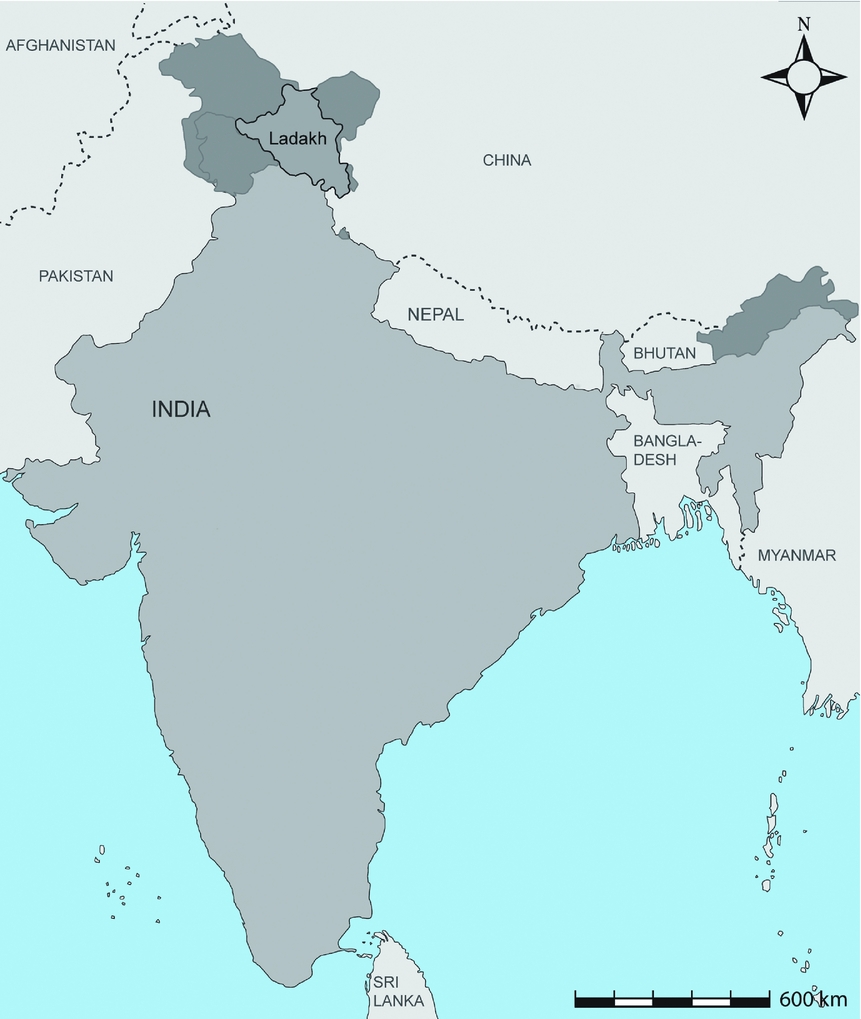
Ladakh is a high-altitude cold desert situated in the province of Jammu and Kashmir in the northernmost part of India (figure 1). The highest point climbs up to the 7,672-metre-high Saser Kangri peak in the easternmost subrange of the Karakoram range in India, and the majority of the plateau in general lies above an elevation of 3,000 metres. The natural landscape is defined by rock, manifested as massive granite hills and mountains or found scattered as boulders on large arid fields, on mountain pastures, and by the many meltwater streams. On these boulders, numerous rock art images can be found, carved into the dark red desert varnish. The first known account of rock art in Ladakh was presented by the Moravian missionary August Hermann Francke in 1902, but it would take another century before professional attention was directed towards the rock carvings (see, for example, Francke Reference Francke1914). In the 1990s, the Archaeological Survey of India (ASI) reported rock art sites over all of Ladakh, and in 2006 a joint-project group discovered and documented around 20,000 rock carvings distributed over 150 rock art sites (Bruneau Reference Bruneau2007; Reference Bruneau2010; Bruneau and Bellezza Reference Bruneau and Bellezza2013; Bruneau, Devers and Vernier Reference Bruneau, Devers and Vernier2011; Vernier Reference Vernier2000).
Map of India and Ladakh. Map made by Astrid Johanne Nyland.

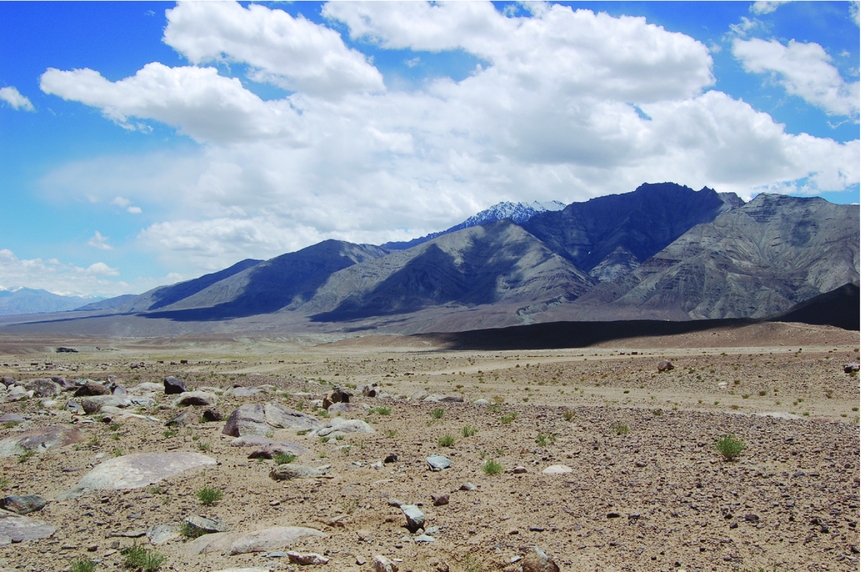
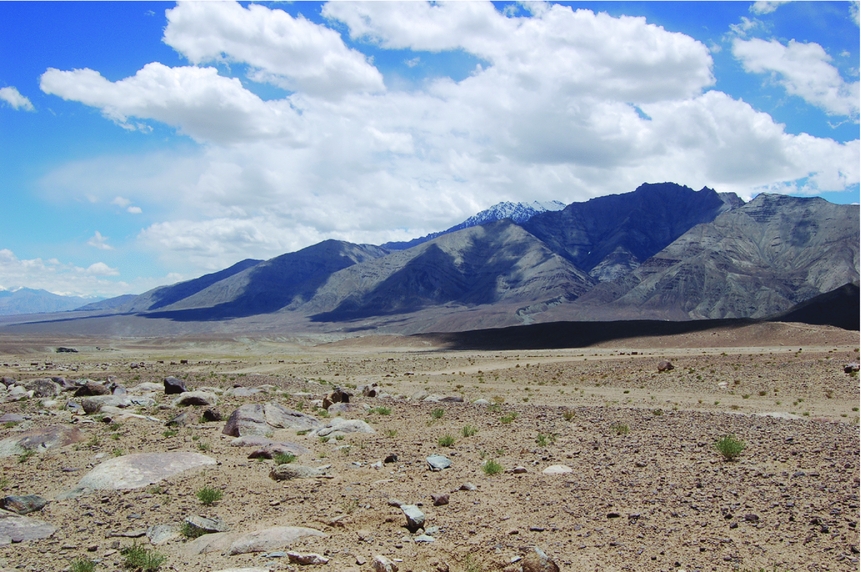
Following the river Indus around 15 kilometres westwards from Leh, the capital of Ladakh, the landscape slowly rises upwards to a plateau lying at an elevation of approximately 3,500 metres. On the rise of the plateau lies a large field scattered with granite rocks and boulders of various shapes and sizes. Here lies the six-square-kilometre rock art site known as Taru Thang, wedged between the mountain ranges and the deep river valley (figure 2). The southern edge of the field is immediately limited by the Leh–Kargil road and a large mound, which separates the field from the river Indus, which runs two kilometres to the south. The small village of Taru lies to the west, and Phyiang, with its connected Buddhist monastery, to the east. A seasonally active meltwater stream runs through the field, coming down from the mountains and Taru village, and exiting through the south-eastern part of the site, where it eventually joins the river Indus. The meltwater stream provides much-needed moisture and ensures the growth of sparse vegetation in an otherwise barren landscape, which in turn allows animals to graze amongst the granite boulders.
A view of the rock art site of Taru Thang in Ladakh.
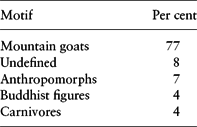
The Austrian ethnographer Karl Jettmar noted that ‘the rocks bordering the clefts, where streams or streamlets flow out from a side valley and join the Indus, are almost as a rule decorated with impressive carvings’ (Jettmar, König and Thewalt Reference Jettmar, König and Thewalt1989, xxiii). He argued that the location of rock art sites coincides with the location of the traditional ceremonial grounds in the western Himalayas, and consequently that there is a correlation between local rock worship and the production of rock art. This theory is supported by my observations at Taru Thang. In 2006 and 2007 I carried out two periods of fieldwork in Ladakh. The aim was to document and investigate the rock carvings of Taru Thang in order to elucidate the connection between western Himalayan rock art production and the mythical, ritual and social universe of the so-called Dardic-speaking people. During the fieldwork, I discovered and documented 296 individual rock carvings (Aas Reference Aas2009). The largest concentration was recorded in the eastern and south-eastern parts of the field, north of the seasonal meltwater stream, below the gentle slope leading up to the mountains to the north. The motifs consist of various species of mountain goat, human figures in hunting scenes and on horseback, geometric shapes and structures, dogs and felines, Buddhist symbols such as chortens and swastikas, and inscriptions and mantras (Table 1).
Taru Thang rock art motifs by percentage.

The striking variation of weathering of the carvings indicates that the rock art site has been in use continuously for a long period of time. While some rock carvings appear bright white and suggest a recent age of production, others are darkened and heavily weathered, which makes them nearly invisible to the naked eye. It is important to keep in mind that the rock carvings have not yet been securely dated and that the preliminary investigations provide merely tentative dates. It has been estimated that the extensive weathering of some of the rock carvings in the Indus valley would take at least three to four millennia. This is a crude estimation which largely depends on other factors such as exposure to sunlight and the quality of the stone, as well as on the method of manufacture (Jettmar, König and Thewalt Reference Jettmar, König and Thewalt1989, xvi). However, by using the estimated time of the extensive weathering as a guideline, it is likely that Taru Thang has been employed as a place for rock art production for at least 3,000 years, a period which stretches back to the Central Asian Bronze Age and continues up to the near present (Francfort, Klodzinski and Mascle Reference Francfort, Klodzinski, Mascle and Lorblanchet1992; Jettmar, König and Thewalt Reference Jettmar, König and Thewalt1989; see also Aas Reference Aas2009; Bruneau Reference Bruneau2007; Reference Bruneau2010; Bruneau and Bellezza Reference Bruneau and Bellezza2013; Bruneau, Devers and Vernier Reference Bruneau, Devers and Vernier2011). It should be noted that further archaeological investigations are needed in order to securely place the rock carvings in time.
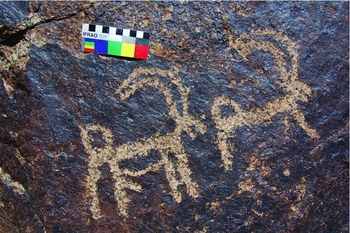
Almost 80 percent of the rock art images documented during my fieldwork depict mountain goats, predominantly ibex (Capra sibirica) (figure 3). The majority of the animals are portrayed alone, together with other species of mountain goat, or as prey in hunting scenes where they appear pursued by human figures armed with either bows and arrows or guns. Occasionally, the hunters are aided by what appear to be dogs. Common to all the mountain goat carvings is an emphasis on the horns, which are portrayed in exaggerated proportions, arching back to the rear of the animal where the tails are presented as curved or in a full loop (Aas Reference Aas2009, 25; see also Bruneau Reference Bruneau2010, 167–71; Bruneau and Bellezza Reference Bruneau and Bellezza2013, 27, 55). The specific posture of the tail indicates that the animals are portrayed in a state of excitement, such as in rut or in flight. The images are small, rarely exceeding twenty centimetres in height or width. They are produced in what can best be described as a ‘minimalistic style’, consisting of either single lines, intersecting lines or parallel lines. Only in few cases are the bodies of the animals fully pecked and filled. Based on these observations, I find it reasonable to assume that the primary purpose of the production of rock carvings was one other than aesthetic.
Ibex rock carvings at Taru Thang, depicted with backwards-sweeping horns and looped tails.

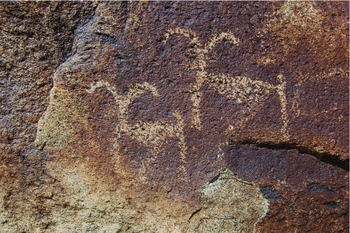
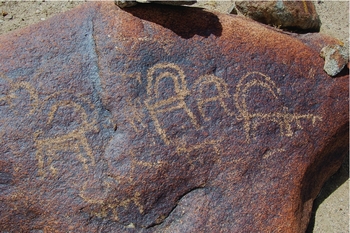
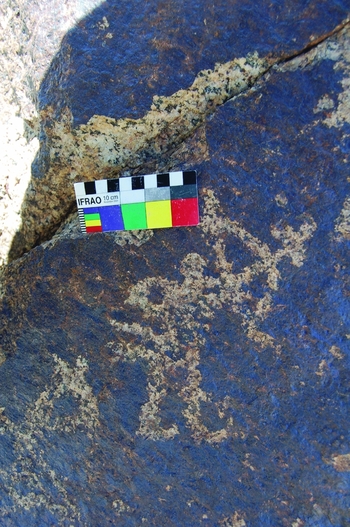
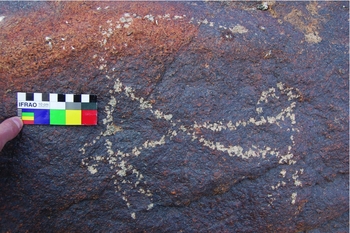
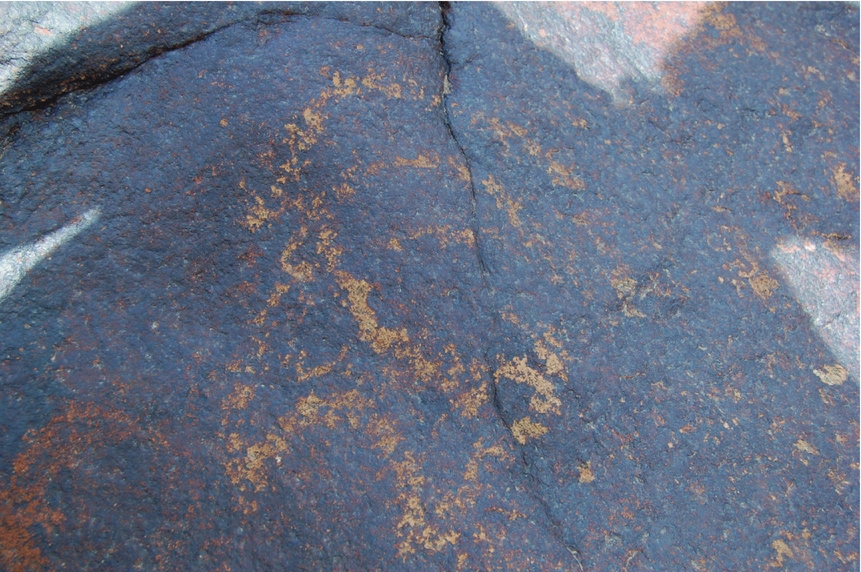
Of particular importance in the context of this paper is that the placement of the rock carvings on the individual boulders is seemingly based on the convenience of the rock as a suitable support for rock art rather than on arrangements relating to the various geological irregularities of the rock surface (figure 4). The rocks and boulders at Taru Thang are, as a rule, heavily eroded and weathered, resulting in surfaces dominated by cracks, holes, lines, fissures and other prevailing flaws. Correspondingly, the available spaces on which imagery could be produced, and at the same time be clearly visible, must have been quite limited. For the most part, the rock art images were carved on surfaces and places where there were noticeably fewer irregularities in the surface, as in an attempt to avoid the involvement of elements which would otherwise disturb the image itself (figures 5 and 6). In other words, the rocks appear to have been employed for displaying the figures more than for staging a scene which included the various flaws in the composition. It should be noted that on some boulders certain minor irregularities have been superimposed by rock carvings. Superimpositions seem to mainly occur in places and cases where the irregularities are too faint to have a visual impact on the rock carvings (figures 7 and 8). I propose that the superimpositions can be viewed as compromises, or settlements, in cases where the available space of the rock surface is perceived as sufficient for rock art production but still influenced by certain lesser geological irregularities which do not warrant avoidance. In other words, as long as the deformities in the rock surface are not dominant enough to corrupt the final product, they can be superimposed. This implies, from a formal point of investigation, that the central significance of the rock carvings is to convey or display the figure depicted rather than to interact with the various irregularities fixed in the rock surface. In certain ways, the utilization of the rocks at Taru Thang is comparable with how a Western painter would use his canvas, namely to emphasize the image produced upon it rather than to accentuate the relationship between image and background. I therefore argue that the primary purpose of the rock surface, in the context of rock art production, is to emphasize the rock carvings themselves rather than to incorporate the geological irregularities in the pictures. From a strictly formal point of view, the rock surfaces therefore emerge as ‘insignificant supports’ in the production of meaningful rock art imagery.
Mountain goat rock carvings, placed between two distinct irregularities in the rock surface.

Composition of mountain goats where the animals have been placed to the left and to the right of an irregularity in the rock surface.

Ibex hunter placed underneath a deep fissure in the rock surface.

Ibex image which superimposes lesser irregularities in the rock surface.

The horns and the tail of this ibex have been carved over a fissure in the rock.

The Dardic-speaking people: rock worship
So-called ‘stone worship’ or the belief in ‘rock gods’ constitutes an essential part of the religious lives of the Dardic-speaking people of the western Himalayas (Jettmar Reference Jettmar1961; Reference Jettmar1986; Klimburg Reference Klimburg1999; Siiger Reference Siiger1956). Living in the shadows of towering mountains, surrounded by steep cliffs, monumental boulders and rocky fields, it is perhaps not surprising that rocks have found their way into their belief system. The prominent role of the rock, as a ritual substance, is best understood in the light of the cultural-historical background of the Dardic-speaking people.
The various Dardic tribes which inhabit the deep river valleys in western Ladakh and the adjoining regions of Pakistan and Afghanistan are believed to be descendants of the early waves of Indo-Aryan migrants, which appeared in the western Himalayas sometime prior to 1500 B.C. Thus they were already present in the river valleys around the time when the Vedic Aryans crossed the Khyber Pass and descended upon the Indian subcontinent sometime after the 13th or 12th century B.C. (Loude and Lièvre Reference Loude and Lièvre1988, 186; Siiger Reference Siiger1956; see also Kuz′mina Reference Kuz′mina2007, 307–20; Parpola Reference Parpola, Blench and Spriggs1999). Despite their common cultural origin, the various groups of Dardic-speaking people should not be considered a homogeneous ethnic group today (see Clark Reference Clark1977): the period preceding the progression of Islam around 800 A.D. favoured independent micro-cultural development in the isolated river valleys. During this period, the individual Dardic tribes developed distinctive cultural characteristics and religious peculiarities, and gradually lost their sense of a shared cultural identity (Jettmar and Edelberg Reference Jettmar and Edelberg1974; Jettmar Reference Jettmar1986; Loude and Lièvre Reference Loude and Lièvre1988). From the 8th century onwards, the so-called ‘Land of the Unbelievers’ in Pakistan and Afghanistan was increasingly reduced due to the advancements of Islam, and today most of the inhabitants have been converted (Cacopardo and Cacopardo Reference Cacopardo and Cacopardo2001; Schmidt and Kohistani Reference Schmidt and Kohistani2008; see also Knudsen Reference Knudsen2009). Across the Indian border the situation was somewhat different, as the Dardic tribes in Ladakh were assimilated by Tibetan Buddhism.
While the various Dardic tribes have their cultural and religious differences today, they have preserved some fragments of their shared ancient belief system, mythical narratives and ritual practices. Among these fragmentary remains are the institutionalized veneration of the wild mountain goat, and the belief that rocks and boulders constitute sacred locations for supernatural communication and contact with divine forces (Staley Reference Staley1964; Müller-Stellrecht Reference Müller-Stellrecht1973; Darling Reference Darling1979; Loude and Lièvre Reference Loude and Lièvre1988; Di Carlo Reference Di Carlo2007). The Dardic-speaking people believe that their well-being is at the mercy of the supernatural beings, and that their fortune as well as their misfortune depends on their relationships with the deities. Living in the barren and uninviting environment of the western Himalayas, there is no shortage of hardships and impending dangers: heavy rains, flash floods, mudslides, avalanches, altitude sickness, livestock diseases and failed crops are just a few of the threats the local inhabitants find themselves exposed to (Siiger Reference Siiger1956). They cope with these hazards through rituals of worship. The Dardic-speakers primarily worship two different types of supernatural being: named major deities and unnamed mountain spirits.
Invoking the major deities through large boulders
Large boulders of unusual dimensions, situated at certain desirable locations in the landscape, function as points of worship for the major deities, and as instruments for invoking named gods or goddesses (Jettmar Reference Jettmar1961; Reference Jettmar1986; see also Vohra Reference Vohra1989). These sacred boulders are typically located in the centre of the local ceremonial ground, and are perceived as essential and integral parts of the holy precincts where the worship of protecting gods or goddesses takes place (Jettmar Reference Jettmar1961, 88; see also Hussam-ul-Mulk Reference Hussam-ul-Mulk, Jettmar and Edelberg1974b, 81; Jettmar Reference Jettmar1986, 80; Jones Reference Jones and Jettmar1986, 113; Loude and Lièvre Reference Loude and Lièvre1988; Robertson Reference Robertson1896). By applying and offering blood, flour, oil, butter or other substances to the boulders, the ritual properties of the rocks can become activated and they correspondingly function as a way of establishing communication with the deities. The offerings performed on the individual boulder are believed to invoke the god, who in turn would respond to the sacrifice by continuing to guard the fields, households and domestic animals, as well as individuals and families (Jettmar Reference Jettmar1961, 88). Ensuring a positive cultural development, and thereby avoiding misfortune caused by various natural disasters, diseases, sicknesses and accidents, are of primary concern among the inhabitants of the western Himalayas. The ritual performed on the sacred boulders therefore constitutes a means to countermeasure such misfortunes and take active control of the future. The offerings and invocations are believed to enhance and strengthen the relationship between humans and the gods, which in turn would protect the community and ensure a prosperous and positive future. In other words, the sacred boulders function as communicative instruments employed in formal rituals during specific annual celebrations.
The hunter and the sacred prey: divining through rocks
In the same way that large, noticeable boulders represent places for communicating with the major deities, the smaller and unimposing rocks are perceived as contact points for the lesser deities, the mountain spirits (see Jettmar Reference Jettmar1961; Klimburg Reference Klimburg1999; Siiger Reference Siiger1956; Vohra Reference Vohra1989; Witzel Reference Witzel, Griffiths and Houben2004). The mountain spirits are typically described as young and beautiful female beings with blond hair living under the supervision of the central deities (Jettmar Reference Jettmar1961; Klimburg Reference Klimburg1999, 156; Tuite Reference Tuite1997; see also Siiger Reference Siiger1956, 19). The spirits emerge as the embodiments of natural forces, displaying creative and life-giving attributes as well as life-threatening ones (see, for example, Lorimer Reference Lorimer1929; Sidky Reference Sidky1994, 73, 91). Representing the custodians of nature, their primary role is to protect the sacred game of the western Himalayas, the wild mountain goats.
Due to their role as protectors of the wild game, there is believed to be a special bond between the local hunters and the mountain spirits: under no circumstances would a hunter kill a mountain goat without permission from his personal spirit (Jettmar Reference Jettmar1961, 87). Ignoring such hunting rituals would have dire consequences for the offender. Displeased spirits were known to be devious and vengeful tricksters and would not hesitate to drive away the game or punish the ignorant hunter with sickness or death (Sidky Reference Sidky1994, 91). On the other hand, if the mountain spirits were given the appropriate offerings and veneration, they would aid the hunter and ensure a successful hunt. Thus the spirits were perceived as both the guides and the masters of the hunters and their primary function was to ensure hunting luck, but only as long as certain rituals were performed to satisfaction (Hussam-ul-Mulk Reference Hussam-ul-Mulk, Jettmar and Edelberg1974a; Jettmar Reference Jettmar1961; Reference Jettmar1986; Klimburg Reference Klimburg1999, 156; Siiger Reference Siiger1956; Tuite Reference Tuite1997; Vohra Reference Vohra1989, 39; Witzel Reference Witzel, Griffiths and Houben2004).
The night before the hunt, the huntsman had to sleep alone. The mountain spirit would appear to him in a dream and present him with a gift indicating his future success. Without this sign of blessing the hunt would certainly be a failure (Durand Reference Durand1899, 90–91, 211–16; Jettmar Reference Jettmar1961, 87; Staley Reference Staley1982, 177). The collective term for the spirits was nangini, meaning ‘mothers’, which emphasizes the close relationship between the hunters and the supernatural beings. The invocation performed on the day of the hunt went as follows: ‘Oh mother adopt me as your son and I request you to give me one of your goats. Be kind and treat me as your guest’ (Hussam-ul-Mulk Reference Hussam-ul-Mulk, Jettmar and Edelberg1974a, 97). The prayer was followed by one or several offerings: each individual hunter would tie a piece of cloth to a specific branch of juniper and place gunpowder on top of the particular rock believed to be the special dwelling place of his respective mountain spirit. Small pieces of cake were placed on other various rocks believed to be shared by the spirit community. The practice was called ishtareik, meaning ‘special offering’. After the offerings were concluded, the spirits would be pleased and the hunters could safely pursue their prey (Hussam-ul-Mulk Reference Hussam-ul-Mulk, Jettmar and Edelberg1974a; Jettmar Reference Jettmar1975, 220–23). It is interesting to note that similar hunting rituals have been observed in other parts of the world, such as amongst the Nlaka'pamux of British Columbia, where hunters would occasionally leave items such as shot and gunpowder on rock art sites to ensure good luck while hunting (Teit Reference Teit1930, 344; see also Whitley and Keyser Reference Whitley and Keyser2006, 11).
The hunter was held in great esteem by the Dardic community, but not primarily due to his capabilities as a food provider (Dollfus Reference Dollfus1988). The elevated status of the hunter was connected with his innate alliance with the mountain spirits, a connection of great social as well as ritual importance. The significance of the hunt can therefore not be explained from the perspective of subsistence, but must be investigated from a socio-ritual point of view. As described, the outcome of the hunt depended entirely on the relationship between the hunter and the spirits, which indicates that hunting practice was also a method of divination: the result of the hunt can be interpreted as a method of measuring the influence the hunter had with the deities, and thereby representing a visualization of his prestige. A successful hunting trip indicated that the huntsman was favoured by the supernatural beings, while a failed trip would indicate that he lacked the necessary influence (Dollfus Reference Dollfus1988, 134–35). In a culture where the fate of the community rested on a positive relationship with the gods, a materialization of divine approval and goodwill would have been considered imperative: the successful hunt was perceived as a direct sign of support from the mountain spirits, which in turn implied that a continued positive cultural development was assured. The spirits, as minions of the major deities, represented the will of the gods and their influence reflected the influence of the larger pantheon as a whole (Dollfus Reference Dollfus1988). The hunt, as a socio-ritual practice, can therefore be understood as the formulation of the question ‘Are we favoured by the gods?’ which was another way of asking, ‘Will the future bring fortune or misfortune?’
The auspicious and divining purpose of the hunt is reflected in a ritual performance executed among the Dardic-speaking Kalash people of Chitral District in northern Pakistan, some miles west of Ladakh. During their New Year celebrations, every household manufactures mountain goat figures made of dough. The figures constitute central components in a simulated hunting ritual which is taken as a prediction of the year to come (Loude and Lièvre Reference Loude and Lièvre1988). A young boy is chosen to play the role of the huntsman and is presented with a predetermined number of small rocks, representing the projectiles of the hunter. The ritual challenge is to destroy the dough goats by throwing rocks at them, leaving no figure intact within the limit of the authorized number of stones. The outcome of the simulated hunt is taken as a prediction of the coming year: if the figures are successfully destroyed, the year will be prosperous and positive cultural development is ensured. If the symbolic hunt fails, misfortune and bad luck will certainly ensue. In other words, the mountain goat figures mirror the real animals which in turn constitute the auspicious materialization of the relationship between gods and men (Dollfus Reference Dollfus1988; Loude and Lièvre Reference Loude and Lièvre1988). The mountain goats, whether in the form of real animals or as manufactured figures, represent tangible indications of the hunter's influence on the supernatural beings, and vice versa. Therefore mountain goat hunting must be understood as much more than a subsidiary practice or the pleasure of sportsmanship: it constitutes a way of predicting the future both for the individual and for the community.
Interpreting the rock art of Taru Thang: the rock as context
The point of departure for this analysis is the argument that the rituals and beliefs associated with rocks form a context which the rock carvings inevitably respond to. A similar idea was explored by David Lewis-Williams and Thomas Dowson in their work on San rock art in southern Africa. They interpreted the rock face on which the rock paintings were affixed as a metaphorical veil ‘suspended between this world and the world of spirits’ (Lewis-Williams and Dowson Reference Lewis-Williams and Dowson1990, 5; see also Lewis-Williams Reference Lewis-Williams1988; Reference Lewis-Williams2002). The essential idea was that the rock surface constituted a supernatural membrane through which the San shamans, as well as certain specific animals, could penetrate. Small openings in the rocks, such as holes, crevices, lines and other geological irregularities, could become enlarged through trance visions which enabled the shamans to pass through the rock face and enter the spirit world. The rock paintings applied to the surface were interpreted as external activators of the intrinsic irregularities of the rock, which provided access through the rock surface and into the spirit world by expanding the ritually produced gateways (Lewis-Williams Reference Lewis-Williams2002; Lewis-Williams and Dowson Reference Lewis-Williams and Dowson1990, 15; see also Clottes and Lewis-Williams Reference Clottes and Lewis-Williams1998; Morris Reference Morris, Blundell, Chippindale and Smith2010; Vinnicombe Reference Vinnicombe1976; Whitley Reference Whitley, Chippindale and Taçon1998; Reference Whitley2011). The conclusion of their study is that the rocks constitute a shamanistic context and consequently that anything produced on the rocks is coloured by that background (Lewis-Williams and Dowson Reference Lewis-Williams and Dowson1990, 15). What we can extract from the southern African example is that there is no such thing as a voiceless background in the production of visual imagery and that the supports inevitably influence the images painted, drawn or carved upon them. In other words, the background constitutes a context, or a stage, to which the affixed imagery must respond. Moving to the case study presented in the present paper, certain questions come into view: what contexts do the rocks at Taru Thang supply to the rock art? How can finding the contextual background of the rock improve our understanding of the rock art imagery?
The rock as an instrument of communication
The rituals and beliefs drawn from the Dardic-speaking people have painted a picture where the rocks emerge as instruments of communication between the local population and the extramundane entities. Central to this conclusion are the two ethnographic cases presented previously: in the first case, the large sacred boulders situated at the centre of the ceremonial grounds appeared as the formal points of connection between humans and their central deity (Jettmar Reference Jettmar1961, 88; see also Hussam-ul-Mulk Reference Hussam-ul-Mulk, Jettmar and Edelberg1974b, 81; Jettmar Reference Jettmar1986, 80; Jones Reference Jones and Jettmar1986, 113; Loude and Lièvre Reference Loude and Lièvre1988; Robertson Reference Robertson1896; Vohra Reference Vohra1989). In the second case, the lesser rocks and boulders were presented as the communication channels between the hunters and their allied mountain spirits (Jettmar Reference Jettmar1961; Klimburg Reference Klimburg1999; Siiger Reference Siiger1956; Witzel Reference Witzel, Griffiths and Houben2004; see also Vohra Reference Vohra1989). Both examples emphasize that the primary function of the rocks and boulders in the western Himalayas is to be devices of communication between the local population and the supernatural forces. Through an external manipulation of the rocks, where various substances were applied to the surfaces, contact and communication with the supernatural forces were established. The rocks functioned as interfaces through which the needs of society could be promoted and the gods and goddesses conciliated and appeased. In other words, the rock surface provided people with a means to mediate for the well-being of the community and thereby ensure a continued positive and prosperous future. In a culture where the safety and protection of the community relied entirely on a beneficial relationship with the supernatural forces, the physical points of contact must have been perceived as essential to survival. The conclusion drawn from these observations is that the rocks and boulders provide a context which, as will be demonstrated, has inextricably shaped and guided the rock carvings produced on them.
In the case of Taru Thang, the rock carvings come into view as integrated parts of the ritual system of communication between the local hunters and the mountain spirits. This argument is supported by the large number of mountain goats and mountain goat hunting scenes found in the rock art material. In that regard, the production of rock art can be understood as a part of the ishtareik, the special offerings presented to the mountain spirits prior to the hunting trips. In the same way as gunpowder and pieces of cake were applied to rocks in order to appease and invoke the mountain spirits, the rock carvings can be interpreted as communiqués, as messages transmitted through the rock interfaces, conveyed from the hunters to the spirits. Viewing the rocks as interfaces with extramundane properties opens the way for an interpretation where the mountain goat rock carvings can be understood as appeals or solicitations to the spirits, aimed at both enhancing one's luck in the hunt and ensuring the safety of the producer. Having ascertained the ritual function of the rock, and placed the rock carvings within that context, it is time to examine how this observation can enhance our perception of rock art, both on a local level and in a broader archaeological perspective.
The significance of the rock in rock art production
If we interpret the rocks as devices through which the local population could mediate with the extramundane entities, then it logically follows that the images affixed on them would have been influenced by those attributes. In other words, the contexts of the backgrounds dictate and guide what is produced on them and how these images are displayed. Take, for example, blank music manuscript paper. What would one expect to find produced on blank music manuscript paper? What purpose does the manuscript paper have in relation to what is written on it? Few would deny that its main purpose is to serve as a background for musical notation, which in turn is deciphered by musicians in order to play music. The blank manuscript paper does not, however, invite people to paint works of art or to write novels upon it. The theory presented here is that the same holds true for the rock surfaces. Just like the manuscript paper, the rocks at Taru Thang possess a particular potential which is tied to their cultural–religious function and purpose. The potential, or context, of the background guides and dictates what is produced on it. In the case of the manuscript paper, the musical notation comprises meaningful signs which are arranged meticulously on the sheet. Their placement, guided by the staves printed on the page, decides how the notation is read and ultimately how it sounds as music. Where the musical notation is meaningful signs on the manuscript paper, the rock art images are meaningful signs carved in the rock surface, constituting messages transmitted from the hunters to the wardens of the wild game. I propose that the messages, in the form of rock carvings, are believed to be deciphered by the spirits and eventually responded to in the form of safe and successful hunts.
These observations have two essential implications which are of interest to the scope of the present paper. First and foremost, they help us to understand why the mountain goat image dominates as a motif in the rock art material at Taru Thang: accepting that the imagery carved in the rocks constitutes appeals transmitted from the local hunters to the mountain spirits, it must have been imperative that the images depicted were relevant to the receivers. Conveying messages which are unintelligible would be out of place, perhaps even insulting to the supernatural beings. In the same way as one would not send for a plumber to fix one's electrical system, one would perhaps not produce on the rocks images which are incomprehensible to the mountain spirits. The mountain goat symbol is situated at the focal point of attention, desired by the hunters and bestowed by the spirits. Carved in the transmissive surface of the boulders, the mountain goat image carries meaning and works through the context of the rock just like the musical notation is comprehensible and provides meaning through its placement on the manuscript paper. In other words, there is no guarantee that symbols of other kinds would have any effect, being misplaced in regard to the context of the background. Second, the observations help us understand why the various geological irregularities seemingly play no part in the presentation of the rock art images.
I propose that the rocks and boulders in the western Himalayas were not perceived as permeable substances which could be passed through by shamans or supernatural beings, but that their predominant role and purpose was to convey and channel messages. Thus the primary importance in the presentation of the rock art on the rock surface would lie in its visibility and conspicuousness: no creature can be seen peering out of the fissures or the holes in the rock surfaces at Taru Thang, half-concealed in the intangible spirit world. Rather, the producers would make sure that the images were as perceptible and as clearly represented as possible, which implies that any line, hole or crevice found in the rock surface would have been avoided. By ensuring that the mountain goat images were clearly visible on the rock surface, the rock art producers could also ensure that the imagery would be received and recognized by the mountain spirits.
Conclusion
This paper evolved in response to an undercommunicated issue in rock art research, namely the role of the rock in rock art production, particularly in cases where no connection between the images and the rock surface can be discerned. This is the case at Taru Thang, where the rock carvings provide no visual impression of interaction with the various irregularities in the rock surface. The many cracks, holes, lines, fissures and crevices seemingly play no part in the presentation of the figures. Taken at face value, the rocks appear to be nothing more than an insignificant, yet convenient, background in the production of ‘meaningful imagery’. Through the ethnographic insight drawn from the Dardic-speaking people, however, it becomes clear that this is not the case. On the contrary, the rocks emerge as significant contexts which have inevitably influenced and empowered the affixed imagery. In other words, knowing the context of the rock equals knowing the rock art imagery produced on them: without the ethnographic insight, which placed the rocks as instruments of supernatural communication, it would not have been possible to interpret the mountain goat images as visual requests conveyed from the local hunters to the mountain spirits, and their potential meaning would be lost.
The conclusion of the discussion presented in this paper is that rock art researchers, to a larger extent, should explore and incorporate the rocks themselves in their interpretations. Rock art images are not detached and disconnected from their backgrounds, but are influenced and coloured by them even in cases where the geological irregularities remain unincorporated in the compositions. In certain cases, the significance of the rock equals and even surpasses the significance of the rock art images. In other words, exclusion of the rock in the analysis of rock art risks missing the context, and in an extension of that, the meaning behind the images themselves.
Acknowledgements
First, I would like to express my sincere gratitude to Prof. Christopher Prescott for continuous support throughout my Ph.D. study, for his motivation and immense knowledge. This paper would not exist without his help. Second, I would like to thank Laurianne Bruneau and Martin Vernier for their incredible work on rock art in Ladakh and for their generosity. I would also like to thank the members of our postgraduate writing group: Marianne Hem Eriksen, Elise Neumann, Lene Os Johannessen, Vibeke Viestad and Josephine Munch Rasmussen.