Introduction
Cannabis and psychosis share a long and at times contentious history (Warnock, Reference Warnock1903; Talbot & Teague, Reference Talbot and Teague1969; Semple et al. Reference Semple, McIntosh and Lawrie2005; Addington et al. Reference Addington, Case, Saleem, Auther, Cornblatt and Cadenhead2014). It is well documented that cannabis use can result in transient attenuated (subthreshold) psychotic symptoms in non-psychotic individuals (D'Souza et al. Reference D'Souza, Sewell and Ranganathan2009; Kuepper et al. Reference Kuepper, van Os, Lieb, Wittchen, Höfler and Henquet2011) as well as an increased risk of developing a psychotic disorder within the general population (Moore et al. Reference Moore, Zammit, Lingford-Hughes, Barnes, Jones, Burke and Lewis2007). Cannabis-induced transient attenuated psychotic symptoms (APS) arise in 20–50% of users and typically last no more than a few hours (D'Souza et al. Reference D'Souza, Sewell and Ranganathan2009). Adolescent cannabis use has also been associated with persistent APS many years after ceasing use in non-psychotic individuals (Kuepper et al. Reference Kuepper, van Os, Lieb, Wittchen, Höfler and Henquet2011). Risk of developing a psychotic disorder also increases in a dose-dependent manner with regular cannabis use, a pattern now demonstrated across multiple prospective population-based studies (Moore et al. Reference Moore, Zammit, Lingford-Hughes, Barnes, Jones, Burke and Lewis2007). In these studies, any use (v. non-use) increases risk 1.4-fold, and heavy use (e.g. daily use) 2.1 times that of non-users (Moore et al. Reference Moore, Zammit, Lingford-Hughes, Barnes, Jones, Burke and Lewis2007).
Given that cannabis use significantly heightens risk for psychosis within the general population, it might be expected that use would be particularly hazardous for young people already at ultra-high risk (UHR) for developing a psychotic disorder. To be considered UHR for psychosis an individual must meet a set of standard criteria developed and now widely used to prospectively identify individuals possibly in the psychosis prodrome (Yung et al. Reference Yung, McGorry, McFarlane, Jackson, Patton and Rakkar1996, Reference Yung, Phillips, Yuen, Francey, McFarlane, Hallgren and McGorry2003, 2004). Briefly, individuals must evidence a functional decline or chronic low functioningFootnote 1 Footnote † and meet one or more of the three following criteria: (1) in the past 12 months, the presence of attenuated (subthreshold) positive psychotic symptoms; (2) in the past 12 months, the presence of brief limited intermittent psychotic symptoms (frank psychotic symptoms which resolve quickly without treatment); (3) genetic vulnerability based on schizotypal personality disorder or a first-degree relative with a psychotic disorder.
To date, eight of nine studies comparing UHR individuals with a history of cannabis use with those who have never used found no relationship between cannabis use and transition to psychosis (Phillips et al. Reference Phillips, Curry, Yung, Yuen, Adlard and McGorry2002; Kristensen & Cadenhead, Reference Kristensen and Cadenhead2007; Corcoran et al. Reference Corcoran, Kimhy, Stanford, Khan, Walsh, Thompson, Schobel, Harkavy-Friedman, Goetz, Colibazzi, Cressman and Malaspina2008; Dragt et al. Reference Dragt, Nieman, Becker, van de Fliert, Dingemans, de Haan, van Amelsvoort and Linszen2010, Reference Dragt, Nieman, Schultze-Lutter, van der Meer, Becker, de Haan, Dingemans, Birchwood, Patterson, Salokangas, Heinimaa, Heinz, Juckel, Graf von Reventlow, French, Stevens, Ruhrmann, Klosterkötter and Linszen2012; Korver et al. Reference Korver, Nieman, Becker, van de Fliert, Dingemans, de Haan, Spiering, Schmitz and Linszen2010; Auther et al. Reference Auther, McLaughlin, Carrión, Nagachandran, Correll and Cornblatt2012; Buchy et al. Reference Buchy, Perkins, Woods, Liu and Addington2014; Valmaggia et al. Reference Valmaggia, Day, Jones, Bissoli, Pugh, Hall, Bhattacharyya, Howes, Stone, Fusar-Poli, Byrne and McGuire2014). While simply using cannabis (v. never using) does not appear to pose a robust risk in UHR populations, recent evidence suggests that factors such as a younger age of first use, heavier use and more potent doses of cannabis may predict both higher transition rates among those at UHR (Valmaggia et al. Reference Valmaggia, Day, Jones, Bissoli, Pugh, Hall, Bhattacharyya, Howes, Stone, Fusar-Poli, Byrne and McGuire2014) as well as an earlier age of psychosis onset among individuals who do transition (Decoster et al. Reference Decoster, Van Os, Kenis, Henquet, Peuskens, De Hert and Van Winkel2011; Di Forti et al. Reference Di Forti, Sallis, Allegri, Trotta, Ferraro, Stilo, Marconi, La Cascia, Reis Marques, Pariante, Dazzan, Mondelli, Paparelli, Kolliakou, Prata, Gaughran, David, Morgan, Stahl, Khondoker, MacCabe and Murray2014).
In short, while prospective general population-based studies have consistently observed an inflated risk of psychosis among cannabis users, cannabis use does not appear to increase the risk of transitioning to a psychotic disorder among UHR individuals. However, where studies have examined age of first use and severity of cannabis exposure, a relationship begins to emerge. Given that up to 55% of young people at UHR for psychosis report a history of cannabis use (Addington et al. Reference Addington, Case, Saleem, Auther, Cornblatt and Cadenhead2014), it is critical that we fully understand the nature of the risk that cannabis use poses. The present study aimed to address this by replicating and extending earlier efforts (Valmaggia et al. Reference Valmaggia, Day, Jones, Bissoli, Pugh, Hall, Bhattacharyya, Howes, Stone, Fusar-Poli, Byrne and McGuire2014) to investigate how characteristics of cannabis use relate to transition risk in UHR populations. In addition to age of first use and use frequency, we examined a novel measure of severity of cannabis abuse as well as history of cannabis-induced APS as predictors of transition risk. Based on previous studies, it was hypothesized that simply having a history of cannabis use (v. no history of use) would not predict transition to psychosis. Instead, we expected that risk of transition to a psychotic disorder in UHR individuals would be significantly related to heavier cannabis use, an earlier age of first use, greater severity of cannabis abuse and a history of experiencing APS while using cannabis.
Method
Participants
Participants in the present study were recruited from the Personal Assessment and Crisis Evaluation (PACE) clinic, Melbourne Australia, between September 2000 and May 2006 and were a subcohort of the larger PACE 400 long-term follow-up study reported previously (Nelson et al. Reference Nelson, Yuen, Wood, Lin, Spiliotacopoulos, Bruxner, Broussard, Simmons, Foley, Brewer, Francey, Amminger, Thompson, McGorry and Yung2013; Donoghue et al. Reference Donoghue, Nelson, Pan, Lane, Wood, Thompson, Lin, McGorry and Yung2015). PACE is a specialized clinic for individuals at UHR for psychosis. At the time of recruitment, referral to PACE was restricted to individuals aged 14–30 years residing in the Northwestern Melbourne Metropolitan area. For inclusion in the present study individuals were required to meet at least one of the following UHR criteria: (a) presence of APS within the past 12 months; (b) history of brief self-limited psychotic symptoms which spontaneously resolve, within the past 12 months; (c) presumed genetic vulnerability to a psychotic disorder plus recent deterioration or chronic low functioning (for complete operationalized criteria, see Yung et al. (Reference Yung, Phillips, Yuen and McGorry2004). Individuals were excluded if they had a known history of psychotic or manic episodes (treated or untreated); medical conditions that would present risk in the present study or account for symptoms (e.g. epilepsy); a lifetime antipsychotic dose of 15 mg or greater of haloperidol (or equivalent); previous or current use of mood-stabilizing medications; intelligence quotient less than 70; pregnant or lactating or insufficient English language proficiency to permit participation or treatment without interpreter.
All individuals referred to PACE during the recruitment period (n = 1428) were assessed against the above criteria, and 464 (32.5%) were deemed eligible for the study. Of these, 115 agreed to randomization in one of three treatment groups: cognitive therapy plus risperidone; cognitive therapy plus placebo; or supportive therapy plus placebo. The details and outcomes of this treatment trial have been reported previously (Phillips et al. Reference Phillips, Nelson, Yuen, Francey, Simmons, Stanford, Ross, Kelly, Baker, Conus, Amminger, Trumpler, Yun, Lim, McNab, Yung and McGorry2009; McGorry et al. Reference McGorry, Nelson, Phillips, Yuen, Francey, Thampi, Berger, Amminger, Simmons, Kelly, Thompson and Yung2013). An additional 78 individuals refused randomization, but agreed to assessment and follow-up in the present study, the remaining eligible PACE clients (n = 271, 19.0% of all PACE referrals) declined participation in the present study.
Measures
UHR status was established using the Comprehensive Assessment of At-Risk Mental States (CAARMS) and the Global Assessment of Functioning method (Yung et al. Reference Yung, Yuen, McGorry, Phillips, Kelly, Dell'Olio, Francey, Cosgrove, Killackey, Stanford, Godfrey and Buckby2005). Duration of symptoms prior to contact with the PACE clinic was also assessed with the CAARMS. The CAARMS is administered as a semi-structured interview assessing intensity, conviction, frequency and duration of various mental health symptoms using well-defined anchor points (Yung et al. Reference Yung, Yuen, McGorry, Phillips, Kelly, Dell'Olio, Francey, Cosgrove, Killackey, Stanford, Godfrey and Buckby2005). It demonstrates good to excellent inter-rater reliability and concurrent validity with other methods of detecting UHR status (Yung et al. Reference Yung, Yuen, McGorry, Phillips, Kelly, Dell'Olio, Francey, Cosgrove, Killackey, Stanford, Godfrey and Buckby2005).
Substance use history at baseline was assessed in a semi-structured interview with the Substance Use Questionnaire (SUQ), a measure used in previous PACE research (Phillips et al. Reference Phillips, Curry, Yung, Yuen, Adlard and McGorry2002). The SUQ includes 21 items (see online Supplementary Table S1) which characterize cannabis use during the heaviest period of use and during the past month. For the present study several variables were derived from this measure: lifetime history of cannabis use (dichotomous); age of first use; age of heaviest use; frequency of use during period of heaviest use; and history of cannabis-induced APS during period of heaviest use (dichotomous). Additionally, we created a ‘severity of cannabis abuse’ variable derived from six items assessing the following characteristics during the period of heaviest use: frequency of use, subjective need for cannabis, impaired capacity to control use, impaired capacity to stop use, social problems and risk-taking behaviour associated with use. Individual cannabis abuse severity scores ranged from 0 to 16, with higher scores reflecting greater severity of cannabis abuse and non-users coded as 0. Scores on this measure are significantly related to the presence and absence of current or past Diagnostic and Statistical Manual of Mental Disorders, 4th edition (DSM-IV) substance abuse/dependence. See online Supplementary material for further details on SUQ administration and validation.
Transition status at follow-up was assessed either using the CAARMS, or, where CAARMS data were not available, through state public mental health records, as per previous research (Nelson et al. Reference Nelson, Yuen, Wood, Lin, Spiliotacopoulos, Bruxner, Broussard, Simmons, Foley, Brewer, Francey, Amminger, Thompson, McGorry and Yung2013). Transition to a psychotic disorder was defined as one full positive psychotic symptom daily for 1 week or longer.
Procedures
Baseline assessments were conducted prior to treatment commencement and involved a battery of self-report and interviewer-administered measures including the CAARMS, SUQ and demographic information reported here. Full details of follow-up procedures for this cohort have been reported elsewhere (Nelson et al. Reference Nelson, Yuen, Wood, Lin, Spiliotacopoulos, Bruxner, Broussard, Simmons, Foley, Brewer, Francey, Amminger, Thompson, McGorry and Yung2013). Briefly, procedures involved employing a tracking system (Henry et al. Reference Henry, Harris, Amminger, Yuen, Harrigan, Lambert, Conus, Schwartz, Prosser, Farrelly, Purcell, Herrman, Jackson and McGorry2007) to locate and invite participants to a face-to-face interview. Where face-to-face interviews were not possible participants were invited to complete a brief telephone or written assessment. Mean time to follow-up in the present study was 5.0 years (range 2.4–8.7 years). Three participants did not complete the SUQ, resulting in a final sample size of n = 190.
Statistical analyses
All analyses were conducted using IBM SPSS version 22.0 (USA) and R version 3.2.1 (R Core Team, 2013). Cox regression survival analyses were conducted to assess the relationship between cannabis use characteristics and time to transition to a psychotic disorder. Time to transition was defined as time from date of baseline assessment to date of transition to a psychotic disorder as defined above or date of last known non-psychotic status for those who did not transition or had deceased. Differences in demographic, baseline functioning and treatment group characteristics between individuals with and without a history of cannabis use were assessed with independent t tests for differences between means and χ2 tests for differences between frequencies. Where differences between individuals with and without a history of cannabis abuse emerged, survival analyses were repeated controlling for these factors.
Results
Sample characteristics
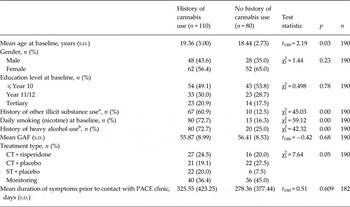
Of the 190 UHR individuals in the present study, 110 (57.9%) reported a history of cannabis use. Characteristics of individuals with and without a history of cannabis use are summarized in Table 1. As illustrated, individuals with a history of cannabis use were older and more likely have a history of other illicit substance use and heavy alcohol use and report daily nicotine use at baseline compared with individuals without a history of use. There was also a difference in the distribution across treatment groups, with relatively more individuals with a history of cannabis use randomized to supportive therapy plus placebo medication. No other differences were observed.
Demographic and clinical characteristics of UHR individuals with and without a history of cannabis use

UHR, Ultra-high risk; s.d., standard deviation; GAF, Global Assessment of Functioning; CT, cognitive therapy; ST, supportive therapy; PACE, Personal Assessment and Crisis Evaluation.
a Includes: opioids, sedatives, stimulants, hallucinogens, volatile substances.
b Defined as more than two standard drinks per day on average or more than five standard drinks in a single session on average during the heaviest period of alcohol use.
Cannabis use and transition to a psychotic disorder
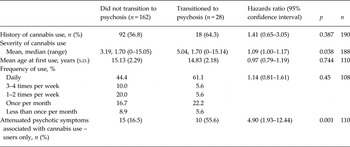
Of the participants, 28 (14.7%) were known to have transitioned to a psychotic disorder by follow-up. Of these, 13 (46.4%) met criteria for schizophrenia, 11 (39.3%) for a psychotic disorder not otherwise specified, one (3.5%) for delusional disorder, and one (3.5%) for substance-induced psychotic disorder. A specific diagnosis was not available for two of the 28 transitioned cases. As summarized in Table 2, lifetime history of cannabis use (v. never using) did not predict transition to a psychotic disorder in this sample. Transition was also unrelated to age of first use and frequency of use. By contrast, greater severity of cannabis abuse was associated with a greater risk of transitioning to a psychotic disorder [hazard ratio (HR) = 1.09, 95% confidence interval (CI) 1.00–1.17, p = 0.038]. This effect indicates that transition risk increases by 9% for every one-point increase in cannabis abuse severity. This effect remained significant after controlling for age at baseline, treatment group, history of other illicit substance use, history of heavy alcohol use and daily nicotine use at baseline (adjusted HR = 1.17, 95% CI 1.04–1.31, p = 0.008). History of other illicit substance use, history of heavy alcohol use and daily nicotine use at baseline were unrelated to transition to a psychotic disorder in this model (all p values >0.245).
Descriptive statistics and Cox regression models describing association between cannabis use characteristics and transition to a psychotic disorder in UHR individuals

UHR, Ultra-high risk; s.d., standard deviation.
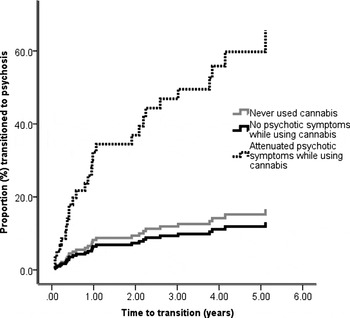
Of the 110 individuals reporting a history of cannabis use, 25 (22.9%) also reported a history of cannabis-induced APS. These individuals were at 4.90 times (95% CI 1.93–12.45, p = 0.001) greater risk of transitioning to a psychotic disorder than individuals with a history of cannabis use without cannabis-induced APS. They were also at 3.96 (95% CI 1.64–9.51) times greater risk of transitioning to a psychotic disorder than individuals who had never used cannabis (p = 0.002). Transition risk did not significantly differ between individuals who had never used cannabis and those with a history of cannabis use without cannabis-induced APS (p = 0.602). The effects of cannabis-induced APS and severity of cannabis use on transition risk also survived a conservative Bonferroni correction for multiple comparisons (i.e. p corrected = 0.01). Differences in transition risk as a function of history of cannabis-induced APS are summarized in the survival curves presented in Fig. 1.
Cumulative survival distribution functions modelling time to transition to a psychotic disorder as a function of lifetime cannabis use and history of cannabis-induced attenuated psychotic symptoms (n = 190).

Cannabis-induced APS: sample characteristics
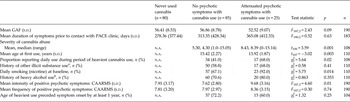
In an effort to identify factors which may account for the relationship between transition risk and history of cannabis-induced APS we conducted a series of exploratory post-hoc analyses comparing the following three groups: individuals with a history of cannabis-induced APS; individuals with a history of cannabis use but no associated psychotic symptoms; individuals who have never used cannabis. As illustrated in Table 3, individuals with a history of cannabis-induced APS reported greater intensity of positive psychotic symptoms at treatment entry (derived from baseline CAARMS assessment) relative to individuals who used cannabis without associated psychotic symptoms (p = 0.009) as well as those with no history of cannabis use (p = 0.03). They also had a younger age of first use, were more likely to report daily cannabis use during their period of heaviest use, more likely to report daily nicotine use at baseline and scored higher on severity of cannabis abuse. Importantly, history of cannabis-induced APS remained a significant predictor of transition after controlling for severity of cannabis abuse, age of first cannabis use, daily nicotine use and intensity of positive symptoms (adjusted HR = 3.75, 95% CI 1.14–12.38, p = 0.03). Additionally, the period during which cannabis-induced APS were reported preceded symptom onset (i.e. those symptoms not acutely related to cannabis use) by at least 1 year in 60% of individuals. This further illustrates that positive symptom intensity at treatment onset cannot account for the relationship between transition risk and a history of cannabis-induced APS.
Sample characteristics as a function of history of attenuated psychotic symptoms while using cannabis

GAF, Global Assessment of Functioning; s.d., standard deviation; PACE, Personal Assessment and Crisis Evaluation; n.a., not applicable; CAARMS, Comprehensive Assessment of At-Risk Mental States.
a Includes: opioids, sedatives, stimulants, hallucinogens, volatile substances.
b Defined as more than two standard drinks per day on average or more than five standard drinks in a single session on average during the heaviest period of alcohol use.
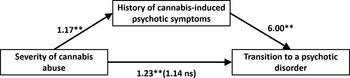
Finally, Fig. 2 summarizes results of a post-hoc mediation analysis (Lange et al. Reference Lange, Vansteelandt and Bekaert2012; Rochon et al. Reference Rochon, du Bois and Lange2014) testing history of cannabis-induced APS as a mediator of the relationship between severity of cannabis abuse and transition risk. As illustrated, having a history of cannabis-induced APS fully mediates the relationship between severity of cannabis abuse and transition risk. Here, the total effect of severity of cannabis abuse on transition to a psychotic disorder is decomposed into a non-significant direct effect of severity of cannabis abuse (HR = 1.14, 95% CI 0.84–1.26), and a significant indirect effect mediated by history of cannabis-induced APS (HR = 1.06, 95% CI 1.01–1.22). This indirect, mediated effect accounted for 33% of the total effect of severity of cannabis abuse on transition risk.
Mediation model illustrating history of cannabis-induced attenuated psychotic symptoms (APS) as a mediator of the relationship between severity of cannabis abuse and transition to a psychotic disorder (n = 109). Note: Paths predicting transition to a psychotic disorder were tested with the Cox regression model. Values indicate hazard ratios (HR) for these predictors. The path from severity of cannabis abuse to history of cannabis-induced APS was tested as a binary logistic regression model with the value indicating the HR. All models included age at baseline, treatment group, history of other illicit substance use, daily nicotine smoking and history of heavy alcohol use as covariates. ns, Not significant; ** p < 0.01.

Discussion
A history of cannabis-induced APS in UHR individuals dramatically increases the risk of transitioning to a psychotic disorder. In the present study, 40% of individuals with a history of cannabis-induced APS developed a psychotic disorder at follow-up, in contrast to 9.5% of individuals with a history of cannabis use without cannabis-induced APS and 12.5% of individuals who had never used cannabis. These findings suggest that cannabis use interacts with some third unknown factor or set of factors among a subpopulation of UHR individuals to elevate transition risk, and that this risk phenotype manifests in cannabis-induced APS. Alternatively, cannabis use could simply unmask a transition risk phenotype that would manifest with or without cannabis use.
While this latter explanation cannot be ruled out, there is growing evidence that risk posed by cannabis use may arise from an interaction with underlying genetic vulnerability factors. Several studies have demonstrated that cannabis use interacts with genes that alter dopaminergic neurotransmission to elevate risk for psychosis (Caspi et al. Reference Caspi, Moffitt, Cannon, McClay, Murray, Harrington, Taylor, Arseneault, Williams, Braithwaite, Poulton and Craig2005; Di Forti et al. Reference Di Forti, Iyegbe, Sallis, Kolliakou, Falcone, Paparelli, Sirianni, La Cascia, Stilo, Marques, Handley, Mondelli, Dazzan, Pariante, David, Morgan, Powell and Murray2012; Colizzi et al. Reference Colizzi, Iyegbe, Powell, Ursini, Porcelli, Bonvino, Taurisano, Romano, Masellis, Blasi, Morgan, Aitchison, Mondelli, Luzi, Kolliakou, David, Murray, Bertolino and Di Forti2015). In particular, carriers of alleles that increase striatal dopamine release and/or reduce prefrontal dopaminergic function are at 2–11 times greater risk of developing a psychotic disorder than non-carriers (Caspi et al. Reference Caspi, Moffitt, Cannon, McClay, Murray, Harrington, Taylor, Arseneault, Williams, Braithwaite, Poulton and Craig2005; Di Forti et al. 2012; Colizzi et al. Reference Colizzi, Iyegbe, Powell, Ursini, Porcelli, Bonvino, Taurisano, Romano, Masellis, Blasi, Morgan, Aitchison, Mondelli, Luzi, Kolliakou, David, Murray, Bertolino and Di Forti2015). ∆−9-Tetrahydrocannabinol (∆9-THC), the active component of cannabis, also acts to increase phasic dopamine firing at the striatum and reduce prefrontal dopaminergic function, which may, in turn, further enhance striatal dopaminergic transmission (Kuepper et al. Reference Kuepper, Morrison, van Os, Murray, Kenis and Henquet2010). Enhanced phasic dopamine firing at the striatum is also implicated in the salience model of psychosis (Kapur et al. Reference Kapur, Mizrahi and Li2005). This model proposes that psychosis, in particular positive psychotic symptoms, may arise from aberrant attribution of salience to otherwise non-salient events and stimuli due to excessive phasic dopamine firing (Kapur et al. Reference Kapur, Mizrahi and Li2005). In the present study, a history of cannabis-induced APS was associated with more intense positive psychotic symptoms at treatment entry, an observation consistent with this dopamine-driven salience attribution model.
The above evidence raises an interesting and important question for future research. Specifically, do cannabis-induced APS, and in turn, elevated transition risk, arise from the intersection of ∆9-THC and genetic factors on striatal dopaminergic function, possibly producing a state of striatal hyperdopaminergia (Kuepper et al. Reference Kuepper, Morrison, van Os, Murray, Kenis and Henquet2010)? Although there is evidence of elevated pre-synaptic striatal dopamine function among individuals at UHR for psychosis (Howes et al. Reference Howes, Bose, Turkheimer, Valli, Egerton, Valmaggia, Murray and McGuire2011; Egerton et al. Reference Egerton, Chaddock, Winton-Brown, Bloomfield, Bhattacharyya, Allen, McGuire and Howes2013), no studies have directly linked this to cannabis use or an interaction between cannabis use and underlying genetic factors. Recently, a study examining pre-synaptic dopamine functioning in non-psychotic cannabis users with a history of cannabis-induced APS found reduced striatal dopamine function relative to a group of non-users (Bloomfield et al. Reference Bloomfield, Morgan, Egerton, Kapur, Curran and Howes2014). However, this study did not include a comparison group of users without a history of cannabis-induced APS, suggesting that any differences in striatal function may have been due to chronic cannabis use (van Hell et al. Reference van Hell, Vink, Ossewaarde, Jager, Kahn and Ramsey2010) rather than the presence of cannabis-induced APS per se. In short, future research is needed to identify the mechanism(s) underlying cannabis-induced APS in UHR individuals and the possible link to genetic factors which modulate dopamine functioning.
Individuals in our study who reported cannabis-induced APS also evidenced heavier and more problematic cannabis use. Given that these individuals were also at greater risk of transitioning to a psychotic disorder, our findings are partially consistent with previous studies linking heavier use and more potent doses of cannabis to higher transition rates among those at UHR for psychosis (Valmaggia et al. Reference Valmaggia, Day, Jones, Bissoli, Pugh, Hall, Bhattacharyya, Howes, Stone, Fusar-Poli, Byrne and McGuire2014) and an earlier age of psychosis onset among individuals who do transition (Decoster et al. Reference Decoster, Van Os, Kenis, Henquet, Peuskens, De Hert and Van Winkel2011; Di Forti et al. 2014). Importantly, the relationship between cannabis-induced APS and transition risk could not be accounted for by differences in severity of cannabis abuse. Instead, we found the reverse: history of cannabis-induced APS fully mediated the relationship between severity of cannabis abuse and transition risk. In other words, severity of cannabis abuse only confers risk for transition to a psychotic disorder because of enhanced cannabis abuse severity among individuals with a history of cannabis-induced APS. These findings could indicate that heavier and more problematic cannabis use increases the risk of experiencing cannabis-induced APS which in turn elevates transition risk. However, they could also simply reflect a tendency for individuals who experience cannabis-induced APS to engage in heavier and more problematic cannabis use. Indeed, recent evidence points to the possibility of shared genetic vulnerability predisposing to both cannabis use and psychosis (Power et al. Reference Power, Verweij, Zuhair, Montgomery, Henders, Heath, Madden, Medland, Wray and Martin2014).
Individuals with a history of cannabis-induced APS also reported a younger age of first use than individuals with a history of cannabis use but no associated psychotic symptoms. Indeed, 88% of individuals with a history of cannabis-induced APS had an age of first use of 15 years or under, compared with 56% of individuals without a history of cannabis-induced APS. This finding accords with evidence that adolescence may be a particularly high-risk period for a gene × cannabis use interaction (Caspi et al. Reference Caspi, Moffitt, Cannon, McClay, Murray, Harrington, Taylor, Arseneault, Williams, Braithwaite, Poulton and Craig2005). Caspi et al. (Reference Caspi, Moffitt, Cannon, McClay, Murray, Harrington, Taylor, Arseneault, Williams, Braithwaite, Poulton and Craig2005) found that adolescent- but not adult-onset cannabis use interacted with a genetic risk allele associated with reduced prefrontal dopaminergic function and indirectly enhanced mesolimbic dopamine function to substantially elevate risk for psychosis.
Finally, although nicotine was not a focus of the present study, it is notable that we found no association between daily nicotine use and transition to a psychotic disorder. This contrasts with recent meta-analytic findings showing a significant positive association between nicotine use and psychosis risk (Gurillo et al. Reference Gurillo, Jauhar, Murray and MacCabe2015). We did find that individuals with a history of cannabis-induced APS were more likely to be daily smokers at baseline, but their smoking history did not account for their increased transition risk.
Limitations
Some limitations of the present study should be noted. First, a recent study comparing self-reported drug use in UHR individuals with urine drug screens revealed both over- and under-reporting of cannabis use (Carol & Mittal, Reference Carol and Mittal2014). This raises concern regarding the validity of self-reported cannabis use in the present study, especially where individuals were recalling patterns and characteristics of use from several years prior. However, it should be noted that an earlier study in a population of individuals with co-morbid cannabis use disorder and psychosis found self-reported cannabis use to be highly reliable when validated against biological measures of cannabis use (Hjorthøj et al. Reference Hjorthøj, Hjorthøj and Nordentoft2012). Second, we did not assess potency of cannabis used or number of years using cannabis. Our assessment of cannabis use exposure was limited to the frequency of use during the period of heaviest use. It is therefore possible that we failed to capture important variance in exposure to cannabis which may be independently linked to transition risk (Valmaggia et al. Reference Valmaggia, Day, Jones, Bissoli, Pugh, Hall, Bhattacharyya, Howes, Stone, Fusar-Poli, Byrne and McGuire2014). Third, we note that many a priori and post-hoc group comparisons were conducted without correction for multiple comparisons (i.e. Tables 1 and 3). While we acknowledge that this approach inflates the possibility of a type 1 error, our purpose in conducting these unadjusted comparisons was to identify and control for confounding factors which may account for our key findings (i.e. Table 2), and control for these where necessary.
Finally, we have argued that in a subsample of individuals, cannabis use may either lead to, or unmask, risk for psychosis. However, it is important to consider the possibility that cannabis-induced APS are simply a correlate of underlying symptoms which drive cannabis use and ultimately transition risk. Although we cannot completely rule out this possibility, we have shown that in roughly 60% of individuals who report cannabis-induced APS, the period during which these cannabis-induced APS occurred preceded the onset of symptoms that ultimately led to engagement with clinical services (i.e. symptoms that occur independent of cannabis use) by at least 1 year. We also show that the relationship between cannabis-induced APS and transition risk remains significant after controlling for the intensity of positive psychotic symptoms at treatment entry. Together these findings support the direction of relationship reported here, that cannabis use leads to, or unmasks transition risk, rather than transition risk manifesting in early symptoms that drive cannabis use.
Conclusions
The present findings reveal important insight into the risk posed by cannabis use for individuals at UHR for psychosis. Our findings suggest that cannabis use only poses risk for a subgroup of UHR individuals who also manifest cannabis-induced APS. This pattern resembles previous evidence that psychosis risk is elevated only in cannabis users who also carry genetic alleles that enhance (either directly or indirectly) striatal dopaminergic function (Caspi et al. Reference Caspi, Moffitt, Cannon, McClay, Murray, Harrington, Taylor, Arseneault, Williams, Braithwaite, Poulton and Craig2005; Di Forti et al. Reference Di Forti, Iyegbe, Sallis, Kolliakou, Falcone, Paparelli, Sirianni, La Cascia, Stilo, Marques, Handley, Mondelli, Dazzan, Pariante, David, Morgan, Powell and Murray2012; Colizzi et al. Reference Colizzi, Iyegbe, Powell, Ursini, Porcelli, Bonvino, Taurisano, Romano, Masellis, Blasi, Morgan, Aitchison, Mondelli, Luzi, Kolliakou, David, Murray, Bertolino and Di Forti2015). Future studies are needed to determine whether the presence of cannabis-induced APS reflects the same or similar underlying genetic vulnerability. Such research could have two significant implications. First, it could provide a means of screening for UHR individuals for whom cannabis use poses the greatest risk prior to cannabis exposure. Second, for UHR individuals with a history of cannabis use, screening for a history of cannabis-induced APS may provide a simple proxy measure of underlying genetic vulnerability and, in turn, an important prognostic tool.
The present findings raise several additional directions for future research. First, we show some evidence that severity of cannabis abuse and earlier age of use onset may increase the likelihood of experiencing cannabis-induced APS. Whether these are true effects, rather than simply a propensity of a vulnerable subgroup to engage in earlier, heavier and more problematic use, needs to be established. Additionally, it will be important to determine whether risk posed by an earlier age of use onset and severity of abuse remain contingent on a third unknown (possibly genetic) factor. Future studies should also establish whether a history of cannabis-induced APS presents risk for individuals not otherwise deemed at UHR for psychosis. Finally, research and clinical services for UHR populations should take care to consider cannabis-induced APS as a marker of risk, rather than a confound to assessing clinically significant APS.
Supplementary material
The supplementary material for this article can be found at https://doi.org/10.1017/ S0033291716002671
Acknowledgements
This work was supported by the Colonial Foundation Philanthropic Trust and by National Health and Medical Research Council (NHMRC) Program grants (no. 566529 and no. 350241). A.L. is funded by an NHMRC Early Career Fellowship (no. 1072593).
The authors would especially like to thank the participants of all the studies and the researchers involved in the original research.
Declaration of Interest
None.