Introduction
Obtaining vital signs is a critical step in the prehospital assessment of trauma patients.Reference Sasser, Hunt and Faul1 The American College of Surgeons (ACS; Chicago, Illinois USA) Committee on Trauma (COT) has delineated a set of trauma team activation (TTA) criteria that are intended to identify the sickest trauma patients in the prehospital setting to allow for early mobilization of personnel and resources. Several of the ACS-COT criteria for field triage to trauma centers and TTA are based on prehospital vital signs, including systolic blood pressure (SBP) less than 90mmHg and Glasgow Coma Scale (GCS) score less than nine.Reference Rotondo, Cribari and Smith2 Furthermore, prehospital vital signs, and measurements based on them such as the shock index, have been shown to correlate with the need for emergent interventions and mortality.Reference Bruijns, Guly, Bouamra, Lecky and Wallis3-Reference Vandromme, Griffin, Kerby, McGwin, Rue and Weinberg8
However, concerns exist over the accuracy of prehospital vital signs due to inherent challenges in obtaining measurements in the field. There is limited evidence assessing the agreement between prehospital and initial emergency department (ED) vital signs, and therefore the ability of prehospital vitals to accurately predict vitals on arrival to the ED is not well understood.
The purpose of this study was to evaluate the agreement between prehospital and first ED vital signs among trauma patients meeting criteria for highest level TTA on a large scale in order to determine if field vitals accurately predict vital signs upon arrival to the ED. The hypothesis was that in this trauma center where transport times are short, these sets of vital sign measurements would demonstrate a strong correlation.
Methods
This is a retrospective, registry-based, observational study of all trauma patients presenting to an urban, Level I trauma center from 2008 to 2018. Patients were included if they triggered highest levels of TTA.Reference Rotondo, Cribari and Smith2 In addition to the standard ACS-COT TTA criteria, at Los Angeles County University of Southern California (LAC+USC; Los Angeles, California USA) Medical Center, the trauma team is also activated for patients aged older than 70 years with a traumatic mechanism of injury on the basis of literature demonstrating poor outcomes after trauma among the elderly.Reference R Benjamin, Khor, Cho, Biswas, Inaba and Demetriades9,Reference Demetriades, Karaiskakis and Velmahos10 Patients were also included if TTA was triggered in the ED. Patients were excluded if prehospital or ED vital signs were not recorded, or if prehospital vital signs were absent. The USC Institutional Review Board approved this study (protocol # HS-18-01051).
Data including patient demographics (age and gender), injury data (mechanism and Injury Severity Score [ISS]), transport time, prehospital and first ED vital signs, and outcomes (mortality; hospital and intensive care unit [ICU] length of stay) were abstracted from the trauma registry. Data were systematically recorded into the trauma registry by experienced, unbiased coders, with the same data points extracted from each patient. Because of the retrospective nature of this study, the data collection coders were unaware of the study objectives at the time of data collection. Specific vital signs analyzed were SBP in mmHg; pulse pressure (PP) in mmHg, defined as the difference between systolic and diastolic blood pressure; heart rate (HR) in beats per minute; respiratory rate (RR); and GCS score.
Descriptive statistics were used to delineate patient demographics, injury data, clinical data, and outcomes. Continuous variables are presented as mean (standard deviation); median (range) and categorical variables are presented as number (percentage). Univariate analysis was performed for paired prehospital and first ED vital signs using the Student’s paired t-test using SPSS software (IBM SPSS Statistics for Macintosh, Version 25.0; Armonk, New York USA).
Values for prehospital and first ED vital signs were then compared using Bland-Altman analysis using R Statistical Software (R Foundation for Statistical Computing, Version 3.5.1; Vienna, Austria). Intraclass correlation coefficients (ICC) were calculated to determine level of agreement between the two values, with values of >0.6 indicating good agreement, 0.4-0.6 indicating fair agreement, and <0.4 indicating poor agreement.
Results
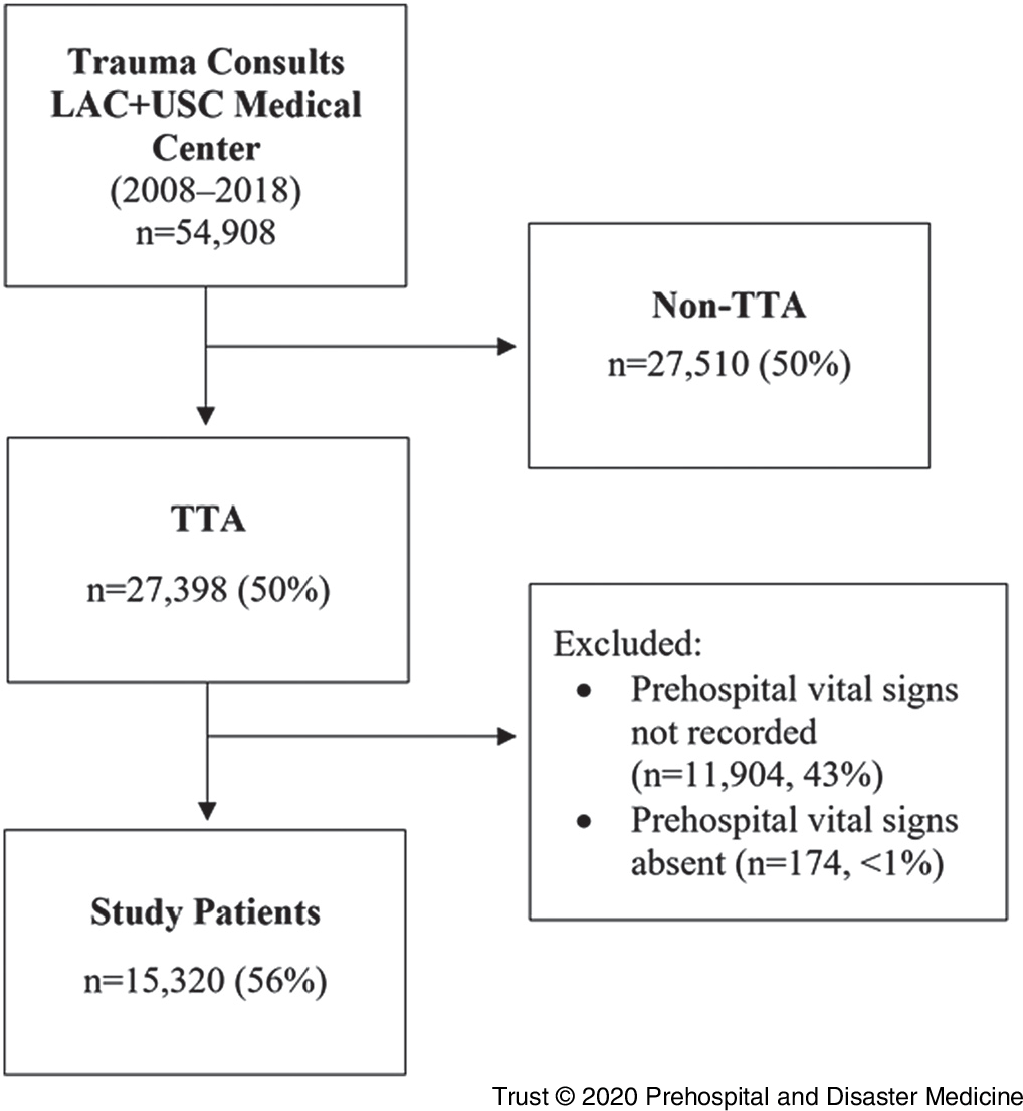
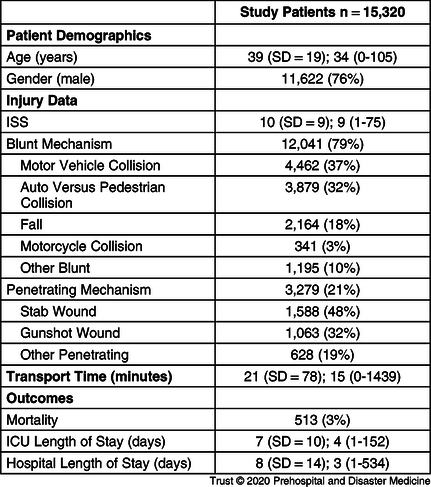
After exclusions, a total of 15,320 patients were included in the analysis (Figure 1). Because of the number of excluded patients, patient demographics were compared between study patients and excluded patients. No clinically significant differences existed. The mean age of study patients was 39 (range 0-105) years old and 76% (n = 11,622) were male (Table 1). Mean ISS was 10 (range 1-75) and 79% (n = 12,041) of patients suffered from a blunt mechanism, most commonly motor vehicle collisions (n = 4,462; 37%) and auto versus pedestrian collisions (n = 3,879; 32%). Mean transport time was 21 (range 0-1,439) minutes. Overall mortality was three percent (n = 513) and mean ICU and hospital length of stay were seven (range 1-152) and eight (range 1-534) days, respectively.
Flow of Patients Through Study.

Patient Demographics, Injury Data, Transport Time, and Outcomes

Note: Categorical variables expressed as n (%), and continuous variables expressed as mean (SD); median (range).
Abbreviations: ICU, intensive care unit; ISS, Injury Severity Score.
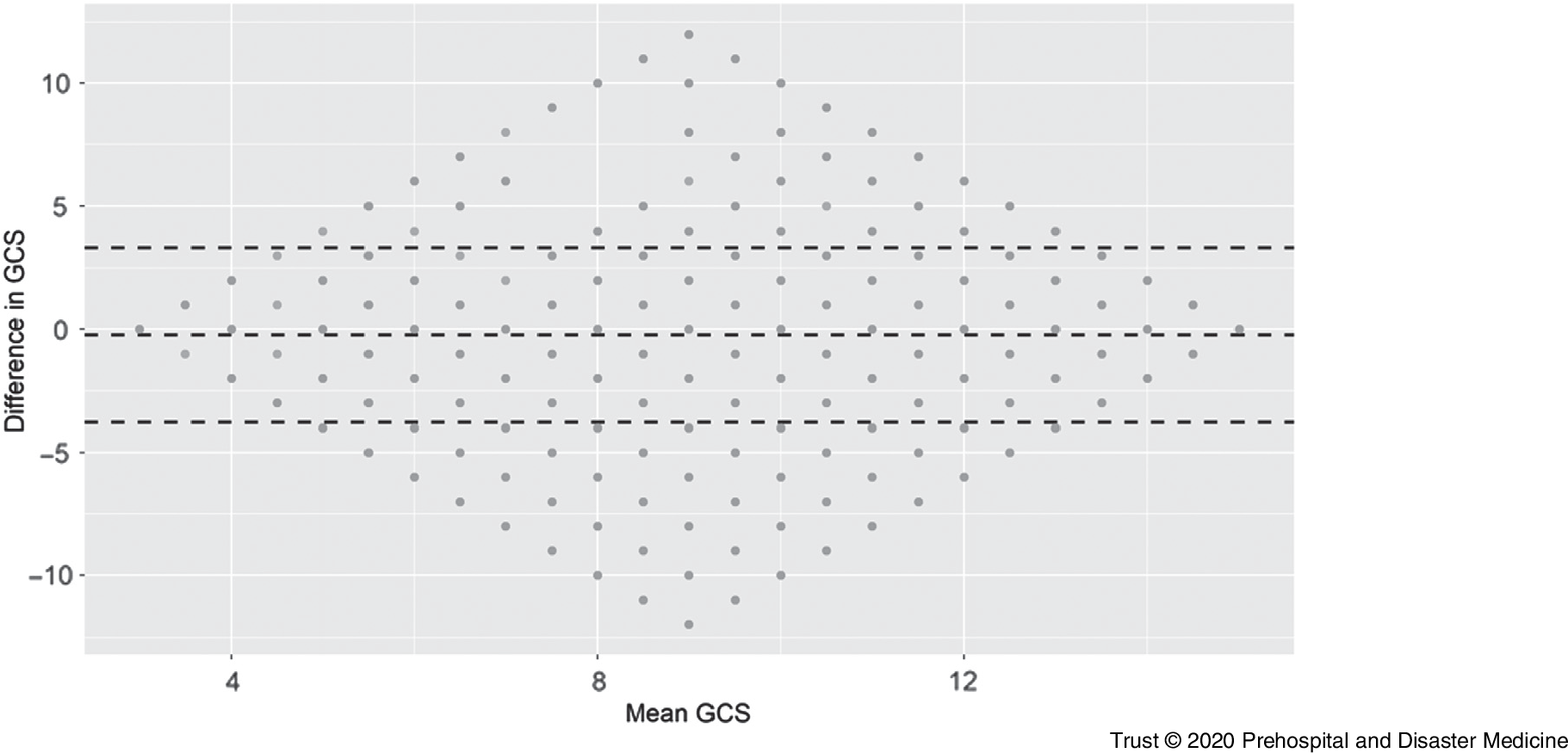
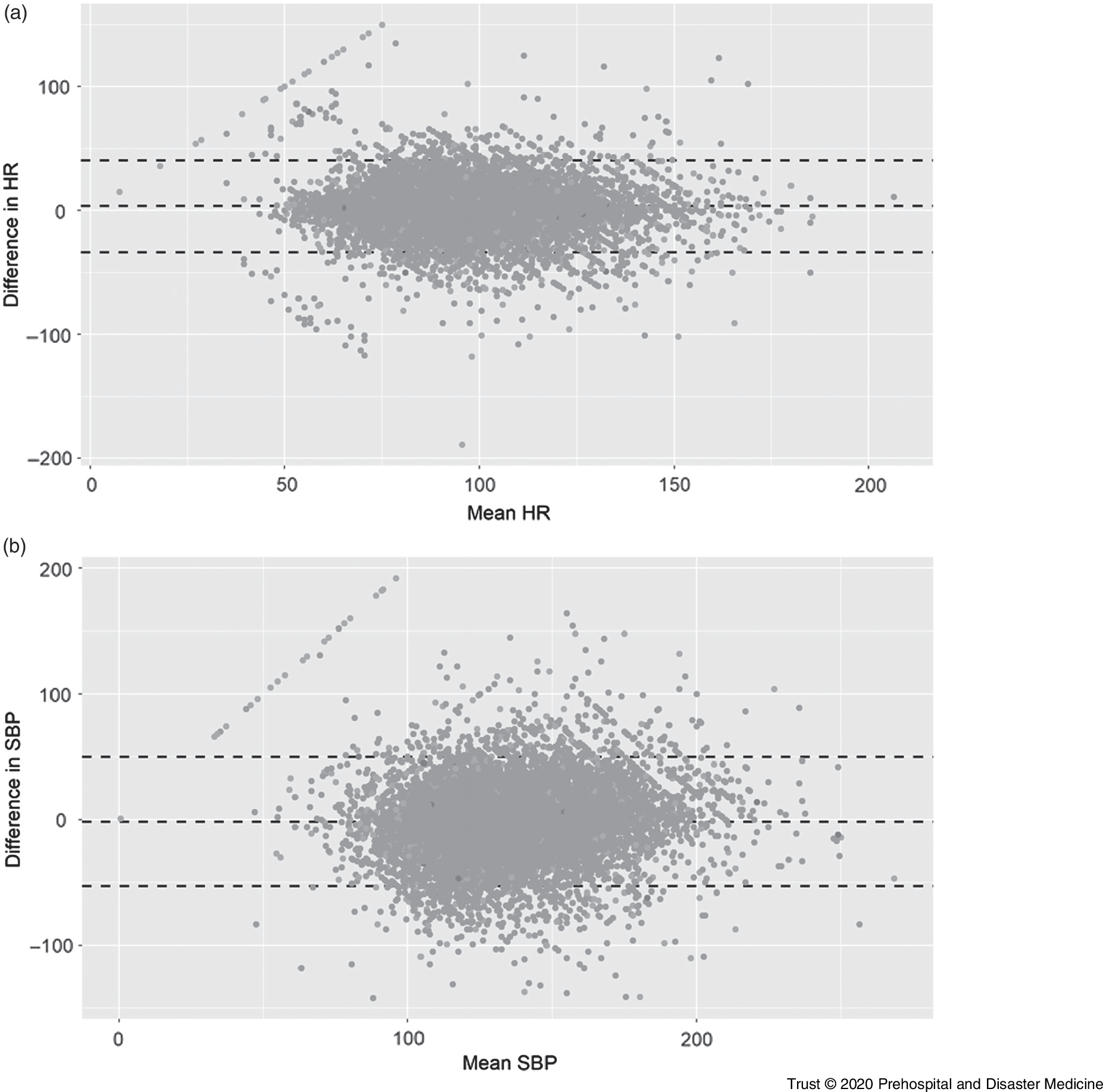
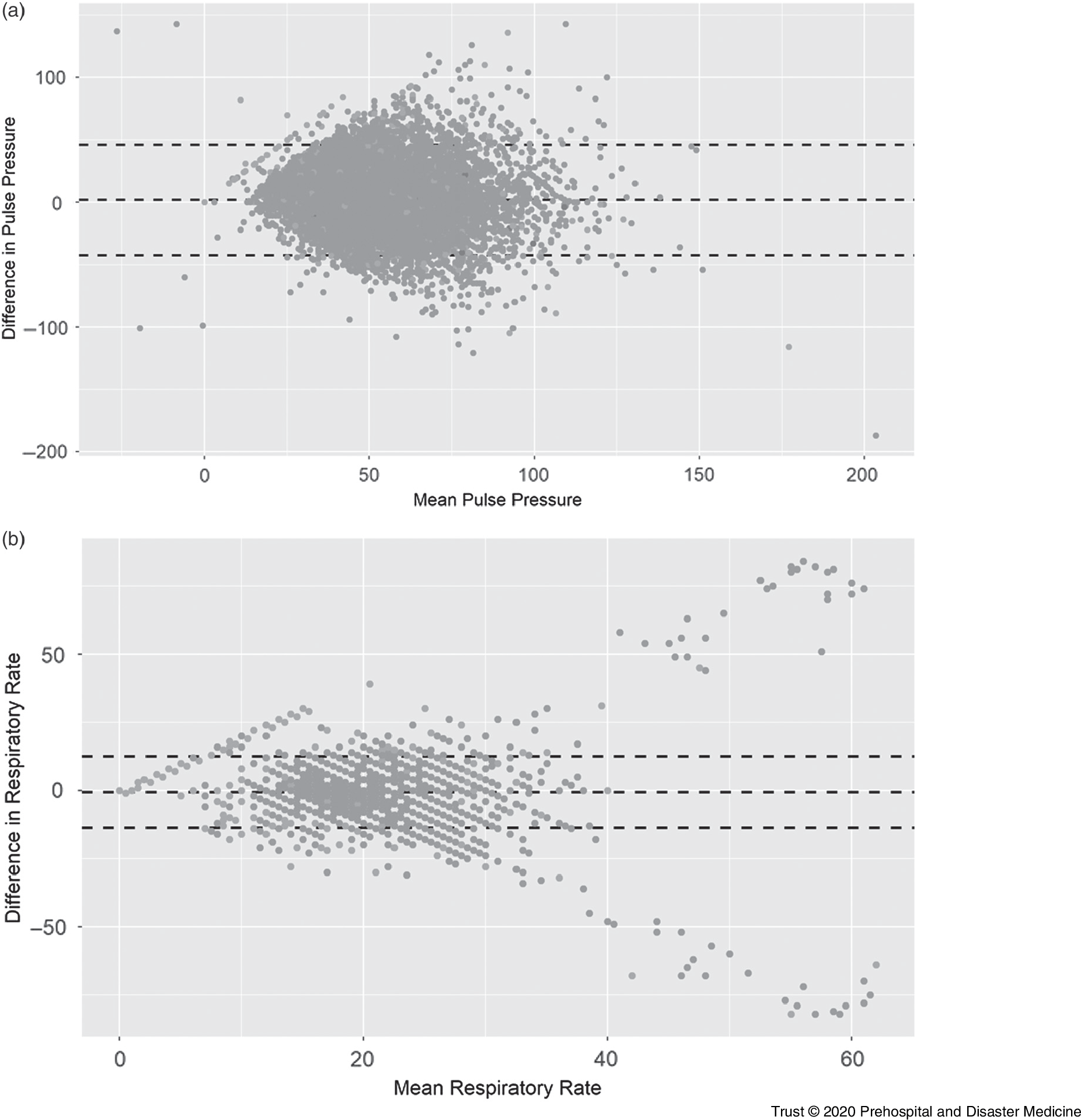
Mean changes and univariate analysis of paired prehospital and first ED vital signs are listed in Table 2. The ICCs on Bland-Altman analysis showed good agreement for GCS (ICC 0.79; 95% CI, 0.77-0.79). Fair agreement was demonstrated for HR (ICC 0.59; 95% CI, 0.56-0.61) and SBP (ICC 0.48; 95% CI, 0.46-0.49). Poor agreement was shown for PP (ICC 0.32; 95% CI, 0.30-0.33) and RR (ICC 0.13; 95% CI, 0.11-0.15. Bland Altman plots are shown in Figure 2, Figure 3, and Figure 4.
Prehospital versus Initial ED Vital Signs

Note: Vital signs are presented as mean (standard deviation); median (range). Prehospital vital signs were compared to first ED vital signs using the paired Student’s t-test; ICC was calculated from Bland Altman analysis.
Abbreviations: GCS, Glasgow Coma Scale score; HR, heart rate in beats per minute; ICC, intraclass correlation coefficient; PP, pulse pressure in mmHg; RR, respiratory rate in breaths per minute; SBP, systolic blood pressure in mmHg.
Bland Altman Plot for GCS; ICC 0.79 (95% CI, 0.77-0.79) indicating good correlation.

Bland Altman Plots for (A) HR (ICC 0.59; 95% CI, 0.56-0.61) and (B) SBP (ICC 0.48; 95% CI, 0.46-0.49) indicating fair correlation.

Bland Altman Plots for (A) PP (ICC 0.32; 95% CI, 0.3-0.33) and (B) RR (ICC 0.13; 95% CI, 0.11-0.15) indicating poor correlation.

Discussion
Prehospital vital signs are a critical component of trauma patient triage, and an integral part of the decision to trigger trauma team activation from the field.Reference Sasser, Hunt and Faul1,Reference Rotondo, Cribari and Smith2 The current literature demonstrates the importance of prehospital vital signs and their ability to predict outcomes after trauma, including the need for massive transfusion, emergent intervention, longer ICU length of stay, and mortality.Reference Chen, Reisner, Gribok and Reifman4-Reference Vandromme, Griffin, Kerby, McGwin, Rue and Weinberg8,Reference Lalezarzadeh, Wisniewski, Huynh, Loza and Gnanadev11,Reference Franklin, Boaz, Spain, Lukan, Carrillo and Richardson12 However, obtaining accurate prehospital vital signs can be challenging, and concerns exist regarding their ability to predict ED vital sign measurements.
Previously, Arbabi, et al showed that field and ED GCS were not significantly different; however, SBP was, as only 60% of their patients remained in the same pre-defined blood pressure categories from the prehospital to ED setting.Reference Arbabi, Jurkovich and Wahl13 When evaluating temporal trends in prehospital vital signs among higher acuity patients, Chen, et al found considerable, non-directional variability, especially in the SBP, RR, and shock index.Reference Chen, Reisner, Gribok and Reifman4 These authors speculated that this variability was likely due to both measurement errors and true physiologic changes. Next, Dinh, et al sought to evaluate the level of agreement between prehospital and ED vital signs.Reference Dinh, Oliver and Bein14 They showed that GCS and HR correlated well, although RR and SBP did not. The current study endeavored to define the level of agreement between prehospital and first ED vital signs on a larger scale.
All trauma patients meeting highest levels of TTA in the urban, Level I trauma center over an eleven-year period were evaluated. The study analyzed 15,320 patients, among whom the average transport time was 21 minutes. Between the field and the ED, the parameter demonstrating the highest level of agreement was GCS. Prehospital and ED SBP and HR correlated well. Prehospital PP and RR were poorly predictive of ED measurements.
Limitations
The study limitations must be acknowledged. First, the study is inherently limited by its retrospective single-center design. Next, a large number of patients were excluded due to missing data and therefore the data may not be generalizable to the trauma population as a whole. Finally, the relatively short transport times are likely to contribute significantly to the observed vital sign agreement. It is unclear if these results can be applied to centers with larger catchment areas or longer transport times.
Conclusion
Despite the inherent challenges with prehospital assessments, GCS, SBP, and HR correlate well with initial ED vital signs among trauma patients who meet criteria for highest levels of activation. Pulse pressure and RR, on the other hand, are less reliable. The short transport time suggests that these prehospital vital signs accurately predict ED vital signs in urban settings with rapid transport times. Caution should be used in the extrapolation of these results to trauma systems with longer prehospital times. Future studies should be encouraged to evaluate vital sign agreement between the field and ED in a variety of trauma practice settings.
Conflicts of interest
none
Author Contributions
MDT, MS, and KI provided the study concept. MDT, MS, BEL, VC, and ZW performed the data collection. MDT, MS, SB, and KI performed the data analysis. MDT, MS, SB, KI, and DD performed the data interpretation. All authors participated in writing and critically reviewing the final manuscript.