Introduction
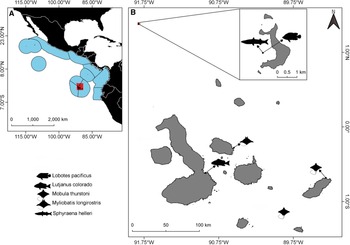
The Tropical Eastern Pacific (TEP) marine ecoregion stretches from southern Baja California to northern Peru (Figure 1A). The TEP is further divided into three marine provinces: the Cortez and Panamic provinces located along the coast of the Americas, and the Ocean Island province, which includes several oceanic island groups, one of which is the Galapagos archipelago (Spalding et al., Reference Spalding, Fox, Allen, Davidson, Ferdaña, Finlayson, Halpern, Jorge, Lombana, Lourie, Martin, McManus, Molnar, Recchia and Robertson2007; Robertson & Cramer, Reference Robertson and Cramer2009). Unique shore fish communities and oceanic conditions characterize each of these provinces, with the Galapagos archipelago showing the highest rate of endemism for shore fishes (Robertson & Cramer, Reference Robertson and Cramer2009).
Location of the new fish records for the Galapagos Islands. (A) Position of the Galapagos Islands within the TEP, where the red square shows the extent of (B). Blue polygons show the limits of the EEZ that comprise the TEP. (B) Location of new records within the Galapagos. Inset shows new record locations at Wolf Island.

The Galapagos Marine Reserve (GMR) encompasses ~138,000 km2 and lies at the confluence of three major ocean currents (Heylings et al., Reference Heylings, Bensted-Smith, Altamirano, Danulat and Edgar2002), namely the Cromwell, Humboldt and Panama currents. Warm water is brought from the north-east by the Panama Current, which contributes larvae as well as some juvenile and adult fishes coming from the Panamic province, which is why a high percentage (44.8%) of the species that make up the fish assemblage in the GMR is shared with the Panamic region (McCosker & Rosenblatt, Reference McCosker and Rosenblatt2010). Both the Humboldt and Cromwell currents bring cold, nutrient-rich waters and carry species from the south and west, respectively (McCosker & Rosenblatt, Reference McCosker and Rosenblatt2010). Their confluence promotes high habitat diversity, and therefore high diversity in fish communities (Banks, Reference Banks, Danulat and Edgar2002), which in turn leads to high rates of endemism (13.6%; 4). To date, a total of 536 shore fishes have been reported for the Galapagos Islands (McCosker & Rosenblatt, Reference McCosker and Rosenblatt2010).
Due to the changing nature of these confluent oceanic currents, species introductions through direct migration, passive or active larval dispersal through drifting or swimming, as well as association with flotsam are frequent (Acuña-Marrero & Salinas-de-León, Reference Acuña-Marrero and Salinas-de-León2013). Previous studies have described new vagrant species in the Galapagos originating in the Indo-Pacific (Robertson et al., Reference Robertson, Grove and McCosker2004; Acuña-Marrero & Salinas-de-León, Reference Acuña-Marrero and Salinas-de-León2013), whose migration may have been triggered by warm El Niño Southern Oscillation (ENSO) events (Robertson et al., Reference Robertson, Grove and McCosker2004; Glynn et al., Reference Glynn, Mones, Podestá, Colbert and Colgan2017). Other studies describe possible range extensions after such events, due to increases in warm water flows from the north-east, which can facilitate fish migrations (Victor et al., Reference Victor, Wellington, Robertson and Ruttenberg2001; Banks, Reference Banks, Danulat and Edgar2002) further aided by oceanic islands such as Malpelo and Cocos, that ‘could act as stepping stones from the Panamic region’ Glynn et al., Reference Glynn, Mones, Podestá, Colbert and Colgan2017. Therefore, changes in oceanic conditions are likely to trigger or prolong fish migrations.
Data about fish community composition and distribution patterns can serve as a point of comparison to understand the effects of changing environmental factors (i.e. extreme climatic events such as ENSO) and anthropogenic impacts (i.e. climate change) on fish communities. The Galapagos is a unique ecosystem whose protection measures are adaptive, so a thorough understanding of its species composition can ultimately provide valuable information for conservation management, especially regarding its dynamic marine ecosystem. To contribute towards an increased understanding of the fish community composition of the Galapagos, we present five new records of fishes for the Galapagos Islands. These are based on underwater imagery obtained as part of large-scale ecological studies conducted by the Charles Darwin Research Station (Salinas de León et al., Reference Salinas de León, Acuña-Marrero, Rastoin, Friedlander, Donovan and Sala2016; Acuña-Marrero et al., Reference Acuña-Marrero, Smith, Salinas-de-León, Harvey, Pawley and Anderson2018; Tanner et al., Reference Tanner, Moity, Costa, Jarrin, Aburto-Oropeza and Salinas-de-León2019) and opportunistic sightings by naturalist guides and researchers.
Materials and methods
The new fish records for the GMR were obtained through several methods. One of them is from the analysis of videos obtained from archipelago-wide surveys of rocky reefs and mangrove habitats using stereo-video systems (Salinas de León et al., Reference Salinas de León, Acuña-Marrero, Rastoin, Friedlander, Donovan and Sala2016; Acuña-Marrero et al., Reference Acuña-Marrero, Smith, Salinas-de-León, Harvey, Pawley and Anderson2018). Stereo-video surveys represent a unique opportunity to identify, catalogue and measure fish individuals since the videos can be replayed for identification purposes (Santana-Garcon et al., Reference Santana-Garcon, Braccini, Langlois, Newman, McAuley and Harvey2014; Salinas-de-León et al., Reference Salinas-de-León, Rastoin and Acuña-Marrero2015; Rastoin-Laplane et al., Reference Rastoin-Laplane, Goetze, Harvey, Acuña-Marrero, Fernique and Salinas-de-León2020), and not only date, time and exact location of the deployment are recorded, but also the exact number and size of specimens can be accurately measured (Cappo et al., Reference Cappo, Harvey, Malcolm, Speare, Beumer and Grant1999). Footage from stereo-Baited Remote Underwater Video Systems (s-BRUVS) and stereo-Diver Operated Video Surveys (stereo-DOVS), as well as data obtained through Underwater Visual Censuses (UVC) were analysed and account for three of the records. Additionally, two other records were obtained due to opportunistic sightings while conducting scientific dives. Trained fish biologists analysed video and photographic evidence and gave tentative identifications. Fish identification and marine biology experts, namely Dr Ross Robertson (Smithsonian Institution), Dr Alan Friedlander (University of Hawaii), Dr Guy Stevens (The Manta Trust), Dr Daniel Fernando (Linnaeus University) and Dr Dave Ebert (American Elasmobranch Society), later confirmed these identifications.
To determine whether a new record should be classified as vagrant or resident in the Galapagos, we followed the guidelines set in Robertson et al. (Reference Robertson, Grove and McCosker2004). A vagrant species is defined as one that does not have a self-replenishing population because either a few individuals of the same size appear once at a single site, or a few isolated individuals have been reported at a few sites and/or on a limited number of occasions. A resident species is defined as probably having a self-sustaining population, as they are relatively common at at least one site and have been frequently sighted over the span of many years, and whose population includes juveniles and adults of different sizes.
Results
We present new records of two elasmobranchs and three teleosts for the Galapagos Islands (Figure 1B). These are presented by phylogenetic order, listing Elasmobranchii as represented by the families Myliobatidae and Mobulidae (Naylor et al., Reference Naylor, Caira, Jensen, Rosana, Straube and Lakner2012), followed by Teloeostomi with the families Sphyraenidae, Lutjanidae and Lobotidae (Betancur-R et al., Reference Betancur-R, Wiley, Arratia and Ortí2017).
Order MYLIOBATIFORMES
Suborder MYLIOBATIDOIDEI
Family MYLIOBATIDAE
Genus Myliobatis Cuvier, 1816
Myliobatis longirostris Applegate & Fitch, 1964
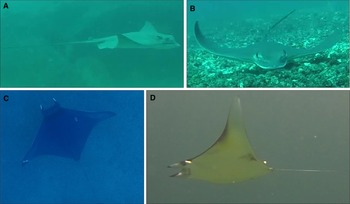
Two individuals of ~135 cm total length (TL) of the snouted eagle ray (Myliobatis longirostris) were recorded on s-BRUVS at two sites in 2015, the Banco Ruso seamount in the south-eastern part of the archipelago, and off the north-eastern coast of San Cristobal Island (Figure 1B). Myliobatis longirostris is quite distinct from the only other Myliobatidae reported in the GMR, the Peruvian bat-eagle ray, M. peruvianus (Grove & Lavenberg, Reference Grove and Lavenberg1997). As its name suggests, M. longirostris is mainly distinguishable due to its markedly long and pointed snout (Figure 2A, B) (McEachran & Notarbartolo di Sciara, Reference McEachran and Notarbartolo di Sciara1995b), while M. peruvianus has a flattened and wide head (Pequeño, Reference Pequeño1989). The snouted eagle ray's pectoral fins are pointed and slightly concave towards the tip of the posterior side (Figure 2B). Myliobatis longirostris has a slender tail, which is approximately the size of the disc and presents no tail fin. However, it does have a rounded dorsal fin, after which one or two large spines protrude at the base (Figure 2B) (McEachran & Notarbartolo di Sciara, Reference McEachran and Notarbartolo di Sciara1995b). Further details are seen in the supplementary material provided for this species (Supplementary data 1). Identifications for M. longirostris were confirmed by Dr Robertson. In the TEP, this ray has been reported from Southern Baja California and the Gulf of California down along the continental coast of Ecuador to northern Peru (Chirichigno & Cornejo, Reference Chirichigno and Cornejo2001; Love et al., Reference Love, Mecklenburg and Mecklenburg2005). This species is listed as Near Threatened by the IUCN due to frequent bycatch of artisanal fisheries and trawlers (Smith & Bizzarro, Reference Smith and Bizzarro2006).
(A) Side view of Myliobatis longirostris obtained from s-BRUVS footage at the Banco Ruso seamount in the southeastern part of the archipelago, and (B) frontal view of M. longirostris recorded by s-BRUVS off San Cristobal in 2015. (C) Dorsal view of Mobula thurstoni photographed around Santa Cruz Island in 2015 by a local naturalist guide. (D) Ventral view of a single M. thurstoni, which was part of a school swimming around Bartolome Island on April 2013. Photo taken by David Acuña-Marrero.

Order MYLIOBATIFORMES
Suborder MYLIOBATIDOIDEI
Family MOBULIDAE
Genus Mobula Rafinesque, 1810
Mobula thurstoni (Lloyd, 1908)
A school of ~20 individuals of the smoothtail mobula (Mobula thurstoni) was sighted while conducting a scientific dive at Bartolomé Island in April 2013. Additional images were obtained from local dive guides, which were taken at several locations around Santa Cruz Island in 2015. To date, there are four species of Mobula registered in the GMR: Mobula birostris, Mobula mobular, Mobula munkiana and Mobula tarapacana (Grove & Lavenberg, Reference Grove and Lavenberg1997; McCosker & Rosenblatt, Reference McCosker and Rosenblatt2010). Mobula thurstoni is smaller than M. mobular (McEachran & Séret, Reference McEachran and Séret1990) and M. tarapacana (McEachran & Notarbartolo di Sciara, Reference McEachran and Notarbartolo di Sciara1995a), and presents swept-back tips of its pectoral fins that are folded at the front margins (Figure 2C) (Compagno et al., Reference Compagno, Ebert and Smale1989); these are more prominent than those of M. munkiana (McEachran & Notarbartolo di Sciara, Reference McEachran and Notarbartolo di Sciara1995a). Mobula thurstoni also has notably short head fins paired with a squat head, and a tail ~60% of the length of the disc in adults (Figure 2C, D) (Compagno et al., Reference Compagno, Ebert and Smale1989). The identification was confirmed by experts Dr Stevens and Dr Fernando of the Manta Trust. This species had previously been reported along the continental coast of the eastern Pacific from Costa Rica to Chile (Lezama-Ochoa et al., Reference Lezama-Ochoa, Hall, Román and Vogel2019), and was reported in Clipperton island (Béarez & Séret, Reference Béarez and Séret2009) as well as through fishing vessel data that included the GMR (Lezama-Ochoa et al., Reference Lezama-Ochoa, Hall, Román and Vogel2019). This species was assessed as Endangered globally by the IUCN due to high active fishing pressure and bycatch rates (Marshall et al., Reference Marshall, Barreto, Bigman, Carlson, Fernando, Fordham, Francis, Herman, Jabado, Liu, Pardo, Rigby, Romanov, Smith and Walls2019).
Order CARANGIFORMES
Suborder SCOMBROIDEI
Family SPHYRAENIDAE
Genus Sphyraena Artedi, 1793
Sphyraena stellata Morishita & Motomura, Reference Morishita and Motomura2020
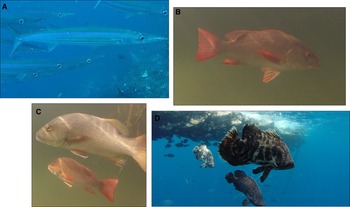
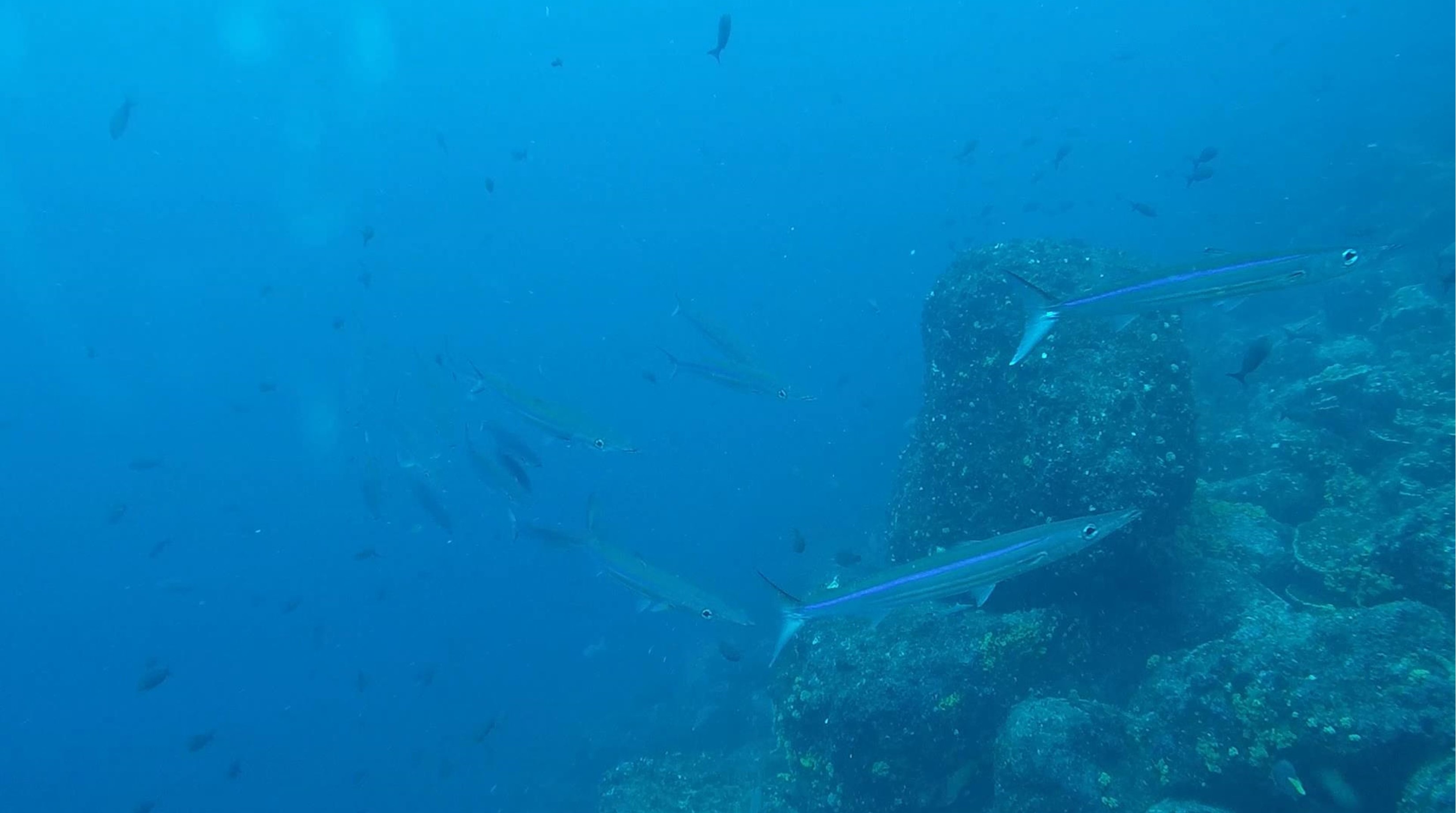
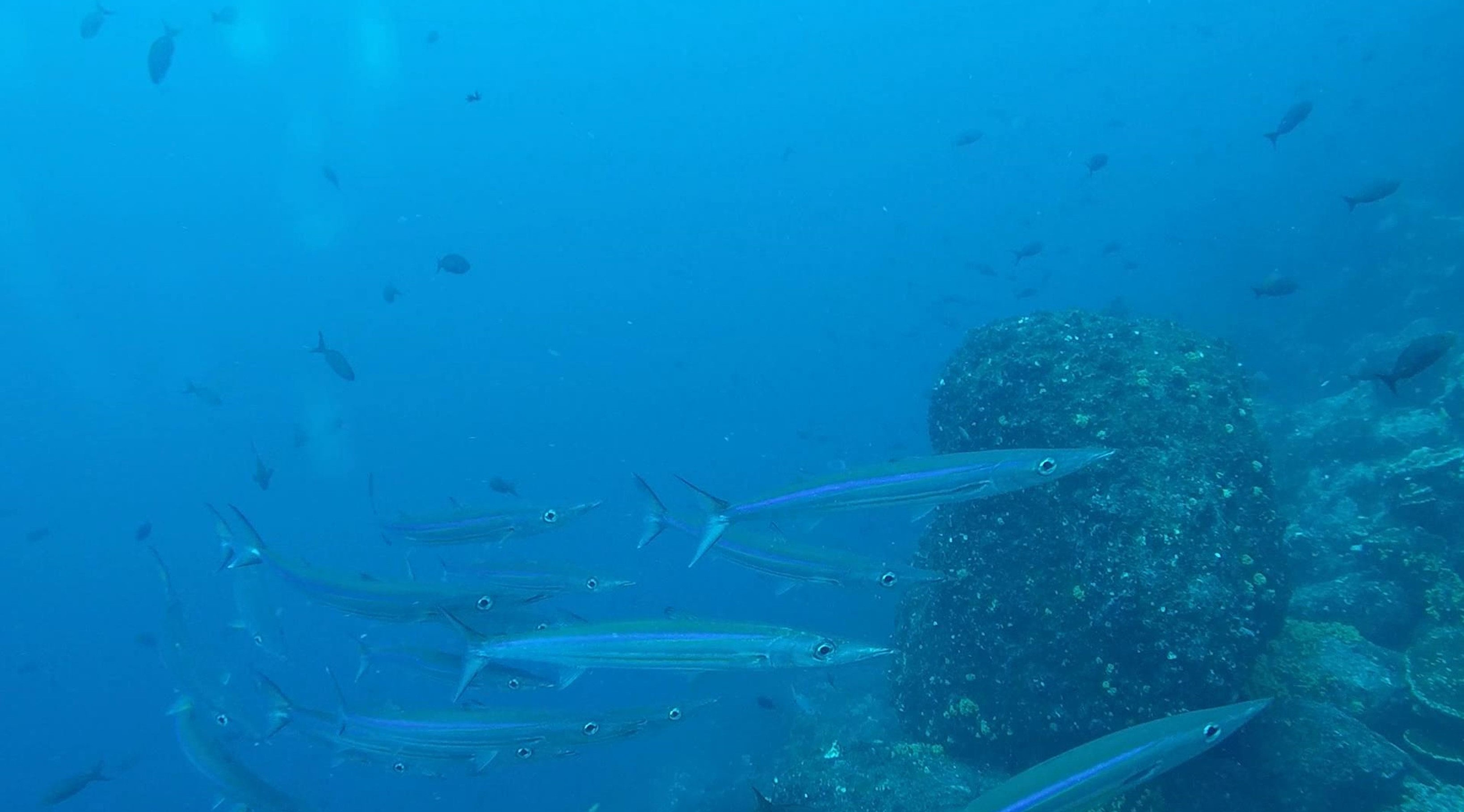
A school of Sphyraena stellata was recorded while conducting stereo-DOVS transects at Wolf Island in August 2015. There are two species of barracuda reported in the GMR: the great and pelican barracuda, S. barracuda (Daget, Reference Daget1986; Allen & Erdmann, Reference Allen and Erdmann2012) and S. idiastes (Merlen, Reference Merlen1988), respectively. Both of these species have distinct markings of dusky bars on the upper half of the body, while S. stellata lacks any dark markings (Figure 3A) (Morishita & Motomura, Reference Morishita and Motomura2020). Sphyraena barracuda adults are much larger than S. stellata, being able to reach standard lengths (SL) of 140 cm (Daget, Reference Daget1986; Allen & Erdmann, Reference Allen and Erdmann2012), while the individuals recorded had a total length of up to 55 cm, which is well within range of the maximum SL of 58.7 cm for this species (Morishita & Motomura, Reference Morishita and Motomura2020). Although one can find juvenile S. barracuda in such sizes, their habitat comprises sheltered mangroves and estuaries, making the occurrence of a juvenile of this species unlikely, given that the sighting was made in the very unsheltered northernmost islands of Galápagos. The origins of the pelvic and dorsal fins are on the same level in S. stellata and S. idiastes (Figure 2E) (Merlen, Reference Merlen1988; Morishita & Motomura, Reference Morishita and Motomura2020), while the first dorsal fin originates at the rear of the base of the pelvic fin in S. barracuda (Daget, Reference Daget1986). The dorsal fins for S. stellata, however, have their origin slightly behind that of the pectoral fins (Figure 3A).
(A) Sphyraena stellata swimming as part of a school of ~20 individuals recorded through stereo-DOVS around Wolf Island in 2015. (B) Side view of Lutjanus colorado photographed at Cartago mangrove bay off eastern Isabela by David Acuña-Marrero in 2014. (C) Comparison of side view of L. novemfasciatus (top) and L. colorado (bottom). (D) Two adults (foreground) and one juvenile (background) of Lobotes pacifica under a drifting piece of palm wood in 2015, photographed while conducting scientific dives around Wolf Island, north of the Galapagos Marine Reserve.

This species has strong resemblance to Sphyraena helleri (Randall et al., Reference Randall, Allen and Steene1998), which has been newly classified as restricted to the Hawaiian islands, as well as S. novaeholladiae (Myers, Reference Myers1991), which is found in the south-western and eastern coast of Australia. Sphyraena stellata is most easily distinguishable by two narrow and bright yellow stripes along the sides of its body, which neither S. helleri nor S. novaehollandiae show. The upper stripe starts from the upper edge of the opercle, following along the lateral line to end at the caudal fin base, while the lower one originates at the pectoral fin base and continues straight to the lower base of the caudal fin (Figure 3A). They have a slightly darker yellow-grey colouration on the dorsal side of the body, while the ventral side is silvery-white (Figure 3A) (Morishita & Motomura, Reference Morishita and Motomura2020). The pectoral fins show a dark spot at the base, and the caudal fin is darker grey than the rest of the body (Figure 3A). They have a slender body and relatively large eyes that have a diameter of at least half the head width, with maxilla that do not reach toward the anterior nostril (Figure 3A). Further figures showing these aspects in more detail are shown in the Supplementary data (Supplementary data 2, 3). Dr Béarez, Dr Robertson and Dr McCosker confirmed the identification of this species as S. stellata. Sphyraena stellata has not been sighted in the TEP before, and its primary distribution had been limited to the Indian and Western Central Pacific Ocean so far. This species has not yet been evaluated by the IUCN.
Order PERCIFROMES
Suborder PERCOIDEI
Family LUTJANIDAE
Genus Lutjanus Bloch, 1790
Lutjanus colorado Jordan & Gilbert, 1882
A few individuals of the Colorado snapper (Lutjanus colorado) were recorded and photographed by David Acuña-Marrero on eastern Isabela Island in 2014. To date, there are four species of snappers which bear a similar resemblance to the Colorado snapper in the RMG, namely Lutjanus argentiventris, L. jordani, L. novemfasciatus and L. peru (Grove & Lavenberg, Reference Grove and Lavenberg1997; McCosker & Rosenblatt, Reference McCosker and Rosenblatt2010). The video clearly shows a salmon red colouration of this individual, which significantly distinguishes it from the other species (Figure 3C, D). The colouration is an accurate measure in this case, since the data were obtained from a survey in shallow waters (1–2 m deep) with reasonably good visibility of ~10 m. Although another resident GMR snapper, Lutjanus aratus, can also present a red colouration, we exclude it mainly due to its distinctly elongated body shape (Allen, Reference Allen1985). Furthermore, L. aratus also has prominent stripes and is considered a deep-water fish, which makes an observation in shallow waters less likely, and does not coincide with the colouration as seen here (Grove & Lavenberg, Reference Grove and Lavenberg1997). Furthermore, the Colorado snapper has a more pointed anal fin shape than that of L. argentiventris (Figure 3d) or than the rounded anal fin of L. jordani and L. novemfasciatus (Figure 3C, D) (Allen, Reference Allen1985; Grove & Lavenberg, Reference Grove and Lavenberg1997). The scales of L. colorado above the lateral line (LL) are parallel to those below the LL, unlike in L. peru, where the scale rows are oblique above the LL compared with those below it (Figure 3C). It is also neither oval-bodied nor elongated (Figure 3c, d), which correspond to the body shapes of L. peru and L. jordani, respectively (Allen, Reference Allen1985). Dr Robertson confirmed the species identification. The Colorado snapper is endemic to the TEP (Gold et al., Reference Gold, Willis, Renshaw, Buentello, Walker, Puritz, Hollenbeck and Voelker2015), varied reports exist from southern Baja California down to the continental coast of Peru, as well as the oceanic islands of Malpelo and Cocos (Allen, Reference Allen1985; Bessudo et al., Reference Bessudo, Acero, Rojas and Cotto2010). This species was assessed as Least Concern by the IUCN (Bessudo et al., Reference Bessudo, Acero, Rojas and Cotto2010).
Order ACANTHURIFORMES
Family LOBOTIDAE
Genus Lobotes Cuvier, 1829
Lobotes pacifica Gilbert, 1898
During a trip to monitor shark populations around Wolf Island on 20 March 2015, a drifting piece of palm attracted large swaths of fishes seeking shelter, a common occurrence for pelagic fishes, including the Pacific tripletail (Lobotes pacifica). Driftwood allows juvenile and adult fishes to hide from predators and find shelter in the open sea, as it creates a shadow that allows them to avoid detection and to see approaching organisms better with less sunlight glare (Nagelkerken et al., Reference Nagelkerken, de Graaff, Peeters, Bakker and van der Velde2006). There are no other fish from the genus Lobotes, and no fishes with similar body shape in the GMR (Grove & Lavenberg, Reference Grove and Lavenberg1997; McCosker & Rosenblatt, Reference McCosker and Rosenblatt2010). Outside of the GMR, the species Lobotes surinamensis presents a similar body shape and a yellowish colouration that can be present in juvenile L. pacifica (Tortonese, Reference Tortonese1990). Lobotes surinamensis was catalogued as a rare vagrant in its easternmost dispersal in Hawaii and Tahiti, making a dispersal to the GMR unlikely. This species also relies on driftwood and other sheltering objects that cannot move independently of the current, and would therefore be unlikely to extend their western range without a significant change in the direction and force of the currents. The dispersion of driftwood through prevailing currents from the Eastern Pacific to the Galapagos Islands such as with L. pacifica is therefore all the more likely.
Lobotes pacifica is easily distinguishable due to its large dorsal and anal fins, which are both rounded and reach past the base of the tail fin, giving them the appearance of being second and third caudal fins, hence the name tripletail (Figure 3A) (Heemstra, Reference Heemstra1995). Other characteristic features of this species include a slightly concave forehead, with a head that is much shorter than the depth of the body and small eyes (Figure 3A). The colouration of adults is olive with dark spots (forefront Figure 3A), while juveniles have a lighter colouration with dark spots (background Figure 3A) (Heemstra, Reference Heemstra1995). The identification of this fish was confirmed by Dr Robertson. The Pacific tripletail has previously been reported in the TEP including in the oceanic island of Cocos (Heemstra, Reference Heemstra1995; Lea et al., Reference Lea, Bearez, van der Heiden, Acero and Cotta2010). This species was assessed by the IUCN as of Least Concern (Lea et al., Reference Lea, Bearez, van der Heiden, Acero and Cotta2010).
Discussion
Most of the new records reported here occurred between 2015 and 2016, which were an El Niño and La Niña year, respectively. The timing of some of these registers suggests that they might not be entirely circumstantial, as range extensions for species distributions might be partially influenced by both warm and cold ENSO events (Victor et al., Reference Victor, Wellington, Robertson and Ruttenberg2001; Banks, Reference Banks, Danulat and Edgar2002). During El Niño years, the south-eastern trade winds die down and upwellings decelerate, which leads to increased SST and thermoclines beginning at lower depths (Glynn et al., Reference Glynn, Mones, Podestá, Colbert and Colgan2017; Martin et al., Reference Martin, Conroy, Noone, Cobb, Konecky and Rea2018). It is likely that species that were previously reported on islands of the TEP, such as M. thurstoni, L. colorado and L. pacifica might have expanded south-east (when coming from Clipperton) or south-west (when coming from Coco and Malpelo) during the 2015 El Niño event. This strengthens the idea of offshore TEP islands as ‘stepping stones’ for Galapagos as described in Glynn et al. (Reference Glynn, Mones, Podestá, Colbert and Colgan2017). El Niño events increase the southward flow of the Panamic Current, and might explain how previous studies have shown range extensions to the Galapagos after ENSO events, such as that of Stethojulis bandanensis and Stegastes acapulcoensis after the 1997–98 El Niño event (Victor et al., Reference Victor, Wellington, Robertson and Ruttenberg2001; Glynn et al., Reference Glynn, Mones, Podestá, Colbert and Colgan2017). During the El Niño phase, the north equatorial counter-current strengthens, allowing species migrations through the Eastern Pacific Barrier (EPB) from the Central Pacific to the Eastern Pacific and vice-versa (Robertson et al., Reference Robertson, Grove and McCosker2004; McCosker & Rosenblatt, Reference McCosker and Rosenblatt2010). The EPB is an expanse of the Pacific Ocean in which the absence of oceanic islands and the 4000–7000 m water depths create a natural barrier for species migrations under normal oceanic conditions (Ekman et al., Reference Ekman, Carter, de Beer, Hogben, Elton, Carpenter, Brambell and de Beaufort1953; Briggs, Reference Briggs1974; Lessios & Robertson, Reference Lessios and Robertson2006). This seems to be the case for S. stellata, a new record for the TEP, which likely originated from the Hawaiian Islands or French Polynesia (Morishita & Motomura, Reference Morishita and Motomura2020). Predictive models and historical ENSO progressions point to regime shifts and more extreme ENSO events due to climate change (Wang et al., Reference Wang, Luo, Yang, Sun, Cane, Cai, Yeh and Liu2019), which opens new discussions on how this might influence dispersal of fish species in the near future.
Another possible explanation for these seven new records is the advances in remote underwater imagery that can help detect species without the disturbing presence of humans, such as s-BRUVS (Brooks et al., Reference Brooks, Sloman, Sims and Danylchuk2011). In addition, the use of video technologies allows for the review of imagery in the lab, where videos can be reviewed multiple times by experienced observers and thus allow for better identification especially when it comes to species that are easily mistaken for others. It is thus likely that a species such as M. longirostris has been resident to the GMR and only recorded recently due to the widespread use of remote stereo-video technology. The future use of remote cameras will likely result in the addition of new records (Cerutti-Pereyra et al., Reference Cerutti-Pereyra, Yánez, Ebert, Arnés-Urgellés and Salinas-de-León2018).
This type of technology is also useful to shine a light on some marine ecosystems of the Galapagos that remain largely under-studied, especially as s-BRUVS can help attract shy fish species that would otherwise be hard to see in low visibility, or areas with many hiding places. It is recommended that further research should be directed to better understand the fish fauna of under-studied marine ecosystems of the Galapagos, such as mangroves, sand flats, mesophotic reefs and the pelagic environment.
Conclusion
In a previous publication that analysed fishing data from purse sein fishing vessels, M. thurstoni was frequently recorded on catches (Lezama-Ochoa et al., Reference Lezama-Ochoa, Hall, Román and Vogel2019). The vessels mentioned in this publication caught the rays outside of the GMR as per regulation. However, given the multi-year sightings reported by us, as well as its distribution in the ETP islands, we confirm these previous sightings and feel confident to propose this species to be classified as resident in the GMR.
The other fish species have only been observed once, or with the same sex and size and thus we propose a vagrant status until further evidence can confirm a resident status within the GMR for M. longirostris, L. pacifica, L. colorado and S. stellata, especially considering that this is the first record of the latter in the TEP.
Supplementary material
The supplementary material for this article can be found at https://doi.org/10.1017/S0025315423000176.
Data
Data sharing is not applicable to this article as no datasets were generated or analysed during the current study.
Acknowledgements
This research was conducted under Galapagos National Park Directorate (GNPD) research permits PC-16-15, PC-17-15, PC-28-16, PC-68-16 and PC-53-19 granted to Dr Pelayo Salinas de León from the Charles Darwin Foundation (CDF). We are grateful to the fish experts Dr Ross Robertson, Dr Alan Friedlander, Dr Dave Ebert, Dr Daniel Fernando and Dr Guy Stevens, who provided species confirmations.
We also thank the GNPD for allowing us to conduct fieldwork in the GMR, as well as the naturalist guide who provided the photo for the bentfin devil ray. Furthermore, we thank the crews of the vessels ‘Taka III’, ‘Queen Mabel’ and ‘Valeska Yamilé’ for assistance during fieldwork.
Additionally, we thank Sara Hansen for valuable input on a rough draft.
This publication is contribution number 2491 of the Charles Darwin Foundation for the Galapagos Islands.
Author contributions
DAM contributed substantially in data gathering and giving tentative identifications; MC gave tentative identifications and edited the manuscript; DFA contributed the map for Figure 1 and edited the manuscript; JS provided and gathered photos and gave valuable input; ERL contributed substantially to data gathering and tentative identifications; PSL compiled the possible records and had a major role in text editing and general editorial work. All co-authors contributed to drafting and/or editing the manuscript. All authors read and approved the final manuscript.
Financial support
The Save Our Seas Foundation, the Lindblad-National Geographic Fund, the Helmsley Charitable Trust, the Gordon and Betty Moore Foundation, the Mark and Rachel Rohr Foundation and the Darwin and Wolf Conservation Fund provided funding for this study.
Conflict of interest
The authors declare that they have no competing interests.
Ethical standards
For the footage from the s-BRUVS data from 2015, the Curtin University Animal Ethics Committee declares that ‘All experiments were performed according to the Australian Code of Practice for the care and use of animals for scientific purposes’ with the identification number AEC_2014_09. Further ethics approvals or consent to participate are not applicable under the research permits cited.