Mutual disclosure of feelings and emotions is central to friendships in adolescence (12–18 years old) and emerging adulthood (18–25 years old), especially for girls (Buhrmester & Furman, Reference Buhrmester and Furman1987; Chow, Roelse, Buhrmester, & Underwood, Reference Chow, Roelse, Buhrmester, Underwood, Laursen and Collins2012; Sullivan, Reference Sullivan1953). Whereas supportive friends are important for the healthy psychosocial development of adolescents and emerging adults, it is possible that some support processes between friends have costs, especially when two friends engage in co-rumination (Rose, Reference Rose2002). Co-rumination is a construct that refers to dyadic tendencies in which two members extensively discuss and revisit problems, and focus on negative feelings (Rose, Reference Rose2002).
Research suggests that co-rumination has both positive and negative effects; while it has been linked to closer friendship quality in youths, it has also been linked to greater emotional disturbance (e.g., depression and anxiety; Rose, Reference Rose2002; Rose, Carlson, & Waller, Reference Rose, Carlson and Waller2007). In other words, the co-rumination process between friends reinforces their negative beliefs in that the friends are validating each other; so, although it is a close friendship, the way that they discuss their problems might be bad for them. Previous research has found that co-rumination leads to experiences of negative affect and a hyper-activated sympathetic nervous system (Byrd-Craven, Granger, & Auer, Reference Byrd-Craven, Granger and Auer2011), which in turn might contribute to its negative effects by amplifying the stress hormone response. Since co-rumination has both costs and benefits associated with it, moderate levels may be adaptive, whereas extreme levels may become maladaptive (Rose & Rudolph, Reference Rose and Rudolph2006).
Over the past decade, researchers have learned a great deal about the outcomes of co-rumination, with studies producing consistent findings on the adjustment trade-offs (Calmes & Roberts, Reference Calmes and Roberts2008; Rose, Reference Rose2002; Rose et al., Reference Rose, Carlson and Waller2007; Starr & Davila, Reference Starr and Davila2009; Tompkins, Hockett, Abraibesh, & Witt, Reference Tompkins, Hockett, Abraibesh and Witt2011). Surprisingly, less is known about the predictors of co-rumination. Drawing ideas from research on attachment, rumination, and trait depression, the current study examined whether these personal characteristics would be related to co-rumination. Since these constructs have been found to be important indicators of emotion regulation in interpersonal relationships, they might be predictive of co-rumination (Campbell, Simpson, Kashy, & Rholes, Reference Campbell, Simpson, Kashy and Rholes2001; Schwartz-Mette & Rose, Reference Schwartz-Mette and Rose2012; Treynor, Gonzalez, & Nolen-Hoeksema, Reference Treynor, Gonzalez and Nolen-Hoeksema2003). Furthermore, although co-rumination is regarded as a dyadic construct, most existing studies did not employ a dyadic design where both friends were examined simultaneously (see exception, Smith & Rose, Reference Smith and Rose2011). In order to address this gap, the current study used a dyadic perspective and examined the effects of attachment styles, trait depression, and rumination on co-rumination in friend dyads (Kenny & Cook, Reference Kenny and Cook1999).
Attachment Representations and Co-Rumination
Attachment theory (Ainsworth, Blehar, Waters, & Wall, Reference Ainsworth, Blehar, Waters and Wall1978; Bowlby, Reference Bowlby1982) suggests that individuals form mental representations with regard to their attachment figures, based on interpersonal experiences. Sensitive and responsive attachment figures give rise to a secure attachment representation, and rejecting or inconsistent attachment figures give rise to either avoidant or anxious attachment representations (Ainsworth et al., Reference Ainsworth, Blehar, Waters and Wall1978; Cassidy, Reference Cassidy1994). Although attachment representations have traditionally been thought of as a typology of secure, avoidant, and anxious (Ainsworth et al., Reference Ainsworth, Blehar, Waters and Wall1978), more contemporary researchers suggest that there are two dimensions that underlie adult attachment representations: anxiety and avoidance (Brennan, Clark, & Shaver, Reference Brennan, Clark, Shaver, Simpson and Rholes1998).
Fraley and Shaver (Reference Fraley and Shaver2000) contend that the anxiety and avoidance dimensions reflect two fundamental components that underlie attachment-related regulatory systems. First, the anxiety component reflects an appraisal-monitoring system that determines the extent to which individuals monitor their partners and relationships (Fraley & Shaver, Reference Fraley and Shaver2000). This component involves regulating an individual's tendencies to monitor and appraise events that might be relevant to a relationship, such as the attachment figure's availability, as well as possible cues of rejection. Second, the avoidance component is responsible for regulating attachment-related behaviours that determine the extent to which individuals choose to draw nearer to or withdraw from their attachment partner (Fraley & Shaver, Reference Fraley and Shaver2000). This component involves regulating an individual's behavioural tendencies to seek intimacy and closeness from their partners, especially in times of stress. Therefore, individuals high in anxiety are characterised by intense worrying about the availability of the attachment figures, and individuals high in avoidance are characterised by a strong preference for emotional distance and feel uncomfortable depending on others (Brenning & Braet, Reference Brenning and Braet2013). Secure individuals are thought to be low on both attachment anxiety and attachment avoidance dimensions and are characterised by representations of comforting attachment figures and a continuing sense of attachment security (Brenning & Braet, Reference Brenning and Braet2013).
Researchers further argue that these internalised attachment representations form a critical foundation for subsequent ways of regulating and coping with negative affect (Cassidy, Reference Cassidy1994; Mikulincer, Florian, & Weller, Reference Mikulincer, Florian and Weller1993). Individuals who are high in attachment anxiety worry about their own value to the attachment figure and about the availability of the attachment figure, due to a history of receiving unpredictable or inconsistent care and support (Ainsworth et al., Reference Ainsworth, Blehar, Waters and Wall1978; Brenning, Soenens, Braet, & Bosmans, Reference Brenning, Soenens, Braet and Bosmans2012). Research has found that individuals who are high in anxiety manage distress by using passive, ruminative, and emotion-focused coping strategies (Campbell et al., Reference Campbell, Simpson, Kashy and Rholes2001; Chow & Buhrmester, Reference Chow and Buhrmester2011). Due to a history of efforts to establish contact with attachment figures resulting in repeated rejection and anger, individuals who are high in attachment avoidance are distrustful of close relationships and tend to be compulsively self-reliant in order to avoid the pressure of becoming someone else's caretaker or to avoid the pain of being rejected (Bowlby, Reference Bowlby1982; Crittenden & Ainsworth, Reference Crittenden, Ainsworth, Cicchetti and Carlson1989; Simpson, Rholes, & Nelligan, Reference Simpson, Rholes and Nelligan1992). Studies have found that individuals who are high in avoidance usually manage distress by downplaying it, withdrawing from close others or distracting themselves from the source of distress, and do not seek support from close others (Chow & Buhrmester, Reference Chow and Buhrmester2011; Collins & Feeney, Reference Collins and Feeney2000; Simpson et al., Reference Simpson, Rholes and Nelligan1992). Due to a history of receiving sensitive and responsive care and support from attachment figures, secure individuals manage distress by turning to close others for support when needed and taking constructive actions to reduce it (Ainsworth et al., Reference Ainsworth, Blehar, Waters and Wall1978; Crittenden & Ainsworth, Reference Crittenden, Ainsworth, Cicchetti and Carlson1989; Simpson et al., Reference Simpson, Rholes and Nelligan1992).
Co-rumination can be conceptualised as being related to the constructs of support-seeking and rumination, but it is more emotionally intense and negative (Rose, Reference Rose2002). Therefore, it is reasonable to argue that co-rumination represents an important type of emotion regulation strategy that individuals exhibit within dyadic friendships, and different attachment representations may be closely related to co-rumination. Since highly anxious individuals tend to engage in emotion regulation strategies that heighten emotions (Cassidy, Reference Cassidy1994), they may be more likely to engage in co-rumination during times of distress. Conversely, highly avoidant individuals tend to suppress emotions and withdraw from the source of distress, and therefore, they may be less likely to engage in co-rumination (Cassidy, Reference Cassidy1994). Based on past theory and research, it is reasonable to suggest that individuals who are high in attachment anxiety would engage in greater levels of co-rumination while individuals who are high in attachment avoidance would engage in lower levels of co-rumination.
Trait Depression and Co-Rumination
Depression is an emotional state that can be characterised as being sad, down, or withdrawn (Cassano & Fava, Reference Cassano and Fava2002). In previous studies, co-rumination has been linked to depression (Calmes & Roberts, Reference Calmes and Roberts2008; Rose, Reference Rose2002; Rose et al., Reference Rose, Carlson and Waller2007; Schwartz-Mette & Rose, Reference Schwartz-Mette and Rose2012; Starr & Davila, Reference Starr and Davila2009; Stone, Hankin, Gibb, & Abela, Reference Stone, Hankin, Gibb and Abela2011). Co-rumination might lead to depression because it involves a persistent negative focus and impedes activities that could offer distraction from problems (Rose et al., Reference Rose, Carlson and Waller2007). Although depression is typically considered as the outcome of co-rumination, it is equally valid to argue that depression might be the predictor of co-rumination between friends. Indeed, past researchers suggest that depression can be conceptualised as a personality trait that is characterised by excessive negative and pessimistic beliefs about one's self and others (Costa & McCrae, Reference Costa, McCrae, Schneider, Reynolds, Lebowitz and Friedhoff1994). This construct is similar to depressive personality disorder or dysthymia in the clinical literature; and, more specifically, trait depression is an enduring predisposition to experience dysphoric moods such as dejection, discouragement, and hopelessness (Costa & McCrae, Reference Costa, McCrae, Schneider, Reynolds, Lebowitz and Friedhoff1994). Therefore, it is possible that people who possess a predisposition to trait depression might be more likely to engage in co-rumination. In fact, past research has found that depressed individuals tend to engage in emotion-focused coping strategies such as self-criticism, mental rumination, overt displays of distress, and wishful thinking (Mikulincer & Florian, Reference Mikulincer, Florian, Brewer and Hewstone2004; Treynor et al., Reference Treynor, Gonzalez and Nolen-Hoeksema2003). For this reason, the current study conceptualised and examined depression as a stable characteristic, rather than a temporary way of feeling, and as a predictor of co-rumination. Integrating research on co-rumination and trait depression, it is possible that individuals who score higher in trait depression would engage in more co-rumination with a close friend.
Rumination and Co-Rumination
Rumination can be conceptualised as a method of coping with distress that involves a passive and repetitive focus on symptoms of distress and its possible causes and consequences (Nolen-Hoeksema, Wisco, & Lyubomirsky, Reference Nolen-Hoeksema, Wisco and Lyubomirsky2008). Past research has shown that people who tend to ruminate are also more likely to co-ruminate with their friends (Jose, Wilkins, & Spendelow, Reference Jose, Wilkins and Spendelow2012). Although rumination and co-rumination are very similar, scholars have examined rumination in comparison to co-rumination in order to substantiate that these two constructs are indeed different from one another (Calmes & Roberts, Reference Calmes and Roberts2008; Jose et al., Reference Jose, Wilkins and Spendelow2012; Stone et al., Reference Stone, Hankin, Gibb and Abela2011).
Jose and colleagues (Reference Jose, Wilkins and Spendelow2012) argued that co-rumination and rumination are distinguishable in that rumination is an individual's intrusive thoughts about one's problems, whereas co-rumination is an interpersonal process of discussing problems with others. Their recent study examined the sequence of emotion regulation processes between rumination and co-rumination and provided support for this notion (Jose et al., Reference Jose, Wilkins and Spendelow2012). They found that individuals who ruminate at high levels are more likely to engage in co-rumination with their best friend but, conversely, co-rumination did not predict rumination. It appears that there is a directional influence from ruminative tendencies to co-ruminate in friendships. Based on past research, it appears that individuals who are more ruminative would engage in more co-rumination than individuals who are less ruminative.
Gender Differences
Previous research has found that females experience higher levels of stress in their relationships and perceive negative interpersonal events as more stressful than males do (Rudolph, Reference Rudolph2002). Females also experience more negative affect associated with their social networks and demonstrate a relational orientation style characterised by an emphasis on the importance of close dyadic relationships to one's sense of self and higher levels of interpersonal sensitivity than males do (Rudolph, Reference Rudolph2002). This heightened interpersonal sensitivity has been proposed by Rudolph (Reference Rudolph2002) to account in part for gender differences in stress reactivity and the increased vulnerability to anxiety and depression in females compared to males.
Furthermore, gender differences have been found in regards to co-rumination. While males have been found to engage in co-rumination, females are more likely to engage in co-rumination than males and are also more likely to develop depressive and anxiety symptoms following co-rumination (Rose & Rudolph, Reference Rose and Rudolph2006). Higher co-rumination levels among females than males also help to account for closer friendships among females than males (Rose, Reference Rose2002). In regards to the temporal ordering of the relations between co-rumination and adjustment, previous research that examined the effects of co-rumination on adjustment over a period of 6 months found that co-rumination predicted higher levels of depressive and anxiety symptoms over time for females, but not for males (Rose et al., Reference Rose, Carlson and Waller2007). Since females are more likely than males to co-ruminate and the negative effects are most severe for females, this indicates a double risk for females (Rose & Rudolph, Reference Rose and Rudolph2006). It was expected that similar gender differences would be found in the current study in that females would engage in more co-rumination than males. Because gender differences in co-rumination were observed in past research, this study further attempted to examine how gender might serve as a moderator between the effects of attachment, depression, and rumination on co-rumination. However, no specific predictions were made regarding these potential interactions, thus the moderation analyses examined in this study were exploratory in nature.
Dyadic Perspective
Most studies on co-rumination have employed an individualistic approach in that adolescents are examined in isolation from their friends (see exception, Smith & Rose, Reference Smith and Rose2011). According to an interdependence perspective (Huston & Robins, Reference Huston and Robins1982; Kenny & Cook, Reference Kenny and Cook1999), characteristics of one individual would likely affect the other individual in the relationship. Elaborating on interdependence theory, the Actor-Partner Interdependence Model (APIM; Kashy & Kenny, Reference Kashy, Kenny, Reis and Judd1999) is a recently developed model that systematically describes how dyadic processes work. This model provides a conceptual basis that allows researchers to untangle the nature of the relationship dynamics and interdependence (Cook & Kenny, Reference Cook and Kenny2005). According to the APIM, the outcomes in a dyadic relationship (e.g., co-rumination) may be driven by actor and/or partner effects. Actor effects occur when one person's emotions, cognitions, or behaviours influence his or her own outcomes whereas partner effects occur when one person's characteristics influence his or her partner's outcomes (Kenny & Cook, Reference Kenny and Cook1999). Since co-rumination is inherently dyadic, it is possible that insecure attachment, trait depression, and rumination might have an effect on the partner. In terms of attachment, because highly avoidant individuals dislike the caretaking role and withdraw during times of distress (Bowlby, Reference Bowlby1973; Campbell et al., Reference Campbell, Simpson, Kashy and Rholes2001), it is possible that individuals with a more avoidant friend would engage in less co-rumination. Furthermore, past studies have shown that anxiously attached, depressive, and ruminative individuals tend to experience greater levels of negative emotions when dealing with stress and problems (Campbell et al., Reference Campbell, Simpson, Kashy and Rholes2001; Schwartz-Mette & Rose, Reference Schwartz-Mette and Rose2012; Treynor et al., Reference Treynor, Gonzalez and Nolen-Hoeksema2003). It is possible that their negative emotions might spill over to their friend during the process of emotional disclosure, which in turn might elicit greater levels of co-rumination from a friend. Together, it is possible that having a more anxious, ruminative, or depressive friend might drive individuals to engage in more co-rumination.
The Current Study
The current study was unique in two important ways. First, it was the first study that investigated potential personal characteristics, including attachment representations, rumination, and trait depression, that might explain co-rumination within friendships. Second, it was one of very few studies to investigate different interpersonal dynamics (e.g., actor vs. partner effects) that exist within friendships, especially in the context of emotion regulation. In summary, actor effects predicted that individuals who scored higher on attachment anxiety, trait depression, and rumination would score higher on co-rumination. In contrast, it was predicted that individuals who scored higher on attachment avoidance would score lower on co-rumination. Furthermore, partner effects predicted that having a friend who is more anxious, higher in trait depression, and more ruminative, might drive individuals to engage in more co-rumination. In contrast, it was predicted that having a friend who is more avoidant might drive individuals to engage in less co-rumination.
Methods
Participants and Procedures
Participants were 212 pairs of same-sex friends attending a Midwestern university. This study targeted a sample of emerging adults within the age range of 18–25 years as this age group is especially vulnerable to excessive, negative problem talk and internalising problems (Calmes & Roberts, Reference Calmes and Roberts2008; Chow et al., Reference Chow, Roelse, Buhrmester, Underwood, Laursen and Collins2012). Participants were asked to bring a close friend with them in order to participate in the study, and advised not to bring their siblings or family members as their friend. Both friends completed a computer-administered survey in the laboratory using separate computers.
Four of the dyads were not within the targeted age range of emerging adults and three of the dyads previously completed this study; therefore, a total of seven dyads were excluded from the analysis. The final sample consisted of 205 pairs of same-sex friends (M age = 18.93 years, SD = 1.31). The duration of their friendships varied (M duration = 3.48, SD = 4.53) and 135 (66%) of the dyads were female. When participants were asked to rank the importance of their friend, participants designated their friend as best friend (41.5%), good friend (49.8%), social friend (6.8%), and acquaintance (2.0%). The final sample was 83.9% Caucasian, 5.6% African American, 2.4% Hispanic, 0.2% Native American, 4.9% Asian, 0.2% Middle Eastern, and 2.4% ‘other/mixed’.
Measures
Demographic survey
Participants answered questions regarding demographic variables such as age, gender, race/ethnicity, friendship type, and friendship duration.
Co-Rumination
Friendship dyads responded to a nine-item shortened version (Jose et al., Reference Jose, Wilkins and Spendelow2012) of the full Co-Rumination Questionnaire (CQ; Rose, Reference Rose2002). The items assessed the extent to which the participants typically co-ruminate with each other as the instructions asked them to think about the way that they usually are with the friend that came with them to the lab. This includes frequently discussing problems, rehashing problems, speculating about problems, mutual encouragement of problem talk, and focusing on negative affect. For example, one item reads: ‘When we talk about a problem that one of us has we spend a long time talking about how sad or mad the person with the problem feels’. Participants rated how well each statement describes their interactions with the friend who came with them to the lab using a 5-point Likert scale, ranging from 1 (not at all true) to 5 (really true). Co-rumination scores were averaged across the nine items, with higher scores reflecting higher levels of co-rumination. For the current study, this questionnaire was found to have high internal reliability (Cronbach's α = .93).
Attachment style
Participants completed the 36-item Experiences in Close Relationships (ECR; Brennan et al., Reference Brennan, Clark, Shaver, Simpson and Rholes1998) measure of adult attachment style. The self-report instrument measures two dimensions of attachment: attachment anxiety (18 items; e.g., ‘I worry about being abandoned’) and avoidance (18 items; e.g., ‘I prefer not to show others how I feel deep down’). Attachment anxiety measures the extent to which individuals worry that attachment figures might not be available or could abandon them, and attachment avoidance measures the extent to which individuals desire limited intimacy and prefer to remain psychologically and emotionally independent (Brennan et al., Reference Brennan, Clark, Shaver, Simpson and Rholes1998). Friendship dyads individually rated the degree to which they agree or disagree with each statement on a scale ranging from 1 (disagree strongly) to 7 (agree strongly). For the current study, the attachment anxiety and attachment avoidance dimensions were found to have high internal reliability (Cronbach's α = .93 and .92, respectively).
Rumination
Participants completed the 22-item Ruminative Responses Scale to measure their use of a ruminative coping style (RRS; Treynor et al., Reference Treynor, Gonzalez and Nolen-Hoeksema2003). The items describe self-focused and symptom-focused responses to depressed mood as well as responses that are focused on the causes and potential consequences of the mood. Participants rated how often they think (e.g., ‘Think about how alone you feel’) or do (e.g., ‘Go away by yourself and think about why you feel this way’) each item when feeling down, sad, or depressed, using a scale from 1 (never) to 4 (always). Higher scores reflect more ruminative tendencies. For the current study, this measure was found to have high internal reliability (Cronbach's α = .94).
Trait depression
Participants completed a modified version of the six-item depression subscale of the Brief Symptom Inventory (BSI; Derogatis & Melisaratos, Reference Derogatis and Melisaratos1983) to measure their trait depression. Although the original BSI was designed to assess symptoms of dysphoric affect and mood, the rating scale was modified to evaluate how respondents feel ‘in general’ and to assess their emotional disposition. This strategy, employed by previous research, intends to use similar items to capture trait versus state depression (Dehon, Gontkovsky, Nakase-Richardson, & Spielberger, Reference Dehon, Gontkovsky, Nakase-Richardson and Spielberger2010; Spielberger & Reheiser, Reference Spielberger and Reheiser2009). Participants read a list of problems and complaints and decided how often they are bothered or distressed by that problem (e.g., ‘Feeling no interest in things’) on a scale ranging from 1 (almost never) to 4 (almost always). The BSI items were averaged, with higher scores reflecting greater trait depression. For the current study, the reliability for the BSI depression subscale was excellent (Cronbach's α = .86).
Overview of Analytic Plan
To account for the dyadic nature of the data, the data was restructured before conducting any analyses. Because no clear criterion exists to distinguish dyad members (as opposed to distinguishable pairs such as parent-child or opposite-sex dyads), the designation of participants as ‘Friend A’ and ‘Friend B’ in the data set would be arbitrary. Rather than assigning roles arbitrarily, Kenny, Kashy, and Cook's (Reference Kenny, Kashy and Cook2006) suggestion was followed and the ‘double-entry method’ was adopted to restructure the data set. Because the data set was based on restructured dyadic data, the means and variances were identical across friends. Restructuring the data in this manner allows researchers to treat the dyad as the unit of analysis, instead of treating the individuals as the unit of analysis. This approach has been used by past research on same-sex friendships (Chow & Buhrmester, Reference Chow and Buhrmester2011; Chow & Tan, Reference Chow and Tan2013).
With the restructured dyadic data, a series of exploratory analyses were conducted to examine the means, standard deviations, and correlations among the study variables. Then, a series of tests were run to examine any gender differences in the means. Finally, the main hypotheses were tested by estimating the APIM (Kenny et al., Reference Kenny, Kashy and Cook2006) through multilevel modelling implemented by SPSS 20.0's Mixed Models. Before the APIMs were estimated, all predictors were standardised to aid in the interpretation of the regression weights (Aiken & West, Reference Aiken and West1991).
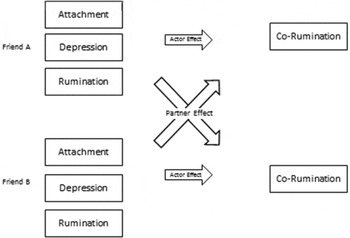
Hypotheses proposed by the current study are represented in Figure 1. As depicted in Figure 1, co-rumination is treated as the endogenous variable affected by other variables or functional relationships in that model. In contrast, attachment representations, trait depression, and rumination are exogenous variables that predict co-rumination.
A simplified conceptual representation of the Actor-Partner Interdependence Model (APIM) for attachment, rumination, and trait depression as predictors of co-rumination in friend dyads. In order to reduce redundancy, each arrow represents all of the possible pathways between the variables. In this model, the co-rumination scores provided by the two friends are allowed to covary. Also, all predictors are allowed to covary. Because the model is based on restructured dyadic data, the actor and partner effects would be identical across friends. For example, the link between Friend A's attachment and co-rumination would be identical to Friend B's attachment and co-rumination.

The model testing of the hypotheses followed a simultaneous regression procedure in that all of the predictors were entered simultaneously. Four separate models were analysed for the independent variables of attachment anxiety, attachment avoidance, rumination, and depression. Friendship duration and gender were included as covariates as well as moderators in the analyses examining attachment anxiety, attachment avoidance, rumination, and trait depression as potential predictors of co-rumination. For the attachment anxiety model, the predictors were friendship duration, gender, actor attachment anxiety, partner attachment anxiety, actor attachment anxiety × partner attachment anxiety interaction, actor attachment anxiety × friendship duration interaction, partner attachment anxiety × friendship duration interaction, actor attachment anxiety × gender interaction, and partner attachment anxiety × gender interaction. The models for attachment avoidance, rumination, and depression followed this same pattern of predictors, substituting the independent variable. The actor's and partner's variables were entered as predictors of co-rumination to estimate the ‘main effects’ of the predictors on co-rumination. The interaction terms were entered to explore whether any moderation effects on co-rumination might emerge. Since college is typically a time of establishing new friendships, the current study explored whether friendship duration might impact the study results. It should be reiterated that no specific predictions were made regarding the moderation effects examined in this study, thus all of the interaction analyses were exploratory in nature.
Results
Exploratory Analyses
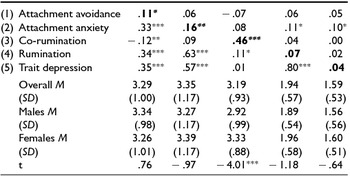
Table 1 presents a summary of the means, standard deviations, correlations, and gender differences among the study variables. Within-individuals’ correlations are reported below the diagonal, cross-individuals’ correlations are reported above the diagonal, and intraclass correlations are reported along the diagonal. Intraclass correlations revealed the degree to which friends were similar in the study variables (e.g., individual's co-rumination and friend's co-rumination).
Means, Standard Deviations, and Correlations Among Study Variables

Note: Coefficients were computed based on double-entry data; thus, the means/standard deviations and correlations for study variables were equal for both friends. Within-individuals correlations are reported below the diagonal, cross-individuals correlations are reported above the diagonal, and intraclass correlations are reported along the diagonal in bold print.
* p < .05. ** p < .01. *** p < .001.
As expected, within-individuals’ attachment avoidance and rumination were related to co-rumination. More specifically, when an individual's attachment avoidance was higher, an individual's co-rumination was lower. When an individual's rumination was higher, an individual's co-rumination was higher. Contrary to expectations, within-individuals’ attachment anxiety and trait depression were not significantly related to co-rumination, although attachment anxiety was marginally significant (r = .09, p = .06). Cross-individuals’ attachment anxiety was found to be significantly related to the friend's rumination and trait depression levels. More specifically, when an individual's attachment anxiety was higher, their friend's rumination and trait depression were higher. Intraclass correlations showed that friends were similar in terms of their attachment avoidance, attachment anxiety, and co-rumination. These intraclass correlations suggested that friend dyads were interdependent in nature and confirmed the need for a dyadic analytical approach to handle the data set.
Furthermore, gender differences were examined among the study variables. A significant gender difference emerged for co-rumination, with females reporting higher co-rumination than males. No other significant gender differences were found. In addition, the correlations between friendship duration and the study variables were examined. It was found that higher friendship duration was related to higher levels of co-rumination (r = .10, p = .05).
Actor-Partner Interdependence Model
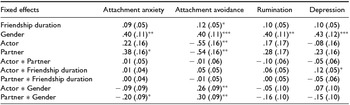
Table 2 presents a summary of the regression coefficients of the APIM from the multilevel models. Friendship duration and gender were included as covariates, as well as moderators in the analyses examining attachment anxiety, attachment avoidance, rumination, and trait depression as potential predictors of co-rumination.
Regression Coefficients of the APIM From the Multilevel Model

Note: Standard error in parentheses.
*p < .05. **p < .01. ***p < .001.
Attachment anxiety
Contrary to the hypotheses, results showed that attachment anxiety was not significantly related to co-rumination at the actor level; however, attachment anxiety was significantly related to co-rumination at the partner level. Specifically, the partner effect showed that individuals who had a friend who reported higher attachment anxiety also reported higher levels of co-rumination (b = .38, SE = .16, p = .02), controlling for their own attachment anxiety. This partner effect was not found to be significant at the correlational level; therefore, it is likely to be the result of a suppression effect in the multiple regression analysis. Since all of the predictor variables were entered into the simultaneous regression, it is possible that the presence of another variable increased the magnitude of this relationship and artificially inflated the relationship between the partner's attachment anxiety and co-rumination. Thus, this finding should be interpreted cautiously and replicated in future studies.
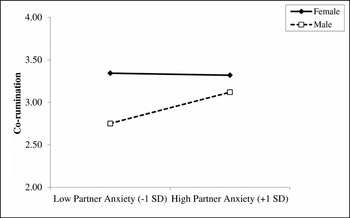
Interestingly, when the interaction terms were examined, gender moderated the effect of attachment anxiety on co-rumination at the partner level. This interaction is displayed in Figure 2, which presents a graphical representation derived by calculating the simple slopes corresponding to individuals scoring 1 standard deviation above and below the mean for partner attachment anxiety (Aiken & West, Reference Aiken and West1991). The moderated partner effect showed that for females, the partner's attachment anxiety had a weak and non-significant effect on their own reports of co-rumination (b = −.01, SE = .05, p = .82). In contrast, for males, the partner's attachment anxiety had a strong positive effect on their own reports of co-rumination (b = .18, SE = .08, p = .02). Thus, for males, having a more anxious friend drove them to perceive that their friendship involved more co-rumination. In general, females engaged in more co-rumination than males despite their own or their partner's attachment anxiety.
Interaction between gender and partner's attachment anxiety on dyadic co-rumination levels. (Simple slopes: females b = −.01, p = .82; males b = .18, p = .02.)

Attachment avoidance
Supporting the hypotheses, results showed that attachment avoidance was significantly related to co-rumination at the actor and partner level. Specifically, the actor effect showed that individuals who were higher in attachment avoidance also reported lower levels of co-rumination (b = −.55, SE = 16, p = .001). Similarly, the partner effect showed that individuals who had a friend who reported higher attachment avoidance also reported lower levels of co-rumination (b = .38, SE = .16, p = .02), controlling for their own attachment avoidance.
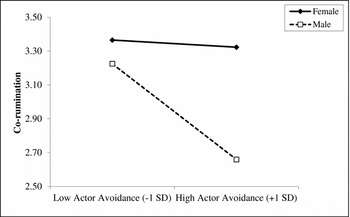
Additionally, when the interaction terms were examined, gender moderated the effect of attachment avoidance on co-rumination at both the actor and partner levels. The interaction between gender and the actor's attachment avoidance on co-rumination is displayed in Figure 3. The moderated actor effect showed that for females, individuals’ attachment avoidance had a weak and non-significant effect on their own reports of co-rumination (b = −.02, SE = .05, p = .70). In contrast, for males, individuals’ attachment avoidance had a strong negative effect on their own reports of co-rumination (b = −.28, SE = .08, p < .001). Thus, for males, individuals who were higher in attachment avoidance engaged in less co-rumination. In general, females engaged in more co-rumination than males despite their own attachment avoidance levels.
Interaction between gender and actor's attachment avoidance on dyadic co-rumination levels. (Simple slopes: females b = −.02, p = .70; males b = −.28, p < .001.)

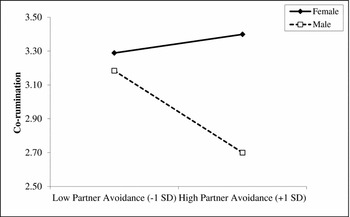
As displayed in Figure 4, the moderated partner effect showed that for females, the partner's attachment avoidance had a weak and non-significant effect on their own reports of co-rumination (b = .05, SE = .05, p = .31). In contrast, for males, the partner's attachment avoidance had a strong negative effect on their own reports of co-rumination (b = −.24, SE = .08, p = .002). Thus, for males, having a more avoidant friend drove them to engage in less co-rumination. In general, females engaged in more co-rumination than males, despite their partner's attachment avoidance level.
Interaction between gender and partner's attachment avoidance on dyadic co-rumination levels. (Simple slopes: females b = .05, p = .31; males b = −.24, p = .002.)

Trait depression
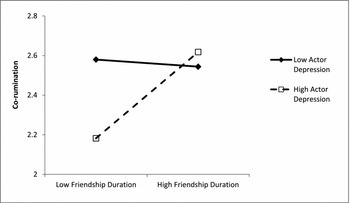
Contrary to the hypotheses, results showed that trait depression was not significantly related to co-rumination at the actor or partner levels. Notably, when the interaction terms were examined, an individual's trait depression score moderated the effect of friendship duration on their own reports of co-rumination. As displayed in Figure 5, the moderated effect showed that for individuals who scored lower in trait depression, friendship duration had a weak and non-significant effect on their co-rumination (b = −.02, SE = .07, p = .80). In contrast, for individuals who scored higher in trait depression, friendship duration had a strong positive effect on their co-rumination (b = .22, SE = .08, p = .007). Thus, for individuals higher in trait depression, the context of a stable, long-term friendship seemed necessary for them to engage in more co-rumination.
Interaction between actor's trait depression score and friendship duration on dyadic co-rumination levels. (Simple slopes: low actor depression b = −.02, p = .80; high actor depression b = .22, p = .007.)

Rumination
Contrary to the hypotheses, results showed that rumination was not significantly related to co-rumination at the actor or partner levels. In addition, all of the interaction terms were found to be non-significant as well. Inconsistent with the correlational analyses above, rumination was not significantly related to co-rumination reported by both friends, after controlling for friendship duration and gender.
Discussion
Contrary to the hypotheses, APIM results revealed that attachment anxiety was not associated with co-rumination at the actor level; however, attachment anxiety was associated with co-rumination at the partner level. The null findings at the actor level are consistent with previous research showing inconsistent findings between attachment anxiety and support-seeking (Alexander, Feeney, Hohaus, & Noller, Reference Alexander, Feeney, Hohaus and Noller2001; Berant, Mikulincer, & Florian, Reference Berant, Mikulincer and Florian2001; Ognibene & Collins, Reference Ognibene and Collins1998; Radecki-Bush, Farrell, & Bush, Reference Radecki-Bush, Farrell and Bush1993). Thus, it is possible that anxiously attached individuals do not always seek support when distressed as they worry about the availability of the attachment figure due to a history of receiving unpredictable or inconsistent care and support (Ainsworth et al., Reference Ainsworth, Blehar, Waters and Wall1978; Brenning et al., Reference Brenning, Soenens, Braet and Bosmans2012). Some might argue that friends are not considered to be attachment figures; however, due to the intimate nature of friendships, contemporary friendship research argues that young people form internal representations that are similar to attachment security (Brennan et al., Reference Brennan, Clark, Shaver, Simpson and Rholes1998; Chow & Tan, Reference Chow and Tan2013; Furman, Simon, Shaffer, & Bouchey, Reference Furman, Simon, Shaffer and Bouchey2002). As previously noted, the significant partner effect was not supported at the correlational level; therefore, it is likely to be the result of a suppression effect in the multiple regression analysis. Thus, this finding should be interpreted cautiously and replicated in future studies.
It was found that gender moderated the effect of attachment anxiety on co-rumination at the partner level. This finding is interesting in that it extends previous research by illuminating the complex relationship between attachment anxiety, gender, and levels of co-rumination. Studies have consistently found that females co-ruminate more so than males (Rose, Reference Rose2002; Rose et al., Reference Rose, Carlson and Waller2007); in the current study, females reported engaging in more co-rumination than males despite their own attachment anxiety or their friend's attachment anxiety levels. An interesting interaction emerged for males in that those who were high in attachment anxiety reported engaging in higher levels of co-rumination. This interaction adds a new dimension to our understanding of co-rumination by showing that certain personal characteristics (i.e., high attachment anxiety) might contribute to a violation of typical gender norms by compelling males to engage in more co-ruminative behaviours. Perhaps attachment anxiety might represent traditional views of femininity and is a female gender-type relational tendency, whereas attachment avoidance might represent traditional views of masculinity and is a male gender-type relational tendency (Feeney, Reference Feeney1999; Matsuoka et al., Reference Matsuoka, Uji, Hiramura, Chen, Shikai, Kishida and Kitamura2006). In general, past research has revealed gender differences, with females rating higher in attachment anxiety than males and males rating higher in attachment avoidance than females (Bartholomew & Horowitz, Reference Bartholomew and Horowitz1991; Feeney, Reference Feeney1999). When a friend violates a traditional gender-type relational tendency it might encourage more co-ruminative behaviours among friends during times of distress. Although this gender-role identity hypothesis is plausible, it is important to note that no significant gender differences were found for the attachment dimensions, thus this speculation might not fully explain the complex relationship between attachment anxiety, gender, and levels of co-rumination. Future research should be conducted to replicate the current findings and parse out this complex relationship.
Supporting the hypotheses, APIM results showed that attachment avoidance was associated with co-rumination at the actor and partner levels in that an individual's co-rumination was not only dependent on their own attachment avoidance but also on their friend's attachment avoidance. These findings provided support for the interdependence theory (Kelley & Thibaut, Reference Kelley and Thibaut1978). Perhaps highly avoidant individuals were less likely to engage in co-rumination because they tend to suppress emotions and withdraw from the source of distress (Cassidy, Reference Cassidy1994), thus discouraging the extensive problem talk that is characteristic of co-rumination. Conceivably, having one highly avoidant friend in a dyad (actor or partner) may inhibit disclosure, in general, due to their strong preference for emotional distance and their tendency to feel uncomfortable depending on others (Brenning & Braet, Reference Brenning and Braet2013).
Additionally, it was found that gender moderated the effect of attachment avoidance on co-rumination at both the actor and partner levels. Consistent with previous research (Rose, Reference Rose2002; Rose et al., Reference Rose, Carlson and Waller2007) on co-rumination, females reported engaging in more co-rumination than males, despite their own attachment avoidance or their friend's attachment avoidance levels. An interaction emerged for males in that those who were high in attachment avoidance, and those with a more avoidant friend, reported engaging in less co-rumination. Previous research indicates that individuals who are high in attachment avoidance are distrustful of close relationships and tend to be compulsively self-reliant in order to avoid the pressure of becoming someone else's caretaker or to avoid the pain of being rejected (Bowlby, Reference Bowlby1982; Crittenden & Ainsworth, Reference Crittenden, Ainsworth, Cicchetti and Carlson1989; Simpson et al., Reference Simpson, Rholes and Nelligan1992) and, as a result, they usually manage distress by downplaying it, withdrawing from close others or distracting themselves from the source of distress, and do not seek support from close others (Chow & Buhrmester, Reference Chow and Buhrmester2011; Collins & Feeney, Reference Collins and Feeney2000; Simpson et al., Reference Simpson, Rholes and Nelligan1992). One possible explanation for this may be that, in situations requiring emotional support, it is possible that highly avoidant individuals may (unwittingly) play an important role in eliciting some of the rejection/distant behaviour that they expect to receive from their attachment figure due to their strong preference for emotional distance and tendency to feel uncomfortable depending on others (Brenning & Braet, Reference Brenning and Braet2013) — in essence, a self-fulfilling prophecy. Indeed, it seems as though having one friend within a male dyad that is high in attachment avoidance discourages both friends from engaging in co-ruminative behaviours.
Contrary to hypotheses, APIM results showed that trait depression and rumination were not significantly related to co-rumination at the actor or partner levels. Notably, an interaction emerged in that an individual's trait depression moderated the effect of friendship duration on their own reports of co-rumination. Because of their tendencies to be enmeshed with other people (Maud, Shute, & McLachlan, Reference Maud, Shute and McLachlan2012) depressed individuals are expected to share negative emotions with others (Starr & Davila, Reference Starr and Davila2008), including short-term friends. Contrary to this, the results, surprisingly, showed that a long-term friendship seemed to be a necessary requirement for individuals higher in trait depression to engage in co-rumination. One explanation for this might be that since depression has more of a withdrawn characterisation (Cassano & Fava, Reference Cassano and Fava2002), perhaps depressed individuals only engage in co-rumination within well-established friendships. Another plausible explanation could be that depressed individuals might, in general, maintain longer friendships. In summary, the current study illuminated the complex relationships between gender, attachment representations, trait depression, and levels of co-rumination in friendships.
It is less clear why rumination was not significantly related to co-rumination at the actor or partner levels. Although previous research found that individuals who ruminate at high levels are more likely to engage in co-rumination with their best friend over time (Jose et al., Reference Jose, Wilkins and Spendelow2012), it is possible that these findings were not replicated due to the design of the current study. Because Jose et al. (Reference Jose, Wilkins and Spendelow2012) utilised a longitudinal design, it is reasonable to suggest that a one-shot design was not sufficient in capturing the temporal sequence of emotion regulation processes between rumination and co-rumination. It would be fruitful for future dyadic studies to employ a longitudinal design to examine the unfolding of this process over time.
Limitations and Future Directions
It is important to note that there are limitations of the current study that need to be addressed in future research. One limitation of the current study is the self-report nature. In order to strengthen the study design, observational assessments of co-rumination would be useful and would increase the confidence in the study results. One possible way to assess co-rumination through observation would be to videotape friendship dyads in the laboratory while engaging in a conversation about their stress/problems and then coding their co-ruminative behaviours. As previously noted, the one-shot design is another limitation and it would be beneficial to follow emerging adults over time. A longitudinal design would allow future studies to examine the temporal sequence of emotion-regulation processes between predictive personal characteristics and co-rumination in friendships. In addition, longitudinal studies would allow for testing bidirectional associations and feedback loops, which are likely to occur within interpersonal processes such as co-rumination. Such studies would also support the hypothesised direction of the effect, which is difficult to infer in correlational studies. Expanding upon this idea, it would also be interesting to examine how these processes unfold over time, across development, and extend into other close relationships (e.g., romantic relationships). Finally, it should also be noted that the sample utilised in the current study was fairly homogenous and future studies are needed to replicate the findings in other, more diverse, samples.
Practical Implications
Finally, the current study may also have practical implications. Considering the adjustment trade-offs of co-rumination, it is important to understand the predictors of co-rumination as well as the consequences of it in order to effectively apply intervention efforts. Researchers have argued that parents, teachers, and mental health professionals typically focus on socially isolated individuals and might leave maladaptive coping processes, such as rumination and co-rumination, disregarded (Rose et al., Reference Rose, Carlson and Waller2007). The current study illustrates the need for increased awareness of the co-rumination dynamic between close friends, and the need for more research to understand the conditions under which intensive discussion of problems can be harmful. Interventions that target this sequence of maladaptive coping responses could inhibit the unfolding of this process and facilitate the use of more effective emotion regulation/coping strategies (e.g., a mindfulness-based therapeutic approach that attempts to address emotional distress through non-judgmental awareness of internal processes). Additionally, individuals with insecure attachment styles may also benefit from being taught skills that foster constructive problem-solving such as that demonstrated by individuals with secure attachment.
Summary
The current study has two major contributions. First, although there were numerous studies on co-rumination conducted over the past decade (e.g. Rose et al., Reference Rose, Carlson and Waller2007), little was known about the personal characteristics that are potentially related to co-rumination. Drawing ideas from research on attachment, rumination, and trait depression, the current study attempted to demonstrate whether these personal characteristics, which have been found to be related to maladaptive emotion regulation strategies (Campbell et al., Reference Campbell, Simpson, Kashy and Rholes2001; Schwartz-Mette & Rose, Reference Schwartz-Mette and Rose2012; Treynor et al., Reference Treynor, Gonzalez and Nolen-Hoeksema2003), would be related to co-rumination.
Second, the current study provides evidence examining the fundamental premise of interdependence theory: interpersonal behaviours are subject to reciprocal influences in a dyadic relationship (Kelley & Thibaut, Reference Kelley and Thibaut1978). Specifically, the current study attempted to demonstrate that co-rumination is subjected to the impact of both the self's and a friend's attachment representations, rumination, and trait depression. Evidence from the current study advances previous studies that have primarily gathered information from only one friend, even though co-rumination has been conceptualised as a dyadic construct. Furthermore, it is also important to note that when partner effects are observed, they are independent of any actor effects, which serves to increase confidence by ruling out ‘potential shared-method variance’ that is common in individual perspective data. Thus, the dyadic design provides a more comprehensive picture of the interpersonal dynamics within a dyadic friendship. In conclusion, this study demonstrated that employing a dyadic approach was valuable in gaining a better understanding of complex, paradoxical processes within close friendships.