

Several hundred inscribed ritual bronze vessels dating to the Western Zhou (1045–771 b.c.e.) and Spring and Autumn periods (770–403 b.c.e.) known up to today were made on the occasion of concluding marriage, and were usually commissioned by men for their daughters, sisters, or spouses. Besides, several dozen vessels are known that were commissioned by or mentioned persons whose designations include the word sheng 生 (甥) that identified several kinds of male relatives by marriage.Footnote 1 A smaller number of bronze vessels bear dedications to relatives by marriage (hungou 婚購) in general. The wide geographical spread of vessels made on the occasion of marriage, or referring to existing marital relationships indicates the high relevance of marital alliances between aristocratic lineagesFootnote 2 and principalitiesFootnote 3 in Zhou China. The present article is based on the analysis of marriage-related inscriptions and offers some observations with regard to particular forms and geographical extension of marital alliances, as well as to their significance for the understanding of the socio-political organization of Zhou China.
The first section shows how marital alliances between Zhou and non-Zhou lineages or principalities are reflected in inscriptions dedicated to, made for, or made by females.Footnote 4 The second section, based on the analysis of thirty-seven cases of sheng mentioned in bronze inscriptions included in the Yin Zhou jinwen jicheng 殷周金文集成,Footnote 5 discusses how early Chinese elites instrumentalized their affinal relationships for enhancing their status, gaining prestige, concluding new marital alliances, communicating with third parties, or making war. The third and fourth sections are based on more recently discovered inscriptions and consider in detail individual cases of Diao sheng 琱生 and Rong sheng 戎生, shedding light on intra- and interlineage relationships, as well as on some of the political effects of marital alliances. The final section argues that marital alliances should be acknowledged as a major factor of political cooperation in Early China, starting from the early Western Zhou and during the Spring and Autumn periods.
Marital Alliances in the Light of Female-Related Inscriptions
Several hundred inscriptions listed in the Jicheng identify ritual bronze vessels as dedicated to, made for, or made by women. They include presents given to women as dowry by their parents or other relatives, wedding presents given to wives by husbands, vessels dedicated by sons to their (usually deceased) mothers, vessels made by women for themselves, for their ancestors, for their parents-in-law, or for other women (daughters, sisters, or other female relatives). Such inscriptions often, but not necessarily, identify a woman's surname (xing) that did not change after marriage. Among the inscriptions of the early Western Zhou period included in the Jicheng, 15 are commissioned for or by Jī 姬-surnamed, 15 by Si 姒-surnamed, 11 by Jiang 姜-surnamed, and 7 by Jí 姞-surnamed women.Footnote 6 There are also many inscriptions dedicated to women whose surname is not indicated. The number of female-related inscriptions increased with the passage of time, following the wider access to bronze-casting technology and the spread of literacy.
There was no single format for recording lineage names (shi) of married women. They could be identified either by their husband's lineage, or by their native lineage depending on who was the speaker and whom he or she was addressing.Footnote 7 Female-related inscriptions testify that during the Western Zhou period, the rule of surname exogamy was generally observed.Footnote 8 The cases of its violation are attested very seldom.Footnote 9 The requirement to marry outside of even distant patrikin and quasi-kin created the basic precondition for alliance-building across geographic space.
Most principalities established after the Zhou conquest of the Shang (c. 1045 b.c.e) were ruled by lineages of the Jī and Jiang surnames. During pre-kingly times, the Jī and the Jiang possibly represented two exogamic moieties that intermarried with each other endogamically.Footnote 10 Inscriptions of the Western Zhou period testify to the existence of the preferential marital partnership between Jī-and Jiang 姜-surnamed lineages. Most striking is that Jiang-surnamed women seem to be married exclusively to Jī-surnamed men.Footnote 11 Several queens or concubines of Zhou kings were Jiang-surnamed women, including King's [Spouse Lady] Jiang 王姜, King's [Spouse] First-born [Lady] Jiang 王伯姜, and King's Spouse, the Elder [Daughter] of Jì, [Lady] Jiang 王婦㠱(紀)孟姜.Footnote 12 Also rulers of Jī-surnamed principalities Wei 衛, Xing 邢, Guo 虢 and Jin 晉 had Jiang-surnamed consorts.Footnote 13 At the same time, Zhou kings took spouses of various other surnames including Ren 妊 (任), Jĭ 妃 (己), Jí 姞, or Gui 嬀.Footnote 14 Heads of various branches of the Guo 虢 lineage were married to women of Jí, Jĭ, Yíng 贏, and Yin 殷 surnames.Footnote 15 It is noteworthy that women of the same surname could originate from different lineages.Footnote 16
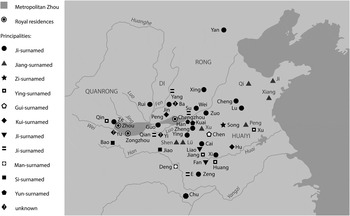
Inscriptions permit us to estimate the geographical extent of marital bonds (cf. Map 1). For instance, the occupant of the late Western Zhou Tomb 63 in the Jin cemetery at Tianma-Qucun 天馬—曲村, Houma 侯馬, Shanxi, identified by excavators as the spouse of a ruler of Jin, was a Jí-surnamed lady from Yang 楊 principality. Yang was located in Hongdong 洪洞 County of present-day Shanxi province, roughly 100 km to the north of the Jin capital.Footnote 17 The early Spring and Autumn period's Tomb 1753 in the cemetery of Guo at Shangcunling, Sanmenxia, Henan, has yielded a tripod dedicated to the Daughter of Su 蘇子. Su was a Jĭ-surnamed principality in Wen 溫 County, Henan, roughly 200 km from Guo.Footnote 18
Early China (c. ninth century b.c.e.)

Other inscribed bronzes provide testimonies to alliances concluded over a much greater distance. An early Western Zhou vessel discovered in the area of the royal center Zongzhou 宗周, was commissioned by Qi Jiang 齊姜, i.e. a woman of the Jiang-surnamed ruling lineage of Qi principality located in Shandong province.Footnote 19 Another early Western Zhou tripod found in the royal metropolitan center Zhou-under-QiFootnote 20 was dedicated to Jì Mother 㠱母, i.e. a woman from Jì 㠱 (紀),Footnote 21 another Jiang-surnamed principality located in Shandong, but even farther to the east.Footnote 22 Jì provided also at least one late Western Zhou queen or a royal concubine, Elder [Daughter] of Jì, [Lady] Jiang 王婦㠱(紀)孟姜.Footnote 23 These women from Shandong travelled a distance of 1,200 and more kilometers from their native places in order to join their bridegrooms in lineages in metropolitan Zhou areas in Shaanxi. A lady from the Gui-surnamed Chen 陳, located in Huai River valley near Huaiyang 淮陽 in Henan, also had to overcome a distance of more than 900 kilometers in order to join another Zhou king during the late Western Zhou period.Footnote 24 Not only the royal house, but also ruling houses of other principalities took wives from far-away places. According to transmitted sources, Lord Mu of Jin 晉穆候 (r. 811–785) married Lady Jiang from Qi 齊姜, the travel distance to which along ancient roads would constitute about 800 km.Footnote 25
During the Western Zhou period, the Zhou faced a variety of lineages that retained their autonomy and stayed outside of the Zhou political hierarchy. Some of them reached the same level of complexity as Zhou units conventionally defined as “principalities” in the present article. Their leaders identified themselves as wang 王 (“king”),Footnote 26gong 公 (“duke” or “patriarch”), or bo 伯 (“first-born” or “eldest”),Footnote 27 e.g. King of Ze 夨王, Duke of Chu 楚公, and the First-born of Yu  伯.Footnote 28 The usage of the title “king” by the ruler of Ze identifies Ze as an autonomous political unit, since in the Zhou hierarchy there could be but one king.Footnote 29 However, the significance of titles should not be overemphasized. Otherwise, principalities whose rulers did not claim kingship and who used Chinese titles or birth ranks to identify themselves can easily be confused with regular members of the Zhou network, which is contraproductive for revealing the political complexity of Early China.Footnote 30 For example, the First-born of Yu 伯 could mistakenly be identified as the head of a regular Zhou lineage. But non-Zhou features in the archaeological complex of Yu discovered near Baoji 寶雞, Shaanxi, and the splendor of its funerary equipment of the tombs of Yu's rulers suggest that it was a culturally idiosyncratic entity with considerable resources and competing for prestige with neighboring influential Zhou lineages.Footnote 31 At the same time, evidence of Yu's subordination to the Zhou royal house is lacking. The location in a strategically favorable place and connections to other non-Zhou units in the west allowed Yu to retain autonomy during several generations of its rulers. Hence, Yu can be assessed as a non-Zhou principality. During the last decade, cemeteries of other geopolitical entities presumably established by non-Zhou peoples have been discovered, including the Kui-surnamed Peng 倗, residing near to Hengshui 橫水 in the Yuncheng 運城 region in south-eastern Shanxi and Ba of unknown surname near Yicheng 翼城 in central Shanxi.Footnote 32 These cemeteries focused on the large and splendidly equipped tombs of their leaders who also identified themselves as “First-borns.” Judging by the funerary equipment of these tombs, rulers of Peng and Ba attempted to compete in size and wealth against the neighboring Jī-surnamed Jin during a certain period of time. Possibly, other non-Zhou groups such as Jí-surnamed E 噩 in northern Hubei,Footnote 33 or Yíng-surnamed Xú 徐 located on the edge of present-day Henan, Anhui, Jiangsu, and Shandong provinces,Footnote 34 also represented lineage-based principalities.
Members of the Zhou political hierarchy from the bottom to the very top could engage in marital alliances with non-Zhou principalities. They included Zhou kings, rulers of Zhou principalities and heads of aristocratic lineages not qualifying as a principality, as well as other members of their lineages. In particular, one queen of the early Western Zhou period was a woman of Yun 員 surname from an unknown principality,Footnote 35 whereas during the late Western Zhou, Zhou kings were allied with women from Jí-surnamed EFootnote 36 and Jĭ-surnamed Fan 番 located near Xinyang 信陽 in southern Henan.Footnote 37 It is not clear whether Zhou kings also married out their daughters to non-Zhou rulers. On lower levels, brides were exchanged in both directions. For example, a woman from the Jī-surnamed Jing 井 lineage was married to the First-born of Yu,Footnote 38 whereas the Third-born of Jing was married to a woman from Man 曼-surnamed Deng 鄧 in Dan 丹 River Valley.Footnote 39 The Second-born of Peng married his daughter to the Jī-surnamed Bi 畢 lineage residing near Xi'an in Shaanxi, whereas Bi provided the spouse for the First-born of Peng.Footnote 40
Zhou and non-Zhou concluded both short- and long-distance marital alliances. Kings of Ze and the rulers of Yu exchanged brides with lineages from the Zhou royal centers Zhou-under-Qi and Zongzhou,Footnote 41 i.e. within reach by a journey of several days. On the other hand, Jing lineage's marital partner Deng resided more than 200 kilometers to the south on the other side of the Qinling 秦嶺 Mountains. Deng, in its turn, intermarried with the Jī-surnamed principality Yīng 應 located at Pingdingshan 平頂山, Henan, 270 km to the north-east along the modern road.Footnote 42 The royal house of Zhou's marital partner Fan was located more than 700 kilometers away, in Huai River Valley. Fan, in its turn, was involved in a marital alliance with another branch of the royal Jī community, the ruling lineage of Lu principality located 600 km to the east in Qufu 曲阜, Shandong.Footnote 43 Jī-surnamed Yan, located near present-day Beijing, intermarried with Ba, to which a c. 900-km-long road led across the Taihang 太行 Mountains in Shanxi.Footnote 44 Thus, the Zhou not only accepted the “aliens” with whom they lived side by side, but also purposely selected partners, even if they lived at a greater distance.
Various rationales can be suggested behind the institution of interstate marriages. Most obviously, marriages across the borders of a principality guaranteed the highest possible level of nobility to the offspring resulting from them, and thus supported the prestige of ruling lineages.Footnote 45 Short-distance alliances enhanced security, preventing, for instance, territorial disputes with neighbors. Long-distance alliances could prevent competition among potential marital partners from neighboring principalities for the right of establishing the “first lady” and their interference in internal politics. Both short- and long-distance marital alliances allowed large principalities to extend their sphere of influence effectively or symbolically. To small principalities, they promised the support of marital partners in critical situations. As the following recently published inscription illustrates, these alliances were of substantial assistance in the organization of defense:
唯十月初吉壬申。馭戎大出于楷。害搏戎,執訊,獲馘。楷候釐害馬四匹,臣一家,貝五朋。害揚楷候休,用作楷中好(子)寶。
It was the tenth month, first auspicious day ren-shen. The Rong driving chariots came out in Kai in great [numbers]. Hai fought the Rong, captured and interrogated [them] and collected the ears [cut off from the heads of dead enemies]. The Lord of Kai made to Hai a gift of four horses, one family of servants, and five strings of cowries. Hai responded to the beneficence of the Lord of Kai, and used this opportunity to make a treasure for Second-born Lady Zi of Kai.Footnote 46
The inscription suggests that Lady Zi of Kai was Hai's wife or mother. Hence, Hai was an affinal relative of the Zi-surnamed Kai lineage, which he came to rescue at a time of danger.
Some non-Zhou principalities involved in marital relationships with the Zhou had previously participated in wars against them. E headed a coalition of the Yi of Huai River in their joint campaign against the Zhou. This war plausibly took place during the reign of King Li 厲 (857–842/828 b.c.e).Footnote 47 Two bronze tureens are known that were made by the Lord of E for King Li's Lady Jí.Footnote 48 Judging from their appearance, they date to the late Western Zhou period and, therefore, most probably were made after this war. In this case marriage could serve to appease the former enemies. Transmitted sources support the view that marriage was conceivable as a means of concluding peace. For instance, the marriage of Zhou King You 幽 (r. 781–771 b.c.e.) and Lady Si 姒 of Bao 褒 located in the upper course of Han River in the south of Shaanxi was concluded immediately after a war.Footnote 49 Bao Si's case demonstrates that women given in marriage to winners enjoyed high status and their sons could even become pretenders to the throne (which, however, resulted in the rebellion organized by the king's father-in-law and was sharply disapproved of in subsequent historical memory). In this case, a marital alliance between the former rivals signified the establishment of partnership and not just subjugation of the vanquished, which would have been accompanied by women's servitude.Footnote 50 Hence, marital alliances with former enemies helped to maintain peace in Zhou China.
Sheng and hungou in Bronze Inscriptions
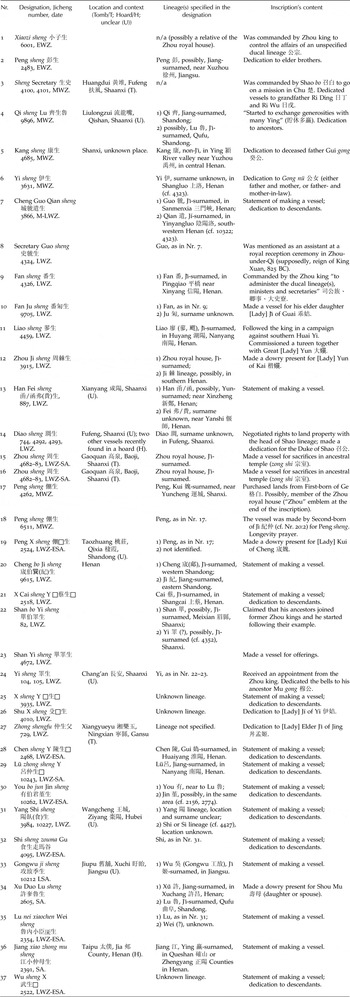
Inscriptions commissioned by or mentioning sheng 生 date from early Western Zhou to the late Spring and Autumn period (see Table 1).Footnote 51
Sheng in Bronze Inscriptions from Western Zhou and Spring and Autumn Periods

Names of the royal Zhou house and major principalities of Jī surname (Guo, Lu, Cai 蔡, Cheng 郕, Gongwu 攻敔, i.e. Wu 吳) and Jiang surname (Qi, Jì, Lü 呂, Xŭ 許) can be seen among their designations. Other sheng designations include the names of smaller principalities or lineages of Gui surname (Chen), Jĭ surname (Fan and Liao 蓼), Kui surname (Peng), or whose surnames are hypothetical or unclear (Han 函, Diao 琱, Qian 遣, Yi 伊, You 有). The number of identifiable cases is sufficient to demonstrate that sheng was not just a popular personal name, but a specific term indicating the relationship between the designated individual and socio-political entities—lineages or principalities. Scholars agree that in the epigraphic texts of the Shang and Zhou periods the word sheng stands for the kinship term written with the determinative nan 男 (“male”) as sheng 甥 and used in persons’ designations with names of lineages or principalities in the Shi jing, Chunqiu, Zuo zhuan, and other pre-Qin literary texts.Footnote 52
Personal names of the sheng were indicated very seldom. In this respect, sheng designations were similar to designations of women indicating the lineages of their fathers or husbands, but not their personal names. Some sheng designations include the names of two lineages. Inscriptions of Shan bo Yi sheng 單伯睪生 (T1:22), Cheng bo Jì sheng 郕伯㠱生 (T1:20), or You bo jun Jĭn sheng 有伯君堇生 (T1:30) were commissioned by First-borns, i.e. effective or designated heads of the lineages identified as on the first position. After their birth rank bo, the name of the second lineage is indicated. Other designations, e.g. Han Fei sheng 圅弗/費生 (T1:13) or Fan Ju sheng 番匊生 (T1:10), do not identify the persons’ positions in their lineages, but give the name of the second lineage straight after the name of the first one. Their birth rank could be other than bo, although it is also possible that designations Shan bo Yi sheng 單伯睪生 (T1:22) and Shan Yi sheng 單伯睪生 (T1:23) referred to the same person, but in the second case the birth rank was omitted. The reference to a second lineage in the designation of an individual suggests a permanent bond between them, which, in these cases, was clearly different from the patrilineal kinship.
Many designations, such as Chen sheng 陳生 (T1:28), Fan sheng 番生 (T1:9), or Zhou sheng 周生 (T1:15, 16), include the name of only one lineage. Many scholars assume that these should be their mother's lineages. They rely on the interpretation of sheng 甥 in the “Shi qinshu” (“Explaining kinship categories” 釋親屬) section of the Shi ming (“Explaining names” 釋名) glossary composed by Liu Xi 劉熙 in the second century c.e. Accordingly, “jiu (here: maternal uncle—M. Kh.) calls a son of his elder or younger sisters sheng” (舅謂姊妹之子曰甥).Footnote 53 However, the interpretation of sheng in the Shi ming as meaning exclusively sororal nephew (ZS)Footnote 54 is relatively late. The early Chinese terminology of kinship went through many changes between the Zhou and the Han periods, reflecting substantial changes in the social organization.Footnote 55 Therefore, earlier reference materials should be given priority over later ones when interpreting the terms used during the Western Zhou and Spring and Autumn periods. The Er ya 爾雅 glossary composed around the third century b.c.e, demonstrates that in the pre-Qin terminology of kinship, the term sheng was polyvalent.Footnote 56 In the “Shi qin” (“Explaining relatives” 釋親) section sheng is glossed twice—once under the “Qi dang” (“Wife's group” 妻黨) and once under “Hun yin” (“Affinal relatives” 婚姻) sections. The “Qi dang” section states the following:
姑之子.為甥.舅之子.為甥.妻之晜弟.為甥.姊妹之夫.為甥.
“A child of one's paternal aunt is [called] sheng. A child of one's maternal uncle is [called] sheng. Elder and younger brothers of one's wife are [called] sheng. A husband of one's elder or younger sister is [called] sheng.”
The “Hun yin” section adds:
謂我舅者.吾謂之甥也
“[If] one calls me jiu, I call him sheng.”Footnote 57
The Er ya thus identifies as sheng several kinds of male relatives, in two consequent generations, including an Ego's own and one descending generation, including cross-cousin (FZS, MBS), brother-in-law (WB, ZH), and sororal nephew (ZS).Footnote 58 In terms of biological kinship, it was applied to both consanguine and affinal relatives.Footnote 59 This should be no surprise, since in the early Chinese kinship terminology terms jiu 舅 (“uncle”) and gu 姑 (“aunt”) also designated both consanguine and affinal relatives.Footnote 60 According to Mikhail Krjukov, “a kinship system of Yin-Zhou type could emerge only under conditions when two exogamous kinship groups were related to each other by bonds of the obligatory cross-cousin marriage.”Footnote 61 As has been noted above in the present article, the Jī and the Jiang plausibly originally represented such groups, and therefore the emergence of the polyvalent term sheng in Zhou China is explainable.Footnote 62
The Er ya does not fully reflect the state of the Chinese kinship system during the Western Zhou and Spring and Autumn periods. Both bronze inscriptions and transmitted literature further attest the meaning of sheng including an Ego's daughter's son, i.e. a relative in the second descending generation.Footnote 63 Moreover, one case reflected in the Shi jing indicates that during the Western Zhou period, sheng could be applied also to females.Footnote 64 Up to the time of the Er ya’s compilation this, originally even more general, term had already dropped some of its connotations.
The definition of sheng in the “Hun yin” gloss seems to be equal to that in the Shi ming, i.e. sororal nephew (ZS). However, this similarity is superficial. In the context of the “Hun yin,” explaining terminology applied to relatives by marriage, the term jiu referred not to maternal uncles of males (MB), but to fathers-in-law of females (HF). A male Ego's father-in-law (WF) was distinguished as wai 外, “external,” jiu. Thus, in the context of “Hun yin” sheng should be understood as daughter's husband (DH). In sum, in all cases considered above, all sheng fall into the affinal category in terms of socially defined, patrilineal kinship.Footnote 65 It designated various categories of affinal relatives of an Ego in his own generation, as well as in the first and the second descending generations. Similarly to the designations of females, designations reflecting relationships established via females could be constructed in different ways depending on the speaker's perspective on the person referred to (even if these overlapped) and on the persons to whom the message was addressed. It is likely that a speaker would identify himself as a member of his patrilineal lineage and an affinal relative of the second lineage when addressing an external audience, especially in official contexts. Addressing his patrilineal relatives or those who were well informed about his origin, he would omit the name of his patrilineal lineage and identify himself as the sheng of the second, external lineage. On the other hand, addressing members of the lineage of his mother, wife, or brother-in-law, he would omit the name of their lineage and identify only his patrilineal lineage. Because of the specific features of Chinese language, a sheng “of” a lineage cannot be distinguished from a sheng “from” a lineage. The participants of the communication in which such designations were used knew who was related to whom and in which way, but we have to accept that it is hardly possible to clarify more precisely in what kind of relationships individual sheng were involved.
Sheng was not necessarily a stable component of a person's designation. Indeed, each male person could be related as a sheng to one or several lineages. The fact that sheng designations occur relatively seldom suggests that this status was explicitly emphasized in certain specific contexts, in other words, when affinal connections were especially significant for the social and political standing of particular individuals or relevant to the success of some particular projects. The analysis of the anthroponymy and contents of sheng-related inscriptions sheds some light on such situations.
Inscriptions of the sheng usually are very short and only include statements connected with the making of the vessel and dedications to ancestors. However, their significance for these who commissioned them should be not underestimated. In most (unfortunately, yet very rare) cases in which the archaeological context of the finds of the sheng’s vessels with such short inscriptions is known, they belonged to inventories of tombs. Moreover, they were often the only objects bearing inscriptions in the tomb. As such, they were intimately related to the person of the deceased, serving his “calling card” on the threshold of the afterlife and facing the world of ancestors. This also points to the fact that being the sheng of a certain lineage was also especially important for this person during his lifetime.
Both the anthroponymy reflected by inscriptions on vessels of unknown provenance of certain sheng and their exquisite quality, including some real masterpieces, indicate that persons who designated themselves as sheng often belonged to the highest elites. Archaeological finds corroborate this estimation. For instance, a person who was identified as sheng Secretary by inscriptions on two gui vessels was buried in a large tomb of the middle Western Zhou period in the Huangdui 黃堆 cemetery on the Zhou plain (cf. T1:3). Although the tomb was looted, its location, size, architecture and other remaining burial items, such as parts of a dismembered chariot, one bronze ding tripod, and one bell point to the fact that the occupant was a member of the top-level nobility closely related to the Zhou royal house.Footnote 66 Although other bronzes in the tomb were finely made, they do not bear any inscriptions. Hence, only the official position as a secretary and his status as a sheng identified the deceased. The inscription further stated that the First-born of Shao 召伯, the head of the powerful metropolitan Shao lineage and a high royal official, sent him on a mission to Chu 楚 (召白令生史事于楚). The name of the lineage to which he was related as a sheng was not specified. This could be due to the fact that this was either the royal house or the Shao lineage. Being a sheng could be relevant to his appointment, wealth and prestige.
Other inscriptions show that several persons referred to as sheng rotated around the Zhou royal court at various times. An early Western Zhou inscription states that “during the King's southern campaign, the king commanded to a sheng to allocate duties to young men of the duke's lineage (or ducal lineages)” (王令生辨事〔于〕公宗小子). During the late mid-Western Zhou, Fan sheng 番生 was appointed by the Zhou king “to administer ducal lineages, ministerial officials and officials of the Great Secretariat” (司公族、卿事、大史寮). Li Feng regards this not as “a specific administrative duty, but … the authority over the entire Zhou government.”Footnote 67 It should be remembered that, as noted above, Fan once provided a royal spouse. Therefore, it is worth considering the possibility that Fan sheng could somehow be related to the Fan lady married to the Zhou king. Her son who was not a royal heir could be identified as a sheng of Fan lineage. He could also be a son of her sister married to another member of the royal house. The close kin relationship with the king and the personal influence of the Fan lady at the court might be among the reasons why Fan sheng was entrusted with such comprehensive responsibilities. Also sheng of influential metropolitan lineages, such as Secretary Guo sheng 史虢生, an affinal relative of Guo lineage, active during the reign of King Xuan 宣 (827/25–782 b.c.e), held offices at the Zhou court.
Archaeology further testifies to the high relevance of affinal relationships on the level of ruling elites of principalities. In the recently excavated late Western-Zhou-period tomb Nr. 1016 in the cemetery of Peng, supposedly occupied by one generation's ruler, an inscribed vessel identified the latter as Bo Jin sheng 伯晉生, i.e. the sheng of the ruling lineage of Jin principality.Footnote 68 Jin was the closest neighbor of Peng and the most important political force in the present-day Shanxi province during this epoch. This inscription points to the fact that the marital alliance with Jin was very significant for Peng politically, and, besides, was possibly a matter of prestige for the whole ruling lineage and its ruler personally.
Considerations of prestige could stand behind the choice of bronze objects for the burial equipment of an early Spring-and-Autumn-period tomb at Xigaoquan 西高泉 in the vicinity of Baoji in Shaanxi.Footnote 69 During the early seventh century b.c.e, one of several consequent capitals of Qin 秦 principality was located in this area. The tomb, occupied by a member of the Qin nobility, contained a dou-basin on a tall ring foot with a design of roundels and scales. It bears the inscription “sheng of Zhou made [this] reverent dou for using it for offerings in the ancestral chamber” (周生乍作尊豆用享于宗, T1:15).Footnote 70 Besides, in the tomb there was also a bronze hu flask without inscription. Excavators suppose that both bronzes may date from the Western Zhou period. If so, it is not clear how they came into the possession of the tomb's occupant.Footnote 71 It is worth considering that the same area yielded the set of bronze bells made in the classical Western Zhou manner and commissioned by Duke Wu of Qin 秦武公 (697–678 b.c.e) and his spouse Lady Jī of Zhou.Footnote 72 The inscription on the bells demonstrates that this Qin ruler was proud of being a marital relative of the royal house, even if he did not go so far as to identify himself as a “sheng of Zhou.” His bells closely imitated bells cast in royal workshops before 771 b.c.e.Footnote 73 By analogy, it is understandable that another Qin noble would boast of being a “sheng of Zhou” through maternal descent, marriage, or just by virtue of having in his possession an inscribed vessel, and thus falsifying an affinal relationship that possibly did not exist. Amazingly, another dou with a fully identical inscription was found elsewhere (cf. T1:16). Unfortunately, its current whereabouts are not known, but the rubbing still exists.Footnote 74 A comparison shows that the calligraphy of the Xigaoquan inscription is less clear and some characters are written differently or even with errors. Obviously, different craftsmen prepared clay models for the inscriptions, and, possibly, the Xigaoquan dou was a Qin copy of a Zhou original. In the absence of the second vessel it cannot be verified whether only the inscription was copied, or also the shape. One cannot avoid questioning whether such vessels with inscriptions testifying to the standing of some persons as sheng of Zhou might not have been produced by the Zhou royal house in a larger number as presents for various affinal relatives.
Already existing affinal connections were relevant when concluding new marriages. This is supported by several inscriptions on dowry and wedding presents for women whose commissioners identified themselves as sheng (cf. Liao sheng xu 蓼生盨 (T1:11), Fan Ju sheng hu 番匊生壺 (T1:10), Zhou Ji sheng pan 周棘生盤 (T1:12), Peng X sheng ding 倗□生鼎 (T1:19), Ji X sheng gui 及□生簋 (T1:28)).
Common affinal connections with third lineages could facilitate communication between lineages/principalities not necessarily already involved in a marital alliance themselves. In particular, Peng X sheng (T1:19) from the Kui-surnamed Peng principality in southern Shanxi gave a dowry present to his daughter Lady Kui, married to a member of the Jī-surnamed Cheng in western Shandong. Amazingly enough, this bronze was found near Qixia 棲霞 city in the east of Shandong, i.e. more than 500 km from Cheng. This surprising find can be explained, because Cheng was, in its turn, related by marital alliance to the Jiang-surnamed Jì in eastern Shandong, as is displayed in the name of Cheng bo Jì sheng 宬伯㠱生 (T1:20). Whereas Cheng was a member of the Jī community, both Peng and Jì were related to it as affinal relatives. It is not clear whether Peng and Jì principalities had a marital alliance between themselves. In any case, they were aware of and communicated with each other, as is suggested by an inscription on a present given by the Second-born of Jì to Peng sheng (T1:18).
Sheng-related inscriptions provide additional information about the geographical dimension of marital alliances (cf. Map 1). The Jī-surnamed Shan 單, a prominent lineage closely related to the Zhou court, resided c. 50 km to the south from the royal center Zhou-under-Qi in Meixian 眉縣 in Shaanxi.Footnote 75 It intermarried with Yi 睪, of unknown surname, possibly residing in the vicinity of the royal residence Zongzhou in Shaanxi, i.e. c. 130 km from Shan (cf. T1:22, 23).Footnote 76 Zhou kings and their officials regularly commuted between Zhou-under-Qi and Zongzhou for administrative purposes. Intermarriages between lineages residing near these two royal centers facilitated solidarity between metropolitan elites. Sheng-related inscriptions witness cooperation between neighboring principalities by means of marital alliances. Peng and Jin were located c. 40 km from one another in southwestern Shanxi. Han and Fei, whose alliance is documented by the inscription of Han Fei sheng 圅弗/費生 (T1:13) were located c. 50 km from one another in central Henan.Footnote 77Sheng-related inscriptions also document several long-distance marital alliances. The inscription of Xŭ Duo Lu sheng 許奓魯生 (T1:34) witnesses an alliance between Xŭ in southeastern Henan and Lu in western Shandong, removed from one another by about 400 km. Cheng and Jì, located in western and eastern Shandong respectively were separated from one another by c. 500 km. These cases demonstrate that both short- and long-distance alliances could be converted into benefits by their participants, either in their own native lineages/principalities or externally.
It is noteworthy that many sheng designations were associated with persons from central and southern Henan and further east (cf. Map 1). Principalities to which these sheng were related included a non-Jī-surnamed Kang 康 in Yĭng 潁 River Valley near Yuzhou 禹州 in central Henan (cf. T1:5);Footnote 78 Han 圅/函, supposedly Yun 㜏 (妘)-surnamed, in central Henan (cf. T1:13); Jí-surnamed Qian in the upper course of the Luo River in western Henan or southern Shaanxi (cf. T1:7);Footnote 79 Yi 伊, of unknown surname, possibly, located in the Yi 伊 River Valley (cf. T1:6);Footnote 80 Jiang-surnamed Lü was near Nanyang 南陽; Jĭ-surnamed Liao (cf. T1:11) and Fan (cf. T1:9) were located near Huyang 湖陽 and Xinyang 信陽 in southwestern Henan respectively;Footnote 81 Ji 棘 of an unknown surname was possibly in southern Henan (cf. T1:12);Footnote 82 Jī-surnamed Cai 蔡 was in Shangcai 上蔡 in southern Henan (cf. T1:21);Footnote 83 Ying 贏-surnamed Jiang 江 was either in Queshan 確山 or Zhengyang 正陽 in southern Henan (cf. T1:36);Footnote 84 Gui-surnamed Chen was near Huaiyang 淮陽 in southeastern Henan (cf. T1:28);Footnote 85 You 有 of unknown surname was located somewhere in southwestern Shandong (T1:30),Footnote 86 and Peng 彭, possibly, Jiang-surnamed, was near Xuzhou 徐州 in Jiangsu (cf. T1:2).Footnote 87 In these areas interaction between the Zhou and various non-Zhou peoples was especially intensive and often hostile. The local population residing in the mountainous or marshy regions were able to defend their autonomy and endanger Zhou colonists starting to settle there from the beginning of the Western Zhou period. Cooperation among the lineages of Zhou colonists themselves, as well as with friendly non-Zhou neighbors, represented an indispensable factor for maintaining peace. The sheng-related inscriptions signal that this cooperation was facilitated by intermarriages.
Some sheng-related inscriptions show that this cooperation sometimes took the form of joint military action. Liao sheng followed the Zhou king in a campaign against southern Huai Yi 南淮夷. Liao, in a similar way to that of Fan, was a Jĭ-surnamed Yi 夷 principality in Huyang, Henan. Liao sheng, similarly to Fan sheng, could be the son of a Liao woman married to a member of the Zhou ruling house and raised at the royal court. Or, vice versa, he could be a member of the Liao lineage, whose aunt or sister was married to a member of the Zhou royal house. In both cases, as affinal relatives of the Zhou king, the Liao lineage had reason to support him in a war. The inscription of Rong sheng discussed below in the present article provides another example of military cooperation between marital relatives.
Considering that marital relations could bring diverse benefits, it is natural that Zhou elites demonstrated respect to their in-laws on various occasions as this is reflected in the following passage of the Zuo zhuan:
凡君即位.好舅甥.脩婚姻.娶元妃以奉粢盛.孝也
When a ruler ascends to the throne, he expresses his love to his elder and younger male affinal relatives (jiu and sheng), arranges [new] marriages, and takes his principal wife to make offerings in grain vessels [in his ancestral temple], thus implementing his filial piety.Footnote 88
Inscriptions confirm that, during the late Western Zhou period at the latest, relationships of both females and males with regard to their parents-in-law were defined in terms of filial piety (xiao 孝).Footnote 89 Women participated in sacrificial ceremonies dedicated to their husbands’ ancestors and continued performing sacrifices to the ancestors of their own lineages.Footnote 90 This explains in turn why so many sacrificial bronze objects were made for or made by women. Religious practice whereby married women were assigned their own substantial roles helped to strengthen interlineage ties.
Affinal relatives were referred to in inscriptions collectively as hungou 婚媾. This term consists of the words hun 婚, “to marry, to take a wife, marriage” and gou 媾, “to wed.”Footnote 91 Dedications to hungou occasionally occur in inscriptions starting from the middle Western Zhou period.Footnote 92 For instance, X ji liangfu commissioned a flask with the following inscription:
□季良父乍□(絞)始(姒)尊壺。用盛旨酒。用享孝于兄弟、婚媾、者老。…
X ji liangfu made this sacrificial flask for [Lady] Si of Jiao. May it be used for containing sweet beer! May it be used to feast and to [to express] filial piety to elder and younger brothers, relatives by marriage, and all the elders! …Footnote 93
Interestingly, the word hun 婚 in this and some other inscriptions is spelled with an additional graph er 耳, “ear,” as [䎽女] or 䎽. In some inscriptions, the same character stands for the word wen 聞, “to hear, to be heard,” with a derivative meaning “fame.” For example, an early Spring and Autumn inscription on the bell commissioned by a prince of Xú reads:
徐王子旃擇其吉金。自乍龢鐘。以敬明祀。以樂嘉賓。倗友。者臣。兼以父兄。庶士。以宴以喜。中瀚且[音易]。元鳴孔皇。其音攸攸。[䎽女](聞)于四方。…
Zhan, the son of the King of Xu, chose his auspicious metal, and made [this] harmonious bell for himself in order to reverently bring clear [ancestral] offerings, in order to enjoy luck-bringing guests, friends, all officials, together with fathers and elder brothers, and all [noble] men; to feast, to please! Accurate, vast and gentle, [its] superb voice [is] grand and magnificent, its sound is you-you [and it is] heard in the four quarters of the world.…Footnote 94
In archaic Chinese, hun and wen sounded closely to each other.Footnote 95 The substitution could be just a phonetical loan. Nevertheless, it is worth considering the possibility that the resulting wordplay could be intentional.Footnote 96 In a sense, “being heard” increased the chance to “get married” to women from the four quarters, whereas brilliant marital alliances contributed to one's fame. Other inscriptions’ commissioners boasted of having “one hundred hungou”Footnote 97 or “one hundred sheng,”Footnote 98 thus supporting the notion that having many affinal relatives was both a factor of political strength and of prestige.
On this point, it should be noted that some inscriptions explicitly express a wish to have both male and female descendants.Footnote 99 Such statements make one reconsider whether the ubiquitous address to zi zi sun sun 子子孫孫 in bronze inscriptions is correctly understood as referring exclusively to male “sons and grandsons,” but not to children of both sexes. Evidently, without having enough daughters, a lineage had less potential for constructing social and political networks. Therefore, valuing only sons and neglecting daughters would signify only political blindness. Wishes of abundant progeny, especially when placed on dowry presents commissioned by a bride's father or brother, very likely concerned the offspring of both sexes, since the female children could potentially “return” to their mother's native lineage.
In sum, even if the concrete type of affinal relationship of particular sheng to the lineages referred to in their designations cannot be revealed, these inscriptions represent a valuable historical source. They demonstrate that being a sheng of a certain, even distantly located lineage represented a permanent, status-relevant relationship that was recognized and respected in the aristocratic society of the Western Zhou and Spring and Autumn periods. They indicate that not only married women personally acted as agents between the lineages of their fathers and husbands, but also that men recognized their obligations to their affinal relatives, from which both lineages could mutually benefit. They document marital alliances between particular lineages/principalities on both regional and interregional levels, thus expanding the pool of data constituted by female-related inscriptions. In combination with the sheng-related inscriptions, general dedications to hungou or dedications to individual affinal relatives testify to the importance of marital bonds between lineages and principalities in Zhou China. In these processes, connections established via mothers, wives, or sisters represented a “capital” that could be converted into wealth, standing, and prestige of particular persons and their whole lineages, or into solidarity and cooperation between lineages and principalities that could have consequences on the scale of the whole Zhou world.
The cases of Diao sheng and Rong sheng discussed in the next two sections in detail give a deeper insight into relationships within patrilineal lineages and between them and their marital relatives during the late Western Zhou and early Spring and Autumn periods.
The Case of Diao sheng
Inscriptions commissioned by a person identifying himself as Diao sheng include four texts. Two tureens with lengthy, informative inscriptions, the fifth-year Diao sheng gui and the sixth-year Diao sheng gui, are kept in the Hobart and Edward Small Moore Memorial Collection in the Yale University Art Gallery and in the Chinese Historical Museum in Beijing respectively.Footnote 100 Their provenance is unclear. A li-tripod with a short, undated dedication by Diao sheng to his deceased father was found several decades ago in Fufeng County of Shaanxi province, but the precise place of discovery is unclear. In 2006, two very unusual, massive large-mouthed zun 尊 vessels commissioned by Diao sheng and dated to the fifth year have been discovered in a hoard in Wujun 五郡, Fufeng, Shaanxi.Footnote 101 The dates indicated in Diao sheng's inscriptions correspond to the fifth and sixth years of King Li (853 and 852) respectively. Another inscription commissioned by someone else informs us that during the reign of King Li, Diao sheng held the office of the royal superintendent zai 宰.Footnote 102 All three lengthy texts of Diao sheng are concerned with the negotiation of property rights between Diao sheng and Shao bo Hu 召伯虎.
Shao was a prominent Jī-surnamed lineage intimately associated with the royal house. During the Zhou conquest of the Shang in the mid-eleventh century b.c.e., Duke Great Protector Shao Shi 太保召公奭 was one of the closest assistants of King Wu. Shi's elder son Ke 克 was enfeoffed in Yan 燕 near present-day Beijing. The main branch of the Shao lineage remained in the metropolitan area. Duke Kang of Shao 召康公 held the office of Superintendent zai during the reign of King Cheng 成 (r. 1042/35–1006 b.c.e.).Footnote 103 Duke Kang's late descendant, Duke Mu of Shao 召穆公, was a counselor of King Li. After the insurrection raised by the metropolitan elites against the king in 841 b.c.e., Duke Mu raised the royal heir Jing 靖 in his house. In 827 b.c.e., Duke Mu of Shao together with Duke Ding of Zhou 周定公 installed him as King Xuan on the Zhou throne. While the king was still young, both dukes assisted him in the affairs of government.Footnote 104 At the beginning of King Xuan's reign, Duke Mu led a military campaign against the Yi of Huai River 淮夷, for which he was praised in the “Jiang Han” 江漢 ode of the Shi jing (Mao 262). This text reveals his personal name Hu 虎.Footnote 105 Most scholars agree that the First-born Hu of Shao referred to in the inscriptions of Diao sheng was Duke Mu of Shao.Footnote 106
Unlike Shao, Diao was never mentioned in transmitted sources.Footnote 107 Other inscriptions indicate that the Diao resided in the area of the royal center Zhou-under-Qi.Footnote 108 A very rich find of bronze vessels, including eleven ding-tripods, eight gui-tureens, two lei and two hu flasks commissioned by August Father of Han 圅(函)皇父 for Lady Yun of Diao 琱 㜏 was found in Kangjia 康家, Fufeng, Shaanxi.Footnote 109 By the number of sacrificial vessels, the dowry of this woman overshadows most representative sets of ritual utensils commissioned by high royal officials. This signals the ability of her father and husband to compete openly with the local aristocracy in prestige, which suggests that the position of the Diao lineage at the court about the second half of the ninth century b.c.e. was secure.
The three lengthy texts of Diao sheng are arranged here in chronological order:Footnote 110
1. The fifth-year Diao sheng gui:
隹五年正月己丑。琱生有事。召來合事。余獻婦氏以壺,告曰:「以君氏令!」曰:「余考之。公僕
 (庸)、土田多刺。式伯氏從許。公宕其參。汝則宕其貳。公宕其貳。汝則宕其一」。余□ 于君氏大章。報婦氏帛束璜。召伯虎曰。「余既訊。我考我母令。余弗敢亂。余或致我考我母令」。琱生則堇圭。
It was the fifth year, the regulated month, day ji-chou. Diao sheng had a matter [with Shao]. Shao came to settle the matter.
I made a donation to [the Shao bo's] spouse with the hu-flasks. [I] announced, saying:
“[Let it be] according to [her] Lordship's command!”
[The command] sounded:
“I have investigated this. There are many disputes concerning the Duke's servants and commoners, lands and fields.Footnote 111 [Let] the First-borns to arrive at a regulation:
If the Duke's [share] will be set as three [parts], your [share] will be set as two [parts];
If the Duke's [share] will be set as two [parts], your [share] will be set as one [part].”
I, [Diao sheng], offer a large jade scepter to [her] Lordship. I respond to the [Shao bo's] spouse with bundled silk [and] a jade pendant.
Shao bo Hu said: “I already interrogated. According to the command of my deceased father and my mother, I do not dare to cause disorder. I will obey the command of my deceased father and my mother to the utmost.”
Diao sheng then [responded to this by] a ceremonial jade scepter.Footnote 112
2. Diao sheng zun:
唯五年九月初吉, 召姜以琱生□五□、壺两, 以君氏命曰: 「余考之。我僕
(庸)、土田多刺, 式許, 勿使散亡。余宕其叁, 汝宕其贰。其兄公, 其弟乃。」余惠大璋, 報婦氏帛束、璜一。 有司眾盥两璧。琱生對揚朕宗君休, 用作召公尊藍(鑑)。用祈通祿、 孚純、靈終, 子子孙孙永寶用之。其有敢變兹命曰: 「汝事召人, 公則明殛!」It was the fifth year, the ninth month, the first auspicious day. Lady Jiang of Shao, [upon receipt] of five [designation of an object and a counting word] [and] a pair of hu-flasks, by the command of [her] Lordship, pronounced: “I have investigated this. There were many disputes concerning the Duke's servants and commoners, lands and fields. Let it be regulated, so as not to cause [the people] to scatter and disappear:
‘I will occupy three, you will occupy two [parts of the lands].
The elder brother regulates, the younger brother follows.’
I, [Diao sheng, respond to this] beneficence by a great jade scepter. I respond to the spouse [of Shao bo] with bundled silk [and] one jade pendant. The office-holders [receive] many water [vessels] and two jade discs.
[I], Diao sheng, extol in response the mercy of my lineage's Lordship. [I] use [this occasion] to make these sacrificial jian-vases for the Duke of Shao. [I will] use them in order to pray for thorough prosperity, sincerity and immaculacy, [and] divine [transformation at the] end.
May my children and grandchildren use these [vessels] for offerings.
If they dare to change this command, [I] say: “You serve the men of Shao. [Otherwise] the Duke will detect and kill you.”Footnote 113
3. The sixth-year Diao sheng gui:
隹六年四月甲子王才
。召伯虎告曰:「余告慶」。曰:「公厥稟貝,用獄,為伯又祇(直)又成。亦我考幽伯幽姜令,余告慶。余以邑訊有司。余典:勿敢封。今余既訊」。有司曰:「令。今余既一名典」。獻。伯氏則報璧。琱生對揚朕宗君其休,用乍朕烈祖召公嘗簋。其萬年子孫寶用享于宗。It was the sixth year, the fourth month, day jia-zi, the King was in Pang.Footnote 114 Shao bo Hu made an announcement, saying:
“I announce a rejoicing matter!” [He] said: “The Duke has already received the cowry-shells [and] used them to settle the lawsuit with the bo. This is righteous, this is accomplished, [and] also according to the command of my deceased father You bo [and my mother] You Jiang.
I announce a rejoicing matter! In all the settlements, I interrogated office-holders. I certify in writing: ‘do not dare to [change (?)] the markers of the boundaries!’ Today, I finished interrogating.”
The office-holder said: “According to the command, I already made a record today.”
[He] offered [it to Diao sheng].
The First-born [i.e. Diao sheng] therefore responded with a jade disc.
[I], Diao sheng, extol in response the beneficence of my lineage's Lordship. [I] use this occasion to make a gui-tureen for feasting my illustrious ancestor the Duke of Shao. Let it be ten thousand years! May the children and grandchildren use it for offerings in the ancestral temple!Footnote 115
 (庸)、土田多刺。式伯氏從許。公宕其參。汝則宕其貳。公宕其貳。汝則宕其一」。余□ 于君氏大章。報婦氏帛束璜。召伯虎曰。「余既訊。
 我考我母令。余弗敢亂。余或致我考我母令」。琱生則堇圭。
 。召伯虎告曰:「余告慶」。曰:「公厥稟貝,用獄
 ,為伯又祇(直)又成。亦我考幽伯幽姜令,余告慶。余以邑訊有司。余典:勿敢封。今余既訊」。有司曰:「
In the last inscription, Diao sheng explicitly called the Duke of Shao his ancestor and dedicated to him his sacrificial tureen. This makes clear that he was a member of Shao and an affinal relative of Diao lineage. The relationships in the Shao lineage can be reconstructed as follows.
Diao sheng's grandfather was a certain Duke of Shao, the head of the Shao lineage. His first-born son (posthumously entitled You bo 幽伯, Gloomy First-born) became his heir. You bo married Lady Jiang, who gave birth to Shao bo Hu. The Duke of Shao's second-born son (posthumously entitled X zhong  仲) founded a new branch of Shao.Footnote 116 Shao bo Hu and Diao sheng were first-born sons of You bo and X zhong respectively, and therefore both of them were referred to as a bo, “the First-born.”Footnote 117 They were related to each other as parallel cousins.
By the will of You bo, some parts of the lineage's property were allocated to X zhong. Later on, they could be inherited by his first-born son and legitimate heir, i.e. Diao sheng. However, after the death of his father, Diao sheng's rights to this property were put into question by some of his patrilineal relatives, which resulted in the “disputes concerning the servants and commoners, lands and fields.” At this point, Diao sheng's relationships with the Diao lineage became relevant enough to be explicitly pointed to in negotiations.
Lin Yun and Zhang Yachu both suggest that Diao sheng was the son of a woman from the Diao lineage. Although this is only one of several possible options, it seems the most plausible in this case, considering that Diao sheng's membership in the Shao lineage is evident. In the internal hierarchy of a lineage, especially under the conditions of polygamy, males were distinguished not only by their birth seniority, but also by the status of their mothers. The latter could be relevant in questions of inheritance. Possibly, Diao sheng's father X zhong married several women simultaneously or successively. By referring to the name of his mother, Diao sheng pointed to his rights resulting from her status in the hierarchy of spouses of his father, or even of all spouses of the lineage.
Diao sheng's inscriptions also show that Shao represented a classical Jī-surnamed lineage with Jiang-surnamed spouses by the side of the lineage's heads. During 853–852 b.c.e. the First-born Hu, whose greatest military achievements took place during 820s b.c.e., would have been relatively young and have only recently become head of the Shao lineage. After his father, referred to as Gloomy First-born, passed away, Lady Jiang, the Dowager Duchess of Shao, referred to, after the posthumous title of her husband, as Gloomy Jiang and “her Lordship” jun shi 君氏, retained control over the lineage's affairs.Footnote 118 This was possibly not least due to the fact that as spouse and widow, she was backed by a network of Jiang-surnamed relatives who, in their turn, were affinal relatives of the Zhou royal house. Similarly, the currently elevated standing of the Diao lineage among the local elites could be relevant for the decision concerning Diao sheng's share in Shao's property. The second woman referred to in the inscription as fu shi 婦氏,Footnote 119 “the Spouse,” also played an active role in the decision-making process. Probably, she was Shao bo's wife. Her surname and lineage affiliation cannot be revealed. It is also noteworthy that, during late Western Zhou periods, although Zhou kings already established officials responsible for resolving private lawsuits, this case was not brought before an external judge, but was regulated within the lineage.Footnote 120 This demonstrates that even in the Zhou metropolitan region, lineages of the highest aristocracy that did not qualify as principalities on the level of external politics represented internally “states within the state.” Involved in marital alliances, they wove a tight tissue of social connections that shaped the life of the inhabitants of metropolitan Zhou.
The Case of Rong sheng
The set of eight bells commissioned by Rong sheng was purchased by the Beijing Poli Museum in the late 1990s in Hong Kong. Each bell bears part of a continuous inscription with a total length of 153 characters, executed in bold, clearly legible characters:Footnote 121
惟十月乙亥。戎生曰: 「休辝皇祖憲公!桓桓翼翼,啟厥明心,廣經其猷, 爯穆天子羨(?)霝(靈),用建于茲外土,遹司蠻戎,用榦不庭方。至于辝皇考卲(昭)伯。遠= (還=) 穆 = ,懿□不朁(僭) ,紹(昭)匹(配)晉侯,用龔(恭)王命。今余弗假廢其顯光」!對揚其大福。嘉遣滷積,俾譖 (僭) 征繁湯,取厥吉金,用作寶協鐘。厥音雝= 、鎗= 、
 = 、
 = 、
 = 、即龢且淑 。余用卲追孝于皇祖皇考, 用祈綽眉壽。戎生其萬年無疆,黃耈又耋畯(俊)保。其子孫永寶用。
It was the 11th month, day yi-hai. Rong sheng said: “Blessed was my august ancestor Duke Xian! Martial and reverent, [he] opened up his enlightened heart. Far-reaching and thorough were his plans. [He] greatly relied on the surpassing (?) blessingFootnote 122 of the Son of Heaven Mu in order to establish [his state] in this external land, to administer Man [and] Rong and to deal with the countries that do not [come to] court. It came [to the time of] my august deceased father Zhao bo. Dexterous [and] reverent, admirably … [and] not going beyond what is proper, [my father] glorified and accompanied my Lord of Jin in order to make [everybody] abide by the king's orders.Footnote 123 Now I do not neglectedly dissipate his illustrious shine [and] respond to his great blessing! [I have been] luckily granted salt gathering. [I] captured and punished Fantang, took their auspicious metal [and] used [it] to make this treasured chime of bells. Their sounds are yong-yong, cang-cang, cong-cong, ai-ai, zhu-zhu, very harmonious and fine! I use them to welcome [and to] express piety to [my] august ancestors [and my] august father, [and] to pray for great longevity. May Rong sheng last ten thousand years without limit [until] yellow-skinned old age and older, [and] long be protected [by ancestors]. May [my] sons and grandsons eternally use and treasure [these bells].
Rong sheng's inscription partly overlaps with the inscription on the Jin Jiang ding 晉姜鼎 discovered in Hancheng 韓城, Shaanxi, and reproduced in Lü Dalin's 呂大臨 (1044–1091) Kaogu tu 考古圖:
隹王九月乙亥。晉姜曰:「余隹司(嗣)朕先姑君晉邦。余不假妄寧,經雍明德,宣□我猷,用
紹(昭)匹(配)辝辟,每揚厥光剌,虔不墜,魯撢京師,乂我萬民」。嘉遣我易(賜)鹵責(積)千兩。勿廢文侯顯命,卑貫通弘僭征繁湯 ,取厥吉金用作寶尊鼎。用康柔妥懷遠邇君子。晉姜用祈綽綰眉壽。作疐為極。萬年無彊。用享用德。畂保其孫子。三壽是利。
In the ninth month of the King, day yi-hai, [Lady] Jiang of Jin said: “I succeeded my former aunt as the Lordess of the Principality of Jin. I do not stay in leisure and reckless tranquility. I adjusted and harmonized my illustrious virtue, and propagated … my plans in order to glorify and to accompany my lord. Every [day I] promote his glorious merits. [I am] pious [and] do not retreat. [I] wisely (?) hold the Capital Garrison [and] rule over our ten thousand peoples.
[I] have been luckily granted salt gathering [in the amount of] one thousand liang.Footnote 124 [I did] not neglect Lord Wen's shiny mandate. [I] went through [and] greatly punished the Yun of Fantang. [I took] their auspicious metal [and] used it to make [this] treasured sacrificial tripod. [I will] use it to [make] peace: gently receive and take care of [various] lords far away and nearby.
[Lady] Jiang of Jin [will] use [it] to pray for everlasting longevity, to multiply until the extreme. Ten thousand years without limit! Use to sacrifice, use to [manifest] virtue! Long protect my grandchildren and children! The three ages of longevity are beneficial!Footnote 125
The Jin Jiang ding tripod's shape and decorations are similar to these of tripods discovered in late Western Zhou to early Spring and Autumn period tombs of Jin rulers and their spouses.Footnote 126 Lady Jiang referred to her husband by his posthumous name, Lord Wen of Jin 晉文侯 (r. 780–746 b.c.e.). This makes clear that the Jin Jiang ding was made after 746 b.c.e., most likely, during the reign of Lord Zhao of Jin 晉昭侯 (r. 745–739 b.c.e.).Footnote 127
Lady Jiang and Rong sheng mentioned in their inscriptions the same circumstances, including the grant of salt and a war against Fantang. Both texts use some similar expressions that, on the other hand, do not belong to the typical repertory of formulas used in bronze inscriptions.Footnote 128 The characters display common orthography and calligraphy.Footnote 129Rong sheng bianzhong's shape and decorations are similar to those of bells excavated from the tombs of Jin rulers of the late Western Zhou to early Spring and Autumn periods.Footnote 130 Considering that Rong sheng mentioned his service to the Lord of Jin, Rong sheng's bells were most plausibly made in Jin about the same time as the Jin Jiang ding.Footnote 131 But how was Rong sheng related to the ruling house of Jin and what do sheng and “Rong” signify in his case?
Li Xueqin suggests that Rong sheng was a son of a woman who belonged to the Rong group of non-Zhou peoples and was married to a Jin official.Footnote 132 Ma Chengyuan argued that he was a member of the Rong group of peoples, possibly a leader of a Rong polity.Footnote 133 In view of the polyvalent meaning of the kinship term sheng, Rong could represent his mother's, father's or even spouse's group. Several factors indicate that Rong sheng was a child of a leader of an autonomous polity and a marital relative of the ruling house of Jin.
It is remarkable that Rong sheng owned a set of bells consisting of eight pieces. As with the number of tripods and tureens, the number of bells in chimes owned by individuals served as identifier of their status.Footnote 134 In cemeteries of principalities of the early Spring and Autumn period, including Jin, Guo, Qin, and Rui, sets of eight bells have been found exclusively in tombs of rulers.Footnote 135 Therefore, Rong sheng's status was comparable with that of the rulers of principalities’ rulers. Since his bells were very likely cast in a Jin foundry, Rong sheng's status was recognized in Jin. Information about his ancestors in the inscription makes clear that he was not a member of the Jin ruling house. Rong sheng's father was referred to in the inscription under his temple name Zhao bo, or Zhao the First-born. As has been noted above, the title First-born was often used by leaders of non-Zhou polities. Rong sheng's more remote ancestor Xian gong 憲公 was said to “to establish [the state] in this external land” (jian yu zi wai tu 建于茲外土). This also supports the view that Rong sheng's family ruled an autonomous principality that cooperated first with the royal house of Zhou and, second, with the ruling house of Jin.
According to the inscription, Zhao bo “glorified” (shao 紹/ zhao 昭) and “accompanied” (pi 匹/ pei 配) the ruler of Jin in order to “make [everybody] abide by the king's orders.” That Rong sheng calls this ruler of Jin “my Lord of Jin” suggests that he and his father both dealt with the same ruler of Jin, i.e. Lord Wen, who was on the throne for thirty-four years. Lady Jiang states in her inscription that she also “glorified and accompanied” the Lord of Jin. The word pi 匹, used in both inscriptions as a verb and translated as “to accompany,” signifies “pair,” “companion,” “equal,” “mate,” “sexual partner” as a noun. Pi possibly corresponds to pei 配, “to pair,” “to accompany,” “to marry,” “to match,” “to be equal,” “to assist.” In Lady Jiang's case, pi/pei very likely pointed to her position as the spouse of Lord Wen of Jin. In the other case, pi/pei could refer just to a political alliance but, because of its sexual connotations, it could also refer to a marital alliance between Jin and Zhao bo's polity. If Zhao bo gave his sister as a spouse to Lord Wen of Jin, or if he married the latter's sister, his son would be related to the current ruler of Jin, Lord Zhao, as a sheng. Lord Wen and Zhao bo could arrange a marriage between their children. As Lord Zhao's sister's husband, Zhao bo's son would also be defined as Lord Zhao's sheng.
Comparing the cases of Rong sheng and Diao sheng, some similarities can be noted. In both cases, the inscriptions are unusually long and detailed. In Diao sheng's case the main subject of the inscriptions are clearly rights on the landed property of the Shao lineage. In Rong sheng's case the negotiations of property rights stay in the background, but can be revealed through the comparison with Lady Jiang's inscription. Rong sheng was “luckily granted salt gathering” jia qian lu ji 嘉遣滷積. Lady Jiang of Jin was also “luckily granted salt gathering” in the amount of one thousand liang. Spring salt (lu 滷) had been collected since the Neolithic period in the Salt Lake area of the Yuncheng basin in southwestern Shanxi near to the Great Bend of the Yellow River.Footnote 136 According to the inscriptions, either Lord Wen or Lord Zhao of Jin granted rights of gathering salt (which was indeed a great source of wealth) to his affinal relative Rong sheng. At the same time, he granted Lady Jiang the right to gather a certain limited amount of salt. Both commissioners of bronze vessels documented these grants in their inscriptions in order to guarantee their rights.
In both cases the events referred to in the inscription took place shortly after the death of the former head of the lineage or principality. During this time, the position of the newly established head was as yet instable, or possibly he was restraining himself from certain activities while fulfilling his obligations of filial piety towards his deceased father, whereas the former head's widow enjoyed maximal power. In both cases we see a widow of the former head who continued managing the affairs of her husband's family and principality. At the same time, the new head's wives and their relatives found themselves on the way towards greater privileges and prosperity. It is understandable that during such transitional periods property rights and standings of persons within lineages and principalities could be negotiated and redefined. Persons whose rights and standings were modified or confirmed as the result of negotiations commissioned lengthy, detailed inscriptions in which they made clear their relationships with the lineage in question, either as a member of a lineage's branch as in the case of Diao sheng, or as a marital relative as in the case of Rong sheng, and claimed their rights.
The Rong sheng bianzhong inscription not only provides information about property rights of spouses and affinal relatives of patrilineal lineages’ heads, but also sheds light on cooperation between Zhou principalities and non-Zhou peoples during the eighth century b.c.e., the period of early Chinese history on which least light has been cast.
The designation Rong, making part of Rong sheng's designation, is best known as a label in the four-part scheme in which foreign peoples residing in the four cardinal directions were referred to as Rong (West), Di 狄 (North), Yi 夷 (East) and Man (South). This cosmological scheme became established during the Warring States period (403–221 b.c.e.),Footnote 137 but these four designations were already in use long before. Li Feng argues that during the Western Zhou period “the term ‘Rong’ meant something like ‘warlike foreigners’ and the term “Yi” came very close to “foreign conquerable,” whereas the distinction between them was “more political than cultural or ethnic.”Footnote 138 This suggests that Rong and Yi were etic terms used by the Zhou to classify their neighbors, perhaps even according to the current state of political affairs. However, the situation is more complicated. Zhou principalities often were seriously threatened by and suffered losses from the Yi, so that the Yi were also “warlike” and not really “conquerable.” On the other hand, the Zhou not only led wars but also cast alliances with the Rong. In the Rong sheng bianzhong the word “Rong” appears both as a part of the commissioner's self-designation and as a term referring to a non-Zhou people's group. Rong sheng's ancestor Xian gong 憲公 was entrusted by King Mu of Zhou to control Man and Rong. In bronze inscriptions of the Western Zhou and early Spring and Autumn periods, the term Man 蠻 was often used as a general designation for foreign peoples (e.g. in the expression “hundred Man” (bai man 百蠻) or was applied to individual groups of foreign peoples.Footnote 139 The Duke of Qin, who commissioned the Qin gong gui 秦公簋 tureen during the mid-Spring and Autumn period, claimed that his ancestors received the Heavenly Mandate “to rule over the Man [and] the Xia” 事蠻夏. The Xia, i.e. the Chinese, were the group to which the Duke of Qin counted himself as belonging.Footnote 140 By analogy, in the expression “to administer the Man and the Rong” 司蠻戎, in Rong sheng's inscription Rong would be Xian gong's own group and the Man would be other foreign peoples. King Mu's policies of making friends with the Rong, or of approximating non-Zhou rulers in order to keep the others calm, are reflected in later transmitted sources.Footnote 141 Xian gong might be one such foreign ally. Hence, in Rong sheng's inscription the term “Rong” was used twice emically by a person who belonged to this group.Footnote 142
As has been pointed out above, Zhou elites intermarried with various neighboring peoples. The ruling house of Jin was no exception. Finds of bronze or ceramic vessels in tombs of Jin-rulers’ spouses dating from the early to late Western Zhou point to the non-Zhou origin of these women.Footnote 143 As mentioned above, the ruling house of Jin intermarried with the ruling house of Peng, a neighboring polity of non-Zhou origin.Footnote 144 Later on, Duke Xian of Jin 晉獻公 (r. 676–651 b.c.e.) married four women from two different Rong groups.Footnote 145 Hence, it is plausible that Lord Wen or Lord Zhao of Jin also took a wife from a Rong peoples’ group.
It is worth considering the possibility that Rong sheng could be a kin relative of Lady Jiang of Jin. Transmitted sources inform us that some groups of the Rong adopted Chinese surnames. Some Jiang-surnamed Rong defeated royal troops during the reign of King Xuan.Footnote 146 Thereupon these Rong were driven back by Lord Mu of Jin in 801 b.c.e.Footnote 147 Another or, perhaps, even the same Jiang-surnamed Rong group was displaced by the forces of the Qin principality and moved to the mountainous region in the south of Jin during the mid-seventh century b.c.e. It is not clear where both these groups of the Rong resided.Footnote 148 Considering various historical-geographical factors, a possible place of residence could be somewhere to the west or southwest of the Great Bend of the Yellow River on the edge of the present-day Shaanxi and Henan provinces.Footnote 149 Starting from the reign of Duke Wen of Jin 晉文公 (r. 636–628 b.c.e.), the latter group of the Jiang-surnamed Rong continuously acted as Jin allies in various military campaigns at least until the mid-6th century b.c.e.Footnote 150 Although the Zuo zhuan informs us about their relationships only during the seventh to sixth centuries b.c.e., this alliance could well be much older. If it was held together by intermarriages, this could also be the reason why the Jin principality offered protection and asylum to the Jiang-surnamed Rong.
Unfortunately, the native lineage of Lady Jiang is unknown and this hypothesis cannot be verified. Besides Qi, where the spouse of Lord Mu of Jin came from, Jì and Xiang 向 in Shandong, Shen and Xŭ in Henan, and some other smaller Zhou principalities all belonged to the Jiang surname community. Rong sheng's lineage could be connected to the ruling house of Jin through another spouse, a sister, or a daughter of Lord Wen of Jin. In any case, affinal relationships between Jin and his polity represented an important political factor.
Lord Wen of Jin was mainly responsible for the restoration of the Zhou dynasty with King Ping (r. 770–720 b.c.e.) in the eastern capital Luoyang in 770 b.c.e. Jin was supported by several other principalities, including Shen 申, Lu, Xŭ, Zheng, and Qin.Footnote 151 That Rong sheng's father Zhao bo “glorified and accompanied the Lord of Jin in order to make everyone abide by the king's orders” most probably means that he was involved in these events on behalf of his polity too. Indeed, the Rong (specifically, the Hound-Rong, Quanrong 犬戎) are often blamed for the murder of the last Western Zhou king, You.Footnote 152 It should be remembered that the Quanrong were drawn into the succession quarrel within the Zhou royal family by Kin You's father-in-law, Jiang-surnamed ruler of Shen.Footnote 153 That other groups of the Rong joined the rulers of Zhou principalities so as to restore order, sheds a new light on the intercultural relationships in Early China.
Later on, Zhao bo's son Rong sheng was appointed, together with Lord Wen's spouse (or already widow) Lady Jiang of Jin, to be in charge of the campaign against Fantang, a non-Zhou polity, possibly located near Xuchang 許昌 in Yĭng River Valley.Footnote 154 This joint appointment was most likely related to the fact that they were both close marital relatives of the ruling house of Jin and enjoyed great trust. Their abilities to mobilize their own native lineages, and perhaps also their connections to other, external lineages could be relevant for the success of this undertaking.
Discussion: Marital Alliances as a Factor of Integration in the Western Zhou Network
The Western Zhou political system was laid out as a network of colonies stretching from Shaanxi to Hebei and Shandong provinces. Besides the Jī-surnamed royal lineage, allied non-Jī lineages, especially those connected with the Jī by marital ties (such as the Jiang-surnamed Qi), also founded new colonies.Footnote 155 The Zhou kings directly controlled their metropolitan areas in Shaanxi and central Henan province. The colonies in more distant places were ruled by hereditary princes, zhuhou 諸候, who were subordinated to the Zhou king. In the space between and around Zhou principalities resided old lineages that were already extant during the Shang time.Footnote 156 Chinese historians traditionally maintain that, from the time of its foundation and throughout the Zhou period, relationships between the royal house and Jī-surnamed principalities were regulated by the so-called “lineage order” (zong fa 宗法).Footnote 157 Considering that this organizing principle could be effective only within patrilineal kinship structures, some authors argue that, complementing the zong fa, principalities ruled by lineages of other surnames were included in the Zhou geopolitical structure by means of marital alliances.Footnote 158 However, these assumptions are usually supported by examples in the Chunqiu and Zuo zhuan. These texts provide abundant evidence corroborating that during the Spring and Autumn period marital alliances were regularly concluded between ruling lineages of principalities and represented an important political factor.Footnote 159 Although transmitted texts contain very little information about marital alliances during the Western Zhou period, the situation in the Spring and Autumn period is often simply projected onto the past. Considering this methodological flaw, Western publications manifest more reserved attitudes to kinship and marriage as constituents of the Western Zhou political system. Especially, Herrlee G. Creel explicitly warned against transferring the Spring and Autumn example to the Western Zhou period, for which, in his view, there is not enough evidence of the importance of the “extended family,” zong fa, and of intermarriages between ruling houses of principalities.Footnote 160 Instead, Creel supported the feudal interpretation of Zhou China, which long remained dominant in Western scholarship.Footnote 161 According to the “feudalist” model, the rulers, including both members and non-members of the Jī surname community, accepted the terms of subordination to the king in the course of investiture ceremonies, and entered into a kind of personal contract with the king, similar to the oath of fealty in medieval Europe. Other scholars suggest that in Zhou China, feudalism was not an alternative to, but incorporated the zong fa.Footnote 162 As Hsu and Linduff have argued, “the combination of contractual and personal bonds through family ties between the zong fa units was peculiar to the Zhou version” of feudalism.Footnote 163 However, ceremonies reflected in Western Zhou bronze inscriptions, regarded by earlier scholars as investitures of feudal lords, in most cases have been later recognized as appointments of officials in the Zhou metropolitan areas, whereas inscriptions testifying about appointments of principalities’ rulers are extremely scarce.Footnote 164 The latter were commissioned by Jī-surnamed zhuhou, which speaks for the existence of the zong fa, but is not sufficient to corroborate “feudalism.” As Li Feng rightly notes, these inscriptions do not document anything comparable to the oath of fielty, and, therefore, a “feudo-vassalic institution” was lacking in Early China.Footnote 165 Sharply rejecting the “feudal” interpretation of Zhou China,Footnote 166 Li Feng acknowledges kinship, the ancestral cult, and the zong fa order as organizing principles in Zhou society, and suggests understanding the Western Zhou political organization as a “delegatory kin-ordered settlement state.”Footnote 167
Acknowledging patrilineal kinship, ancestral worship, and zong fa as main factors of integration leaves open the question as to how the Zhou kings regulated their relationships with members of their network that did not belong to their patrilineal kin.Footnote 168
Both “feudalists” and their critics believe that the ability of the Zhou king to apply violence guaranteed the integrity of the Zhou network. Many scholars regard the fourteen shi 師 mentioned in a number of inscriptions as royal “standing armies.” Some authors assume that the shi, located in the royal metropolitan areas in Shaanxi and Henan provinces, represented a major force that protected principalities from external threats.Footnote 169 Others suppose that the shi were capable of suppressing any disobedience of the network's members.Footnote 170 However, it is doubtful whether or not, in the absence of a system of regular taxation, large standing armies could be properly supported. The designation shi shi 師氏, “captains’ lineages,” appearing in many inscriptions, indicates that the shi were in fact lineages entrusted with defence of the Zhou metropolitan areas.Footnote 171 The size and the might of the shi represent hypothetical values and are possibly overestimated.Footnote 172 Even if the metropolitan shi, controlled by the king, sometimes participated in campaigns in distant regions, Zhou principalities recruited their own warriors. They supported the king in military campaigns or, as the example in the Hai gui quoted above demonstrates, led such campaigns on their own.Footnote 173 Zhou kings relied heavily on the cooperation of principalities’ rulers, and would have hardly been able to quash any ruler's rebellion by setting forth the royal shi without support from other principalities.Footnote 174
If the king's own forces were limited, the network of patrilineally related Jī-principalities could, theoretically, jointly exercise pressure on non-Jī members of the Zhou network. It is noteworthy that Jiang-surnamed Qi, Jì, Xŭ, and Shen, Zi 子-surnamed Song 宋, and Gui-surnamed Chen neighbored Jī-surnamed principalities Lu, Cheng, Yīng, and Cai respectively. Still, the Jī did not necessarily always dictate conditions to the rulers of Jiang-surnamed principalities. If the zong fa was an organizing principle not only within the Jī, but also in other surname communities, Jiang-surnamed principalities located at a close distance from one another in Shandong and in Henan could cooperate in order to defend their common interests.Footnote 175 In cases of tenseness, peripheral non-Jī principalities could forge a friendship with non-Zhou peoples and rebel against the Zhou, as actually happened in 771 b.c.e., when the ruler of Shen rebelled and borrowed support from the Quanrong, who finally crushed the Western Zhou dynasty. This demonstrates how fragile the stability of Zhou peace was. Coercion could not suffice to keep non-Jī-surnamed principalities within the Zhou political network. Rather, the latter remained with the Jī not because of fear of punishment, but because of benefits from cooperation.
As an alternative to coercion, gift-giving, especially donations of prestige objects by the Zhou king, is sometimes regarded as a significant factor in integration in Western Zhou society and politics.Footnote 176 Indeed, inscriptions commemorate royal gifts more often than the military achievements of their commissioners. Attempting a general theory of the development of “archaic states,” political anthropologist Stephan Breuer classifies Western Zhou together with a number of other ancient political systems under the category of “prestige-goods” states, which he regards as an evolutionary stage between “conical clan” and “urban territorial” states. According to Breuer, in “conical clan states” members of one kinship group monopolized power; in “prestige goods states,” the privileged lineage opened the way for political participation to non-kin associates by the use of gifts, including insignia and luxury items, as a kind of “political currency” that could be converted into status, alliances, and loyalty.Footnote 177 Breuer's concept of the “prestige goods state” is applicable to the territories in Shaanxi and central Henan under the direct rule of the Zhou king, but not for the Western Zhou political network as a whole.
Elsewhere I have suggested analytically distinguishing between the royal metropolitan territories as the “smaller Zhou kingdom,” on one hand, and the “larger Zhou polity” including principalities, on the other hand (cf. Map 1).Footnote 178 The former was gradually consolidating territorially, politically and administratively, thus heading towards a centralized state (although this process was not accomplished until the crisis of 771 b.c.e.). I'm not yet convinced whether the latter was even conceived as a centralized state, as most evidence supporting the existence of such a concept at the beginning of the Western Zhou period is based either on post-Western Zhou transmitted literature, or on interpretations of the rhetoric of some of the bronze inscriptions. Not qualifying as a “state,” the “larger Zhou polity,” or, better put, political network, nevertheless existed as a political agglomeration centered on the Zhou king. Within the “smaller kingdom,” the power of the king was strong and he was recognized as the sovereign. There, royal officials gathered power in their hands, and royal gifts were used as practical instruments for recruiting people into service, rewarding them for their loyalty, and encouraging competition for closer access to the king.Footnote 179 Inscriptions from principalities confirm that on the local level, dominated by local rulers, the situation was similar.Footnote 180 However, only very few inscriptions commissioned by rulers of principalities commemorate royal gifts, and, just as in the case of “investiture” inscriptions, their commissioners belonged to the Jī surname community.Footnote 181 Even if some inscribed vessels made by rulers of major non-Jī-surnamed principalities, such as Qi and Jì, have been found, they do not mention royal gifts. Marcel Granet, who emphasized prestige as “the principle of feudal cohesion” in his study of “Chinese feudalism,” warned that there was no universal standard with which “prestige goods” could be evaluated, but only local and temporary ones. He underlined that the value of things depended on the virtue of their donor or owner, and that things changed their value as a result of the transfer.Footnote 182 The absence of commemorations of royal gifts in inscriptions of non-Jī-surnamed rulers indicates that they did not volunteer to adjust their own prestige on the scale established by the king. Therefore, royal gifts were not universally valid as a “political currency” in the frame of the Western Zhou political network, and Breuer's interpretation of the latter as a “prestige-goods state” does not hold.
Both models regarding coercion or distribution of prestige goods as factors of integration in the Western Zhou network presume that as long as the Zhou royal house was strong, it functioned as a node to which all members of its geopolitical network were radially connected. Later on, the weakness of the central power, unable to dispatch armies or to bestow gifts, caused the disintegration of this radial network. The new situation called forth the intensification of both violence and diplomatic exchange among individual principalities, which now organized themselves in decentralized, concurrent networks. However, the loss of military strength by the king in 771 b.c.e. did not cause the collapse of the whole political system, and it was quickly restored with a new Zhou king at its center. Also, the limitation on the king's ability to distribute gifts after the loss of his material base in Shaanxi did not change much in his relationships with rulers of principalities. These facts signal that the Zhou kings’ ability to apply coercion or to distribute gifts were not the main integrative factors in the Western Zhou political network, and, moreover, that the strength of the royal house was not alone responsible for holding together the Zhou political system. Therefore, it is necessary to look more closely at other factors of integration in the Zhou geopolitical network. As both inscriptional evidence discussed in this article and archaeological investigations of several past decades demonstrate, marital alliances between ruling elites of principalities played a greater role than previously acknowledged in Western scholarship and represented an important integrative factor in Zhou China.
Excavations of tombs in cemeteries of principalities attest to the privileged status of rulers’ spouses as “tokens of interlineage association” starting from the early Western Zhou period.Footnote 183 Most inscriptions on bronze vessels commissioned by rulers of principalities either identified themselves as rulers, or were made for their wives or daughters, and, therefore, also served to strengthen interlineage associations. The cases of Diao sheng and Rong sheng demonstrate that spouses of lineage heads or principality rulers, possibly backed by their patrilineal relatives, could actively interfere in the affairs of their husbands’ houses. The cases of Liao sheng, Hai, and Rong sheng show that affinal relatives provided military or political assistance to each other. In general, the numerous female- and sheng-related inscriptions in the Jicheng corroborate that, starting from the early Western Zhou period, marital alliances represented a substantial form of cooperation between the Zhou royal house and Zhou principalities, between principalities among themselves, and between the Zhou and various non-Zhou groups. Marital ties bound together the Western Zhou political network much more smoothly and effectively than the strength of arms or the splendor of royal gifts.
Inscriptions demonstrate that Zhou kings married outside of the smaller Zhou kingdom to women from other Zhou and non-Zhou principalities. This practice certainly had political effects. Successful marital policies allowed Zhou kings to secure their status as leaders in the Jī community and in their political network constructed across the borders of surname communities. By taking wives from such distant principalities as Qi, Jì, or Chen, they inhibited the “drifting-away”Footnote 184 of principalities, once defined as parts of the “larger Zhou polity” through conquest and colonization, but not bound to the center by administration or economy. Marrying women from “alien,” non-Zhou principalities was, possibly, the most reliable means of securing peace on the Zhou borders. Attracting women from Zhou and non-Zhou principalities, Zhou kings constructed the king-centered network of marital relationships.Footnote 185 Married to members of the royal house and other aristocratic lineages in the western metropolitan area, women from distant and “alien” principalities embodied by their presence the coherence of the Zhou political network and harmony in its relationships with its environment. The organization of a betrothal, the passage of the bridal convoy through the territories of other principalities lying along its itinerary, the marriage ceremony in the royal palace and, possibly, subsequent visits by spouses to their native families offered many opportunities for displaying royal authority and prestige and for controlling the fidelity of both Jī and non-Jī subordinates. To some extent, marital alliances between the Zhou royal house and the non-Zhou anticipated the institution of he qin 和親, “harmonious affinal relationships” of later epochs, adopted, in particular, by the Han 漢 Empire (202 b.c.e.–220 c.e.) in order to achieve peaceful coexistence with the Xiongnu 匈奴.Footnote 186
It is often assumed that rulers of principalities intermarried mostly with local elites within principalities, thus contributing to the political and cultural unity within the latter.Footnote 187 Inscriptions demonstrate that already during the Western Zhou period, marital alliances were established across the borders between the ruling lineages of individual Zhou principalities, and between the latter and various non-Zhou principalities without mediation of the king. As a result, various decentralized networks of affinal relationships were created. The king-centered and the decentralized marital networks complemented each other over a long period of time. The fact that the Zhou commonwealth did not fall apart after the crisis experienced by the Zhou royal house in 771 b.c.e. points to the substantial significance of decentralized networks constructed, among others, by means of interstate marriages for the stability of the Zhou political system. During the Spring and Autumn period, ruling houses of principalities did not need to invent a new strategy to withstand the political collapse resulting from the weakening of the royal house, but maintained the already long established policy.
Re-acknowledgment of the significance of interstate, trans-regional marital alliances in early Chinese geopolitical processes also invites us to reconsider the significance of affinal relationships between lineages below the level of principalities. Although the organization of Chinese lineages was based on the principles of patrilineality and patriarchy, the explicit designations of members of high elites as sheng show that benefitting from affinal relationships received social approval. Each new marriage signified not only the recruitment of women as sexual partners, mothers, educators of children, labor force, assistants in the ancestral cult, etc., but also the establishment of durable interlineage relationships where men connected through women could engage in various common enterprises. Shifting the focus from the lineage to a network of lineages connected to each other by affinal ties and mutually reproducing, or connected through each other to third parties may be productive for studying interactions in early Chinese society.Footnote 188 For instance, horizontal ties between metropolitan lineages in the small Zhou kingdom, strengthened by intermarriages, facilitated cooperation within the local aristocracy, but also split it into different factions and allowed some groups to place themselves in opposition to the royal power. Not by chance, in 841 b.c.e., only ten years after the events referred to in Diao sheng’s inscriptions, the metropolitan nobility was able to unite and to expel King Li. Similar processes also took place in principalities during the Spring and Autumn period.
As inscriptions commissioned by sheng demonstrate, being an affinal relative of the royal Zhou, large principalities, or of strong metropolitan lineages was associated with considerable prestige, especially for members of weaker or peripheral principalities and lineages. Vice versa, for the aristocracy from the metropolitan areas or Zhou principalities, having marital connections with distant and exotic non-Zhou aliens was also a matter of prestige. This means that the standing of individuals or their lineages was not fixed by patrilineal descent alone, but could be negotiated and modified through, among other ways, marital relationships with other lineages. It is important to recognize that there was neither a single source (e.g. Zhou king) nor a single standard of prestige. Various representations of prestige were possibly behind different marital policies practiced by lineages or principalities. In particular, bronze inscriptions show that the Zhou royal house and other Jī-surnamed lineages favored diversity and constructed wide, inclusive affinal networks. In contrast, Jiang-surnamed lineages maintained preferential partnership with the Jī, probably seeking to preserve the aristocratic purity of their line and hoping for better marriage chances for their daughters. With the passage of time, the choice of marital policy, possibly, decided whose kinship network would achieve political domination. The exclusive policy of the Jiang brought them expected results in Shandong, where the ruling house of Qi was able to regularly establish principal wives in Lu and, finally, achieved domination over Lu and other Jī-surnamed neighbors during the Spring and Autumn period. The same policy was less successful in other places where Jī lineages had a greater number of neighbors with different surnames, and where the Jiang were not continuously able to place their daughters as principal wives. Avoiding giving their daughters to non-Jī-surnamed lineages, the Jiang had fewer opportunities to recruit new allies from other surname communities, and, therefore, they cemented their secondary role in the Zhou network.
 叔簋 (Jicheng 3950, 3951, Fengdong 灃東, Chang'an, Shaanxi, Middle Western Zhou).
 簋 (Jicheng 4324, Late Western Zhou) dated to the eleventh year of King Li, 847