Error-related negativity (ERN), an electrophysiological marker of error monitoring, is a potential psychopathology biomarker (Hanna et al., Reference Hanna, Carrasco, Harbin, Nienhuis, LaRosa, Chen and Gehring2012; Ladouceur, Dahl, Birmaher, Axelson, & Ryan, Reference Ladouceur, Dahl, Birmaher, Axelson and Yan2006; Meyer, Weinberg, Klein, & Hajcak, Reference Meyer, Weinberg, Klein and Hajcak2012). Data clearly show that the ERN longitudinally links early behavioral inhibition (BI) to later social anxiety (Buzzell, Troller-Renfree,et al., Reference Buzzell, Troller-Renfree, Barker, Bowman, Chronis-Tuscano, Henderson and Fox2017; Lahat, Lamm, et al., Reference Lahat, Walker, Lamm, Degnan, Henderson and Fox2014; McDermott et al., Reference McDermott, Perez-Edgar, Henderson, Chronis-Tuscano, Pine and Fox2009). However, few studies connect the ERN to other developmental pathways. Thus, it remains unclear whether ERN relates uniquely to specific pathways, particularly those involving aberrant, negative-valence, high-arousal responses to threat. To answer such questions on specificity, we compared the associations among BI, ERN, and social anxiety to associations in another developmental pathway involving irritability, an early-life phenotype sharing the aberrant threat-related enhanced response found in children with high BI. We followed 291 children longitudinally from infancy to test whether early-life phenotyping, combined with pre-adolescent ERN, predicts social anxiety vs. irritability in pre-adolescence.
Error-related negativity is believed to index error monitoring, a component of cognitive control that is central to adjusting one's behavior in the face of conflict. Larger ERNs have been associated with negative affect (Luu, Collins, & Tucker, Reference Luu, Collins and Tucker2000) and greater response control (Pailing, Segalowitz, Dywan, & Davies, Reference Pailing, Segalowitz, Dywan and Davies2002). Studies investigating associations between ERN and broad classifications of psychopathology have found that larger ERNs map onto internalizing symptoms, whereas smaller ERNs map onto externalizing symptoms; such associations have been found in both children (Hanna et al., Reference Hanna, Carrasco, Harbin, Nienhuis, LaRosa, Chen and Gehring2012; Ladouceur et al., Reference Ladouceur, Dahl, Birmaher, Axelson and Yan2006; Meyer, Weinberg, Klein, & Hajcak, Reference Meyer, Weinberg, Klein and Hajcak2012) and adults (Franken, van Strien, Franzek, & van de Wetering, Reference Franken, van Strien, Franzek and van de Wetering2007; Hajcak & Simons, Reference Hajcak and Simons2002; Holmes & Pizzagalli, Reference Holmes and Pizzagalli2008). However, few studies demonstrate specific relations among early childhood phenotypes, ERN, and clinical outcomes. Evaluating how early childhood phenotypes predict both later biomarker status (such as ERN) and specific clinical outcomes is important because this information can be used to define unique pathways with corresponding profiles in the biological correlates of psychiatric outcomes. Thus, our primary purpose was to investigate whether ERN correlates uniquely with particular clinical correlates of early childhood phenotypes. We focused on two childhood phenotypes that share several common features: behavioral inhibition (BI; an early temperamental phenotype associated with increased risk for social anxiety disorder) and irritability (a phenotype that increases risk for affective disorders, particularly among those with elevated irritability sustained over development).
The two phenotypes are similar in measures of attention, affect, and arousal. Both BI and irritability are characterized by aberrant, negative-valence, high-arousal responses to perceived social threat (Henderson, Pine & Fox, Reference Henderson, Pine and Fox2015; Leibenluft & Stoddard, Reference Leibenluft and Stoddard2013; Perez-Edgar et al., Reference Pérez-Edgar, Reeb-Sutherland, McDermott, White, Henderson, Degnan and Fox2011; Salum et al., Reference Salum, Mogg, Bradley, Stringaris, Gadelha, Pan and Leibenluft2017) and by heightened attention allocation to threat (Hommer et al., Reference Hommer, Meyer, Stoddard, Connolly, Mogg, Bradley and Brotman2014; Leibenluft & Stoddard, Reference Leibenluft and Stoddard2013; Perez-Edgar et al., Reference Pérez-Edgar, Reeb-Sutherland, McDermott, White, Henderson, Degnan and Fox2011). However, children with irritability or BI differ in their behavioral responses to perceived threat; behaviorally inhibited children tend to avoid threat (for a review see Fox & Pine, Reference Fox and Pine2012), while irritable children tend to execute an approach response to threat (Brotman, Kircanski, Stringaris, Pine, & Leibenluft, Reference Brotman, Kircanski, Stringaris, Pine and Leibenluft2017; Leibenluft, Reference Leibenluft2017). Since ERN is thought to index aspects of response control (Pailing et al., Reference Pailing, Segalowitz, Dywan and Davies2002), we hypothesized that ERN would exhibit unique associations with clinical profiles as a function of these two early childhood phenotypes. Thus, ERN could differentially moderate associations between phenotype and psychopathology, a pattern that might arise from the unique role of response control in connecting each early phenotype to specific later clinical outcomes.
The current study extends the literature by examining specific clinical outcomes in two childhood phenotypes. These outcomes are assessed via careful diagnostic assessments rather than broad classifications of more general forms of psychopathology. Specifically, we tested whether ERN interacts with early behavior to predict levels of psychopathology, concurrent with ERN assessment, that are associated with early BI vs early irritability. Previous studies, including similar reports using the current sample (Buzzell, Troller-Renfree, et al., Reference Buzzell, Troller-Renfree, Barker, Bowman, Chronis-Tuscano, Henderson and Fox2017; Lahat, Walker, et al., Reference Lahat, Walker, Lamm, Degnan, Henderson and Fox2014; McDermott et al., Reference McDermott, Perez-Edgar, Henderson, Chronis-Tuscano, Pine and Fox2009), found that a larger ERN influences the strength of the association between BI in toddlerhood and anxiety. Thus, we hypothesized that behaviorally inhibited children who exhibit larger ERNs would show greater social anxiety symptoms at age 12. In contrast, previous work in different samples suggests that irritable children who exhibit approach-oriented behavior show relatively diminished error monitoring (Kessel et al., Reference Kessel, Meyer, Hajcak, Dougherty, Torpey-Newman, Carlson and Klein2016). Therefore, we hypothesized that children with high irritability and blunted ERN would show greater irritability symptoms at age 12. This would suggest that variations in a common cognitive process relate to distinct developmental pathways.
Methods
Participants
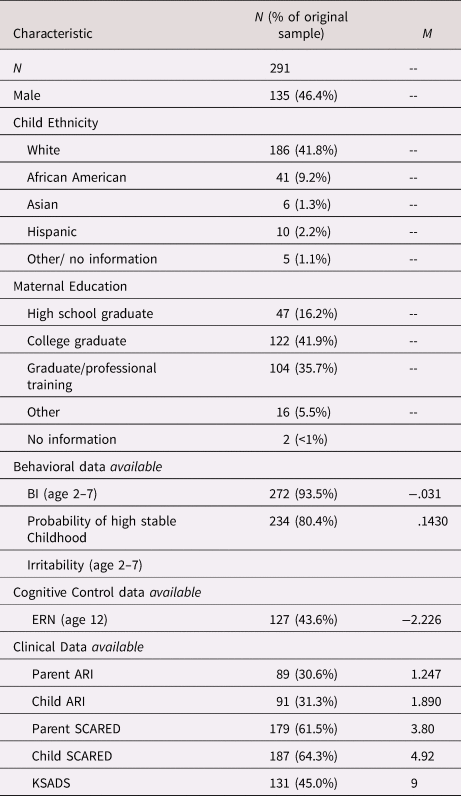
In early infancy, 779 typically developing four-month-old infants were recruited from the Washington DC metro area via mailings that described a longitudinal study of early temperament. Exclusion criterion included prematurity, low birth weight, developmental disorder, and/or birth complications. At four months, infants were invited to participate in a reactivity assessment. A subset of infants (n = 291) were selected to participate in further longitudinal visits. The families who participated in the longitudinal study consisted of a selected sample that exhibited higher negative reactivity and positive reactivity than would be expected from random sampling (see Supplemental materials for additional information on sampling and relation to the phenotypes reported here). Participating families were invited to the lab four times over the first two years of life and then annually until the children reached the age of 5 years—at which point the invited visits occurred every 2 years until the children reached age 12. Visits during early childhood consisted of behavioral, questionnaire, and EEG data collection. Children who participated in ERN visits and clinical assessment visits did not differ from those who chose not to participate in these visits on any measure of interest or in terms of gender or maternal education (all ps > .627). Table 1 summarizes sample demographics and attrition rates for each of the assessments of interest. Overall, permanent attrition for this sample was very low (< 10%).
Demographic characteristics and data collected

Measures
Early phenotypes
This sample was originally identified as being at high risk for developing anxiety, so there is considerable phenotyping data available to assess BI. In contrast, there is relatively limited work on phenotyping to assess early irritability, which was not a focus of the early-life assessments. In the current study, we planned to balance our phenotypes by relying on methods of assessing irritability that have shown predictive power (Pagliaccio et al., Reference Pagliaccio, Pine, Barch, Luby and Leibenluft2018; Wiggins, Mitchell, Stringaris, & Leibenluft, Reference Wiggins, Mitchell, Stringaris and Leibenluft2014).
To evaluate irritability and behavioral inhibition, we used maternal report and in-lab measures from age 2 to 7 years. Of note, the approach to phenotyping behavioral inhibition and irritability was based on prior research with these two constructs. With this approach, the analyses attempted to balance a study strength and a study weakness. A strength being that we used construct definitions that were consistent with prior work, with minor modifications on each construct. The weakness being that this prior research used different sources of information across the two constructs.
Behavioral inhibition (BI)
In the current study, as in Buzzell, Troller-Renfree, et al. (Reference Buzzell, Troller-Renfree, Barker, Bowman, Chronis-Tuscano, Henderson and Fox2017), we assessed BI at ages 2 and 3 by measuring infants’ reactions to novel objects and people (for a full description, see Fox, Henderson, Rubin, Calkins, & Schmidt, Reference Fox, Henderson, Rubin, Calkins and Schmidt2001; White, McDermott, Degnan, Henderson, & Fox, Reference White, McDermott, Degnan, Henderson and Fox2011). We then augmented these measures by adding data that was obtained at ages 4, 5, and 7, when social reticence was assessed by measuring hesitation to engage with a peer in a free-play session (Chronis-Tuscano et al., Reference Chronis-Tuscano, Degnan, Pine, Perez-Edgar, Henderson, Diaz and Fox2009). In addition, the data on in-lab behavior were supplemented by parental report on temperament questionnaires at each visit. At ages 2 and 3, parents filled out the Toddler Behavior Assessment Questionnaire (TBAQ) social fear subscale—for ages 2 and 3, ICC = .577, p < .001, 95% CI [.448, .674]. At ages 4, 5, and 7, parents filled out the Child Behavior Questionnaire (CBQ) shyness subscale—for ages 4, 5, and 7, ICC = .645, p < .001, 95% CI [.586, .699]. The social fear composite of the TBAQ, the shyness subscale of the CBQ, and behavioral measures were standardized at each age and averaged to create a 2- to 7-year BI composite score. This composite score captures both individual variability in a standardized in-lab assessment and parent report, providing a comprehensive assessment of children's behavioral inhibition across several settings.
Early childhood irritability
Early childhood irritability was assessed using three items from the Child Behavior Checklist (CBCL), a validated parent report of child behavior problems and social competencies. The CBCL includes 120 items, in which the parent rates the child's behavior over the past 6 months on a scale from 0 (not true) to 2 (often true or very true). Parents filled out the CBCL at each lab visit from ages 2 to 7 (For CBCL irritability scores at ages 2, 3, 4, 5, and 7, ICC = .356, p < .001, 95% CI [.276, .442]. For all analyses to follow, we focused on three items that index irritability (“temper tantrums or hot temper,” “stubborn, sullen, or irritable,” and “sudden changes in mood or feelings”). Previous reports have identified these items as loading well onto an irritability factor (e.g., Stringaris et al., Reference Stringaris, Goodman, Ferdinando, Razdan, Muhrer, Leibenluft and Brotman2012), and reports using this composite have indicated strong internal consistency and reasonable stability across time (Wiggins et al., Reference Wiggins, Mitchell, Stringaris and Leibenluft2014). We chose to use the same three items across all ages for measurement consistency across time. Notably, Wiggins et al (Reference Wiggins, Mitchell, Stringaris and Leibenluft2014) also added a fourth item (“easily frustrated”) to her three-year irritability composite. We computed the sum scores on these items to index irritability such that higher scores indicate greater irritability symptoms at each assessment.
To phenotype early childhood irritability, we modeled irritability over development because this approach has been shown to be predictive of later outcomes (Pagliaccio et al., Reference Pagliaccio, Pine, Barch, Luby and Leibenluft2018). To model sustained irritability over development, we used latent class growth analysis (implemented in Mplus 8.0 statistical software; Muthén and Muthén, Los Angeles, CA) to identify which children showed high stable childhood irritability (as indexed by the CBCL) from ages 2 to 7. This method was used to identify groups of individuals who exhibited similar developmental trajectories, and it has been used previously to identify children with high and stable childhood irritability (Pagliaccio et al., Reference Pagliaccio, Pine, Barch, Luby and Leibenluft2018; Wiggins et al., Reference Wiggins, Mitchell, Stringaris and Leibenluft2014). We estimated models with two to six classes and chose the best-fitting model based on multiple fit indicators (Akaike Information Criterion [AIC], Bayesian Information Criterion [BIC], sample size-adjusted BIC [SSABIC], entropy, Lo-Mendell-Rubin Adjusted Likelihood Ratio Test [LMR-LRT], Vuong-Lo-Mendell-Rubin Likelihood Ratio Test [VLMR], Bootstrapped Likelihood Ratio Test [BLRT], minimum class size of 1%) and interpretability. The analysis used the MLR estimator, in which all available data are used to estimate model parameters. Intercepts and slopes were constrained to be invariant within each class because we were not interested in within-group variance. We extracted the probability that a child was in the high stable irritability class as our early childhood irritability phenotype of interest.
Specifically, fit indices demonstrated that the four-class model was the best-fitting model (see the Supplemental material for model fit indicators)Footnote 1. The AIC, BIC, and SSBIC were all smaller in the four-class model than in the two- and three-class models. The four-class model also showed relatively high entropy and a significant BLRT, and the smallest class was 10.50% of the sample. The VLMR and LMR indicated that the five-class model may be preferable, but the smallest class for the five-class model was <1%. Thus, we selected the four-class model as the best fit.
Overall, 16% of the children were assigned to the high stable irritability class. Nevertheless, by using this approach we were able to extract (for all subjects) probability scores indicative of the likelihood that any child was classified in the high stable irritable class. Our analyses focused on the probability that a child was assigned to the high stable irritability class because we expected that these children would be the most at risk for developing irritability at age 12. These scores were mean-centered prior to testing interaction effects. Supplemental figure S2 depicts all of the classes and the percentage of the sample in each class. See the supplemental information (Table S3) for evidence that, in our sample, other irritability classifications failed to show significant positive associations with increased irritability at age 12.
Error-related negativity
Flanker Task
At the 12-year visit, children completed a flanker task while continuous EEG data were acquired using a 128-channel HydroCel Geodesic Sensor Net and EGI software (Electrical Geodesic, Inc., Eugene, OR). The task, data, and processing pipeline have been reported previously in Buzzell, Richards, et al. (Reference Buzzell, Richards, White, Barker, Pine and Fox2017). On each trial, five horizontally aligned arrowheads were presented. The central arrow was “flanked” (or surrounded by) arrows that were either facing the same direction (i.e., congruent; < < < < <) or the opposite direction (i.e., incongruent; < < > < <). The arrows, which were preceded by a fixation cross (~300–600 ms), were presented for 200 ms and followed by a blank screen (~1860 ms). Children were to indicate the direction of the central arrow as quickly as possible.
The flanker task consisted of 12 blocks with 32 trials per block. At the end of the block, the computer presented feedback based on the child's performance. If accuracy was 90% or above, the feedback provided was “Respond faster.” If accuracy was between 75% and 90%, the feedback provided was “Good job.” If accuracy was below 75%, the feedback provided was “Be more accurate.” This feedback ensured that children produced a sufficient number of errors to analyze the EEG activity surrounding erroneous behavior and ensured that differences in ERN response were not a result of differing error rates (see Amodio, Jost, Master, & Yee, Reference Amodio, Jost, Master and Yee2007; Gehring, Coss, Coles, Meyer, & Donchin, Reference Gehring, Goss, Coles, Meyer and Donchin1993; Hajcak, McDonald, & Simons, Reference Hajcak, McDonald and Simons2003 for evidence that ERN is larger when participants make fewer errors). Participants completed the flanker task twice, once under standard flanker conditions and once under a “social” pressure manipulation. These manipulations were counterbalanced across individuals, and there was no evidence that manipulation order affected the amplitude of the ERN (p > .573), nor was there evidence of any significant phenotype-by-order interaction (all ps > .193). Here, we report ERN data from the standard flanker task because extensive work has documented that it interacts with levels of BI to predict BI-associated risk for anxiety (see Lahat, Walker, et al., Reference Lahat, Walker, Lamm, Degnan, Henderson and Fox2014; McDermott et al., Reference McDermott, Perez-Edgar, Henderson, Chronis-Tuscano, Pine and Fox2009). Of note, the previous report of these data (Buzzell, Richards, et al., Reference Buzzell, Richards, White, Barker, Pine and Fox2017) focused on the social ERN by regressing the social ERN on the standard flanker ERN—thereby generating residual ERN scores that isolated the variance in ERN that was associated with the social condition independently of the standard ERN. Thus, the results presented here draw on analyses that were used in Buzzell, Richards, et al. (Reference Buzzell, Richards, White, Barker, Pine and Fox2017) to generate these residual ERN scores.
EEG preprocessing and Event-Related Potential (ERP) quantification
All EEG analyses used custom MATLAB scripts (The MathWorks, Natick, MA) and the EEGLAB toolbox (Delorme & Makeig, Reference Delorme and Makeig2004). Data were high-pass filtered at 0.3 Hz and low-pass filtered at 45 Hz; FAST tools (Nolan, Whelan, & Reilly, Reference Nolan, Whelan and Reilly2010) were used to identify and remove bad channels. Artifactual ICA components were detected and removed through a combination of manual and automated procedures using the ADJUST toolbox (Mognon, Jovicich, Bruzzone, & Buiatti, Reference Mognon, Jovicich, Bruzzone and Buiatti2011). Missing channels were interpolated using a spherical spline interpolation and then referenced to the average of all electrodes. Data were epoched to the response markers from -500 to 1000 ms and baseline corrected using the 200-ms period preceding response onset. Given that errors are more likely to occur on incongruent trials, only incongruent trials were analyzed to isolate error-specific effects and avoid any confounds related to congruency. Separate ERPs were calculated for the social and nonsocial conditions of the task, with only the nonsocial ERPs being analyzed here.
Mean amplitudes of ERN and correct-related negativity were calculated from a cluster of frontocentral electrodes surrounding FCz (EGI electrodes 12, 5, 6, 13, 112, 7, and 106) for the first 100 ms following response (Barker, Reference Barker2016; Barker, Troller-Renfree, Pine, & Fox, Reference Barker, Troller-Renfree, Pine and Fox2015). The correct-related negativity was then subtracted from the ERN for each participant to compute the delta-ERN, which was used for all subsequent analyses. For simplicity, the delta-ERN is referred to as the “ERN” throughout the rest of this manuscript. All participants included in the ERP analyses had a minimum of six artifact-free incongruent-error trials, which has been shown to elicit a reliable measurement of ERN in both children and adults (Pontifex et al., Reference Pontifex, Scudder, Brown, O'Leary, Wu, Themanson and Hillman2010; Steele et al., Reference Steele, Anderson, Claus, Bernat, Rao, Assaf and Kiehl2016). For a complete description of the EEG/ERP analysis procedures, see Buzzell, Richards, et al. (Reference Buzzell, Richards, White, Barker, Pine and Fox2017).
Clinical Assessments at age 12
Social Anxiety
To assess social anxiety symptoms at age 12, we collected three measures of anxiety from three sources (clinicians, parents, and children) and created a factor score that combined them into one measure. Clinicians conducted semistructured diagnostic interviews (i.e., the Kiddie Schedule for Affective Disorder and Schizophrenia (KSADS); see Kaufman et al., Reference Kaufman, Birmaher, Brent, Rao, Flynn and Moreci1997). All clinicians were trained, and diagnoses were confirmed by senior psychiatrists. Moreover, as reported elsewhere, interviews were recorded and a random subset were reviewed throughout the study to maintain adequate reliability (Buzzell, Troller-Renfree, et al., Reference Buzzell, Troller-Renfree, Barker, Bowman, Chronis-Tuscano, Henderson and Fox2017). In this longitudinal sample, a total of 131 children received KSADS evaluations at age 12. Nine (6.9%) children received a current diagnosis of social anxiety at age 12. Parents and children also completed the Screen for Child Anxiety Related Disorders (SCARED), a 66-item questionnaire measuring anxiety disorder symptoms over the past three months —SCARED parent and child report ICC = .443, p < .001, 95% CI [.306, .560]. Scores on SCARED range from 0 to 14 for each anxiety subscale, with higher scores indicating more anxious symptoms. Previous studies have demonstrated strong internal consistency for the SCARED subscales (See Muris, Dreessen, Bogels, Weckx, & van Melick, Reference Muris, Dreessen, Bögels, Weckx and van Melick2004). Our analyses focused on KSADS-determined social phobia diagnoses and SCARED scores on the social anxiety subscale.
To combine measures of social anxiety across three reporters (parent, child, and clinician), we conducted a confirmatory factor analysis that included all individuals in the longitudinal sample who had either KSADS or SCARED data at age 12 (n = 194). We used a one-factor model (implemented in Mplus 8.0 statistical software; Muthén and Muthén, Los Angeles, CA). This approach allowed us to detect variability in symptoms across several informants and to use as much data available for each child as possible. This approach was also useful given that few children met criteria for social anxiety disorder at this age (see Table 1). Given that the diagnostic variable was categorical, the confirmatory factor analysis used the default WLSMV estimator, wherein missing data are excluded on a pairwise basis. The confirmatory factor analysis indicated that data from all three reporters had high loadings (SCAREDparent = .604; SCAREDchild = .762; KSADs = .807, all ps < .001) on the latent social anxiety variable. A standardized factor score was extracted for each participant and used as the social anxiety dependent variable of interest, with higher factor scores indicating more severe social anxietyFootnote 2.
Irritability
We assessed irritability symptoms at age 12 from two unique reporters (parents and children). Parents and children completed the Affective Reactivity Index (ARI; Stringaris et al., Reference Stringaris, Goodman, Ferdinando, Razdan, Muhrer, Leibenluft and Brotman2012), a scale that contains six symptom items and one impairment item designed to assess chronic irritability. Each item is scored on a 3-point scale (0 = not true, 1 = somewhat true, and 2 = certainly true). Affective Reactivity Index scores range from 0 to 12, and only the first six items are summed to form the total score (according to the guidelines outlined in Stringaris et al., Reference Stringaris, Goodman, Ferdinando, Razdan, Muhrer, Leibenluft and Brotman2012). Previous studies have demonstrated internal consistency for the ARI (Stringaris et al., Reference Stringaris, Goodman, Ferdinando, Razdan, Muhrer, Leibenluft and Brotman2012). Largely, our sample did not meet clinical cutoffs for irritability (n = 34 [12%] exceeding clinical cutoff; see Kircanski et al., Reference Kircanski, Zhang, Stringaris, Wiggins, Towbin, Pine and Brotman2017). We averaged the parent report (M = 1.25; SD = 1.633; range = 0–6) and child self-report (M = 1.89; SD = 2.258; range = 0–10) ARI scores—ARI parent and child report, ICC = .220, p < .015, 95% CI [.022, .404]. See the supplemental materials for evidence that ARI scores at age 12 were associated with CBCL externalizing, but not internalizing, symptoms.
Analytic Strategy
Preliminary analyses
Relation between behavioral inhibition and childhood irritability
To begin, we tested whether our behavioral phenotypes (i.e., behavioral inhibition and childhood irritability) were correlated with one another. We also tested whether our phenotypes differed in terms of demographics. In particular, some studies have suggested that there are sex differences as a function of chronic irritability (Leibenluft, Cohen, Gorrindo, Brook, & Pine, Reference Leibenluft, Cohen, Gorrindo, Brook and Pine2006) and others report that SES may be related to risk for psychopathology (Velez, Johnson, & Cohen, Reference Velez, Johnson and Cohen1989). We used Mann-Whitney and Kruskal-Wallis tests to evaluate whether there were any gender or maternal education differences associated with either childhood phenotype.
Focal analysis strategy
First, we evaluated the relationships between each of the two early phenotypes of interest (BI and chronic high irritability) and clinical outcome (social anxiety composite score and mean ARI) using Pearson correlation. Second, we tested whether the ERN interacts with early phenotype to predict clinical outcome using the PROCESS macro in SPSS (Hayes, Reference Hayes2018). To supplement this analysis, we evaluated whether any combination of phenotype and level of ERN magnitude resulted in increased risk for psychopathology. To do so, we computed tertiles for ERN data. Tertiles allowed us to compare groups with equal sample sizes and resulted in the following cut-points for ERN. High ERN reflects scores that are less than −2.84 (n = 43); moderate ERN reflects scores that are between −2.84 and −1.11 (n = 42); and low ERN reflects scores that are greater than −1.11 (n = 42); See histogram in supplemental information). We chose to use tertiles rather than splitting the groups based on mean ± 1 standard deviation because the latter split resulted in some group's having far fewer subjects than others (See the supplemental materials for details and results of a parallel analysis using this method of splitting). Using these ERN groupings, we replotted our data to compute the correlation between early phenotype and clinical outcome. If individuals are at increased risk for developing psychopathology, we expected the correlation between phenotype and outcome to be significantly greater than 0. If there is no significant link between phenotype and clinical outcome, the correlation between phenotype and outcome should not differ from 0. The supplemental information demonstrates that splitting the data into tertiles generally aligns with a split defined by mean ± 1 standard deviation (compare the main text figures to Figures S3 & S4) with some exceptions in terms of the irritability model.
Results
Preliminary analyses
Relation between childhood behavioral phenotypes
There was no significant association between childhood behavioral inhibition and childhood irritability (p > .29), suggesting that these behavioral phenotypes are not related (see Table 2). Results also indicated that irritability and BI did not differ as a function of gender and maternal education (all ps > .37). As such, we did not include these variables in further analyses.
Correlations among focal variables of interest

**p < .01.
Focal analyses
Early phenotypes predict clinical outcome
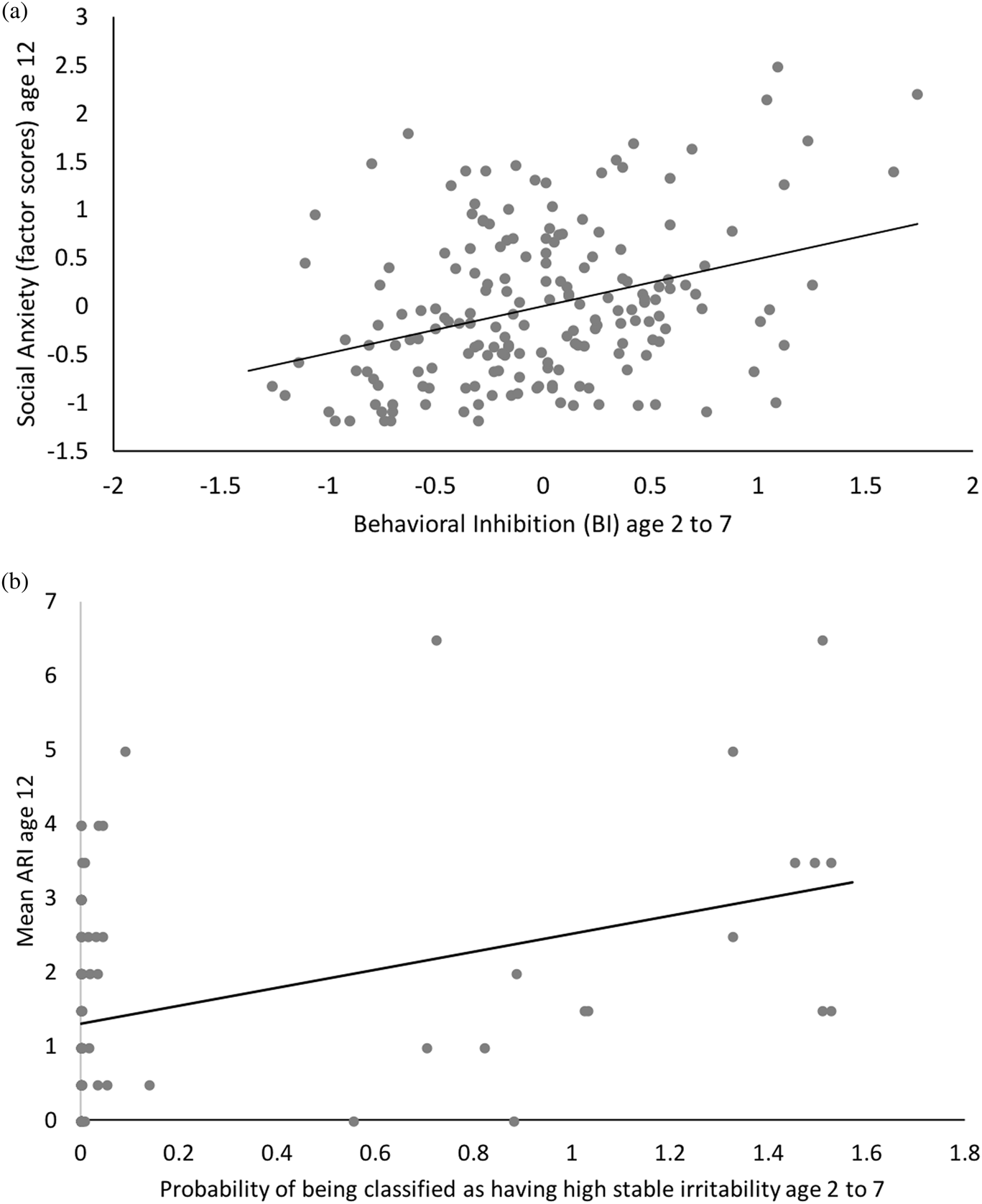
First, we tested whether our early behavioral phenotypes predicted our clinical outcomes of interest. Results indicated that behavioral inhibition predicted social anxiety at age 12 (r = .34, p < .001). Results further indicated that high stable childhood irritability predicted irritability at age 12 (r = .35, p < .001; see Figure 1). Both relations remained significant when controlling for the other phenotype (BI–social anxiety: r = .33, p < .001; childhood irritability–12-year irritability: r = .35, p < .001). Furthermore, BI did not predict irritability at age 12 and irritability in childhood did not predict social anxiety at age 12 (all ps > .76).
Relation between early phenotype and 12-year psychopathology symptoms: (a) demonstrates that behavioral inhibition predicts social anxiety at age 12 and (b) demonstrates that high stable irritability predicts 12-year irritability. Irritability probability scores have been arcsine-transformed and jittered to illustrate the distribution of scores better.

ERN as a domain-specific correlate
Next, we tested whether the correlation between early childhood phenotypes and clinical outcomes differed as a function of ERN.
Behavioral inhibition to social anxiety
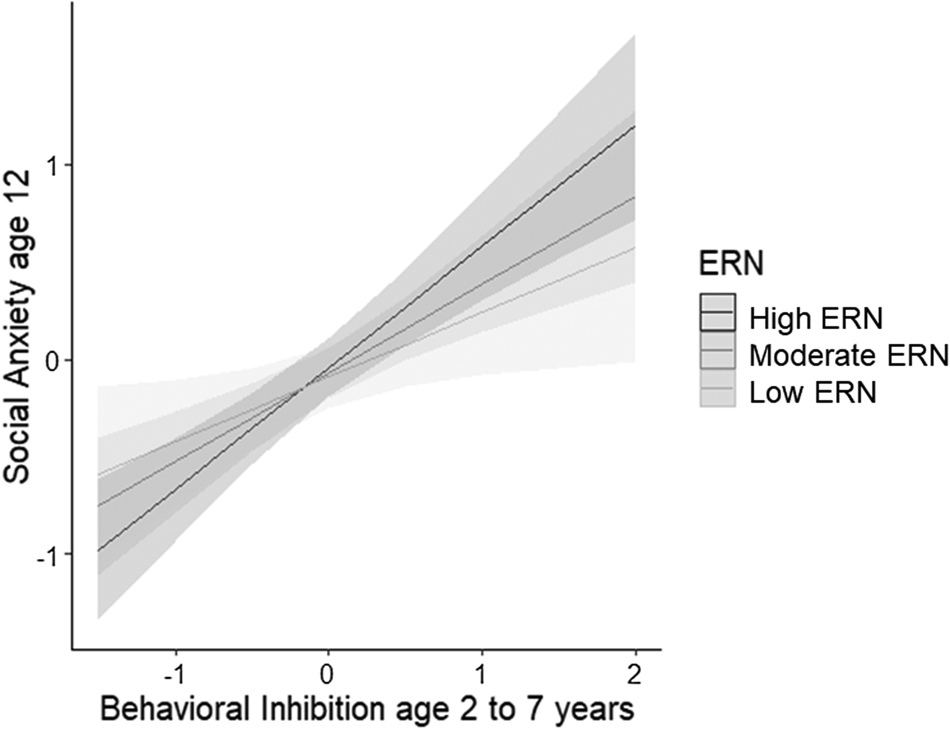
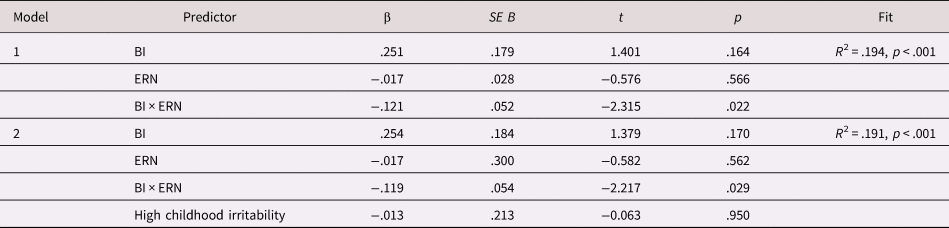
Results indicate distinct correlations between ERN and social anxiety in children with and without BI, β = −.121, ΔR 2 = .035, F (1, 122) = 5.360, p < .022, (Figure 2); and that these results remained significant when controlling for irritability (Table 3). Specifically, children with high BI who have larger (more negative) ERNs have greater social anxiety.
The moderating effect of ERN on risk for developing social anxiety. Each line depicts low/moderate/high ERNs as determined by dividing the data into tertiles.

Regression results predicting social anxiety at age 12

To supplement these continuous analyses, we next examined whether the association between phenotype and clinical outcome differed as a function of ERN magnitude. To assess whether this was the case, we examined the correlation between phenotype and clinical outcome for individuals in each ERN group using a tertile split (described above). Results indicated that the association between BI and social anxiety was significant for the high-ERN, r (41) = .559, p < .001, and the moderate-ERN groups, t (41) = .463, p < .002, but not the low-ERN group (p > .572). This suggests that the association between BI and social anxiety found in the two higher ERN groups fails to manifest among individuals who exhibit a low ERN. These correlations held when controlling for childhood irritability, high-ERN: r (35) = .535, p < .001; moderate-ERN: r (41) = .437, p < .003; low-ERN: p < .633.
Childhood irritability to irritability at age 12
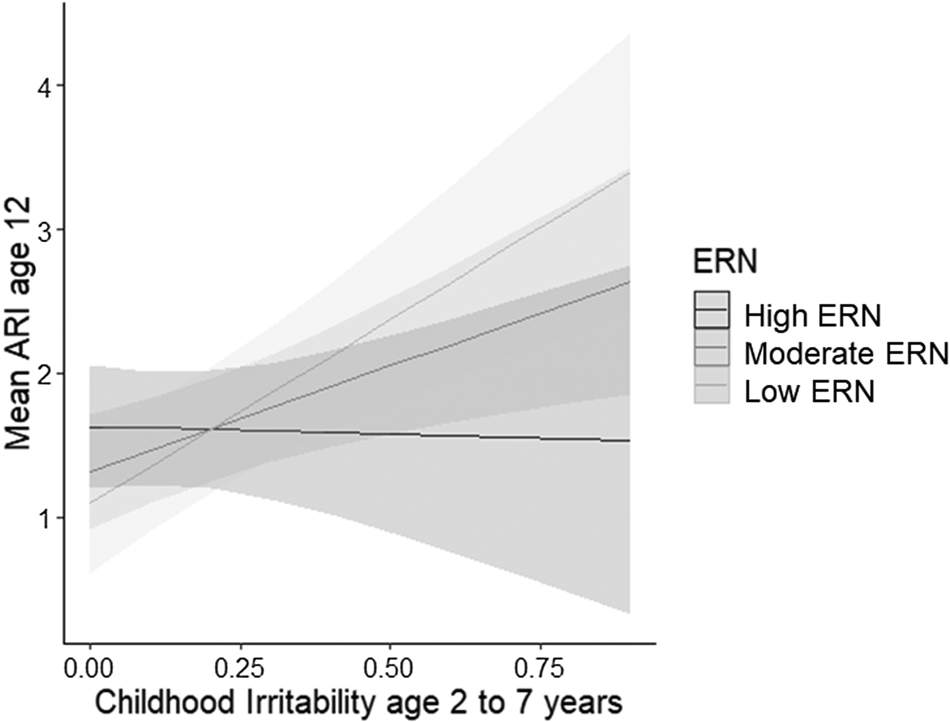
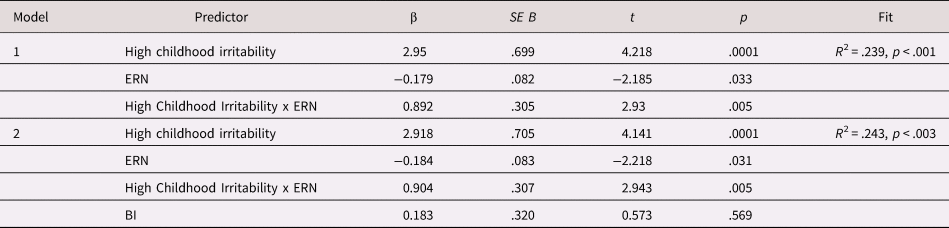
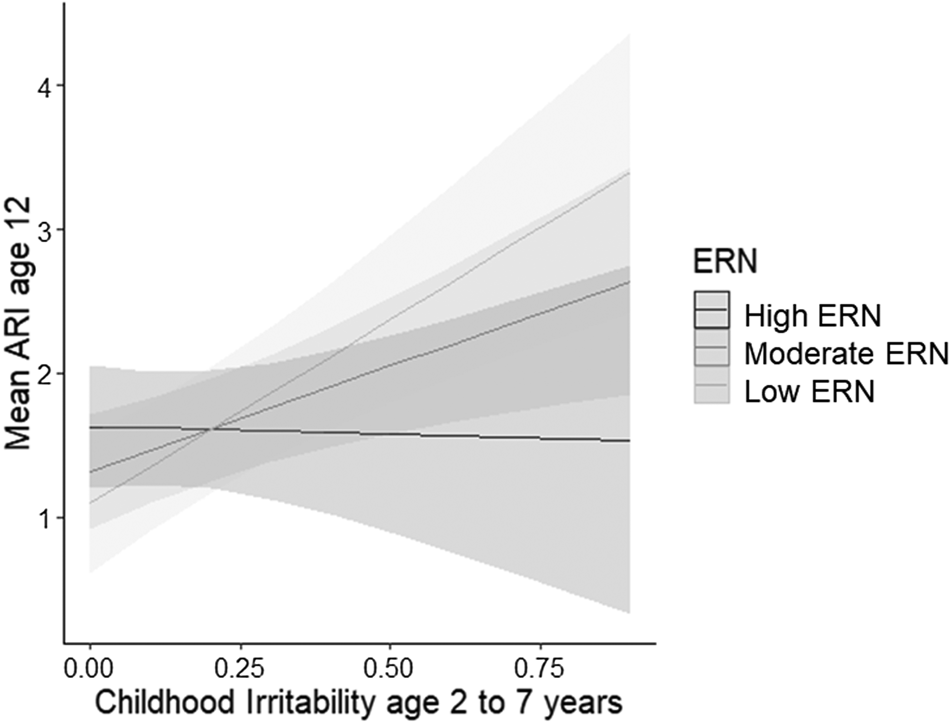
The association between childhood irritability and age-12 irritability differed as a function of ERN magnitude, β = .892, ΔR 2 = .111, F (1, 59) = 8.571, p < .005. (Figure 3 and Table 4). These results remained significant when controlling for BI (see Table 4). Specifically, highly irritable children who have smaller (more positive) ERNs exhibit high irritability in early adolescence.
The moderating effect of ERN on risk for exhibiting irritability symptoms at age 12. Each line depicts low/moderate/high ERNs as determined by dividing the data into tertiles.
Regression results predicting ARI at age 12

To further evaluate whether risk for psychopathology increased in individuals who exhibited different ERN magnitudes, we examined whether the correlation between childhood irritability and ARI at age 12 differed as a function of ERN groups (i.e., tertile splits described above). Results indicated that the correlation between childhood and age-12 irritability did manifest in the low-ERN group, r (24) = .651, p < .001, but not in the high- or moderate-ERN groups (all ps > .123). These results held when controlling for BI, low-ERN: r (22) = .650, p < .001; moderate- and high-ERN, ps < .207. Together, these results suggest that the association between high stable childhood irritability and 12-year irritability manifests only in individuals with a low ERN but not among individuals who exhibit a high or moderate ERN. Nevertheless, caution is warranted when interpreting the absence of correlations in these relatively small groups, as small samples of the individuals with ARI data reduced power to detect effects.
Discussion
The goal of the current study was to examine whether ERN manifested unique correlations with two specific clinical outcomes: social anxiety and irritability. Our results suggest that ERN correlates with concurrent psychopathology in unique ways, based on early temperament. Children who exhibit elevated behavioral inhibition during childhood and demonstrate an increased ERN show elevated social anxiety at age 12. In contrast, children who exhibit elevated irritability symptoms in early childhood and later show more blunted ERN exhibit higher irritability symptoms at age 12. Together, this work suggests that ERN, when considered in combination with early behavior, may act as a biomarker that can identify distinct developmental pathways to anxiety and irritability.
Action monitoring requires both the ability to detect when an error has occurred (i.e., error monitoring) and the ability to adjust performance in response to these errors (i.e., control instantiation; Botvinick, Braver, Barch, Carter, & Cohen, Reference Botvinick, Braver, Barch, Carter and Cohen2001). While BI and irritability share several common features (including negative affect), they differ with respect to behavioral response to threat. Behaviorally inhibited children tend to respond to threat with increased control (i.e., avoidance), whereas irritable children tend to exhibit decreased control (i.e., approach the threat; Salum et al., Reference Salum, Mogg, Bradley, Stringaris, Gadelha, Pan and Leibenluft2017). Error detection and control instantiation are thought to be linked (Debener, Reference Debener2005; Gehring et al., Reference Gehring, Goss, Coles, Meyer and Donchin1993). Indeed, anxious individuals tend to show both a larger ERN (i.e., increased error detection) and increased reaction times (i.e., which may reflect increased control instantiation) following an error (or “post-error slowing”; Meyer, Weinberg, Klein, & Hajcak, Reference Meyer, Weinberg, Klein and Hajcak2012; Buzzell, Troller-Renfree, et al., Reference Buzzell, Troller-Renfree, Barker, Bowman, Chronis-Tuscano, Henderson and Fox2017). Thus, larger ERNs are thought to facilitate greater post-error slowing and thus the avoidance of subsequent errors (although see Buzzell, Troller-Renfree, et al., Reference Buzzell, Troller-Renfree, Barker, Bowman, Chronis-Tuscano, Henderson and Fox2017 for an alternative explanation). The link between the ERN and subsequent control instantiation fits with the patterns observed in our data. We found that individuals at risk for anxiety show both BI and enhanced error monitoring (as indexed by a larger ERN). Speculatively, this enhanced error monitoring may relate to children's tendency to avoid situations where errors and other threatening events occur. Furthermore, the opposite might be true among individuals who are irritable. That is, children who are irritable and, compared with other irritable children, less capable of robust error monitoring (i.e., blunted ERN) may fail to implement strategies that support avoidance of errors. Such failure could lead these irritable children to exhibit less avoidance (or greater approach behavior) than irritable children more capable of effective error monitoring. Future work should examine relations between ERN and post-error slowing in irritable patients.
Critically, these results also highlight the variability in error monitoring processes for individuals who experience BI or irritability in childhood—not all children who show BI or irritability also experience enhanced/reduced error monitoring. Thus, these findings may suggest that those individuals whose error monitoring processes map onto their approach and avoidance tendencies in childhood are most at risk for developing psychopathology. Further research is needed to understand what facilitates this link between the error monitoring response and childhood behavioral tendencies.
Our results replicate past studies that have demonstrated that BI predicts social anxiety (Clauss & Blackford, Reference Clauss and Blackford2012) and examined the moderating effect of BI on the development of anxiety (Lahat, Lamm, et al., Reference Lahat, Lamm, Chronis-Tuscano, Pine, Henderson and Fox2014; McDermott et al., Reference McDermott, Perez-Edgar, Henderson, Chronis-Tuscano, Pine and Fox2009). Additionally, our findings extend previous studies (including those in this sample) by demonstrating that the link between BI and social anxiety persists when measures of social reticence across early childhood are integrated into the early phenotype measure and when clinician report is integrated into the social anxiety metric. This analytic approach is different from that used in previous reports in that it used all of the phenotyping data (rather than focusing solely on behavioral assessments in toddlerhood) and clinical data collected (rather than focusing solely on self-report measures). Previous reports based on data from this sample have also focused on ERN in a social context (see Buzzell, Troller-Renfree, et al., Reference Buzzell, Troller-Renfree, Barker, Bowman, Chronis-Tuscano, Henderson and Fox2017), whereas the current study reports data from a standard flanker task (what Buzzell, Richards, et al., Reference Buzzell, Richards, White, Barker, Pine and Fox2017, refer to as the nonsocial context). The current study focused on ERN in a nonsocial as opposed to a social context because more previous work uses the standard version of the flanker task, which allows our results to be generalized to the broader conflict monitoring literature. Furthermore, we know from previous studies that the standard flanker task moderates the link between BI in toddlerhood and anxiety in later childhood (see Buzzell, Troller-Renfree, et al., Reference Buzzell, Troller-Renfree, Barker, Bowman, Chronis-Tuscano, Henderson and Fox2017; Lahat, Lamm, et al., Reference Lahat, Lamm, Chronis-Tuscano, Pine, Henderson and Fox2014; McDermott et al., Reference McDermott, Perez-Edgar, Henderson, Chronis-Tuscano, Pine and Fox2009) so these findings replicated previous reports in the literature. Nevertheless, future work could examine the role of social context to test whether error monitoring under social conditions better moderates the link between early phenotypes of social threat and later clinical outcomes. We further demonstrated that the association between BI and anxiety is not present in children with blunted ERN.
The effect that we found for irritability is opposite to the one we observed for BI—children exhibiting a relatively large or even moderate-amplitude ERN show no association between early irritability and ARI at age 12, whereas children with small, blunted ERN showed an association between early irritability and 12-year irritability. Broadly speaking, longitudinal studies find relatively low levels of cognitive control to typically predict negative outcomes including, but not limited to, most forms of psychopathology (e.g., Moffitt et al., Reference Moffitt, Arseneault, Belsky, Dickson, Hancox, Harrington and Sears2011; Snyder Miyake, & Hankin, Reference Snyder, Miyake and Hankin2015). Interestingly, we see this pattern in irritability but not in BI. In contrast, in BI, enhanced error monitoring is associated with worse outcomes. This pattern suggests that individuals with highly active fear circuits could have a naturally heightened behavior monitoring system, which results in inflexibility of attention that, in turn, contributes to increased anxious symptoms.
To date, limited work examines childhood irritability and ERN. Kessel et al. (Reference Kessel, Meyer, Hajcak, Dougherty, Torpey-Newman, Carlson and Klein2016) provide some of the first evidence that children with irritability show distinct symptom patterns as a function of ERN: children who were irritable at age 3 and exhibited high ERN (at age 6) showed greater internalizing symptoms at age 9, whereas irritable children with blunted ERN showed greater externalizing symptoms. Thus, the current study differed from Kessel et al. (Reference Kessel, Meyer, Hajcak, Dougherty, Torpey-Newman, Carlson and Klein2016) both in the ages that irritability and outcomes were assessed and the outcome-assessment tools. In particular, Kessel et al. (Reference Kessel, Meyer, Hajcak, Dougherty, Torpey-Newman, Carlson and Klein2016) provided data on early childhood irritability (i.e., age 3), which may not map onto irritability trajectories from ages 2 to 7 years. Previous work suggests that normative irritability tends to decline after the preschool years (Dougherty et al., Reference Dougherty, Smith, Bufferd, Stringaris, Leibenluft, Carlson and Klein2013). Thus, Kessel et al. (Reference Kessel, Meyer, Hajcak, Dougherty, Torpey-Newman, Carlson and Klein2016) may have failed to quantify levels of stable childhood irritability, but rather captured heightened irritability at one cross-sectional point. Whether irritability at age 3 is longitudinally predictive of irritability at later ages is an open question that could inform how the latter results map onto those of the current study. Furthermore, in contrast to Kessel et al. (Reference Kessel, Meyer, Hajcak, Dougherty, Torpey-Newman, Carlson and Klein2016), who measured clinical outcomes using CBCL, our study assessed irritability at age 12 by using a clinical assessment tool—the ARI. While the CBCL broadly characterizes externalizing behaviors, the ARI more narrowly indexes irritability that is associated with temper tantrums or other displays of anger and frustration (Stringaris et al., Reference Stringaris, Goodman, Ferdinando, Razdan, Muhrer, Leibenluft and Brotman2012). Indeed, data in the supplemental materials demonstrate that the ARI significantly predicts the externalizing but not the internalizing subscale of the CBCL at age 12. This further supports the idea that our results are more narrowly indexing irritability associated with externalizing behaviors. When considered together with the results of Kessel et al. (Reference Kessel, Meyer, Hajcak, Dougherty, Torpey-Newman, Carlson and Klein2016), our results replicate the finding that irritability and blunted ERN predict a developmental trajectory related to outward expressions of anger.
Multiple studies show cross-sectional (Stoddard et al., Reference Stoddard, Stringaris, Brotman, Montville, Pine and Leibenluft2014), longitudinal (Vidal-Ribas et al., Reference Vidal-Ribas, Brotman, Valdivieso, Leibenluft and Stringaris2016), and genetic (Savage et al., Reference Savage, Verhulst, Copeland, Althoff, Lichtenstein and Roberson-Nay2015; Stringaris et al., Reference Stringaris, Goodman, Ferdinando, Razdan, Muhrer, Leibenluft and Brotman2012) associations between irritability in childhood and internalizing symptoms (i.e., anxiety and depression) in adolescence and adulthood. However, our study did not find a significant correlation between social anxiety and irritability at age 12. This could indicate that while irritability and general anxiety are related, irritability and social anxiety may not be related. This study is also the first to examine associations between BI and irritability, and we did not find a significant correlation. Further work is needed to replicate this finding and examine whether these childhood risk phenotypes co-occur or are distinct—particularly because irritability and anxiety regularly co-occur. Additionally, future research might examine whether our ERN findings generalize to children who show persistently high levels of both irritability and internalizing symptoms from an early age.
In addition to several strengths, our results are limited in several respects. First, despite that our selected sample was at increased risk for psychopathology (particularly BI; Fox, Snidman, Haas, Degnan, & Kagan, Reference Fox, Snidman, Haas, Degnan and Kagan2015), clinical assessments identified few individuals meeting criteria for social anxiety disorder (<10% of the sample) or irritability at age 12 (12% of the sample). However, it is important to note that psychopathology was measured when the children were quite young, so more of them can be expected to develop symptoms later. Further work in samples with a greater prevalence of psychopathology is needed to better assess the clinical validity of these developmental relations and the generalizability of these data. Second, our measurement of ERN and our clinical assessments were both taken at age 12. Thus, the current findings should be extended through studies examining both ERN and clinical data at multiple points. Third, we examined early childhood phenotypes using two different assessment metrics. Childhood irritability was assessed using questionnaire measures and via a latent class growth analysis, whereas BI was assessed using both behavioral and questionnaire measures via a standardized composite score. We chose to use these metrics because they represent the standard method of assessment in each subfield and also allowed us to use the most longitudinal data available in creating our early phenotypes. Indeed, the longitudinal cohort reported here was more extensively assessed for levels of BI than for levels of irritability. Interest in evaluating irritability increased when subjects had reached age 12, thereby resulting in less data available for characterizing irritability. Thus, we attempted to maximize the amount of data used for characterizing each phenotype and the analytic approach used to assess variability. This led us to use different methods to capture stable phenotypes within each domain, which leaves open questions about whether one metric captures the stability of early behavior better than another and the associated effect on our findings. Even so, our results demonstrate that these early phenotypes are roughly equal in sensitivity because both map onto previously-reported patterns from community samples in the literature (Fox et al., Reference Fox, Henderson, Rubin, Calkins and Schmidt2001; Wiggins et al., Reference Wiggins, Mitchell, Stringaris and Leibenluft2014). Nevertheless, it is possible that the irritability metric is less sensitive because it relied exclusively on parent-report measures. Further, this approach complicates attempts to determine the extent to which differences between the phenotypes are related to differences in information sources. Future work should seek to establish age-appropriate behavioral assessments of irritability to be incorporated in longitudinal study designs. This approach would allow for a more direct comparison of childhood irritability and BI. Further replication of these results in community and clinical samples could evaluate the specificity of the proposed risk pathways.
Identifying specific biomarkers that can determine which individuals are most at risk for developing specific clinical outcomes is foundational to understanding the pathophysiology of childhood mental illness. Error-related negativity has received considerable interest as a potential biomarker (Olvet & Hajcak, Reference Olvet and Hajcak2008). The findings presented here demonstrate that ERN interacts with phenotype to predict distinct pathways to psychopathology. Our results replicate previous findings on BI and provide novel data about how error monitoring may be linked to persistent irritability beyond early childhood. In sum, our results show that risk for psychopathology is related to both early behavioral phenotypes and error monitoring.
Financial Support
This research was supported (in part) by the NIMH Intramural Research Program (ZIAMH002781-15, NCT00018057; CAF, ARS, JFS, KK, AW, EL, DSP) and NIH grant number U01MH093349 (NAF).
Supplementary Material
The supplementary material for this article can be found at https://doi.org/10.1017/S0954579419001329.